
Printed plastic film is everywhere in the consumer supply chain, from retail carrier bags and stretch wrap to laminated pouches and agricultural film, and almost all of it carries ink. For a recycling plant, that ink is not a cosmetic nuisance but a direct limitation on what the recovered resin can become. Learning how to remove ink from printed plastic films in a recycling line is therefore the difference between selling a dark, low-value regrind and producing bright, versatile pellet that competes with virgin material. The deinking process for film is a wet, chemical, and mechanical sequence: alkaline chemistry detaches the ink binder from the polymer, friction energy scrubs the loosened pigment away, and counter-current rinsing carries the released ink out of the stream before drying and pelletizing. Polyretec, a Wanplas factory, builds film washing lines, including its PP/PE Weiche Kunststoffzerkleinerung and Waschlinie, that are configured for exactly this challenge, drawing on Austrian process know-how within the Wanplas group’s recycling equipment portfolio. This guide walks through the ink chemistries you will meet, the alkaline and friction parameters that actually work, how to measure deinking rate, how to handle the resulting wastewater and sludge, how to control pellet color after extrusion, and the failure modes that quietly ruin otherwise good lines.
Understanding Ink Types on Printed Plastic Films
The first step in removing ink is knowing which ink you are removing, because print method and chemistry determine how readily the ink releases from the film. Two structural distinctions matter most. Surface printing, sometimes called face printing, lays the ink directly on the outside of the film where it is exposed; this is common on LDPE shopping bags and many mono-layer PE films, and because the ink is on the outside it is the easiest to detach. Reverse printing, or back printing, lays the ink on the inner side of a layer, typically inside a laminate or against a sealant layer, where it is protected by the outer film; this is normal for high-quality pouches and snack packaging, and the protected ink is far harder to reach with wash chemistry.
Chemistry is the second distinction. Solvent-based inks use organic solvents to carry pigment and binder, cure quickly, and adhere strongly; they release under alkaline conditions but the solvent itself may need vapor control during handling. Water-based inks replace solvent with water and are generally easier on the environment, though the binder still needs alkaline attack to detach. UV-cured inks are crosslinked by ultraviolet light into a rigid network that is engineered not to dissolve, which makes them the most difficult to deink and often impossible to bring to a light color by washing alone. The table below maps these variables to removal difficulty so a plant can set expectations before investing in a line.
Ink Type and Removal Difficulty
| Print Method | Ink Chemistry | Removal Difficulty | Practical Note |
|---|---|---|---|
| Surface print | Solvent-based | Medium | Exposed, releases with alkaline plus friction |
| Surface print | Water-based | Low to Medium | Binder still needs caustic attack |
| Reverse print in laminate | Solvent-based | High | Protected layer; sort or accept darker output |
| Surface or reverse | UV-cured | Very High | Crosslinked; usually sorted out |
Beyond print method and chemistry, the film substrate itself changes the game. LDPE and LLDPE films are soft and easily abraded, so aggressive friction can generate fines and haze; PP films are stiffer and tolerate more mechanical action; PVC-printed film should be separated because PVC poisons polyolefin recycling and its ink chemistry differs. A deinking line is therefore really a sorting-plus-washing system, and the sorting decision at the infeed sets the ceiling on the color you can ever reach.
Print coverage and ink construction also set the deinking load in ways operators underestimate. A film printed with a single light line carries little pigment and washes bright with modest chemistry, while a heavy block print or a multilayer graphical design lays down far more binder and color that must all be detached and carried out. Overprint varnishes and matte coatings add a clear layer that can trap ink beneath it, mimicking reverse printing even on a surface-printed web, and such films need longer residence or stronger friction to reach the same brightness.
Why Deinking Matters for Film Recycling Quality
Ink is composed of pigment particles held by a binder on the film surface, and when printed film is simply shredded and melted without deinking, those pigment particles disperse through the melt as fine colored specks. The result is a dark, muddy pellet whose only safe use is black or dark masterbatch, because any light product made from it inherits the gray or brown tint. Deinking matters because it converts a constrained, low-price material into a broadly usable one, and because residual ink also carries odor, reduces optical brightness, and can introduce heavy-metal pigments that restrict food-contact and brand-owner acceptance.
The economic logic is direct. A bright natural or white recycled polyolefin pellet commands a clear premium over a dark one and can substitute for virgin in many converters’ recipes, whereas a dark pellet is locked into low-margin applications. For a plant running printed post-consumer film, the payback on a proper alkaline and friction deinking section is usually measured in the price gap between bright and dark regrind, and that gap widens as brand owners set higher recycled-content and lower-carbon targets. Deinking is not a luxury stage; for printed film it is the value-creation stage.
There is also a processing reason. Residual ink behaves like a contaminant in the extruder: it can plate dies, increase filtration load, and contribute to gas venting and odor in the pelletizing hall. Removing ink upstream reduces screw and screen wear and stabilizes extrusion, which is why well-deinked flake runs cleaner through the pelletizer supplied, for example, by the Wanplas group’s Kerke factory when a plant integrates washing with twin-screw extrusion.
Beyond the plant gate, deinking is increasingly driven by regulation and by brand-owner commitments rather than by price alone. Packaging extended-producer-responsibility schemes and recycled-content mandates in several regions reward converters that can prove high-quality recycled resin, and bright deinked polyolefin is exactly the material those schemes reward. A film line that only produces dark regrind is locked out of these incentive streams, whereas one that reaches light, low-odor flake can qualify for premium off-take and supports the circular-economy claims that brand owners now publish.
Alkaline Deinking Process Parameters
Alkaline deinking is the chemical foundation of film ink removal. A sodium hydroxide solution raises the pH of the wash bath so that the ink binder, often an acid- or ester-based resin, is hydrolyzed and loosened from the polymer surface. A non-ionic surfactant is added to wet the hydrophobic film, to lift the detached pigment into suspension, and to stop it redepositing. The three parameters that decide success are alkali concentration, bath temperature, and residence time, and they must be tuned together rather than maximized independently.
A typical starting point for printed polyolefin film is sodium hydroxide at 1 to 3 percent by weight, a wash temperature of 50 to 80 degrees Celsius, and a residence time of 8 to 15 minutes in the hot wash stage. Lower ink loads and water-based inks sit at the gentle end; heavy solvent or laminated ink needs the aggressive end. Pushing concentration or temperature too high risks polymer haze, yellowing, and loss of mechanical properties, while too little leaves ink behind. The bath pH is normally held in the range of about 9 to 11, and the surfactant dose is tuned so that the wash water shows stable foam without excessive carryover.
The table below gives a reference parameter set for a film deinking line. These are not universal constants; Polyretec’s commissioning practice is to run wash trials on the customer’s actual printed film and lock the set points against measured deinking rate, because ink formulation varies so widely between converters and regions that a fixed recipe will under- or over-clean.
Reference Alkaline Deinking Parameters
| Parameter | Typical Range | Effect of Too Low | Effect of Too High |
|---|---|---|---|
| NaOH concentration | 1 to 3 percent by weight | Ink remains attached | Haze, yellowing, odor |
| Bath temperature | 50 to 80 degrees C | Slow binder hydrolysis | Polymer heat history penalty |
| Residence time | 8 to 15 minutes | Incomplete detachment | Throughput loss, energy waste |
| Bath pH | About 9 to 11 | Weak deinking | Chemical consumption rises |
| Surfactant dose | By trial, low to medium | Pigment redeposition | Foam carryover, COD load |
Friction Washing and Rinse Stages
Chemistry loosens the ink, but mechanical friction is what physically removes it. After the hot alkaline soak, the film, now in flake or still in strip form depending on the line, passes through a friction washer where a high-speed rotor tumbles the material against itself and the chamber wall under a counter-current water flow. The shear detaches the hydrolyzed binder and scrubs pigment from the surface. For film, the friction intensity must be balanced: enough to clean, but not so much that the soft LDPE generates excessive fines or rolls into balls that shield ink from the water.
Rinsing is where many lines lose the gain. Once ink is detached it is suspended in wash water, and if the rinse is poorly designed the pigment redeposits on the film as the water cools and the surfactant loses activity. Counter-current rinsing, where the cleanest water meets the nearly finished film and the dirtiest water leaves at the infeed end, minimizes redeposition and cuts fresh water use. One or two cold rinse stages after the friction washer strip the remaining caustic and suspended ink, and a final check of rinse-water pH confirms the film is neutral before dewatering.
For film specifically, dewatering uses a squeeze dryer or a reel-type dewatering system rather than the centrifuge common for rigid flake, because film mats and traps water. A squeezer compacts the film and expels water mechanically, after which a hot-air or crystallizing dryer removes bound moisture. The objective is the same as for rigid flake: moisture below one percent so the pelletizer runs clean, but the hardware is chosen for the matting behavior of film.
Temperature management inside the friction washer deserves attention because film behaves differently from rigid flake under shear. The mechanical work of the rotor generates heat, and if the chamber runs too hot the LDPE can soften and weld into ropes or balls that shield ink from the water and choke the discharge screen. Good designs balance rotor speed, water flow, and a cooled or tempered water circuit so the film stays below its sticking point while still receiving enough scrubbing energy, and they include a screen or perforated cage sized to pass cleaned flake without trapping matted film.
Evaluating Deinking Rate
You cannot improve what you do not measure, and deinking rate is the metric that tells a plant whether the line is earning its premium. The most intuitive measure is visual and photographic comparison of washed flake or pellet against a reference, but visual grading is subjective, so plants back it with instruments. A spectrophotometer reports brightness or the L-star value of the material; as ink is removed, L-star rises toward the natural polymer value, and the change is quantified as deinking efficiency. Ash-content analysis before and after washing captures the inorganic pigment removed, and solvent or alkaline extraction of residual ink gives a chemical measure of what remains.
Image analysis is increasingly used on pellets or flakes: a camera and software count and size dark specks, producing a specks-per-area index that correlates with customer complaints. Whichever method a plant adopts, the deinking efficiency is calculated consistently as the difference between the ink indicator of the feed and that of the product, divided by the feed indicator, expressed as a percentage. The table below lists common methods and what each captures, so a line can be audited with more than one technique.
Deinking Rate Evaluation Methods
| Method | What It Measures | Strength | Limitation |
|---|---|---|---|
| Spectrophotometer L-star | Brightness change | Fast, objective | Affected by inherent color |
| Ash content difference | Inorganic pigment removed | Direct mass basis | Slow, needs furnace |
| Solvent extraction | Residual ink extract | Sensitive to leftover ink | Laboratory only |
| Image analysis of specks | Dark speck count | Matches customer view | Needs calibration |
A practical quality loop sets a target deinking efficiency, say 90 percent for bright-grade film, measures it on each production batch, and adjusts alkali dose, temperature, or friction speed when the number slips. Without this loop, a line can drift for weeks while the pellet silently darkens and the price premium is lost.
Wastewater Treatment and Sludge Management
Deinking moves ink from the film into the water, so the wash stream leaves the line dirtier than it entered, and that water must be treated. The dominant load is dispersed pigment and surfactant, giving the water a high chemical oxygen demand and a visible color. The standard approach is coagulation and flocculation, where a coagulant destabilizes the colloidal pigment and a polymer flocculant gathers it into settleable flocs, followed by dissolved-air flotation or sedimentation that lifts or drops the ink as sludge. The clarified water is then recirculated to the rinse and wash stages, which both cuts fresh water use and keeps the pollutant on site for controlled handling.
The sludge from deinking is the concentrated ink, and because printing inks can contain heavy-metal pigments such as chromium, lead, or cadmium depending on the source film, the sludge is treated as controlled waste and analyzed before disposal. A plant should characterize the sludge against local hazardous-waste criteria and route it to an authorized receiver under a manifest. Where the feed is predominantly post-industrial film with known, heavy-metal-free inks, the sludge may be classed less stringently, but post-consumer mixed film demands the cautious approach. The economic point is that the sludge volume and its disposal cost are part of the deinking operating budget and should be designed for, not discovered later.
Good line design reduces both water and sludge burden through counter-current rinsing, caustic replenishment rather than full exchange, and tight control of surfactant dose. Polyretec’s film washing configurations are normally supplied with the recirculation and flotation hardware needed to keep the effluent inside permit limits, and the Wanplas group’s shared engineering standards emphasize closed-loop water as a default rather than an option.
Operating the water loop also means watching the organic load, not just the pigment. The chemical oxygen demand of the deinking stream rises with ink load and surfactant dose, and a plant should track it so the treatment train is sized correctly; small, concentrated sidestreams from coagulation can be handled by an evaporator or by controlled sludge thickening, while large continuous flows usually justify biological treatment or a shared municipal discharge after clarification. The choice is an economic and permitting decision, but in every case the goal is the same: return clear water to the line and concentrate the ink into a manageable, characterized sludge.
Color Control After Pelletizing Deinked Film
Even after good washing, deinked film is rarely perfectly natural in color; a slight gray or cream tint commonly remains, and the pelletizing step is where that residual color is managed. The first control is the deinking result itself: the lower the residual ink, the lighter the pellet, and the more applications open up. The second control is sorting; a near-infrared sorter installed after drying can pull the darkest flakes and any non-polyolefin material, lifting the average brightness of what reaches the extruder. Polyretec film lines can be specified with this optional optical sorting for plants targeting bright pellet.
The third control is formulation at the pelletizer. Where the deinked resin still carries a tint, converters mask it with masterbatch: a small addition of white or, more commonly, black or dark color lets the material serve demanding articles without showing the gray. For natural or light products, the plant either pushes deinking and sorting hard enough to reach the needed brightness or reserves the deinked material for medium and dark goods and uses virgin or high-grade flake for the bright ones. Melt flow index must also be checked, because over-aggressive washing and the heat history of repeated processing can shift it, and odor from any residual ink or surfactant must be below the threshold the end product allows.
The strategic message is that color control is a system, not a single machine. It starts with infeed sorting to exclude UV and laminated ink, continues through alkaline and friction deinking tuned to a measured rate, and finishes with sorting and masterbatch at pelletizing. A plant that treats any one of these as optional will find the pellet color drifting out of specification, and the value of the whole deinking investment is lost. When the deinked flake is pelletized, integration with a twin-screw extruder from the Wanplas group’s Kerke factory gives consistent melt mixing that helps distribute any masking masterbatch uniformly.
Odor is the silent quality parameter in deinked film and it is decided during both washing and pelletizing. Residual solvent-based ink that was never fully detached releases volatile notes when the flake is melted, and any caustic not rinsed from the film carries a sharp smell into the pelletizing hall. Controlling odor means completing deinking, neutralizing and rinsing to a stable pH, and where the feed is solvent-heavy, adding vapor extraction at the crusher and a stripping step in the wash so the pellet leaves the line neutral and odor-free, which is what food-contact and sensitive-converter specifications require.
Common Deinking Failures and How to Avoid Them
Most deinking failures are not equipment breakdowns but configuration and feed errors, and they repeat across plants. The first and most common is feeding unsorted film that includes UV-cured, laminated, or PVC-printed material into a line tuned only for surface-printed polyolefin; the protected or crosslinked ink never detaches, the pellets stay dark, and the operator blames the washer when the real fault was the infeed sort. The fix is a pre-sort, ideally with optical or density separation, that rejects these problem streams.
The second failure is under-dosing the chemistry. A plant trying to save on caustic or surfactant sets the bath too weak or too cold, the binder is never hydrolyzed, and friction only smears the ink. The opposite, over-dosing, causes the third failure: polymer haze, yellowing, and a harsh odor that itself fails quality, plus wasted chemical and a heavier wastewater load. The remedy is to tune concentration, temperature, and residence time against a measured deinking rate rather than by guesswork.
The fourth failure is poor rinsing and redeposition, where detached ink is allowed to settle back onto cooling film because the rinse is co-current or undersized. Counter-current rinsing with adequate stages solves it. The fifth is fines generation: over-aggressive friction on soft LDPE creates dust that traps ink and clouds the product, so rotor speed and retention must suit the film grade. The sixth is skipping dewatering before drying, which wastes heat and can agglomerate the film. Each of these is avoidable with the parameter discipline described earlier, and Polyretec’s commissioning includes a wash-trial step that sets the line inside the safe window before handover.
Equipment Configuration Recommendations
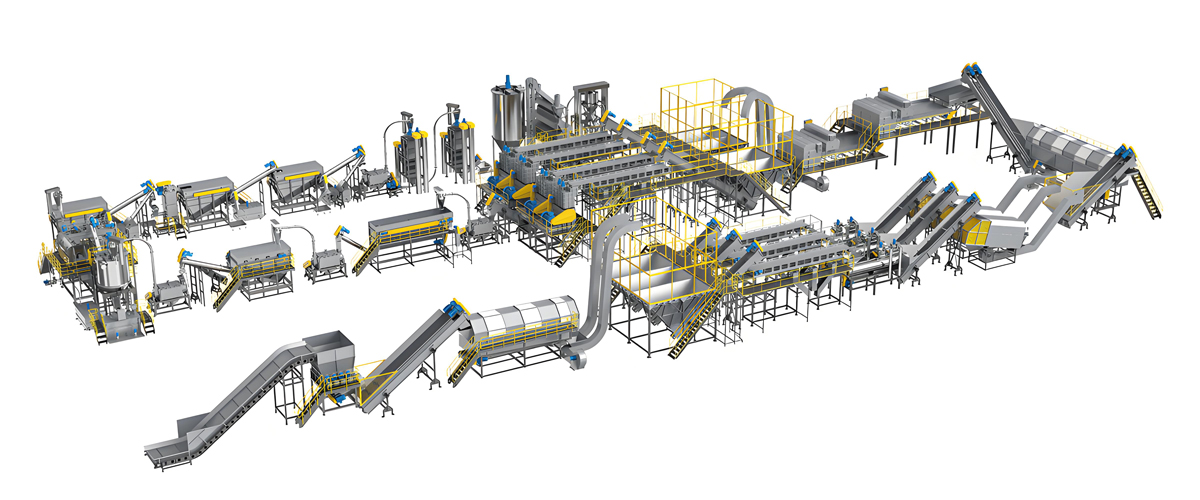
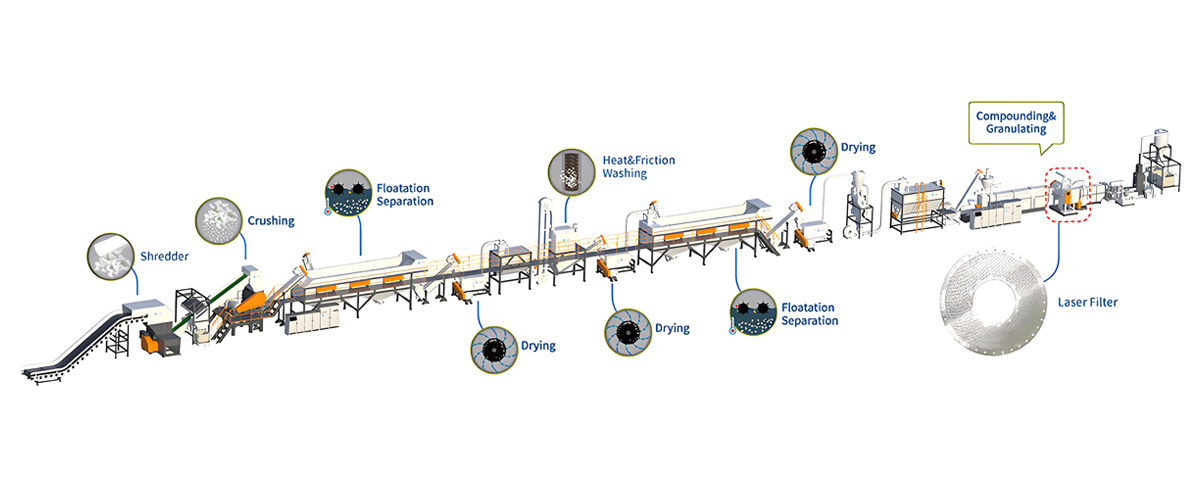
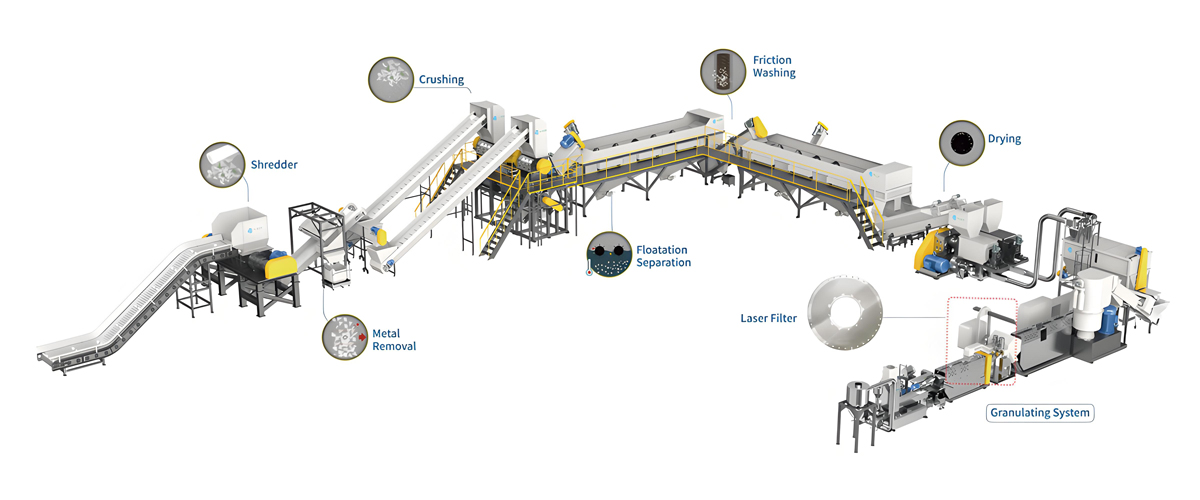
Specifying a printed-film deinking line means choosing a configuration that matches the ink load and the target pellet color. A compact line for clean, known post-industrial film needs a granulator or shredder, a hot alkaline wash, a friction washer, rinse, squeezer, and dryer, with manual sorting. A standard line for post-consumer printed film adds automatic sorting, stronger friction, counter-current rinse with recirculation, and flotation wastewater treatment. A high-grade line adds near-infrared sorting and tighter process control for bright pellet, while a hazardous-rated variant adds vapor and odor control for solvent-heavy feed. The table below contrasts these tiers using relative cost labels rather than figures, because final cost scales with capacity and options.
Film Deinking Line Configuration Tiers
| Tier | Core Components | Target Output Color | Relative Cost |
|---|---|---|---|
| Compact | Shred, hot wash, friction, rinse, squeezer | Medium to dark | Low |
| Standard | Adds auto-sort, recirculation, flotation | Light to medium | Medium |
| High grade | Adds NIR sort, tight process control | Bright natural | High |
| Hazardous-rated | Adds vapor and odor control | By project | Premium |
When benchmarking suppliers, compare Polyretec’s film washing line against established washing and recycling names such as Erema, Sorema, Starlinger, AMUT, and Herbold, each of which offers film or flake washing technology. The deciding factors are the aggressiveness and tunability of the alkaline-friction stage for your specific ink mix, the quality of the counter-current rinse and water recirculation, the availability of optical sorting for color control, and the depth of commissioning and spare-parts support. Polyretec’s position, built on Austrian-derived process design within the Wanplas group, is to deliver measured deinking performance at a competitive total cost of ownership, with the group’s Kerke factory available where the deinked flake is to be pelletized in one integrated train.
Frequently Asked Questions
Can all printed films be deinked in a washing line?
Most surface-printed and many reverse-printed films made with solvent or water-based inks can be substantially deinked by alkaline washing and friction. UV-cured and heavily crosslinked inks are far harder and often cannot reach a light enough color for bright reprocessing, so they are best sorted out before washing.
What alkali concentration works for film deinking?
A common starting point is sodium hydroxide at 1 to 3 percent by weight with a wash temperature of 50 to 80 degrees Celsius and a residence time of 8 to 15 minutes. The exact dose is tuned against the ink load, because too little leaves ink while too much risks polymer haze and yellowing.
How is deinking rate measured?
Plants use a combination of spectrophotometric brightness or L-star change, ash-content difference before and after washing, and image analysis of flake or pellet color. The deinking efficiency is calculated from the difference in ink indicator between feed and product divided by the feed value.
Why do pellets stay gray after washing?
Gray or dark pellets usually mean the ink was not fully detached in the wash, that UV or laminated ink remained in the stream, or that fine ink particles redeposited during rinsing. Strengthening the alkaline and friction stages, improving counter-current rinse, and sorting out crosslinked inks corrects most cases.
Does deinking wastewater need special treatment?
Yes. The wash water carries dispersed pigment, surfactant, and organic load, giving high chemical oxygen demand. Coagulation, flotation, and settling recover the ink as sludge, and the clarified water is recirculated. The pigment-rich sludge may contain heavy metals and is handled as controlled waste.
Can deinked film be used for light-colored products?
It depends on the residual ink level. With strong deinking and good sorting, deinked polyolefin can be used for medium and dark articles, and for light articles when paired with opaque masterbatch. For very bright or transparent goods, near-infrared sorting and high deinking rates are required, and some plants instead use the deinked material in dark or black applications.
Which Polyretec line handles printed film deinking?
Polyretec, a Wanplas factory, supplies the PP/PE Weiche Kunststoffzerkleinerung and Waschlinie configured for film, which can be equipped with hot alkaline washing, friction washers, and rinse stages suited to printed LDPE and PP film deinking, with optional near-infrared sorting for color control.
What is the biggest cause of deinking failure?
The most common failure is feeding mixed, unsorted film that includes UV-cured, laminated, or PVC-printed material into a line tuned only for surface-printed polyolefin. Without pre-sort and correct alkaline-friction tuning, the ink is never detached and the pellets remain dark.
Conclusion
Removing ink from printed plastic films in a recycling line is a disciplined sequence of sorting, alkaline chemistry, friction, and rinse that converts dark, ink-laden film into a bright, versatile flake. The chemistry, sodium hydroxide at 1 to 3 percent with a 50 to 80 degrees Celsius bath and 8 to 15 minutes residence, hydrolyzes the ink binder; friction washing scrubs the pigment away; and counter-current rinsing carries it out of the stream before squeezing and drying below one percent moisture. Measuring deinking rate with a spectrophotometer, ash, or image analysis closes the loop, while coagulation, flotation, and sludge control keep the wastewater and its pigment load inside permit and cost bounds. Color after pelletizing is then managed by the deinking result, optional near-infrared sorting, and masterbatch formulation, with the whole system tuned to avoid the common failures of poor sorting, wrong chemistry, redeposition, and fines generation.
For plants specifying such a line, Polyretec, a Wanplas factory, offers the PP/PE Weiche Kunststoffzerkleinerung and Waschlinie configured for printed film deinking, built on Austrian-derived process know-how and backed by the Wanplas group’s shared quality and after-sales commitments, including an annual free spare-parts allowance. The right choice matches the configuration tier, compact, standard, high grade, or hazardous-rated, to your ink mix and your target pellet color, verified by wash trials on your own film before purchase. Contact the Polyretec team to arrange a sample evaluation and a deinking configuration matched to your throughput, ink profile, and brightness goal.