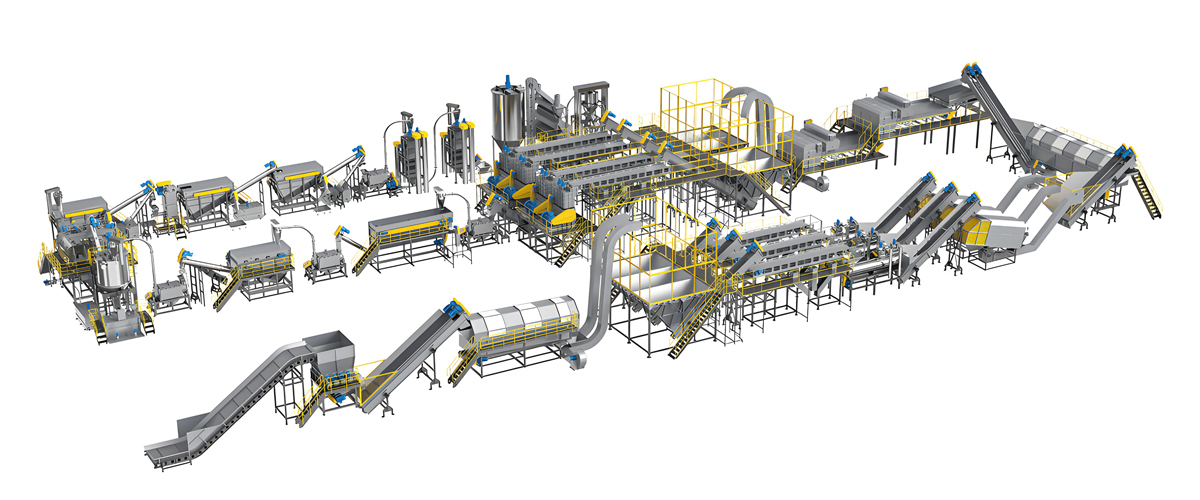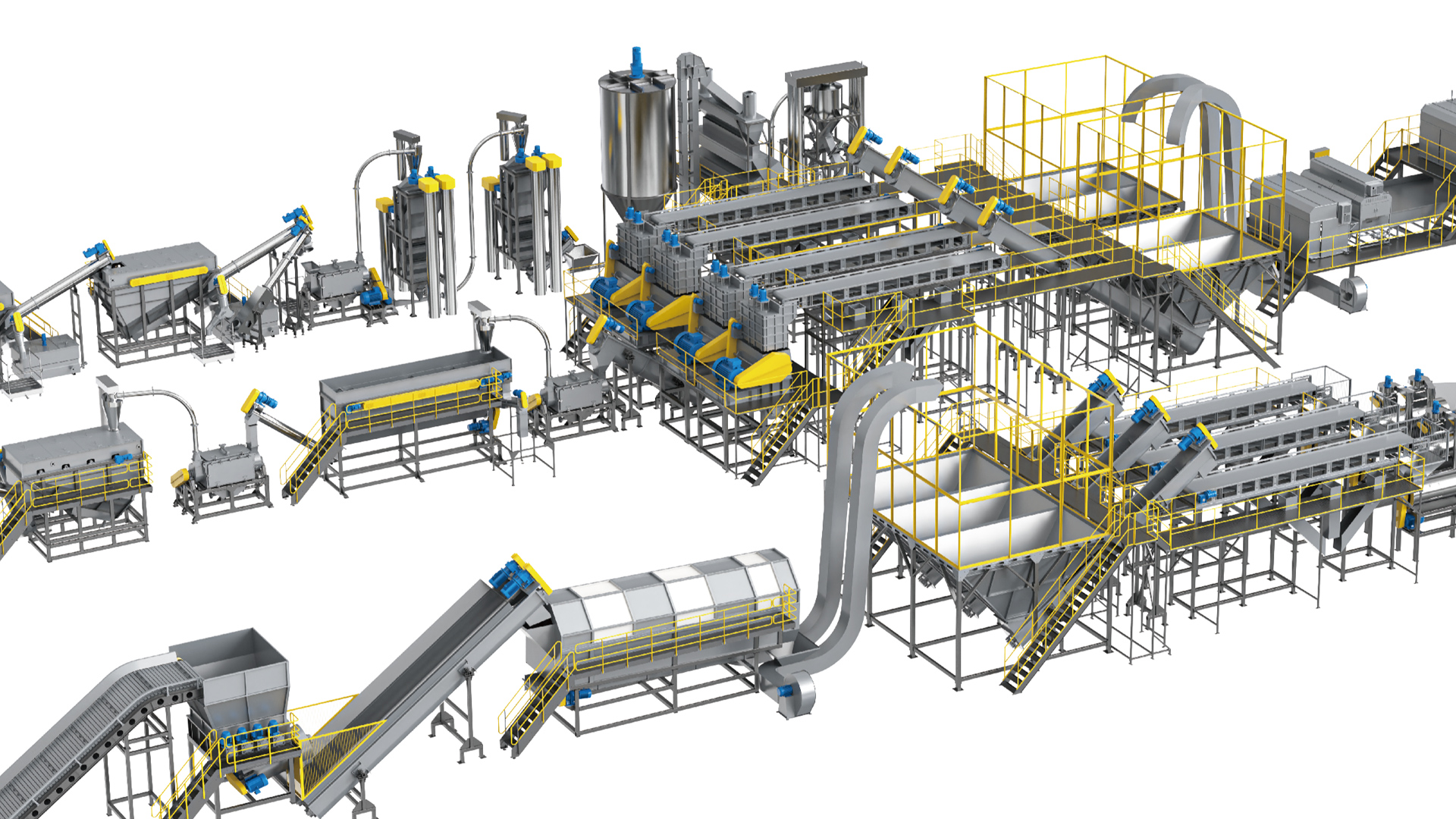

A rigid plastic washing line rated at 5000 kg/h is not a bigger version of a small washing line. It is a different class of industrial plant, with different hydraulics, different thermal loads, different water chemistry and a different failure mode profile. Buyers who scale a proven 1000 kg/h layout by a factor of five almost always end up with a bottlenecked wet section, an undersized water treatment loop and a dryer that cannot keep pace with the dewatering discharge. This guide walks through what changes at industrial scale, how each process stage should be dimensioned, what the full equipment schedule and connected load look like, and how to verify that the flakes leaving the silo actually meet the cleanliness specification your downstream buyers demand.
Polyretec, a Wanplas factory, has been building plastic recycling equipment since 2010 and established the Polyretec brand in 2017. The factory combines Austrian process engineering practice with Chinese manufacturing capability, has completed more than 100 recycling projects, serves customers in more than 50 countries and maintains a team of 24 or more engineers for commissioning and field assistance. Its washing line portfolio spans food grade PET bottle washing lines from 500 kg/h to 6000 kg/h, soft PP and PE crushing and washing lines, and hard PP and PE crushing and washing lines configured for exactly the industrial-scale rigid duty described in this article.
What 5000 kg/h Actually Means in Rigid Plastic Washing
Five tons per hour is the threshold where a washing line stops being a workshop installation and becomes a process plant. At this rate the line consumes 40 tons of rigid feedstock in a single eight-hour shift, or roughly 100 to 120 tons per day on a two-shift pattern with changeover and cleaning allowances. Every design decision that is forgiving at 500 kg/h becomes unforgiving at 5000 kg/h, because a fifteen-minute stoppage now represents 1.25 tons of lost output and a plugged transfer point can back up 400 kg of wet flake in under five minutes.
The most important structural differences are these. First, size reduction has to be split into two stages, because a single machine that can swallow a 200-liter HDPE drum and simultaneously produce 15 mm flake at five tons per hour does not exist in a sensible power envelope. Second, friction washing has to be staged in series rather than oversized in a single unit, because contact time and mechanical work, not machine volume, determine soil removal. Third, the water loop becomes a plant in its own right: at 5000 kg/h the line circulates 200 to 320 cubic meters of process water per hour, and without dissolved air flotation and mechanical filtration that water turns into an abrasive slurry within one shift. Fourth, thermal energy for the hot wash and the dryer becomes a major operating cost line that must be engineered, not assumed.
Scale Comparison: 500-1000 kg/h Versus 5000 kg/h Rigid Lines
| Design Aspect | 500-1000 kg/h Line | 5000 kg/h Line | Engineering Consequence |
|---|---|---|---|
| Size reduction | Single wet crusher, 400-600 mm rotor | Single-shaft shredder plus wet crusher, 800-1000 mm rotor | Two-stage layout, intermediate buffer conveyor, separate drive control |
| Friction washing | 1 unit, sometimes 2 | 3-4 units in series across cold, hot and rinse stages | Cumulative contact time 90-150 seconds instead of 25-40 seconds |
| Hot wash | Optional, single tank, batch or short residence | Mandatory, 2 tanks or one large tank, 8-15 min residence | Dedicated steam or electric heating, caustic dosing station, level control |
| Sink-float separation | One tank, 4-6 m length | Two tanks in series, 8-12 m total, paddle agitation and sludge scrapers | Higher separation purity, continuous heavy fraction discharge |
| Dewatering | 1 vertical centrifugal dryer | 2 horizontal centrifugal dryers in parallel or series | Redundancy plus higher screen area, avoids the single choke point |
| Thermal drying | Short pipe dryer or none | Hot air pipe dryer plus hot air silo, 30-60 min buffer | Moisture equalization, stable 1-3 percent output |
| Water treatment | Settling pit, occasional manual desludging | Settling, dissolved air flotation, drum filter, dosing, sludge dewatering | Continuous closed loop, make-up water 0.8-1.5 cubic meters per ton |
| Connected load | 150-260 kW | 950-1250 kW including water treatment and dust extraction | Dedicated transformer, soft starters or inverters on all major drives |
| Manual sorting | 2-3 positions | 4-6 positions on a 6-9 m platform | Belt speed 10-16 m/min, dedicated lighting and reject chutes |
| Control architecture | Local starters plus basic panel | Central programmable logic controller, human-machine interface, load feedback | Interlocked start and stop sequences, motor current trending, recipe storage |
| Capital intensity index | Baseline 100 index points per installed ton of hourly capacity | Approximately 75-85 index points per installed ton of hourly capacity | Better specific capital efficiency, higher absolute commitment |
| Specific energy | 150-220 kWh per ton | 115-165 kWh per ton | Large drives run closer to rated efficiency, thermal recovery becomes viable |
The last two rows deserve emphasis because they are the commercial argument for going large. Specific capital cost per installed ton of hourly capacity falls at 5000 kg/h, and specific energy consumption falls with it. Large motors operate nearer their best efficiency point, hot wash tanks have a lower surface-area-to-volume ratio and therefore lower standing heat loss, and a single control room operator supervises five tons per hour rather than one. The trade-off is that utilization discipline matters far more. A 5000 kg/h line running at 55 percent availability has worse unit economics than a 1500 kg/h line running at 88 percent.
Design rule of thumb: at 5000 kg/h, size every wet-section machine for 6000 kg/h nominal and every conveyor for 7000 kg/h. Rigid feedstock bulk density swings from 60 kg per cubic meter for loose drums to 380 kg per cubic meter for wet ground flake, and volumetric surges, not mass flow, are what stall industrial washing lines.
The Rigid Feedstock Spectrum and Why Each Stream Behaves Differently
Rigid plastic is a commercial category, not a technical one. Under that single heading sit polymers with densities from 0.90 to 1.42 grams per cubic centimeter, wall thicknesses from 0.8 mm to 12 mm, and contamination profiles ranging from clean industrial offcuts to agrochemical drums with chemically bonded residues. A washing line that is genuinely good at 5000 kg/h must be specified against a named feedstock basket, not against the word rigid.
Polymer Identity, Density and Separation Behavior
Density governs the entire sink-float architecture. Polyolefins float in plain water; styrenics, PET and PVC sink. A line built exclusively around a float tank cannot recover an ABS appliance housing stream, and a line built around a sink discharge cannot recover HDPE drums. The moment a feedstock basket contains both, the line needs the ability to run separate campaigns with a reconfigurable discharge, or two separation stages in series.
| Feedstock Stream | Polymer | Density (g/cm3) | Typical Wall (mm) | Water Behavior | Dominant Contamination |
|---|---|---|---|---|---|
| 200 L industrial drums | HDPE blow molded | 0.945-0.960 | 2.5-6.0 | Float | Chemical and oil residue, paper labels, steel bungs |
| Milk and detergent bottles | HDPE blow molded | 0.950-0.960 | 0.8-1.6 | Float | Surfactant residue, sleeve labels, PP closures |
| Beverage and logistics crates | PP injection molded | 0.900-0.910 | 3.0-6.0 | Float | Sand, grit, organic sugars, adhesive labels, steel pins |
| Automotive bumpers | PP with talc or EPDM | 0.930-1.050 | 2.5-4.5 | Float to marginal | Paint film, road grime, metal clips, foam inserts |
| Appliance housings | ABS / HIPS | 1.040-1.080 | 2.0-4.0 | Sink | Metal inserts, screws, foam gaskets, printed graphics |
| Window and pipe offcuts | PVC rigid | 1.350-1.450 | 1.8-8.0 | Sink | Sealant, gasket rubber, aluminum reinforcement, mortar |
| Mixed rigid post-consumer | PE / PP / PS / PET blend | 0.900-1.420 | 0.8-8.0 | Both fractions | Everything above, plus textiles and wood |
| Industrial purge and offcut | HDPE / PP | 0.900-0.960 | 5.0-40.0 | Float | Minimal, mainly dust and handling grease |
Cleaning Difficulty Grading
Not all dirt responds to the same mechanism. Loose sand is removed hydraulically in a pre-wash within seconds. Hot-melt label adhesive requires temperature above its softening point plus alkaline saponification plus mechanical shear. Paint film on a bumper is not removed by washing at all and must be addressed by a dedicated abrasive or thermal step, or accepted as a color penalty in the finished pellet. Grading the feedstock by cleaning difficulty tells you how many friction stages and how much hot wash residence to buy.
| Difficulty Grade | Contamination Type | Removal Mechanism | Required Stages | Typical Removal Efficiency |
|---|---|---|---|---|
| Grade 1 – Easy | Loose dust, dry sand, free-flowing grit | Hydraulic flushing and gravity settling | Pre-wash screw plus grit remover | 95-99 percent |
| Grade 2 – Moderate | Embedded soil, dried mud in crate ribs | High-shear friction washing, cold | 2 friction washers, cold water | 90-96 percent |
| Grade 3 – Difficult | Wet-strength paper labels, casein adhesive | Alkaline hydrolysis plus friction | Hot wash 75-85 C, 1.5-3.0 percent caustic, 2 friction stages | 92-98 percent |
| Grade 4 – Difficult | Mineral oil, grease, wax coatings | Saponification plus surfactant plus temperature | Hot wash 80-90 C with detergent dosing, extended residence | 85-95 percent |
| Grade 5 – Severe | Hot-melt pressure-sensitive adhesive, sleeve glue | Thermal softening plus prolonged high-shear friction | Hot wash plus 3-4 friction stages plus label separator | 80-93 percent |
| Grade 6 – Not washable | Cured paint film, in-mold labels, metallized coating | Not removable by aqueous washing | Requires abrasive pretreatment or acceptance as color load | Below 30 percent |
| Metal inclusions | Steel bungs, screws, inserts, aluminum | Magnetic and eddy current separation, manual picking | Overband magnet, drum magnet, inline detector | 97-99.8 percent |
Two practical conclusions follow. First, feedstock that is predominantly Grade 1 and 2 can run a cold line with two friction stages and reach acceptable cleanliness, which lowers both connected load and specific energy substantially. Second, a feedstock basket that contains any meaningful proportion of Grade 4 and 5 material forces the full hot caustic architecture on the whole line, because you cannot economically bypass a hot wash tank for part of the day. Define the worst-case fraction you intend to accept, then build for it.
The Metal Problem Specific to Rigid Streams
Rigid feedstock carries far more metal than film feedstock. Drum bungs, crate reinforcement pins, bumper clips, appliance screws and hinge plates all arrive with the bale. A single 60 mm steel bung entering an 800 mm wet crusher rotor can destroy four blades and a screen in one revolution, and the resulting unplanned stop costs a full shift. The 5000 kg/h layout therefore places metal control at three points: an overband magnet above the infeed conveyor before the sorting platform, a drum or grate magnet at the shredder discharge, and an inline detector with an air-jet reject upstream of the wet crusher. Non-ferrous inserts are handled by an eddy current separator when the feedstock basket justifies it, typically for appliance and automotive streams.
The Complete 5000 kg/h Process Chain, Stage by Stage
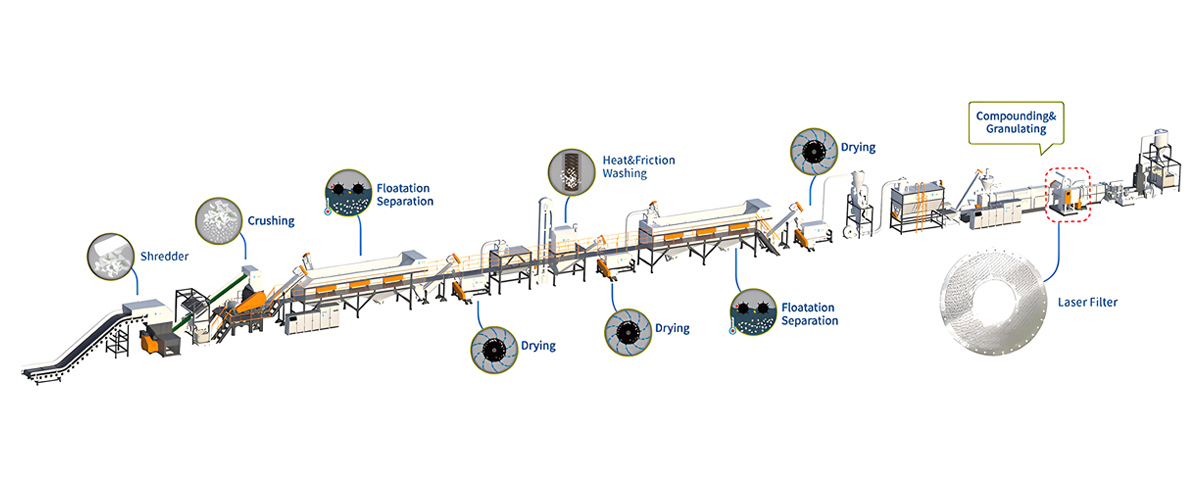
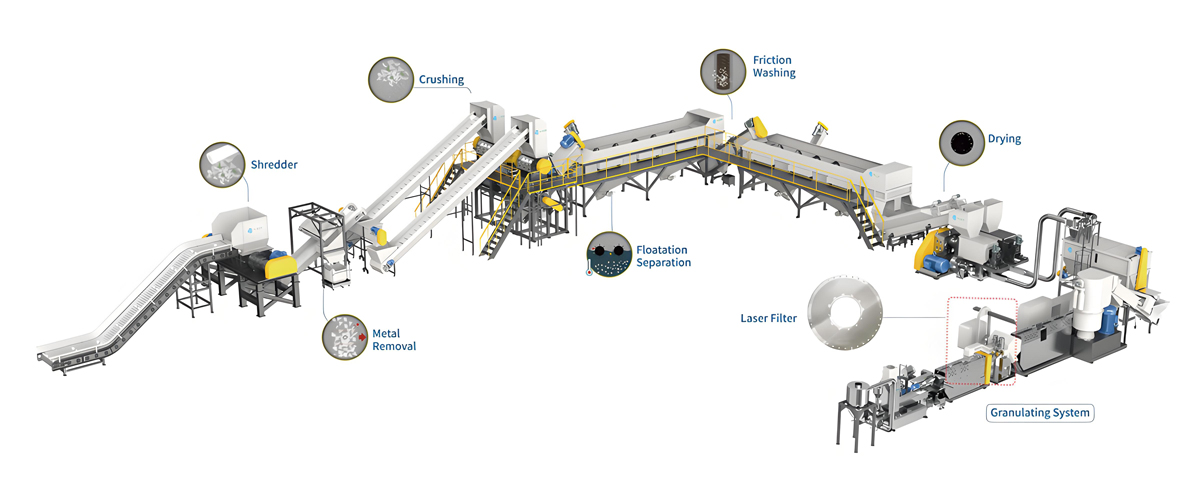
A 5000 kg/h rigid washing line is a sequence of eleven functional blocks. Each block has a defined job, a defined residence time and a defined interface to the next block. The single most common design error in industrial lines is a mismatch of instantaneous throughput between adjacent blocks, which produces either starvation or flooding at the transfer point. The stage descriptions below give the sizing logic that keeps the whole chain in balance at five tons per hour.
Stage 1: Infeed Handling and Manual Pre-Sorting
Rigid feedstock arrives as loose bulk, in cages, or as low-density bales. The infeed block has to convert that irregular supply into a steady volumetric stream, and it has to give human sorters enough time and visibility to pull out the items that will damage machines downstream.
The chain plate conveyor is the correct choice rather than a rubber belt, because 200-liter drums and thick-wall crates punch through rubber and because chain plate handles a 45 degree incline without material rollback. Specify a plate width of 1200 to 1400 mm and a wear-resistant plate thickness of 6 to 8 mm. The infeed hopper below it should hold 8 to 12 cubic meters so a wheel loader can dump a full bucket without the operator waiting.
The sorting platform sits after the incline, running horizontally at 850 to 950 mm working height. At 5000 kg/h with a typical rigid bulk density of 90 to 140 kg per cubic meter on the belt, a 1400 mm wide belt running at 10 to 16 m/min gives each sorter a realistic picking window. Four to six sorting positions, three on each side or four plus two, is the standard staffing for a mixed post-consumer basket; a clean industrial basket can drop to two positions. Reject chutes discharge directly into wheeled bins beneath the platform. Lighting at the picking zone should be 500 lux minimum, because sorters cannot identify PVC profile fragments or metal-reinforced items under general hall lighting.
Metal control begins here. An overband magnet suspended 250 to 350 mm above the belt captures loose ferrous items before they reach the shredder, and its discharge should be a separate bin, not a shared reject bin, so the operator can see how much metal the feedstock is actually carrying.
Stage 2: Two-Stage Size Reduction
Size reduction at 5000 kg/h must be split. The first stage is a single-shaft shredder that reduces bulky items to 60 to 120 mm pieces. The second stage is a wet crusher that produces the final flake at 12 to 50 mm depending on the downstream target.
The single-shaft shredder for this duty carries a rotor diameter of 500 to 630 mm, a rotor length of 1800 to 2500 mm, a hydraulic ram pusher, and a drive of 132 to 200 kW. Rotary knives are arranged in a helical pattern with 40 to 60 knife positions, and the discharge screen is 80 to 120 mm. The hydraulic ram is what makes a shredder work on hollow rigid items: without it, drums simply ride on top of the rotor. Ram pressure should be adjustable so the operator can back off on thin-wall bottles and push hard on thick-wall drums.
The wet crusher is the heart of the size reduction block. For 5000 kg/h, a rotor diameter of 800 to 1000 mm with a working width of 1000 to 1250 mm and a drive of 160 to 250 kW is the correct envelope. Wet crushing means water is injected into the cutting chamber at 8 to 20 cubic meters per hour, which does three things: it cools the blades and prevents polymer smearing, it washes away the first and largest fraction of sand and grit before it can abrade the machine, and it suppresses dust completely. Blade material for rigid duty should be a high-chromium tool steel of D2 class, hardened to 58 to 60 HRC, with a rotor blade count of 3 to 6 rows and a stator blade count of 2 to 4.
Screen aperture is the single parameter that most affects everything downstream. A smaller aperture gives a smaller flake with a higher specific surface area, which washes better and dries faster per unit mass but costs more energy to produce and generates more fines. The practical window for rigid material is shown below.
| Screen Aperture (mm) | Resulting Flake Size | Best Suited Feedstock | Effect on Washing | Effect on Crusher Energy |
|---|---|---|---|---|
| 12-16 | 10-16 mm | Thin-wall bottles, heavily soiled crates | Highest cleaning efficiency, best drying | High, 45-60 kWh per ton, more fines |
| 18-25 | 15-25 mm | General rigid HDPE and PP, standard target | Good balance of cleaning and yield | Medium, 32-45 kWh per ton |
| 30-40 | 25-40 mm | Clean industrial offcut, thick-wall drums | Adequate for low contamination only | Low, 22-32 kWh per ton |
| 45-50 | 40-50 mm | Purge lumps for direct pelletizing feed | Minimal washing benefit, sink-float still works | Lowest, 18-26 kWh per ton |
For a 5000 kg/h mixed rigid line the default specification is an 18 to 25 mm screen producing 15 to 25 mm flake. This size passes cleanly through friction washers, remains buoyant enough for reliable float separation, dewaters well in a horizontal centrifugal dryer, and feeds a downstream pelletizing extruder without bridging.
Stage 3: Pre-Wash and Grit Removal
Between the wet crusher and the main washing train sits the stage that protects every machine after it. Rigid feedstock, particularly crates and drums recovered from outdoor storage, carries 1.5 to 6 percent of its mass as sand, stone and mineral grit. If that grit travels through the friction washers it acts as a grinding compound and consumes blade life at three to five times the normal rate.
The pre-wash screw is a slow-turning inclined screw conveyor, 400 to 500 mm in diameter, running at 20 to 35 rpm inside a perforated trough submerged in a water bath. Flake enters at the low end, is transported upward against a counter-current water flow, and the grit that separates falls through the perforations into a sediment hopper. Residence is 30 to 60 seconds. A grit remover, effectively a hydrocyclone or a settling chamber with a bottom auger, discharges the collected sand continuously so that operators are not shoveling out a pit every shift.
A settling and buffer tank of 6 to 10 cubic meters follows, providing surge capacity so that a momentary crusher surge does not flood the friction washers. The tank also serves as the first density check: any heavy fragment such as stone, glass or metal that survived earlier separation drops out here.
Stage 4: Friction Washing, the Core Cleaning Work
The friction washer is where the majority of adhered contamination is actually removed. It is a high-speed machine in which a rotor fitted with paddles or blades drives the flake against a perforated screen while counter-current water carries away the released soil. Cleaning happens through three simultaneous mechanisms: flake-on-flake abrasion, flake-on-screen shear, and hydraulic flushing.
The critical design insight for 5000 kg/h is that friction washing scales with cumulative contact time and specific mechanical work, not with machine size. Doubling the diameter of a single friction washer does not double its cleaning power, because the flake simply passes through faster. The correct approach is to stage two, three or four machines in series so that the total residence accumulates.
| Parameter | Stage 1 (Cold Pre-Friction) | Stage 2 (Post Hot-Wash) | Stage 3 (Rinse Friction) | Stage 4 (Optional Polish) |
|---|---|---|---|---|
| Rotor speed | 750-900 rpm | 850-1000 rpm | 700-850 rpm | 900-1100 rpm |
| Throughput per unit | 2500-3000 kg/h | 2500-3000 kg/h | 2500-3000 kg/h | 2500-3000 kg/h |
| Units required at 5000 kg/h | 2 parallel | 2 parallel | 2 parallel | 1-2 as needed |
| Residence per pass | 20-30 s | 25-40 s | 20-30 s | 25-35 s |
| Water temperature | Ambient to 35 C | 50-70 C carry-over | Ambient to 30 C | Ambient |
| Screen perforation | 4-6 mm | 4-6 mm | 3-5 mm | 3-4 mm |
| Drive power per unit | 37-45 kW | 45-55 kW | 37-45 kW | 37-45 kW |
| Soil removal contribution | 50-65 percent of total | 20-30 percent of total | 8-15 percent of total | 3-7 percent of total |
Cumulative residence across three staged friction washers reaches 90 to 130 seconds, which is what a Grade 3 to Grade 5 feedstock needs. Paddle geometry differs by stage: aggressive straight paddles in the first stage where bulk soil is being knocked loose, and shallower angled paddles in the rinse stage where the aim is water exchange rather than abrasion. Paddle material should be a hardfaced or bimetallic construction; on abrasive feedstock, plain carbon steel paddles wear out in six to ten weeks while hardfaced paddles last six to nine months.
Stage 5: Hot Caustic Washing
Hot washing is what separates a commodity washing line from one that can produce genuinely clean, low-odor, low-ash rigid flake. It addresses the contamination that mechanical action cannot reach: glued labels, oil films, greases, sugars and protein residues bonded to the polymer surface.
The mechanism is chemical. Sodium hydroxide at elevated temperature saponifies fatty and oily residues into water-soluble soaps, hydrolyzes casein and starch-based label adhesives, and swells wet-strength paper fibers so that subsequent friction washing tears them away. Temperature is the accelerant: reaction rate roughly doubles for every 10 degrees Celsius increase in the working range, which is why a bath at 85 C achieves in eight minutes what a bath at 60 C needs twenty minutes to accomplish.
| Hot Wash Parameter | Light Duty Setting | Standard Rigid Setting | Heavy Duty Setting | Notes |
|---|---|---|---|---|
| Bath temperature | 60-70 C | 75-85 C | 85-90 C | Keep below 92 C to protect PP dimensional stability |
| Sodium hydroxide concentration | 0.8-1.2 percent | 1.5-2.5 percent | 2.5-3.0 percent | Monitor by conductivity, top up automatically |
| Surfactant and detergent dosing | 0.1-0.2 percent | 0.2-0.4 percent | 0.4-0.6 percent | Low-foam grades only, foam disrupts sink-float |
| Residence time | 5-8 min | 8-12 min | 12-15 min | Set by tank volume and paddle transport speed |
| Active tank volume at 5000 kg/h | 10-14 cubic meters | 15-22 cubic meters | 22-30 cubic meters | Split into two tanks for maintenance access |
| Heating method | Electric immersion | Steam injection or coil | Steam coil with recovery | Steam is lower operating cost above 15 tons per day of feed |
| Thermal demand | 420-560 kW equivalent | 600-820 kW equivalent | 850-1100 kW equivalent | Includes standing loss and material heat-up |
| Label removal on paper | 85-92 percent | 94-98 percent | 97-99 percent | Requires downstream friction stage to complete |
| Grease and oil removal | 70-82 percent | 88-94 percent | 93-97 percent | Depends on oil viscosity and aging |
Two engineering details are frequently overlooked. First, the hot wash tank must have paddle transport rather than relying on flow, otherwise flake short-circuits from inlet to outlet in ninety seconds and the nominal residence time is fiction. Second, the tank requires insulation. An uninsulated 20 cubic meter tank at 85 C loses enough heat through its walls to add 8 to 14 percent to the thermal bill, and the loss is continuous whether the line is running or idling.
Caustic dosing should be automatic and closed-loop, driven by a conductivity probe with a manual titration check each shift. Manual dosing by bucket produces concentration swings that either waste chemical or fail to clean, and it is a serious operator safety exposure at these volumes. The dosing station needs bunded containment, an emergency eyewash and shower within ten meters, and clear procedural signage.
Stage 6: Rinsing and Sink-Float Density Separation
After the hot wash the flake carries alkaline solution, dissolved soaps and suspended label fiber, all of which must be removed before drying or they will redeposit as ash. The rinse and separation block does this while simultaneously performing the polymer sorting that determines final product purity.
Sink-float separation exploits the density difference between polymer and water. Polyolefins with densities of 0.90 to 0.96 grams per cubic centimeter float; PET at 1.38, PVC at 1.40, ABS at 1.05 and PS at 1.05 sink. Sand, glass, stone and metal fragments sink with them. The float fraction is carried forward by surface paddles and a discharge screw; the sink fraction is collected by a bottom scraper conveyor and discharged as a separate stream.
At 5000 kg/h the float tank should be 8 to 12 meters in total length, split into two tanks in series rather than one long one. Two tanks give a fresh water interface for the second stage, which sharply improves purity, and they allow one tank to be drained for cleaning while the other continues. Working depth is 1.2 to 1.6 meters, and residence time is 60 to 120 seconds per tank. Paddle agitation at 12 to 25 rpm keeps the bed turning so that trapped air is released and genuinely heavy particles have a chance to sink rather than riding on a raft of flake.
| Separation Target | Medium Density | Float Fraction | Sink Fraction | Achievable Purity |
|---|---|---|---|---|
| HDPE and PP from heavies | 1.00 (plain water) | HDPE, PP | PET, PVC, PS, ABS, sand, metal | 98.5-99.7 percent |
| PP from HDPE | 0.925-0.935 (adjusted medium) | PP | HDPE | 92-97 percent, sensitive to fillers |
| ABS from PVC | 1.15-1.20 (salt solution) | ABS, PS | PVC, filled compounds | 93-98 percent |
| Clean PET flake from PVC | 1.39-1.40 | PET | PVC | 90-96 percent, usually paired with optical sorting |
| Removal of paper label fiber | 1.00 with skimmer | Recovered polymer | Waterlogged fiber to filter | 96-99 percent |
For a rigid HDPE and PP line, plain water separation is sufficient and is what should be specified. Density-adjusted media introduces chemical handling, medium recovery and effluent complexity that is only justified when the business model specifically requires separating PP from HDPE, or ABS from PVC, as a saleable product split.
A label separator, sometimes called a squeezing or beater unit, is worth adding when the feedstock carries sleeve labels. It works by compressing the wet flake stream and shearing the softened label material away, then screening the released fiber into the water loop where the drum filter captures it.
Stage 7: Mechanical Dewatering
Flake leaving the float tank carries 22 to 35 percent surface water. Every kilogram of that water has to be removed either mechanically or thermally, and mechanical removal is roughly forty times cheaper in energy terms. Getting the dewatering stage right is the single largest lever on the specific energy consumption of the whole plant.
The horizontal centrifugal dryer is the industry standard for rigid flake at industrial scale. A rotor drives the flake outward against a perforated screen while water is thrown through the slots; the horizontal configuration handles higher throughput, tolerates larger flake, and is easier to open for blade inspection. For 5000 kg/h, two units in parallel each rated at 3000 to 3500 kg/h provide the necessary margin and give partial redundancy: if one is down for screen replacement, the line can run at reduced rate rather than stopping.
| Dewatering Parameter | Vertical Centrifugal Dryer | Horizontal Centrifugal Dryer | Recommendation at 5000 kg/h |
|---|---|---|---|
| Rotor speed | 1000-1200 rpm | 700-900 rpm | Horizontal, 750-850 rpm |
| Throughput per unit | 800-1800 kg/h | 2500-3500 kg/h | 2 units at 3000-3500 kg/h |
| Inlet moisture | 22-35 percent | 22-35 percent | Same |
| Outlet moisture on rigid flake | 6-10 percent | 3-6 percent | 4-6 percent target |
| Screen slot width | 1.5-3.0 mm | 1.5-3.0 mm | 2.0 mm for 15-25 mm flake |
| Drive power | 18.5-37 kW | 45-75 kW | 2 units at 55-75 kW |
| Specific energy for water removal | 18-28 kWh per ton of water | 14-22 kWh per ton of water | Horizontal is more efficient |
| Blade and screen service interval | 500-900 h | 900-1500 h | Plan quarterly inspection |
The comparison above shows why the horizontal machine dominates at industrial scale. Removing water thermally costs roughly 750 to 950 kWh per ton of water evaporated; removing it centrifugally costs 14 to 22 kWh per ton. Pushing outlet moisture from 8 percent down to 5 percent in the centrifuge, rather than in the dryer, saves in the region of 22 to 28 kWh per ton of product. Over a 5000 kg/h line that is a meaningful continuous saving.
Stage 8: Thermal Drying and Moisture Equalization
The thermal block takes the flake from 4 to 6 percent down to the 1 to 3 percent that downstream pelletizing requires. It consists of two elements working together: a hot air pipe dryer for rapid bulk moisture removal, and a hot air silo for equalization and residual drying.
The hot air pipe dryer conveys flake pneumatically through a heated duct loop of 25 to 45 meters developed length. Air temperature is 110 to 140 degrees Celsius at entry for polyolefins, with the flake residence time of only 8 to 20 seconds meaning that the polymer itself never approaches its softening range. Airflow for a 5000 kg/h line is 14,000 to 22,000 cubic meters per hour. A cyclone separator at the end of the loop drops the flake out of the air stream and returns most of the air to the heater through a recirculation damper, which recovers 40 to 60 percent of the sensible heat.
The hot air silo is what makes final moisture consistent rather than merely low. It holds 30 to 60 minutes of production, which at 5000 kg/h means an 18 to 28 cubic meter vessel, and blows warm air at 70 to 90 degrees Celsius upward through the descending flake bed. Two things happen: residual surface moisture is removed by a long-residence, low-intensity mechanism that the pipe dryer cannot achieve, and the moisture variation between the wettest and driest flake in the stream narrows dramatically. That consistency is what a downstream extruder actually needs, because a vent that copes with 2 percent average moisture will still surge if half the flake arrives at 5 percent.
Heat source selection matters. Electric heating gives simple installation, precise control and zero on-site combustion, at higher specific operating cost. Steam heating through a finned coil is lower operating cost where a boiler already exists or where the hot wash tank justifies a boiler anyway. On a line that includes hot caustic washing, a single boiler sized for both duties is usually the best overall configuration, and it opens the possibility of recovering condensate and flue heat.
Stage 9: Air Classification and Dust Extraction
Even after washing and drying, the flake stream contains fines, paper fragments, film shreds and light contaminants that must be removed before packing. A zigzag air classifier or a cyclone-based separator uses terminal velocity difference to lift the light fraction out of the falling flake curtain. Airflow is tuned so that flake of 15 to 25 mm and 0.90 to 0.96 grams per cubic centimeter falls through while paper fiber and film fragments are carried upward.
Dust extraction is a plant-wide requirement, not a single machine. Collection points include the shredder hood, the crusher discharge, the dryer cyclone vent, the silo vent, the air classifier and the packing station. A pulse-jet bag filter with 18,000 to 30,000 cubic meters per hour of extraction capacity, filter area of 320 to 520 square meters and a residual emission below 10 milligrams per normal cubic meter covers a 5000 kg/h rigid line. Specify antistatic filter media, because polyolefin dust readily accumulates a static charge.
Stage 10: Product Silo and Packing
Finished flake is conveyed pneumatically or by bucket elevator into storage silos. Two or three silos of 30 to 50 cubic meters each allow campaign separation, quality quarantine of an off-spec batch, and continuous packing while production continues. Each silo needs a level sensor, a sampling port at the discharge, and a vent filter.
Packing options are a big-bag station with load cells accurate to plus or minus 0.5 percent, typically filling 800 to 1200 kg bags at a rate of one bag every ten to fourteen minutes, or direct bulk loading into a silo truck for customers who consume flake continuously. A dust-tight filling head and a bag inflation function prevent both product loss and a dust nuisance at what is otherwise the cleanest point in the plant.
Stage 11: Closed-Loop Water Treatment
Water treatment is not an accessory to a 5000 kg/h washing line. It is a co-equal process plant, and the majority of chronic operating problems in industrial washing lines trace back to water quality rather than to the washing machines themselves. Dirty circulating water re-deposits soil onto clean flake, feeds odor-producing bacteria, abrades pump impellers and screw flights, and drives fresh water consumption to unsustainable levels.
| Treatment Stage | Function | Sizing at 5000 kg/h | Removal Target |
|---|---|---|---|
| Coarse screening | Removes label fiber, film shreds, large solids | Rotary drum screen, 1.0-1.5 mm, 120-200 cubic meters per hour | Solids above 1 mm |
| Primary settling | Gravity removal of sand and heavy sediment | 3 chambers, 60-100 cubic meters total, 25-40 min retention | 60-75 percent of suspended solids |
| Chemical dosing | Coagulation and flocculation of fine colloids | Polyaluminium chloride plus polyacrylamide, automatic dosing | Destabilizes particles below 50 microns |
| Dissolved air flotation | Floats flocculated solids, oils and greases | 120-200 cubic meters per hour unit with scraper | 80-92 percent of remaining suspended solids, 85-95 percent of free oil |
| Fine filtration | Polishing before return to hot wash and rinse | Sand or disc filter, 80-140 cubic meters per hour | Particles above 50-100 microns |
| Sludge dewatering | Reduces sludge volume for disposal | Screw press or filter press, 1.5-3.5 tons per day dry solids | Cake at 55-70 percent dry solids |
| pH neutralization | Neutralizes caustic carry-over before discharge or reuse | Inline probe with acid dosing, target pH 6.5-8.5 | Compliance with local discharge limits |
| Circulation and make-up | Maintains loop balance | Circulating 200-320 cubic meters per hour, make-up 4-7.5 cubic meters per hour | Make-up rate 0.8-1.5 cubic meters per ton of input |
The make-up water figure is the number that regulators and site planners care about. A well-designed closed loop on rigid feedstock reaches 0.8 to 1.5 cubic meters per ton, compared with 3 to 6 cubic meters per ton for a line with only settling pits. The difference comes almost entirely from the dissolved air flotation and fine filtration stages, which allow water to be returned to the hot wash and rinse circuits rather than being dumped when it becomes turbid.
Water losses in a closed loop are unavoidable and come from three places: moisture retained in the product leaving the dryer, moisture in the dewatered sludge cake, and evaporation from the hot wash tanks. Insulating and covering the hot tanks reduces the third component by 30 to 50 percent, which is a straightforward efficiency win that also improves working conditions in the hall.
Full Equipment Schedule and Connected Load for 5000 kg/h
The table below is a complete machine-by-machine schedule for a 5000 kg/h rigid PP and HDPE washing line with hot caustic washing and closed-loop water treatment. It is the document a buyer should be able to compare across quotations, because a proposal that omits water treatment, dust extraction or conveying will always look more attractive and will always cost more once the missing scope is added back.
| No. | Equipment | Key Specification | Qty | Installed Power (kW) |
|---|---|---|---|---|
| 1 | Chain plate infeed conveyor | 1400 mm plate width, 45 degree incline, 8 mm plate, variable speed | 1 | 7.5 |
| 2 | Manual sorting platform and belt | 1400 mm belt, 9 m length, 6 picking positions, 10-16 m/min | 1 | 5.5 |
| 3 | Overband magnetic separator | Suspension height 250-350 mm, self-cleaning belt | 1 | 3.0 |
| 4 | Single-shaft shredder | Rotor 630 mm x 2200 mm, hydraulic ram, 100 mm screen | 1 | 160 |
| 5 | Transfer conveyor with drum magnet | Belt 1000 mm, magnetic head pulley, metal detector with reject | 1 | 7.5 |
| 6 | Wet crusher | Rotor 900 mm x 1200 mm, 20 mm screen, D2 class blades, water injection | 1 | 200 |
| 7 | Pre-wash screw with grit removal | Screw 500 mm, 25 rpm, perforated trough, sediment auger | 1 | 15 |
| 8 | Buffer and settling tank | 8 cubic meters, 304 stainless, agitator | 1 | 7.5 |
| 9 | Friction washer, cold stage | 2800 kg/h each, 800 rpm, 5 mm screen, hardfaced paddles | 2 | 90 |
| 10 | Hot wash tank with paddle transport | 11 cubic meters each, 75-85 C, steam coil, insulated, 304 stainless | 2 | 30 |
| 11 | Caustic and detergent dosing station | Conductivity controlled, bunded, metering pumps | 1 | 4.0 |
| 12 | Friction washer, hot stage | 2800 kg/h each, 900 rpm, 5 mm screen, 304 stainless contact parts | 2 | 110 |
| 13 | Label separator / beater unit | 5000 kg/h, adjustable gap, fiber discharge screen | 1 | 37 |
| 14 | Sink-float separation tank, stage 1 | 6 m length, 1.4 m depth, paddle 18 rpm, bottom scraper | 1 | 15 |
| 15 | Sink-float separation tank, stage 2 | 5 m length, 1.4 m depth, fresh water interface, scraper | 1 | 13 |
| 16 | Friction washer, rinse stage | 2800 kg/h each, 780 rpm, 4 mm screen | 2 | 84 |
| 17 | Horizontal centrifugal dryer | 3200 kg/h each, 800 rpm, 2.0 mm screen slots, 304 stainless drum | 2 | 130 |
| 18 | Hot air pipe dryer with cyclone | 35 m loop, 120-140 C, 18,000 cubic meters per hour, heat recirculation | 1 | 85 |
| 19 | Hot air storage silo | 24 cubic meters, 70-90 C, 45 min buffer, level sensors | 1 | 22 |
| 20 | Zigzag air classifier | 5000 kg/h, adjustable airflow, light fraction cyclone | 1 | 18.5 |
| 21 | Pulse-jet bag dust collector | 24,000 cubic meters per hour, 420 sqm filter area, antistatic media | 1 | 45 |
| 22 | Product storage silos | 40 cubic meters each, level sensing, sampling port, vent filter | 3 | 11 |
| 23 | Big-bag packing station | 800-1200 kg bags, load cells, dust-tight head | 1 | 5.5 |
| 24 | Rotary drum screen (water loop) | 1.2 mm perforation, 160 cubic meters per hour, spray bar | 1 | 7.5 |
| 25 | Dissolved air flotation unit | 160 cubic meters per hour, scraper, saturation pump | 1 | 30 |
| 26 | Sand or disc filter | 110 cubic meters per hour, automatic backwash | 1 | 15 |
| 27 | Sludge screw press | 2.5 tons per day dry solids, cake at 60 percent dry | 1 | 11 |
| 28 | Process water pump set | Circulating 260 cubic meters per hour total, duty and standby | 6 | 75 |
| 29 | Interconnecting screws and conveyors | 12 units, 300-500 mm, dewatering and transfer duty | 12 | 66 |
| 30 | Central control panel and instrumentation | Programmable logic controller, human-machine interface, inverters, load trending | 1 | 8.0 |
| Total | Complete rigid washing line, 5000 kg/h | Including water treatment and dust extraction | – | 1318.5 kW connected |
| Running | Actual average operating load | Load factor 0.58-0.68 on mixed rigid feedstock | – | 765-895 kW average |
The gap between connected load and running load is the number most first-time buyers misread. Connected load determines the transformer, the main breaker and the cable sizing; running load determines the electricity bill. A load factor of 0.58 to 0.68 is normal for a rigid washing line, because shredder and crusher motors are sized for peak torque on the hardest item in the feedstock and spend most of their time well below rated current. Transformer sizing should nevertheless be based on connected load with a 20 percent margin, giving a 1600 kVA unit for the schedule above.
Specific electricity consumption for this configuration lands at 155 to 180 kWh per ton of input on mixed post-consumer rigid, and 115 to 140 kWh per ton on cleaner industrial feedstock where the hot wash can be operated at a reduced setting. Thermal energy for the hot wash and dryer adds a further 190 to 280 kWh equivalent per ton, supplied as steam or electricity depending on the site.
Utilities, Building Envelope and Manpower Planning
The mechanical equipment is only part of what a 5000 kg/h project requires. Sites that fail at commissioning almost always fail on the surrounding infrastructure: insufficient headroom above the hot wash section, an undersized incoming electrical supply, a wastewater permit that does not cover the actual discharge, or a workforce that has not been trained to run a continuous process.
| Utility or Infrastructure Item | Requirement at 5000 kg/h | Design Note |
|---|---|---|
| Process hall footprint | 1800-2400 sqm | Linear layout of 70-95 m, 22-28 m width, plus maintenance aisles |
| Feedstock and product storage | 3000-5000 sqm | Covered or roofed; wet feedstock adds mass and lengthens drying |
| Water treatment area | 300-450 sqm | Bunded, with sludge skip access for a forklift or small truck |
| Clear height | 9-11 m over hot wash and dryer, 6-7 m elsewhere | Silo and cyclone stack drive the tall zone |
| Floor loading and drainage | 15-25 kN per sqm, graded floor with channel drains | Wet section floor must drain back to the water loop, not to storm water |
| Electrical supply | 1600 kVA transformer, 400 V three-phase distribution | Power factor correction to 0.95 or better, harmonic filtering for inverters |
| Specific electricity consumption | 155-180 kWh per ton of input | Falls to 115-140 kWh per ton on clean industrial feedstock |
| Thermal energy | 190-280 kWh equivalent per ton | 2-3 ton per hour steam boiler, or equivalent electric heating |
| Fresh water make-up | 0.8-1.5 cubic meters per ton, 4-7.5 cubic meters per hour | Storage tank of 40-60 cubic meters buffers supply interruptions |
| Circulating process water | 200-320 cubic meters per hour | Separate hot and cold circuits to avoid thermal shorting |
| Compressed air | 4-7 cubic meters per minute at 0.7 MPa | Dust collector pulsing, pneumatic valves, metal reject jets |
| Wastewater discharge | 0.3-0.7 cubic meters per ton bleed, pH 6.5-8.5 | Chemical oxygen demand and suspended solids limits set by local permit |
| Solid residue | Sludge cake 1.5-3.5 tons per day, rejects 4-12 percent of input | Reject rate is feedstock-driven; contract it explicitly with suppliers |
| Noise | Shredder and crusher zone 85-95 dBA | Acoustic enclosure and hearing protection zone marking required |
| Installation and commissioning period | Mechanical erection followed by wet commissioning and trial production | Foundations and utilities must be complete before equipment arrival |
Shift Staffing Structure
A 5000 kg/h rigid line is a continuous process and needs a crew organized around it rather than a group of machine minders. The staffing pattern below reflects what works in practice on a two-shift or three-shift operation.
| Position | Headcount per Shift | Primary Responsibility | Skill Level |
|---|---|---|---|
| Shift supervisor | 1 | Production rate, quality decisions, changeover authority | Experienced, process-trained |
| Control room operator | 1 | Human-machine interface monitoring, load trending, alarm response | Trained on the specific control system |
| Loader driver | 1 | Feedstock supply to the infeed hopper, bale breaking, yard management | Licensed operator |
| Manual sorters | 4-6 | Removal of metal, PVC, wood, textiles and oversize items | Trained on material identification |
| Wet section attendant | 2 | Friction washers, hot wash, float tanks, blockage clearance | Semi-skilled, safety-certified for caustic handling |
| Dry section and packing operator | 1 | Dryer, silo, classifier, big-bag filling, sampling | Semi-skilled |
| Water treatment operator | 1 | Dosing, flotation, filter backwash, sludge handling, pH log | Trained in chemical handling |
| Maintenance technician | 1 | Blade changes, screen swaps, lubrication, electrical faults | Skilled mechanical and electrical |
| Total per shift | 12-16 | Continuous production of 5 tons per hour | Mixed skill levels |
Manual sorting headcount is the variable that responds most directly to feedstock quality. A clean, contracted industrial feedstock can run with two sorters; an open-market mixed post-consumer bale sometimes needs eight. Buying better feedstock is often cheaper than employing more sorters, and it always produces a better product, but the calculation depends on local labor and material availability.
Process Parameter Adaptation by Rigid Feedstock Type
A 5000 kg/h line that runs a single feedstock all year is easy to set up. Most plants do not have that luxury and must switch between drum campaigns, crate campaigns and mixed rigid campaigns. The recipe table below is the operational heart of a well-run rigid line, and it should be stored in the control system so that changeover is a menu selection rather than an argument between shifts.
| Parameter | HDPE Drums and Jerrycans | PP Crates and Pallets | ABS / HIPS Appliance Housings | Mixed Rigid Post-Consumer |
|---|---|---|---|---|
| Shredder screen | 100-120 mm | 80-100 mm | 80-100 mm | 80-100 mm |
| Wet crusher screen | 25-30 mm | 18-22 mm | 15-20 mm | 18-25 mm |
| Crusher water injection | 10-14 cubic meters per hour | 14-20 cubic meters per hour | 8-12 cubic meters per hour | 14-20 cubic meters per hour |
| Hot wash temperature | 80-90 C | 70-80 C | 60-70 C | 78-88 C |
| Sodium hydroxide concentration | 2.0-3.0 percent | 1.2-2.0 percent | 0.8-1.5 percent | 1.8-2.5 percent |
| Hot wash residence | 10-15 min | 8-12 min | 6-10 min | 10-14 min |
| Friction stages engaged | 3-4 | 3 | 2-3 | 4 |
| Sink-float configuration | Float product, sink to reject | Float product, sink to reject | Sink product, float to reject | Both fractions recovered separately |
| Centrifugal dryer speed | 780-850 rpm | 750-820 rpm | 800-880 rpm | 780-850 rpm |
| Hot air dryer temperature | 125-140 C | 115-130 C | 95-110 C | 115-135 C |
| Expected residual ash | 0.4-0.9 percent | 0.5-1.1 percent | 0.3-0.8 percent | 0.8-1.6 percent |
| Expected final moisture | 1.0-2.0 percent | 1.2-2.5 percent | 1.0-2.2 percent | 1.5-3.0 percent |
| Expected yield from input | 88-94 percent | 85-92 percent | 82-90 percent | 76-88 percent |
| Cleaning difficulty rating | Grade 4 | Grade 3 | Grade 2 to 3 | Grade 4 to 5 |
| Relative operating cost level | High | Medium | Medium | Very High |
Note the ABS and HIPS column. Because these polymers sink, the entire separation logic inverts: what is a product discharge on a polyolefin campaign becomes a reject discharge, and the tank must be plumbed and controlled to allow that reversal. Hot wash temperature is also capped lower, because styrenics soften earlier than polyolefins and aggressive alkaline attack can dull the surface and shift color. Any line intended to handle both polyolefin and styrenic campaigns must be specified with dual-mode discharge from the start; retrofitting it later means rebuilding the tank.
The yield row deserves attention in any commercial model. Yield on mixed rigid post-consumer material is 76 to 88 percent, meaning that 12 to 24 percent of the input mass leaves as water-borne soil, labels, metal, sludge and reject. Business plans built on a 95 percent yield assumption fail. Yield should be verified during a feedstock trial, not assumed from a brochure.
Polyretec Equipment Modules for 5000 kg/h Rigid Washing
Polyretec builds washing lines around a small number of proven, standardized product families that are then configured to the customer’s capacity and feedstock. For industrial-scale rigid duty, the relevant families are the Hard PP/PE Crushing and Washing Line, the Food Grade PET Bottle Washing Line where a rigid PET fraction is part of the business, and the Rigid Flakes Recycling and Pelletizing Line for operators who intend to sell pellets rather than flake. Auxiliary equipment covers the water loop, conveying and dust control that turn a set of machines into a plant.
Module 1: Polyretec Hard PP/PE Crushing and Washing Line, 5000 kg/h Configuration
This is the core product for the application described throughout this guide. It is engineered specifically for thick-wall rigid polyolefin: drums, jerrycans, crates, pallets, bumpers, pipe offcuts and industrial regrind. Compared with the soft PP and PE line built for film and woven bags, the hard line uses a heavier shredder rotor, a wet crusher with a reinforced bearing housing, larger friction washer drives, and a sink-float section dimensioned for the higher bulk density and lower buoyancy margin of thick-wall flake.
| Specification | 2000 kg/h Configuration | 3000 kg/h Configuration | 5000 kg/h Configuration | 8000 kg/h Configuration |
|---|---|---|---|---|
| Nominal throughput | 2000 kg/h | 3000 kg/h | 5000 kg/h | 8000 kg/h |
| Shredder rotor diameter | 500 mm | 560 mm | 630 mm | 720 mm |
| Shredder rotor length | 1600 mm | 1800 mm | 2200 mm | 2600 mm |
| Shredder drive | 90 kW | 110 kW | 160 kW | 250 kW |
| Wet crusher rotor diameter | 630 mm | 800 mm | 900 mm | 1000 mm |
| Wet crusher working width | 800 mm | 1000 mm | 1200 mm | 1400 mm |
| Wet crusher drive | 110 kW | 132 kW | 200 kW | 280 kW |
| Flake size range | 12-40 mm | 12-45 mm | 12-50 mm | 15-50 mm |
| Friction washer stages | 2 | 3 | 3-4 | 4 |
| Friction washer units | 2 | 3 | 6 | 8 |
| Hot wash tank volume | 7 cubic meters | 11 cubic meters | 22 cubic meters (2 x 11) | 34 cubic meters (2 x 17) |
| Hot wash working temperature | 60-90 C | 60-90 C | 60-90 C | 60-90 C |
| Sink-float tank length | 5 m | 7 m | 11 m (6 m + 5 m) | 14 m (8 m + 6 m) |
| Centrifugal dryer units | 1 horizontal | 1 horizontal | 2 horizontal | 3 horizontal |
| Centrifugal dryer rotor speed | 750-900 rpm | 750-900 rpm | 700-900 rpm | 700-900 rpm |
| Output moisture after dryer train | 1-3 percent | 1-3 percent | 1-3 percent | 1-3 percent |
| Wet contact parts material | 304 stainless steel | 304 stainless steel | 304 stainless, 316 optional | 304 stainless, 316 optional |
| Circulating water flow | 90-130 cubic meters per hour | 130-190 cubic meters per hour | 200-320 cubic meters per hour | 330-480 cubic meters per hour |
| Total connected load | 520-620 kW | 720-860 kW | 1180-1350 kW | 1750-2000 kW |
| Process hall footprint | 900-1200 sqm | 1200-1600 sqm | 1800-2400 sqm | 2600-3400 sqm |
The 316 stainless option in the wet contact row is worth a specific comment. Standard 304 stainless steel is entirely adequate for hot caustic service on ordinary rigid feedstock. Upgrading to 316 becomes worthwhile when the feedstock carries chloride-bearing residues, when agrochemical drums are a significant fraction of the basket, or when the site’s make-up water is brackish. The upgrade is applied selectively to the hot wash tanks and the friction washer screens, not to the whole line, which keeps the relative cost increment at a Medium rather than a High level.
Module 2: Polyretec Food Grade PET Bottle Washing Line
Many rigid recyclers handle both a polyolefin stream and a PET stream, either because their collection contracts bundle them or because the sink fraction from the polyolefin line is a saleable PET flake once it has been polished. Polyretec builds the Food Grade PET Bottle Washing Line across a 500 kg/h to 6000 kg/h range, with the configuration designed around the target flake grade rather than around throughput alone.
| Specification | Standard Grade Configuration | High Grade Configuration | Food Grade Configuration |
|---|---|---|---|
| Throughput range | 500-6000 kg/h | 500-6000 kg/h | 1000-6000 kg/h |
| Target application | Fiber and strapping | Sheet and non-food bottle | Bottle-to-bottle after decontamination |
| Label removal | Dry label remover | Dry label remover plus air classifier | Dry label remover, air classifier, wet separator |
| Hot wash temperature | 75-85 C | 80-90 C | 85-90 C |
| Caustic concentration | 1.0-1.8 percent | 1.8-2.5 percent | 2.0-3.0 percent |
| Friction washer stages | 2 | 3 | 3-4 |
| Sink-float stages | 1 | 2 | 2 plus polishing rinse |
| Residual PVC content | Below 200 ppm | Below 80 ppm | Below 30 ppm |
| Residual polyolefin content | Below 300 ppm | Below 120 ppm | Below 50 ppm |
| Output moisture | Below 1.5 percent | Below 1.0 percent | Below 0.8 percent |
| Wet contact parts material | 304 stainless steel | 304 stainless steel | 316 stainless steel on hot section |
| Water consumption | 2.5-4.0 cubic meters per ton | 1.8-3.0 cubic meters per ton | 1.5-2.5 cubic meters per ton with closed loop |
The PET line is a useful reference point for anyone specifying a rigid polyolefin line, because it shows how the same process blocks are re-tuned when the product specification tightens. A food grade PET flake specification drives more friction stages, more separation stages, hotter caustic and a stainless upgrade; a rigid HDPE flake destined for pipe or pallet production does not need that level of polish and should not pay for it.
Module 3: Polyretec Rigid Flakes Recycling and Pelletizing Line
Washed flake is a saleable product, but pellets command a wider buyer base and are far easier for injection molders and extruders to handle. Operators who intend to sell into molding rather than into the flake trade should plan the pelletizing stage from the beginning, because retrofitting it means re-planning the silo, the conveying and the electrical distribution.
| Specification | Rigid Flakes Recycling and Pelletizing Line |
|---|---|
| Feed material | Washed rigid HDPE, PP, PS and ABS flake at 1-3 percent moisture |
| Throughput range | 300-1500 kg/h per line, multiple lines for 5000 kg/h flake output |
| Extruder configuration | Single-screw with force feeder, or twin-screw for filled and mixed grades |
| Screw L/D ratio | 33:1 to 40:1 depending on degassing requirement |
| Barrel and screw material | Nitrided or bimetallic barrel, wear-resistant screw for filled feedstock |
| Degassing | Single or double vacuum vent, essential above 1.5 percent inlet moisture |
| Melt filtration | Continuous or piston screen changer, 90-250 micron screens |
| Pelletizing method | Water ring die-face hot cutting, or strand pelletizing with water bath |
| Pellet size | 2.5-4.0 mm |
| Pellet moisture after dewatering | Below 0.5 percent |
| Melt flow rate consistency | Within plus or minus 15 percent across a shift on a stable feedstock |
| Typical specific energy | 280-390 kWh per ton depending on polymer and filtration |
For downstream pelletizing at compounding scale, Wanplas supplies matched twin-screw pelletizing systems that integrate directly with Polyretec washing lines, so a customer building a complete flake-to-pellet plant can source the washing line and the compounding stage under a single project scope with one commissioning team and one control philosophy.
Module 4: Polyretec Auxiliary Equipment for the Water and Air Loops
Polyretec supplies the auxiliary equipment that surrounds the main washing train as part of the same project scope: rotary drum screens, settling and flotation units, sludge dewatering presses, dosing stations, pneumatic conveying, cyclone separators, pulse-jet dust collectors, storage silos and big-bag packing stations. Sourcing these from the line supplier rather than assembling them locally is what makes the difference between a plant that reaches 0.8 to 1.5 cubic meters per ton of make-up water and one that never gets below 4 cubic meters per ton, because the water balance only closes when the treatment capacity is matched to the actual dirt load the washing stages generate.
Downstream Applications for Washed Rigid HDPE and PP
The commercial value of a 5000 kg/h rigid washing line comes from the applications its output can serve. Washed rigid polyolefin flake and the pellets made from it feed a broad set of end markets, and each market has a different tolerance for color, ash, odor and melt flow rate consistency. Knowing which market you are selling into should determine how hard you push the washing line, because over-processing costs energy and yield without adding value.
| End Application | Preferred Feedstock | Processing Route | Quality Sensitivity | Typical Recycled Content |
|---|---|---|---|---|
| Logistics crates and trays | PP crate regrind, washed | Injection molding | Medium; color tolerant, impact critical | 50-100 percent |
| Industrial pallets | Mixed rigid HDPE and PP | Injection molding or structural foam | Low; dark colors acceptable | 80-100 percent |
| Non-pressure drainage pipe | Rigid HDPE flake | Pipe extrusion, often multi-layer with a recycled core | Medium; gel and ash control matters | 30-70 percent in core layer |
| Cable protection duct | Rigid HDPE flake | Pipe extrusion | Medium; wall integrity critical | 40-80 percent |
| Sheet and thermoformed industrial parts | Washed HDPE or PP pellet | Sheet extrusion then thermoforming | High; surface defects visible | 20-60 percent |
| Automotive non-visible components | PP bumper regrind, washed and compounded | Injection molding with impact modification | High; mechanical specification driven | 20-50 percent |
| Construction formwork panels | Mixed rigid polyolefin | Extrusion or compression molding | Low; strength and reusability matter | 90-100 percent |
| Garden furniture and decking profile | HDPE flake, sometimes wood-filled | Profile extrusion, wood-plastic composite | Medium; weathering and color | 60-100 percent |
| Non-food packaging containers | Washed HDPE pellet | Extrusion blow molding, multi-layer with recycled middle layer | High; odor and color tightly specified | 25-50 percent in middle layer |
| Agricultural drainage and irrigation fittings | Rigid HDPE and PP | Injection molding | Medium | 50-90 percent |
Two patterns emerge from this table. First, the highest recycled content sits in applications where the part is structural, dark-colored and not in contact with food: pallets, formwork, crates and duct. These are the natural first markets for a new 5000 kg/h rigid plant, because they tolerate the color variation and mild odor that post-consumer rigid inevitably carries. Second, the applications that pay a premium, such as multi-layer packaging and automotive components, demand a compounding step with property adjustment and tightly controlled melt flow rate. That is a different business with different equipment, and it should be entered deliberately rather than accidentally.
Material behavior sets the boundaries here. Recycled HDPE from mixed rigid sources typically shows a melt flow rate between 0.3 and 8 grams per ten minutes depending on the blend of blow molding and injection grades in the feedstock, with density between 0.945 and 0.960 grams per cubic centimeter. Recycled PP from crates runs 2 to 20 grams per ten minutes at density 0.900 to 0.910, and notched impact strength drops noticeably if the feedstock has seen extended outdoor weathering. These variations are why melt flow rate consistency, rather than absolute value, is the specification that professional buyers actually enforce.
Capacity-to-Configuration Selection Guide
The table below maps a customer’s stated capacity target and feedstock type to a recommended Polyretec line configuration. It is the starting point for a technical discussion, not a substitute for one, because the actual feedstock sample almost always reveals something the specification sheet did not mention.
| Target Output | Feedstock Type | Recommended Polyretec Line | Key Configuration Points | Connected Load |
|---|---|---|---|---|
| 1000 kg/h | Clean industrial HDPE and PP offcut | Hard PP/PE Crushing and Washing Line, entry configuration | Single-stage crushing, 2 friction washers, cold wash, 1 float tank, 1 vertical dryer | 240-320 kW |
| 1000 kg/h | Post-consumer crates with soil and labels | Hard PP/PE Crushing and Washing Line with hot wash | Shredder plus wet crusher, 2 friction stages, 7 cubic meter hot tank, settling and filtration | 340-420 kW |
| 2000 kg/h | HDPE drums and jerrycans with oil residue | Hard PP/PE Crushing and Washing Line, 2000 kg/h configuration | 630 mm shredder, 630 mm wet crusher, 2 friction stages, 7 cubic meter hot tank at 85 C | 520-620 kW |
| 3000 kg/h | Mixed rigid post-consumer | Hard PP/PE Crushing and Washing Line, 3000 kg/h configuration | 3 friction stages, 11 cubic meter hot tank, 7 m float tank, horizontal dryer, flotation water loop | 720-860 kW |
| 5000 kg/h | Mixed rigid post-consumer, labels and grease | Hard PP/PE Crushing and Washing Line, 5000 kg/h configuration | 630 mm shredder plus 900 mm wet crusher, 6 friction washers, 22 cubic meter hot tank, 11 m dual float, 2 horizontal dryers, full water treatment | 1180-1350 kW |
| 5000 kg/h | Predominantly clean industrial rigid | Hard PP/PE Crushing and Washing Line, cold-optimized 5000 kg/h | 4 friction washers, reduced hot wash or bypass, simplified water loop, same size reduction train | 880-1020 kW |
| 5000 kg/h | Rigid PET fraction alongside polyolefin | Hard PP/PE line plus Food Grade PET Bottle Washing Line | Two parallel trains sharing water treatment, dust extraction and control room | 2000-2400 kW combined |
| 5000 kg/h flake to pellet | Washed rigid HDPE and PP | Hard PP/PE line plus Rigid Flakes Recycling and Pelletizing Line | Multiple pelletizing trains, vacuum degassing, continuous melt filtration | 2600-3200 kW combined |
| 8000 kg/h | Mixed rigid post-consumer at regional scale | Hard PP/PE Crushing and Washing Line, 8000 kg/h configuration | 720 mm shredder, 1000 mm wet crusher, 8 friction washers, 34 cubic meter hot tank, 3 horizontal dryers | 1750-2000 kW |
| 500-1500 kg/h | Film, woven bags, agricultural film | PP/PE Soft Plastic Crushing and Washing Line | Different machine family; do not attempt film on a rigid line | 180-380 kW |
The last row is a warning as much as a recommendation. Film and rigid material require genuinely different machines. Film wraps around rigid-duty rotors, blinds friction washer screens, and floats too readily for a rigid-tuned sink-float tank. A plant that expects to handle both should buy two lines, or accept that the shared line will run one of the two streams badly.
Cleanliness Acceptance Criteria and How to Verify Them
A washing line should be bought against a measurable output specification, not against a promise that the flake will be clean. The acceptance protocol below is what a serious buyer should write into the contract and what a serious supplier should be willing to demonstrate during a trial run with the customer’s own material.
| Quality Indicator | Test Method Principle | Acceptance Target, Rigid HDPE and PP | Why It Matters Downstream |
|---|---|---|---|
| Residual ash content | Muffle furnace incineration at 600 C, gravimetric residue | Below 1.0 percent on clean feedstock, below 1.6 percent on mixed | Ash is mineral filler and sand; it abrades screws and reduces impact strength |
| Moisture content | Oven loss on drying at 105 C, or capacitive inline probe | Below 3 percent, target 1-2 percent | Drives extruder vent surging, hydrolysis and pellet voids |
| Visible foreign particle count | Manual count on a spread sample of defined mass | Below 150 ppm by count, below 40 ppm for premium grades | Directly visible in molded parts; a rejection trigger for buyers |
| Metal content | Inline detector pass plus magnetic sweep of a bulk sample | Below 20 ppm ferrous, below 50 ppm total | Destroys melt filtration screens and pelletizer blades |
| Polymer purity | Density column, differential scanning calorimetry or infrared identification | Above 98.5 percent target polymer | Cross-polymer contamination causes delamination and brittleness |
| Melt flow rate consistency | Melt flow rate tester, repeated across a shift | Within plus or minus 15 percent of the shift mean | Molders set process windows on melt flow rate; drift causes scrap |
| Color consistency | Spectrophotometer, delta E measurement against a reference | Delta E below 3.0 within a batch, below 5.0 between batches | Determines whether the material can be used in visible parts |
| Odor level | Sensory panel rating on a defined scale after controlled heating | Grade 2-3 on a 6-point scale for general industrial use | The most common reason for rejection in consumer-facing applications |
| Bulk density | Standard measuring vessel, gravimetric | 0.30-0.42 tons per cubic meter for 15-25 mm flake | Determines conveying, silo sizing and extruder feed stability |
| Fines content below 2 mm | Sieve analysis | Below 2.5 percent by mass | Fines degrade first in the extruder and cause black specks |
| Residual alkalinity | pH of a defined-ratio water extract from the flake | pH 6.5-8.5 on the extract | Caustic carry-over corrodes equipment and causes yellowing |
Odor deserves special mention because it is the criterion most often left out of contracts and most often responsible for a rejected shipment. Odor in recycled rigid polyolefin originates from three sources: residual product in the original container, degradation products formed during processing, and microbial activity in poorly managed process water. The washing line addresses the first, correct thermal management addresses the second, and disciplined water treatment with biocide dosing addresses the third. A line that skips the water treatment investment will produce flake that smells, no matter how many friction stages it has.
Sampling discipline matters as much as the tests themselves. Take a composite sample of at least 5 kg from the silo discharge every two hours, split it by riffle divider, retain one half for one month and test the other. Trend the results rather than reading them one at a time; a slow upward drift in ash content is the earliest warning that friction washer screens are worn or that the water loop is losing its capacity.
Service, Commissioning and Long-Term Support
At industrial scale, the quality of the supplier’s service organization affects the plant’s economics more than any single machine specification. A 5000 kg/h line that loses one shift per month to a parts delay gives up 40 tons of output; the equivalent capital saving from choosing a cheaper machine rarely covers that. Polyretec structures its support around the project lifecycle rather than around the shipment date.
Feedstock Trial and Sample Washing Before Commitment
The most valuable service Polyretec offers a serious buyer is a washing trial on the customer’s own material. Send a representative sample of the actual feedstock, and the engineering team runs it through a pilot configuration to establish the achievable ash content, moisture, yield and visual cleanliness. This converts the whole specification discussion from assertion to evidence, and it frequently changes the recommended configuration. A feedstock the customer describes as clean crate regrind often turns out to carry 3 percent grit, which changes the pre-wash and water treatment sizing significantly.
Factory Testing Before Shipment
Every line is assembled and tested at the factory before it is dismantled for shipment. Testing has two stages: a no-load run confirming rotation direction, bearing temperature, vibration, drive current and control sequence on every machine; and a loaded run with representative material confirming throughput, discharge quality and interlock behavior across the connected train. Customers are welcome to witness the loaded test in person, and Polyretec maintains an open factory policy across the Wanplas brand for exactly this purpose.
Installation, Commissioning and Training
Polyretec dispatches engineers for on-site installation supervision and commissioning. The commissioning sequence runs from mechanical alignment and utility connection, through dry running of individual machines, to wet commissioning with water only, and finally to loaded trial production with progressive rate increase to nameplate capacity. Operator and maintenance training is delivered during this period and covers recipe management, startup and shutdown sequences, blade and screen replacement, water treatment chemistry, and the safety procedures for caustic handling and lockout of rotating equipment.
Spare Parts and Wear Component Planning
The Wanplas brand policy of USD 500 in free parts every year applies to Polyretec lines, alongside free replacement of parts that fail within the warranty period. Beyond that entitlement, a 5000 kg/h rigid line needs a planned wear parts stock, because the wear rates on rigid feedstock are materially higher than on film.
| Wear Component | Typical Service Life | Failure Symptom | Recommended Stock Level |
|---|---|---|---|
| Shredder rotary knives | 700-1400 h, feedstock dependent | Rising motor current, longer piece length, ram cycling more often | One full set plus 25 percent |
| Wet crusher rotor blades | 500-1000 h on rigid, less with grit carry-over | Oversize flake, increased fines, elevated noise | Two full sets |
| Wet crusher stator blades | 1000-1800 h | Widening cutting gap, smeared flake edges | One full set |
| Crusher screens | 1500-3000 h | Enlarged apertures, oversize passing through | One of each aperture in use |
| Friction washer paddles, hardfaced | 4000-6500 h | Falling cleaning efficiency, rising ash content | One set per washer stage |
| Friction washer screens | 3000-5000 h | Enlarged perforations, product loss to water loop | Two sets |
| Centrifugal dryer blades | 900-1500 h | Higher outlet moisture, uneven discharge | One set per dryer |
| Centrifugal dryer screens | 1800-3000 h | Product escaping with the water, moisture rising | Two sets |
| Process water pump impellers and seals | 4000-8000 h | Falling flow, seal weeping, cavitation noise | One spare pump end |
| Conveying screw flights | 6000-12000 h | Reduced transport rate, material backing up | Wear strips for the two most loaded screws |
| Dust collector filter bags | 8000-14000 h | Rising differential pressure, visible emission | 25 percent of installed count |
The single most effective maintenance practice on a rigid line is trending motor current on the shredder, wet crusher and friction washers. Blade wear shows up as a rising current draw for the same throughput long before it shows up as a quality problem, which turns blade replacement from an emergency into a planned task scheduled into a maintenance window.
Remote Support and Ongoing Assistance
Polyretec maintains a team of more than 24 engineers for field assistance across the more than 50 countries it serves. Remote support covers control system diagnostics, recipe adjustment for a new feedstock, troubleshooting of throughput or quality drift, and guidance on wear part replacement. Where a control system with remote data access is specified, engineers can review trend data directly rather than working from a verbal description, which shortens the diagnosis substantially. The Wanplas brand promises that back this up include the transportation guarantee, the production capacity guarantee, and the quality standard guarantee.
Frequently Asked Questions
How much floor area does a 5000 kg/h rigid plastic washing line need?
Plan for 1800 to 2400 square meters of covered process hall, plus 3000 to 5000 square meters of bale and bulk storage, plus 300 to 450 square meters for water treatment. The process hall needs 9 to 11 meters of clear height above the hot wash and dryer section because of the silo and cyclone stack, and 6 to 7 meters elsewhere. Do not compress the maintenance aisles: blade changes on an 900 mm wet crusher rotor require a clear working envelope and overhead lifting access.
What is the real difference between a 1000 kg/h and a 5000 kg/h rigid washing line?
The difference is structural rather than a simple scale factor. At 5000 kg/h you need two-stage size reduction, three to four friction washing stages in series, a hot wash tank with paddle transport and automatic caustic dosing, a closed water loop with dissolved air flotation, and a control system with load feedback and recipe storage. A 1000 kg/h line can operate with single-stage crushing, one or two friction washers and settling tanks. Scaling a small layout by five almost always produces a bottlenecked wet section and a water loop that fails within a shift.
What final moisture content can I expect from the line?
A correctly sized mechanical plus thermal train delivers 1 to 3 percent residual moisture on rigid HDPE and PP flake. Horizontal centrifugal dryers take the flake from 22 to 35 percent down to 4 to 6 percent, and the hot air pipe dryer with hot air silo completes the job to 1 to 3 percent. If your downstream pelletizing extruder has vacuum degassing, 2 to 3 percent is entirely workable; if it does not, insist on 1 to 2 percent and specify the silo buffer accordingly.
Do I really need hot caustic washing, or can I run cold?
It depends entirely on the feedstock. Clean industrial offcut and purge material washes perfectly well cold with three friction stages, and running cold cuts specific energy by 190 to 280 kWh equivalent per ton. The moment your basket contains glued paper labels, oil residue, grease, agrochemical traces or food residue, cold washing leaves those contaminants in place and they show up as ash, odor and color defects in the product. Specify hot wash capability if there is any prospect of that feedstock entering the plant.
How much water does a 5000 kg/h rigid line consume?
Circulating flow is 200 to 320 cubic meters per hour, but that water goes round the loop rather than out the drain. With settling, dissolved air flotation, fine filtration, chemical dosing and sludge dewatering, fresh make-up falls to 0.8 to 1.5 cubic meters per ton of input, or 4 to 7.5 cubic meters per hour at full rate. Lines built with settling pits only typically consume 3 to 6 cubic meters per ton, which is both a cost and a permitting problem in most jurisdictions.
How many people do I need to run the line per shift?
A typical crew is 12 to 16 people: one shift supervisor, one control room operator, one loader driver, four to six manual sorters, two wet section attendants, one dry section and packing operator, one water treatment operator, and one maintenance technician. Manual sorting headcount is the biggest variable and responds directly to feedstock quality; contracting cleaner feedstock is often cheaper than employing more sorters.
Can one line handle HDPE drums, PP crates and ABS housings?
One line can process all three, but not simultaneously without a quality penalty. HDPE and PP float while ABS and HIPS sink, so the sink-float discharge logic has to reverse between campaigns. Run them as separate campaigns with stored recipes, and specify the separation tanks with dual-mode discharge from the outset. Retrofitting reversible discharge after installation means rebuilding the tank section, which is a far more expensive exercise than specifying it correctly at the start.
What cleanliness level should the line guarantee on post-consumer rigid?
Realistic contract targets on mixed post-consumer rigid HDPE and PP are residual ash below 1.6 percent, moisture below 3 percent, visible foreign particle count below 150 parts per million by count, polymer purity above 98.5 percent, and melt flow rate variation within plus or minus 15 percent across a shift. On clean industrial feedstock, ash below 1.0 percent and particle counts below 40 parts per million are achievable. Verify these on your own material during a feedstock trial rather than accepting brochure figures.
What yield should I build into my business plan?
Yield from input to saleable flake is 88 to 94 percent on clean HDPE drums, 85 to 92 percent on PP crates, and 76 to 88 percent on mixed post-consumer rigid. The losses are water-borne soil, labels, metal, moisture, sludge and manual rejects. Business plans built on 95 percent yield assumptions fail at the first month-end reconciliation. Establish your actual yield during the trial run and contract your feedstock supply against a maximum contamination percentage.
Should I buy the washing line and the pelletizing line together?
If you intend to sell pellets rather than flake, yes. Planning both from the start means the silo capacity, conveying routes, electrical distribution and building layout are all sized correctly the first time, and one commissioning team handles the whole plant with a single control philosophy. Retrofitting pelletizing later almost always means re-routing conveying and upgrading the transformer. For downstream pelletizing at compounding scale, Wanplas supplies matched twin-screw pelletizing systems that integrate directly with Polyretec washing lines.
Conclusion and Next Steps
The best rigid plastic washing line for 5000 kg/h industrial output is the one that is specified against your actual feedstock, not against a generic capacity number. At this scale the decisive design choices are all made before the first machine is ordered: two-stage size reduction sized for the largest item you will accept, three or four friction washing stages rather than one oversized machine, a hot caustic wash with genuine paddle-transported residence time, dual sink-float tanks for separation purity, horizontal centrifugal dewatering to keep the thermal load down, a hot air silo for moisture consistency, and a closed water loop with flotation and filtration that lets the plant run at 0.8 to 1.5 cubic meters of fresh water per ton. Get those seven decisions right and the line will hold nameplate output on real feedstock. Get any one of them wrong and the plant will spend its life running at 60 percent of what it was bought to do.
The full 5000 kg/h equipment schedule in this guide totals approximately 1319 kW of connected load at an operating load factor of 0.58 to 0.68, with specific electricity consumption of 155 to 180 kWh per ton on mixed post-consumer rigid, thermal energy of 190 to 280 kWh equivalent per ton, a process hall of 1800 to 2400 square meters and a shift crew of 12 to 16. Those are the planning numbers to take into a feasibility study. The acceptance criteria table gives you the contractual language to hold a supplier to, and the recipe table gives your operations team a starting point for every feedstock campaign they will run.
Polyretec, a Wanplas factory, has built plastic recycling equipment since 2010, has completed more than 100 projects, serves customers in more than 50 countries, and maintains more than 24 engineers for commissioning and field support. The Hard PP/PE Crushing and Washing Line is configured from 1000 kg/h through 8000 kg/h, with the 5000 kg/h build described here as the standard industrial configuration. The Wanplas brand promises apply across every line: USD 500 in free parts each year, free replacement of parts that fail within warranty, a transportation guarantee, a production capacity guarantee and a quality standard guarantee, together with an open factory policy for customers who want to see the machines being built and tested.
If you are planning a 5000 kg/h rigid washing plant, the most productive next step is to send a representative sample of your actual feedstock for a washing trial. The engineering team will run it, report the achievable ash content, moisture, yield and visual cleanliness, and return a line configuration matched to what the material actually needs rather than what a standard datasheet assumes. Alternatively, share your target output, your feedstock basket and your available floor area, and Polyretec will prepare a tailored line layout with a full equipment schedule and utility requirements. Customers are also welcome to visit the factory in person to witness a loaded machine test before making any commitment.