
Improving washing line speed without sacrificing flake quality is the single most common request that recyclers bring to our engineering team, and it is also the request most likely to go wrong. Polyretec, a Wanplas factory, is a well-known manufacturer of plastic recycling equipment with a history reaching back to 2010 and a brand established in 2017, combining advanced Austrian technology with Chinese manufacturing to deliver washing lines across more than 50 countries. With 100+ project deployments, 24+ engineers on call, and 10+ years of credible commitment behind every line, we have watched the same pattern repeat: a plant pushes throughput to chase demand, the flake comes out wetter, dirtier, or full of fines, and the downstream pelletizing or spinning process pays the price. The lesson is simple and it drives this entire guide. Speed and quality are not opposites, but they are linked through residence time, mechanical intensity, water management, and the balance of every stage in the line.
This article treats washing line speed as an engineering problem rather than a wish. The wrong way to speed up is to open the feed gate and hope. The right way is to define quality precisely, map every stage and its throughput ceiling, find the one stage that limits the whole line, widen that bottleneck first, and only then raise the overall rate while keeping each quality indicator inside its acceptable window. Along the way you will find quality-indicator thresholds, a stage-by-stage bottleneck map, a quantified speed-to-quality trade-off table, a water and energy view, a twelve-row troubleshooting table for classic speed traps, and two real Polyretec washing line families with specification tables. Our slogan, “Turn Waste Into Treasure,” only holds when the treasure is clean, dry, uniform flake that a converter is glad to buy. That is what running faster the right way protects.
Define Flake Quality Before You Touch the Speed Dial
You cannot protect what you have not defined, so the first step in raising washing line speed is to write down exactly what flake quality means for your product and your customers. Flake quality is a bundle of measurable properties, not a feeling. When a plant says the flake “looks worse” after a speed increase, that vague impression almost always resolves into one or more specific indicators that drifted out of range. Naming those indicators and their acceptable thresholds gives you the guardrails inside which any speed gain must live.
The core flake quality indicators are cleanliness, residual moisture content, contamination level, flake size uniformity, color, and odor, plus the practical measure of how well the flake behaves in the next process. Cleanliness covers residual labels, glue, oil, and organic residue clinging to the surface. Residual moisture content decides whether the flake can be pelletized without excessive degradation or venting problems. Contamination level captures foreign polymers, metals, paper, and rubber that survive sorting and washing. Flake size uniformity affects conveying, dosing, and melt consistency. Color and odor matter enormously for food grade rPET and for visible end products. Each of these is a lever the wash process can move, and each can be pushed the wrong way by careless speed increases.
It helps to translate every indicator into a target and an acceptable threshold expressed as a concept rather than a single universal number, because the correct limit depends on end use. Food grade rPET flake for bottle-to-bottle recycling carries much tighter cleanliness, color, and contamination thresholds than PP flake destined for a molded pallet. The table below frames each indicator, why speed threatens it, and the direction of an acceptable concept threshold. Treat these as engineering guardrails to define with your own laboratory and your customer specifications, not as fabricated guarantees.
Flake Quality Indicators and Acceptable Threshold Concepts
| Quality Indicator | What It Measures | How Speed Threatens It | Acceptable Threshold Concept |
|---|---|---|---|
| Surface cleanliness | Residual label, glue, oil, organic film | Shorter friction and hot wash residence time | Very low visible residue; food grade far tighter than general grade |
| Residual moisture | Water left after dewatering and drying | Dryer and centrifuge cannot keep pace | Low single-digit percent for PET; even lower target before pelletizing |
| Contamination level | Other polymers, metal, paper, rubber | Float tank carry-over, missed metal detection | Parts-per-million range for food grade; higher tolerance for general grade |
| Size uniformity | Flake dimension spread and fines share | Faster feed to a worn granulator screen | Narrow size band; controlled fines fraction |
| Color | Yellowing, greying, color mixing | Incomplete wash of dyes and residue | Stable measured color values within customer window |
| Odor | Residual product and decomposition smell | Weaker hot wash detergency at speed | Neutral odor acceptable to converter and brand owner |
| Downstream suitability | Behavior in pelletizing, spinning, sheet | Any of the above drifting out of range | Stable melt, low filter blocking, consistent pellet |
With these guardrails written down, every subsequent speed decision becomes testable. If a proposed change keeps all indicators inside their thresholds, it is a genuine improvement. If it pushes even one indicator out of range, it is not a speed gain, it is a quality loss disguised as productivity. This discipline separates recyclers who scale profitably from those who chase output and lose customers to inconsistent flake.
The Washing Line Stage by Stage: Where Speed Bottlenecks Hide
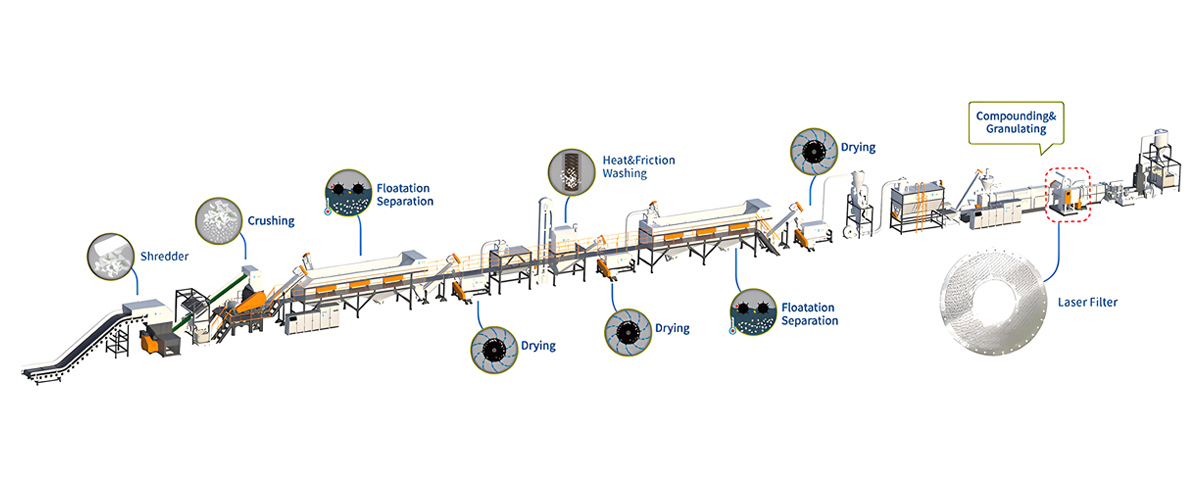
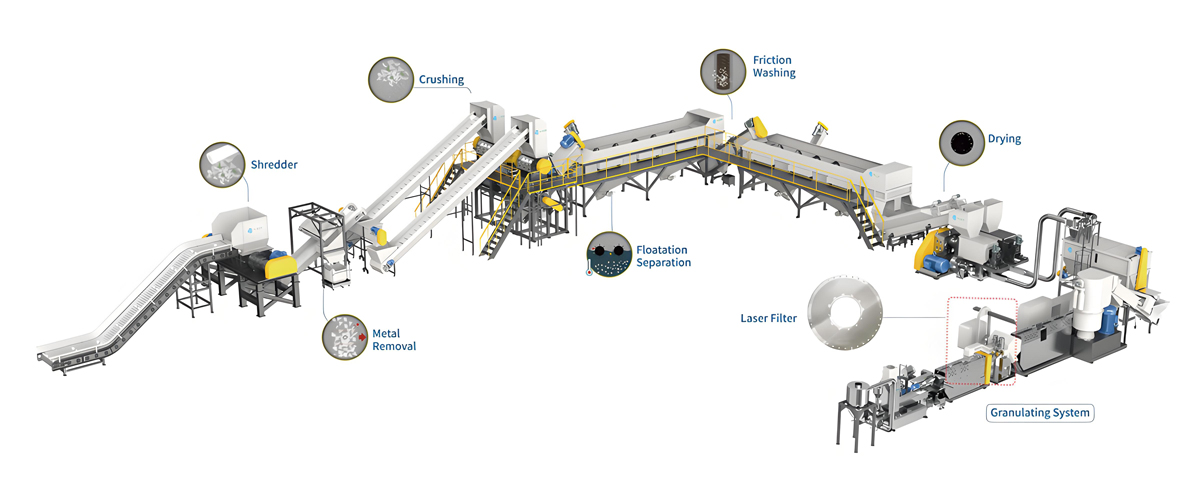
A washing line is only as fast as its slowest stage, so understanding the throughput ceiling of each stage is the foundation of any speed program. A modern washing line moves bottle bales or baled film through infeed, label removal, size reduction, pre-wash and friction washing, sink-float separation, hot wash, dewatering, drying, and final sorting. Every stage has its own limiting factor, and the way you raise capacity at one stage is different from the next. Below we walk the line in order, naming the throughput limit and the practical speed levers for each stage.
1. Infeed and Label Removal
Metered, even feeding sets the pace for everything that follows, because surges overload downstream stages and starve them in turn. The infeed conveyor and metering system should deliver a steady, uniform mass flow rather than clumps, and the label remover, sometimes called a de-labeler or beater machine, strips the bulk of paper and film labels before size reduction. Efficient label removal directly lowers the organic and fiber load carried into friction washing and hot wash, which means the later stages can run faster because they have less residue to clean. When infeed is uneven or de-labeling is weak, the friction washer and hot wash become bottlenecks that were actually created upstream.
2. Crushing and Granulating
Size reduction converts bottles and film into flake, and its throughput depends on blade sharpness, screen aperture, feed rate, and motor load. A wet granulator with sharp blades and a correctly sized screen produces a narrow flake size band at high rate, while dull blades and an undersized screen generate excess fines and heat. There is a direct trade-off between throughput and flake size: pushing feed rate too hard against a fine screen spikes motor load, raises fines, and degrades size uniformity. Keeping blades sharp, matching screen aperture to the target flake, and monitoring motor amperage let you run the granulator near its true ceiling without wrecking size quality.
3. Pre-Wash and Friction Washing
The friction washer is the workhorse of cleanliness, using high-speed rotation, water, and flake-on-flake abrasion to scrub off glue, dirt, and organic film. Its throughput is governed by rotor speed, residence time, water volume, and the mechanical intensity it applies. Running flake through faster shortens residence time, so cleanliness falls unless rotor speed or water action rises to compensate. There is also a balance with fines: extremely aggressive friction cleans well but can shave fine powder from the flake, so the goal is enough intensity to remove contamination without generating excess fines. This balance of residence time versus intensity is the single most important concept for speeding up the wash without losing cleanliness.
4. Sink-Float Separation
Sink-float tanks separate polymers by density, letting PET sink while polyolefins such as PP and PE float, and their throughput depends on tank residence time, agitation, and the density difference of the mixed stream. Adequate residence time lets flakes reach their equilibrium level so the separation is clean. Pushing flow through too fast shortens residence time and increases the risk of entrainment, where the wrong polymer is carried over the weir before it can settle or rise. Speeding up sink-float therefore usually means a longer or larger tank, better flow distribution, and controlled agitation, rather than simply raising the flow rate through the existing tank.
5. Hot Wash
Hot wash is where stubborn adhesives, oils, and PVC glue residues are attacked with heat, caustic or detergent, and time, and it is decisive for food grade PET flake. Its cleaning power is a function of temperature, chemical concentration, and residence time. When you speed up the line and shorten hot wash residence time, you must compensate by raising temperature or chemical concentration to keep detergency equivalent, or cleanliness and odor suffer. Hot wash is also energy intensive, so it interacts strongly with the energy and water discussion later in this guide. A well-designed hot wash gives the operator clear, controllable knobs to trade time for intensity as the line speeds up.
6. Dewatering by Centrifuge
Mechanical dewatering, usually a high-speed centrifuge, spins water off the flake and is one of the most common speed bottlenecks in the whole line. Its performance depends on rotor speed and how much flake it can process while still hitting the residual moisture handoff to drying. Pushed too hard, a dewatering centrifuge leaves the flake too wet for the dryer to finish, and it can also generate fines through mechanical action. Because residual moisture is a hard specification for downstream pelletizing, an undersized dewatering stage forces the whole line to slow down. Widening this stage, by a larger or higher-speed centrifuge, is frequently the highest-value debottlenecking move a plant can make.
7. Drying
Drying completes moisture removal using mechanical dewatering followed by thermal or centrifugal drying, and hitting the moisture target is a precondition for good pelletizing. Thermal dryers add hot air energy to drive off the last water, and their capacity is limited by air flow, temperature, and dwell time. Because moisture content must reach target before flake can be pelletized or shipped as food grade, the dryer very often caps the line speed. When the dryer is the bottleneck, raising line rate without expanding drying capacity simply produces wet flake that fails specification. Right-sizing the dryer, combining efficient mechanical dewatering with adequate thermal capacity, is essential for any real speed increase.
8. Sorting and Contaminant Removal
Final sorting protects contamination level with metal separation, air classification to remove fines and light contaminants, and optical or near-infrared sorting concepts for polymer purity. These stages are easy to overlook when chasing speed, yet they are exactly where faster flow lets metal fragments or foreign polymers slip through. Metal detectors and magnetic separators must be sized for the peak flow, and air classification and screening must keep pace so fines and dust do not accumulate in the product. Treating sorting as a first-class part of the throughput plan prevents the quiet quality failures that only show up when a customer rejects a shipment.
Key principle: every washing line stage has its own throughput ceiling, and the line runs at the speed of the lowest ceiling. Raise the whole line only after you have identified and widened that single limiting stage.
Bottleneck Analysis: Find It, Widen It, Then Speed Up
The disciplined path to higher washing line speed is takt matching: measure the real throughput of every stage, find the one with the lowest ceiling, widen it, and repeat. Takt is simply the pace at which material must move through each stage to hit the target line rate. When one stage cannot sustain that pace, it becomes the bottleneck and dictates the whole line, no matter how much spare capacity the other stages have. Adding power or speed anywhere except the bottleneck wastes money and often makes quality worse, because it pushes more material into the stage that was already struggling.
Bottleneck analysis starts with honest measurement under real feedstock, not nameplate figures. Run the line at its normal rate and record the actual sustainable throughput of each stage, the motor load or amperage, the residence time, and the quality indicator most at risk at that stage. The stage with the lowest sustainable throughput at acceptable quality is the true bottleneck. In most washing lines this turns out to be dewatering or drying, because moisture is a hard specification, but it can also be the friction washer for heavily contaminated feed or the granulator for tough, thick material. Only after you have named the bottleneck should you decide how to widen it.
Widening happens in a deliberate order. First widen the identified bottleneck to lift the whole line, then re-measure, because a new bottleneck will emerge at the next lowest ceiling. Chase the moving bottleneck stage by stage until the line balances at the target rate with all quality indicators in range. This iterative approach is far cheaper and far safer than a blanket upgrade of every stage, and it is how our engineers plan capacity expansions on existing lines. The table below summarizes typical stage ceilings, how to recognize when each is the bottleneck, and the practical means to widen it.
Stage Throughput, Bottleneck Signs, and Widening Levers
| Stage | Signs It Is the Bottleneck | Widening Lever | Quality Risk If Ignored |
|---|---|---|---|
| Infeed and label removal | Surging feed, high residue into wash | Metered feed, stronger de-labeling | Cleanliness, fiber contamination |
| Crushing and granulating | High motor amperage, excess fines | Sharper blades, larger rotor and screen | Size uniformity, fines loss |
| Friction washing | Residue on flake at target rate | Larger or additional friction washer | Cleanliness, odor |
| Sink-float separation | Polymer carry-over at higher flow | Longer or larger float tank | Contamination level |
| Hot wash | Glue and oil surviving at speed | More volume, higher temperature or dosing | Cleanliness, color, odor |
| Dewatering centrifuge | Flake too wet into dryer | Higher speed or larger centrifuge | Residual moisture, fines |
| Drying | Moisture off target at higher rate | Larger thermal dryer, better dewatering upstream | Residual moisture, pelletizing stability |
| Sorting and metal removal | Metal or foreign polymer slipping through | Right-sized detection and classification | Contamination level |
Reading this table top to bottom is a diagnostic checklist. Walk your line, tick which signs you see, and the bottleneck reveals itself. The plants that improve washing line speed most reliably are the ones that resist the urge to upgrade everything and instead spend their capital on the one or two stages that actually cap the line.
Engineering Levers That Add Speed Without Losing Quality
Once the bottleneck is known, several engineering levers let you raise throughput while holding every quality indicator in range. These levers are not tricks; they are the physics of washing applied deliberately. Used together, they let a line run meaningfully faster while keeping flake clean, dry, uniform, and low in contamination. Used carelessly, any one of them can be the source of the very quality loss you are trying to avoid.
Increase Bottleneck Stage Capacity Directly
The most straightforward lever is to add capacity exactly where the bottleneck lives: a larger or additional friction washer, a longer or larger sink-float tank, a higher-speed or larger dewatering centrifuge, or a bigger thermal dryer. Because this capacity is added at the limiting stage, it lifts the entire line rather than shuffling the constraint sideways. This is why our capacity expansion projects always begin with a stage-by-stage throughput audit rather than a generic upgrade quote. Adding the right module in the right place is the difference between a genuine speed gain and expensive machinery that changes nothing.
Trade Residence Time for Intensity, Keeping Cleaning Equivalent
Cleaning is roughly the product of residence time and intensity, so when speeding up shortens residence time you can preserve results by raising intensity. In practice this means that if hot wash dwell time falls, you raise temperature or chemical concentration to keep detergency equivalent; if friction washer residence time falls, you raise rotor speed or mechanical action. The key word is equivalent: the goal is to hold the total cleaning effect constant, not to guess. Establishing the residence-time-times-intensity relationship for your feedstock, through trials on a real sample, is what turns this from theory into a reliable operating recipe as the line speeds up.
Manage Water: Counter-Current Rinsing, Filtration, and Recirculation
Water is the medium that carries contamination away, so at higher throughput water management is what keeps flake clean. Counter-current rinsing, where the cleanest water meets the cleanest flake and dirty water flows back toward the dirty end, maximizes cleaning per liter of fresh water. Recirculation with filtration recovers and reuses process water so that higher throughput does not simply mean proportionally more fresh water. Water quality itself matters: recirculated water must be filtered well enough that it does not redeposit contamination on the flake. A line that speeds up without upgrading water treatment will see cleanliness fall, because the extra contamination load overwhelms the water system.
Automation and Inline Detection
Automation removes the human variability that quietly caps safe line speed. Inline moisture, turbidity, and contamination monitoring give operators live feedback so they can hold quality at higher rates instead of running conservatively for fear of drift. Automated chemical dosing keeps hot wash concentration on target as flow changes, and load-adaptive feeding smooths the surges that overload downstream stages. Together these controls let a line run closer to its true ceiling with confidence, because the process reacts to disturbances in seconds rather than waiting for a shift-end laboratory sample. Automation is often the cheapest way to unlock the last increment of safe speed on an otherwise capable line.
Stabilize Incoming Feed Quality
The cleaner and more consistent the feedstock, the faster the washing line can run, because it has less contamination to remove and fewer surges to absorb. Better upstream sorting, tighter bale specifications, and pre-removal of gross contaminants all reduce the load on every wash stage, which directly translates into headroom for higher speed. This is why feedstock discipline is not a separate topic from washing line speed; it is one of the most powerful speed levers available. A plant that invests in incoming material quality frequently finds it can raise throughput with little or no change to the wash equipment itself.
Practical rule: when you shorten residence time to go faster, raise intensity by an equivalent amount, and upgrade water treatment in step. Speed, cleaning intensity, and water management move together or quality falls.
The Speed to Quality Trade-off, Quantified
Every speed increase has a predictable direction of effect on quality and consumption, and quantifying it turns guesswork into planning. The table below expresses, in relative terms, what typically happens to cleanliness, residual moisture, fines loss, energy use, and water use as a line is pushed 10, 20, and 30 percent above its balanced baseline without any compensating upgrades. The percentages describe direction and relative magnitude, not exact laboratory results for a specific feed, and they assume the line is not debottlenecked as it speeds up. The point is to show how quickly quality erodes when speed runs ahead of capacity, and therefore how much compensating investment each speed step requires.
Relative Speed-to-Quality Trade-off (No Compensating Upgrade)
| Effect Area | +10% Speed | +20% Speed | +30% Speed |
|---|---|---|---|
| Cleanliness (residue) | Slightly worse, usually recoverable | Noticeably worse without intensity boost | Significant risk of out-of-spec residue |
| Residual moisture | Marginal rise if dryer has headroom | Clear rise as dryer nears its ceiling | Likely off target; dryer becomes limiting |
| Fines loss | Small increase | Moderate increase from harder mechanical action | Large increase; yield and uniformity suffer |
| Specific energy per kg | Roughly flat to slightly lower | Flat, then rising if drying is forced | Rising as stages run past efficient range |
| Specific water per kg | Flat with good recirculation | Rising unless water treatment is upgraded | Rising sharply to hold cleanliness |
| Required compensating action | Minor tuning of intensity and dosing | Debottleneck one stage; add water treatment | Debottleneck multiple stages; larger dryer and centrifuge |
The pattern is clear: modest speed gains up to roughly ten percent are often achievable with careful tuning of intensity, dosing, and water quality, while gains of twenty to thirty percent almost always require real debottlenecking of the dewatering, drying, and water-treatment stages. Reading the last row as a shopping list keeps expectations honest. A plant that wants thirty percent more output should budget for widened bottleneck stages, not just a faster feed setting.
Energy and Water at Higher Throughput
Running faster raises absolute energy and water use, but specific consumption per kilogram of flake is what actually determines cost and sustainability, and it can be held flat or improved with good design. Hot wash heating and thermal drying dominate energy use, while friction washing, rinsing, and hot wash dominate water use. When a line speeds up, the naive expectation is that both climb in proportion, yet a well-engineered line resists that because several stages have fixed overheads that get spread across more output as throughput rises.
On the water side, the decisive factors are recirculation rate and water treatment. A line with counter-current rinsing and a robust filtration and recirculation loop can push a high share of its water back into the process, so higher throughput draws relatively little extra fresh water. The recirculation rate, expressed as the fraction of process water reused rather than discharged, is one of the most important design levers for both cost and environmental performance. When the recirculation loop is sized generously and filtered well, specific water use per kilogram of flake can stay roughly flat even as the line speeds up, which is exactly what allows fast running to remain clean and affordable.
On the energy side, heat recovery and efficient drying are the main levers. Recovering heat from hot wash water and from dryer exhaust reduces the energy needed to bring fresh process water and drying air up to temperature. Efficient mechanical dewatering upstream of the thermal dryer is doubly valuable, because every extra bit of water removed by spinning is water the energy-hungry dryer does not have to evaporate. The table below frames the relative direction of energy and water intensity as throughput rises, contrasting a line without water and heat recovery against one designed with recirculation and heat recovery.
Relative Energy and Water Intensity vs Design Approach
| Resource View | Conventional line, minimal recovery | Recirculation + heat recovery design | Direction as speed rises |
|---|---|---|---|
| Fresh water per kg flake | High; rises with speed | Low; high recirculation share | Held roughly flat with good loop |
| Water recirculation rate | Low share reused | High share reused after filtration | Higher reuse protects cleanliness at speed |
| Drying energy per kg | High; sensitive to wet infeed | Lower with strong dewatering first | Falls when centrifuge does more work |
| Hot wash energy per kg | High; heat lost to drain | Lower with heat recovery | Overhead spread over more output |
| Overall specific cost trend | Rises with speed | Flat to improving with speed | Design decides the outcome |
The takeaway is that energy and water intensity at higher speed are design choices, not fixed penalties. A washing line specified with strong dewatering, an efficient dryer, generous water recirculation, and heat recovery can run faster and cleaner while holding or even reducing its cost and environmental footprint per kilogram of flake produced.
Polyretec Washing Lines Built for Speed and Quality
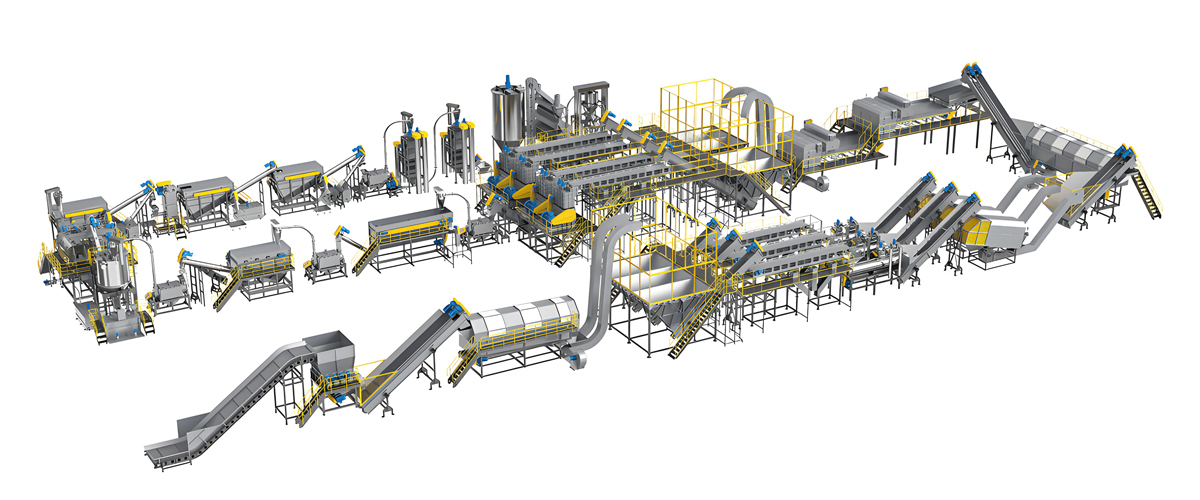
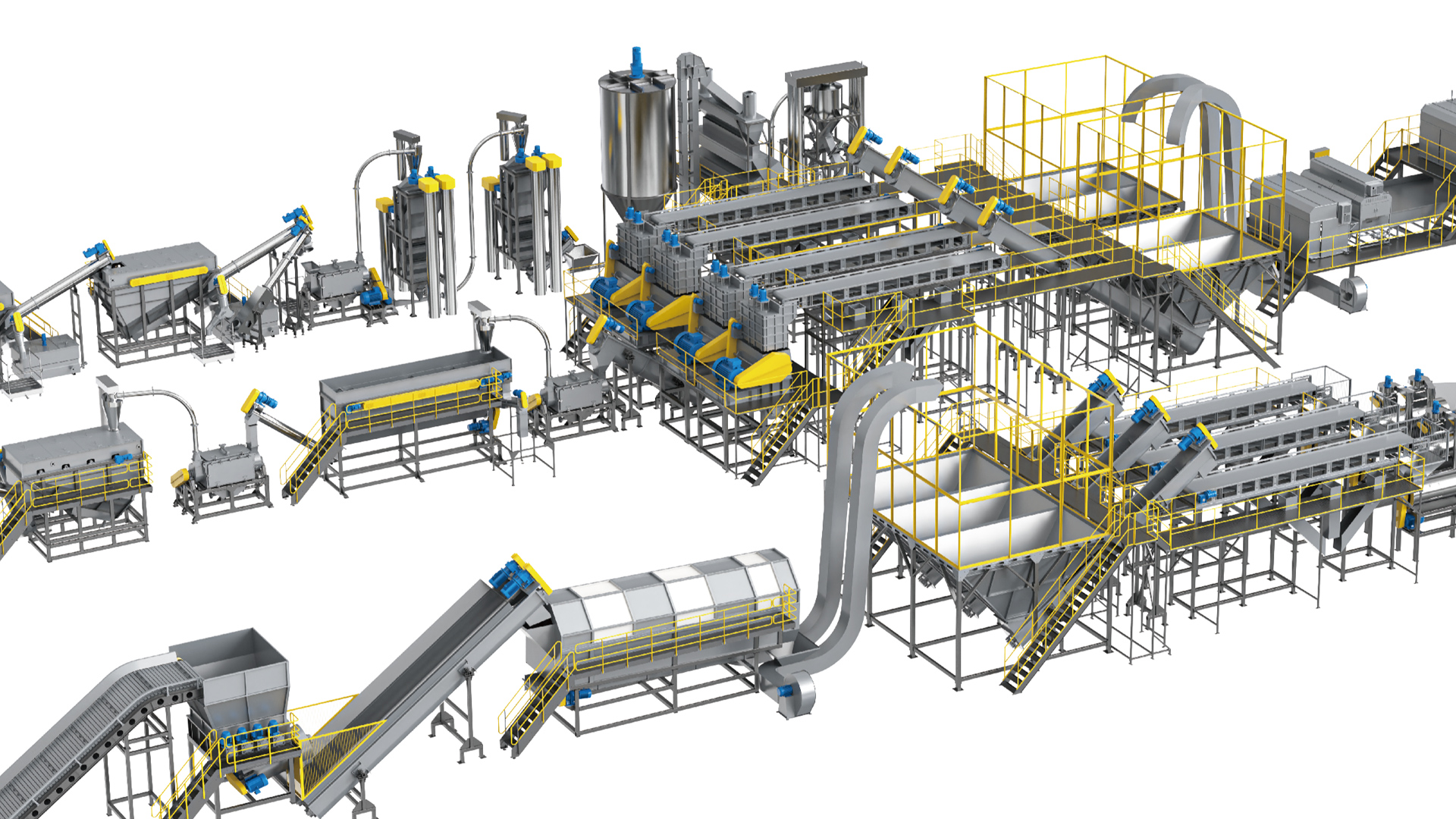
Polyretec designs washing lines so that speed and flake quality rise together, with the bottleneck stages sized generously and water and drying engineered for higher throughput. Drawing on Austrian process technology and Chinese manufacturing, our washing line family preprocesses waste plastics through crushing, cleaning, sorting, and drying, and each configuration is tailored to a specific feedstock and flake grade rather than sold as a one-size-fits-all box. Below are two washing line families that anchor most of our projects, each presented with a specification table using typical engineering ranges rather than fabricated exact figures. Final specifications are always set to your feedstock, contamination level, target output, and flake grade.
Food Grade PET Bottle Washing Line (500 to 6000 kg/h)
The Food Grade PET Bottle Washing Line is our flagship for bottle-to-bottle and high-value rPET flake, engineered around the stages that decide food grade cleanliness and moisture. It carries a full stage set: metered infeed and label removal, wet granulating, pre-wash and friction washing, sink-float separation, hot wash for glue and oil removal, high-speed dewatering, and thermal drying, with metal separation and water treatment integrated throughout. Because it is offered from 500 to 6000 kg/h and designed for different flake grades, the hot wash, dewatering, and drying stages are sized so that speed increases do not force moisture or cleanliness out of range. This is the line most suited to the residence-time-versus-intensity strategy described earlier, because its hot wash and friction stages give operators clear, controllable knobs.
| Capacity Tier | Suitable Feed Form | Main Stage Configuration | Installed Power (typical) | Water & Recirculation | Footprint (typical) |
|---|---|---|---|---|---|
| 500 to 1000 kg/h | Baled PET bottles, mixed color | Label removal, granulate, friction, float, hot wash, dewater, dry | Approx. 150 to 250 kW | Filtration loop; high recirculation share | Approx. 200 to 400 m² |
| 1500 to 3000 kg/h | Baled PET bottles, higher contamination | Full stage set with enlarged hot wash and dewatering | Approx. 300 to 550 kW | Multi-stage filtration; heat recovery option | Approx. 500 to 900 m² |
| 4000 to 6000 kg/h | Baled PET bottles, food grade target | Full stage set with redundant dewater and drying capacity | Approx. 600 to 1000 kW | Large recirculation and treatment; heat recovery | Approx. 1000 to 1600 m² |
Across all tiers, the design philosophy is the same: size the dewatering and drying stages so that residual moisture stays on target even at the top of the capacity band, and build in the water treatment needed to keep cleanliness high as throughput rises. That is what lets a food grade PET line run near its rated speed without slipping out of specification.
PP/PE Soft Plastic Crushing & Washing Line (500 to 1500 kg/h)
The PP/PE Soft Plastic Crushing and Washing Line is purpose-built for flexible feedstock such as film, woven bags, and agricultural film, where high organic and mud contamination make washing intensity and water management critical. Soft plastics behave very differently from rigid bottles: they trap dirt and moisture, they are prone to wrapping and clumping, and they demand robust size reduction and aggressive friction washing to reach acceptable cleanliness. This line pairs heavy-duty crushing with strong friction washing and thorough dewatering, and one-step pelletizing can be integrated where the output feeds directly into repelletizing. Its throughput band of 500 to 1500 kg/h reflects the reality that heavily contaminated soft plastics wash more slowly per kilogram than clean rigid bottles.
| Capacity Tier | Suitable Feed Form | Main Stage Configuration | Installed Power (typical) | Water & Recirculation | Footprint (typical) |
|---|---|---|---|---|---|
| 500 to 800 kg/h | Packaging film, woven bags, light soil | Crushing, pre-wash, friction wash, float, dewater, dry | Approx. 120 to 200 kW | Recirculation with mud and fines removal | Approx. 180 to 350 m² |
| 1000 to 1500 kg/h | Agricultural film, heavy mud and soil | Heavy-duty crushing, multi-stage friction, extended float, strong dewater | Approx. 220 to 380 kW | High-capacity treatment; sludge handling | Approx. 350 to 650 m² |
For soft plastics, the fastest safe throughput is closely tied to feed cleanliness and to the capacity of the mud and fines removal in the water loop. Where output flows directly into repelletizing, integrating one-step pelletizing removes an intermediate handling step and helps keep the whole recycling chain balanced from wash to pellet.
Applications: What Clean, Fast Flake Feeds
The value of running a washing line faster while protecting flake quality is measured entirely in the end products that the flake can serve. Clean, dry, uniform flake opens the door to high-value markets, while inconsistent flake is confined to low-value uses or rejected outright. Two application families dominate our projects, and each rewards the discipline of speed-with-quality in a different way.
Food grade rPET flake from PET bottle washing lines feeds the highest-value recycling streams. When cleanliness, color, low contamination, and low moisture are all held in range, the flake can go into bottle-to-bottle rPET for beverage and food packaging, into polyester fiber for textiles and nonwovens, into strapping band, and into thermoformed sheet for trays and packaging. Each of these end uses has strict quality expectations, and each is where the difference between fast-but-dirty and fast-and-clean flake shows up as either a premium sale or a rejected lot. A PET washing line that speeds up while holding food grade quality is, in effect, protecting access to the most profitable market for the flake.
PP and PE soft film flake from soft plastic washing lines feeds a broad set of durable and semi-durable products. Washed agricultural film, packaging film, and woven bag flake are pelletized and used in film for non-food applications, in molded and extruded goods, in construction and agricultural products, and in a range of second-life items where consistent, clean regrind is essential for stable processing. Here too, cleanliness and moisture decide whether the pellet runs cleanly on downstream extrusion and molding equipment or causes filter blocking, degradation, and defects. Fast, clean flake is what makes the downstream converter’s process stable, which is the real reason customers pay for quality.
In both families the chain is the same: the washing line produces flake, the flake is pelletized or used directly, and the pellet or flake becomes a new product. Speeding up the wash without protecting quality breaks that chain by producing flake that cannot reach its intended end use. This is why Polyretec treats flake quality indicators as the true output specification of a washing line, with throughput as a target to hit within those specifications rather than at their expense.
Matching Feedstock to the Right Line
Choosing the right washing line configuration starts with four questions: what is the feed type, how contaminated is it, what output do you need, and what flake grade must you hit. The answers point directly to a line family and capacity band, and getting them right at the specification stage is what prevents the bottlenecks and quality problems that plague mismatched lines. A line specified for clean rigid bottles will struggle with muddy agricultural film, and a line sized for general grade will not reliably deliver food grade flake no matter how carefully it is run. The selection table below maps common feedstock and grade combinations to a recommended Polyretec configuration and capacity band.
Feedstock to Washing Line Selection Guide
| Feed Type | Contamination | Target Output | Flake Grade | Recommended Configuration |
|---|---|---|---|---|
| PET bottles | Low to medium | 500 to 1000 kg/h | Food grade rPET | Food Grade PET Line, entry tier, full hot wash |
| PET bottles | Medium to high | 1500 to 3000 kg/h | Food grade rPET | Food Grade PET Line, mid tier, enlarged dewater and dry |
| PET bottles | Medium to high | 4000 to 6000 kg/h | Food grade rPET | Food Grade PET Line, high tier, redundant drying capacity |
| PP/PE packaging film | Light to medium | 500 to 800 kg/h | General grade | PP/PE Soft Line, entry tier |
| Agricultural film | Heavy mud and soil | 1000 to 1500 kg/h | General grade | PP/PE Soft Line with heavy-duty crushing and mud removal |
| Woven bags | Medium | 500 to 1200 kg/h | General grade | PP/PE Soft Line, optional one-step pelletizing |
Use this guide as a starting point, then let our engineers refine it against a real sample of your feedstock. The most reliable selection always combines a representative material sample with clear targets for output and flake grade, so the line is sized to run fast at your required quality rather than fast on paper only.
Common Speed Traps: Cause and Cure
Most washing line speed failures fall into a small set of recurring patterns, and recognizing them early prevents an expensive quality incident. The troubleshooting table below collects the classic speed traps our engineers see when a line is pushed past its balanced rate, each paired with its usual root cause and a practical corrective action. Use it as a fast diagnostic when quality drifts after a speed increase, and note how many of the cures point back to the bottleneck and residence-time-versus-intensity principles established earlier.
Washing Line Speed Traps, Causes, and Cures
| Speed Trap Symptom | Likely Root Cause | Corrective Action |
|---|---|---|
| Residual moisture over target | Dewatering or drying is the bottleneck | Enlarge centrifuge and dryer; improve dewater before drying |
| Residual labels and glue on flake | Hot wash residence time too short | Raise temperature or dosing; add hot wash volume |
| Fines suddenly spike | Over-aggressive friction or dull granulator blades | Tune friction intensity; sharpen blades; check screen |
| Wrong polymer in the flake | Sink-float carry-over at high flow | Lengthen float tank; improve flow distribution and agitation |
| Flake color turning grey or yellow | Incomplete wash of dyes and residue | Restore cleaning intensity; upgrade water treatment |
| Metal fragments slipping through | Metal detection undersized for peak flow | Right-size magnetic and metal separators for peak rate |
| Dewatering centrifuge overload trips | Feed surge or excess capacity demand | Meter feed; add load-adaptive control; enlarge centrifuge |
| Dryer cannot finish moisture | Wet infeed and undersized thermal capacity | Strengthen mechanical dewater; add dryer capacity |
| Persistent odor in flake | Weak hot wash detergency at speed | Raise hot wash temperature and dosing; verify contact time |
| Cleanliness falls despite hot wash | Recirculated water too dirty | Upgrade filtration; increase fresh water at rinse; counter-current flow |
| Granulator amperage spikes | Feed rate outruns cutting capacity | Meter feed; sharpen or replace blades; size rotor to target |
| Downstream pelletizing unstable | Flake wet or contaminated from rushed wash | Return moisture and cleanliness to spec before raising rate |
| Water loop foaming or overflowing | Treatment cannot keep pace with load | Expand water treatment and recirculation capacity |
Notice the recurring theme across these cures: nearly every speed trap traces back either to an undersized bottleneck stage or to intensity and water treatment that were not raised in step with speed. Fixing the symptom at the surface rarely works; fixing the underlying balance almost always does.
Downstream Integration and Relative Cost
Washing line performance flows directly downstream, because flake moisture and cleanliness determine how well the pellet extrudes and how stable the final product becomes. Wet flake causes venting and degradation problems in pelletizing, contaminated flake blocks melt filters and creates defects, and non-uniform flake makes dosing and melt flow inconsistent. This is why a washing line should never be specified in isolation from what comes next. For downstream pelletizing, Wanplas supplies matched pelletizing systems that integrate directly with Polyretec washing lines, so the flake specification the wash produces is the flake specification the pelletizer expects, and the two stages are balanced as one chain rather than bolted together as an afterthought.
The economics of speeding up should be evaluated in relative terms rather than absolute figures, because every plant faces different local conditions. We therefore express cost impacts as a relative index where a balanced baseline line equals 100 index points, and speed or upgrade options are compared as a percentage or multiple of that baseline. This keeps the focus on the direction and magnitude of investment rather than on any specific amount, and it lets you weigh a speed step against its true cost of debottlenecking. The table below frames the relative investment and operating cost direction of common speed strategies against the baseline of 100 index points.
Relative Cost Index of Speed Strategies (Baseline = 100 Index Points)
| Speed Strategy | Relative Investment | Relative Index vs Baseline 100 | Quality Outcome |
|---|---|---|---|
| Tuning intensity and dosing only | Low | About 100 to 105 index points | Maintained for small speed gains |
| Adding automation and inline sensors | Low to Medium | About 105 to 115 index points | Improved stability at higher rate |
| Debottlenecking one stage | Medium | About 1.2 to 1.4 times baseline | Maintained for moderate speed gains |
| Upgrading water treatment and recovery | Medium to High | About 1.3 to 1.6 times baseline | Cleanliness held; lower specific water |
| Multi-stage debottleneck for large gains | High | About 1.6 to 2 times baseline | Maintained for large speed gains |
| New high-capacity line | Very High to Premium | More than 2 times baseline | Designed for speed and quality together |
The relative view makes the decision logic visible. Small speed gains are cheap and low risk, moderate gains justify targeted debottlenecking, and large gains eventually favor a purpose-built high-capacity line where speed and quality are engineered together from the start. Matching the investment level to the speed goal, rather than over- or under-investing, is the essence of a sound capacity plan.
Service, Support, and Commissioning
A washing line only reaches its rated speed at target quality when it is installed, commissioned, and supported properly, which is why Polyretec pairs its equipment with the full Wanplas service commitment. Before shipment, each line is trialed and tested at the factory so that its stages are verified together, not just individually, and so that the balance between throughput and quality is proven before the machinery ever leaves our facility. This pre-shipment testing is the first line of defense against the bottlenecks and quality surprises that otherwise appear only after installation.
On site, our engineers handle installation and commissioning, tuning each stage to your real feedstock so that the residence-time-versus-intensity balance is set correctly for your material from day one. With 24+ engineers available for assistance and a globalization service network spanning more than 50 countries, support does not end at start-up. As a group policy shared across Wanplas factories, customers receive USD 500 in free parts per year, along with warranty replacement of damaged parts, so routine wear does not become an unexpected burden. Spare parts planning, process training for operators, and remote support round out the package so your team can hold quality as they push for speed.
We also welcome customers to visit under our open factory policy, to see washing lines running before they buy and to bring feedstock samples for trial runs. Seeing a line process material similar to your own, and measuring the resulting flake quality at a given speed, is the most convincing way to confirm that a configuration will deliver the throughput you need at the quality your customers demand. This combination of pre-shipment testing, on-site commissioning, ongoing engineering support, and open trials is how Polyretec, backed by the Wanplas brand and its 10+ years of credible commitment, turns a speed target into a reliable, repeatable result.
Frequently Asked Questions
Can I increase washing line speed without buying a new line?
Often yes. Many lines have only one or two limiting stages, usually dewatering or drying, and debottlenecking those stages while improving upstream sorting and adding automated dosing can lift throughput by roughly 10 to 20 percent while holding flake quality. A full replacement is only justified when your speed goal exceeds what targeted debottlenecking can deliver. The right first step is always a stage-by-stage throughput audit, not a new-line quote.
Which washing line stage is the most common speed bottleneck?
Dewatering and drying are the most frequent bottlenecks because residual moisture is a hard specification for downstream pelletizing and food grade shipment. If the dewatering centrifuge or thermal dryer cannot keep pace, the whole line must slow to protect the moisture target. For heavily contaminated feed, the friction washer or hot wash can also become the bottleneck, and for tough thick material it can be the granulator.
How does faster throughput affect flake cleanliness?
Faster throughput shortens residence time in the friction washer, hot wash, and float tanks, which reduces cleaning unless intensity is raised to compensate. To keep cleanliness constant you must raise temperature, chemical concentration, or mechanical action so that the product of residence time and intensity stays equivalent. Without that compensation, residual labels, glue, and oil remain on the flake and cleanliness falls below specification.
What flake quality indicators must be protected when speeding up?
The core indicators are surface cleanliness, residual moisture content, contamination level from other polymers and metals, flake size uniformity, color, and odor, plus overall suitability for the downstream process. Each has an acceptable threshold tied to the end use, with food grade rPET far tighter than general grade. A genuine speed gain keeps every indicator inside its threshold; anything that pushes even one out of range is a quality loss, not a productivity gain.
Does higher speed always mean higher water and energy use?
Absolute water and energy use rise with throughput, but specific consumption per kilogram of flake can stay flat or even fall with good design. Counter-current rinsing, water recirculation with filtration, efficient mechanical dewatering, and heat recovery let a line run faster without a proportional rise in fresh water and energy per kilogram. In practice, water and energy intensity at higher speed are design choices rather than fixed penalties.
How do I match feedstock to the right Polyretec washing line?
Match by feed type, contamination level, target output, and flake grade. Food grade rPET flake needs the Food Grade PET Bottle Washing Line, offered from 500 to 6000 kg/h with full hot wash and water treatment, while film, woven bags, and agricultural film suit the PP/PE Soft Plastic Crushing and Washing Line at 500 to 1500 kg/h. The most reliable selection combines these criteria with a trial run on a real sample of your material.
Is automation worth it for a mid-size washing line?
For most mid-size lines, automation is one of the cheapest ways to unlock the last increment of safe speed. Inline moisture, turbidity, and contamination monitoring, automated chemical dosing, and load-adaptive feeding remove the human variability that forces operators to run conservatively. The result is a line that holds quality closer to its true throughput ceiling, which is exactly what you want when demand rises and every kilogram of clean flake counts.
Conclusion
Improving washing line speed without sacrificing flake quality is achievable, but only when speed is treated as an engineering outcome rather than a setting. Define flake quality precisely, map the throughput ceiling of every stage, find and widen the single limiting bottleneck, trade residence time for intensity in equivalent amounts, and upgrade water treatment and drying in step with the speed you add. Do those things and cleanliness, moisture, contamination, uniformity, color, and odor all stay in range while output climbs. Skip them and the flake simply gets wetter, dirtier, and fuller of fines the faster you run. The quantified trade-off, the bottleneck map, and the speed-trap table in this guide exist to keep that discipline in front of you every time demand tempts you to open the feed gate.
Polyretec, a Wanplas factory, designs washing lines so that speed and quality rise together, from the Food Grade PET Bottle Washing Line at 500 to 6000 kg/h to the PP/PE Soft Plastic Crushing and Washing Line at 500 to 1500 kg/h, backed by pre-shipment testing, on-site commissioning, 24+ engineers, and the Wanplas group service commitment. If you want to run faster while protecting flake quality, share a sample of your feedstock along with its contamination and moisture profile, your target output, and the flake grade you must reach, and our engineers will design a proposal that raises throughput within your quality specification. You are also welcome to send material for a trial run and to visit the factory to see the line perform before you decide. Turn waste into treasure, at the speed your market demands and the quality your customers require.