
Table of Contents
- 1. Understanding LDPE and LLDPE Film Waste as a Recycling Feedstock
- 2. Why Film Waste Is Hard to Pelletize
- 3. The Austrian Technology Route for Film Pelletizing
- 4. The Five-Stage Pelletizing Process Explained
- 5. New Generation Pelletizing Line
- 6. PP/PE Soft Plastic Crushing and Washing Line With One-Step Pelletizing
- 7. Recycled Pellet Quality Specifications
- 8. Single-Stage vs Twin-Stage Pelletizing
- 9. Energy Consumption and Throughput
- 10. Application Industries for Recycled LDPE/LLDPE Pellets
- 11. Selection Guide: Feedstock to Model Recommendation
- 12. Common Problems, Causes and Solutions
- 13. Upstream Integration With Washing and Drying
- 14. Service and Support
- 15. Frequently Asked Questions
- 16. Conclusion and Next Step
Understanding LDPE and LLDPE Film Waste as a Recycling Feedstock
Polyretec, a Wanplas factory, is a well-known manufacturer of plastic recycling equipment whose history dates back to 2010, with the brand established in 2017. By combining advanced Austrian technology with Chinese manufacturing strength, Polyretec delivers cost-effective, high-performance recycling solutions for both post-consumer and post-industrial plastic waste. With 100+ project experience, service in 50+ countries, 24+ engineer assistance, and a 10+ year credible commitment, Polyretec operates under the slogan “Turn Waste Into Treasure.” Among its core recycling families, the pelletizing line for LDPE and LLDPE film waste represents one of the most technically demanding yet economically valuable recovery routes in the plastics industry.
Low-density polyethylene (LDPE) and linear low-density polyethylene (LLDPE) are the two workhorse resins behind the flexible film that surrounds modern life. LDPE is a branched, low-crystallinity polyethylene with a density typically between 0.910 and 0.940 grams per cubic centimeter, while LLDPE is a linear polymer built with short-chain branches that give it higher tensile strength and puncture resistance at similar density. Both share a melt flow rate (MFR) that varies widely by grade, commonly from under 0.5 to over 50 grams per 10 minutes depending on whether the film is a heavy-duty shipping sack or a thin lamination layer. Together they make up the bulk of single-use and flexible packaging film: shopping bags, stretch wrap, shrink film, agricultural mulch, bubble wrap, printed roll stock, and industrial liners.
The reason this family attracts so much recycling attention is simple arithmetic. Film is light, cheap to produce, and generated in enormous volume, yet it is almost never returned through rigid-container collection streams. When recovered, clean or moderately contaminated LDPE/LLDPE film can be re-extruded into pellets that compete closely with virgin resin for many non-critical applications, recovering most of the original polymer value. The catch is that film is one of the hardest plastic waste forms to convert back into uniform, reusable pellets, and that difficulty is exactly what an Austrian-technology pelletizing line is engineered to overcome.
This article focuses on the pelletizing line itself, the downstream conversion of film waste into recycled pellets, and the engineering choices that determine final pellet quality. It does not cover washing-line speed optimization as a separate topic; instead it explains how the pelletizer receives, conditions, melts, degasses, filters, and cuts film feedstock into consistent granules, and how Polyretec configures that line for different film types and target end uses.
Why Film Waste Is Hard to Pelletize
Film waste behaves unlike any other plastic recycling feedstock. A rigid bottle flake drops predictably into a hopper; a loose LDPE bag floats, folds, and bridges. Understanding the physical and chemical reasons film is difficult is the first step toward selecting the right pelletizing configuration.
Low Bulk Density and Poor Flow
Loose film has an extremely low bulk density, often below 100 kilograms per cubic meter for shredded post-consumer bags. That means a hopper that would hold hundreds of kilograms of flake holds only a few kilograms of film. The material traps air, folds on itself, and resists gravity feeding. Conventional gravity hoppers and simple screw feeders stall, surge, or form stable arches over the throat, a phenomenon called bridging. The Austrian-technology approach treats this from the start with an integrated shredder-feeder or a crammer-assist forced feeder that meters material independent of its natural flow behavior.
Entanglement and Wrapping
Film is flexible and tends to wrap around rotating shafts, screws, and agitators. Once a film web catches on a shaft, it can build into a solid mass that jams the feed section. Pre-cutting into fluff or agglomerating the film into a denser, more manageable form reduces wrapping and stabilizes the feed rate into the extruder barrel.
High Surface Area Means High Contamination Load
Film exposes more surface per kilogram than any other plastic form. That large surface carries printing ink, adhesives, paper labels, aluminum laminate, dust, and food residue. Printing solvent and residual volatiles are held in the polymer or on its surface. Water from washing, or simply ambient moisture, is retained in the folds. All of these must be removed or managed before the melt can be cut into clean pellets, or the result is porous, odorous, speckled granules unsuitable for film-to-film reuse.
Orientation and Shrinkage
Many films are biaxially oriented during production to gain strength. When heated in the extruder barrel, that orientation relaxes and the material tries to shrink, which can cause uneven melting, localized thermal degradation, and inconsistent residence time. The screw and barrel design must accommodate this relaxation smoothly rather than fighting it.
Variability of the Feedstock
Post-consumer film is never one material. A bale may contain LDPE and LLDPE blends, small amounts of polypropylene, polystyrene, or polyester, plus non-plastic contaminants. Heavily printed shopping bags differ from clean industrial stretch wrap, and agricultural film carries sand, stones, and ultraviolet stabilizer packages. Each variation shifts the ideal melt temperature, degassing requirement, and filtration level. A robust pelletizing line must tolerate this variability without constant operator intervention.
The Austrian Technology Route for Film Pelletizing
The phrase “Austrian technology” here describes a widely respected engineering philosophy for plastics reprocessing rather than any single supplier. It is characterized by tight integration of the front-end material handling with the extrusion and pelletizing core, intelligent process control, and a strong focus on removing volatiles and contaminants before the melt is cut. Polyretec adopts this philosophy and realizes it with Chinese manufacturing scale, which is why its lines are positioned as Austrian-technology pelletizing systems built for global film recyclers.
Integrated Shredder-Feeder-Extruder Concept
The defining feature is an integrated material path: a shredder or agglomerator feeds directly into a forced-feed throat on the extruder, eliminating the open hopper where bridging occurs. Film is cut or compacted close to the screw, and a crammer or side-feeder pushes it into the barrel at a rate controlled by the extruder’s melt pressure and motor load. This closed, feedback-driven feed loop is what lets a line run continuously on fluffy, low-bulk-density film instead of stalling every few minutes.
Intelligent Feed Regulation
Rather than a fixed screw speed, the control system modulates the feeder based on barrel fill, melt pressure at the screen changer, and motor amperage. If the melt pressure rises because a filter is loading, the feeder slows; if the barrel runs empty, it speeds up. The result is a stable, self-correcting throughput that protects the screw and barrel and produces consistent pellet quality hour after hour.
Long Single-Screw Plasticizing With Stable Melt
The Austrian route favors a generous single-screw extruder with a high length-to-diameter (L/D) ratio for thorough melting and mixing of film, supported by barrier and kneading elements where needed. The long barrel enables gradual temperature profiling, gentle shear, and uniform melt before the degassing and filtration stages. For applications needing compounding or very high output, Wanplas supplies matched twin-screw pelletizing systems that integrate with Polyretec lines, extending the configuration without changing the front-end film handling.
Strong Degassing and Fine Filtration
Two vacuum degassing zones are common on film lines because the feed carries both moisture and printing volatiles. Melt filtration uses continuous or dual-station screen changers, and for heavily contaminated film a laser-assisted filter concept can extend screen life. The combination suppresses porosity, odors, and black specks in the final pellet.
Stable, Repeatable Pelletizing
The cut is synchronized to melt pressure and throughput so pellet size stays uniform. Water-ring die-face hot cutting is typical for film because it handles the low-viscosity LDPE/LLDPE melt cleanly; underwater granulation is selected where the highest pellet uniformity and lowest dust are required.
The Five-Stage Pelletizing Process Explained
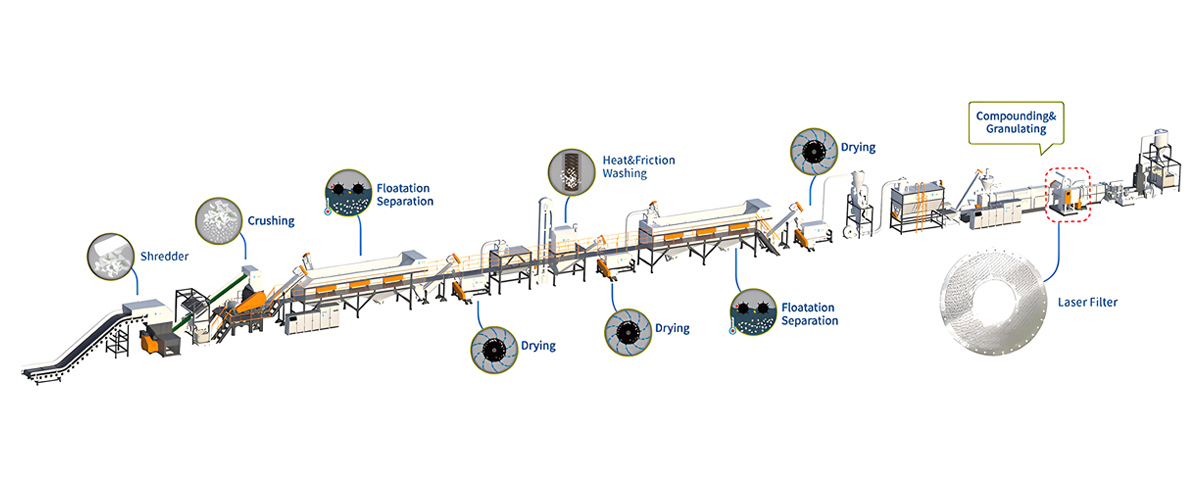
Every LDPE/LLDPE film pelletizing line, regardless of capacity, moves the material through five functional stages: feeding and shredding, plasticizing and extrusion, degassing, melt filtration, and pelletizing. The table below summarizes the function and target of each stage, followed by a detailed discussion.
| Stage | Function | Key Parameters | Process Target |
|---|---|---|---|
| 1. Feeding and Shredding | Metered intake of fluffy or baled film | Crammer speed, screw load feedback, cut size | Stable feed, load variation below 4 percent |
| 2. Plasticizing | Melt and homogenize the polymer | Barrel zones 160 to 230°C, L/D 28 to 34 | Homogeneous, fully melted stock |
| 3. Degassing | Remove water and volatiles | Vacuum -0.06 to -0.09 MPa, one or two zones | Residual volatiles below 0.1 percent |
| 4. Melt Filtration | Remove solids and gels | Mesh 60 to 250 micrometer, pressure control | Low gel and black-speck count |
| 5. Pelletizing | Cut and cool the melt | Water ring 40 to 60°C, cutter synchronized | Uniform 3 to 5 mm pellets, low dust |
Stage 1: Feeding and Shredding
The bale or loose film enters a shredder or agglomerator that reduces it to a manageable fluff or compacted form. From there a forced feeder, often a crammer or a side-mounted screw, pushes the material into the extruder throat. The feeder speed is governed by the main drive load: as the barrel approaches its target fill, the feeder eases off; as it empties, the feeder pushes harder. Loose film and agglomerated film are handled differently. Loose film relies entirely on the forced feeder and benefits from pre-agglomeration, while already agglomerated or densified regrind feeds more like a solid and needs less assistance but still requires controlled metering to avoid pressure spikes.
Stage 2: Plasticizing and Extrusion
Inside the barrel, a single-screw extruder with a high L/D ratio melts the film through a combination of conductive heat from the barrel heaters and shear heat from the turning screw. The screw profile uses a deep feed section to accept the low-bulk-density material, a compression section to compact and melt it, and a metering section to deliver a steady, pressurized melt. Barrier flights and optional mixing elements improve homogeneity, which matters for film because uneven melting produces gels and weak spots in the final pellet. Temperature is profiled zone by zone, typically starting cooler at the feed to build pressure and rising toward the melt zone, with the die held at the target melt temperature for the specific LDPE or LLDPE grade.
Stage 3: Degassing
Once melted, the polymer still holds water from washing and volatile organic compounds from printing inks and adhesives. These are removed in one or two vacuum degassing zones where the melt is spread into a thin film over a vented section of the barrel under vacuum. Single degassing is adequate for clean, dry post-industrial film; double degassing is strongly recommended for printed bags and high-moisture agricultural film. Effective degassing is the single biggest contributor to eliminating bubbles and porosity in the pellet and to reducing odor in the final recycled product.
Stage 4: Melt Filtration
Before cutting, the melt passes through a filter that removes solid contaminants: paper, aluminum, sand, crosslinked gels, and degraded polymer. The simplest option is a manual screen pack, but for continuous film operation a continuous or dual-station screen changer is far more practical because it swaps the screen without stopping the line. A laser-assisted filter concept, which uses a laser-cut disc and continuous cleaning, extends operating time on heavily contaminated feed. Filtration fineness is expressed in micrometer or mesh: coarser screens (around 200 to 250 micrometer) protect throughput on dirty feed, while finer screens (60 to 100 micrometer) give cleaner pellets for film-to-film reuse at some cost to pressure and screen life. The choice is a deliberate trade between pellet cleanliness and sustainable throughput.
Stage 5: Pelletizing
The filtered melt reaches the die and is cut into pellets by one of three methods. Water-ring die-face hot cutting spins a blade against the die face while a ring of water cools and conveys the pellets; it is the standard for LDPE/LLDPE film because it handles the low-viscosity melt reliably and produces rounded, uniform granules. Underwater pelletizing cuts the strand below the melt surface in a water chamber, giving the highest uniformity and lowest dust, preferred when the pellet must re-enter sensitive processes. Strand pelletizing pulls cooled strands through a cutter and is simpler but less suited to the soft, low-strength LDPE/LLDPE melt at high output. After cutting, the pellets are separated from water, centrifugally dewatered, and dried before storage or bagging.
New Generation Pelletizing Line
The New Generation Pelletizing Line is Polyretec’s flagship pelletizer for film waste. It is designed for thin-walled LDPE film as well as thick-walled PE and PP regrind, built with a robust frame and heavy-duty drivetrain for maximum performance on post-consumer waste. The line integrates the Austrian-technology shredder-feeder-extruder concept with double degassing and continuous filtration, and it scales from small specialist operations to large centralized recyclers.
The specifications below are typical engineering ranges for the series and are provided to support configuration discussion rather than as guaranteed fixed parameters; final values are confirmed against the customer’s actual feedstock and target output.
| Model | Capacity (kg/h) | Screw Diameter (mm) | L/D Ratio | Configuration | Degassing | Melt Filtration | Pelletizing | Power (kW) | Feed Form |
|---|---|---|---|---|---|---|---|---|---|
| NGPL-300 | 300 to 500 | 130 | 30:1 | Single-stage | Single | Screen changer, manual | Water-ring die-face hot cut | 110 to 140 | Loose film, fluff |
| NGPL-600 | 500 to 800 | 150 | 32:1 | Single-stage | Double | Continuous screen changer | Water-ring die-face hot cut | 180 to 230 | Loose film, agglomerates |
| NGPL-1000 | 800 to 1200 | 180 | 33:1 | Twin-stage option | Dual-station hydraulic | Water-ring or underwater | 280 to 360 | Loose film, regrind | |
| NGPL-1500 | 1200 to 1500+ | 200 | 34:1 | Twin-stage | Double | Laser filter option | Underwater granulation | 380 to 480 | Thin-wall LDPE film, regrind |
Each model shares the same control philosophy: load-based feed regulation, zone temperature profiling, automatic screen-changer pressure monitoring, and synchronized cutting. The NGPL-600 and above include double degassing as standard because most film waste carries printing and moisture loads that single degassing cannot fully clear. The NGPL-1000 and NGPL-1500 can be specified as twin-stage systems where contamination or degassing demand is severe, described further in the single-stage versus twin-stage section below.
PP/PE Soft Plastic Crushing and Washing Line With One-Step Pelletizing
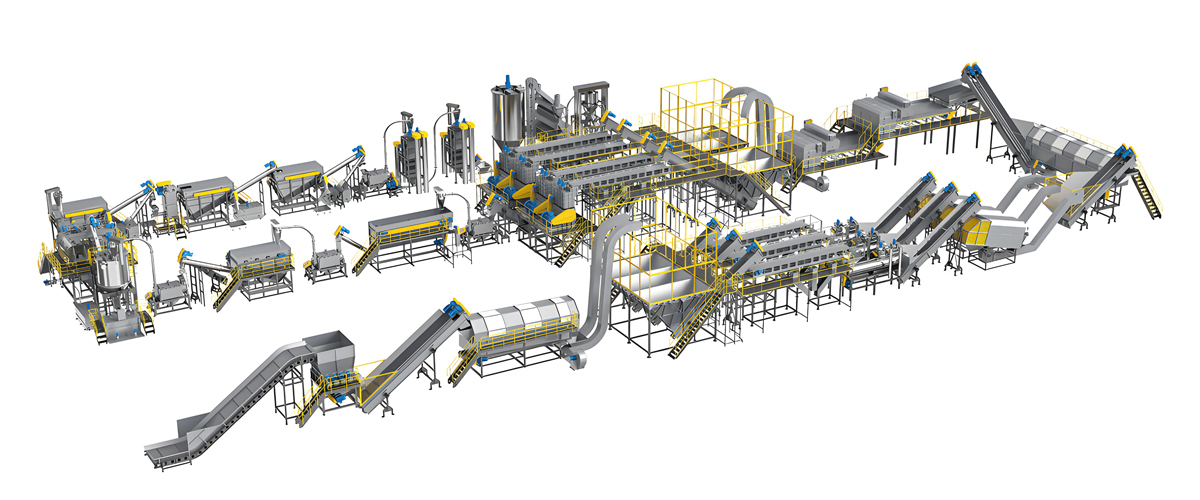
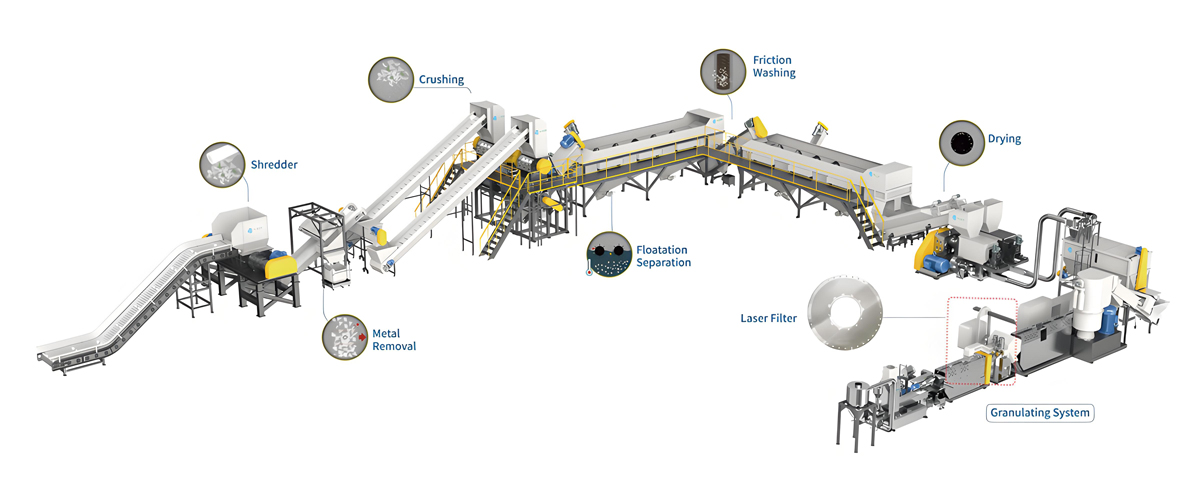
For operations that want to receive dirty film and ship pellets from a single integrated train, Polyretec offers the PP/PE Soft Plastic Crushing and Washing Line with a one-step pelletizing option. Rated from 500 to 1500 kg/h, this line processes film, woven bags, and agricultural film through crushing, friction washing, floating separation, dewatering, and then directly into pelletizing without an intermediate re-pelletizing step. This dramatically shortens the process route for many film recyclers and reduces handling losses.
| Model | Capacity (kg/h) | Crusher Power (kW) | Wash System | Pelletizing | Filtration | Typical Feed |
|---|---|---|---|---|---|---|
| PW-500 | 500 | 55 | Friction washer and float tank | Strand or water-ring | Screen changer | Film, woven bag, agriculture film |
| PW-800 | 800 | 75 | Friction, float, dewatering | Water-ring die-face | Continuous screen changer | Film, woven bag, agriculture film |
| PW-1000 | 1000 | 90 | Full wash and dry | Water-ring or underwater | Dual-station screen changer | Film, woven bag, agriculture film |
| PW-1500 | 1500 | 132 | Full wash and dry | Underwater granulation | Laser filter option | Film, woven bag, agriculture film |
The one-step option is most valuable when the feed is moderately dirty but not heavily printed, because the washing front removes the bulk of loose contamination before the melt stage, lowering the load on the screen changer and improving pellet appearance. Where the film is heavily printed or carries strong odor, the separate New Generation Pelletizing Line with double degassing is the better choice, and the two can be combined: the washing line prepares clean flake or agglomerate that the pelletizer converts to granules. For downstream compounding or twin-screw needs beyond single-screw film pelletizing, Wanplas supplies matched twin-screw pelletizing systems that integrate directly with Polyretec lines.
Recycled Pellet Quality Specifications
The value of a recycled pellet is judged by how closely it can re-enter a demanding process. Different end uses impose different ceilings on contamination, moisture, and property retention. The table below summarizes target bands for the three most common reuse routes for LDPE/LLDPE recycled pellets.
| Property | Blown Film Reuse | Injection Molding | Pipe and Profile |
|---|---|---|---|
| Pellet size uniformity | Plus/minus 0.5 mm | Plus/minus 0.8 mm | Plus/minus 1.0 mm |
| Moisture content | Below 0.1 percent | Below 0.2 percent | Below 0.3 percent |
| MFR stability | Plus/minus 10 percent | Plus/minus 15 percent | Plus/minus 20 percent |
| Black specks and contamination | Below 5 per kg | Below 15 per kg | Below 30 per kg |
| Odor | Low | Moderate | Moderate |
| Tensile retention versus virgin | Above 80 percent | Above 75 percent | Above 70 percent |
Pellet shape and uniformity affect feeding and melt stability downstream; rounded, consistent granules meter better than irregular or dusty material. Moisture trapped in the pellet causes splay and porosity in the next process, so dewatering and drying must be verified, not assumed. Black specks come from degraded polymer and inadequate filtration; tighter screens and more aggressive degassing reduce them. Melt flow rate stability reflects how consistently the line was run and whether mixed grades were blended predictably. Odor traces back to residual volatiles and ink; only thorough degassing and upstream washing remove it. Mechanical property retention depends on avoiding thermal degradation through correct temperature profiling and residence-time control.
Single-Stage vs Twin-Stage Pelletizing
A central decision in configuring an LDPE/LLDPE film pelletizing line is whether to use a single-stage or twin-stage extrusion arrangement. A single-stage line uses one extruder for melting, degassing, filtration, and pumping to the die. A twin-stage line adds a second extruder, typically fed by the first through a melt transfer, providing an extra mixing and degassing stage and a larger filtration area.
| Aspect | Single-Stage | Twin-Stage |
|---|---|---|
| Best feedstock | Clean, low-contamination film | Printed, dirty, high-moisture film |
| Degassing capacity | Single or double vacuum | Double plus extra venting |
| Filtration area | Limited by one screen | Large, dual screens |
| Melt residence time | Lower | Higher |
| Throughput stability under load | Good | Excellent |
| Investment level | Medium (about 1.0 times baseline 100) | High (about 1.6 times baseline 160) |
| Maintenance demand | Lower | Higher |
| Specific energy per kg | Lower | Slightly higher |
The rule of thumb is to choose twin-stage when contamination is high, degassing demand is severe, or the target pellet must re-enter sensitive film production. Twin-stage systems cost more and use marginally more energy, but they sustain throughput where a single-stage line would stall or require constant screen changes. For clean post-industrial offcuts, single-stage is the economical and sufficient choice.
Energy Consumption and Throughput
Film pelletizing is energy-sensitive because so much of the cost is electricity for shredding, extrusion, and drying. Specific energy is best expressed as kilowatt-hours per kilogram of pellet, and it rises with contamination, moisture, and required filtration fineness. The table below gives typical ranges and a relative cost index with a baseline of 100 index points.
| Feed Scenario | Specific Energy (kWh/kg) | Relative Cost Index (baseline 100) |
|---|---|---|
| Clean, dry LDPE film | 0.30 to 0.45 | 100 |
| Printed LDPE/LLDPE film | 0.40 to 0.55 | 115 |
| High-moisture agricultural film | 0.50 to 0.70 | 135 |
| Heavily printed and contaminated | 0.60 to 0.85 | 150 |
| Regrind, low bulk density | 0.35 to 0.50 | 105 |
Throughput depends as much on feed condition as on machine size. A line rated for 1000 kg/h on clean film may deliver only 600 to 700 kg/h on wet, heavily printed agricultural film because the degassing and filtration stages must work harder and the screen changes more often. Planning capacity against the worst realistic feed, not the best, prevents disappointing start-up performance. Relative investment categories for the overall line are Low, Medium, High, Very High, and Premium; a single-stage NGPL-600 sits around Medium, while a twin-stage NGPL-1500 with laser filtration approaches High to Very High.
Application Industries for Recycled LDPE/LLDPE Pellets
The source film for an LDPE/LLDPE pelletizing line is broad. Agricultural film includes mulch, greenhouse cover, and silage wrap. Packaging film spans shrink and stretch wrap, pallet wrap, and industrial liners. Printed film comes from roll stock, labels, and shopping bags. Shopping and retail bags, bubble wrap, and industrial shrink film are all common inputs. The recycled pellets produced then re-enter a wide range of manufacturing.
For blown film applications, recycled LDPE/LLDPE pellets are used in garbage bags, carrier bags, construction film, and agricultural film where perfect clarity is not required. In injection molding they become pails, caps, crates, and houseware. In pipe and profile extrusion they appear in non-pressure drainage pipe, conduit, and profile. In sheet and board extrusion they contribute to backing layers and non-critical sheets. The cleaner and more uniform the pellet, the higher the proportion of recycled content a converter can use without sacrificing product performance, which is why degassing and filtration quality directly influence the pellet’s market value.
Selection Guide: Feedstock to Model Recommendation
Choosing the right configuration starts from the feedstock condition, the target output, and the intended pellet use. The table below maps common situations to a recommended configuration and filtration setting.
| Feedstock Condition | Target Output | Pellet Use | Recommended Configuration | Filtration |
|---|---|---|---|---|
| Clean post-industrial film | 300 to 600 kg/h | Blown film | Single-stage NGPL-300 or NGPL-600, water-ring | Screen changer, 100 micrometer |
| Printed film, shopping bags | 500 to 1000 kg/h | Film or extrusion | Single-stage double degassing NGPL-600 or NGPL-1000 | Continuous, 80 micrometer |
| High-moisture agricultural film | 500 to 800 kg/h | Injection or pipe | Twin-stage NGPL-1000 with pre-dry | Dual-station, 120 micrometer |
| Regrind or flake | 800 to 1500 kg/h | All uses | Twin-stage NGPL-1500 | Laser filter option |
| Integrated wash and pellet | 500 to 1500 kg/h | Various | PW-500 to PW-1500 one-step | Continuous screen changer |
This guide is a starting point. The final recommendation should be confirmed against an actual sample of the customer’s film, including its contamination and moisture profile, because real-world feedstock varies more than any table can capture. Polyretec evaluates samples through trial runs before finalizing a configuration.
Common Problems, Causes and Solutions
Even a well-designed line encounters operating problems, most of which trace back to feed variability, filtration load, or degassing adequacy. The following troubleshooting table is a practical reference for operators and plant managers running LDPE/LLDPE film pelletizing lines.
| Problem | Likely Cause | Recommended Action |
|---|---|---|
| Feed instability or bridging | Very low bulk density, static, over-sized film | Increase crammer speed, pre-agglomerate, control moisture, reduce cut size |
| Melt pressure fluctuation | Inconsistent feed, screen loading | Stabilize feeder with load feedback, use automatic screen changer, confirm degassing |
| Porosity or bubbles in pellets | Trapped moisture or volatiles | Improve degassing, pre-dry feed, add second vacuum zone |
| Black specks in pellets | Degraded material, dirty screen, overheating | Tighten filtration, lower barrel temperature, purge, clean die |
| Strand or melt breakage at die | Weak melt, screen pressure, cold die | Raise melt temperature, clean die, check filtration, verify cutter sync |
| Pellet agglomeration or clumping | Poor cutting, warm water, overload | Adjust cutter speed, lower water temperature, reduce throughput |
| High moisture in final pellets | Poor dewatering or drying | Improve centrifuge, add drying, verify water separation |
| Low throughput versus rating | Feed limit, screen clog, low screw speed | Optimize feeder, coarser pre-filter, raise screw speed within limit |
| Frequent screen changes | High contamination load | Use coarser pre-filter, dual-station changer, consider laser filter |
| Odor in pellets | Residual volatiles, ink, inadequate degassing | Strengthen degassing, improve upstream washing, add venting |
| Uneven pellet size | Cutter or water-ring sync error | Tune cutter speed to throughput, check blade wear, verify die |
| High energy consumption | Over-shearing, excessive temperature | Optimize temperature profile, reduce unnecessary shear, right L/D |
| Die drool or melt bleed | Pressure imbalance at die | Adjust back pressure, inspect die geometry, balance melt flow |
| Discoloration of pellets | Oxidation, overheating, stabilizer loss | Lower temperature, add stabilizer, use inert atmosphere if needed |
Upstream Integration With Washing and Drying
A pelletizing line does not operate in isolation. Its input condition determines its output quality, and the most important upstream factor is moisture. Film leaving a washing line should be dewatered and, for high-moisture agricultural film, dried before pelletizing, because every percent of residual water must be removed in the degassing zone at the cost of throughput and odor control. Polyretec’s PP/PE Soft Plastic Crushing and Washing Line delivers washed, dewatered material that can feed the pelletizer directly in the one-step configuration, while the New Generation Pelletizing Line accepts clean flake or agglomerate from a separate washing front.
Where the application requires twin-screw compounding or alloying of the recycled polyethylene with other materials, Wanplas supplies matched twin-screw pelletizing systems that integrate with Polyretec lines, so the customer can build a complete film-to-compound train under one engineering responsibility. The key integration principle is that the washing and drying stage must deliver material at a known, consistent moisture and contamination level so the pelletizer can hold stable throughput and pellet quality.
Service and Support
Polyretec backs every pelletizing line with comprehensive after-sales support structured around the Wanplas group’s shared commitments. Before shipment, each line is assembled and test-run with representative material so that performance is verified and the customer can witness acceptance at the factory. Engineers then travel to the customer site for installation and commissioning, tuning the line to the actual local feedstock rather than a generic setting.
The support package includes 24+ engineer assistance for technical questions, a spare parts program built on the group policy of USD 500 free parts per year, formula and process training so operators understand temperature, degassing, and filtration interplay, remote operation and maintenance support through connected controls, and an open-factory policy that welcomes customers to visit, audit, and witness trial runs. For global customers, the 50+ country service network and 10+ year credible commitment mean long-term availability of parts and know-how well beyond the warranty period.
Frequently Asked Questions
What is the difference between single-screw and twin-screw pelletizing for film waste?
Single-screw pelletizing uses one extruder for melting, degassing, filtration, and pumping to the die, and it is the standard, cost-effective choice for LDPE/LLDPE film. Twin-screw pelletizing adds a second intermeshing extruder that provides stronger mixing, larger filtration area, and extra degassing, which is valuable when the film is heavily contaminated, printed, or must be compounded with additives. For straightforward film-to-pellet recovery, single-screw is preferred; Wanplas supplies matched twin-screw pelletizing systems for applications that need them.
How does degassing remove moisture and odor from LDPE/LLDPE film?
After the polymer is melted, it passes through a vented section of the barrel held under vacuum, typically from -0.06 to -0.09 MPa. The vacuum pulls water vapor and volatile organic compounds from printing inks and adhesives out of the thin melt film. Single degassing handles clean, dry film, while double degassing is used for printed bags and wet agricultural film. Strong degassing is the main way to prevent bubbles in the pellet and to reduce odor in the recycled product.
What melt filtration is best for printed film with high contamination?
Printed and dirty film benefits from a continuous or dual-station screen changer that swaps the filter without stopping the line, with fineness around 80 to 120 micrometer to balance cleanliness and throughput. For very high contamination, a laser-assisted filter concept extends operating time by continuously cleaning the screen. The right choice trades pellet cleanliness against sustainable throughput, and it should be confirmed against a real sample of the film.
Can the pelletizing line connect directly to a washing line?
Yes. Polyretec’s PP/PE Soft Plastic Crushing and Washing Line offers a one-step pelletizing option that receives dirty film and delivers pellets from a single train, rated from 500 to 1500 kg/h. Alternatively, a separate washing line can feed clean flake or agglomerate into the New Generation Pelletizing Line. The essential condition is that the washing and drying stage delivers material at a known, consistent moisture and contamination level.
What pellet quality can be expected for blown film reuse?
For blown film reuse, target pellets with size uniformity of about plus/minus 0.5 mm, moisture below 0.1 percent, melt flow rate stability within plus/minus 10 percent, fewer than 5 black specks per kilogram, low odor, and tensile retention above 80 percent of the virgin resin. Achieving this requires double degassing, fine filtration, and stable process control, which is exactly what the Austrian-technology configuration is built to deliver.
How much floor space and power does a typical line need?
A single-stage NGPL-600 occupies a modest footprint suitable for most recycling workshops and draws roughly 180 to 230 kW installed power, while a twin-stage NGPL-1500 approaches 380 to 480 kW and needs more space for the second extruder and larger filtration. Exact layout and utility requirements are confirmed during configuration, because feeding equipment, silos, and drying add to the footprint beyond the extruder itself.
What after-sales support does Polyretec provide?
Support includes pre-shipment test runs and factory acceptance, on-site installation and commissioning by engineers, a spare parts program under the group’s USD 500 free parts per year policy, formula and process training, remote operation and maintenance assistance, and an open-factory policy for visits and trial runs. The 24+ engineer team and 50+ country network provide long-term coverage.
How do I choose between water-ring and underwater pelletizing?
Water-ring die-face hot cutting is the standard for LDPE/LLDPE film because it handles the low-viscosity melt reliably and produces uniform rounded granules at lower complexity. Underwater granulation cuts below the melt surface and gives the highest uniformity and lowest dust, which is preferred when the pellet re-enters sensitive film or compounding processes and justifies its higher cost. Strand cutting is simpler but less suited to soft film at high output.
Conclusion and Next Step
LDPE and LLDPE film waste is a high-volume, high-value but difficult recycling feedstock defined by low bulk density, entanglement, high surface contamination, and retained moisture and volatiles. The Austrian-technology pelletizing route meets this challenge with an integrated shredder-feeder-extruder, load-based feed regulation, long single-screw plasticizing, strong double degassing, fine continuous melt filtration, and synchronized water-ring or underwater pelletizing. Polyretec, a Wanplas factory, packages this route into the New Generation Pelletizing Line for demanding post-consumer film and the PP/PE Soft Plastic Crushing and Washing Line with one-step pelletizing for integrated operations, backed by 100+ project experience, 50+ countries served, 24+ engineer assistance, and the “Turn Waste Into Treasure” commitment.
To get a configuration that fits your reality, send a sample of your film together with its contamination and moisture profile, your target capacity, and your intended pellet use. Polyretec will evaluate the material through trial runs, recommend the appropriate single-stage or twin-stage setup with the right degassing and filtration, and invite you to witness the test and audit the factory before you commit. This plain-text invitation reflects the open, sample-driven engineering approach that defines the Austrian-technology film pelletizing line.