
Why Printed and Sticky LDPE Film Needs a Complete Line, Not a Single Machine
The best LDPE film pelletizing line for printed and sticky film waste is not defined by the extruder alone. It is defined by how well nine consecutive process stages hand material to each other: pre-sorting, shredding, dry pre-cleaning, wet granulation, float-sink separation, friction washing, hot washing, mechanical and thermal drying, and finally densification followed by vented extrusion with melt filtration. Printed film and adhesive-loaded film punish every weak link in that chain, and the failure always shows up at the same place, in the pellet, as black specks, color drift, porosity or odor. Buyers who shop for a pelletizing machine in isolation almost always discover that the machine was never the constraint.
Printed and sticky film is the hardest LDPE stream in the recycling industry for three structural reasons. First, ink is not surface dirt but a bonded coating layer that represents 2 to 8 percent of film weight, and its binder chemistry decomposes into carbonized particles at melt temperatures that a poorly configured line reaches routinely. Second, the contamination is chemically diverse: agricultural film arrives with 20 to 60 percent soil and grit by weight, food packaging film carries fats and organic residue, stretch film carries pressure-sensitive adhesive, and heavy-duty sacks carry mineral or chemical powder. No single unit operation removes all four. Third, film has almost no bulk density. Loose washed film flake sits at 0.03 to 0.08 tons per cubic meter, roughly one twentieth the bulk density of rigid regrind, so conveying, feeding and metering all need dedicated engineering rather than standard components.
Polyretec, a Wanplas factory, has built plastic recycling equipment since 2010 and has operated as an independent brand since 2017, with more than 100 delivered projects, service coverage across more than 50 countries and a technical team of over 24 engineers. Printed and adhesive-contaminated LDPE film has been a repeat specialty rather than an occasional order: delivered projects include a printed bag and film pelletizing system in Turkey, a heavy-duty washing line for LDPE film with sticker labels in Mexico, and a fully automated PP and PE film washing plant in Taiwan built around the PTW1000 configuration. This article sets out the full engineering logic of that line, stage by stage, with the parameters that actually determine whether the finished pellet sells into a demanding application or a low-value one.
A film pelletizing line does not fail at the extruder. It fails three stages upstream, and the extruder is simply where the evidence becomes visible.
Grading the Difficulty of LDPE Film Waste Streams
Every line specification starts with an honest difficulty grade for the incoming material, because the same nominal throughput requires very different equipment depending on the stream. The grading below is the working scheme used to size wash tanks, blade steel, heating load and filtration on Polyretec projects. It separates four common LDPE film families by ink load, contamination type, abrasion risk and the dominant processing challenge each one creates.
| Film Stream | Typical Ink Load (percent of film weight) | Dominant Contamination | Abrasion Risk | Difficulty Grade | Critical Line Stage |
|---|---|---|---|---|---|
| Post-industrial printed packaging film (converter trim, misprints) | 3 to 8 | Surface ink, minor dust | Low | Medium | Hot washing plus fine melt filtration |
| Post-consumer printed packaging film (bags, sacks, shrink hoods) | 2 to 6 | Ink, food residue, grease, paper labels | Medium | High | Hot washing with caustic and surfactant dosing |
| Agricultural film (mulch film, greenhouse film, silage film) | 0 to 2 | Soil, sand, stones, plant matter, moisture, 20 to 60 percent by weight | Very High | Very High | Dry pre-cleaning plus grit removal and abrasion-resistant blades |
| Stretch and wrapping film with adhesive | 0 to 3 | Pressure-sensitive adhesive, tape residue, pallet dust | Low | High | Temperature-controlled conveying and densification |
| Heavy-duty industrial sacks (cement, resin, fertilizer, masterbatch) | 2 to 6 | Mineral and chemical powder, printed liner, occasional paper ply | High | High | Bag opening, de-dusting and multi-stage rinsing |
| Mixed post-consumer film from municipal collection | 2 to 8 | All of the above plus foreign polymer and organics | Very High | Very High | The complete chain with buffered capacity at every stage |
Two practical rules come out of this grading. The first is that difficulty is set by the abrasive and chemical load, not by the printing. Agricultural film with almost no ink is harder to process than a heavily printed converter trim, because sand destroys blades, pumps and screw flights while ink only degrades appearance. The second rule is that a line specified for one grade rarely upgrades cleanly to a harder grade. Adding grit removal, heating capacity and a larger water treatment loop after installation costs far more than including them in the original layout, which is why the honest answer to what will I feed this line in three years matters more than this month’s bale supply.
Ink Layers: Why Printing Governs Pellet Color and Black Speck Count
Printing ink is the single feature that decides whether a recycled LDPE pellet sells as a light gray general-purpose grade or a dark charcoal filler grade. Ink typically accounts for 2 to 8 percent of printed film weight, and its behavior in the process depends entirely on binder chemistry rather than on color.
Three binder families dominate flexible packaging. Nitrocellulose-based inks are the most common on surface-printed polyethylene bags; they are alkali-sensitive, which makes them the easiest family to remove in a caustic hot wash, but they are also thermally fragile and begin decomposing well below normal polyethylene processing temperatures. Polyurethane-based inks, used where lamination bond strength matters, resist alkali far better and often need a longer residence time, higher caustic concentration and a stronger surfactant package. Water-based inks respond well to temperature and mechanical friction but can redeposit onto flake surfaces if the wash water is not continuously cleaned, producing a gray haze that no amount of extra washing removes.
The thermal behavior matters as much as the chemistry. Ink binders that survive washing enter the extruder as an organic coating on the flake surface. Below roughly 215 degrees Celsius melt temperature they largely volatilize and leave through the vacuum vents. Above roughly 230 degrees Celsius they carbonize into hard, dark particles that the melt filter must catch. This is why black speck count is a temperature problem before it is a filtration problem: a line running a melt temperature 20 degrees too high will generate specks faster than any screen can remove them, and the operator will blame the filter.
Reverse-printed laminate is the boundary case. When ink sits between two film plies, the outer ply mechanically shields it from both chemical attack and friction, so wash efficiency drops close to zero. The realistic commercial strategy for laminate-heavy input is deliberate color homogenization: accept a stable gray or charcoal pellet, control the color difference value batch to batch through silo blending, and sell into applications where color is not a specification. Promising a natural-colored pellet from reverse-printed laminate is the most common technical overreach in this market.
Soil, Grease, Adhesive and Powder: The Four Contamination Families
Ink defines appearance, but the four contamination families below define equipment wear, water consumption, energy demand and process stability. Each family requires a different unit operation, and the reason a printed and sticky film line looks expensive on paper is that it must carry all four countermeasures simultaneously.
Mineral soil and grit. Agricultural film can arrive at 20 to 60 percent contamination by weight, mostly soil, sand and small stones, with high moisture content that inflates bale weight further. Mineral particles are harder than tool steel edges and will erode wet crusher blades, pump impellers, screw flights and even tank walls if allowed to circulate. The engineering answer is to remove as much grit as possible while it is still dry, then to design every wet stage with a sedimentation path so that the fraction which does enter the water loop settles out instead of recirculating.
Fats, oils and organic residue. Food packaging film carries grease, protein residue and sugars. These do not respond well to cold water, but they saponify readily in a caustic hot wash. Left in place, they cause three downstream problems: odor in the finished pellet, foaming in the water treatment loop, and a surface film on flake that reduces friction washer efficiency for everything else in the batch.
Pressure-sensitive adhesive. Stretch film, tape and sticker labels bring adhesive residue that behaves like a thermoplastic with an extremely low softening point. It stays manageable below roughly 40 degrees Celsius and becomes tacky between 40 and 60 degrees Celsius, which is easily reached inside a compaction screw or an agglomerator running against back pressure. Softened adhesive binds flakes into plugs that bridge above the extruder throat and stall the line. Countermeasures are mechanical and thermal rather than chemical: water-jacketed feeder housings held below 45 degrees Celsius, slightly reduced compaction ratios, and anti-bridging paddles or scrapers in hoppers.
Mineral and chemical powder. Heavy-duty sacks retain cement, fertilizer, resin dust or masterbatch pigment inside folds and seams. Powder is not abrasive in the same way as sand, but it raises ash content directly and it blinds melt filter screens quickly because the particles are fine and deformable. Bag opening followed by mechanical de-dusting before any water contact is far more effective than trying to wash powder out later, since wetted powder turns into a slurry that coats everything it touches.
Density, Thickness and Bulk Density: The Physics Behind Line Design
Three physical properties of LDPE film set hard boundaries on what the line can and cannot do, and a good specification treats them as design inputs rather than footnotes.
Density. LDPE sits at 0.915 to 0.935 grams per cubic centimeter, comfortably below water. This is the single most useful property in the whole process, because it makes float-sink separation possible: LDPE and other polyolefins float while PET, PVC, aluminum foil fragments, sand and stones sink. The margin is generous against PET at roughly 1.38 and PVC at roughly 1.40, which is why a properly operated float-sink stage removes those contaminants almost completely. The margin against PP at 0.90 to 0.91 is effectively zero, so PP film cannot be removed by density at all.
Thickness. Film in the recycling stream spans 8 to 150 micrometers, from thin shopping bags and stretch wrap to heavy-duty sack liners and greenhouse film. Thin film tears and wraps; thick film resists cutting and carries more contamination per piece. A wet crusher screen sized for one end of the range will either pass unshredded pieces or produce excessive fines at the other end, which is why blade configuration and screen aperture are chosen against the dominant thickness band, not against an average.
Bulk density. Loose film waste is between 0.03 and 0.08 tons per cubic meter. After washing and drying, the flake is still in that range. An extruder throat, by contrast, needs material approaching 0.30 tons per cubic meter or higher to feed reliably by gravity. That gap of roughly one order of magnitude is the reason film lines carry an agglomerator or a heavy compaction force feeder, and it is also the reason film conveying uses screw conveyors, blowers and mechanically assisted hoppers rather than the simple belt arrangements that work for rigid regrind.
| Property | Typical Value for LDPE Film Waste | Design Consequence |
|---|---|---|
| Polymer density | 0.915 to 0.935 grams per cubic centimeter | Float-sink separation removes PET, PVC, foil, sand and stone |
| PP film density (contaminant) | 0.90 to 0.91 grams per cubic centimeter | Cannot be separated by density; needs near-infrared sorting or source control |
| Film thickness range | 8 to 150 micrometers | Blade geometry and screen aperture must target the dominant band |
| Loose bulk density | 0.03 to 0.08 tons per cubic meter | Mechanically assisted conveying and feeding throughout |
| Agglomerated bulk density | 0.30 to 0.45 tons per cubic meter | Stable gravity feeding into the extruder throat |
| Melting point | 105 to 115 degrees Celsius | Hot wash must stay below softening; agglomerator control is critical |
| Working melt temperature | 195 to 215 degrees Celsius | Upper limit set by ink carbonization, not by polymer degradation |
Polymer Contaminants: PP Film, Labels, Metals and Multilayer Structures
Density separation solves the easy half of the contamination problem. The remaining half consists of materials that either share LDPE density or are bonded to it, and each requires its own countermeasure.
Polypropylene film. PP is the most common polymer contaminant in polyolefin film bales and the hardest to remove, because at 0.90 to 0.91 grams per cubic centimeter it floats alongside LDPE. Modest PP content, roughly below 5 percent, is tolerable in general-purpose recycled LDPE and mostly shows as a slightly higher stiffness and a small drop in impact performance. Higher PP content produces gels, uneven melt behavior and inconsistent film blowing downstream. The two effective controls are near-infrared optical sorting on dry flake before washing, and supply-side control of what enters the bale. Optical sorting adds capital cost and only pays back when the customer specification genuinely requires it.
Paper labels and paper plies. Paper disintegrates in the wet stages and largely leaves with the water, but the fibers that remain increase ash content and produce visible brown specks. Multi-stage rinsing with fresh water on the last stage, plus a well-designed water treatment loop that removes fiber rather than recirculating it, is the practical answer.
Metals. Ferrous fragments come from staples, wire, clamps and general handling damage; non-ferrous fragments come from aluminum foil laminate and hardware. Magnetic separation over the infeed conveyor handles ferrous material cheaply and should always be installed. Eddy current separation removes non-ferrous fragments and is worth the investment whenever laminate content is significant, because aluminum flake fragments are hard, abrasive and highly visible in the finished pellet.
Multilayer and barrier structures. Laminates containing polyamide, ethylene vinyl alcohol or aluminum foil cannot be separated into their components by any mechanical washing process. They behave as infusible or partially infusible inclusions in the LDPE melt and appear as gels or specks. Their impact is controlled at the filter, not in the wash: finer melt filtration catches more of them at the cost of higher melt loss and more frequent screen changes. When laminate content is high, the honest engineering position is to target a lower-grade application for the pellet rather than to chase a filtration fineness the line cannot sustain.
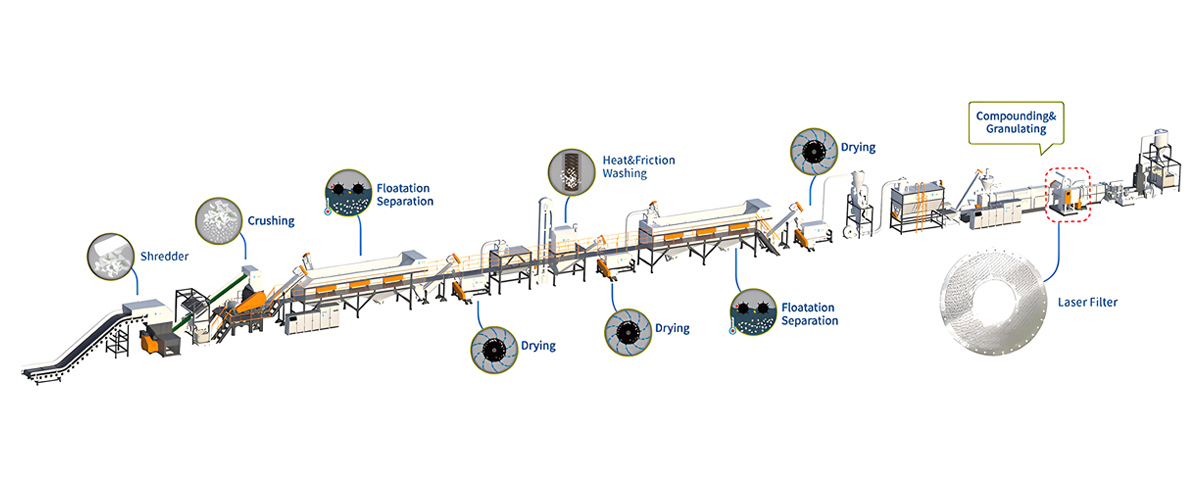
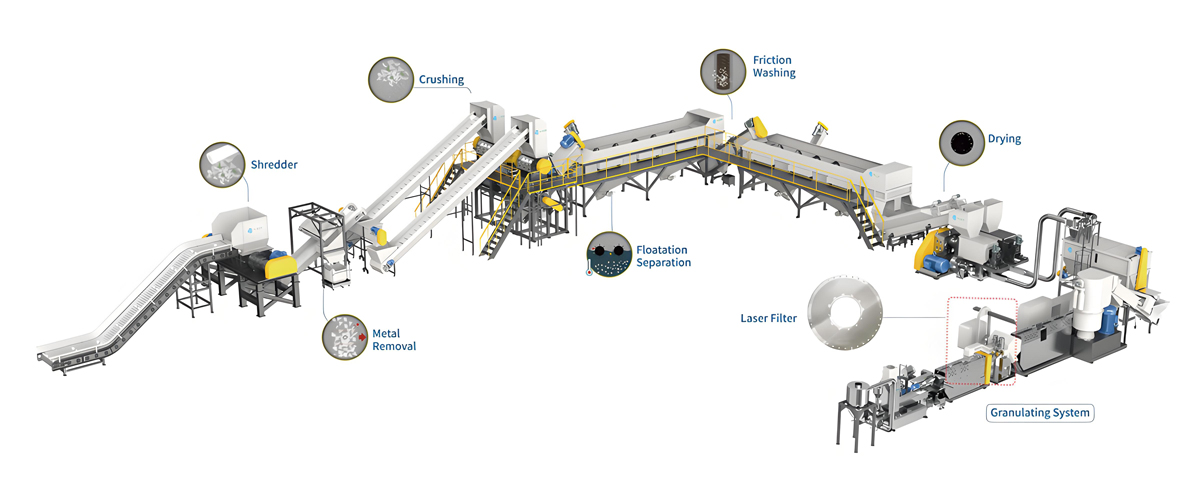
Complete Line Architecture: Material Flow From Bale to Big Bag
A complete LDPE film washing and pelletizing plant is a sequence of buffered unit operations, each with its own throughput curve, and the art of line engineering is matching those curves so no stage starves or floods the next one. The table below is the full stage list for a printed and sticky film line, with the equipment parameters that a buyer should see on a technical offer. Throughput figures assume a nominal 1000 kilograms per hour of finished pellet; a 500 kilograms per hour line scales the same architecture down rather than deleting stages.
| Stage | Equipment | Key Parameters | Function | Removal or Effect |
|---|---|---|---|---|
| 1. Infeed | Chain plate conveyor with sorting platform | Belt width 1000 to 1500 millimeters, speed 3 to 12 meters per minute, variable frequency drive | Bale feeding and manual removal of oversize foreign objects | Removes rope, wood, rigid parts, textiles |
| 2. Ferrous removal | Overband or drum magnetic separator | Magnetic field strength 8000 to 12000 gauss at the working gap | Continuous ferrous extraction | Removes 95 percent or more of loose ferrous fragments |
| 3. Non-ferrous removal | Eddy current separator | Rotor speed 1500 to 3000 revolutions per minute, belt width 1000 to 1200 millimeters | Aluminum and non-ferrous metal ejection | Protects blades and reduces visible metallic specks |
| 4. Shredding | Single-shaft or double-shaft shredder | Rotor diameter 400 to 800 millimeters, blades in D2 or SKD-11 tool steel, screen 60 to 150 millimeters, drive 55 to 160 kilowatts | Size reduction of bales and large sheets | Produces conveyable, meterable fragments |
| 5. Dry pre-washing | Friction bag opener plus de-dusting and grit removal drum | Rotor speed 300 to 600 revolutions per minute, perforated screen 8 to 20 millimeters | Mechanical release of dry soil and powder | Removes 40 to 60 percent of dry soil before any water contact |
| 6. Wet granulation | Wet crusher with water injection | Knife gap 0.3 to 0.8 millimeters, screen aperture 30 to 60 millimeters, rotor 400 to 900 revolutions per minute, drive 55 to 132 kilowatts | Final size reduction under water spray | Detaches soil, prevents dust, cools the cut |
| 7. Float-sink separation | Two or three float wash tanks in series with screw discharge | Tank length 3 to 6 meters each, paddle agitation, inclined discharge screw at 25 to 35 degrees | Density-based sorting | Removes PET, PVC, foil, sand, stone; each additional tank raises purity |
| 8. Friction washing | High-speed friction washer, counter-current | Rotor speed 700 to 1200 revolutions per minute, screen 3 to 8 millimeters, drive 30 to 55 kilowatts | Mechanical scrubbing of flake surfaces | Removes over 90 percent of loosely bound surface contamination |
| 9. Hot washing | Heated wash reactor with agitator | 75 to 95 degrees Celsius, caustic soda 0.5 to 2.0 percent plus surfactant, residence 10 to 20 minutes, steam or thermal oil heating | Chemical attack on ink binders, grease and adhesive | Removes 70 to 90 percent of surface ink and most saponifiable residue |
| 10. Rinsing | Rinsing tank plus second friction washer | Counter-current fresh water on the final stage | Chemical carry-over removal | Neutralizes flake surface, prevents redeposition |
| 11. Mechanical dewatering | Horizontal centrifugal dryer | Rotor 700 to 1000 revolutions per minute, screen 0.5 to 1.5 millimeters, drive 22 to 45 kilowatts | Bulk water removal | Outlet moisture 3 to 8 percent |
| 12. Thermal drying | Hot air pipe dryer plus vertical drying silo | Air temperature 80 to 120 degrees Celsius, silo residence 15 to 40 minutes | Residual moisture removal and buffering | Outlet moisture below 1 percent |
| 13. Agglomeration | Agglomerator or high-compaction force feeder | Rotor 700 to 1000 revolutions per minute, water-cooled housing, drive 90 to 250 kilowatts | Densification of dried film flake | Bulk density raised to 0.30 to 0.45 tons per cubic meter |
| 14. Extrusion | Single-screw extruder with double-stage venting, or two-stage extrusion system | L/D 30 to 36 to 1, vacuum minus 0.08 to minus 0.095 megapascals, barrel zones 160 to 200 degrees Celsius | Melting, homogenization and devolatilization | Removes residual moisture and ink volatiles |
| 15. Melt filtration | Hydraulic double-piston screen changer, continuous belt filter, or fully automatic laser-drilled rotary disc filter | Filtration fineness 80 to 150 micrometers, filter area matched to throughput | Removal of carbonized and infusible particles | Determines black speck count in the finished pellet |
| 16. Pelletizing | Water ring die-face pelletizer or underwater pelletizer | Die hole diameter 2.8 to 4.0 millimeters, blade set matched to throughput | Melt cutting and cooling | Produces uniform pellet geometry |
| 17. Pellet handling | Centrifugal pellet dryer, vibrating classifier, blending silo, metal detector | Silo volume for 4 to 12 hours of production | Drying, fines removal, batch homogenization, final safety check | Eliminates batch color variation and residual metal |
| 18. Packing | Automatic weighing and bagging station | 25 kilogram bags or 500 to 1000 kilogram big bags | Finished goods packaging | Traceable lot control |
Two architectural principles run through this table. Buffers matter as much as machines: a drying silo and a blending silo absorb the natural short-term variation of a wet process and let the extruder run at steady state, which is worth more to pellet quality than any single upgrade elsewhere. And contamination should always be removed at the earliest stage where removal is physically possible, because every kilogram of soil that reaches the water loop must later be removed from the water at a much higher cost in energy, chemicals and sludge handling.
Infeed Conveying, Manual Sorting and Metal Removal
The infeed section looks unglamorous but sets the reliability ceiling for the whole plant. A chain plate conveyor with a hardened running surface handles baled film, wet material and the occasional stone without the belt damage that a rubber conveyor suffers. Belt width of 1000 to 1500 millimeters with a variable frequency drive running 3 to 12 meters per minute gives operators enough dwell time to work, and the drive speed becomes the primary throughput control for the entire line.
Manual sorting remains the most cost-effective removal method for a specific class of contaminant: large, rigid, non-target objects that no automated system reliably catches. Rope, wire bundles, wood, textiles, rigid containers, and the occasional tool or machine part all belong to this class, and any one of them can stop a shredder for an hour. A sorting platform with two to four positions, adequate lighting and a rejection chute directly beside each position is standard on printed and post-consumer film lines. On clean post-industrial trim it can be reduced to a single inspection position.
Magnetic separation should be treated as mandatory rather than optional. An overband magnet at 8000 to 12000 gauss over the infeed conveyor removes the great majority of loose ferrous material for a modest capital and near-zero operating cost, and it protects every blade downstream. Eddy current separation is the judgment call. It removes aluminum and other non-ferrous fragments, which matters when the stream contains foil laminate or hardware. On agricultural film and clean converter trim it is usually unnecessary; on mixed post-consumer film and printed laminate scrap it pays for itself in blade life and in the reduction of visible specks.
Shredding: Blade Steel, Screen Size and Throughput Matching
Shredding converts bales and large sheets into fragments that can be conveyed, metered and washed. For film, the output target is 60 to 150 millimeters, which is deliberately coarse. Over-shredding at this stage is a common and expensive mistake: fine film fragments increase surface area, absorb more water, carry more soil into the water loop and become harder to dewater, while offering no benefit that the wet crusher does not deliver more efficiently later.
Single-shaft shredders with a hydraulic pusher ram give the most consistent output size on film because the ram forces material against the rotor continuously, and the screen under the rotor sets the particle size directly. Double-shaft shredders handle mixed and heavily contaminated input with greater tolerance for foreign objects, at the cost of a wider particle size distribution. For agricultural film and heavy-duty sacks, a double-shaft machine ahead of the wet crusher is usually the more robust choice; for baled packaging film, single-shaft with a 100 to 150 millimeter screen is typical.
Blade steel selection is where the abrasion grading from earlier pays off. D2 and SKD-11 tool steel, hardened to 58 to 62 HRC, are the working standard for film shredding. On agricultural film with high sand content, blade life drops sharply and the practical countermeasures are a slightly lower rotor speed, a rotor design that allows blade rotation to a fresh cutting edge, and acceptance of a shorter re-sharpening interval. Expect 200 to 400 operating hours between blade services on heavily soiled agricultural film and roughly double that on clean packaging film.
Drive sizing follows throughput and stream difficulty. A 500 kilograms per hour film line typically uses 55 to 90 kilowatts at the shredder; a 1000 kilograms per hour line uses 110 to 160 kilowatts. Undersizing the shredder motor is a false economy, because the shredder is the stage most exposed to unpredictable input and the one whose stoppages cascade through the entire plant.
Dry Pre-Washing: Removing Grit Before It Reaches the Water Loop
Dry pre-washing is the stage most often omitted from budget line offers and the one that most reliably transforms the operating economics of an agricultural film plant. Its principle is simple: dry soil is far easier and cheaper to remove than wet soil, so remove it before adding water.
The equipment is a friction-based rotating drum or a beater-type machine with a perforated screen of 8 to 20 millimeters, running at 300 to 600 revolutions per minute. Shredded film enters, is beaten and tumbled against the screen, and dry soil, sand and powder pass through the perforations while the film continues forward. On agricultural film with 20 to 60 percent soil load, a well-designed dry pre-cleaning stage removes 40 to 60 percent of the total soil burden. On heavy-duty sacks, the same machine class doubles as a bag opener that shakes retained powder out of folds and seams.
The downstream benefits compound. Less soil in the water loop means smaller sedimentation basins, lower flocculant consumption, less sludge to dewater and dispose of, lower fresh water make-up, and dramatically less abrasive wear on wet crusher blades, pumps and screw conveyors. The stage also reduces the load on the hot wash tank, which means less heating energy per ton. For any stream above roughly 15 percent soil content, dry pre-cleaning is not an accessory; it is the stage that makes the rest of the line economical.
Wet Granulation: Knife Gap, Screen Aperture and Water Injection
The wet crusher performs the final size reduction, and it does so under continuous water spray for three reasons: water carries away released soil immediately, it suppresses dust, and it cools the cutting zone so that friction heat never approaches the 105 to 115 degrees Celsius softening range of LDPE.
Knife gap is the parameter that separates a well-maintained film crusher from a poor one. The working range is 0.3 to 0.8 millimeters between rotating and fixed blades. Below 0.3 millimeters the blades risk contact and the machine generates excessive fines; above 0.8 millimeters, thin film folds through the gap instead of being cut cleanly, producing long tails that wrap on the rotor and block the screen. On film lines running mixed thickness, 0.4 to 0.6 millimeters is a good default, checked and reset at every blade service.
Screen aperture of 30 to 60 millimeters suits film. Finer screens increase residence time in the cutting chamber, generate heat, and produce fines that are hard to dewater and that raise melt loss at the filter. Coarser screens pass pieces that the friction washer cannot scrub effectively and that later cause feeding irregularity. Water injection is typically 2 to 5 cubic meters per hour at the crusher on a 1000 kilograms per hour line, with the water recovered and returned to the treatment loop rather than discharged.
Rotor speed of 400 to 900 revolutions per minute and a drive of 55 to 132 kilowatts cover the normal capacity range. Rotor design matters more on film than on rigid material: a claw or scissor-cut rotor geometry cuts film progressively across the width rather than impacting it flat, which reduces both power draw and the tendency of thin film to wrap.
Float-Sink Separation as a Line Stage
Float-sink separation is the density sorting step that removes everything heavier than water from the polyolefin fraction. Wet flake enters a tank of water where LDPE, at 0.915 to 0.935 grams per cubic centimeter, floats and is carried forward by paddles and a surface skimmer to an inclined discharge screw, while PET, PVC, aluminum fragments, sand, stones and heavy organic matter sink to the bottom and are removed by a bottom screw conveyor. Because the density gap between LDPE and PET or PVC is very large, the separation efficiency for those contaminants is high with correct residence time and agitation.
For a printed and sticky film line, the design decisions at this stage are straightforward: two to three tanks in series rather than one, because each additional pass raises purity on material that entered the tank still holding soil; sufficient tank length, typically 3 to 6 meters per unit, to give flake time to reach its equilibrium buoyancy; and a bottom sediment removal system sized for the real grit load rather than a token screw. Detailed water level tuning and hydrodynamic optimization inside the tank are a separate engineering subject and are treated elsewhere; at line level, what matters is that the stage is sized for the incoming soil burden and is preceded by dry pre-cleaning so that it is not asked to do a job better done upstream.
High-Speed Friction Washing With Counter-Current Water Flow
Friction washing is the mechanical workhorse of the wet section. A vertical or horizontal rotor fitted with paddles spins at 700 to 1200 revolutions per minute inside a perforated screen of 3 to 8 millimeters, driving flake against flake and against the screen wall. The scrubbing action removes over 90 percent of loosely bound surface contamination, and the released soil escapes through the perforations with the water while the flake continues upward or forward.
Counter-current water flow is what turns a friction washer from a mixer into a washer. Water enters at the discharge end and flows against the direction of material travel, so the cleanest flake meets the cleanest water and the dirtiest incoming flake meets water that is already carrying soil out of the machine. The concentration gradient this creates is the reason counter-current friction washing consumes substantially less fresh water than co-current designs for the same cleanliness result. On a printed film line, two friction washers are standard: one immediately after float-sink separation to remove bulk soil, and one after the hot wash and rinse to strip loosened ink residue and chemical carry-over.
Three design details separate a durable machine from a maintenance problem. Paddle material and hardfacing determine wear life on abrasive agricultural film, and replaceable paddle tips are worth specifying. Screen open area determines how quickly released soil leaves the machine; too little open area and the soil simply recirculates with the flake. Finally, the housing must be arranged so that the machine can be opened for inspection without dismantling the drive, because friction washer screens need regular cleaning on any stream that carries fiber or plant matter.
On a 1000 kilograms per hour line, friction washers typically draw 30 to 55 kilowatts each. That is a significant share of the wet section power draw, which is another argument for removing dry soil upstream: a friction washer asked to remove 60 percent soil load consumes far more energy and wears far faster than one polishing flake that has already been pre-cleaned.
Hot Washing: Chemistry, Temperature and Residence Time for Ink and Grease
Hot washing is the stage that makes printed and greasy film economically recyclable, and it is non-negotiable for any stream carrying surface print or food residue. Cold friction washing removes soil; only hot caustic chemistry removes ink binders and saponifies fats.
The reactor is a heated, agitated vessel operating at 75 to 95 degrees Celsius with a caustic soda concentration of 0.5 to 2.0 percent, supplemented by a surfactant package to lower surface tension and keep detached ink dispersed in the water instead of redepositing on flake. Residence time is 10 to 20 minutes. Heating is by direct steam injection or by a thermal oil jacket, and the choice usually follows what utilities the plant already has: steam is faster to bring to temperature and simpler to control, while thermal oil avoids condensate dilution of the wash liquor.
The three process variables interact strongly, and understanding the trade-offs is the difference between a wash recipe that works and one that merely consumes chemicals. Temperature drives reaction rate, but the ceiling is set by LDPE softening near 105 to 115 degrees Celsius and, practically, by the point at which flake begins to agglomerate in the tank. Caustic concentration drives the chemical attack on ink binders, but excess caustic raises rinsing demand, neutralization load in the water treatment plant and the risk of residual alkalinity in the pellet. Residence time can substitute partially for both, which is why a larger reactor volume often outperforms an aggressive chemical recipe on the same stream.
| Contamination Target | Temperature (degrees Celsius) | Caustic Soda (percent) | Surfactant Dosing | Residence Time (minutes) | Expected Removal | Notes |
|---|---|---|---|---|---|---|
| Nitrocellulose-based surface ink | 80 to 90 | 0.8 to 1.5 | Standard nonionic package | 10 to 15 | 80 to 90 percent | Most alkali-sensitive ink family; easiest to remove |
| Polyurethane-based surface ink | 85 to 95 | 1.5 to 2.0 | Reinforced package with dispersant | 15 to 20 | 60 to 80 percent | Alkali-resistant; needs the highest severity setting |
| Water-based ink | 75 to 85 | 0.5 to 1.0 | Standard package plus anti-redeposition agent | 10 to 15 | 75 to 90 percent | Redeposition is the main risk; keep wash liquor clean |
| Reverse-printed laminate ink | 85 to 95 | 1.5 to 2.0 | Reinforced package | 15 to 20 | Below 20 percent | Ink is mechanically shielded; target color homogenization instead |
| Fats, oils and food residue | 80 to 90 | 1.0 to 2.0 | Degreasing surfactant | 10 to 15 | 85 to 95 percent | Saponification is fast; watch foaming in the water loop |
| Pressure-sensitive adhesive residue | 80 to 90 | 1.0 to 1.5 | Solvent-assisted surfactant | 15 to 20 | 50 to 75 percent | Combine with strong friction washing directly after the reactor |
| Paper label fiber and adhesive | 75 to 85 | 0.5 to 1.0 | Standard package | 10 to 15 | 80 to 95 percent | Fiber must be removed from the water loop, not recirculated |
Two operating disciplines determine whether the hot wash keeps performing after the first month. Wash liquor must be continuously bled and replenished, because detached ink and saponified grease accumulate until the liquor itself becomes the contamination source. And the rinse immediately after the reactor must be genuinely counter-current with fresh water on the final pass, otherwise alkaline carry-over follows the flake into the dryer, concentrates as water evaporates, and shows up as surface residue and elevated ash in the finished pellet.
Rinsing, Centrifugal Dewatering and Thermal Drying
The drying cascade has one job: deliver flake to the extruder or agglomerator below 1 percent moisture, using mechanical separation for as much of the water as possible because mechanical dewatering costs a fraction of what thermal evaporation costs.
Rinsing comes first. A rinse tank followed by a second friction washer removes chemical carry-over and any ink residue loosened but not detached in the reactor. Fresh water enters at this final stage and cascades backward through the earlier tanks, which is the standard counter-current arrangement for the whole wet section and the main reason a well-designed line uses so little make-up water.
Mechanical dewatering follows in a horizontal centrifugal dryer, sometimes called a squeezer or centrifuge, with the rotor at 700 to 1000 revolutions per minute inside a screen of 0.5 to 1.5 millimeters. Outlet moisture is typically 3 to 8 percent depending on flake size distribution and the amount of fines present. Fines hold water disproportionately, which is a further argument against over-shredding upstream. Drive power is 22 to 45 kilowatts on a 1000 kilograms per hour line.
Thermal drying finishes the job. A hot air pipe dryer with air at 80 to 120 degrees Celsius carries flake pneumatically while evaporating surface water, and a vertical drying silo downstream provides 15 to 40 minutes of residence at moderate temperature to equalize moisture through the batch. The silo is not optional on a high-capacity line: it is the buffer that decouples the inherently variable wet section from the extruder, and it is what allows the extruder to see a constant feed condition even when the washing line has a short interruption.
Air temperature control matters because LDPE film is thin and heats quickly. Above roughly 120 degrees Celsius, thin film begins to soften, stick to duct walls and form lumps that block the system. Below 80 degrees Celsius, evaporation is too slow to reach the moisture target within the available residence time. The working window is narrow, and a properly tuned line uses a temperature sensor with closed-loop control rather than a fixed setpoint.
Agglomeration: Densifying Film Before the Extruder
Agglomeration solves the bulk density problem that defines film recycling. Dried film flake at 0.03 to 0.08 tons per cubic meter cannot feed a gravity-fed extruder throat reliably; the screw sees an inconsistent column of material, output surges, melt pressure oscillates and pellet geometry varies. The agglomerator raises bulk density to 0.30 to 0.45 tons per cubic meter, which is comfortably inside the range a single-screw extruder feeds without difficulty.
The machine is a high-speed rotor, typically 700 to 1000 revolutions per minute, inside a cylindrical chamber. Friction between the blades and the film raises the material to just below its melting point, at which stage the softened film sinters into irregular grains. A metered water quench is then injected, which shocks the mass, breaks it into free-flowing agglomerate and simultaneously flashes off remaining surface moisture. Drive power is substantial, typically 90 to 250 kilowatts depending on throughput, and this is one of the larger single energy consumers in the plant.
Two control problems dominate agglomerator operation on printed and sticky film. The first is temperature: the process window between good sintering and a solid melted mass inside the chamber is narrow, and the correct control strategy is closed-loop water quench timing based on motor load rather than on a fixed timer. The second is adhesive. Stretch film residue softens at 40 to 60 degrees Celsius, well below the sintering point, so it becomes tacky early in the cycle and can build up on the chamber wall. A water-jacketed housing, regular cleaning intervals and a slightly reduced batch size on adhesive-heavy streams are the practical countermeasures.
The alternative to agglomeration is a high-compaction force feeder integrated directly with the extruder, which densifies film continuously in a compaction screw ahead of the throat. Below roughly 500 kilograms per hour this is often the better answer: less energy, fewer moving parts, no separate machine. Above that throughput, and particularly on mixed film with variable thickness, a dedicated agglomerator generally produces steadier extruder output and a more uniform pellet, and it also gives the operator a buffer of densified material to run from.
Extrusion: Screw Geometry, Double-Stage Venting and Degassing
The extruder converts densified film into a homogeneous melt while removing everything volatile that survived the wet section. For printed and sticky LDPE film, three configuration choices dominate: screw geometry, venting arrangement and whether to use single-stage or two-stage extrusion.
Screw geometry for recycled film uses an L/D ratio of 30 to 36 to 1, considerably longer than a virgin film extruder, because the additional length provides residence time for devolatilization and homogenization of a feedstock whose melt index varies from flake to flake. A barrier screw with a mixing section in the metering zone gives better melt homogeneity, which matters directly for color consistency on printed material. Compression ratio is moderate, typically 3 to 1 to 3.5 to 1, since aggressive compression on a variable-density feed generates shear heat that pushes the melt toward the ink carbonization band.
Venting is where a film recycling extruder differs most from a standard machine. A double-stage vacuum vent arrangement operating at minus 0.08 to minus 0.095 megapascals removes residual moisture, volatile ink components and low-molecular-weight degradation products. The first vent takes the bulk of the moisture shortly after the melting zone; the second, further downstream, extracts the remaining volatiles from a fully molten and mixed material. Single-vent machines can handle clean post-industrial film, but on printed post-consumer material they produce porous pellets, visible surface bubbles and a persistent odor.
Temperature control is the discipline that keeps ink from carbonizing. The barrel profile below is a working baseline for printed LDPE film; note that it is deliberately conservative at the front and does not climb aggressively toward the die. Melt temperature should be measured, not assumed, and the target is 195 to 215 degrees Celsius.
| Configuration | Barrel Zone Profile (degrees Celsius) | Screw Speed (revolutions per minute) | Target Melt Temperature (degrees Celsius) | Vacuum (megapascals) | Recommended Filtration Fineness |
|---|---|---|---|---|---|
| Clean post-industrial LDPE film, unprinted | 170 / 185 / 195 / 205 / 210 / 205 | 80 to 140 | 205 to 215 | Single vent, minus 0.06 to minus 0.08 | 120 to 150 micrometers, single stage |
| Printed post-industrial film | 165 / 180 / 190 / 200 / 205 / 200 | 70 to 130 | 200 to 210 | Double vent, minus 0.08 to minus 0.09 | 100 to 120 micrometers |
| Printed post-consumer packaging film | 160 / 175 / 185 / 195 / 200 / 195 | 60 to 120 | 195 to 208 | Double vent, minus 0.085 to minus 0.095 | 150 micrometers coarse plus 100 micrometers fine, two steps |
| Agricultural film with residual grit | 160 / 175 / 185 / 195 / 200 / 195 | 60 to 110 | 195 to 205 | Double vent, minus 0.085 to minus 0.095 | 150 to 200 micrometers first pass; continuous filter strongly advised |
| Stretch film with adhesive residue | 160 / 175 / 185 / 195 / 200 / 195 | 60 to 120 | 195 to 208 | Double vent, minus 0.085 to minus 0.095 | 100 to 120 micrometers |
| Mixed post-consumer film, high laminate content | 160 / 175 / 185 / 195 / 200 / 195 | 60 to 110 | 195 to 205 | Two-stage extrusion, minus 0.09 to minus 0.095 on stage two | 150 micrometers plus 80 to 100 micrometers, two stages |
Screw diameter follows the required throughput, and the pairing below is the standard sizing used on Polyretec film pelletizing configurations. A screw run near the top of its capacity band produces more shear heat and less homogeneous melt, so where output growth is planned, sizing one class up is usually the better decision.
| Screw Diameter | Typical Output on LDPE Film (kilograms per hour) | Main Drive Power (kilowatts) | Suggested Application |
|---|---|---|---|
| 100 millimeters | 250 to 350 | 75 to 110 | Small converter, in-house trim recovery, trial production |
| 120 millimeters | 400 to 550 | 110 to 160 | Mid-size recycler, single-shift merchant pellet production |
| 160 millimeters | 700 to 1000 | 200 to 280 | Continuous commercial recycling of post-consumer film |
| 180 millimeters | 1000 to 1500 | 280 to 400 | Large-scale plant, multi-shift, integrated with a full washing line |
Two-stage extrusion deserves its own note. In a two-stage system, the first extruder melts and homogenizes while the second extruder, fed from the first, builds the pressure needed to drive melt through fine filtration. The advantage is decoupling: filtration back pressure no longer forces the plasticizing screw into a high-shear operating point, so melt temperature stays lower and filtration can be finer. The trade-off is higher capital cost, more floor space and an additional drive to maintain. As a rule of thumb, specify two-stage extrusion when incoming contamination exceeds roughly 3 percent by weight, when laminate content is significant, or when the customer specification requires filtration finer than 100 micrometers on a soiled stream.
Melt Filtration Fineness and Screen Changer Selection
Melt filtration determines the black speck count of the finished pellet, and on printed film it is the single most consequential equipment choice after the extruder itself. The filter must capture carbonized ink particles, infusible laminate fragments, residual mineral matter and paper fiber, all while sustaining continuous operation on a contamination load that would blind a conventional screen within hours.
Three technologies cover the practical range. A hydraulic double-piston screen changer is the economical baseline: two filter positions, hydraulic sliding, and a screen change that can be done without stopping the line, though with a brief pressure and flow disturbance. For clean and lightly printed film it is entirely adequate. A continuous belt filter advances a screen belt automatically as differential pressure rises, giving genuinely uninterrupted operation and much lower operator attention; it suits moderately contaminated post-consumer film and is the most common choice on merchant film recycling lines. A fully automatic laser-drilled rotary disc filter uses a perforated steel disc rather than a woven mesh, with a scraper that removes retained contamination continuously and discharges it, so the filtration element is self-cleaning and effectively permanent. Its advantages on heavily contaminated printed and agricultural film are very long service intervals, minimal melt loss compared with continuous screen belts, and stable back pressure that in turn stabilizes melt temperature.
| Filtration Technology | Practical Fineness | Contamination Tolerance | Melt Loss | Operator Attention | Relative Investment | Best Fit |
|---|---|---|---|---|---|---|
| Hydraulic double-piston screen changer | 100 to 200 micrometers | Low to medium | Medium, purge at each change | High, manual screen replacement | Low | Clean post-industrial film, in-house trim recovery |
| Continuous screen belt filter | 80 to 150 micrometers | Medium to high | Medium, belt consumption is ongoing | Low | Medium | Printed post-consumer packaging film |
| Fully automatic laser-drilled rotary disc filter | 80 to 150 micrometers | High to very high | Low, controlled discharge only | Very low | High | Heavily printed film, agricultural film, mixed post-consumer input |
| Two-step arrangement, coarse plus fine | 150 micrometers then 100 micrometers | Very high | Low to medium | Low | High | Demanding pellet specifications from difficult input |
The fineness decision should be made against the customer specification, not against an abstract quality ambition. On printed post-consumer film the recommended arrangement is two-step filtration at 150 micrometers followed by 100 micrometers, which captures the great majority of carbonized particles without the blinding rate that a single fine screen suffers. Agricultural film should start coarser, at 150 to 200 micrometers, because mineral grit that survived washing blinds fine screens within minutes. Chasing 60 micrometers on a soiled stream is a specification error that shows up as constant screen changes, high melt loss and disappointing net output.
Pelletizing Head, Pellet Cooling and Classification
Water ring die-face pelletizing is the standard choice for LDPE film. Melt is extruded through a die plate and cut immediately at the die face by rotating blades, while a ring of circulating water on the inside of the cutting chamber cools and transports the pellets. The reason it suits film is tolerance: recycled film melt carries variable viscosity and occasional inclusions, and a water ring head handles that variability with fewer stoppages than a system requiring tight, stable melt conditions. Die hole diameters of 2.8 to 4.0 millimeters produce the pellet size range that downstream converters expect.
Underwater pelletizing, in which the die face is fully submerged, produces a more uniform, more spherical pellet with lower fines generation and is the preferred choice where pellet geometry is part of the sale specification. It requires a more stable melt and a more sophisticated water and temperature control circuit, and it is less forgiving of the viscosity swings that come with mixed post-consumer film. Both are legitimate choices; the decision follows the pellet specification and the consistency of the input stream.
Downstream of the cutting head, pellets pass through a centrifugal pellet dryer and then over a vibrating classifier that removes oversize agglomerates, tails and fines. The classifier is a small piece of equipment with a large effect on customer satisfaction, because fines and tails are the defects that converters notice first when they load a hopper. Blade wear at the die face is the maintenance item to watch: worn blades leave tails, and tails are the leading cause of downstream feeding complaints on recycled pellet.
Homogenization, Metal Detection and Packing
The final block converts a variable production stream into a consistent commercial product. Its value is disproportionate to its cost, and it is the part of the line most often trimmed from a budget offer.
A blending silo holding four to twelve hours of production is the primary tool for color consistency. Printed film input varies bale to bale, and the resulting pellet color varies with it; a mass-flow blending silo averages those variations so that a customer receiving a twenty-ton lot sees one color rather than a sequence of shades. On printed film, where color difference is a live commercial issue, silo blending frequently makes the difference between a pellet that meets a converter’s specification and one that does not.
A metal detector on the packing line is the final safety check. Despite magnetic and eddy current separation upstream, occasional metallic particles find their way through, and a converter who finds metal in a recycled pellet lot does not usually order again. Modern detectors reject a short pellet slug around the detection event rather than stopping the line.
Packing is either 25 kilogram bags for smaller customers and export consolidation, or 500 to 1000 kilogram big bags for bulk supply. Automatic weighing with lot number printing supports traceability, which is increasingly a requirement rather than a courtesy: recycled content certification schemes require documented mass balance from input to output, and a packing station that records lot data automatically makes that documentation straightforward instead of a manual burden.
Polyretec Soft PP/PE Crushing and Washing Line for Film Streams
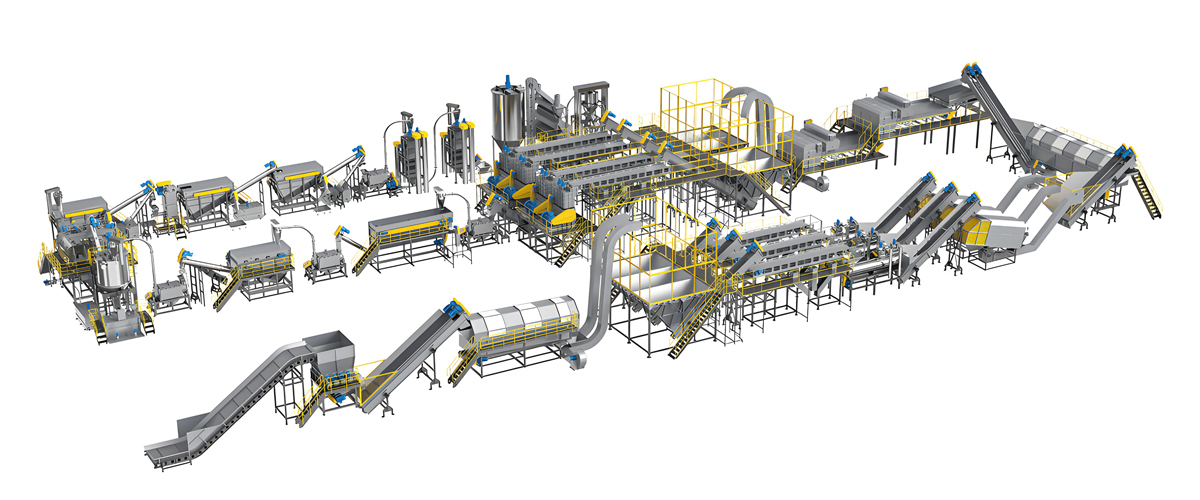
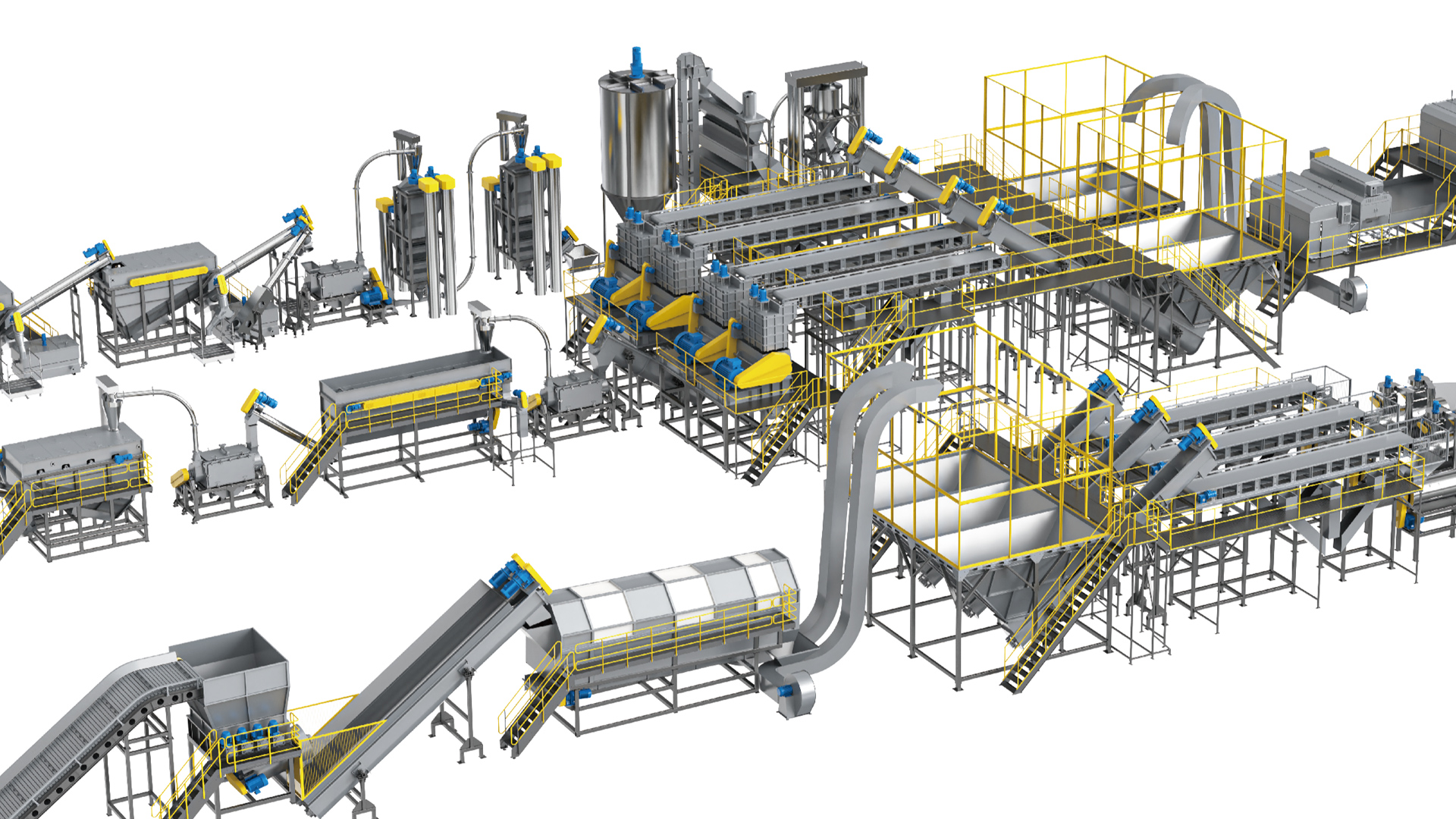
The wet front end of a printed and sticky film plant is built on the Polyretec Soft PP/PE Crushing and Washing Line, a configuration developed specifically for film, woven bags and agricultural film rather than adapted from a rigid plastics line. It covers the capacity range of 500 to 1500 kilograms per hour, and it can be supplied either as a flake-producing washing plant or with one-step pelletizing integrated directly downstream, so that washed flake goes straight into the extruder without an intermediate storage and re-handling step.
The distinguishing engineering features on this line all address the film-specific problems described earlier in this article. Dry pre-cleaning is available as an integral stage rather than an add-on, which is what makes agricultural film with high soil load economically processable. Blade steel and screen configurations in the shredding and wet crushing sections are selected against the abrasion grade of the intended stream. The wash section uses counter-current water flow throughout, with fresh water entering at the final rinse and cascading backward, which is what holds fresh water consumption inside the 0.5 to 1.5 cubic meters per ton band when a closed-loop treatment package is fitted. For printed and greasy streams, the heated wash reactor with caustic and surfactant dosing is integrated into the flow rather than bolted on, so residence time is designed rather than improvised.
The fully automated PP and PE film washing plant delivered in Taiwan around the PTW1000 configuration is the reference installation for the 1000 kilograms per hour class: continuous operation with centralized control, automatic dosing and integrated water treatment. Projects delivered in Mexico for LDPE film carrying sticker labels, built around a heavy-duty shredder and beater machine arrangement, and in Turkey for printed bags and film, cover the sticky and heavily printed ends of the same equipment family.
| Parameter | 500 kilograms per hour class | 800 kilograms per hour class | 1000 kilograms per hour class (PTW1000 reference) | 1500 kilograms per hour class |
|---|---|---|---|---|
| Design throughput, washed flake | 500 kilograms per hour | 800 kilograms per hour | 1000 kilograms per hour | 1500 kilograms per hour |
| Target materials | LDPE and LLDPE film, PP woven bags | Printed packaging film, stretch film, woven bags | Printed post-consumer film, agricultural film, heavy-duty sacks | Mixed post-consumer film, agricultural film at scale |
| Infeed | Chain plate conveyor with sorting platform and overband magnet | Chain plate conveyor, sorting platform, magnet, optional eddy current | Chain plate conveyor, multi-position sorting, magnet plus eddy current | Chain plate conveyor, multi-position sorting, magnet plus eddy current |
| Shredding | Single-shaft, screen 100 to 150 millimeters | Single-shaft or double-shaft, screen 80 to 150 millimeters | Heavy-duty shredder, screen 60 to 150 millimeters | Heavy-duty shredder, screen 60 to 120 millimeters |
| Dry pre-cleaning | Optional | Recommended | Integrated beater and de-dusting drum | Integrated beater and de-dusting drum, extended |
| Wet crusher | Knife gap 0.3 to 0.8 millimeters, screen 40 to 60 millimeters | Knife gap 0.3 to 0.8 millimeters, screen 30 to 60 millimeters | Knife gap 0.3 to 0.8 millimeters, screen 30 to 60 millimeters | Knife gap 0.3 to 0.8 millimeters, screen 30 to 50 millimeters |
| Float-sink tanks | Two in series | Two in series | Two to three in series | Three in series |
| Friction washers | One, 700 to 1000 revolutions per minute | Two, 700 to 1200 revolutions per minute | Two, 700 to 1200 revolutions per minute, counter-current | Two to three, 700 to 1200 revolutions per minute, counter-current |
| Hot wash reactor | Optional, 75 to 90 degrees Celsius | Standard for printed film, 75 to 95 degrees Celsius | Standard, 75 to 95 degrees Celsius, caustic 0.5 to 2.0 percent | Standard, 75 to 95 degrees Celsius, extended residence volume |
| Dewatering | Centrifugal dryer, outlet 3 to 8 percent moisture | Centrifugal dryer, outlet 3 to 8 percent moisture | Centrifugal dryer plus pipe dryer, outlet below 1 percent | Centrifugal dryer plus pipe dryer and silo, outlet below 1 percent |
| Water treatment | Sedimentation plus filtration | Sedimentation, dissolved air flotation, filtration | Closed loop with dosing, 85 to 95 percent recirculation | Closed loop with dosing and sludge dewatering |
| Control | Centralized panel with programmable logic controller | Centralized panel, touch screen human-machine interface | Fully automated, recipe management, remote monitoring ready | Fully automated, recipe management, remote monitoring ready |
| One-step pelletizing option | Available | Available | Available | Available |
Polyretec New Generation Pelletizing Line for LDPE Film
Downstream of the washing plant, the Polyretec New Generation Pelletizing Line is the configuration built for thin-walled LDPE film and thick-walled PE and PP regrind. It is a robust-construction line intended for post-consumer waste rather than for clean in-house scrap, which shows in the details that matter on printed material: long L/D plasticizing, double-stage vacuum venting, generous filtration area and a control philosophy that holds melt temperature down instead of pushing throughput up.
The line is configured around the screw diameter that matches the required output, and each class carries the same architecture. Densification is by agglomerator or high-compaction force feeder according to throughput and stream type. Filtration is specified against the contamination grade of the input rather than sold as a fixed item, with hydraulic screen changers on clean streams and continuous or fully automatic laser-drilled rotary disc filters on heavily printed and soiled streams. Pelletizing is by water ring die-face head as standard for film, with underwater pelletizing available where pellet geometry is part of the specification.
| Parameter | Screw 100 millimeters | Screw 120 millimeters | Screw 160 millimeters | Screw 180 millimeters |
|---|---|---|---|---|
| Output on LDPE film | 250 to 350 kilograms per hour | 400 to 550 kilograms per hour | 700 to 1000 kilograms per hour | 1000 to 1500 kilograms per hour |
| L/D ratio | 30 to 36 to 1 | 30 to 36 to 1 | 30 to 36 to 1 | 30 to 36 to 1 |
| Main drive power | 75 to 110 kilowatts | 110 to 160 kilowatts | 200 to 280 kilowatts | 280 to 400 kilowatts |
| Screw speed | 60 to 140 revolutions per minute | 60 to 140 revolutions per minute | 60 to 130 revolutions per minute | 60 to 120 revolutions per minute |
| Densification | Force feeder standard, agglomerator optional | Force feeder or agglomerator | Agglomerator standard | Agglomerator standard, extended chamber |
| Venting | Double-stage vacuum, minus 0.08 to minus 0.095 megapascals | Double-stage vacuum, minus 0.08 to minus 0.095 megapascals | Double-stage vacuum, minus 0.085 to minus 0.095 megapascals | Double-stage vacuum, minus 0.085 to minus 0.095 megapascals |
| Two-stage extrusion option | Available | Available | Recommended above 3 percent contamination | Recommended above 3 percent contamination |
| Melt filtration | Hydraulic screen changer, 120 to 150 micrometers | Continuous belt filter, 100 to 150 micrometers | Continuous or laser-drilled rotary disc, 80 to 150 micrometers | Laser-drilled rotary disc, 80 to 150 micrometers, two-step available |
| Pelletizing head | Water ring die-face, 2.8 to 3.5 millimeter die holes | Water ring die-face, 2.8 to 4.0 millimeter die holes | Water ring die-face or underwater | Water ring die-face or underwater |
| Pellet handling | Centrifugal dryer and vibrating classifier | Centrifugal dryer, classifier, silo | Centrifugal dryer, classifier, blending silo, metal detector | Centrifugal dryer, classifier, blending silo, metal detector |
| Control | Programmable logic controller with touch screen | Programmable logic controller with recipe storage | Full automation, data logging, remote support ready | Full automation, data logging, remote support ready |
For projects that require compounding-grade homogenization of the recycled melt, for example when mineral filler, color masterbatch or a compatibilizer is dosed into the recyclate, Wanplas supplies matched twin-screw pelletizing systems that integrate directly with Polyretec washing lines, so the washed flake can be routed either to a single-screw film pelletizing line or to a twin-screw compounding step within the same plant layout.
Master Process Parameter Sheet for Printed and Sticky LDPE
The table below consolidates the working setpoints for a 1000 kilograms per hour printed and sticky LDPE film line into one reference sheet. These are commissioning starting points, refined during the trial run against the customer’s actual material.
| Process Variable | Setpoint or Range | Measurement Point | Effect if Set Too Low | Effect if Set Too High |
|---|---|---|---|---|
| Shredder screen aperture | 60 to 150 millimeters | Rotor screen | Excess fines, higher water carry-over | Oversize pieces overload the wet crusher |
| Wet crusher knife gap | 0.4 to 0.6 millimeters typical | Blade set, checked at each service | Blade contact risk, excessive fines | Film folds instead of cutting, rotor wrapping |
| Friction washer speed | 700 to 1200 revolutions per minute | Drive frequency | Incomplete surface cleaning | Fines generation, higher power draw and wear |
| Hot wash temperature | 75 to 95 degrees Celsius | Reactor liquor | Ink and grease not released | Flake softening and agglomeration in the tank |
| Caustic soda concentration | 0.5 to 2.0 percent | Liquor titration, per shift | Poor ink removal, gray haze | Rinsing burden, alkaline carry-over, ash increase |
| Hot wash residence time | 10 to 20 minutes | Reactor volume against flow | Chemistry has no time to act | Reduced plant throughput |
| Centrifuge outlet moisture | 3 to 8 percent | Sampling at discharge | Not achievable without excess energy | Thermal dryer overload, venting stress |
| Dryer air temperature | 80 to 120 degrees Celsius | Duct sensor, closed loop | Moisture target missed | Film softening, duct blockage, lumps |
| Flake moisture at extruder | Below 1 percent | Sampling at silo outlet | Not applicable | Porous pellets, surging, vent flooding |
| Agglomerate bulk density | 0.30 to 0.45 tons per cubic meter | Sampling at agglomerator discharge | Feeding instability and output surging | Over-sintering, lumps, energy waste |
| Melt temperature | 195 to 215 degrees Celsius | Melt probe before the filter | Unmelted inclusions, high filter pressure | Ink carbonization, black specks, odor |
| Vacuum level | Minus 0.08 to minus 0.095 megapascals | Vent line gauge | Residual moisture and volatiles in the pellet | Melt drawn into the vent port |
| Filtration fineness | 80 to 150 micrometers | Filter specification | High black speck count | Blinding, melt loss, back pressure spikes |
| Filter differential pressure | Change or advance at 6 to 10 megapascals | Pressure transducers before and after filter | Premature change, wasted screen | Melt temperature rise from back pressure |
Recycled LDPE Pellet Quality Targets and Test Methods
A recycled pellet is a commercial product with a specification, and the line must be able to demonstrate that specification consistently. The table below sets out the property targets that converters typically ask for on recycled LDPE from printed film, together with the test method and the process lever that controls each property.
| Property | Typical Target | Test Method Basis | Controlled By |
|---|---|---|---|
| Melt flow rate at 190 degrees Celsius and 2.16 kilograms | 0.3 to 2.0 grams per 10 minutes | Melt flow rate testing per ISO 1133 | Input consistency, melt temperature, residence time |
| Density | 0.918 to 0.930 grams per cubic centimeter | Immersion or gradient column per ISO 1183 | Polymer purity, foreign polyolefin content |
| Moisture content | Below 0.1 percent | Loss on drying or Karl Fischer titration | Drying cascade and vacuum venting |
| Ash content | Below 1.5 percent | Muffle furnace incineration per ISO 3451 | Washing efficiency, dry pre-cleaning, filtration |
| Black speck count | Counted per 100 grams against an agreed reference | Visual count on cast plaque or pressed film | Melt temperature control and filtration fineness |
| Color difference value | Agreed tolerance band against a reference pellet | Spectrophotometric color measurement | Hot wash efficiency and silo blending |
| Tensile strength retention | 75 to 90 percent of virgin reference | Tensile testing per ISO 527 | Thermal history, degradation control, contamination |
| Elongation at break | Agreed minimum against application | Tensile testing per ISO 527 | Degradation control and foreign polymer content |
| Odor | Assessed against an agreed sensory scale | Internal panel assessment on heated sample | Hot wash degreasing and vacuum devolatilization |
| Pellet geometry and fines | Uniform pellet, minimal tails and fines | Sieve analysis and visual inspection | Cutter blade condition and classification |
Two of these deserve particular attention on printed film. Ash content is the number that reveals whether the wet section is genuinely working, because it aggregates mineral soil, paper fiber, pigment and filler that survived the whole process. And black speck count is the property that most often triggers a customer complaint, which is why melt temperature discipline and filtration selection are treated as quality controls rather than as production settings.
Water Treatment, Sludge Handling and Air Emission Control
A film washing plant is a water plant with a polymer product, and the water treatment loop deserves the same engineering attention as the extruder. A well-designed closed loop recirculates 85 to 95 percent of process water, which is what keeps fresh water consumption in the 0.5 to 1.5 cubic meters per ton band even on soiled agricultural film.
The treatment train follows a standard sequence. Coarse solids settle in a sedimentation basin sized for the real grit load rather than a nominal one. Dissolved air flotation then removes suspended fines, emulsified grease and detached ink particles by attaching micro-bubbles to them and skimming the resulting float layer. Chemical dosing with a coagulant such as polyaluminum chloride followed by a polyacrylamide flocculant aggregates the remaining fine solids into settleable flocs. Filtration polishes the water before it returns to the process, and a bleed stream is discharged or sent for external treatment to prevent the accumulation of dissolved salts and organics.
Sludge handling is the part most often underestimated. On agricultural film, the sludge volume is substantial because most of what enters the plant as bale weight leaves as sludge, and wet sludge is expensive to transport. A filter press or screw press that raises sludge dry solids content materially reduces disposal cost and is a routine part of a properly specified line. Where dry pre-cleaning has removed 40 to 60 percent of soil before it ever reaches the water, the sludge burden falls proportionally, which is one more reason that stage repays its cost.
Air emissions come from two sources. The hot wash section releases steam carrying trace volatile organic compounds, and the extruder vacuum vents release moisture along with ink volatiles and low-molecular-weight degradation products. Both should be captured and treated rather than vented into the workshop. A condenser on the vacuum line recovers most of the moisture and condensable organics; activated carbon adsorption or a comparable treatment stage handles the remainder. Beyond regulatory compliance, this matters for the working environment, because ink volatiles in a workshop are the most common health and comfort complaint on printed film recycling plants.
Utility Consumption Benchmarks per Ton of Pellet
Utility consumption per ton of finished pellet is the honest way to compare line designs, because it is independent of scale, currency and local tariffs. The table below gives working benchmarks for LDPE film lines with a closed-loop water package.
| Stream | Electrical Energy (kilowatt hours per ton of pellet) | Fresh Water (cubic meters per ton) | Caustic Soda (kilograms per ton) | Yield, Bale to Pellet | Sludge Generated |
|---|---|---|---|---|---|
| Clean post-industrial film, unprinted | 280 to 360 | 0.3 to 0.8 | Not required | 88 to 95 percent | Very low |
| Printed post-industrial film | 340 to 430 | 0.5 to 1.0 | 3 to 6 | 85 to 92 percent | Low |
| Printed post-consumer packaging film | 400 to 500 | 0.8 to 1.3 | 5 to 10 | 60 to 75 percent | Medium |
| Stretch film with adhesive | 380 to 470 | 0.6 to 1.1 | 4 to 8 | 70 to 85 percent | Low to medium |
| Heavy-duty industrial sacks | 400 to 500 | 0.8 to 1.3 | 4 to 8 | 70 to 85 percent | Medium |
| Agricultural film, high soil load | 450 to 550 | 1.0 to 1.5 | 3 to 7 | 45 to 65 percent | High to very high |
Three observations follow from these numbers. Energy consumption is dominated by three consumers: the agglomerator, the extruder main drive and the hot wash heating load, which together typically account for 65 to 75 percent of plant demand. Water consumption is driven almost entirely by what leaves the system as sludge moisture and flake carry-over, not by tank volume, so a better sludge press reduces water consumption more effectively than a bigger recirculation pump. And yield, not utility cost, is the variable that dominates plant economics on soiled streams; a five-point yield improvement from better dry pre-cleaning is worth more than any plausible energy saving elsewhere.
Investment Level, Payback Window and Operating Economics
Because equipment pricing varies with configuration, scope and destination, the useful way to discuss investment is through an index rather than a figure. Setting a baseline 500 kilograms per hour LDPE film washing and pelletizing line at 100 points on a line investment index, the relative positions below hold across most project configurations.
| Configuration | Line Investment Index (baseline 500 kilograms per hour LDPE film line = 100 points) | Installed Power Level | Operating Cost Level | Output Pellet Grade | Indicative Payback Window |
|---|---|---|---|---|---|
| 500 kilograms per hour, washing only, flake output | 62 to 72 points | Low | Low | Washed flake, sold as intermediate | 18 to 30 months |
| 500 kilograms per hour, washing plus pelletizing, baseline | 100 points | Medium | Medium | General-purpose recycled LDPE pellet | 16 to 28 months |
| 1000 kilograms per hour, washing plus pelletizing | 155 to 180 points | High | Medium | General-purpose to good-quality pellet | 14 to 24 months |
| 1000 kilograms per hour with hot wash and two-step filtration | 185 to 215 points | High | Medium to high | Low black speck, controlled color pellet | 14 to 26 months |
| 1000 kilograms per hour agricultural film configuration with extended pre-cleaning | 200 to 235 points | Very High | High | Filler and construction grade pellet | 16 to 30 months |
| 1500 kilograms per hour full configuration with two-stage extrusion | 245 to 290 points | Very High | Medium per ton, High absolute | Premium recycled LDPE pellet | 13 to 22 months |
Payback windows above assume continuous multi-shift operation, a secured feedstock supply and a stable offtake for the finished pellet. All three assumptions deserve scrutiny before the equipment decision, because the most common cause of disappointing project economics is not equipment performance but feedstock availability: a line sized for 1500 kilograms per hour running at 600 kilograms per hour because the bales are not there carries the capital and the labor of the larger plant with the output of the smaller one.
One further economic point applies specifically to printed film. Adding a properly sized hot wash section and a second filtration step raises capital cost by a modest percentage of the total line, but it moves the pellet from a dark, variable filler grade into a controlled light-gray general-purpose grade. That step change in product grade has a far larger effect on project returns than any equivalent saving on the mechanical sections, which is why the hot wash is the last place to economize on a printed film line.
Requirement to Line Configuration Selection Guide
The table below maps common project requirements to a recommended Polyretec line configuration. It is written the way a technical offer should be prepared: input stream first, then throughput, then the pellet grade the customer needs, and only then the equipment.
| Input Stream | Required Output | Target Pellet Grade | Recommended Polyretec Configuration | Critical Options to Include |
|---|---|---|---|---|
| In-house printed film trim from a converter | 250 to 350 kilograms per hour | Reusable in-house blend at 20 to 40 percent | New Generation Pelletizing Line, 100 millimeter screw, with force feeder | Double-stage venting, hydraulic screen changer at 120 to 150 micrometers |
| Printed post-industrial packaging film, low soil | 400 to 550 kilograms per hour | Light gray general-purpose pellet | Soft PP/PE Crushing and Washing Line, 500 kilograms per hour class, with hot wash, plus 120 millimeter pelletizing line | Hot wash reactor, continuous belt filter at 100 to 120 micrometers |
| Printed post-consumer packaging film | 700 to 1000 kilograms per hour | Controlled color, low black speck pellet | Soft PP/PE Crushing and Washing Line, 1000 kilograms per hour class, plus 160 millimeter pelletizing line | Two to three float tanks, hot wash with dosing, two-step filtration, blending silo |
| Agricultural film, 20 to 60 percent soil | 700 to 1000 kilograms per hour | Construction and filler grade pellet | Soft PP/PE Crushing and Washing Line, 1000 kilograms per hour class with extended dry pre-cleaning, plus 160 millimeter pelletizing line | Beater and de-dusting drum, grit removal, abrasion-resistant blades, laser-drilled rotary disc filter, sludge press |
| Stretch and wrapping film with adhesive | 400 to 700 kilograms per hour | General-purpose pellet with stable melt flow rate | Soft PP/PE Crushing and Washing Line, 800 kilograms per hour class, plus 120 to 160 millimeter pelletizing line | Water-jacketed densification housing, anti-bridging paddles, hot wash with solvent-assisted surfactant |
| Heavy-duty industrial sacks with powder residue | 500 to 1000 kilograms per hour | General-purpose pellet, controlled ash | Soft PP/PE Crushing and Washing Line, 800 to 1000 kilograms per hour class, plus 160 millimeter pelletizing line | Bag opener with de-dusting, multi-stage rinsing, dissolved air flotation in the water loop |
| Mixed post-consumer film from municipal collection | 1000 to 1500 kilograms per hour | Stable charcoal or gray pellet | Soft PP/PE Crushing and Washing Line, 1500 kilograms per hour class, plus 180 millimeter pelletizing line with two-stage extrusion | Eddy current separation, three float tanks, extended hot wash, two-step filtration, large blending silo |
| Film plus a filler or masterbatch dosing requirement | 500 to 1000 kilograms per hour | Compounded recycled grade | Polyretec washing line feeding a matched twin-screw pelletizing system supplied by Wanplas | Gravimetric side feeding, melt filtration, underwater pelletizing |
One guideline underlies every row: specify the wet section for the dirtiest material the plant will realistically buy, and specify the extrusion section for the pellet grade the plant intends to sell. Those are two different questions, and answering only one of them is how projects end up with a good extruder in front of an inadequate washing line, or the reverse.
Troubleshooting: Black Specks, Odor, Color Drift and Output Loss
The defects below are the ones that actually appear on printed and sticky film lines, listed with the diagnostic sequence that resolves them fastest. The general principle is to check the process condition before changing the equipment, because in the great majority of cases the root cause is a setpoint or a maintenance interval rather than a design flaw.
| Symptom | Most Likely Cause | Secondary Causes | Diagnostic Check | Corrective Action |
|---|---|---|---|---|
| Black specks in the pellet | Melt temperature above the ink carbonization band | Filtration too coarse; screen overdue for change; dead spots in the barrel or die | Measure actual melt temperature at the probe, not the barrel setpoint; check filter differential pressure trend | Lower the barrel profile and screw speed; advance or change the filter; move to two-step filtration; inspect for stagnation zones |
| Gray haze on nominally washed flake | Ink redeposition from contaminated wash liquor | Insufficient liquor bleed; missing anti-redeposition agent | Sample and inspect liquor clarity; check bleed and make-up rates | Increase liquor bleed, add or adjust the surfactant package, improve dissolved air flotation performance |
| Batch-to-batch color variation | No effective homogenization after pelletizing | Bale-to-bale input variation; inconsistent hot wash performance | Compare color measurements across consecutive lots | Install or enlarge the blending silo; stabilize hot wash setpoints; pre-blend input bales |
| Odor in the finished pellet | Insufficient degreasing in the hot wash | Weak vacuum on the vents; melt temperature too high generating degradation products | Heated sample sensory check; verify vacuum gauge reading under load | Raise caustic concentration and residence time; service the vacuum system; lower the melt temperature |
| Porous pellets or steam at the die | Excess moisture entering the extruder | Vent port partially blocked; dryer air temperature too low; excessive fines holding water | Sample flake moisture at the silo outlet; inspect vent ports | Restore drying cascade performance; clean vents; reduce fines generation upstream |
| Output surging and unstable melt pressure | Feeding instability from low bulk density material | Bridging in the feeder; agglomerator producing inconsistent grain size | Observe the throat under load; check agglomerate bulk density by sampling | Tune agglomerator quench timing; fit anti-bridging paddles; verify feeder cooling |
| Feeder or hopper bridging on stretch film | Adhesive softening above 40 to 60 degrees Celsius | Compaction ratio too aggressive; feeder cooling inadequate | Measure feeder housing temperature during production | Hold the housing below 45 degrees Celsius with water jacket cooling; reduce compaction; add a scraper |
| Rapid melt filter blinding | Filtration specified finer than the stream supports | Residual grit from inadequate pre-cleaning; paper fiber carry-over | Inspect the retained contamination on a removed screen | Step the fineness back; add or restore dry pre-cleaning; improve rinsing and fiber removal in the water loop |
| High ash content in the pellet | Incomplete soil and powder removal | Short hot wash residence; float tank overloaded; sediment recirculating | Ash test on flake before extrusion to localize the stage | Restore dry pre-cleaning; clear tank sediment systems; extend residence time |
| Wet crusher wrapping and blocking | Knife gap too wide for thin film | Blunt blades; screen aperture too fine; insufficient water injection | Measure the gap at several points across the rotor | Reset the gap to 0.4 to 0.6 millimeters; sharpen or rotate blades; verify spray nozzles |
| Pellet tails and fines | Worn die-face cutter blades | Incorrect blade pressure; die holes partially blocked | Inspect the blade set and die face during a planned stop | Replace blades, reset pressure, clean the die plate, verify classifier operation |
| Falling throughput at constant settings | Progressive filter loading | Screw and barrel wear; feeder cooling loss; contamination grade drift in incoming bales | Trend filter pressure and specific energy per kilogram over a week | Restore filtration cycle; measure screw and barrel clearance at the next service; re-check input contamination |
Application Industries and End Markets for Recycled LDPE
Recycled LDPE from printed and sticky film supports a broad set of end markets, and the pellet grade the line produces determines which of them are accessible. Understanding the destination in advance is what makes the specification decisions earlier in this article commercially rational.
Refuse sacks and general packaging film. The largest single outlet for recycled LDPE from post-consumer film. Blend ratios of 30 to 100 percent recycled content are routine, color tolerance is wide, and mechanical requirements are moderate. Black speck count matters less here than melt flow consistency, because unstable melt flow causes bubble instability in film blowing.
Construction and agricultural film. Damp-proof membranes, concrete curing film, temporary protection film and silage film accept recycled content at 20 to 80 percent. The gray or charcoal color that printed film naturally produces is not an obstacle in these applications, and in some of them it is preferred.
Drip irrigation tubing and agricultural pipe. Recycled LDPE and LLDPE blends are widely used in irrigation tubing, typically at 20 to 60 percent inclusion. Consistency of melt flow rate and freedom from hard inclusions matter here, because inclusions cause wall defects and emitter blockages.
Injection molded crates, pallets and general parts. Thick-section injection moldings tolerate higher contamination and lower optical quality than film applications, which makes them the natural home for pellets from difficult input. Impact performance is the property to watch, and it is controlled mainly by foreign polymer content and thermal history.
Pipe outer layers and cable ducting. Multi-layer pipe constructions use recycled polyolefin in the non-critical outer layer, with a virgin inner layer meeting the performance specification. This is a growing outlet as recycled content targets tighten across construction supply chains.
Compounded and filled grades. Where a recycled pellet needs mineral filler, color adjustment or a compatibilizer for use in a specific molded part, the recyclate becomes a compounding feedstock. For these projects, Wanplas supplies matched twin-screw pelletizing systems that integrate directly with Polyretec washing lines, so a plant can serve both the film pellet market and the compounded grade market from one washed flake stream.
Standards, Certification and Documentation
Recycled material sold into regulated or brand-owner supply chains needs documentation, not just quality. The framework below is what a serious recycling plant should be able to demonstrate.
Quality management. ISO 9001 provides the documented process control, traceability and corrective action framework that converters increasingly audit before placing volume orders. For a recycling plant, the practical value is lot traceability from bale to bag.
Environmental management. ISO 14001 covers water discharge, sludge disposal and air emission management. On a film washing plant, where water and sludge are the dominant environmental interfaces, this is a substantive standard rather than a paper exercise.
Recycled content verification. Third-party recycled content certification schemes verify the mass balance between input waste and output recyclate, and the Global Recycled Standard is the most widely recognized framework for tracking recycled content through a supply chain. Both depend on documented input weights, output weights and loss accounting, which is why automatic weighing and lot recording at the packing station is worth specifying from the start.
Machinery safety. Equipment supplied into the European market must meet the applicable machinery directive requirements and carry CE marking, covering guarding, emergency stop architecture, electrical safety and noise. For a plant with high-speed rotors, hot caustic liquor and molten polymer, these are the provisions that protect operators in daily practice.
Polyretec supplies complete technical documentation with each line, including process flow diagrams, electrical schematics, equipment manuals, spare parts lists and commissioning records, so that certification audits and internal maintenance planning both have a documented basis.
Trial Runs, Installation, Training and Lifetime Support
No two film waste streams are identical, which is why the single most useful step before a line purchase is a trial run on the customer’s own material. Polyretec accepts customer material samples for laboratory and pilot testing, and the trial produces the data that a specification should be built on: achievable ink removal, realistic yield from bale to pellet, ash content, moisture behavior, filtration loading rate and the melt temperature window that keeps black specks under control. A specification written from a trial run on real material is a different document from one written from a bale description.
Turnkey delivery. Lines are supplied as complete turnkey projects covering layout design, equipment manufacture, water treatment integration, electrical and control integration, and utility interface definition. A film recycling plant has more interfaces between stages than most plastics machinery installations, and single-source responsibility for those interfaces removes the coordination gap where projects usually lose time.
Testing before shipment. Equipment is tested before dispatch, and where the customer supplies material, the line can be run on the actual feedstock so that both parties see the result before the machinery leaves the factory rather than after it arrives.
Installation and commissioning. Polyretec engineers attend site for installation supervision and commissioning, taking the line from mechanical completion through water loop filling, chemical dosing calibration, extruder start-up and first pellet production. With a team of more than 24 engineers and project experience across more than 50 countries, commissioning is a routine operation rather than an experiment.
Operator training. Training covers the setpoint logic behind each stage rather than only button sequences, because the operator who understands why the knife gap is 0.5 millimeters and why the melt temperature ceiling is 215 degrees Celsius is the one who keeps the pellet inside specification a year later. Training includes blade service, screen changing, dosing control, water loop maintenance and troubleshooting the defect table above.
Spare parts and after-sales support. As a Wanplas factory, Polyretec applies the group service commitment of USD 500 free parts per year, with free replacement of parts damaged within the warranty period. Wear parts on a film line, blades, screens, paddles and filter elements, are stocked as standard items rather than made to order. Technical support is available remotely through the line control system where the customer network permits, which resolves most process questions without a site visit.
Open factory policy. Wanplas operates an open factory policy across its factories, and buyers are welcome to visit Polyretec to inspect equipment under construction, watch a line running on real material and speak directly with the engineers who will commission their project. For a capital purchase of this size, a factory visit answers questions that no specification document can.
Frequently Asked Questions
What is the realistic ink removal rate on printed LDPE film, and does washing make the pellet natural again?
A correctly configured hot wash stage running at 80 to 95 degrees Celsius with 0.5 to 2.0 percent caustic soda plus a matched surfactant package and 10 to 20 minutes of residence time removes roughly 70 to 90 percent of surface-printed ink. That is enough to move the pellet from a dark, streaky appearance to a uniform light gray, but it will not produce a natural transparent pellet. Reverse-printed ink sandwiched inside a laminate is mechanically protected and cannot be washed off at any temperature. For those streams the correct commercial target is a stable, repeatable gray or charcoal pellet with a controlled color difference value rather than color removal.
Do I really need both a washing line and an agglomerator before the extruder?
It depends on the bulk density of the washed flake, not on preference. Washed and dried LDPE film flake typically sits at 0.03 to 0.08 tons per cubic meter, which is far too light for a gravity-fed extruder throat, so some form of densification is mandatory. An agglomerator raises bulk density to 0.30 to 0.45 tons per cubic meter and simultaneously drives off residual surface moisture, which stabilizes output on high-capacity lines. A compaction-style force feeder integrated with the extruder is the alternative and is often sufficient below 500 kilograms per hour, but above that throughput agglomeration usually gives steadier melt pressure and a better pellet.
Which melt filtration fineness should I specify for printed and sticky film?
For printed post-consumer film the practical window is 80 to 150 micrometers. A two-step arrangement with a coarse first screen around 150 micrometers followed by a fine screen near 100 micrometers gives the best balance between black speck count and melt loss. Going finer than 80 micrometers on a soiled stream causes rapid screen blinding, frequent changes and significant purge losses. Agricultural film carrying grit should start coarser, typically 150 to 200 micrometers on the first pass, because abrasive mineral particles blind fine screens within minutes.
How hot can I run the extruder on printed film before the ink starts to carbonize?
Keep the melt temperature under about 215 degrees Celsius, with 195 to 210 degrees Celsius as the working window for printed LDPE. Above roughly 230 degrees Celsius, nitrocellulose and polyurethane based ink binders decompose rapidly and the black speck count per 100 grams climbs sharply within a single production shift. Running a lower barrel profile with a slightly higher screw speed and a longer metering zone gives the same throughput without pushing the melt into the carbonization band.
What water and power consumption should I budget per ton of finished pellet?
With a closed-loop water treatment package, a complete LDPE film washing and pelletizing plant consumes roughly 0.5 to 1.5 cubic meters of fresh make-up water per ton of finished pellet, because 85 to 95 percent of the process water is recirculated. Specific power consumption for the whole line, including the hot wash heating load, typically lands between 380 and 550 kilowatt hours per ton. Heavily soiled agricultural film sits at the top of both ranges; low-soil post-industrial printed film sits near the bottom.
Can one line process agricultural film, printed packaging film and stretch film?
Yes, provided the line is specified from the beginning for the hardest of the three. Agricultural film requires extra dry pre-cleaning volume, grit removal and abrasion-resistant blade steel; printed packaging film needs longer hot wash residence and a stronger chemical dosing package; stretch film with adhesive residue needs temperature-controlled conveying and densification so the adhesive does not soften and bridge. A line built with all three feature sets runs recipe changeovers through the control system. Retrofitting grit removal or hot wash capacity into a line originally sized for clean film is far more expensive than specifying it up front.
How much yield loss should I expect from bale to pellet?
Yield from baled input to bagged pellet is typically 60 to 75 percent for post-consumer printed packaging film, 45 to 65 percent for agricultural film depending on soil load, and 85 to 92 percent for clean post-industrial printed film. The losses are soil and moisture removed in washing, rejected sink fraction, non-target polymer, screen changer purge and start-up transitions. Any supplier quoting above 90 percent yield on soiled agricultural film is quoting on dry contamination-free input, not on real bale weight.
Does the line need to run continuously, and what maintenance downtime should I plan for?
A film washing and pelletizing plant is designed for continuous operation, and it performs best that way because the hot wash tank and extruder both take time to reach steady state. Plan roughly 20 to 24 hours of production per day with one shift-change inspection, plus a weekly slot of four to eight hours for blade rotation, screen inspection, sludge removal and water loop maintenance. Wet crusher blades on agricultural film may need re-sharpening every 200 to 400 operating hours; on clean packaging film the interval typically doubles.
Conclusion: Specify the Line for the Worst Bale You Will Ever Buy
The best LDPE film pelletizing line for printed and sticky film waste is the one specified against the hardest material the plant will realistically process, not the cleanest sample in the negotiation. Every stage in the chain covered here exists to solve a specific physical problem: dry pre-cleaning removes soil before it becomes an expensive water problem; float-sink separation removes everything denser than water; counter-current friction washing strips bound surface contamination; hot washing with caustic and surfactant attacks ink binders and grease that mechanical action cannot touch; the drying cascade protects the extruder; agglomeration solves the bulk density gap; double-stage venting removes what the wet section left behind; and melt filtration catches what nothing else could. Remove any one of these and the pellet tells the story.
The parameters that matter most are few and specific. Keep melt temperature between 195 and 215 degrees Celsius so ink volatilizes instead of carbonizing. Give the hot wash 10 to 20 minutes at 75 to 95 degrees Celsius with 0.5 to 2.0 percent caustic and a matched surfactant. Deliver flake to the extruder below 1 percent moisture and at 0.30 to 0.45 tons per cubic meter bulk density. Filter at 80 to 150 micrometers, in two steps on difficult streams. Close the water loop to recirculate 85 to 95 percent. Get those right and a printed post-consumer film stream produces a controlled light-gray pellet with ash below 1.5 percent and tensile strength retention of 75 to 90 percent, at 380 to 550 kilowatt hours and 0.5 to 1.5 cubic meters of fresh water per ton.
Polyretec, a Wanplas factory, has been building plastic recycling equipment since 2010 and has delivered more than 100 projects across more than 50 countries, with printed film, sticker-loaded film and agricultural film among its recurring specialties. Lines are supplied turnkey, tested before shipment, installed and commissioned by Polyretec engineers, and supported afterward with operator training, remote technical assistance and the Wanplas commitment of USD 500 free parts per year.
If you are evaluating a line for printed or sticky LDPE film, the most productive next step is to send a representative sample of your worst material together with your target output and the pellet specification your customers ask for. Polyretec will run a trial, report the achievable ink removal, yield, ash content and filtration loading, and return a line configuration built on those measured results rather than on assumptions. You are also welcome to visit the factory, see a comparable line running on real film waste, and talk the configuration through with the engineers who will commission it.