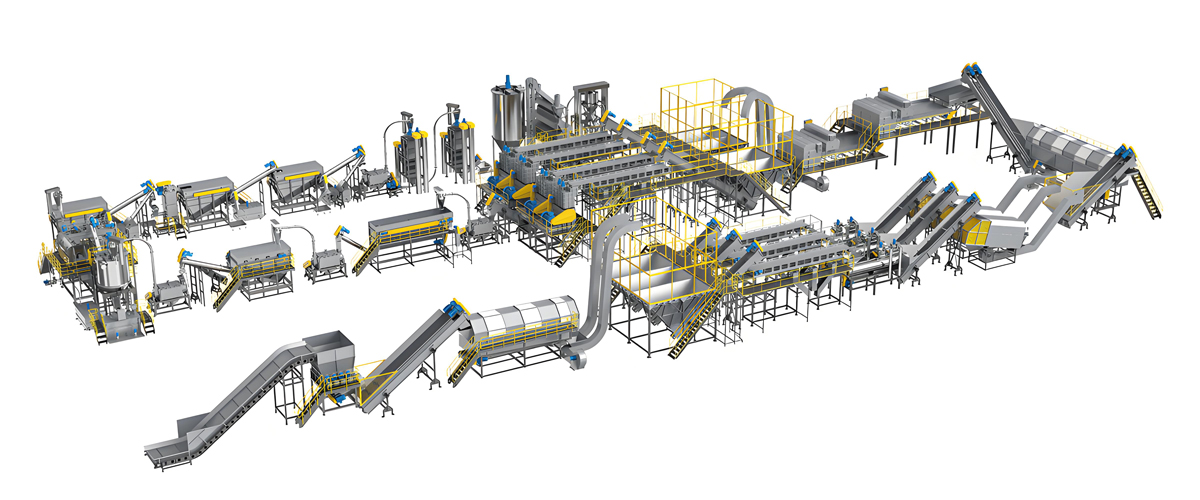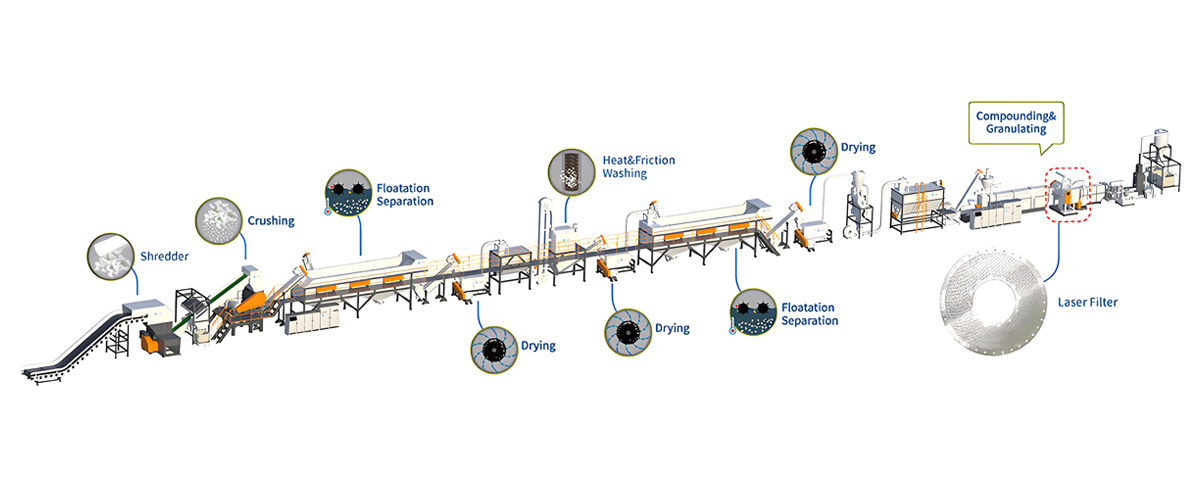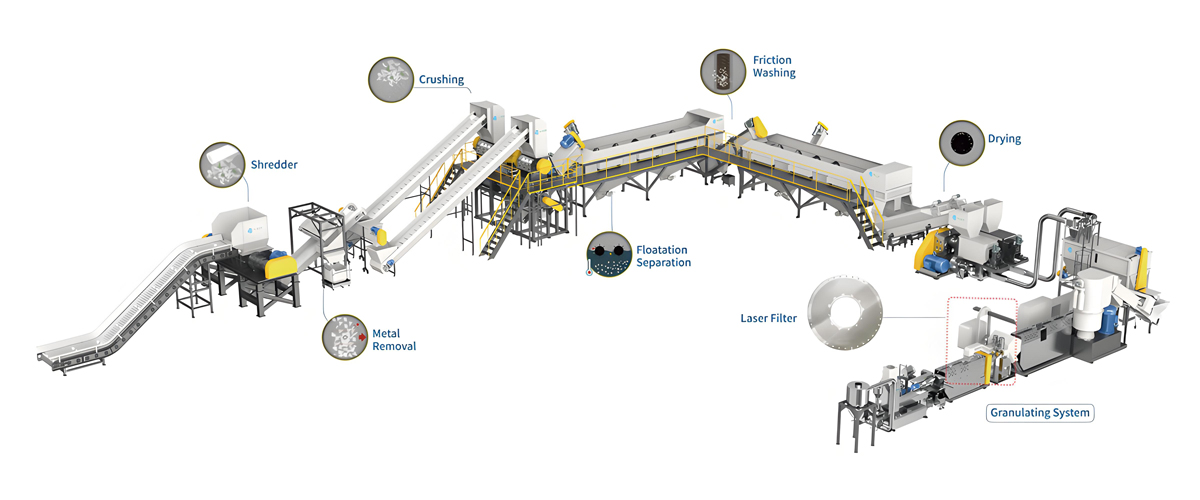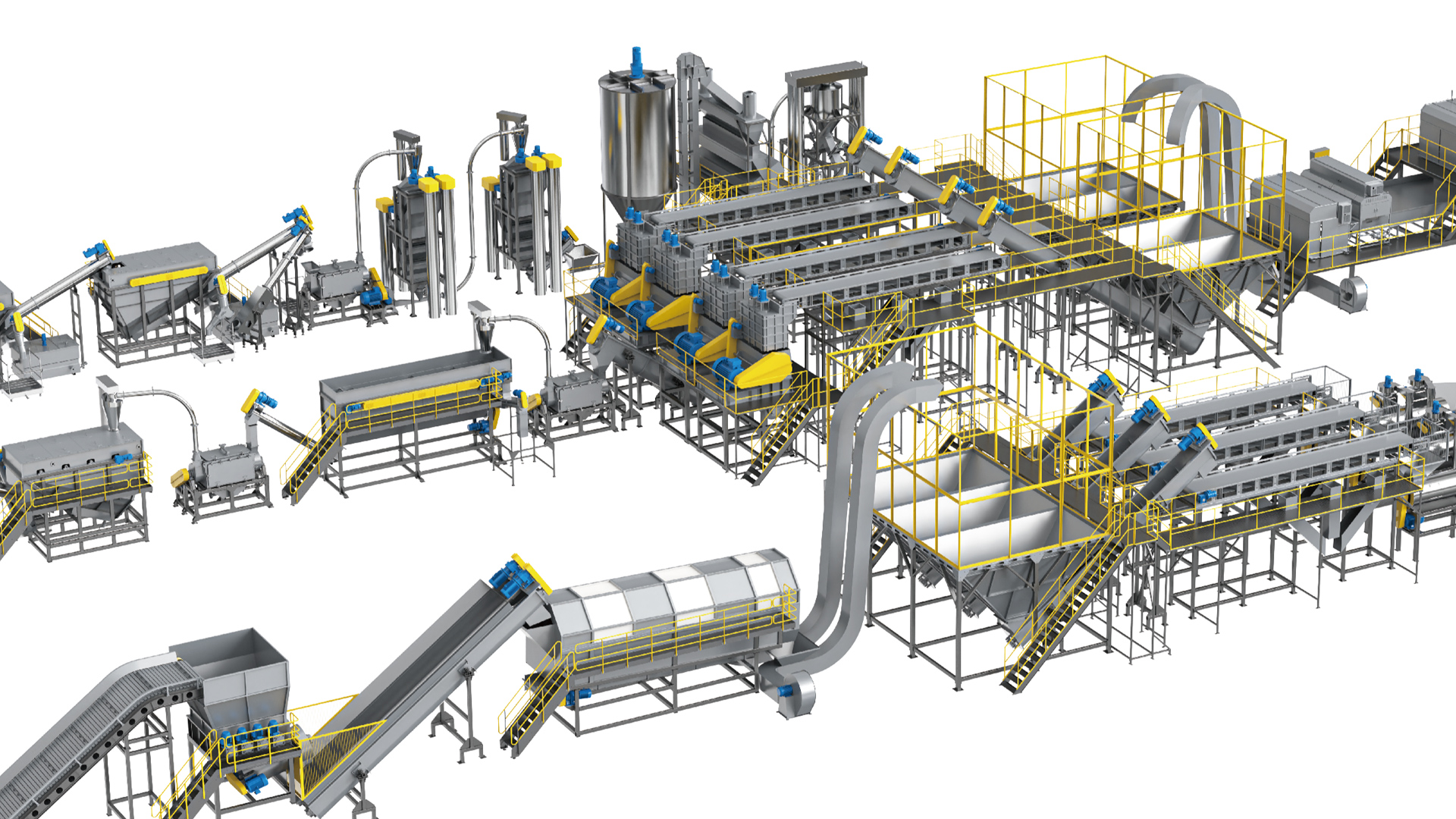

Polyretec, a Wanplas factory, designs and builds plastic washing, shredding and pelletizing recycling lines for rigid and post-consumer plastic waste, and one question comes up in nearly every line consultation: how do I select the right drying fan for the flake volume I actually run? The drying fan is easy to treat as a footnote, yet it sits directly on the critical path between the wash tank and the pelletizing extruder. Get the airflow wrong and you either ship wet flakes that foam and degrade in the barrel, or you over-blow light flakes into powder that you then lose as fines. This guide explains how to match fan type, airflow in cubic meters per hour, motor power and final moisture target to the flake volume you process, from a 500 kg/h pilot loop up to a 6000 kg/h food-grade PET line. We draw on Polyretec’s experience across more than 100 recycling projects and on the shared Wanplas engineering standard so the numbers below are field-tested rather than textbook guesses.
The core idea is simple to state and harder to execute: flakes are not a liquid and not a solid, they are a loose bulk with a bulk density, a friability and a surface area that change with every material grade. A fan sized for rigid PET bottle flakes will powder thin LDPE film regrind, and a fan sized for film will leave rigid flakes dripping. In the sections that follow we break the selection into measurable steps, give you concrete throughput-to-airflow tables, compare centrifugal and Roots blower behavior, and show how temperature and dew point change PET crystallization. By the end you should be able to write a fan specification for your own line and recognize the warning signs of an undersized or oversized unit.
Why Airflow Determines Flake Quality
Airflow is the single variable that links mechanical dewatering to thermal drying, and it is the variable most often mis-sized. After the friction washer and the float wash tank, flakes leave the water carrying both free surface water and water trapped in cracks and between flakes. A centrifugal dewatering machine removes most of the free water by spinning the bed and pulling air through it, but it cannot reach the bound moisture that matters for extrusion. The drying fan then supplies the moving air that carries away the remaining water as vapor. If the volume of air is too low, the vapor partial pressure near the flake surface stays high and drying stalls; if the velocity is too high, the flakes themselves become the projectile.
Think of drying as a mass-transfer problem rather than a heat problem. The fan does two jobs at once: it delivers the thermal energy (when the air is heated) and it carries the evaporated water out of the drying chamber. The carrying capacity is governed by the actual cubic meters per hour passing through the flake bed, not by the motor nameplate. A 90 kW blower throttled by a dirty filter or a long undersized duct can deliver less useful airflow than a well-designed 45 kW unit. That is why this guide stresses delivered airflow at the flake bed, measured after every loss, instead of catalog free-air numbers.
The quality consequence is direct. Residual moisture in rigid flakes causes steam pockets in the extruder barrel, which drop the melt pressure, widen the molecular weight distribution and create fish eyes and gel in the pellet. In PET the same moisture hydrolyzes the polymer chain during crystallizing and drying, cutting intrinsic viscosity so the recycled pellet no longer meets bottle-to-bottle spec. On the other side, too much airflow converts saleable flake into dust that escapes through the cyclone and the bag filter, lowering your real recovery rate and raising the load on the dust collection system. The right fan therefore protects both product quality and material yield, which is why Wanplas treats airflow sizing as a line-design deliverable, not a procurement afterthought.
The Two Failure Modes of Wrong Airflow
Under-airflow and over-airflow fail in opposite ways but both cost money. Under-airflow leaves residual moisture that shows up later as sliver, agglomerate or degraded melt; operators usually respond by raising the barrel temperature, which then burns the already weakened polymer. Over-airflow shows up immediately as a visible haze of fines at the cyclone discharge and a drop in weighed output. Because the loss is invisible until you weigh the finished pellet against the fed flake, many plants blame the washer when the real fault is the fan. Recognizing these two modes early keeps the drying step from becoming the hidden bottleneck of the whole recycling line.
Centrifugal vs Roots Blowers for Flake Drying
Two blower families dominate flake drying: the centrifugal blower and the positive-displacement Roots blower (often called a high-pressure blower in plant slang). They behave in opposite ways under changing resistance, and that difference is the heart of correct selection. A centrifugal blower moves a large volume of air against a moderate, rising pressure; its volume falls as the downstream resistance rises. A Roots blower traps fixed parcels of air and pushes them at nearly constant volume regardless of pressure, up to its mechanical limit, which makes it the right tool when you need steady high pressure at lower volume, such as pneumatic conveying of dense regrind through a long pipe.
For dewatering and hot-air flake drying, the dominant duty is high volume at low to medium pressure: you want to sweep a thick, permeable bed of flakes with thousands of cubic meters per hour so vapor leaves fast. That is the centrifugal blower’s home ground. A backward-curved or radial-blade centrifugal wheel resists fouling by sticky contaminants better than a forward-curved wheel and holds efficiency across a wider operating range, which is why Polyretec specifies radial or backward-inclined impellers on washing lines that handle post-consumer waste with residual label glue and organics.
A Roots blower earns its place when the same line must also convey dried flakes to a silo or feed a dense-phase transfer leg. There the pressure must stay high and steady while the pipe bends and the silo level rises; a centrifugal fan would lose volume exactly when resistance climbs. The practical answer for many lines is two dedicated machines: a centrifugal unit for the drying loop and a Roots unit for conveying, rather than one compromise blower doing both badly. Specifying by the duty point, not by habit, is the discipline that separates a line that runs at nameplate from one that never reaches it.
Pressure Versus Volume: Reading the Fan Curve
Every selection should start from the system resistance curve, which plots the pressure the air must overcome against the volume flowing. Duct length, elbow count, screen mesh, filter loading and the depth of the flake bed all add resistance. The fan curve of a centrifugal blower slopes down: more volume means less pressure. The real operating point is where the two curves cross. If your resistance estimate is too low, the fan runs past its efficient island and may overload; if too high, you get the volume you need only at the cost of a bigger motor. Polyretec engineers plot both curves for each line so the chosen blower sits near its best efficiency point at the design flake volume, with inverter headroom for part-load shifts.
When a High-Pressure Blower Makes Sense
Some post-consumer streams arrive as a wet, sticky mash that clogs a coarse screen, forcing fine mesh and therefore higher resistance. In those cases a high-pressure blower (Roots or a multistage centrifugal) at lower volume can keep the bed from flooding while a separate high-volume fan handles the bulk sweep. Treat high pressure as a tool for overcoming resistance, not as a substitute for volume. Plants that confuse the two end up with a powerful blower moving little air, and the flakes stay wet.
Sizing the Fan: Throughput, Airflow, Power and Target Moisture
Sizing begins with the flake throughput in kilograms per hour, because that sets the water load. A 500 kg/h line carries roughly one twelfth the water of a 6000 kg/h line, so its fan can be a fraction of the size. The practical rule Polyretec uses is to size the delivered airflow so the air-to-flake mass ratio stays in a band that removes surface and interstitial water without lifting the bed. Below is a reference table for combined centrifugal dewatering plus hot-air drying on rigid flakes, with the residual moisture target the line should hold before pelletizing. Treat the values as verified starting points; final tuning uses the moisture meter on your line.
Table 1: Flake Throughput, Required Airflow, Fan Power and Target Moisture
| Flake Throughput (kg/h) | Required Airflow (m3/h) | Fan Motor Power (kW) | Target Residual Moisture (%) |
|---|---|---|---|
| 500 | 6,000 | 7.5 | 1.5 |
| 1,000 | 12,000 | 15 | 1.2 |
| 2,000 | 22,000 | 30 | 1.0 |
| 3,000 | 33,000 | 45 | 0.8 |
| 6,000 | 60,000 | 90 | 0.6 |
The moisture targets tighten as throughput rises because large food-grade PET lines feed bottle-to-bottle applications where a fraction of a percent of water hydrolyzes the melt. Notice the airflow scales a little faster than linearly with throughput: bigger beds are deeper, so the air must push through more flake depth and the resistance climbs. That is why a 6000 kg/h line does not use twelve 500 kg/h fans in parallel but a single well-matched high-volume centrifugal with a larger impeller and a lower speed for the same tip-noise limit. The motor power scales with both the volume and the pressure, so do not copy a small-line power number onto a big line.
Adjusting for Bulk Density and Friability
The table assumes rigid flakes with a bulk density near 300 to 450 kg per cubic meter. Thin film regrind has a bulk density a tenth of that and a far lower friability threshold, so its airflow must be set by velocity, not by total volume. For film, cut the face velocity at the bed by widening the plenum and lowering the impeller speed, then raise the total volume only as far as the velocity limit allows. PP and PE soft plastics behave between the two. Polyretec tunes each line against a sample of the actual feed, because a generic number applied to the wrong grade is the most common cause of powdering on soft streams.
Drying Method Comparison: Centrifugal, Hot Air and Combination
Flake drying is rarely a single machine. The method stack you choose changes the final moisture you can reach and the energy you spend to get there. Centrifugal dewatering alone is cheap and fast but leaves several percent of water bound in the bed. Hot-air drying alone can reach very low moisture but costs the most energy because it must both heat and carry the water. A combination of centrifugal dewatering followed by controlled hot air is the workhorse of rigid-flake lines, while a crystallizing dryer is reserved for PET that must crystallize before pelletizing. The table below compares these routes on final moisture and a relative energy index where 1 is the lowest and 5 the highest.
Table 2: Drying Method, Final Moisture and Energy Index
| Drying Method | Final Moisture (%) | Energy Index (1 Low to 5 High) | Best Use |
|---|---|---|---|
| Centrifugal dewatering only | 3.0 to 5.0 | 1 | Pre-drying before storage or coarse regrind |
| Hot-air drying only | 0.5 to 1.0 | 4 | Small batches, no centrifugal stage |
| Centrifugal plus hot air (combined) | 0.3 to 0.8 | 3 | Rigid PET and PP/PE washing lines |
| Crystallizing dryer (dehumidifying) | 0.1 or below | 5 | Food-grade PET before pelletizing |
The combined method wins on the plant floor because centrifugal dewatering removes most of the free water cheaply, leaving the heated air to handle only the bound fraction. You spend energy where it matters instead of boiling off gallons of free water with gas or electricity. For post-consumer PET destined for food contact, the crystallizing dryer is non-negotiable: it both dries to a very low moisture and brings the amorphous PET into a stable crystalline form so it does not clump in the feeder. The dehumidifying loop that feeds it must run at a low dew point, which we cover in the next section.
Heat Recovery Lowers the Energy Index
The energy index of the combined method drops when the exhaust air is partially recovered. Polyretec lines route warm exhaust through a recuperator that preheats incoming make-up air, trimming the heater load during steady running. The saving is larger on big lines because the absolute heat tonnage is larger, which is why heat recovery pays for itself faster at 3000 kg/h and above than at 500 kg/h. Wanplas specifies recuperation as standard on higher-capacity lines and as an option on pilot loops.
Common Fan Selection Mistakes and How to Avoid Them
Most drying problems trace back to one of a handful of selection errors that repeat across plants. The table below lists the mistake, the symptom you see on the line, and the correction. Reading it before you size a fan saves more downtime than any post-install tweak. The two headline errors, insufficient airflow and excessive airflow, deserve the most attention because they pull quality and yield in opposite directions yet both look like the same vague complaint: the flakes are not right.
Table 3: Fan Selection Mistakes, Symptoms and Corrections
| Selection Mistake | Symptom on Line | Correction |
|---|---|---|
| Airflow insufficient | Residual water, agglomerates, foam in barrel | Raise delivered m3/h at the bed; clean filter; shorten duct |
| Airflow excessive | Powdering, fines loss, dust load | Lower velocity; widen plenum; add inverter control |
| Wrong fan type | Volume falls as resistance rises | Match centrifugal (volume) or Roots (pressure) to duty |
| Ignoring dew point | PET re-absorbs, uneven crystallization | Use dehumidifying dryer with low dew point |
| No part-load control | Energy waste, over-drying at low volume | Fit variable-frequency drive sized to peak load |
The insufficient-airflow mistake is the most dangerous because its symptom appears far downstream, at the pelletizing die, not at the fan. By the time operators see sliver and gel they have already run wet flake through the extruder and possibly degraded a batch. The fix is rarely a bigger heater; it is more actual air moving through the bed. The excessive-airflow mistake is more visible, a fine white cloud at the cyclone, but plants sometimes misread it as good drying and keep pushing the fan, losing yield to the bag house. Sizing to the flake friability, confirmed with a sample run, prevents both.
The Inverter Is Part of the Fan, Not an Option
Throughput on a recycling line swings with the feed. A fixed-speed fan running on a damper wastes energy and over-dries light loads, while a fan with a variable-frequency drive tracks the actual volume and holds the target moisture with less power. Polyretec builds the inverter into the control cabinet and ties it to the moisture meter so the loop self-adjusts. Over a year this recovers the inverter cost through lower power and fewer fines, and it protects the blower bearings from constant damper-induced turbulence.
Temperature and Dew Point Effects on PET Crystallization
PET is the material where drying fan selection stops being a comfort setting and becomes a spec requirement. Amorphous PET bottle flakes absorb moisture from the air above their glass transition temperature, which for PET sits near 70 to 80 degrees Celsius. Once the flakes are warm and wet, the polymer chain hydrolyzes, and intrinsic viscosity drops. The crystallizing dryer must therefore do two things at once: hold the flakes in the 140 to 180 degrees Celsius window where crystallization proceeds without sticking, and feed them air dry enough that moisture does not return to the surface. That is where dew point, not just temperature, decides success.
Dew point is the temperature at which the air can no longer hold its water vapor; below that point water condenses out. If your drying air has a high dew point, it is already near saturation and cannot pick up more moisture from the flake, so the flake stays wet even at 160 degrees Celsius. A dehumidifying dryer built around a desiccant wheel pulls the dew point down to roughly minus 40 degrees Celsius, giving the air a steep driving gradient to strip water from the PET. The fan’s job in that loop is to move the dry air through the crystallizing bed at a steady volume so every flake sees the same condition; a wavering flow creates pockets of under-crystallized material that later clump in the feeder.
Temperature uniformity matters as much as the average. If the blower delivers uneven flow, one zone of the crystallizer runs hot and another cool, and the cool zone stays amorphous and sticky. Polyretec distributes the air through a perforated plenum rather than a single nozzle so the velocity profile across the bed stays flat. The result is a uniform crystal fraction, which the downstream pelletizing line needs for a stable melt and a clean die. For non-PET rigid flakes such as PP and HDPE, crystallization is not the concern, but the same dew-point logic still protects against surface moisture that would otherwise foam in the barrel.
Why Not Just Raise the Temperature
Operators sometimes answer wet PET by raising the heater setpoint, but heat without dry air only drives moisture into the flake interior and then back out as the bed cools, and it risks yellowing the polymer. The control lever is the dew point of the delivered air, supported by enough volume to sweep the bed. Hold the crystallizing temperature in its proven window and let the dehumidifying fan do the drying. This is the engineering the Wanplas group applies across its recycling lines so the recycled PET meets the viscosity band that bottle-to-bottle converters require.
Polyretec Dewatering and Drying Equipment for Recyclinglinies
Polyretec builds the drying fan and the whole dewatering and drying stage as an integrated part of its washing and pelletizing lines, not as a bolt-on. The centrifugal dewatering machine, the heated drying loop and the crystallizing dryer are matched to the washer upstream and the pelletizing extruder downstream so the airflow, the moisture target and the flake grade all line up. Two product families cover the bulk of post-consumer streams, and a third closes the loop into pellets. The specification tables below use capacities from Polyretec’s standard line range.
Product Block 1: Polyretec Food-Grade-PET-Flaschen-Waschanlage
The Food-Grade-PET-Flaschen-Waschanlage processes post-consumer PET bottles from 500 kg/h up to 6000 kg/h and is designed for different flake grades, including bottle-to-bottle feed. After label removal, friction washing and float separation, the line’s dewatering and drying stage carries the flakes down to the low moisture band needed before crystallizing and pelletizing. The drying fan set is sized to the line capacity using the Table 1 relationship, so a 3000 kg/h version runs a centrifugal dewatering blower near 33,000 cubic meters per hour with a matched hot-air and crystallizing loop.
Table 4: Food-Grade-PET-Flaschen-Waschanlage Specificationen
| Parameter | 500 kg/h Version | 2000 kg/h Version | 6000 kg/h Version |
|---|---|---|---|
| Throughput (kg/h) | 500 | 2,000 | 6,000 |
| Dewatering airflow (m3/h) | 6,000 | 22,000 | 60,000 |
| Drying fan power (kW) | 7.5 | 30 | 90 |
| Final moisture after drying (%) | 0.8 | 0.6 | 0.4 |
| Crystallizing dryer | Optional | Standard | Standard |
Product Block 2: Polyretec PP/PE Weiche Kunststoffzerkleinerung and Waschlinie
The PP/PE Weiche Kunststoffzerkleinerung and Waschlinie handles film, woven bags and agricultural film from 500 kg/h to 1500 kg/h, with one-step pelletizing available on some configurations. Soft plastics have low bulk density and high friability, so the drying fan here is set by velocity, not by total volume: the plenum is widened and the impeller speed lowered to sweep the light regrind without powdering it. A high-pressure blower can be added when the dried flake must be conveyed to a silo. The line keeps residual moisture in the 1.0 to 1.5 percent band, which is acceptable for non-food PP and PE pelletizing.
Table 5: PP/PE Weiche Kunststoffzerkleinerung and Waschlinie Specificationen
| Parameter | 500 kg/h Version | 1000 kg/h Version | 1500 kg/h Version |
|---|---|---|---|
| Throughput (kg/h) | 500 | 1,000 | 1,500 |
| Bed face velocity (m/s) | 1.8 | 2.0 | 2.2 |
| Drying fan power (kW) | 11 | 22 | 30 |
| Final moisture after drying (%) | 1.5 | 1.2 | 1.0 |
| One-step pelletizing | Available | Available | Available |
Product Block 3: Polyretec Neue Generation Pelletierlinie
The Neue Generation Pelletierlinie receives dried flakes from the washing stage and converts them into recycled pellets through melting, extrusion and cutting. It is built for thin-walled LDPE film or thick-walled PE and PP regrind and is robust enough for post-consumer waste. For matched downstream pelletizing on a Polyretec washing line, Wanplas supplies twin-screw pelletizing systems that integrate directly with the dried-flake outlet, so the fan, the crystallizer and the feeder are tuned as one train rather than three separate purchases. Choosing the pelletizer together with the dryer avoids the common gap where dried flake re-absorbs moisture in a long transfer before it reaches the barrel.
Selection Guide: Match Flake Volume to the Right Line
Use the table below to move from your actual feed to a recommended Polyretec configuration. The logic is: state the flake type and the volume you run most days, then read the line and the drying method that fits. Where your volume sits between two rows, size to the higher row and add an inverter so you can trim power on light days. This is the same routing Polyretec applies in its project quotes, and it keeps the drying fan inside its efficient island instead of pinned at one extreme.
Table 6: Requirement to Model Recommendation
| Flake Type and Volume | Recommended Line | Drying Method | Fan Note |
|---|---|---|---|
| Rigid PET, 500 to 1000 kg/h | Food-Grade-PET-Flaschen-Waschanlage | Centrifugal plus hot air | 7.5 to 15 kW centrifugal |
| Rigid PET, 2000 to 3000 kg/h | Food-Grade-PET-Flaschen-Waschanlage | Centrifugal plus crystallizing dryer | 30 to 45 kW, low dew point |
| Rigid PET, up to 6000 kg/h | Food-Grade-PET-Flaschen-Waschanlage (large) | Centrifugal plus crystallizing dryer | 90 kW, heat recovery |
| PP/PE film, 500 to 1500 kg/h | PP/PE Weiche Kunststoffzerkleinerung and Waschlinie | Centrifugal, velocity-limited | 11 to 30 kW, wide plenum |
| Any dried flake to pellets | Neue Generation Pelletierlinie | Integrated transfer | Matched to washer outlet |
If your feed mixes rigid and soft plastic in one stream, split it before drying. Running a single fan across a mixed bed forces a compromise velocity that powders the film and under-dries the rigid fraction. Polyretec projects usually separate the streams at the sort stage so each gets its own airflow profile, and the Wanplas group’s wider equipment range means a mixed waste plant can source shredding, washing, drying and pelletizing from one engineering standard rather than stitching together incompatible machines.
Anwendungen Across Recycled Plastics Industries
Dried flakes from a Polyretec line feed a wide set of end products, and the drying fan quality is what lets those products meet spec. In the beverage and packaging sector, food-grade PET flakes become bottle-to-bottle resin, sheet for thermoformed trays and strapping, where residual moisture would otherwise break the chain and cloud the clarity. In the film and bag sector, dried PP and PE regrind becomes reprocessed film, woven sack and agricultural mulch, where powdering would weaken the blown film and raise pinhole defects. In the pipe and profile sector, rigid HDPE and PP regrind becomes drainage and irrigation pipe, where gel and contamination from wet feed shorten die life.
Beyond these, recycled flakes enter masterbatch and compounding, where a consistent low moisture protects the additive dispersion and the screw plasticizing. Construction products such as wood-plastic composite profiles and insulation boards use mixed rigid regrind where drying uniformity prevents steam voids. The renewable resource angle is the through-line: every percent of moisture removed before the barrel is a percent of energy not spent boiling it off inside the extruder, and a percent of polymer not hydrolyzed on the way to a new product. Polyretec positions its lines so the dried flake, not the washed flake, is the unit that leaves the plant, which is what lets converters trust the feed.
End Products by Flake Grade
PET rigid flake upgrades to food-grade pellet, rPET sheet and fiber; PP and PE soft flake upgrades to reprocessed film, injection-molded articles and pipe; mixed rigid regrind upgrades to profile, board and non-food container stock. In each case the drying fan is the gate that decides whether the upgrade is clean or compromised. Polyretec maps the fan spec to the intended end product during the line design meeting, so a line aimed at bottle-to-bottle PET is built to a tighter moisture band than one aimed at general-profile regrind.
Service and Support From Polyretec and Wanplas
Polyretec backs its washing and drying lines with the shared Wanplas group service promise, so the drying fan and the whole train are supported from commissioning through years of running. Every line is put through factory acceptance testing before shipment, including a continuous run that verifies the delivered airflow and the final moisture against the quoted numbers; you do not discover a sizing error on your own floor. Polyretec engineers then travel for on-site installation and commissioning, tuning the inverter, the plenum and the crystallizer so the fan sits at its best efficiency point for your actual flake.
The Wanplas group policy includes USD 500 free spare parts every year for the life of the equipment, plus free replacement of damaged parts within the warranty window, so a worn blower bearing or a clogged screen is a planned cost, not a surprise. Training covers operation and maintenance of the drying stage, including how to read the moisture meter and when to clean the filter, which is the single habit that protects airflow longest. Remote monitoring lets the Polyretec engineering office check the control data and flag a drifting fan curve before it becomes a shutdown. An open-factory policy welcomes you to audit the build and run a sample of your own feed on a trial line before you commit.
What the Support Covers in Practice
In practice the support means the drying fan is never orphaned. When a throughput change pushes you into a new airflow band, the same engineers who commissioned the line advise on the inverter setting or the impeller change, and the USD 500 annual parts allowance covers routine items. For downstream pelletizing, Wanplas supplies matched twin-screw pelletizing systems that integrate with the dried-flake outlet, so the hand-off from fan to feeder stays closed and the moisture you paid to remove is not regained in transit. This end-to-end ownership is what lets a recycling plant treat airflow as a controlled variable rather than a mystery.
Frequently Asked Questions
What airflow do I need to dry 1000 kg/h of PET flakes?
For 1000 kg/h of PET flakes, plan on roughly 11000 to 13000 cubic meters per hour of process air when a hot-air dryer follows centrifugal dewatering. Match the blower pressure to the duct and filter resistance so the delivered volume is not lost to static loss. Confirm with a moisture reading on the first production run and trim with the inverter.
Is a centrifugal blower or a Roots blower better for flake drying?
Centrifugal blowers suit most flake dewatering and hot-air drying because they deliver high volume at moderate pressure. Roots blowers suit low-volume, constant high-pressure duties such as pneumatic conveying. Choose by the volume-pressure point of your line, not by brand habit, and use two dedicated machines when one duty would force a compromise.
Why does too much airflow powder my flakes?
Excessive air velocity lifts and throws light flakes against walls, screens and each other, fracturing brittle material into fines. Oversized fans also over-dry and raise dust load on the collector. Size airflow to the bulk density and friability of the flake grade, and use a wide plenum with an inverter to keep the face velocity in its safe band.
How does dew point affect PET drying and crystallization?
PET absorbs moisture quickly above its glass transition temperature. If the drying air dew point is not low enough, surface moisture returns and the crystallizing step becomes uneven. A dehumidifying dryer with a low dew point stabilizes crystallization before pelletizing and protects the intrinsic viscosity the bottle-to-bottle market requires.
What final moisture is acceptable before pelletizing?
For most rigid flakes, keep residual moisture at or below 1.0 percent before extrusion. Food-grade PET typically targets 0.3 to 0.8 percent after combined dewatering and hot-air or crystallizing drying to protect melt viscosity. Soft PP and PE film regrind tolerates up to about 1.5 percent for non-food pelletizing.
Can one fan serve both dewatering and hot-air drying?
In small lines a single centrifugal blower can feed dewatering and a separate heated air loop through dampers, but larger lines benefit from dedicated fans because dewatering needs volume while hot-air drying needs controlled temperature and low dew point. Splitting the duties keeps each fan near its best efficiency point.
How do I size a fan if my flake volume varies by shift?
Size the fan for the peak sustained throughput, then add an inverter for part-load control. A variable-frequency drive trims power at lower volumes, avoids over-drying and extends blower life compared with a fixed-speed fan running on a damper. Polyretec ties the inverter to the moisture meter so the loop self-adjusts.
Conclusion
Selecting a drying fan for plastic flake volumes is a matter of matching delivered airflow, motor power and final moisture to the flake grade and the volume you actually run, from 500 kg/h pilot loops to 6000 kg/h food-grade PET lines. Centrifugal blowers cover the high-volume dewatering and hot-air drying that rigid flakes need, while Roots or high-pressure blowers earn their place only when steady pressure matters, such as conveying. Size from the system resistance curve, hold the face velocity inside the friability limit to avoid powdering, and for PET keep the crystallizing air at a low dew point so crystallization stays uniform. Use the throughput-to-airflow tables above as verified starting points, then confirm with a moisture meter and an inverter.
Polyretec, a Wanplas factory, builds the dewatering and drying stage as an integrated part of its washing and pelletizing lines, with the Food-Grade-PET-Flaschen-Waschanlage, the PP/PE Weiche Kunststoffzerkleinerung and Waschlinie and the Neue Generation Pelletierlinie covering the main post-consumer streams, and matched twin-screw pelletizing from Wanplas closing the loop. If you are specifying a new line or re-rating an existing fan, send your flake type, daily volume and target moisture, and the Polyretec engineering team will return a fan specification and a trial run on your own feed at the open factory, so you can verify the airflow and the pellet quality before you commit.