
Post-consumer plastic waste rarely arrives pre-sorted. Bottles made of PET and HDPE arrive tangled with LDPE and PP film, agricultural wrap, and printed bags. An Austrian technology shredder built for this mixed plastic bottle and film waste must crack rigid containers and cut flexible film in one pass. Polyretec, a Wanplas factory, designs shredding modules that combine Austrian-origin process know-how with Chinese manufacturing scale. This article explains how mixed feed is sized down, which shredder type fits each plant, and how the flakes feed a washing line and a pelletizing line.
Polyretec combines Austrian-origin process know-how with Chinese manufacturing scale, so the equipment carries European cutting concepts at a reachable investment level. The factory has shipped recycling projects to more than 50 countries since its recycling equipment origin in 2010, and the brand was established in 2017. That track record matters when a plant must run continuous shifts on inconsistent post-consumer feed.
Why Mixed Bottle and Film Waste Challenges Single Machines
Bottles and film behave like two different materials on the same conveyor. Bottles are rigid, thick-walled, and springy. Film is thin, flexible, and eager to wrap around any rotating shaft. A rotor profiled for one form performs poorly on the other.
Rigid bottles need high torque at low speed. The rotor must crack the wall without generating frictional heat that melts the plastic. Film needs aggressive intake and an anti-wrap geometry so the web is pulled in instead of riding the rotor.
Contamination raises wear on every mixed load. Labels, caps, dirt, and stickers carry grit that dulls knives fast. Stickers on LDPE film are especially abrasive and common in post-consumer streams.
Bulk density differs sharply between the two forms. Loose bottles occupy 40 to 80 kg per cubic meter. Loose film is far lighter and tends to bridge inside the hopper, starving the rotor and causing uneven load.
The table below maps each waste form to the engineering problem it creates. This mapping drives the rotor, screen, and feeder choices later in the article.
| Waste Form | Typical Material | Key Challenge | Shredder Response |
|---|---|---|---|
| Rigid bottles | PET, HDPE | Spring-back, thick wall | High-torque low-speed rotor |
| Flexible film | LDPE, PP | Wrapping, bridging | Anti-wrap intake, ram feeder |
| Printed bags | LDPE, BOPP | Abrasive ink, stickers | Hard-faced knives, wet cut |
| Mixed bales | PET + film | Density swing | Variable-speed drive, hopper agitator |
Baled feed arrives in dense, wired blocks that must be loosened before the shredder. A bale opener or a rotating agitator breaks the block so the rotor sees a steady stream instead of a sudden slug that overloads the drive. Polyretec sizes the feed system to the bale density the plant expects, because a bottle-heavy bale and a film-heavy bale release material at different rates even at the same weight.
Leaving these differences unmanaged produces oversized chunks and long film strands. Both defects force downstream screens to clog and lower the throughput of the entire washing line.
Austrian-Origin Shredding Principles
Austrian-origin process know-how in plastics recycling centers on controlled size reduction. The goal is uniform flakes at the lowest practical energy per kilogram, with minimal fine dust and minimal heat.
The first principle is low-speed, high-torque rotation. Rotors turn between roughly 80 and 120 rpm. The high torque cracks rigid bottles cleanly instead of smearing them. Low speed keeps the melt temperature of the plastic below its softening point.
The second principle is the screen-and-counter-knife system. A fixed counter-knife shears material against the rotating knives. The perforated screen below sets the maximum flake size. Smaller screen holes yield smaller, more uniform flakes for the washing line.
The third principle is wet shredding. Water is injected at the rotor during cutting. Water suppresses dust, cools the cut, and begins pre-washing. Wet flakes carry less surface soil into the friction washer, raising final flake cleanliness.
Austrian-origin engineering also stresses rotor balance and segmented knives. A balanced rotor vibrates less and lasts longer. Segmented knives let one worn tooth be flipped or replaced instead of regrinding the whole rotor.
Fast screen change matters for mixed waste. A plant switching from bottles to film should swap screens in minutes, not hours. Quick-change designs keep the line running when the feed composition shifts.
| Principle | How It Works | Plant Benefit |
|---|---|---|
| Low-speed high-torque | 80 to 120 rpm rotor | Cleans cracks, no melt heat |
| Screen + counter-knife | Shear against fixed edge | Controlled flake size |
| Wet cutting | Water at rotor | Less dust, pre-wash |
| Segmented knives | Replaceable teeth | Lower knife cost |
These principles scale from a compact 500 kg per hour module to a heavy-duty 2000 kg per hour single-shaft unit. The same know-how appears in the wet crushers embedded in Polyretec washing lines.
Rotor balance deserves special attention on mixed waste. An unbalanced rotor transfers vibration to the bearings and frame, which accelerates wear and can loosen the screen housing. Austrian-origin practice specifies tight balance tolerances and regular inspection of the mounting so the machine stays quiet and accurate over years of operation.
Shredder Types Compared for Mixed Waste
Three shredder families serve mixed bottle and film waste. Each trades flake uniformity against intake aggressiveness. Choosing wrong sends uneven material into the washing line and cuts pellet quality.
A single-shaft shredder uses a ram-fed horizontal rotor and a screen. It produces the most uniform flake of the three and handles rigid bottles best. It also accepts pre-cut film when the intake is aggressive.
A double-shaft shredder uses two counter-rotating shafts with no screen. It swallows bulky, tangled bales without bridging. Its output is coarse and less uniform, so it usually pre-breaks before a granulator.
A wet crusher, also called a granulator with water injection, targets film and pre-crushed bottles. It yields small flakes of 8 to 14 mm and is the standard cutting stage inside washing lines.
| Type | Feed Form | Flake Size | Uniformity | Best Use |
|---|---|---|---|---|
| Single-shaft | Bottles, rigid | 20 to 60 mm | High | Mixed rigid pre-cut |
| Double-shaft | Bulky bales | 40 to 100 mm | Medium | Pre-breaking tangled feed |
| Wet crusher | Film, bottle | 8 to 14 mm | High | Washing line cutting |
For a plant receiving baled mixed waste, the practical chain is double-shaft pre-break, then single-shaft or wet crusher for final flake. This two-stage approach protects knives and stabilizes the washing line feed.
Knife geometry follows the feed. A V-shaped hook knife pulls material in and suits mixed rigid and film, while a straight flake knife yields a more uniform cut for bottle-dominant feed. The hook angle, rake, and number of teeth per rotor revolution decide both intake and flake size. Polyretec selects the knife profile from a sample of the customer’s waste so the rotor grips film without wrapping and cracks bottles without smearing.
Energy use differs by type. Single-shaft units draw steady power matched to load. Double-shaft units spike during shear. Wet crushers add a water pump load but save energy later by delivering cleaner flakes.
Polyretec Heavy-Duty Single-Shaft Shredder
Polyretec, a Wanplas factory, builds a heavy-duty single-shaft shredder as the cutting heart of its bottle and rigid-plastic lines. The rotor, knives, and screen follow the Austrian-origin principles described above.
The machine uses a hydraulic ram feeder that pushes mixed bottles and film into the rotor without bridging. A variable-speed drive matches torque to the load, so a rigid PET bottle and a soft LDPE bag draw the power each needs.
Knives are hard-faced and segmented. Operators flip or replace a single segment instead of removing the whole rotor. Quick-change screens let the plant switch flake size when the feed shifts from bottles to film-heavy bales.
The table below lists representative capacity tiers. Polyretec configures each tier to the customer’s feed composition and target flake size during project engineering, so final values are confirmed in the quotation.
Specificationen: Polyretec Single-Shaft Shredder Tiers
| Output | Rotor Ø | Motor | Speed | Bildschirm | Flake |
|---|---|---|---|---|---|
| 500 kg/h | 400 mm | 37 kW | 90 rpm | 40 mm | 20 to 40 mm |
| 1000 kg/h | 500 mm | 75 kW | 95 rpm | 35 mm | 18 to 35 mm |
| 1500 kg/h | 600 mm | 110 kW | 100 rpm | 30 mm | 15 to 30 mm |
| 2000 kg/h | 700 mm | 160 kW | 105 rpm | 30 mm | 15 to 30 mm |
Installation places the shredder after metal separation and before the wet crusher or washing tunnel. A magnetic separator and a metal detector upstream protect the rotor from tramp steel in mixed bales.
Throughput depends on feed bulk density and the share of film. A film-heavy bale runs lighter per hour than a dense bottle bale at the same rotor setting. Polyretec sizes the motor using the worst-case mixed ratio the plant expects.
For mixed bottle and film waste, the 1000 kg per hour tier is the common starting point. It balances capital cost with the flexibility to handle both forms across a typical post-consumer stream.
Knife maintenance drives the real operating cost more than the purchase price. Polyretec supplies spare segmented knives and trains the team to flip worn teeth during a short planned stop. Plants that skip this routine face sudden knife failure and unplanned downtime that erases any saving from a cheaper cutter.
Wet Crusher Inside the PET and PP/PE Waschlinies
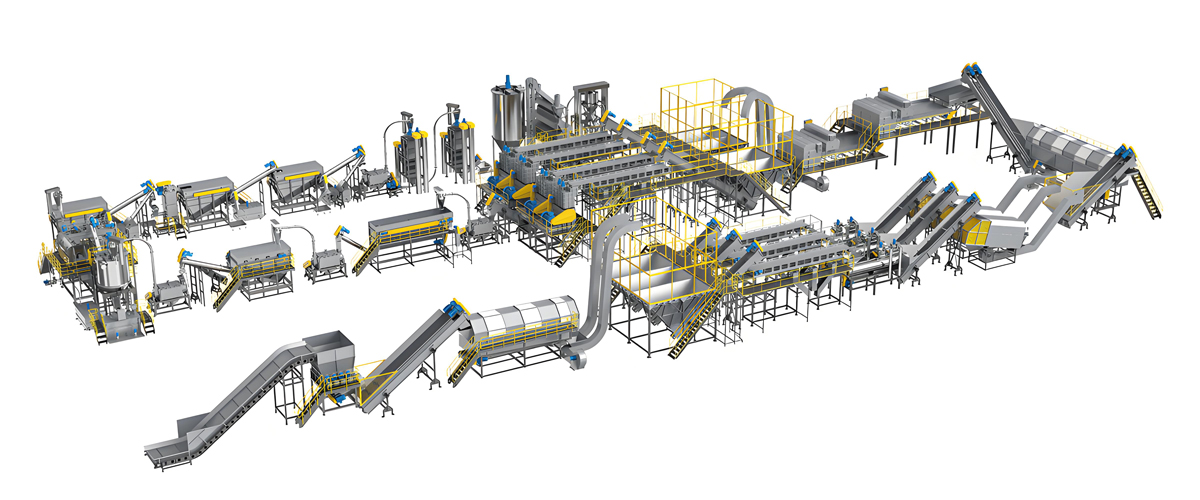
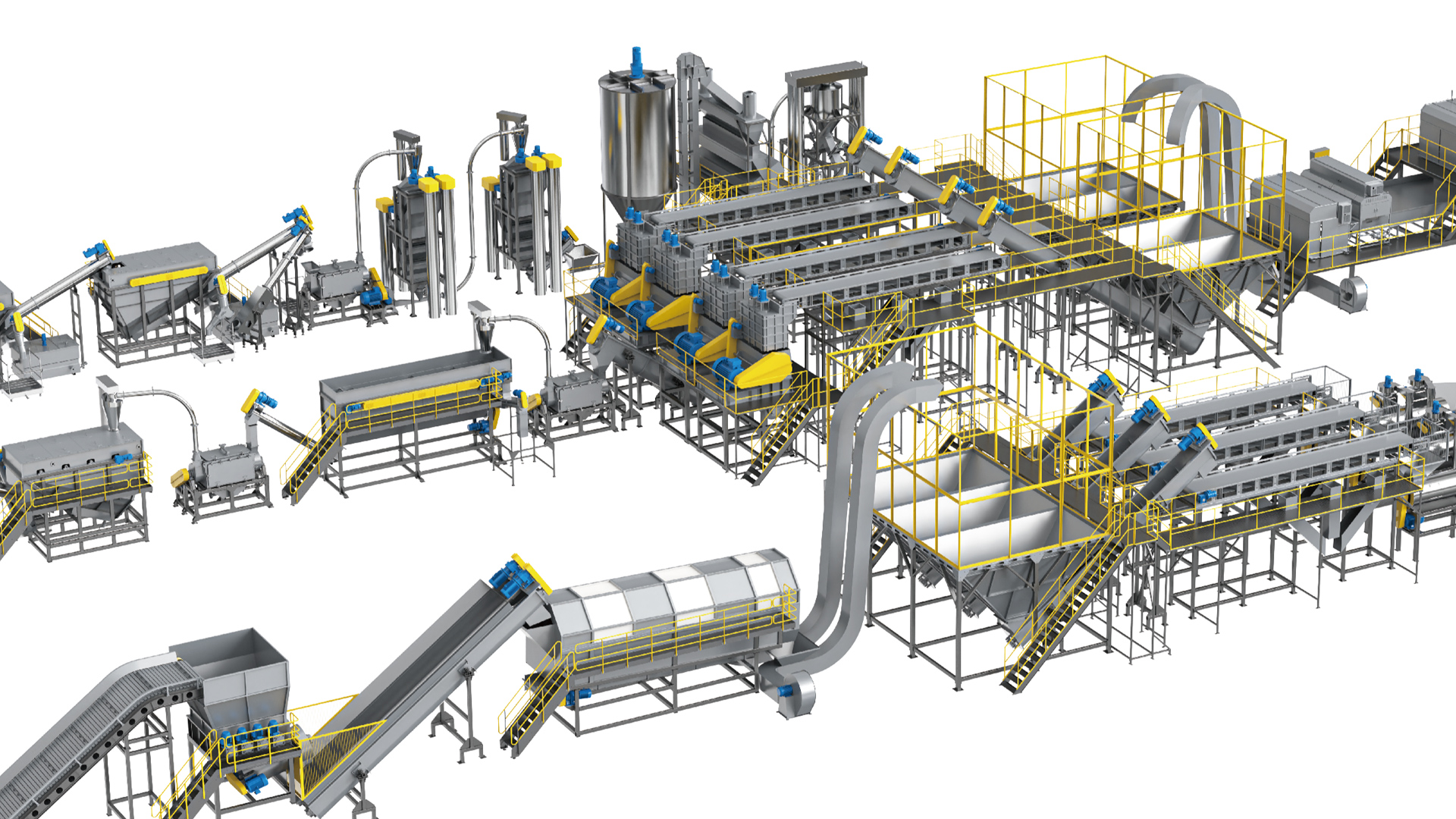
The wet crusher is where film and pre-shredded bottles become wash-ready flakes. Polyretec embeds this stage in two documented lines: the Food-Grade-PET-Flaschen-Waschanlage and the PP/PE Weiche Kunststoffzerkleinerung and Waschlinie.
The Food-Grade-PET-Flaschen-Waschanlage runs from 500 kg per hour to 6000 kg per hour. It is designed for different flake grades, including food-contact rPET when the full wash sequence is specified. The wet crusher sets the flake size before friction washing.
The PP/PE Weiche Kunststoffzerkleinerung and Waschlinie runs from 500 kg per hour to 1500 kg per hour. It targets film, woven bags, and agricultural film. One-step pelletizing is available when the plant wants flakes to flow straight to a pelletizing line.
Water in the crusher cools the cut and floats light contaminants. The slurry then moves to the friction washer, where high-speed paddles scrub labels and dirt from the flake surface.
Specificationen: Polyretec Waschlinie Tiers
| Line | Output | Motor | Wasser | Feuchtigkeit | Contamination |
|---|---|---|---|---|---|
| PET 500 | 500 kg/h | 110 kW | 3 m3/h | ≤2 percent | Low after wash |
| PET 2000 | 2000 kg/h | 280 kW | 8 m3/h | ≤2 percent | Low after wash |
| PET 6000 | 6000 kg/h | 620 kW | 18 m3/h | ≤2 percent | Low after wash |
| PP/PE 500 | 500 kg/h | 95 kW | 2.5 m3/h | ≤3 percent | Low after wash |
| PP/PE 1500 | 1500 kg/h | 210 kW | 6 m3/h | ≤3 percent | Low after wash |
Moisture after dewatering stays low because the line uses a centrifuge before drying. Low moisture protects the downstream pelletizing line extruder and reduces energy in the dryer.
Contamination level after the full wash depends on the incoming stream. Heavily soiled agricultural film needs a longer wash and an extra friction stage. Polyretec sets the stage count from a sample of the customer’s actual waste.
Line Integration and Pelletizing
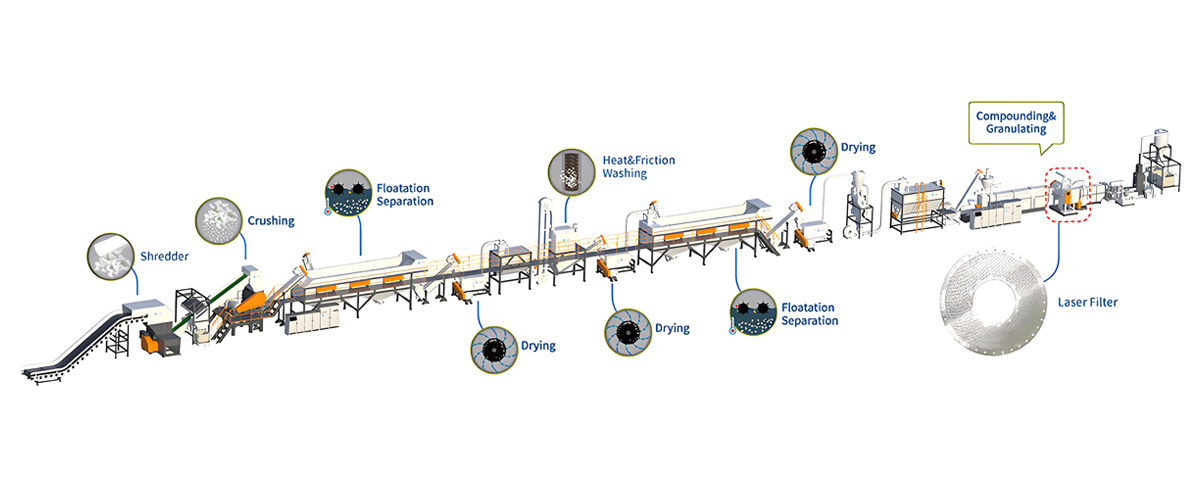
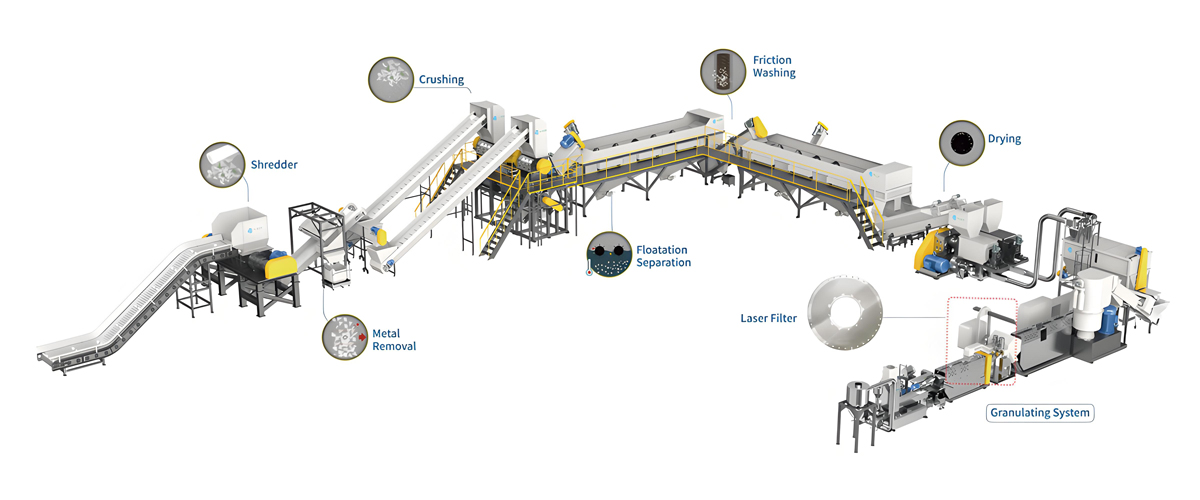
A shredder is only the entry point. The flakes must flow through washing, drying, and often pelletizing to become a saleable recycled product. Integration decides whether the plant reaches its rated output.
After the wet crusher, flakes pass a friction washer and a float wash tank. The float tank separates sinking PET from floating LDPE and PP film, enabling a rough material split inside one line.
A dewatering machine removes surface water, then a dryer drops moisture to the target. Dry flakes either pack for sale or feed the Neue Generation Pelletierlinie from Polyretec.
The Neue Generation Pelletierlinie handles thin-walled LDPE films and thick-walled PE or PP regrind. It is built for robust, continuous operation on post-consumer waste with maximum performance.
For downstream pelletizing of separated rigid fractions, Wanplas supplies matched twin-screw pelletizing systems that integrate directly with Polyretec washing lines. This keeps the brand portfolio clean while covering the full process.
Closed-loop water treatment is recommended for lines above 2000 kg per hour. Recirculated water cuts consumption and keeps the wash chemistry stable, which improves flake cleanliness batch to batch.
Flake conveying between stages also affects quality. Pneumatic conveyance is fast but can generate fines if the line velocity is too high, while a gentle belt or auger keeps the flake intact at the cost of floor space. Polyretec matches the conveyance to the flake size from the crusher so the washing line receives clean, whole flakes rather than dust that loads the filters.
Material routing inside the line also affects the final product value. Sinking PET and floating LDPE or PP separate naturally in the float tank, so the plant can sell two clean fractions instead of one mixed one. Good crushing sets the flake size that makes this split efficient and reduces cross-contamination between streams.
Application Industries
Polyretec recycling equipment turns waste plastics into reusable pellets and blocks for new products. This closes the loop for manufacturers that once bought only virgin resin.
In plastic product production, recycled PET flakes become fiber, strapping, and sheet. Recycled PE and PP pellets become film, pipes, and profiles. The washing line is the gate that decides flake quality.
In renewable resource utilization, the equipment reduces dependence on primary plastic. Municipalities, brand owners, and converters use recycled content to meet sustainability targets without sacrificing supply.
Concrete end products include packaging film, beverage bottles, construction sheet, drainage pipe, automotive trim, and household goods. Each demands a specific flake grade that the shredder and wash sequence must deliver.
Food-contact rPET requires the strictest wash. Polyretec designs the Food-Grade-PET-Flaschen-Waschanlage to reach food-grade flake when the full wash, hot wash, and filtration stages are specified.
Agricultural film recycling supports farms and greenhouses. The PP/PE Weiche Kunststoffzerkleinerung and Waschlinie recovers low-density film that would otherwise be landfilled or burned.
Selection Guide for Mixed Waste
Correct selection starts from the feed, not the machine. Match the input form, the target flake size, and the daily tonnage to a Polyretec line tier before discussing price.
A plant with mostly rigid bottles and moderate film should start at the 1000 kg per hour single-shaft shredder, then add the PET washing line at the matching tier. A film-dominant plant should lead with the PP/PE soft line.
The table below converts common requirements into recommended Polyretec configurations. These are starting points; Polyretec finalizes the layout after testing a sample of the actual waste.
| Input | Target Flake | Kapazität | Recommended Line |
|---|---|---|---|
| Bottles + film | 15 to 30 mm | 1000 kg/h | Single-shaft shredder + PET wash |
| Bottles only | 10 to 20 mm | 2000 kg/h | PET washing line 2000 |
| Film, bags | 8 to 14 mm | 500 to 1500 kg/h | PP/PE soft washing line |
| Tangled bales | Pre-break | Any | Double-shaft pre-breaker first |
| Washed flakes to pellet | Pellet | Match wash | Neue Generation Pelletierlinie |
Capacity is rated on a defined feed. A 2000 kg per hour PET line assumes sorted, loosely baled bottles at normal contamination. Mixed, wet, or sticker-heavy feed reduces real output and may need an extra stage.
Future expansion should be planned at purchase. Polyretec can size the shredder one tier above current volume so a later washer upgrade does not require replacing the cutting stage.
Service and Support
Polyretec brings more than machines. The factory traces its recycling equipment origin to 2010 and established the brand in 2017. It has delivered 100 plus projects across 50 plus countries with 24 plus field engineers.
Every project receives pre-shipment testing. Polyretec runs the line on a sample of the customer’s waste before delivery, confirming output, flake size, and moisture meet the agreed specification.
Installation and commissioning are handled by Polyretec engineers on site. They set the rotor speed, screen, and wash chemistry, then train the customer’s operators on safe running and knife change.
The Wanplas group service promise applies to Polyretec lines. Customers receive USD 500 free spare parts every year, plus free replacement of damaged parts within the warranty period.
Polyretec also offers a transportation guarantee, a production capacity guarantee, and a quality standard that refunds and adds 10 percent compensation if quality fails to meet the contract. The factory welcomes customer visits for audit and sample trial.
Remote support keeps the line running between visits. Engineers review the control system data and advise on adjustments, so a small setting error does not become a long stoppage.
Pre-Treatment: Metal and Dirt Removal
Tramp metal is the fastest way to destroy a shredder rotor. Bolts, steel-backed caps, and can fragments hide inside mixed post-consumer bales and reach the hopper unseen. A single hard piece can chip a knife segment and force a full rotor stop.
Polyretec places a magnetic separator over the feed belt to pull ferrous steel before the material enters the hopper. A metal detector downstream catches non-ferrous pieces such as aluminum and triggers a reject or an automatic stop before damage occurs.
Dirt and sand act like lapping compound on cutting edges. On very dirty agricultural film, a pre-wash or trommel removes grit that would otherwise shorten knife life and widen the flake size band within a single shift.
Removing obvious non-plastic early also helps. While the washing line handles final cleaning, a coarse pre-sort of labels, stones, and caps reduces screen clogging at the crusher and stabilizes throughput.
The table shows the protection sequence Polyretec applies to mixed waste lines. Each step lowers wear and protects the flake quality that later washing stages depend on.
| Stage | Target | Device | Benefit |
|---|---|---|---|
| Feed belt | Ferrous steel | Magnetic separator | Protects rotor |
| Before hopper | Aluminum | Metal detector | Auto stop |
| Dirty film | Sand, grit | Trommel or pre-wash | Longer knife life |
| Manual sort | Non-plastic | Conveyor pick | Less clogging |
A clean, metal-free feed is the foundation of uniform flakes. No screen setting or rotor speed can compensate for a rotor hitting steel every few minutes, so this stage is never optional on mixed waste.
Energy Use and Operating Cost Factors
Shredding is energy intensive, yet good design keeps operating cost in the Medium range rather than High. The dominant cost is the motor, which Polyretec sizes to the worst-case mixed load the plant expects.
A variable-speed drive matches torque to the feed, so the rotor draws only the power each batch needs. Fixed-speed units run at full draw and waste energy on light film loads that need far less cutting force.
Wet cutting adds a water pump load, but the cleaner flakes lower later wash and drying energy. On balance, wet systems sit at Medium cost while dry systems drift Higher on cleaning and dust control.
Water recirculation cuts both water consumption and heating cost. Above 2000 kg per hour, a closed loop with filtration is the standard Polyretec recommendation because it pays back through lower utility bills.
Relative cost labels help planners compare options without fixed quotes. The scale runs Low, Medium, High, Very High, and Premium. The shredder itself is Medium; a full food-grade wash with hot stage is Higher; a basic film wash is Lower.
| Cost Element | Relative Level | Why |
|---|---|---|
| Shredder motor | Medium | Sized to peak load |
| Wet cutting pump | Low to Medium | Offsets later savings |
| Basic film wash | Low | Fewer stages |
| Food-grade PET wash | High | Hot wash, filtration |
| Water recirculation | Medium | Lower utility bill |
Cost planning should treat the shredder as part of a system, not a standalone machine. Saving on the cutter while raising wash and dryer energy is a false economy that uniform, pre-cleaned flakes avoid.
Commissioning and Operator Training
Delivery is not the end of the project. Polyretec commissions each line on site, which is when flake uniformity is first verified on the customer’s real waste rather than on a test bench sample alone.
Engineers set the rotor speed, screen, and wash chemistry, then run the line and sample the flake. They tune the settings until the size band matches the agreed specification before handing the plant to the operator team.
Operators learn safe running, knife change, and the daily flake screen test. Training covers lockout before any rotor entry, because the cutting chamber is a high-risk zone that must be de-energized during service.
A commissioning report documents the process window: screen size, speed, feed rate, and expected flake distribution. Later shifts use this report as the reference whenever output drifts or feed changes.
Remote support follows commissioning. Polyretec reviews control system data and advises on adjustments, so a small setting drift is corrected before it widens the flake band or raises fines.
Troubleshooting Common Shredding Problems
Even a well-designed line drifts when feed or settings change. The symptoms below map to the usual causes and the fixes Polyretec applies during service calls and remote support.
Oversized chunks usually mean the screen is too large or the rotor speed is too low for elastic material. The fix is a smaller screen, a higher speed, and better separation of rigid from film at the feed.
Long film strands appear when the rotor fails to pull film in. The anti-wrap intake may be weak or the speed too low. Raise the speed, check the intake geometry, and add water flow to keep the web moving.
Excessive fines point to dull knives or excessive speed. Flip or replace the segmented knives, lower the speed, and confirm the screen matches the material rather than over-cutting it.
A rotor that stops or trips shows overload from tramp metal or overfeeding. Clear the metal, reduce the feed rate, and verify the metal detector is armed before restarting the line.
An uneven flake band often means a deformed screen or unsorted mixed feed. Replace the screen and add a pre-sort step so the crusher sees a consistent material range.
| Symptom | Cause | Fix |
|---|---|---|
| Oversized chunks | Screen too large | Smaller screen, sort feed |
| Film strands | Weak intake | Higher speed, more water |
| Excess fines | Dull knives | Replace knives, lower speed |
| Rotor trips | Tramp metal | Clear, check detector |
| Uneven band | Deformed screen | Replace screen, pre-sort |
Most downtime on mixed waste lines traces to feed preparation, not the machine itself. Investing in sorting and metal removal prevents the majority of these problems before they reach the rotor.
Wash Water Treatment and Environmental Compliance
A washing line uses large volumes of water, and how that water is handled decides both operating cost and permit compliance. Polyretec designs closed-loop water treatment for lines above 2000 kg per hour, where recirculation pays back through lower utility bills and steadier wash chemistry. Below that tier, a simpler settling and filter loop still recovers most process water.
The treatment chain starts with a dirty-water tank where heavy soil and sand drop out by gravity. A filter press or centrifuge then removes fine sludge so the clarified water returns to the friction washer and crusher. Keeping the loop clean protects the pumps and stops grit from re-depositing on flakes during the next pass.
Effluent limits differ by region. Some authorities restrict suspended solids, chemical oxygen demand, and detergent discharge, so the plant may need a final polishing stage or a licensed discharge point. Polyretec sizes the treatment to the local limit the buyer reports, and the float tank already removes most plastic before the water leaves the line.
Noise and dust are the other compliance items. The low-speed shredder and enclosed cutting chamber keep noise within a typical plant range, and wet cutting suppresses dust at the source. A baghouse or wet scrubber at the dryer outlet captures any residual fines so the work area stays within occupational exposure expectations.
The table below maps each compliance area to the Polyretec control. The aim is a line that meets permit terms while keeping flakes clean and operating cost in the Medium band.
| Compliance Area | Control Method | Plant Benefit |
|---|---|---|
| Water use | Closed-loop recirculation | Lower utility bill |
| Suspended solids | Settling plus filter press | Cleaner return water |
| Effluent limit | Sized to local permit | Permit compliance |
| Dust | Wet cutting, scrubber | Safer work area |
| Noise | Low-speed, enclosed chamber | Within plant range |
Frequently Asked Questions
Can one shredder handle both bottles and film?
A single-shaft shredder with a ram feeder and adjustable screen can process both, but film-heavy loads need an anti-wrap intake. For tangled bales, add a double-shaft pre-breaker first.
What flake size should I target?
Target 8 to 14 mm for washing line film and 15 to 30 mm for rigid bottle pre-cut. Smaller, uniform flakes wash cleaner and pellet more steadily.
Why choose wet shredding over dry?
Water at the rotor suppresses dust, cools the cut, and pre-washes flakes. Wet flakes enter the friction washer cleaner, raising final flake quality.
How does Austrian process know-how help?
It brings low-speed high-torque rotors, balanced segmented knives, and fast screen change. These cut energy per kilogram and extend knife life on mixed waste.
What capacity can Polyretec lines reach?
PET washing lines run 500 to 6000 kg per hour. PP/PE soft washing lines run 500 to 1500 kg per hour. Shredder tiers reach 2000 kg per hour.
Do you install the line on site?
Yes. Polyretec engineers handle installation, commissioning, and operator training. They tune rotor speed, screen, and wash chemistry using your sample waste.
Can shredded flakes go straight to pelletizing?
Only after washing and drying. The Neue Generation Pelletierlinie accepts clean, dry flakes. Wet or soiled flakes must pass the full wash first.
How do I reduce knife wear on mixed waste?
Remove tramp metal upstream, use hard-faced segmented knives, and keep the screen matched to feed. Polyretec confirms the setting during pre-shipment testing.
Conclusion
Mixed plastic bottle and film waste is hard because two materials with opposite behavior share one bale. An Austrian technology shredder solves this with low-speed high-torque cutting, wet size reduction, and fast screen change. Polyretec, a Wanplas factory, builds these principles into single-shaft shredders and the washing lines that follow them. The result is uniform flakes that feed a pelletizing line and become reusable recycled plastic. Send Polyretec your waste specification for a tailored line configuration, arrange a factory audit, or request a sample trial run on your own material.