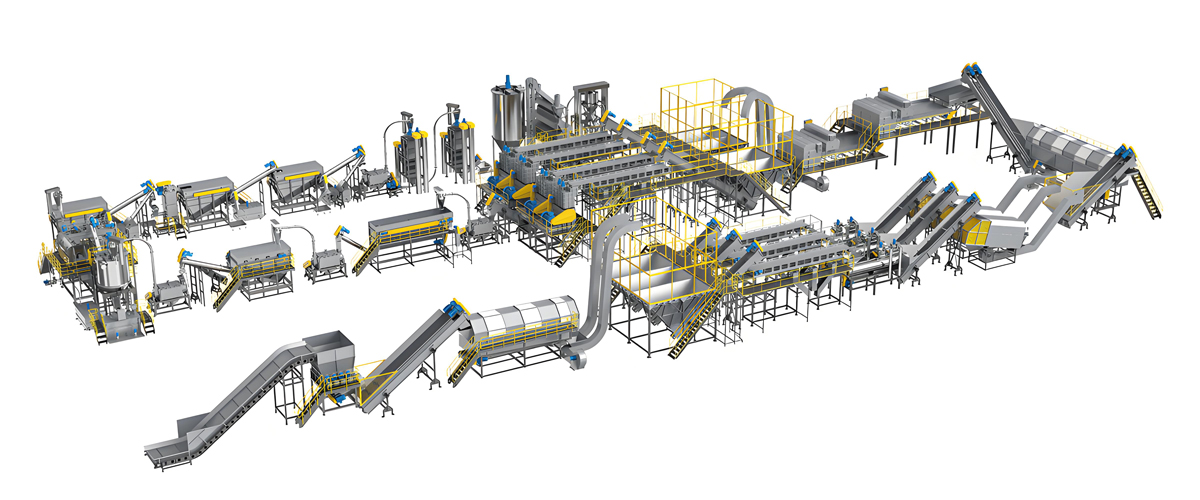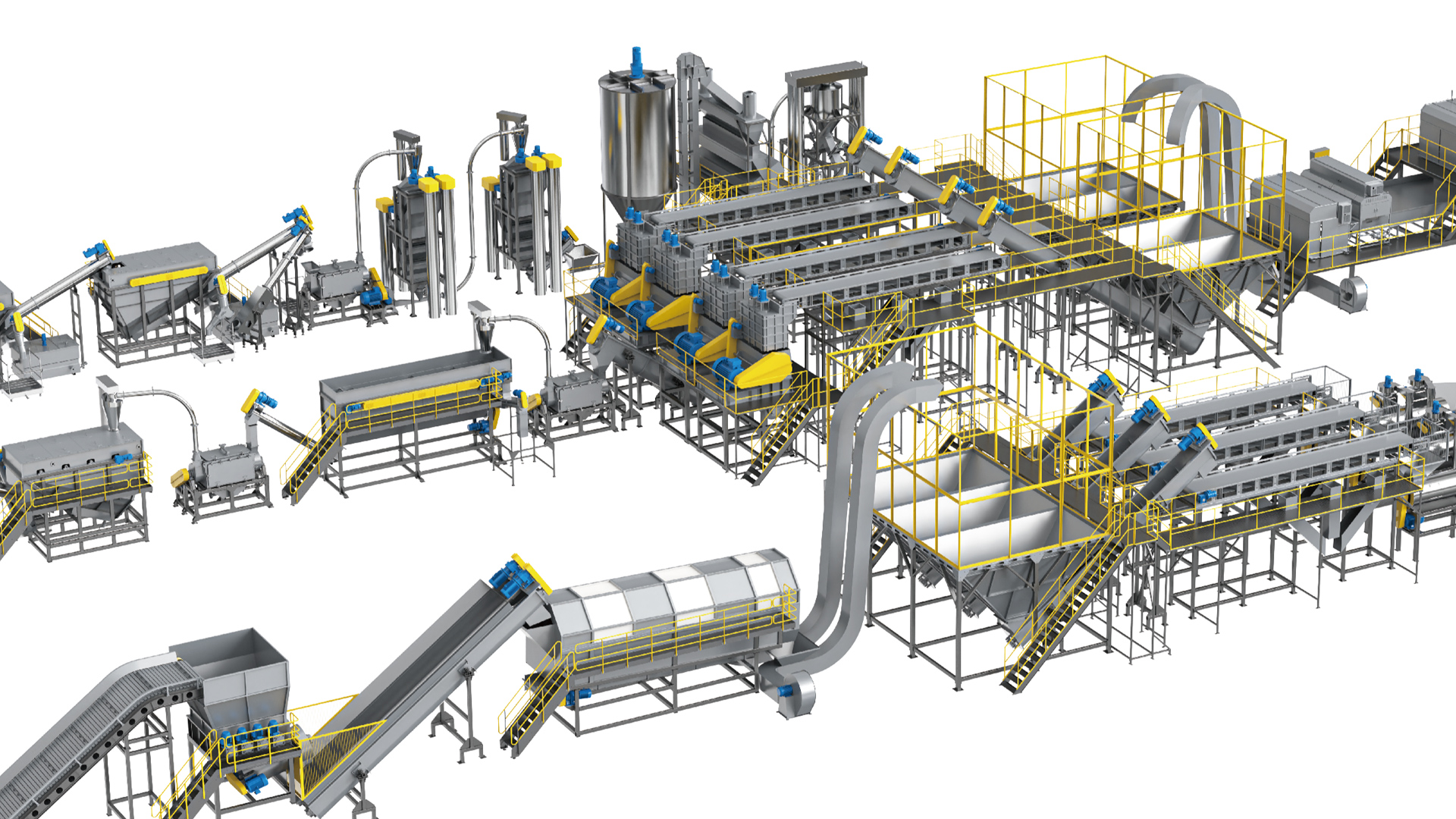

Polyretec, a Wanplas factory, builds plastic recycling equipment that turns post-consumer and post-industrial waste into reusable material. A soft plastic washing line is one of the most requested systems because flexible polyolefin film makes up a large share of plastic waste worldwide. This article explains how Austrian-origin process know-how is applied to design a soft plastic washing line rated from 500kg/h to 1500kg/h output, using Polyretec PP/PE washing technology as the reference example. Readers will learn the process flow, the key modules, how to match capacity to feedstock, and how to select the right configuration for their recycling business.
What Is a Soft Plastic Waschlinie
A soft plastic washing line is a continuous system that cleans flexible polyolefin waste such as LDPE, HDPE, and PP film, woven bags, and agricultural film so the material can be pelletized or sold as clean flakes. The line removes dirt, oil, glue, paper labels, and food residue through shredding, friction washing, sink-float separation, dewatering, and thermal drying. The output is dry, low-contamination flakes ready for extrusion or direct use.
Austrian-origin process know-how refers to the washing and mechanical drying concepts first refined in Central Europe for post-consumer film recycling. These concepts emphasize high-intensity friction cleaning, efficient water recovery, and low residual moisture before pelletizing. Polyretec adapts this know-how with Chinese manufacturing scale, which keeps the equipment cost-effective while preserving the cleaning quality that the process is known for.
The term “soft plastic” separates flexible film and bags from rigid bottles and profiles. Soft film tangles, holds water, and carries printing ink and stickers, so it needs a different machine layout than rigid plastic. A purpose-built washing line for soft plastic uses a wet shredder or crusher at the front, aggressive friction washers in the middle, and a squeezer or centrifugal dryer at the end to remove the water that film traps.
For a buyer, the most practical measure of a soft plastic washing line is its rated output in kilograms per hour. Polyretec offers the PP/PE soft plastic crushing and washing line in the 500kg/h to 1500kg/h range, which covers small recycling shops through medium-scale processors. The same process principles scale up to larger lines, but the 500 to 1500kg/h band is the most common entry and growth range for film recyclers.
Why Austrian-Origin Process Know-How Matters
Austrian-origin process know-how matters because film recycling is unforgiving: small cleaning gaps become quality defects in the final pellet. The Central European approach treats washing as a sequence of mechanical actions rather than a single wash tank. Each stage has a defined job, and the stages are tuned so that water, energy, and retention time are spent where they remove the most contamination.
The first principle is pre-treatment discipline. Film must be reduced to a manageable size before washing, and gross contamination such as sand and stones should be rejected early. Polyretec designs its lines so the wet crusher and pre-wash handle bulky, dirty feed without choking the downstream friction washers. This staged approach is a direct transfer of Austrian-origin process logic into a Chinese-built machine.
The second principle is friction over soaking. Soaking loosens dirt slowly and uses large volumes of water. High-speed friction washers use mechanical shear between the material and a rotating shaft to strip labels, ink, and organic matter in seconds. This is the core of the Austrian-origin washing concept and the reason Polyretec lines can hit low residual contamination at 1500kg/h without enormous wash tanks.
The third principle is water discipline. A good washing line recycles rinse water through settling and filtration instead of discharging it. Closed-loop water recovery lowers operating cost and supports environmental compliance. Polyretec applies this in its PP/PE washing lines, where the float wash tank and rinse stages share a treated water circuit that is topped up only with fresh make-up water.
The practical result is a line that delivers export-grade flakes with predictable moisture and contamination, which protects the pelletizing stage and the final recycled resin value. Process know-how, not just steel, is what separates a reliable washing line from a cheap one that clogs after a week.
The Complete Process Flow From Dirty Film to Clean Flakes
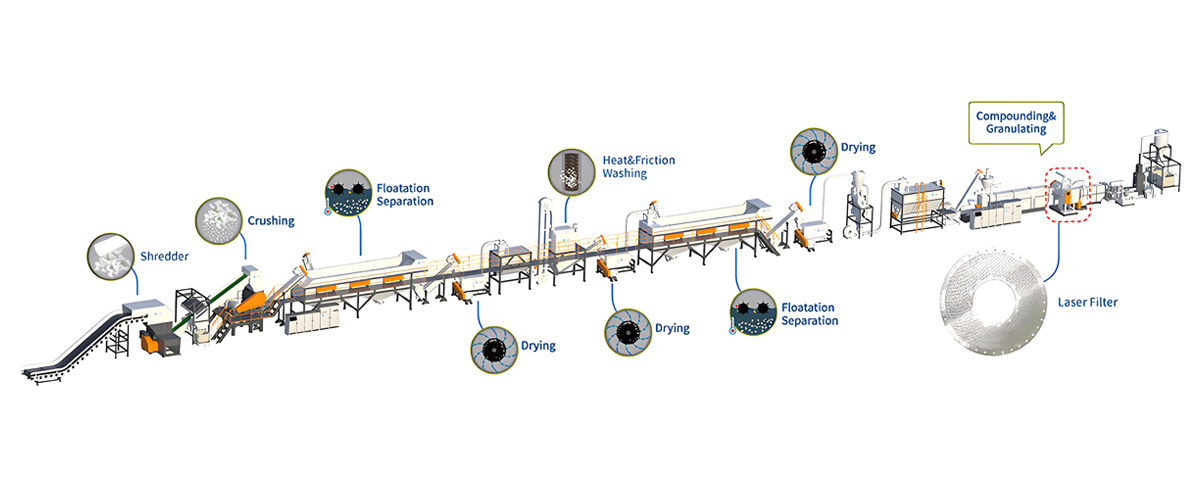
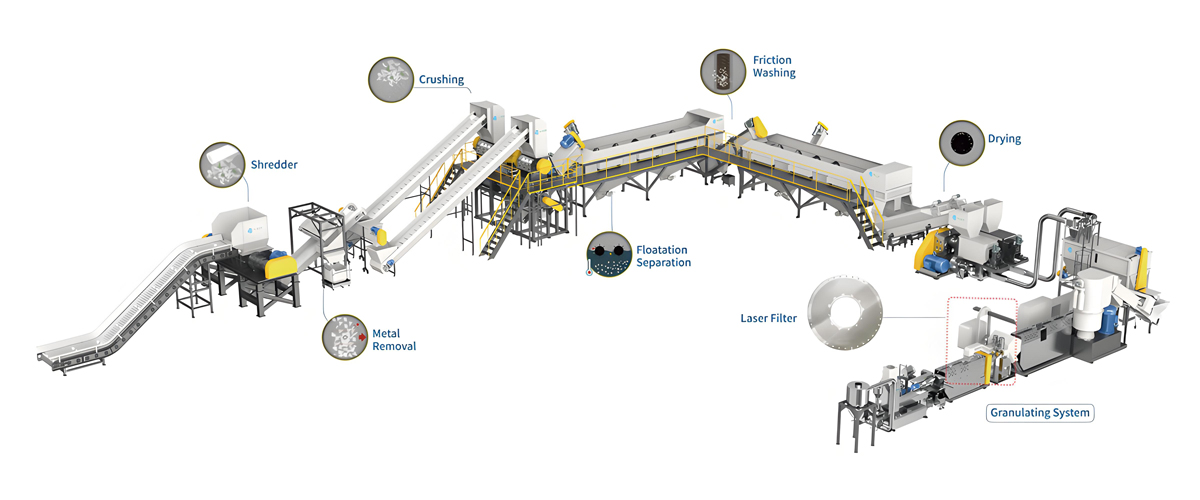
The complete process flow of a soft plastic washing line moves material through six logical stages, each removing a specific type of contamination. Understanding the flow helps a buyer judge whether a quoted line has the right modules for their feedstock. The table below summarizes the sequence and the contamination each stage targets.
| Stage | Equipment | Contamination Removed | Typical Result |
|---|---|---|---|
| 1. Size reduction | Wet crusher or shredder | Bulk volume, tangles | Film cut to 40 to 80mm pieces |
| 2. Pre-wash | Rotary or friction pre-washer | Sand, mud, loose dirt | Heavy solids dropped out |
| 3. Friction wash | High-speed friction washer | Labels, ink, oil, organics | Surface cleaned aggressively |
| 4. Sink-float | Float wash tank | Sinking plastics, paper, wood | Polyolefins floated and collected |
| 5. Dewatering | Centrifugal dewatering machine | Free surface water | Moisture dropped sharply |
| 6. Drying | Hot-air dryer or squeezer | Bound moisture | Residual moisture below 5 percent |
Stage one begins with a wet crusher that cuts film while spraying water, which suppresses dust and starts cleaning. Cutting first is important because whole bags bridge and jam conveyors. After cutting, the material enters the friction washer, where a high-speed rotor and perforated screen rub flakes against each other to peel off adhered dirt.
Stage four, sink-float separation, exploits density. LDPE, HDPE, and PP all have density below water, so they float, while PET, PVC, glass, metal, and most paper sink and are drained away. This single step removes a large share of non-polyolefin contamination without chemicals, which is why density separation is central to any Austrian-origin washing design.
The final two stages decide pelletizing quality. Centrifugal dewatering removes free water, and the hot-air dryer or squeezer removes bound water trapped in film folds. Reaching residual moisture below 5 percent prevents steam bubbles and degradation during extrusion. Polyretec tunes these stages so a 1500kg/h line still delivers dry flakes at the end of a long run.
Polyretec PP/PE Weiche Kunststoffzerkleinerung and Waschlinie
Polyretec’s PP/PE soft plastic crushing and washing line is the host product for this discussion. It is engineered for film, woven bags, and agricultural film, and it is available in configurations from 500kg/h up to 1500kg/h. The line can run as a standalone washing system or connect to a pelletizing stage for one-step operation. The table below lists representative configurations within the output range.
| Model Band | Output | Typical Feedstock | Installed Power (reference) | Residual Moisture |
|---|---|---|---|---|
| PTW-500 | 500kg/h | Post-industrial LDPE film, clean bags | Medium | Below 5 percent |
| PTW-800 | 800kg/h | Mixed PE film, woven bags | Medium-High | Below 5 percent |
| PTW-1000 | 1000kg/h | Agricultural film, printed film | High | Below 5 percent |
| PTW-1500 | 1500kg/h | High-volume mixed soft plastic | Very High | Below 5 percent |
The PTW series reflects Polyretec’s combination of Austrian-origin process know-how and Chinese manufacturing. Each band shares the same module sequence described earlier, with larger rotors, wider screens, and bigger water circuits as output rises. The 500kg/h version suits a new recycling shop, while the 1500kg/h version targets established processors handling continuous film waste.
A key design choice is the front-end crusher. For thin LDPE film, a wet crusher with a forced feed roller keeps material moving and prevents bridging. For thick woven bags and raffia, a more robust cutting chamber protects the blades. Polyretec configures the crusher to the dominant feedstock so the line runs steadily rather than stalling on the hardest fraction.
One-step pelletizing is optional. When selected, cleaned and dried flakes pass directly into a pelletizing line, eliminating an intermediate storage and conveying step. This reduces labor and floor space and is attractive for film with stable, known contamination. For mixed or highly variable feedstock, operators often keep washing and pelletizing separate to control quality at each stage.
All configurations are built toward CE and ISO export requirements, with electrical and safety systems selected for global deployment. Polyretec, as a Wanplas factory, applies the group’s shared quality standards across the line, so a 500kg/h starter and a 1500kg/h plant share the same engineering discipline.
Core Equipment Modules and Their Functions
A soft plastic washing line is a chain of modules, and the weakest module sets the real output. The table below maps each core module to its function and the failure mode to watch for. Buyers should confirm that every module in the chain is sized for the target output, not just the crusher and dryer.
| Module | Function | Watch-Out at Rating |
|---|---|---|
| Wet crusher | Cuts film, suppresses dust, starts wash | Bridging on thin film; blade wear |
| Friction washer | Mechanical scrubbing of flakes | Under-powered rotor at high output |
| Float wash tank | Sink-float density separation | Poor agitation leaves sinking trash |
| Dewatering machine | Centrifugal water removal | Screen clog from fines |
| Hot-air dryer | Removes bound moisture | Insufficient heat at 1500kg/h |
| Storage silo | Buffers clean flakes | Moist flakes clump in silo |
The friction washer is the heart of the Austrian-origin design. It uses a rotating shaft with paddles inside a perforated cage. Material tumbles, and the combination of impact and shearing strips labels and ink. At 1500kg/h the rotor must be larger and the screen area wider, or cleaning quality drops and contamination rides through to the dryer.
The float wash tank needs gentle but constant agitation so floating polyolefins stay on the surface while sinking contamination drops to the bottom auger. Too little agitation and light trash follows the good material; too much and flakes escape the collection stream. Polyretec tunes the tank length and paddle speed to the specific output band.
The dewatering machine is a high-speed centrifuge that throws free water through a screen basket. It is sensitive to fine material, so pre-filtration of the wash water matters. The hot-air dryer then blows warm air through the moving flakes to evaporate bound moisture. Together they deliver the below-5-percent residual moisture that pelletizing demands.
A storage silo may seem minor, but moist flakes clump and bridge, stopping the line. Polyretec sizes the silo and its discharge to the dried-flake flow, often adding a gentle agitator. Treating the silo as a process module, not an afterthought, is part of the disciplined Austrian-origin layout.
Matching Output to Feedstock: 500 to 1500kg/h
Matching output to feedstock is the difference between a line that meets its rating and one that limps along at half capacity. The 500kg/h to 1500kg/h range covers very different businesses, and the right choice depends on feedstock volume, contamination, and working hours. A line rated for 1500kg/h only reaches that number with clean, pre-sorted, continuous feed.
A 500kg/h line is the typical entry point. It fits a recycling shop processing local post-industrial film, off-cuts, and clean bags. With one shift and steady feed, it converts roughly four tonnes of film per day into clean flakes. Power and floor-space needs stay modest, which lowers the barrier to starting a film recycling operation.
An 800kg/h to 1000kg/h line suits a growing processor with mixed PE film and woven bags. Agricultural film with soil and stickers needs more aggressive pre-wash, so real output trends below the nameplate until pre-sorting improves. Polyretec often recommends a heavier front-end crusher and an extra friction stage in this band for dirty feed.
A 1500kg/h line is a plant-scale investment. It demands a reliable supply of several tonnes per hour of film, a water treatment area, and trained operators. At this scale, uptime and preventive maintenance matter more than at 500kg/h because every stopped hour loses more material. The Austrian-origin discipline of staged cleaning pays off most clearly here.
The practical rule is to size for sustainable feed, not peak feed. A line running at 80 percent of nameplate on consistent material outperforms an oversized line that starves and clogs. Polyretec helps buyers size by analyzing their actual waste stream rather than quoting the highest number on the brochure.
One-Step Washing Plus Pelletizing vs Separate Lines
One critical decision is whether to link washing and pelletizing into one step or keep them as separate lines. Both approaches are valid, and the better choice depends on feedstock consistency and quality targets. The comparison below weighs the two layouts on the factors that matter to a film recycler.
| Factor | One-Step Washing + Pelletizing | Separate Washing and Pelletizing |
|---|---|---|
| Floor space | Compact, linked flow | Larger footprint |
| Labor | Lower, fewer transfers | Higher, more handling |
| Quality control | Less staging control | Independent tuning per stage |
| Feedstock fit | Stable, known contamination | Mixed or highly variable waste |
| Flexibility | Limited reconfiguration | Lines can run independently |
| Best for | Single-stream film recyclers | Multi-source processors |
One-step washing plus pelletizing feeds dried flakes straight into the extruder. The advantage is a short, efficient path with fewer conveyors and less manual handling. For a recycler processing one consistent film stream, this is usually the most economical layout and a good match for Polyretec’s integrated PP/PE washing line with pelletizing option.
Separate lines give control. The washing line can be optimized purely for cleanliness, and the pelletizing line independently for melt filtration and degassing. When feedstock varies week to week, separation lets an operator adjust each stage without compromising the other. For multi-source processors, this flexibility often outweighs the space saving of one-step design.
Cost of ownership differs too. One-step lines have fewer motors and frames, lowering capital and maintenance. Separate lines cost more upfront but protect output when one stage needs service, because the other can sometimes run on buffered inventory. The right answer follows the waste stream, not a generic rule.
Polyretec supports both routes. For downstream pelletizing, Wanplas supplies matched pelletizing systems that integrate directly with Polyretec washing lines, giving buyers a single responsibility point for the full washing-to-pellet path without naming unrelated suppliers.
Handling LDPE, HDPE, and PP Film Plus Woven Bags
Soft plastic is not a single material, and a washing line must handle the differences between LDPE, HDPE, PP film, and woven bags. All are polyolefins and float in water, which is why one line can process them together. The differences show up in thickness, stiffness, and how they carry contamination. The table below outlines handling notes for each fraction.
| Material | Typical Source | Handling Note |
|---|---|---|
| LDPE film | Packaging, shrink wrap, bags | Thin, tangles; needs forced feed |
| HDPE film | Carry bags, liners | Stiffer; responds well to friction |
| PP film | BOPP, woven tape | Lower melt; watch drying heat |
| Woven bags | PP/PE sacks, raffia | Thick; robust crusher needed |
| Agricultural film | Mulch, greenhouse | High soil; heavy pre-wash |
LDPE film is the most common soft plastic feed and also the trickiest to feed because it stretches and bridges. A wet crusher with a forced feed roller and the right screen size keeps it moving. HDPE film is stiffer and less prone to tangling, so it moves through the line more easily and scrubs clean with standard friction washing.
PP film and woven bags need attention at the crusher. Woven PP sacks are thick and can blunt blades quickly, so Polyretec selects a cutting chamber and blade material sized for the abrasive load. BOPP film has a lower melting point, so the hot-air dryer temperature must be controlled to avoid partial melting or clumping during drying.
Agricultural film is the dirtiest common feed. It arrives with soil, stones, plant matter, and stickers. This fraction needs the strongest pre-wash and a robust heavy-duty crusher, plus good dewatering afterward. Polyretec has deployed washing lines for LDPE agricultural film with stickers, using a heavy-duty shredder and beater arrangement to break the contamination loose before friction washing.
Mixed loads are normal in real recycling. The value of Austrian-origin process know-how is exactly here: staged cleaning means one line can accept a blended polyolefin stream and still output clean flakes, because each module targets a contamination type rather than a single material.
Selection Guide: Requirement to Recommended Model
The selection guide below translates common buyer requirements into a recommended Polyretec configuration. It is a starting point; the final configuration should follow an analysis of the actual waste stream, including contamination level, working hours, and target flake quality. Polyretec engineers use this logic when proposing a line.
| Requirement | Recommended Model | Rationale |
|---|---|---|
| New shop, clean industrial film | PTW-500 | Lowest entry cost, simple operation |
| Mixed PE film, one shift | PTW-800 | Balanced capacity and footprint |
| Agricultural film with soil | PTW-1000 with heavy pre-wash | Extra cleaning for dirty feed |
| Continuous multi-shift film | PTW-1500 | Plant-scale steady output |
| Film plus one-step pelletizing | PTW line with pelletizing option | Short path to pellets |
For a new recycling shop with clean industrial off-cuts, the PTW-500 is usually correct. It keeps capital and power modest while still producing export-grade flakes. Operators learn the process on a simpler line before scaling, which reduces risk during the first year of operation.
For mixed PE film running one shift, the PTW-800 balances capacity and footprint. It handles woven bags and printed film better than the 500kg/h version because the crusher and friction washer are larger. Most regional film recyclers land in this band as their first growth step.
For agricultural film, the PTW-1000 with an upgraded pre-wash is the safer choice even if the nominal volume looks like an 800kg/h job. Soil and stickers penalize real output, so sizing up protects the nameplate. Polyretec routinely adds a beater and extra rinse for this feed.
For continuous multi-shift operation, the PTW-1500 is the plant-scale answer. It requires reliable feed supply, water treatment, and a maintenance plan, but it delivers the lowest cost per kilogram of cleaned flake at volume. The selection should always be confirmed against measured feedstock, not estimated volume.
Application Areas for Recycled Soft Plastic
Recycled soft plastic from a washing line flows into many end products, which is why film recycling stays in demand. The clean flakes become recycled resin that replaces virgin polyolefin in applications where color and optics are less critical. Polyretec’s washing lines support plastic product production and renewable resource utilization, the two application pillars in its profile.
In plastic product production, recycled LDPE and HDPE flakes are pelletized and then blown into film again, extruded into pipe, or molded into items such as garbage bags, agricultural film, and construction sheet. Recycled PP from woven bags becomes injection-molded crates, pallets, and non-food containers. The closed loop keeps value inside the plastics economy.
In renewable resource utilization, washed flakes reduce dependence on primary plastic made from petrochemical feedstock. Municipalities and brand owners increasingly set recycled-content targets, and a reliable washing line is the first step to supplying that recycled material. Polyretec frames its mission as turning waste into treasure, which aligns with this circular goal.
Film-to-film recycling is the tightest loop. A washing line producing clean LDPE flakes that are pelletized and re-blown into film keeps the material in its highest-value use. This is where residual moisture below 5 percent and low contamination directly protect the recycled resin’s processability and strength.
Beyond film, washed polyolefin flakes feed compounding, where they are blended with additives or virgin resin to make modified compounds. Wanplas, as the parent brand, supplies complementary extrusion and compounding systems, so a Polyretec washing line can sit at the front of a broader polyolefin recycling and upgrading chain.
Service and Support
Polyretec, a Wanplas factory, backs its washing lines with the shared Wanplas service policy. Equipment is tested before shipment, including continuous running checks, so the line arrives validated rather than unproven. This pre-shipment testing reduces commissioning risk and shortens the time to first clean flakes.
On-site installation and commissioning are provided by Polyretec engineers, who set up the line, tune the water circuits, and train operators on safe running and routine maintenance. Training covers crusher blade inspection, friction washer screen cleaning, dewatering basket care, and dryer temperature control, the tasks that keep a 500 to 1500kg/h line running.
The Wanplas group policy includes USD 500 free spare parts per year and free replacement of damaged parts within warranty. Polyretec also welcomes customer visits to its factory, an open-factory approach that lets buyers inspect build quality and discuss configuration before ordering. Remote support helps diagnose faults between visits.
Spare parts availability matters most at 1500kg/h scale, where downtime is expensive. Polyretec stocks common wear items such as crusher blades, friction washer screens, and dewatering baskets, and advises a preventive replacement schedule based on throughput. The goal is planned maintenance, not emergency repair.
With experience dating to 2010 and a brand established in 2017, Polyretec brings more than a decade of recycling equipment know-how and 100-plus project references across 50-plus countries. That track record is part of the support a buyer receives, from first inquiry through long-term operation.
Frequently Asked Questions
What does Austrian tech mean for a soft plastic washing line?
Austrian-origin process know-how refers to washing and mechanical drying concepts developed in Central Europe for post-consumer film. Polyretec adapts these concepts with Chinese manufacturing to build cost-effective PP/PE washing lines rated from 500kg/h to 1500kg/h. The know-how shapes staging, friction intensity, and water recovery rather than naming any single supplier.
Can one line handle both LDPE and HDPE film?
Yes. LDPE and HDPE are both polyolefins and float in water, so a single washing line processes them together. Density separation handles contamination, while the friction washer and float tank remove organics and sinking debris. PP film and woven bags also run on the same line with the right crusher setup.
What output can a 1500kg/h soft plastic washing line reach?
A 1500kg/h rating is based on clean, pre-sorted post-industrial film with low contamination. Heavily printed or soiled agricultural film reduces effective throughput, so feedstock quality and pre-sorting directly affect real output. Sizing to sustainable feed protects the nameplate capacity.
Is one-step pelletizing better than separate washing and pelletizing?
One-step washing plus pelletizing saves floor space and labor and suits film with stable contamination. Separate lines give better quality control for mixed or highly contaminated feedstock and allow independent optimization of each stage. The better choice follows the waste stream profile.
How much water does a soft plastic washing line use?
Water use depends on cascade design and recycling loops. Modern lines reuse rinse water through settling and filtration, so net consumption stays moderate. Polyretec configures closed-loop water recovery to cut fresh water demand and support environmental compliance at the plant.
What residual moisture should cleaned flakes have?
After centrifugal dewatering and hot-air drying, clean soft plastic flakes typically reach residual moisture below 5 percent, which is suitable for direct pelletizing or storage without clumping. Good drying protects extrusion quality and prevents degradation in the pelletizing stage.
Which model fits a startup recycling shop?
A 500kg/h PP/PE washing line is the common entry configuration for a new recycling shop. It needs a smaller footprint, lower power, and less feedstock volume while still delivering export-grade flakes. Operators can scale to 800 or 1000kg/h as feed volume grows.
Does Polyretec provide installation and training?
Yes. Polyretec, a Wanplas factory, provides pre-shipment testing, on-site installation and commissioning, operator training, and USD 500 free spare parts per year under its shared Wanplas service policy. Remote support and factory visits are also available to buyers.
Conclusion
A soft plastic washing line rated from 500kg/h to 1500kg/h is a practical, scalable entry into film recycling, and Austrian-origin process know-how gives that line its cleaning discipline. Polyretec, a Wanplas factory, applies this know-how in its PP/PE crushing and washing line, with staged friction washing, density separation, and reliable dewatering that deliver dry, low-contamination flakes. The right model depends on feedstock volume and dirt level, from the PTW-500 starter to the PTW-1500 plant-scale line, with one-step or separate pelletizing to match the business. If you are planning a film recycling line, share your feedstock type, daily volume, and contamination level with Polyretec so the engineering team can propose a configured washing line and invite you to the factory for a test run on your material.