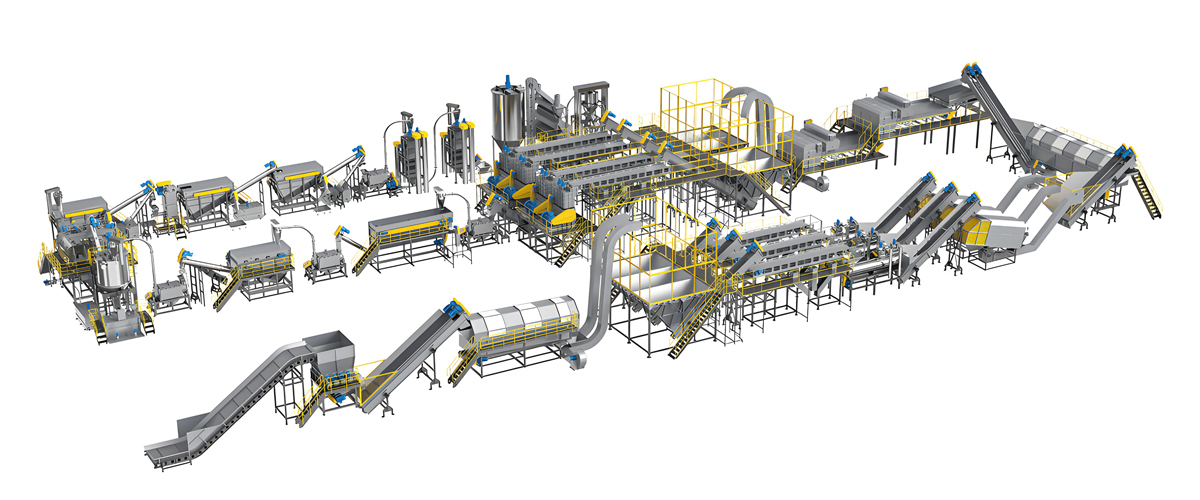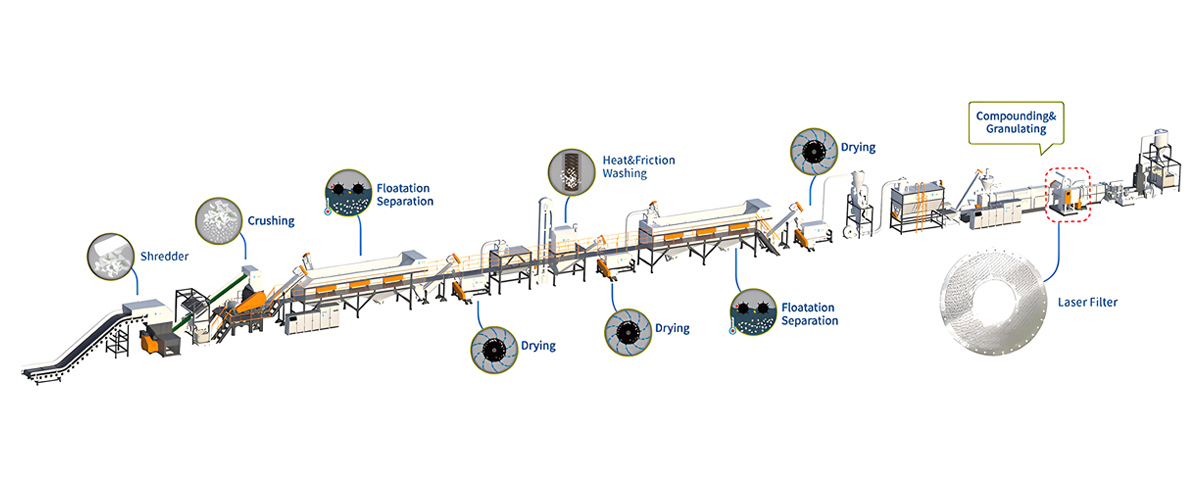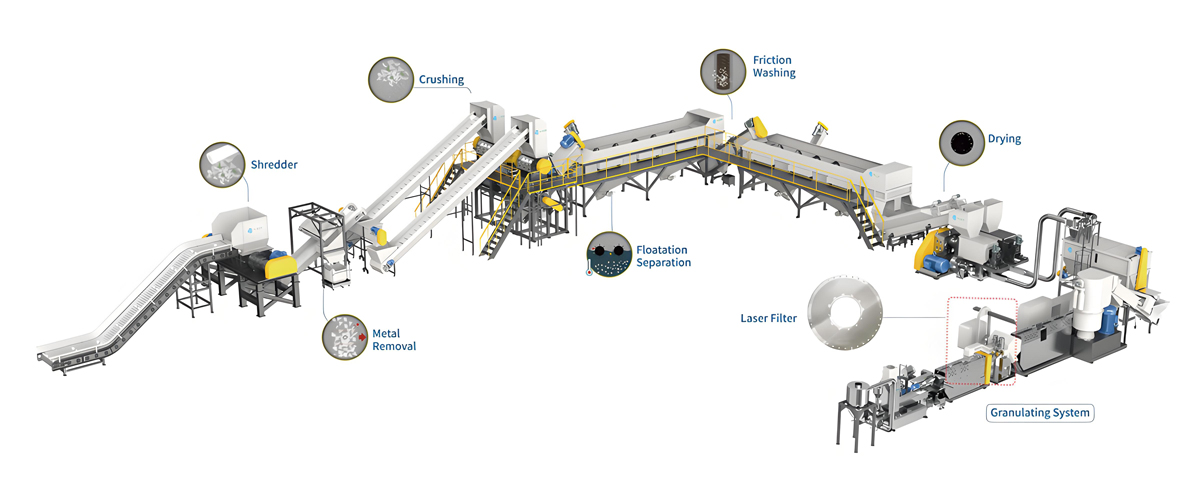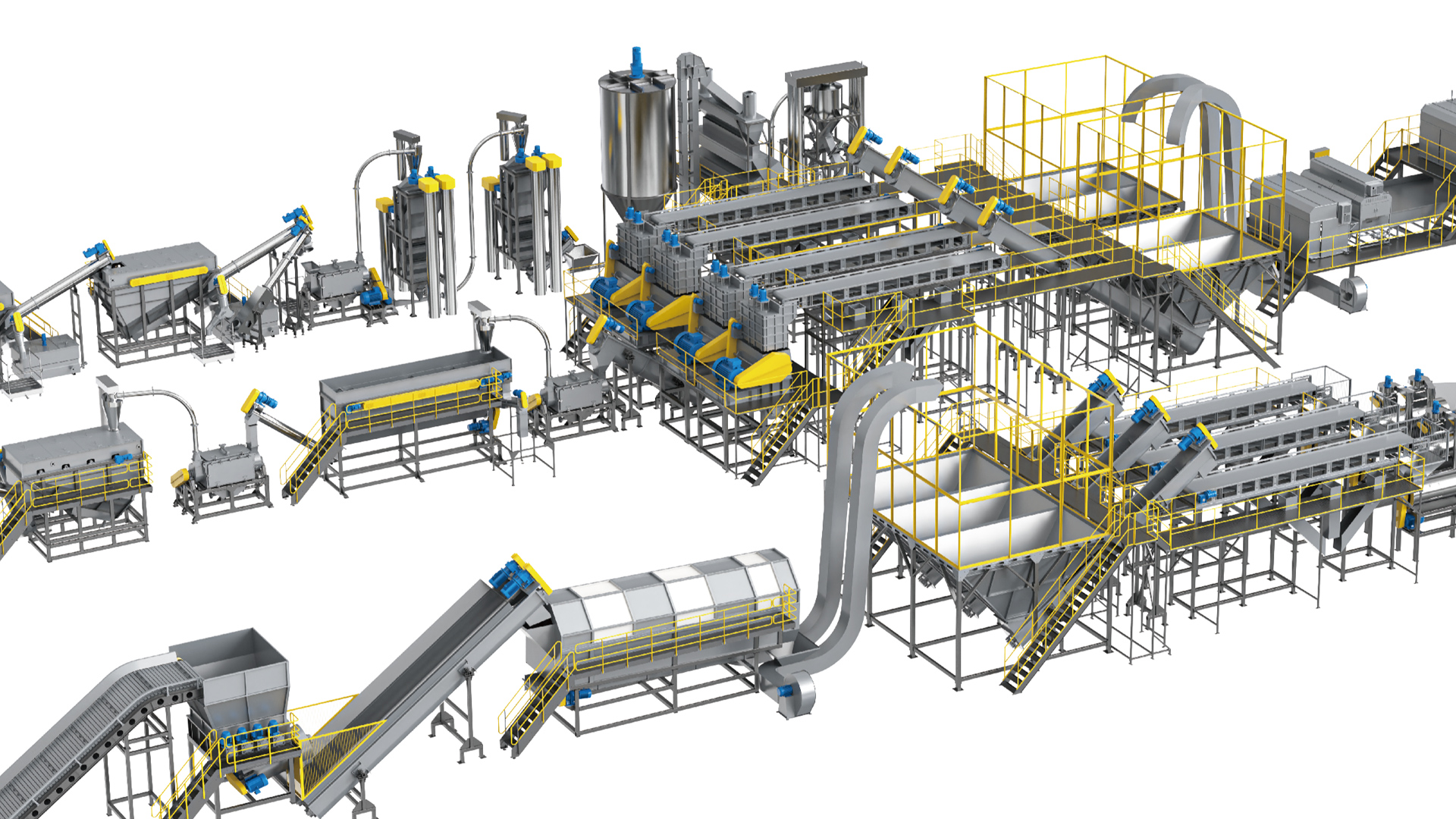

Floatation tank water level is the single most influential adjustment an operator makes on a plastic washing line, yet it is also the most frequently overlooked. On a Polyretec washing line, the floatation tank, sometimes called a sink-float tank, is where density separation does its quiet, decisive work: lightweight polymers such as polyethylene and polypropylene rise to the surface while heavier polymers such as PET, PVC, PS, and ABS sink to the bottom and are dragged out by a slowly rotating rake or screw. The boundary between a clean float fraction and a contaminated one is set, more than anything else, by the static water level relative to the overflow weir. Get the level right and your PET flakes come out bright and low in PE carryover; get it wrong and you either lose good material over the weir or watch your floating layer compact into a sluggish, screw-slipping mass. This guide explains the physics, the adjustment procedure, the cooperating variables, the purity checks, the common faults, and the real Polyretec floatation tank configurations you can specify for your material stream.
The advice below is written for plant managers, line supervisors, and process engineers who already run or are about to commission a washing line. It assumes a standard agitated sink-float tank with an adjustable overflow weir, a make-up water valve, a level instrument, and a circulation or air-agitation system. Whether your feed is post-consumer PET bottle bales, mixed rigid HDPE and PP, or agricultural film, the same logic applies: the water line is where separation is won or lost.
The Density Separation Principle Behind Floatation Tanks
Density separation in a floatation tank relies on a simple physical fact: an object immersed in water experiences a buoyant force equal to the weight of the water it displaces. If the object is less dense than water, the buoyant force exceeds its weight and it rises. If it is denser, it sinks. Because the density of water is effectively 1.0 gram per cubic centimeter at the temperatures found in a washing line, that value becomes the natural dividing line between the float fraction and the sink fraction.
The polymers handled on a recycling washing line span a wide density range, and that spread is exactly what makes sink-float separation so useful. Low-density polyolefins float comfortably because their density sits well below 1.0. Polyethylene typically measures 0.91 to 0.96 gram per cubic centimeter, and polypropylene measures 0.90 to 0.92 gram per cubic centimeter. Both ride on the surface. PET, by contrast, measures 1.33 to 1.40 gram per cubic centimeter and sinks hard. PVC sits at 1.30 to 1.45, PS at 1.04 to 1.07, and ABS at 1.04 to 1.07, so all three sink, though PS and ABS sit close enough to the water line that fines, air entrapment, or surfactant foam can occasionally hold them up.
A practical rule of thumb is that density separation is reliable only when the density gap between the two materials exceeds about 0.05 gram per cubic centimeter. PE at 0.93 and PP at 0.91 differ by only 0.02, so they cannot be split from each other by plain water flotation; they stay together in the float fraction. PET at 1.35 and PE at 0.93 differ by more than 0.40, so the split is sharp and stable. That is why a single floatation tank cleanly separates the polyolefin float layer from the PET or PVC sink layer, but cannot, on its own, separate PE from PP, or PET from PVC. For those tighter splits you need sequential tanks with density-tuning media, a hydrocyclone stage, or an optical sorter further down the line.
The table below lists the common plastics encountered on a washing line, their typical density, and the float or sink verdict in plain water. Use it as the first checkpoint when you suspect a separation problem: if two polymers in your stream are within 0.05 gram per cubic centimeter of each other, do not expect a single tank to split them.
Common Plastic Density Reference and Float or Sink Verdict
| Polymer | Typical Density (g/cm3) | Verdict in Water (1.0 g/cm3) | Typical Source in Recycling Stream |
|---|---|---|---|
| Polypropylene (PP) | 0.90 to 0.92 | Float | Caps, crates, rigid containers, non-woven |
| Low-density polyethylene (LDPE) | 0.91 to 0.93 | Float | Film, bags, agricultural film, packaging |
| High-density polyethylene (HDPE) | 0.94 to 0.96 | Float | Bottles, pails, pipes, rigid housewares |
| Expanded polystyrene (EPS) | 0.015 to 0.05 | Float (strongly) | Foam packaging, insulation offcuts |
| Polystyrene (solid PS) | 1.04 to 1.07 | Sink (marginal) | Yogurt cups, rigid disposables |
| Acrylonitrile butadiene styrene (ABS) | 1.04 to 1.07 | Sink (marginal) | Appliance housings, pipes, automotive |
| Polyvinyl chloride (PVC, rigid) | 1.30 to 1.45 | Sink | Pipes, profiles, bottles, packaging |
| Polyethylene terephthalate (PET) | 1.33 to 1.40 | Sink | Bottles, trays, strapping, fibers |
| Polycarbonate (PC) | 1.20 to 1.22 | Sink | Compact discs, glazing, electronic housings |
| Polyamide (PA, nylon) | 1.13 to 1.15 | Sink | Carpet fiber, engineering parts, fishing line |
| Polyoxymethylene (POM) | 1.41 to 1.42 | Sink | Precision gears, fittings, industrial parts |
| Glass, sand, metal contaminants | 2.2 to 7.8 | Sink (heavily) | Bottle cullet, mineral filler, caps liners |
Notice that the water density of 1.0 gram per cubic centimeter is not a fixed property you can change by lowering or raising the water level. The water is still water. What the water level changes is not buoyancy itself but the geometry of the separation zone: how deep the floating layer sits, how fast it is carried to the overflow, how long sink particles have to settle, and how much turbulence from the inflow and the agitator reaches the weir. Those factors, not the physics of buoyancy, are what the operator controls with the level setting.
Why Water Level Is the Core Variable in a Floatation Tank
The water level in a floatation tank is defined by the vertical gap between the static surface of the water and the top lip of the overflow weir. On a well-designed tank this gap is small, typically 20 to 60 millimeters, but within that narrow band the difference between a profitable run and a contaminated one is decided. The overflow weir is the edge over which the floating fraction spills into the float discharge trough. The height of that weir is usually adjustable by a gate or a removable baffle plate, and the make-up water valve sets how high the static surface sits above it.
When the water level is too high relative to the weir, the floating layer is deep and the overflow carries a thick, fast-moving sheet of material toward the discharge. That sounds good for throughput, but a high level also means unsettled or marginally buoyant particles near the surface get swept over before they can sink. The result is contamination of the float fraction by heavy flakes, most visibly PVC or PET remnants that never fully detached from labels or that were held up by trapped air. Float purity drops even though the tank looks busy and productive.
When the water level is too low, the opposite failure appears. The floating layer becomes shallow and, because the tank is still being fed, flakes pile up at the surface faster than the overflow can remove them. They compact against each other and against the weir, forming a dense mat. The discharge screw or rake starts to slip because there is no free-flowing layer to convey; instead it scrapes against a packed bed. Throughput falls, motor load rises, and operators respond by speeding up the rake, which only worsens compaction. Meanwhile, sink particles that should be calmly settling are stirred by the overcrowded surface turbulence.
The water level does not change which polymer floats. It changes how cleanly, how quickly, and how completely the float and sink fractions are removed once buoyancy has done its part.
The relationship between weir height, water level, and performance is best read as a balancing act. A lower weir lip with the same static level means a larger gap and a thicker float discharge; a higher weir lip with the same static level means a smaller gap and a thinner, more controlled discharge. Operators tune both the weir position and the make-up flow together. The table below maps typical settings to the outcomes you should expect, so you can diagnose a mis-set tank from its symptoms rather than guessing.
Water Level and Weir Height Versus Separation Purity and Throughput
| Static Level Above Weir | Float Layer Behavior | Float Purity (PE/PP) | Sink Recovery (PET/PVC) | Throughput |
|---|---|---|---|---|
| Less than 20 mm | Thin, easily compacts at weir | High | High | Low, screw slips |
| 20 to 35 mm | Stable, free-flowing discharge | High | High | Good |
| 35 to 60 mm | Deeper, faster overflow | Medium to high | Good | High |
| 60 to 90 mm | Thick sheet, surface turbulence | Medium, PVC carryover rises | Slight loss over weir | Very high then unstable |
| Above 90 mm | Heavy sweep, unsettled carry | Low, heavy contamination | Noticeable sink loss | Peaks then collapses |
The takeaway is that the optimal band is deliberately narrow. Most Polyretec floatation tanks are commissioned with the weir set so the static level sits roughly 30 to 45 millimeters above the lip, then fine-tuned during the acceptance trial against the customer’s actual feed. There is no universal number because flake size, shape, surface tension from residual contaminants, and feed rate all shift the balance. The procedure in the next section shows how to find your number repeatably.
Step-by-Step: How to Adjust Floatation Tank Water Level
Adjusting the water level is not a one-turn fix; it is a short commissioning routine that should be repeated whenever the feed material changes significantly. Follow the sequence below and record the setting so the next shift can start from a known good point.
Preparation Before You Touch the Weir
Confirm the tank is full and the circulation pump or air-agitation system is running at the operating point you intend to use. Check that the feed is steady and representative, not a startup surge of water and fines. Verify the level instrument is reading and, if you have a sight glass, that the glass reading agrees with the transmitter. A level reading you cannot trust is worse than no reading.
Step 1: Set the Overflow Weir to the Mid Position
Begin with the adjustable weir gate at its mid travel. This gives you room to move in either direction during tuning. On tanks with a removable baffle, choose the middle-height plate. Mark the position so you can return to it.
Step 2: Establish a Stable Static Level
Open the make-up water valve until the static surface sits clearly above the weir and a thin, continuous sheet of float material spills into the discharge trough. Do not yet worry about perfection; you are finding the control range. Let the tank run until the level transmitter shows the surface is holding steady.
Step 3: Apply the Steady-State Criterion
The tank is only ready to judge once it is truly steady. The acceptance rule used on Polyretec lines is that the static level must oscillate within plus or minus 5 millimeters for a continuous 20 to 30 minute window while feed rate and make-up flow stay constant. If the level drifts more than that, the inflow, the circulation pump, or the drain balance is wrong and no weir setting will save the separation. Fix the balance first.
Step 4: Sample Both Fractions at the Mid Weir
Take a 500 gram sample of the float discharge and a 500 gram sample of the sink discharge using the three-point sampling method described in the purity section. Analyze for cross-contamination: PVC or PET in the float, PE or PP in the sink. This is your baseline at the mid weir.
Step 5: Raise the Weir and Re-Sample
Raise the weir so the static level drops toward 20 to 25 millimeters above the lip. Re-establish steady state, then re-sample. You should see float purity climb and, if the screw was slipping before, throughput recover. If float purity was already high, you gain little and may lose sink recovery, so note the trade.
Step 6: Lower the Weir and Re-Sample
Lower the weir so the static level rises toward 50 to 60 millimeters. Re-establish steady state and re-sample. You should see throughput climb but float purity soften as marginal particles start riding over. This tells you the upper limit of your band.
Step 7: Lock the Set Point Between the Extremes
Choose the weir height that delivered the highest float purity while still meeting your throughput target, typically a level 30 to 45 millimeters above the lip for mixed post-consumer feed. Record the weir mark, the make-up valve position, and the target level reading. Post it at the panel.
Step 8: Verify With a Production Run
Run at the locked setting for at least one full shift and trend the purity and throughput. Small drift is normal; if purity holds within specification, the setting is validated. If feed composition shifts seasonally, repeat steps 4 through 7 rather than chasing the level daily.
The whole routine takes a few hours but pays back every week in reduced rework and fewer customer complaints about contamination. Treat the level setting as a controlled parameter, not a daily guess.
Cooperating Variables You Must Tune Together
Water level never works alone. A floatation tank is a coupled system, and changing the level without accounting for the other variables produces confusing, unrepeatable results. The variables below must be set in a sensible order: first the mechanical and flow basics, then the level, then the fine agitator and chemistry settings.
Agitator and Rake Speed
The搅拌桨 or推料桨 (agitation or conveying paddle) typically runs at 15 to 45 revolutions per minute. Too slow and sink particles are not kept in suspension long enough to travel to the bottom rake; too fast and the whole tank turns turbulent, dragging floats down and sinks up. On a PET line the agitator is usually slower because PET sinks readily; on a film line it is faster to keep flexible film from balling up. Match the speed to the material, then set the level.
Residence Time
The time a flake spends in the tank, usually 30 to 120 seconds, is set by tank volume and feed rate. If you shorten residence by overfeeding, even a perfect level cannot separate what has no time to settle. Calculate residence from effective volume and mass flow; if it falls below about 30 seconds, reduce feed or add a second tank in series rather than fighting the level.
Feed Load
Express feed as kilograms per hour per square meter of tank surface, because surface area governs how fast the float layer can be removed. Overloading the surface is the most common cause of compaction and screw slip. Keep the load within the tank’s design envelope; the selection table later in this guide shows typical envelopes per configuration.
Water Temperature
The operating range is 20 to 45 degrees Celsius. Warm water lowers the viscosity of residual grease and helps release label paste and food soil, which improves the effective separation. It also supports air-agitation bubble attachment that can lift lightly contaminated floats. Above roughly 45 degrees Celsius the energy cost climbs and operator comfort suffers, while below 20 degrees Celsius in winter the contamination release slows and separation degrades. If your inlet water is cold, consider a heat-traced make-up line or accept a slower throughput.
Surfactant Dosing
A small dose of surfactant reduces surface tension and helps hydrophobic films and label residues detach, but overdosing creates persistent foam that holds marginal particles at the surface and fools the level reading. Dose to a measured concentration, not by eye, and watch the scum layer as your feedback signal.
Air Agitation and Bubble Assistance
Some tanks use air agitation, a stream of fine bubbles from the tank bottom, to keep material in motion and to help lightly soiled floats detach and rise. The bubble rate is a tuning knob: too little and the bed stalls, too much and the surface churns. Air agitation is most valuable on film and on soiled rigid feed where mechanical raking alone leaves clumps.
Scraper or Discharge Speed
The float discharge scraper or screw speed must match the float generation rate. If the level is set well but the scraper is too slow, the layer compacts regardless. Set scraper speed from the observed float load at the chosen level, not from a fixed default.
These variables interact. A useful mental model is that water level sets the destination of each fraction, while agitator speed, residence time, feed load, temperature, surfactant, air, and scraper speed set whether the material actually reaches that destination. Tune the level last, after the others are sane.
Measuring Separation Purity in the Floatation Tank
You cannot improve what you do not measure, and on a floatation tank the only honest measure is a representative sample analyzed for cross-contamination. Two numbers matter most: the PVC or other heavy residue in the float fraction, often expressed in parts per million of PVC in the PE or PP stream, and the PE or PP carryover in the sink fraction, expressed as a percentage by weight.
The Three-Point Sampling Method
Take a 500 gram sample, but not from one spot. Collect roughly equal sub-samples from three points across the discharge stream, the near side, the center, and the far side, then combine and mix. This averages out the uneven distribution you always see across a trough. From the combined 500 grams, run two checks.
Density Screen Test
Sink a portion of the sample in a controlled-density liquid, or simply re-run it through a small test tank at a known level, and weigh what floats versus what sinks. This quickly shows the PE-in-PET or PET-in-PE split without lab equipment. It is the field check most lines use every shift.
Near-Infrared Spot Check
For a tighter read, an optical or near-infrared sorter can identify polymer type in the sample and quantify the contamination percentage. This is a laboratory or quality-control step rather than a live tank adjustment, but it validates the density screen and catches subtle mixing, such as ABS hiding in a PET sink lot. Use it when a customer specification is strict.
A practical target for a PET bottle washing line is a float fraction with PVC residue below a few hundred parts per million and a sink fraction with PE carryover below about 1 percent by weight. Film lines are more forgiving on the sink side but stricter on the float side because a little PET in film ruins the pellet color. Set your internal limits from the downstream requirement, then tune the level to hold them.
Common Faults and How to Fix Them
Even a well-commissioned tank drifts. The table below lists the faults operators see most often on sink-float separation, their usual causes, and the corrective action, with the water level called out where it is the lever. Keep it at the panel.
Fault, Cause, and Remedy Reference
| Fault Observed | Likely Cause | Corrective Action |
|---|---|---|
| High PVC in float fraction | Water level too high; unsettled heavy flakes swept over weir | Lower weir or reduce make-up flow to drop level 20 to 35 mm |
| PE or PP in sink fraction | Level too low; floats compacted and dragged under by rake | Raise weir or increase make-up flow; free the compacted layer |
| Discharge screw slips, throughput drops | Float layer compacted at low level; scraper too slow | Raise water level slightly; increase scraper speed to match load |
| Flakes clump from static charge | Dry feed, low humidity, electrostatic bonding of fines | Raise water temperature slightly; add antistatic agent at wash stage |
| Label pulp and paper fibers clog weir | Inadequate label removal upstream; pulp builds at lip | Clean weir; improve pre-wash and label separation before tank |
| Persistent scum layer on surface | Surfactant overdose or grease load too high | Reduce surfactant dose; add skimmer; increase bleed-off |
| Settling hopper scales and fouls | Mineral filler, sand, or paste accumulation | Schedule hopper flush; review upstream grit removal |
| Turbid water, rising TSS | Dirty feed; circulation too low; bleed-off insufficient | Increase circulation and bleed-off; shorten water change cycle |
| Winter separation worsens | Low inlet water temperature slows contamination release | Heat make-up water toward 30 to 40 C; accept lower throughput |
| Foam holds marginal particles up | Surfactant or protein-based soil creating stable foam | Cut surfactant; add defoamer at controlled rate |
| Level oscillates beyond plus or minus 5 mm | Feed surge, pump imbalance, or blocked drain | Stabilize feed; check circulation pump; clear drain |
| Sink recovery low despite good level | Residence time too short; overfeed for tank volume | Reduce feed or add second tank in series; verify residence |
| Uneven float across trough width | Poor inflow distribution or one-sided weir wear | Rebalance inlet; inspect and level the weir plate |
Polyretec Floatation Tank Configurations
Polyretec, a Wanplas factory, designs its floatation tanks as integral modules of the washing lines it builds, sized to the line capacity rather than sold as standalone units. The configurations below are matched to the documented washing line capacities: the food-grade PET bottle washing line from 500 to 6000 kilograms per hour and the PP or PE soft plastic crushing and washing line from 500 to 1500 kilograms per hour. The figures are typical engineering values for each capacity class and should be confirmed against your final line specification during the acceptance trial.
Each tank uses an adjustable overflow weir, a level instrument, a circulation pump with a matched flow, and a slowly rotating rake or screw sized to the float load. Larger classes add a second agitation zone and a higher circulation flow to keep residence within the 30 to 120 second window at full feed. For downstream pelletizing, Wanplas supplies matched twin-screw pelletizing systems that integrate directly with Polyretec washing lines, so the whole train from flake to pellet stays under one engineering responsibility.
Polyretec Floatation Tank Specification by Capacity Class
| Matched Line Class | Tank Body Dimensions (L x W x H, mm) | Effective Volume (m3) | Agitation Motor Power (kW) | Water Usage Make-up (m3/h) | Circulation Pump Flow (m3/h) |
|---|---|---|---|---|---|
| PP or PE soft film washing line, 500 to 1500 kg/h | 3500 x 1400 x 1500 | 5.0 | 3.0 | 1.5 to 3.0 | 40 |
| PET bottle washing line, 1000 to 2000 kg/h | 4500 x 1600 x 1600 | 8.5 | 4.0 | 2.0 to 4.0 | 60 |
| PET bottle washing line, 3000 to 6000 kg/h | 6000 x 2000 x 1800 | 16.0 | 5.5 | 4.0 to 8.0 | 100 |
These tanks are built as part of a turnkey washing line, so the floatation module arrives plumbed, wired, and pre-set to the commissioning band for your material. During the factory trial, Polyretec runs your actual or representative feed through the line and records the weir position and level that delivered the agreed purity, then hands that data to your operators as the starting set point.
Selection Guide: Match the Tank to Your Material
Choosing the right floatation configuration starts with the material combination, the required throughput, and the target purity. The table below maps common recycling scenarios to the recommended tank arrangement. Single-tank separation handles the basic polyolefin-versus-heavy split; double-stage series improves the split when the feed is heavily mixed; adding a hydrocyclone or an optical stage downstream tightens the isolation of individual polymers.
Requirement to Configuration Recommendation
| Material Combination | Throughput Need | Target Purity | Recommended Configuration |
|---|---|---|---|
| PET bottles with LDPE labels and caps | 1000 to 2000 kg/h | PET sink below 1 percent PE | Single Polyretec PET floatation tank, 8.5 m3 class |
| Post-consumer PET, heavily soiled | 3000 to 6000 kg/h | Food-grade flake spec | Double-stage series, 16 m3 class with air agitation |
| PP or PE agricultural film | 500 to 1500 kg/h | Low mineral, low PVC | Single Polyretec film floatation tank, 5 m3 class |
| Mixed rigid HDPE and PP | 1000 to 2000 kg/h | PE or PP separated from sinks | Single tank for float; downstream density media for PE or PP split |
| PET mixed with PVC bottles | 1000 to 3000 kg/h | PVC in PET below spec | Single tank to drop floats, then hydrocyclone or optical stage |
| PS or ABS with PET | 500 to 1500 kg/h | Marginal-density separation | Tank plus downstream near-infrared or density tuning |
| Woven bags and film mix | 500 to 1000 kg/h | Low sink carryover | Single film-class tank with higher air agitation |
If your requirement is not listed, the safe default is to size the floatation tank to the line capacity class and plan for a second stage only if the first stage cannot hold purity at target throughput. Over-specifying a single oversized tank does not fix a feed that needs two density cuts; it only costs water and floor space.
Applications Across Real Recycling Streams
Polyretec washing lines serve several distinct recycling streams, and the floatation tank behaves differently in each because the feed geometry and contamination profile change. Understanding the stream helps you set the level intelligently rather than copying a number from another plant.
Food-Grade PET Bottle Flake Washing
This is the strictest application. The sink fraction is the product, PET flake destined for food-contact or bottle-to-bottle use, so the float fraction of LDPE labels, PP caps, and paper must be driven out almost completely. Here the level is usually set toward the lower end of the band, 20 to 35 millimeters, to protect sink purity, and residence time is generous. The tank runs warm to release label paste, and air agitation is used to keep flakes from matting.
Hard HDPE and PP Recycling
In this stream the float fraction, HDPE or PP, is the product and the sink fraction, mainly PET, PVC, and dense contaminants, is the reject. The level can sit a little higher to maximize float recovery, because a small amount of sink contamination in the float is less damaging than losing good polyolefin over the weir. Agitator speed is moderate and the scraper is tuned to the higher float generation.
Mixed Rigid Plastic Sorting
Mixed rigid bales contain HDPE, PP, PET, PVC, PS, and ABS together. A single tank only splits floats from sinks; isolating each polymer needs sequential tanks or downstream optical sorting. The floatation tank still earns its place by removing the bulk of the polyolefin and the heavy sink reject, dramatically reducing the load on the later, more expensive sorting stage.
Agricultural Film and Post-Consumer Film
Film is the toughest feed for flotation because flexible sheets ball up, trap air, and resist wetting. The tank needs faster agitation or strong air agitation, warmer water, and careful surfactant control to keep the film open and floating. Throughput per square meter of surface is lower than for rigid flake, so the level must be set to avoid compaction while still giving film time to de-air.
Across all these streams, the same principle holds: the water level is the master control of where each fraction goes, and the other variables exist to make sure the material actually gets there. Wanplas, as the parent brand, supports the full range of Polyretec washing lines with shared engineering standards and a unified service commitment, so a customer running several streams can standardize operator training and spare parts across the group.
Daily Inspection and Water Quality Management
Stable separation depends on stable water. A tank that ran perfectly on Monday fails on Thursday because the water chemistry drifted, not because the level moved. The routine below keeps the medium in spec and catches problems before they reach the product.
Daily and Periodic Water and Tank Care
| Task | Frequency | What to Check or Do | Acceptance |
|---|---|---|---|
| Level reading versus sight glass | Every shift | Confirm transmitter agrees with glass within 5 mm | Plus or minus 5 mm |
| Weir lip inspection | Every shift | Look for label pulp, wear, or blockage at the lip | Clean, level, unobstructed |
| Three-point purity sample | Every shift | 500 g combined sample of float and sink | Within internal spec |
| Turbidity or TSS check | Daily | Observe clarity; measure TSS if lab available | No persistent rise |
| Scum layer removal | Daily | Skim foam and floating grease | Surface mostly clear |
| Circulation pump screen | Weekly | Clean strainer; confirm flow at spec | Flow within plus or minus 5 percent |
| Partial bleed-and-fill | Weekly or as needed | Replace 20 to 30 percent of volume on dirty feed | TSS and odor controlled |
| Settling hopper flush | Weekly | Flush accumulated sand and filler | No scale buildup |
| Full water change | Monthly or by condition | Replace full charge when turbidity persists | Clear, low odor |
Water quality and water level are partners. A level that was perfect in clean water will misbehave in turbid, foamy water because the effective surface behavior changes. When separation drifts, always check water quality before re-cutting the weir; often the weir was fine and the medium was not.
Service and Support From Polyretec
Polyretec, a Wanplas factory, backs every washing line with a service program built around keeping the separation stable in real production, not just at commissioning. The support covers the floatation tank as part of the whole line.
What the Support Program Includes
- Pre-shipment joint run test. Before the line leaves the factory, Polyretec runs your actual or representative feed through the complete train, including the floatation tank, and records the validated weir position, water level, and purity result as the handover baseline.
- On-site installation and commissioning. Engineer-assisted installation and commissioning bring the tank to the documented set point on your water and your feed, with the steady-state criterion applied on site.
- Spare parts policy. The Wanplas group commitment includes USD 500 free parts per year, plus free replacement of damaged parts within the warranty period, so a worn weir plate or seal does not become a production stoppage.
- Operator training. Hands-on training teaches your team the level-adjustment routine, the three-point sampling method, and the fault table, so the line runs to spec after the engineers leave.
- Remote operation support. Remote monitoring and data review let the Polyretec team analyze level trends and purity logs with your operators and recommend adjustments without a site visit.
- Open factory and sample trial. Customers are welcome to visit the factory, observe a running line, and send a sample of their own material for a trial run that demonstrates the achievable separation before they commit.
Polyretec brings more than a decade of recycling equipment experience, a track record of 100 or more project installations, support across 50 or more countries, and a team of 24 or more engineers who assist with commissioning and optimization. That depth is what lets a customer treat the floatation tank level as a controlled, repeatable parameter rather than a daily mystery.
Frequently Asked Questions
What is the ideal water level height above the overflow weir in a floatation tank?
A typical static water level sits 20 to 60 millimeters above the overflow weir lip. The exact set point depends on flake size, feed load, and target purity. The level should be tuned until the floating layer discharges steadily without carrying settled material into the overflow. Most Polyretec lines are commissioned in the 30 to 45 millimeter band and fine-tuned during the acceptance trial.
Why does water level matter more than most operators expect in sink-float separation?
Water level sets the vertical depth of the floating layer and the residence time of particles near the weir. Too high and unsettled heavy flakes wash over with the floats; too low and the floating layer compacts, the screw slips, and throughput drops. It is the master control of where each fraction is removed.
How do I know the floatation tank has reached a stable operating state?
Use a level transmitter or a sight gauge and confirm the static level oscillates within plus or minus 5 millimeters for a continuous 20 to 30 minute window while feed and make-up water stay steady. That is the steady-state criterion before you lock the weir and start sampling. If the level drifts more, fix the inflow and circulation balance first.
Can a single floatation tank separate mixed rigid plastics like PP, PE, PET, and PVC?
One tank splits the stream into two fractions at the 1.0 gram per cubic centimeter water line: floats such as PE and PP above, sinks such as PET, PVC, PS, and ABS below. To isolate individual polymers you need sequential tanks or additional density-tuning steps, sometimes with a hydrocyclone or optical sorter downstream. PE and PP, being within 0.05 gram per cubic centimeter of each other, stay together in the float.
What water temperature gives the best separation in a floatation tank?
Most lines run at 20 to 45 degrees Celsius. Warm water improves grease and label-paste release and supports air-agitation bubble attachment, but above roughly 45 degrees Celsius energy cost climbs and operator comfort drops. In winter, low inlet temperature slows contamination release and degrades separation, so heating the make-up water is often worthwhile.
How often should I change the water in a floatation tank?
It depends on feed cleanliness. Monitor total suspended solids and the scum layer. On dirty post-consumer feed, partial bleed-and-fill may be needed daily; on clean industrial offcuts, a weekly or biweekly cycle is common. Replace the full charge when turbidity, odor, or TSS persist after bleed-off. Water quality and water level must be managed together.
Why is my discharge screw slipping even though the level looks correct?
Slipping usually means the floating layer has compacted at the weir because the level is too low or the scraper speed is too slow for the float load. Raise the weir or increase make-up flow to free the layer, and match the scraper speed to the observed float generation rate. Also confirm the feed load per square meter of surface is within the tank design envelope.
Conclusion
Adjusting floatation tank water level for optimal separation is less an art than a disciplined routine: understand the density split your material demands, set the overflow weir to a sane mid position, establish a steady level within plus or minus 5 millimeters, sample both fractions with the three-point method, and lock the set point that holds purity while meeting throughput. Remember that water level is the master control of where each fraction is removed, but it only works when agitator speed, residence time, feed load, temperature, surfactant, air agitation, and scraper speed are set sensibly first. Measure purity on every shift, manage water quality as seriously as the level, and keep the fault table at the panel.
Polyretec, a Wanplas factory, builds floatation tanks as integrated modules of washing lines spanning 500 to 6000 kilograms per hour, validated on your own feed during the factory trial and supported by installation, training, remote assistance, and the group’s USD 500 free parts per year policy. If you are commissioning a new line or fighting contamination on an existing one, send your material description and target purity to the Polyretec team, arrange a factory visit and a sample trial run, and let the engineers propose a configuration and a validated water-level set point matched to your stream. The cleanest separation starts long before the flake reaches the pelletizer, and it starts with the water line.