
Flake uniformity is the single most overlooked lever in plastic recycling. Two lines with the same rated capacity can deliver very different pellet quality based only on how evenly the plastic was crushed. This article explains how to improve flake uniformity in the plastic crushing process using equipment design, screen selection, and operating discipline. Polyretec, a Wanplas factory, builds crushers and washing lines that apply these methods on post-consumer PET, HDPE, LDPE, and PP waste. The guidance below helps plant owners tighten flake size distribution and protect downstream washing and pelletizing.
What Flake Uniformity Means in Recycling
Flake uniformity describes how closely individual plastic pieces match in size and shape after crushing. A uniform stream has a narrow size distribution with few oversized chunks and few fines.
Uniform flakes behave predictably in every later step. They fluidize evenly in the float wash tank, scrub at the same rate in the friction washer, and dry at the same speed in the centrifuge.
Poor uniformity creates processing losses. Oversized pieces escape the wash and carry soil into the pellet. Fines float as sludge, clog screens, and raise water and energy use.
Uniformity also protects the pelletizing line. Consistent flake melts at a steady rate, so the extruder sees stable feed and produces round, dense pellets instead of irregular lumps.
The table below links each quality symptom to its plant consequence. Most recycling plants measure uniformity by screening a flake sample over a stack of mesh sizes and recording the mass retained on each.
| Flake Issue | Process Effect | Product Result |
|---|---|---|
| Oversized chunks | Escape wash stage | Dirty pellet |
| Excess fines | Clog screens, sludge | Higher water, energy |
| Mixed sizes | Uneven drying | Moisture variation |
| Uniform flakes | Stable feed | Consistent pellet |
A realistic target is to keep more than 80 percent of flakes within a defined size band. The exact band depends on the material and the downstream use, discussed in later sections.
Two metrics describe uniformity in practice. The first is the span ratio, the largest retained flake divided by the smallest. A span near 1.0 means a tight stream. The second is the fines fraction, the mass passing the smallest mesh, which should stay low to protect water and energy balance.
Operators run the screen test with a stack of sieves sized at 4 mm, 8 mm, 12 mm, and 18 mm. After a timed shake, the retained mass on each sieve is weighed. A healthy PET stream holds most mass on the 8 mm and 12 mm sieves with little on the 4 mm pan or the 18 mm top.
Uniformity also interacts with bulk density. Narrow flake bands pack with fewer voids, so a given silo volume holds more usable plastic and the metering feeder delivers a steadier mass flow to the wash and pelletizing stages.
Color consistency is a secondary signal. When flakes match in size, the wash removes labels and glue at an even rate, so the output color stays uniform batch to batch. Wide size bands hide pockets of unwashed material that show as dark specks in the pellet.
How the Crushing Process Works
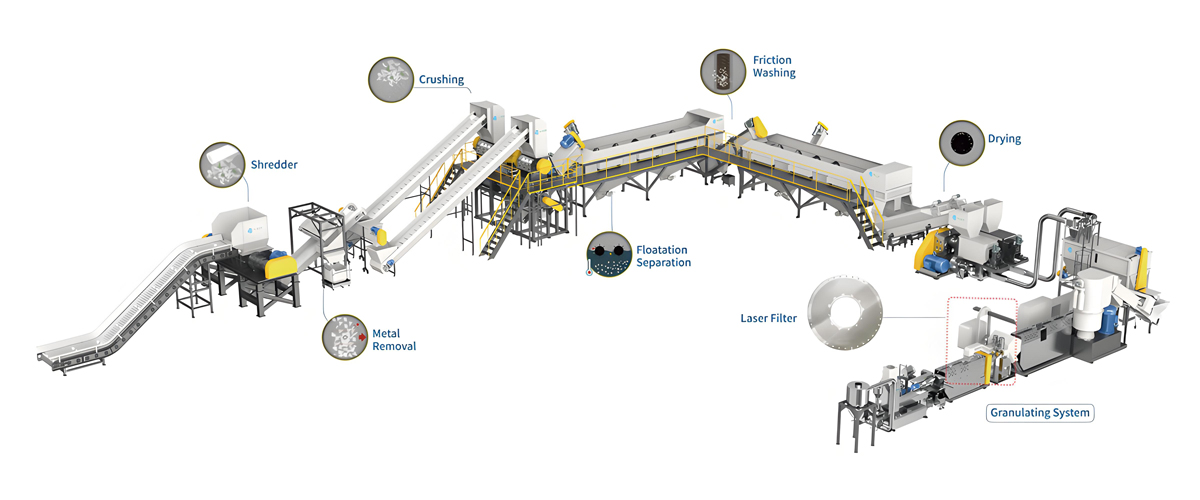
Crushing is the size-reduction stage that follows coarse shredding. In a washing line, the wet crusher or granulator cuts pre-broken bottles and film into flakes small enough for washing.
The rotor carries fixed knives that pass a stationary counter-knife. Material is cut at the shear point, then forced through a perforated screen by rotor action and water flow.
Only pieces smaller than the screen holes pass through. Larger pieces recirculate inside the chamber until they are cut small enough. This self-regulating loop is what sets the maximum flake size.
Water injected during cutting cools the plastic and floats light contaminants. The slurry of flakes and water then moves to the friction washer for surface cleaning.
Crushing quality depends less on raw power than on consistency. A well-tuned crusher at moderate speed beats an oversized crusher run without screen discipline.
Two crusher types serve recycling plants. The single-shaft crusher uses one rotor with movable knives against a fixed bed knife, suited to bulky rigid items. The wet granulator used in washing lines mounts the rotor below a water-filled chamber and forces flakes through the screen while washing.
The wet granulator wins for flake uniformity because cutting and washing happen in one step. Dry crushers cut well but leave dust and need a separate rinse, during which fines agglomerate and widen the size band.
Feed enters through a hopper sized to the bale opener output. A screw or belt meter feeds the rotor at a set rate so the chamber never packs. Packing is the main cause of oversized escape and should be controlled by the feed device, not by slowing the rotor.
After the screen, the flake slurry travels through a slurry pump or a inclined screw to the friction washer. Pipe diameter and pump speed are tuned so flakes do not settle and re-clump before they reach the wash, which would undo the uniformity gained at the screen.
The knife gap at the shear point sets the cut quality. A gap of 0.2 to 0.5 mm gives a clean slice on PET, while a wider gap tears film and raises fines. Polyretec sets this gap during commissioning and records it in the line’s process window.
Material Properties That Affect Flakes
Different plastics crush differently because of density, melt behavior, and rigidity. Knowing the material tells the operator which screen and speed to choose.
PET is dense and rigid. It sinks in water and cuts cleanly into sharp flakes. Its high melt temperature tolerates brief heat from the cut without smearing.
HDPE is less dense and more elastic. It springs back under the knife and can produce elongated pieces if the rotor speed is too low or the screen too large.
LDPE and PP film are flexible and heat sensitive. They need higher rotor speed and water cooling to avoid long strands that wrap and bridge the screen.
The table lists typical property ranges. Values vary by grade and additive package, so Polyretec confirms the setting on a sample of the actual waste.
| Material | Density g/cm3 | Melt Temp C | Crush Behavior |
|---|---|---|---|
| PET | 1.38 | 250 to 260 | Cuts clean, sinks |
| HDPE | 0.94 to 0.97 | 130 | Elastic, floats |
| LDPE | 0.91 to 0.93 | 110 | Soft, film |
| PP | 0.90 to 0.91 | 165 | Stiff film, floats |
Density also drives separation. In the float wash tank, PET sinks while LDPE and PP rise, giving a rough material split that simplifies later sorting and improves each flake stream’s uniformity.
Moisture content in the feed also matters. Dry bales shatter into sharp, dusty flakes, while pre-wetted bales cut cooler and produce fewer fines. Polyretec often sprays the feed belt before the hopper for film grades that heat fast.
Contaminants change the cut. Sand and glass raise knife wear and can nick the screen edge, quietly opening the flake band. A pre-wash or a coarse trommel before the crusher protects the knives and holds uniformity over longer runs.
Label and glue residue on PET bottles behaves differently from the bottle wall. The label film is LDPE or PP and wants higher speed, so a blended bottle stream needs a screen sized for the PET body while the rotor speed stays high enough to cut the label cleanly.
Thickness of the wall also sets flake shape. Thin food trays cut into small squares, while thick industrial lumps need a pre-shredder so the granulator sees pieces small enough to cut evenly. Skipping the pre-shredder is a common cause of wide bands on rigid industrial waste.
Key Factors That Control Flake Uniformity
Seven factors decide flake uniformity in the crushing process. Managing them together is more effective than tuning any single one.
Feed consistency is first. Mixed, poorly sorted bales swing density and hardness, forcing the rotor to chase changing load. Steady feed yields steady flakes.
Screen hole size and pattern set the ceiling on flake size. Smaller holes give tighter distribution but lower throughput, so the hole size must match the line’s capacity target.
Rotor speed sets how aggressively material is cut. Too slow lets elastic HDPE stretch instead of cut. Too fast heats film and makes fines.
Knife geometry and wear change the shear angle. Dull knives crush rather than cut, raising fines and power draw. Segmented, hard-faced knives keep the cut sharp.
Material mix matters because PET, HDPE, and film want different settings. Running a blended bale needs a compromise speed and a screen sized for the dominant fraction.
Moisture and throughput also play roles. Wet cutting cools film and reduces fines. Overfeeding the chamber slows rotor speed and grows oversized pieces.
Finally, maintenance discipline keeps settings honest. A screen deformed by tramp metal quietly widens the flake band and must be caught in routine checks.
Screening after crushing is the gate that enforces uniformity. An undersized or clogged screen lets oversized pieces ride the return and re-enter the chamber, while a clean screen of the right hole keeps the top of the band fixed. Polyretec sizes the screen area to the rated flow so pressure across the screen stays low.
Friction washing downstream also shapes the final flake. The friction washer scrubs surface soil, but it does not change size. If the crusher sends mixed sizes, the washer scrubs small flakes more than large ones, leaving soil on the big pieces. Uniform crush therefore makes the wash even and cuts wash water use.
Rinse and sink-float tanks sort by density, yet flake shape from the crusher affects how flakes settle. Thin, flat flakes drift and can be carried over with the float stream, mixing materials. A consistent flake shape from a steady cut reduces this misclassification.
Centrifugal drying responds to size too. Small flakes dry faster than large ones, so a mixed stream leaves the centrifuge with a moisture spread. Tight flakes dry to one moisture level, which the pelletizing extruder needs for stable melt.
Operator habit is the last factor. The same machine yields different bands under different shifts until the process window is written down and followed. Logging the four settings (screen, speed, feed, water) turns good runs into repeatable runs.
Screen Size and Rotor Speed Compared
Screen size and rotor speed are the two dials an operator uses daily. The table pairs common settings with the flake result they produce on mixed bottle waste.
| Screen Hole | Rotor Speed | Flake Size | Uniformity | Note |
|---|---|---|---|---|
| 8 mm | High | 6 to 10 mm | High | Film grade |
| 12 mm | Medium | 10 to 14 mm | High | Balanced |
| 18 mm | Medium | 14 to 22 mm | Medium | Rigid pre-cut |
| 18 mm | Low | 18 to 30 mm | Low | HDPE stretches |
The 12 mm screen at medium speed is the common sweet spot for mixed bottle and film waste. It keeps most flakes in a 10 to 14 mm band while preserving throughput.
For film-only lines, an 8 mm screen at higher speed prevents long strands. For rigid bottle-only lines, an 18 mm screen at medium speed avoids over-cutting and excess fines.
Speed should be adjusted with feed rate, not alone. Raising speed while overfeeding still grows oversized pieces because the chamber stays packed.
Screen hole shape also affects the cut. Round holes give near-spherical flakes and fewer long slivers. Slotted screens raise throughput but can pass elongated pieces, so they suit film where a longer flake is acceptable but not rigid PET that needs tight shape.
Open screen area sets how fast flakes clear the chamber. A screen with 30 percent open area clears faster than one at 20 percent, so the same rotor speed yields finer flakes on the higher-open-area screen. Polyretec picks screen thickness and hole pattern together with the rotor to hit the target band.
The table below shows how a small speed change moves the band on a fixed 12 mm screen. The effect is material specific: PET tolerates wider speed range than LDPE film, which smears if the cut heats.
| Material | Screen | Speed Step | Band Shift | Risk |
|---|---|---|---|---|
| PET | 12 mm | +10 percent | 10 to 13 mm | Low fines |
| PET | 12 mm | -10 percent | 11 to 15 mm | Slight oversize |
| LDPE film | 10 mm | +10 percent | 6 to 9 mm | Strand risk if low water |
| LDPE film | 10 mm | -10 percent | 9 to 14 mm | Long strands |
A step of 10 percent in rotor speed is a safe tuning increment. Larger steps jump the band past the target and should be avoided unless the feed material changes. The operator should re-run the sieve test after each speed change to confirm the new window.
Polyretec PET Washing Line Crusher
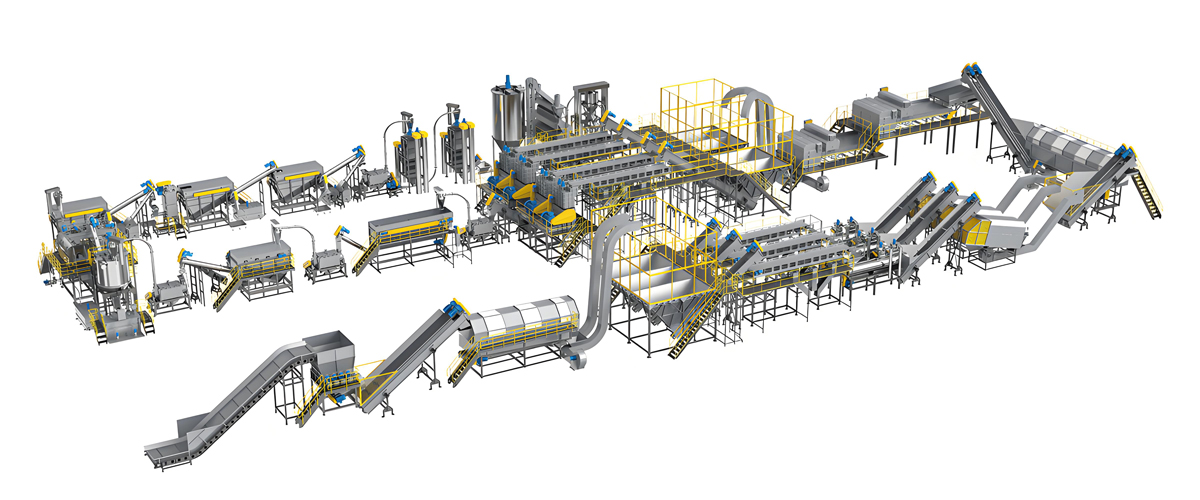
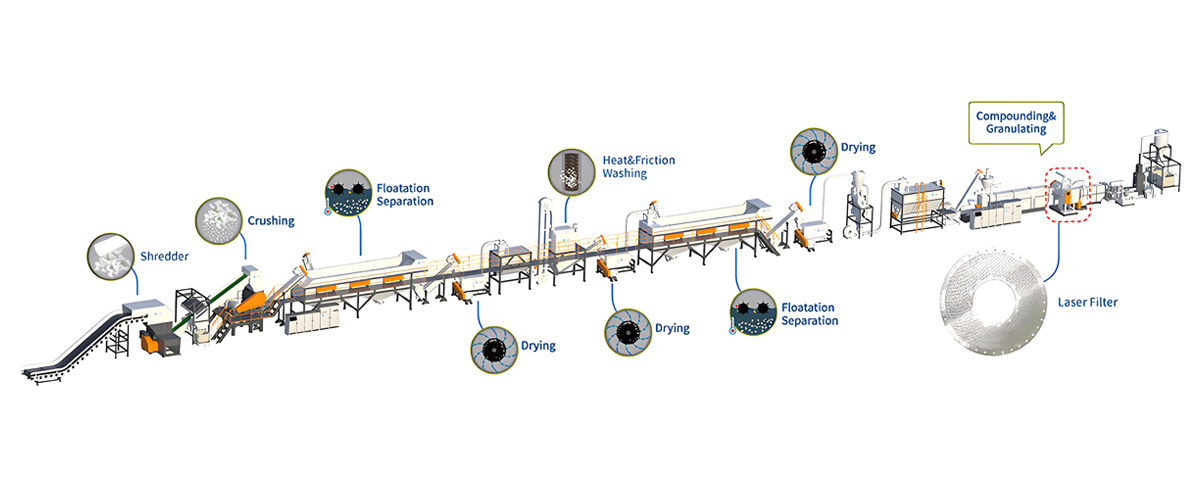
Polyretec, a Wanplas factory, embeds a tuned wet crusher in its Food Grade PET Bottle Washing Line. The line runs from 500 kg per hour to 6000 kg per hour and is designed for different flake grades.
The crusher uses hard-faced, segmented knives and a quick-change screen. Operators switch the screen between 8 mm and 18 mm depending on whether the plant targets fiber-grade or bottle-to-bottle flake.
A variable-speed rotor lets one machine serve both rigid PET and the LDPE label residue that rides with it. Water injection keeps the cut cool so PET does not smear or yellow.
The table lists representative crusher tiers inside the PET line. Polyretec confirms each tier’s exact parameters against the customer’s feed during project engineering.
Specification: Polyretec PET Line Crusher Tiers
| Line Output | Rotor | Motor | Screen | Flake | Moisture |
|---|---|---|---|---|---|
| 500 kg/h | 600 mm | 55 kW | 12 mm | 10 to 14 mm | ≤2 percent |
| 2000 kg/h | 900 mm | 160 kW | 12 mm | 10 to 14 mm | ≤2 percent |
| 6000 kg/h | 1200 mm | 400 kW | 14 mm | 12 to 16 mm | ≤2 percent |
Moisture after dewatering stays at or below 2 percent, which protects the downstream pelletizing extruder. Consistent moisture also stabilizes the dryer load batch to batch.
For food-grade rPET, the full wash adds a hot wash and fine filtration after crushing. The crusher’s uniform flake is what lets those later stages reach specification reliably.
Choosing the PET crusher tier starts from the bottle source. Post-consumer bales with caps and labels need the higher motor tier to cut the mixed wall thickness, while sorted, cap-removed bottles run well on the lower tier and save energy.
Knife count scales with rotor width. The 600 mm rotor uses fewer segments than the 1200 mm rotor, yet both keep the same shear angle so flake shape stays consistent across tiers. This lets a plant grow from 500 kg per hour to 6000 kg per hour without re-qualifying its flake grade.
Water use at the crusher links to flake cooling and transport. Polyretec sizes the water ring to keep the cut zone below the smear temperature of PET, typically well under the 250 degrees Celsius melt point, so flakes leave the chamber clean rather than fused.
For bottle-to-bottle grade, the 8 mm to 12 mm screen range is preferred to feed the decontamination and solid-state polycondensation steps with a fine, even flake. Fiber-grade accepts the 14 mm to 16 mm band from the 6000 kg per hour tier, which trades some uniformity for throughput.
The line’s control system records rotor load, water flow, and motor current. A rising current at fixed feed signals knife wear or screen loading, giving the operator an early warning before the flake band drifts out of spec.
Polyretec PP/PE Soft Line Granulator
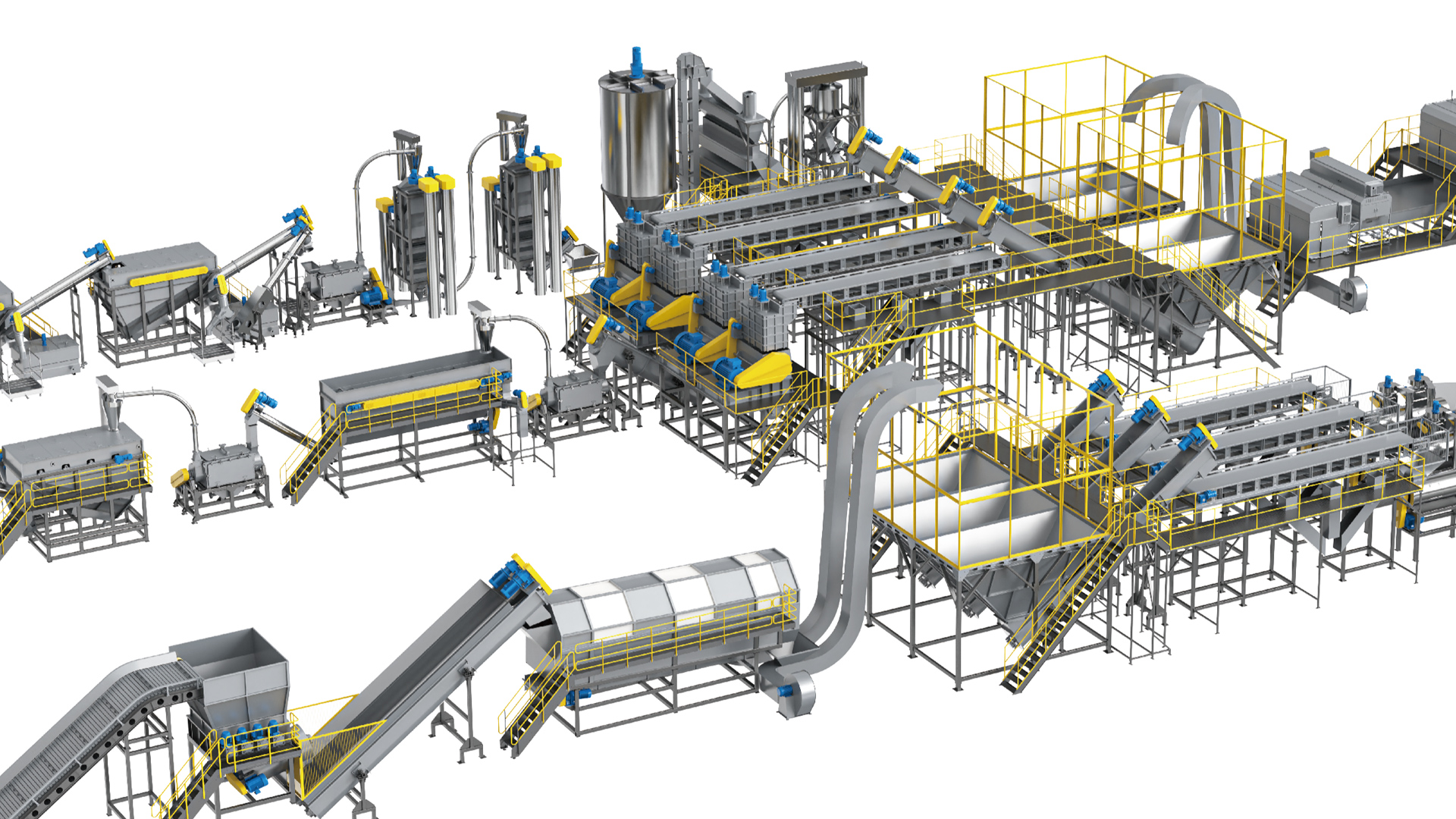
The PP/PE Soft Plastic Crushing and Washing Line targets film, woven bags, and agricultural film. It runs from 500 kg per hour to 1500 kg per hour, with one-step pelletizing available.
Film needs a different crushing profile than bottles. The granulator runs a higher rotor speed with strong water flow to keep LDPE and PP from forming long strands.
An anti-wrap rotor and an aggressive intake pull film into the cut instead of letting it ride the shaft. The screen at 8 to 10 mm yields small flakes suited to film washing and pelletizing.
The table lists representative tiers. As with the PET line, final values are set after Polyretec tests a sample of the customer’s actual film waste.
Specification: Polyretec PP/PE Soft Line Granulator Tiers
| Line Output | Rotor | Motor | Screen | Flake | Moisture |
|---|---|---|---|---|---|
| 500 kg/h | 500 mm | 45 kW | 8 mm | 6 to 10 mm | ≤3 percent |
| 1000 kg/h | 700 mm | 90 kW | 10 mm | 8 to 12 mm | ≤3 percent |
| 1500 kg/h | 800 mm | 132 kW | 10 mm | 8 to 12 mm | ≤3 percent |
When one-step pelletizing is selected, the uniform granules flow straight from the washer to the New Generation Pelletizing Line, cutting handling and lowering contamination risk.
Agricultural film often carries sand and stickers. Polyretec adds an extra friction stage and a pre-rinse so the granulator sees cleaner feed and holds its flake band longer between knife changes.
Film thickness varies from thin shopping bags to thick woven bulk sacks. The granulator’s higher speed handles thin film, while the anti-wrap rotor and a slower intake pull suit thick woven PP that would otherwise ride the shaft and tangle.
For one-step pelletizing, the washed flakes pass a densifier before the New Generation Pelletizing Line. Uniform flakes densify at the same rate, so the melt enters the extruder evenly and the strand cutter makes matching pellets without frequent size rejects.
Color sort before or after crushing changes the flake stream. Clear and colored film crushed together keep one band but mix grade; sorting first yields two uniform streams, each with its own tight band and its own pellet color. Polyretec configures the line for the customer’s grade plan.
Woven bags carry printed ink and lamination. The higher water flow and friction wash strip most ink, but heavy lamination needs a pre-cut or a stronger friction stage so the granulator does not see sheets that fold instead of cut. Planning this step protects the flake shape.
Process Optimization Steps
Improving flake uniformity is a routine, not a one-time fix. The steps below give plant teams a practical checklist they can apply every shift.
Step one is to sort the feed. Removing non-plastic and separating rigid from film narrows the material range the crusher must handle and is the highest-payback action.
Step two is to set the screen for the dominant fraction and lock it. Frequent unplanned screen changes signal poor feed sorting upstream.
Step three is to tune rotor speed with feed rate. Raise speed only as far as the feed allows without packing the chamber.
Step four is to track knife wear with a simple flake screen test. When fines rise above the band, flip or replace the segmented knives before quality drops.
Step five is to keep water flow on target. Low water lets film heat and form strands; high water wastes pump energy without improving flakes.
Step six is to log each batch. Recording screen, speed, feed, and flake test builds the process window that keeps uniformity stable across operators and shifts.
Step seven is to verify water quality. Recirculated wash water carries fine solids that redeposit on flakes; a side-stream filter keeps the slurry clean so the crusher feed stays consistent and the flake band holds.
Step eight is to match the dryer to the flake. Centrifugal dryers tuned for the 10 to 14 mm band leave less residual moisture than a unit sized for film; running the wrong dryer spreads moisture and disturbs the pelletizing melt.
Step nine is to audit the screen monthly with a go/no-go plug gauge. Holes stretched by wear pass oversized flakes silently. Replacing the screen on a schedule, not on failure, keeps the top of the band fixed.
Step ten is to train a backup operator to run the sieve test. Uniformity depends on the person reading the result, so two trained readers reduce the chance that drift goes unnoticed between shifts.
A weekly review of the log spots slow trends. A gradual rise in fines often precedes a knife change; catching it early avoids a batch of off-spec flake and the rework that follows. Polyretec includes this review in its operator training.
Application Industries
Uniform flakes unlock higher-value recycled products. Polyretec recycling equipment converts waste plastics into reusable pellets and blocks for manufacturers that once used only virgin resin.
In plastic product production, steady PET flakes become fiber, strapping, and sheet. Even PE and PP pellets become film, pipe, and profile with predictable melt behavior.
In renewable resource utilization, uniform flakes let converters hit recycled-content targets without sacrificing process stability. Consistent feed means fewer line stops and less scrap.
End products include packaging film, beverage bottles, construction sheet, drainage pipe, automotive trim, and household goods. Food-contact rPET demands the tightest flake band of all.
Agricultural film recovery supports farms and greenhouses by returning low-density waste into usable PE and PP pellet. Tight flake uniformity keeps the washed film clean enough to re-extrude.
Food and beverage packaging is the largest outlet for uniform PET flake. Bottle-to-bottle rPET must meet strict impurity limits, and a narrow flake band is what lets the wash and decontamination reach those limits at line speed.
Textile and fiber users convert steady PET flake into staple fiber for clothing, wipes, and geotextile. Fiber lines are sensitive to flake size because the cutter wears unevenly on mixed feed, so uniformity directly extends cutter life.
Construction uses recycled PE and PP in profile, pipe, and board. Drainage pipe made from uniform pellet holds wall thickness and pressure rating; off-spec flake causes thin spots that fail in the field.
Automotive and appliance trims take recycled PP compounds. Consistent flake gives stable fill and color, letting compounders hit mechanical specs without over-adding virgin resin to mask batch variation.
Household goods and strapping band round out the demand. Strapping needs high tensile strength from clean, uniform PET, while thin-wall houseware needs steady melt flow that only a tight flake band supplies.
Selection Guide for Crushers
Select the crusher from the material and the target flake, not from price alone. The table turns common plant situations into a recommended Polyretec configuration.
| Material | Target Flake | Capacity | Recommended Setup |
|---|---|---|---|
| PET bottles | 10 to 14 mm | 500 to 6000 kg/h | PET washing line crusher |
| LDPE film | 6 to 10 mm | 500 to 1500 kg/h | PP/PE soft line granulator |
| PP woven bag | 8 to 12 mm | 500 to 1500 kg/h | PP/PE soft line granulator |
| Mixed bale | 10 to 14 mm | 1000 kg/h | PET crusher, sorted feed |
| Washed to pellet | Pellet | Match wash | New Generation Pelletizing Line |
Capacity is rated on a defined feed. A 6000 kg per hour PET line assumes sorted, loosely baled bottles at normal contamination. Wet or sticker-heavy feed lowers real output.
Plan for expansion at purchase. Polyretec can size the crusher one tier above current volume so a later washer upgrade does not force a crusher replacement.
Beyond material and flake size, three selection considerations protect the investment. Power per tonne shows efficiency: a line that cuts at lower kWh per tonne holds margin as energy cost moves. Spare knife commonality across tiers lowers inventory. Footprint sets whether the crusher fits the existing hall.
The table compares the two Polyretec crusher families on these practical points so a plant can match the machine to its site and grade plan.
| Factor | PET Line Crusher | PP/PE Soft Granulator |
|---|---|---|
| Best feed | Rigid bottles, trays | Film, woven bags |
| Speed profile | Medium | High |
| Screen range | 8 to 18 mm | 8 to 10 mm |
| Power per tonne | Low at scale | Medium |
| Knife type | Segmented, hard-faced | Anti-wrap, segmented |
| Downstream | Wash to rPET | Wash to pellet |
When a plant runs both bottles and film, Polyretec often supplies one PET line and one soft line rather than a single compromise machine, because the screen and speed needed for each are too far apart to share without losing uniformity on both.
For plants with variable feed, the variable-speed rotor option on the PET crusher covers light film residue, while a separate soft line covers heavy film. This split keeps each line in its best window and avoids the fines and strands that a single mixed setting would create.
Service and Support
Polyretec supports every line from startup through years of operation. The factory’s recycling equipment origin traces to 2010 and the brand was established in 2017. It has delivered 100 plus projects in 50 plus countries with 24 plus field engineers.
Each project receives pre-shipment testing on a sample of the customer’s waste. Polyretec confirms flake size, output, and moisture before the line leaves the factory.
Engineers install and commission the line on site. They set the rotor speed, screen, and wash chemistry, then train operators on safe running, knife change, and the flake screen test.
The Wanplas group service promise covers Polyretec lines. Customers receive USD 500 free spare parts every year and free replacement of damaged parts within the warranty period.
Polyretec also provides a transportation guarantee, a production capacity guarantee, and a quality standard that refunds and adds 10 percent compensation if quality fails. The factory welcomes customer visits for audit and sample trial.
Remote support keeps the process window honest between visits. Engineers review control system data and advise on speed and screen adjustments so uniformity stays in band.
Spare parts stocking is planned with the customer. Polyretec lists the wear items (knives, screen, seals, bearings) and suggests a stock level based on the rated run hours, so a knife change never waits on shipping and the flake band never slips from delayed maintenance.
Training covers the sieve test in detail. Operators learn to weigh each sieve, read the distribution, and decide whether the drift is knife wear, screen stretch, or feed change. This skill is what turns the service promise into day-to-day uniformity.
Annual line audit revisits the process window. As feed sources shift over a year, the optimal screen and speed may move; the audit resets the window to the current waste and documents the change for the next operator handover.
Documented commissioning records travel with the line. The original gap setting, screen size, and tested flake distribution are filed so a future service visit can confirm the machine still matches its qualified state rather than guessing from scratch.
Crusher Maintenance for Stable Flakes
Maintenance is where flake uniformity is either held or lost. A crusher set perfectly at commissioning drifts within weeks unless a simple routine keeps the cut and the screen in spec. This section covers the checks that matter most for the plastic crushing process.
Knife inspection leads the list. Segmented knives wear on the edge first, and a worn edge crushes instead of slices, raising fines. Polyretec recommends a visual and feel check every shift and a measured check with the sieve test weekly.
Knife rotation and replacement follow a pattern. Most segmented rotors let the operator rotate each segment to a fresh edge before a full change, doubling the time between purchases. Recording the rotation date in the log prevents running a segment past its life.
Screen care is the second pillar. The screen sets the top of the flake band, so any stretch or dent opens the band. A monthly plug-gauge check of hole size, plus immediate change after tramp metal contact, keeps the band fixed.
Bearing and drive checks protect the rotor speed. A worn bearing slows the rotor without tripping the motor, and the lower speed lets elastic HDPE stretch into oversized pieces. Vibration trending catches this before the flake test shows it.
Water system maintenance is often overlooked. Clogged nozzles cut local cooling, so part of the chamber runs hot and smears film into strands. A weekly nozzle clean and a flow check keep the cut even across the full rotor width.
The table summarizes a practical maintenance cadence. Cadence scales with run hours; a 6000 kg per hour line running 20 hours a day needs checks sooner than a 500 kg per hour line running one shift.
| Task | Frequency | Target | Effect on Flake |
|---|---|---|---|
| Knife visual check | Per shift | No edge crush | Low fines |
| Sieve test | Weekly | Band in spec | Stable size |
| Screen plug gauge | Monthly | Hole size held | Fixed top band |
| Bearing vibration | Monthly | Within limit | Steady speed |
| Nozzle clean | Weekly | Full flow | Even cooling |
| Annual audit | Yearly | Window reset | Matches feed |
Lubrication and belt tension round out the routine. A loose drive belt slips under load and lowers effective rotor speed; a missed grease point shortens bearing life. Both are cheap to do and costly to skip, because each quietly widens the flake band.
Polyretec supplies a maintenance checklist matched to the delivered line, with the exact torque, gap, and screen values from commissioning. Following that sheet is the simplest way to keep flake uniformity where the project qualified it.
Frequently Asked Questions
What is a good flake uniformity target?
Keep more than 80 percent of flakes inside the chosen size band, such as 10 to 14 mm. Screen a sample over mesh sizes to confirm the distribution per shift.
Which screen size gives the best flakes?
A 12 mm screen at medium speed suits mixed bottle and film waste. Film lines use 8 mm, rigid bottle lines use 18 mm. Match the screen to the dominant fraction.
Why do dull knives hurt uniformity?
Dull knives crush instead of cut, raising fines and power draw. Segmented hard-faced knives keep a sharp shear angle and protect the flake band.
Does film need different settings than bottles?
Yes. Film needs higher rotor speed and strong water flow to avoid strands. Bottles need medium speed and a larger screen to prevent over-cutting and fines.
Can I pelletize right after crushing?
Only after washing and drying. The New Generation Pelletizing Line takes clean, dry flakes. Wet or soiled flakes must pass the full wash first.
How often should I change the screen?
Change the screen when the flake test shows the band widening or when tramp metal deforms it. Routine checks catch drift before quality drops.
Does Polyretec test my actual waste?
Yes. Polyretec runs pre-shipment testing on a sample of your waste to confirm flake size, output, and moisture before delivery.
How do I reduce fines in the flake?
Avoid over-speed cutting, keep knives sharp, and match the screen to the material. Wet cutting and steady feed also lower fine generation.
What rotor speed suits PET versus film?
PET runs at medium speed with a 12 to 14 mm screen for a clean cut. LDPE and PP film need higher speed with an 8 to 10 mm screen and strong water flow to stop long strands.
How does the screen hole shape affect flakes?
Round holes give near-spherical flakes with few slivers, best for rigid PET. Slotted screens raise throughput but pass elongated pieces, so they suit film grades more than bottle-to-bottle flake.
Conclusion
Flake uniformity is won in the crushing process, not corrected later. Tight feed sorting, the right screen, balanced rotor speed, sharp segmented knives, and disciplined logging keep flakes in a narrow band. Polyretec, a Wanplas factory, builds these controls into its PET and PP/PE washing line crushers so uniform flakes feed a stable pelletizing line. Send Polyretec your waste specification for a tailored crusher configuration, arrange a factory audit, or request a sample trial run on your own material.