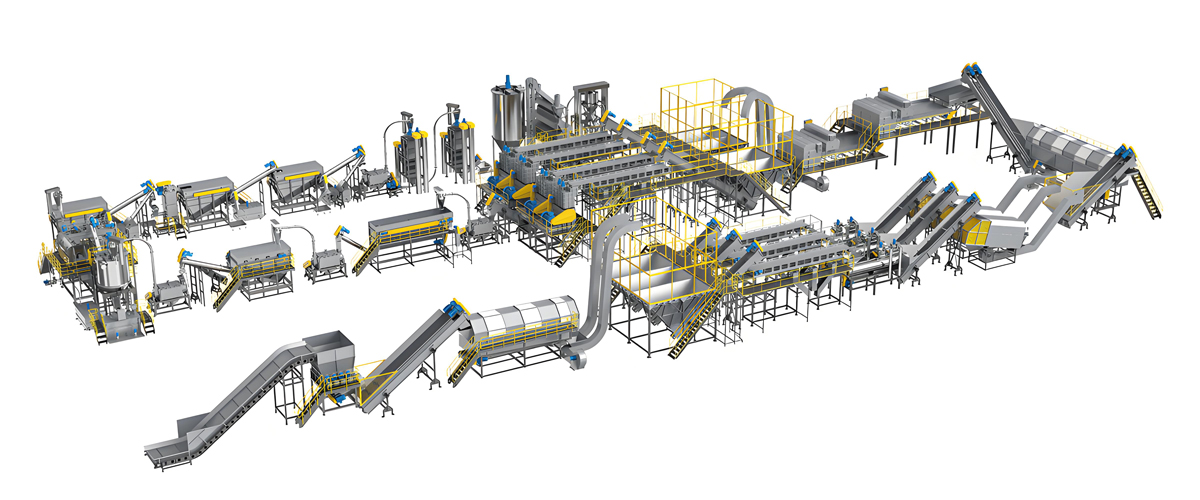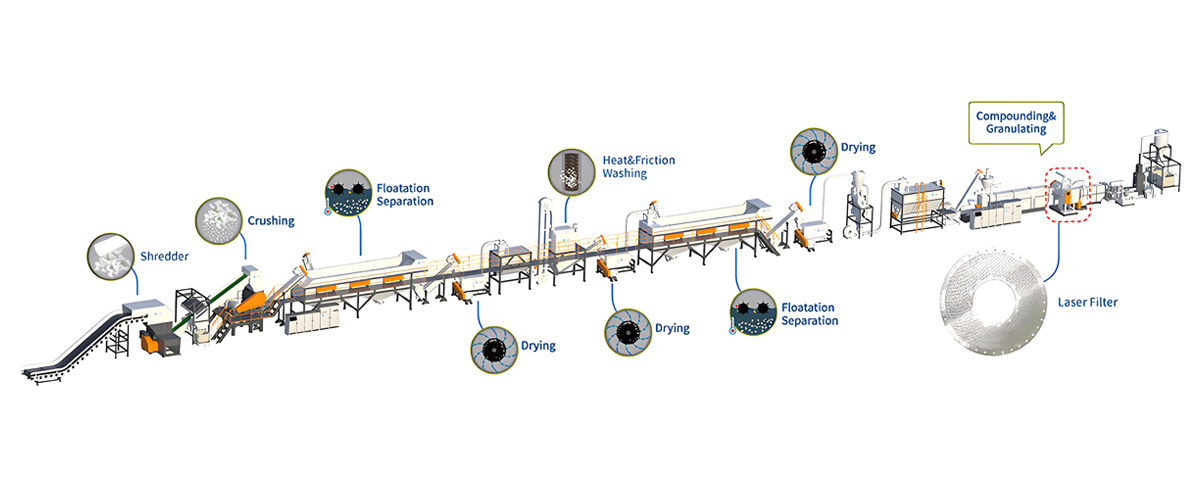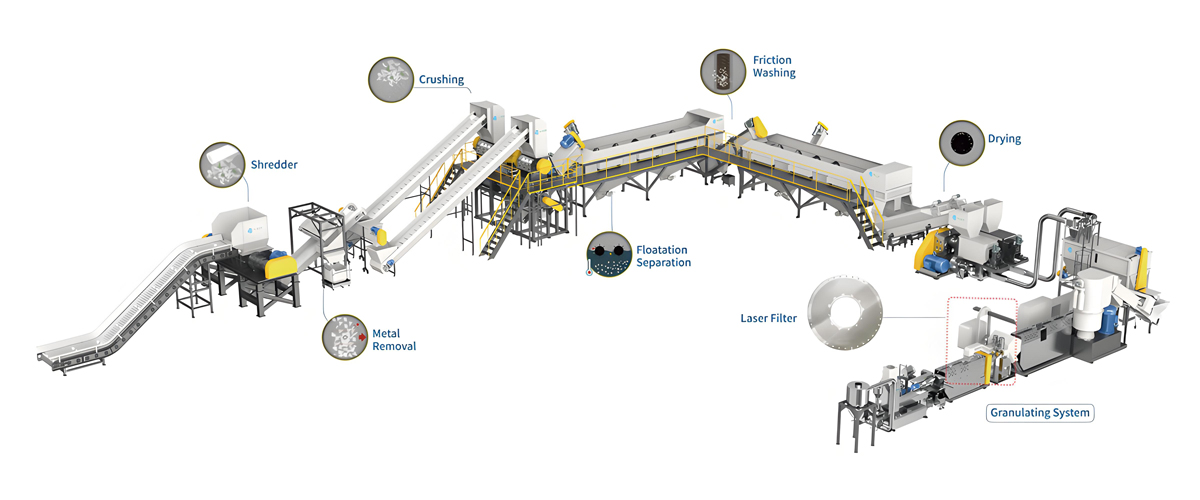

Polyretec, a Wanplas factory, has specialized in plastic recycling equipment since 2010 and has supported more than 100 recycling projects across 50-plus countries. A pelletizing cooler for recycled plastic pellets is one of the most underestimated yet performance-critical components in a recycling line. Choosing the wrong cooling method leads to agglomerated pellets, high residual moisture, dust generation, unstable bulk density, and downstream feeding problems in extrusion or injection molding. This guide explains how to choose the right pelletizing cooler for recycled plastic pellets by analyzing cooler types, capacity matching, pellet size, fan power, cooling time, and material behavior. Whether you process post-consumer LDPE film, thick-walled PP/PE regrind, or rigid PET flakes, the right cooling strategy protects pellet quality and lowers total energy consumption.
What Is a Pelletizing Cooler and Why It Matters for Recycled Pellets
A pelletizing cooler is the downstream unit that removes the heat generated during cutting and solidification of hot plastic pellets immediately after the extruder die or die-face cutting head. In a recycling line, molten recycled material is filtered, extruded through a die plate, cut into pellets by a rotating knife, and then the pellets are still at or near melt temperature. Without controlled cooling, the pellets stick together, oxidize, pick up color, and form elongated or deformed shapes that are difficult to convey, sieve, and feed. A pelletizing cooler stabilizes pellet geometry, controls residual moisture, reduces dust, and delivers a free-flowing, uniform granule suitable for storage, blending, and re-extrusion.
For recycled plastics the cooler matters even more than for virgin compounding, because post-consumer feedstock carries variable melt viscosity, contamination, filler content, and moisture history. A cooler that performs well on clean polypropylene may perform poorly on printed LDPE film with high wax and ink content. The selection therefore must match the real heterogeneity of the recycled stream rather than an idealized specification sheet.
The functional goals of any pelletizing cooler can be stated simply: bring pellets from cut temperature to a safe handling temperature, do so without adding unwanted moisture, maintain a tight pellet-size distribution, minimize fines and streamers, and consume the least practical energy per tonne of output. A well-chosen cooler also reduces the load on the dewatering and drying stages and protects the downstream storage silo from heat buildup.
From a process viewpoint, the cooler is not isolated. It receives pellets from the cutting system, interacts with the conveying air or water, and feeds the screening or bagging station. Its design must be coordinated with the pelletizing method chosen upstream. That is why Polyretec engineers evaluate the cooler together with the pelletizing line rather than as a bolt-on afterthought.
Regulatory and market drivers make this coordination more important every year. Brand owners and converters increasingly demand recycled-content certification and traceable, low-contamination pellets, which raises the quality bar that the cooling stage must meet. At the same time, energy efficiency and dust-emission limits push recyclers toward coolers that do more with less air and water. A cooler selected only on first-cost will struggle to satisfy these rising requirements, whereas a cooler specified for the full quality envelope protects both compliance and resale value of the recycled granule.
How a Pelletizing Cooler Works in a Recycling Line
The cooling step follows a predictable sequence regardless of the specific hardware. Melt exits the die, is cut into pellets, and the hot pellets enter a cooling medium. Heat transfers from the pellet surface inward, the polymer solidifies, and the pellets are separated from the cooling medium and conditioned for handling. The differences between cooler types are defined by whether the medium is air, water, or a combination, and by how the pellets are transported and classified during cooling.
Air-Cooled Cooling Principle
In air-cooled systems, hot pellets are conveyed through a stream of ambient or conditioned air. Heat is removed by forced convection as the pellets tumble or vibrate along a cooling channel or fluidized zone. Air-cooled cooling is preferred when water contact must be avoided, such as for hygroscopic or hydrolysis-sensitive recycled materials, and when the pellet surface must stay dry for direct feeding into a dryer-free process. The trade-off is lower heat-removal capacity per unit volume compared with water, so air-cooled coolers need larger air volumes and longer residence time for high-throughput lines.
Water-Based Cooling Principle
Water-based cooling uses a water ring, water curtain, or submerged chamber where pellets are quenched almost instantly. Water has a heat capacity and heat-transfer coefficient far higher than air, so it cools small, heat-sensitive pellets very rapidly and produces round, uniform, low-fines granules. After water cooling, the pellets must pass through a dewatering centrifuge and, for many recycled grades, a thermal dryer to reach the required residual moisture. Water-based cooling is dominant for LDPE, LLDPE, and PP film recycling where pellet shape quality is critical.
Fluidized Bed and Counterflow Cooling
Vibrating fluidized bed and counterflow coolers represent a hybrid where pellets are suspended or vibrated in a controlled air field, sometimes with a small amount of process water mist or indirect cooling. These systems give excellent temperature uniformity and are valued when pellet batches must be cooled gently to avoid thermal shock and when dust control is a priority. They are common in larger compounding and recycling plants where consistent bulk density and low fines are contractual requirements.
In every case, the cooler output should be checked for temperature, moisture, and shape before bagging. A simple rule used by Polyretec commissioning teams is that the pellet surface temperature at the discharge should be near ambient and the pellet should be hard enough to survive a drop test without deformation.
Main Types of Pelletizing Coolers
Recycling plants typically choose among four cooler families. Each has a clear operating envelope defined by material, pellet size, throughput, and acceptable residual moisture. The comparison below is technology-versus-technology, which is the correct way to evaluate cooling hardware.
Air-Cooled Strand and Die-Face Pellet Cooler
The air-cooled pellet cooler conveys hot cut pellets through a duct or vibrating trough with high-volume air. It is the simplest and lowest-moisture system, ideal for PP, PS, ABS, and rigid PE regrind where water contact is undesirable. It produces a dry pellet directly and is easy to integrate with a screening classifier. Its limitation is heat-removal capacity, which constraints throughput for very small or very hot pellets.
Water-Ring Die-Face Hot Cutting with Cooling
Water-ring cooling pairs die-face hot cutting with a rotating water ring that quenches and conveys pellets. It is the workhorse for LDPE and LLDPE film recycling and for many PP grades. Pellets are spherical and uniform, fines are low, and throughput is high. The required dewatering and drying stages add equipment but pay back through superior pellet quality and market value.
Underwater Pelletizing Cooling System
Underwater pelletizing cuts the melt below the water surface in a pressurized chamber, giving extremely uniform, spherical pellets at high output. It is the premium solution for demanding recycled grades and large lines. Capital and complexity are higher, and water quality management is essential, but the pellet quality and throughput are unmatched for film and fiber-grade recycled material.
Vibrating Fluidized Bed Cooler
The vibrating fluidized bed cooler suspends pellets in a gentle air flow while a vibration conveys them forward. It provides outstanding temperature uniformity, low mechanical stress, and strong dust control. It is frequently selected for recycled engineering plastics and for plants that must meet tight bulk-density specifications.
| Cooling Technology | Typical Materials | Residual Moisture | Pellet Shape Quality | Relative Throughput | Best Use Case |
|---|---|---|---|---|---|
| Air-cooled pellet cooler | PP, PS, ABS, rigid PE | Very Low | Good | Medium | Dry pellet, no water contact |
| Water-ring cooling | LDPE, LLDPE, PP film | Low after drying | Very Good | High | Film recycling, uniform pellets |
| Underwater pelletizing | LDPE, PP, PET* | Low after drying | Excellent | Very High | Large lines, fiber-grade |
| Vibrating fluidized bed | PP, PE, PS, ABS | Very Low | Excellent | Medium-High | Tight bulk density, low fines |
| Counterflow cooler | PE, PP regrind | Low | Good | Medium | Gentle cooling, dust control |
*Note: PET is normally processed as dry flake or strand-pelletized with strict moisture control because it hydrolyzes; water contact must be followed by thorough drying. Polyretec configures PET recycling lines with crystallizing and dehumidifying dryers rather than relying on water cooling for the final pellet.
Key Specifications to Evaluate Before Buying
Selecting a pelletizing cooler is a specification exercise. The four numbers that decide success are throughput, pellet size, cooling air volume or water flow, and residual moisture. Evaluate them together, because improving one often constrains another.
Throughput and Capacity Matching
Throughput is the single most common source of mismatch. A cooler rated for a clean virgin line at 1000 kg/h may underperform on a recycled line at the same nameplate because recycled melt has variable density and higher fines. Size the cooler for the actual output of the washing and extrusion stages, not the theoretical extruder maximum. Polyretec typically adds a capacity margin so the cooler is not the bottleneck during surge feeding from bale-opening.
Pellet Size and Bulk Density
Pellet diameter and bulk density determine how air or water flows around each granule. Smaller pellets cool faster but are harder to fluidize without blowing them out as dust. Larger pellets need longer residence time. The table below links pellet size to a recommended throughput band and cooler family for recycled polyolefins.
| Pellet Diameter | Bulk Density (typical) | Recommended Throughput Band | Preferred Cooler Type | Key Risk if Mismatched |
|---|---|---|---|---|
| 2 mm | Low to Medium | 200 to 800 kg/h | Air-cooled or water-ring | Dust loss in air stream |
| 3 mm | Medium | 400 to 1200 kg/h | Water-ring or fluidized bed | Uneven cooling |
| 4 mm | Medium to High | 600 to 1800 kg/h | Water-ring or underwater | Slow core solidification |
| 5 mm | High | 800 to 2200 kg/h | Underwater or counterflow | Soft-center pellets |
Cooling Air Volume and Fan Power
For air-cooled and fluidized systems, the fan defines performance. Air volume removes the heat; static pressure overcomes duct and filter resistance. Under-sizing the fan is the most frequent cause of warm, agglomerated discharge. The table gives typical air-volume and fan-power bands for recycled polyolefin coolers at representative throughputs.
| Cooler Type | Throughput | Air Volume | Fan Power | Motor Type | Static Pressure |
|---|---|---|---|---|---|
| Air-cooled pellet cooler | 500 kg/h | 6000 to 9000 m³/h | 7.5 to 11 kW | IE3 inverter | Medium |
| Air-cooled pellet cooler | 1000 kg/h | 11000 to 15000 m³/h | 15 to 18.5 kW | IE3 inverter | Medium |
| Vibrating fluidized bed | 800 kg/h | 8000 to 12000 m³/h | 11 to 15 kW | IE3 inverter | Low-Medium |
| Counterflow cooler | 1000 kg/h | 9000 to 13000 m³/h | 12 to 16 kW | IE3 inverter | Medium |
| Water-ring (water pump) | 1500 kg/h | Water flow 25 to 40 m³/h | 7.5 to 11 kW | IE3 direct | Low |
Residual Moisture and Pellet Homogeneity
Residual moisture is the contract-breaking parameter. For most dry-fed re-extrusion, residual moisture should be below 0.2 percent for air-cooled pellets and below 0.1 percent after the dryer for water-cooled pellets. Higher moisture causes bubbling, skipping, and mechanical-property loss in the next processing step. Homogeneity matters equally: a cooler that delivers 90 percent perfect pellets and 10 percent soft or elongated ones still forces the customer to screen and discard. Polyretec sets acceptance on the full batch, not a spot sample.
Polyretec Air-Cooled Pellet Cooler Module
PRT-NG-AC Air-Cooled Pellet Cooler Module
The PRT-NG-AC is the air-cooled cooler module of the Polyretec New Generation Pelletizing Line. It is engineered for recycled PP, PS, ABS, and rigid PE/PP regrind where water-free pellets are required. The module integrates conveying, cooling, dedusting, and screening into one skid, and it is tuned during commissioning to the actual recycled feedstock rather than a generic setting.
| Specification | PRT-NG-AC 500 | PRT-NG-AC 1000 | PRT-NG-AC 1500 |
|---|---|---|---|
| Applicable material | PP, PS, rigid PE | PP, PS, ABS, PE | PP, PS, ABS, PE |
| Throughput | 200 to 600 kg/h | 600 to 1100 kg/h | 1100 to 1500 kg/h |
| Pellet size range | 2 to 4 mm | 2 to 5 mm | 2 to 5 mm |
| Cooling air volume | 6000 to 9000 m³/h | 11000 to 15000 m³/h | 15000 to 18000 m³/h |
| Fan power | 7.5 to 11 kW | 15 to 18.5 kW | 18.5 to 22 kW |
| Cooling time | 8 to 15 s | 10 to 18 s | 12 to 20 s |
| Residual moisture | Below 0.2 percent | Below 0.2 percent | Below 0.2 percent |
| Dedusting | Cyclone + bag filter | Cyclone + bag filter | Cyclone + bag filter |
| Compressed air | 0.6 MPa | 0.6 MPa | 0.6 MPa |
This module is the recommended choice when the recycled stream is sensitive to moisture or when the plant wants to avoid the dewatering and drying stages entirely. For printed film with high contamination, the integrated bag filter keeps the work environment clean and recovers fine powder for re-processing.
Polyretec Water-Ring and Underwater Cooling Solutions
PRT-NG-WR Water-Ring Cooling Module and PRT-NG-UW Underwater Option
For thin-walled LDPE and LLDPE films and for high-value PP grades, the PRT-NG-WR water-ring module of the Polyretec New Generation Pelletizing Line delivers round, uniform pellets at high output. The melt is cut at the die face and immediately quenched in the water ring, then dewatered and dried. For the largest lines, the PRT-NG-UW underwater option is offered with pressurized cutting and continuous water treatment.
| Specification | PRT-NG-WR 800 | PRT-NG-WR 1500 | PRT-NG-UW 2000 |
|---|---|---|---|
| Applicable material | LDPE, LLDPE, PP | LDPE, LLDPE, PP | LDPE, PP, PET* |
| Throughput | 300 to 900 kg/h | 900 to 1500 kg/h | 1500 to 2000 kg/h |
| Pellet size range | 2 to 4 mm | 2 to 4 mm | 2 to 3.5 mm |
| Process water flow | 10 to 20 m³/h | 20 to 30 m³/h | 30 to 40 m³/h |
| Dewatering power | 4 to 7.5 kW | 7.5 to 11 kW | 11 to 15 kW |
| Cooling water temp | 15 to 30 °C | 15 to 30 °C | 15 to 28 °C |
| Residual moisture after dryer | Below 0.1 percent | Below 0.1 percent | Below 0.1 percent |
| Pellet shape quality | Very Good | Very Good | Excellent |
Both modules are delivered with Polyretec’s Austrian-technology process design and Chinese manufacturing cost efficiency. The water-ring module suits most film recyclers; the underwater option is selected when throughput and pellet uniformity justify the higher investment and water-treatment requirement.
Application Industries for Recycled Pellets
Recycled pellets from a properly cooled line serve a wide range of industries. The cooler choice should reflect the end-use quality requirement, because some applications tolerate higher moisture and fines while others demand tight specifications.
| Application Industry | Typical Recycled Material | End Product | Preferred Cooler | Critical Quality |
|---|---|---|---|---|
| Packaging film and bag producers | LDPE, LLDPE post-consumer film | Carry bags, shrink film | Water-ring | Uniform shape, low gel |
| Pipe and profile manufacturers | HDPE, PP regrind | Drainage pipe, profiles | Air-cooled or fluidized | Dry pellet, stable MFI |
| Woven bag and non-woven producers | PP raffia, PP non-woven | Woven sacks, geotextile | Water-ring | Low moisture, low ash |
| Houseware and consumer goods | PP, PS, ABS regrind | Containers, stools | Air-cooled | Color consistency |
| Agriculture film recyclers | Low-density PE film with soil | Agriculture mulch, film | Water-ring with washing | Clean, low contamination |
| Renewable resource utilization | Mixed post-consumer polyolefin | Composite board, pallets | Air-cooled or counterflow | Bulk density control |
Polyretec positions recycled pellet cooling as part of a circular economy: converting waste plastics into reusable pellets reduces dependence on primary plastic resources. The same cooler decision that protects pellet quality also supports the sustainability story that recyclers present to brand owners and regulators.
Cooling Time and Material Behavior Reference
Cooling time is not a fixed constant; it depends on polymer heat capacity, pellet size, and the cooling medium. The reference below gives typical cooling-time bands for common recycled polymers in well-designed coolers. Treat these as planning values; final settings are confirmed during commissioning on the actual feedstock.
| Recycled Material | Melt Cut Temp | Air-Cooled Time | Water-Cooled Time | Behavior Note |
|---|---|---|---|---|
| LDPE film | 200 to 230 °C | 15 to 22 s | 3 to 6 s | Low temp, soft, needs gentle air |
| LLDPE film | 210 to 240 °C | 16 to 24 s | 3 to 6 s | Higher melt strength |
| HDPE regrind | 220 to 260 °C | 12 to 18 s | 4 to 7 s | Crystallizes, releases latent heat |
| PP regrind | 230 to 270 °C | 12 to 20 s | 4 to 8 s | Fast set, sensitive to thermal history |
| PS regrind | 200 to 230 °C | 10 to 16 s | 4 to 7 s | Brittle, low fines tolerance |
| ABS regrind | 220 to 250 °C | 14 to 20 s | 5 to 8 s | Heat-sensitive, avoid overheat |
| PET flake (dry) | 260 to 290 °C | 18 to 26 s | Not recommended | Hydrolysis risk, dry cooling only |
The table shows why water cooling is so effective for polyolefin film: it removes heat roughly four times faster than air. But it also shows why PET must avoid free water. Matching cooling time to material prevents soft-center pellets and preserves the mechanical properties the recycler sells.
In practice the fastest acceptable cooling is usually the best, provided pellet shape and moisture stay within spec. Over-cooling polyolefins wastes energy and air, while under-cooling risks agglomeration, so the commissioning target is a consistent discharge temperature just above ambient with zero soft pellets in the screened fraction.
How to Match Cooler to Material and Output
The selection matrix below converts a customer requirement directly into a recommended Polyretec configuration. It is the practical shortcut Polyretec application engineers use during the first technical call.
| Customer Requirement | Material Example | Output Band | Recommended Polyretec Module | Reason |
|---|---|---|---|---|
| No water contact, dry pellet | PP, PS, ABS regrind | 200 to 1500 kg/h | PRT-NG-AC air-cooled | Avoids moisture and drying stage |
| Maximum pellet uniformity | LDPE, LLDPE film | 300 to 1500 kg/h | PRT-NG-WR water-ring | Round, low-fines granules |
| Highest throughput and quality | PP, LDPE, PET* | 1500 to 2000 kg/h | PRT-NG-UW underwater | Premium output, fiber-grade |
| Tight bulk density, low dust | Mixed PE/PP | 800 to 1500 kg/h | Vibrating fluidized bed | Gentle, uniform cooling |
| Moderate output, simple line | HDPE, PP regrind | 600 to 1200 kg/h | Counterflow cooler | Low complexity, good control |
| Integrated washing plus pelletizing | Film with contamination | 500 to 1500 kg/h | New Generation Pelletizing Line with matched cooler | One supplier, coordinated design |
Use the matrix as a starting point, then validate with a sample run. Polyretec routinely requests a representative sample of the recycled feedstock so the cooler, cutter, and extruder are tuned together rather than guessed from a generic specification.
Relative Cost and Energy Considerations
Investment and operating cost should be compared on a relative basis rather than absolute figures, because final pricing depends on capacity, options, and destination. The cost index below sets the air-cooled mid-size module at 100 and expresses other options relative to it. This keeps the comparison clear without quoting currency.
| Cooling Solution | Relative Cost Index | Energy per Tonne | Complexity | Operating Cost Level |
|---|---|---|---|---|
| Air-cooled pellet cooler | 100 | Low | Low | Low |
| Counterflow cooler | 120 | Low-Medium | Low-Medium | Low-Medium |
| Water-ring system | 130 | Medium | Medium | Medium |
| Vibrating fluidized bed | 150 | Medium | Medium-High | Medium-High |
| Underwater pelletizing | 180 | Medium-High | High | High |
The lowest index is not always the best value. A water-ring system at index 130 often earns back its premium through higher pellet selling price, lower rejects, and better throughput. Conversely, an air-cooled module at index 100 is the most economical when moisture must be avoided and the output is moderate. Polyretec advises customers to calculate payback on pellet-value uplift, not just equipment index.
A practical payback view compares the annual value of avoided rejects and upgraded pellet grade against the incremental cost and energy of the chosen cooler. For a mid-size film recycling line, moving from a basic air-cooled setup to a water-ring module can lift pellet value enough to recover the premium within a single operating season, while also raising throughput headroom for future feedstock growth. The decision should therefore be made on lifecycle cost and revenue impact, supported by a sample run, rather than on the equipment cost index alone.
Energy is dominated by the fan or water pump and, for water systems, the dryer. Inverter-controlled IE3 motors, properly sized ducts, and clean filters keep the energy per tonne in the Low to Medium band. Polyretec commissioning includes a 72-hour continuous operation test on related equipment lines to confirm stable energy performance before shipment.
Common Mistakes to Avoid When Choosing a Cooler
Most pelletizing cooler failures are decided before the equipment arrives, during specification. Learning from recombinant installations across 50-plus countries, Polyretec identifies a short list of repeated mistakes that undermine pellet quality and plant uptime. Avoiding them is the fastest route to a cooler that performs on day one and keeps performing for years.
Under-Sizing the Fan and Air System
The single most common error is specifying the fan for nameplate throughput rather than real recycled output with its fines and variable melt density. When the air volume is too low, pellets leave the cooler warm and soft, agglomerate in the silo, and create feeding problems downstream. The correction is to size from measured heat load, include filter and duct pressure, and keep a margin so surge feeding from bale opening does not overwhelm the system. Polyretec confirms the fan curve during commissioning rather than trusting a catalog number.
Ignoring Feedstock Variability
Recycled streams are never constant. A line tuned for clean industrial PP will struggle when a batch of printed, soiled LDPE film arrives with higher wax, ink, and moisture. Buyers who specify the cooler for the best-case material expose themselves to failure on the worst-case batch. The robust approach is to define the cooler envelope around the full expected range, add an inline screening and dedusting stage, and keep process parameters adjustable. Polyretec routinely asks for several representative samples across the year, not a single ideal sample.
Skipping Sample Commissioning
A cooler that looks correct on paper can still produce soft-center pellets if the cutter speed, melt pressure, and air flow are not coordinated. Skipping a sample run is a false economy. A short trial on the actual feedstock reveals the right knife-particle gap, residence time, and fan setpoint, and it produces reference pellets the customer can approve before full production. Polyretec treats the sample commissioning as mandatory for new recycling lines rather than an optional extra.
Commissioning, Maintenance, and Spare Parts Planning
A cooler is a long-life asset only when it is commissioned correctly and maintained on a plan. The following practices keep recycled pellet cooling stable and protect the investment over the equipment lifecycle.
Pre-Shipment Testing and Acceptance
Before the cooler leaves the factory, it should be run under load with material comparable to the customer’s stream. Polyretec applies continuous operation testing on related equipment lines to verify stable energy performance, cooling consistency, and control behavior. Acceptance is based on the full batch meeting residual moisture, temperature, and shape targets, not on a favorable spot sample. This discipline reduces on-site surprises and shortens the time to full production.
Routine Maintenance for Coolers
Maintenance centers on airflow and separation. For air-cooled and fluidized systems, ducts, cyclones, and bag filters must be inspected and cleaned on a schedule matched to contamination level; a rising pressure drop is the early warning to service the filter. For water systems, water quality, screens, and the dewatering centrifuge deserve attention to prevent scaling and pellet carryover. Polyretec provides the maintenance procedure and training so the customer team can keep the cooler within specification without external dependence.
Spare Parts and Lifecycle Strategy
Critical wear items such as knives, screens, filter bags, bearings, and seals should be stocked according to the maintenance plan. The Wanplas group’s shared policy of USD 500 free parts every year supports this by offsetting routine replacement costs, while free replacement for damaged parts within warranty covers manufacturing defects. Polyretec’s spare-parts supply and 24-plus engineers for assistance keep downtime short when an unexpected item is needed. A simple lifecycle register, updated at each service, prevents the costly scramble that follows an unplanned stoppage.
Service, Support, and the Wanplas Brand Promise
Choosing hardware is only half the decision; the partner behind it determines long-term uptime. Polyretec, as a Wanplas factory, inherits the group’s shared service commitments. The Wanplas group provides USD 500 free parts every year to supported customers, free replacement for damaged parts within warranty, an open-factory policy that welcomes customer visits, and an average of 10-plus years of experience per equipment type. Polyretec itself brings 100-plus project experience, 50-plus countries served, and 24-plus engineers for on-site and remote assistance.
Polyretec’s customer services include pre-shipment testing, installation and commissioning, operator training, spare-parts supply, and remote monitoring support through the control system. The Austrian-technology process know-how is transferred to the customer team so the cooling module keeps performing after the commissioning engineer leaves. The open-factory policy means a buyer can audit the build quality before final payment.
For recycled pellet cooling specifically, Polyretec offers a tailored configuration service: send a sample of your recycled feedstock and your target output, and the engineering team returns a matched cooler specification with a realistic commissioning plan. This removes the guesswork that causes most cooling failures in the field.
Frequently Asked Questions
What is the difference between air-cooled and water-ring pellet cooling?
Air-cooled cooling removes heat with forced air and delivers a dry pellet with no water stage, ideal for PP, PS, ABS, and rigid PE. Water-ring cooling quenches pellets in water for very fast, uniform cooling and superior shape, mainly for LDPE, LLDPE, and PP film, but it requires dewatering and drying afterward. The choice depends on moisture tolerance and pellet-quality requirements.
Can I use a water-based cooler for recycled PET pellets?
PET is hydrolysis-sensitive and should not rely on free water cooling for the final pellet. Polyretec configures PET recycling with crystallizing and dehumidifying dryers and dry or gently air-cooled pelletizing to keep residual moisture extremely low. Water contact is acceptable only when followed by thorough drying that meets the strict IV-stability requirements of bottle-to-bottle or fiber applications.
How do I size the fan power for an air-cooled pellet cooler?
Size the fan from the required air volume, which scales with throughput and pellet heat load, plus the static pressure of ducts and filters. A 500 kg/h polyolefin line typically needs 6000 to 9000 m³/h at 7.5 to 11 kW, while a 1000 kg/h line needs 11000 to 15000 m³/h at 15 to 18.5 kW. Under-sizing the fan is the most common cause of warm, agglomerated discharge, so include a margin.
What residual moisture level is acceptable after cooling?
For dry-fed re-extrusion, air-cooled pellets should be below 0.2 percent residual moisture and water-cooled pellets below 0.1 percent after the dryer. Higher moisture causes bubbling, skipping, and mechanical-property loss in the next processing step. Polyretec sets acceptance on the full batch rather than a spot sample to guarantee consistent quality.
How often should cooler screens, cyclones, and filters be cleaned?
Frequency depends on feedstock contamination. For clean post-industrial regrind, inspect screens and bag filters weekly and clean when pressure drop rises. For printed or soiled post-consumer film, daily cleaning of cyclones and filters is common. The integrated dedusting on Polyretec modules recovers fine powder, so a visible dust increase is the signal to service the filter early.
Does Polyretec provide the cooler as a standalone unit or only with the pelletizing line?
Polyretec designs the cooler as part of the New Generation Pelletizing Line for coordinated performance, but the cooler modules can be specified to integrate with an existing extrusion and cutting system. The engineering team evaluates the upstream die, cutter, and conveying air before recommending a standalone or fully integrated configuration.
What is the typical lead time for a Polyretec pelletizing cooler?
Lead time varies with capacity, options, and shipping destination, so it is confirmed per order rather than quoted as a fixed number. Polyretec mitigates risk through a transportation guarantee and a production-capacity guarantee, and it performs continuous operation testing before shipment to reduce on-site commissioning delays.
Conclusion
Choosing the right pelletizing cooler for recycled plastic pellets is a specification decision, not a commodity purchase. Start from your material and output: use air-cooled cooling when moisture must be avoided, water-ring cooling for uniform LDPE and PP film pellets, and underwater cooling for the highest throughput and quality. Match fan power and residence time to pellet size, confirm residual moisture on the full batch, and validate the configuration with a real feedstock sample.
Polyretec, a Wanplas factory, delivers these cooling strategies through the New Generation Pelletizing Line, with the PRT-NG-AC air-cooled module and the PRT-NG-WR water-ring and PRT-NG-UW underwater modules backed by Austrian-technology process design and Chinese manufacturing efficiency. With 100-plus recycling projects, 50-plus countries served, 24-plus engineers, and the Wanplas group’s USD 500 free parts every year commitment, Polyretec is positioned to tune the entire cooling and pelletizing train to your recycled stream.
To take the next step, send your recycled material sample and target hourly output to the Polyretec engineering team. They will return a matched cooler specification, a commissioning plan, and an invitation to visit the factory and witness a trial run on material similar to yours. A well-chosen cooler protects pellet quality, lowers energy per tonne, and keeps your recycling line running at its planned capacity.