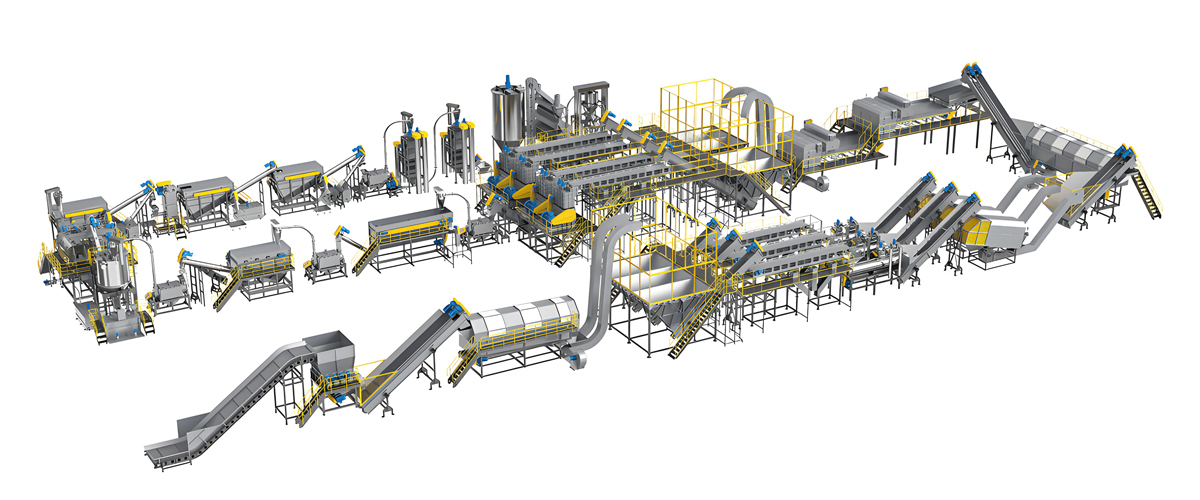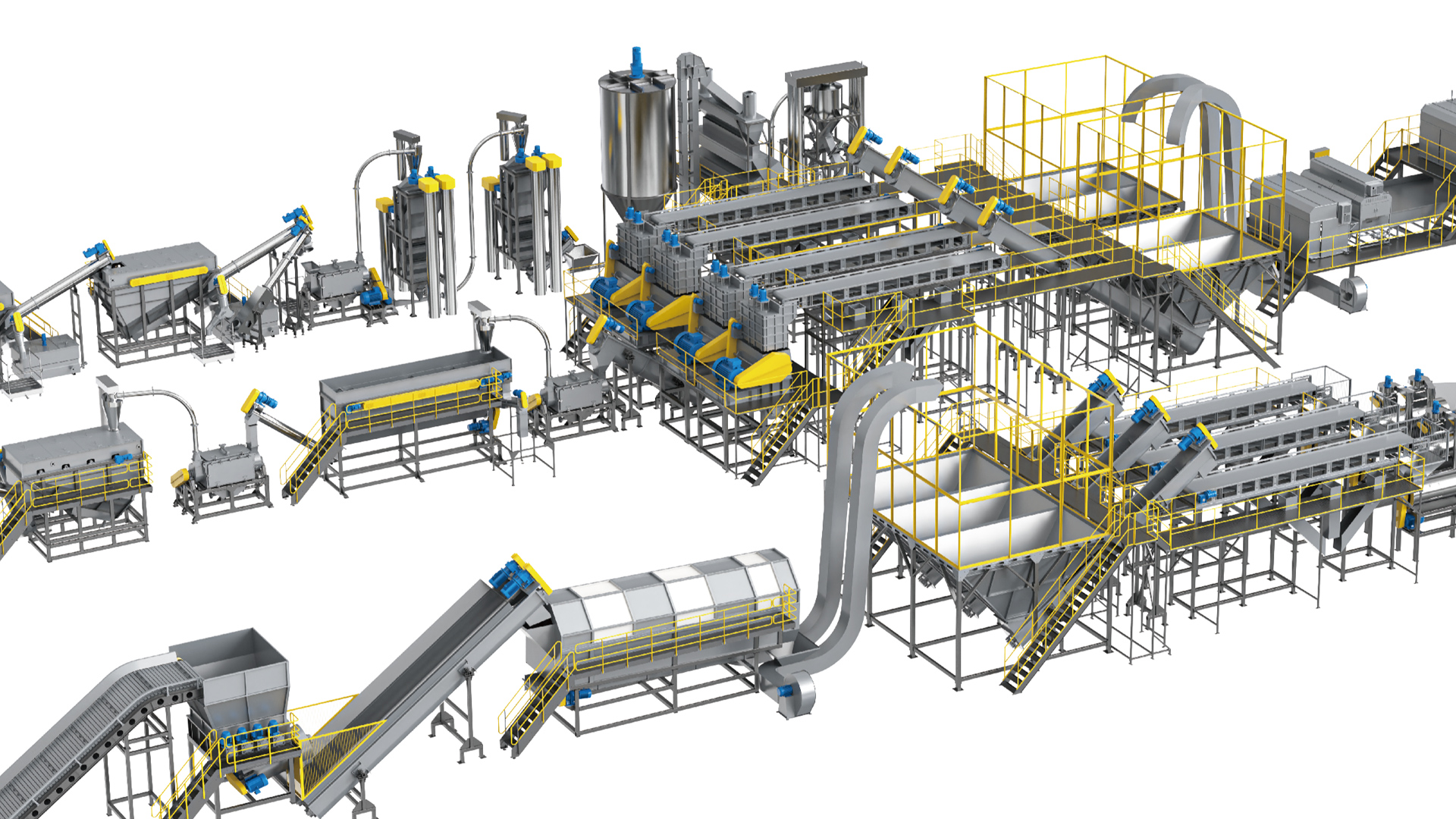

A 500 kg/h PET bottle washing line is the smallest configuration that can still deliver genuinely marketable, contaminant-controlled PET flakes rather than crude regrind. At this throughput the process chemistry, residence times and separation physics are identical to those of a 2000 kg/h plant; only the vessel volumes, motor ratings and degree of automation change. That is precisely why the 500 kg/h class attracts so many first-time recyclers, contract processors and brand owners building a captive feedstock stream: technical risk is manageable, the plant fits in a modest building, and flake quality can be pushed all the way to food-grade input specification if the line is specified correctly from the first drawing.
It is also the throughput class where the most expensive mistakes are made. Because the tonnage is small, buyers are tempted to shorten the hot washer, skip the second friction washer, drop the zigzag air classifier or under-size the water treatment loop. Every one of those decisions shows up later as a rejected shipment: label fiber in the flake, polyolefin caps above 100 ppm, glue haze that clouds the sheet, or intrinsic viscosity loss that makes the material unusable for anything but low-value fiber. This guide walks the entire 500 kg/h line station by station, with equipment ratings, screen apertures, temperatures, residence times, consumption figures per tonne and an acceptance table you can hand to a supplier as a purchase specification.
Polyretec, a Wanplas factory, has built PET bottle washing lines from 500 kg/h to 6000 kg/h since 2010, combining Austrian process know-how with Chinese manufacturing capability, and the 500 kg/h food-grade configuration is among the most frequently requested layouts across more than 100 delivered projects in over 50 countries. The parameters below reflect that field experience rather than catalogue theory. Wanplas, the parent brand, applies the same acceptance discipline across all of its factories, and that shared standard is what allows a small line to be specified with large-line rigor.
Why 500 kg/h Is the Realistic Entry Point for PET Bottle Recycling
Below roughly 400 kg/h, a PET bottle washing line stops behaving like a continuous process and starts behaving like a batch operation. The hot washer cannot maintain a stable temperature profile, the float-sink tank surface loading becomes too low for reliable stratification, and specific energy consumption per tonne climbs steeply because heating losses, agitator power and pump duty are largely independent of throughput. At 500 kg/h the process crosses into a genuinely continuous regime: the hot washer holds a steady 80 to 90 °C, the friction washers run with a consistent material bed, and the dryer sees a stable flake curtain.
The second reason 500 kg/h works is feedstock logistics. One tonne of baled post-consumer PET bottles typically yields 720 to 820 kg of clean, dry flake. A single-shift 500 kg/h line running eight productive hours consumes about 5 to 5.5 tonnes of bales per day, which is comfortably within the collection radius of a mid-sized city or a single beverage bottler’s returns stream. Larger lines force operators into regional or imported bale procurement, which brings quality variability, moisture surcharges and storage requirements that a small operation is not equipped to absorb.
The third reason is capital discipline. In relative terms, a 500 kg/h line sits in the Low to Medium investment band compared with the High to Very High band of a 2000 kg/h food-grade plant carrying near-infrared sorting and integrated decontamination. The compact footprint, single sorting platform, single hot washer and modest water treatment package keep both capital exposure and fixed operating overhead down while the operator learns the material.
What 500 kg/h does not mean is lower quality. The output specification of a well-built small line is the same as that of a large line, because acceptance limits are set by the downstream converter, not by the washing line size. A fiber spinner does not relax its polyvinyl chloride limit because your plant is small. The engineering task, therefore, is to preserve every quality-critical unit operation while compressing the equipment envelope.
Feedstock Reality Check Before You Specify Anything
The bale you buy determines the line you need. Clear post-consumer beverage bottles from a deposit return scheme arrive at 92 to 97 percent PET content, with caps, rings, labels and moisture making up the balance. Mixed curbside bales run at 78 to 90 percent PET, carry more polyvinyl chloride bottles, more polyolefin containers and considerably more organic residue. Industrial or bottler reject bales, produced from unfilled or short-filled bottles, can reach 98 percent PET and require the least aggressive washing.
Colour composition matters just as much. A stream of 100 percent clear bottles produces flake that can go to bottle-to-bottle, sheet or high-value fiber. A stream containing 20 percent blue and green bottles must either be colour sorted or accepted as a mixed-colour flake that only serves strapping and dark fiber. On a 500 kg/h line, colour separation is usually done by adding a dedicated manual sorting position at the bottle stage rather than an optical flake sorter, which keeps relative equipment cost Low but adds one person per shift.
| Bale Type | PET Content | Typical Yield to Dry Flake | Washing Intensity Required | Relative Processing Cost |
|---|---|---|---|---|
| Deposit-return clear bottles | 92 to 97 percent | 80 to 88 percent | Standard: 2 friction washers, 1 to 1.5 percent caustic | Low |
| Bottler reject / unfilled | 96 to 99 percent | 88 to 93 percent | Light: shortened hot wash acceptable | Low |
| Mixed curbside collection | 78 to 90 percent | 68 to 78 percent | Heavy: 3 friction washers, 2 to 3 percent caustic, double float-sink | High |
| Landfill-recovered / heavily soiled | 60 to 80 percent | 50 to 68 percent | Very heavy: pre-wash drum, extended hot wash, extra rinse | Very High |
The Complete 500 kg/h Process Flow, Station by Station
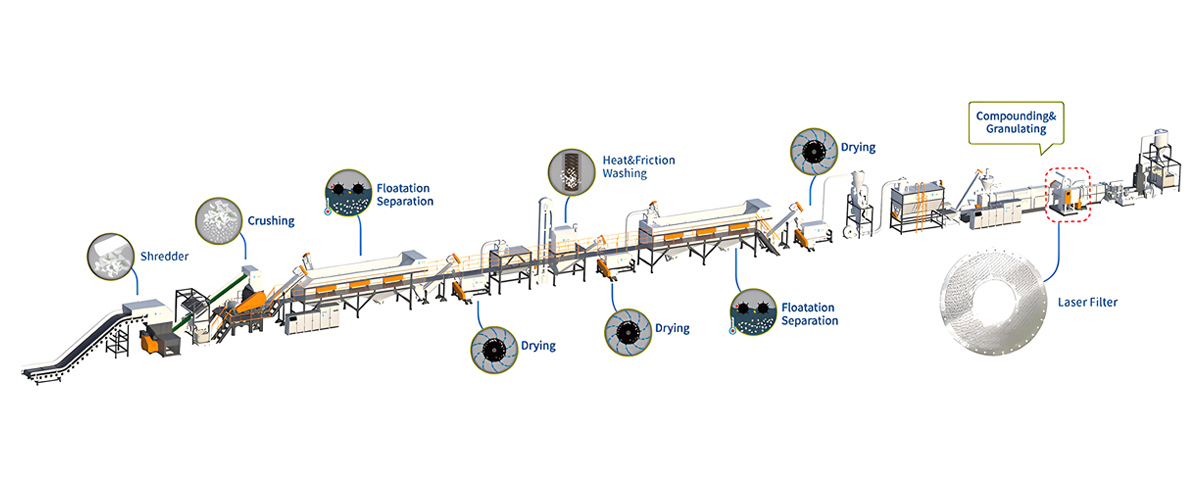
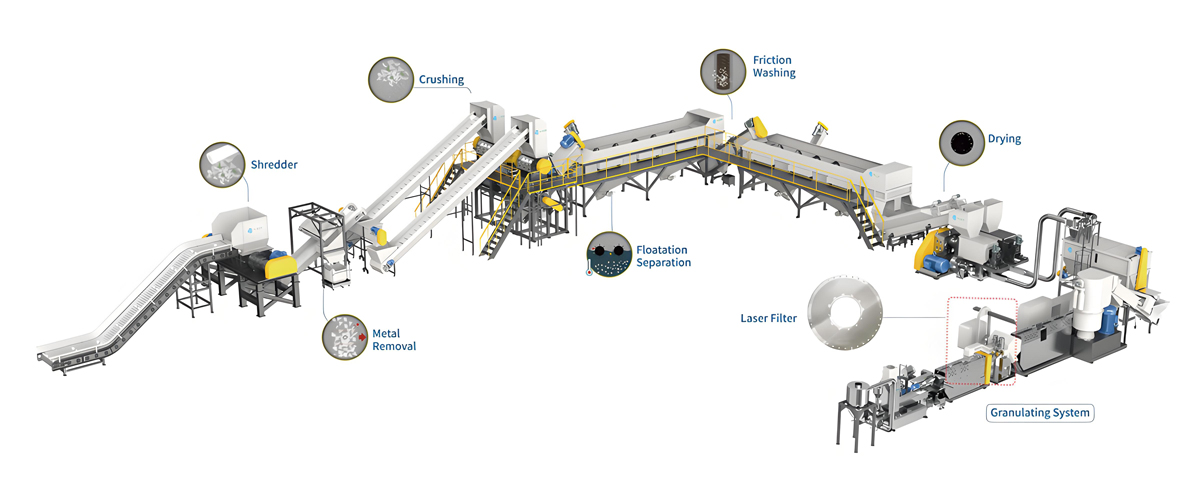
A compliant 500 kg/h PET bottle washing line has nine functional stations. Skipping any of them shifts the burden onto a later station that was never designed to carry it. The sequence below is the configuration Polyretec supplies as standard for food-grade flake production, with equipment ratings suited to 500 kg/h nominal throughput at roughly 90 percent line availability.
Station 1: Bale Opener, Belt Conveying and the Sorting Platform
Baled PET bottles arrive compressed at 300 to 450 kg per cubic meter with steel or polyester strapping. The bale opener is a slow-speed rotating shaft fitted with hardened hooks or chain flails that tears the bale apart and delivers loose bottles at a controlled rate. For a 500 kg/h line, specify a bale opener rated at 900 to 1500 kg/h nominal, driven by a 7.5 to 15 kW geared motor turning at 20 to 60 rpm, with variable-frequency speed control so the operator can buffer surges. Deliberately oversizing this station is correct practice: bale feeding is intermittent, and the opener must clear a bale faster than the line consumes it.
An inclined belt conveyor with 800 mm belt width, 1.5 to 2.2 kW drive and belt speed of 8 to 15 m/min carries loose bottles to the sorting platform. The platform is a horizontal picking belt 4 to 6 m long running at 8 to 12 m/min with a bottle layer thickness of 30 to 50 mm, giving each picker 20 to 40 seconds of exposure to the stream. Two to three pickers work the belt, removing polyvinyl chloride bottles, polyethylene and polypropylene containers, metal cans, glass, stones, wood, textiles and heavily contaminated bottles. A permanent overband magnet above the discharge point catches ferrous fragments, and a rotating trommel screen driven by a 1.5 to 3 kW motor removes sand, grit and loose caps before material reaches the delabeler.
Manual sorting on a 500 kg/h line is a deliberate design choice, not a compromise. At this throughput a trained three-person picking crew reaches polyvinyl chloride removal effectiveness comparable to entry-level near-infrared sorting, at a relative equipment cost of Low rather than High. The trade-off is labor dependency and shift-to-shift consistency, discussed in detail later.
Station 2: Delabeler and Zigzag Air Classifier
Labels are the single largest quality threat in PET bottle recycling because oriented polypropylene and polyethylene label film has a density close to that of polyolefin caps and, once shredded, becomes very difficult to separate from flake. The dry delabeler uses a high-speed rotor fitted with beater blades inside a perforated drum; friction between bottles strips sleeve and wrap-around labels without cutting the bottle body. Specify a delabeler with a 22 to 37 kW drive, rotor speed 500 to 900 rpm, drum perforation 20 to 30 mm, and residence time of 30 to 60 seconds. Correctly tuned, label removal reaches 95 percent or better on standard wrap-around and sleeve labels.
Stripped label material is drawn off by a zigzag air classifier immediately downstream. The classifier uses a 5.5 to 11 kW centrifugal fan generating internal air velocity of 8 to 14 m/s in the separation channel. Light label film, dust and paper fragments rise and are captured in a cyclone and rotary valve; heavy bottles fall through. The target is to reduce label content to 1 percent or less by mass before material enters the wet crusher, because any label surviving into the crusher becomes 8 to 14 mm film fragments that behave hydrodynamically like PET flake and pass straight through the float-sink tank.
Station 3: Wet Crusher
The wet crusher reduces whole bottles to flakes while water is injected into the cutting chamber. Wet crushing rather than dry crushing is mandatory for a food-grade PET line: the water carries away frictional heat that would otherwise soften the flake surface and drive contaminants into it, suppresses dust, and begins washing action inside the chamber itself. For 500 kg/h, a rotor of 400 to 600 mm diameter with a 45 to 75 kW motor is appropriate, 55 kW being the most common selection. Rotor speed sits at 400 to 600 rpm with a claw-type or V-type rotor carrying three to five rotating blades against two stationary blades.
Blade material should be D2 or SKD-11 cold-work tool steel, heat treated to 58 to 62 HRC, with an adjustable cutting gap of 0.2 to 0.5 mm. These grades give the wear resistance PET demands while remaining regrindable four to six times over their service life. Screen perforation of 12 to 16 mm produces a flake size distribution centred on 8 to 14 mm, which is the accepted window for both hot washing efficiency and downstream extrusion. Water injection into the chamber runs at 1.5 to 3.0 m³/h. Because this article treats the washing line as a system, note only that shredder-type pre-reduction is unnecessary at this scale for bottle feedstock; a single-stage wet crusher handles whole bottles directly.
Station 4: Friction Washers in Series
Friction washers do the mechanical scrubbing that chemistry alone cannot achieve. Each unit is a vertical or horizontal cylindrical housing with a high-speed paddle shaft turning at 800 to 1200 rpm inside a perforated screen basket, driven by a 15 to 22 kW motor. Flakes are propelled against the screen and against each other; the shear removes surface soil, sand, residual label fiber and biofilm, while wash water carrying the dirt escapes through 1.5 to 3 mm screen perforations.
Install two to three friction washers in series on a 500 kg/h line. Two is the minimum; three is strongly recommended when feedstock is post-consumer curbside material rather than clean bottler returns. Residence time per unit is short, typically 20 to 40 seconds, but the cumulative effect across three passes is the difference between a flake that meets a 10 black specks per kilogram limit and one that does not. Position one friction washer before the hot washer to remove gross soil, and one or two after the hot washer to strip loosened glue and saponified oil before rinsing.
Station 5: Hot Washer with Caustic and Surfactant
The hot washer is the chemical heart of the line and the station most often under-specified on small plants. It is a heated, agitated tank in which flakes are held in a sodium hydroxide solution to saponify oils, dissolve polyvinyl alcohol label adhesive, release hot-melt glue from oriented polypropylene labels, remove residual beverage sugars and substantially reduce microbial load.
Specify caustic soda at 1 to 3 percent by mass, with 1.5 to 2.0 percent covering most post-consumer streams, plus a non-ionic surfactant at 0.2 to 0.5 percent. Operating temperature is 80 to 90 °C. Going above 90 °C risks surface hydrolysis and measurable intrinsic viscosity loss; dropping below 80 °C sharply reduces glue removal. Residence time must be 10 to 20 minutes, which at 500 kg/h and typical solid loading means an effective working volume of 3 to 5 m³. The agitator draws 7.5 to 15 kW, and heating load is 300 to 500 kW delivered either by a steam coil at 0.4 to 0.6 MPa or by a thermal oil jacket where site steam is unavailable.
Two design details separate a good hot washer from a poor one. First, flake must be genuinely suspended and turned over, not simply floated on a stagnant surface; paddle geometry and tank aspect ratio determine this. Second, caustic concentration must be monitored and dosed continuously, because saponification consumes alkali and a drifting concentration produces intermittent glue carry-over that only appears as a quality problem hours later.
Station 6: Rinsing and Float-Sink Separation
Float-sink separation exploits the density gap between PET and polyolefins, and it is the single most reliable purification step in the entire line. PET flake has a density of 1.34 to 1.39 g/cm³ and sinks in water. Polypropylene caps, polyethylene rings and residual label film have densities of 0.90 to 0.96 g/cm³ and float. A properly dimensioned tank achieves 99 percent or better separation efficiency in a single pass.
The float-sink tank on a 500 kg/h line is typically 4 to 6 m long and 1.2 to 1.6 m wide, fitted with a bottom screw conveyor driven by a 3 to 5.5 kW motor that removes sunk PET, and a surface paddle or skimming screw that pushes the floating fraction to a side discharge. Residence time is 60 to 120 seconds. Two things kill efficiency: excessive turbulence, which drags light material downward, and excessive flake loading, which forms a raft that traps caps beneath it. Loading should not exceed the tank’s rated surface throughput even when the operator is trying to catch up after a stoppage.
Install two float-sink stages where the target is food-grade flake: one immediately after the hot washer and a second after the final friction washer, combined with a counter-current rinsing tank that removes residual caustic and brings flake surface pH back to 7 to 8. Rinsing is not optional; residual alkali on the flake surface will attack the polymer during subsequent drying and extrusion.
Station 7: Dewatering Centrifuge
Mechanical dewatering is far cheaper in energy terms than thermal drying, so the centrifuge should be pushed as hard as it will go. A vertical dewatering centrifuge with a 15 to 22 kW drive, rotor speed of 1000 to 1500 rpm and a wedge-wire or perforated screen basket brings flake from roughly 15 to 25 percent surface water down to 1 to 3 percent residual moisture in a single pass. Screen slot width of 0.8 to 1.5 mm retains flake while releasing fines and water.
Removing one percentage point of moisture mechanically costs a small fraction of what the same removal costs in the hot air dryer, so centrifuge screen condition directly determines the line’s specific energy consumption. Worn or blinded screens are one of the most common causes of a line that quietly drifts from 250 kWh per tonne to 320 kWh per tonne over a few months without anyone noticing.
Station 8: Hot Air Drying System and Buffer Silo
The thermal drying system takes flake from 1 to 3 percent down to the final target. A pipe dryer or horizontal thermal dryer circulates air at 130 to 150 °C through the flake stream; the blower draws 11 to 18.5 kW and the air heater load is 60 to 100 kW, supplied electrically or by steam-to-air heat exchanger. Residence time in the drying loop is 3 to 8 minutes depending on configuration.
Target moisture is 0.5 percent or below for general industrial grades. For food-contact bottle-to-bottle feedstock the requirement tightens to 0.3 percent or below, because residual water accelerates hydrolytic chain scission during subsequent melt processing and directly costs intrinsic viscosity. Keep dryer air temperature at or below 150 °C: PET has a glass transition temperature near 78 °C and flake begins to tack and agglomerate if the air temperature and residence time combination is too aggressive. Discharge into a 5 to 10 m³ buffer silo with a level sensor, which decouples the wet end from the packing end and allows the wet section to be stopped for cleaning without halting despatch.
Station 9: Final Air Classification, Metal Separation, Silo and Big Bag Packing
The finishing train is short but decisive for the certificate of analysis. A final zigzag air classifier with a 4 to 7.5 kW fan removes fines, dust and any remaining light film fragments that survived earlier stages. Metal separation follows: a high-sensitivity metal detector combined with a rare-earth drum magnet and, where non-ferrous contamination is a concern, an eddy current separator. Together these hold metal content at or below 20 ppm.
Cleaned, dried and classified flake is conveyed to the finished product silo and packed into 1000 to 1250 kg big bags on a weighing and filling station. Sample each big bag or each production batch for the acceptance parameters in the next section, retain a 1 kg reference sample per batch, and label every bag with batch number, production date, moisture and intrinsic viscosity. Traceability documentation is not administrative overhead; it is the prerequisite for selling into any certified recycled-content supply chain.
Station Summary Table
| Station | Sizing for 500 kg/h | Drive Power | Residence Time | Process Target |
|---|---|---|---|---|
| 1. Bale opener, conveyor, sorting platform | Opener 900 to 1500 kg/h; picking belt 4 to 6 m | 7.5 to 15 kW plus 3 to 5 kW conveying | 20 to 40 s per picker | Remove polyvinyl chloride, polyolefin bottles, metal, foreign matter |
| 2. Delabeler and zigzag air classifier | Rotor 500 to 900 rpm; drum holes 20 to 30 mm | 22 to 37 kW plus 5.5 to 11 kW fan | 30 to 60 s | Label removal 95 percent or better; residual label 1 percent or less |
| 3. Wet crusher | Rotor 400 to 600 mm; screen 12 to 16 mm; D2 or SKD-11 blades | 45 to 75 kW | Single pass, seconds | Flake 8 to 14 mm, 90 percent or more within window |
| 4. Friction washers (2 to 3 units) | 800 to 1200 rpm; screen 1.5 to 3 mm | 15 to 22 kW each | 20 to 40 s per unit | Remove soil, sand, biofilm, loosened glue |
| 5. Hot washer | 3 to 5 m³ working volume; caustic 1 to 3 percent; 80 to 90 °C | 7.5 to 15 kW agitator; 300 to 500 kW heat | 10 to 20 min | Saponify oils, dissolve polyvinyl alcohol glue, sanitize |
| 6. Rinsing and float-sink separation | Tank 4 to 6 m long, 1.2 to 1.6 m wide; 1 to 2 stages | 3 to 5.5 kW per tank | 60 to 120 s | Separation efficiency 99 percent or better; surface pH 7 to 8 |
| 7. Dewatering centrifuge | 1000 to 1500 rpm; screen slot 0.8 to 1.5 mm | 15 to 22 kW | Single pass | Residual moisture 1 to 3 percent |
| 8. Hot air dryer and buffer silo | Air 130 to 150 °C; silo 5 to 10 m³ | 11 to 18.5 kW blower; 60 to 100 kW heater | 3 to 8 min | Moisture 0.5 percent or below; 0.3 percent for food grade |
| 9. Air classification, metal separation, packing | Zigzag classifier plus detector, drum magnet, eddy current | 4 to 7.5 kW plus 3 to 6 kW handling | Continuous | Metals 20 ppm or below; dust removed; 1000 to 1250 kg big bags |
Flake Acceptance Specification: The Numbers That Define Your Line
Everything upstream exists to satisfy a single page of numbers. The acceptance specification below is the working standard for food-grade-capable PET flake from a 500 kg/h line, and it should be written into the equipment purchase contract as a guaranteed performance figure tested during commissioning on the buyer’s own feedstock. A supplier who will not accept these figures on a defined bale specification is telling you something important about the line.
Polyvinyl chloride is the most damaging contaminant of all. When PET containing polyvinyl chloride is melted, hydrogen chloride is liberated, which catalyses chain scission and produces yellowing, black specks and severe intrinsic viscosity loss. A limit of 50 ppm sounds generous until you realise it corresponds to roughly one 30 g polyvinyl chloride bottle in every 600 kg of feedstock. This is why the manual sorting platform and the float-sink stage must both perform: polyvinyl chloride has a density of 1.32 to 1.45 g/cm³ and overlaps PET, so it cannot be removed by sink-float and must be caught at the bottle stage.
Guaranteed Output Specification
| Parameter | Acceptance Limit | Controlling Station | Test Method / Frequency |
|---|---|---|---|
| Polyvinyl chloride content | 50 ppm or below | Manual sorting platform; delabeler feed inspection | Hot-plate char test or chlorine analyser, 1 kg sample per shift |
| Polyethylene and polypropylene content | 100 ppm or below | Float-sink separation; zigzag air classifier | Density flotation of 1 kg sample, every batch |
| Metal content (ferrous and non-ferrous) | 20 ppm or below | Overband magnet, drum magnet, eddy current, detector | Inline detector log plus manual screen, per batch |
| Moisture content | 1 percent or below; 0.3 percent for food grade | Dewatering centrifuge and hot air dryer | Moisture analyser, every 2 hours |
| Intrinsic viscosity | 0.72 to 0.78 dl/g retained | Hot washer temperature control; dryer temperature control | Solution viscometry, one test per batch |
| Black specks | 10 per kg or fewer | Friction washers; hot washer chemistry | Visual count on 1 kg spread sample, per batch |
| Flake size 8 to 14 mm | 90 percent or more by mass | Wet crusher screen and blade condition | Sieve analysis, daily |
| Fines below 2 mm | 0.5 percent or below | Final zigzag air classifier | Sieve analysis, daily |
| Surface pH | 7 to 8 | Counter-current rinsing tank | Aqueous extract pH meter, per shift |
| Bulk density of flake | 300 to 400 kg/m³ | Crusher screen and classification | Standard graduated measuring vessel, daily |
Why Intrinsic Viscosity Retention Is the Hardest Number to Hit
Virgin bottle-grade PET resin enters the bottle blowing process at an intrinsic viscosity of roughly 0.80 to 0.84 dl/g, and after injection stretch blow molding a finished bottle typically measures 0.76 to 0.82 dl/g. A washing line that operates within specification should return flake at 0.72 to 0.78 dl/g, meaning a loss of no more than about 0.04 dl/g through the wash. Every 0.01 dl/g beyond that narrows the downstream options.
Three mechanisms consume intrinsic viscosity in a washing line. Hydrolysis is the dominant one: PET reacts with water at elevated temperature, and the reaction rate roughly doubles for each 10 °C rise. This is why the 90 °C ceiling in the hot washer is a hard limit rather than a suggestion. Alkaline attack is the second: caustic above 3 percent, or insufficient rinsing that leaves alkali on the flake surface into the dryer, etches the surface and cleaves chains. Thermal degradation is the third, and it appears when dryer air exceeds 150 °C or flake is held stagnant in a hot silo.
A useful commissioning practice is to measure intrinsic viscosity at three points on the same batch: on whole bottles from the bale, on wet flake leaving the float-sink tank, and on dried flake at the packing station. If the loss between bottle and wet flake exceeds 0.02 dl/g, the hot washer is running too hot or too long. If the loss occurs between wet and dried flake, the dryer or the rinse is at fault. Diagnosing this once, properly, at commissioning saves months of guesswork.
Utilities and Consumption: Power, Water, Heat, Caustic and Air
Utility design is where small lines are most often set up to fail. Installed power for a complete 500 kg/h PET bottle washing line is 180 to 260 kW, but actual running load is only 120 to 170 kW because bale opening, crushing and drying rarely peak simultaneously and several drives run intermittently. Sizing the transformer and incoming cable to installed power rather than running load is correct; sizing the running-cost expectation on installed power is not, and it leads to badly wrong operating models.
Specific electrical consumption typically lands at 230 to 330 kWh per tonne of finished dry flake for an electrically heated line, and 150 to 220 kWh per tonne where steam covers hot washer and dryer heating. The spread within that range is almost entirely determined by three things: the condition of the dewatering centrifuge screen, the insulation quality on the hot washer, and whether the operator runs the line at nominal throughput or in stop-start mode.
Consumption Table per Tonne of Finished Flake
| Utility / Consumable | Once-Through Operation | With Closed-Loop Reuse | Notes |
|---|---|---|---|
| Installed electrical power | 180 to 260 kW | 190 to 280 kW | Reuse adds 10 to 20 kW of pumping and dissolved air flotation load |
| Actual running load | 120 to 170 kW | 130 to 185 kW | Diversity factor 0.62 to 0.70 typical |
| Specific electricity, electric heating | 230 to 330 kWh per tonne | 245 to 350 kWh per tonne | Dominated by hot washer and dryer heating |
| Specific electricity, steam heating | 150 to 220 kWh per tonne | 165 to 240 kWh per tonne | Excludes boiler fuel |
| Water consumption | 2.5 to 4.0 m³ per tonne | 0.6 to 1.2 m³ per tonne | Reuse rate 85 to 92 percent |
| Saturated steam at 0.4 to 0.6 MPa | 0.35 to 0.60 tonne per tonne | 0.30 to 0.52 tonne per tonne | Warm reuse water lowers heat-up duty |
| Thermal oil alternative heat load | 360 to 600 kW peak | 320 to 540 kW peak | Used where no site boiler exists |
| Sodium hydroxide consumption | 4 to 9 kg per tonne | 3 to 7 kg per tonne | Higher on heavily soiled or glue-rich feedstock |
| Surfactant / detergent | 0.8 to 2.0 kg per tonne | 0.7 to 1.8 kg per tonne | Non-ionic, low-foaming grade required |
| Compressed air at 0.6 to 0.8 MPa | 0.6 to 1.2 m³ per min | 0.8 to 1.5 m³ per min | Valves, pulse filters, dissolved air flotation saturator |
| Water treatment chemicals | Not applicable | 0.5 to 1.5 kg per tonne | Coagulant plus polymer flocculant |
| Dewatered sludge output | 30 to 70 kg per tonne | 35 to 80 kg per tonne | At 60 to 75 percent cake moisture; feedstock dependent |
Choosing Between Steam and Thermal Oil
The hot washer and the dryer together account for 60 to 75 percent of the line’s total energy demand, so the heating decision dominates operating economics. Saturated steam at 0.4 to 0.6 MPa is the preferred medium wherever a boiler already exists or a boiler is justified by other plant loads. Steam transfers heat efficiently through coils, responds quickly to load changes, and condensate return recovers a meaningful share of the energy.
Thermal oil is the pragmatic alternative on sites with no boiler, no boiler operator licence, or restrictive pressure vessel regulations. A thermal oil heater sized at 360 to 600 kW peak covers a 500 kg/h line. The trade-offs are slower thermal response, a higher relative capital cost for the heating package, and the need for periodic oil condition monitoring. Direct electric heating is the simplest to install and the easiest to control, but it carries the highest running load, which is why it is generally reserved for the dryer air heater rather than the hot washer.
Whichever medium is chosen, insulate properly. A 4 m³ hot washer running at 85 °C with poor insulation loses a substantial standing heat load continuously, and on a single-shift operation that loss is incurred during every heat-up cycle as well. Insulation is a Low relative cost item with one of the shortest payback profiles in the entire plant.
Water Treatment, Closed-Loop Reuse and Environmental Compliance
A PET bottle washing line is, from a regulator’s point of view, a wet industrial process producing an organically loaded, alkaline, solids-bearing effluent. Treating water as an afterthought is the fastest way to have a new plant shut down. On a 500 kg/h line the treatment package is compact, but it must contain the same four functional stages as a large plant.
The Four-Stage Treatment Train
Stage one, coarse solids removal and three-stage sedimentation. Wash water leaving the friction washers and float-sink tanks first passes a vibrating screen or drum filter with 0.5 to 1 mm apertures that catches flake fines, label fragments and fiber. It then enters three sedimentation compartments in series, sized for a combined retention of 4 to 8 hours at the line’s circulation rate. Sand, grit and heavy soil settle out; each compartment is fitted with a sludge scraper or conical bottom with periodic discharge.
Stage two, dissolved air flotation. Dissolved air flotation is the workhorse for removing emulsified oils, saponified fats, surfactant residue and fine suspended solids that will not settle. Water is saturated with air at 0.4 to 0.6 MPa in a saturator vessel and released into the flotation cell, where micro-bubbles of 30 to 60 micrometers attach to flocculated particles and lift them to the surface for skimming. Coagulant, typically polyaluminium chloride, and a polymer flocculant are dosed ahead of the cell at a combined 0.5 to 1.5 kg per tonne of flake. A well-run dissolved air flotation unit removes 80 to 95 percent of suspended solids and a large share of chemical oxygen demand.
Stage three, filtration and pH correction. Clarified water passes a multi-media sand filter and, where the reuse target is high, an activated carbon polishing filter that removes colour and residual organics. pH is corrected from the alkaline wash condition back toward neutral before the water re-enters the circulation tank. Skipping pH correction causes scaling in heat exchangers and progressive caustic accumulation in the loop.
Stage four, reuse distribution with quality tiering. Not all reclaimed water is equal, and the smartest small-line designs tier it. The cleanest reclaimed water returns to the rinsing tank and the float-sink tank. Intermediate quality water feeds the friction washers and the hot washer make-up. The dirtiest acceptable water goes to the wet crusher injection point, where a degree of contamination is irrelevant because the material is about to be washed anyway. This tiering is what lifts overall reuse from around 70 percent to the 85 to 92 percent range.
Discharge, Sludge and Odour
Even at 85 to 92 percent reuse, a blowdown stream must leave the loop to prevent dissolved salts and organics from accumulating. This bleed, typically 0.6 to 1.2 m³ per tonne, goes either to a municipal sewer under a trade effluent consent or to an on-site biological treatment stage. Untreated wash water from PET bottle recycling carries a chemical oxygen demand commonly in the range of 1500 to 4000 mg/L; after the full train described above it typically falls to 100 to 300 mg/L, which meets most municipal acceptance criteria but should always be verified against the local consent limit before the plant is designed.
Sludge is the physical residue of everything you removed: soil, sand, label fiber, glue, organics and chemical floc. A 500 kg/h line generates 30 to 80 kg of dewatered cake per tonne of flake at 60 to 75 percent cake moisture. A filter press or screw press reduces volume and handling cost. Characterise the sludge before the plant starts, because disposal classification depends on what the feedstock brought in with it.
Odour is the complaint that most often reaches the local authority first. It comes from anaerobic fermentation of beverage sugars in the sedimentation tanks and, on hot days, from the bale storage yard. Control it with three measures: keep sedimentation retention under 8 hours so the water does not go anaerobic, cover the tanks and vent them through a biofilter or activated carbon scrubber, and enforce a bale stock rotation rule so that no bale sits in the yard beyond a defined age. A first-in-first-out yard discipline is a zero-cost measure with a very high return.
Building, Layout and Manpower for a 500 kg/h Line
A 500 kg/h PET bottle washing line needs 400 to 700 m² of total site area, and the split between process hall and storage matters more than the headline number. The process hall itself occupies 220 to 400 m², laid out as a linear or L-shaped flow from bale opener to packing station. Bale storage requires 150 to 250 m², sized for at least 7 to 10 days of feedstock so that collection interruptions do not stop production. Finished flake staging needs 40 to 80 m² for big bag storage under cover.
Civil and Structural Requirements
Clear height under the roof truss should be at least 6 m. This is not negotiable if the line uses a hot washer on a raised steel platform, which it should. Raising the hot washer to a platform level of 3.5 to 4.5 m allows gravity discharge into the downstream friction washer and float-sink tank, which eliminates a transfer pump, removes a wear point and reduces mechanical damage to the flake. The platform must be designed for the filled vessel weight plus dynamic agitator load, with a live load allowance of at least 400 kg/m² for maintenance access.
Floor construction is the single most underestimated civil item. The wet section of the plant is permanently wet, alkaline and warm. Specify a reinforced concrete slab of at least 150 mm with a chemically resistant coating, sloped at 1 to 2 percent toward continuous drainage channels running the length of the wet section. Channels should be grated, at least 200 mm wide, and connected directly to the water treatment collection sump, not to the storm drain. Apply an anti-slip surface finish throughout the wet area; wet PET flake on a smooth floor is genuinely hazardous.
Electrical distribution should be a single main panel with individual variable-frequency drives for the bale opener, crusher, friction washers, dryer blower and conveyors. Position the control room or panel enclosure outside the wet zone with a viewing window over the sorting platform and the float-sink tank, the two stations that need the most operator attention. Ingress protection of IP55 or better applies to every motor and junction box in the wet section.
Layout Principles That Save Money Later
A linear layout is the simplest and works whenever the building allows a run of 35 to 45 m. Where the building is squarer, an L-shaped layout with the wet section on one leg and the drying and packing section on the other works equally well and has the advantage of physically separating the wet, dirty zone from the dry, clean zone. That separation matters for both housekeeping and product quality: dust and splash from the wet end must not reach the dried flake conveying and packing area.
Leave a clear maintenance aisle of at least 1.2 m on the service side of every tank and machine. On small lines this is routinely sacrificed to save floor area, and the consequence is that changing a friction washer screen takes a full shift instead of two hours. Similarly, allow a lifting route from the crusher position to a door wide enough for the rotor to be removed; rotor and blade service is a recurring, planned event, not an exception.
Finally, plan the utility corridor before the equipment. Steam or thermal oil supply, compressed air, treated water return, raw water make-up, caustic dosing and the electrical trunking all need a defined route. Retrofitting a caustic dosing line through a completed plant is unpleasant work.
Manpower and Shift Structure
| Role | Headcount per Shift | Primary Responsibility | Skill Level |
|---|---|---|---|
| Manual sorters | 2 to 3 | Remove polyvinyl chloride, polyolefin, metal, foreign matter; colour sorting if required | Trained operator, 2 to 4 weeks to proficiency |
| Line operator | 1 | Control panel, throughput balance, hot washer chemistry, quality sampling | Skilled, requires process training |
| Utilities and water treatment attendant | 1 | Dissolved air flotation, dosing, sludge press, boiler or thermal oil heater | Skilled, may be shared with maintenance |
| Feeding and packing | 1 | Forklift bale feeding, big bag changeover, labelling, warehouse | Semi-skilled, forklift licence |
| Maintenance technician | Shared / day shift only | Blade changes, screen changes, pump and bearing service | Skilled mechanical and electrical |
Single-shift operation at 500 kg/h yields roughly 4 tonnes of flake per day at 8 productive hours, or 90 to 100 tonnes per month at 22 to 25 working days. Two shifts approximately double that to 190 to 210 tonnes per month, and three shifts reach 280 to 310 tonnes per month, though the third shift must accommodate cleaning and maintenance windows so the realistic multiplier is closer to 2.7 than 3.0.
The output flexibility of a small line is a genuine commercial advantage. A 500 kg/h line on single shift can absorb a doubling of feedstock supply simply by adding a second shift, with no capital outlay beyond additional labor and a modest increase in water treatment sludge handling. A 2000 kg/h line has no such headroom on a small feedstock base: it either runs at partial load, which wrecks specific energy consumption and hot washer stability, or it sits idle.
What a 500 kg/h Line Gives Up Against 1000 to 2000 kg/h
Choosing 500 kg/h is a set of deliberate trade-offs, and understanding them precisely is what separates a well-judged investment from a regretted one. The output specification does not change with line size, but the way that specification is achieved, the labor intensity, the specific consumption and the operational resilience all do.
Manual Sorting Versus Near-Infrared Optical Sorting
The most consequential difference is the sorting method. A 1000 to 2000 kg/h line almost always carries a near-infrared bottle sorter, which identifies polymer type by spectral signature and ejects non-PET containers with compressed air jets at rates far beyond human capability. Near-infrared sorting delivers consistent performance across shifts, does not fatigue, and produces a data log that supports certification audits.
At 500 kg/h, near-infrared sorting sits in the High to Very High relative cost band against a line whose total investment is Low to Medium, and the belt loading is often too thin for the sorter to work efficiently. Manual sorting by two to three trained pickers is the standard answer. Properly managed, it achieves comparable polyvinyl chloride removal. The risks are entirely human: fatigue after the fourth hour, inconsistency between shifts, turnover of trained staff, and degradation of performance when the belt is overloaded to catch up on throughput. Mitigate with disciplined belt loading, rotation of pickers every 90 to 120 minutes, good lighting at 500 lux or better over the belt, and a documented visual reference board showing the specific containers to be rejected.
Station Consolidation and Its Consequences
Small lines consolidate stations that large lines keep separate. A large plant may run a pre-wash drum, three friction washers before the hot washer and three after, two hot washer stages in series and three float-sink tanks. A 500 kg/h line typically runs two to three friction washers in total, one hot washer and one to two float-sink stages.
Consolidation is acceptable provided the total residence time and total mechanical work are preserved. The failure mode is consolidating and shortening at the same time: fitting one friction washer instead of three and also reducing hot washer residence from 15 minutes to 6 minutes removes both the mechanical and the chemical margin, and the line will then only meet specification on the cleanest feedstock. When a supplier proposes a shortened configuration, the correct question is which quality parameter is being surrendered, and on what feedstock the guarantee still holds.
Comparison Table: 500 kg/h Against Larger Classes
| Aspect | 500 kg/h | 1000 kg/h | 2000 kg/h |
|---|---|---|---|
| Relative capital investment | Low to Medium | Medium to High | High to Very High |
| Bottle sorting method | Manual, 2 to 3 pickers | Manual plus optional single-channel near-infrared | Near-infrared plus manual quality check |
| Friction washers | 2 to 3 units | 3 to 4 units | 5 to 6 units |
| Hot washer configuration | Single tank, 3 to 5 m³ | Single or dual tank, 6 to 10 m³ | Two tanks in series, 12 to 20 m³ |
| Float-sink stages | 1 to 2 | 2 | 2 to 3 |
| Installed power | 180 to 260 kW | 320 to 450 kW | 580 to 850 kW |
| Specific electricity per tonne | 230 to 330 kWh | 200 to 290 kWh | 175 to 255 kWh |
| Water per tonne with reuse | 0.6 to 1.2 m³ | 0.5 to 1.0 m³ | 0.4 to 0.9 m³ |
| Total footprint | 400 to 700 m² | 700 to 1200 m² | 1300 to 2200 m² |
| Manpower per shift | 4 to 6 | 6 to 8 | 8 to 12 |
| Labor intensity per tonne | High | Medium | Low |
| Achievable flake specification | Food-grade capable | Food-grade capable | Food-grade capable with tighter statistical consistency |
| Output flexibility | Very high: 1, 2 or 3 shifts | Moderate | Low: needs stable high-volume feedstock |
Designing the Upgrade Path to 1000 kg/h from Day One
The most valuable engineering decision available to a 500 kg/h buyer costs relatively little and pays back enormously: specify the line as modular with a defined upgrade route. Doubling throughput later then becomes a targeted equipment replacement rather than a plant rebuild.
Six items should be oversized at the outset. First, the bale opener at 900 to 1500 kg/h already covers 1000 kg/h operation without change. Second, the sorting conveyor should be specified at 1000 mm belt width even though 800 mm suffices at 500 kg/h; widening a belt later means a new frame. Third, the electrical incomer, main panel and transformer should be sized for 400 to 500 kW installed rather than 260 kW, since upgrading a supply is slow and disruptive. Fourth, the water treatment plant should be built for 1000 kg/h from the start, because civil tanks are the hardest element to enlarge and the incremental cost at construction is Low. Fifth, floor drainage channels and the collection sump should be sized for double flow. Sixth, the building layout should reserve a defined empty bay of 20 to 30 m² adjacent to the hot washer for the future second friction washer bank and second float-sink tank.
With those six provisions in place, the upgrade itself consists of replacing the wet crusher with a larger rotor and motor, adding two friction washers, enlarging or duplicating the hot washer, adding the second float-sink tank, and uprating the dewatering centrifuge and dryer. That work can typically be executed in a planned shutdown rather than a plant closure, and the relative cost of the upgrade is Medium against a Very High cost of building a second line.
Downstream Value Paths: Bottle-to-Bottle, Fiber and Strapping
The flake specification you need is determined entirely by what the flake becomes. Three downstream paths dominate, and they impose materially different requirements. Deciding the target market before specifying the line is the correct sequence; specifying the line first and then looking for a buyer is how plants end up with unsellable material.
Bottle-to-Bottle
Bottle-to-bottle is the highest value path and the most demanding. Washed flake from the line does not, by itself, qualify for food contact. It must pass through a super-clean decontamination process, usually a combination of high-temperature vacuum treatment and solid-state polycondensation, which both removes residual volatile contaminants to the levels required by regulatory challenge testing and rebuilds intrinsic viscosity from the flake level of 0.72 to 0.78 dl/g up to bottle-grade 0.80 dl/g or above.
Solid-state polycondensation operates on crystallised flake or pellets at 200 to 220 °C under vacuum or inert gas for 8 to 16 hours, driving the polycondensation equilibrium forward and raising intrinsic viscosity by 0.06 to 0.12 dl/g. The process is only viable if the incoming flake is clean, dry and consistent, which is exactly why the washing line specification is so tight for this route. The recycled resin must also be covered by an appropriate regulatory authorisation, and the process itself, not the resin batch, is what is evaluated and approved.
For a 500 kg/h operator, the realistic model is to produce food-grade-capable flake and supply it to a converter operating the decontamination and solid-state polycondensation stage, rather than installing that stage in-house. The relative capital cost of super-clean plus solid-state polycondensation is Premium and only makes sense at considerably higher throughput.
Fiber Grade
Fiber is the largest single outlet for recycled PET flake worldwide, covering polyester staple fiber for nonwovens, filling and textiles, and filament for yarn. Requirements are moderately demanding but more forgiving than bottle-to-bottle in some respects and stricter in others. Intrinsic viscosity of 0.62 to 0.75 dl/g is acceptable for staple fiber, so a modest viscosity loss is tolerable. Moisture below 1 percent is sufficient.
What fiber spinners will not tolerate is particulate contamination and inconsistency. Fine spinnerets with hole diameters in the tens of micrometers block on black specks, metal fines and unmelted polyolefin. Consequently the metal limit and the black speck limit are as strict as for bottle-to-bottle, and colour consistency matters greatly because fiber is often spun undyed or lightly dyed. Mixed-colour flake is restricted to dark fiber applications.
Strapping and Sheet
PET strapping is the most forgiving high-volume outlet and a sensible first market for a new 500 kg/h operation. Strapping tolerates mixed colours, accepts intrinsic viscosity from 0.70 dl/g upward, and is relatively insensitive to minor contamination. Sheet extrusion for thermoformed packaging sits between fiber and strapping in strictness: it needs good colour and low black specks for optical clarity, but tolerates a wider viscosity band than bottle production.
| Requirement | Bottle-to-Bottle | Fiber Grade | Sheet / Thermoforming | Strapping |
|---|---|---|---|---|
| Intrinsic viscosity of flake | 0.72 to 0.78 dl/g, raised by solid-state polycondensation | 0.62 to 0.75 dl/g | 0.68 to 0.78 dl/g | 0.70 dl/g and above |
| Polyvinyl chloride limit | 50 ppm or below | 50 to 100 ppm | 50 to 100 ppm | 150 ppm or below |
| Polyolefin limit | 100 ppm or below | 100 to 200 ppm | 100 to 300 ppm | 500 ppm or below |
| Metal limit | 20 ppm or below | 20 ppm or below | 30 ppm or below | 50 ppm or below |
| Moisture at delivery | 0.3 percent or below | 1 percent or below | 0.5 percent or below | 1 percent or below |
| Colour requirement | Clear only, tight consistency | Clear preferred; mixed acceptable for dark fiber | Clear or light blue | Mixed colour acceptable |
| Black specks | 10 per kg or fewer | 10 to 20 per kg | 15 per kg or fewer | 40 per kg or fewer |
| Additional processing required | Super-clean decontamination plus solid-state polycondensation | Direct flake spinning or pelletizing | Melt filtration and vacuum degassing | Standard pelletizing or direct extrusion |
| Relative market value of output | Premium | Medium to High | Medium to High | Low to Medium |
Where the operator wants to move beyond selling flake and produce pellets, a pelletizing line follows the washing line. Wanplas’s Kerke factory supplies single-screw and twin-screw extruders that integrate directly with Polyretec washing systems, allowing washed flake to be fed into melt filtration, vacuum degassing and strand or underwater pelletizing. For PET specifically, adequate melt filtration and vacuum degassing are essential because the polymer is hydrolytically sensitive and any residual moisture entering the barrel translates directly into viscosity loss.
Standards, Certification and Documentation
Certification is what converts a technically capable plant into a commercially credible supplier. For a 500 kg/h PET bottle washing line, five frameworks matter, and they operate at different levels: some assess the recycling process, some assess the management system, and some assess the chain of custody.
EFSA evaluation of recycled plastic for food contact is the European route. The European Food Safety Authority assesses recycling processes, not individual resin batches, through a challenge test that demonstrates the process can reduce surrogate contaminants to a defined residual level. The evaluation applies to a specific process operating within a defined parameter window, which is why process parameters must be recorded and controlled: operating outside the evaluated window invalidates the assessment. Note again that the washing line is the input stage; it is the super-clean decontamination process downstream that is the subject of the evaluation.
FDA food contact notification is the corresponding route for the United States market. The Food and Drug Administration reviews submissions on recycling processes and issues a no-objection letter where the process demonstrates adequate contaminant removal. Its practical requirements resemble the European approach: documented process parameters, challenge testing data, and defined feedstock controls.
EuCertPlast certifies post-consumer plastic recyclers on traceability, input characterisation, output quality control and environmental management. It is an audited scheme that examines whether the recycler actually knows and documents what enters and leaves the plant. For a small operation it is a realistic and valuable early certification because it validates the operating discipline rather than requiring premium equipment.
The Global Recycled Standard, commonly abbreviated GRS, is a chain-of-custody standard verifying recycled content claims through the supply chain, and it also carries social and environmental criteria. It is particularly relevant when flake is destined for textile and fiber markets, where brand owners increasingly require certified recycled content.
ISO 15270 provides the framework for the recovery and recycling of plastics waste, setting out definitions, options and requirements for recovery processes. It is a guidance framework rather than a certifiable product standard, but it is a useful reference for structuring a plant’s process documentation.
| Framework | What It Assesses | Relevance to a 500 kg/h Washing Line | Relative Effort |
|---|---|---|---|
| EFSA recycled plastic evaluation | The decontamination process against surrogate challenge testing | Applies downstream; the washing line must supply flake within the evaluated input specification | Very High |
| FDA food contact notification | Recycling process contaminant removal for United States food contact | Same as above; requires documented and stable process parameters | Very High |
| EuCertPlast | Recycler traceability, input and output control, environmental management | Directly applicable to the washing plant; strong early target | Medium |
| Global Recycled Standard | Chain of custody for recycled content plus social and environmental criteria | Essential for supplying textile and fiber customers with content claims | Medium |
| ISO 15270 | Framework for plastics waste recovery and recycling | Reference framework for structuring process documentation | Low |
| CE marking of machinery | Machinery safety for equipment placed on the European market | Specify in the purchase contract if the plant is in Europe | Low, supplier obligation |
Regardless of which certification is pursued, the underlying requirement is the same: records. Feedstock supplier and bale characterisation records, batch production records with process parameters, quality test results per batch, retained samples, water treatment discharge monitoring, and despatch records linking every big bag to a batch. A plant that keeps these records from the first day of operation can pursue certification whenever the market requires it. A plant that does not must generate a history from scratch, which takes months.
Commissioning, Operation and Maintenance Discipline
The gap between a line’s nameplate performance and its actual performance is almost entirely a function of commissioning quality and maintenance discipline. On lines of this size, where there is rarely a dedicated process engineer, written procedures matter more than they do on large plants.
A Realistic Commissioning Sequence
Commissioning should proceed in five stages rather than jumping straight to full production. Stage one is dry mechanical running: every drive rotated in the correct direction, guards fitted, emergency stops proven, vibration and bearing temperature checked on the crusher and centrifuge. Stage two is water-only running: all tanks filled, pumps and level controls proven, leaks found and fixed, drainage verified, and the water treatment loop circulated with clean water. Stage three is cold material running at reduced rate, typically 250 to 300 kg/h, with no caustic and no heat, to prove material transfer and identify choke points. Stage four is full process running on the buyer’s own feedstock at nominal rate with heat and chemistry engaged. Stage five is the performance test.
The performance test should run continuously for at least 48 hours, preferably 72, on representative feedstock, with samples taken every two hours and tested against the acceptance table. Accepting a line on the basis of a two-hour demonstration with hand-picked clean bottles is the most common commercial mistake in this sector. Insist that the guarantee is measured on the material you will actually process.
Maintenance Schedule
| Interval | Task | Why It Matters |
|---|---|---|
| Every shift | Check caustic concentration and hot washer temperature; log moisture and visual flake quality; clear float-sink surface skimmer | Chemistry drift and skimmer blockage are the two fastest routes to off-specification flake |
| Daily | Sieve analysis of flake size; inspect crusher screen for wear and blinding; drain and clean dissolved air flotation skimmings; check dryer outlet temperature | Flake size drift is the earliest indicator of blade wear |
| Weekly | Inspect friction washer screens; check centrifuge screen for blinding; grease bearings per schedule; verify metal detector calibration | Blinded centrifuge screens raise dryer energy consumption invisibly |
| Monthly | Rotate or regrind crusher blades; desludge sedimentation tanks; inspect hot washer coil for scaling; test intrinsic viscosity retention across the line | Scaled coils reduce heat transfer and force longer residence at higher temperature |
| Quarterly | Full tank drain and clean; replace worn screens; check platform structure and drainage channels; recalibrate instrumentation | Biofilm accumulation in tanks is a hidden source of black specks and odour |
| Annually | Crusher rotor and bearing overhaul; pump and gearbox service; electrical insulation testing; water treatment media replacement | Deferred rotor service is the most common cause of unplanned multi-day downtime |
Crusher blade service dominates the consumable schedule. Expect blade rotation or regrinding every 150 to 400 operating hours depending on how much sand and grit the feedstock carries, and full blade replacement after four to six regrinds. Keeping one complete spare blade set on the shelf turns a two-day stoppage into a four-hour changeover, and spares availability is a legitimate criterion for selecting a supplier. The Wanplas brand policy of free spare parts allowance each year plus warranty replacement of damaged parts is designed for exactly this pattern of consumable-driven downtime, and Polyretec applies it across its recycling equipment.
Troubleshooting the Most Common Field Problems
Nine problems account for the overwhelming majority of quality complaints on small PET bottle washing lines. Each has a characteristic signature and a defined diagnostic order.
Problem 1: Polyolefin Content Above 100 ppm
Check the float-sink tank first. The usual causes are excessive flake loading forming a surface raft that traps caps, excessive turbulence from an over-fast bottom screw, or a skimmer that is not clearing the floating layer fast enough. Second, check the zigzag air classifier fan speed, because label film that survives classification behaves like PET in the tank. Third, check whether the crusher screen has worn oversize, producing flakes above 14 mm whose hydrodynamic behaviour is less predictable.
Problem 2: Polyvinyl Chloride Above 50 ppm
This is almost always a sorting failure, not a process failure, because polyvinyl chloride density overlaps PET and cannot be removed downstream. Check belt loading first: an overloaded picking belt hides containers. Check picker rotation and lighting. Check whether the incoming bale specification has changed. If the feedstock has genuinely deteriorated, the options are to reduce belt speed and accept lower throughput, add a fourth picker, or install a near-infrared sorter.
Problem 3: Black Specks Above 10 per kg
Black specks come from three sources: carbonised organic residue not removed in the hot washer, biofilm from tanks that are not cleaned on schedule, and metal or rubber wear debris. Check hot washer temperature and caustic concentration first. Then inspect the friction washers, since insufficient mechanical scrubbing leaves residue attached. Then look for wear sources: conveyor belt edges, worn pump impellers and degraded tank linings all shed dark particles.
Problem 4: Intrinsic Viscosity Below 0.72 dl/g
Measure at three points as described earlier to localise the loss. Loss in the wet section means the hot washer is too hot, too long, or the caustic concentration has drifted above 3 percent. Loss in the dry section means dryer air is above 150 °C, flake is stagnating in a hot zone, or the rinse is leaving alkali on the surface. Check the rinse tank overflow and surface pH before blaming the dryer.
Problem 5: Moisture Above Target
Start at the centrifuge, not the dryer. A blinded or worn centrifuge screen lets flake through wetter than specified, and the dryer cannot recover the difference at design residence time. Then check dryer air temperature, blower flow and any recirculation damper position. Finally, check whether the flake size distribution has shifted toward fines, which hold more surface water per unit mass.
Problem 6: Label Fiber Visible in Finished Flake
Diagnose backwards from the classifier. If the final zigzag classifier is passing fiber, either its fan speed is too low or the material feed rate is too high for the channel. If fiber content entering the classifier is already high, the delabeler is under-performing: check rotor speed, drum perforation blockage and residence time. Sleeve labels of shrink polyvinyl chloride or oriented polystyrene are particularly stubborn and may require a longer delabeler residence time.
Problem 7: Flake Size Distribution Drifting Coarse
Worn crusher blades and an increased cutting gap are the standard cause. Measure the gap, inspect blade edges for rounding, and check the screen for enlarged or torn perforations. Coarse flake reduces hot washer efficiency because surface-area-to-mass ratio falls, so this problem propagates into glue removal and black speck counts within a shift or two.
Problem 8: Line Throughput Falling Below 500 kg/h
Throughput loss is nearly always a bottleneck rather than a general slowdown. Walk the line and find where material accumulates. Common bottlenecks are a blinded crusher screen, a friction washer screen packed with fiber, an under-cleared float-sink bottom screw, or a dryer that cannot keep up because the centrifuge is passing wet flake. Fix the bottleneck rather than raising the feed rate.
Problem 9: Excessive Water Consumption or Poor Reuse Rate
If fresh water use exceeds 1.2 m³ per tonne on a closed-loop line, the treatment train is under-performing. Check dissolved air flotation first: saturator pressure, bubble quality and coagulant dosing. Then check filter backwash frequency, since over-frequent backwashing consumes a surprising volume. Then check for physical losses: overflowing tanks, leaking glands and excessive water carried out with the sludge cake all show up as make-up water.
Frequently Asked Questions
How much floor space does a 500 kg/h PET bottle washing line need?
Plan for 400 to 700 m² of total site area. The process hall itself takes 220 to 400 m², bale storage takes 150 to 250 m² sized for 7 to 10 days of feedstock, and finished big bag staging takes 40 to 80 m². Clear height under the roof truss must be at least 6 m so the hot washer can sit on a 3.5 to 4.5 m platform with gravity discharge into the downstream tanks. Also allow a 1.2 m maintenance aisle on the service side of every machine, which is the space most often cut and most often regretted.
What moisture content should PET flakes leave a 500 kg/h washing line at?
The dewatering centrifuge brings flake from 15 to 25 percent surface water down to 1 to 3 percent in a single pass. The hot air drying system then takes it to 0.5 percent or below for general industrial grades and 0.3 percent or below where the flake feeds a food-contact bottle-to-bottle process. Push the mechanical stage as hard as possible, because removing moisture in the centrifuge costs a small fraction of what the same removal costs in the dryer.
Can a 500 kg/h PET washing line produce genuinely food-grade flakes?
The line can produce flake that meets food-grade input specification: polyvinyl chloride at 50 ppm or below, polyolefins at 100 ppm or below, metals at 20 ppm or below, moisture at 0.3 percent or below and intrinsic viscosity retained at 0.72 to 0.78 dl/g. Food-contact status for the final resin, however, is granted to the downstream super-clean decontamination and solid-state polycondensation process, which is what regulatory bodies actually evaluate. The washing line is the qualifying input stage, not the approval holder.
How much water does a 500 kg/h PET bottle washing line consume?
Once-through operation consumes 2.5 to 4.0 m³ of water per tonne of finished flake. With a full treatment train comprising three-stage sedimentation, dissolved air flotation, multi-media filtration and pH correction, reuse reaches 85 to 92 percent and fresh make-up water falls to 0.6 to 1.2 m³ per tonne. Tiering the reclaimed water by quality, sending the cleanest to rinsing and the dirtiest to crusher injection, is what lifts reuse from around 70 percent into the 85 to 92 percent band.
What total power does a 500 kg/h PET washing line draw?
Installed power is 180 to 260 kW and actual running load is 120 to 170 kW, giving a diversity factor of roughly 0.62 to 0.70. Specific consumption is 230 to 330 kWh per tonne with electric heating, falling to 150 to 220 kWh per tonne where steam covers hot washer and dryer duty. Size the transformer and incoming cable on installed power, but build the operating model on running load.
How many operators does a 500 kg/h PET washing line need per shift?
Four to six people: two to three manual sorters on the picking platform, one line operator at the control panel handling chemistry and quality sampling, one utilities and water treatment attendant, and one on forklift bale feeding and big bag handling. A maintenance technician is normally shared or assigned to day shift only. Rotate the sorters every 90 to 120 minutes, because sorting accuracy falls measurably after that.
Can a 500 kg/h line later be upgraded to 1000 kg/h?
Yes, provided the line is specified as modular from the outset. Oversize six items at the design stage: the bale opener, the sorting conveyor width, the electrical incomer and main panel, the water treatment plant, the floor drainage and collection sump, and a reserved 20 to 30 m² equipment bay. The upgrade then consists of a larger wet crusher, additional friction washers, an enlarged hot washer, a second float-sink tank and an uprated centrifuge and dryer, executed in a planned shutdown at Medium relative cost.
Why is manual sorting acceptable at 500 kg/h but not at 2000 kg/h?
At 500 kg/h the belt loading gives each picker 20 to 40 seconds of exposure to a 30 to 50 mm bottle layer, which is enough for reliable identification. At 2000 kg/h the same belt would either run four times faster or carry a four times thicker layer, and human accuracy collapses in both cases. Near-infrared sorting also carries a High to Very High relative cost that is disproportionate against a Low to Medium total investment, whereas at 2000 kg/h it is a proportionate share of a much larger project.
What causes intrinsic viscosity loss during washing, and how is it controlled?
Three mechanisms. Hydrolysis dominates: PET reacts with water at temperature, and the rate roughly doubles per 10 °C, which is why 90 °C is a hard ceiling in the hot washer. Alkaline attack is second, caused by caustic above 3 percent or inadequate rinsing that carries alkali into the dryer. Thermal degradation is third, appearing when dryer air exceeds 150 °C or flake stagnates in a hot silo. Control all three by holding 80 to 90 °C, dosing caustic continuously against measured concentration, rinsing to a surface pH of 7 to 8, and capping dryer air at 150 °C.
What should the performance guarantee in the purchase contract cover?
Insist on a continuous 48 to 72 hour test on your own representative feedstock, not on hand-picked clean bottles, with samples every two hours tested against the full acceptance table: polyvinyl chloride, polyolefins, metals, moisture, intrinsic viscosity, black specks, flake size distribution, fines and surface pH. Also specify guaranteed throughput at 500 kg/h of finished dry flake, water consumption per tonne and installed versus running power. A supplier unwilling to guarantee on your feedstock is telling you the line has no margin.
Conclusion: Specifying a 500 kg/h Line That Will Not Disappoint You
A 500 kg/h PET bottle washing line succeeds or fails on a small number of decisions taken before any steel is cut. Preserve every quality-critical unit operation: manual sorting with adequate picker exposure, a delabeler achieving 95 percent or better removal backed by zigzag air classification, wet crushing through a 12 to 16 mm screen with D2 or SKD-11 blades, two to three friction washers in series, a hot washer with genuine 10 to 20 minute residence at 80 to 90 °C in 1 to 3 percent caustic, float-sink separation at 99 percent or better efficiency, mechanical dewatering to 1 to 3 percent, thermal drying to 0.5 percent or 0.3 percent for food grade, and a finishing train that holds metals at 20 ppm or below.
Build the water treatment plant properly the first time. Three-stage sedimentation, dissolved air flotation, filtration and pH correction take reuse to 85 to 92 percent and drop fresh water from 2.5 to 4.0 m³ per tonne down to 0.6 to 1.2 m³ per tonne, while keeping the plant on the right side of its discharge consent. Provide 400 to 700 m² with 6 m clear height, a properly drained and coated floor, and a raised hot washer platform. Staff it with four to six trained people per shift and hold them to a written maintenance schedule.
Above all, decide the downstream market first. Bottle-to-bottle, fiber, sheet and strapping impose materially different limits on intrinsic viscosity, contamination and colour, and the line configuration should be driven by that target rather than by a generic catalogue specification. Then build the upgrade path to 1000 kg/h into the original design, because the six oversizing decisions that make a future doubling straightforward cost very little at construction and a great deal to retrofit.
Polyretec, a Wanplas factory, has been engineering PET bottle washing lines from 500 kg/h to 6000 kg/h since 2010, combining Austrian process technology with Chinese manufacturing, supported by more than 100 delivered projects across over 50 countries and a team of engineers available for installation, commissioning and long-term process support. Wanplas, the parent brand, backs every factory with the same commitments: free spare parts allowance each year, warranty replacement of damaged parts, a guaranteed production capacity clause and an open factory policy for pre-purchase inspection. If you are specifying a 500 kg/h PET bottle washing line, bring your own bale sample and your target flake specification to the discussion, and require that the performance guarantee be measured on the material you will actually run.