
Size reduction is the least glamorous stage of a plastic recycling plant and the one that destroys the most profit when it is specified wrongly. A washing line can be perfectly engineered, the pelletizing extruder can be a premium unit, and the whole plant will still underperform if the shredder in front of them produces the wrong particle size, wraps itself in film every twenty minutes, or eats a set of blades every fortnight. Choosing the correct shredder type for plastic bottle and film waste is therefore not a procurement detail — it is the decision that sets throughput, energy consumption per tonne, wear cost, and final flake quality for the entire line.
The confusion begins with vocabulary. Operators use “shredder”, “crusher”, “granulator”, “grinder” and “pulverizer” interchangeably, yet these machines run at rotor speeds that differ by a factor of fifty and produce output particles that differ by three orders of magnitude. A twin-shaft shredder turning at 18 rpm and a granulator turning at 600 rpm are not competing products; they occupy different positions in the same process chain. Once that distinction is clear, the second question becomes tractable: what does rigid, brittle PET bottle waste need, and what does tough, stringy, contaminated PE/PP film need? The answers point in opposite directions.
This guide, prepared by Polyretec, a Wanplas factory specializing in plastic washing and recycling equipment since 2010, walks through the full size reduction family, the material-specific behaviour of bottles versus film, cutter metallurgy and clearance settings, motor and drive sizing, safety and protection systems, a practical selection decision tree, maintenance discipline, and the mistakes that recur across the more than one hundred projects Polyretec has commissioned in over fifty countries. Every parameter given is an engineering working range intended for feasibility studies and specification drafting; final figures must always be confirmed against the manufacturer’s data sheet for the specific model and feedstock.
Table of Contents
- The Size Reduction Family: Shredder, Granulator, Pulverizer Defined
- Single-Shaft vs Twin-Shaft vs Four-Shaft Shredders
- Why PET Bottles and PE/PP Film Behave in Opposite Ways
- Recommended Size Reduction Routes by Feedstock
- Cutter Engineering: Steel Grades, Geometry and Clearance
- Motor Power, Gear Reduction and Torque Matching
- Protection, Safety and Environmental Compliance
- The Shredder Selection Decision Tree
- Maintenance, Wear Parts and Operating Discipline
- Eight Costly Mistakes in Shredder Selection
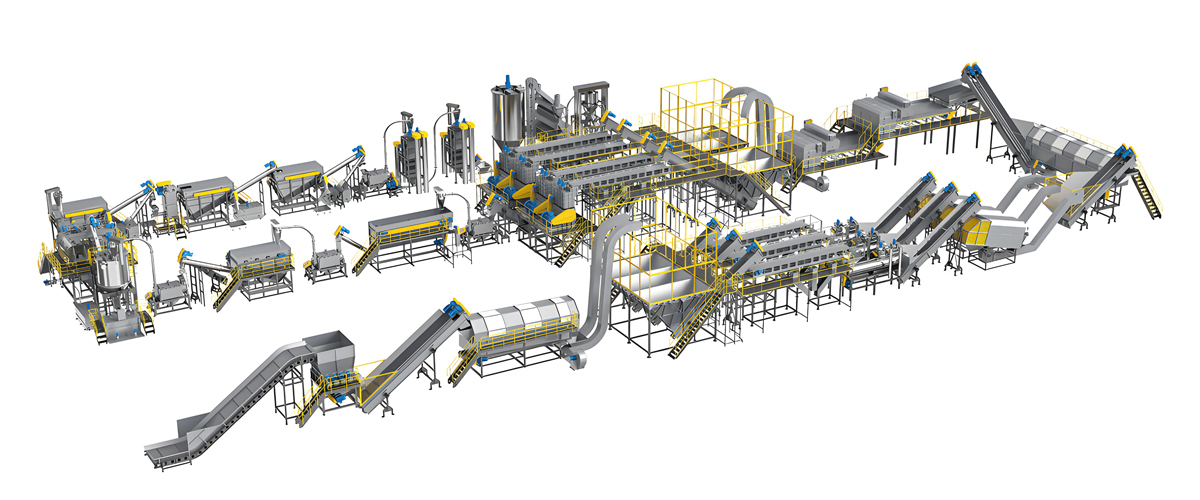
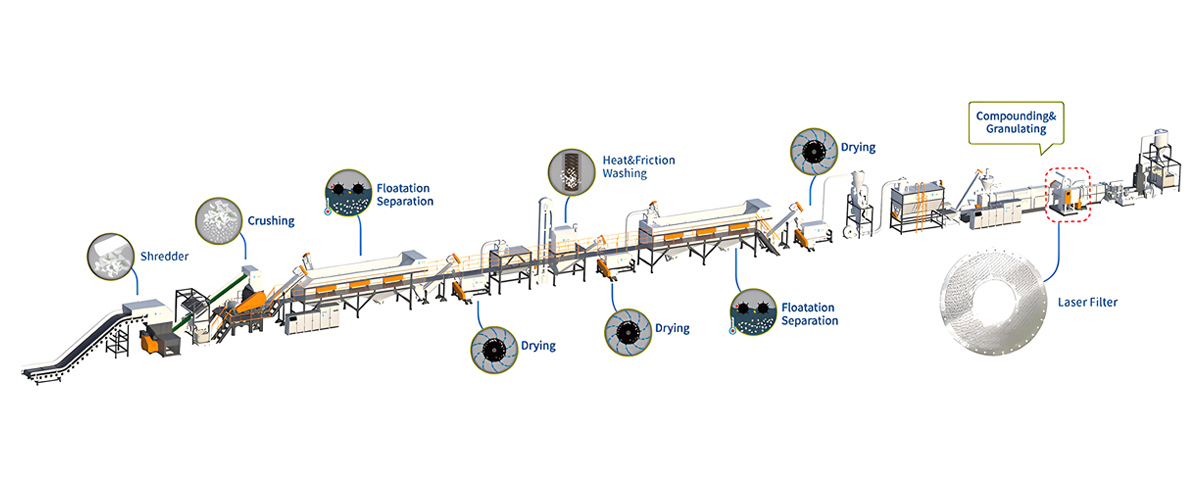
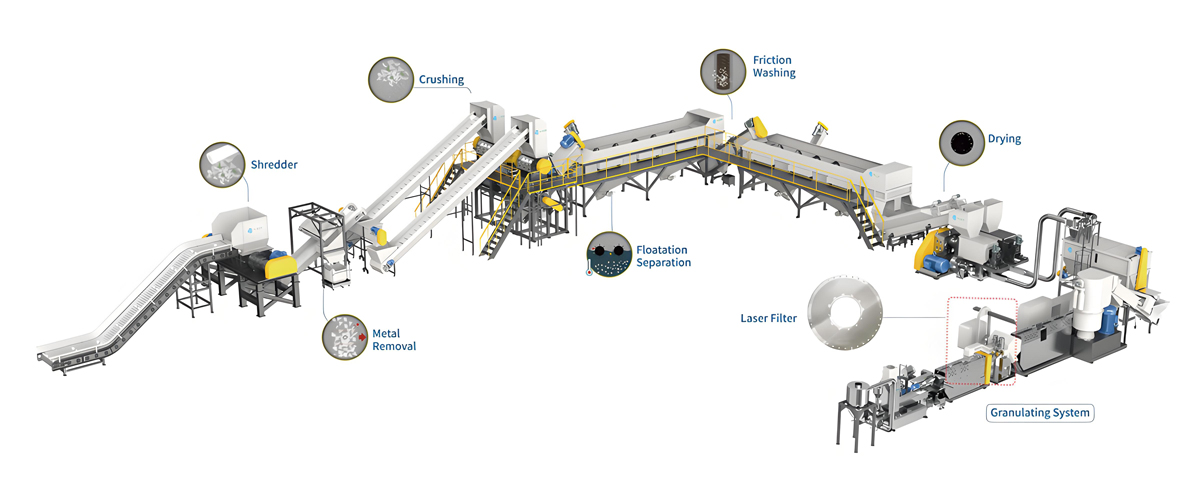
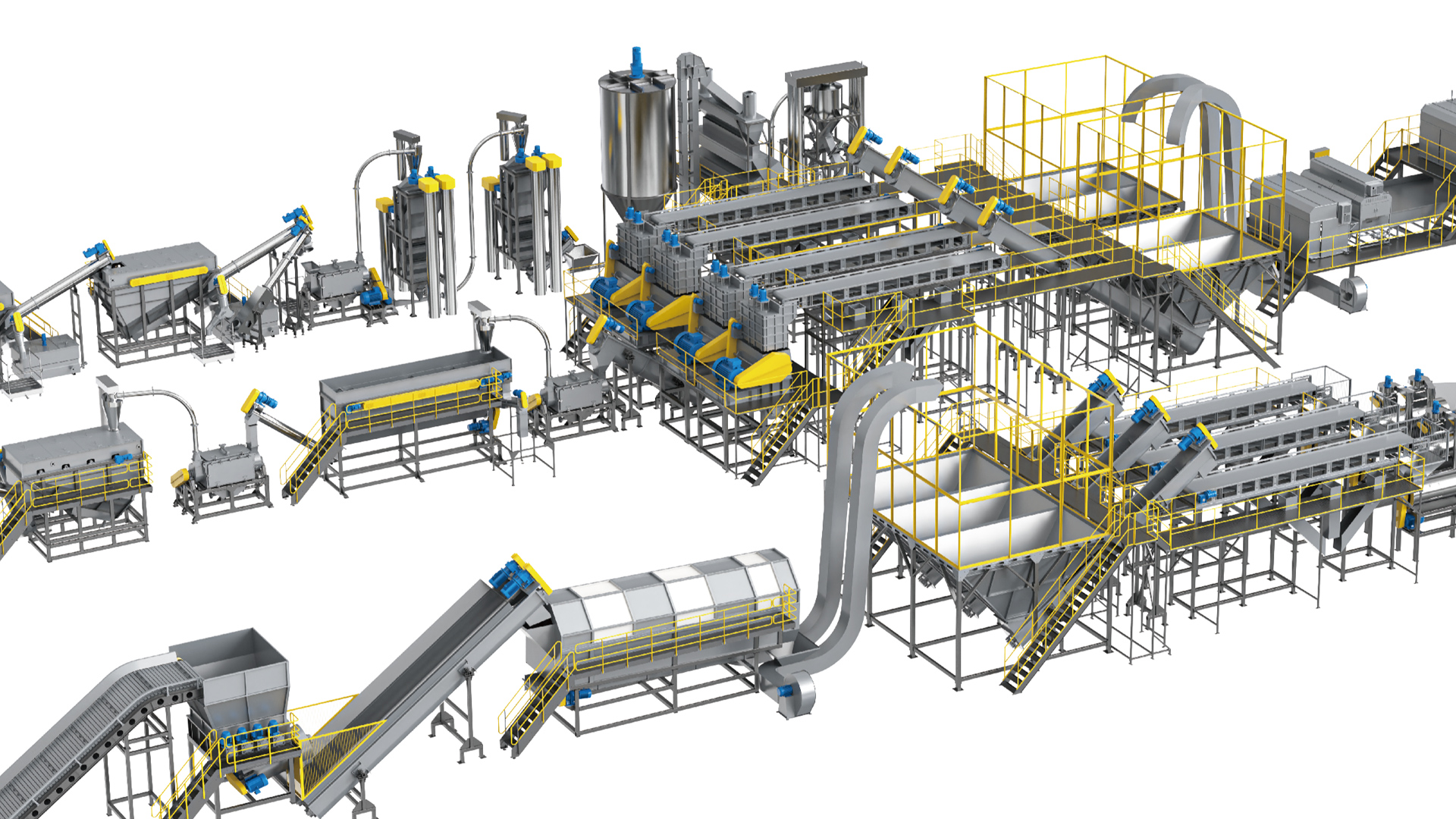
- How Polyretec Configures Size Reduction for Bottle and Film Lines
- Frequently Asked Questions
- Conclusion and Specification Checklist
The Size Reduction Family: Shredder, Granulator, Pulverizer Defined
Plastic size reduction machines are classified by rotor speed and cutting mechanism, not by the name printed on the nameplate. Low-speed high-torque machines tear; medium-speed machines shear against a screen; high-speed machines chop; and mills abrade into powder. Understanding which mechanism a machine uses immediately tells you what feedstock it tolerates and what output it delivers.
A shredder is a low- to medium-speed machine designed for primary size reduction of bulky, unsorted or baled waste. Its purpose is volume reduction and liberation of the material into a conveyable, screenable form. A granulator — also correctly called a crusher in the recycling trade — is a high-speed machine with rotating blades passing close to fixed bed knives, working against a perforated screen that determines final particle size. A pulverizer (grinder) uses a pair of grooved discs, one rotating and one stationary, to abrade dry plastic into powder. Each has a defined place in the chain, and in most bottle or film plants at least two of them are used in series.
The critical mental model is this: a shredder decides whether the material can be processed at all, while a granulator decides the quality of the flakes that reach the washing and pelletizing stages. Feeding a granulator with material a shredder should have handled is the single most common cause of unplanned downtime in recycling plants.
Comparison Table: The Complete Size Reduction Family
| Machine type | Rotor speed | Cutting mechanism | Typical output size | Screen | Feed tolerance | Best-fit feedstock |
|---|---|---|---|---|---|---|
| Single-shaft shredder | 80–150 rpm | Rotating blades shear against fixed bed knife, material pressed by hydraulic ram | 20–100 mm, uniform | Yes, perforated, 20–100 mm holes | Medium — small metal parts damage blades | Film rolls, bulky purgings, woven bags, big bags, sheet offcuts, baled film |
| Twin-shaft shredder (double-shaft) | 12–30 rpm | Interlocking cutter discs tear and pull material between two counter-rotating shafts | 30–150 mm, irregular | Normally none | Very high — tolerates occasional tramp metal | Rigid bulky items, drums, IBC cages, pallets, crates, tangled and mixed waste |
| Four-shaft shredder | 12–30 rpm | Twin-shaft tearing plus two counter-shafts, discharge through screen | 30–80 mm, controlled | Yes, 30–80 mm | High | Complex mixed waste, RDF preparation, electronic housings, composite parts |
| Granulator / crusher | 400–800 rpm | 3–9 rotating blades against 2–4 fixed blades, chopping action | 8–20 mm flakes | Yes, 8–20 mm | Low — sensitive to metal, stone and oversize | Bottles, pre-shredded material, clean production scrap, edge trim |
| Pulverizer / disc mill | 3,000–3,600 rpm (disc) | Abrasion between grooved rotating and static discs | 300–800 micron powder | Classifier / sieve | Very low — clean dry feed only | PVC dry blend, rotomolding powder, PE powder for masterbatch carriers |
Two observations follow from this table. First, the output size ranges barely overlap: a twin-shaft shredder cannot produce 12 mm flakes and a granulator cannot swallow a 200-litre drum. Second, feed tolerance moves inversely to output fineness. The finer the machine cuts, the more sensitive it is to contamination. That trade-off is the physical reason why almost every serious bottle or film line uses a two-stage layout rather than trying to do everything in one machine.
Key working figures. Rotor speed spread across the family: 12 rpm (twin-shaft) to 3,600 rpm (pulverizer disc). Specific energy for PET bottle size reduction: 35–60 kWh per tonne. Specific energy for contaminated PE/PP film: 60–110 kWh per tonne. Practical blade clearance for film cutting: 0.1–0.3 mm. Blade hardness range across common tool steels: HRC 56–62.
Single-Shaft vs Twin-Shaft vs Four-Shaft Shredders
Within the shredder category, the number of shafts is not a measure of capability but a description of the cutting geometry, and each geometry solves a different problem. Selecting between them is the first branch of the decision tree and it depends almost entirely on the physical form of the incoming waste rather than on the polymer type.
Single-Shaft Shredder: Controlled Output Through a Screen
The single-shaft shredder is the workhorse of film recycling. A rotor carrying rows of small square or V-shaped blades turns at 80–150 rpm inside a chamber. A hydraulic ram pushes the material against the rotor with adjustable pressure, typically 6–12 MPa in the hydraulic circuit, so that light, springy material such as loose film or woven bags cannot bounce away from the cutting zone. Material stays in the chamber until it is small enough to pass the perforated screen fitted beneath the rotor. Screen hole diameters of 20–100 mm are standard; a 40–60 mm screen is the usual choice ahead of a film washing line.
Because the screen enforces the particle size, output is far more uniform than a twin-shaft machine can achieve, and this uniformity matters enormously downstream. A friction washer, a float wash tank and a dewatering centrifuge all behave predictably only when fed a consistent particle band. The trade-offs are that a single-shaft shredder is intolerant of tramp metal, that the hydraulic ram adds a maintenance system, and that screen changes take a crew of two roughly 45–90 minutes depending on machine size.
Blade arrangement on the rotor deserves attention. A straight-row rotor engages many blades simultaneously, producing a hammering load and higher peak current. A helical rotor, where blades are arranged in a spiral, engages progressively, which lowers peak torque by roughly 15–25 percent, reduces noise by 3–5 dB(A), and gives a smoother cut on tough film. For film work, a helical rotor with shear-type blades is nearly always the better specification.
Twin-Shaft Shredder: Torque Above All
The twin-shaft shredder — the glossary term is also double-shaft shredder — uses two counter-rotating shafts carrying interlocking cutter discs. Shaft speeds are 12–30 rpm, often with a small differential between the two shafts (for example 14 rpm and 18 rpm) so that material is actively drawn in and torn rather than merely pinched. There is normally no screen; particle size is governed by disc thickness and the number of hooks per disc, giving an irregular 30–150 mm output.
Its virtue is brute torque and forgiveness. A twin-shaft shredder will pass a bolt, a short length of steel banding, or a lump of compacted dirt without catastrophic damage, and its auto-reverse logic will free most jams without operator intervention. This makes it the correct primary machine for post-consumer rigid waste: HDPE drums, crates, pipe offcuts, PP big-bag bales with heavy contamination, and tangled agricultural film with soil and stones. Its weakness is exactly the mirror image: output is coarse and inconsistent, so it can rarely be the last size reduction step before washing.
Four-Shaft Shredder: Torque Plus Size Control
A four-shaft shredder adds two counter-shafts above the main pair and fits a discharge screen, combining tearing action with a size guarantee of 30–80 mm. It is the specialist answer for heterogeneous waste streams where both robustness and a defined particle band are required — mixed rigid and flexible packaging, electronic housings with metal inserts, or refuse-derived fuel preparation. Capital cost and specific energy are both higher than a twin-shaft machine, so four-shaft units are specified where the material mix genuinely demands them rather than as a default upgrade.
Comparison Table: Shredder Architectures Head to Head
| Criterion | Single-shaft shredder | Twin-shaft shredder | Four-shaft shredder |
|---|---|---|---|
| Rotor / shaft speed | 80–150 rpm | 12–30 rpm | 12–30 rpm |
| Torque character | Medium torque, medium speed | Very high torque, very low speed | Very high torque, very low speed |
| Feeding aid | Hydraulic ram, 6–12 MPa | Self-feeding via hooks | Self-feeding via hooks |
| Screen | 20–100 mm perforated | None | 30–80 mm perforated |
| Output uniformity | High | Low | Medium-high |
| Tramp metal tolerance | Low to medium | High | Medium-high |
| Film and stretch wrap handling | Excellent with shear blades | Poor — film wraps on shafts | Fair |
| Rigid drum and crate handling | Fair, ram-limited | Excellent | Excellent |
| Noise level | 88–95 dB(A) | 85–90 dB(A) | 85–92 dB(A) |
| Specific energy, typical | Medium to High | Low to Medium | Medium to High |
| Blade count per machine | 40–200 small blades | 20–60 cutter discs | 40–120 cutter discs |
| Relative capital cost | Medium | Medium to High | High to Very High |
| Relative wear cost per tonne | Medium | Low | Medium |
Why PET Bottles and PE/PP Film Behave in Opposite Ways
The single most useful principle in shredder selection is that PET bottles fail by brittle fracture while polyolefin film fails by ductile tearing, and cutting machinery must be designed around that difference. Everything else — blade geometry, rotor speed, clearance, screen size, power draw — follows from these two failure modes.
PET Bottle Waste: Hard, Brittle, Abrasive
Post-consumer PET has a density of roughly 1.33–1.40 g/cm³, a glass transition temperature near 75–80 °C, and notched impact strength low enough that it shatters cleanly at ambient temperature. That brittleness is an advantage for size reduction: a high-speed granulator chops PET efficiently, producing flakes with relatively clean edges and little fines generation, provided the blades are sharp and the clearance is correct. Specific energy for PET bottle size reduction typically falls in the 35–60 kWh per tonne band, and a well-set wet granulator will hold the low end of that range.
The complications are different in character. Bale wire, aluminium closures, steel rings and glass fragments arriving with the bales are hard, and PET’s rigidity means a foreign object is transmitted straight into the cutting edge rather than absorbed. Chipped blades are the usual failure mode, and a single missed piece of tramp metal can nick every rotating blade in one pass. PET is also mildly abrasive, particularly when bottles carry sand or label adhesive residues, so edge rounding proceeds steadily even without impacts.
Because PET is hygroscopic and because bottle flakes carry label and glue residues, most modern lines use a wet granulator: water is injected into the cutting chamber at roughly 1–3 cubic metres per tonne of throughput. Water cools the blades, suppresses dust, begins detaching labels and glue, and lubricates the discharge. The standard screen for a food-contact-grade PET line is 12–16 mm, which yields flakes that pass hot washing and dewatering efficiently while staying large enough to avoid excessive loss through screens in the sink-float separation stage. Flake size below about 8 mm sharply increases losses and drying energy; above about 20 mm the label removal and washing efficiency drop.
PE and PP Film Waste: Tough, Stringy, Heat-Sensitive
Polyolefin film is the mirror image. LDPE and LLDPE have elongation at break commonly in the 300–800 percent range, so the material stretches rather than fractures. A blunt blade with excessive clearance does not cut film at all — it draws it into strings, which then wrap around the rotor shaft and bearing housings. This is why the twin-shaft shredder, so effective on drums, is generally a poor choice for stretch wrap and thin film: the tearing action plus low speed is an almost ideal mechanism for winding film onto the shafts.
Film’s second problem is thermal. PE melts at 110–130 °C and PP at 160–170 °C, while the cutting zone of an overloaded shredder can easily exceed those temperatures locally. Once film begins to melt it smears onto blades and screens, blinding the perforations and creating a self-reinforcing blockage that ends in a shutdown and a manual clean-out with scrapers. Preventing this requires adequate blade sharpness, controlled ram pressure, sufficient screen open area, and in many cases water injection or forced air extraction at the discharge.
Specific energy for film is markedly higher than for PET — commonly 60–110 kWh per tonne, and toward the upper end when the film is thick, wet, or heavily soiled. This is because ductile deformation absorbs energy before the cut is completed, and because the low bulk density of film (30–80 kg/m³ loose, 200–400 kg/m³ baled) means a large volume must be moved for each tonne processed.
Comparison Table: PET Bottle vs PE/PP Film Cutting Requirements
| Parameter | PET bottle waste | PE / PP film waste |
|---|---|---|
| Failure mode under blade | Brittle fracture | Ductile tearing / stretching |
| Density | 1.33–1.40 g/cm³ | 0.90–0.96 g/cm³ |
| Bulk density as received | 250–450 kg/m³ (baled) | 200–400 kg/m³ baled, 30–80 kg/m³ loose |
| Primary risk | Blade chipping from tramp metal and glass | Shaft wrapping and melt smearing |
| Preferred primary machine | Twin-shaft shredder (optional, for baled or bulky feed) | Single-shaft shredder with hydraulic ram, mandatory |
| Preferred secondary machine | Wet granulator, 12–16 mm screen | Wet granulator, 15–25 mm screen, or direct to washing |
| Blade clearance target | 0.15–0.30 mm | 0.10–0.20 mm, tightly controlled |
| Blade geometry | Flat or slight negative rake, robust edge | Positive rake shear blades, scissor action |
| Rotor speed at final stage | 500–800 rpm | 400–600 rpm |
| Water injection | 1–3 m³ per tonne, standard | Optional to recommended, 1–2 m³ per tonne |
| Specific energy | 35–60 kWh per tonne | 60–110 kWh per tonne |
| Blade life between regrinds | 80–200 tonnes | 20–60 tonnes for sandy agricultural film; 100–150 tonnes for clean industrial film |
| Typical fines generation | 1–3 percent | 0.5–2 percent |
Special Cases: Woven Bags, Stretch Film and Agricultural Film
Three film-adjacent streams justify separate treatment. PP woven bags and big bags (FIBC) are strong in two directions and often contain sewn-in polyester threads and printed liners. A single-shaft shredder with a 40–60 mm screen handles them well, but blade clearance must be held tight because woven tapes slip through a wide gap unaltered. Big bags with lifting loops should be pre-cut or fed with the loops removed, as the loops are the most common wrapping initiator.
Stretch film and pallet wrap are the most difficult flexible feed in the industry: extremely thin, extremely elastic, and delivered in dense rolls. They demand a single-shaft machine with a helical rotor, sharp shear blades, and a screen no smaller than 50 mm to avoid blinding. Ram pressure should be reduced rather than increased, since forcing elastic material against the rotor increases stretching rather than cutting.
Agricultural film arrives with soil, sand, stones and moisture that can reach 30–50 percent of total incoming mass. The correct approach is not a tougher shredder but a pre-treatment step: a pre-shredder or bale opener followed by a dry trommel or vibrating screen to remove the bulk of the mineral load before the main size reduction. Cutting sandy film with standard tool steel blades is what drives blade life down to the 20–60 tonne range. With pre-screening and abrasion-resistant powder metallurgy blades, that figure can typically be doubled.
Recommended Size Reduction Routes by Feedstock
A correct size reduction route is defined by the incoming material form and the requirements of the downstream process, and in the great majority of plants it consists of two stages rather than one. The primary stage makes the material conveyable and liberates contamination; the secondary stage sets the particle size that the washing line and pelletizing line need.
For a PET bottle washing line running loose or lightly baled bottles, a twin-shaft shredder is often unnecessary. Bottles are hollow, low in bulk density, and easily fed; a de-baler followed by a bale breaker, manual or automatic sorting, and a wet granulator with a 12–16 mm screen is a complete and efficient route. Where bales are heavily compressed, contain mixed rigid packaging, or come from municipal collection with a high foreign-object load, a low-speed twin-shaft pre-shredder at 60–80 mm output is worth its capital cost purely for the protection it gives to the granulator blades.
For PE/PP film, the two-stage route is not optional. A single-shaft shredder must come first, because no granulator will accept baled film without wrapping. After shredding to 40–60 mm the material can go either directly into the wet section of the washing line, or through a wet granulator if a finer, more uniform particle is needed for a high-specification pellet. The choice depends on the pellet grade being targeted and on the capacity of the downstream friction washers.
Route Selection Table
| Feedstock | Primary stage | Secondary stage | Target output size | Downstream | Notes |
|---|---|---|---|---|---|
| PET bottles, loose or light bales | Bale breaker + sorting (no shredder needed) | Wet granulator, 12–16 mm screen | 12–16 mm flakes | Hot washing, sink-float, dewatering | Metal detection before granulator is mandatory |
| PET bottles, dense municipal bales | Twin-shaft shredder, 60–80 mm | Wet granulator, 12–16 mm screen | 12–16 mm flakes | Hot washing line | Pre-shredder pays back through blade life alone |
| PET trays and thermoformed sheet | Single-shaft shredder, 40 mm screen | Wet granulator, 10–14 mm | 10–14 mm flakes | Washing + decontamination | Watch fines generation on thin-wall trays |
| LDPE / LLDPE industrial film, clean | Single-shaft shredder, 50–60 mm | Optional wet granulator | 40–60 mm | Washing then pelletizing, or direct pelletizing | Clean film may bypass washing entirely |
| Post-consumer PE film, printed and soiled | Single-shaft shredder, 40–50 mm | Wet granulator, 20–25 mm | 20–25 mm | Full washing line | Ink and glue load raises washing duty |
| PP woven bags / FIBC | Single-shaft shredder, 40–60 mm, tight clearance | Wet granulator, 15–20 mm | 15–20 mm | Washing + pelletizing | Remove lifting loops and metal buckles first |
| Stretch film and pallet wrap | Single-shaft shredder, helical rotor, 50–60 mm, reduced ram pressure | Usually none | 50–60 mm | Agglomeration or direct pelletizing | Screen must not be undersized |
| Agricultural film with soil and sand | Bale opener + trommel pre-screen, then single-shaft shredder, 50 mm | Wet granulator with pre-wash | 25–40 mm | Intensive washing, multiple wash stages | Powder metallurgy blades strongly advised |
| Rigid HDPE drums, crates, pipe | Twin-shaft shredder, 50–100 mm | Granulator, 12–18 mm | 12–18 mm | Washing + pelletizing | Classic two-stage rigid layout |
| Mixed rigid + flexible for RDF | Four-shaft shredder, 30–50 mm screen | None | 30–50 mm | Fuel preparation, no washing | Metal removal by overband magnet and eddy current |
One point on downstream matching deserves emphasis because it is so frequently overlooked. The screen aperture chosen at the last size reduction stage must be compatible with the perforation of the dewatering centrifuge and the mesh of the friction washers. If a granulator screen is reduced from 14 mm to 10 mm to chase a finer flake, the proportion of particles passing through the centrifuge screen rises, product is lost into the water circuit, and the water treatment load increases. Particle size is a whole-line parameter, never a local one. Once the flakes leave the size reduction stage, they enter the washing sequence, which Polyretec configures separately according to flake grade and contamination level.
Cutter Engineering: Steel Grades, Geometry and Clearance
Blades are the highest-frequency consumable in any recycling plant, and blade specification determines both cut quality and operating cost more directly than any other single component. Three variables matter: the steel, the geometry, and the clearance.
Blade Steel Grades
Four families of tool steel cover essentially all plastic size reduction duty. D2 (and its close equivalent SKD-11, roughly Cr12Mo1V1 in Chinese designation) is a high-carbon high-chromium cold-work steel, typically hardened to HRC 58–62. It offers excellent wear resistance and is the default choice for granulator blades cutting clean or mildly contaminated material. H13 (SKD-61) is a hot-work steel hardened to HRC 48–54; it is tougher and much more resistant to impact and thermal shock, which makes it appropriate for twin-shaft cutter discs where shock loading dominates and where edge retention matters less. 9CrSi and similar low-alloy grades appear on low-cost machines and are acceptable only for clean in-house scrap.
Powder metallurgy (PM) tool steels represent the top of the range. Made by hot isostatic pressing of atomised powder, they combine a very fine, uniformly distributed carbide structure with high hardness, typically HRC 60–64, and deliver two to four times the service life of D2 in abrasive service. Their capital cost is Premium, but for agricultural film with sand loading or for post-consumer streams with persistent mineral contamination, cost per tonne processed is usually lower than conventional steel. Tungsten carbide tipping and hardfacing overlays are also used, particularly on twin-shaft hooks, where the objective is resisting abrasion rather than maintaining a fine cutting edge.
Blade Steel Comparison Table
| Steel grade | Typical hardness | Toughness | Wear resistance | Regrind cycles | Relative cost | Best application |
|---|---|---|---|---|---|---|
| 9CrSi / low alloy | HRC 56–58 | Medium | Low | 4–6 | Low | Clean in-house production scrap only |
| D2 / SKD-11 (Cr12Mo1V1) | HRC 58–62 | Medium | High | 5–8 | Medium | Granulator blades, PET flakes, clean to mildly contaminated film |
| H13 / SKD-61 | HRC 48–54 | High | Medium | 5–8 | Medium | Twin-shaft cutter discs, shock-loaded duty, hot service |
| Powder metallurgy tool steel | HRC 60–64 | High | Very High | 6–8 | Premium | Abrasive agricultural film, mineral-loaded post-consumer waste |
| Tungsten carbide tipped / hardfaced | HRA 88–92 at tip | Low at tip | Very High | 1–3 (specialist regrind) | Premium | Twin-shaft hooks, highly abrasive rigid waste |
Blade Geometry
Geometry is chosen to match the failure mode of the polymer. V-type blades, arranged so that the cut propagates from the centre outward, reduce peak load and are common on single-shaft rotors handling bulky material. Square blades — small, four-edged, indexable inserts bolted in rows — are the standard for single-shaft film shredders because each blade can be rotated three times before removal, giving four cutting edges per insert and a very low cost per edge. Hook blades on twin-shaft cutter discs grip and pull material inward; hook count per disc (typically 2, 3 or 5) trades feeding aggression against output fineness, with more hooks giving finer output but lower intake. Helical rotor arrangements stagger the blades along a spiral so that only a few engage at any instant, producing a scissor-like progressive cut that is markedly better for film.
Rake angle matters as much as blade shape. A positive rake of 5–15 degrees produces a slicing action suited to ductile film. A neutral or slightly negative rake gives a stronger, better-supported edge suited to brittle PET and to material where impact damage is likely. Specifying a positive-rake film blade for a PET bottle granulator is a common error that leads to rapid edge chipping.
Clearance: The Parameter That Decides Whether Film Cuts
The gap between the rotating blade and the fixed bed knife must be 0.1–0.3 mm for plastic size reduction, and for film the tighter half of that range is mandatory. The physics is simple: a cut occurs when the material is sheared between two edges passing each other. If the gap exceeds the material thickness by a significant margin, thin film is dragged into the gap and stretched instead of severed, producing strings that wrap the rotor. Since typical packaging film is 15–120 microns thick, a 0.5 mm gap is effectively an open door.
Clearance is set with feeler gauges after every blade change and after every regrind, adjusting the bed knife shim stack. It must also be re-checked after the first 8 hours and again at 48 hours of operation following a blade change, because thermal cycling and settling of the bolted joints will shift the setting. Blade fixing bolts should be re-torqued to the manufacturer’s specification on the same schedule; a loosening blade bolt is one of the few failure modes capable of destroying a rotor.
Blades can normally be reground 5–8 times before the blade seat geometry no longer permits correct clearance adjustment. Each regrind removes 0.3–0.8 mm of material, and after the final cycle the blade is scrap. Planning a regrind rotation — one set in service, one set in the sharpening shop — eliminates the downtime that otherwise accompanies every blade change and is standard practice in well-run plants.
Motor Power, Gear Reduction and Torque Matching
Drive sizing for a shredder is a torque problem, not a power problem, and this distinction explains why two machines with the same installed kW can have completely different capabilities. A twin-shaft shredder converts a modest motor rating into enormous shaft torque through a reduction ratio of 60:1 to 120:1, while a granulator applies its power at 400–800 rpm with a direct or belt drive and comparatively little torque multiplication.
Shaft torque can be estimated as motor torque multiplied by gear ratio and drive efficiency. A 22 kW motor at 1,480 rpm produces about 142 N·m. Through a 90:1 planetary reduction at 95 percent efficiency, that becomes roughly 12,100 N·m at the shredder shaft, turning at about 16 rpm. That is why a twin-shaft machine with two 22 kW motors can tear apart a 200-litre drum that would instantly stall a 75 kW granulator.
Power and Capacity Reference Table
| Machine and duty | 500 kg/h | 1,000 kg/h | 2,000 kg/h | Reduction ratio | Drive type |
|---|---|---|---|---|---|
| Single-shaft shredder, PE/PP film | 37–45 kW | 55–75 kW | 110–132 kW | 20:1 to 35:1 | Motor + helical gearbox, or hydraulic drive |
| Single-shaft shredder, rigid / sheet | 30–37 kW | 45–55 kW | 90–110 kW | 20:1 to 35:1 | Motor + helical gearbox |
| Twin-shaft shredder, rigid waste | 2 × 11–15 kW | 2 × 18.5–22 kW | 2 × 37–45 kW | 60:1 to 120:1 | Motor + planetary or cycloidal gearbox |
| Four-shaft shredder, mixed waste | 2 × 15–18.5 kW | 2 × 22–30 kW | 2 × 45–55 kW | 60:1 to 120:1 | Motor + planetary gearbox |
| Wet granulator, PET bottles | 30–37 kW | 45–55 kW | 90–110 kW | Direct or 1:1 to 1:1.5 belt | Motor + V-belt, flywheel rotor |
| Wet granulator, PE/PP film | 37–45 kW | 55–75 kW | 110–160 kW | Direct or belt | Motor + V-belt, flywheel rotor |
| Hydraulic power pack for ram | 4–5.5 kW | 5.5–7.5 kW | 11–15 kW | — | Separate pump unit |
These figures assume continuous operation with a reasonably consistent feed. Real throughput varies by 30 percent or more with bulk density, moisture content, screen aperture and blade condition, and a dull blade set can cut throughput in half while raising current draw. When drawing up a specification, always state the required output in kg per hour for a defined feedstock and screen size rather than quoting motor kW, because kW alone guarantees nothing.
Hydraulic Drive versus Electric Motor and Gearbox
Two drive philosophies compete in the shredder market. The electric motor plus gearbox arrangement gives higher energy efficiency — typically 90–95 percent through the drive train — lower maintenance, and simpler control, and it dominates single-shaft film shredders and all granulators. The full hydraulic drive, where a hydraulic motor turns the rotor, offers inherent overload protection through pressure relief, infinitely variable speed, and instant reversal, at the cost of an efficiency in the 70–80 percent range and an oil system requiring cooling and filtration. Hydraulic drive appears mainly on heavy-duty machines expected to encounter frequent jams and hard contamination.
Overload Protection, Auto-Reverse and Soft Start
Every shredder needs a defined overload response. The auto-reverse function monitors motor current or hydraulic pressure and, when a threshold of typically 105–120 percent of rated load is exceeded for a set dwell time of 1–3 seconds, reverses the rotor for a fixed interval of 2–5 seconds before attempting to resume forward rotation. Two or three attempts are allowed; if the jam persists, the machine stops and raises an alarm rather than repeatedly hammering the drive train. Configuring an unlimited retry count is a mistake that shortens gearbox life dramatically.
Soft starters or variable frequency drives are strongly recommended for all shredders above about 30 kW. Direct-on-line starting of a large rotor draws 6–8 times rated current and imposes a severe shock on couplings and gear teeth. A variable frequency drive additionally allows rotor speed to be tuned to the feedstock — reducing speed for thick, tough material to gain torque, raising it for light film to increase throughput — and enables the controlled reversal used by the auto-reverse logic. On granulators, a heavy flywheel-type rotor stores kinetic energy and smooths the load, which is why granulator rotor mass is a genuine specification point rather than a marketing figure.
Protection, Safety and Environmental Compliance
Protection systems in a size reduction plant serve two distinct purposes: keeping foreign objects out of the machine and keeping operators out of the cutting chamber. Both are non-negotiable, and both are addressed by well-established international standards.
Foreign Object Protection
The economic case for contamination removal is overwhelming. A single steel bolt reaching a granulator rotor at 700 rpm can chip every rotating blade in one revolution, and the cost of a full blade set plus the downtime for replacement dwarfs the cost of the protection equipment many times over. A properly protected line uses layered defences:
- Overband magnet above the infeed conveyor, removing ferrous items from the material stream continuously without interrupting flow.
- Drum magnet or magnetic head pulley at the conveyor discharge, catching ferrous fragments that were buried in the material bed.
- Metal detector spanning the belt, wired to stop the conveyor and trigger an alarm when non-ferrous metal — aluminium closures, copper wire, lead weights — is detected. Detection sensitivity for a sphere of 3–5 mm is typical on a 800–1,000 mm belt.
- Eddy current separator where aluminium loading is significant, as with mixed municipal bottle bales.
- Air classifier or zigzag separator after the shredder, removing paper, dust and light film from heavier fractions.
- Trommel or vibrating pre-screen for soil and stone removal ahead of agricultural film shredding.
A blockage detection system — level sensors in the discharge chute plus motor current monitoring — should shut the infeed conveyor before the chamber packs solid. Recovering a packed single-shaft chamber can take a maintenance crew several hours of manual scraping.
Operator Safety
Machine safety design for plastics size reduction equipment is governed by a well-defined standards framework. ISO 13857 sets the safety distances that prevent upper and lower limbs from reaching hazard zones, which determines infeed hopper height and geometry — a hopper deep enough that an arm cannot reach the rotor is the primary guard on most single-shaft machines. ISO 13850 governs emergency stop function design, requiring accessible, unambiguous, latching stop devices with manual reset. ISO 14120 covers fixed and movable guards, and ISO 14119 covers interlocking devices associated with guards: any access door to the cutting chamber must have an interlock, and on machines with high rotor inertia the interlock must be a guard-locking type that keeps the door closed until the rotor has come to rest. Rotor run-down on a large granulator can take 30–90 seconds after power removal.
Lockout-tagout discipline is mandatory for any blade change, screen change or chamber entry. The sequence is: stop, isolate electrically, isolate and depressurise the hydraulic circuit, verify zero energy, apply personal locks, then confirm rotor immobility mechanically before any hand enters the chamber. EN 12012-1, the European standard covering blade granulators and shredders for plastics and rubber, is the specific product standard to reference when specifying a CE-marked machine for the European market.
Noise and Dust
Shredders and granulators are among the loudest machines in a recycling plant. Sound pressure levels of 85–95 dB(A) at the operator position are normal, measured according to ISO 11201. Where sustained exposure exceeds 85 dB(A), engineering controls are required before relying on hearing protection. Effective measures include an acoustic enclosure around the machine, which typically achieves a 10–15 dB(A) reduction; anti-vibration mounts on the machine base; lined feed hoppers and discharge chutes; and rotor speed reduction via the variable frequency drive, since noise scales strongly with tip speed. Choosing a helical rotor rather than a straight-row rotor is worth a further 3–5 dB(A) at no operating cost.
Dust is a concern principally in dry size reduction. PET dry granulation generates fine dust that is both a respiratory hazard and, in confined volumes, a combustible dust risk. Wet granulation eliminates most of it, which is a significant secondary reason for choosing wet operation on PET lines. Where dry operation is unavoidable, a cyclone plus cartridge filter dust extraction system sized for 1,500–4,000 m³/h at the granulator discharge is standard, and pulverizer installations producing fine powder should be assessed against the applicable combustible dust requirements, including ATEX zoning in Europe.
The Shredder Selection Decision Tree
Shredder selection can be reduced to six sequential questions, each of which narrows the equipment choice, and answering them in order prevents the circular arguments that stall most procurement discussions. The order matters: material form comes before capacity, and downstream requirements come before final screen selection.
Step 1 — What is the physical form of the incoming material?
Rolls, bales, loose film, drums, crates, purgings and sheet all feed differently. Roll and bale forms require a ram-assisted single-shaft machine or a bale opener. Rigid three-dimensional items require twin-shaft tearing. Loose light film requires ram assistance and controlled infeed. If more than one form arrives at the plant, size the primary machine for the most difficult one.
Step 2 — How contaminated is the stream, and with what?
Metal, stone, soil, textile and moisture each demand a different response. High metal risk pushes the selection toward twin-shaft primary shredding plus a full metal detection suite. High mineral load demands pre-screening and PM steel or hardfaced blades. High moisture affects both throughput and downstream drying load.
Step 3 — What output particle size does the downstream process need?
Work backwards from the pellet or flake specification. Food-grade PET flakes require 12–16 mm. Washed film for pelletizing accepts 25–60 mm. Fuel preparation accepts 30–50 mm. Never select a screen aperture without confirming it against the dewatering and washing equipment.
Step 4 — What is the required throughput, and at what utilisation?
Specify capacity in kg/h for the defined feedstock. Assume 80–85 percent equipment utilisation over a shift once blade changes, screen changes and jam clearing are included, and size the machine so that nominal capacity exceeds the required average by 20–30 percent. A shredder running continuously at its absolute limit wears blades disproportionately fast.
Step 5 — What comes next in the process?
A washing line, a direct pelletizing line, an agglomerator, or fuel preparation each impose different particle requirements. Direct pelletizing of clean film can accept a coarser, less uniform particle than a washing line, because the extruder feed section will handle it. A washing line, by contrast, is highly sensitive to particle uniformity.
Step 6 — What are the site constraints?
Available power supply, ceiling height for hopper loading, floor loading capacity, noise limits at the site boundary, water availability for wet operation, and the skill level of the maintenance team all constrain the practical choice. A technically ideal machine that the local team cannot maintain is not the right machine.
Decision Matrix Table
| Material form | Contamination level | Target output | Recommended primary | Recommended secondary | Key protection |
|---|---|---|---|---|---|
| PET bottles, sorted, loose | Low | 12–16 mm | Bale breaker only | Wet granulator | Overband magnet + metal detector |
| PET bottles, municipal bales | High | 12–16 mm | Twin-shaft shredder | Wet granulator | Magnet + eddy current + metal detector |
| Film rolls, industrial | Low | 40–60 mm | Single-shaft shredder | Optional granulator | Overband magnet |
| Film bales, post-consumer | Medium-high | 20–40 mm | Single-shaft shredder | Wet granulator | Magnet + metal detector + air classifier |
| Agricultural film | Very high (mineral) | 25–40 mm | Bale opener + trommel + single-shaft | Wet granulator, PM blades | Pre-screen + magnet + stone trap |
| Woven bags / FIBC | Medium | 15–20 mm | Single-shaft, tight clearance | Wet granulator | Magnet for buckles and clips |
| Rigid drums and crates | Medium-high | 12–18 mm | Twin-shaft shredder | Granulator | Magnet + metal detector |
| Mixed rigid and flexible | High | 30–50 mm | Four-shaft shredder | None | Magnet + eddy current |
| Clean in-house production scrap | None | 8–12 mm | None | Granulator (beside-the-press) | Basic magnet |
Maintenance, Wear Parts and Operating Discipline
Shredder reliability is almost entirely a function of maintenance discipline rather than of machine quality, because every critical wear mechanism in the machine is predictable and measurable. Plants that follow a written inspection routine typically achieve 90 percent or better availability; plants that run to failure rarely exceed 70 percent.
Daily and Shift Checks
At the start of each shift the operator should confirm blade edge condition visually through the inspection hatch, check the screen for wear or blinding, verify that the discharge is clear, inspect the magnet and clean accumulated ferrous material from it, check hydraulic oil level and temperature, confirm that no abnormal noise or vibration is present at startup, and verify that all emergency stops and door interlocks function. This takes under ten minutes and prevents the majority of unplanned stoppages.
Scheduled Maintenance Intervals
| Task | Interval | Acceptance criterion | Downtime | Relative cost |
|---|---|---|---|---|
| Blade bolt torque check | After 8 h and 48 h following each blade change, then weekly | Within manufacturer’s specified torque | 20–40 min | Low |
| Blade clearance verification | After every blade change and regrind; weekly in service | 0.1–0.3 mm by feeler gauge | 30–60 min | Low |
| Blade rotation or regrind | Every 80–200 t (PET); 20–60 t (abrasive film) | Edge radius below 0.3 mm | 2–4 h | Medium |
| Screen inspection | Weekly | Hole enlargement under 10 percent of nominal | 30 min | Low |
| Screen replacement | Every 1,500–4,000 t depending on abrasion | Uniform aperture restored | 45–90 min | Medium |
| Bearing regreasing | Every 500–1,000 operating hours | Correct grease type and quantity, no over-greasing | 30 min | Low |
| Rotor shaft seal inspection | Monthly | No material ingress toward bearings | 1 h | Low |
| Gearbox oil analysis and change | Every 4,000–8,000 h | Within viscosity and particle count limits | 3–4 h | Medium |
| Hydraulic oil and filter change | Every 2,000–4,000 h | Cleanliness code per manufacturer | 2–3 h | Medium |
| V-belt tension and condition | Monthly | Correct deflection, no glazing or cracking | 30 min | Low |
| Bed knife replacement | Every 3–5 rotating blade sets | Full clearance adjustment range restored | 3–5 h | Medium |
| Rotor rebuild or re-tipping | Every 5–8 years or as wear dictates | Blade seats within tolerance | Several days | Very High |
Spare Parts Inventory
A recommended minimum stock for a single production line comprises one complete set of rotating blades and one set of bed knives (relative cost High, but non-negotiable — a plant without spare blades will eventually stop for days), two screens in the working aperture plus one in an alternative aperture (Medium), a full set of blade bolts and washers, which should always be replaced rather than reused (Low), one set of rotor shaft seals (Low), one pair of main bearings (Medium), one hydraulic pump seal kit and spare filter elements (Low), spare V-belts (Low), and a spare set of proximity and interlock sensors (Low). Gearboxes and hydraulic power packs are typically not stocked as complete units except in remote installations where lead time would be prohibitive.
Maintenance Labour
Planned maintenance labour for a well-run size reduction section normally runs between 0.15 and 0.40 maintenance hours per tonne processed, with the low end applying to clean industrial film on well-specified machines and the high end to abrasive agricultural film. Tracking this figure is one of the best diagnostic indicators available: a rising trend almost always signals either a degrading feedstock or a machine operating outside its design envelope, and it will show up in the data weeks before it shows up as a breakdown.
Eight Costly Mistakes in Shredder Selection
The same errors recur across recycling projects worldwide, and every one of them is avoidable at the specification stage at a fraction of the cost of correcting it after commissioning.
1. Feeding film directly into a granulator. This is the most frequent and most expensive mistake. Baled or roll film entering a high-speed granulator wraps around the rotor and bearing housings within minutes. The machine stalls, the material must be cut away by hand, and repeated incidents damage the shaft seals and let contamination into the bearings. Film always needs a single-shaft shredder first.
2. Sending twin-shaft output straight to the washing line. A twin-shaft shredder produces 30–150 mm irregular pieces. Hollow shapes trap dirt, friction washers cannot scrub effectively at that size, and the material does not separate properly in sink-float. The result is washed material that still fails contamination specification. A secondary granulation stage is required.
3. Omitting metal detection to save capital. The savings are recovered by the first blade set destroyed by a bolt. Metal protection is the highest-return investment in the entire size reduction section.
4. Mismatching screen aperture to downstream capability. Choosing a finer granulator screen without checking dewatering centrifuge perforation and friction washer mesh causes product loss into the water circuit and overloads water treatment. Particle size must be decided as a line-wide parameter.
5. Allowing blade clearance to drift. Clearance is not a commissioning setting; it is a maintenance parameter. When it drifts past roughly 0.5 mm, film stops cutting and starts stringing, throughput collapses, and energy per tonne climbs sharply. Weekly verification with feeler gauges costs minutes.
6. Sizing on motor kW instead of throughput for a defined feedstock. Two 75 kW machines can differ by a factor of two in real throughput on the same material depending on rotor design, screen area, gear ratio and blade geometry. Always specify and guarantee kg/h at a stated screen size and feedstock.
7. Ignoring bulk density in conveyor and hopper design. Loose film at 30–80 kg/m³ requires a very large volumetric handling capacity for a modest mass flow. Conveyors and hoppers sized on mass alone will starve the shredder, and an intermittently fed shredder wears blades unevenly and consumes more energy per tonne.
8. Running an unlimited auto-reverse retry count. Configuring the control system to reverse and retry indefinitely converts a simple jam into repeated shock loading of the gearbox and couplings. Two or three attempts, then stop and alarm, is the correct configuration.
How Polyretec Configures Size Reduction for Bottle and Film Lines
Polyretec, a Wanplas factory, has specialised in plastic washing and recycling equipment since 2010, combining Austrian process technology with Chinese manufacturing capability, and its approach to size reduction is built around matching the machine to the feedstock rather than selling a standard configuration. With more than one hundred commissioned projects across upwards of fifty countries and a team of over twenty-four engineers available for on-site support, the factory’s specification practice reflects a large body of field experience with exactly the bottle and film streams discussed in this guide.
For PET bottle work, Polyretec’s Food Grade PET Bottle Washing Line covers 500 kg/h to 6,000 kg/h and is configured around a wet granulator producing 12–16 mm flakes, with a twin-shaft pre-shredder added where the incoming bales are dense or contaminated. The flake grade target drives the screen selection, and the size reduction section is matched to the downstream hot washing and dewatering equipment as an integrated system rather than as separately purchased machines.
For flexible packaging, the PP/PE Soft Plastic Crushing and Washing Line covers 500 kg/h to 1,500 kg/h and is built around a single-shaft shredder with a hydraulic ram, helical rotor and shear-type blades. One-step pelletizing is available where the customer wants washed film converted directly into pellets. Field references illustrate the range of duty: a heavy-duty shredder plus beater configuration for LDPE film with adhesive labels in Mexico, a fully automated PTW1000 PP/PE film washing machine in Taiwan, an LDPE printed film pelletizing system in Turkey, and a PP non-woven and TPE glove recycling project in Vietnam for a listed group that had previously operated European equipment.
Where the recovered material must be converted into pellets, Polyretec’s New Generation Pelletizing Line handles thin-walled LDPE films and thick-walled PE/PP regrind, and for compounding-grade output Wanplas’s Kerke factory supplies KTE-series co-rotating parallel twin-screw extruders and complete pelletizing systems that integrate directly with Polyretec washing lines. This cross-factory capability within the Wanplas brand means a single supplier relationship can cover size reduction, washing, and pelletizing without the interface risk that comes from mixing vendors at each stage.
Polyretec applies the Wanplas brand’s shared commitments across all equipment: an annual free spare parts allowance, free replacement of parts that fail within the warranty period, a transportation guarantee, a production capacity guarantee, and an open factory policy for customer inspection before shipment. The Wanplas mission, “Warm Global Customers With China Plastic Machinery”, is expressed in practice as pre-shipment testing, engineer-supported installation and commissioning, and long-term technical support. As of 2026, plants specifying size reduction equipment are also increasingly required to demonstrate traceable recycled content and consistent flake quality for food-contact applications, which raises the importance of getting particle size and contamination control right at the shredding stage.
Frequently Asked Questions
What is the difference between a shredder and a granulator?
A shredder is a low- to medium-speed machine, running at 12–150 rpm depending on type, used for primary size reduction of bulky or baled waste, producing 20–150 mm pieces. A granulator, also called a crusher, runs at 400–800 rpm with rotating blades cutting against fixed bed knives through a perforated screen, producing 8–20 mm flakes. Shredders make material handleable; granulators set the final particle size for washing and pelletizing. Most bottle and film lines use both in series.
Can one machine handle both PET bottles and PE/PP film?
Not efficiently. The two materials fail in opposite ways — PET fractures, film stretches — so they need different blade geometry, different clearance settings and different rotor speeds. A single-shaft shredder can process both if blades and clearance are reset between campaigns, but throughput will be compromised on at least one of them, and frequent changeovers accelerate wear. Plants processing both streams in volume should use dedicated size reduction lines.
Why does film wrap around the shredder shaft, and how is it prevented?
Wrapping occurs when film is stretched rather than cut, which happens when blade clearance exceeds roughly 0.3 mm, when blades are blunt, or when the machine geometry pulls material along the shaft rather than shearing it across it. Prevention requires tight clearance of 0.1–0.2 mm, sharp shear-type blades with positive rake, a helical rotor arrangement, effective shaft seals and wiper plates at the rotor ends, and adequate screen open area so material leaves the chamber promptly.
What screen size should be used for a PET bottle washing line?
A 12–16 mm screen is the industry standard for food-grade PET flakes. Below 8 mm, excessive fines are produced, losses through downstream screens rise, and drying energy increases. Above 20 mm, label and glue removal in the hot washing stage becomes less effective and sink-float separation is slower. The exact aperture must be checked against the perforation of the dewatering centrifuge to avoid losing product into the water circuit.
How long do shredder blades last before regrinding?
Blade life depends overwhelmingly on abrasive contamination rather than on the polymer. Clean PET bottle processing typically gives 80–200 tonnes between regrinds, clean industrial film 100–150 tonnes, and sandy agricultural film only 20–60 tonnes. Blades in D2 or SKD-11 can normally be reground 5–8 times, each cycle removing 0.3–0.8 mm, before the seat geometry no longer permits correct clearance adjustment. Powder metallurgy blades can extend abrasive-service life by a factor of two to four.
Is a twin-shaft shredder suitable for plastic film?
Generally no. A twin-shaft shredder tears material between counter-rotating cutter discs at 12–30 rpm with no screen, and that combination of low speed and pulling action is close to an ideal mechanism for winding film onto the shafts. It also produces coarse, irregular 30–150 mm output that a washing line cannot clean properly. For film, a single-shaft shredder with a hydraulic ram and a screen is the correct primary machine; twin-shaft units belong on rigid bulky waste such as drums, crates and pipe.
How much energy does plastic size reduction consume per tonne?
Specific energy is typically 35–60 kWh per tonne for PET bottle processing and 60–110 kWh per tonne for PE/PP film, with the higher film figure reflecting the energy absorbed by ductile deformation and the large volumes involved at low bulk density. Blunt blades, incorrect clearance and undersized screens can push consumption 30–50 percent above these ranges, which makes energy per tonne one of the most useful early warning indicators of degrading blade condition.
What safety standards apply to plastic shredders?
The key references are ISO 13857 for safety distances preventing limbs reaching hazard zones, ISO 13850 for emergency stop design, ISO 14120 for guards, ISO 14119 for interlocking devices with guard locking on high-inertia rotors, ISO 11201 for noise measurement, and EN 12012-1 as the product standard for size reduction machines for plastics and rubber. Machines exported to Europe require CE marking. Lockout-tagout procedures covering both electrical and hydraulic isolation must be enforced for every blade or screen change.
Do I need a pre-shredder before a PET granulator?
It depends on the bale. Sorted, loose or lightly baled bottles can be fed directly to a wet granulator after a bale breaker, because bottles are hollow and low in bulk density. Densely compressed municipal bales containing mixed rigid packaging, metal and other foreign objects justify a twin-shaft pre-shredder at 60–80 mm output; the capital cost is usually recovered through extended granulator blade life and avoided downtime alone.
How is required shredder capacity calculated?
Start from the annual tonnage target, divide by the planned operating hours, then divide by an equipment utilisation factor of 0.80–0.85 to account for blade changes, screen changes and jam clearing. Add a 20–30 percent margin so the machine is not running permanently at its limit, since continuous operation at maximum load accelerates blade wear disproportionately. Always state the resulting figure as kg/h for a specific feedstock and screen aperture, never as motor kW.
Conclusion and Specification Checklist
Choosing the right shredder type for plastic bottle and film waste comes down to respecting one physical reality: PET fractures and polyolefin film stretches, and no single machine geometry serves both optimally. PET bottle lines are built around a high-speed wet granulator at 12–16 mm, with a low-speed twin-shaft pre-shredder added only when bale contamination justifies it. Film lines are built around a single-shaft shredder with hydraulic ram, helical rotor and tightly controlled 0.1–0.2 mm blade clearance, followed by wet granulation where flake uniformity matters. Getting these two routes right, and protecting them with proper metal detection, resolves the large majority of size reduction problems seen in operating plants.
Before issuing a purchase specification, confirm the following: the physical form and contamination profile of the feedstock; the required throughput in kg/h at a stated screen aperture, with a 20–30 percent margin; the target output particle size cross-checked against dewatering and washing equipment; blade steel grade and geometry matched to the polymer and abrasion level; installed power and gear reduction appropriate to the torque demand; auto-reverse thresholds and retry limits; soft start or variable frequency drive above 30 kW; a layered metal protection suite; guarding and interlocks compliant with ISO 13857, ISO 13850, ISO 14119 and ISO 14120; noise control to keep operator exposure within limits; and a spare parts package covering at least one complete blade set, two screens and a full bolt set.
Polyretec, a Wanplas factory with more than a decade of dedicated recycling equipment experience, configures size reduction as part of an integrated washing and pelletizing solution rather than as an isolated machine purchase, with engineering support available for feedstock assessment, layout planning, installation, commissioning and operator training. Whether the project is a 500 kg/h film washing line or a 6,000 kg/h food-grade PET plant, sharing a representative feedstock sample and a clear statement of the target flake or pellet specification is the fastest route to a correctly sized machine. Contact the Polyretec engineering team to discuss your feedstock and capacity requirements, and to arrange a factory visit under the Wanplas open factory policy.