
Flake loss in floatation separation is one of the most persistent and expensive problems in a PET bottle flake washing line. Operators frequently observe that the cleanest, highest-value PET flakes disappear into the scum, the overflow, or the recirculation water instead of landing in the sink discharge, and they struggle to recover them without sacrificing throughput or product purity. This article explains how to solve flake loss in floatation separation process with a fully quantified, engineering-led method. We begin with the density physics that define the separation window, then break the loss into six individually measurable sources, then give executable parameters for the floatation tank and its upstream pre-treatment, and finally show a mass-balance diagnosis routine that closes to 98 percent or better. By applying the recommendations here, a PET recycling line can lift PET recovery from a typical 92 to 95 percent up to 98 to 99.3 percent while driving PVC residue below 50 ppm and PE/PP residue below 100 ppm.
How Floatation Separation Works: The Density Window
Floatation separation, often written as floatation separation in the recycling industry, relies on a single physical fact: in a water medium of density 1.0 g/cm3, plastics that are denser than water sink and plastics that are lighter than water float. The floatation tank is therefore a density classifier, not a chemical reactor. The quality of the separation depends almost entirely on how cleanly the feed stream maps onto that simple 1.0 g/cm3 threshold and on how well the hardware keeps the intended sink product in the bottom flow rather than letting it escape with the floating fraction.
The central challenge for PET recovery is that PET itself sits at 1.33 to 1.40 g/cm3, comfortably above water, so a clean PET flake should always sink. The contamination problem is that several common post-consumer plastics fall close to or above the same threshold, and some of them overlap PET so tightly that gravity alone cannot split them. PVC is the worst offender: at 1.32 to 1.45 g/cm3 it sinks alongside PET and is genuinely difficult to separate by density alone. PS at 1.04 to 1.07 g/cm3 and PA at 1.13 to 1.15 g/cm3 also sink, while PE at 0.91 to 0.96 g/cm3 and PP at 0.89 to 0.92 g/cm3 float.
This density map is the foundation of every loss-reduction decision. When a PET flake is lost, it is almost never because the physics failed; it is because the flake was carried into the wrong stream by water motion, surface effects, particle size, or mechanical design. Understanding which resin behaves which way tells you where to look.
Common Resin Density and Sink-Float Behavior
| Resin | Density Range (g/cm3) | Behavior in Water (1.0 g/cm3) | Separation Note vs PET |
|---|---|---|---|
| Water (medium) | 1.00 | Reference | The dividing line for sink vs float |
| PET | 1.33 to 1.40 | Sink (target product) | Wanted in the sink discharge |
| PVC | 1.32 to 1.45 | Sink | Overlaps PET, hard to split by density alone |
| PS | 1.04 to 1.07 | Sink | Sinks with PET, separated by optical or density aids |
| PA | 1.13 to 1.15 | Sink | Sinks with PET, usually low in bottle streams |
| PE | 0.91 to 0.96 | Float | Cleanly floats away from PET |
| PP | 0.89 to 0.92 | Float | Cleanly floats away from PET |
The practical consequence is that floatation separation is excellent at pushing PE and PP into the float stream, adequate at sinking PET and PS and PA together, and poor at isolating PET from PVC. Any floatation design that ignores the PVC overlap will never reach premium food-grade purity, no matter how well the tank is tuned. That is why a complete flake-loss solution pairs floatation with a front-end near-infrared sorter and a downstream hydrocyclone, both of which are discussed later in this article.
Another subtlety is apparent versus true density. A PET flake that is clean and fully wetted behaves at its true 1.38 g/cm3 and sinks. The same flake carrying a micro-bubble, an oil film, or a static charge can behave as if it were far lighter and ride the surface. This gap between true density and apparent density is the root cause of false float, which is the third loss source we quantify below. Keeping the surface chemistry under control is therefore just as important as keeping the mechanical design under control.
The Six Sources of Flake Loss, Quantified
Before any hardware is changed, the loss must be broken into components that can each be measured at a sampling point and assigned a number. In practice, flake loss in floatation separation comes from six distinguishable sources. Treating them as one vague “loss” is the most common reason lines never improve: an operator who adjusts the wrong source makes the line worse while believing progress is being made. The table below assigns a typical loss-rate band to each source and pairs it with a diagnosis method and a countermeasure that is expanded in the next section.
Six Flake Loss Sources: Typical Loss Rate, Diagnosis, and Countermeasure
| # | Loss Source | Typical Loss Rate | Diagnosis Method | Primary Countermeasure |
|---|---|---|---|---|
| 1 | Good PET carried off with label/cap scum overflow | 0.8 to 3.5 percent of quality flakes | Inspect scum outlet; dry-weigh PET in scum sample | Adjust overflow weir, add rewash tank, reduce agitation |
| 2 | Fines (<4 mm) lost in overflow and recirculation | 30 to 50 percent of total loss | Screen overflow and return water for sub-4-mm fraction | Control crush size, recover fines with centrifuge screen |
| 3 | False float of PET from bubbles, oil, static | 0.5 to 2 percent | Sink clean PET in lab; compare to tank scum PET | Friction wash, surfactant, lower surface tension |
| 4 | Label pulp fiber wrapping and carrying flakes | Variable, typically 0.3 to 1.5 percent | Microscope check of scum for fiber-wrapped PET | Improve hot wash, heavier friction wash, fine screening |
| 5 | Over-agitation vortex dragging sink product up | 0.5 to 2.5 percent above optimum | Measure impeller rpm and tip linear velocity | Set 12 to 35 rpm, 0.3 to 0.8 m/s tip velocity |
| 6 | Overflow weir height and water-level fluctuation | Worsens sharply above 15 mm fluctuation | Log weir height and level sensor deviation | Adjustable weir plus-20 mm, level closed-loop control |
Source 1 is the most visible and the most frustrating: the label and cap separation tank is designed to skim floating contaminants, but its overflow also drags 0.8 to 3.5 percent of perfectly good PET flakes over the weir. This is often misdiagnosed as “low yield” rather than as “misplaced product,” which leads operators to push more material through and make the loss worse. The fix is never to stop skimming; it is to recover the PET from the scum stream rather than discard the scum.
Source 2 is usually the largest single component, representing 30 to 50 percent of all flake loss. Fines below 4 mm are simply too small to settle against the upward water and overflow currents, so they follow the flow out with the floating fraction and through the recirculation loop. The mainstream flake specification of 4 to 12 mm exists precisely to keep the recoverable product in a size range that behaves predictably in the tank. When the under-4-mm fraction exceeds about 5 percent of feed, loss climbs steeply.
Source 3, false float, is the subtlest. A PET flake at true density 1.38 g/cm3 should sink, but a surface coated with oil, carrying static charge, or holding micro-bubbles can present an apparent density near or below 1.0 g/cm3. The loss here is 0.5 to 2 percent and is almost always a surface-cleanliness problem rather than a tank-design problem. The remedy is upstream in the friction washer and the wetting-agent dose, not in the tank itself.
Source 4, label pulp, appears when paper labels are not fully removed in the hot wash. The pulp fibers form a light, matted network that wraps around dense PET and floats the bundle. This loss is variable but can reach 1.5 percent in lines processing high-label-content feed. Source 5 is mechanical: an impeller running above 35 rpm creates a vortex strong enough to pull sinking PET upward into the scum. Source 6 is hydraulic: if the water level swings more than 15 mm, the effective weir height changes continuously and the separation cut point drifts, scattering product between streams.
Systematic Solutions: From Pre-Treatment to Tank Design
Solving flake loss in floatation separation is not a single adjustment; it is a chain of controls running from the crusher all the way to the recirculation loop. Each stage either prevents a loss source from forming or recovers product that would otherwise escape. The logic is sequential: you cannot fix fines loss in the tank if the crusher is over-producing fines, and you cannot fix false float in the tank if the friction washer is leaving an oil film. We therefore present the solution as an ordered set of executable parameters.
Pre-Treatment: Size Control at the Crusher
The first and cheapest control point is particle size. The mainstream flake should be 8 to 14 mm, which keeps the bulk of the product in the well-behaved 4 to 12 mm recovery window while still allowing efficient washing. The under-4-mm fines fraction should be held at 5 percent or less of the feed. This is achieved with a crusher blade gap of 0.2 to 0.5 mm and a screen of 12 to 16 mm. A tighter blade gap reduces the proportion of ultra-fine dust, and the 12 to 16 mm screen removes oversize before it enters the washer, where oversize would shield contamination and also create irregular fragments during later handling.
It is worth stressing that most lines that complain about “floatation loss” are actually suffering from crusher oversize or undersize. If the fines fraction is above 5 percent, the floatation tank is being asked to do something it physically cannot do, and no amount of tank tuning will recover those fines at the primary stage. The correct response is to recover them downstream with a centrifuge screen and a hydrocyclone, covered in section 5, not to blame the tank.
Friction Washing and Surface Chemistry
The friction washer is the countermeasure for false float (source 3) and label pulp (source 4). Run the friction washer at 800 to 1200 rpm to mechanically scrub the flake surface, removing oil films, adhered pulp, and the static charge that invites micro-bubble attachment. A water-only scrub is rarely enough; add a surfactant wetting agent at 0.1 to 0.3 percent to lower the water surface tension to 35 to 45 mN/m. At that surface tension, air cannot easily anchor to the flake, micro-bubbles collapse or detach, and the true density of the PET dominates its behavior. The result is that a 1.38 g/cm3 flake reliably sinks instead of riding the surface.
Temperature supports this effect. After the hot alkali wash, the process water sits at 40 to 65 degrees Celsius, which softens and releases adhered oils and glues and reduces water viscosity enough to let fines settle. The same hot water should be carried into the floatation stage rather than cooled, because cooling re-thickens surface films and increases false float. Water temperature is therefore a process parameter, not a comfort setting.
Floatation Tank Design and Operating Window
The tank itself must be designed and operated inside a tight window. Effective residence time should be 60 to 180 seconds; below 60 seconds the flakes do not complete their sink-float trajectory, and above 180 seconds the tank grows uneconomically while offering no further gain. Tank depth of 0.8 to 1.5 m provides the vertical settling distance the dense PET needs without creating an unmanageable head of water. Agitation is set by impeller speed of 12 to 35 rpm, equal to a tip linear velocity of 0.3 to 0.8 m/s, which is enough to keep solids in suspension and detach labels but not enough to form a product-lifting vortex.
Mechanical recovery inside the tank pairs a screw conveyor at the bottom, which drags the sunk PET toward the discharge, with a scraper at the surface, which sweeps the floating PE/PP and label fraction to the overflow. The overflow weir must be mechanically adjustable by plus or minus 20 mm so the operator can set the exact cut point for the current feed and hold it there. Finally, multi-stage series connection of 2 to 3 tanks lifts recovery to 98.5 to 99.5 percent, because the sink discharge of stage one is re-floated in stage two and again in stage three, each pass recovering more of the misplaced PET.
Floatation Tank Key Operating Parameters: Recommended Values
| Parameter | Recommended Value | Controls / Purpose | Failure Mode if Out of Range |
|---|---|---|---|
| Effective residence time | 60 to 180 s | Full sink-float trajectory | Below 60 s: incomplete separation |
| Tank depth | 0.8 to 1.5 m | Settling distance for dense PET | Too shallow: fines escape upward |
| Impeller speed | 12 to 35 rpm | Suspension without vortex | Above 35 rpm: vortex lifts PET |
| Tip linear velocity | 0.3 to 0.8 m/s | Equivalent agitation control | Mismatch with rpm harms separation |
| Overflow weir adjustment | plus or minus 20 mm | Sets the cut point | Fixed weir: cannot track feed change |
| Series stages | 2 to 3 stages | Recovery to 98.5 to 99.5 percent | Single stage: lower ceiling recovery |
| Water temperature | 40 to 65 degrees C | Releases oils, aids settling | Cold: more false float |
| Suspended solids in water | at or below 3 percent | Keeps medium clear | Above 3 percent: needs hydrocyclone |
| Surfactant dose | 0.1 to 0.3 percent | Surface tension 35 to 45 mN/m | Too low: foaming; too high: false float |
Note the suspended-solids rule: when the recirculated water carries more than 3 percent solids, the medium is no longer close to clean water and the apparent density of everything in it shifts. At that point a hydrocyclone must be inserted into the loop to strip the fine solids before the water returns to the tank. This is both a quality control and a loss control, because dirty water is a major contributor to fiber wrapping and to false float.
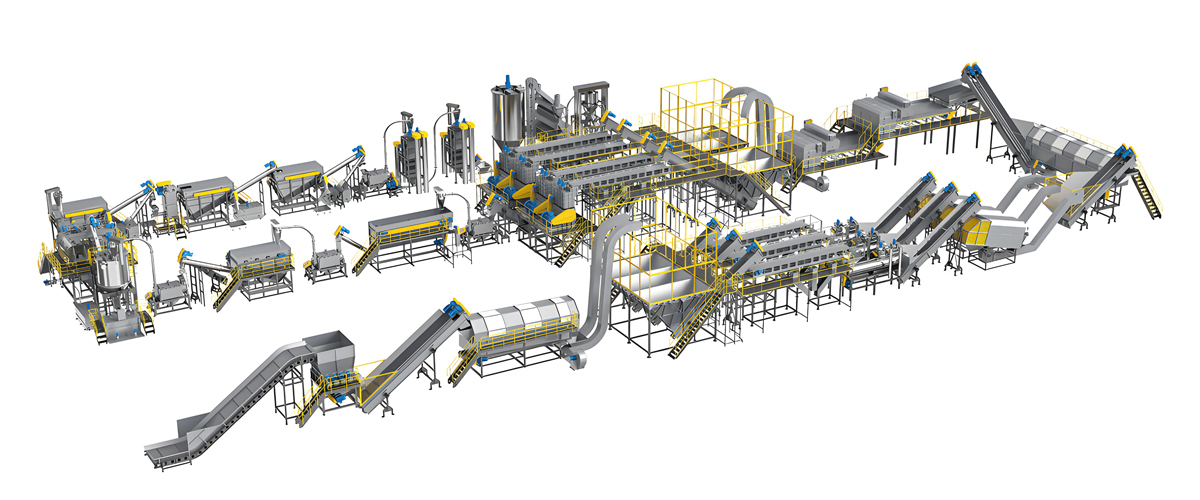
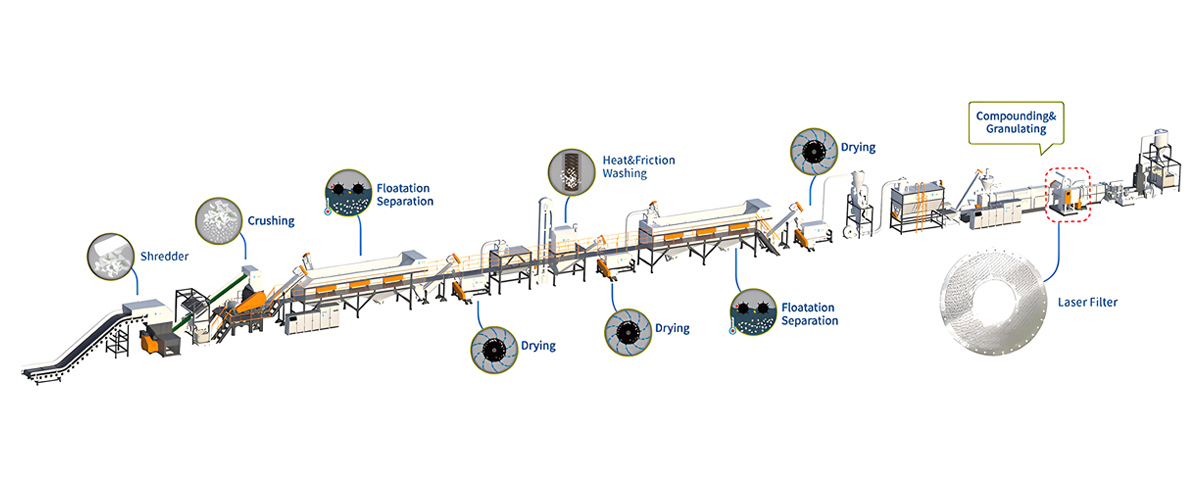
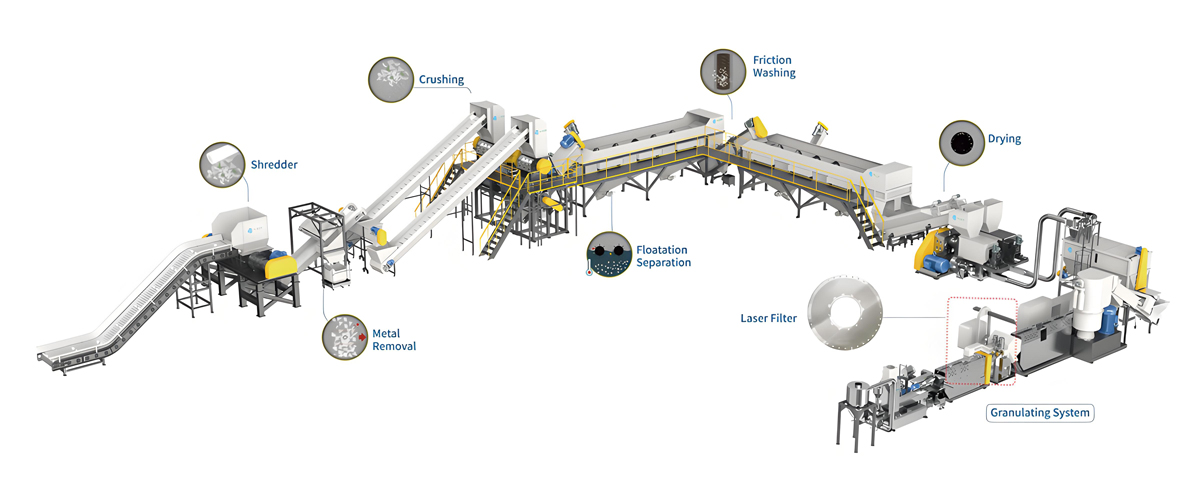
The recommendations above are exactly the kind of parameter set that Polyretec, a Wanplas factory, builds into its PET bottle washing lines and PP/PE soft-plastic washing lines. Polyretec combines Austrian technology with Chinese manufacturing to deliver cost-effective washing systems without compromising recovery, and the floatation stage is engineered around these residence-time, agitation, and weir-control windows rather than left to operator guesswork.
Diagnosing Loss with a Mass-Balance Sampling Plan
A loss-reduction program is only as real as its measurement. The single most useful discipline is a mass-balance check: sample the material at defined points, dry and weigh it, and confirm that what enters the stage equals what leaves it in all streams combined. A floatation stage that cannot close its mass balance is a stage nobody understands, and no tuning decision on it can be trusted. The target closure rate is 98 percent or better; below that, the discrepancy is itself a finding, usually a sampling gap or an uncounted bleed stream.
Set four sampling points. The first is the scum outlet, where floating PE/PP, labels, and any misplaced PET are skimmed. The second is the overflow water, the thin stream that leaves over the weir and carries fines and dissolved solids. The third is the sink discharge, the wanted PET product. The fourth is the water recirculation return, which loops back into the tank and is the hidden home of fines that never left the system. At each point take 5 to 10 kg of sample, dry it to constant weight, and record the dry mass. Convert each stream to a rate using the measured flow, then sum the outputs and compare with the dry input.
Mass-Balance Sampling Points and Calculation
| Sampling Point | What It Reveals | Sample Size | Calculation Step |
|---|---|---|---|
| Scum outlet | PET wrongly floated (sources 1, 3, 4) | 5 to 10 kg, dry-weigh | PET in scum divided by PET in |
| Overflow water | Fines loss (source 2) | 5 to 10 kg, filter and dry | Fines dry mass times flow rate |
| Sink discharge | Recovered PET product | 5 to 10 kg, dry-weigh | Primary recovery numerator |
| Recirculation return | Hidden fines accumulation (source 2, 6) | 5 to 10 kg, filter and dry | Add to outputs before closure test |
| Closure check | Validity of the whole balance | All points same shift | Sum outputs divided by input, target 98 percent or better |
The mass balance does more than confirm recovery; it localizes the loss. If the scum outlet carries clean, full-size PET, your problem is false float or over-agitation, and you should look at surfactant dose and impeller speed. If the overflow and recirculation return are dominated by sub-4-mm particles, your problem is fines, and you should look at the crusher screen and the downstream fines recovery. If the scum carries fiber-wrapped clusters, your problem is label removal in the hot wash. Each pattern points to a different countermeasure, and the balance prevents you from spending effort on the wrong one.
Run this check weekly during steady production and immediately whenever recovery dips or product color shifts. It is a Low difficulty, Low cost procedure that pays back many times over because it keeps every other tuning decision honest. Treat any closure below 98 percent as a failed measurement, not a real result, and repeat the sampling before changing equipment.
Secondary Recovery, Hydrocyclones, and Online Detection
Even a well-tuned primary floatation stage sheds some product into the scum and the fines stream, and the difference between a 95 percent and a 99 percent line is almost entirely what you do with those secondary streams. The goal is to stop treating scum and overflow as waste and start treating them as low-grade feed that still contains recoverable PET.
Secondary Recovery Devices
The scum rewash tank, or rewash tank, takes the skimmed float fraction and re-slurries it with fresh, hot, surfactant-dosed water, then re-floats it. Because the PE/PP and labels are already separated once, the second pass releases a meaningful amount of the PET that was mechanically trapped in the first scum. A centrifuge screen recovers the micro-flakes from the overflow and recirculation water by spinning the slurry and presenting a fine screen that the primary tank cannot. On the water loop itself, fit a 60 to 100 mesh vibrating screen plus a scum remover so that the returning water is stripped of both fine solids and floating debris before it re-enters the tank.
Hydrocyclone Supplement
The hydrocyclone, or hydrocyclone separator, is the precision instrument of the recovery chain. Its separation precision is better than gravity floatation because it classifies by centrifugal force in a strongly accelerated field rather than by slow settling in a still column. A well-set hydrocyclone can drive PVC residue below 50 ppm while simultaneously recovering the micro-flakes that the tank lost. It is especially valuable because it attacks the PVC overlap that floatation alone cannot resolve: where gravity leaves PET and PVC mixed in the sink stream, the hydrocyclone separates them by the small density and shape differences that centrifugal acceleration amplifies.
The hydrocyclone is not a replacement for floatation. It is uneconomic as the sole primary stage for the full coarse flake stream, and it works best as a supplementary precision and recovery stage placed on the underflow and on the recirculation loop. In that position it both cleans the product and reclaims fines, directly supporting the KPI targets below.
Online Detection and Closed-Loop Control
Manual mass balances are essential but slow. To hold the window continuously, add online detection. A near-infrared (NIR) sorter placed before the floatation stage removes most PVC from the feed while it is still dry and cheap to sort, protecting the floatation density window and reducing the load on the hydrocyclone. Density online monitoring in the slurry confirms that the medium stays near 1.0 g/cm3 and alarms if contamination shifts it. Level sensors on the tank and turbidity sensors on the recirculation water feed a closed loop that automatically holds the weir and the water clarity, directly attacking loss sources 5 and 6.
These sensors convert the six loss sources from things you discover after the fact into things the control system prevents in real time. For a line targeting premium food-grade output, this instrumentation is the difference between hitting the KPI occasionally and hitting it every shift.
Target KPIs and Relevant Standards
| Metric | Typical Before | Target After | Main Lever |
|---|---|---|---|
| PET recovery rate | 92 to 95 percent | 98 to 99.3 percent | All six sources addressed |
| PVC residue | Higher, variable | below 50 ppm | NIR pre-sort plus hydrocyclone |
| PE/PP residue | Higher, variable | below 100 ppm | Floatation plus rewash recovery |
| Water consumption (open) | 2 to 4 t per t flake | 0.3 to 0.8 t per t flake (closed) | Recirculation with screen and scum remover |
| Mass-balance closure | Often unmeasured | 98 percent or better | Four-point sampling discipline |
The standards framework matters because recovery alone is not enough; the recovered PET must be certifiably recyclable. EN 15343 defines the traceability and recycled-content calculation method for plastics recycling, and EuCertPlast certifies compliance with it. EU 2022/1616 governs recycled plastic intended for food contact, which is the premium market most PET washing lines target. ASTM D7611 provides the resin identification and coding system used to verify what the flakes actually are, and ISO 15270 gives the general guidelines for the recycling of plastics waste. Designing the floatation and recovery stage to meet these standards is what turns a working line into a sellable, certifiable product. Competitors such as EREMA and Sorema build to similar frames, and matching their recovery and purity numbers is the practical benchmark for a Polyretec line.
For the subsequent pelletizing step, Wanplas’s Kerke factory supplies twin-screw extruders that integrate with Polyretec washing systems, so a complete line can move from cleaned flake to pellet under one quality umbrella. That integration is a separate selection topic and is not expanded here; the focus of this article is the floatation stage loss control that feeds it.
Frequently Asked Questions
Why does PET sometimes float even though its density is higher than water?
PET’s true density of 1.33 to 1.40 g/cm3 is well above water, so a clean, fully wetted flake always sinks. False float happens only when the surface carries trapped air, micro-bubbles, oil films, or static charge that lowers the effective apparent density. Proper friction washing at 800 to 1200 rpm and a surfactant dose of 0.1 to 0.3 percent that brings surface tension to 35 to 45 mN/m remove these effects and let the true density dominate.
How small a flake is too small to recover economically in floatation?
Flakes below 4 mm, the fines fraction, are the single largest contributor to total loss, accounting for 30 to 50 percent of all flake loss because they follow the overflow and recirculation flow. Keeping the under-4-mm fraction at or below 5 percent of feed and screening the mainstream to 4 to 12 mm is the practical control target. Fines that are already formed should be recovered downstream with a centrifuge screen and a hydrocyclone rather than in the primary tank.
What stirrer speed should I run in the floatation separation tank?
Maintain the agitation impeller at 12 to 35 rpm, which corresponds to a tip linear velocity of 0.3 to 0.8 m/s. Above this range, vortex formation drags sinking PET upward into the scum and raises loss by 0.5 to 2.5 percent above optimum. Below it, suspended solids and labels fail to detach from the flake surface, which worsens fiber wrapping and false float. The speed should be set from the start as a fixed parameter, not adjusted by ear.
Can a hydrocyclone fully replace floatation separation?
No. Hydrocyclones deliver finer separation precision than gravity floatation and can drive PVC residue below 50 ppm while also recovering fines, but they cannot economically process the full coarse flake stream alone. The best practice is to use floatation as the primary stage and hydrocyclones as a supplementary precision and recovery stage on the underflow and recirculation loop, where their centrifugal classification resolves the PVC overlap that gravity cannot.
How do I tell whether my recovery loss comes from fines or from false float?
Run a mass balance with four sampling points: the scum outlet, the overflow water, the sink discharge, and the recirculation return. If the scum and overflow carry mostly sub-4-mm particles, the loss is fines dominated and the crusher screen and centrifuge recovery are the levers. If the scum carries clean, dense, full-size PET, the loss is false float from surface contamination or over-agitation, and the friction washer and impeller speed are the levers.
Which water quality parameters matter most for controlling flake loss?
The three that matter most are temperature, suspended solids content, and surface tension. Keep water at 40 to 65 degrees Celsius after the hot alkali wash, hold suspended solids at or below 3 percent, and use a surfactant to bring surface tension to 35 to 45 mN/m. Exceeding any of these thresholds measurably increases both fines carry-off and false float, and suspended solids above 3 percent should trigger hydrocyclone decontamination of the loop.
Is near-infrared sorting necessary before floatation separation?
It is not strictly mandatory, but it is strongly recommended when the feed carries significant PVC. Because PVC density of 1.32 to 1.45 g/cm3 overlaps PET, gravity floatation alone cannot reliably separate them. A front-end NIR sorter removes most PVC before the tank, protecting the floatation window and helping reach the PVC residue target of below 50 ppm while reducing the load on the downstream hydrocyclone.
How often should a mass-balance loss check be performed?
Run a full mass balance weekly during steady production and immediately whenever recovery drops or product color shifts. Each check samples 5 to 10 kg per point, dries and weighs the material, and should close to 98 percent or better. A closure below 98 percent means a sampling or measurement gap, not a real process result, and the check should be repeated before any equipment change is decided.
Conclusion
Flake loss in floatation separation is solvable because it is not a mystery of physics but a set of six measurable, addressable sources. Begin with the density window: PET at 1.33 to 1.40 g/cm3 must sink, PE and PP must float, and PVC at 1.32 to 1.45 g/cm3 must be handled by sorting and centrifugal means rather than by density alone. Then attack the six losses in order: recover PET from the scum overflow, control fines at the crusher and reclaim them downstream, eliminate false float with friction washing and surfactant, strip label pulp in the hot wash, hold impeller speed at 12 to 35 rpm, and keep the weir and water level stable within plus or minus 20 mm and 15 mm respectively.
The engineering window that delivers this is concrete: 8 to 14 mm mainstream flake, 60 to 180 s residence time, 0.8 to 1.5 m tank depth, 40 to 65 degrees Celsius water, 0.1 to 0.3 percent surfactant, 2 to 3 series stages, and a recirculation loop cleaned by a 60 to 100 mesh screen and a hydrocyclone. Measure it all with a four-point mass balance that closes to 98 percent or better, and automate the hold with NIR pre-sort, density monitoring, and level and turbidity closed loops. Done consistently, these steps lift PET recovery from 92 to 95 percent to 98 to 99.3 percent, drive PVC residue below 50 ppm and PE/PP residue below 100 ppm, and cut water use to 0.3 to 0.8 t per t of flake in closed loop, all within the EN 15343, EuCertPlast, EU 2022/1616, ASTM D7611, and ISO 15270 framework.
Polyretec, a Wanplas factory, designs its PET and PP/PE washing lines around exactly these parameters, pairing Austrian process technology with Chinese manufacturing to deliver recovery and purity without a premium cost tier. Wanplas, as the parent brand, backs this with shared quality standards and after-sales commitments across its network of specialized factories. If your floatation stage is shedding good PET into the scum or the water loop, the path above is the one that turns loss into recovered product, shift after shift.