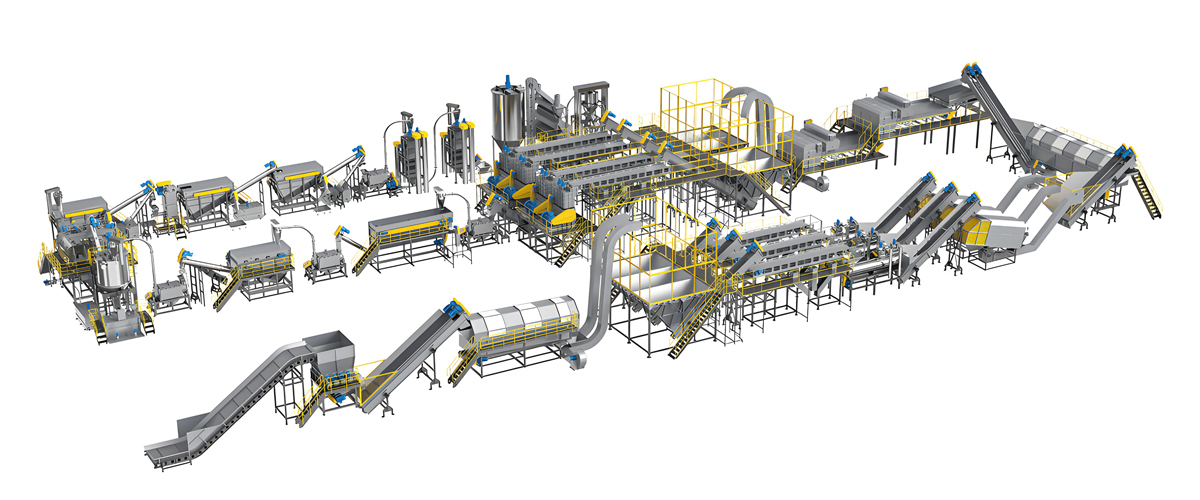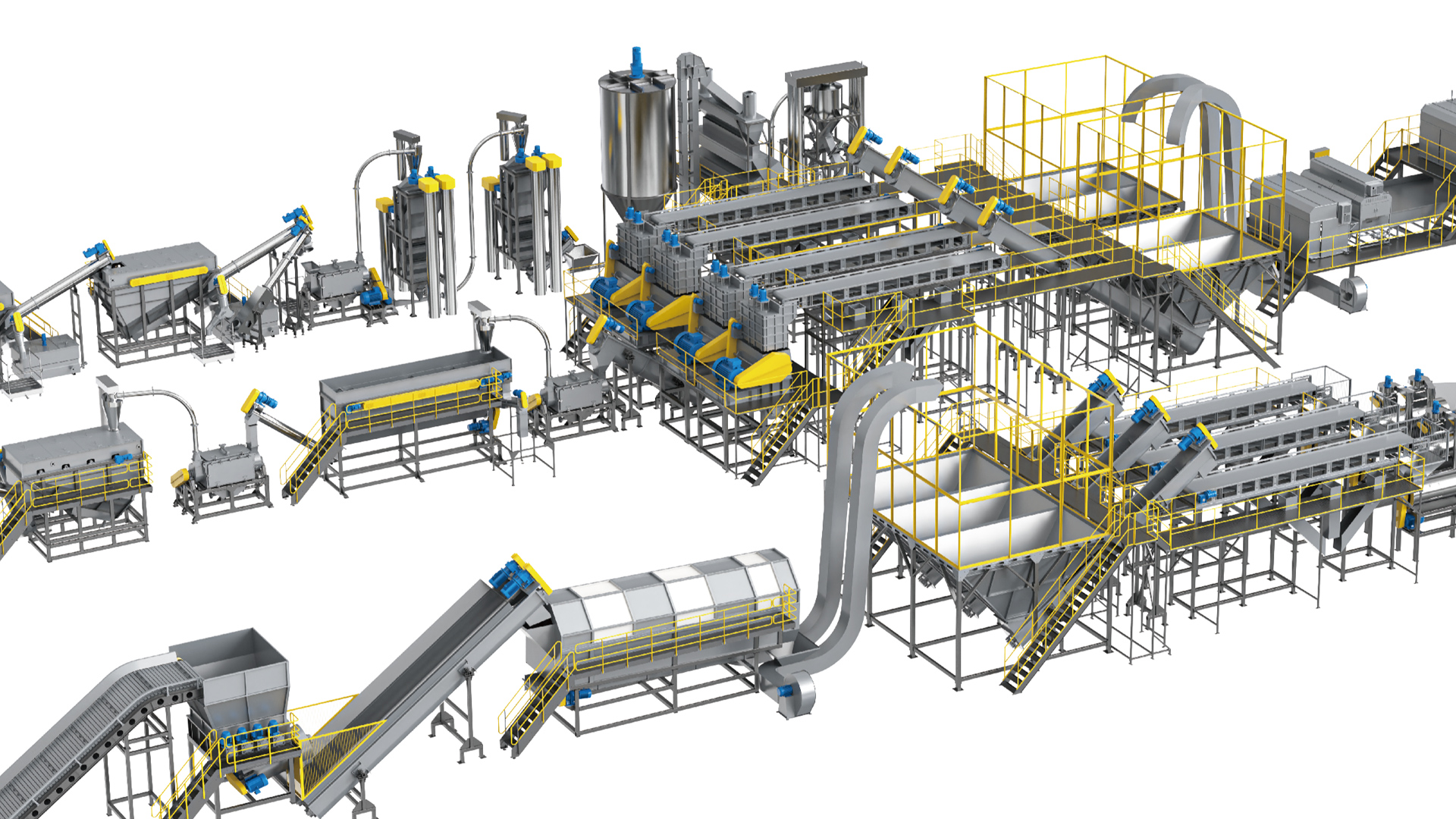

Small and medium enterprises are quietly becoming the backbone of distributed plastic recycling. Unlike mega-plants that depend on enormous, uninterrupted feed volumes, an SME recycler needs a line that is compact, forgiving on variable post-consumer waste, and defensible on capital. The engineering philosophy most associated with this need is the Austrian technology route of plastic recycling: a single-screw extruder married to an integrated cutter-compactor, deep vacuum degassing, continuous laser melt filtration, and closed-loop process control. Polyretec, a Wanplas factory, builds this class of equipment for operators running from a few hundred kilograms per hour up to the low-tonnage commercial range. This article explains what the Austrian technology route actually delivers, how its capacity tiers map to SME plant sizes, how the process chain behaves station by station, which waste streams it handles best, what quality numbers matter to buyers, and how a smaller operator should plan utilities, water, and compliance. By the end, a business owner or plant engineer should be able to read a quotation and a layout drawing with confidence, and to separate genuine engineering substance from marketing noise.
What the Austrian Technology Route Means in Plastic Recycling
The phrase “Austrian technology” in plastic recycling does not refer to a single brand. It refers to a recognizable engineering school that matured around processing difficult, low-bulk-density, contamination-prone polyolefin waste into uniform pellets. The central idea is integration: instead of treating shredding, drying, feeding, plasticizing, filtering, degassing, and pelletizing as separate islands, the route compresses them into a continuous, self-regulating line. The advantages are lower labor intensity, smaller footprint, and far better tolerance for film, fiber, and foam feed that would choke a conventional feeding system.
At the heart sits a single-screw extruder whose barrel receives material not from a passive hopper but from a cutter-compactor mounted directly above the feed throat. The compactor is a hybrid shredder and pre-conditioner. It cuts, heats, and densifies the fluff, then drops it by gravity into the screw. This eliminates the bridging and surging that plague light film and rafia when fed from a standard hopper. The single-screw design is preferred over a co-rotating twin-screw for many post-consumer polyolefin jobs because it is simpler, cheaper to maintain, and sufficiently intensive for the shear levels that polyethylene and polypropylene recycling require.
Devolatilization is handled in two stages where possible. The barrel includes a venting section, and the line applies deep vacuum at one or two ports so that residual moisture and volatiles are pulled below the melt before it reaches the die. A vacuum level at or below minus 0.090 MPa is the practical target. Continuous melt filtration uses a laser filter whose screen is cleaned without stopping the line; a double-column backflush screen changer provides redundancy so that the operator is never forced into an emergency shutdown to swap media. Typical filtration fineness runs from 60 to 150 micrometers depending on the contamination profile.
The distinctive modern addition is closed-loop control. Online viscosity or melt flow rate sensors read the melt in real time. If the MFR drifts, the control system nudges barrel temperature, screw speed, or devolatilization intensity. A laser filter also reports differential pressure across the screen, and that signal feeds back to optimize backflush timing and protect the gear pump. The net effect is that pellet properties stay inside a narrow band even when the incoming bale quality varies from week to week, which is exactly the condition an SME recycler faces.
It is important to be fair to other technology families. The German and Italian schools, the Japanese precision-extrusion tradition, and the Chinese high-value manufacturing base each contribute variants. None is categorically superior; each optimizes for a different feed, budget, and quality target. The Austrian route simply became shorthand for the integrated single-screw plus cutter-compactor concept because it solved the film-and-fiber feeding problem so completely. Polyretec combines that Austrian-derived concept with Chinese manufacturing scale, which is why its lines are positioned at a cost envelope accessible to SMEs rather than only to large converters.
A practical note for buyers: the integrated route concentrates wear on a smaller set of components. The compactor knives, the screw and barrel lining, the laser screen, and the die inserts are the consumables that define maintenance cost. Because the machine runs harder on difficult feed, a sensible SME keeps a scheduled knife regrind cycle, monitors barrel wear against setpoints, and stocks the screen and die spares that the line consumes most. The engineering upside is that these parts are standardized and locally supportable, so the route avoids the locked-in service dependency that some premium European brands impose. The closed-loop control also helps here: by flagging differential pressure and drive-load trends early, it turns maintenance from reactive breakdown repair into planned intervention, which is exactly what a small crew needs to keep utilization high.
Capacity Positioning for Small and Medium Enterprises
SME recycling is not one size. A regional collector, a brand-owned take-back loop, and a dedicated recycler have different volumes, space, and staffing. Three capacity tiers capture most SME scenarios. The first covers roughly 150 to 300 kilograms per hour, the second 300 to 500 kilograms per hour, and the third 500 to 800 kilograms per hour. Each tier implies a different plant footprint, crew size, and installed electrical power, and each implies a different return profile measured in index points rather than currency.
The 150 to 300 kilogram-per-hour tier is the entry point. A team of four to six people can run it across one or two shifts. Covered space of 500 to 800 square meters is usually enough, including storage for baled feed and finished pellets. Installed power sits in the 120 to 200 kilowatt band. This tier fits an operator with a stable but modest local waste stream, such as agricultural film collection in a farming region or post-industrial offcuts from nearby factories.
The 300 to 500 kilogram-per-hour tier is the workhorse of serious SME recyclers. Staffing of six to eight covers feeding, line tending, quality checks, and packaging. Floor area grows to roughly 800 to 1200 square meters once you include washing, the pelletizing line, and buffer silos. Installed power reaches 200 to 320 kilowatts. This is the sweet spot for woven-bag regrind, mixed rigid polyolefin, and steady post-consumer film where the feed is predictable enough to run near nameplate.
The 500 to 800 kilogram-per-hour tier approaches the lower end of industrial scale while still being operator-managed. It needs eight to ten people, 1200 to 1500 square meters, and 320 to 450 kilowatts of installed power. At this size, the economics shift: throughput amortizes the line faster, but utility management and feed consistency become the deciding factors. An operator who cannot secure a steady, sorted stream should not jump to this tier, because idle capacity is the most expensive capacity in recycling.
Three-Tier Capacity Configuration Checklist
| Parameter | Tier 1: 150-300 kg/h | Tier 2: 300-500 kg/h | Tier 3: 500-800 kg/h |
|---|---|---|---|
| Suitable feed examples | Agricultural film, clean industrial offcuts, light rafia | PP woven bags, mixed post-consumer film, rigid regrind | Continuous film, high-volume rigid HDPE and PP, dedicated streams |
| Covered plant area | 500-800 m2 | 800-1200 m2 | 1200-1500 m2 |
| Operating crew | 4-6 people | 6-8 people | 8-10 people |
| Installed power | 120-200 kW | 200-320 kW | 320-450 kW |
| Cutter-compactor size | Small integrated unit | Medium integrated unit | Large integrated unit with buffer |
| Typical investment intensity | Low | Medium | High |
| Maintenance skill demand | Low | Medium | Medium-High |
| Recommended starting mode | Single shift, local feed | One to two shifts, sorted stream | Two shifts, contract feed secured |
The table is a planning aid, not a promise. Real footprint and crew depend on whether washing is included, how automated the packaging is, and whether the building already has power and drainage. Polyretec’s project engineers typically propose the tier from the client’s confirmed monthly feed volume rather than from an aspirational target, because over-sizing is the most common and most damaging mistake in SME recycling.
The Full Process Chain, Segment by Segment
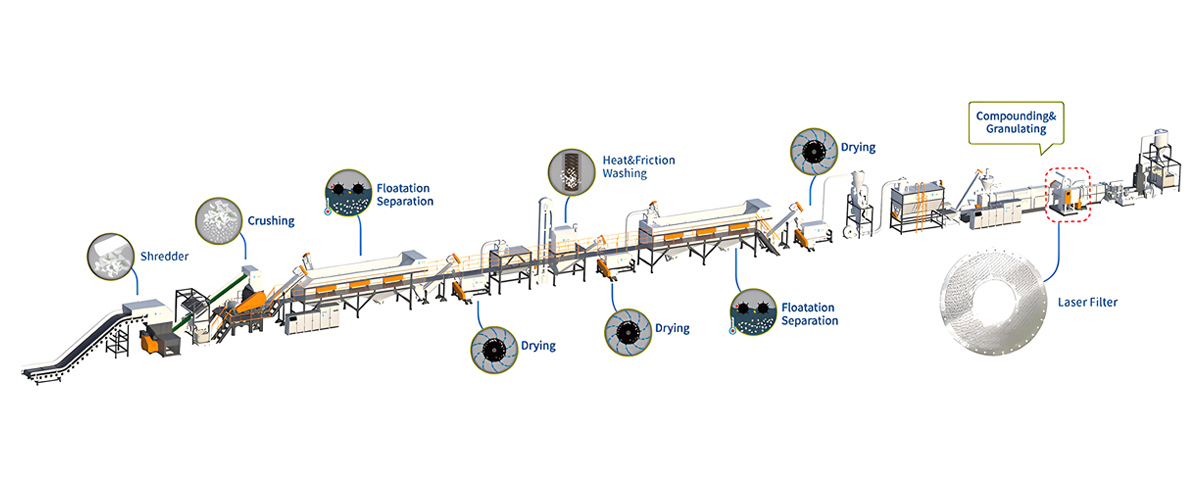
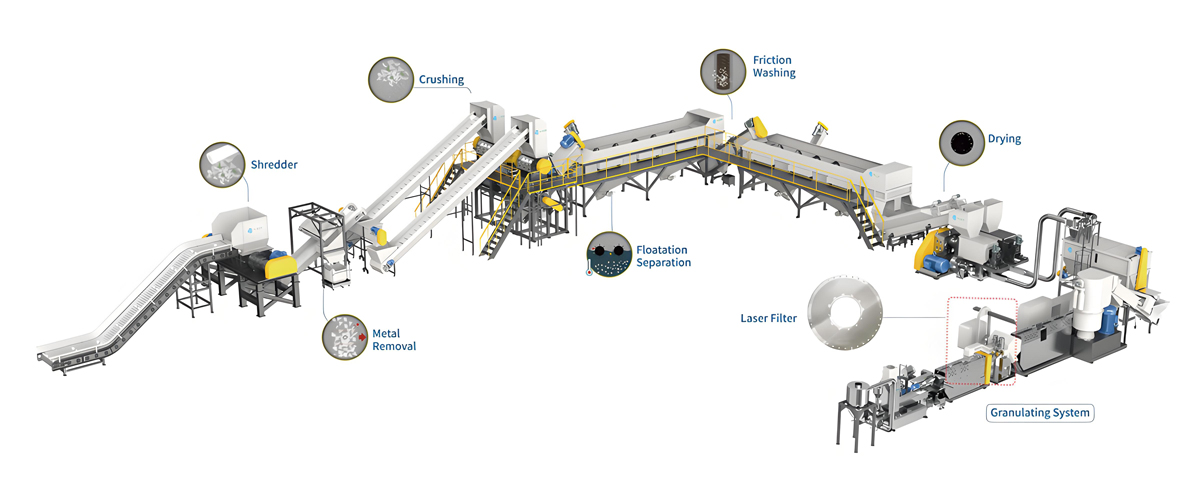
A recycling line is only as good as its weakest station. Walking the chain from bale to pellet reveals where quality is won or lost. The following segments are common to the Austrian-technology single-screw route, with the washing stage included where film and post-consumer waste demand it.
Feeding and Shredding
Baled waste is first opened and, for bulky rigid items, passed through a single-shaft shredder. Knife clearance is set tight, typically 0.3 to 0.8 millimeters, so the cut is clean rather than torn. A screen with 20 to 60 millimeter openings controls the flake or chip size that leaves the shredder. Oversize pieces recirculate; correctly sized material moves forward. For film, a separate shredder or the cutter-compactor itself performs this size reduction, and metal is pulled out by magnetic and sometimes eddy-current separation before the material is compacted.
Cutter-Compactor Pre-Conditioning
The cutter-compactor is where the Austrian route earns its reputation. Rotating knives chop the fluff while a controlled heater raises the mass to 60 to 95 degrees Celsius. At that temperature, surface moisture begins to leave, and the polymer softens just enough to agglomerate. Moisture falls to a 3 to 8 percent band, and bulk density climbs by a factor of 3 to 8. This dense, warm granulate feeds straight into the extruder barrel without bridging. For film and fiber, the compactor is not optional equipment; it is the difference between a line that runs and a line that clogs.
Extrusion and Plasticizing
The single-screw extruder has a length-to-diameter ratio in the 30 to 36 to 1 range. Where deeper homogenization is needed, a twin-stage configuration of 30 plus 10 provides a second plasticizing and devolatilizing zone. The barrel carries a venting section aligned with the vacuum port. Melt temperature is held within polymer-specific windows: polyethylene around 190 to 225 degrees Celsius, polypropylene around 200 to 235 degrees Celsius. Screw speed, barrel profile, and feed rate are the three levers that the control system modulates to hold MFR steady.
Melt Filtration
Before the melt reaches the die, it passes through a continuous laser filter with 60 to 150 micrometer screens. A double-column backflush changer keeps one column online while the other is cleaned, so there is no production gap. Filtration area and the associated differential pressure are managed to stay at or below 8 MPa. The laser filter’s pressure signal is part of the closed loop: when differential pressure rises, backflush frequency increases automatically, protecting the gear pump and the die from pressure spikes.
Devolatilization
One or two vacuum ports pull volatiles from the melt. The objective is to drive residual moisture below 300 parts per million and to strip VOCs and residual ink or label volatiles. Deep vacuum, at or below minus 0.090 MPa, is what lets a line accept moderately wet or printed feed without producing porous, odorous, or brittle pellets. Inadequate degassing is the usual root cause of fisheyes and odor complaints in recycled polyolefin.
Pelletizing
The filtered, degassed melt is cut at the die. Three methods are used depending on the polymer and the plant’s preference. Water-ring pelletizing throws strands or melt into a water ring and cuts at the face; strand pelletizing pulls extruded strands through a cooling bath before a rotary cutter; underwater pelletizing cuts submerged in water for heat-sensitive or high-throughput jobs. Pellet size lands at 2.5 to 4 millimeters, and uniformity of shape and size is a direct indicator of die and cutter tuning.
Over the whole chain, the human interface matters as much as the hardware. A modern Austrian-route line presents its setpoints, alarms, and trend data through a PLC and HMI that an operator can learn in days rather than weeks. Recipe management lets the plant store a profile for each feed type, so switching from agricultural film to woven bags is a loaded recipe rather than a manual re-derivation of temperatures and speeds. Data acquisition records barrel zones, vacuum level, melt pressure, and MFR trend so that quality claims to a buyer or certifier rest on evidence. For an SME, this is the quiet advantage: the line does not require a polymers engineer on every shift, only a trained technician who can read alarms and follow the recipe book the commissioning engineer leaves behind.
Downstream and Finishing
Fresh pellets are dewatered in a centrifuge, then dried in a fluidized or ventilated dryer until residual moisture is below 0.05 percent. A metal detector catches any ferrous or non-ferrous fragment that escaped upstream. Pellets are then equalized in a homogenizing silo so that minor batch-to-batch variation is smoothed before bagging. Finally, automatic packaging weighs and seals the product for shipment. A flotation and washing stage, including friction washers and rinse tanks, sits upstream of the compactor for dirty post-consumer feed; it is addressed only briefly here because a companion article on this site covers flotation losses in detail.
Process Segment to Parameter to Quality Impact
| Process segment | Key parameter | Quality impact if mis-set |
|---|---|---|
| Shredder | Knife gap 0.3-0.8 mm; screen 20-60 mm | Torn stock raises fines, hurts compactor throughput and pellet uniformity |
| Cutter-compactor | 60-95 C; moisture 3-8%; density x3-8 | High moisture or low density causes bridging, surging, and poor melt |
| Extruder barrel | L/D 30-36:1; PE 190-225 C; PP 200-235 C | Over-temperature degrades polymer; under-temperature gives unmelt and gels |
| Melt filtration | Laser 60-150 micrometer; dP at or below 8 MPa | Coarse screen leaves black specks; high dP risks die and pump failure |
| Devolatilization | Vacuum at or below -0.090 MPa; moisture under 300 ppm | Trapped volatiles cause fisheyes, odor, and brittle pellets |
| Pelletizing | Pellet 2.5-4 mm; uniform shape | Off-size or tails create handling, dosing, and re-melt problems downstream |
| Drying and silo | Residual moisture below 0.05%; homogenizing | Wet pellets hydrolyze in reprocessing; poor mixing gives lot-to-lot variation |
Material Families and Process Compensation
No single line is perfect for every plastic. The Austrian single-screw route shines on polyolefins and handles several families with specific compensations. Knowing the limits prevents expensive mismatch.
LDPE Agricultural Film
Low-density polyethylene agricultural film is the classic cutter-compactor feed. It arrives dirty, with soil content around 3 to 8 percent and moisture as high as 5 to 20 percent. Washing removes the bulk of soil, and the compactor drives the residual moisture into the acceptable 3 to 8 percent band before extrusion. Without the compactor, such wet, light film would be nearly impossible to feed steadily.
PP Woven Bags and Rafia
Polypropylene woven bags, rafia, and tape scrap densify well and tolerate the route’s temperature window. Printing ink is the main contaminant, and the deep vacuum stage is what pulls the associated volatiles. A finer laser screen (toward 60 to 90 micrometers) is often justified when ink load is high.
HDPE Rigid Material
High-density polyethylene rigid items, such as bottles, caps, and crates, are denser and less dependent on the compactor for density gain, but they still benefit from the integrated feeding for surge control. Rigid feed usually needs less washing and tolerates coarser filtration, which extends screen life and lowers backflush frequency.
PET Bottle Flakes
PET is the important exception. Polyethylene terephthalate must be crystallized and dried before melt extrusion to avoid hydrolytic chain scission, and its intrinsic viscosity must be maintained or rebuilt, often via solid-state or a co-rotating twin-screw route rather than a single-screw cutter-compactor line. Polyretec’s PET bottle washing lines handle the flake-cleaning stage separately, and the pelletizing stage for PET follows a different machinery logic. An SME should not expect to run PET bottles and LDPE film on the identical single-screw configuration without significant changeover work.
Multi-Layer Composite Film
Multi-layer films that combine polyolefins with EVOH, nylon, or aluminum pose a real limitation. The incompatible layers and metallization resist homogenization and raise gel and delamination risk in the pellet. Where such material is a small fraction of the stream, the line tolerates it; where it dominates, a different process or dedicated sorting is required. Honest assessment of the feed mix is essential before committing capital.
Contamination and Additive Compensation
Beyond the polymer family, the line must compensate for what the waste carries. Printed film brings pigment and ink that the vacuum stage must strip; heavily filled material raises ash and demands finer, more frequent filtration. In practice, recyclers add small doses of stabilizer or antioxidant at the compactor or via a side feeder to protect the melt from oxidative degradation during the second pass through heat and shear. A compatibilizer may be introduced when the stream blends polyethylene and polypropylene that would otherwise phase-separate. These additions are deliberate and measured, not improvised, because overuse of additive shifts the MFR and ash budget and can invalidate a certification. The disciplined operator treats additive dosing as part of the recipe, logged alongside temperature and vacuum, so the pellet remains predictable lot after lot.
Waste Type to Pretreatment to Configuration
| Waste type | Pretreatment requirement | Recommended configuration |
|---|---|---|
| LDPE agricultural film | Washing, soil removal, pre-dry to 3-8% moisture | Cutter-compactor plus single-screw, deep vacuum, 90-150 micrometer laser |
| PP woven bags and rafia | Bale opening, metal separation, light wash | Cutter-compactor, single-screw, 60-90 micrometer screen for ink |
| HDPE rigid regrind | Shred to 20-60 mm, metal removal, optional wash | Single-screw or compactor-fed, coarser 120-150 micrometer filtration |
| PET bottle flakes | Crystallization, drying, IV management | Dedicated PET washing line plus twin-screw or solid-state route, not single-screw compactor |
| Multi-layer composite film | Front-end sorting to limit incompatible layers | Accept only as minority blend; finer filtration, higher degassing, frequent gel checks |
Quality Metrics That Define a Bankable Pellet
A recycled pellet is only worth what a converter will pay, and that price rests on measurable, repeatable properties. The Austrian route’s closed-loop control exists to hold these numbers inside a salable band.
Melt flow rate stability is the first gate. Buyers specify an MFR window, and the line should hold within plus or minus 10 percent across a run and across lots. Online MFR or viscosity sensing is what makes this achievable on variable feed. Gel count, the number of un-melted or cross-linked specks per area, reflects filtration and temperature control; a clean laser screen and correct barrel profile keep it low. The yellowing index, or YI, tracks thermal and oxidative history. A line that runs too hot or with inadequate vacuum will drift yellow, and color-sensitive converters will reject the lot.
Mechanical retention matters for applications that demand strength. Tensile strength retention of 85 to 95 percent relative to a virgin reference is a realistic, defensible target for well-run polyolefin recycling. Ash content, the non-combustible residue from inorganic contamination, should sit at or below 1.5 percent; higher ash signals insufficient washing or screen failure and degrades both appearance and processing. Together these metrics tell an SME operator whether the line is merely running or actually producing a product.
European Integrated Route vs Traditional Split Route
When an SME evaluates options, the main fork is between the integrated Austrian-style single-screw plus cutter-compactor line and a traditional split configuration where a standalone shredder, a separate agglomerator, and a basic single-screw extruder are bolted together. The table below compares them using investment intensity and maintenance difficulty rated on a five-step scale of Low, Medium, High, Very High, and Premium.
| Comparison dimension | European integrated route (single-screw + cutter-compactor) | Traditional split route (separate shredder, agglomerator, extruder) |
|---|---|---|
| Investment intensity | Medium | Low to Medium |
| Footprint efficiency | High | Low |
| Labor demand | Low | Medium to High |
| Maintenance difficulty | Medium | High |
| Tolerance to film and fiber | Very High | Low to Medium |
| Process control and automation | High | Low |
| Product consistency (MFR stability) | High | Medium |
| Upgrade and expansion cost | Medium | High |
| Best-fit operator | SME with variable post-consumer feed | Operator with clean, uniform in-house scrap |
The split route’s appeal is a lower entry ticket and the ability to run each machine independently, which some operators prefer for flexibility. Its weakness is that it pushes the difficult coordination work onto people: an operator must match shredder output, agglomerator condition, and extruder appetite by hand. The integrated route spends more upfront on engineering so that the line self-coordinates. For an SME short on specialist labor, that trade is usually worth it. Where feed is clean, single-source industrial scrap, the split route can still be rational.
SME Implementation Recommendations
Buying the line is the easy part. Running it profitably for years is where SMEs win or lose. Four recommendations follow from the engineering above.
First, phase the investment. A modular approach lets an operator start with washing and a single pelletizing tier, then add a second extruder, a second silo, or automated packaging as feed volume proves out. Wanplas, the parent brand of Polyretec, and its network of specialized factories support this staged thinking, and Wanplas’s Kerke factory supplies co-rotating twin-screw extruders that can later integrate with Polyretec washing systems for PET or engineering-resin streams. Beginning small protects cash flow and avoids paying for idle capacity.
Second, plan utilities before the machines arrive. Compressed air, three-phase power sized to the installed kilowatt band of the chosen tier, chilled and process water, and drainage must be designed into the building, not improvised. A common SME failure is to install a capable line on inadequate power or water, then wonder why output never reaches nameplate.
Third, close the water loop. A recycling washing line can be water-hungry, but a properly designed closed-circuit system returns 85 to 95 percent of process water after flotation, friction washing, and centrifugation, with turbidity managed by settling and filtration. Sludge from the clarifier is dewatered and routed to approved handling rather than discharged. Beyond compliance, water reuse is a direct operating-cost lever, and in many regions it determines whether the permit is granted at all.
Fourth, respect noise, dust, and energy. Shredders and centrifugal dryers generate noise that needs enclosures or buffer distance; dust from flake handling needs capture at transfer points. Specific energy consumption for a well-tuned cutter-compactor plus single-screw line typically falls in the 0.25 to 0.45 kilowatt-hour per kilogram range. Holding the lower end depends on matching the compactor preheat to the feed, minimizing idle running, and keeping the filtration differential pressure controlled rather than letting screens clog.
Fifth, treat commissioning and training as part of the capital, not an afterthought. A line that ships and sits is a liability; a line that is installed, run on trial feed, and handed over with a documented recipe book and a trained crew is an asset from week one. Budget for the factory-acceptance run, the on-site commissioning, and at least one full shift of supervised operation. Track overall equipment effectiveness from the start: availability lost to unplanned downtime, performance lost to slow cycles, and quality lost to off-spec pellets. An SME that measures these three numbers quickly learns whether the bottleneck is feed supply, a single worn station, or simply under-staffing, and can fix the right thing rather than guessing. The Austrian route’s instrumentation makes this measurement cheap; the discipline to use it is the operator’s responsibility.
Standards and Certifications for Recycled Output
For an SME that wants to sell beyond the local commodity market, certifications are not paperwork; they are the ticket to brand-led and European supply chains. Several frameworks matter.
EuCertPlast certifies plastic recycling processes in Europe with an emphasis on traceability and responsible input. EN 15343 is the European standard that defines traceability and recycled content calculation, and it is frequently required alongside EuCertPlast. ISO 15270 provides guidance on the recovery and recycling of plastics waste at a process level. The Global Recycled Standard, known as GRS, verifies recycled content across the supply chain and includes social and environmental processing criteria. RecyClass assesses the recyclability and recycled content of plastic packaging and issues letters of compatibility that converters rely on. For the most demanding application, food-contact recycled plastic in the European Union is governed by Regulation EU 2022/1616, which sets the framework for processes that produce recycled material intended to touch food.
An SME should treat these not as a checklist to clear at the end, but as design inputs from day one. Chain-of-custody documentation, input legitimacy verification, and consistent process records are what auditors examine, and a line built around closed-loop control and homogenizing storage is far easier to certify than one run by intuition. Polyretec, as a Wanplas factory with project experience across many countries, typically supports certification readiness through documented process parameters and traceable equipment configuration.
Frequently Asked Questions
What does the Austrian technology route mean for a plastic recycling line?
It describes an engineering philosophy built on single-screw extrusion integrated with a cutter-compactor, twin-stage devolatilization, continuous laser melt filtration, deep vacuum degassing, and closed-loop online viscosity or melt flow rate control. The goal is stable pellet quality from contaminated or low-bulk-density post-consumer waste with reduced operator skill demand.
Which capacity tier should a small or medium enterprise select?
SMEs typically choose between 150-300 kg/h, 300-500 kg/h, and 500-800 kg/h. The first suits niche film or regional collectors, the mid tier fits steady woven-bag or rigid regrind streams, and the upper tier serves dedicated recyclers with stable feed and 500-1500 m2 of covered space.
Why is the cutter-compactor essential for film and fiber feed?
Loose film and fiber have very low bulk density and high trapped air and moisture. The cutter-compactor preheats material to 60-95 C, reduces moisture to 3-8 percent, and raises bulk density by 3-8 times, eliminating bridging and allowing direct, surge-free feeding into the extruder barrel.
Can PET bottle flakes be processed on this type of line?
PET requires a different path than polyolefin film. It needs crystallization and pre-drying before extrusion, and intrinsic viscosity management through solid-state or co-rotating twin-screw options to avoid hydrolytic and thermal degradation. Polyretec’s PET washing lines separate this washing stage from polyolefin pelletizing.
How is product quality verified on the line?
Melt flow rate stability is held within plus or minus 10 percent, gel count and yellowing index are monitored, ash is kept at or below 1.5 percent, and tensile strength retention is targeted at 85-95 percent of virgin reference. Online MFR or viscosity sensors close the loop with the barrel temperature and screw speed.
What certifications matter for recycled pellet buyers?
For European and brand-led supply chains, EuCertPlast, EN 15343 traceability, ISO 15270, GRS, RecyClass, and EU 2022/1616 for food-contact recycled plastic are the most relevant. They verify chain of custody, input legitimacy, and process control rather than only the final pellet specification.
How should an SME control water and energy consumption?
A closed-loop water system returns 85-95 percent of process water after flotation, friction washing, and centrifugation, with sludge dewatered and routed to approved handling. Specific energy consumption typically lands at 0.25-0.45 kWh per kilogram of output when the cutter-compactor and degassing are tuned to the feed.
Is the single-screw route suitable for multi-layer film waste?
Only as a minority component. Multi-layer films with EVOH, nylon, or aluminum resist homogenization and raise gel and delamination risk. An SME should sort such material out at the front end or limit its share, using finer filtration and more aggressive degassing when it cannot be avoided.
Conclusion
The Austrian technology route of plastic recycling, centered on the single-screw extruder with an integrated cutter-compactor, deep vacuum degassing, continuous laser filtration, and closed-loop MFR control, is arguably the most SME-friendly architecture available today. It converts variable, low-density, contaminated polyolefin waste into a consistent, certifiable pellet without demanding a large specialist crew. By selecting the right capacity tier among 150-300, 300-500, and 500-800 kilograms per hour, planning utilities and a closed water loop up front, and designing for certification from day one, a small or medium enterprise can build a recycling operation that is compact, defensible, and ready for brand-led supply chains. Polyretec, a Wanplas factory, brings this Austrian-derived concept together with Chinese manufacturing scale so that the technology sits within reach of operators who would otherwise be locked out of quality recycling. The line is not magic; it is disciplined engineering, and disciplined engineering is exactly what turns waste into treasure.