
Reducing plastic waste in the washing line process is one of the fastest ways a recycler can improve profitability without buying more material. The phrase “reduce plastic waste” here means two things at once: losing less recoverable polymer to fines, water, and mis-sorting, and producing cleaner flakes that the market will pay more for. A well-tuned washing line keeps good plastic inside the circuit instead of flushing it out with sludge or throwing it away with contaminants.
Polyretec, a Wanplas factory, has built plastic recycling equipment since 2010 and has operated under the Polyretec brand since 2017. With more than 100 project references, equipment running in over 50 countries, and a team of 24 plus engineering specialists, Polyretec designs washing lines that treat material loss as a measured, controllable variable rather than an accepted cost. From the PTW1000 film washing line running in Taiwan to post-consumer PET projects across multiple regions, the engineering focus is consistent: maximize input-to-output yield while keeping water and energy in check.
This guide walks plant managers, process engineers, and procurement teams through the full loss-control picture. You will learn how to define and measure loss on a dry basis, read a per-stage loss map, control fines during crushing and friction washing, recover material from process water, tune density separation, set the hot washing window, manage incoming material, optimize equipment, hand over clean flakes to pelletizing, and run a data-driven improvement program. Every recommendation is framed so you can apply it with standard, generic chemicals and standard machines.
Understanding Material Loss in the Washing Line Process
Before any equipment change, you must agree on what “loss” means. In a washing line, not every kilogram that leaves the system is wasted plastic. Some of it is contamination that was never valuable, and removing it is the entire point of washing. Confusing the two leads to bad decisions, such as keeping dirt in the product to inflate yield numbers.
Material loss is recoverable polymer that exits the process as fines, entrained particles, or mis-sorted flakes and can no longer be sold as flake or pellet. Legitimate rejects are non-plastic contaminants such as labels, caps, dirt, sand, metal, and incompatible polymers like PVC in a PET stream. Only material loss counts against your true yield. Legitimate rejects are the quality price of cleaning, and a line that reports zero rejects is almost certainly shipping dirty product.
All loss accounting should be done on a dry basis. Wet flake weighs more because of adsorbed and free water, so comparing a wet input to a wet output hides the real number. Weigh each stream after drying, or correct for measured moisture, then express everything as a percentage of dry input. This single discipline removes most arguments about whether a line is “losing too much.”
Typical full-line material loss ranges, excluding legitimate rejects, fall into clear bands by feed type. Film materials such as agricultural film and printed packaging film lose the most, roughly 12 to 25 percent, because they shred easily into fines and carry heavy soiling. Rigid containers and hard PP/PE lose 6 to 12 percent. PET bottle flakes sit between, around 8 to 15 percent, with the spread driven by label, cap, and PVC content. A line outside its band is a line with a controllable problem.
The cleanest way to see the whole picture is a mass balance. The table below shows a dry-basis mass balance for a 1000 kg/h post-consumer film line. It separates clean output, fines, legitimate rejects, and mis-rejection so you can see exactly where polymer disappears.
The Dry-Basis Mass Balance
| Stream | Flow (kg/h, dry) | Share of input | Classification |
|---|---|---|---|
| Dry input (baled film) | 1000 | 100.0 percent | Reference |
| Clean dried flakes (output) | 815 | 81.5 percent | Yield |
| Fines to process water | 65 | 6.5 percent | Material loss |
| Mis-sorted PP/PE with PET stream | 25 | 2.5 percent | Material loss |
| Adhered organics and residue | 25 | 2.5 percent | Material loss |
| Labels, caps, dirt, foreign material | 70 | 7.0 percent | Legitimate rejects |
In this example the recoverable material loss is 11.5 percent and legitimate rejects are 7.0 percent, for a total technical loss of 18.5 percent. That sits inside the film band of 12 to 25 percent. If your measured number is higher, the loss map in the next section tells you which stage to inspect first.
The Per-Stage Loss Map
A loss map breaks the line into stages and assigns each a typical loss rate, a loss form, a primary cause, and a countermeasure. The rates below are expressed as a percentage of each stage’s own input, not as a cumulative figure, because that is how you diagnose a running line. The overall mass balance remains the final arbiter.
How to Read the Loss Map
Treat the map as a diagnostic checklist. When your total loss is above band, walk the line stage by stage with a bucket and a scale, measure the local loss, and compare it to the table. Most plants find that two or three stages explain nearly all avoidable loss. Fix those first; the rest are usually within tolerance.
| Process stage | Typical loss (percent of stage input) | Loss form | Primary cause | Countermeasure |
|---|---|---|---|---|
| Pre-sorting | 0.5 to 2.0 | Mis-rejection of good material | Rushed manual sort, no metal detection | Sorting table, metal detector, trained crew |
| Crushing or shredding | 1.0 to 3.0 | Fines, over-shredding | Wrong screen aperture, tight knife gap | Optimize screen and knife gap, limit passes |
| Pre-wash and label removal | 1.0 to 3.0 | Labels, caps, dirt as rejects | Weak label remover, short soak | Label remover, longer pre-soak, grit removal |
| Friction washing | 2.0 to 5.0 | Fines, attached contamination | High speed, long residence, worn screen | Tune speed and residence, maintain screen plate |
| Hot washing | 1.0 to 3.0 | Alkali degradation, weight loss | Over-alkali, long time, high temperature | Balance caustic and time to soiling |
| Sink-float separation | 1.0 to 4.0 | Mis-rejection, density errors | Bubbles, wrong density, single stage | Density control, multi-stage, de-aeration |
| Rinsing | 0.5 to 2.0 | Carry with water | Open discharge, no screen recovery | Screened rinse tank, recirculated rinse |
| Dewatering | 1.0 to 3.0 | Fines through screen basket | Aperture too large, worn basket | Match aperture to flake size, monitor wear |
| Drying | 0.5 to 1.5 | Fine dust, entrainment | High air velocity, worn seals | Optimize air, recover dust to loop |
| Pelletizing (downstream) | 2.0 to 5.0 | Startup waste, screen change | Moisture, degradation, changeover | Dry feed, steady run, Wanplas pelletizing |
The two stages with the highest recoverable loss are normally friction washing and dewatering, because they generate or release fines. The stages with the highest mis-rejection risk are pre-sorting and sink-float separation. A balanced improvement plan attacks both kinds of loss, not just the one that is easiest to see.
Controlling Fines Loss During Crushing and Friction Washing
Fines are the silent thief of a washing line. They are small enough to pass through screens, light enough to stay suspended in water, and cheap enough that nobody notices them until the yield report comes in. Controlling fines starts at the crusher and continues through every wet stage.
Crushing sets the particle size distribution for everything downstream. A film or bottle that is cut to a consistent flake size washes more evenly and loses less. Over-shredding happens when the screen aperture is too small, the knife gap is too tight, or material passes through the crusher more than once. Each extra pass grinds more of the good flake into dust. The fix is to choose a screen aperture that matches the target flake size and to set the knife gap so the cutter shears rather than pulverizes.
The friction washer is where attached soil, ink, and glue are scrubbed off, but it is also where fines multiply if mismanaged. Higher rotor speed and longer residence time clean better up to a point, then they start eroding the flake edge into fines. The optimum is the lowest speed and shortest time that still meets your cleanliness spec. Worn screen plates open the gap and let fines circulate and re-grind, so screen plate condition should be a scheduled check, not a breakdown repair.
Fines Recovery Methods
Even with good crushing and washing, some fines are unavoidable, and they are worth recovering. Four methods are commonly used, often in combination:
- Cyclone separation concentrates fine solids from the water stream so they can be returned or sold as regrind for low-grade uses.
- Microfiltration on the recirculation loop captures the smallest particles before they reach the sludge pond.
- Sedimentation and grading in a settling tank lets heavier, more valuable particles drop first while ultra-fines stay suspended and are handled separately.
- Filter press recovery dewaters the sludge so the recoverable fraction is squeezed out instead of landfilled with the rejects.
A plant that ignores fines recovery typically loses two to four yield points to the water loop alone. Adding even a settling tank and a filter press closes most of that gap at a moderate investment.
Minimizing Loss Carried Away by Process Water
Water is the transport medium of a washing line, and it is also the highway that fines use to escape. Every liter that leaves the line open-ended can carry polymer with it. The two levers are the dewatering screen basket and the water recirculation design.
The centrifugal dryer, often called a dewatering machine, uses a rotating screen basket to throw water out while keeping flake in. The basket aperture must match the product. For flakes in the 8 to 14 mm range, an aperture of 0.5 to 2.0 mm is typical, with finer flakes needing the smaller end. If the aperture is too large, good flake follows the water. If it is too small, the basket clogs and the line slows. Worn baskets drift open over time, so aperture should be measured during planned maintenance, not guessed.
Water recirculation is where yield and cost meet. A side-filtration loop on the main tank removes suspended solids continuously, a sedimentation tank grades particles by settling rate, and material is recovered from the sludge before dewatering. With good design, water reuse reaches 80 to 95 percent, which cuts the fresh water bill sharply. But higher reuse concentrates fines, so the recovery equipment must scale with the recirculation rate. The coupling is direct: push reuse up without recovery, and you trade water savings for yield loss.
The practical rule is to recover before you discard. Any stream that goes to the sludge pond should first pass a screen or a cyclone fine enough to catch your smallest saleable flake. Whatever you capture can re-enter the loop or be sold as off-grade material; whatever you miss is gone.
Density Separation and Avoiding Mis-Rejection
The sink-float separation tank is where polymers are split by density, and it is the stage most sensitive to mis-rejection. PP and PE float because their density is 0.90 to 0.96 g/cm³, while PET sinks at 1.38 g/cm³. A correct tank keeps the two streams apart and sends contamination down with the heavy fraction.
Mis-rejection happens when light flakes falsely sink. The usual cause is entrained air bubbles clinging to the flake surface, which add buoyancy-busting weight, or attached dirt and moisture that push density above the cut point. De-aeration, a brief pre-wet, and clean tank water reduce false sinking. Where the cut is tight, a salt or specific gravity adjuster sets the water density precisely between the two polymer groups so the separation is crisp rather than gradual.
Multi-stage separation trims residual errors. A first tank does the bulk split, a second polishes the float stream, and a third recovers value from the sink stream before it is rejected. For mixed post-consumer bales, optical or near-infrared sorting after the tank removes the last mis-sorted pieces, especially PVC hiding in PET. Keeping mis-rejection under control protects yield without sacrificing purity, which is the real goal of the sink-float step.
Optimizing the Hot Washing Window
Hot washing removes grease, food residue, glue, and persistent organics that cold water cannot touch. The process window is well defined: temperature 75 to 90 degrees Celsius, caustic soda (NaOH) concentration 1 to 3 percent, residence time 10 to 20 minutes, with a non-ionic surfactant dosed to wet the soil and a defoamer to control foam. Inside that window, cleaning improves steadily with each parameter.
Why Over-Alkali Backfires
Push past the window and the chemistry turns against you. Caustic above three percent or residence over twenty minutes begins to attack the polymer surface, raising weight loss and lowering the melt strength of the final pellet. The flake looks clean but weighs less and processes worse. The balance is to dose the chemical to the soiling level: lightly soiled material needs the low end of the window, heavily soiled material the high end, but never beyond it. A defoamer keeps the tank from boiling over, and the non-ionic surfactant does the wetting work so the caustic can be held at the minimum effective level.
Monitoring alkali concentration and topping up based on measured load, rather than a fixed daily dump, keeps the window stable across shifts and prevents the slow drift into over-alkali that erodes yield week after week.
Incoming Material Management and Pre-Sorting
No washing line can out-clean a bad bale. Incoming material quality sets the ceiling on your yield, and a small rise in contamination amplifies loss through every downstream stage. As a rule of thumb, every five percent increase in foreign material or soiling raises sorting burden and can add several points of material loss once mis-rejection and over-cleaning are counted.
Pre-sorting is the cheapest loss control you will ever buy. A manual sorting table removes large non-plastic objects before they jam or contaminate the line. Air separation lifts film and light fractions away from heavy rejects. A magnetic separator and a metal detector catch ferrous and non-ferrous pieces that would otherwise damage equipment and force rejects. Near-infrared sorting, where budget allows, automates polymer-level separation at the front end so the wet line only sees the right plastic.
An incoming acceptance standard turns this from hope into procedure. The table below is a starting point that each plant can tune to its own bale supply.
Incoming Material Acceptance Standard
| Parameter | Acceptable range | Action if exceeded | Loss impact |
|---|---|---|---|
| Foreign material, non-plastic | Less than 3 percent by weight | Pre-sort or reject the load | High |
| Moisture and dirt | Less than 15 percent | Pre-dry or pre-wash | Medium |
| Metal content | Less than 0.1 percent | Magnetic and detector check | High |
| PVC in PET stream | Less than 1 percent | Sort out before washing | High, downgrades grade |
| Film thickness variation | Uniform bales | Crusher tuning | Medium |
| Label coverage, PET bottles | Less than 15 percent | Label remover, longer soak | Medium |
Equipment-Side Optimization for Lower Loss
Loss is not only a chemistry problem; it is a mechanical one. Small equipment details decide whether polymer stays in the product or leaves as dust and sludge.
The Role of the Friction Washer Screen Plate
The friction washer screen plate sets how much material is retained versus ground finer. A plate matched to the flake size scrubs without pulverizing. Worn plates open the gap and should be replaced on a schedule tied to throughput, not to failure. The screw gap in the conveyor and washer affects how gently material is handled; tight gaps shear flakes, wide gaps let them tumble and clean by rubbing.
The centrifugal dryer screen basket wears in the same way, and its wear directly raises fines loss, so basket inspection belongs in the same maintenance plan. Conveying sections leak when seals or transfer points are loose, dropping flake onto the floor where it is swept into reject. Pipe dead corners accumulate material that goes stale, degrades, and is flushed out at the next purge. Shutdown draining and clean-out should be a written procedure so the line does not lose a batch of good material every time it stops.
None of these items is expensive on its own, but together they explain why two lines of the same model can show five points of different yield. The disciplined plant maintains the machines; the others lose polymer to wear they never measured.
Drying, Pelletizing Handover, and Downstream Loss
The washing line does not end at the flake; it ends where the next process accepts the material. A clean, dry flake that is handed to pelletizing in the wrong condition creates loss all over again.
After centrifugal dewatering, flakes should reach below three to eight percent moisture depending on the polymer, with PET driven close to one percent by hot-air drying. Moisture above target causes poor venting in the pelletizing extruder, foaming, and thermal degradation, all of which waste material and lower quality. The hot-air dryer temperature and residence time should be set to the polymer and checked against the incoming moisture, not left at a fixed value.
At the pelletizing handover, the largest losses are startup waste and screen change waste. A cold start produces off-spec strand until temperatures stabilize, and every screen change discards the material in the barrel and die. Wanplas supplies matched pelletizing systems that integrate directly with Polyretec washing lines, and consistent dry feed from the washer is what lets those systems run long, steady campaigns with minimal changeover loss. Treating the washer and the pelletizer as one connected process, rather than two separate machines, is the mindset that recovers the last few points of yield.
Polyretec Washing Lines Built for Material Recovery
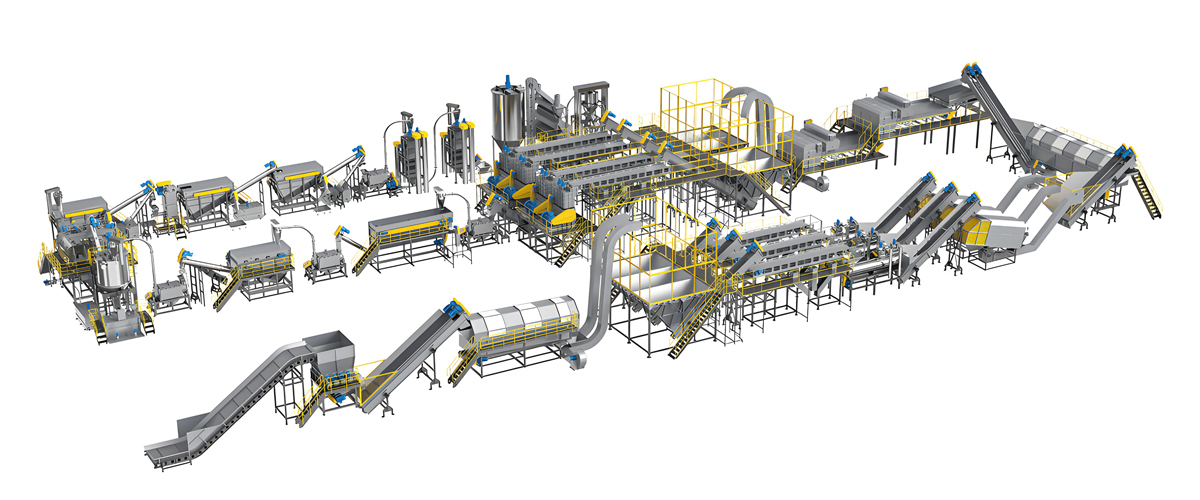
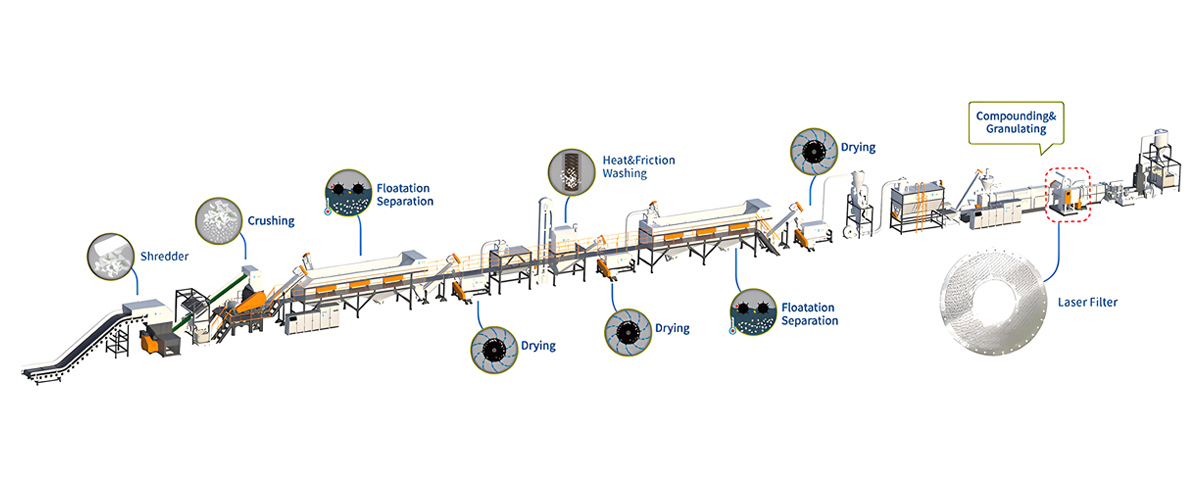
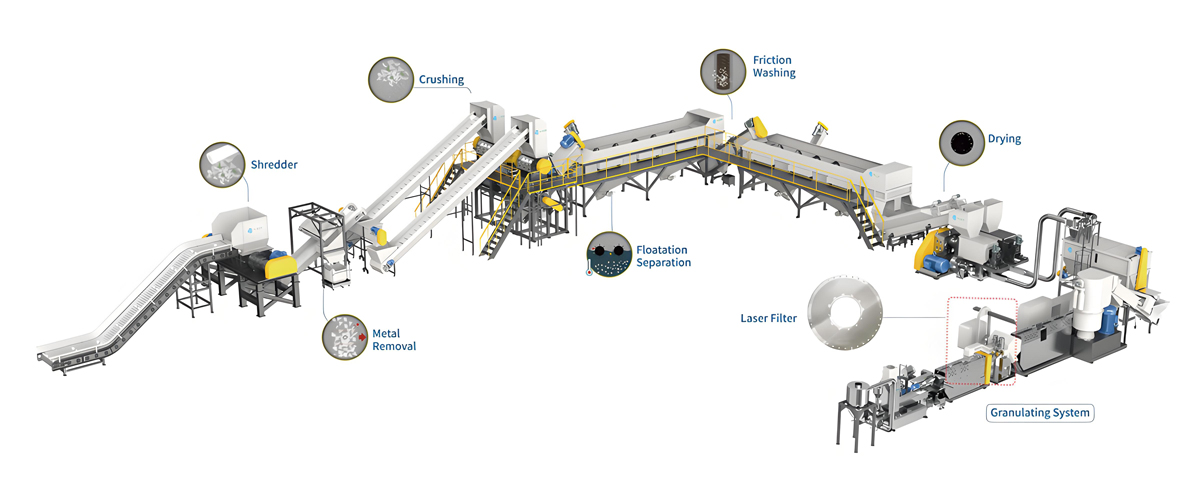
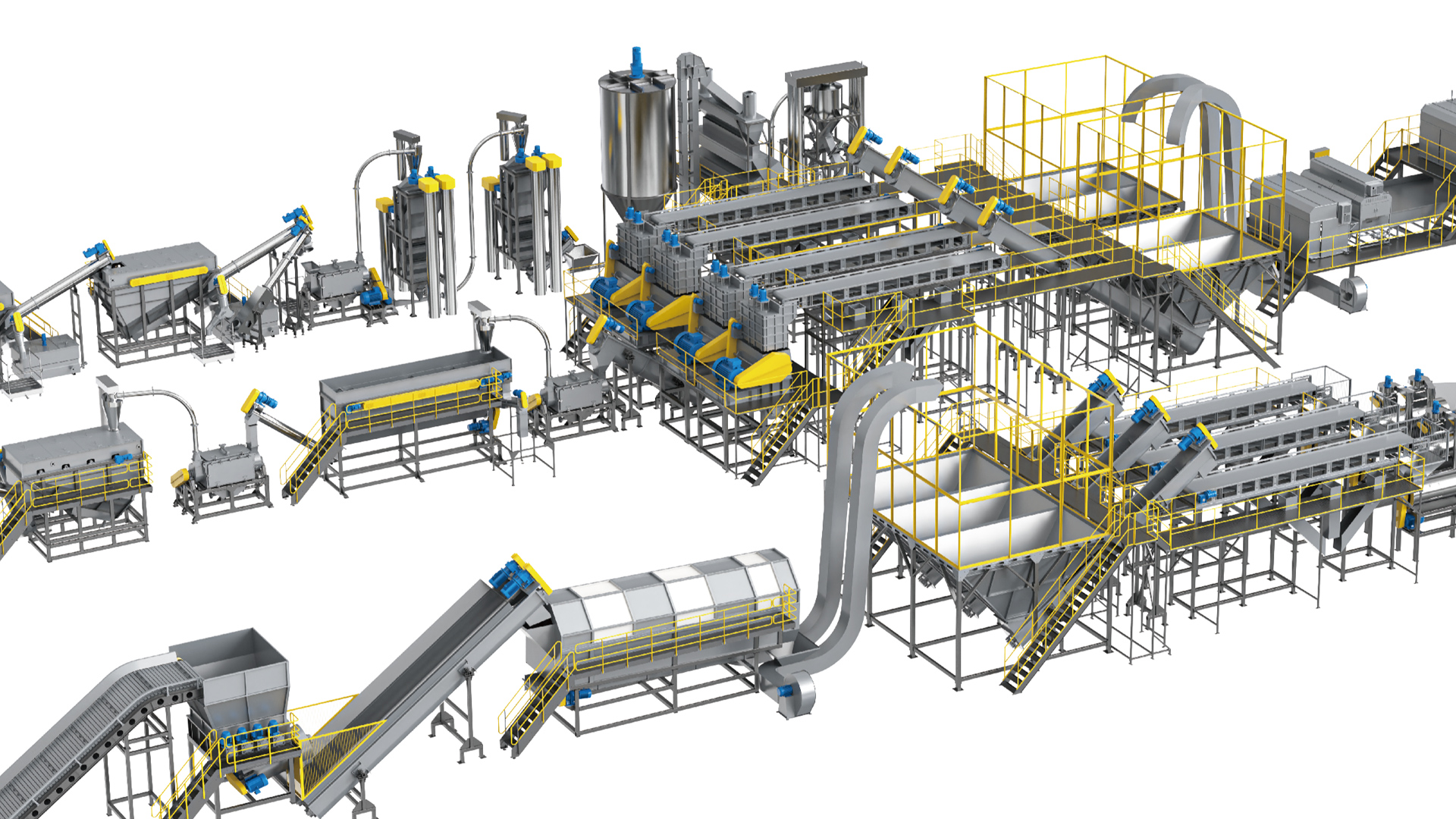
Polyretec, a Wanplas factory, designs every washing line around the loss map above. The equipment is built so that the counters in the tables are reachable in normal operation, not only in a laboratory. Two product lines cover the bulk of the market: PP/PE film washing and PET bottle flake washing.
PTW1000 PP/PE Film Washing Line
The PTW1000 series is the mid-capacity film washing line, proven in fully automated film recycling projects such as the PP/PE film washing installation in Taiwan. It pairs a heavy-duty shredder with dual friction washers, a screened rinse section, and a centrifugal dryer, and it is built to keep fines inside the loop through staged recovery.
| Specification | PTW1000 film line |
|---|---|
| Throughput | 1000 kg/h |
| Installed power | Approximately 185 kW |
| Fresh water consumption | Approximately 1.8 m³/h with recirculation |
| Footprint | Approximately 38 m by 8 m |
| Moisture after centrifugal drying | Below 3 percent |
| Material loss rate | 12 to 18 percent (film band) |
Food Grade PET Bottle Flake Washing Line
The Food Grade PET bottle flake washing line runs from 500 kg/h up to 6000 kg/h and is engineered for different flake grades. It combines a label remover, hot washer, multi-stage sink-float separation, and optical sorting feed to keep both purity and yield high. The table below shows representative specifications by capacity class.
| Specification | 1000 kg/h class | 3000 kg/h class | 6000 kg/h class |
|---|---|---|---|
| Throughput | 1000 kg/h | 3000 kg/h | 6000 kg/h |
| Installed power | Approximately 210 kW | Approximately 480 kW | Approximately 820 kW |
| Fresh water consumption | Approximately 2.2 m³/h | Approximately 5.0 m³/h | Approximately 9.0 m³/h |
| Footprint | Approximately 42 m by 9 m | Approximately 55 m by 10 m | Approximately 70 m by 12 m |
| Moisture after drying | Below 1.5 percent | Below 1.5 percent | Below 1.5 percent |
| Material loss rate | 8 to 12 percent | 9 to 14 percent | 10 to 15 percent |
Both lines are delivered as part of the Wanplas group’s recycling program, with Pelletizing supplied by Wanplas so the washer and extruder are specified as one material-recovery system.
Application Scenarios Across Recycling Streams
Loss control looks different for each waste stream, which is why Polyretec lines are configured per application rather than sold as one fixed machine.
- Agricultural film recycling brings heavy soil, sand, and agrochemical residue. The line needs a strong pre-wash, a robust friction washer, and aggressive fines recovery because the feed is the dirtiest and loses the most.
- Packaging film recycling carries print ink and pressure-sensitive adhesive. Hot washing with caustic and surfactant does the heavy lifting, and residence time is tuned to the ink load.
- PET bottle flake recycling is about label, cap, and PVC control. Multi-stage sink-float separation and optical sorting protect both purity and yield.
- Daily chemical bottle recycling uses HDPE and PP with residual product and label glue. A pre-wash followed by friction and sink-float separation recovers clean rigid flake.
- Industrial waste film is often clean and uniform, so a light wash with low water use and minimal mechanical action keeps loss under ten percent.
Matching the configuration to the stream is the single biggest driver of whether you sit at the low or high end of the loss band for your material.
Matching Your Waste Stream to the Right Configuration
The table below turns the application logic into a direct recommendation. It maps waste type, contamination, target capacity, and loss target to a Polyretec product line and the key configuration that protects yield.
| Waste type | Contamination level | Target capacity | Loss target | Recommended Polyretec line | Key configuration |
|---|---|---|---|---|---|
| Post-consumer agricultural film | High, soil and sand | 500 to 1000 kg/h | Below 18 percent | PTW1000 PP/PE film washing line | Heavy-duty shredder, dual friction washer, two-stage rinsing, fines recovery |
| Printed packaging film and woven bags | Medium to high, ink and adhesive | 1000 to 1500 kg/h | Below 16 percent | PTW series film washing line | Hot washing with caustic, extended friction time, surfactant dosing |
| PET bottle bales, post-consumer | Medium, labels, caps, PVC | 1000 to 3000 kg/h | Below 12 percent | Food Grade PET bottle flake washing line | Label remover, hot washer, multi-stage sink-float, optical sorting feed |
| Daily chemical HDPE and PP bottles | Medium | 500 to 1500 kg/h | Below 14 percent | Hard PP/PE washing line | Pre-wash, friction washer, sink-float separation |
| Industrial clean scrap film | Low | 500 to 1000 kg/h | Below 10 percent | Compact film washing line | Light wash, single friction stage, low water use |
Data-Driven Loss Management on the Plant Floor
You cannot improve what you do not measure, and loss is no exception. A data-driven program puts a scale and a sample point at every stage boundary so the loss map is filled with real numbers, not estimates.
- Segmented weighing at each stage inlet and outlet turns the loss map into a live dashboard.
- Shift loss boards show each crew the yield they achieved, creating healthy accountability.
- Anomaly alarm thresholds flag any stage whose loss jumps beyond its normal band so the cause is found the same shift.
- SPC trend analysis separates normal variation from a real drift, so you act on signal and ignore noise.
Plants that run this program typically recover one to two points of sustained yield simply by catching abnormal loss within the shift it happens, instead of discovering it in the monthly report.
Continuous Improvement Roadmap
Loss reduction is a program, not a one-time fix. The roadmap below ranks measures by the yield they return, the difficulty of doing them, the relative investment, and how fast they pay back. Investment levels use the group scale of Low, Medium, High, and Very High so buyers can plan without needing a quote first.
| Measure | Expected loss reduction (points) | Difficulty | Investment | Time to effect |
|---|---|---|---|---|
| Optimize shredder screen and knife gap | 1.5 to 3.0 | Low | Low | 2 to 4 weeks |
| Add fines recovery, sedimentation and filter press | 2.0 to 4.0 | Medium | Medium | 1 to 3 months |
| Tune friction washer speed and residence | 1.0 to 2.5 | Low | Low | 2 to 6 weeks |
| Multi-stage sink-float with density adjuster | 1.5 to 3.5 | Medium | Medium | 1 to 2 months |
| Water recirculation with side filtration | 0.5 to 1.5 plus water saving | Medium | Medium | 1 to 2 months |
| Upgrade dewatering screen basket grading | 1.0 to 2.0 | Low | Low | 2 to 4 weeks |
| Incoming material pre-sort station | 2.0 to 5.0 | Medium | Medium | 1 to 2 months |
| SPC loss monitoring dashboard | 1.0 to 2.0 sustained | Medium | Low | 1 month |
| Hot wash caustic optimization | 0.5 to 1.5 | Low | Low | 2 to 4 weeks |
The pattern is clear: the cheapest measures, such as knife gap and screen basket tuning, return quickly, while the bigger capital items, such as full fines recovery, return the most but take longer. A sensible sequence is to bank the quick wins first, then fund the capital projects with the savings.
Balancing Water, Energy, and Yield
Reducing loss sometimes competes with saving water and power. More rinsing recovers more flake but uses more water; longer friction washing cleans better but draws more power; higher recirculation saves water but needs filtration energy. The matrix below expresses each action as an index point on yield, water, and energy, where higher is better, so the tradeoff is visible at a glance.
| Action | Yield index | Water index | Energy index | Net note |
|---|---|---|---|---|
| Friction washer speed reduction | Plus 2 | Neutral | Plus 2 | Win on both yield and energy |
| Add side filtration to loop | Plus 2 | Plus 3 | Minus 1 | Small energy cost, large resource gain |
| Extend hot wash residence | Plus 1 | Minus 1 | Minus 2 | Use only when soiling demands it |
| Tighten dewatering basket | Plus 2 | Plus 1 | Neutral | Strong, low-cost win |
| Multi-stage sink-float | Plus 3 | Minus 1 | Minus 1 | Best purity and yield return |
The takeaway is that not every loss fix costs resources. Several improvements, led by friction washer speed reduction and basket tightening, raise yield while cutting energy or water. Those are the ones to do first.
Environmental Compliance and Wastewater Treatment
A washing line that recovers more polymer also generates a cleaner environmental footprint, but the wastewater and sludge still need responsible handling. Process water carries suspended solids, alkali, surfactant, and trace organics, and it must be treated before discharge or full reuse. A typical system combines sedimentation, neutralization, biological or chemical treatment, and sludge dewatering so the discharge meets local limits.
Sludge from the sedimentation and filter press steps is mostly inorganic grit plus unrecoverable fines and rejects. It should be characterized and disposed of according to local regulation, with the recoverable fraction returned to the loop wherever the economics allow. Environmental management systems aligned with ISO 14001 and national standards such as the GB series help structure this so compliance is auditable rather than accidental. Treating compliance as part of the loss program, not separate from it, keeps both the regulator and the yield report satisfied.
Service and Support You Can Rely On
Polyretec, a Wanplas factory, treats loss control as a service commitment, not just a machine sale. Every line is put through continuous operation testing before shipment so the measured loss and capacity are proven, not promised. Engineers handle installation and commissioning on site, then train your crew to read the loss map and run the dashboard themselves.
- Testing before shipment verifies throughput, moisture, and loss on your specified material where possible.
- Installation and commissioning by Polyretec engineers gets the line to nameplate yield fast.
- USD 500 free parts every year under the Wanplas group policy keeps wear items like screen plates and baskets in stock.
- Training covers operation, maintenance, and loss diagnosis for your team.
- Remote operation and maintenance support lets engineers read PLC data and guide correction from the Wanplas service center.
- Open factory visits are welcome, so you can audit the build and trial your own waste stream on a running line.
This support structure is what lets the numbers in the spec tables stay real in year two and year five, not only in the first week.
Frequently Asked Questions
What is the difference between material loss and legitimate rejects in a washing line?
Material loss is good plastic that leaves the process as fines, entrained particles, or mis-sorted flakes and can never be recovered. Legitimate rejects are non-plastic contaminants such as labels, caps, dirt, metal, and PVC that should be removed. Only material loss counts against your yield; legitimate rejects are the quality price of cleaning.
Which stage of the washing line loses the most plastic?
Friction washing and dewatering are usually the largest sources of recoverable loss because fine flakes are either ground smaller or pass through the screen basket with process water. Pre-sorting and sink-float separation cause the largest mis-rejection losses when density control is poor. Measuring each stage separately shows where to act first.
How does water recirculation affect material loss?
Higher water reuse, typically 80 to 95 percent, lowers fresh water cost but concentrates fines in the loop. Without side filtration, sedimentation, or a filter press, those fines are lost to sludge. The goal is to recover material from the water stream before it is dewatered and discarded.
Why is over-alkali hot washing a problem for yield?
Caustic soda at 75 to 90 degrees Celsius removes organics effectively, but concentrations above three percent or residence over twenty minutes can degrade the polymer surface, raise weight loss, and shorten the useful life of the flake. Dosing should be balanced against the soiling level rather than maximized.
How can mis-rejection in the sink-float tank be reduced?
Control water density with a salt or specific gravity adjuster so PET sinks and PP/PE floats as designed, remove entrained air bubbles that falsely sink light flakes, and use multi-stage separation. Optical or near-infrared sorting after the tank further trims residual mis-rejection.
What moisture level should flakes reach before pelletizing?
After centrifugal dewatering, flakes should normally reach below three to eight percent moisture depending on polymer, then hot-air drying brings PET close to one percent. Excess moisture causes poor venting, foaming, and degradation in the pelletizing extruder supplied by Wanplas.
Can incoming material quality really change my loss rate that much?
Yes. Every five percent rise in contamination or foreign material amplifies downstream sorting burden, raises mis-rejection risk, and can add several points of material loss. An incoming acceptance standard and a pre-sort station are among the highest-return improvements available.
How does Polyretec support loss reduction after installation?
Polyretec, a Wanplas factory, runs continuous operation testing before shipment, provides installation and commissioning, training, and remote operation and maintenance support, and includes USD 500 of free parts every year. Customers are welcome to visit the factory to audit the line and trial their own material.
Conclusion
Reducing plastic waste in the washing line process is fundamentally an exercise in measurement and discipline. Define loss on a dry basis, build a per-stage loss map, and attack the stages where fines, water, and mis-rejection actually leave the system. Control crushing and friction washing so you stop making dust, recover what you do make through sedimentation and filtration, tune the sink-float tank so good flake is not thrown away, and keep the hot wash inside its window so chemistry cleans instead of consuming. Then hand clean, dry flake to pelletizing as one connected process.
Polyretec, a Wanplas factory with more than 100 projects and equipment in over 50 countries, builds washing lines around exactly this logic, from the PTW1000 film line to the Food Grade PET bottle flake washing line. The spec tables in this guide show the yield, moisture, and loss targets these lines are engineered to meet, and the selection table points you to the right configuration for your stream.
If you want to recover more of your material, we invite you to send us your waste stream specifications and target capacity so we can recommend a tailored configuration, arrange a factory visit, and run a trial on your own material. Our engineers will help you build the loss map for your plant and prove the numbers before the line ever ships.