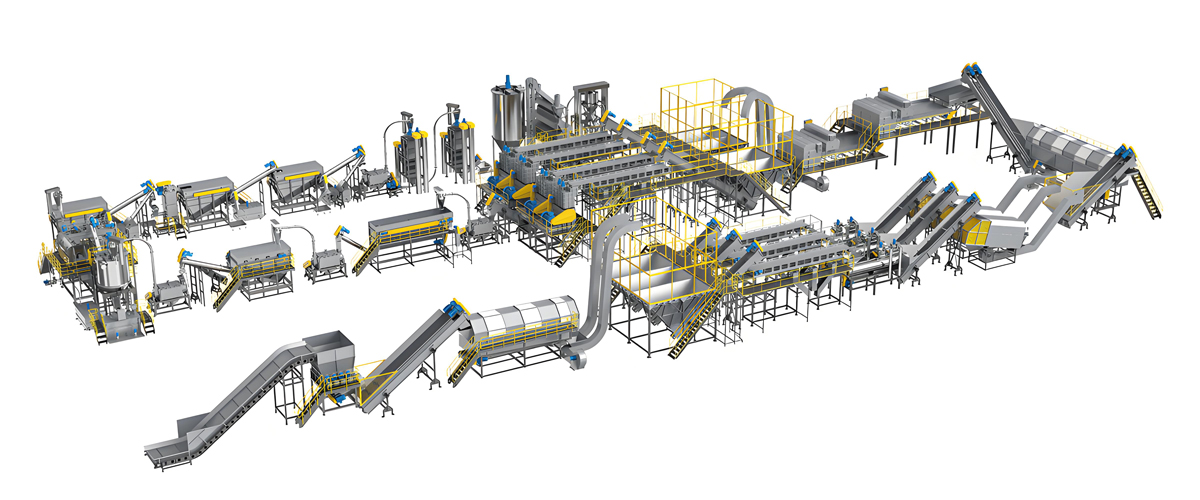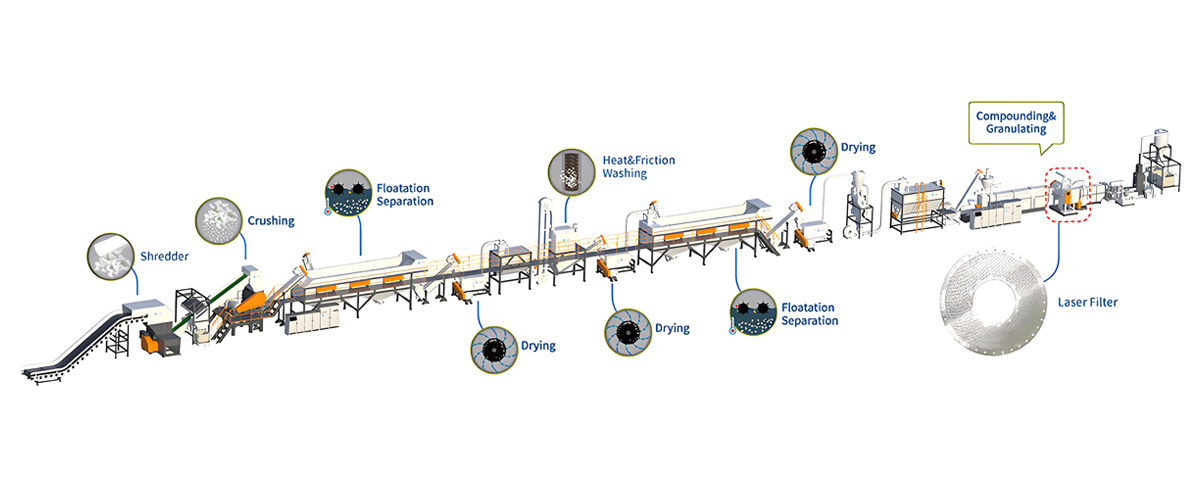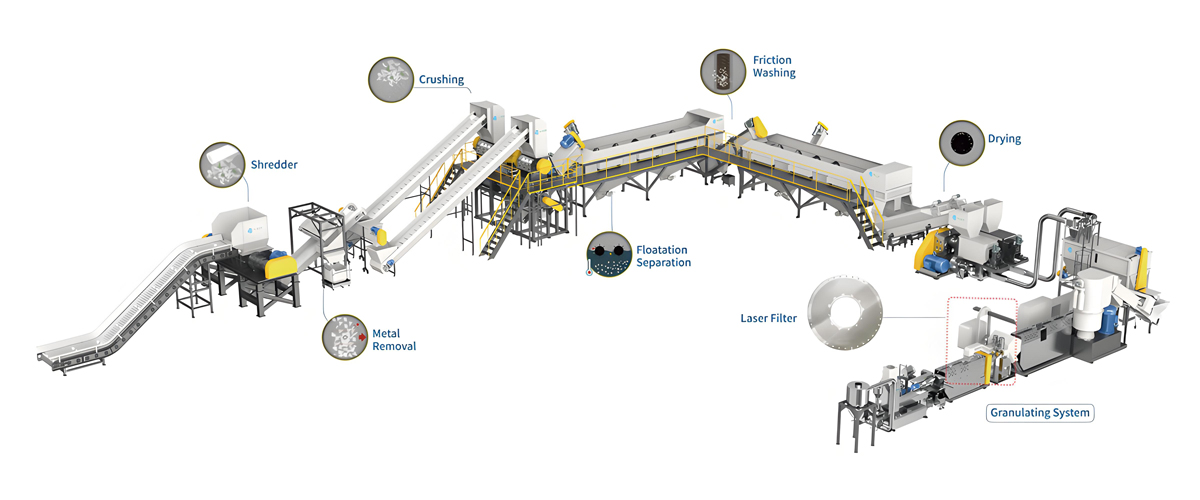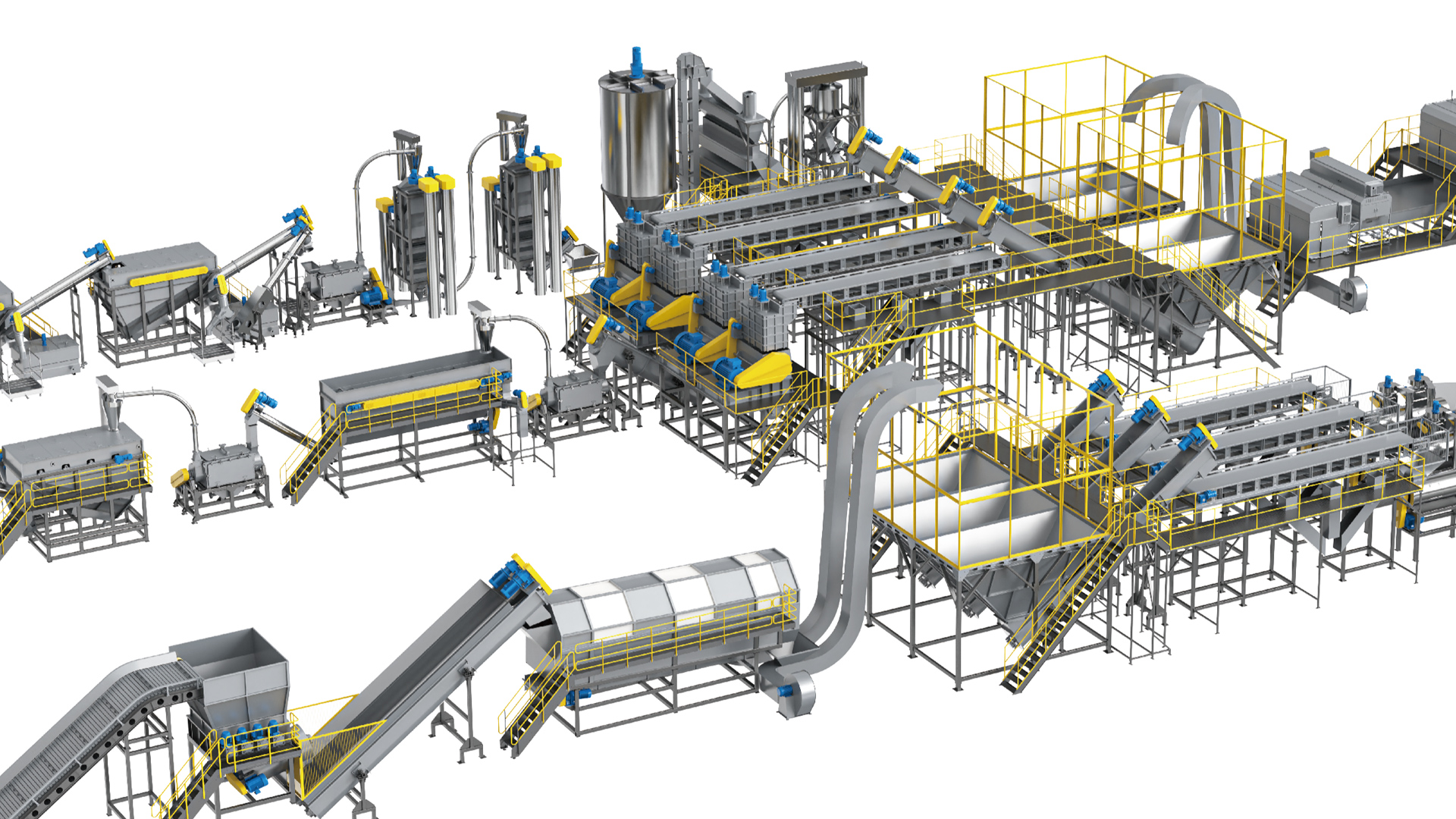

Large rigid plastic waste, and in particular the high-density polyethylene and polypropylene drums used across the chemical, coatings, lubricant, food-ingredient, and agrochemical industries, represents one of the most valuable yet most demanding streams that a plastic recycling plant can process. A chemical drum washing line is the engineered sequence of equipment that turns dirty, labelled, residue-bearing drums into clean, dry, specification-grade flakes ready for reprocessing. Selecting the best chemical drum washing line for large rigid plastic waste is not a matter of buying a generic washer; it is a matter of matching pre-treatment, crushing, hot alkaline washing, friction washing, metal separation, drying, and quality control to the specific contamination profile of the incoming drums. Polyretec, a Wanplas factory, designs rigid washing and pelletizing systems that build on Austrian process know-how combined with Chinese manufacturing scale, and its Hard PP/PE Crushing and Washing Line together with its Rigid Flakes Recycling and Pelletizing Line are purpose-built for exactly this kind of heavy, contaminated input. Wanplas, the parent brand that aggregates the group’s specialized factories, positions Polyretec as its dedicated recycling equipment unit. This guide explains, in practical engineering detail, how a modern drum washing line should be specified, what process parameters actually deliver clean flakes, how hazardous residues and wastewater are handled, and which quality metrics prove the line is working.
What Defines a Chemical Drum Washing Line
A chemical drum washing line is a continuous, wet mechanical process train that receives bulk rigid plastic containers and delivers washed, size-reduced, metal-free, dry flakes at the discharge end. The phrase “best chemical drum washing line for large rigid plastic waste” refers specifically to systems tuned for thick-walled, large-format containers such as 60 liter, 120 liter, 200 liter, and 220 liter drums, rather than for thin film or for PET bottles. The contamination challenge is different from other streams in three ways: the wall thickness means crushing requires substantial torque; the contents are frequently greasy, waxy, or chemically active; and the hardware attached to drums, steel hoops, ring seals, bungs, and foil labels, introduces metal and multi-layer contaminants that a film or bottle line would never see.
The core stages of a drum washing line are pre-treatment, size reduction, hot alkaline washing, friction washing, density separation, metal separation, dewatering, and thermal drying. Each stage is sized against the throughput target, which for dedicated drum lines typically runs from 500 kilograms per hour for a compact cell up to 2000 kilograms per hour or more for a full industrial plant. The polymer mix is dominated by HDPE because blow-molded drums are overwhelmingly high-density polyethylene, with PP used for some heat-resistant or food-grade drums, and with PVC appearing only as liners, gaskets, or occasional mis-sorted containers that must be rejected.
What separates a competent drum line from a weak one is not the presence of a washer, but the balance between aggressive cleaning and polymer protection. Overly aggressive caustic dosing or excessive mechanical shear discolors the flakes, embrittles the resin, and lowers the melt flow index that downstream blow molders depend on. Under-aggressive cleaning leaves oil, glue, and odor that ruin the regrind. The engineering task is to hit a narrow window of temperature, concentration, residence time, and mechanical intensity that removes contamination while preserving material value, and that is the standard against which any proposed line should be judged.
Pre-Treatment Before Crushing
Pre-treatment is the single most underestimated stage of a drum washing line, and it is where the largest share of downstream quality problems are either prevented or created. Before any drum enters a crusher, it must be emptied of free liquid, loose powder, and bulk solid residue. Whole, closed drums can contain kilograms of product that, if fed directly to a granulator, contaminate the entire batch, spray solvent-laden mist into the workshop, and waste washing chemistry. A tilt-and-drain rack or a rotary emptying tipper discharges free product into a collection sump, after which the drum passes a cold pre-rinse that flushes talc, pigment dust, and water-soluble residues before they are baked onto the flake surface during hot washing.
Label and sleeve removal is the next operation. Many industrial drums carry full-wrap PVC or paper labels bonded with hot-melt or solvent-based adhesive. Soaking the drums in a warm caustic bath before crushing softens the adhesive so the label detaches in the friction stage, but some operations prefer a mechanical label stripper or a brush unit that lifts the sleeve while the drum is still whole. Caps, tamper rings, and metal bungs are removed at this point, either by hand on a low-throughput line or by automated de-capping tooling on a high-throughput line. Removing the metal hardware before crushing protects the crusher knives and keeps ferrous fragments from being hammered into the plastic where they later abrade screens and extruder screws.
Sorting and hazard verification belong in pre-treatment as well. Drums should be graded by polymer where possible, and any container that previously held acutely toxic, strongly corrosive, or persistent organic substances must be diverted to an authorized hazardous waste route rather than entering the wash train. A practical control program combines incoming inspection, random swabbing for residual solvent, and a pH check of the drained liquid. Polyretec’s rigid lines are commonly supplied with a manual sorting conveyor and an inspection cabin at the line infeed so that operators can reject non-conforming items before they reach the crusher, protecting both product quality and worker safety.
Crushing and Size Reduction
Crushing rigid drums is fundamentally different from granulating thin film or bottles because the wall is thick, often 2 to 5 millimeters, and the container is large and hollow. The safest and most efficient approach is a two-stage size reduction: a slow-speed, high-torque shredder first reduces whole drums to rough pieces of 40 to 80 millimeters, after which a high-speed granulator cuts those pieces into uniform flakes of 12 to 18 millimeters. Single-stage heavy crushers with a hydraulic pusher ram are also used, but they demand robust rotors and generous motor power to avoid stalling on thick rims and reinforced chimes.
Wet granulation, where the granulator is fed with a curtain of water during cutting, is strongly recommended for drum lines. The water suppresses dust, cools the knives, and begins the washing action while the material is still in large pieces so that interior contamination is exposed early. Rotor design matters: angled fly knives with adjustable clearance against stationary bed knives give a clean cut rather than a tear, which reduces fines and longs that later clog screens. Screen aperture selection sets the final flake size and should be matched to the downstream washer and pelletizer; a 14 millimeter screen is a common default for drum flake.
Explosion and fire risk must be designed for at the crusher because residual solvent trapped inside a drum can vaporize the instant the wall is cut. Where drums may carry flammable residues, the granulator should be equipped with spark-proof construction, inert gas blanketing, temperature monitoring on bearings, and a detonation isolation system on the dust extraction. These protective measures add cost but are non-negotiable where the feedstock is unknown industrial waste, and they are part of the difference between a consumer-grade granulator and a line qualified for chemical drum recycling.
Hot Alkaline Washing and Friction Washing
Hot alkaline washing is the heart of drum cleaning and the stage that removes the hydrophobic contamination, oils, greases, waxes, and label adhesives, that cold water cannot touch. The process uses a heated sodium hydroxide solution, normally dosed at 0.5 to 2.5 percent by weight, maintained at 60 to 85 degrees Celsius, with a residence time of 10 to 20 minutes in a stirred or circulated hot wash tank. At these conditions the caustic saponifies fats and hydrolyzes adhesive chemistry so that the contaminant loses its grip on the polymer surface. A non-ionic surfactant is typically added to improve wetting and to keep released soil suspended rather than redepositing on the flake.
Friction washing follows the hot soak and provides the mechanical energy that physically scrubs the loosened soil away. A friction washer is a horizontal or vertical chamber with a high-speed rotor and counter-current water flow; the flakes are tumbled against each other and against the chamber wall, and the shearing action strips glue films, pigment crust, and surface dirt. Rotor tip speed, water-to-flake ratio, and retention time set the cleaning intensity. After friction washing, one or two cold rinse stages remove the caustic and suspended soil, and a sink-float separation tank exploits density differences to float HDPE and PP while sinking PVC, metals, and heavy contaminants.
The table below summarizes a representative parameter set for a drum washing line processing moderately to heavily soiled HDPE and PP drums. These numbers are starting points; every line must be tuned against the actual feedstock, and Polyretec’s commissioning team normally runs wash trials on customer samples to lock in the final set points.
Typical Washing Stage Parameters for Rigid Drum Flake
| Process Stage | Key Parameter | Typical Range | Purpose and Note |
|---|---|---|---|
| Cold pre-rinse | Water temperature and time | 15 to 30 degrees C, 2 to 5 min | Removes dust, soluble salts, loose powder |
| Hot alkaline wash | NaOH concentration | 0.5 to 2.5 percent by weight | Saponifies oil and adhesive; raise for heavy soil |
| Hot alkaline wash | Bath temperature | 60 to 85 degrees C | Higher temperature speeds saponification |
| Hot alkaline wash | Residence time | 10 to 20 minutes | Tank volume sets retention at fixed throughput |
| Friction wash | Rotor tip speed | Medium to High | Mechanical scrubbing of loosened soil |
| Cold rinse | Stages and pH | 1 to 2 stages, pH 6 to 8 | Strips caustic before drying |
| Sink-float separation | Medium density | Approx 0.95 to 1.0 g per cc | Floats PE/PP, sinks PVC and metal |
Hazardous Residue Management and Wastewater Treatment
Chemical drums by definition may carry hazardous residues, so the best chemical drum washing line is designed around residue management rather than ignoring it. The first control is characterization: incoming drums should be sampled for residual volatile organic compounds using a portable photoionization detector, checked for pH and odor, and in higher-risk plants analyzed by gas chromatography for solvent traces. Total petroleum hydrocarbon limits and heavy-metal pigment checks separate material that can be washed from material that must be rejected. This incoming verification is the foundation of both product safety and regulatory compliance.
Wastewater from a drum line is demanding. The hot alkaline stream carries saponified fats, suspended solids, surfactant, and color, giving it a high chemical oxygen demand and high biological oxygen demand. A robust treatment train starts with neutralization of the caustic, then flocculation and either dissolved-air flotation or settling to drop suspended solids, followed where needed by biological treatment or an evaporator for small, concentrated sidestreams. Caustic recovery, where the hot wash liquor is filtered and replenished rather than discarded, both cuts chemical cost and shrinks the wastewater load, and it is a feature worth specifying on any line that runs continuously.
Sludge from flotation and sedimentation concentrates the removed contamination and may contain heavy metals from pigment residues, so it is handled as a controlled waste subject to local manifest and disposal rules. The table below lists representative control points and the kind of limit a plant should track, noting that exact numeric thresholds are set by the local authority and by the end-use grade of the flake rather than by the machine builder.
Residue and Wastewater Control Points
| Control Point | Method | Why It Matters |
|---|---|---|
| Residual VOC on feed | Portable PID / GC-MS swab | Explosion risk and odor in final flake |
| Wash water COD and BOD | Laboratory wet analysis | Sizing of neutralization and biological stage |
| Total petroleum hydrocarbons | Extractable hydrocarbon test | Limits residual oil in reprocessed resin |
| Heavy metals in sludge | ICP analysis of settled sludge | Determines sludge disposal classification |
| Final flake odor | Heated headspace sniff / panel | Customer acceptance for re-blow molding |
Metal Separation and Contaminant Removal
Metal is the contaminant that most directly damages downstream equipment, and drum lines see more of it than almost any other rigid stream because of hoops, chimes, bungs, and foil-laminated labels. The defense is layered. At pre-treatment, manual or powered tools pull steel hoops and bungs off whole drums. After crushing, an over-belt magnet on the flake conveyor captures ferrous fragments, and an eddy-current separator rejects aluminum and other non-ferrous pieces that the magnet misses. Where the feed includes foil-printed sleeves, an optical or air-classification step can supplement the metal separators.
Beyond metal, the line must also separate polymers. HDPE and PP float together in a sink-float tank, while PVC, PET, and most metals sink, so density separation is doing double duty: it rejects heavy contaminants and it isolates the target polyolefin fraction. For plants that need mono-material HDPE of very high grade, a near-infrared sorter can be added after drying to pull the last PP, PVC, and colored flakes, lifting purity well above what density separation alone achieves. Polyretec’s rigid lines are commonly configured with magnet, eddy-current, and optional optical sorting so that the flake meets blow-molding specifications.
The commercial reason to invest in strong separation is simple: a single missed steel shard entering a pelletizing extruder can score the screw and barrel, contaminate a full lot, and trigger an unplanned shutdown. Holding total metal in the output flake below 50 parts per million is the usual internal target for a line feeding drum-to-drum reprocessing, and the separation train is what delivers it.
Dewatering and Drying of Rigid Flakes
After the final rinse, flakes leave the water saturated, and they must be dewatered and dried before they can be stored or fed to an extruder. Dewatering begins with a vibratory screen or a centrifuge that removes free surface water, dropping moisture from saturation to roughly 10 to 20 percent. A high-speed centrifuge, either vertical or horizontal, then spins the flake to squeeze water out of the interstitial spaces, and a hot-air dryer or a crystallizing dryer removes the remaining bound moisture. For rigid flake destined for extrusion, the target is below one percent, typically 0.3 to 0.8 percent.
Drying energy is a meaningful operating cost, so the drying section should be specified against the actual throughput rather than oversized. A common mistake is to skimp on dewatering and push the thermal dryer to compensate, which wastes heat and can overheat the flakes, causing agglomeration and yellowing. The correct design front-loads mechanical dewatering, which is cheap in energy, and uses thermal drying only for the final bound-moisture fraction. Polyretec’s rigid flake packages pair a centrifuge with a hot-air dryer sized to the line capacity so that moisture exits in the target band without thermal abuse.
Moisture that is too high at the extruder feed causes steam venting, surface defects, and hydrolytic chain scission that lowers molecular weight; moisture that is too low is rarely a problem for polyolefins but wastes energy. The practical control is an in-line moisture indicator at the dryer outlet and a routine laboratory check, because consistent low moisture is what lets the pelletizing line run at stable throughput and produce uniform pellets.
Output Flake Quality Metrics
The proof that a chemical drum washing line is the best for its job is in the quality metrics of the flake it delivers. A recycling plant buying or operating such a line should define acceptance against measured values, not against appearance. The principal metrics are flake size distribution, bulk density, moisture, total impurities, PVC content, metal content, odor, color, and retained melt flow index. Each is checked by a standard method: sieve analysis for size, oven loss for moisture, ash or extraction for impurities, density gradient or FTIR for PVC, magnet and eddy-current audit for metal, and capillary rheometry for melt flow.
For drum-to-drum reprocessing, the usual internal specification is total impurities below 0.2 percent, PVC contamination below 200 parts per million, and metal below 50 parts per million, with flake moisture below one percent and a flake size held within the chosen screen range. Where the flake is aimed at food-contact or high-visibility applications, tighter limits apply and are verified by an independent laboratory, because the presence of a certification such as EFSA, FDA, or EuCertPlast recognition depends on documented, audited control rather than on the machine alone. The table below summarizes a representative quality target set.
Representative Output Flake Quality Targets
| Metric | Typical Target | Test Method |
|---|---|---|
| Flake size | 12 to 18 mm uniform | Sieve analysis |
| Moisture | Below 1 percent | Oven loss at 105 C |
| Total impurities | Below 0.2 percent | Ash or extraction |
| PVC content | Below 200 ppm | Density gradient or FTIR |
| Metal content | Below 50 ppm | Magnetic and eddy-current audit |
| Odor | Neutral, no chemical note | Heated headspace panel |
| Melt flow retention | Within grade spec | Capillary rheometry |
Safety and Environmental Compliance
Operating a chemical drum washing line sits at the intersection of mechanical safety, chemical safety, and environmental permitting, so compliance is engineered into the line rather than added afterwards. Where drums may carry flammable residues, the crusher and dust extraction are specified to explosion-protection standards, with spark detection, inerting, and isolation so that a single ignition cannot propagate. Ventilation at the infeed and at the hot wash area controls caustic mist and any residual solvent vapor, and operators work behind guarded stations with appropriate personal protective equipment.
Environmental compliance centers on wastewater discharge and hazardous waste handling. The plant must hold the permit required by the local authority for its effluent, and the treatment train described earlier exists to keep that effluent inside permit limits for pH, suspended solids, and organic load. Sludge and rejected hazardous drums move under a tracked manifest to authorized receivers. On the product side, lines intended to supply food-contact loops are built and documented to support recognition under frameworks such as EFSA, FDA, or EuCertPlast, and the equipment carries the required CE marking and is produced under an ISO 9001 quality system with ISO 14001 environmental management where the site is certified.
The practical advice for a buyer is to treat compliance as a design input from day one. A line that meets the cleaning target but cannot show documented residue controls, wastewater treatment, and safety protection will not survive an audit by a brand owner or a regulator, and the cost of retrofitting protection after installation is far higher than specifying it up front. Polyretec, as a Wanplas factory, supplies lines with the documentation and safety features expected by export customers, and the Wanplas group’s shared commitment to quality standards supports the after-sales verification that compliance requires.
Equipment Configuration and Selection
Choosing the best chemical drum washing line means matching a configuration tier to the feedstock and the target flake grade. A compact line for clean, sorted, in-house drums needs only a granulator, a hot wash tank, a friction washer, rinsing, and drying, with manual pre-treatment. A standard export line adds automated de-capping, magnet and eddy-current separation, sink-float, and a centrifuge dryer. A high-capacity, high-purity line adds caustic recovery, near-infrared sorting, full wastewater treatment, and explosion protection. The table below contrasts these tiers using relative cost labels rather than figures, because final cost depends on capacity, options, and destination market.
Configuration Tier Comparison
| Tier | Core Components | Typical Throughput | Relative Cost |
|---|---|---|---|
| Compact | Granulator, hot wash, friction, rinse, dryer | Around 500 kg/h | Low |
| Standard | Adds de-capping, magnet, eddy-current, sink-float | 800 to 1200 kg/h | Medium |
| High purity | Adds NIR sort, caustic recovery, wastewater plant | 1500 to 2000 kg/h plus | High |
| Hazardous-rated | Adds explosion protection and full residue control | By project | Premium |
When comparing suppliers, it helps to benchmark Polyretec’s rigid line against established names such as Erema, Lindner, Sorema, Starlinger, AMUT, and Herbold, each of which offers heavy washing or size-reduction technology. The deciding factors are usually the aggressiveness of the hot wash and friction stage for drum soil, the completeness of metal and PVC separation, the water and chemical economy of the design, and the depth of commissioning and spare-parts support. Polyretec’s combination of Austrian-derived process design and Chinese manufacturing scale is positioned to deliver the required flake grade at a competitive total cost of ownership, and for plants that also pelletize, the Wanplas group’s Kerke factory supplies twin-screw extruders that integrate with the washed flake stream.
Frequently Asked Questions
What plastics are chemical drums typically made from?
The large industrial drums most often recycled are blow-molded from high-density polyethylene, with a smaller share made from polypropylene. Some drums carry PVC-based liners or labels, which must be separated because PVC degrades the recycled HDPE stream.
Can drums that held hazardous chemicals be recycled?
Drums that previously contained non-listed, non-acute residues can enter a standard washing line after triple rinsing and residue verification. Drums that carried acutely toxic, strongly corrosive, or persistent organic pollutants should be diverted to authorized hazardous waste channels and never mixed with the general rigid waste stream.
Why is hot alkaline washing necessary for drums?
Residual oils, greases, waxes, and many label adhesives are hydrophobic and cannot be removed by cold water alone. A heated sodium hydroxide solution saponifies fats and hydrolyzes adhesives, allowing friction and rinse stages to strip them from the flake surface.
What alkali concentration and temperature are used?
Typical operation uses sodium hydroxide at 0.5 to 2.5 percent by weight, held at 60 to 85 degrees Celsius, with a residence time of 10 to 20 minutes. Heavily soiled drums may use the upper end of both ranges, while lightly contaminated material can be cleaned at lower dosage to protect polymer properties.
How is metal contamination removed from drum flakes?
Steel hoops, ring seals, and bungs are removed mechanically before crushing, then an over-belt magnet captures ferrous fragments and an eddy-current separator rejects aluminum and other non-ferrous pieces. Well-tuned lines hold total metal in the output flake below 50 parts per million.
What moisture level must output flakes reach?
For direct feeding into a pelletizing extruder, rigid flakes should leave the drying section at below one percent moisture, typically 0.3 to 0.8 percent. Higher moisture increases melt degradation, raises energy use, and can cause venting problems during extrusion.
How much water does a drum washing line consume?
With counter-current rinsing and caustic recovery, a modern closed-loop rigid washing line uses roughly 0.5 to 1.5 cubic meters of fresh water per ton of clean flakes. Open-loop legacy systems can consume three to five times that volume, so water management is a key selection criterion.
What flake purity is required for reprocessing into new drums?
Reproducing blow-molded drums from recycled content usually requires total impurities below 0.2 percent, PVC contamination below 200 parts per million, and metal below 50 parts per million. Higher-grade applications, including food-contact loops, demand even tighter limits verified by laboratory analysis.
Conclusion
The best chemical drum washing line for large rigid plastic waste is one that is engineered around the drum’s specific contamination, thick walls, and attached metal, rather than adapted from a film or bottle washer. Pre-treatment and label removal protect the crusher and set cleaning up to succeed; hot alkaline washing at 0.5 to 2.5 percent caustic and 60 to 85 degrees Celsius does the chemical work that cold water cannot; friction washing and sink-float deliver the mechanical and density separation; and magnet, eddy-current, and optional optical sorting hold metal and PVC within the tight limits that drum-to-drum reprocessing demands. Dewatering and drying below one percent moisture protect the polymer during extrusion, while residue characterization and wastewater treatment keep the operation inside safety and environmental rules, including the documentation needed for EFSA, FDA, or EuCertPlast recognition where food-contact grades are targeted.
For plants specifying such a line, Polyretec, a Wanplas factory, offers the Hard PP/PE Crushing and Washing Line and the Rigid Flakes Recycling and Pelletizing Line built on Austrian-derived process know-how and backed by the Wanplas group’s shared quality and after-sales commitments, including an annual free spare-parts allowance. The right choice is the tier whose pre-treatment, washing aggression, separation completeness, and compliance features match your feedstock and your flake grade, verified by wash trials on your own drums before purchase. Contact the Polyretec team to arrange a sample evaluation and a configuration matched to your throughput and purity targets.