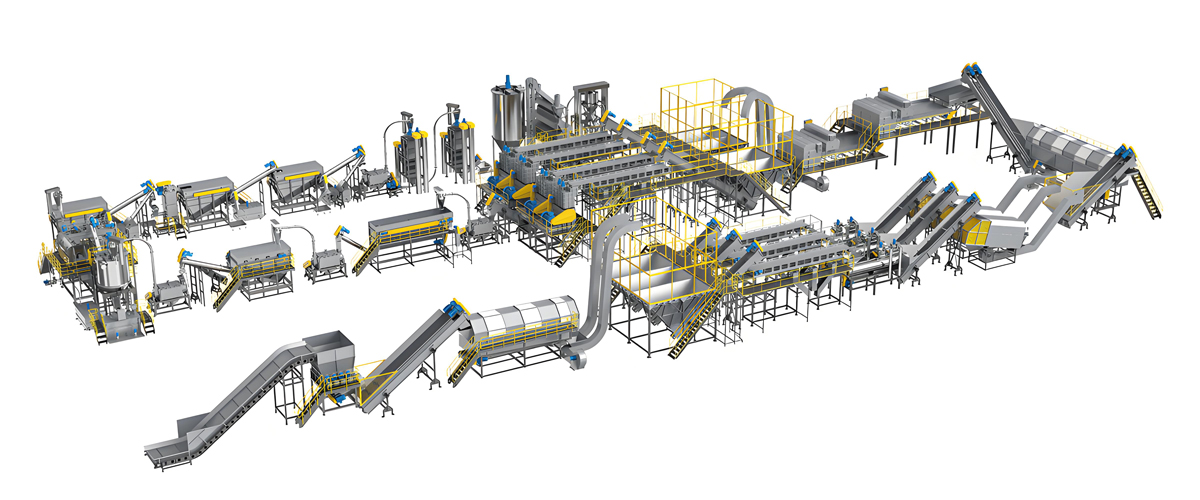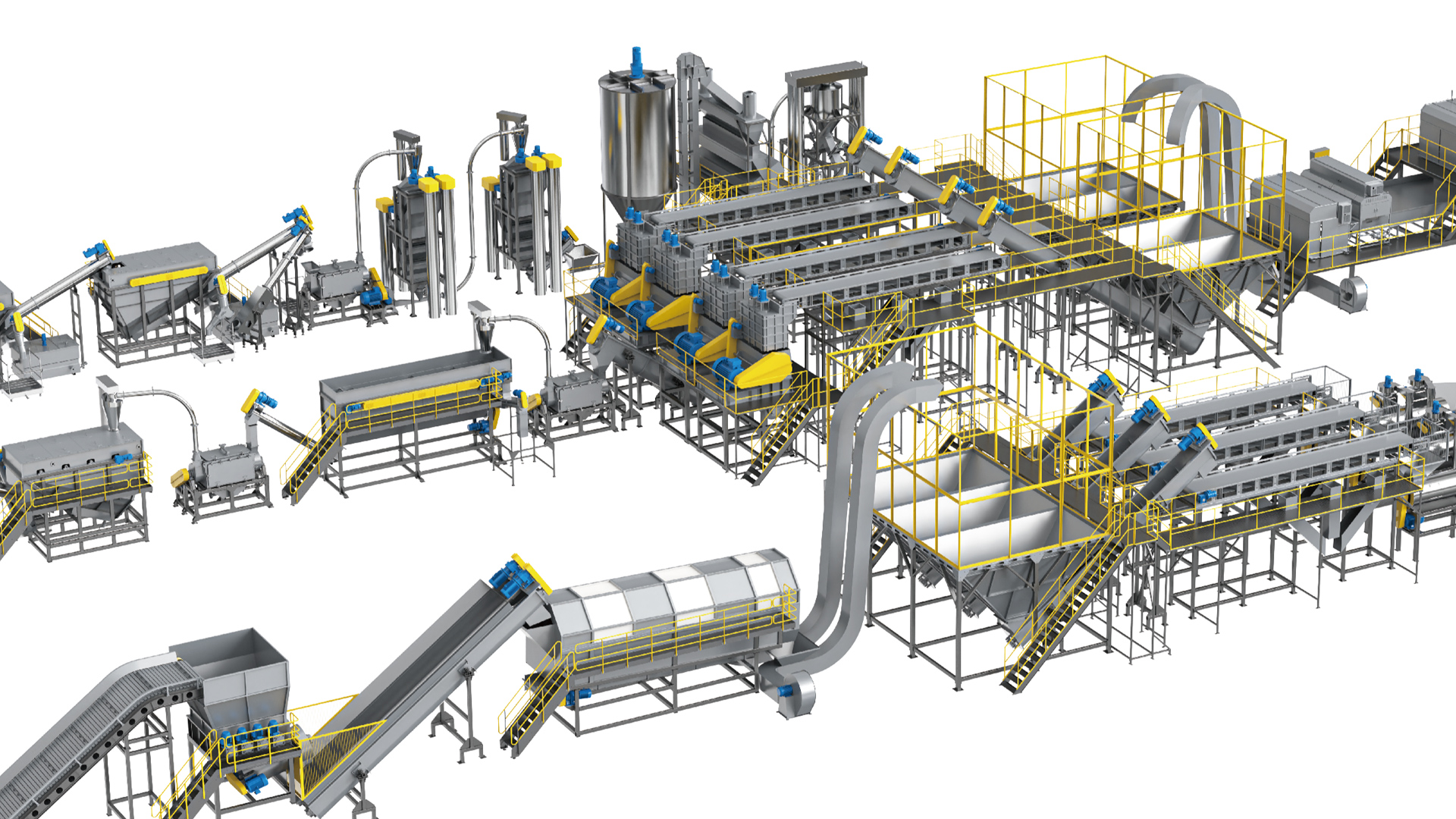

Introduction
A rigid plastic washing line is the backbone of any serious ABS and PS recycling operation, yet most general-purpose washing equipment is designed around PET bottles or film and fails the moment it meets dense, mixed, contaminated rigid waste. ABS and PS are the workhorse engineering and commodity plastics of electronics housings, appliance shells, automotive interior trim, toys, and single-use packaging, and their recycling stream is growing as WEEE and post-industrial scrap regain value. Choosing the best rigid plastic washing line for ABS and PS plastic waste means understanding why these polymers behave differently in water, how contamination must be stripped without degrading the resin, and how the line must be engineered from infeed sorting all the way to densified, compliant pellet. This guide walks plant engineers, procurement managers, and recyclers through the full technical picture.
ABS, or acrylonitrile-butadiene-styrene, typically sits at a density of 1.04 to 1.06 g/cm3, while polystyrene ranges from 1.04 to 1.06 g/cm3 for GPPS and 1.03 to 1.06 g/cm3 for HIPS. Both polymers are denser than water, which immediately disqualifies the simple float-sink separation that works so well for separating PET from PP or PE. This single physical fact reshapes the entire washing and sorting strategy, forcing operators toward density-media separation, electrostatic separation, near-infrared sorting, and X-ray detection for hazardous additives. A line that ignores this reality will produce contaminated, off-spec flake that cannot be sold into demanding injection molding or extrusion applications.
Polyretec, a Wanplas factory, has built its recycling equipment expertise around these exact challenges, combining Austrian process technology with Chinese manufacturing efficiency to deliver washing and pelletizing lines that treat ABS and PS as the demanding materials they are. As part of the Wanplas brand network, Polyretec integrates with sister factories such as Kerke for twin-screw pelletizing extruders, giving recyclers a single accountable source for a complete rigid-plastic recovery line. In the sections that follow, we explain the process chain, the separation science, the material-specific pitfalls, the capacity and utility profile, and the compliance framework that separates a profitable ABS/PS recycling plant from a warehouse of rejected flake.
Whether you process post-industrial ABS off-cuts, WEEE-derived HIPS television housings, or a mixed rigid bale from municipal collection, the principles in this article apply. We quantify performance in kWh per ton, cubic meters of water per ton with closed-loop recovery, achievable yield percentages, and relative cost tiers rather than fixed prices, because every plant’s contamination profile and utility cost structure is different. By the end, you should be able to specify a line with confidence and ask suppliers the right questions.
Why ABS and PS Require a Purpose-Built Waschlinie
ABS and PS cannot be washed and sorted on the same assumption as buoyant plastics, and that difference drives every equipment decision downstream. A standard PET bottle washing line assumes that almost everything lighter than 1.38 g/cm3 floats and everything heavier sinks, which is a clean binary. For ABS and PS, that binary collapses because both sink, along with PVC, PC, PET, and metal. The washing line must therefore include positive sorting stages that identify and pull the target polymer rather than merely separating it from water-borne contaminants.
The practical consequence is that a purpose-built rigid line carries more separation hardware per meter of line than a film or bottle line of equal throughput. It needs a density-media tank tuned to a narrow band, electrostatic and NIR units for dry sorting, an eddy-current rotor for non-ferrous metal, and increasingly an X-ray module to flag brominated flame retardant fractions from WEEE feed. Each of these adds capital and operating complexity, but they are the difference between flake that meets EN 15347 characterization and flake that is rejected at the gate.
Beyond sorting, ABS and PS differ from PET in how they tolerate heat and mechanical stress during washing. ABS is thermally sensitive; above roughly 260 degrees C the butadiene phase oxidizes and the melt yellows, while PS is prone to thermal and shear degradation that generates styrene monomer and odor. A washing line that overheats the melt during the pelletizing stage, or that fails to dry the flake adequately before extrusion, will destroy the very properties the recycler is trying to recover. The best rigid washing line therefore treats washing and pelletizing as one coupled system rather than two disconnected machines.
Density Reality Check: What Sinks and What Floats
The table below summarizes how common rigid-plastic stream components behave in plain water and why float-sink alone is insufficient. Densities are typical values and vary by grade, filler, and additive loading.
| Material | Typical density (g/cm3) | Behavior in water | Implication for separation |
|---|---|---|---|
| ABS | 1.04 to 1.06 | Sinks | Cannot be float-sink separated from PS, PVC, PC, PET |
| GPPS | 1.04 to 1.06 | Sinks | Overlaps ABS density; needs NIR or electrostatic ID |
| HIPS | 1.03 to 1.06 | Sinks | Rubber-modified; distinguishable by NIR spectrum |
| PET | 1.38 to 1.40 | Sinks (heavier) | Sink-float works vs PP/PE but not vs ABS/PS |
| PP / PE | 0.90 to 0.97 | Floats | Easily removed by flotation from ABS/PS |
| PVC | 1.30 to 1.45 | Sinks | Chlorine content; must be removed by NIR/X-ray |
| PC | 1.20 to 1.22 | Sinks | Dense; removable in density-media or by NIR |
| Aluminum | ~2.70 | Sinks fast | Eddy current removes non-ferrous metal |
| Steel | ~7.85 | Sinks fast | Magnetic or metal detection separation |
As the data shows, ABS and PS overlap each other in density and overlap with several other sinkers. Only a sorting method that identifies the polymer chemistry, not just its buoyancy, can produce a clean stream. That is the central design constraint of the best rigid washing line.
The Complete Process Chain From Shredding to Pelletizing
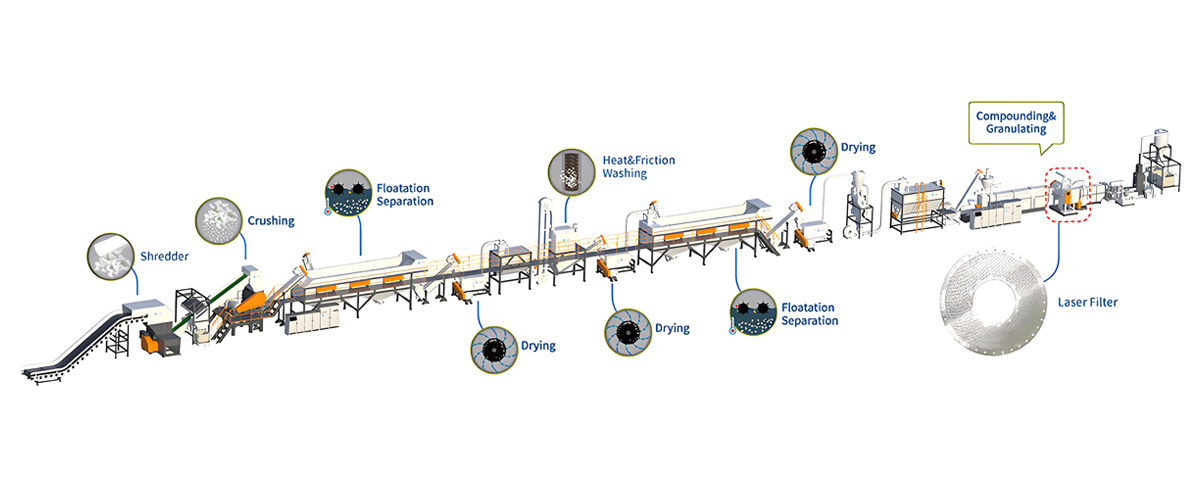
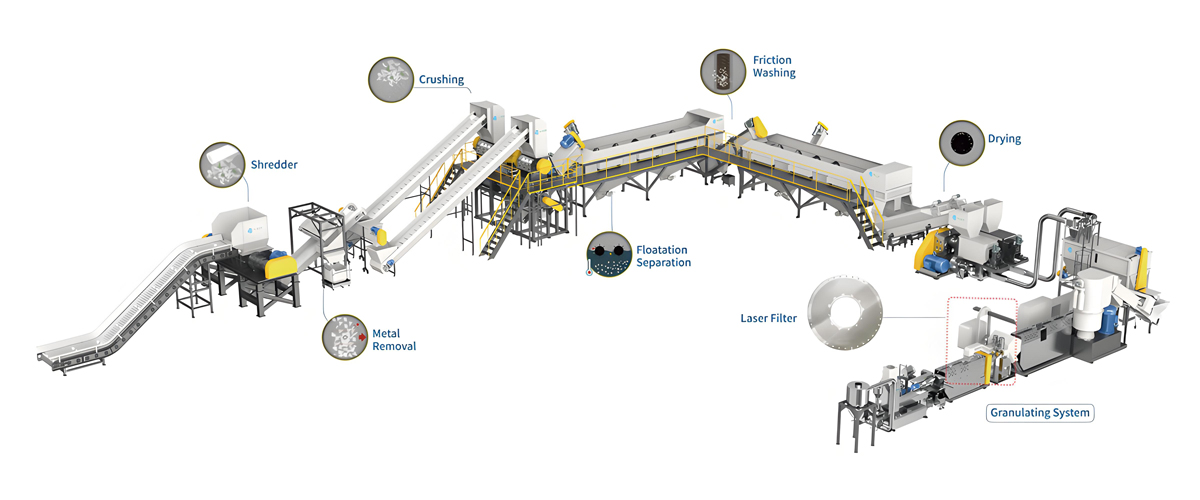
A complete rigid ABS/PS washing and recovery line is a sequence of mechanical, thermal, and physical separation steps that progressively removes size heterogeneity, surface contamination, labels, adhesives, oils, metals, and incompatible polymers, then re compounded the clean flake into uniform pellet. The chain is best understood as a conveyor of increasing purity and decreasing particle size, ending in a densified, characterized product. Skipping or under-sizing any single stage shows up later as odor, black specks, low impact strength, or regulatory failure.
The generic chain runs as follows: manual or automated infeed sorting; a shredder that reduces bulky parts to 50 to 100 mm pieces; a granulator that cuts flake to a uniform 12 to 16 mm with blade clearance of 0.15 to 0.3 mm; a pre-wash trommel or friction washer spinning at 700 to 1000 rpm to knock off loose dirt and sand; a hot-wash tank at 80 to 90 degrees C with 1 to 3 percent NaOH plus surfactant and a 10 to 20 minute residence to release label glue and oils; a rinse stage; a density-media separation tank; centrifugal dewatering to 1 to 3 percent residual moisture; thermal drying below 0.5 percent; air classification to strip label chips and fines; metal detection; and finally pelletizing via a vented single-screw or co-rotating twin-screw extruder with melt filtration at 60 to 150 micrometer and water-ring or underwater cutting, then homogenization in a blending silo.
The table below maps each process stage to its equipment, the key operating parameter, and the function it performs. Treat it as the specification backbone when reviewing any supplier’s proposal. A credible supplier will be able to state every one of these parameters for the line they quote.
| Process stage | Equipment | Key parameter | Function and role |
|---|---|---|---|
| Infeed sorting | Manual belt + NIR pre-sort | Removal of PVC, metal, non-plastic | Protects downstream equipment and product grade |
| Shredding | Single or twin-shaft shredder | Output 50 to 100 mm | Reduces bulky housings to manageable size |
| Granulation | Granulator | Blade gap 0.15 to 0.3 mm; screen 12 to 16 mm | Uniform flake for consistent washing |
| Pre-wash | Trommel / friction washer | 700 to 1000 rpm | Removes sand, dirt, loose label fragments |
| Hot wash | Heated wash tank | 80 to 90 C; NaOH 1 to 3 percent; 10 to 20 min | Releases glue, oil, and stubborn residues |
| Rinse | Fresh water rinse | Neutral pH target | Strips caustic and surfactant residues |
| Density separation | Media tank | Tuned 1.0 to 1.2 g/cm3 | Splits ABS/PS from heavier/ lighter fractions |
| Dewatering | Centrifugal dryer | Residual moisture 1 to 3 percent | Removes free water before thermal drying |
| Thermal drying | Hot air dryer | Below 0.5 percent moisture | Prevents splay and hydrolysis in extrusion |
| Dedust / air classify | Air classifier / zig-zag | Fines and label chip removal | Improves optical sort purity and pellet clarity |
| Metal detect | Metal detector / separator | Ferrous and non-ferrous reject | Protects extruder screw and screen changer |
| Pelletizing | Twin-screw or vented single-screw | L/D 36 to 44; 60 to 150 micrometer filter | Melt, devolatilize, filter, cut to pellet |
| Homogenization | Blending silo | Batch uniformity | Evens MFI, color, and additive distribution |
A line configured to this map delivers washed flake and pellet as one continuous process. Polyretec offers washing lines and a new-generation pelletizing line that integrate along exactly this chain, and for the extrusion stage the Wanplas group’s Kerke factory supplies co-rotating twin-screw extruders with the L/D and vacuum devolatilization needed for thermally sensitive ABS and PS.
Stage-by-Stage Breakdown of a Rigid ABS/PS Waschlinie
Understanding each stage in depth lets you size equipment correctly and diagnose problems before they reach the pellet. The following subsections cover the stages that most often decide whether a rigid line succeeds or fails.
Stage 1: Infeed and Pre-Sorting
Infeed begins on a slow, wide belt where operators or an automated picker remove obvious non-plastic, metal, and PVC objects. For WEEE-derived feed, this stage is where brominated flame retardant housings should first be flagged, although final confirmation belongs to X-ray downstream. A metal detector at infeed protects the shredder from tramp steel. Pre-sorting is low cost and high leverage: every kilogram of contaminant removed here saves multiple sorting passes later.
Stage 2: Shredding
A single-shaft shredder with a ram feeder is common for bulky appliance and electronics housings, while a twin-shaft unit handles tangled, mixed bales with less bridging. Target output is 50 to 100 mm, large enough to avoid generating excessive fines yet small enough for stable granulator feed. Over-shredding at this stage raises dust and lowers yield; under-shredding stalls the granulator. Rotor speed, screen size, and hydraulic ram pressure are the tuning knobs.
Stage 3: Granulation
The granulator converts shredded pieces into wash-ready flake. Blade clearance of 0.15 to 0.3 mm and a screen of 12 to 16 mm produce a consistent flake that washes evenly and sorts cleanly. Knife sharpness directly affects fines generation and energy draw; a dull knife smears rather than cuts, creating more dust and more label-chip carryover. For ABS specifically, avoid excessive screen residence that heats the flake, because heat accelerates styrene fume release.
Stage 4: Pre-Wash and Friction
A trommel or friction washer spinning at 700 to 1000 rpm mechanically scrubs loose soil, sand, and label fragments from the flake surface. Friction washers use a rotating paddle shaft inside a perforated cage; the flake tumbles against itself and the cage, abrading contamination without excessive size reduction. This stage protects the hot-wash chemicals from being wasted on easily removable dirt and reduces load on the water-treatment system.
Stage 5: Hot Wash
Hot washing is the heart of rigid-plastic cleaning. At 80 to 90 degrees C with 1 to 3 percent NaOH and a surfactant, label adhesives swell and release, and oils and greases emulsify. A 10 to 20 minute residence ensures glue from pressure-sensitive labels and screen-printed inks loosens. For PS, keep temperatures toward the lower end and avoid long residence, because PS softens and can agglomerate; for ABS, the upper range is tolerable but watch for foaming from residual organics. Rinse thoroughly afterward so no caustic reaches the extruder, where it would catalyze degradation.
Stage 6: Density-Media Separation
Because ABS and PS both sink in water, a density-media tank uses a tuned solution, typically a salt or calcium chloride brine adjusted to a density between 1.0 and 1.2 g/cm3, to float off buoyant contaminants such as PP and PE while sinking the target fraction. By selecting the media density, operators can also sink heavier PVC or PC away from the ABS/PS stream. The media must be continuously monitored and topped up, because every load of flake dilutes or contaminates the bath. Closed-loop media recovery keeps operating cost at a Medium tier rather than drifting upward.
Stage 7: Dewatering and Thermal Drying
A centrifugal dryer removes free water to 1 to 3 percent residual moisture, and a hot-air dryer drives it below 0.5 percent. This dryness is non-negotiable before extrusion: residual moisture in ABS hydrolyzes during melting and produces splay, brittleness, and dimensional instability in molded parts. Drying energy is a meaningful part of the line’s kWh per ton, so dryer efficiency and heat recovery matter.
Stage 8: Air Classification and Metal Detection
After drying, a zig-zag or air classifier lifts light label chips and fines away from heavy flake, sharpening the stream for final optical sorting. A metal detector then rejects any remaining ferrous or non-ferrous fragment. These two stages are the last line of defense for extruder protection and pellet cleanliness, and they should sit immediately before the feed throat of the pelletizer.
Stage 9: Pelletizing
Pelletizing converts clean flake into a uniform, free-flowing product. A vented single-screw extruder suffices for clean, single-grade feed, while a co-rotating twin-screw with L/D 36 to 44 and vacuum devolatilization is preferred for ABS and PS that carry odor, volatiles, or require additive incorporation such as impact modifiers. Melt filtration through a screen changer at 60 to 150 micrometer removes gels and black speck precursors; water-ring or underwater cutting yields consistent pellet. The blended homogenization silo then evens out MFI, color, and additive distribution across batches.
Sorting Technologies Compared: Density Media, Electrostatic, NIR, Eddy Current, X-Ray
Because float-sink fails for ABS and PS, the washing line must deploy one or more positive identification technologies. Each has a sweet spot, and the best lines combine them in layers so that a contaminant missed by one is caught by another. The comparison below summarizes how they differ.
| Technology | Separates by | Best for | Limitations |
|---|---|---|---|
| Density-media separation | Buoyancy in tuned brine (1.0 to 1.2 g/cm3) | Floating PP/PE off ABS/PS; sinking PVC/PC away | Cannot distinguish ABS from PS; needs media management |
| Electrostatic separation | Tribo-electric charge polarity | ABS vs PS vs PVC dry separation | Sensitive to moisture and fines; needs dry feed |
| Near-infrared (NIR) | Polymer absorption spectrum | Fast ABS/PS/PC/PVC identification | Black or carbon-filled parts absorb light; needs clean surface |
| Eddy current | Induced magnetic field on non-ferrous metal | Aluminum, brass, copper removal | No effect on plastic; only metal |
| X-ray (BFR detection) | Bromine / chlorine atomic signature | Flagging brominated flame retardants in WEEE ABS | Capital cost High; needs calibration and reject handling |
Density-media separation is the workhorse for bulk buoyant-contaminant removal and is relatively Low to Medium in capital cost. Electrostatic and NIR sorting are the precision tools that separate ABS from PS and from PVC, where density overlaps; both are Medium to High in capital cost but deliver the grade that commands a premium in injection-molding markets. Eddy current is a targeted, robust metal remover that pairs with a magnetic stage for steel. X-ray detection is increasingly mandatory for WEEE feed because brominated flame retardants must be excluded to satisfy RoHS and POPs limits; its capital cost is High to Very High, but the regulatory risk it removes justifies it for electronics-derived streams.
A layered strategy might run density media first to dump the cheap, abundant PP/PE fraction, then NIR to split ABS, PS, and PVC, then electrostatic to polish the ABS/PS boundary, and finally X-ray to quarantine any BFR-containing particles. The exact stack depends on feed composition, but a line that relies on a single method will almost always underperform on mixed rigid waste.
Material-Specific Processing for ABS and PS
Washing is only half the story; the resin itself imposes strict handling rules once the flake reaches the extruder. ABS and PS are sensitive in ways that PET and polyolefins are not, and ignoring these rules wastes the entire upstream effort.
Moisture and Drying
ABS absorbs 0.2 to 0.4 percent moisture, which sounds small but is enough to cause hydrolysis and splay during melting. The flake must be dried at about 80 degrees C for 2 to 4 hours under a dew point of -20 to -40 degrees C before pelletizing. PS absorbs less but still benefits from drying to suppress streaks. Inadequate drying is the most common cause of cosmetic and mechanical defects in recycled ABS and PS parts.
Thermal Sensitivity
ABS processes around 210 to 250 degrees C and degrades above roughly 260 degrees C, where the butadiene phase oxidizes, the melt yellows, and impact strength collapses. PS degrades at somewhat lower thermal tolerance and generates styrene monomer and odor under shear and heat. The pelletizing extruder must hold tight temperature zones, use gentle screw geometry, and apply vacuum devolatilization to pull volatiles out before the die. Vacuum venting also addresses the next issue: odor and VOC.
Odor and VOC Removal
Post-consumer and WEEE ABS/PS often carry odor from previous use, residual surfactants, or degradation. Vacuum devolatilization on a twin-screw extruder, combined with adequate residence and sometimes a stripping agent, reduces odor to acceptable levels for indoor and automotive applications. A line that pelletizes without devolatilization will produce pellet that smells and loses market value.
Color Strategy and Re-Sorting
ABS and PS come in every color, and mixed-color flake yields gray or muddy pellet. Two strategies dominate: sort by color with NIR or optical units before washing to produce clean white, black, or natural grades, or accept a mixed natural stream for non-appearance applications. Color sorting upstream raises yield value but adds equipment and lowers total throughput; the choice depends on the end market.
Impact-Strength Recovery
Recycling and repeated heat history reduce the rubber-phase contribution to ABS toughness. To recover impact strength, compounders add SBS or MBS impact modifiers and, where ABS is blended or coupled to other phases, a maleic-anhydride compatibilizer. These are added at the pelletizing stage through a side feeder on a twin-screw extruder. Without them, recycled ABS may fail Izod impact specifications for demanding housings.
Post-Pellet Quality Checks
Every batch should be checked for melt flow index (MFI) and notched Izod impact, plus a visual for black specks and gel. MFI indicates molecular-weight stability; a sharp rise signals degradation. Izod confirms impact recovery after modification. These two tests are the minimum gate before pellet ships to a molder. The table below summarizes the material-specific handling checklist.
| Property / issue | ABS | PS (GPPS/HIPS) | Control measure |
|---|---|---|---|
| Moisture absorption | 0.2 to 0.4 percent | Low but present | Dry 80 C, 2 to 4 h, dew point -20 to -40 C |
| Processing window | 210 to 250 C; >260 C degrade | Lower tolerance; watch shear heat | Tight zone control, gentle screw, vacuum |
| Odor / VOC | Moderate to high | Styrene fume risk | Vacuum devolatilization at extrusion |
| Impact recovery | Add SBS / MBS + MAH compatibilizer | HIPS already rubber-modified | Side feeding on twin-screw |
| Quality gate | MFI + Izod + black specks | MFI + appearance + VOC | Lab check per batch |
Capacity Tiers, Energy and Water Footprint
Rigid ABS/PS washing and pelletizing lines are commonly specified in three capacity tiers: 500 kg/h, 1000 kg/h, and 2000 kg/h of input. Throughput drives footprint, power, water demand, staffing, and capital cost tier. The figures below are representative ranges; actual values depend on contamination level, sorting depth, and local utility conditions.
| Parameter | 500 kg/h tier | 1000 kg/h tier | 2000 kg/h tier |
|---|---|---|---|
| Input capacity | 500 kg/h | 1000 kg/h | 2000 kg/h |
| Energy intensity | Medium kWh/ton | Medium kWh/ton | Medium to High kWh/ton |
| Fresh water demand | Low to Medium m3/ton | Medium m3/ton | Medium m3/ton |
| Closed-loop reuse | 80 to 90 percent | 80 to 90 percent | 80 to 90 percent |
| Yield | Medium to High percent | Medium to High percent | Medium to High percent |
| Operators | Low (1 to 2) | Low to Medium (2 to 3) | Medium (3 to 4) |
| Footprint | Compact | Medium | Large |
| Capital cost tier | Medium | High | Very High |
Energy intensity is best read as kWh per ton rather than raw kilowatts, because that normalizes for throughput and lets you compare a 500 kg/h line against a 2000 kg/h line fairly. The densest consumers are the hot wash (heating water continuously), the dryers, and the extruder. Water demand falls sharply once the closed-loop system is tuned, because 80 to 90 percent of process water is recovered through flotation, filtration, and evaporation make-up. Yield percentage is set mainly by feed contamination and the number of sorting passes; a clean post-industrial stream yields far higher than a dirty WEEE bale.
For context, established European and Austrian suppliers such as EREMA and Starlinger set the benchmark for integrated washing and extrusion systems, while Italian specialists like SOREMA and German firms like Herbold Meckesheim contribute strong washing and size-reduction know-how. Polyretec, a Wanplas factory, positions its lines in the Medium to High capital tier by combining Austrian-derived process know-how with Chinese manufacturing cost efficiency, which typically places total investment below the Premium tier charged by fully European turnkey lines while retaining comparable process logic.
Closed-Loop Water Treatment and Consumption
Washing ABS and PS generates a dirty stream loaded with suspended solids, emulsified oils, dissolved caustic, and label adhesives. Discharging this directly is neither permitted in most regions nor economical. A closed-loop water-treatment skid recovers the bulk of the water and returns it to the pre-wash and rinse stages.
The typical train begins with dissolved-air flotation (DAF), where micro-bubbles lift suspended oils and fines to the surface for skimming. Flocculation with polymer and coagulant then clumps fine particles so they settle or filter out. Multi-stage filtration, often sand or cartridge followed by a polishing stage, removes the remainder before the clean water returns to the line. Make-up water replaces only what is lost to evaporation, product carry-out, and sludge removal, which is why fresh demand stays in the Low to Medium m3 per ton range even at the 2000 kg/h tier.
Sludge from DAF and filtration is the line’s main solid waste and must be managed as a potentially contaminated stream, especially for WEEE feed where BFR particles may concentrate. A well-run closed loop not only cuts the water bill but also reduces the volume of effluent requiring licensed disposal, lowering the operating cost tier and the environmental footprint simultaneously. Polyretec’s washing lines are designed around this recovery loop so that utility cost stays predictable rather than exposed to local water pricing.
Quality Control, Standards and Regulatory Compliance
Recycled ABS and PS enter markets with tightening substance rules, so compliance is not optional. The relevant standards and regulations form the acceptance criteria that buyers will test against, and a washing line must be able to demonstrate conformance through documentation and sampled testing.
ISO 15270 provides the framework for plastics waste recovery and recycling, guiding how a recovery process should be specified and managed. EN 15347 covers the characterization of plastics wastes, defining how to sample and report contamination and composition so that buyers and sellers speak the same language. RoHS restricts hazardous substances in electrical and electronic equipment and directly affects WEEE-derived ABS and PS, since housings from old devices may contain restricted materials. REACH governs the registration and restriction of chemical substances placed on the market and applies to additives and residues in recycled polymer. POPs regulation sets strict limits on persistent organic pollutants, including certain brominated flame retardants historically used in ABS; this is why X-ray BFR detection is essential for electronics feed. GB/T 40006 defines requirements for recycled plastic materials in the Chinese market and is relevant for lines serving Asian converters.
Quality control should be built into the line, not bolted on at the end. In-process checks include moisture after drying, metal-free confirmation before extrusion, and continuous monitoring of media density. Post-process checks include MFI, Izod impact, color, black-specks count, and where the end use demands it, elemental screening for bromine and other restricted substances. A line that cannot produce this test record will struggle to sell into automotive, appliance, and electronics supply chains, where documentation is as valuable as the pellet itself.
Troubleshooting: Defect and Quality Matrix
Even a well-designed line drifts, and the symptoms usually point to a specific upstream cause. The matrix below is the field guide operators should keep at the control panel. Catching a defect early prevents a full batch of off-spec pellet.
| Symptom / defect | Likely cause | Correction |
|---|---|---|
| Yellow or burnt pellet | Extruder too hot; ABS >260 C; poor vacuum | Lower barrel zones; improve devolatilization |
| Splay / silver streaks | Residual moisture above 0.5 percent | Verify dryer; raise dew point control; extend dry time |
| Low Izod impact | Heat history; missing impact modifier | Add SBS/MBS; reduce residence; check compatibilizer |
| Black specks in pellet | Gels / foreign polymer; weak filtration | Tighten screen to 60 to 150 micrometer; improve sort |
| Odor from pellet | Inadequate devolatilization; residual surfactant | Increase vacuum; extend rinse; add stripping agent |
| Mixed color / muddy shade | No color sort; blended feedstock | Add optical color sort; segregate natural vs colored |
| PVC contamination detected | Weak NIR / electrostatic sort | Tune NIR; add electrostatic stage; quarantine batch |
| BFR non-compliance risk | WEEE feed without X-ray screening | Install X-ray BFR detection; reject flagged fraction |
| High water consumption | Closed loop bypassed or DAF underperforming | Restore loop; check flocculation and filtration |
| Metal in product | Detector failed or bypassed | Test detector; verify reject gate; inspect screen changer |
This matrix also doubles as a commissioning checklist: if a line cannot be tuned to clear each row, it is mis-specified for the feed it is meant to handle. Polyretec’s engineers typically run a 24-hour continuous trial on representative feed before handover, precisely to surface these failure modes under real load rather than ideal lab conditions.
How to Select the Right Waschlinie and Supplier
Choosing the best rigid plastic washing line for ABS and PS waste is a function of feed characterization, target grade, capacity, and compliance obligations, evaluated against total cost of ownership rather than sticker price. The following steps give a disciplined selection path.
Step 1: Characterize Your Feed
Sample the actual bales you will process and quantify ABS versus PS ratio, PVC and metal content, label and glue load, oil and odor level, and whether any WEEE origin introduces BFR risk. This single analysis dictates every downstream decision, from shredder power to whether X-ray is mandatory.
Step 2: Define the Target Grade
Decide whether you are making natural washed flake for color-critical molding, mixed natural pellet for non-appearance use, or impact-modified engineering grade. The target sets the sorting depth, the drying spec, and whether you need twin-screw compounding with side feeding.
Step 3: Size the Capacity Tier
Match input tonnage to the 500, 1000, or 2000 kg/h tier, but size for realistic yield rather than nameplate. A line rated 1000 kg/h that yields 70 percent still ships less pellet than a well-fed 500 kg/h line at 90 percent yield, so evaluate output, not just input.
Step 4: Specify the Sorting Stack
Insist on layered sorting: density media for bulk buoyant removal, NIR plus electrostatic for ABS/PS/PVC separation, eddy current for metal, and X-ray if WEEE feed is in scope. Ask each supplier which methods their proposal includes and where the gaps are.
Step 5: Verify Utility and Compliance Readiness
Request kWh per ton, m3 water per ton with reuse percentage, and the documentation the line produces for ISO 15270, EN 15347, RoHS, REACH, POPs, and GB/T 40006. A supplier unwilling to state these numbers is a risk.
Step 6: Evaluate the Supplier as a System Partner
The washing line and pelletizer must be engineered as one system. Polyretec, a Wanplas factory, provides washing lines and a new-generation pelletizing line, and can integrate the Wanplas group’s Kerke twin-screw extruders for the compounding stage, giving a single accountable partner from infeed to homogenized pellet. When comparing suppliers, weight after-sales support, spare-parts policy, and commissioning discipline as heavily as the equipment quote. Look for a supplier that runs a continuous load trial on your own feed before sign-off.
Frequently Asked Questions
What is the best rigid plastic washing line for ABS and PS waste?
The best line combines a single or twin-shaft shredder, a granulator with tight blade clearance, hot caustic washing, density-media or electrostatic separation, centrifugal and thermal drying, and an integrated pelletizing extruder. The right configuration depends on feed contamination, target purity, and capacity tier.
Why does float-sink separation not work for ABS and PS?
ABS at 1.04 to 1.06 g/cm3 and PS at 1.03 to 1.06 g/cm3 both sink in water, so they cannot be separated from each other or from other heavy plastics by simple float-sink. A denser medium such as a salt or calcium chloride solution, or dry electrostatic and NIR sorting, is required.
How much energy does a rigid ABS/PS washing and pelletizing line use?
Energy intensity is best expressed as kWh per ton of input. A well-integrated washing and pelletizing line typically lands in the Medium to High range, with the densest consumption in the hot wash, drying, and extrusion stages. Closed-loop water recovery lowers the water footprint rather than the energy footprint.
Do WEEE-sourced ABS fractions need special handling?
Yes. WEEE-sourced ABS often contains brominated flame retardants. Such fractions must be detected, for example by X-ray, and diverted to comply with RoHS and POPs limits. Mixing BFR material into recycled pellet risks regulatory non-compliance and market rejection.
What purity can a rigid ABS/PS washing line achieve?
Yield and purity depend on feed quality and sorting depth. With density-media plus electrostatic and NIR sorting and metal detection, lines can reach high purity flakes suitable for reprocessing. The final yield percentage is set by contamination level and the number of sorting passes.
Should ABS and PS be washed and pelletized together or separately?
They should generally be sorted before pelletizing because their melt behavior and impact targets differ. Co-processing is possible only when the end application accepts a blended stream, but separate densification preserves grade value and simplifies impact-strength recovery.
Why must ABS be dried before pelletizing?
ABS absorbs 0.2 to 0.4 percent moisture and is thermally sensitive above roughly 260 degrees C. Drying at about 80 degrees C for 2 to 4 hours under a low dew point protects melt stability, prevents splay and yellowing, and supports reliable vacuum devolatilization during extrusion.
Which standards apply to recycled ABS and PS flakes and pellets?
Key references include ISO 15270 for plastics recycling, EN 15347 for recycled plastics characterization, RoHS and REACH for substance restrictions, POPs limits for brominated flame retardants, and GB/T 40006 for recycled plastic materials. These define sampling, purity, and hazardous-substance thresholds.
What is density-media separation and when is it used?
Density-media separation floats or sinks plastic in a tuned brine, typically adjusted between 1.0 and 1.2 g/cm3, to split buoyant PP and PE from ABS and PS or to drop heavier PVC and PC. It is the primary bulk separator for rigid streams where plain water float-sink fails, though it cannot by itself tell ABS from PS.
Conclusion
The best rigid plastic washing line for ABS and PS waste is not a standard PET or film washer with the label changed; it is a purpose-engineered system built around the fact that both polymers are denser than water and therefore invisible to float-sink separation. Success comes from layered sorting, disciplined hot washing, thorough drying, and careful extrusion that respects ABS thermal sensitivity and PS odor and VOC behavior, all wrapped in a closed-loop water system and a compliance framework covering ISO 15270, EN 15347, RoHS, REACH, POPs, and GB/T 40006.
Specify the line by feed characterization, target grade, and capacity tier, demand kWh per ton and m3 water per ton with reuse percentage, and choose a supplier who treats washing and pelletizing as one accountable system. Polyretec, a Wanplas factory, delivers exactly this integrated approach, pairing Austrian-derived process technology with Chinese manufacturing efficiency and the option to integrate the Wanplas group’s Kerke twin-screw extruders for impact-modified engineering grades. For recyclers ready to turn ABS and PS waste into compliant, high-value pellet, the path is clear: characterize the feed, specify the sorting stack, validate against the defect matrix, and commission on real load before you commit.