
Polyretec, a Wanplas factory, manufactures plastic recycling equipment built on a washing and pelletizing technology route that originated in Austria and matured across European engineering practice. Established as an operation in 2010 and launched as a brand in 2017, Polyretec has delivered more than 100 recycling projects across more than 50 countries, supported by a team of 24 or more engineers and a commitment to the recycling industry that now spans more than 10 years. The guiding principle of the brand is simple to state and difficult to execute: Um Abfall zu Schätzen zu machen. This article examines the Austrian-technology plastic washing line for PP, PE, and PC bottle waste, explaining how pre-washing, wet crushing, friction washing, hot caustic washing, sink-float separation, optical sorting, and drying combine into a continuous process that converts contaminated bottle waste into clean, reusable flake and regrind.
Plastic bottle waste is one of the most recovered and most mismanaged material streams in the world. Polypropylene, polyethylene, and polycarbonate bottles arrive at a recycling plant coated with dirt, labels, adhesives, caps, and mixed polymer fractions that must be removed before the material can re-enter production. A washing line is the central machine system that performs this cleaning and separation work. The value of the Austrian-origin technology route is that it was developed for exactly this problem: high contamination, variable feed, and strict flake-quality requirements. Polyretec applies that engineering heritage through its own design and manufacturing, so the resulting equipment carries European process logic while remaining cost-effective to build, install, and maintain.
Throughout this guide we use plain engineering language rather than brand names. The washing process, the equipment modules, and the performance tiers described here reflect how Polyretec designs and supplies its lines. Where a capability belongs to another category of machinery, we attribute it to Wanplas generically, because Wanplas is the parent brand that aggregates the full range of specialized factories. You will learn how each washing stage works, which real Polyretec product module fits which waste stream, how flake quality is controlled, and how to select the right throughput for your operation.
Understanding PP, PE, and PC Bottle Waste Streams
Before selecting a washing line, it is necessary to analyze the three resin families named in the title: polypropylene, polyethylene, and polycarbonate. Each behaves differently during crushing, washing, and density separation, and that behavior determines how the line must be configured. The table below summarizes the properties that matter most at the washing stage.
Material Properties That Drive Washing Design
| Material | Typical Density (g/cm3) | Melting Behavior | Washing Note |
|---|---|---|---|
| Polypropylene (PP) | 0.90 to 0.91 | Melts around 160 to 170 degrees C | Floats in water; soft and film-like fractions need gentle handling |
| Polyethylene (PE, HDPE/LDPE) | 0.92 to 0.97 | Melts around 120 to 135 degrees C | Floats in water; films and bottles separate well from heavy contaminants |
| Polycarbonate (PC) | 1.20 | High heat resistance, higher melt point | Sinks in water; needs careful separation from PET and PVC |
| Polyethylene Terephthalate (PET) | 1.30 to 1.40 | Crystallizes; high processing temperature | Sinks; food-grade washing requires aggressive label and glue removal |
| Polyvinyl Chloride (PVC, contaminant) | 1.30 to 1.45 | Degrades and releases acid gas | Must be removed; sinks with PET, so optical and air separation are used |
Polypropylene is a semi-crystalline thermoplastic with good chemical resistance and a relatively low density. In bottle form it appears as thin-wall containers, caps, and rigid packaging. Polyethylene is the most common polyolefin and spans high-density bottle stock and low-density film. Both PP and PE float, which makes them easy to separate from heavier polymers by sink-float tanks. Polycarbonate is an engineering plastic with high impact strength and transparency, and it is denser than water, so it sinks. A washing line that accepts PC bottle waste must account for that density difference and avoid mixing it with PET and PVC during separation.
The contamination story is as important as the resin story. Post-consumer bottle waste carries paper labels, pressure-sensitive adhesives, residual liquid, dirt, and metal closures. Post-industrial scrap is cleaner but often arrives as mixed off-cuts and edge trim. A washing line must be specified against the worst realistic feed, not the best-case material, because a line tuned only for clean scrap will fail when contaminated post-consumer bales arrive. This is where the European-origin washing philosophy helps: it assumes variable, dirty feed and builds redundancy into each cleaning stage.
Why the Austrian-Origin Washing Technology Route Matters
The washing-line technology route that Polyretec applies has its engineering roots in Austria and, more broadly, in Central European plastics-recycling practice. That geographic and technological heritage matters because it shaped how the process is sequenced: remove bulk dirt first, then cut the bottle wet, then scrub, then wash hot with caustic, then separate by density, then polish, then dry and sort. This sequence was refined in regions with strict environmental standards and high labor costs, which forced designers to optimize for automation, water recovery, and consistent flake quality rather than for the lowest possible equipment price.
It is important to be precise about what is being claimed. The technology route is described here as a generic geographic and engineering descriptor: a method and a process logic that developed in Austria and across Europe. No specific Austrian or European company is being named, and no single supplier owns the concept of washing plastic bottles with a wet granulator, a friction washer, a hot caustic tank, and a sink-float system. Polyretec attributes the equipment it builds to its own engineering team, its own manufacturing, and the Wanplas group’s shared quality standards. The European heritage informs the design; Polyretec delivers and supports the machine.
European-origin washing logic prioritizes process redundancy and water recovery. Polyretec translates that logic into equipment that is engineered, manufactured, and serviced under its own brand and within the Wanplas factory network.
From a buyer’s perspective, the practical benefit of this route is risk reduction. A line built on a proven European process sequence is easier to commission, easier to troubleshoot, and more likely to hold flake quality across a shifting feed mix. Polyretec’s contribution is to combine that proven logic with Chinese manufacturing capability, which compresses lead time and cost without compromising the core cleaning principles. The result is a washing line that a mid-size recycler in a developing market can afford, while still meeting the quality expectations of buyers who are used to European-engineered plants.
Another reason the route matters is standardization. Because the process stages are well defined, Polyretec can modularize the line. A customer starts with a base configuration and adds modules such as an additional friction washer, a caustic hot-wash loop, a label remover, or an optical sorter depending on the target flake grade. Modularity also helps spare-parts planning and future capacity expansion, both of which the Wanplas group supports through its shared service promises.
The Complete Washing Process Flow for Bottle Waste
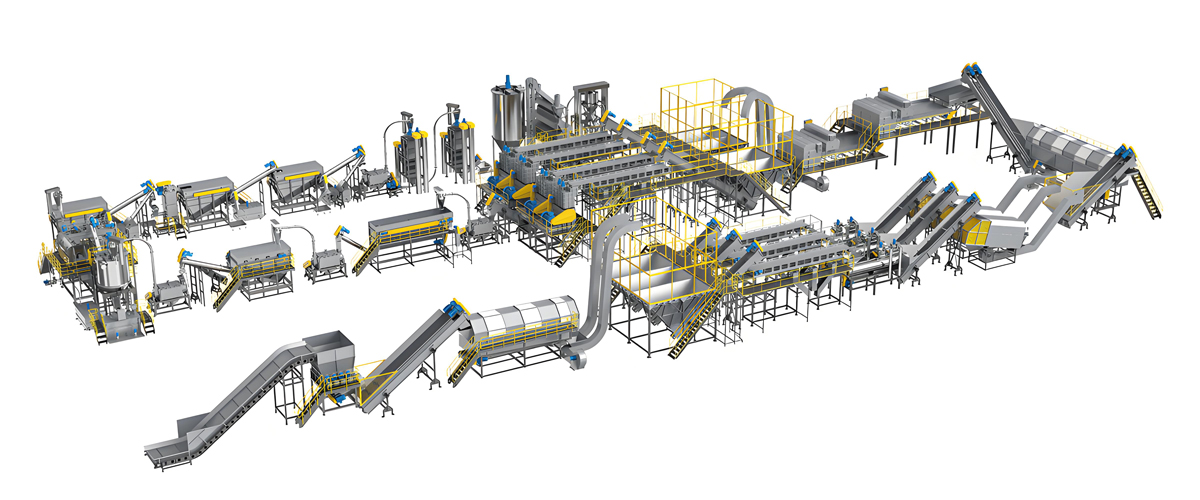
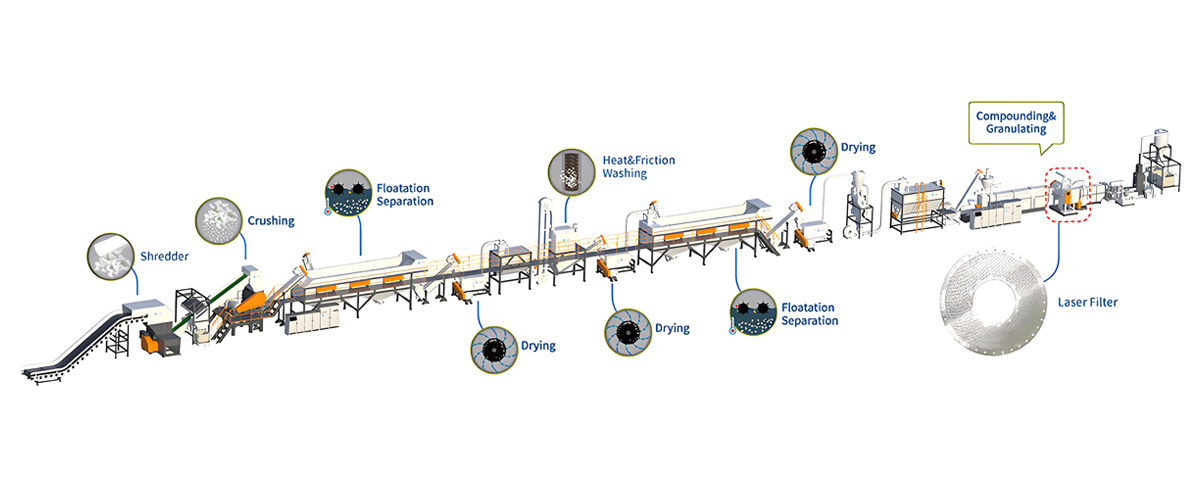
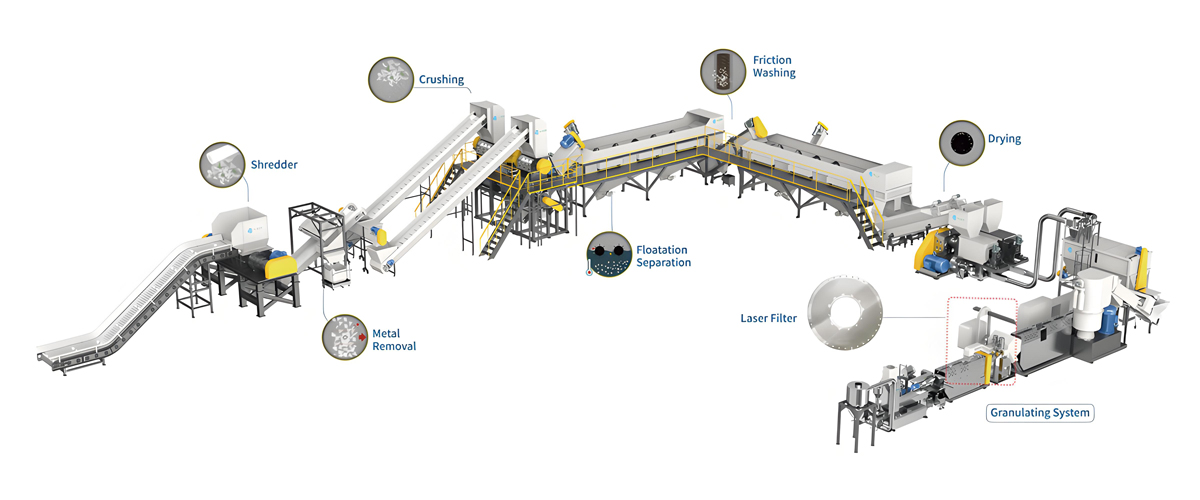
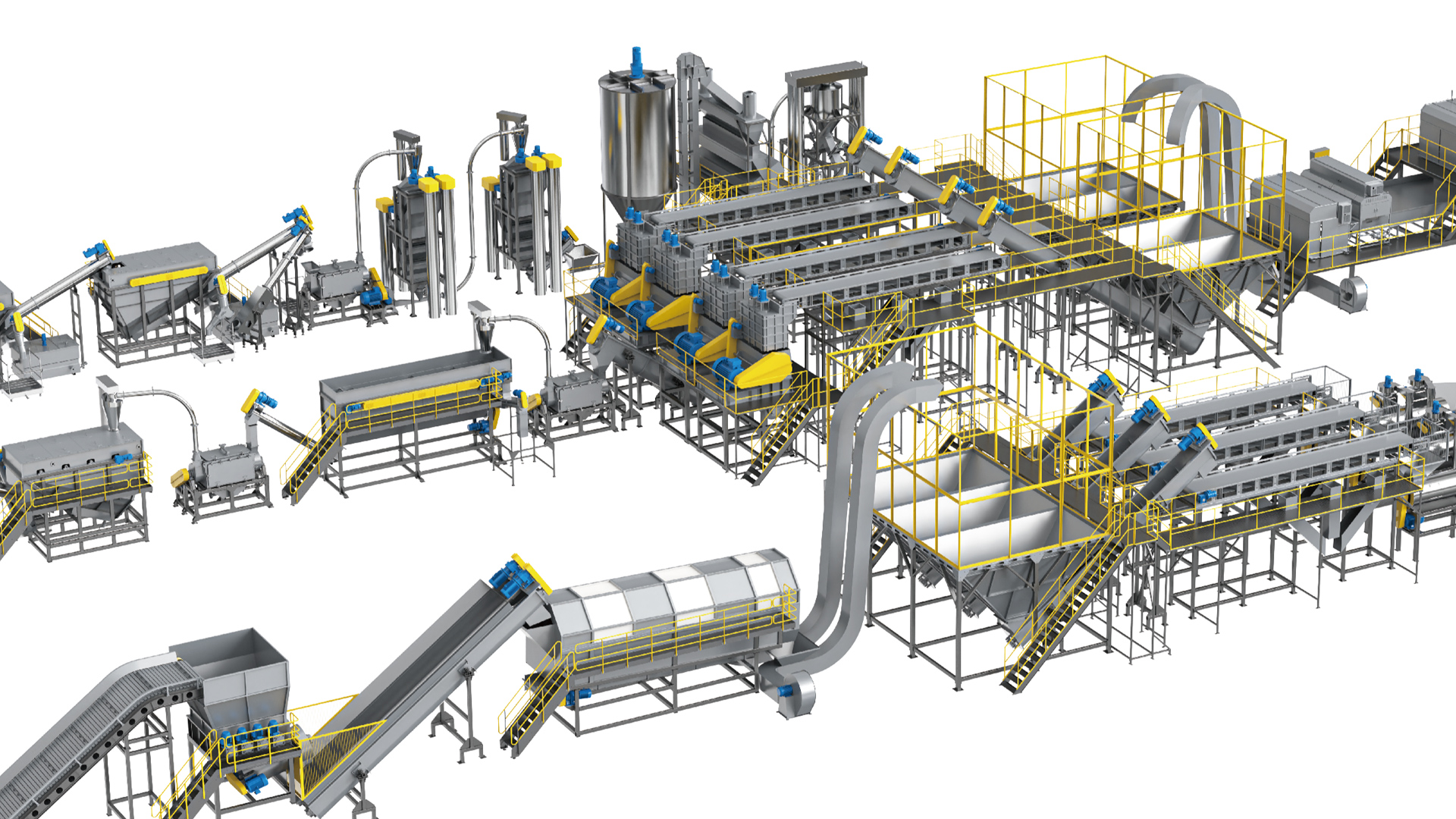
A modern washing line is a continuous train of machines, each performing one cleaning or separation function. The following stages describe how PP, PE, and PC bottle waste moves from bale to clean flake. Although PET is addressed in its own product module, the same stage logic applies, and the differences are called out where they matter.
Pre-Washing and Belt Feeding
The bale is broken and fed onto a belt conveyor where large stones, metals, and obvious non-plastic objects are removed by hand or by a trommel and magnetic separator. Pre-washing sprays the bottles with water to remove loose dirt, sand, and residual liquid before they reach the crusher. Removing bulk soil early protects the downstream water loop and reduces the load on the friction washers.
Crushing With a Wet Granulator
The heart of the line is the wet granulator, a crusher that cuts bottles underwater or under a water spray. Crushing wet serves three purposes: it keeps the blade and material cool so polymers do not smear or melt, it knocks labels and adhesives loose while the flake is still large, and it begins the washing action at the moment of size reduction. The output is flake, not dust, and the water carries away the first fraction of soluble contamination. Compared with a dry crusher, the wet granulator produces cleaner flake and a safer work environment because it suppresses fine dust.
Friction Washing
After crushing, the flake passes through a friction washer, a high-speed rotating device that uses mechanical scrubbing against the flake surface to detach remaining glue, ink, and fine dirt. Friction washing is physical, not chemical, so it is the first line of defense against label and cap residue. The intensity of friction washing is tuned to the material: PP and PE films need gentler action to avoid over-fragmentation, while rigid bottle flake tolerates more aggressive scrubbing.
Hot Washing With Caustic Solution
For food-grade and heavily labeled streams, the flake enters a hot-wash tank with a caustic (alkaline) solution. Heat and alkali break down adhesives, starches, and organic soils that cold friction washing cannot remove. The caustic concentration, temperature, and residence time are set by the contamination profile. After hot washing, the flake is thoroughly rinsed to neutralize any remaining alkali, because residual caustic would damage downstream equipment and degrade flake quality.
Sink-Float Separation
The rinsed flake moves into a sink-float separation tank, sometimes called a float wash tank, where density does the sorting. PE and PP flakes float to the surface and are skimmed off, while heavier materials such as PVC, PET, glass, and metals sink and are dragged from the bottom. For a line handling PP and PE bottle waste, this stage is where the valuable floating fraction is collected. For PC bottle waste, which sinks, the tank logic is reversed: the operator collects the sinking fraction and removes the floating PP, PE, and label contaminants.
Friction Scrubbing and Final Rinsing
Even after sink-float separation, flake benefits from a second friction scrub and a clean-water rinse. This polishing stage removes the last traces of fine fiber, label dust, and any residual caustic. Final rinsing uses the cleanest water in the loop so the flake leaves the washing train ready for dewatering and drying.
Dewatering and Drying
Mechanical dewatering squeezes free surface water from the flake using a centrifuge or screw press. Thermal or hot-air drying then reduces moisture to the low level required for storage or for direct feeding into a pelletizing line. Residual moisture targets depend on the next process step; flake destined for extrusion pelletizing must be very dry to avoid steam voids and hydrolysis in the melt.
Optical Sorting and Metal Separation
The final quality gate is optical sorting. A color sorter and a near-infrared (NIR) sorter identify off-color flake and mis-sorted polymer, ejecting it with compressed air. Metal separation, using magnetic and eddy-current devices, removes ferrous and non-ferrous fragments that survived earlier stages. Together, optical sorting and metal separation raise the flake to a saleable, spec-compliant grade.
Flake Quality Outcomes
After the full train, the operator measures residual moisture, bulk density, and the content of PVC, metal, and label remnants. The target is a clean, uniform flake with minimal cross-contamination. For food-grade PET, the line is designed to reach the purity levels that bottle-to-bottle and sheet producers require. For PP and PE, the priority is removing labels, caps, and dirt so the flake can re-enter extrusion or pelletizing without fouling the melt.
Product Module: Food-Grade-PET-Flaschen-Waschanlage
The Food-Grade-PET-Flaschen-Waschanlage is a Polyretec product module engineered for post-consumer PET bottle bales that must be converted into clean flake suitable for food-contact and high-value reuse. Although the title emphasizes PP, PE, and PC, this module is the reference example of the Austrian-technology washing train at its most demanding setting, because food-grade washing leaves no margin for label, glue, or PVC contamination. The same stage logic extends to the other resins through adjusted settings.
Capacity spans from 500 kg/h to 6000 kg/h, which lets a recycler start with a compact line and scale toward a high-throughput plant. The line is designed for different flake grades, so the specification can be tuned from standard rPET flake up to bottle-to-bottle grade by adding hot washing intensity, extra friction washers, and optical sorting. Polyretec configures each line against the customer’s actual bale composition and target market.
Food-Grade-PET-Flaschen-Waschanlage Specificationen
| Parameter | 500 to 1000 kg/h | 1500 to 3000 kg/h | 4000 to 6000 kg/h |
|---|---|---|---|
| Throughput range | 500 to 1000 kg/h | 1500 to 3000 kg/h | 4000 to 6000 kg/h |
| Final flake moisture | Low, dewatering plus drying | Low, dewatering plus drying | Low, dewatering plus drying |
| Target flake grade | Standard to food grade | Food grade capable | Food grade, high volume |
| Hot caustic wash | Included, adjustable | Included, intensified | Included, multi-loop |
| Label and cap removal | Friction plus hot wash | Friction plus hot wash | Aggressive, redundant |
| Optical sorting | Optional color sorter | Color plus NIR sorter | Multi-stage sorting |
| Water recovery | Recirculation loop | Recirculation loop | Closed-loop, filtration |
| Footprint | Compact layout | Medium layout | Large layout, planned |
Because the line is modular, a customer can begin with the 500 kg/h tier and later expand toward 6000 kg/h by adding parallel or sequential modules rather than replacing the entire train. Polyretec’s engineers plan the layout so that future expansion does not require a full redesign. This scalability is a direct benefit of the standardized European process sequence: each stage is a defined unit that can be duplicated or upgraded.
Product Module: PP/PE Weiche Kunststoffzerkleinerung and Waschlinie
The PP/PE Weiche Kunststoffzerkleinerung and Waschlinie is the Polyretec module built for flexible and semi-rigid polyolefin waste: films, woven bags, agriculture film, and soft bottle stock. Its capacity range is 500 kg/h to 1500 kg/h, which fits operations that collect post-consumer and post-industrial polyolefin scrap but do not need the very high throughput of a PET plant. For this stream, one-step pelletizing is available, meaning the washed flake can move directly into a pelletizing line without intermediate storage.
Soft plastics behave differently from rigid bottles. Films tangle, bridge, and fragment into fines if handled roughly, so the wet granulator and friction washers are tuned for gentle, high-throughput cutting and scrubbing. Sink-float separation still applies because PP and PE float while contaminants sink, but the flake size and shape require screening and dewatering equipment suited to light, flexible material.
PP/PE Weiche Kunststoffzerkleinerung and Waschlinie Specificationen
| Parameter | 500 to 800 kg/h | 1000 to 1500 kg/h | Optional Add-On |
|---|---|---|---|
| Throughput range | 500 to 800 kg/h | 1000 to 1500 kg/h | One-step pelletizing |
| Feed type | Film, woven bag, ag film | Film, woven bag, ag film | Mixed soft PP/PE |
| Crushing method | Wet granulator, tuned | Wet granulator, tuned | Heavy-duty rotor |
| Friction washing | Gentle high-speed scrub | Gentle high-speed scrub | Extra friction loop |
| Sink-float separation | Float collection of PP/PE | Float collection of PP/PE | Fine screening |
| Drying | Dewater plus thermal dry | Dewater plus thermal dry | Direct to pelletizer |
| Output form | Clean washed flake | Clean washed flake | Pellet via one-step line |
For many polyolefin recyclers, the one-step pelletizing option is the most economic path. Washed PP/PE flake is soft, low-melt, and easy to re-extrude, so feeding it straight into a pelletizing line avoids the cost and moisture risk of storing and re-handling flake. When the customer plans to pelletize, Wanplas supplies matched pelletizing systems that integrate with the Polyretec washing output, so the two stages are engineered as one continuous process rather than two disconnected machines.
Handling PC Bottle Waste on the Same Technology Platform
Polycarbonate bottle waste deserves specific attention because it does not behave like PP, PE, or PET. PC is dense, sinks in water, and is an engineering plastic with higher value and stricter processing care. A washing line that accepts PC bottles must separate them from the heavier sink fraction that also contains PET and PVC, using optical and air-based methods rather than density alone.
The Austrian-technology washing train handles PC by reusing the same stages with adjusted logic. Pre-washing and wet crushing still apply, but the crusher gap and rotor speed are set to avoid over-grinding a tough, high-impact material. Friction washing removes surface coatings and labels. Sink-float separation collects the sinking fraction, and then optical sorting identifies PC against PET and PVC by color and near-infrared signature. Because PC and PVC both sink and sit close in density, optical and air separation are essential; relying on density alone would mix them.
From a commercial view, PC bottle waste is often a smaller, higher-value stream than PP or PE. Polyretec positions it as a configurable option on the same platform rather than a separate product line, which keeps capital cost reasonable. The customer gains one washing philosophy across multiple resins, with module settings switched per material campaign. This modular flexibility reflects the European engineering heritage of building adaptable, standardized equipment.
Flake Quality Standards: PVC, Metal, and Label Removal
Flake quality is what separates a washing line that produces saleable material from one that produces liability. Three contamination classes dominate the quality discussion: PVC, metal, and label or adhesive residue. Each is addressed by a specific stage or combination of stages in the Polyretec train.
Contamination Control Map
| Contaminant | Primary Removal Stage | Secondary Control | Why It Matters |
|---|---|---|---|
| PVC | Sink-float, optical, air separation | NIR sorter | Degrades and releases acid gas during reprocessing |
| Metall | Magnetic and eddy-current separation | Metal detector at outlet | Damages granulator blades and extruder screws |
| Labels and adhesives | Wet granulator plus friction wash | Hot caustic wash | Raises ash and reduces melt quality |
| Dirt and sand | Pre-wash and trommel | Rinse loops | Abrasive to downstream equipment |
| Off-color flake | Optical color sorter | Manual grading | Limits use in clear or light products |
PVC is the most feared contaminant in a polyolefin or PET stream because, when the contaminated flake is later melted, PVC degrades and releases hydrogen chloride, which attacks equipment and poisons the melt. The washing line’s job is to drive PVC content down to a trace level through density and optical separation. Metal is a mechanical hazard: a single bolt or bottle cap fragment can chip a granulator blade or score an extruder screw, so magnetic and eddy-current separation are non-negotiable, and a final metal detector guards the outlet.
Label and adhesive removal is a chemistry and mechanics problem. Pressure-sensitive adhesives and hot-melt glues resist cold water but yield to the combination of mechanical friction and hot caustic exposure. Polyretec tunes the hot-wash temperature and alkali concentration to the label type in the local waste stream, which varies by region and by product category. The practical lesson for buyers is to characterize the label mix before specifying the line, because the washing chemistry must match the glue chemistry.
Energy and Water Consumption: Relative Performance Tiers
Energy and water consumption are central to the operating cost of any washing line, but they are presented here as relative tiers rather than fixed absolute figures, because real consumption depends on throughput, feed contamination, local water quality, and utility prices. The goal is to help a buyer compare technology routes and understand where Polyretec’s design saves resources.
Relative Resource Tiers by Line Type
| Line Configuration | Energy Tier | Water Tier | Resource-Saving Feature |
|---|---|---|---|
| Basic cold-wash PP/PE line | Low | Medium | Simple train, limited modules |
| Standard PET washing line | Medium | Medium to high | Recirculation loop |
| Food-grade PET line with hot wash | High | High without recovery | Caustic recovery, closed loop |
| Polyretec optimized line | Efficient tier | Efficient tier | Recovery, filtration, tuned friction |
The dominant energy users are the friction washers, the hot-wash heater, the dewatering centrifuge, and the dryer. The dominant water users are the rinse and hot-wash stages. Polyretec reduces both through three design choices rooted in the European engineering approach: water recirculation with filtration, caustic recovery in food-grade loops, and friction-wash intensity that is matched to the material rather than run at maximum continuously. These choices place the line in an efficient tier relative to conventional open-loop systems that dump and refill wash water.
Buyers should request a resource estimate based on their own throughput and contamination, because a generic number would mislead. Polyretec’s engineers size the pumps, heaters, and dryer to the specified capacity, and they can propose water-treatment and sludge-handling options that lower the environmental footprint further. The Wanplas group’s shared commitment to quality standards means the line is built to run continuously and efficiently rather than to win on a low headline price that costs more in utilities later.
Application Industries for Washed Flake and Regrind
Washed flake and regrind from a Polyretec line enter two broad application areas, both of which align with the brand’s mission to convert waste into usable material. The first is plastic product production, where recycled flake or pellet becomes feedstock for new goods. The second is renewable resource utilization, where recycling reduces dependence on primary plastic derived from virgin feedstock.
In plastic product production, washed PP and PE flake is extruded into pipe, profile, film, or molded articles, while PET flake becomes fiber, sheet, strapping, or, at food grade, new bottles. PC flake, when clean, returns to engineering applications that value its impact strength and heat resistance. Each end use sets its own purity bar: a strapping line tolerates more variation than a bottle-to-bottle line, so the washing grade should be matched to the destination rather than over- or under-specified.
In renewable resource utilization, the washing line is the mechanical foundation of a circular material loop. By returning local bottle waste to local factories as flake or pellet, a recycler reduces import of virgin resin, cuts landfill and ocean plastic, and builds a stable local supply of secondary material. Polyretec supports this with more than 100 delivered projects and operations across more than 50 countries, which shows the model works across climates, waste mixes, and regulatory regimes. The open-factory policy and shared Wanplas service promises make it practical for a new operator to enter the recycling business with engineering backing.
Selection Guidance: Matching Waste Type to the Right Line
Choosing the correct line starts from three inputs: the dominant resin in your waste, the throughput you can reliably supply, and the flake grade your buyers require. The table below maps common situations to the recommended Polyretec configuration. It is a starting point; final configuration is confirmed with Polyretec engineering after a feed sample analysis.
Waste Type and Throughput Selection Table
| Waste Type | Throughput | Recommended Line | Key Modules |
|---|---|---|---|
| Post-consumer PET bottles, food grade | 500 to 6000 kg/h | Food-Grade-PET-Flaschen-Waschanlage | Hot wash, optical sorting |
| PP/PE film, woven bag, ag film | 500 to 1500 kg/h | PP/PE Weiche Kunststoffzerkleinerung and Waschlinie | Gentle wet granulator, one-step pelletizing |
| Rigid PP/PE bottles and containers | 500 to 1500 kg/h | PP/PE Weiche Kunststoffzerkleinerung and Waschlinie | Sink-float, friction wash |
| PC bottle waste, mixed with PET/PVC | Configurable | PC-configured washing platform | Optical and air separation |
| Mixed PP/PE bales plus pelletizing need | 500 to 1500 kg/h | Washing line plus Wanplas pelletizing | Integrated one-step pelletizing |
The selection logic is straightforward. If your feed is mostly PET and you need food-grade output, choose the Food-Grade-PET-Flaschen-Waschanlage and invest in hot washing and optical sorting. If your feed is soft polyolefin and you want the simplest path to pellet, choose the PP/PE Weiche Kunststoffzerkleinerung and Waschlinie with one-step pelletizing. If PC is present, plan for optical and air separation from the start. Polyretec’s 24 or more engineers assist with this analysis, and the Wanplas network supplies complementary pelletizing so the whole process is coherent.
Service and Support: Free Parts, After-Sales, Open Factory
A washing line is a long-life capital asset, so the support behind it matters as much as the machine itself. Polyretec, as a Wanplas factory, operates under the group’s shared service promises. The most concrete of these is USD 500 in free spare parts provided every year, which lowers the cost of routine maintenance and keeps the line running through its first critical years. Wanplas also backs the equipment with warranty replacement for damaged parts and a quality standard that protects the buyer if specifications are not met.
Polyretec’s customer services are described as comprehensive and effective after-sales support. In practice this covers installation and commissioning by engineers, operator training on the washing sequence and safety, remote troubleshooting, and supply of wear parts such as granulator blades, screen packs, and friction-washer paddles. Because the line is modular, spare parts are standardized, which simplifies inventory and shortens downtime.
The open-factory policy is a distinctive part of the Wanplas culture. Customers are welcome to visit the factory, inspect the manufacturing quality, and witness acceptance testing before shipment. For a buyer investing in a 6000 kg/h food-grade line, that transparency removes a great deal of risk: you see the equipment run on material similar to your own before you commit to delivery. Combined with more than 100 delivered projects and presence in more than 50 countries, the support structure makes Polyretec a practical partner rather than a distant equipment vendor.
- USD 500 free spare parts every year
- Warranty replacement for damaged parts
- Installation, commissioning, and operator training
- Open-factory visits and pre-shipment acceptance testing
- Engineering support from 24 or more Polyretec engineers
Frequently Asked Questions
What types of bottle waste can the Austrian-technology washing line process?
The washing platform processes post-consumer and post-industrial PP, PE, and PC bottle waste, and it is also configured for PET bottle streams. Each material is matched to a crusher setting, friction wash intensity, and sink-float separation logic appropriate to its density and contamination profile. Polyretec analyzes a feed sample before finalizing the configuration so the line matches the real waste mix rather than an assumed ideal.
How does the wet granulator differ from a dry crusher in bottle washing?
A wet granulator cuts bottles underwater or under spray so labels, dust, and soluble contamination are flushed away during size reduction, which protects flake quality and suppresses fine dust. A dry crusher generates heat and fine dust and leaves adhesives on the flake, so a wet granulator is preferred for food-grade washing and for any line where flake purity matters. The wet method also cools the material, preventing smear and melt that would ruin the polymer surface.
Why is sink-float separation important for PP, PE, and PC flakes?
Sink-float tanks exploit density differences. PE and PP float while heavier contaminants such as PVC, PET, glass, and metals sink, so the tank removes the bulk of unwanted material before the final rinsing and optical sorting stages. For PC, which also sinks, the tank collects the heavy fraction and then optical or air separation removes PET and PVC. This stage is the backbone of polymer purity in any washing line.
What flake quality can I expect after the full washing process?
A well-tuned line delivers low residual moisture, minimal PVC and metal content, and strong label and cap removal. Final values depend on feed quality, but food-grade PET lines are designed to reach the purity levels required for bottle-to-bottle and sheet applications. Polyretec confirms achievable quality through sample testing and sets the specification with the buyer before shipment, so expectations are documented rather than assumed.
How much water and energy does a washing line consume?
Consumption is presented as relative tiers rather than fixed figures because it scales with throughput and contamination. Recirculation, caustic recovery, and optimized friction washing place Polyretec lines in an efficient tier compared with conventional open-loop systems. Buyers should request a resource estimate based on their own capacity and feed, because a generic absolute number would not reflect local conditions or the chosen module set.
Can the same line handle both PET and PP/PE bottle waste?
Some modules overlap, but PET and PP/PE have different density and abrasion behavior, so Polyretec recommends dedicated line configurations. The Food-Grade-PET-Flaschen-Waschanlage and the PP/PE Weiche Kunststoffzerkleinerung and Waschlinie are engineered for their respective streams. Running the wrong material on a line tuned for another resin reduces efficiency and can compromise flake quality, so separate trains or clear material campaigns are advised.
What after-sales support does Polyretec provide?
Polyretec provides comprehensive after-sales support, USD 500 in free spare parts every year, installation and commissioning, operator training, and an open-factory policy that welcomes customer visits and acceptance testing before shipment. Wear parts are standardized across the modular design, which shortens downtime and simplifies inventory for the operator.
How do I choose the right throughput for my waste stream?
Start from your available feed volume, contamination level, and target flake grade, then match it to the capacity tiers in the selection table. Polyretec engineers assist with a tailored configuration based on your local waste mix and utility constraints. It is better to size the line to steady reliable feed than to peak occasional volume, because continuous operation at a stable rate produces the cleanest, most uniform flake.
Conclusion
The Austrian-technology plastic washing line for PP, PE, and PC bottle waste is best understood as a proven European process sequence delivered by Polyretec’s own engineering and manufacturing. Founded in operation in 2010 and as a brand in 2017, Polyretec has built more than 100 recycling projects across more than 50 countries, supported by 24 or more engineers and a commitment to the industry of more than 10 years. The brand’s promise, Um Abfall zu Schätzen zu machen, is realized through washing lines that remove dirt, labels, PVC, and metal, then dry and optically sort flake into a reusable, often food-grade, material.
Two real product modules anchor the offering: the Food-Grade-PET-Flaschen-Waschanlage from 500 to 6000 kg/h, and the PP/PE Weiche Kunststoffzerkleinerung and Waschlinie from 500 to 1500 kg/h, the latter with optional one-step pelletizing. PC bottle waste is handled on the same configurable platform through optical and air separation. Across every configuration, Polyretec emphasizes water recovery, energy-efficient friction washing, and standardized modular design that scales with the operator’s growth.
If you are evaluating a washing line for bottle waste, the most useful next step is to send your waste profile and target flake grade to the Polyretec engineering team for a tailored configuration proposal. You are also welcome to visit the factory, observe acceptance testing on material similar to your own, and discuss capacity, layout, and after-sales support in person. With USD 500 in free spare parts every year, comprehensive after-sales service, and the backing of the Wanplas group, Polyretec offers a practical, transparent path from contaminated bottle waste to clean, reusable plastic.