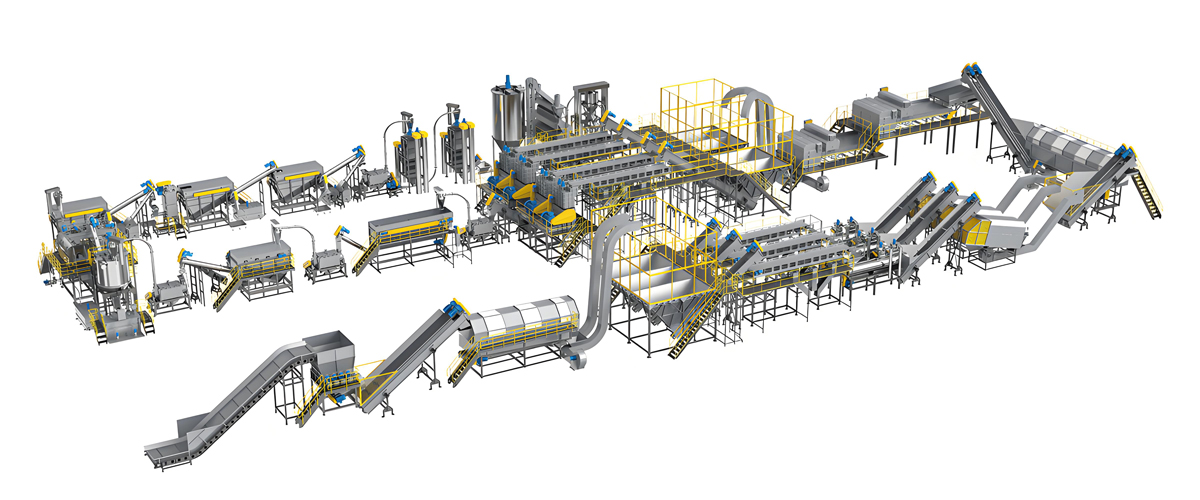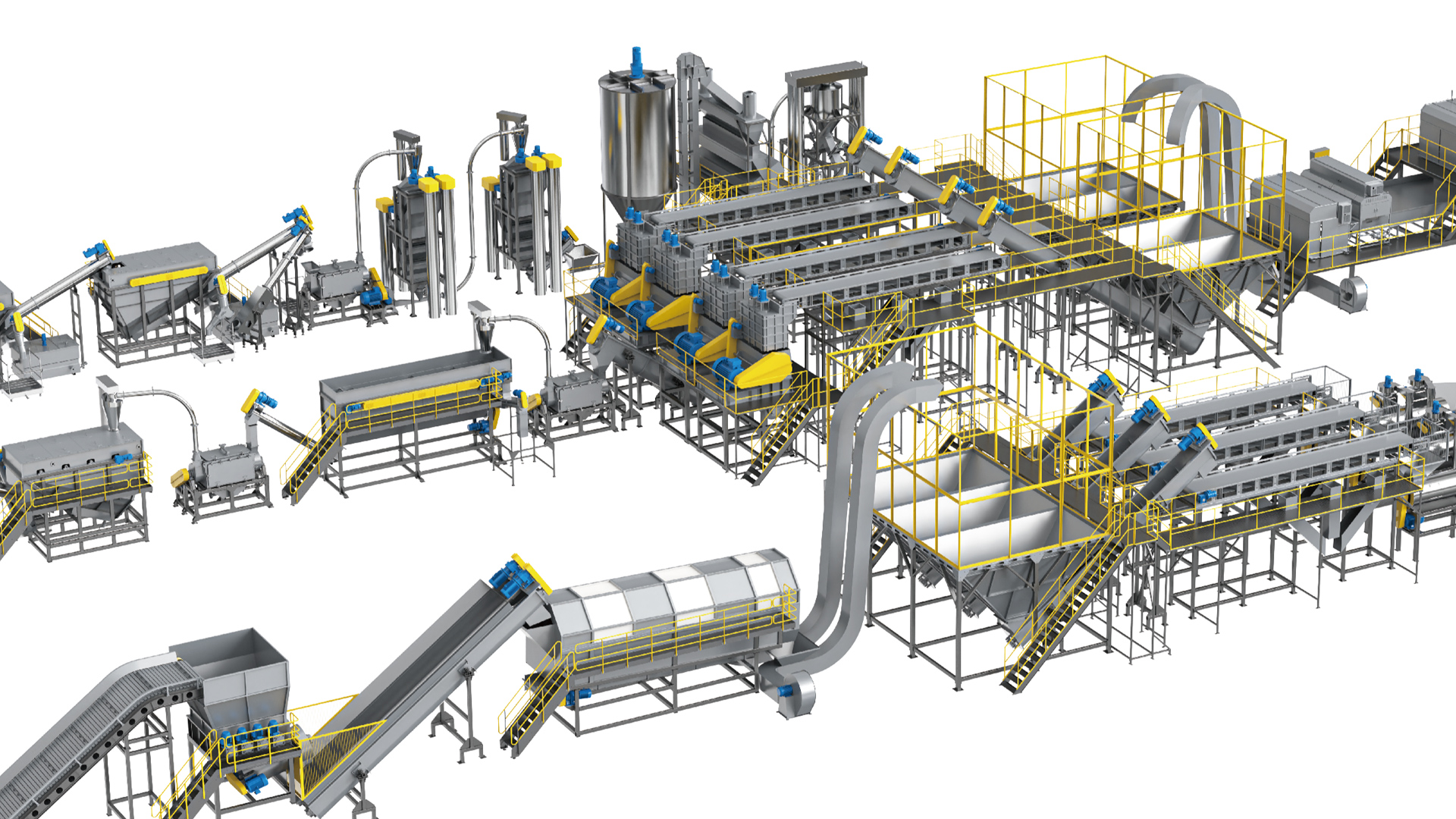
Recycling rigid plastic bottles that once held detergent, engine oil, lubricants or industrial chemicals is one of the toughest jobs in plastic recovery. These containers arrive with stubborn oil films, alkali and surfactant residue, paper labels and pressure-sensitive glue that a simple cold rinse cannot remove. A purpose-built rigid plastic washing line built on a European-style hot wash technology route is the most reliable way to turn this contaminated waste into clean, reusable PP and PE flakes. As a specialized manufacturer, Polyretec, a Wanplas factory, designs washing and pelletizing systems for rigid and post-consumer plastic waste, and this guide explains the process, the engineering decisions and the selection logic you need before investing in a line.
Why Oil- and Alkali-Contaminated Rigid Bottles Need a Dedicated Linha de lavagem
Detergent bottles, chemical drums, motor oil jugs and similar rigid containers share a common problem: they are never empty when they enter the waste stream. A residual film of oil, surfactant, solvent or alkaline cleaner clings to the inner wall, and that film is precisely what ruins a standard wash. Cold water rinsing only smears the oil around. Mechanical friction alone cannot dissolve bound grease. Paper labels and glue add a further layer of organic contamination that, if left in place, yellows the flakes and blocks the screen changer during later extrusion.
A dedicated rigid plastic washing line solves this by separating the problem into stages. First it breaks the bottles down and strips loose dirt, then it uses heat and alkali to chemically break the oil into an emulsified form that water can carry away, then it rinses repeatedly to remove both the emulsion and the alkali itself. This staged logic is the foundation of the European-style hot wash technology route that leading recycling plants have standardized on for rigid post-consumer waste.
The business case is straightforward. Clean flakes sell at a premium over dirty regrind, they pelletize without fouling the barrel, and they meet the tighter impurity limits that brand owners now demand for closed-loop packaging. A line that removes oil and alkali reliably is therefore not a luxury option but the baseline requirement for any operator who wants to move beyond low-grade reuse.
What Counts as Rigid Plastic Washing Material: Detergent Bottles, Chemical Drums and Motor Oil Bottles
The term “rigid” distinguishes these containers from films and flexible pouches. Rigid PP/PE waste keeps its shape, shreds into thick flakes rather than tangling, and runs through a washing line without the agitator or film-specific hardware that thin plastics need. The three dominant feedstocks for an oil and chemical bottle line are:
Detergent and shampoo bottles (HDPE and PP). These carry surfactant residue and pressure-sensitive labels. The oil load is moderate but the glue load is high, so the hot wash must be strong enough to release adhesive without over-foaming.
Chemical drums and jerry cans (HDPE). Industrial drums may hold alkaline cleaners, acids neutralized to salt, or solvent traces. Contamination is heavier and more variable, so the line needs adjustable alkali concentration and longer retention in the hot wash tank.
Motor oil and lubricant bottles (HDPE and PP). These are the hardest feed. Mineral oil forms a thin tenacious film that cold washing never removes, and the caps and labels add mixed polymer. A robust hot alkali stage plus good friction washing is mandatory.
PP and PE are processed together because their densities are both below 1.0 gram per cubic centimeter and they behave similarly through crushing, friction and float-sink steps. If a customer needs pure PP or pure PE output, a sink-float or color sorting pass separates them after washing. The washing chemistry itself does not change between the two resins.
Material the line should not accept without pre-sorting includes PVC bottles, which sink and must be removed upstream, and metal tins, which damage the shredder. A dry pre-sort and a metal separator at the infeed protect the equipment and keep flake purity high.
The European-Style Hot Wash Process Route
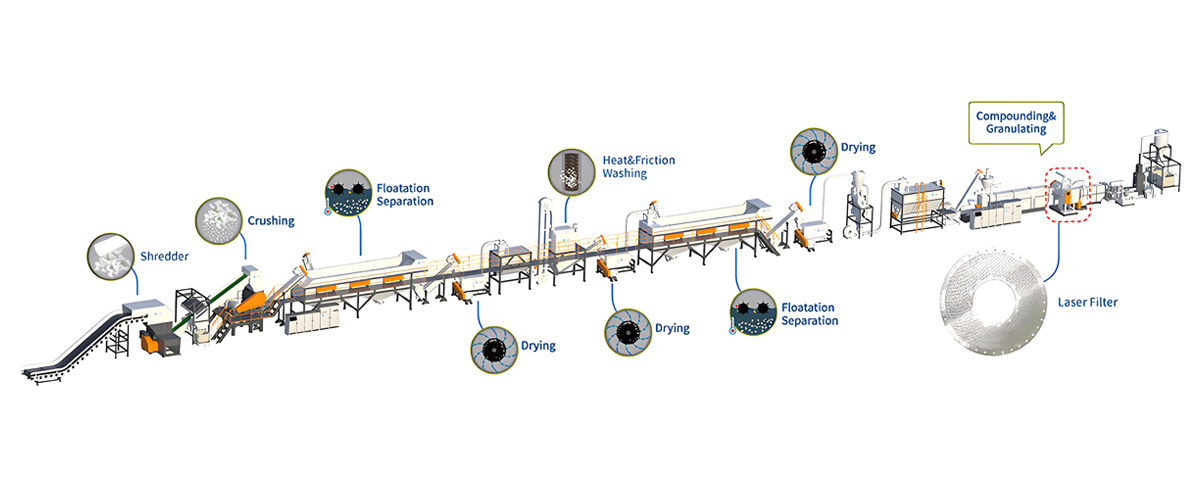
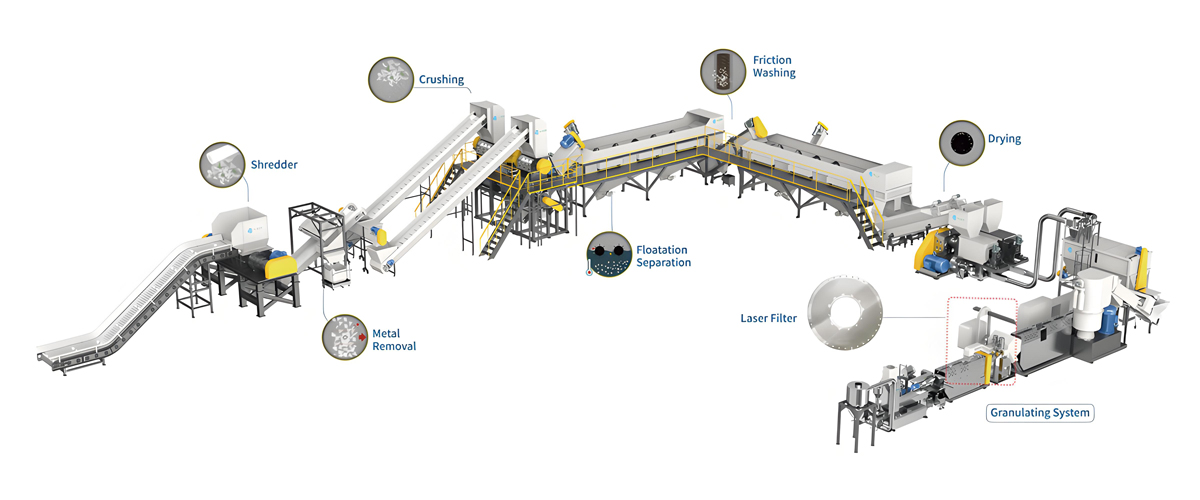
The European-style hot wash technology route organizes cleaning into five continuous stages. Each stage has one job, and the sequence is fixed because skipping or reordering a stage degrades the result.
Stage 1 — Pre-wash and de-labeling. Whole bottles enter a wet pre-wash drum or a cold soak tank where loose soil, sand and surface dust are knocked off. A label-scraping or steam-softening step loosens paper and glue. This stage protects the downstream hot wash from being overloaded with coarse dirt that would otherwise consume alkali and clog settling.
Stage 2 — Friction washing. Shredded flakes pass through a high-speed friction washer where rotating paddles and a perforated screen rub flake against flake under sprayed water. Friction removes the loosened label fragments and the outer oil smear. Friction washing is mechanical, so it works best after the pre-wash has already softened contaminants.
Stage 3 — Hot alkali washing. This is the core of the route. Flakes sit in a heated tank with a caustic soda (sodium hydroxide) solution, typically at 60 to 85 degrees Celsius, for several minutes of retention. The alkali saponifies oil and grease, turning them into water-soluble soap, and hydrolyzes the label glue so it releases. Temperature, alkali concentration and retention time are the three levers that control cleaning power.
Stage 4 — Multi-stage rinsing. After the hot wash, flakes move through two or three rinse tanks, often with a final hot rinse to strip residual alkali. Without thorough rinsing, trapped caustic will later corrode equipment and discolor the product. A counter-current water arrangement keeps freshwater use low while still diluting the contaminant load.
Stage 5 — Dewatering and drying. A dewatering centrifuge removes most surface water, then a thermal dryer drops moisture to below 1 percent so the flakes store and feed cleanly into a pelletizing line. Final moisture and residual oil are the two numbers that decide whether the output is saleable.
Line Configuration by Capacity
The equipment set is the same across capacities; what changes is the size of each module and the water and power behind it. The table below shows a typical rigid bottle washing line configured for three standard throughput tiers. Wet weight of fed bottles is used because whole bottles trap air and water.
| Equipment Module | 500 kg/h | 1000 kg/h | 2000 kg/h |
|---|---|---|---|
| Belt conveyor with metal separator | 0.75 kW, 600 mm wide | 1.1 kW, 800 mm wide | 2.2 kW, 1000 mm wide |
| Pre-wash drum / soak tank | 3.0 kW, 4 m³ | 5.5 kW, 8 m³ | 11 kW, 16 m³ |
| Single-shaft shredder | 45 kW, 12 to 16 mm screen | 90 kW, 12 to 16 mm screen | 160 kW, 14 to 18 mm screen |
| Friction washer | 22 kW, 1.2 m³/min spray | 37 kW, 2.4 m³/min spray | 75 kW, 4.8 m³/min spray |
| Hot alkali wash tank (heated) | 30 kW, 6 m³, 60 to 85 °C | 55 kW, 12 m³, 60 to 85 °C | 110 kW, 24 m³, 60 to 85 °C |
| Rinse tanks (2 to 3 stages) | 4 kW each, 5 m³ | 7.5 kW each, 9 m³ | 15 kW each, 18 m³ |
| Dewatering centrifuge | 7.5 kW | 15 kW | 30 kW |
| Thermal dryer | 18 kW, 120 °C air | 36 kW, 130 °C air | 72 kW, 140 °C air |
| Approx. total connected power | 130 kW | 240 kW | 470 kW |
| Process water demand (make-up) | 0.8 to 1.5 m³/h | 2.0 to 3.5 m³/h | 4.0 to 7.0 m³/h |
| Footprint (L x W) | 22 m x 6 m | 30 m x 8 m | 42 m x 10 m |
| Operating labor | 1 to 2 persons | 2 persons | 2 to 3 persons |
Water demand in the table is make-up only. With a closed-loop settling and filtration circuit, recirculated water covers most of the process volume, so the freshwater draw stays in the ranges shown. The hot wash heater is the largest single power consumer, which is why insulation and heat recovery on the rinse water pay back quickly.
Contamination Level Matrix
Not every feed is equally dirty. Matching the process intensity to the contamination level is the difference between wasting alkali and leaving oil behind. The matrix below maps light, medium and heavy oil contamination to the hot wash settings and rinse stages the line should apply.
| Contamination Level | Typical Feed | Hot Wash Temp | NaOH Concentration | Retention Time | Rinse Stages | Expected Residual Oil |
|---|---|---|---|---|---|---|
| Light oil | Clean detergent bottles, light surfactant | 60 to 70 °C | 0.5 to 1.0 percent | 6 to 8 min | 2 stages | Below 80 ppm |
| Medium oil | Mixed household bottles, some grease | 70 to 80 °C | 1.0 to 1.8 percent | 8 to 12 min | 2 to 3 stages | Below 50 ppm |
| Heavy oil | Motor oil jugs, chemical drums | 80 to 85 °C | 1.8 to 3.0 percent | 12 to 18 min | 3 stages | Below 30 ppm |
For heavy oil feed, an optional pre-soak with a higher alkali charge before the main hot wash further reduces the load on the heated tank. Operators should also watch foam: too much surfactant in the feed can carry oil back onto the flakes unless an anti-foam program and good defoaming are in place.
Outlet Cleanliness and Residual Oil Targets
The line is only as good as its output numbers. Buyers of washed rigid PP/PE flakes judge them on impurity level, residual oil, moisture, color and odor. The table below lists the targets a properly tuned European-style hot wash line should meet, and the test method families used to confirm them.
| Quality Indicator | Target for Clean Rigid Flakes | Why It Matters | Typical Check |
|---|---|---|---|
| Total impurities (non-polymer) | Below 0.3 percent | Protects screen changer and screw | Float-sink, visual sort, ash test |
| Residual oil / grease | Below 50 ppm (heavy feed below 30 ppm) | Prevents yellowing and odor in pellets | Solvent extract, FTIR screening |
| Moisture after drying | Below 1.0 percent | Avoids steam voids in extrusion | Loss-on-drying oven |
| Residual alkali (pH of leachate) | Near neutral, pH 6.5 to 8.0 | Stops corrosion and degradation | pH strip or meter on rinse water |
| Label and glue remnants | Below 0.1 percent by area | Improves color and optics | Visual and sieve check |
| Odor | Neutral, no hydrocarbon smell | Needed for food-contact-grade paths | Sniff and sealed-jar test |
Meeting these targets is what lets the flakes move into a pelletizing line and, for suitable streams, toward food-contact-grade reuse after further processing. The washing line does not by itself grant any certification; it creates the clean feedstock that downstream steps and independent laboratories then verify against standards such as those referenced by regional food-contact rules.
Product Spotlight: Polyretec Hard PP/PE Crushing and Linha de lavagem
Polyretec, a Wanplas factory, builds the Hard PP/PE Crushing and Linha de lavagem for exactly this feed: rigid bottles, drums and containers carrying oil, glue and alkali residue. The line follows the five-stage European-style hot wash route above and is delivered as a turnkey package with electrical control, piping and commissioning support.
The configuration is offered in three throughput tiers so a buyer can match the line to available feed and floor space. Each tier keeps the same process sequence; only module size and drive power scale.
| Especificação | 500 kg/h Tier | 1000 kg/h Tier | 2000 kg/h Tier |
|---|---|---|---|
| Suitable feed | Rigid HDPE/PP bottles, caps | Bottles, drums, jerry cans | Bulk drums, mixed rigid waste |
| Shredder power | 45 kW | 90 kW | 160 kW |
| Hot wash temperature range | 60 to 85 °C | 60 to 85 °C | 60 to 85 °C |
| Hot wash tank volume | 6 m³ | 12 m³ | 24 m³ |
| Rinse stages | 2 | 2 to 3 | 3 |
| Final moisture | Below 1.0 percent | Below 1.0 percent | Below 1.0 percent |
| Total connected power | About 130 kW | About 240 kW | About 470 kW |
| Make-up water | 0.8 to 1.5 m³/h | 2.0 to 3.5 m³/h | 4.0 to 7.0 m³/h |
| Control system | PLC with HMI | PLC with HMI | PLC with HMI and remote link |
Key engineering points that set the line apart: the hot wash tank uses direct steam or electric heating with insulated walls to hold temperature steady; the friction washer screen is quick-release for fast cleaning; and the dewatering centrifuge plus thermal dryer are sized so flakes leave at storage-safe moisture. All electric components use internationally recognized brands, and the line is built to CE and ISO shop standards.
Product Spotlight: Polyretec Rigid Flakes Linha de reciclagem e pelletização
Washing produces flakes. Many operators want pellets, because pellets feed more evenly, blend with additives and ship without moisture concerns. The Polyretec Rigid Flakes Linha de reciclagem e pelletização takes clean rigid PP/PE flakes from the washing line and converts them into uniform re-pellets through compaction, extrusion, melt filtration and cutting.
The extruder uses a wear-resistant barrel and screw set with a properly selected L/D ratio for rigid regrind, plus a continuous screen changer that protects the melt from any residual fines. For downstream pelletizing that is not part of the Polyretec washing scope, Wanplas supplies matched twin-screw pelletizing systems that integrate directly with Polyretec washing lines, keeping the whole plant under one control philosophy.
| Especificação | 500 kg/h Tier | 1000 kg/h Tier | 2000 kg/h Tier |
|---|---|---|---|
| Feeder type | Compactor feeder | Compactor feeder | Compactor feeder |
| Extruder barrel diameter | 100 mm | 130 mm | 160 mm |
| L/D ratio | About 32:1 | About 34:1 | About 36:1 |
| Drive power | 90 kW | 160 kW | 280 kW |
| Melt filtration | Continuous screen changer | Continuous screen changer | Dual-station screen changer |
| Cutting method | Die-face hot cutting | Die-face hot cutting | Die-face hot cutting |
| Pellet moisture | Below 0.2 percent | Below 0.2 percent | Below 0.2 percent |
| Total connected power | About 120 kW | About 210 kW | About 360 kW |
Because the pelletizing line runs on flakes that already passed the washing quality gate, it stays clean: the screen changer lasts longer, the barrel sees less abrasion, and the pellets hold color. The two lines together form a complete rigid bottle recovery plant from loose waste to bagged re-pellets.
Aplicações Across Industries
Clean rigid PP/PE flakes and pellets from an oil and chemical bottle washing line serve a wide set of end products. The application reach is what makes the investment resilient across market cycles.
Blow-molded containers. Recycled HDPE from detergent and chemical drums returns to new jerry cans, pails and industrial bottles. This is the largest and most stable outlet because it does not require food-grade status.
Injection-molded housewares and parts. PP and HDPE regrind feed pallets, crates, bins, flower pots and technical components where color tolerance is acceptable. The cleaned flakes give consistent flow and low odor.
Pipe and profile compounds. Rigid PE regrind blends into non-pressure pipe, corrugated conduit and construction profiles, where impurity limits are moderate but cost pressure is high.
Sheet and board. Thick PP and PE board for signage, pallets and protective packaging uses recycled rigid flake as a major filler, lowering material cost while keeping stiffness.
Chemical and detergent packaging closed loop. Brand owners recovering their own post-industrial bottles can, after the hot wash and further processing, bring material back toward compliant packaging grades, supporting renewable resource utilization and lower dependence on primary resin.
The reason to keep the wash quality tight is precisely this range of outlets: a cleaner flake opens the higher-value injection and sheet markets, while a merely “okay” flake is stuck in low-grade pipe filler. The European-style hot wash route is the lever that moves flakes up the value ladder.
How to Choose: Requirement to Model Selection
Choosing the right line starts from the feed and the target, not from a catalog number. The table below maps common buyer situations to the recommended Polyretec configuration. All recommendations stay within the host factory’s real product lines.
| Buyer Requirement | Feed Profile | Target Output | Recommended Polyretec Configuration |
|---|---|---|---|
| Start-up recycler, local collection | Light detergent bottles | Clean flakes, 500 kg/h | Hard PP/PE Crushing and Linha de lavagem, 500 kg/h tier |
| Regional plant, mixed bottles | Medium oil, mixed HDPE/PP | Clean flakes, 1000 kg/h | Hard PP/PE Crushing and Linha de lavagem, 1000 kg/h tier, 3 rinse stages |
| Industrial drum recycler | Heavy oil, chemical drums | Premium flakes, 1000 to 2000 kg/h | Hard PP/PE Crushing and Linha de lavagem, 2000 kg/h tier with pre-soak |
| Flake-to-pellet operator | Pre-washed rigid flakes | Re-pellets, 1000 kg/h | Rigid Flakes Linha de reciclagem e pelletização, 1000 kg/h tier |
| Full recovery plant | Bottles to pellets | Flakes plus pellets, 2000 kg/h | Washing 2000 kg/h tier plus Pelletizing 2000 kg/h tier, integrated |
| Downstream pelletizing only | Need matched extrusion | Integrated plant | Wanplas matched twin-screw pelletizing system with Polyretec line |
When the feed is unknown or seasonal, size the hot wash tank for the worst month rather than the average. A tank that is right for light summer bottles will fail on heavy winter motor oil jugs. Polyretec engineers review the actual feed sample before finalizing the configuration, which avoids the most expensive mistake: buying a line that cannot clean the real waste.
Energy, Water and Operating Cost Considerations
Two cost centers dominate a rigid washing line: heat for the hot wash and water treatment. Both are manageable with the right design.
Heat. The hot wash heater is the biggest power draw. Insulating the tank, recovering heat from the first rinse back into the hot wash, and using steam where plant boiler capacity exists all cut energy use. Relative operating cost by capacity tier rises from Low at 500 kg/h to Medium at 1000 kg/h and High at 2000 kg/h, but the cost per kilogram of cleaned flake typically falls as scale increases because fixed losses are spread over more output.
Water. A closed-loop with settling, filtration and a light caustic make-up keeps freshwater low. Recirculation also keeps the alkali concentration steadier, which improves cleaning. The make-up numbers in the capacity table already assume this loop; an open once-through system would multiply water cost several times.
Consumables. Caustic soda, anti-foam and screen packs are the recurring items. Heavy oil feed uses more alkali, so feed grading directly controls this line item. Good pre-sort to remove PVC and metal also protects the barrel and screw in the pelletizer, extending part life.
Labor. The line is largely automatic once running; one or two operators per shift cover feeding, watching the HMI and sampling. Remote monitoring lets the Wanplas engineering team check PLC data and flag anomalies without a site visit, reducing unplanned stops.
Hot Wash Versus Conventional Cold Wash Routes
Buyers sometimes ask why not just use a conventional cold wash line. The comparison below shows why oil and chemical bottles need heat.
| Factor | European-Style Hot Wash Route | Conventional Cold Wash Route |
|---|---|---|
| Oil and grease removal | Alkali saponifies oil; reliable on motor oil | Smears oil; poor on heavy residue |
| Label and glue release | Hydrolyzes glue; clean separation | Partial; glue fragments remain |
| Residual oil outcome | Below 50 ppm typical | Often above 200 ppm |
| Flake color and odor | Neutral, low odor | Yellow tint, hydrocarbon smell |
| Downstream pelletizing | Stable, long screen life | Fouling, frequent screen change |
| Energy use | Higher (heating) | Lower |
| Best fit | Oil, chemical, alkali bottles | Clean post-industrial rigid scrap |
The trade-off is clear: cold wash saves energy but fails on exactly the contaminants that define this feed. For detergent, chemical and motor oil bottles, the hot wash route is not optional. Compared with entry-level imported units that omit the heated stage, a properly specified hot wash line delivers a product that actually sells into higher-value markets.
Service and Support
Polyretec, a Wanplas factory, backs every washing and pelletizing line with the group’s shared service commitments. These are part of the buying decision, not an afterthought.
Factory testing before shipment. Each line runs on a representative feed at the workshop so the buyer sees throughput and flake quality before loading. Test reports cover capacity, moisture and residual impurity.
Installation and commissioning. Engineers travel to the site to set up, align and tune the line, then run a supervised start-up until the operator team is confident.
Spare parts policy. Under the Wanplas brand promise, every customer receives USD 500 free parts per year, and parts damaged within warranty are replaced free. Wear items such as screens, blades and belt sections are stocked for fast dispatch.
Training. On-site and remote training covers daily operation, alkali dosing, routine cleaning of the friction washer screen, and safe lock-out procedures for the shredder and heater. Operators learn to grade feed and set the hot wash by contamination level.
Remote support and monitoring. The control system links to the Wanplas engineering team, who can read PLC data, spot drifting parameters and guide fixes without delay. This keeps unplanned downtime short.
Open factory. Customers are welcome to visit the workshop, audit the build quality and run their own feed on a demonstration line before committing. The open-factory policy is a standing invitation, not a one-time offer.
Feed Preparation and Pre-Sorting Before the Linha de lavagem
No washing line performs better than the feed it receives. The single highest-leverage step in a rigid bottle recovery plant happens before the first drop of water: preparation and sorting at the infeed. A small investment in pre-sort discipline pays back many times over in barrel life, flake purity and alkali savings.
Metal removal. Bottles often arrive with steel or aluminum caps, pumps and accidental tins. A belt with an over-belt magnet pulls ferrous parts, and a downstream eddy-current or inductive separator catches non-ferrous metal. Metal that reaches the shredder chips the rotor, and metal that reaches the flake stream fails the impurity spec and can spark in the dryer. Polyretec lines fit the metal separator at the conveyor, ahead of the shredder, exactly for this reason.
PVC separation. PVC bottles sink in water and have a different thermal behavior; if they slip into the PP/PE stream they ruin both washing and later extrusion because PVC degrades and releases acid at Polyretec pelletizing temperatures. A dry optical or density pre-sort, or at minimum a manual pick station, keeps PVC below the tolerance. The washing line itself should not be asked to remove large PVC loads.
Label and cap handling. Pressure-sensitive labels and multi-layer caps are part of the design scope, not a defect. The hot wash releases glue and the friction washer strips fragments, but extremely high glue loads benefit from a pre-steam label softening pass. Caps of mixed polymer are acceptable because the wash route treats PP and PE together; only the final sink-float or color sort splits them if a single-resin output is required.
Moisture and dirt load. Excess soil and sand in the feed consumes alkali and fills the settling tank. A simple pre-wash or even a shake-out screen at the tip floor lowers chemical cost and extends the interval between tank cleaning. Operators who grade feed by contamination level, as the matrix in this guide recommends, consistently report lower operating cost per ton of clean flake.
Troubleshooting Common Wash Quality Problems
Even a well-specified line drifts if it is not watched. The table below lists the usual symptoms, their likely causes and the adjustment that restores quality. Keep it at the control panel.
| Symptom | Likely Cause | Corrective Action |
|---|---|---|
| Oily or hydrocarbon smell in flakes | Hot wash too cool or alkali too weak | Raise temperature toward 80 to 85 °C; increase NaOH to contamination level |
| Yellow or grey flake color | Short retention or insufficient rinse | Lengthen hot wash retention; add a third rinse stage |
| Residual alkali,腐蚀 of later equipment | Rinse water near alkaline | Check counter-current rinse; confirm final rinse pH near neutral |
| High foam in tanks | Surfactant-rich feed, low defoam | Add anti-foam program; pre-wash heavier before hot stage |
| Label fragments in output | Glue not released | Raise hot wash temp; verify steam label softening if fitted |
| High moisture after dryer | Dryer air low or centrifuge worn | Check dryer temperature and airflow; inspect centrifuge screen |
Most quality problems trace back to one of three settings: hot wash temperature, alkali concentration or retention time. Because these three levers are independent, an operator can usually recover quality with a single change once the symptom is correctly read. The remote monitoring link lets the Wanplas engineering team confirm the setting from the HMI data rather than guessing.
Commissioning and First-Run Checklist
A new line should not be judged on its first hour. A structured commissioning plan protects the investment and proves the spec. Polyretec follows this sequence during installation and commissioning:
First, fill and heat the hot wash tank and confirm it holds the target temperature with the insulation in place. Second, run a clean water circulation test through the whole line to verify pumps, screens and the dewatering centrifuge. Third, feed a known light bottle sample and record capacity, moisture and residual impurity. Fourth, move to a medium and then a heavy oil sample, adjusting temperature, alkali and rinse stages per the contamination matrix. Fifth, take flake samples for independent check of residual oil, moisture and impurity. Only when all tiers meet target is the line accepted.
Operators should keep a simple log: feed grade, hot wash temperature, alkali dose, rinse stages, flake moisture and residual oil per shift. Over a few weeks this log shows the real operating envelope of the plant and becomes the basis for optimization and for training new staff. The Wanplas open-factory visits and training sessions build exactly this discipline into the customer team.
Water Treatment, Sludge and Environmental Compliance
A washing line moves a lot of dirty water, and what leaves the plant matters as much as what enters it. The closed-loop design already minimizes freshwater draw, but the contaminant it captures must be handled. Alkali, emulsified oil and label fiber concentrate in the settling tank and the filtration circuit, forming a sludge that is pumped out on a schedule set by feed grade. That sludge is classified as industrial residue and should go to an approved handler; it is not sewer discharge.
Good practice separates the streams: a first-stage settler drops heavy grit and sand, a flotation or dissolved-air unit lifts oil and light fiber, and a filter polishes the return water. Operators log sludge volume against feed tonnage so the treatment cost is known per unit of output. Plants that pre-sort aggressively and keep PVC out of the line generate far less hazardous load, which lowers both disposal cost and compliance risk. Treated process water that meets local limits can be partly discharged or fully recirculated, and the choice depends on regional rules that the customer confirms with local authorities before commissioning.
Frequently Asked Questions
Can a rigid plastic washing line really remove motor oil and grease?
Yes. A hot alkali wash stage at 60 to 85 degrees Celsius with caustic soda saponifies mineral oil and grease, and multi-stage rinsing then carries the emulsion and alkali away. Residual oil typically drops below 50 ppm, and below 30 ppm on heavy feed with a pre-soak.
What capacity ranges are practical for rigid bottle washing lines?
Standard configurations run from 500 kg/h for entry-level plants through 1000 kg/h to 2000 kg/h for industrial throughput. Water, power and footprint scale with capacity, but the five-stage process route stays the same.
Why is hot washing better than cold washing for chemical bottles?
Cold wash only smears oil and leaves glue fragments, causing yellow flakes and odor. Hot alkali washing dissolves bound oil and glue, delivering lower residual oil, neutral color and stable downstream pelletizing. For this feed the hot route is the reliable choice.
How much water does a rigid washing line consume?
A 1000 kg/h line typically needs 2.0 to 3.5 cubic meters per hour of make-up water when a closed-loop settling and filtration system recirculates most process water. An open once-through design would use several times more.
What residual oil level is acceptable before pelletizing?
For rigid PP/PE flakes the target is below 50 ppm residual oil with below 0.3 percent total impurities and below 1.0 percent moisture, so the extruder barrel and screen changer stay clean and the pellets hold color.
Do I need a separate pelletizing line after washing?
Washing delivers clean flakes. If pellets are the goal, Wanplas supplies matched pelletizing systems that integrate directly with Polyretec washing lines, giving a complete bottle-to-pellet recovery plant under one control philosophy.
Can the line handle both PP and PE rigid containers?
Yes. PP and PE have similar sub-1.0 density behavior and share the same wash route. They are separated afterward by sink-float or color sorting only if a pure single-resin output is required by the buyer.
What after-sales support comes with a Polyretec line?
Factory testing, on-site installation and commissioning, training, remote monitoring, open-factory visits and USD 500 free parts per year under the Wanplas policy. Wear parts are stocked for fast dispatch and warranty covers damaged components.
Conclusion
Oil- and alkali-contaminated rigid bottles are recoverable only with a washing line built around the European-style hot wash technology route: pre-wash and de-labeling, friction washing, hot alkali washing, multi-stage rinsing, and dewatering and drying. The process turns detergent bottles, chemical drums and motor oil jugs into clean PP/PE flakes that downstream pelletizing converts into reusable re-pellets.
Polyretec, a Wanplas factory, delivers this route as the Hard PP/PE Crushing and Linha de lavagem in 500, 1000 and 2000 kg/h tiers, with the Rigid Flakes Linha de reciclagem e pelletização for operators who want pellets. Matching the hot wash settings to the contamination level, closing the water loop and sizing the tank for the worst feed are the engineering choices that decide whether the output reaches premium markets.
If you are planning a rigid bottle recovery plant, send your feed sample and target output to the Polyretec team. They will analyze the contamination level, recommend the right tier and configuration, invite you to the open factory to run your material, and support commissioning and operation under the Wanplas service promise. Clean flakes start with the right wash line, and the right wash line starts with an honest look at your waste.