
Choosing the best LDPE film recycling line for Mexico sticker film waste is not a matter of picking the largest shredder or the longest washing tank. It is a matter of designing around one specific contaminant family: pressure-sensitive adhesive, and the silicone release coating that travels with it. Mexican recyclers in Monterrey, Guadalajara, Estado de México and the Bajío corridor collect enormous volumes of low-density polyethylene film that carries self-adhesive labels, label liner scrap, protective films and rejected labelled bags. That material looks like ordinary post-industrial film in the bale, and it behaves like ordinary film through the shredder. Then it reaches the melt filter, and the differences become expensive.
Adhesive-loaded film is the reason a conventional PP/PE washing line that runs perfectly on clean stretch film can lose half its output when the feedstock changes to labelled material. The gum does not wash off in cold water. It softens in the extruder, migrates to the screen pack, blinds the mesh and forces screen changes every hour or two. Silicone release coating behaves even worse, because it is chemically inert, survives caustic solution and reappears later as fish eyes in blown film or as poor ink adhesion on printed products. Any serious line specification for this stream therefore needs three additions over a standard film washing line: a hot caustic washing stage with real residence time, a rinse train long enough to strip residual alkali, and a continuous melt filtration system that can hold fine screens without stopping.
This guide walks through the entire process chain for a dedicated LDPE sticker film recycling line built for Mexican conditions. It covers feedstock classification, adhesive chemistry, station-by-station equipment parameters, the caustic washing window, film-specific pelletizing with compaction and multi-stage degassing, three capacity configurations, water treatment obligations under Mexican regulations, and the practical realities of 60 hertz power, import routing and rLDPE offtake. Polyretec, a Wanplas factory, has supplied washing and pelletizing lines for exactly this application, including a Mexican installation built around a heavy-duty shredder and beater machine for LDPE film with stickers, and the engineering logic below reflects that field experience.
Why Mexican Sticker Film Waste Is a Different Feedstock
Mexican sticker film waste is a blended stream in which the polymer is easy and the surface chemistry is hard. The LDPE and LLDPE base resin is forgiving, thermally stable and simple to melt, but the material arrives coated with adhesive, printed with solvent inks, mixed with paper liner fibre and, in the agricultural fraction, loaded with soil. Understanding where each fraction originates is the first step in designing the line, because collection origin predicts contamination type far better than any visual bale inspection.
Where the material comes from
Label converting plants generate release liner film and matrix waste, the skeleton left after die-cutting labels. This fraction is clean of soil but heavily coated with both adhesive and silicone, and it often carries paper liner fragments. Labelling lines in food, beverage and personal care plants generate rejected labelled film, mislabelled bags and start-up scrap. Self-adhesive protective film comes from appliance, furniture and metal-sheet manufacturers across Monterrey and Saltillo, where surface protection film is peeled off after assembly and discarded with adhesive still active.
The agricultural fraction is entirely different. Greenhouse film and mulch film from Sinaloa, Jalisco, Michoacán and Baja California come in with soil, sand, plant residue and moisture. Ash content in agricultural film routinely reaches the 5 to 15 percent range before washing, and moisture as delivered can sit anywhere from 3 to 8 percent. That fraction is not adhesive-heavy, but it is abrasive, and it dictates pump material selection, hydrocyclone wear liners and sludge handling capacity.
The commercial fraction, mainly shopping bags and stretch film from distribution centres in Monterrey, Guadalajara and Mexico City, sits between the two extremes. It is relatively low in mineral contamination but carries tape residue, printed graphics and a persistent fraction of foreign polymers.
The contamination map
Beyond adhesive, four contamination groups define the process design. Printing inks include nitrocellulose and polyurethane solvent systems as well as water-based systems, and their pigments and binders are the main source of grey discoloration and volatile odour in the finished pellet. Paper fibre from label liner disperses in the wash water and, if not removed, carbonises in the extruder and shows as black specks. Mineral contamination — soil, sand and grit — abrades screws and barrels and raises ash content above specification. Foreign polymers, mainly polypropylene from woven bag fragments and polyethylene terephthalate from label facestock, plus occasional metal staples and strapping clips, complete the picture.
Because LDPE has a density of roughly 0.915 to 0.935 grams per cubic centimetre, it floats. Polyethylene terephthalate at about 1.38 and polyvinyl chloride at about 1.40 sink, as do sand and grit. That density gap is the single most reliable separation mechanism available, and a well-designed sink-float train exploits it repeatedly rather than once.
Table 1: Mexican LDPE Film Waste Classification
| Waste Category | Typical Origin in Mexico | Dominant Contaminants | Contamination Level | Processing Difficulty | Recommended Process Route |
|---|---|---|---|---|---|
| Release liner and label matrix film | Label converters, printing houses (CDMX, Querétaro) | Silicone release coating, acrylic adhesive, paper fibre | 8–18% | Very High | Shredder + wet granulator + hot caustic wash with de-siliconizing agent + continuous melt filter 80–100 µm |
| Rejected labelled bags and sleeves | Food and beverage packers, personal care plants | Acrylic and rubber adhesive, solvent inks, paper labels | 5–12% | High | Hot caustic wash 80–90 °C + 3 friction washers + melt filter 100–120 µm |
| Self-adhesive surface protection film | Appliance and metal fabrication (Monterrey, Saltillo) | Rubber-based adhesive with tackifier, metal fines, oil | 4–10% | High | Elevated caustic temperature + surfactant blend + magnetic separation before washing |
| Greenhouse and mulch film | Sinaloa, Jalisco, Michoacán, Baja California | Soil, sand, plant residue, moisture, UV-degraded resin | 10–25% | Very High | Pre-wash drum + multi-stage sink-float + hydrocyclone + wear-resistant pumps |
| Supermarket bags and stretch film | Distribution centres in Monterrey, Guadalajara, CDMX | Tape residue, printing ink, PP and PET fragments | 3–8% | Medium | Standard hot wash 70–80 °C + sink-float + melt filter 120–150 µm |
| Post-industrial clean LDPE trim | Blown film and cast film converters | Dust, occasional ink, minimal adhesive | <2% | Low | Direct compaction and pelletizing, washing optional |
Design rule: Never size an LDPE sticker film line on the cleanest fraction you expect to buy. Size it on the dirtiest fraction you cannot afford to reject, then use blending ratios to protect throughput.
Adhesive and Silicone Chemistry: What Actually Blocks Your Screens
Pressure-sensitive adhesive is a permanently tacky, viscoelastic polymer that never fully cures, and that single property explains almost every processing problem in sticker film recycling. Because it does not crosslink into a hard solid, it stays soft at ambient temperature, becomes fluid at extrusion temperature and remains sticky at every point in between. The three chemistries encountered in Mexican label and protective film waste behave very differently in a washing line, and a line that only handles one of them will disappoint on mixed bales.
Acrylic pressure-sensitive adhesive
Acrylate copolymer adhesives dominate durable label and food packaging label applications. They are polymerised from acrylic ester monomers and contain a high density of ester linkages. Those ester groups are the process engineer’s best friend: in hot sodium hydroxide solution they hydrolyse, converting the adhesive into water-soluble carboxylate soaps that rinse away. Saponification rate roughly doubles for every ten degrees of temperature rise within the practical window, which is why a caustic tank running at 85 degrees Celsius removes far more adhesive than the same tank at 65 degrees. Acrylic adhesive is, in short, the manageable case.
Rubber-based pressure-sensitive adhesive
Rubber adhesives are built from styrene-isoprene-styrene or styrene-butadiene-styrene block copolymers blended with tackifying resins such as hydrogenated hydrocarbon resins or rosin esters, plus process oils. There are almost no hydrolysable groups in this system, so caustic solution alone achieves little. Removal depends on softening the adhesive above its flow point and then physically shearing it off the film surface, which means higher wash temperature, higher friction washer speed and longer residence time. Surfactant selection matters more here than caustic concentration: a well-chosen nonionic and anionic blend emulsifies the softened rubber phase and keeps it suspended so it does not redeposit on clean film downstream.
Silicone release coating: the hardest problem
Silicone release coating is the reason experienced recyclers price liner film differently from every other LDPE grade. The coating is a thin layer of crosslinked polydimethylsiloxane applied to the liner surface so that labels release cleanly. Its siloxane backbone is not hydrolysed by sodium hydroxide at process concentrations, it is not soluble in water, and it survives extrusion temperatures without decomposing. What it does instead is migrate. Silicone has extremely low surface energy, so it concentrates at melt interfaces, appears as gel-like fish eyes in downstream blown film, and destroys ink adhesion and heat-seal strength on any product made from contaminated pellets.
Three countermeasures work in combination. The first and most effective is physical: where the waste stream allows, separate liner film at source before it enters the bale, because removing silicone-coated material is far cheaper than treating it. The second is chemical: dedicated de-siliconizing agents, typically alkaline formulations with chelating and wetting components, applied at elevated temperature to swell and lift the coating. The third is mechanical: high shear friction washing after the chemical stage, since the loosened coating must be abraded off rather than dissolved. Even with all three, a realistic target is significant reduction rather than complete elimination, and the finished pellets should be graded accordingly instead of being sold into film applications that cannot tolerate gels.
Secondary contaminants that compound the problem
Solvent-based nitrocellulose and polyurethane inks release volatile organic compounds during extrusion, which is why multi-stage vacuum degassing is not optional on printed film. Paper fibre from label liner has a density close to water when saturated and does not separate reliably by flotation, so it must be removed mechanically in friction washers and by fine screening of the wash water. Residual sodium hydroxide carried over from the caustic tank is corrosive to nitrided screw and barrel surfaces and accelerates wear at the screw tip and in the melt filter housing, which is why rinse capacity is a safety item rather than a refinement.
Complete Line Layout, Station by Station
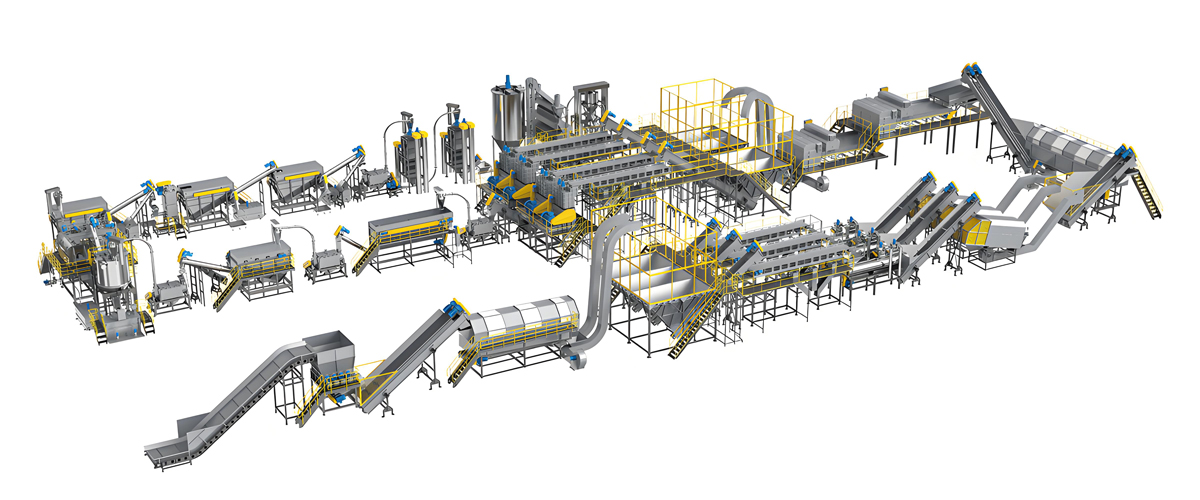
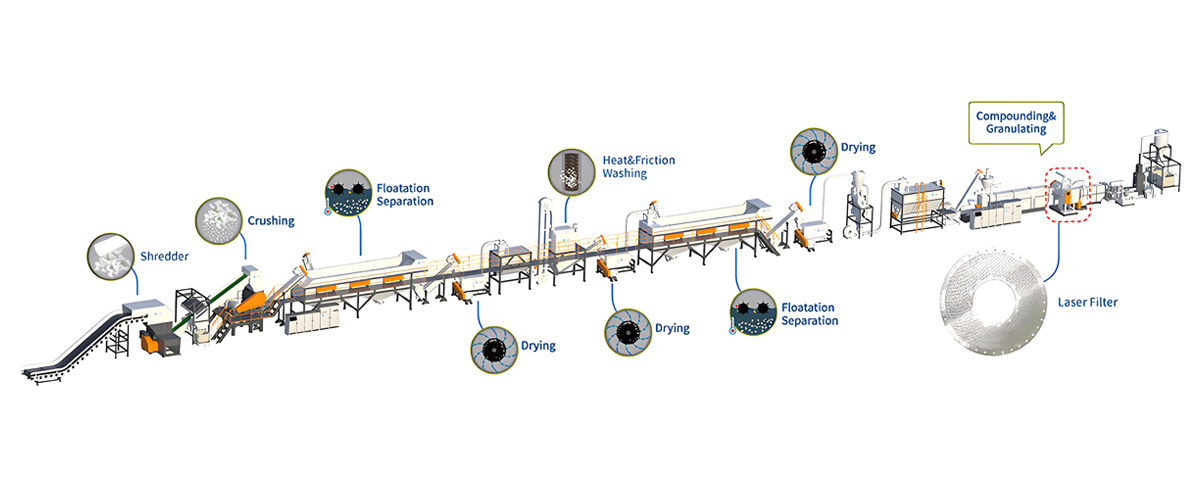
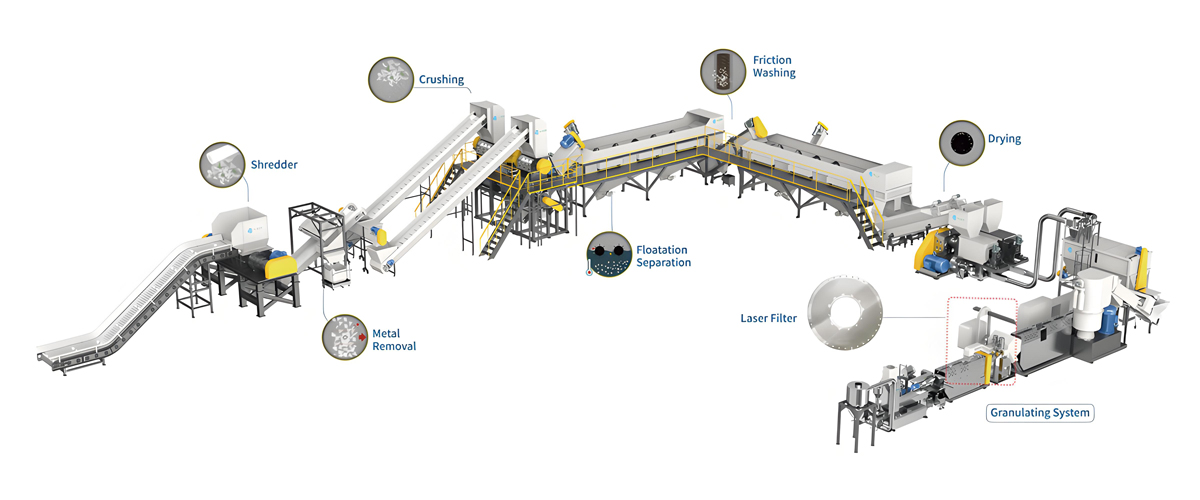
A dedicated LDPE sticker film recycling line runs eleven functional stations, and the sequence matters as much as the individual machines. The governing principle is that film must be reduced to a manageable geometry before it meets water, that separation should be attempted at multiple points rather than concentrated in a single tank, and that the material must be genuinely dry before it enters the extruder.
1. Infeed, bale opening and pre-sorting
Baled film arrives compressed and interlocked, so a bale opener with rotating tines is required to break the bale into loose film without wrapping the shafts. Material then passes onto a belt sorting conveyor running at 0.2 to 0.4 metres per second, slow enough for operators to pull out foreign objects: PET bottles, PP woven sacks, rope, textile, wood and heavy rubber. An overband magnet and a drum magnet remove ferrous items such as staples, strapping clips and nails, and an inductive metal detector on the discharge protects the shredder rotor from non-ferrous metal. Manual sorting recovers value at very low capital intensity, and in Mexican operations where labour is available, a longer sorting belt with more stations is usually the highest-return upgrade available.
2. Single-shaft shredder
Film must be shredded before it meets water. A low-speed high-torque single-shaft shredder running at 80 to 120 revolutions per minute with a rotor diameter of 400 to 600 millimetres and a hydraulic ram pusher reduces film to 50 to 80 millimetre pieces. Low rotor speed matters: high-speed cutting of thin LDPE generates frictional heat, and softened film welds into ropes that jam the discharge screen. Rotary knives should be reversible four-edge inserts, and the screen should be quick-change, because sticker film builds deposits on screen bars faster than clean film does.
3. Wet granulator
The wet granulator reduces shredded film to washable flake while water is injected directly into the cutting chamber. Blade clearance is held tight at 0.2 to 0.5 millimetres, and the discharge screen is typically 12 to 20 millimetres for film. Water serves three purposes: it cools the cutting zone and prevents the film from melting onto the blades, it begins detaching soil and loose label paper, and it carries flake out of the chamber. On adhesive-heavy streams, warm water in the granulator circuit noticeably reduces blade fouling compared with ambient water.
4. Sink-float separation
Wet flake enters the first sink-float tank, where LDPE floats and heavier fractions settle. A screw or paddle conveyor at the tank bottom removes settled PET, PVC, sand, grit and metal fines continuously, while surface paddles move floating film toward the discharge. Multi-stage separation, with two or three tanks in series and washing between them, dramatically outperforms a single long tank because each transfer re-wets the flake and gives trapped heavy particles another chance to release. Tank water temperature is usually maintained at 40 to 60 degrees Celsius on this stage to begin softening adhesive before the caustic step.
5. High-speed friction washers
Friction washers are vertical or horizontal units in which a high-speed rotor at 800 to 1200 revolutions per minute drives flake against a perforated screen. The mechanism is flake-on-flake and flake-on-screen abrasion, not chemistry, and it is the most effective way to strip adhering soil, loosened label paper and softened adhesive film. Sticker film lines run two to four friction washers in series. On liner-heavy feedstock, at least one friction washer should be positioned immediately downstream of the caustic tank while the material is still hot, because adhesive softened at 85 degrees Celsius shears off far more readily than adhesive that has cooled and re-tacked.
6. Hot caustic washing
This is the defining stage of the line and is treated in detail in the next section.
7. Rinsing and mechanical dewatering
Caustic-washed flake carries alkali on its surface and in the water film between flakes, and that alkali must be removed before extrusion. Two or three rinse tanks in counter-current arrangement, in which fresh water enters at the last stage and flows backwards toward the first, minimise water consumption while maximising rinse effectiveness. Rinse water pH should be monitored continuously, with the final rinse discharge held near neutral. A dewatering screw removes free water, followed by a horizontal or vertical centrifugal dryer that spins flake against a fine screen and brings residual moisture down to 3 to 5 percent.
8. Thermal drying
A pipeline hot-air dryer with cyclone separator finishes the job, taking moisture below 1 percent. Air temperature is held at 80 to 100 degrees Celsius. Exceeding 110 degrees is a genuine risk with thin LDPE film, because flake softens, agglomerates on duct walls and eventually blocks the cyclone. A residual moisture sensor at the silo inlet is worth its cost, since moisture is the leading cause of vapour porosity and strand breakage at the die.
9. Compaction and pelletizing
Film-specific pelletizing is covered in its own section below, because it is where most film recycling projects either succeed or fail.
10. Pellet finishing
Pellets from the cutter pass over a vibrating dewatering screen, then through a classifier that removes fines, longs, doubles and tails. A homogenising silo with an internal mixing cone blends production from several hours, which is essential when feedstock varies batch to batch, because customers judge rLDPE by consistency more than by peak quality. Packing is normally into 25 kilogram bags or bulk bags with a liner.
Table 2: Line Station Equipment and Key Parameters
| Station | Equipment | Key Parameters | Function on Sticker Film |
|---|---|---|---|
| 01 Infeed | Bale opener + belt sorting conveyor | Belt speed 0.2–0.4 m/s; 4–8 sorting stations | Loosens bales, removes bulk foreign material |
| 02 Metal removal | Overband magnet, drum magnet, metal detector | Magnetic flux 8000–12000 Gs at pole face | Removes staples, clips, wire before shredding |
| 03 Shredding | Single-shaft shredder with hydraulic ram | 80–120 rpm; rotor Ø400–600 mm; output 50–80 mm | Size reduction without frictional melting |
| 04 Wet granulation | Wet granulator (crusher) with water injection | Blade gap 0.2–0.5 mm; screen 12–20 mm | Produces washable flake, cools cutting zone |
| 05 Density separation | Multi-stage sink-float tank + screw conveyor | 2–3 stages; 40–60 °C; residence 2–4 min per stage | Removes PET, PVC, sand, grit, metal fines |
| 06 Friction washing | High-speed friction washer, 2–4 units in series | 800–1200 rpm; screen perforation 3–6 mm | Abrades soil, paper fibre and softened adhesive |
| 07 Caustic washing | Heated agitated caustic tank with steam coil | NaOH 1–3% w/w; 75–90 °C; 10–20 min | Saponifies acrylic adhesive, lifts ink and grease |
| 08 Rinsing | Counter-current rinse tanks, 2–3 stages | Final rinse pH 7–8; fresh water at last stage | Removes residual alkali and suspended solids |
| 09 Dewatering | Dewatering screw + centrifugal dryer | Rotor 700–1000 rpm; outlet moisture 3–5% | Mechanical water removal before thermal drying |
| 10 Thermal drying | Pipeline hot-air dryer + cyclone separator | Air 80–100 °C; outlet moisture <1% | Final drying without flake agglomeration |
| 11 Pelletizing | Compactor + single-screw extruder, melt filter, pelletizer | L/D 33:1 or two-stage; vacuum −0.06 to −0.09 MPa; filter 80–150 µm | Densifies, degasses, filters and pelletizes |
Hot Caustic Washing: The Core Adhesive Removal Stage
Hot caustic washing is the stage that separates a sticker film line from a general-purpose film washing line, and it works through chemistry that must be tuned to the adhesive family in the feed. Sodium hydroxide at 1 to 3 percent by weight, at 75 to 90 degrees Celsius, with 10 to 20 minutes of agitated residence time, saponifies ester-based adhesives and simultaneously attacks the binder systems in printing inks. Under-dosing produces adhesive carry-over and constant screen blinding. Over-dosing wastes chemical, raises effluent treatment load and, on ink-heavy material, can strip pigment into the water so aggressively that the wash bath turns opaque within hours.
Setting the parameter window
Concentration and temperature trade against each other, but not linearly. Raising temperature is generally more effective than raising concentration, because saponification is strongly temperature-dependent while excess hydroxide beyond a certain point simply increases rinse burden. In practice a starting point of 1.5 percent sodium hydroxide at 85 degrees Celsius with 15 minutes of residence handles most mixed Mexican label film. Highly contaminated liner film pushes toward 2.5 to 3 percent and 90 degrees Celsius, while lightly contaminated printed bags can run at 1 percent and 75 degrees Celsius.
Surfactant dosing at 0.1 to 0.5 percent is the second lever and is often underused. A blend of nonionic surfactant, which handles wetting and oil emulsification, with anionic surfactant, which provides dispersancy and prevents redeposition, outperforms either alone. Nonionic surfactants have a cloud point above which they lose effectiveness, so the selected grade must be rated for the operating temperature. A defoamer is mandatory: without it, the combination of agitation, surfactant and dissolved ink binder generates a foam blanket that overflows the tank and disrupts the flake conveying system.
Adapting to rubber adhesive and silicone
For rubber-based adhesive, caustic saponification contributes little. The effective route is thermal softening plus mechanical shear: run the tank at the upper temperature limit, extend residence time toward 20 minutes, add a solvent-assisted degreasing component compatible with the effluent treatment plant, and place a high-speed friction washer directly at the tank outlet so that shearing occurs while the adhesive is still fluid.
For silicone release coating, add a dedicated de-siliconizing agent to the caustic bath, raise temperature to the upper limit, and accept that mechanical abrasion carries most of the load. Where the incoming stream can be split, keeping silicone-coated liner film in a separate campaign — processed with a dedicated screen pack and sold into applications tolerant of gels — protects the quality of the main production. This is the single most valuable operational discipline in liner film recycling, and it costs nothing but sorting attention.
Rinse discipline
Residual alkali is not a cosmetic issue. Sodium hydroxide carried into the extruder attacks nitrided screw surfaces, accelerates wear at the screw flight tips and in the melt filter housing, and can catalyse polymer degradation that shows up as odour and yellowing. The countermeasure is straightforward: counter-current rinsing with enough stages, continuous pH monitoring on the final rinse discharge, and a conductivity check on the dewatered flake as a routine quality gate.
Table 3: Caustic Washing Parameter Window by Adhesive Type
| Parâmetro | Acrylic PSA | Rubber PSA (SIS/SBS) | Silicone Release Coating | Notes |
|---|---|---|---|---|
| NaOH concentration | 1.0–2.0% w/w | 1.5–2.5% w/w | 2.0–3.0% w/w | Higher concentration increases rinse and effluent load |
| Temperature | 75–85 °C | 85–90 °C | 85–90 °C | Temperature is the strongest single variable |
| Residence time | 10–15 min | 15–20 min | 15–20 min | Set tank volume from throughput and target time |
| Surfactant dosing | 0.1–0.3% | 0.3–0.5% | 0.3–0.5% plus de-siliconizing agent | Nonionic and anionic blend; check cloud point |
| Mechanical shear after tank | 1 friction washer | 2 friction washers | 2 friction washers, high speed | Shear while material is still hot |
| Expected removal effectiveness | High | Medium | Low to Medium | Grade output accordingly; do not oversell film-grade quality |
| Final rinse target | pH 7–8 | pH 7–8 | pH 7–8 | Residual alkali corrodes screw and filter housing |
Pelletizing Thin LDPE Film: Compaction, Degassing and Melt Filtration
Pelletizing washed LDPE film is a fundamentally different engineering problem from pelletizing regrind, and the reason is bulk density. Washed film flake has a bulk density in the range of 0.02 to 0.05 grams per cubic centimetre. A conventional extruder feed throat cannot convey that material: it bridges, it rides on the screw without being drawn in, and output collapses to a fraction of nameplate. The material must be densified to roughly 0.3 to 0.4 grams per cubic centimetre before it enters the screw, and how that densification is achieved defines the pelletizing architecture.
Compactor plus single-screw extruder
The dominant architecture for film is a compactor, sometimes called an agglomerator or plastcompactor, feeding a single-screw extruder through a side feeder. A rotating tool disc inside the compactor throws flake against the vessel wall, and friction heats the material to just below its melting point, causing it to shrink and consolidate into a coarse, dense, free-flowing crumb. That crumb is then pushed by the compactor’s discharge screw directly into the extruder feed section.
This arrangement has two additional benefits beyond densification. Frictional pre-heating means the extruder receives warm material and needs less energy and less screw length to plasticise it, and the compactor’s residence time at elevated temperature under agitation drives off a meaningful fraction of surface moisture before the melt phase. For LDPE film, an extruder with an L/D ratio around 33:1, a barrier screw with a mixing section, and a vented barrel is a sound baseline.
Two-stage extrusion for heavily printed or odorous material
Where the feedstock is heavily printed, carries solvent residues, or must meet a stricter odour specification, a two-stage extruder is the stronger choice. The first stage plasticises and homogenises; the melt then discharges into a second, larger-diameter, slower-turning stage where it is spread thin under high vacuum. The dramatically increased melt surface area in the second stage is what makes deep volatile removal possible, and it is far more effective than simply adding another vent to a single-stage machine.
Degassing strategy
Multi-stage degassing is mandatory for sticker film. The first vacuum stage, typically at −0.06 to −0.09 megapascals gauge, removes residual moisture and air entrained during compaction. The second stage targets volatile organic compounds from ink solvents, tackifier fractions and adhesive low-molecular-weight species. Vacuum system sizing is routinely underestimated: a liquid ring pump with adequate capacity and a knock-out pot for condensate is required, and vent port geometry must be designed to prevent melt from creeping into the vent, which is the most common cause of unplanned stoppage on film lines.
Melt filtration: where sticker film lines are won or lost
If one component determines whether a sticker film line reaches its rated output, it is the melt filter. Adhesive residue, paper char, unmelted foreign polymer and mineral fines all arrive at the screen pack, and on adhesive-heavy material a conventional manual or hydraulic plate screen changer blinds within minutes. Operators find themselves changing screens several times per hour, each change causing a pressure surge, a melt interruption and a run of off-specification pellets. Production becomes impossible.
Two technologies solve this. The continuous belt screen changer advances a roll of filter mesh automatically as differential pressure rises, so melt pressure remains within a narrow band and the process never stops. It is simple, robust and well suited to variable contamination. The self-cleaning laser-drilled filter uses a rotating perforated drum with precisely dimensioned laser-drilled holes and a scraper that continuously removes retained contaminant, discharging it through a discharge screw. It handles very high contaminant loads with low polymer loss and is the preferred choice where contamination exceeds a few percent.
Filtration fineness for rLDPE from sticker film sits in the 80 to 150 micrometre range, roughly 100 to 200 mesh. Finer filtration produces visibly cleaner pellets but raises melt pressure, increases shear heating and reduces filter life, so the specification should follow the intended application rather than defaulting to the finest available. A melt pump downstream of the filter stabilises die pressure and decouples output from filter pressure fluctuation, which materially improves pellet size consistency.
Die and cutting
Water ring pelletizing is the common choice for rLDPE film: strands or die-face cuts are thrown into a water ring, cooled and conveyed to a centrifugal dryer. Underwater pelletizing produces more uniform spherical pellets and handles high output smoothly, but carries higher capital cost and more demanding die-plate maintenance. Strand pelletizing remains viable at lower capacities and gives excellent pellet geometry, though strand breakage on contaminated melt is a persistent nuisance, which is another argument for effective filtration.
Key technical takeaway: On adhesive-loaded LDPE film, filtration capability sets the real production ceiling. A line with an excellent washing section and a manual screen changer will underperform a line with an average washing section and a continuous filter, because unplanned screen changes destroy availability.
Three Capacity Configurations from 300 to 1500 kg/h
Capacity selection for a Mexican sticker film line should be driven by secured feedstock volume, not by ambition. A line running at 50 percent of nameplate because collection cannot keep up performs worse on every operating metric than a correctly sized smaller line running full. Three configurations cover the majority of Mexican projects.
300–500 kg/h: local collector scale
This tier suits regional collectors and converters recycling their own scrap plus purchased local material. The line typically uses a single shredder, one wet granulator, a two-stage sink-float section, two friction washers, a compact caustic tank and a single-screw pelletizing line with a continuous belt screen changer. Footprint requirements are modest, water treatment can be a simplified package, and the operating crew is small. This is the entry point for most first-time recyclers in the Bajío and central Mexico.
500–800 kg/h: the mainstream configuration
Most commercially serious Mexican sticker film projects land here. The washing section gains a third friction washer, a larger caustic tank with better temperature control, and a three-stage counter-current rinse. The pelletizing section moves to a compactor-fed extruder with two-stage degassing and a self-cleaning filter option. Water recirculation becomes a designed system rather than an afterthought. This tier balances capital intensity against unit conversion cost and is where the majority of quotations are ultimately signed.
1000–1500 kg/h: industrial scale
The largest tier demands genuinely stable feedstock supply, typically contracted volumes from label converters, large packers or organised agricultural collection programmes. Equipment scales up throughout: a larger shredder with a heavier rotor, parallel granulators or a single high-capacity unit, four friction washers, a large heated caustic tank with steam supply, an extended rinse train, high-capacity centrifugal dryers and either a large single-screw compactor line or a two-stage extruder. Water treatment becomes a standalone plant with dedicated operators, and the electrical installation typically requires a dedicated transformer and coordination with CFE on supply capacity.
Table 4: Capacity Configuration Comparison
| Item | 300–500 kg/h | 500–800 kg/h | 1000–1500 kg/h |
|---|---|---|---|
| Installed power (washing section) | 120–180 kW | 180–280 kW | 300–450 kW |
| Installed power (pelletizing section) | 150–220 kW | 220–350 kW | 400–650 kW |
| Floor area required | 450–700 m² | 700–1100 m² | 1200–2000 m² |
| Circulating water volume | 15–25 m³/h | 25–40 m³/h | 45–75 m³/h |
| Make-up water per tonne input | 0.8–1.5 m³ | 0.6–1.2 m³ | 0.5–1.0 m³ |
| Water recirculation rate | 75–85% | 80–90% | 85–90% |
| Operators per shift | 4–6 | 6–9 | 10–14 |
| Melt filtration recommendation | Continuous belt screen changer | Belt screen changer or self-cleaning filter | Self-cleaning laser-drilled filter |
| Relative capital investment level | Medium | High | Very High to Premium |
| Relative conversion cost per tonne | High | Medium | Low |
| Feedstock security required | Low | Medium | Very High |
Wash Water and Environmental Compliance in Mexico
Wash water from an LDPE sticker film line is alkaline, turbid and organically loaded, and Mexican discharge rules apply from the first day of operation. The effluent carries suspended soil and sand, dissolved and emulsified adhesive fractions, ink pigments and binders, surfactant residues and residual sodium hydroxide. Chemical oxygen demand is driven mainly by the dissolved adhesive and ink components rather than by the plastic itself, and pH after the caustic circuit is high enough that neutralisation is always required before discharge or reuse.
The regulatory framework has three layers. NOM-001-SEMARNAT-2021 sets permissible limits for discharge to national waters and property, and it tightened several parameters relative to the earlier standard, so plants designed against the previous version should be re-checked. NOM-002-SEMARNAT-1996 governs discharge into municipal sewerage systems, which is the route most industrial parks actually use. Discharge permits and water use concessions are administered by CONAGUA, and any facility drawing groundwater or discharging to national waters needs that authorisation in place before commissioning. SEMARNAT oversees environmental impact assessment, and depending on state and municipality, a Licencia Ambiental Única may be required as the single integrated operating licence. Solid residues, principally the dewatered sludge from the wash water treatment, fall under NOM-161-SEMARNAT-2011 and its state-level counterparts for special handling waste, so a documented disposal route must exist before start-up.
The treatment chain for this effluent is well established: coarse screening to catch film fragments and fibre, a grit chamber to drop sand, pH neutralisation, coagulation and flocculation using polyaluminium chloride with a polyacrylamide polymer, dissolved air flotation to remove the flocculated adhesive and ink solids, biological treatment where organic load justifies it, sand filtration as a polishing step, and return of clarified water to the wash circuit. A recirculation target of 80 to 90 percent is realistic and is normally the assumption used when sizing make-up water supply. Sludge from the flotation unit is dewatered on a filter press and handled as special handling waste. Detailed selection between treatment technologies is a subject in its own right; the essential point for line design is that the water plant must be specified alongside the washing line, sized for the dirtiest feedstock, and permitted before equipment arrives.
Table 5: Wastewater Characteristics, Treatment Steps and Mexican Regulatory Reference
| Effluent Characteristic | Source in the Line | Treatment Step | Mexican Regulatory Reference |
|---|---|---|---|
| Suspended solids (soil, sand, fibre) | Sink-float tanks, friction washers | Screening, grit chamber, sedimentation | NOM-001-SEMARNAT-2021 / NOM-002-SEMARNAT-1996 |
| High pH and residual alkali | Caustic tank, first rinse | Acid neutralisation with pH control loop | NOM-002-SEMARNAT-1996 (pH range for sewer discharge) |
| Chemical oxygen demand from adhesive and ink | Caustic tank, hot wash circuit | Coagulation, flocculation, dissolved air flotation, biological stage if required | NOM-001-SEMARNAT-2021 |
| Surfactant and emulsified oil | Caustic tank with surfactant dosing | Flotation with defoaming, adsorption polishing | NOM-001-SEMARNAT-2021 (fats and oils parameter) |
| Water abstraction and discharge authorisation | Whole plant | Concession and discharge permit application, metering | CONAGUA concession and discharge registration |
| Dewatered sludge and screening residue | Flotation unit, filter press, coarse screens | Filter press dewatering, authorised disposal contractor | NOM-161-SEMARNAT-2011 special handling waste |
| Overall facility operation | Whole plant | Environmental impact assessment, integrated operating licence | SEMARNAT environmental impact procedure, Licencia Ambiental Única |
Practical Deployment in Mexico: Power, Imports, Ports and Markets
An LDPE recycling line that works perfectly in a Chinese factory acceptance test can still fail in Mexico for reasons that have nothing to do with process engineering. Electrical frequency, import documentation, port routing and offtake channels all need to be settled during the specification phase rather than after shipment.
Electrical supply: 60 hertz is not a detail
Mexican industrial supply from CFE is typically 220 or 440 volts at 60 hertz, against the 380 volts at 50 hertz standard used in much of Asia and Europe. This is the most frequently underestimated aspect of exporting recycling equipment to Mexico. A 50 hertz motor operated at 60 hertz runs roughly 20 percent faster, which changes shredder rotor speed, granulator tip speed, friction washer speed, pump duty and extruder screw speed simultaneously. Gearbox ratios must be recalculated, variable frequency drives must be rated for the actual supply, and control transformers and cooling fans must match. The correct approach is to specify the entire electrical package for 440 volts at 60 hertz from the outset and to have the supplier confirm motor nameplate data before manufacture. Total installed capacity should be discussed with CFE early, since a 1000 to 1500 kg/h line with a dedicated transformer represents a meaningful load in many industrial parks.
Import classification and certification
Plastics processing machinery generally falls under HS heading 8477, with 8477.20 covering extruders and 8477.80 covering other machinery for working plastics, which typically captures washing line equipment. Importers must be registered in the padrón de importadores, and each shipment clears on a pedimento prepared by a licensed customs broker. Companies operating under an IMMEX manufacturing and export programme can temporarily import machinery with deferred duties and taxes where the output is destined for export, which is a common structure for recyclers supplying rLDPE into United States markets. On the certification side, NOM-001-SCFI covers electrical safety requirements and NOM-003-SCFI addresses safety requirements and labelling for electrical products, so control panels, marking and documentation should be prepared for Mexican requirements rather than adapted afterwards. Bilingual operation and maintenance manuals and Spanish-language control panel labelling are practical necessities, not optional extras.
Ports and inland logistics
Equipment from Asia normally arrives through Manzanillo on the Pacific coast, which handles the main trans-Pacific services and offers good rail and road connections to Guadalajara, the Bajío and Mexico City. Lázaro Cárdenas is the alternative Pacific gateway and is often less congested. On the Atlantic side, Veracruz and Altamira serve the northeast and are the natural choice for projects in Monterrey and the Gulf corridor. Oversized items such as large caustic tanks, sink-float tanks and shredder frames should be checked against inland road restrictions early, since a container-friendly design that splits large tanks into shippable modules with site assembly avoids expensive special transport permits.
Where the rLDPE goes
Mexico’s position under USMCA makes recycled polyethylene produced in Mexico attractive to North American converters, as regional content and regional sourcing considerations favour material produced within the trade area. Brand owners with public recycled-content commitments, including signatories to the Ellen MacArthur Foundation Global Commitment, continue to expand their demand for post-consumer recycled polyethylene, and that demand pulls through into the Mexican converter base. Domestic outlets are equally important: refuse sacks, construction and vapour barrier film, agricultural film using 20 to 40 percent recycled content, injection moulded pallets and crates, and cable and pipe protective sheathing all absorb rLDPE at different quality levels. Building relationships with two or three offtake channels at different quality grades is the practical way to protect a recycler against feedstock variability, since not every production run will hit the top grade.
rLDPE Pellet Quality Grades and Test Methods
Recycled LDPE from sticker film should be graded and sold against measured specifications, because the range of achievable quality from this feedstock is wide and customers who receive inconsistent material do not return. A standard test panel makes grading objective and defensible.
Melt flow index measured to ASTM D1238 at 190 degrees Celsius and 2.16 kilograms is the primary processing indicator, and for film-grade rLDPE the useful range is roughly 0.3 to 1.5 grams per 10 minutes. Density to ASTM D792 confirms polymer identity and reveals foreign polymer or filler contamination. Ash content to ISO 3451 quantifies mineral residue and should be below 1 percent for general applications and considerably lower for film. Moisture content should be below 0.05 percent at packing. Black speck count per 100 grams, assessed on a pressed film plaque, is the most visible quality metric and the one customers check first. Tensile strength and elongation at break to ASTM D638 verify that the polymer has not been thermally degraded. Odour rating according to VDA 270 matters for any application with consumer contact, and colour measurement in the L*a*b* system tracks batch-to-batch consistency in a way that visual comparison cannot.
Table 6: rLDPE Quality Grading from Sticker Film Feedstock
| Property (Test Method) | Grade A (Film Grade) | Grade B (General Purpose) | Grade C (Utility) |
|---|---|---|---|
| Melt flow index, 190 °C/2.16 kg (ASTM D1238) | 0.4–1.0 g/10 min, batch variation within ±15% | 0.3–1.5 g/10 min, variation within ±25% | 0.3–2.5 g/10 min, uncontrolled variation |
| Density (ASTM D792) | 0.918–0.930 g/cm³ | 0.918–0.935 g/cm³ | 0.915–0.945 g/cm³ |
| Ash content (ISO 3451) | <0.3% | 0.3–1.0% | 1.0–3.0% |
| Moisture at packing | <0.03% | <0.05% | <0.10% |
| Black specks per 100 g | <10 | 10–40 | >40 |
| Elongation at break (ASTM D638) | >350% | 200–350% | <200% |
| Odour rating (VDA 270) | Grade 3 or better | Grade 4 | Grade 5 or worse |
| Residual silicone indication (gel count on film plaque) | Very low | Moderate | High |
| Typical end applications | Refuse sacks, construction film, agricultural film blends at 20–40% | Heavy-duty sacks, vapour barrier film, injection moulded crates | Pallets, cable sheathing, pipe protection, filler applications |
Troubleshooting Matrix for Sticker Film Lines
Most production problems on an LDPE sticker film line trace back to one of four root causes: adhesive that was not removed, moisture that was not removed, contamination that reached the melt, or a mismatch between screw configuration and material bulk density. The matrix below maps the symptoms operators actually report to their likely causes and the corrective actions that resolve them.
Table 7: Fault and Countermeasure Matrix
| Symptom | Probable Causes | Diagnostic Check | Countermeasure |
|---|---|---|---|
| Frequent screen blinding, rapid pressure rise | Adhesive carry-over; caustic temperature or residence too low; filter too fine for load | Inspect used screen for tacky brown residue; log caustic tank temperature and pH | Raise caustic temperature toward 90 °C, extend residence, add friction washer after tank, upgrade to continuous or self-cleaning filter |
| Pellets tacky, blocking in silo or bag | Residual adhesive in melt; insufficient pellet cooling; cutting water temperature too high | Check pellet surface tack after 24 h; measure cutting water temperature | Improve washing effectiveness, lower cutting water temperature, extend dewatering and cooling conveyor length |
| High black speck count | Carbonised paper fibre; degraded polymer in dead zones; worn screw; filtration too coarse | Press film plaque and count specks; inspect screw and adapter for burnt deposits | Improve paper removal in friction washers, purge and clean adapter and die, reduce melt temperature, tighten filtration to 80–100 µm |
| Strong odour in pellets | Ink solvent residues; inadequate degassing; excessive melt temperature | VDA 270 odour test; verify vacuum gauge reading at both vents | Restore vacuum to −0.06 to −0.09 MPa, clean vent ports, consider two-stage extruder, reduce barrel temperature profile |
| Strand breakage at the die | Moisture in feed; melt pressure fluctuation; contaminant passing the filter; uneven die temperature | Measure flake moisture at silo inlet; trend melt pressure signal | Verify dryer outlet below 1% moisture, install or tune melt pump, check die heater zones and clean die lands |
| Output below rated capacity | Bulk density too low into feed throat; compactor underperforming; feed bridging; screw wear | Measure crumb bulk density after compactor; check compactor motor load and tool disc gap | Adjust compactor tool disc clearance and temperature to reach 0.3–0.4 g/cm³, add water spray control, refurbish worn screw and barrel |
| Wastewater COD above permitted limit | Dissolved adhesive and ink load; coagulant dosing off-target; flotation underloaded | Jar test on raw effluent; check dosing pump calibration and flotation air ratio | Re-optimise coagulant and flocculant dosing, restore flotation air-to-solids ratio, add biological polishing stage if load is sustained |
| Fish eyes and poor ink adhesion in customer film | Residual silicone release coating migrating in melt | Blown film plaque gel count; customer surface energy test | Segregate liner film at source, add de-siliconizing agent, increase friction washing after caustic tank, downgrade affected lots to Grade B or C |
Frequently Asked Questions
Can a standard PE film washing line handle Mexican sticker film waste?
A standard PE film washing line will physically process sticker film, but it will not remove pressure-sensitive adhesive or silicone release coating. Without a hot caustic washing stage, an adequate rinse train and a continuous melt filtration system, screen changes become constant and pellets tend to block in the silo. The washing section may look identical on a layout drawing, but the caustic tank volume, heating capacity, friction washer count and filtration technology are all different.
Why is silicone release coating harder to remove than acrylic adhesive?
Acrylic pressure-sensitive adhesive contains ester linkages that saponify in hot caustic solution, converting the adhesive into water-soluble soaps that rinse away. Cured polydimethylsiloxane release coating has a siloxane backbone that resists water, alkali and extrusion temperature, so chemistry alone cannot remove it. The workable approach combines a specialty de-siliconizing agent, elevated wash temperature, high-shear friction washing and, wherever possible, separating liner film at source before baling.
What melt filtration fineness is recommended for adhesive-loaded LDPE film?
A working window of 80 to 150 micrometres, roughly 100 to 200 mesh, covers most sticker film streams. Film-grade output justifies the finer end, while utility applications tolerate the coarser end with better filter life and lower melt pressure. The key requirement is that the chosen fineness must be held continuously, which means a continuous belt screen changer or a self-cleaning laser-drilled filter rather than a manual plate changer.
How is the electrical package different for a line installed in Mexico?
Mexican industrial supply from CFE is typically 220 or 440 volts at 60 hertz, so every motor, variable frequency drive, control transformer and cooling fan must be specified for 60 hertz. A 50 hertz motor run at 60 hertz turns about 20 percent faster, which shifts shredder speed, granulator tip speed, pump duty and screw output away from the design point. Electrical safety documentation should also be prepared against NOM-001-SCFI and NOM-003-SCFI requirements, with Spanish-language panel labelling and manuals.
How much recycled content can rLDPE from sticker film support in new film products?
Grade A material from a well-run line commonly supports 20 to 40 percent recycled content in agricultural and construction film, and considerably higher shares in refuse sacks where appearance is not critical. The limiting factors are gel count from residual silicone, black speck count and melt flow index consistency rather than mechanical properties. Converters typically qualify a supplier by running a trial at a low inclusion rate and stepping up as batch-to-batch consistency is demonstrated.
How long does commissioning take and what support is available in Mexico?
A washing and pelletizing line of this type is normally assembled and commissioned over several weeks on site, with mechanical installation, water and electrical connection, dry running, wet trials on customer feedstock and then production trials. Polyretec, a Wanplas factory, supports installation with engineer dispatch, remote diagnostics, bilingual documentation and a spare parts programme, and the Wanplas brand policy includes an annual free spare-parts allowance for customers under its service commitment. Operator training on caustic handling, filter change procedure and water plant dosing should be scheduled during wet trials rather than afterwards.
Should the caustic washing stage run continuously or in batches?
Continuous operation with a well-controlled dosing and heating loop is preferred for production lines, because it keeps the chemical environment stable and avoids the quality swings that batch operation causes. Batch operation is sometimes chosen at small scale where feedstock changes frequently and each campaign needs a different chemistry. In either case, the bath must be monitored for alkalinity and dissolved organic load, and partially replaced on a schedule rather than run to exhaustion.
What is the single most common specification mistake on these projects?
Undersizing melt filtration. Buyers frequently allocate the budget to a larger extruder or an extra washing tank and then accept a basic screen changer, only to discover that the line cannot run for an hour without a screen change. Filtration technology should be selected against the worst feedstock the plant intends to buy, and the washing section should be designed to reduce the load reaching that filter rather than relying on it to compensate for weak washing.
Conclusion
The best LDPE film recycling line for Mexico sticker film waste is not the biggest line available, and it is not a standard film washing line with a bigger motor. It is a line engineered around one dominant contaminant problem: pressure-sensitive adhesive and silicone release coating that survive ordinary washing and then attack the melt filter, the pellet quality and the customer’s product. That engineering shows up in four places. A hot caustic washing stage with real residence time and correct surfactant chemistry. A rinse train long enough to leave no residual alkali on the flake. Compaction and multi-stage degassing that convert low bulk density film into a stable, volatile-free melt. And continuous melt filtration capable of holding 80 to 150 micrometres without stopping production.
Around that core, the Mexican context adds its own requirements: 60 hertz electrical design matched to CFE supply, import routing through Manzanillo, Lázaro Cárdenas, Veracruz or Altamira with correct HS 8477 classification and NOM documentation, wash water treatment permitted under CONAGUA and the applicable SEMARNAT standards, and an offtake strategy that recognises USMCA-driven demand for regionally produced recycled polyethylene alongside domestic film and moulding markets. Recyclers who plan all of this before the equipment ships avoid the retrofits that otherwise consume the first year of operation.
Polyretec, a Wanplas factory, builds washing and pelletizing lines for exactly this feedstock, including PP and PE soft plastic crushing and washing lines from 500 to 1500 kilograms per hour and pelletizing lines designed for thin-walled LDPE film, with delivered projects covering LDPE film with stickers in Mexico, printed film pelletizing in Turkey and fully automated film washing in Taiwan. Where a project also needs compounding capability, Wanplas’s Kerke factory supplies twin-screw extruders that integrate with Polyretec washing systems, giving a single point of responsibility across the whole chain. Recyclers evaluating a sticker film project should begin with a representative feedstock sample and a laboratory wash trial, because the adhesive mix in the bale, not the nameplate throughput, determines what the line must be.