
Introduction: Low Cost Recycling as an Engineering Problem
Polyretec, a Wanplas factory, designs and manufactures plastic recycling equipment with a history that reaches back to 2010 and a brand established in 2017. Over more than a decade the factory has accumulated 100 plus project references, delivered equipment to 50 plus countries, and built a support team of 24 plus field engineers backed by a ten-plus-year credible commitment to the recycling industry. The factory specializes in plastic recycling washing lines and pelletizing lines that turn post-consumer and post-industrial plastic waste into reusable pellets.
The phrase “low cost plastic recycling” is frequently used as a marketing slogan, but in practice it is an engineering problem with measurable causes. A recycling line does not become inexpensive by using cheaper steel or a smaller motor. It becomes low cost when the process is structured so that energy per ton, water per ton, yield loss, labor per ton, and unplanned downtime all move in the right direction at the same time. The Austrian technology route is one well-developed way to reach that balance, and it is the subject of this article.
The Austrian technology route is a combination of process features, not a reference to any single supplier. It describes a line architecture built around a cutter-compactor fed single-screw extruder, continuous melt filtration, multistage vacuum degassing, and a closed-loop water system. In this article we explain what each element does, walk through the full process flow stage by stage, show representative specification tables for real Polyretec series, break down where the cost advantage actually comes from, and give a selection path you can use to match a line configuration to your material and target output.
Throughout the article we use an indexed cost model rather than absolute prices. We define a processing cost index of 100 points as the baseline for a conventional low-reuse, low-utilization layout, then express improvements as reductions in points. We also use physical quantities that any plant manager can measure: kilograms per hour, kilowatt-hours per ton, cubic meters of water per ton, water reuse percentage, yield percentage, and overall equipment effectiveness. This keeps the discussion grounded and comparable across sites and regions.
The goal is practical. After reading, you should be able to explain to a finance reviewer why a cutter-compactor fed single-screw pelletizing line can lower the cost per ton of recycled pellet, which materials it suits, which it does not, and which Polyretec series and options match your feedstock. Every claim here traces either to Polyretec’s published product scope or to standard recycling-process engineering.
What the Tecnologia austríaca Route Means
The Austrian technology route is best understood as a process concept rather than a brand. It is a way of arranging a plastic recycling pelletizing line so that lightweight, low-bulk-density, and heat-sensitive materials are handled with minimum energy and maximum continuity. The defining elements are a cutter-compactor directly coupled to a single-screw extruder, self-cleaning or laser melt filtration, and multistage vacuum degassing. Together they produce a continuous, stable melt from film and fiber feedstocks that are difficult to feed through a conventional throat.
The cutter-compactor fed single-screw extruder
A cutter-compactor is a compact chamber where pre-shredded film or fiber is cut by rotating blades, heated by friction and controlled external heat, and compacted into a dense, continuous plug. That plug is then pushed directly into the feed section of a single-screw extruder, usually through a short transition throat with little or no free fall. Because the material is already densified, the single-screw extruder can use a shorter compression zone and a more uniform feed, which stabilizes the melt and reduces surging.
The key advantage is integration. Cutting, pre-conditioning, pre-drying, and pre-heating happen inside one chamber instead of across three separate machines. The extruder screw then performs plasticizing, mixing, and pressure build-up. For post-consumer film this architecture is efficient because the bulk density of loose LDPE film can be below 0.10 grams per cubic centimeter, far too low to feed reliably through a standard hopper without bridging or floating.
Continuous melt filtration
Melt filtration removes solid contaminants such as paper, wood, sand, and un-melted polymer from the melt before it reaches the die. In the Austrian technology route, filtration is continuous rather than batch. A self-cleaning screen changer or a laser filter disc keeps the line running while contaminant is discharged, so there is no need to stop the extruder to change a screen pack. Filter fineness typically ranges from 40 to 150 micrometers depending on the desired pellet cleanliness and the downstream application.
Multistage vacuum degassing
Post-consumer film carries moisture, trapped air, and volatile odor compounds from inks, food residues, and degradation products. The Austrian technology route uses two or more vacuum zones, commonly at negative pressures from minus 0.08 to minus 0.095 megapascal, to strip these volatiles from the melt. Effective degassing improves pellet appearance, reduces odor grade, and protects the final product from bubbles and surface defects.
Closed-loop friction washing and water recovery
Although the pelletizing step is the focus, the Austrian technology route expects a well-engineered washing stage upstream. Closed-loop friction washing, with water treatment and reuse, keeps fresh water consumption low. A properly designed loop returns 80 percent to 95 percent of process water, which protects both the environment and the operating budget.
Why this is described as “European-style” without naming a supplier
The architecture is widely recognized as a European-style single-screw cutter-compactor line because the process concept was matured in Central Europe. In this article we deliberately keep the discussion at the level of technology features. We benchmark against generic categories such as “conventional hydraulic lines” or “entry-level imported units” rather than naming any equipment maker. This keeps the comparison honest and focused on process physics.
Cutter-Compactor Single-Screw vs Twin-Screw Forced Feeding
A central decision in any recycling pelletizing project is whether to use a cutter-compactor fed single-screw extruder or a twin-screw forced-feed compounding extruder. Both are valid; they suit different feedstocks and different cost profiles. The table below compares them on the dimensions that drive total cost of ownership.
| Dimension | Cutter-compactor fed single-screw (Austrian route) | Twin-screw forced feeding |
|---|---|---|
| Best feedstock | Light film, fiber, woven bag, low-bulk-density PE/PP | High filler load, heavy modification, powder blends |
| Specific energy (film) | Lower, typically 0.28 to 0.45 kWh per kg | Higher, typically 0.35 to 0.55 kWh per kg |
| Shear intensity | Moderate, gentle on heat-sensitive grades | High, strong dispersive mixing |
| Degassing capacity | Multistage vacuum, strong on volatiles | Side venting, strong on moisture and filler gas |
| Investment grade | Low to Medium | Medium to High |
| Footprint | Compact, integrated compactor and extruder | Larger, separate feeder and gearbox |
| Typical role at Polyretec | Linha de pelotização de nova geração for film and regrind | Supplied by Wanplas for downstream compounding |
The conclusion is straightforward. For the film and lightweight regrind that dominate post-consumer recycling, the cutter-compactor fed single-screw layout delivers the lower specific energy and the lower investment grade. For heavily filled or modified compounds, a twin-screw compounding system is the better tool. Because Polyretec is part of the Wanplas group, downstream compounding capacity can be sourced from Wanplas as a matched twin-screw pelletizing system that integrates directly with Polyretec washing lines.
Full-Line Process Flow and Key Parameters
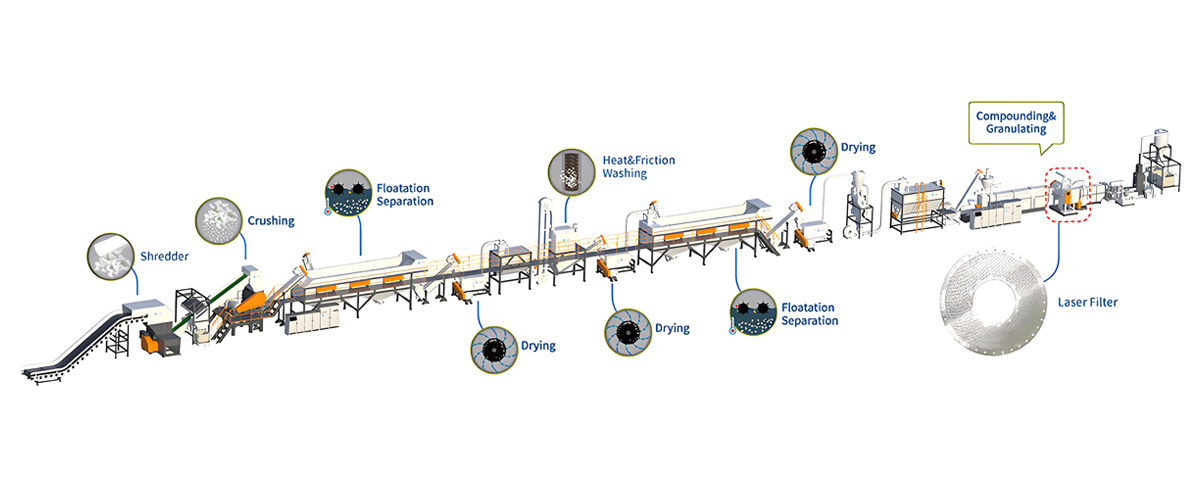
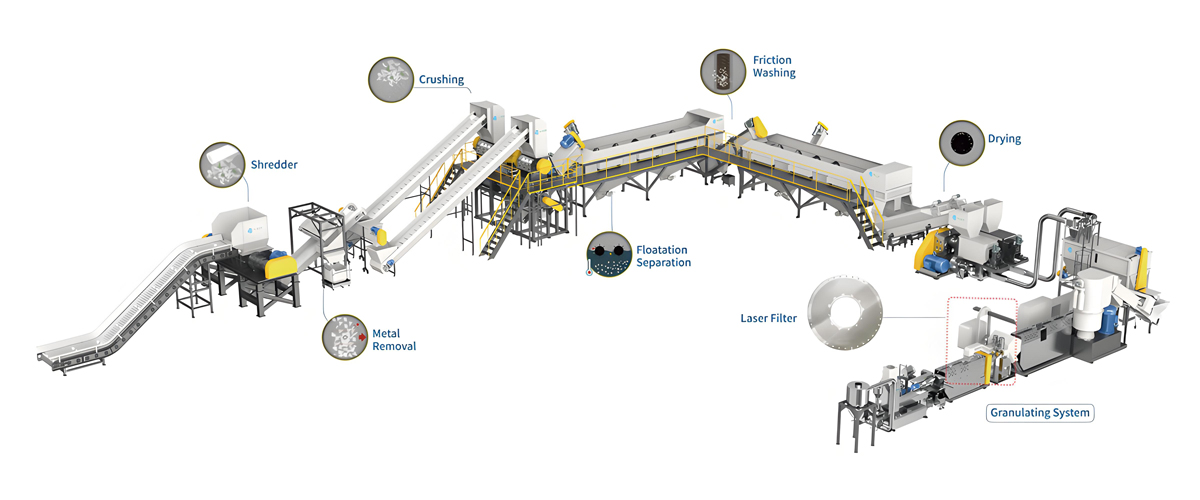
A low cost pelletizing result depends on the whole line, not only the extruder. The following nine stages cover the typical flow from loose waste to packed pellet. Each stage lists the parameters that matter for cost and quality.
Stage 1: Feeding and crushing
Loose bales or loose film are opened and fed to a crusher, also called a granulator in recycling terminology. Blade gap is set to 0.5 to 1.5 millimeters and the screen hole is 10 to 20 millimeters, producing flakes small enough for stable washing yet large enough to limit fine generation. A conveyor belt with metal separation protects downstream equipment from tramp steel and non-ferrous metal.
Stage 2: Pre-washing and label removal
A friction washer removes loose dirt and loosens labels, while a label-removal unit and a sink-float separation tank separate materials by density. Polyethylene and polypropylene float at 0.90 to 0.96 grams per cubic centimeter, whereas PET sinks at 1.38 grams per cubic centimeter. This stage sets the contamination level that the rest of the line must handle.
Stage 3: Hot washing where required
For printed or greasy film, a hot wash at 60 to 85 degrees Celsius with 1 percent to 2 percent sodium hydroxide and a surfactant removes ink and organic soil. Residence time is tuned to the contamination level; overdosing caustic raises chemical cost and water load without improving pellet quality, so the wash recipe is matched to the feedstock rather than applied uniformly.
Stage 4: Dewatering and drying
A centrifuge dewaters the flakes to 3 percent to 8 percent surface moisture. A hot-air dryer then brings moisture below 1 percent, and below 0.5 percent is preferable before pelletizing because residual water loads the degassing system and can cause fish eyes in the pellet. Drying energy is recovered where possible to limit total specific energy.
Stage 5: Compacting, plasticizing, and extrusion
The cutter-compactor runs with temperature self-control and feeds the single-screw extruder. Screw length-to-diameter ratio is typically 30:1 to 36:1, and barrel temperature zones are set around 180 to 230 degrees Celsius for PE and PP. Stable feeding keeps melt pressure steady, which protects the screen changer and the melt pump.
Stage 6: Melt filtration and screen changing
Filter fineness is selected against the contaminant load and the downstream complaint risk. Finer filtration raises pressure and screen consumption, so the chosen mesh is a balance. A continuous self-cleaning filter keeps running while discharging contaminant, and the filter media loss rate is tracked per ton of product.
Stage 7: Degassing and odor control
Two or more vacuum stages strip moisture and volatiles. Odor-grade reduction depends on residence time and vacuum level; where local rules require it, a dedicated volatile organic compound treatment unit is added after the vent. Effective degassing is what separates a usable pellet from a reject with bubbles or smell.
Stage 8: Pelletizing method
Cutting can be water-ring, underwater, die-face hot cutting, or air-cooled. Pellet size is usually 2.5 to 4 millimeters. Water-ring and underwater give uniform, low-dust pellets for automated handling; die-face hot cutting suits some compounds; air-cooled avoids water contact for moisture-sensitive grades. Bulk density and pellet appearance are checked against the downstream specification.
Stage 9: Post-treatment and packing
Vibration screening removes off-size and long pellets, dust is extracted, and the pellet is transferred to a homogenizing silo for blend uniformity before packing and palletizing. Homogenization matters for customers who run continuous extrusion and need stable melt flow from every bag.
| Stage | Key parameter | Typical range | Cost or quality effect |
|---|---|---|---|
| Crushing | Blade gap / screen hole | 0.5 to 1.5 mm / 10 to 20 mm | Sets flake size, limits fines |
| Density separation | PE/PP vs PET density | 0.90 to 0.96 vs 1.38 g/cm3 | Drives stream purity |
| Hot wash | Temperature / caustic | 60 to 85 C / 1 to 2 percent NaOH | Ink and soil removal |
| Drying | Moisture before pelletizing | Below 1 percent, prefer below 0.5 percent | Protects degassing, pellet look |
| Extrusion | Screw L/D / barrel zone | 30:1 to 36:1 / 180 to 230 C | Stable melt, energy use |
| Filtration | Filter fineness | 40 to 150 micrometers | Cleanliness vs pressure cost |
| Degassing | Vacuum level | minus 0.08 to minus 0.095 MPa | Odor and bubble control |
| Pelletizing | Pellet size | 2.5 to 4 mm | Downstream handling |
Polyretec Product Modules and Especificação Tables
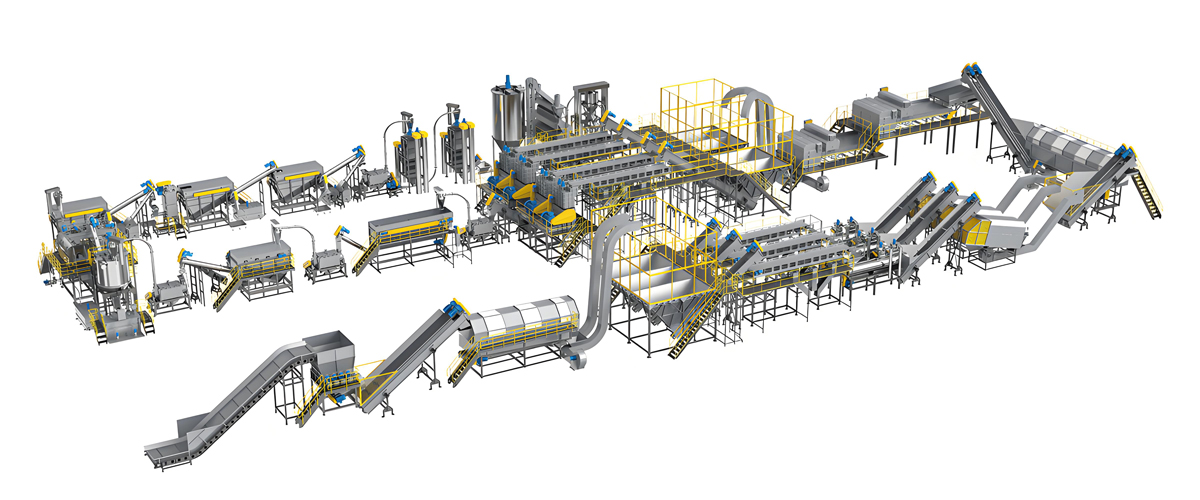
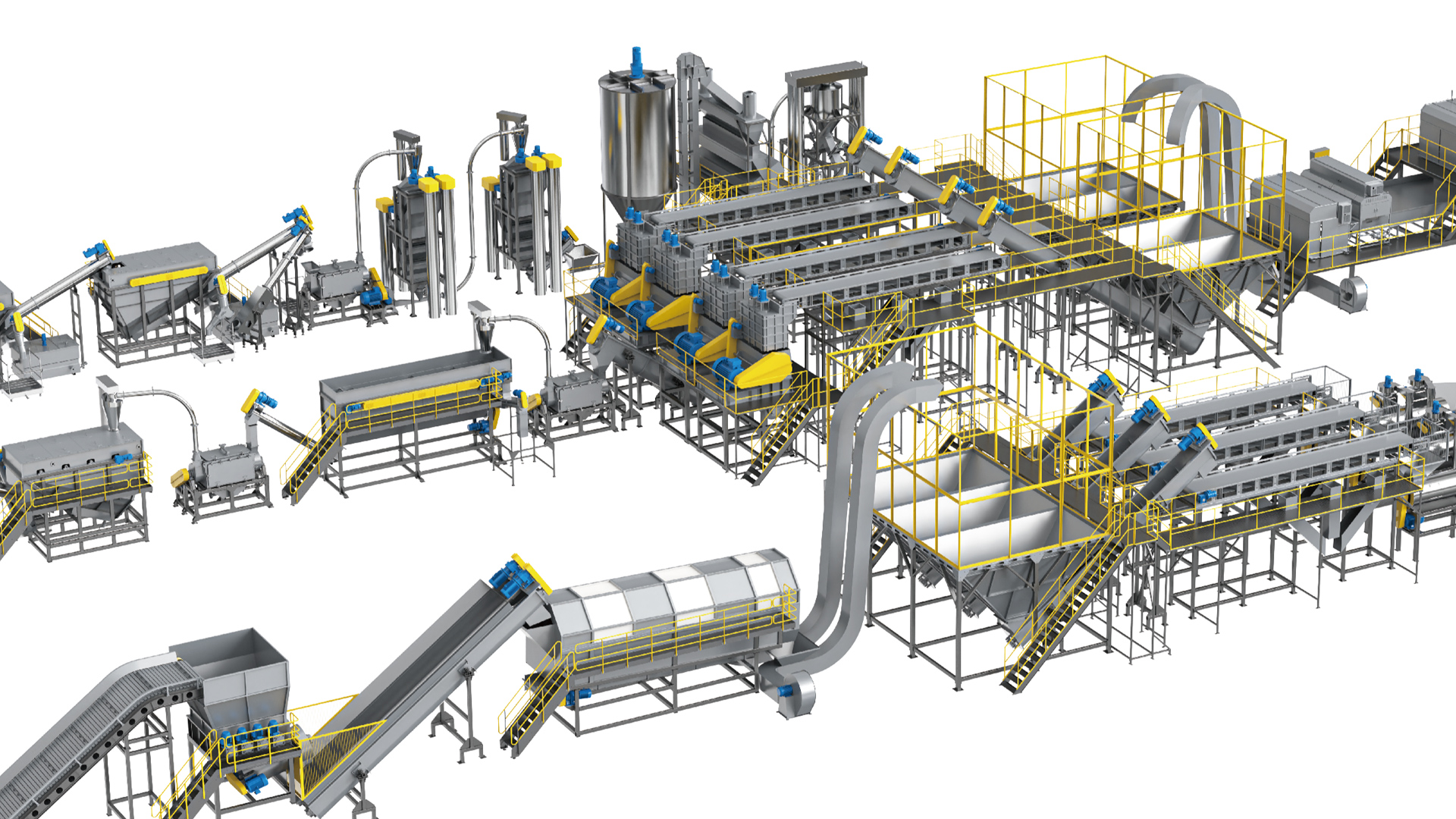
Polyretec’s published product scope includes washing lines and pelletizing lines built on this Austrian-style process concept. The two modules below are drawn directly from that scope. Especificação values are representative technical envelopes by capacity class; the exact configuration is confirmed at order because power, water, and footprint depend on the ordered capacity, the material, and the site layout.
Module 1: Linha de pelotização de nova geração
The Linha de pelotização de nova geração is designed for thin-walled LDPE film as well as thick-walled PE and PP regrind. It is built for maximum performance on post-consumer waste, with a robust cutter-compactor directly coupled to a single-screw extruder, continuous melt filtration, multistage vacuum degassing, and a melt pump for stable die pressure. Representative envelope values are shown below.
| Parâmetro | 300 kg/h class (LDPE film) | 500 kg/h class | 1000 kg/h class |
|---|---|---|---|
| Capacidade | 300 kg/h | 500 kg/h | 1000 kg/h |
| Screw diameter | 120 mm | 150 mm | 200 mm |
| L/D ratio | 32:1 | 33:1 | 34:1 |
| Main drive power | 90 kW | 160 kW | 315 kW |
| Total installed power | about 160 kW | about 280 kW | about 520 kW |
| Water for pellet cooling | 0.8 m3/h | 1.2 m3/h | 2.0 m3/h |
| Footprint | about 18 x 6 m | about 22 x 7 m | about 28 x 8 m |
| Applicable material | LDPE / LLDPE film, PP film, woven PP, PE/PP regrind, rigid PP and HDPE flake | ||
Module 2: Linha de lavagem de garrafas PET de qualidade alimentar
The Linha de lavagem de garrafas PET de qualidade alimentar covers 500 kg/h to 6000 kg/h and is engineered for different flake grades. It preprocesses waste PET through crushing, cold and hot washing, friction washing, separation, and drying. Pelletizing of the cleaned flake into food-contact or non-food pellet is a downstream module; for integrated projects the pelletizing stage can be supplied as a matched system, and twin-screw compounding downstream is available from Wanplas.
| Parâmetro | 1000 kg/h class | 3000 kg/h class | 6000 kg/h class |
|---|---|---|---|
| Capacidade | 1000 kg/h | 3000 kg/h | 6000 kg/h |
| Extruder screw | N/A at washing stage; pelletizing is a separate downstream module | ||
| Total installed power | about 220 kW | about 480 kW | about 850 kW |
| Water consumption (make-up) | about 1.5 m3/h | about 3.5 m3/h | about 6.0 m3/h |
| Water reuse rate | 80 percent to 95 percent with closed-loop treatment | ||
| Footprint | about 35 x 10 m | about 50 x 12 m | about 70 x 14 m |
| Applicable material | Post-consumer PET bottles, PET bottle flake | ||
Module 3: PP/PE Trituração de plástico mole and Linha de lavagem
The PP/PE Trituração de plástico mole and Linha de lavagem covers 500 kg/h to 1500 kg/h and is built for film, woven bags, and agricultural film, with one-step pelletizing available. This is the natural front end for the Linha de pelotização de nova geração when the feedstock is soft and dirty, and it demonstrates how washing and pelletizing are planned as one continuous system rather than two separate purchases.
| Parâmetro | 500 kg/h class | 1000 kg/h class | 1500 kg/h class |
|---|---|---|---|
| Capacidade | 500 kg/h | 1000 kg/h | 1500 kg/h |
| One-step pelletizing | Available, couples washing output to cutter-compactor extruder | ||
| Total installed power | about 180 kW | about 320 kW | about 450 kW |
| Water consumption (make-up) | about 1.0 m3/h | about 1.8 m3/h | about 2.6 m3/h |
| Water reuse rate | 80 percent to 95 percent with closed-loop treatment | ||
| Footprint | about 30 x 9 m | about 42 x 10 m | about 55 x 12 m |
| Applicable material | Agricultural film, packaging film, woven PP bags, LDPE / LLDPE / PP film | ||
These three modules are real Polyretec product families. They are selected and combined based on the feedstock and the required output grade, and the exact power and footprint are finalized during engineering based on site conditions. Polyretec’s application coverage spans PE and PP agricultural film, packaging film, woven bags, rigid PP, HDPE hollow containers, and PET bottle flake, with the recycled pellet flowing to film, injection molding, pipe, and non-food packaging applications.
Six Real Sources of Low Cost
Low cost is the sum of several measurable effects. Each is expressed below as a percentage, an index point, or a physical quantity so that the claim can be checked on any plant floor. We use the processing cost index of 100 points as the baseline for a conventional low-reuse, low-utilization layout.
Source 1: Specific electric energy
The cutter-compactor route lowers specific energy on film because the densified feed lets the extruder run at stable throughput without a separate forced-feed motor. The main extruder typically accounts for 60 percent to 70 percent of total line electric load. On film, specific energy in the pelletizing step commonly lands in the 0.28 to 0.45 kWh per kg band, while the washing step sits in the 0.25 to 0.5 kWh per kg band depending on contamination. The energy index of the baseline can fall from about 38 points to about 28 points when the route and good drying are applied.
Source 2: Water and water reuse
Closed-loop water treatment returns 80 percent to 95 percent of process water. Fresh make-up then becomes a small fraction of circulation, and water use per ton of finished pellet drops accordingly. Where an open once-through system might use several cubic meters per ton, a well-run closed loop cuts make-up dramatically, moving the water-and-chemicals index from about 12 points toward 7 points.
Source 3: Yield
Yield, the ratio of finished pellet to clean feed, typically ranges from 85 percent to 95 percent depending on pre-sorting and filtration. Every one percentage point of yield gained reduces the effective material cost per ton of pellet, because the same input produces more saleable output. Better pre-sorting and appropriately fine filtration can move the yield-loss index from about 18 points toward 11 points. Yield is often the single largest lever on unit cost, larger than the energy saving itself.
Source 4: Labor
Automation of feeding, screen changing, and packing reduces the headcount required per shift. A conventional line might need four to five operators per shift, while an automated Austrian-route line can run with two to three, including supervision. This moves the labor index from about 18 points toward 11 points without sacrificing output.
Source 5: Spare parts and downtime
Cutter blades, screen packs, and filter discs are consumables scheduled by running hours. Screw and barrel life in the thousands of running hours, combined with planned maintenance, keeps unplanned downtime low. The Wanplas group policy provides 500 free replacement parts per year as baseline coverage, which caps a portion of the recurring spare-part expense. The spares-and-maintenance index moves from about 10 points toward 7 points.
Source 6: Capacity utilization
Fixed overhead per ton falls as utilization rises. Moving from 60 percent to 80 percent and then to 95 percent utilization can reduce the overhead index from about 7 points toward 4 points. This is why line reliability and fast changeovers matter as much as the nominal capacity plate.
| Cost component | Baseline index (points) | Optimized index (points) | Main driver |
|---|---|---|---|
| Energy | 38 | 28 | Cutter-compactor route, good drying |
| Water and chemicals | 12 | 7 | 80 to 95 percent reuse |
| Yield loss | 18 | 11 | Pre-sort and filtration |
| Labor | 18 | 11 | Automated feed, screen, pack |
| Spares and maintenance | 10 | 7 | Hour-based scheduling, 500 free replacement parts per year |
| Overhead (utilization) | 7 | 4 | 60 percent to 95 percent utilization |
| Total processing cost index | 103 | 68 | About 34 percent lower index |
The table is a representative engineering model, not a price quote. The absolute cost in any currency depends on local energy tariffs, labor rates, and material value. What the model shows is the direction and relative magnitude of each lever, which is what a low cost design must optimize.
Recycled Pellet Quality and Downstream Usability
Low cost is worthless if the pellet cannot be used. The Austrian technology route is tuned to produce pellets that meet downstream specifications, and the relevant metrics are physical and measurable.
| Quality metric | Representative target | Why it matters |
|---|---|---|
| Melt flow rate stability | Narrow band per grade | Stable extrusion and molding |
| Gels and black specks | Minimized by fine filtration | Fewer surface defects |
| Color difference (Delta E) | Low for natural grades | Batch-to-batch consistency |
| Odor grade | Low after degassing | Non-food and some near-food use |
| Tensile strength retention | High versus virgin control | Mechanical performance |
| Ash content | Low, controlled | Inorganic contaminant load |
| Umidade | Low, measured in ppm | Processing stability |
Downstream usability maps to application grade. Film-grade pellet serves blown and cast film; injection-grade pellet serves containers, caps, and housewares; pipe-grade pellet serves non-pressure and some pressure pipe; and non-food packaging covers a wide range of industrial and consumer items. Food-contact status is a separate question addressed by the decontamination process and the applicable regional approval, discussed below.
Material-Specific Process Differences
Different feedstocks demand different process emphasis. The table below summarizes how the Austrian technology route is tuned per material.
| Material | Typical contamination | Process emphasis | Recommended Polyretec module |
|---|---|---|---|
| PE agricultural film | Sand and soil 5 to 20 percent | Heavy friction wash, strong rinse | PP/PE Soft Washing + New Generation Pelletizing |
| Packaging film | Print ink, adhesive | Hot wash, degassing | Linha de pelotização de nova geração |
| Woven PP bag | Dust, print, label | Shake-out, wash, dry | PP/PE Soft Washing + Pelletizing |
| Rigid PP | Labels, dirt | Grind, wash, dense flow | Linha de pelotização de nova geração |
| HDPE bottle | Caps, labels, residue | Separation, wash, dry | Rigid washing + pelletizing |
| Mixed soft and hard | Variable | Pre-sort, density split | Washing line + pelletizing, tuned |
Common Mistakes in Line Evaluation
Buyers often focus on the wrong number. The following mistakes inflate apparent cost or hide real cost.
- Watching only nominal extruder capacity. A line rated at 1000 kg/h on clean flake may deliver 700 kg/h of finished pellet if yield is 85 percent and the washing bottleneck caps feed. Evaluate finished-pellet output, not plate rating.
- Ignoring water treatment. Skipping closed-loop treatment saves capital up front but raises make-up water and discharge cost every month. The reuse rate is a first-order cost driver.
- Setting filtration too coarse. A coarse screen lowers pressure but invites gels and black specks that trigger downstream complaints and rejects. Filtration should match the application grade.
- Mismatching crusher screen and extruder capacity. If the crusher produces oversized or uneven flake, the compactor and extruder surge. Screen hole and extruder throughput must be matched.
- Neglecting pre-sorting. Contamination that enters the line as mixed material leaves as yield loss and higher ash. Pre-sort at the bale or bunker stage pays back quickly.
As a side note, conveyor-belt hygiene on the washing line is a routine housekeeping task and is best handled by the standard cleaning practice already in place at the plant; it is not a design feature of the pelletizing route and is mentioned here only to separate it from the cost levers that actually matter.
Selection Decision Path and Recommendation Table
The selection path is a short sequence of questions. Answer them in order, then read the recommendation table.
- What is the dominant material: film, fiber, rigid, or bottle?
- What is the contamination level: low, medium, or high?
- What is the target finished-pellet output in kg/h?
- Is food-contact grade required, or non-food grade acceptable?
- Will the pellet go to film, injection, pipe, or compounding?
Follow the path: material decides the washing front end, contamination decides wash intensity and filtration, output decides capacity class, food grade decides decontamination depth, and downstream use decides pellet specification. The table below gives a starting recommendation.
| Material / contamination / target | Recommended series | Key options |
|---|---|---|
| LDPE film, low to medium dirt, 300 to 1000 kg/h | Linha de pelotização de nova geração | Cutter-compactor, 40 to 80 micrometer filter, 2-stage vacuum |
| Agricultural film, high sand, 500 to 1500 kg/h | PP/PE Soft Washing + Pelletizing | Heavy friction wash, strong rinse, one-step pelletizing |
| PET bottle, mixed grade, 1000 to 6000 kg/h | Linha de lavagem de garrafas PET de qualidade alimentar | Hot wash, optical sort-ready, downstream pelletizing module |
| Rigid PP or HDPE, medium dirt, 500 to 1500 kg/h | Rigid washing + New Generation Pelletizing | Grind and wash, dense-flow extrusion |
| Highly filled or modified compound | Wanplas twin-screw compounding system | Side feeding, high shear, integrates with washing output |
Environmental Compliance and Standards
A responsible recycling line must meet environmental rules as well as production targets. The relevant areas are wastewater discharge, volatile organic compound treatment, noise, extended producer responsibility, and management-system certification.
Wastewater from washing must meet the applicable local discharge standard; in China the relevant requirements are expressed in the GB series of national standards for integrated wastewater and for the plastics industry, and the closed-loop design is the primary control that keeps discharge volume and load within limits. Volatile organic compound emissions from degassing vents are addressed by capture and treatment units sized to the local permit. Noise is controlled by enclosures and damping around the crusher and extruder gearbox. Extended producer responsibility schemes in many regions increasingly require recycled-content incorporation, which raises demand for consistent recycled pellet and rewards lines with stable quality.
On management systems, ISO 9001 and ISO 14001 are the relevant certifications for quality and environmental management; Polyretec operates under the Wanplas group quality framework, and the group’s products are built to meet CE requirements where applicable. For food-contact recycled material, the decontamination process must be validated against the applicable regional approval route, for example EFSA in Europe or FDA in the United States; this is a separate validation step from the mechanical line itself and must be planned explicitly rather than assumed.
Service and Support
Polyretec, as a Wanplas factory, delivers the group’s shared service commitments alongside its own recycling expertise. The support structure is built to keep the line running and to protect the low cost case over the equipment life.
- Testing before shipment. Each line is run and inspected at the factory before delivery so that commissioning risk is reduced on arrival.
- Installation and commissioning. Field engineers support on-site setup, start-up, and process tuning to the specific feedstock.
- Spare-parts policy. The Wanplas group provides 500 free replacement parts per year as baseline coverage, with warranty replacement for qualified components.
- Process training. Operators receive training on feeding, filtration, degassing, and changeover so the line reaches its utilization target.
- Remote operation support. Remote monitoring and data review let the support team diagnose process drift and recommend adjustments.
- Open factory and trial run. Customers are welcome to visit the factory, and a physical sample trial run can be arranged so the material is processed on the actual configuration before order confirmation.
Linha de pelletização Subsystem Deep-Dives
A low cost pelletizing line is only as strong as its weakest subsystem. Each unit from the bunker to the packing station has its own cost and quality behavior, and optimizing the line means optimizing each one against the others rather than buying the cheapest version of each. The five subsections below go deeper than the process-flow overview and give the parameters a plant engineer should specify and monitor.
Feeding and metering
Stable output begins with stable feed. A metered belt or loss-in-weight feeder delivers a consistent mass flow to the cutter-compactor, typically controlled to within plus or minus 3 percent of the set rate. A metal detector and a magnet protect the compactor blades and the extruder screw from tramp steel. Where bulk density varies through the day, a level sensor in the buffer bunker keeps the compactor throat full without flooding it, which is what prevents the surging that raises specific energy and widens pellet-size variation. Feed that is too thin or too thick both waste capacity, so the metering step is the first place to look when throughput drifts.
Melt filtration in detail
Continuous filtration uses a self-cleaning screen changer or a laser filter disc that indexes a small band of clean media into the melt path while discharging the contaminated band. Filter fineness is chosen from 40 to 150 micrometers against the downstream complaint risk: coarse at 80 to 150 micrometers for low-spec film, fine at 40 to 60 micrometers for molded or fiber grades. Pressure drop across the screen is logged because a rising trend signals media loading and predicts the next discharge cycle. Screen-media consumption is tracked per ton of product so the filtration cost is visible, not hidden, and so the chosen mesh can be tuned to the real contaminant load rather than guessed.
Die-face cutting
The die presents the melt through a ring of holes, and a rotor cuts the strands at the face. Rotor speed is matched to throughput and pellet size, commonly in the range of 400 to 1200 rotations per minute for water-ring and die-face hot cutting, with die-hole counts scaled to capacity. Pellet diameter is set by hole size and cut speed, usually 2.5 to 4 millimeters. Stable die pressure, held by the melt pump, is what keeps pellet length uniform; pressure swings show up directly as longs and shorts in the screen, which is why the melt pump is treated as a core part of the Austrian technology route rather than an option.
Centrifugal dryer
After cutting in water, the pellet carries surface moisture that must be removed before silo storage. A centrifugal dryer spins the pellet at 800 to 1500 rotations per minute to throw off water, then a short hot-air pass brings moisture below 0.5 percent. Residence is kept short to avoid pellet rounding and generation of fines. The dewatered water returns to the closed loop, so the dryer also protects the reuse rate rather than adding to discharge, and the small heat input from the hot-air stage is recovered where the layout allows it.
Screening and dedusting
A vibrating screen with a mesh slightly larger than the target pellet removes longs, doublets, and oversize, while an air knife or cyclonic deduster pulls off fines and fluff. Screen mesh is typically 4 to 6 millimeters for a 3 millimeter pellet. Removing off-size material before the homogenizing silo is what lets the downstream customer run continuous extrusion without frequent screen-pack changes, and it is a low-cost step that protects the value of the whole batch. The dedusting airflow is balanced so it removes fluff without entraining good pellet, which would lower yield.
| Subsystem | Key parameter | Representative range | Cost or quality effect |
|---|---|---|---|
| Feeder | Feed-rate accuracy | plus or minus 3 percent | Stops surging, lowers energy |
| Melt filter | Fineness | 40 to 150 micrometers | Cleanliness vs media cost |
| Die-face cutter | Rotor speed | 400 to 1200 rpm | Pellet length uniformity |
| Centrifugal dryer | Spin speed | 800 to 1500 rpm | Moisture below 0.5 percent |
| Vibration screen | Mesh size | 4 to 6 mm for 3 mm pellet | Removes longs and fines |
Low-Cost Plant Layout
Floor space is a hidden cost driver. The Austrian-engineered single-screw cutter-compactor line is compact because cutting, pre-conditioning, and extrusion share one frame, so the pelletizing island needs roughly 18 by 6 meters at the 300 kilogram per hour class and about 28 by 8 meters at the 1000 kilogram per hour class, excluding the upstream washing hall. A linear layout with the bunker, compactor-extruder, pelletizing, dryer, and silo on one center line shortens conveyor runs and cuts transfer loss. Utility routing matters: water loop, electrical, and vacuum lines should run in a shared trench so maintenance access stays clear. A minimum 1.2 meter service aisle along the drive side of the barrel and gearbox lets the crew change blades and inspect the screw without blocking material flow, which protects availability. Good layout also shortens the walk path for the reduced operator count, so labor savings from automation are not lost to travel time.
OEE Improvement Tactics
Overall equipment effectiveness multiplies availability, performance, and quality. A line that runs but makes off-spec pellet scores poorly, and a line that makes good pellet but stops often scores poorly. The Austrian route supports a realistic availability target of 90 percent to 95 percent through continuous filtration and hour-based maintenance. Performance loss is cut by matching the crusher screen to extruder throughput and by keeping feed bulk density steady. Quality loss is cut by correct filtration and degassing. Practical tactics include a daily start-up checklist, a running-hours log for every consumable, a 30-minute changeover standard between colors or materials, and a monthly review of the processing cost index so drift is caught early rather than at the end of the quarter. Because each lever is measured, the OEE number becomes a management tool rather than a slogan.
Maintenance Intervals and Spare-Parts Strategy
Planned maintenance is cheaper than breakdown maintenance. The consumable items follow running-hour schedules, while the heavy items follow condition monitoring. The table below lists representative intervals; the exact values are set during commissioning from the material and the duty cycle.
| Item | Action | Representative interval |
|---|---|---|
| Compactor blades | Inspect and rotate or replace | 200 to 400 running hours |
| Screen pack or filter disc | Replace or index by pressure drop | Per pressure trend, tracked per ton |
| Extruder screw and barrel | Measure wear, rebuild if needed | 4000 to 8000 running hours |
| Gearbox oil | Sample and replace | 4000 running hours |
| Dryer and screen bearings | Lubricate and check vibration | 2000 running hours |
The spare-parts strategy keeps critical items on the shelf: at least one set of compactor blades, one screen pack or filter disc, and one set of cutter knives per line, plus a spare barrel liner where the duty is abrasive. The Wanplas group policy provides 500 free replacement parts per year as baseline coverage, which caps a portion of the recurring expense. Consumables are reordered by running-hours data rather than by emergency, so the line never waits on a worn blade for a stoppage that could have been planned. A simple stock list with minimum and reorder levels turns spare-parts control from a guess into a number on the same dashboard as the processing cost index.
Operator Training and Throughput Optimization
Utilization and throughput are operator skills as much as machine specs. Training covers four areas: safe feeding and metal protection, filtration and screen scheduling, degassing and odor checks, and color or material changeover. A trained crew reaches the target utilization faster and avoids the mistakes that waste yield. Throughput optimization builds on that training with a short list: pre-sort at the bunker to cut ash, match the crusher screen hole to extruder capacity, hold feed bulk density steady, schedule filter discharges during natural lulls, and standardize changeover under 30 minutes. On film grades these steps typically recover 5 percent to 15 percent of lost throughput without any new hardware, which is among the lowest-cost gains available on an existing line. The recovered output also lowers the overhead index, because fixed cost is spread over more finished pellet.
Common Pellet Defects and Fixes
Even a well-set line shows defects when a parameter drifts. Catching them early protects the batch and the customer relationship. The table below maps the common defects to their usual cause and the standard fix.
| Defect | Typical cause | Standard fix |
|---|---|---|
| Fish eyes or bubbles | Residual moisture, weak degassing | Dry below 0.5 percent, deepen vacuum |
| Black specks | Coarse filter, degraded polymer | Fine filtration, lower barrel temperature |
| Longs or doublets | Die-pressure swing, dull cutter | Stabilize melt pump, sharpen blades |
| Excess fines | Over-cut, long dryer residence | Adjust cut speed, shorten drying |
| Color variation | Mixed feed, poor homogenization | Pre-sort, lengthen silo blend |
| Odor | Incomplete degassing, high volatiles | Raise vacuum level, add vent treatment |
The pattern across all six defects is the same: each traces to a measurable parameter, and each has a measured fix. That is the core advantage of the Austrian technology route for a cost-focused operator. Because cutting, plasticizing, filtration, degassing, and cutting are instrumented and logged, drift shows up in the data before it shows up as a customer complaint, and the processing cost index stays where the design put it. Treating defects as signals rather than surprises is what keeps a low cost line low cost over its full operating life.
Frequently Asked Questions
What exactly is meant by the Austrian technology route in pelletizing?
The Austrian technology route is a set of process features rather than a single supplier. It combines a cutter-compactor fed single-screw extruder, continuous melt filtration, multistage vacuum degassing, and a closed-loop water system into one continuous line engineered for thin films and lightweight post-consumer plastics. The value is in the architecture, not in any brand name.
How does a cutter-compactor fed single-screw extruder lower processing cost?
The cutter-compactor densifies fluffy film and fiber into a consistent feed plug so the single-screw extruder runs at stable throughput without a separate forced-feed throat. This removes a motor, reduces footprint, and cuts specific energy consumption on film grades by a measurable margin versus a twin-screw forced-feed layout, while making the line easier to automate.
Which materials are best suited to this Austrian-style single-screw line?
Low-bulk-density and heat-sensitive materials perform best: LDPE and LLDPE agricultural film, post-consumer packaging film, woven PP bags, printed PE/PP film, and rigid PP and HDPE regrind. Highly filled or heavily modified compounds are better handled by a twin-screw compounding system supplied by Wanplas, which integrates with Polyretec washing lines.
Can the line reach food-contact quality recycled pellet?
Food-grade status depends on the full cleaning and decontamination process plus the relevant regional approval route such as EFSA in Europe or FDA in the United States. The Austrian technology route supports high decontamination with multistage vacuum degassing and fine melt filtration, but each project must be validated against the applicable food-contact regulation rather than assumed.
What water consumption and reuse level should I plan for?
A closed-loop water treatment package typically returns 80 percent to 95 percent of process water to the line. Fresh make-up is a small fraction of total circulation, and the water use per ton of finished pellet drops accordingly versus an open once-through system, which also reduces discharge load.
How is spare-part risk controlled over the operating life of the line?
Consumable items such as cutter blades, screen packs, and filter discs are scheduled by running hours, and the Wanplas group policy provides 500 free replacement parts per year as a baseline coverage. Predictive maintenance on the cutter-compactor and extruder screws further limits unplanned downtime and protects utilization.
What capacity utilization is realistic, and why does it matter for cost?
Well-run lines reach 90 percent to 95 percent utilization once feed supply and changeover discipline are established. Because fixed overhead per ton falls as utilization rises, moving from 60 percent toward 95 percent can lower the overhead portion of the processing cost index by roughly 40 percent, a larger effect than many buyers expect.
Conclusion
The Austrian technology route is a proven way to make plastic recycling genuinely low cost, and it does so through engineering rather than through low-price components. By integrating cutting, pre-conditioning, and extrusion in a cutter-compactor fed single-screw line, by filtering melt continuously, by degassing in multiple vacuum stages, and by closing the water loop, the route moves every major cost lever in the right direction: lower specific energy, higher water reuse, better yield, fewer operators, controlled spares, and higher utilization.
Polyretec, a Wanplas factory with a history reaching back to 2010, brings this route to market through real product families such as the Linha de pelotização de nova geração, the Linha de lavagem de garrafas PET de qualidade alimentar, and the PP/PE Trituração de plástico mole and Linha de lavagem, with downstream twin-screw compounding available from Wanplas where the application requires it. The result is a recycling line that is both technically credible and economically attractive across film, rigid, and bottle feedstocks.
If you are evaluating a pelletizing or washing project, send your material type, contamination level, and target output, and our team will propose a matched configuration, arrange a factory visit and a physical sample trial run, and confirm the specification that fits your site. We welcome you to see the line running on your own material before you decide.