
How to Improve Pellet Strength in Recycled Plastic Production
Table of Contents
- Why Pellet Strength Defines Recycled Plastic Value
- How a Recycled Plastic Linha de pelletização Works
- Polyretec Linha de pelotização de nova geração
- Cutting and Pelletizing Systems: Five Methods Compared
- The Engineering Factors That Control Pellet Strength
- Matching Melt Flow Index and Regrind Quality
- Troubleshooting Weak, Friable, Porous, and Uneven Pellets
- Application Industries for Recycled LDPE, HDPE, and PP Pellets
- How to Select the Right Polyretec Pelletizing System
- Service, Support, and the Wanplas Factory Commitment
- Frequently Asked Questions
- Conclusion and Next Steps
Why Pellet Strength Defines Recycled Plastic Value
Polyretec, a Wanplas factory, has been building plastic recycling equipment since 2010 and has delivered more than 100 complete recycling projects across 50 plus countries, supported by a team of 24 plus engineering specialists. The company combines Austrian-technology process routes with Chinese manufacturing capacity to give recyclers cost-effective, durable lines for washing and pelletizing post-consumer and post-industrial plastic waste. When recyclers talk about quality, the single property that most often decides whether a recycled pellet can be sold into film, pipe, or injection molding is pellet strength: the ability of the pellet to survive handling, transport, and remelting without breaking into fines or dust.
Pellet strength is not a luxury specification. It is the difference between a product that flows cleanly through a hopper and one that generates dust, bridges in the silo, and contaminates the next processing step with gels and unplasticized lumps. Weak or friable pellets raise the loading loss, increase the risk of blocked screens in the downstream extruder, and force the converter to run at lower output to keep the melt stable. Strong, uniform pellets, by contrast, let the converter run faster, hold tighter tolerances, and produce cleaner film and pipe with fewer defects.
This article explains how pellet strength is created inside a recycling pelletizing line and how to optimize every stage from feedstock cleaning to cutting and cooling. We cover the Polyretec Linha de pelotização de nova geração and the full range of cutting systems available on a modern recycling line, then we work through the technical factors that control strength, a troubleshooting table for common defects, the application industries that consume recycled LDPE, HDPE, and PP pellets, and a selection table that maps material and output to the correct Polyretec configuration. By the end you will be able to specify a line that produces dense, strong, uniform recycled pellets.
The core idea is simple to state and difficult to execute: pellet strength is the visible result of invisible process control. Melt cleanliness, devolatilization, cooling rate, cutting method, and the quality of the regrind feeding the line all combine to decide whether the final pellet is a robust, free-flowing cylindrical pellet or a fragile, porous crumb. Each of these variables is manageable when the line is designed and operated correctly.
For recyclers handling post-consumer film, agriculture mulch, woven bags, rigid containers, and mixed PE/PP waste, the economics are unforgiving. A line that loses three percent of output to fines and dust is quietly giving away margin on every ton. A line that holds pellet strength high protects that margin and opens the door to higher-value converters who will not accept dusty material. Pellet strength, in other words, is a profit lever as much as a quality metric.
How a Recycled Plastic Linha de pelletização Works
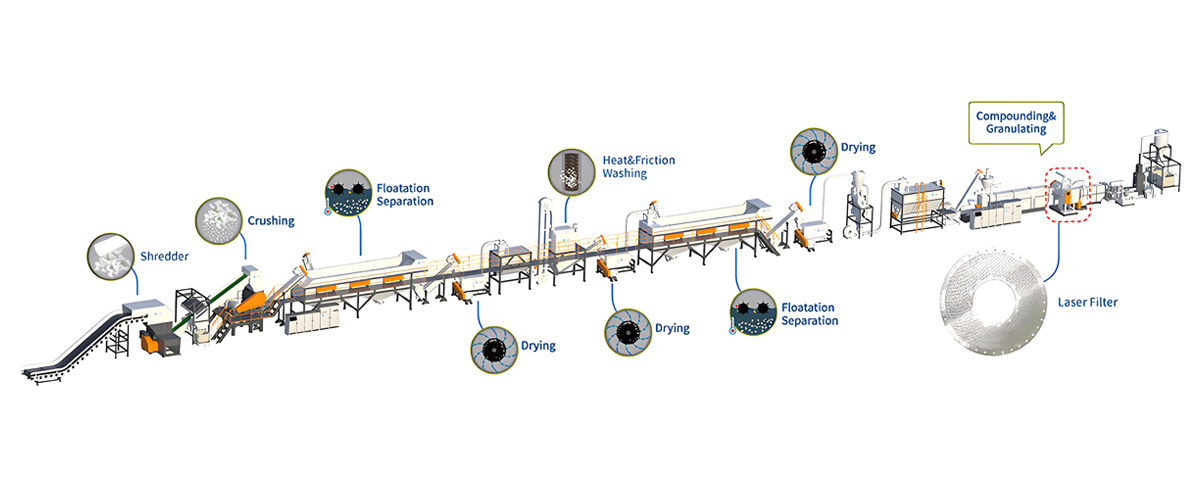
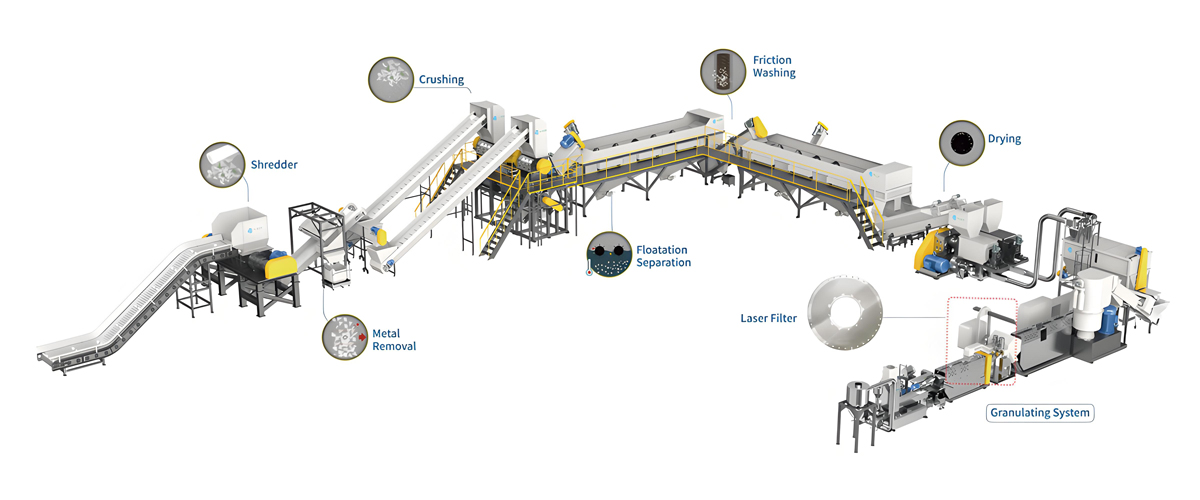
A recycled plastic pelletizing line turns loose, contaminated waste into uniform, free-flowing, reusable pellets through a sequence of melting, filtering, devolatilizing, homogenizing, cutting, and cooling. Understanding the sequence is the first step to controlling pellet strength, because every stage removes or introduces a defect that shows up in the final pellet.
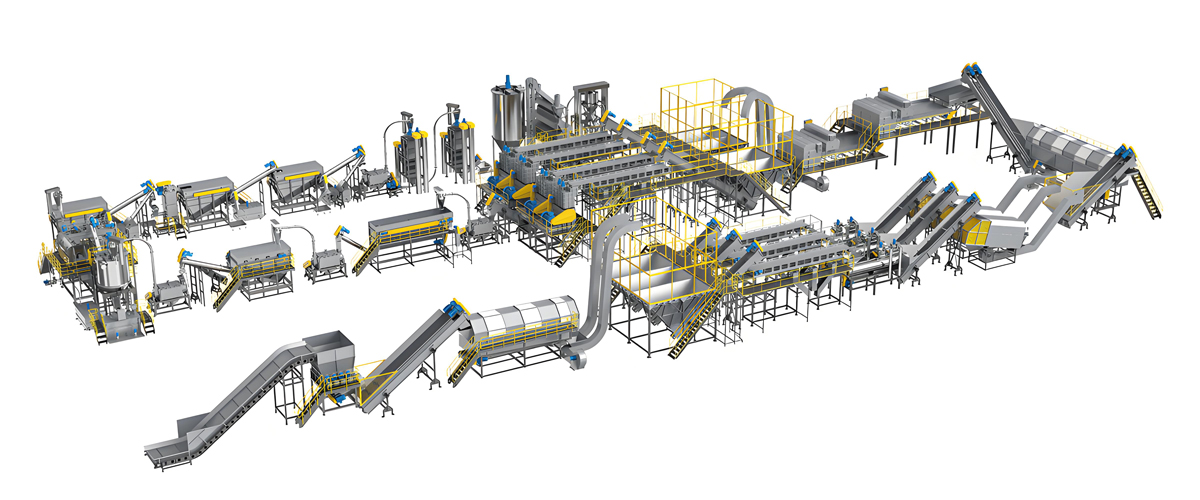
The journey begins upstream, before the pelletizer. Waste film, bags, or rigid scrap must first be washed, sorted, and reduced to clean flakes or regrind. On a complete Polyretec recycling plant, a washing line removes dirt, organics, labels, and residual product, then a drying system brings moisture down to a safe level. Clean, dry regrind is the foundation of pellet strength: material that still carries sand, paper, or water will produce weak, porous, and contaminated pellets no matter how good the pelletizer is. For this reason, the washing step is not optional housekeeping; it is the first strength control point.
Once the regrind is clean and dry, it is fed into the pelletizing extruder. The extruder barrel and screw plasticize the material, building melt temperature and pressure. In the barrel, the polymer is melted, sheared, and homogenized while the screw conveys it forward. A well-designed screw profile balances shear, residence time, and mixing so the melt is uniform without inducing thermal degradation. Degradation is the enemy of strength: over-sheared, over-heated polymer chains break, and short chains make brittle pellets.
Before the melt reaches the die, it passes through a melt filtration stage. A screen changer traps remaining solids, such as grit, unmolten fragments, and crosslinked gels, so they cannot become weak spots inside the pellet. Immediately after filtration, or in a dedicated venting zone, the melt is devolatilized: water vapor, trapped air, and low-molecular-weight volatiles are pulled out under vacuum. Residual volatiles are the direct cause of porous, foamy pellets. A properly vented line produces dense pellets; a poorly vented line produces sponge-like material.
The homogenized, filtered, devolatilized melt then exits through the die as strands or as molten extrudate at the die face. At this point the cutting system takes over. Depending on the configuration, the melt is cut into pellets by a rotating blade either underwater, in a water ring, against a strand in a water bath, or in an air-cooled die-face hot-cutting arrangement. The cut pellets are then cooled and dried. Cooling rate directly influences crystallinity, internal stress, and surface finish, all of which affect how the pellet behaves later in the converter’s hopper and barrel.
Finally, pellets are screened, conveyed to silos, and packaged. At this last stage the strength of the pellet is proven: a strong pellet passes the screen, flows to storage, and survives the truck. A weak pellet shatters into fines that clog the screen and contaminate the lot. The entire line, from wash to cut, is therefore a single chain of strength-determining steps.
Polyretec Linha de pelotização de nova geração
The Linha de pelotização de nova geração is Polyretec’s flagship recycling pelletizer, engineered for thin-walled LDPE films as well as thick-walled PE and PP regrind, with a robust construction built for the demanding duty of post-consumer waste. It is the recommended backbone for recyclers who need to convert low-bulk-density film and high-bulk-density rigid scrap into strong, uniform pellets at commercial scale.
What distinguishes the Linha de pelotização de nova geração is its tolerance for difficult feedstock. Post-consumer film is notoriously variable: it carries print, moisture, dirt, and a wide melt flow index range. The line pairs a high-torque extruder with an efficient feeding system that handles low-bulk-density film without surging, then filters and devolatilizes the melt aggressively before cutting. The result is a dense pellet even from challenging feedstock. The configuration can be matched to either strand cutting or die-face cutting depending on the material and the converter’s downstream needs.
Below is a representative specification table for the Linha de pelotização de nova geração. The values reflect typical configuration ranges for a recycling-grade line and should be confirmed against the specific material mix and target output during project engineering.
| Parâmetro | Typical Range / Especificação | Engineering Note |
|---|---|---|
| Throughput | 200 to 1000 kg/h | Depends on bulk density, MFI, and cutting method |
| Applicable materials | LDPE, LLDPE, HDPE, PP regrind, PP woven, mixed post-consumer PE/PP | Handles both film and rigid scrap |
| Pellet geometry | Cylindrical strand-cut 2.5 to 4.0 mm; die-face cut 2.0 to 3.5 mm | Size set by die hole and cutter speed |
| MFI handling range | 0.3 to 50 g/10 min | Wide range covers film to rigid grades |
| Screw diameter | 100 to 180 mm | Selected to match target throughput |
| L/D ratio | 28 to 36 | Longer L/D improves homogenization |
| Melt filtration | Continuous screen changer, 60 to 250 micron | Removes grit and gels that weaken pellets |
| Devolatilization | Single or double vacuum vent | Critical for dense, non-porous pellets |
| Drive power | 55 to 250 kW | Scales with screw size and output |
| Cooling options | Water bath, air cooled, water ring, underwater | Matched to cutting method |
| Residual moisture after drying | Less than 0.1 percent | Protects melt from porosity |
The Linha de pelotização de nova geração is most valuable when a recycler wants one flexible platform that can process both film and rigid scrap with consistent pellet quality. Its devolatilization and filtration are tuned for post-consumer contamination, which is exactly where cheaper, single-stage lines fail to deliver strength. For operations that need maximum uptime, the continuous screen changer means filtration can be maintained without stopping the line, keeping pellet quality stable across long runs.
Cutting and Pelletizing Systems: Five Methods Compared
The cutting system is the last mechanical step that shapes the pellet and one of the strongest determinants of final pellet strength and uniformity. Polyretec integrates multiple cutting technologies so the line can be matched to the material rather than forcing the material to fit one cutter. The five principal methods are water-cooled strand pelletizing, air-cooled strand pelletizing, air-cooled die-face hot cutting, water ring die-face hot cutting, and underwater pelletizing.
Strand cutting pulls extruded strands through a water cooling bath and then across a rotary cutter. It produces clean cylindrical pellets and is forgiving on a wide MFI range, which is why it remains popular for recycled LDPE and PP. Air-cooled strand cutting skips the water bath and cools the strands in ambient or forced air, which is useful when water sensitivity or drying load must be minimized. Die-face cutting, by contrast, cuts the melt directly at the die exit: the air-cooled die-face hot cutting method blows cooled air onto the hot cut pellets, while the water ring method sweeps cut pellets into a ring of water, and the underwater method cuts inside a pressurized water chamber for the most uniform, spherical, and dense pellet of all.
The choice of cutting method changes pellet strength in measurable ways. Underwater cutting minimizes exposure of the hot melt to air, reducing oxidation and giving the most consistent shape and the highest bulk density. Water ring cutting is close behind and is often the best balance of cost and quality for recycled polyolefins. Strand cutting is robust and easy to maintain but is more sensitive to strand breakage, which produces off-size and fused pellets if the cooling or puller speed is wrong. Air-cooled die-face hot cutting suits materials that must avoid water contact and is compact, but cooling is less aggressive so pellet shape control demands careful tuning.
| Cutting Method | Cooling Medium | Best For | Pellet Shape | Strength Control Note |
|---|---|---|---|---|
| Water-cooled strand | Water bath + air knife | LDPE, LLDPE, PP film and regrind | Cylindrical | Forgiving; sensitive to strand breakage |
| Air-cooled strand | Ambient or forced air | Water-sensitive or low-output runs | Cylindrical | Lower cooling load; slower line speed |
| Air-cooled die-face hot cutting | Air blast at die face | Compact lines, water-averse materials | Irregular round | Shape control needs fine tuning |
| Water ring die-face hot cutting | Water ring sweep | Recycled PE/PP, medium to high output | Near-spherical | Strong, uniform; balanced cost |
| Underwater pelletizing | Pressurized water chamber | High-value, uniform pellet demand | Spherical, dense | Highest uniformity and bulk density |
From a strength perspective, the die-face methods win on consistency because every pellet is cut from a melt at uniform temperature and pressure, then cooled immediately and uniformly. Strand cutting can match that quality but depends on the operator keeping strand speed, bath temperature, and cutter timing in lockstep. For recyclers chasing the tightest pellet-size distribution and the strongest, most dust-free output, water ring or underwater cutting is the safer engineering choice, while strand cutting remains the pragmatic choice for versatile, service-friendly operation.
The Engineering Factors That Control Pellet Strength
Pellet strength is governed by a small set of physical processes inside the line. Master these and you master the pellet. The principal factors are melt filtration quality, devolatilization, cooling rate, cutting method, regrind contamination, and moisture control. Each one either adds strength or, if neglected, subtracts it.
Melt filtration. A pellet is only as strong as its weakest inclusion. Grit, unmolten fragments, and crosslinked gels act as stress concentrators; under mechanical load or remelt they cause micro-cracks that read as friability. Continuous screen filtration at 60 to 250 micron removes these defects before they are locked into the pellet. The finer the screen, the cleaner the melt, but screen fineness must be balanced against pressure rise and throughput. A well-tuned filtration stage is the first guarantor of a strong, homogeneous pellet.
Devolatilization. Trapped volatiles become bubbles inside the solidifying pellet, creating internal voids that slash strength and make the pellet float in a sink-float test. Vacuum venting after filtration pulls out water vapor, air, and low-molecular-weight decomposition products. Double-vent configurations handle wet or highly contaminated feedstock better than single vent. If you see porous pellets, the vent is almost always the first place to look.
Cooling rate. Cooling rate decides crystallinity and internal stress. Too fast, and the pellet skin sets while the core is still molten, trapping stress that later manifests as cracking. Too slow, and the pellet deforms, agglomerates, or picks up moisture. The goal is a controlled, uniform quench that lets the pellet set evenly. Water ring and underwater systems give the most uniform cooling; strand baths require careful temperature control to avoid thermal shock.
Cutting method. As covered above, die-face cutting gives uniform pellets with minimal air exposure, reducing oxidation that embrittles the surface. Strand cutting is robust but depends on synchronization. The cutting method sets the geometry and the surface integrity of the pellet, both of which feed directly into how the pellet survives handling.
Regrind contamination. No pelletizer can fix dirty feed. Sand, paper, organics, and residual product from unwashed waste become inclusions and volatiles that weaken pellets and foul the screen. This is why a proper washing line upstream is non-negotiable for strength. Within the Wanplas group, matched washing and pelletizing are designed to work as one system so that clean, dry regrind reaches the extruder. A recycler who skips or under-specifies washing will fight weak pellets forever, regardless of cutter quality.
Moisture control. Water in the regrind flashes to steam in the barrel and vents as porosity; it also hydrolyzes some polymers and promotes degradation. Drying the regrind to below 0.1 percent residual moisture before pelletizing is essential. Moisture that survives into the melt becomes bubbles, and bubbles become weak, porous pellets. Moisture control is therefore the quiet hero of pellet strength.
| Factor | Effect on Strength | Control Action |
|---|---|---|
| Melt filtration | Removes inclusions that cause cracks | Continuous screen at 60 to 250 micron |
| Devolatilization | Prevents internal voids | Single or double vacuum vent after filtration |
| Cooling rate | Sets crystallinity and stress | Uniform quench; control bath or water temperature |
| Cutting method | Sets geometry and surface integrity | Die-face for uniformity; strand for versatility |
| Regrind contamination | Introduces inclusions and volatiles | Wash and sort upstream to clean regrind |
| Moisture control | Prevents steam porosity | Dry regrind below 0.1 percent moisture |
Matching Melt Flow Index and Regrind Quality
Melt flow index, commonly written as MFI and measured in grams per ten minutes, is the single most useful number for predicting how a recycled material will pelletize and how strong the pellet will be. MFI describes how easily the melt flows under a standard load, which is a proxy for molecular weight: high MFI means short chains and low viscosity, low MFI means long chains and high viscosity. Both extremes challenge pellet strength in different ways.
Very low-MFI material, such as thick-walled HDPE or heavily crosslinked scrap, is stiff and hard to plasticize uniformly. It needs a longer L/D barrel, higher torque, and more aggressive screw shear to homogenize, otherwise the pellet contains unmelted nodules that weaken it. Very high-MFI material, such as heavily degraded LDPE film, flows easily but has short chains that make naturally brittle pellets; it also tends to drool at the die and form long, fused strands that cut poorly. The art of a good recycling line is to handle the full 0.3 to 50 g/10 min range without sacrificing strength.
Regrind quality interacts tightly with MFI. Mixed post-consumer waste often blends wide-MFI components, and the blend’s average MFI is less important than its spread. A broad MFI distribution melts unevenly, so the pellet has regions of high and low viscosity that cool and shrink differently, generating internal stress and weak spots. Sorting by polymer type and, where possible, by grade narrows the MFI spread and dramatically improves pellet uniformity. Color sorting and density separation upstream protect both the MFI window and the final pellet strength.
Additives can also be used deliberately to recover strength. A small dose of a compatible chain extender can rebuild molecular weight in degraded polyolefins, raising effective MFI control and improving pellet toughness. Stabilizers protect the melt from further thermal and oxidative degradation during the high-shear pelletizing step. These are best decided during line commissioning with the material characterization in hand, because overdose causes its own defects such as plate-out and yellowing. The right line gives the operator the residence time, venting, and dosing points to manage MFI proactively rather than reactively.
In practice, the pelletizing line should be specified around the worst-case MFI and contamination of the intended feedstock, not the average. A line tuned for clean, uniform industrial scrap will struggle on mixed post-consumer film, and the first symptom will be weak or porous pellets. Polyretec’s Linha de pelotização de nova geração is deliberately built around that worst-case duty, which is why it suits recyclers whose feedstock quality varies from day to day.
Troubleshooting Weak, Friable, Porous, and Uneven Pellets
Even a well-specified line drifts, and when it does the pellets tell the story. The table below maps the most common pellet defects to their likely causes and the fixes that restore strength. Use it as a first-response checklist on the floor.
| Defect | Likely Cause | Fix |
|---|---|---|
| Weak or friable pellets that crumble on handling | Thermal degradation from over-shear or over-temperature; oxidation at die face; inclusions from poor filtration | Lower barrel temperature and screw speed; tighten screen micron rating; switch to die-face cutting to reduce air exposure; add stabilizer |
| Porous or foamy pellets with internal voids | Inadequate devolatilization; residual moisture in regrind; trapped air in melt | Improve vacuum venting, add a second vent, dry regrind below 0.1 percent, check feeder for air entrainment |
| Uneven pellet size or fused lumps | Cutter speed out of sync with strand or melt output; worn blade; inconsistent melt pressure | Recalibrate cutter-to-output ratio, replace blade, stabilize melt pressure with gear pump or better feeding, verify die hole uniformity |
| Long tails or strings on pellets | Cutting temperature too high; blade dull; poor cooling before cut | Reduce die temperature, sharpen or replace blade, increase cooling before the cut point |
| Pellets that bridge or dust in the silo | Low bulk density from poor cutting; excessive fines from breakage | Move to water ring or underwater cutting, tighten screen on classifier, improve regrind cleanliness to reduce breakage |
| Surface dullness or plate-out on pellets | Additive overdose; degradation residues; contamination | Reduce additive loading, improve filtration, review stabilizer package with material data |
The pattern in every one of these defects is the same: a strength problem is rarely caused by the cutter alone. It is caused by a chain of small deviations in filtration, venting, cooling, and cutting that compound into a visible pellet fault. The fastest path to recovery is to walk the line from wash to cut, checking each control point in order, rather than tweaking the cutter in isolation.
Application Industries for Recycled LDPE, HDPE, and PP Pellets
Strong recycled pellets are the raw material that keeps whole industries running on circular plastic. Once a Polyretec line produces dense, uniform LDPE, HDPE, or PP pellets, those pellets re-enter manufacturing across film, pipe, and injection molding sectors. The strength of the pellet directly determines whether it can be accepted by these converters.
| Industry | Typical Product | Preferred Pellet | Strength Requirement |
|---|---|---|---|
| Flexible packaging film | Carry bags, shrink film, stretch film | Recycled LDPE/LLDPE | High uniformity, low gel, low dust |
| Agriculture film and mulch | Greenhouse film, mulch, silage wrap | Recycled LDPE/HDPE blend | Clean melt, good tensile retention |
| Pipe and profile | Drainage pipe, conduit, profiles | Recycled HDPE/PP | High density, no voids, consistent MFI |
| Injection molding | Pails, crates, caps, housewares | Recycled PP/HDPE | Free-flowing, low fines, stable MFI |
| Woven and raffia | Woven bags, sacks, tape | Recycled PP | High toughness, low ash content |
| Construction and geomembrane | Sheets, membranes, composites | Recycled PE/PP | Dense, contamination-free pellets |
Within the Wanplas group, recycled pellets from a Polyretec line feed naturally into downstream processing knowledge across the group’s network of specialized factories, from film and sheet extrusion to pipe production, all under the shared Wanplas quality framework. For the recycler, the practical point is that pellet strength is what qualifies the material for these higher-value outlets. A dusty, friable pellet is relegated to the lowest-value applications; a strong, clean pellet can be sold into film and injection molding where margins are better.
Food-contact and medical applications demand even tighter control, and recycled content there is governed by regional regulations and certification such as FDA and EU 10/2011 frameworks for appropriate streams. While recycled post-consumer polyolefins are more often used in non-food film, pipe, and industrial molding, the discipline of producing strong, clean, low-contamination pellets is the same foundation that any upgrade in application grade requires.
How to Select the Right Polyretec Pelletizing System
Selecting a pelletizing system is a matter of matching three variables: the material type and its MFI range, the required output, and the pellet quality target. The table below gives a starting recommendation based on common recycling scenarios. Final configuration should be confirmed with a material sample trial on the actual feedstock.
| Material / Output | Recommended Polyretec System | Cutting Method | Why |
|---|---|---|---|
| Post-consumer LDPE film, 200 to 500 kg/h | Linha de pelotização de nova geração, compact configuration | Water-cooled strand or water ring | Handles low bulk density; good pellet uniformity at moderate output |
| Mixed PE/PP film and bags, 500 to 1000 kg/h | Linha de pelotização de nova geração, high-output configuration | Water ring die-face hot cutting | Balances throughput with strong, uniform pellets |
| HDPE rigid scrap and bottles, 300 to 800 kg/h | Linha de pelotização de nova geração with double vent | Water ring or underwater | Double venting removes volatiles for dense pipe-grade pellets |
| PP woven and raffia, 300 to 700 kg/h | Linha de pelotização de nova geração, PP-tuned screw | Water ring or strand | PP-tuned profile protects toughness and MFI |
| Premium uniform pellet, any polyolefin | Linha de pelotização de nova geração with underwater cutter | Underwater pelletizing | Highest bulk density and size uniformity for demanding converters |
| Water-averse or low-output trials | Linha de pelotização de nova geração, air-cooled option | Air-cooled strand or die-face hot cut | Avoids water contact; compact footprint |
The guiding principle is to size the line for the worst feedstock you expect to run, not the best. A line specified for clean industrial scrap will produce weak pellets the moment mixed post-consumer film arrives, because the filtration and venting margins will be too small. Polyretec’s Linha de pelotização de nova geração is designed with exactly that margin, which is why it is the default recommendation for recyclers whose input quality varies.
When the pellet quality target is highest, underwater cutting is worth the additional investment because it removes the air-exposure and cooling-unevenness variables almost entirely. For most recycled polyolefin operations, water ring cutting delivers 90 percent of the benefit at a lower cost and simpler maintenance. Strand cutting remains the right call when service simplicity and flexibility across materials matter more than the last point of pellet uniformity.
Service, Support, and the Wanplas Factory Commitment
Buying a pelletizing line is the start of a long operating relationship, and the strength of that relationship matters as much as the strength of the pellet. As a Wanplas factory, Polyretec operates under the shared Wanplas brand commitments that apply across the group’s specialized factories. These commitments are designed to keep a recycling line running at rated pellet quality for years.
Every Polyretec line is run through production testing before shipment so that pellet quality and throughput are verified on material representative of the customer’s feedstock. Installation and commissioning are carried out by Polyretec engineers who tune the filtration, venting, cooling, and cutting parameters to the actual waste stream. Operator training covers not just startup but the daily discipline of moisture control, screen changing, and cutter calibration that keeps pellets strong.
The Wanplas shared spare-parts policy provides USD 500 free parts per year, with free replacement of damaged parts within the warranty period. Remote monitoring and support let Polyretec engineers analyze line data and advise on adjustments before a small drift becomes a pellet-quality problem. The open-factory policy welcomes customers to visit the plant, audit the build quality, and witness a trial run on their own material before committing.
Beyond the contractual promises, the practical support that protects pellet strength is continuity of process knowledge. Because Polyretec designs both washing and pelletizing as parts of one recycling system, the engineering team can optimize the whole chain rather than only the pelletizer. A contaminant problem that shows up as weak pellets can be traced back to the wash stage and fixed at the source, which is the only durable way to hold pellet strength high. That system-level view is the core advantage of sourcing from a specialized Wanplas factory rather than assembling disparate machines.
Frequently Asked Questions
What is the most important factor for pellet strength in recycled plastic?
The single most important factor is cleanliness of the melt, which depends on upstream washing, melt filtration, and devolatilization. A pellet is only as strong as its weakest inclusion or void, so removing grit, gels, and volatiles before cutting does more for strength than any cutter setting. Pair that with controlled cooling and you have the foundation of a strong, uniform pellet.
Why are my recycled pellets porous and lightweight?
Porous, low-density pellets are almost always caused by trapped volatiles or moisture. Residual moisture in the regrind flashes to steam in the barrel, and inadequate vacuum venting leaves air and decomposition products inside the solidifying pellet. Dry the regrind below 0.1 percent moisture and improve or add a vacuum vent, and the porosity will normally disappear.
Which cutting method gives the strongest recycled pellets?
Underwater pelletizing gives the most uniform, dense, and consistently strong pellets because the melt is cut and cooled inside a pressurized water chamber with minimal air exposure. Water ring die-face cutting is a close, lower-cost alternative that still beats strand cutting on uniformity. Strand cutting is robust and flexible but depends more on operator synchronization to avoid off-size or fused pellets.
How does MFI affect pellet strength and how should I manage it?
MFI reflects molecular weight: very low MFI is hard to plasticize uniformly, while very high MFI means short, brittle chains. Both produce weak pellets if not managed. Sort feedstock by polymer and grade to narrow the MFI spread, use a longer L/D barrel and higher torque for low-MFI material, and consider a compatible chain extender or stabilizer for degraded, high-MFI scrap during commissioning.
Can a washing line really improve pellet strength?
Yes, and it is often the decisive step. Unwashed waste carries sand, paper, organics, and residual product that become inclusions and volatiles in the melt, directly causing friable and porous pellets. A proper washing line upstream delivers clean, dry regrind, which is the prerequisite for any pelletizer to make strong pellets. Within the Wanplas group, washing and pelletizing are engineered as one system for this reason.
Why do my pellets have uneven size or fused lumps?
Uneven size and fused lumps usually come from the cutter being out of sync with the melt output, a worn blade, or unstable melt pressure. Recalibrate the cutter speed to the strand or melt flow, replace the blade, and stabilize pressure with better feeding or a gear pump. Also verify that all die holes are uniform, because a blocked hole forces the remaining holes to over-extrude.
How much moisture can remain in regrind before pelletizing?
Residual moisture should be kept below 0.1 percent before the material enters the extruder barrel. Above that, water flashes to steam and creates voids that weaken pellets and can cause surface foaming. A good drying and dewatering stage after washing is essential, and the line should be verified with a moisture check on the feed.
Is underwater cutting worth the extra cost for recycled polyolefins?
For most recyclers, water ring cutting delivers the bulk of the quality benefit at lower cost and simpler maintenance, so it is the pragmatic choice. Underwater cutting is worth the premium when the pellets must meet the tightest size distribution and highest bulk density for demanding film or injection molding converters, or when the product is positioned at the top of the quality range.
How do I keep pellet strength stable across long production runs?
Stable strength comes from stable process control. Run a continuous screen changer so filtration does not lapse, keep the vacuum vent operating, monitor regrind moisture at the feed, and schedule blade replacement before wear causes tails and fines. Remote monitoring from Polyretec engineers can flag drift early, and the USD 500 free parts per year policy keeps consumables available.
What output can a Polyretec pelletizing line deliver?
The Linha de pelotização de nova geração covers a typical throughput range of 200 to 1000 kg/h depending on material bulk density, MFI, and cutting method. The exact rated output for a given feedstock is confirmed during a material sample trial and production testing before shipment, so the quoted figure reflects real pellet quality rather than a best-case number.
Conclusion and Next Steps
Pellet strength in recycled plastic production is not a mystery; it is the sum of disciplined control at every stage from wash to cut. Clean, dry regrind feeds a well-filtered, properly devolatilized melt that is cut and cooled uniformly into dense, free-flowing pellets. The Linha de pelotização de nova geração from Polyretec, a Wanplas factory, is engineered for exactly this duty on post-consumer LDPE, HDPE, and PP, with cutting options from strand to water ring to underwater so the line can be matched to the material and the quality target.
The practical path is straightforward. Start with a washing line that delivers clean regrind, specify the pelletizing line for your worst feedstock rather than your best, choose the cutting method that matches your quality and budget, and maintain the filtration, venting, and cooling discipline that keeps strength high. When a defect appears, walk the line from wash to cut rather than tweaking the cutter alone, and use the troubleshooting table to find the root cause quickly.
Polyretec brings more than a decade of recycling project experience, 100 plus delivered installations, and 50 plus countries of field knowledge to every line, backed by the shared Wanplas commitments of USD 500 free parts per year, pre-shipment production testing, installation and commissioning, operator training, remote support, and an open-factory policy. If you are planning or upgrading a recycled plastic pelletizing line and want strong, uniform, dust-free pellets, send your material specification and target output for a tailored configuration, arrange a factory audit, or request a sample trial run on your own feedstock. Our engineering team will analyze your waste stream and recommend the Polyretec pelletizing system that meets your strength and throughput goals.