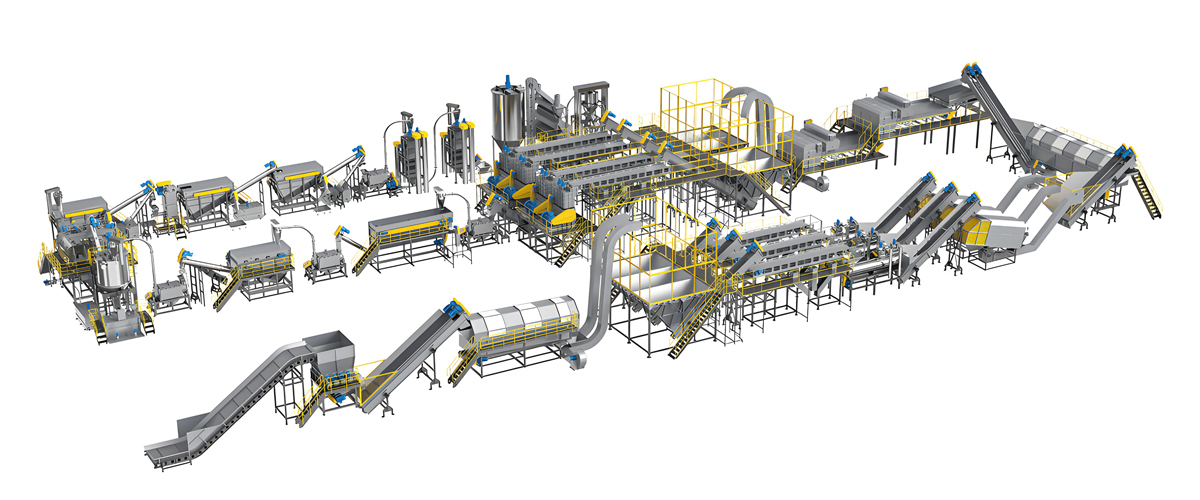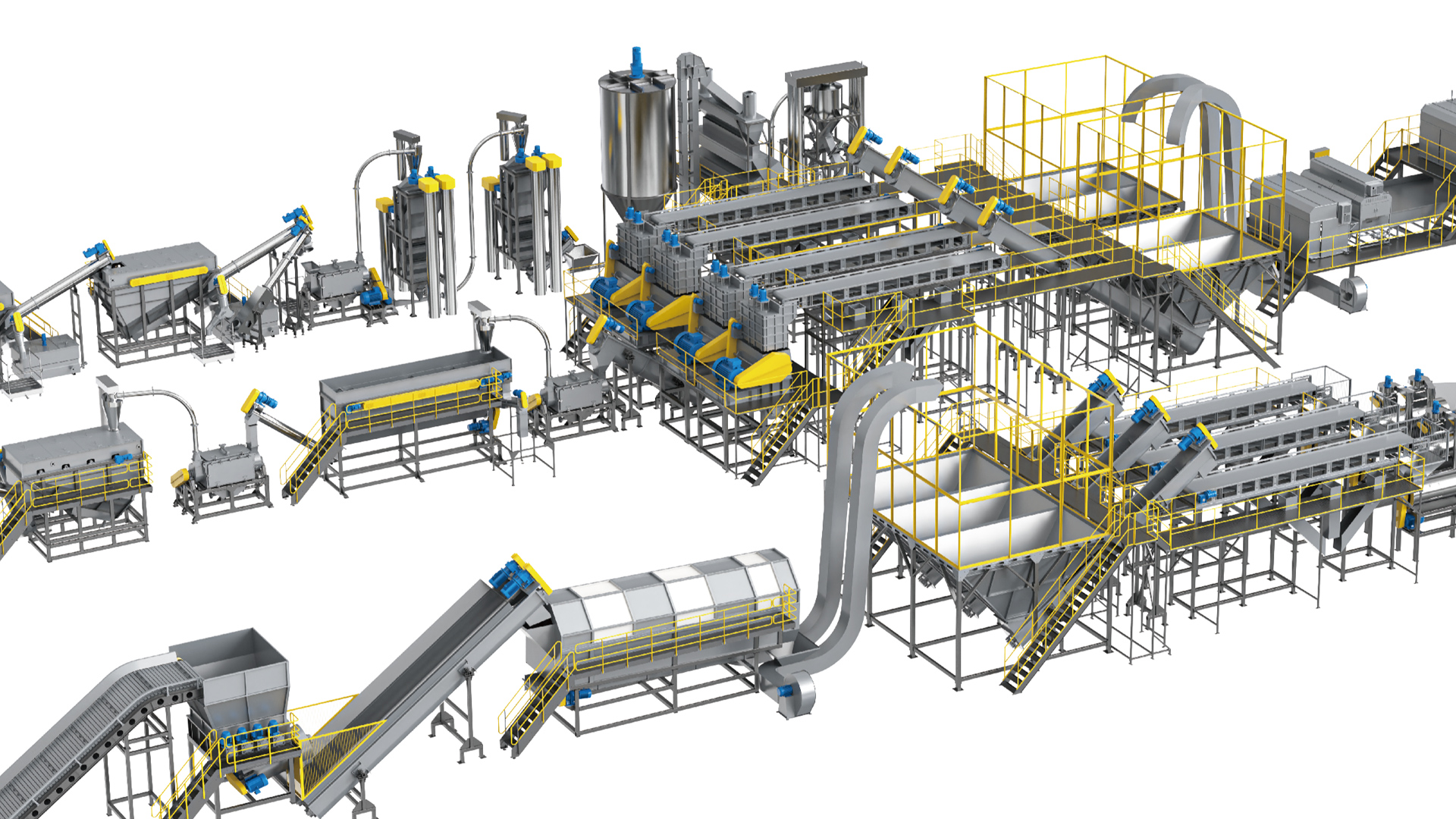

Choosing the best PP PE film recycling line with a one-step pelletizing system is fundamentally a moisture problem disguised as a machinery problem. Polyolefin film — agricultural mulch, greenhouse sheeting, packaging bags, PP woven sacks and FIBC liners — is thin, light and enormously large in surface area per kilogram. That geometry is exactly what makes film cheap to produce and painful to recycle. Water clings to it, soil grinds into it, and the loose bulk density of washed flakes makes conventional gravity feeding almost useless. A line that handles rigid HDPE bottle regrind beautifully can strangle itself on the same tonnage of washed agricultural film.
The decisive difference between an average film recycling plant and a genuinely profitable one is what happens in the twenty seconds between the last washing stage and the extruder feed throat. In a conventional two-step layout, washed flakes leave a mechanical dryer at eight to twelve percent residual moisture, cool down in a storage silo, absorb ambient humidity, and are then re-fed cold into a separate pelletizing extruder. Every one of those steps costs energy, floor space, labor and pellet quality. In a one-step layout, a squeezing dryer — a heated screw compactor — drives residual moisture below one percent and discharges hot, plasticized-edge flake directly into the extruder feed section at eighty to one hundred and ten degrees Celsius. Nothing cools down. Nothing re-wets. Nothing gets handled twice.
This guide is written for plant engineers, recycling entrepreneurs and procurement managers who need to specify a real machine, not read a brochure. It walks through feedstock grading, the complete process flow from bale opener to bagging, the physics of friction washing and float separation, extruder and melt filtration configuration, pelletizing method selection, water treatment, energy benchmarks in kilowatt-hours per kilogram, pellet quality control and odor reduction. It also presents concrete specifications for Polyretec, a Wanplas factory that has built plastic recycling equipment since 2010, established the Polyretec brand in 2017, and now supports more than one hundred projects across over fifty countries with a team of twenty-four or more engineers. Where higher-output or compounding-grade pelletizing is required beyond the standard film line, Wanplas supplies matched systems that bolt onto the Polyretec washing line without redesigning the plant.
1. Why Film Recycling Is Harder Than Rigid Plastics
Film recycling is harder than rigid plastic recycling for four measurable reasons: surface-area-driven water retention, extremely low bulk density, abrasive mineral contamination, and printing inks or adhesive layers that survive washing. Each one attacks a different part of the line, and a line specified only for tonnage without accounting for these four factors will underperform from the first week of production.
Surface area and residual moisture
A twenty-micron LDPE film has a specific surface area roughly one hundred times greater than a three-millimeter HDPE bottle wall of the same mass. Water is held in three ways: as a surface film bound by surface tension, as capillary water trapped between overlapping flakes, and as water pockets inside folded or tubular fragments. Mechanical centrifuges remove the first category efficiently and the second category partially, but they cannot remove the third at all. That is why a well-run horizontal centrifuge on rigid flake reaches two to three percent residual moisture, while the same machine on film flake plateaus at eight to twelve percent. Pushing a centrifuge harder does not help — beyond a certain rotor speed the film simply mats into a dense cake that shields the inner layers from centrifugal force.
Twelve percent moisture entering an extruder means one hundred and twenty grams of water per kilogram of polymer must be evaporated inside the barrel and pulled out through the vent ports. At a throughput of one thousand kilograms per hour that is one hundred and twenty liters of water per hour turning into steam inside the process. Even with double degassing, the vapor load destabilizes melt pressure, creates bubbles in the strand, and forces the operator to reduce output. The one-step squeezing dryer exists precisely to remove that vapor load mechanically and thermally before it ever reaches the vent zone.
Low bulk density and conveying behavior
Loose washed film flake has a bulk density of roughly 0.05 to 0.15 tonnes per cubic meter, compared with 0.30 to 0.45 for rigid regrind and 0.55 to 0.62 for virgin pellets. This has three consequences. First, screw conveyors and blowers must be sized on volume, not mass — a conveyor rated for one thousand kilograms per hour of pellets will move perhaps two hundred kilograms per hour of loose film. Second, gravity feeding into an extruder throat fails: the flake bridges, the screw flights run partly empty, and output collapses to a fraction of nameplate. Third, storage silos must be enormous or the line must run in continuous balance with no buffer. The engineering answers are forced feeding with a compaction screw, oversized transfer pipework, and — in the one-step architecture — eliminating the intermediate silo altogether.
Mineral abrasion from soil and agricultural residue
Agricultural mulch film can arrive with ten to thirty percent soil, sand and plant residue by weight. Silica sand has a Mohs hardness of seven; hardened tool steel sits around six to six and a half. Every gram of sand that enters the wet crusher, the friction washer or the extruder is actively machining the equipment. Untreated soil load shortens crusher blade life from months to weeks, erodes friction washer paddles, scores the squeezing dryer screw, and blinds melt filtration screens at an unsustainable rate. This is why a serious agricultural film line begins with de-stoning and pre-washing before the material ever touches a cutting edge, and why blade and screw materials must be selected for abrasive service rather than for general-purpose polyolefin.
Printing inks, adhesive layers and odor carriers
Post-consumer packaging film is typically printed, sometimes laminated, and frequently carries pressure-sensitive label adhesive. Solvent-based inks contribute pigment particles that darken the pellet and raise the black-spot count; adhesive residues cause tackiness in the dryer and gel formation in the melt. Neither is removed by cold water. Hot caustic washing at seventy-five to eighty-five degrees Celsius with one to three percent sodium hydroxide and a surfactant is the standard countermeasure, and it changes the entire line design: heated tanks, chemical dosing, corrosion-resistant stainless steel, higher water treatment load, and a rinse stage to neutralize carryover. Absorbed food residues and degradation products also carry odor, which becomes a commercial issue when the pellet is aimed at consumer-visible applications.
2. Feedstock Grades and Their Impact on Line Configuration
No single film recycling line configuration is correct for all feedstock. The contamination level of the incoming bale determines washing intensity, wear part specification, filtration fineness and, ultimately, the pellet grade that can be sold. The most common commercial error is buying a line specified for clean post-industrial scrap and then feeding it heavily soiled agricultural film — the line will run, but throughput, filter life and pellet quality will all fall far short of the quotation.
The table below maps five common polyolefin film feedstock grades against the parameters that actually drive line configuration. Contamination level is expressed as total non-polymer content by weight of the delivered bale.
| Feedstock grade | Contamination level | Moisture after mechanical drying | Required washing intensity | Relative wear rate on equipment | Achievable pellet grade |
|---|---|---|---|---|---|
| Post-industrial LDPE film (converter trim, clean edge scrap) | Below 1 percent | 6 to 8 percent | Cold rinse only; hot wash optional | Low | Near-virgin; suitable for film blowing back into similar products |
| Post-consumer LDPE packaging film (shrink hoods, stretch wrap, bags) | 2 to 5 percent | 8 to 10 percent | Cold pre-wash plus friction washing; hot wash for printed material | Medium | Good general-purpose grade; garbage bags, inner layers of packaging film |
| PP woven bag and FIBC fabric | 3 to 8 percent | 9 to 12 percent | Intensive friction washing; float separation to remove sewn-in fibers and liners | Medium to high | Industrial grade; injection crates, pallets, non-critical moldings |
| Agricultural mulch film | 10 to 30 percent soil, sand and plant residue | 10 to 12 percent | De-stoning, multi-stage pre-wash, high-intensity friction washing, hot wash | Very high | Utility grade; garbage bags, irrigation pipe, geotextile backing |
| Greenhouse film | 5 to 15 percent | 9 to 11 percent | De-stoning plus friction washing; hot wash where adhesive tape residue is present | High | Mid grade; agricultural film, irrigation components, molded parts |
Reading the table as a specification tool
The practical use of this table is backwards from how it is usually read. Start from the pellet grade you intend to sell, then trace left to see what washing intensity and wear specification the line must carry. If the target market is film-to-film — meaning the recycled pellet goes back into blown film — the ash content ceiling is typically below 0.5 percent and the black-spot count must be low, which forces hot washing, fine melt filtration and often a double filtration stage. If the target is irrigation pipe or geotextile, ash tolerance rises above one percent, filtration can be coarser, and the line can run faster with lower operating cost.
Mixed feedstock deserves special mention. Many recyclers buy whatever bales are available, meaning the line sees clean post-industrial scrap on Monday and heavily soiled mulch film on Thursday. A line designed only for the average will be over-specified half the time and under-specified the other half. The correct approach is to specify washing capacity and wear parts for the dirtiest grade the plant will realistically process, and to build throughput flexibility into the extruder and pelletizer through variable-speed drives so that the clean grades can run at higher output. Polyretec configures its PP PE film lines this way as standard, with frequency-controlled drives on the crusher, friction washers, squeezing dryer and extruder so that a single line can be re-balanced for feedstock changes from the control panel rather than by mechanical modification.
Bale quality and pre-sorting discipline
Contamination that never enters the line costs nothing to remove. Manual pre-sorting on the infeed conveyor to pull out rope, wood, metal fragments, rigid containers and heavily degraded material typically pays for itself many times over in reduced wear and filter consumption. A magnetic separator over the infeed belt and a second one after crushing catch ferrous fragments before they reach the extruder. For agricultural film with heavy soil, pre-shredding followed by a dry pre-cleaning drum can remove a substantial fraction of loose soil before any water is added, cutting the load on the water treatment plant considerably.
3. Full Line Process Flow of a PP PE Film Recycling Line
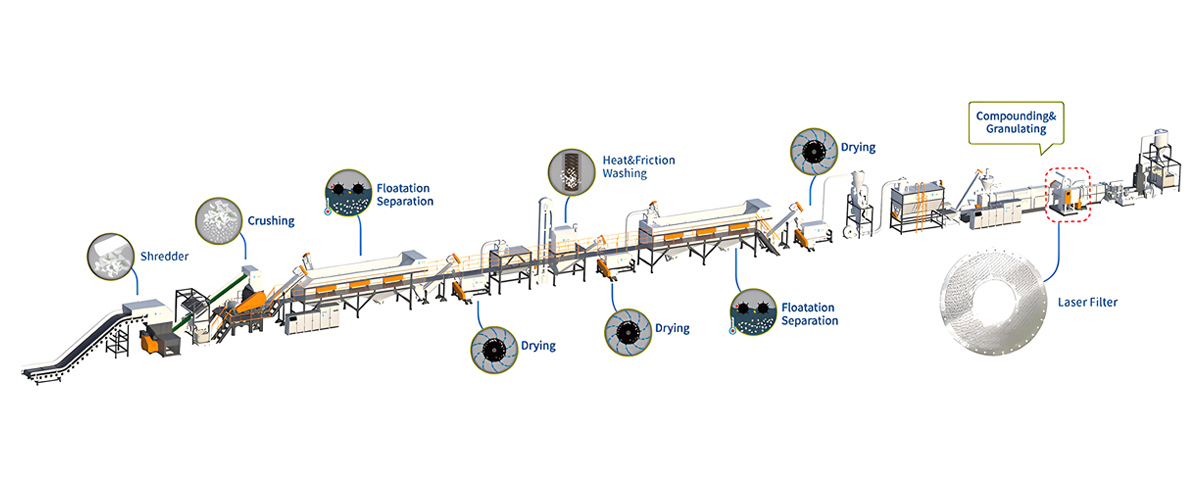
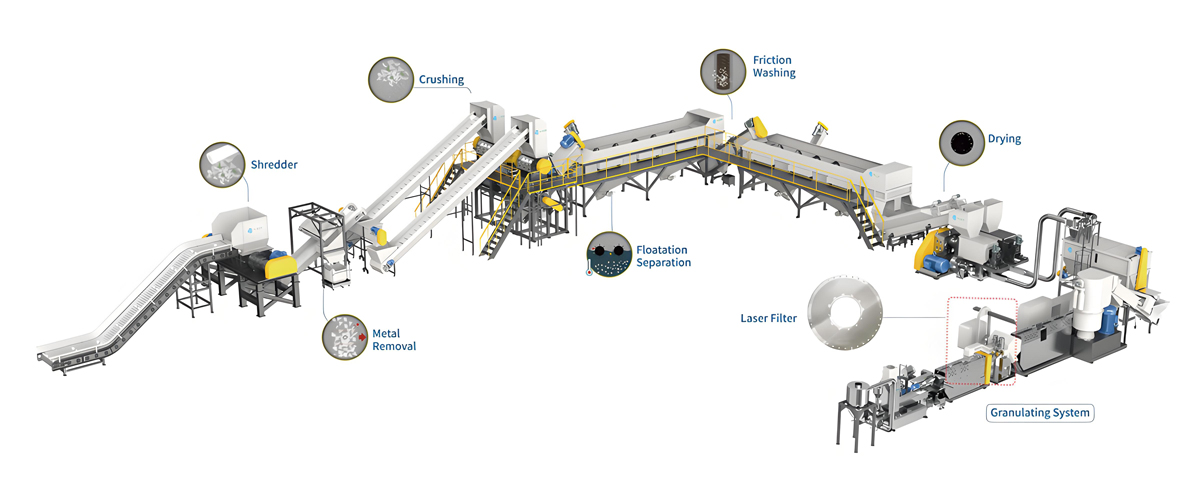
A complete one-step PP PE film recycling line is a continuous chain of sixteen process stages, each of which removes a specific contaminant class or conditions the material for the next stage. Understanding what each stage is actually responsible for prevents the common mistake of trying to compensate for a missing stage by over-driving the one after it.
Stage-by-stage description
Bale opener. Compressed bales arrive at densities of three hundred to five hundred kilograms per cubic meter and must be broken up without tearing the material into unmanageable fragments. A rotating shaft with staggered teeth pulls the bale apart and delivers loose film onto the sorting conveyor at a controlled, even rate. Feed rate stability here determines stability everywhere downstream; a surging bale opener produces surging output at the pelletizer eight machines later.
Pre-washing and de-stoning. For soiled feedstock, a pre-washing tank with a bottom screw removes heavy mineral debris by simple sedimentation while paddles keep the film in suspension. Sand, gravel and metal fragments settle and are augured out continuously. Removing abrasives at this point, before any cutting edge is involved, is the single highest-return decision in an agricultural film line.
Wet crusher with water injection. The film is size-reduced to a flake of roughly forty to eighty millimeters while water is injected into the cutting chamber. The water acts as a coolant, a dust suppressant and a transport medium that carries liberated soil away from the blades in real time. Wet crushing is discussed in detail in section five.
Friction washer (first stage). A high-speed rotor inside a perforated drum accelerates the flakes against each other and against the drum wall. The mechanical scrubbing action dislodges surface-bound soil, which passes through the perforations with the water while the flakes advance axially.
High-speed friction washer (second stage). A second, faster friction stage attacks the contamination that survived the first pass — bonded soil, biofilm and light ink. Two friction stages in series remove substantially more contamination than one stage running twice as long, because each transfer between machines re-orients the flakes and exposes new surfaces.
Floating separation tank. Density-based separation removes any polymer heavier than water — PET fragments, PVC labels, rubber, and residual mineral matter. Polyolefins float; contaminants sink and are augured out of the tank bottom. This stage is discussed in section six.
Horizontal high-speed friction washer. A final horizontal friction stage with fresh or hot water performs the polishing wash and, importantly, begins the dewatering process by throwing free water off the flake before it enters the squeezing dryer.
Squeezing dryer (screw compactor). The heart of the one-step system. Residual moisture falls from eight to twelve percent down to below one percent through mechanical compression combined with barrel heating and steam venting. Full detail follows in section four.
One-step feeding into the extruder. Hot, compacted flake discharges directly into the extruder feed section without an intermediate silo, conveyor or cooling stage. This is the defining feature of the one-step architecture.
Double degassing. An atmospheric vent removes the bulk of residual steam and air entrained with the low-bulk-density feed; a downstream vacuum vent at approximately minus 0.08 megapascals extracts residual moisture and volatile organic compounds from the melt.
Melt filtration. A screen changer removes solid contaminants that survived washing — paper fibers, unmelted polymer, mineral particles and carbonized material. Filtration options are compared in section eight.
Pelletizing. Die-face hot cutting, water ring cutting, underwater cutting or strand cutting converts the filtered melt into pellets. Method selection is covered in section nine.
Dewatering and drying of pellets. A centrifugal dryer removes surface water from the freshly cut pellets, bringing residual moisture typically below 0.1 percent for polyolefin, which requires no hygroscopic drying.
Vibrating sieve. A simple screening stage separates fines, tails, doubles and oversized agglomerates from the acceptable pellet fraction. Screen aperture is matched to the target pellet size, and a two-deck arrangement removes both oversize and undersize in one pass. Detailed screen selection for flake sieving upstream is a separate topic; at the pellet end, a two-deck vibrating sieve with a top deck around five millimeters and a bottom deck around two millimeters covers the great majority of polyolefin pellet geometries.
Homogenizing silo. Blending several hours of production in a silo with internal mixing evens out short-term variation in color, melt flow rate and moisture. Without this stage, batch-to-batch variation visible to the customer can be significant even when the line is running well.
Bagging. Automatic weighing and bagging into twenty-five kilogram sacks or bulk bags, with a sampling point for quality control retention samples.
Where the two-step layout diverges
In a two-step plant, the chain breaks after the mechanical dryer. Flakes are conveyed to a storage silo or big bags, cool to ambient temperature, re-absorb atmospheric moisture, and are later fed into a separate pelletizing line that begins with its own hopper, feeder and often a separate agglomerator or compactor. The thermal energy invested in the wash water and the drying stage is entirely lost. The one-step line preserves that energy in the material itself and carries it straight into plasticizing.
4. The Core Advantage: One-Step Squeezing Dryer and Extruder Integration
The squeezing dryer is the component that makes one-step film recycling possible, and it is the component most frequently under-specified when buyers compare quotations on price alone. Its function is to take flake at eight to twelve percent moisture and deliver it to the extruder at below one percent moisture, at a temperature of eighty to one hundred and ten degrees Celsius, at a bulk density three to five times higher than loose flake, and at a mass flow rate that exactly matches the extruder.
How a squeezing dryer works
Mechanically, a squeezing dryer is a single screw running inside a slotted or perforated barrel, with a decreasing channel volume along its length and a restricted discharge. Three effects combine:
Mechanical expression. As channel volume decreases toward the discharge, the flake mass is compressed. Free and capillary water is physically squeezed out through the barrel slots and drains away. This stage alone typically takes moisture from twelve percent down to three to four percent, and it costs almost nothing thermally because no phase change is involved.
Frictional and conductive heating. The compressed material is sheared against the barrel wall, generating frictional heat, while electrically heated barrel zones add controlled conductive heat. Material temperature rises to eighty to one hundred and ten degrees Celsius — high enough to flash off remaining bound moisture as steam and to soften the flake surface, but deliberately below the melting point of polyethylene so that the material remains conveyable rather than turning into a melt.
Steam venting. The steam generated is vented through the barrel slots and an extraction hood rather than being carried forward into the extruder. This is important: a squeezing dryer that heats the material but does not properly vent the steam simply transports moisture in vapor form into the feed throat, where it condenses and defeats the purpose.
The result at the discharge is a hot, semi-compacted, partly surface-fused flake mass with a bulk density typically in the range of 0.25 to 0.40 tonnes per cubic meter — dense enough to feed an extruder reliably — at below one percent residual moisture.
Why direct hot feeding saves energy
Consider the thermal arithmetic for polyethylene. The specific heat capacity of solid PE is approximately 2.3 kilojoules per kilogram per Kelvin, and the heat of fusion is roughly 200 kilojoules per kilogram. Taking one kilogram of PE from twenty-five degrees Celsius to a melt temperature of two hundred and twenty degrees requires on the order of 650 kilojoules including fusion. If the material enters the extruder at one hundred degrees Celsius instead of twenty-five, roughly 170 kilojoules per kilogram of that requirement has already been supplied — free — by heat that the washing and squeezing process generated anyway. That is approximately twenty-five percent of the sensible-plus-latent heat demand of plasticizing.
In practice, measured line-level savings are more modest than the ideal calculation because motor efficiency, radiation losses and the extruder’s own shear heating all interact. Realistic field experience puts the thermal chain saving of one-step versus two-step at fifteen to twenty-five percent of total specific energy consumption for the extrusion and drying stages combined. On a one thousand kilogram per hour line running six thousand hours per year, that is a very large number of kilowatt-hours, and it accrues every single production hour without any operator intervention.
Why direct feeding improves pellet quality
Energy is only half the argument. The quality argument is arguably stronger:
No re-absorption of atmospheric moisture. Washed polyolefin flake stored in a silo or big bag equilibrates with ambient humidity. In a humid climate, flake that left the dryer at three percent can be back at five or six percent within a day. That moisture goes straight into the extruder and produces bubbles, silver streaking and strand breaks.
No secondary contamination. Every transfer, every silo and every big bag is an opportunity to pick up dust, fibers, previous-batch residue or foreign material. Eliminating the intermediate storage stage eliminates an entire contamination pathway.
Stable extruder feed. Because the squeezing dryer discharges at a controlled, compacted density directly into the feed throat, the extruder sees a consistent volumetric feed rather than the surging, bridging behavior of loose flake. Melt pressure stability improves, which directly improves pellet dimensional consistency and reduces filter stress.
Shorter thermal history. One heating event instead of two means less total time at elevated temperature, which means less oxidative degradation, better retention of mechanical properties and lower odor.
| Parameter | Two-step (separate washing and pelletizing) | One-step (integrated squeezing dryer and extruder) |
|---|---|---|
| Specific energy index (two-step baseline = 100) | 100 | 75 to 85 |
| Moisture entering the extruder | 5 to 12 percent, variable with storage time and ambient humidity | Below 1 percent, consistently controlled |
| Material temperature at feed throat | Ambient, 15 to 35 degrees Celsius | 80 to 110 degrees Celsius |
| Footprint | Larger; requires intermediate silo, buffer storage and a second feed system | Compact; typically 20 to 30 percent less floor area for equivalent output |
| Intermediate handling steps | Conveying, storage, re-feeding, sometimes re-agglomeration | None; continuous transfer |
| Risk of secondary contamination | Medium to high | Low |
| Pellet quality consistency | Variable; depends on storage discipline and climate | High; feed condition is process-controlled |
| Operators required per shift | Higher; separate crews often needed for washing and pelletizing | Lower; one integrated crew, typically 1 to 2 fewer people |
| Investment intensity | Medium; can be phased, but total equipment count is higher | Medium to High for the integrated block, offset by lower building and handling cost |
| Flexibility to sell washed flake separately | High; flake is a saleable intermediate | Lower; the line is optimized to produce pellets |
| Startup and shutdown complexity | Lower; the two halves are independent | Higher; the line must be balanced as one system |
The honest limitation of one-step
One-step integration is not universally superior. If your business model is to sell washed flake to third-party pelletizers as well as to pelletize in-house, a two-step layout gives you a saleable intermediate product and the freedom to run the washing line and the pelletizing line at different hours and different capacities. One-step ties the two together: if the extruder stops, the washing line stops. For most dedicated film recyclers producing their own pellet, that coupling is an acceptable trade for the energy, quality and labor benefits. For traders and toll processors with variable business, the flexibility of two-step may win. Polyretec builds both architectures and will configure the line around the business model rather than pushing one answer.
5. Wet Crushing versus Dry Crushing
Wet crushing is the correct choice for essentially all contaminated polyolefin film, and the reason is not water itself but what the water does to the abrasive load inside the cutting chamber. Injecting water at the crusher removes liberated soil in real time, suppresses dust, cools the blades and prevents the thermal softening that causes film to wrap around the rotor. Dry crushing remains appropriate only for clean post-industrial trim where there is no mineral contamination and where the material will not be washed afterward.
What water actually does in the cutting chamber
When film is cut, soil that was bonded to the surface is liberated as fine particles. In a dry crusher those particles stay in the chamber, circulating with the material, and every revolution grinds them against the blades and the screen. In a wet crusher, injected water at a typical ratio of six to ten cubic meters per tonne of throughput flushes those particles out through the screen continuously. Blade life on heavily soiled agricultural film can improve by a factor of two to four compared with dry crushing of the same material.
Water also solves the heat problem. Film has low thermal mass and high surface area, so the frictional heat of cutting raises its temperature quickly. Above roughly seventy degrees Celsius, LDPE becomes tacky and begins to weld to itself and to the rotor. The result is the classic film crusher failure mode: a solid mass of welded polymer wrapped around the shaft, requiring hours of manual removal. Continuous water injection keeps chamber temperature near ambient and eliminates this failure mode entirely.
Finally, water suppresses airborne dust. Dry crushing of soiled agricultural film generates a significant respirable dust load containing soil, pesticide residue and polymer fines. This is a genuine workplace health issue as well as an explosion-risk consideration in enclosed dust collection systems. Wet crushing removes the hazard at source.
Blade material and geometry
Blade specification determines both cut quality and maintenance cost. For film service, the practical options are:
SKD-11 (equivalent to D2 cold work tool steel). High chromium and carbon content give excellent wear resistance and good toughness after heat treatment to around fifty-eight to sixty HRC. This is the standard choice for general film and woven bag service and offers the best balance of blade life, re-sharpening capability and cost.
D2 tool steel. Functionally equivalent to SKD-11 under a different designation, widely used for the same duty. Both can be re-ground many times over their service life, which matters because re-sharpening is far cheaper than replacement.
Tungsten carbide hardfacing overlay. For extremely abrasive service — heavily soiled agricultural mulch film with sand content above twenty percent — a carbide overlay welded onto the cutting edge extends life substantially. The trade-off is that carbide-overlaid blades cannot be re-ground conventionally and are more brittle under shock loading from tramp metal, so upstream magnetic separation becomes mandatory rather than optional.
Blade clearance is the parameter operators most often neglect. For film, the gap between rotating and fixed blades should be maintained at 0.2 to 0.5 millimeters. Below 0.2 millimeters the blades risk contact and catastrophic damage; above 0.5 millimeters the film is torn rather than cut, producing long stringy fragments that wrap on downstream rotors and block screens. Clearance should be checked and reset at every blade change and verified weekly in heavy service.
Screen aperture selection
Screen aperture determines flake size, and flake size affects everything downstream. For PP PE film, apertures of forty to eighty millimeters are standard. Smaller apertures produce more uniform flake and better washing efficiency because more surface is exposed, but they also increase crusher energy consumption, reduce throughput and generate more fines. Larger apertures increase throughput but leave large fragments that wash less effectively and feed less consistently into the squeezing dryer.
A practical rule: use sixty to eighty millimeters for relatively clean packaging film where washing demand is moderate, and forty to sixty millimeters for agricultural film where maximum washing surface exposure is required. PP woven bag material generally runs well at fifty to seventy millimeters — small enough to break up the woven structure, large enough to avoid excessive fiber generation.
Water consumption and recirculation ratio
A wet crusher on a one thousand kilogram per hour line consumes roughly six to ten cubic meters of water per hour in circulation. Almost all of this is recirculated: water leaving the crusher passes to sedimentation, is clarified, and returns. Fresh make-up water is required only to replace what leaves with the flake, what evaporates and what is purged with sludge. In a well-designed system with a water treatment loop, make-up demand is typically eight to fifteen percent of circulating volume. Section twelve covers water treatment in detail.
6. Friction Washing and Separation Physics
Friction washing and float separation are the two workhorses of a film washing line, and they work on completely different physical principles. Friction washing removes contamination that is mechanically attached to the polymer surface. Float separation removes contamination that is chemically or physically distinct from the polymer by density. Neither can substitute for the other, and a line missing either one will produce visibly inferior pellets.
Friction washing mechanics
A friction washer consists of a vertical or horizontal perforated drum containing a high-speed rotor fitted with paddles or scraper blades. Flakes enter at one end with water and are accelerated to rotor speeds of typically seven hundred to one thousand revolutions per minute. Three cleaning mechanisms operate simultaneously:
Flake-to-flake abrasion. Adjacent flakes moving at different velocities rub against each other. Because both surfaces are polymer, this action is aggressive on contamination but gentle on the material itself.
Flake-to-wall impact. Centrifugal force throws flakes against the perforated drum wall. The impact dislodges bonded particles, which are immediately carried away by the water passing through the perforations.
Hydraulic shear. Water moving at high relative velocity across the flake surface strips loosened particles and prevents redeposition.
Rotor speed is the primary control parameter. Below about seven hundred revolutions per minute, the mechanical energy is insufficient to remove bonded soil. Above about one thousand, energy consumption rises sharply and film flake begins to shear into fines, which are lost as yield and load the water treatment system. Residence time is the second parameter, typically fifteen to forty seconds per stage — which is why lines use two or three stages in series rather than one long machine.
Hot washing chemistry
Cold friction washing removes soil, dust and loose debris. It does not remove printing ink, adhesive, oil, grease or biological residue. For those, hot caustic washing is required: water at seventy-five to eighty-five degrees Celsius with sodium hydroxide at one to three percent concentration plus a non-ionic surfactant.
The chemistry works on three fronts. Sodium hydroxide saponifies fatty residues and attacks the binder systems in many printing inks, allowing the pigment layer to be mechanically scrubbed off. Elevated temperature reduces the viscosity of adhesives and oils by orders of magnitude, making them removable by mechanical action. The surfactant lowers interfacial tension so that water can penetrate between the contaminant and the polymer surface, and keeps the removed material dispersed so it does not redeposit.
Caustic concentration must be controlled. Below one percent, ink removal is incomplete. Above three percent, chemical consumption rises without proportional benefit, the rinse load increases substantially, and there is a risk of surface oxidation on polyolefin that can affect downstream printability if the pellet is used for film. Temperature above eighty-five degrees Celsius is generally counterproductive for LDPE because the material begins to soften and agglomerate. A rinse stage after hot washing is mandatory to remove carryover caustic, which would otherwise cause corrosion downstream and leave residue in the pellet.
Float separation and polymer densities
The floating separation tank exploits the fact that polyolefins are among the very few commodity polymers less dense than water. In a quiescent tank, polyolefin flakes float and are skimmed off the surface by a paddle conveyor, while denser materials sink and are removed by a bottom auger.
| Material | Density (grams per cubic centimeter) | Behavior in water | Separation outcome |
|---|---|---|---|
| Polypropylene (PP) | 0.90 to 0.91 | Floats strongly | Retained as product |
| Low-density polyethylene (LDPE) | 0.91 to 0.93 | Floats | Retained as product |
| High-density polyethylene (HDPE) | 0.94 to 0.96 | Floats marginally | Retained as product; requires calm tank conditions |
| Polystyrene (PS) | 1.04 to 1.06 | Sinks | Removed |
| Polyethylene terephthalate (PET) | 1.38 to 1.40 | Sinks rapidly | Removed |
| Polyvinyl chloride (PVC) | 1.35 to 1.45 | Sinks rapidly | Removed; critical, as PVC degrades and releases acid in the extruder |
| Paper and cellulose fiber (wet) | 1.1 to 1.5 | Sinks or remains suspended | Partially removed; balance handled by melt filtration |
| Sand and mineral soil | 2.4 to 2.7 | Sinks rapidly | Removed |
| Aluminum foil fragments | 2.7 | Sinks | Removed |
Two practical warnings apply. First, HDPE at 0.96 grams per cubic centimeter has very little buoyancy margin, and any turbulence, entrained air loss or attached contamination can push a flake below the surface. Tank design must provide a quiescent zone with adequate residence time — typically sixty to one hundred and twenty seconds. Second, contaminated or laminated flakes behave according to their composite density, not their base polymer density. A PE film flake with a heavy paper label attached may sink and be lost as yield; conversely, a PET fragment folded into a PE film pocket with trapped air may float and contaminate the product. Adequate size reduction before the float tank is what liberates these composites into separable single-material fragments.
Contaminant removal responsibility matrix
| Contaminant type | Primary removal stage | Supporting stage | Typical removal efficiency |
|---|---|---|---|
| Loose soil, dust and sand | Pre-washing and de-stoning tank | Wet crusher water injection | 85 to 95 percent |
| Bonded soil and dried mud | Friction washer stages 1 and 2 | Hot wash where clay content is high | 90 to 97 percent |
| Stones, gravel, metal fragments | Pre-washing sedimentation | Magnetic separator; float tank | Above 98 percent |
| PET, PVC and other heavy polymers | Floating separation tank | Manual pre-sorting | 95 to 99 percent |
| Printing ink and pigment layers | Hot caustic wash at 75 to 85 degrees Celsius | High-speed friction washing after hot wash | 60 to 90 percent, ink system dependent |
| Pressure-sensitive adhesive and label glue | Hot caustic wash with surfactant | Horizontal friction washer | 70 to 90 percent |
| Paper labels and cellulose fiber | Hot wash softening plus friction | Melt filtration for residual fiber | 80 to 95 percent |
| Oils, greases and food residue | Hot caustic wash | Rinse stage | 85 to 95 percent |
| Odor-bearing volatile compounds | Vacuum degassing in the extruder | Hot wash; melt temperature control | Measured by VDA 270 rating improvement |
| Fine mineral particles below 100 micrometers | Melt filtration | Friction washing | Depends on filter fineness; see section eight |
7. Extruder Configuration for Film Recycling
The extruder in a one-step film recycling line is not a standard pelletizing extruder with a different hopper. It is a specifically configured machine whose feed section, screw geometry and venting arrangement are all designed around two facts: the feedstock has very low bulk density, and it still carries residual moisture and volatiles even after squeezing.
Why forced feeding is mandatory
Gravity feeding depends on material flowing into the screw channel under its own weight and filling the flights. With virgin pellets at 0.55 to 0.62 tonnes per cubic meter, this works perfectly. With film flake at 0.05 to 0.15 tonnes per cubic meter, it does not work at all. The flake bridges above the feed throat, the flights run one-quarter full, and output falls to twenty or thirty percent of what the screw geometry should deliver. Worse, the feed rate becomes erratic, so melt pressure oscillates and the pelletizer produces inconsistent pellets.
A force feeder — a compaction screw or crammer mounted at the feed throat and driven independently — solves this by mechanically pushing material into the main screw at a controlled rate. In a one-step line, the squeezing dryer itself performs much of this function, discharging pre-compacted material at 0.25 to 0.40 tonnes per cubic meter directly into the feed section. A supplementary force feeder or side-feeding compactor is still used on high-output configurations to guarantee complete flight filling and to decouple feed rate control from the dryer.
The engineering benefit of complete flight filling extends beyond throughput. A fully filled feed section conveys material as a solid plug, which produces stable pressure build-up in the compression zone, consistent melting, and predictable specific energy consumption. A partly filled feed section produces intermittent conveying, air entrainment, unstable melting and higher scrap rates.
Screw geometry for polyolefin film
The recommended configuration for PP PE film recycling in a one-step line is a single-screw extruder with the following characteristics:
Length-to-diameter ratio of 33:1 to 36:1. This is longer than a conventional pelletizing extruder at 25:1 to 30:1, and the extra length is needed for two reasons: to accommodate two venting zones with adequate melt seal and re-pressurization between them, and to provide sufficient residence time for complete melting of the wide flake size distribution typical of recycled film.
Compression ratio of 3:1 to 3.5:1. Higher than the 2.5:1 to 3:1 typical for virgin polyolefin, because the incoming material is lower in bulk density and needs more volumetric reduction to reach full melt density. Too high a compression ratio, however, causes excessive shear heating and degradation, so 3.5:1 is a practical upper limit for recycled film.
Barrier screw with a mixing head. A barrier flight separates the solid bed from the melt pool along the transition zone, which dramatically improves melting efficiency and reduces the amount of unmelted material carried forward. A mixing element — a Maddock-type or pineapple-type mixing head — in the metering zone homogenizes melt temperature and disperses color and any residual gel. Melt homogeneity directly determines pellet color consistency, which is a commercially visible quality attribute.
Nitrided or bimetallic barrel lining. Recycled film carries residual abrasives even after excellent washing. A bimetallic barrel liner with high wear resistance is strongly recommended for agricultural film service; standard nitriding is adequate for clean post-industrial material.
Double degassing configuration
Two venting zones, not one, are the standard for film recycling:
Atmospheric vent, positioned after initial melting. This removes the bulk of entrained air brought in with the low-bulk-density feed, plus steam from residual moisture. It operates at ambient pressure and is sized generously because the volumetric flow of released gas is large. A vent stuffer or a venting screw is often fitted to prevent melt from rising into the vent port.
Vacuum vent, positioned in the metering zone. Operating at approximately minus 0.08 megapascals gauge, the vacuum vent extracts residual moisture, low molecular weight degradation products and odor-bearing volatile organic compounds from the melt. Vacuum level, melt temperature and the melt surface renewal rate at the vent all determine devolatilization efficiency. A decompression zone with deliberately increased channel depth at the vent creates a partly filled section with a large free melt surface, which is what makes vacuum extraction effective.
Between the two vents there must be a melt seal — a section where the screw channel is completely full — otherwise the vacuum simply pulls air backward through the atmospheric vent. Getting this seal right is a matter of screw design, not operator adjustment, which is why film recycling screws should not be substituted with general-purpose screws.
Melt temperature control
Target melt temperature for LDPE film recycling is typically one hundred and ninety to two hundred and twenty degrees Celsius; for PP woven material, two hundred and ten to two hundred and forty. Running hotter improves filterability and melt homogeneity but accelerates oxidative degradation, worsens odor and yellows the pellet. Running cooler preserves properties but risks unmelted particles reaching the filter and increases motor load. Because a large share of the melting energy in a single-screw extruder comes from shear rather than from the barrel heaters, screw speed is often a more effective melt temperature control than the heater set points — a point many operators overlook.
8. Melt Filtration Options
Melt filtration is the last line of defense between contamination and the finished pellet, and it is where the economics of dirty feedstock become brutally visible. A filter that is too coarse lets black specks and mineral particles through into the pellet; a filter that is too fine on heavily contaminated material blinds within minutes, forcing constant screen changes, high melt loss and low uptime. Matching filtration technology to contamination level is therefore a primary line design decision, not an accessory choice.
Understanding filtration fineness
Screen fineness is quoted either in mesh or in micrometers, and the relationship depends on wire diameter, so the two are not perfectly interchangeable. As a working approximation for standard woven wire screens: 40 mesh is roughly 400 micrometers, 60 mesh roughly 250 micrometers, 80 mesh roughly 180 micrometers, 100 mesh roughly 150 micrometers, 120 mesh roughly 125 micrometers, and 150 mesh roughly 100 micrometers. Filtration below approximately 80 micrometers on recycled polyolefin is rarely practical with woven screens alone and requires sintered or laser-drilled filter media in a continuously self-cleaning system.
Screen packs are normally built in layers: a coarse support screen for mechanical strength, a fine screen for actual filtration, and sometimes an intermediate grade. The breaker plate carries the pack against melt pressure, which can reach fifteen to twenty megapascals on a heavily loaded filter.
Technology routes compared
| Filtration route | Typical fineness | Interruption at screen change | Melt loss / scrap rate | Suitable contamination level | Investment intensity |
|---|---|---|---|---|---|
| Manual plate screen changer | 40 to 100 mesh (400 to 150 micrometers) | Full line stop, several minutes per change | Low per change but high cumulative purge loss | Very clean post-industrial scrap only | Low |
| Single-piston hydraulic screen changer | 60 to 120 mesh (250 to 125 micrometers) | Brief pressure and flow interruption, seconds | Low, typically below 0.5 percent | Clean to lightly contaminated film | Low to Medium |
| Dual-piston / dual-bolt hydraulic screen changer | 60 to 150 mesh (250 to 100 micrometers) | Continuous; one screen filters while the other is changed | Low, 0.3 to 0.8 percent | Medium contamination; the standard workhorse for packaging film | Medium |
| Continuous back-flush filter | 80 to 150 mesh (180 to 100 micrometers) | None; back-flushing is automatic during production | Medium, 1 to 3 percent depending on flush frequency | Medium to heavy contamination; post-consumer and agricultural film | High |
| Fully automatic self-cleaning laser-drilled filter | 70 to 150 micrometers with high open area | None; scraper removes contamination continuously | Low to Medium, 0.5 to 2 percent, contamination dependent | Heavy and highly variable contamination; the highest uptime route | Premium |
Selecting filtration for your feedstock
For clean post-industrial LDPE trim, a single-piston or dual-piston hydraulic changer at 80 to 100 mesh is entirely adequate and represents the best value. For post-consumer packaging film at two to five percent contamination, a dual-piston continuous changer at 100 to 120 mesh is the standard and can typically run several hours between changes. For agricultural mulch film, where mineral fines survive even excellent washing, a continuous back-flush or self-cleaning filter becomes almost mandatory — a piston changer would need screen changes so frequently that uptime and melt loss would both become unacceptable.
A useful diagnostic: if your screen change interval is shorter than about forty-five minutes on a piston changer, you have either a washing problem upstream or the wrong filtration technology. Fix the washing first, because filtration is the most expensive place in the line to remove contamination. Every gram of soil that reaches the filter has already been heated to melt temperature, carrying its full share of energy cost, and it leaves the process as scrap that includes valuable polymer.
Double filtration for high-grade output
Where the target application demands very low black-spot counts — for example recycled pellet intended for the inner layer of packaging film — a two-stage filtration arrangement is used: a coarse first-stage filter at 40 to 60 mesh removes bulk contamination and protects the second stage, followed by a fine second-stage filter at 120 to 150 mesh for polishing. This arrangement extends the life of the expensive fine screens dramatically and gives more stable melt pressure than trying to do everything in one filter. The cost is additional equipment, additional pressure drop and therefore a slightly higher melt temperature, which must be managed through screw speed and barrel profiling.
9. Pelletizing Methods Compared
Four pelletizing methods are used in polyolefin film recycling, and each represents a different balance of pellet appearance, energy consumption, residual moisture and capital requirement. The choice interacts with output level and with the melt characteristics of the specific material, so it should be made after the extruder configuration is fixed, not before.
Water ring pelletizing
In water ring cutting, the melt is extruded through a multi-hole die plate and cut immediately at the die face by rotating blades. The pellets are thrown outward into a ring of circulating water that lines the inside of the cutting chamber, where they are quenched and carried away to a dewatering unit. It is mechanically simple, robust and forgiving, which is why it dominates the mid-capacity film recycling market. Pellets are lens-shaped or slightly irregular rather than perfectly cylindrical, which is cosmetically inferior to underwater cutting but functionally irrelevant for most applications. Water ring systems handle the melt viscosity variation of recycled film well and tolerate operator error better than underwater systems.
Die-face hot cutting
Die-face hot cutting, sometimes called air-cooled die-face cutting, cuts at the die plate and cools the pellets in an air stream rather than in water. Because there is no water contact, residual moisture is essentially zero and no pellet dryer is needed. The trade-off is that hot pellets can stick together if the air cooling is inadequate, and the method is best suited to materials with a sharp melting transition and moderate tack. It is attractive where water use must be minimized or where the pellet feeds directly into a downstream process that cannot tolerate any moisture.
Underwater pelletizing
In underwater pelletizing, the die plate and the cutting chamber are completely submerged in temperature-controlled process water. Pellets are cut and quenched simultaneously and are conveyed as a slurry to a centrifugal dryer. This produces the most uniform, spherical, cosmetically attractive pellet and gives the highest throughput per die area, which is why it dominates at high capacity. The cost is complexity: the die plate must be precisely heated to prevent freeze-off, the water temperature must be controlled within a narrow band, and startup requires more skill. For film recycling above roughly one thousand kilograms per hour where pellet appearance matters commercially, underwater cutting is the premium choice.
Strand pelletizing
Strand pelletizing extrudes the melt as continuous strands through a strand die, draws them through a water bath for cooling, dries them with an air knife, and feeds them into a cutter that chops them into cylindrical pellets. It gives the most uniform cylindrical pellet geometry and the lowest capital cost, and it is very easy to inspect visually — a strand break is instantly obvious. Its weakness in film recycling is exactly that sensitivity: recycled film melt with variable viscosity, residual moisture or gel content breaks strands, and each break requires operator intervention. Strand pelletizing therefore works best on relatively clean, consistent feedstock.
| Method | Suitable capacity range | Pellet appearance | Relative energy consumption | Residual moisture after drying | Best-suited material |
|---|---|---|---|---|---|
| Water ring pelletizing | 200 to 1500 kilograms per hour | Lens-shaped, slightly irregular, acceptable | Medium | 0.1 to 0.3 percent | General PP and PE film, printed packaging film, woven bags |
| Die-face hot cutting (air cooled) | 150 to 800 kilograms per hour | Irregular to lens-shaped; some tails | Low to Medium | Essentially zero; no water contact | Clean post-industrial film where water use must be minimized |
| Underwater pelletizing | 500 to 3000 kilograms per hour and above | Uniform and near-spherical; the best cosmetic result | Medium to High | Below 0.1 percent after centrifugal drying | High-output post-consumer film, premium pellet grades |
| Strand pelletizing | 150 to 1000 kilograms per hour | Uniform cylindrical; easy visual inspection | Low | 0.1 to 0.3 percent | Clean, consistent feedstock with stable melt strength |
For most PP PE film recycling lines in the three hundred to one thousand five hundred kilogram per hour range, water ring pelletizing is the default recommendation because it tolerates the viscosity variability inherent in post-consumer film. Polyretec supplies all four methods and specifies the pelletizer as part of the line balance rather than as an interchangeable add-on, because die area, cutter speed and melt pump sizing must all match the extruder output curve.
10. Polyretec PP PE Film Recycling Line Specifications
Polyretec, a Wanplas factory with recycling equipment manufacturing history dating to 2010 and the Polyretec brand established in 2017, builds PP PE soft plastic crushing and washing lines with integrated one-step pelletizing across a capacity range from five hundred to one thousand five hundred kilograms per hour, with smaller three hundred kilogram per hour configurations available for pilot and specialty operations. The PTW series is the film-dedicated platform: a complete turnkey chain from bale opener through washing, squeezing drying, extrusion and pelletizing to bagging, delivered as one balanced system with a single control architecture.
The line specifications below are configured for post-consumer PP and PE film at typical contamination levels. Power figures represent total installed power across the whole line including all conveyors, pumps and auxiliary drives; actual running consumption is normally sixty to seventy-five percent of installed power depending on feedstock and load factor.
| Line model | Capacity (kilograms per hour) | Applicable material | Total installed power (kW) | Water consumption, circulating (cubic meters per hour) | Water recycling rate | Footprint (square meters) | Operators required |
|---|---|---|---|---|---|---|---|
| PTW-300 | 300 | LDPE film, packaging film, light PP woven bag | 210 to 250 | 4 to 6 | 80 to 85 percent | 250 to 320 | 2 to 3 |
| PTW-500 | 500 | LDPE and HDPE film, packaging film, PP woven bag, FIBC | 320 to 380 | 6 to 9 | 82 to 88 percent | 350 to 450 | 3 |
| PTW-800 | 800 | Post-consumer packaging film, agricultural film, PP woven bag | 470 to 560 | 9 to 13 | 84 to 89 percent | 480 to 620 | 3 to 4 |
| PTW-1000 | 1000 | Post-consumer film, greenhouse film, mulch film, PP woven material | 580 to 690 | 11 to 16 | 85 to 90 percent | 600 to 760 | 4 |
| PTW-1500 | 1500 | High-volume mixed post-consumer film, heavy-duty agricultural film, PP woven and FIBC | 820 to 980 | 16 to 23 | 85 to 90 percent | 820 to 1050 | 4 to 5 |
How to read the line specification table
Three points deserve explanation because they are frequently misread in comparative quotations.
Capacity is defined at the pellet outlet, not at the bale infeed. A line rated at one thousand kilograms per hour produces one thousand kilograms of finished, sieved pellet per hour. For heavily soiled agricultural film with twenty percent contamination, the corresponding bale infeed rate is roughly one thousand two hundred and fifty kilograms per hour. Quoting capacity at the infeed makes a line look larger than it is and is a common source of disappointment after commissioning.
Water consumption is circulating volume, not consumption. The figures above are the volume of water moving through the wash circuit per hour. With the water treatment loop in operation, fresh make-up demand is roughly eight to fifteen percent of that figure. Section twelve gives the detailed water balance.
Footprint assumes a linear layout with maintenance access. The ranges given include walkways, control room and the water treatment area but not raw material bale storage or finished pellet warehousing, which are usually the larger space consumers in a recycling plant. A U-shaped or L-shaped layout can compress the machine footprint by ten to fifteen percent where building geometry demands it.
Standard scope and configurable options
Every PTW line includes as standard: bale opener, infeed sorting conveyor with magnetic separation, pre-washing and de-stoning tank, wet crusher with water injection, two friction washing stages, floating separation tank, horizontal high-speed friction washer, squeezing dryer, single-screw extruder with double degassing, hydraulic screen changer, pelletizer with dewatering, vibrating sieve, homogenizing silo, bagging station, integrated water circulation system, and a centralized control panel with a touch screen human-machine interface.
Configurable options include: hot washing tanks with caustic and surfactant dosing, additional friction washing stages for heavy soil, upgraded melt filtration to continuous back-flush or self-cleaning types, upgraded pelletizing to underwater cutting, a melt pump for pressure stabilization, a side-feeding compactor for very low bulk density feed, an extended water treatment package with dissolved air flotation, bimetallic barrel and wear-resistant screw for abrasive service, remote monitoring with data acquisition, and pellet metal detection before bagging.
11. Polyretec Key Equipment Specifications
Line-level figures are useful for budgeting, but the machines that determine whether the line performs are the wet crusher, the friction washers, the squeezing dryer, the extruder and the pelletizer. The table below gives the machine-level specifications Polyretec applies across the PTW range so that buyers can verify that each stage is genuinely sized for the stated line capacity rather than being a smaller machine carried by an optimistic capacity claim.
| Equipment | Key dimension | PTW-300 | PTW-500 | PTW-800 | PTW-1000 | PTW-1500 |
|---|---|---|---|---|---|---|
| Wet crusher | Rotor diameter (mm) | 500 | 600 | 800 | 800 | 1000 |
| Rotor length (mm) | 600 | 800 | 1000 | 1200 | 1400 | |
| Blade arrangement (rotating / fixed) | 9 / 2 | 12 / 2 | 15 / 3 | 18 / 3 | 24 / 4 | |
| Drive power (kW) | 37 | 55 | 90 | 110 | 160 | |
| Friction washer (per stage) | Drum diameter (mm) | 300 | 350 | 400 | 450 | 500 |
| Rotor speed (rpm) | 700 to 900 | 700 to 950 | 750 to 1000 | 750 to 1000 | 750 to 1000 | |
| Drive power per stage (kW) | 11 | 15 | 22 | 30 | 37 | |
| Squeezing dryer | Screw diameter (mm) | 200 | 240 | 280 | 320 | 380 |
| Throughput (kg/h) | 350 | 560 | 880 | 1100 | 1650 | |
| Outlet moisture | Below 1 percent across the full range; outlet material temperature 80 to 110 degrees Celsius | |||||
| Drive power (kW) | 37 | 55 | 75 | 90 | 132 | |
| Single-screw extruder | Screw diameter (mm) | 110 | 130 | 150 | 160 | 180 |
| L/D ratio | 33:1 | 33:1 | 36:1 | 36:1 | 36:1 | |
| Output (kg/h) | 300 to 350 | 500 to 580 | 800 to 900 | 1000 to 1150 | 1500 to 1700 | |
| Main drive power (kW) | 90 | 132 | 200 | 250 | 355 | |
| Pelletizer | Type (standard configuration) | Water ring | Water ring | Water ring | Water ring or underwater | Underwater |
| Cutter speed (rpm) | 600 to 1400 | 600 to 1600 | 700 to 1800 | 700 to 2000 | 800 to 2400 | |
| Drive power (kW) | 7.5 | 11 | 15 | 18.5 | 30 | |
Reading the equipment table as a verification checklist
Notice that the squeezing dryer throughput and the extruder output are both specified above the nominal line capacity — a PTW-1000 line uses a squeezing dryer rated at one thousand one hundred kilograms per hour and an extruder capable of one thousand to one thousand one hundred and fifty kilograms per hour. This deliberate ten to fifteen percent headroom is what allows the line to hold rated output when feedstock quality dips, and it is the specification detail that most often separates a line that hits its numbers from one that does not. When comparing quotations, check the component ratings against the line rating; if every component is rated exactly at line capacity, the line will run below capacity in real conditions.
The barrier screw with mixing head, the double degassing arrangement and the compression ratio of 3:1 to 3.5:1 described in section seven are standard across the PTW extruder range. Bimetallic barrel lining is standard on PTW-800 and above and available as an option on smaller lines; for agricultural mulch film it should be specified regardless of line size because the mineral load is the dominant wear driver.
12. Water Treatment and Water Recycling
A film washing line is a water treatment plant with a recycling machine attached, and plants that treat water as an afterthought discover this expensively. Wash water leaving the line carries suspended soil, dissolved organic matter, polymer fines, surfactant and — where hot caustic washing is used — high pH. Discharging it untreated is illegal in essentially every jurisdiction, and buying fresh water at the circulating rate would be economically ruinous. A properly designed loop recovers eighty to ninety percent of the circulating water continuously.
The four-stage treatment loop
Sedimentation. Wash water flows into settling tanks where residence time allows sand, soil particles and other dense solids to fall out under gravity. Lamella clarifiers with inclined plates dramatically increase effective settling area within a given tank volume and are the standard choice where floor space is limited. Sludge is drawn from the bottom continuously or on a timer. Sedimentation typically removes sixty to eighty percent of total suspended solids and is the cheapest removal stage per kilogram of solids, so it should be sized generously.
Dissolved air flotation. Fine particles, polymer fines, emulsified oils and low-density organic matter do not settle in any reasonable time. Dissolved air flotation injects microbubbles into the water; the bubbles attach to these particles and carry them to the surface, where a skimmer removes the resulting float layer. Flocculant and coagulant dosing before the flotation cell substantially improves capture by aggregating fine particles into larger, more buoyant flocs. This stage is what makes high water recycling rates achievable on soiled agricultural film.
Filtration. Sand filters, multimedia filters or disc filters polish the clarified water, removing residual suspended solids down to the range where the water can be returned to friction washers and crushers without causing abrasion or redeposition. Filter backwash returns to the sedimentation stage.
Return to process. Treated water is buffered in a clean water tank and pumped back to the process. Not all return water needs the same quality: the wet crusher and pre-washing tank can accept lower-grade water, while the final rinse stage should receive the cleanest water or fresh make-up. Designing a two-quality return system — cascading water from the cleanest stage backward toward the dirtiest — substantially reduces both treatment load and fresh water demand.
pH management and caustic handling
Where hot caustic washing is used, the water leaving that circuit has a pH typically between eleven and thirteen. It should be kept in a separate circuit from the general wash water, both because the chemistry is worth conserving and because mixing it with the main loop pushes the whole system alkaline and interferes with flocculation. Caustic circuit water is topped up with fresh sodium hydroxide as concentration drops, and purged periodically when the organic load becomes too high. Purged caustic water requires neutralization before it can enter the main treatment loop or be discharged.
Water balance by line capacity
| Line capacity (kg/h) | Circulating water (cubic meters per hour) | Fresh make-up water (cubic meters per hour) | Water recycling rate | Wet sludge generation, clean film feed (kg/h) | Wet sludge generation, agricultural film feed (kg/h) |
|---|---|---|---|---|---|
| 300 | 4 to 6 | 0.5 to 0.9 | 80 to 85 percent | 10 to 20 | 90 to 180 |
| 500 | 6 to 9 | 0.8 to 1.3 | 82 to 88 percent | 15 to 35 | 150 to 300 |
| 800 | 9 to 13 | 1.1 to 1.8 | 84 to 89 percent | 25 to 55 | 240 to 480 |
| 1000 | 11 to 16 | 1.3 to 2.2 | 85 to 90 percent | 30 to 70 | 300 to 600 |
| 1500 | 16 to 23 | 1.8 to 3.1 | 85 to 90 percent | 45 to 105 | 450 to 900 |
Sludge figures are given as wet sludge after a filter press or screw press at approximately sixty to seventy percent dry solids. The dramatic difference between clean film and agricultural film feed is worth dwelling on: at one thousand kilograms per hour, agricultural mulch film can generate ten times the sludge of clean packaging film. Sludge handling capacity, storage and disposal must be designed for the dirtiest feedstock the plant intends to process, and disposal logistics should be arranged before the line is commissioned, not after the first sludge pit overflows.
Practical water system design advice
Three recommendations from field experience. First, oversize the sedimentation volume — it is the cheapest tankage in the plant and the buffer it provides absorbs feedstock variability that would otherwise upset the whole loop. Second, install a pressed sludge handling system rather than relying on periodic manual pit cleaning; manual handling becomes the bottleneck that limits plant uptime. Third, measure and log fresh water make-up continuously. A rising make-up rate is the earliest and most reliable indicator that the treatment loop is degrading, usually because flocculant dosing has drifted or a filter needs servicing.
13. Energy Consumption Benchmarks
Specific energy consumption, expressed in kilowatt-hours per kilogram of finished pellet, is the single most useful operating metric for a film recycling line. It captures machine efficiency, feedstock quality and operating discipline in one number, and it is directly comparable between plants regardless of local energy tariffs. A well-configured one-step PP PE film recycling line running post-consumer packaging film should achieve total specific energy consumption in the range of 0.30 to 0.45 kilowatt-hours per kilogram.
Where the energy goes
| Process stage | Share of total line energy | Typical specific consumption (kWh per kg of pellet) | Primary driver of variation |
|---|---|---|---|
| Crushing (bale opener, wet crusher, conveying) | 8 to 12 percent | 0.025 to 0.055 | Screen aperture, blade sharpness, material thickness |
| Washing (friction washers, float tank, pumps) | 15 to 20 percent | 0.045 to 0.090 | Number of washing stages, contamination level, rotor speed |
| Squeezing and drying | 18 to 25 percent | 0.055 to 0.110 | Inlet moisture, target outlet moisture, barrel heating profile |
| Extrusion (main drive, barrel heating, vacuum system) | 40 to 50 percent | 0.120 to 0.225 | Screw design, melt temperature, feed temperature, filter pressure drop |
| Pelletizing and auxiliaries (cutter, dryer, sieve, silo, bagging) | 8 to 12 percent | 0.025 to 0.055 | Pelletizing method, cooling water temperature |
| Total line | 100 percent | 0.30 to 0.45 | Contamination level is the dominant variable |
Interpreting the numbers
Extrusion dominates, which is why the one-step architecture targets it. Feeding the extruder with material already at eighty to one hundred and ten degrees Celsius removes a meaningful fraction of the sensible heat requirement, and feeding it with material below one percent moisture removes the very large latent heat penalty of evaporating water inside the barrel. This is where the fifteen to twenty-five percent thermal chain saving of one-step versus two-step comes from.
Clean post-industrial LDPE film sits at the bottom of the range, typically 0.28 to 0.33 kilowatt-hours per kilogram, because washing is minimal and filtration pressure drop is low. Heavily contaminated agricultural mulch film sits at the top, typically 0.42 to 0.50, because it requires more washing stages, hot washing, higher squeezing dryer load and much higher filtration pressure drop. If your measured figure exceeds 0.50 on ordinary packaging film, something is wrong — the most common causes are a worn screw and barrel allowing excessive back-flow, a blinded filter running at high pressure drop, an under-filled extruder feed section, or a squeezing dryer operating with inadequate steam venting so that the extruder is doing the drying work.
Practical energy reduction measures
Keep the melt filter clean. Filter pressure drop is pure parasitic energy. A filter operating at eighteen megapascals instead of eight is consuming meaningfully more main drive power for identical output, and the extra shear also raises melt temperature and degrades the polymer.
Maintain screw and barrel clearance. Wear increases the radial gap, allowing melt to flow backward over the flights. Output falls, specific energy rises, and melt temperature increases because the same material is being sheared repeatedly. Measuring screw diameter and barrel bore at scheduled intervals and re-lining or replacing before wear becomes severe is straightforward preventive maintenance with a fast payback.
Use variable frequency drives everywhere. Pumps, friction washers and conveyors running at fixed speed when the line is at partial load waste substantial energy. Frequency control across the line typically cuts auxiliary energy consumption by ten to twenty percent under variable loading.
Insulate the barrel and heated tanks. Barrel insulation jackets and insulated hot wash tanks reduce radiation losses considerably. This is one of the lowest-cost energy measures available and is often omitted on budget-built lines.
Do not overheat the melt. Every ten degrees Celsius of unnecessary melt temperature costs energy, worsens odor, and increases oxidative degradation. Because shear supplies much of the heat in a single-screw extruder, reducing screw speed while maintaining output through better feeding is frequently more effective than lowering heater set points.
14. Pellet Quality Control
Recycled pellet is sold on specification, and the specification is what determines which downstream markets are open to you. Seven measurements define a polyolefin recyclate: melt flow rate, ash content, moisture, black-spot count, color difference, odor rating and tensile properties. A plant that measures these routinely and keeps records can sell into demanding applications; a plant that does not is restricted to the commodity end of the market regardless of how good its equipment is.
The seven core measurements
Melt flow rate (MFR). Measured per ISO 1133 or ASTM D1238, typically at 190 degrees Celsius with a 2.16 kilogram load for PE and 230 degrees Celsius with 2.16 kilograms for PP. MFR indicates both the base resin grade and the extent of thermal degradation. A rising MFR across production batches means chain scission is occurring — usually from excessive melt temperature or too much residence time. Consistency matters as much as absolute value: a customer blowing film needs to know the MFR will be the same next month.
Ash content. Measured per ISO 3451 or ASTM D5630 by controlled combustion, ash content quantifies the inorganic residue — mineral soil, fillers, pigment. It is the single most direct measure of washing and filtration effectiveness. Below 0.5 percent indicates excellent washing; one to two percent is typical of agricultural film recyclate; above three percent limits the material to low-grade applications and causes accelerated wear in the customer’s own machinery.
Moisture. Measured by loss on drying or Karl Fischer titration. Polyolefins are not hygroscopic, so surface moisture is the only concern, and a properly operating centrifugal dryer should deliver below 0.1 percent. Higher values point to a dewatering problem at the pelletizer, not a material property issue.
Black-spot count. Counted visually on a defined sample mass, usually expressed as specks per kilogram, sometimes with a size threshold such as above 0.2 millimeters. Black spots come from carbonized polymer in dead zones of the extruder, unremoved contamination, and degraded material shed from the barrel wall. They are the most commercially visible defect in light-colored recyclate.
Color difference (delta E). Measured with a colorimeter against a reference standard in CIELAB space. For recyclate, the practical concern is batch-to-batch consistency rather than matching a specific target, because mixed post-consumer film will always be grey to dark grey. A delta E below two between batches is generally imperceptible to the eye; above five it is obvious and will generate customer complaints.
Odor rating (VDA 270). A standardized sensory test in which a conditioned sample is assessed by a trained panel and rated on a six-point scale, where one is imperceptible and six is intolerable. Automotive and consumer-goods customers frequently specify VDA 270 ratings of three or three and a half maximum. Section fifteen addresses how to improve this rating.
Tensile strength and elongation at break. Measured per ISO 527 or ASTM D638 on compression-molded or injection-molded specimens. Tensile properties confirm that the polymer backbone has survived the process. Elongation at break is the more sensitive indicator — it falls before tensile strength does when degradation begins.
Contamination level, achievable pellet grade and downstream application
| Feedstock contamination | Achievable ash content | Typical MFR consistency | Realistic pellet grade | Suitable downstream applications |
|---|---|---|---|---|
| Post-industrial LDPE, below 1 percent | Below 0.3 percent | Within plus or minus 10 percent batch to batch | Near-virgin, film grade | Blown film, stretch wrap, liner film, extrusion coating |
| Post-consumer packaging film, 2 to 5 percent | 0.4 to 1.0 percent | Within plus or minus 15 percent | Good general-purpose grade | Garbage bags, construction sheeting, inner layers of multi-layer packaging film, injection molded non-critical parts |
| PP woven bag and FIBC, 3 to 8 percent | 0.8 to 2.0 percent | Within plus or minus 20 percent | Industrial grade | Injection crates, pallets, flower pots, woven fabric tape, industrial moldings |
| Greenhouse film, 5 to 15 percent | 0.8 to 1.8 percent | Within plus or minus 20 percent | Mid grade | Agricultural film, irrigation pipe, geotextile backing, molded agricultural components |
| Agricultural mulch film, 10 to 30 percent | 1.5 to 3.0 percent | Within plus or minus 25 percent | Utility grade | Garbage bags, irrigation pipe, cable duct, geomembrane backing, drainage components |
Building a practical quality system
A workable laboratory for a film recycling plant needs a melt flow rate tester, a muffle furnace for ash determination, a moisture balance, a small colorimeter and a laboratory press for preparing tensile specimens. Sampling discipline matters more than instrument sophistication: take a sample every hour from the bagging station, retain it with a batch label, and test melt flow rate and ash at least once per shift. Full tensile and odor testing can be less frequent, typically per production lot or per customer requirement.
The homogenizing silo is the quality control instrument most plants underuse. Blending four to eight hours of production before bagging smooths short-term variation dramatically, turning a series of slightly different hourly outputs into one consistent lot. For customers who care about consistency — and the ones who pay well always do — this is often more valuable than a marginal improvement in average quality.
15. Odor Reduction for Post-Consumer Film
Odor is the quality attribute that most often blocks recycled film pellet from entering higher-value markets. It is also the attribute least amenable to a single equipment fix, because odor in post-consumer polyolefin comes from at least four distinct sources that require four different countermeasures. Understanding which source dominates in your specific feedstock is the prerequisite to improving the VDA 270 rating.
The four sources of odor
Absorbed residues from prior contents. Polyolefin absorbs fatty and aromatic compounds from food, detergent, agrochemicals and fuels during its first life. These compounds diffuse into the polymer bulk, not just onto its surface, which is why surface washing does not remove them. They must be driven out thermally in the melt phase.
Degradation products. Thermal and oxidative degradation of polyolefin generates aldehydes, ketones, carboxylic acids and short-chain hydrocarbons — all of which have low odor thresholds. Every excess degree of melt temperature and every extra minute of residence time adds to this load. This source is entirely within your control through process parameters.
Microbiological activity. Organic residue on film that has been baled and stored wet for weeks supports bacterial and fungal growth, producing volatile fatty acids, amines and sulfur compounds with extremely low odor thresholds. Hot caustic washing addresses this effectively; cold washing does not.
Residual additives and ink solvents. Slip agents, antioxidants and residual printing ink solvents contribute a background odor that is usually mild but persistent.
The five-lever odor reduction path
Lever one: intensify vacuum degassing. This is the highest-impact single measure. Deepening vacuum from minus 0.06 to minus 0.09 megapascals substantially increases the driving force for volatile removal. Equally important is the melt surface renewal rate at the vent: a decompression zone with deep flights and a partly filled channel exposes far more melt surface than a full channel, and adding a dedicated devolatilization screw element in the vent zone can improve extraction efficiency considerably without any change in vacuum level.
Lever two: steam or inert gas stripping. Injecting a small quantity of water or nitrogen into the melt upstream of the vacuum vent creates a stripping medium. The injected fluid vaporizes and disperses through the melt as fine bubbles, and volatile organic compounds partition into those bubbles and are carried out at the vent. This works on the same principle as steam stripping in chemical process engineering and is markedly more effective than vacuum alone for compounds with limited volatility. The injection rate is small — typically well under one percent by mass — and must be carefully controlled to avoid destabilizing the melt.
Lever three: control melt residence time. Long residence at high temperature generates new odor faster than degassing removes existing odor. Dead zones in the screw, the adapter and the die are the worst offenders because material stagnating there degrades severely and then intermittently sloughs off into the main flow. Streamlined flow channel design, avoidance of sharp corners and regular purging discipline all reduce this contribution.
Lever four: lower the melt temperature. Odor generation from thermal degradation rises steeply with temperature. Reducing melt temperature from 230 to 205 degrees Celsius on LDPE film recyclate typically produces a clearly measurable VDA 270 improvement. The constraint is filterability and melt homogeneity, so the reduction must be accompanied by adequate mixing and acceptable filter pressure drop.
Lever five: improve upstream washing. Hot caustic washing at seventy-five to eighty-five degrees Celsius removes the microbiological and fatty residue sources before they ever enter the melt. This is the cheapest odor reduction available, because removing a contaminant with water is always less expensive than removing it with vacuum. For post-consumer film aimed at odor-sensitive markets, hot washing should be considered mandatory rather than optional.
Realistic expectations
A post-consumer packaging film recyclate produced on a cold-wash line with single degassing typically rates around VDA 270 grade four to five. Adding hot caustic washing usually gains half a grade to a full grade. Adding a properly configured double degassing arrangement with deep vacuum gains another half to full grade. Adding melt stripping and careful temperature control can reach grade three to three and a half, which opens most non-automotive consumer applications. Reaching grade two and below on post-consumer film is very difficult with mechanical recycling alone and generally requires exceptionally clean input material.
16. Selection Guide: Requirement to Line Model
The following selection table translates four common customer scenarios into a specific Polyretec line model and the key configuration decisions that go with it. Configuration matters as much as capacity: two customers buying the same PTW-1000 line for different feedstock will receive meaningfully different machines.
| Customer scenario | Recommended line model | Hot washing required? | Melt filtration specification | Recommended pelletizing method | Other key configuration notes |
|---|---|---|---|---|---|
| 500 kg/h clean post-industrial LDPE film from a converter, printing minimal, contamination below 1 percent | PTW-500 | No; cold rinse and friction washing are sufficient | Dual-piston hydraulic screen changer, 100 mesh | Water ring, or strand where cylindrical pellet geometry is preferred | Standard nitrided barrel is adequate; two friction stages; compact water loop; can be run with 2 to 3 operators |
| 1000 kg/h post-consumer packaging film, printed, mixed shrink hood and stretch wrap, 2 to 5 percent contamination | PTW-1000 | Yes; hot caustic wash at 75 to 85 degrees Celsius with surfactant plus rinse stage | Continuous back-flush filter, 120 mesh, or dual-piston with double filtration for film-grade output | Water ring standard; underwater cutting where pellet appearance is commercially important | Bimetallic barrel; three friction stages; deep vacuum degassing for odor; dissolved air flotation in the water loop |
| 800 kg/h agricultural mulch film, heavy soil load 15 to 25 percent, seasonal campaign operation | PTW-800 | Recommended; hot wash improves ash content and odor materially on soiled mulch film | Fully automatic self-cleaning filter, 100 to 150 micrometers; a piston changer will blind too quickly | Water ring | Extended de-stoning with pre-shredder and dry pre-cleaning drum; tungsten carbide hardfaced crusher blades; bimetallic barrel; oversized sedimentation and sludge press; four friction stages |
| 1500 kg/h PP woven bag and FIBC, 3 to 8 percent contamination, continuous three-shift operation | PTW-1500 | Optional; hot wash where bags carried chemical, mineral or fertilizer contents | Continuous back-flush filter, 100 to 120 mesh, sized for high throughput | Underwater pelletizing for output stability and pellet uniformity at this capacity | Heavy-duty bale opener and pre-shredder; wide-rotor wet crusher; float tank sized for liner and fiber removal; melt pump for pressure stability; homogenizing silo sized for 6 to 8 hours of production |
How Polyretec runs the selection process
The selection table above is a starting point, not a final specification. In practice, Polyretec asks for four things before configuring a line: a representative feedstock sample of at least twenty kilograms, the target output in kilograms per hour and hours per year, the intended downstream application for the pellet, and the site constraints covering available floor area, power supply and water discharge permissions. A sample trial run on the factory’s test line then establishes actual yield, actual ash content and actual specific energy consumption for that specific material, which is a far more reliable basis for a purchase decision than any table.
Yield is the number most frequently underestimated. A bale of agricultural mulch film at twenty percent contamination and eight percent moisture yields roughly seventy to seventy-five percent of its delivered weight as finished pellet after accounting for contamination removal, fines loss and filter scrap. Building a business case on a yield assumption of ninety percent for that feedstock will produce a badly wrong result, and the trial run is how you avoid it.
17. Downstream Pelletizing Capacity from Wanplas
The single-screw extruder integrated into a Polyretec PP PE film recycling line is optimized for one job: converting washed, squeeze-dried film flake into clean recycled pellet with double degassing and melt filtration. It does that job efficiently and at low specific energy consumption. It is not, however, a compounding machine, and some recycling businesses need compounding capability alongside their washing line.
When single-screw recycling extrusion is not enough
Three situations call for a different machine. The first is filler and additive incorporation: adding calcium carbonate, talc or glass fiber to recyclate to hit a customer’s stiffness or cost specification requires the distributive and dispersive mixing capability of a co-rotating twin-screw machine, which a single-screw recycling extruder cannot match. The second is compatibilization of mixed polyolefin streams: blending PP and PE fractions with a compatibilizer to produce a usable alloy requires precise, controlled shear input along a configurable screw. The third is color masterbatch let-down at high loading with tight dispersion requirements, where the mixing quality of a twin-screw machine produces measurably better color uniformity.
The integrated route
For high-output twin-screw compounding of the washed flakes, and for modified-grade pelletizing that requires fillers, compatibilizers or color masterbatch, Wanplas supplies matched pelletizing systems that integrate directly with Polyretec washing lines. Because both come from within the Wanplas group, the interface between the washing line and the compounding system is engineered rather than improvised: the squeezing dryer discharge, the side-feeding arrangement, the control architecture and the utility connections are specified together as one project.
The practical architecture is straightforward. The Polyretec washing line handles bale opening through squeezing drying and delivers hot, dry, compacted flake. That flake is fed — either directly or through a buffered side-feeder where batch flexibility is needed — into a co-rotating twin-screw system supplied by Wanplas, with gravimetric feeders for fillers and additives, side feeding for fiber or high-loading mineral, twin venting for devolatilization, and melt filtration ahead of the pelletizer. The result is a single plant that can produce both a clean recyclate pellet and a compounded, specification-grade material from the same washing front end.
Deciding whether you need it
Most film recyclers do not need twin-screw compounding on day one. If your business is converting film waste into general-purpose recycled pellet sold by grade, the integrated single-screw line in the PTW series is the right machine and adding compounding capability would be capital spent without return. If your business is supplying specification-grade compounds to molders or extruders — where the customer specifies a filler loading, a stiffness value or a color — then the twin-screw route is necessary and should be planned into the plant layout from the beginning, because retrofitting it later means rebuilding the material handling between the two halves of the plant. Discussing the full five-year product roadmap at the specification stage costs nothing and frequently changes the layout decision.
18. Common Problems and Fixes
Every film recycling line encounters the same short list of production problems. What separates a well-run plant from a struggling one is diagnostic speed — knowing which of several possible causes to check first, and in what order. The table below organizes the seven most common problems by cause and corrective action.
| Problem | Most likely causes | Corrective actions, in order of priority |
|---|---|---|
| Pellets contain bubbles or voids | Residual moisture above 1 percent entering the extruder; vacuum vent not achieving target level; melt seal between vents broken; squeezing dryer steam venting blocked | Measure flake moisture at the squeezing dryer discharge; clean and verify the steam extraction hood and barrel slots; check vacuum pump performance and the vacuum line for polymer carryover; verify barrel heating profile on the squeezing dryer; confirm the extruder screw is the correct film-recycling design with an intact melt seal section |
| Strand breaking at the pelletizer (strand systems) | Moisture-generated bubbles weakening the strand; melt temperature too high reducing melt strength; unmelted particles; inconsistent feed causing melt pressure oscillation; cooling bath temperature too high or too low | Address moisture first; reduce melt temperature in steps of 5 degrees Celsius and observe; check filter pressure drop and change screens if elevated; verify force feeder operation and feed section fill; adjust water bath temperature and strand path length; inspect the die for partly blocked holes |
| High ash content in the pellet | Inadequate washing intensity for the contamination level; friction washer rotor speed too low or paddles worn; float tank overloaded or turbulent; melt filter too coarse; crusher screen too large leaving poorly washed large fragments | Measure ash at intermediate points to locate where contamination is passing; raise friction washer rotor speed toward 1000 rpm; inspect and replace worn paddles; reduce float tank throughput or increase residence time; step filtration finer one grade at a time; consider a smaller crusher screen aperture |
| Black spots in the pellet | Carbonized polymer from screw and barrel dead zones; degraded material in the adapter or die; excessive melt temperature; overly long screen change interval; contamination passing the filter | Purge the extruder thoroughly with purging compound; inspect the screw, adapter and die for burnt deposits and clean mechanically; check for damaged or worn screw flights creating stagnation; reduce melt temperature; shorten the screen change interval; verify screen pack integrity and that no bypass path exists around the breaker plate |
| Strong odor in the finished pellet | Inadequate vacuum degassing; melt temperature too high; long residence time and dead zones; microbiological load from wet-stored feedstock; no hot washing on contaminated post-consumer film | Verify vacuum level reaches minus 0.08 megapascals or better; add or deepen the decompression zone at the vent; reduce melt temperature; consider melt stripping with controlled water or nitrogen injection; add hot caustic washing upstream; reduce feedstock storage time before processing |
| Low output against nameplate | Extruder feed section not fully filled due to low bulk density; force feeder speed too low; worn screw and barrel allowing back-flow; blinded melt filter; squeezing dryer under-delivering; motor at current limit from excessive melt viscosity | Check feed throat fill visually; increase force feeder or squeezing dryer discharge rate; measure screw and barrel wear against original dimensions; change screens and monitor pressure drop recovery; verify squeezing dryer throughput matches extruder demand; check that material temperature at the feed throat is in the 80 to 110 degrees Celsius band |
| Melt filter blocking too fast | Washing performance below the level the filtration was specified for; feedstock dirtier than the design case; filter too fine for the actual contamination level; paper or fiber load surviving the wash; degraded polymer generating gels | Measure flake ash content before extrusion to quantify the washing shortfall; restore washing performance before changing filtration; if contamination is genuinely higher than design, upgrade to a continuous back-flush or self-cleaning filter; add a coarse pre-filter stage ahead of the fine filter; reduce melt temperature to limit gel formation |
The diagnostic principle worth remembering
Almost every quality problem at the pellet end of a film recycling line originates upstream, in washing or drying, not in the extruder. The extruder is where problems become visible, which makes it the natural place to look, and this is why so much time is wasted adjusting extruder parameters to compensate for a washing shortfall. Establish a routine measurement of flake ash content and flake moisture at the squeezing dryer discharge. Those two numbers tell you immediately whether a problem is upstream or downstream, and that single piece of diagnostic discipline saves more production time than any other habit in a recycling plant.
19. Applications of Recycled Film Pellets
Recycled PP and PE film pellet has a genuine and expanding market, but that market is segmented by quality grade. Knowing which applications your pellet grade can realistically serve — and what each application actually demands — determines both your pricing position and your equipment specification.
Garbage bags and refuse sacks
The single largest volume outlet for recycled LDPE film pellet. Garbage bags tolerate grey and dark color, accept ash content up to roughly two percent, and do not require food-contact compliance. Blown film processing does demand adequate melt strength and a low gel and black-spot count, because gels cause bubble instability and visible defects in thin film. Utility-grade pellet from agricultural film recycling finds a natural home here, typically blended with a proportion of virgin material to stabilize processing.
Agricultural mulch film and ground cover
Recycled LDPE returns directly to agricultural film production, closing the loop on the same material stream. Black mulch film is particularly tolerant since carbon black masterbatch covers all color variation. Requirements are mechanical: adequate tensile strength and elongation to survive mechanical laying, plus UV stabilization appropriate to the intended field life. Ash content up to two percent is generally acceptable.
Irrigation pipe and drainage components
Extruded PE irrigation pipe, drip tubing and corrugated drainage pipe are strong outlets for mid-grade and utility-grade recyclate. Wall thickness is generous compared with film, so occasional inclusions are tolerable, and the buried service environment does not require cosmetic quality. Pressure-rated pipe is a different matter — it demands controlled MFR, verified long-term hydrostatic behavior and low contamination, so most pressure pipe uses only a limited recyclate fraction in the middle layer of a multi-layer wall.
Injection molded crates, pallets and containers
Recycled PP from woven bags and FIBC feeds naturally into injection molded industrial products: transport crates, pallets, flower pots, tool trays and construction buckets. These parts are thick-walled, structurally forgiving and usually dark colored. Impact strength matters, so the material must not be over-degraded, and consistent MFR is essential to keep molding cycles stable.
Inner layers of multi-layer packaging film
The highest-value outlet accessible to good-grade recyclate. In a three-layer or five-layer blown film structure, the middle layer can carry a substantial fraction of recycled material while virgin skin layers provide surface quality, sealability and any food-contact barrier required. Requirements are demanding: ash below one percent, very low gel and black-spot count, consistent MFR and acceptable odor. Achieving this requires hot washing, fine or double melt filtration and disciplined melt temperature control — which is precisely why the equipment specification discussion in earlier sections matters commercially.
Geotextile and geomembrane backing
Civil engineering applications — drainage geocomposites, geomembrane backing layers, erosion control materials — use large volumes of recycled polyolefin and tolerate relatively high ash and dark color. Long-term durability under UV and soil chemistry exposure is the main technical requirement, addressed through stabilizer packages rather than through recyclate purity.
Cable duct, construction sheeting and industrial moldings
Additional volume outlets include cable protection ducting, temporary construction sheeting, damp-proof membranes, and a broad range of non-critical industrial moldings. These applications generally specify by mechanical performance rather than by material origin, which makes consistent MFR and consistent ash content more important than absolute purity.
20. Service and Support
A recycling line is a continuous-process plant, not a standalone machine, and the difference between a plant that reaches rated output in six weeks and one that struggles for a year is almost entirely a matter of support quality. Polyretec, a Wanplas factory, backs its PP PE film recycling lines with a support program built around more than one hundred completed projects, service coverage in over fifty countries, and a team of twenty-four or more engineers.
Testing before shipment
Every line is assembled and run at the factory before dispatch. Mechanical run-in verifies alignment, bearing temperatures, drive currents and control interlocks across the full line. Where the customer supplies feedstock in advance, a production trial is run on the actual material so that output, moisture at the squeezing dryer discharge, ash content and pellet quality are verified before the equipment leaves the factory rather than discovered during commissioning on the customer’s site. Trial results are documented and handed over with the machine.
Sample trial runs
Prospective customers are invited to send material samples for trial processing on the factory test line before any purchase commitment. A trial establishes the three numbers that determine the business case: actual yield percentage, actual specific energy consumption in kilowatt-hours per kilogram, and actual achievable pellet quality measured by ash, MFR and visual inspection. For unusual feedstock — heavily printed film, laminated structures, unusually soiled agricultural material — this trial is the only reliable way to specify the line correctly.
Installation and commissioning
Engineers attend site for mechanical installation supervision, electrical connection verification, water loop filling and commissioning, and a staged startup that brings the line to rated output in a controlled sequence. Commissioning includes establishing the initial process parameter set for the customer’s specific feedstock and recording it as a baseline recipe in the control system, so that operators have a known-good starting point to return to after any feedstock change.
Operator and maintenance training
Training covers daily operation, feedstock assessment, parameter adjustment, screen change procedure, blade change and clearance setting, water treatment operation including flocculant dosing, quality sampling routine, and the safety procedures for the crusher, the hot wash tanks and the extruder. Training is delivered during commissioning and reinforced with documentation. Maintenance training covers the scheduled inspection intervals for blades, friction washer paddles, squeezing dryer screws, extruder screw and barrel wear measurement, and pump and valve servicing.
Spare parts policy
Wanplas applies a group-wide spare parts commitment of USD 500 free parts per year, covering routine consumables and wear items within that allowance. Beyond the free allowance, a recommended spare parts list is supplied with every line covering crusher blades, friction washer paddles, screen packs, seals, bearings and drive components, with the fast-moving items identified so that the plant can hold appropriate stock rather than waiting for shipment when a wear part fails.
Remote support and data monitoring
Remote monitoring with data acquisition is available as a configured option. Logged process data — melt pressure, melt temperature, motor currents, vacuum level, moisture readings and throughput — lets factory engineers diagnose problems from a distance and often resolve them without a site visit. Trend data is also the basis for predictive maintenance: a slowly rising main drive current at constant output is an early screw and barrel wear signal that is invisible to daily observation.
Open factory visits
Customers are welcome to visit the manufacturing facility to inspect lines under construction, observe test runs, and meet the engineering team. For a capital purchase of this scale, seeing the fabrication quality of the tanks, the finish of the screws and the standard of electrical panel construction tells a buyer more than any specification sheet. Visits can be combined with a sample trial run so that one trip covers both factory verification and material qualification.
21. Frequently Asked Questions
What is the difference between a one-step and a two-step film recycling line?
A two-step line separates washing and pelletizing into two independent processes: washed flake is dried to eight to twelve percent moisture, stored, then re-fed cold into a separate pelletizing line. A one-step line integrates a squeezing dryer that takes moisture below one percent and discharges hot flake at eighty to one hundred and ten degrees Celsius directly into the extruder feed section, with no intermediate storage. The one-step route typically saves fifteen to twenty-five percent of the thermal chain energy, produces more consistent pellet quality, occupies twenty to thirty percent less floor area and needs one to two fewer operators per shift. The two-step route retains the flexibility to sell washed flake as an intermediate product.
How much moisture remains in the flake after a squeezing dryer?
Below one percent, consistently, when the squeezing dryer is correctly sized and its steam venting is functioning. This compares with eight to twelve percent from a mechanical centrifuge alone on film flake. The reduction is achieved through mechanical compression that expresses free and capillary water, combined with barrel heating that flashes off remaining bound moisture as steam, with that steam vented through the barrel slots rather than carried forward. If your discharge moisture is above one percent, check the steam extraction path and the barrel heating profile first.
Can one line process both PP woven bags and PE film?
Yes, and most commercial lines do. PP and PE both float in water, so the float separation stage does not distinguish between them, and both process on the same washing chain. The differences are at the extruder: PP requires a higher melt temperature, typically two hundred and ten to two hundred and forty degrees Celsius versus one hundred and ninety to two hundred and twenty for LDPE. Running a mixed PP and PE stream produces a blended pellet with intermediate properties, which is acceptable for many industrial applications but not for film-grade output. Where the two must be kept separate, campaign the line — run PP for a period, purge, then run PE — rather than attempting simultaneous separation.
What water recycling rate is realistically achievable?
Eighty to ninety percent with a properly designed treatment loop comprising sedimentation, dissolved air flotation, filtration and controlled return. Fresh make-up water is then only eight to fifteen percent of circulating volume, replacing water lost with the flake, with the sludge and to evaporation. Achieving the upper end requires flocculant dosing that is actively managed rather than set and forgotten, and a cascaded return system that sends the cleanest water to the final rinse and the lower-grade water to the crusher and pre-wash.
How do I reduce odor in recycled post-consumer film pellet?
Work five levers in order of cost-effectiveness. Add hot caustic washing at seventy-five to eighty-five degrees Celsius to remove microbiological and fatty residue before melting. Deepen vacuum degassing toward minus 0.09 megapascals and add a decompression zone that maximizes melt surface renewal at the vent. Reduce melt temperature, since odor generation from degradation rises steeply with temperature. Eliminate dead zones and shorten residence time. Finally, consider controlled melt stripping with a small injection of water or nitrogen upstream of the vacuum vent. Together these can typically move a post-consumer film recyclate from VDA 270 grade four or five to grade three or three and a half.
What is the typical energy consumption of a PP PE film recycling line?
Total specific energy consumption for a well-configured one-step line runs 0.30 to 0.45 kilowatt-hours per kilogram of finished pellet. Clean post-industrial LDPE film sits at the low end, around 0.28 to 0.33. Heavily contaminated agricultural mulch film sits at the high end, around 0.42 to 0.50, because it needs more washing stages, hot washing and much higher melt filtration pressure drop. Extrusion accounts for forty to fifty percent of the total, squeezing and drying eighteen to twenty-five percent, washing fifteen to twenty percent, crushing eight to twelve percent, and pelletizing with auxiliaries eight to twelve percent.
Which melt filtration should I choose for agricultural film?
A continuous back-flush filter or a fully automatic self-cleaning filter in the range of one hundred to one hundred and fifty micrometers. Piston-type screen changers, which work well for clean and lightly contaminated film, blind too quickly on mulch film because mineral fines survive even good washing. A practical test: if screen change interval on a piston changer falls below roughly forty-five minutes, either the washing needs improvement or the filtration technology needs upgrading. Fix the washing first, because removing contamination in the melt phase is the most expensive place in the line to do it.
What pellet yield should I expect from agricultural mulch film?
Roughly seventy to seventy-five percent of delivered bale weight for material at twenty percent contamination and eight percent moisture, after accounting for contamination removal, fines loss during washing and melt filter scrap. Clean post-industrial LDPE trim yields ninety-two to ninety-six percent. Post-consumer packaging film at two to five percent contamination typically yields eighty-eight to ninety-two percent. Building a business case on an optimistic yield assumption is the most common financial error in film recycling, which is why a sample trial run on your actual feedstock is worth doing before committing to a line size.
Do I need a homogenizing silo?
If you sell to customers who specify consistency — and those are the customers who pay best — then yes. A homogenizing silo blending four to eight hours of production smooths short-term variation in color, melt flow rate and moisture into one consistent lot. Without it, hourly variation reaches the customer directly, and complaints about batch-to-batch inconsistency will limit your market to buyers who are indifferent to quality. It is one of the lowest-cost quality improvements available in a recycling plant.
22. Conclusion
The best PP PE film recycling line with a one-step pelletizing system is not defined by the largest extruder or the highest nameplate capacity. It is defined by how completely the line addresses the four fundamental difficulties of film — high surface area and stubborn residual moisture, very low bulk density that defeats conventional feeding, abrasive mineral contamination that destroys wear parts, and inks, adhesives and absorbed residues that survive cold washing. A line that solves all four in balance will outperform a line with a bigger extruder and a weak washing front end at every quality level and every cost measure.
The one-step architecture is the structural answer to the moisture problem. By taking flake from eight to twelve percent moisture down to below one percent in a heated squeezing dryer and feeding it hot and compacted straight into the extruder, the line eliminates the intermediate drying, storage and re-heating stages of a two-step plant. The consequences run through the entire operation: fifteen to twenty-five percent lower thermal chain energy, elimination of atmospheric moisture re-absorption, removal of an entire secondary contamination pathway, stable extruder feed and therefore stable melt pressure, a shorter thermal history with less degradation and lower odor, a twenty to thirty percent smaller footprint, and one to two fewer operators per shift.
Around that core, the remaining decisions follow from feedstock. Wet crushing with correctly specified blade material and 0.2 to 0.5 millimeter clearance protects the line from abrasion. Two or three friction washing stages at seven hundred to one thousand revolutions per minute remove bonded soil; a float separation tank exploits the density gap between polyolefins and everything heavier; hot caustic washing at seventy-five to eighty-five degrees Celsius handles ink, adhesive and microbiological load. A 33:1 to 36:1 single-screw extruder with forced feeding, a 3:1 to 3.5:1 compression ratio, a barrier screw with mixing head and double degassing converts that flake into clean melt. Melt filtration matched to actual contamination level, and a pelletizing method matched to output and quality target, complete the chain. Water treatment returns eighty to ninety percent of circulating water, and the whole line lands at 0.30 to 0.45 kilowatt-hours per kilogram.
Polyretec, a Wanplas factory building recycling equipment since 2010 with more than one hundred projects across over fifty countries, supplies this line as the PTW series from three hundred to one thousand five hundred kilograms per hour, configured around the customer’s actual feedstock rather than a catalog default. Where the business also requires compounded, filled or compatibilized grades beyond clean recyclate, Wanplas supplies matched twin-screw pelletizing systems that integrate directly with the Polyretec washing line as one engineered project. Support runs from pre-purchase sample trials through factory testing, installation and commissioning, operator training, the group USD 500 free parts per year policy, remote monitoring and open factory visits.
If you are evaluating a PP PE film recycling line in 2026, the most valuable step you can take is also the simplest: send a representative sample of your actual feedstock, along with your target output, your intended pellet application and your site constraints covering floor area, power supply and water discharge permissions. A trial run on that material will give you real yield, real specific energy consumption and real pellet quality — the three numbers your business case actually depends on. From there, a tailored line configuration can be built around your material rather than around an assumption. You are equally welcome to visit the factory, watch a line under test, and see the fabrication quality for yourself before you commit.