
Building a Food Grade PET Pelletizing Line for Recycled Bottle Flakes
A food grade PET pelletizing line for recycled bottle flakes is the most demanding configuration in plastic recycling because the output must re-enter direct food contact without compromising human health. The Austrian-technology route has become a global reference for this application because it separates decontamination from melt processing. Instead of asking a twin-screw venting extruder to do all the purification work, the Austrian concept places a batch vacuum decontamination reactor ahead of a low-shear single-screw extruder, adds fine melt filtration, monitors intrinsic viscosity on-line, and finishes with solid-state polycondensation to rebuild molecular weight. The result is a recycled PET pellet, often called rPET, that can be used for bottle-to-bottle and sheet-to-sheet food packaging.
This article explains how such a line is engineered, stage by stage, from the incoming bale of post-consumer PET bottles to a homogeneous bag of food grade pellets. We cover the technical meaning of the Austrian route, compare it with the more conventional twin-screw venting plus solid-state polycondensation tower approach, detail every process step with temperature, pressure, residence time and key control points, list the quality specifications that separate food grade from non-food grade material, and document the compliance framework built around EU 2022/1616, EU 10/2011, EFSA, FDA 21 CFR 177.1630 and China GB 4806.7. We also present capacity and energy data, a troubleshooting table and a relative cost structure that uses only qualitative levels rather than absolute figures.
Whether you are specifying a new recycling plant, upgrading an existing washing line, or preparing a dossier for a food contact no objection letter, the information below maps the process logic that regulators and brand owners expect. Polyretec, a Wanplas factory, builds these systems by combining Austrian process know-how with Chinese manufacturing scale, and the technical principles described here apply to the 500 to 3000 kg/h capacity range discussed later.
What Defines the Austrian-Technology Food Grade PET Route
The phrase “Austrian technology” in recycled PET refers to a process philosophy that was pioneered in Central Europe for bottle-to-bottle recycling. Its defining idea is that contaminants are removed mainly in the solid phase, under vacuum, before the polymer is ever melted. This protects the polymer from thermal and mechanical degradation while giving the decontamination step a long, controlled residence time. In a food grade PET pelletizing line built on this philosophy, five elements work together as a system.
The first element is the vacuum reactor pretreatment, a batch vessel where cleaned and dried flakes are held at low absolute pressure, typically 1 to 3 mbar, and at 200 to 215 degrees Celsius for 30 to 90 minutes. Volatile pollutants such as solvents, oils and odor compounds diffuse out of the solid flakes and are stripped away by the vacuum. This is the single most important stage for achieving a letter of no objection, because regulatory challenge tests measure contaminant removal precisely at this kind of process condition.
The second element is low-shear single-screw extrusion. After the reactor, the flakes are already decontaminated, so the extruder only needs to melt, homogenize and form a strand or pellet. A low-shear screw with a length-to-diameter ratio of 30 to 36 minimizes molecular chain breakage and keeps intrinsic viscosity stable. This contrasts with a twin-screw venting extruder, which must both decontaminate and melt in one machine and therefore subjects the material to higher shear and more variable residence time.
The third element is melt filtration. A laser-perforated screen with 40 to 80 micrometer openings, mounted in a continuous back-flush self-cleaning filter, removes gels, carbonized specks and solid contaminants from the melt before it reaches the die. The filter is controlled by differential pressure so that the screen is cleaned automatically without stopping production.
The fourth element is on-line intrinsic viscosity and melt viscosity monitoring. Because food grade rPET lives or dies by its molecular weight, the line measures melt viscosity continuously, either by capillary rheology or by melt pressure inference at the die. Any drift triggers an alarm and a process adjustment, protecting the downstream solid-state polycondensation and the final customer.
The fifth element is solid-state polycondensation, or SSP. After pelletizing, the pellets are held at 200 to 215 degrees Celsius under nitrogen or vacuum for 6 to 14 hours. This rebuilds intrinsic viscosity from about 0.70 to 0.80 to 0.85 dl/g and provides a final safety margin of decontamination. Together, these five stages form a route that is robust, auditable and accepted by food safety authorities when properly documented.
Austrian Route vs Traditional Twin-Screw Venting Plus SSP Route
Most food grade rPET lines in the world follow one of two architectures. The Austrian route described above front-loads decontamination into a dedicated vacuum reactor and uses a gentle single-screw extruder. The traditional route relies on a co-rotating twin-screw venting extruder to carry out decontamination during melting, then sends the pellets to a continuous solid-state polycondensation tower. Both can reach food grade quality, but they differ in operating window, sensitivity and capital profile.
The twin-screw venting route packs decontamination, melting, devolatilization and discharge into one machine. Its strength is a smaller footprint and a single continuous melt step. Its weakness is that decontamination depends heavily on feed consistency and on vacuum vent performance during extrusion, where residence time is short and shear is high. A single-screw, low-shear extruder, by comparison, runs at lower shear and protects intrinsic viscosity, but it cannot decontaminate on its own, which is exactly why the Austrian route must add the separate reactor.
The table below summarizes the practical differences that a plant owner should weigh when selecting a configuration. The comparison is expressed in engineering terms rather than brand names, because the value of the Austrian concept lies in the process logic, not in any single manufacturer.
| Dimension | Austrian Route: Reactor plus Low-Shear Single-Screw | Traditional Route: Twin-Screw Venting plus SSP Tower |
|---|---|---|
| Primary decontamination stage | Batch vacuum reactor, 1 to 3 mbar, 200 to 215 degrees Celsius, 30 to 90 min | Twin-screw venting extruder devolatilization zone, short residence time |
| Extruder type and shear | Low-shear single-screw, L/D 30 to 36, gentle on IV | Co-rotating twin-screw, higher shear, higher dispersive mixing |
| Intrinsic viscosity control | IV preserved in extrusion, rebuilt in SSP | IV may drop in venting zone, rebuilt in SSP |
| Sensitivity to feed fluctuation | Lower, reactor gives a long controlled buffer | Higher, venting depends on steady feed and vacuum |
| Batch versus continuous | Reactor is batch, extrusion and SSP are continuous | Both extrusion and SSP tower are continuous |
| Footprint | Larger due to reactor and buffer silos | More compact in the melt section |
| Audit clarity for challenge test | Very clear single decontamination step to model | Decontamination split across extruder and tower |
| Relative capital cost | High to Very High | High to Very High |
Neither route is universally superior. The Austrian reactor route wins on audit clarity and IV stability, which is why it is favored for bottle-to-bottle dossiers. The twin-screw venting route wins on compactness and continuous flow. A well-designed food grade PET pelletizing line should choose based on feed quality, target market and available floor space, and in practice many plants blend elements of both.
The Complete Process Chain From Bale to Food Grade Pellet
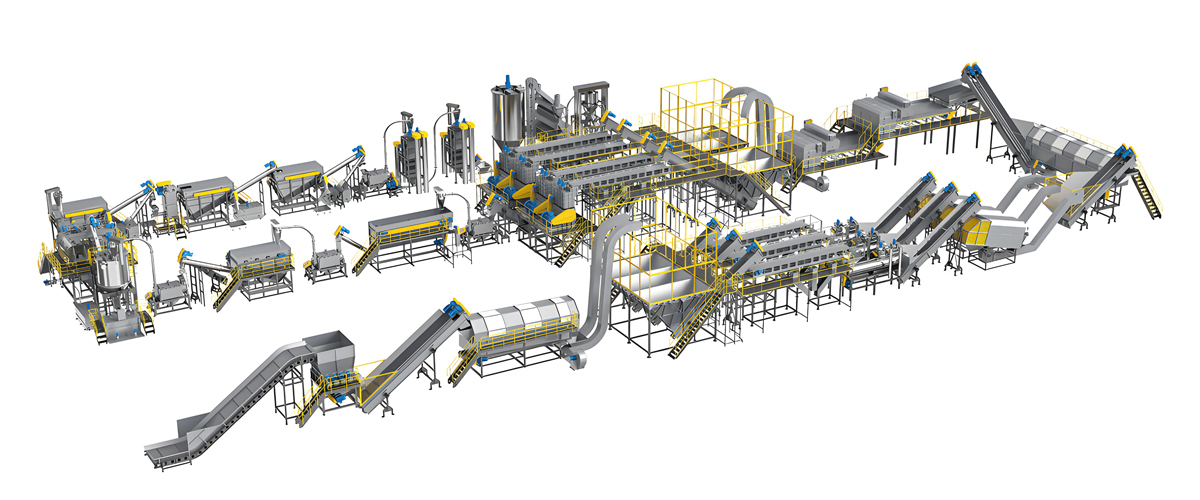
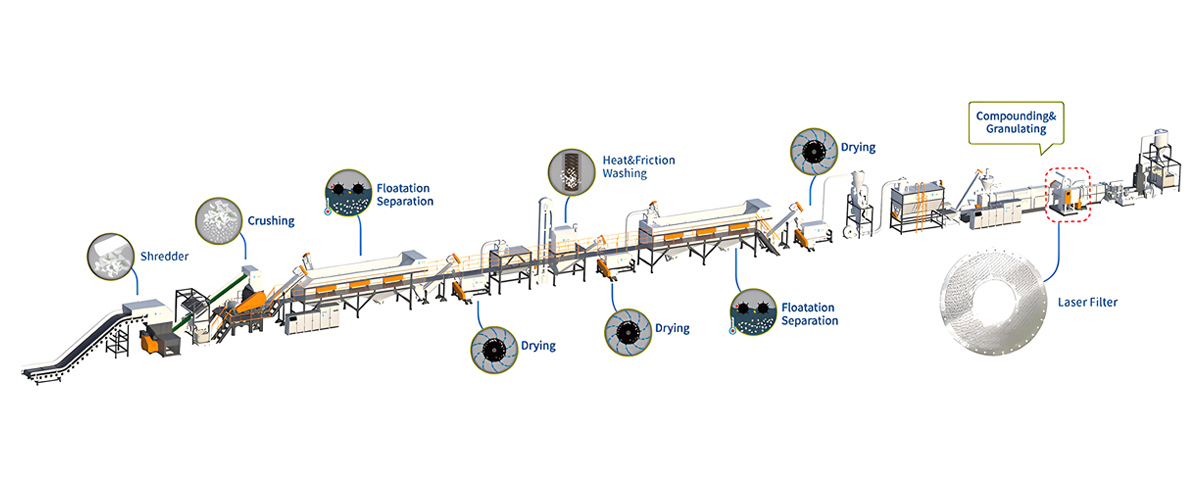
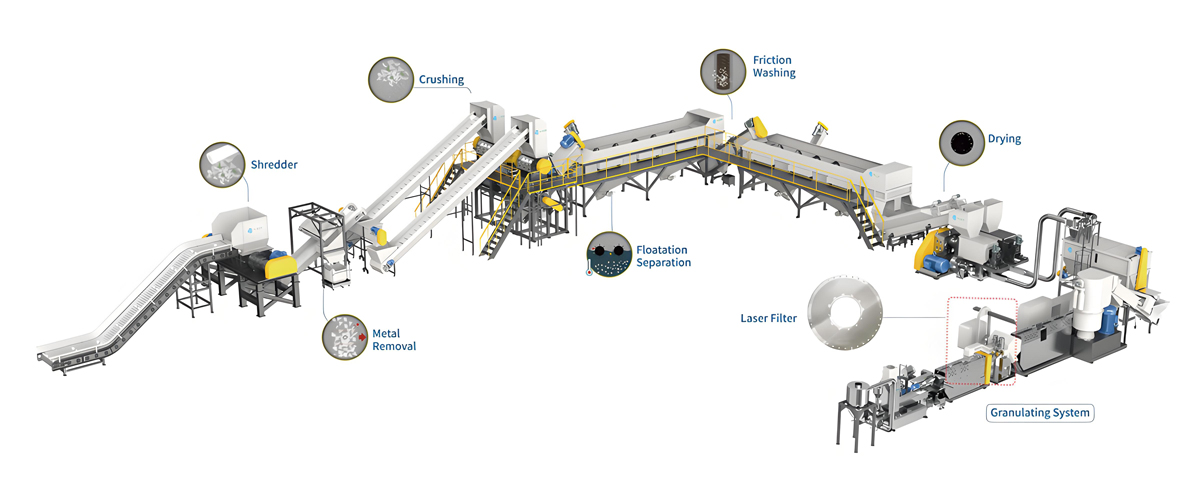
A complete food grade PET pelletizing line for recycled bottle flakes contains sixteen linked stages. The first eight are about cleaning and preparing the flake; the next two are about crystallization and vacuum decontamination; the following three are about melting, filtering and monitoring; the next two are about pelletizing and solid-state polycondensation; and the final stage is about homogenization and packaging. The table below gives the backbone parameters for every stage so that engineers can see the operating window at a glance.
| Step | Stage | Key Parameter | Key Control Point |
|---|---|---|---|
| 1 | Bale opening and pre-sorting | Manual plus NIR, metal detection, eddy current | Remove non-PET, PVC, metals at bale level |
| 2 | Wet crushing | Knife gap 0.2 to 0.5 mm, screen 10 to 14 mm | Flake size uniformity, low fines |
| 3 | Hot caustic wash | NaOH 1 to 3 percent, 80 to 90 degrees Celsius, 10 to 20 min | Remove glue, oil, PVC labels |
| 4 | Friction wash and high-speed label removal | High tip speed, counter-current rinse | Label and surface residue removal |
| 5 | Sink-float separation | PET 1.38 g/cm3 sinks, PE/PP 0.90 to 0.96 floats, >99 percent | Polyolefin separation efficiency |
| 6 | Rinse and dewatering centrifuge | Moisture to 1 to 3 percent | Residual caustic, water carry-over |
| 7 | Hot air drying | 150 to 170 degrees Celsius | Moisture below 50 ppm before extrusion |
| 8 | Flake color sorting | CCD cameras plus NIR | Remove off-color flakes, metal, PVC |
| 9 | Crystallization | 170 to 185 degrees Celsius, stirred bed, crystallinity >40 percent | Prevent agglomeration, reach amorphous-to-crystalline transition |
| 10 | Vacuum decontamination reactor | 1 to 3 mbar, 200 to 215 degrees Celsius, 30 to 90 min | Core food grade decontamination step |
| 11 | Low-shear single-screw extrusion | L/D 30 to 36, melt 265 to 285 degrees Celsius, vacuum vent | IV stability, no degradation |
| 12 | Melt filtration | Laser screen 40 to 80 micrometer, back-flush, dP control | Black specks, gel removal |
| 13 | On-line IV and melt viscosity monitoring | Capillary rheology or melt pressure method | Continuous IV verification |
| 14 | Underwater pelletizing and dewatering | Water ring or underwater cut, centrifugal dry, screen | Pellet shape, no agglomeration |
| 15 | Solid-state polycondensation | 200 to 215 degrees Celsius, N2 or vacuum, 6 to 14 h, IV 0.70 to 0.80 to 0.85 | Final IV and residual decontamination |
| 16 | Homogenization, metal separation, packaging | Blend silo, metal detector, auto bagging | Lot uniformity and traceability |
The remaining sections explain each cluster of stages in depth. The cleaning stages determine whether the reactor and extruder ever see contamination; the reactor and crystallization stages determine food safety; the extrusion and filtration stages determine pellet purity; and the pelletizing and solid-state polycondensation stages determine the final specification.
Cleaning and Pre-Treatment Stages
The cleaning section is where most food grade failures are decided. A decontamination reactor cannot remove glue, paper or PVC labels, so these must be stripped upstream. The Austrian route assumes a high-quality washed flake feed, and the eight cleaning stages below are the minimum to deliver it.
Bale Opening and Pre-Sorting
Post-consumer PET arrives as compressed bales. A bale breaker loosens the pack and a moving belt carries bottles past manual sorters who remove whole non-PET objects, multilayer pouches and obvious contaminants. Automated sorting then takes over: a near-infrared, or NIR, sorter identifies polymer type by its absorption spectrum and ejects non-PET fractions; a metal detector and an eddy current separator remove ferrous, non-ferrous and stainless fractions. Pre-sorting at this point protects every downstream machine from damage and keeps PVC, which has a density close to PET, out of the stream before it is too late.
Wet Crushing
Bottles are crushed wet, with water flooding the cutting chamber. Wet crushing suppresses dust, cools the knives and starts the label loosening process. The knife gap is set tight, between 0.2 and 0.5 mm, and the discharge screen is 10 to 14 mm, so the output is a relatively uniform flake rather than a mixture of dust and chunks. Tight control of the knife gap is a recurring quality lever: too wide and the flakes are coarse and hard to wash; too tight and the fines fraction grows, raising water treatment load and lowering yield.
Hot Caustic Wash
The flakes enter a hot alkali bath with sodium hydroxide at 1 to 3 percent concentration, held at 80 to 90 degrees Celsius, for 10 to 20 minutes. This step hydrolyzes the glues that bond labels to the bottle, saponifies oils and food residues, and helps detach PVC shrink sleeves. Temperature and concentration must be balanced: too mild and labels survive; too aggressive and the PET surface etches, raising acetaldehyde and lowering the L star color value. The wash liquor is continuously filtered and the caustic is replenished to hold concentration in the target band.
Friction Wash and High-Speed Label Removal
After the caustic soak, a friction washer uses high tip-speed rotor blades and counter-current rinsing water to scrub each flake mechanically. Detached labels, fine paper fibers and surface grime are flushed away. A high-speed vertical label remover can be inserted here to strip stubborn sleeve material. The discharge clarity, measured by turbidity of the rinse water, is a good proxy for how clean the flakes are before separation.
Sink-Float Separation
PET has a density of about 1.38 g/cm3, while polyolefins such as polyethylene and polypropylene float at 0.90 to 0.96 g/cm3. In a water-filled tank, PET sinks and the polyolefins rise to the surface where skimmers remove them. A well-tuned sink-float stage achieves better than 99 percent separation efficiency, which matters because polyolefin contamination above 10 ppm can fog film and weaken the recycled pellet. Density separation is the cheapest and most reliable way to drop the bulk of the floatables.
Rinse and Dewatering Centrifuge
Clean sunk flakes are rinsed with fresh water to remove residual caustic, then spun in a dewatering centrifuge. The goal is to drop surface moisture to 1 to 3 percent. Residual alkali at this point would later neutralize the crystallizer atmosphere and shift color, so the rinse water conductivity is monitored as a control variable. The centrifuge also removes the last fine solids that escaped earlier stages.
Hot Air Drying
A hot air dryer drives the moisture from the 1 to 3 percent surface level down to below 50 ppm in the flake before it enters the crystallizer. Air temperature is 150 to 170 degrees Celsius. Drying below 50 ppm is essential because water in the reactor hydrolyzes PET chains and lowers intrinsic viscosity; a moisture strip chart is part of the challenge-test record.
Flake Color Sorting
The final cleaning gate is optical. A CCD color sorter with NIR confirmation scans every flake at high speed and ejects off-color flakes, any remaining metal and any missed PVC. Color sorting lifts the L star value and suppresses yellowness, which is why food grade rPET can reach L star above 78 and b star below 4. Combined with the upstream steps, this delivers a flake clean enough for the vacuum reactor.
Crystallization and the Vacuum Decontamination Reactor
Amorphous PET flakes soften and stick together at roughly 70 to 80 degrees Celsius, well below the temperature needed for decontamination. They must therefore be crystallized before any high-temperature step. Crystallization is carried out in a heated, gently stirred bed at 170 to 185 degrees Celsius, holding the flakes in motion so they cannot agglomerate. As crystallinity climbs above 40 percent, the material gains a higher softening point and can tolerate the reactor temperature without blocking the equipment.
The vacuum decontamination reactor is the heart of the Austrian food grade concept. Clean, dry, crystallized flakes are charged into a batch vessel, the vessel is evacuated to 1 to 3 mbar absolute pressure, and the temperature is raised to 200 to 215 degrees Celsius for a residence time of 30 to 90 minutes. Under these conditions, volatile contaminants diffuse from the polymer interior to the surface and are carried away by the vacuum stream. Because the flakes are solid, there is almost no shear and negligible hydrolysis, so intrinsic viscosity is preserved while pollutants leave.
This reactor step is what regulatory challenge tests model. When a dossier claims a given contaminant reduction, the modeled process condition must match the real reactor, which is why the plant records pressure, temperature and residence time for every batch. A letter of no objection from EFSA or FDA is, in practice, a confirmation that this decontamination step, backed by the challenge test, removes contaminants to a safe level. Operators treat the reactor as a validated unit: any deviation in pressure or temperature triggers a hold-and-investigate procedure rather than a silent continuation.
Low-Shear Single-Screw Extrusion and Melt Filtration
After the reactor, the flakes are decontaminated but still solid. The extruder’s only job is to melt, mix gently and form a clean melt. A low-shear single-screw extruder with a barrel length-to-diameter ratio of 30 to 36 is used, with melt temperature controlled at 265 to 285 degrees Celsius and a vacuum vent to remove the last traces of moisture and volatiles. The gentle screw geometry avoids the chain scission that high shear would cause, keeping intrinsic viscosity stable through the melt step.
Melt filtration sits between the extruder and the die. A laser-perforated screen with 40 to 80 micrometer openings is housed in a continuous back-flush self-cleaning filter. When the differential pressure across the screen rises, a small amount of melt is reversed through the screen to blow the captured solids into a waste collector, without stopping the line. This protects the die, stabilizes pellet quality and keeps black specks below the 3 per kg limit. The filter is one of the highest-maintenance items on the line, and its back-flush interval is a direct indicator of how clean the feed flake really is.
On-line intrinsic viscosity and melt viscosity monitoring closes the loop. A capillary rheometer or a melt pressure inference method measures viscosity continuously and converts it to intrinsic viscosity. Because the SSP step later raises IV, the extrusion target is set to leave headroom; the monitor simply guarantees the melt is in the right band and that no thermal event is degrading the polymer. The data stream from this monitor is logged and becomes part of the food safety record for each lot.
Underwater Pelletizing and Solid-State Polycondensation
The filtered melt passes through the die and is cut into pellets. In an underwater or water-ring pelletizing system, the strands are cut at the die face by rotating knives, and the pellets are quenched in water, then separated by a centrifugal dryer and classified on a vibrating screen. The cut must be clean: if the knife-to-die gap or water temperature is wrong, the pellets string out or agglomerate into lumps. Pellet size uniformity matters for the SSP step, because uniform particles pack and heat evenly.
Solid-state polycondensation is the final build of molecular weight. The pellets are held at 200 to 215 degrees Celsius under a nitrogen blanket or under vacuum for 6 to 14 hours. In the solid state, chain ends react to extend the polymer, raising intrinsic viscosity from about 0.70 to 0.80 to 0.85 dl/g. SSP also provides a last decontamination margin, because the high temperature and inert or vacuum atmosphere drive off residual volatiles. The residence time and atmosphere are controlled precisely, and the exit IV is measured before the material moves to homogenization. SSP is the reason the line can deliver a bottle-grade pellet even when the feed flakes start at a modest 0.68 to 0.76 dl/g.
Homogenization, Metal Separation and Packaging
Reactor batches and SSP lots are blended in a homogenization silo so that the final product has uniform intrinsic viscosity, color and contamination level across the whole shipment. A metal separator scans the flowing pellets to catch any ferrous or non-ferrous fragment that might have entered from wear, and an automatic bagging or big-bag station packages the product with a lot code. Traceability is a food grade requirement: every bag can be traced back to the bale source, the reactor batch and the SSP lot. This is where ISO 22000 and HACCP discipline becomes visible on the plant floor.
Key Quality Specifications Feed Flakes vs Output Pellets
The difference between a food grade pellet and a plain recycled pellet is defined by a tight specification. The table below lists the typical targets a buyer or regulator will ask for, contrasting the incoming cleaned flake with the outgoing pellet. These numbers are representative of commercial food grade rPET and should be confirmed against the specific dossier and application.
| Parameter | Feed Bottle Flakes | Output Pellets | Note |
|---|---|---|---|
| Intrinsic viscosity (IV) | 0.68 to 0.76 dl/g | 0.76 to 0.85 dl/g | Raised by SSP |
| Moisture before extrusion | Below 50 ppm | Final below 0.2 percent | Protects IV |
| Acetaldehyde (AA) | Minimized by process | Below 1 ppm | Bottle-grade requirement |
| Color L star | Controlled by sorting | Above 78 | Brightness |
| Color b star (yellowness) | Controlled by sorting | Below 4 | Low yellowness |
| Black specks | Removed by filtration | Below 3 per kg (0.1 to 0.4 mm) | Gel and carbon control |
| PVC content | Below 50 ppm | Below 50 ppm | Critical contaminant |
| Polyolefin content | Below 10 ppm | Below 10 ppm | From sink-float |
| Glue content | Below 30 ppm | Below 30 ppm | From caustic wash |
| Metal content | Below 5 ppm | Below 5 ppm | From separation |
| Melting point | 245 to 255 degrees Celsius | 245 to 255 degrees Celsius | DSC measured |
| Crystallinity (DSC) | Reported by DSC | Reported by DSC | Consistency check |
These limits are not arbitrary. Acetaldehyde below 1 ppm keeps the pellet suitable for water and carbonated drink bottles, where off-taste is rejected by consumers. The black speck and PVC limits protect film clarity and processing stability. The color targets let the rPET be used without heavy masterbatch correction. A food grade PET pelletizing line is engineered so that every one of these numbers is met lot after lot.
Food Grade Compliance Framework
Food grade recycled PET is a regulated material, and the line must be capable of supporting a compliance dossier in every market it serves. The framework spans Europe, the United States and China, and is reinforced by management standards that cover the whole plant.
European Union: EU 2022/1616, EU 10/2011 and EFSA
In the European Union, recycled plastic intended for food contact is governed by EU 2022/1616, the regulation that replaced the older EC 282/2008 and sets the rules for recycled plastic materials and articles. The underlying food contact plastic framework is EU 10/2011, which defines the positive list of authorized substances and the migration limits. EFSA, the European Food Safety Authority, evaluates recycling processes through a challenge test: it reviews which contaminants the process must remove and at what efficiency, then issues a scientific opinion. A successful opinion lets a national authority grant authorization, and a well-run Austrian-route line is built precisely so that its reactor conditions match the EFSA model.
United States: FDA 21 CFR 177.1630 and the No Objection Letter
In the United States, PET for food contact is covered by FDA 21 CFR 177.1630, which authorizes polyethylene terephthalate for repeated use in contact with food. For recycled PET, the Food and Drug Administration grants a no objection letter, or NOL, after reviewing a chemistry submission that demonstrates the recycling process removes contaminants to a level of no concern. The FDA’s Chemistry Guidelines for Recycled Plastics describe how to design and report the challenge test. The Austrian reactor route aligns naturally with this path because its batch decontamination step is easy to characterize and validate.
China: GB 4806.7 and GB/T 40006.1
In China, food contact plastics are regulated under GB 4806.7, which sets safety requirements for plastic materials and articles in contact with food. Recycled plastics, including recycled PET, are addressed by GB/T 40006.1, the national standard series for recycled plastics that specifies terminology, classification and requirements for recycled polyethylene terephthalate. A line exporting to or operating in China should prepare its process documentation against these standards as well.
Management Standards: ISO 22000, HACCP, BRCGS
Beyond the material regulations, food grade plants adopt food safety management systems. ISO 22000 and HACCP provide the hazard analysis and critical control point discipline that turns the reactor pressure and temperature records into a managed food safety system. BRCGS for packaging materials adds a recognized certification that brand owners increasingly demand from rPET suppliers. Traceability, lot control and documented deviation handling are the practical outputs of these standards on the plant floor.
The standards below are kept as plain text in this article because they are reference points, not clickable resources. They form the compliance backbone that a food grade PET pelletizing line must be able to demonstrate.
| Market | Core Standard | What It Covers | Role of the Line |
|---|---|---|---|
| European Union | EU 2022/1616 and EU 10/2011 | Recycled plastic authorization and food contact limits | Provide EFSA challenge-test conditions |
| United States | FDA 21 CFR 177.1630 | PET food contact and recycled PET NOL pathway | Support FDA chemistry dossier |
| China | GB 4806.7 and GB/T 40006.1 | Food contact plastic safety and recycled PET spec | Meet national recycled PET requirements |
| Global management | ISO 22000 and HACCP | Food safety management system | Document CCPs and traceability |
| Brand acceptance | BRCGS packaging | Packaging material certification | Pass third-party audits |
Surrogate Challenge Test Methodology
The surrogate challenge test is the scientific backbone of every food grade dossier. Because real food contaminants are too varied to test directly, regulators use a set of model compounds, called surrogates, whose behavior in PET brackets the worst-case pollutants. The cleaned flakes are spiked with these surrogates, the recycling process is run, and the residual level in the pellet is measured. The removal efficiency must exceed a required threshold for the process to be accepted.
A typical surrogate set includes six classes: toluene, chlorobenzene, phenylcyclohexane, benzophenone, methyl salicylate and a copper salt. Toluene and chlorobenzene represent volatile, low-molecular contaminants; phenylcyclohexane represents a non-volatile, non-polar surrogate that is hard to remove; benzophenone and methyl salicylate represent compounds with intermediate polarity; and the copper salt represents inorganic, non-volatile contamination. The spiked flakes are conditioned, often by storing at about 40 degrees Celsius for 14 days, so the surrogates migrate into the polymer and mimic real-world contamination that has aged in the bottle.
The table below shows representative surrogate properties, the soak condition and the typical required removal efficiency. These values are illustrative of standard challenge-test designs and should be confirmed against the specific EFSA or FDA protocol being followed.
| Surrogate | Class Represented | Soak Condition | Required Removal Efficiency |
|---|---|---|---|
| Toluene | Volatile, non-polar | 40 degrees Celsius, 14 days | Greater than 99 percent |
| Chlorobenzene | Volatile, chlorinated | 40 degrees Celsius, 14 days | Greater than 99 percent |
| Phenylcyclohexane | Non-volatile, non-polar | 40 degrees Celsius, 14 days | Greater than 99 percent |
| Benzophenone | Intermediate polarity | 40 degrees Celsius, 14 days | Greater than 99 percent |
| Methyl salicylate | Intermediate polarity, ester | 40 degrees Celsius, 14 days | Greater than 99 percent |
| Copper salt | Inorganic, non-volatile | 40 degrees Celsius, 14 days | Greater than 90 percent |
The reason the Austrian reactor route is favored for dossiers is that a single, well-characterized vacuum step carries most of the removal burden, which makes the mathematical model of the challenge test straightforward and defensible. The 40 degrees Celsius, 14 day soak ensures the surrogates are distributed through the flake, and the measured residual after the process is compared against the conservative intake assumed in the safety calculation.
Production Capacity and Energy Consumption
A food grade PET pelletizing line is offered in several throughput tiers. The most common are 500, 1000, 1500, 2000 and 3000 kg/h of input bottle flakes. Larger lines benefit from economy of scale in energy and labor, while smaller lines suit regional collectors and trial production. The table below gives representative installed power and specific energy consumption for each tier; the figures are typical and should be confirmed against the final equipment list.
| Capacity Tier (kg/h) | Typical Installed Power (kW) | Specific Energy (kWh/kg) | Water Reuse Rate |
|---|---|---|---|
| 500 | About 380 to 450 | 0.40 to 0.45 | Above 90 percent |
| 1000 | About 620 to 720 | 0.34 to 0.40 | Above 90 percent |
| 1500 | About 880 to 1000 | 0.32 to 0.38 | Above 90 percent |
| 2000 | About 1150 to 1300 | 0.30 to 0.35 | Above 90 percent |
| 3000 | About 1600 to 1850 | 0.28 to 0.33 | Above 90 percent |
Water is a major operating concern. A closed-loop water treatment system captures wash and rinse water, removes suspended solids and caustic, and returns more than 90 percent of it to the line, with only a small make-up stream needed to replace losses. The discharged fraction is treated for chemical oxygen demand, or COD, and suspended solids, or SS, before leaving the site, usually through a combination of neutralization, flocculation, biological treatment and filtration. Because this article focuses on the food grade pelletizing process rather than the dust control of the crushing hall, the water system is summarized here only at the level needed to show the line is environmentally self-contained.
Energy is dominated by the crystallizer, the vacuum reactor heaters, the extruder drive and the SSP ovens. The specific energy of 0.28 to 0.45 kWh/kg places the Austrian route in the mid-to-high band of recycling processes, which is the trade-off for its superior decontamination and IV control. Plants can recover heat from the SSP cooling loop and the dryer exhaust to improve the effective figure.
Common Fault Troubleshooting Guide
Even a well-designed line drifts. The table below maps the most common food grade defects to their likely root causes and the corrective action an operator should take. These are engineering diagnoses; each should be confirmed against the equipment manual and the validated process window before changes are made.
| Symptom | Likely Root Cause | Corrective Action |
|---|---|---|
| IV drops too fast | Moisture above 50 ppm, or over-temperature in barrel | Check dryer, lower melt temperature, verify SSP atmosphere |
| Pellets yellow | Residual caustic, over-long reactor residence, thermal history | Improve rinse, tighten reactor time, check color sorter |
| Black specks exceed limit | Filter screen too coarse or back-flush failing | Tighten to 40 to 80 micrometer, inspect back-flush, review feed |
| Acetaldehyde too high | Excess thermal exposure in extrusion or SSP | Reduce melt temperature, shorten SSP, verify cooling |
| Crystallized material agglomerates | Poor bed agitation, temperature overshoot | Increase stir speed, lower setpoint, check residence |
| Filter clogs frequently | Dirty feed flake, gel formation | Strengthen pre-wash and color sort, raise back-flush rate |
| Strands string out at die | Knife gap, water temperature, melt viscosity off | Adjust knife, cool water, recheck IV monitor |
| Underwater pellets agglomerate | Poor dewatering, screen blinding | Service centrifuge, clean screen, verify water flow |
The pattern behind most of these faults is feed quality. A clean, dry, well-sorted flake rarely causes extrusion or filtration problems; the reactor and crystallizer only fail when the upstream washing line lets contamination through. This is why the Austrian route treats the washing line and the pelletizing line as one integrated system rather than two separate machines.
Cost Structure in Relative Terms
Buyers often ask for a budget, but absolute figures depend on site, utility price, freight and scope, so this article expresses cost only in relative levels. The levels used are Low, Medium, High, Very High and Premium, and they are intended for comparison between line sections rather than as a quotation.
| Cost Element | Relative Level | Comment |
|---|---|---|
| Bale opening and pre-sort | Medium | Manual plus NIR sorting |
| Washing and separation | Medium to High | Caustic, water treatment, centrifuges |
| Crystallizer and vacuum reactor | High to Very High | Core food grade investment |
| Low-shear single-screw extruder | High | Gentle, purpose-built barrel |
| Laser melt filter | High | Self-cleaning, fine screen |
| On-line IV monitor | Medium to High | Capillary rheology or pressure method |
| Solid-state polycondensation | Very High | Long ovens, nitrogen or vacuum |
| Compliance documentation | Medium to Premium | Challenge test and dossier support |
| Whole line, turnkey | Premium | Food grade certification commands premium |
In relative terms, the vacuum reactor and the solid-state polycondensation oven are the two most capital-intensive process steps, and the compliance dossier is the most knowledge-intensive. The washing line, while not the most expensive, has the largest influence on whether the premium food grade outcome is actually achieved, because every downstream stage assumes a clean flake feed.
Why Polyretec, a Wanplas Factory
Polyretec is a Wanplas factory specializing in plastic recycling equipment, with roots going back to 2010 and a brand established in 2017. Its technology approach combines Austrian process know-how with Chinese manufacturing scale, which is exactly the combination needed to deliver a food grade PET pelletizing line at a workable cost. The company’s washing lines run from 500 kg/h up to 6000 kg/h, and its pelletizing systems are built to integrate directly with the washed flake output.
As part of the Wanplas brand, Polyretec draws on a network of specialized factories. For downstream compounding of rPET, Wanplas’s Kerke factory supplies twin-screw compounding extruders that can add masterbatch or functional additives to the recycled pellet. For converting the rPET back into packaging, Wanplas’s YuDa factory builds PET bottle blow molding machines and Wanplas’s Aibim factory builds injection blow molding machines. This means a customer can source a coherent bottle-to-bottle or sheet-to-sheet solution from one group, with shared engineering discipline and a shared after-sales promise.
Polyretec’s stated mission, “Turn Waste Into Treasure,” aligns with the food grade recycling goal of keeping PET in a closed loop rather than sending it to landfill or downgrade applications. With project experience across many countries and engineer assistance for installation and commissioning, the factory positions itself as a partner for plants that must meet EU 2022/1616, FDA and GB 4806.7 requirements rather than a mere equipment vendor.
Frequently Asked Questions
What makes an Austrian-technology food grade PET pelletizing line different from a standard recycling extrusion line?
The Austrian route relies on a batch vacuum decontamination reactor for pollutant removal before extrusion, followed by low-shear single-screw extrusion, fine melt filtration, on-line IV monitoring and a solid-state polycondensation step. A standard line usually depends on twin-screw venting extrusion and an SSP tower for decontamination, which is more sensitive to feed fluctuations and shear degradation.
Why is the vacuum decontamination reactor the core step for food contact approval?
At 1 to 3 mbar absolute pressure and 200 to 215 degrees Celsius for 30 to 90 minutes, volatile contaminants diffuse out of the polymer and are removed under vacuum. This batch reactor step is the process stage that challenge tests measure, and it is what supports a letter of no objection from regulators such as EFSA and FDA.
What intrinsic viscosity can the line achieve for food grade rPET pellets?
Feed bottle flakes typically show an intrinsic viscosity of 0.68 to 0.76 dl/g. After extrusion and solid-state polycondensation the output pellets reach 0.76 to 0.85 dl/g, with the SSP step raising IV from about 0.70 to 0.80 to 0.85 dl/g over a 6 to 14 hour residence time.
How strict are the contamination limits for food grade recycled PET flakes and pellets?
Typical food grade targets are PVC below 50 ppm, polyolefins below 10 ppm, glue below 30 ppm and metal below 5 ppm in the cleaned flakes, while finished pellets must keep acetaldehyde below 1 ppm, black specks below 3 per kg and yellowness b star below 4.
Which regulations apply to food grade recycled PET produced on this line?
The line is designed to support EU 2022/1616 and EU 10/2011 in Europe, FDA 21 CFR 177.1630 with a no objection letter pathway in the United States, and GB 4806.7 together with GB/T 40006.1 in China, supported by ISO 22000, HACCP and BRCGS packaging standards.
What capacity tiers are available and what is the typical energy use?
Standard tiers run at 500, 1000, 1500, 2000 and 3000 kg/h. Specific energy consumption normally falls between 0.28 and 0.45 kWh per kg of pellets, with closed-loop water treatment returning more than 90 percent of process water to the line.
How is the melt filtered during pelletizing?
A laser-perforated screen with 40 to 80 micrometer openings is used in a continuous back-flush self-cleaning melt filter. Differential pressure across the screen is monitored and the back-flush cycle is triggered automatically, which protects the die and stabilizes pellet quality.
Can the line be integrated with other Wanplas factories?
Yes. Polyretec, a Wanplas factory, supplies the washing and pelletizing system, while Wanplas’s Kerke factory provides twin-screw compounding extruders for downstream modification, and Wanplas’s YuDa and Aibim factories supply blow molding machines that can consume the rPET pellets.
What happens if the feed flakes are not clean enough?
If PVC, glue or polyolefins slip through the washing line, they concentrate at the melt filter and in the pellet, raising black speck counts and lowering color. The reactor cannot remove solid contaminants, so feed quality failures usually appear as filter clogging, yellowness or failed contamination limits rather than as a reactor problem.
Is solid-state polycondensation always required for food grade rPET?
In most bottle-grade applications, yes. SSP rebuilds intrinsic viscosity after the thermal history of washing and extrusion and adds a final decontamination margin. Some thin-wall or fiber applications accept a lower IV, but food contact bottle-to-bottle typically requires the SSP step to reach 0.80 to 0.85 dl/g.
How does the line handle traceability for food safety audits?
Every bag is linked to a lot code that traces back through the SSP lot, the reactor batch and the source bale. Reactor pressure, temperature and residence time are logged per batch, and deviation triggers a hold procedure, satisfying the record-keeping expectations of ISO 22000, HACCP and BRCGS audits.
Conclusion
A food grade PET pelletizing line for recycled bottle flakes is defined less by any single machine than by the discipline of its process chain. The Austrian-technology concept earns its reputation by front-loading decontamination into a validated vacuum reactor, protecting molecular weight with a low-shear single-screw extruder, guaranteeing purity with laser melt filtration and on-line IV monitoring, and finishing with solid-state polycondensation to reach bottle-grade intrinsic viscosity. The sixteen-stage chain from bale to bag leaves nothing to chance: each stage has a temperature, pressure, residence time and control point that the compliance dossier can defend.
For plants targeting food contact, the payoff is access to the bottle-to-bottle and sheet-to-sheet markets under EU 2022/1616, FDA 21 CFR 177.1630 and GB 4806.7, provided the surrogate challenge test and the management system are in place. The cost is real and sits at the Premium end of the relative scale, concentrated in the reactor, the SSP oven and the documentation, but the washing line remains the true gatekeeper of quality.
Polyretec, a Wanplas factory, builds these lines by pairing Austrian process logic with Chinese manufacturing scale, and integrates with Kerke, YuDa and Aibim within the Wanplas network for a complete rPET loop. If you are specifying a food grade PET pelletizing line, start from the reactor and the washing line, because everything downstream depends on getting those two right.