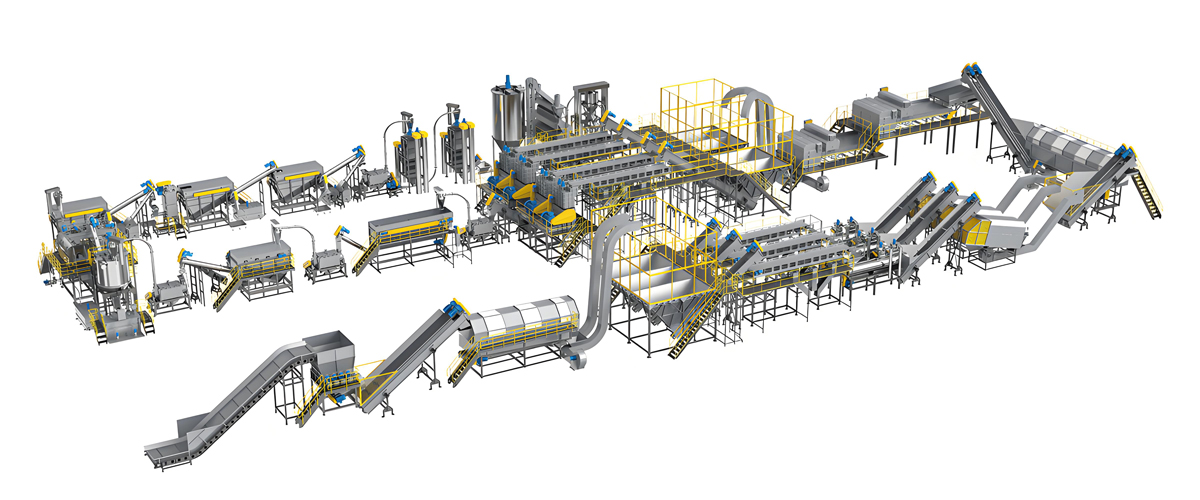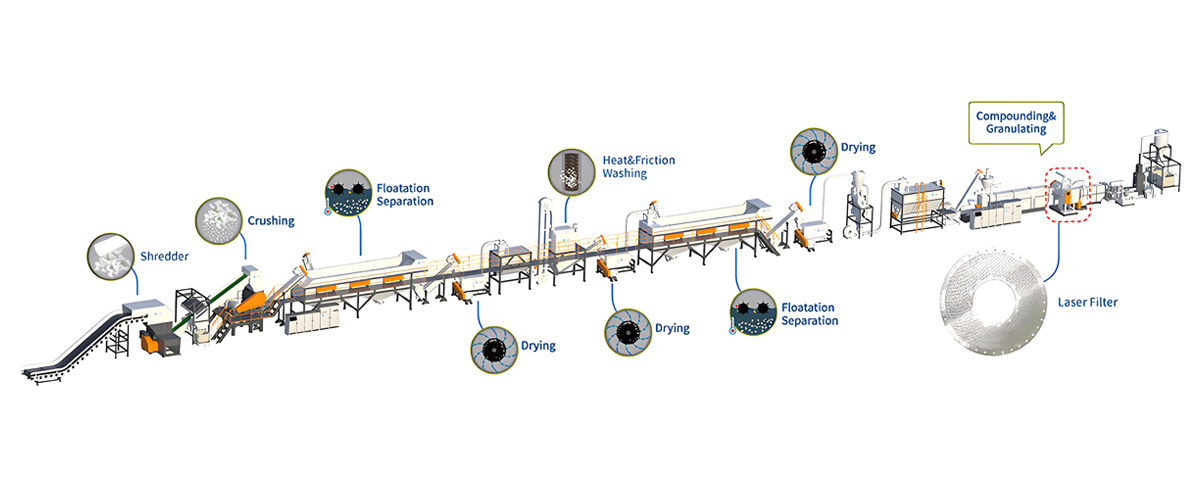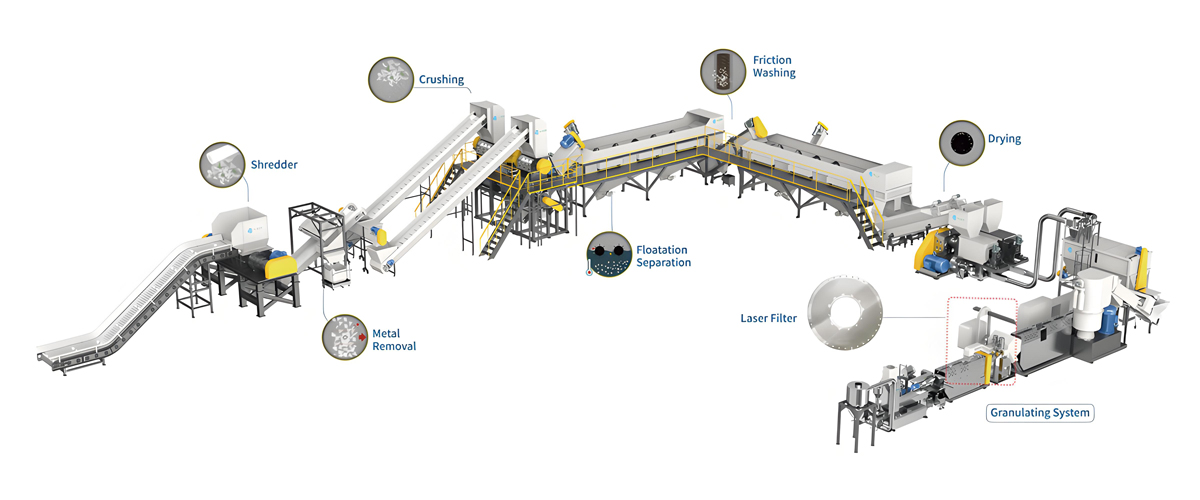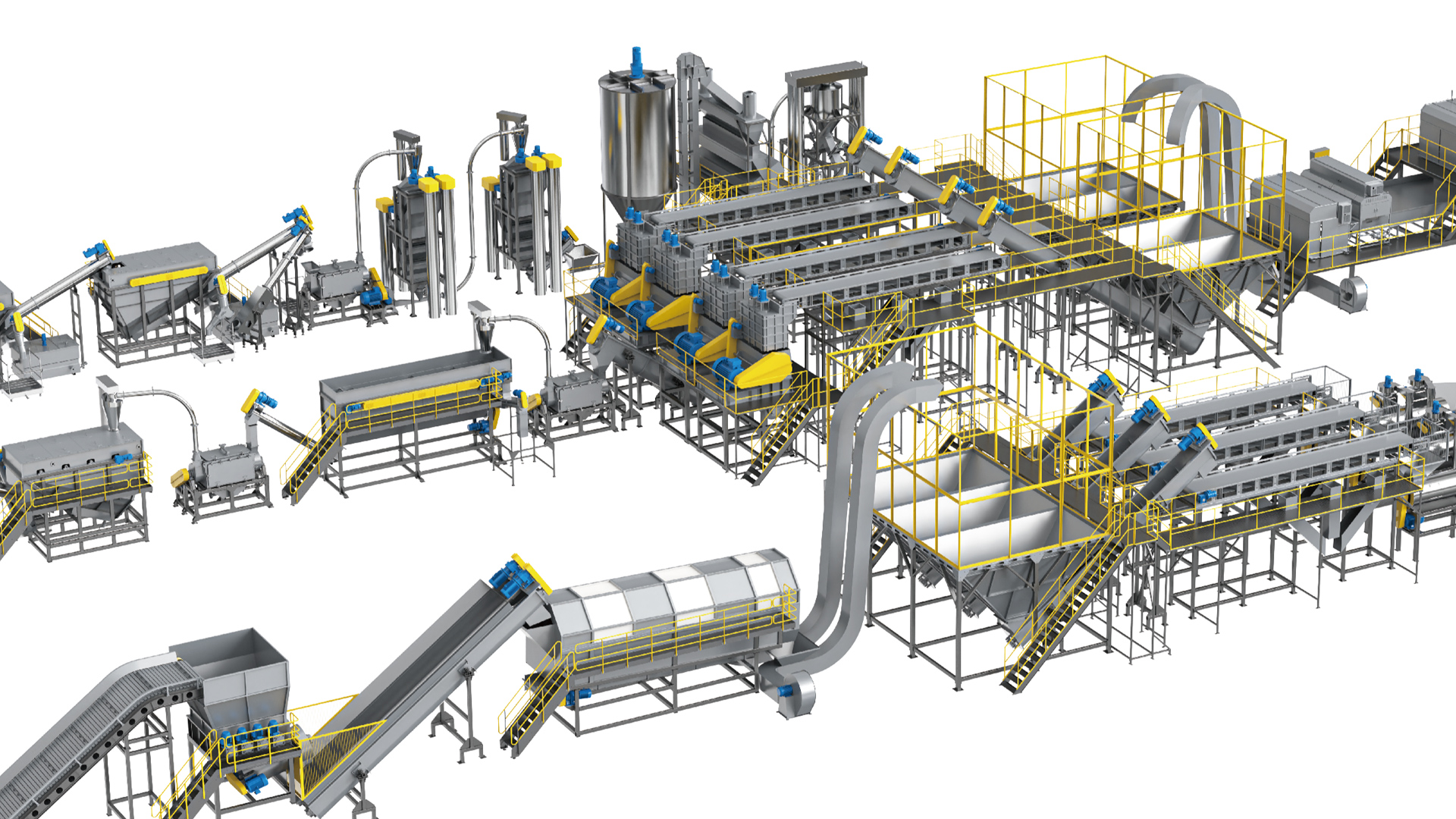

Choosing the correct motor power for a plastic shredder and washing line is the decision that most affects both the capital cost and the daily operating cost of a recycling plant. Too little power and the line stalls on thick or contaminated feed, trips its protection, and forces costly manual pre-cutting. Too much power and the buyer pays a Premium price for capacity that never gets used while every operating hour burns excess electricity. The right motor power is found by matching the machine to the actual feedstock density, throughput, and contamination, not by copying a competitor’s nameplate. Polyretec, a Wanplas factory, applies Austrian technology process engineering to its shredders and washing lines and sizes every drive from the customer’s real material profile. This guide explains how to choose motor power for a plastic shredder and washing line with concrete kilowatt tables, throughput references, and a specification checklist you can send to any supplier.
Recycling lines are energy-intensive. A typical washing line for rigid or PET material can draw well over one hundred kilowatts of connected load, and the shredder upstream adds a further thirty to one hundred ten kilowatts depending on rotor design. Because the line runs for long shifts, the motor efficiency class and the accuracy of the power sizing decide a large share of the plant’s profitability. The keyword phrase plastic shredder and washing line appears throughout this article so procurement teams can benchmark specifications consistently.
Why Motor Power Selection Decides Line Performance
Motor power is the link between the physical resistance of the plastic and the line’s ability to keep moving. In a shredder, the motor must supply enough torque at the rotor to cut or tear the material against the fixed knives without stalling. In a washing line, motors drive crushers, friction washers, hot washers, screw conveyors, sinks, and dryers, each demanding a different torque and speed profile. Undersized motors overheat and trip; oversized motors waste energy and capital.
The performance risk is most acute at the shredder. A single-shaft shredder with a hydraulic ram compacts the feed into the rotor, and when the material is thick-walled pipe or dense rigid HDPE, the shear force spikes. If the motor and gearbox cannot absorb that spike, the drive protects itself by reversing or stopping, which halts the entire washing line downstream. Correct motor power therefore protects not just the shredder but the throughput of every machine after it.
Understanding Motor Power, Torque, and Throughput
Motor power, measured in kilowatts, is the rate at which the drive can do work. For shredding and washing, the more useful concept is torque, the rotational force at the rotor or shaft. A shredder needs high torque at low rotor speed; a friction washer needs moderate torque at higher speed. The relationship is simple: power equals torque multiplied by rotational speed. This is why a low-speed single-shaft shredder uses a large reduction gearbox to turn a relatively standard motor into very high shaft torque.
Specific Energy
The practical metric for sizing is specific energy, the kilowatt-hours consumed per ton of material processed. Film shredding may need only fifteen to thirty kilowatt-hours per ton, while heavy rigid or heavily filled material can exceed sixty kilowatt-hours per ton. Throughput and specific energy together set the required motor power: power in kilowatts approximately equals throughput in tons per hour multiplied by specific energy divided by operating hours per hour of run time.
Variable Frequency Drives
A variable frequency drive, often abbreviated VFD, lets the motor draw only the current the load needs. For a plastic shredder and washing line this is essential: during light feed the drive coasts at low current, and during a contamination surge it briefly pulls more, then returns to baseline. Specifying a VFD-rated motor with ten to fifteen percent headroom is the modern standard and avoids the old practice of grossly oversizing the motor.
Motor Efficiency Class
Motors are graded IE1, IE2, IE3, and IE4 by efficiency. For a recycling line running long shifts, IE3 should be the minimum, with IE4 justified on large drives above seventy-five kilowatts where the energy saving repays the premium within a few years. CE and ISO compliance of the electrical system is expected, and UL compliance may be requested for North American installations.
Shredder Motor Power Sizing by Material
Shredder selection starts with rotor type. A single-shaft shredder suits most washed or pre-sorted rigid and film feed and offers the best control. A double-shaft or four-shaft shredder handles bulky, mixed, or hazardous profiles where the goal is volume reduction rather than precise flake. The table below gives practical motor power ranges by material and throughput, using a single-shaft design as the baseline.
| Material | Throughput (kg per hour) | Motor power (kW) | Rotor type |
|---|---|---|---|
| LDPE film, woven bag | 300 to 500 | 37 to 55 | Single-shaft |
| PP PE soft, agriculture film | 500 to 800 | 55 to 75 | Single-shaft |
| Rigid HDPE, PP regrind | 800 to 1000 | 75 to 110 | Single-shaft, heavy |
| PET bottle bale, mixed rigid | 1000 to 1500 | 90 to 132 | Double or single heavy |
| Pipe, profile, thick wall | 500 to 900 | 110 to 160 | Single-shaft, extra torque |
Rotor Speed Considerations
Low rotor speed, typically twenty to forty revolutions per minute for a single-shaft shredder, maximizes torque and reduces dust and heat. High-speed granulators running at several hundred revolutions per minute use less torque but more kilowatt per cut and are better suited to pre-cut regrind than whole bales. The plastic shredder and washing line should pair a low-speed shredder for primary size reduction with a high-speed granulator only when a fine flake is required before washing.
Waschlinie Motor Power Breakdown
A washing line is a sequence of motor-driven machines, and the total power is the sum of each. The table below lists typical motor loads for a one thousand kilogram per hour PP PE or PET washing line. Actual values shift with machine size and design, but the proportions are representative of Austrian-technology lines.
| Machine | Motor power (kW) | Function |
|---|---|---|
| Crusher or wet granulator | 37 to 55 | Size reduction to flake |
| Friction washer | 15 to 30 | High-speed scrubbing |
| Hot washer | 11 to 22 | Detergent and heat wash |
| Screw loaders and conveyors | 4 to 12 total | Transfer between stages |
| Float sink tank agitator | 3 to 7 | Density separation |
| Centrifugal dryer | 30 to 55 | Moisture removal |
| Water pump set | 15 to 30 | Process water circulation |
The dryer and the friction washer are the largest consumers after the crusher, because both do mechanical work on the plastic rather than just moving it. A plant that reuses process water in a closed loop also reduces the pump duty, which trims the connected load. Polyretec, a Wanplas factory, commonly specifies a closed water loop on its Austrian-technology washing lines for this reason.
Throughput Tables for Shredders and Waschlinies
Motor power and throughput move together, but not linearly. Doubling throughput rarely doubles power because fixed losses stay constant. The reference tables help a buyer sanity-check a supplier’s quote.
Waschlinie Throughput vs Connected Load
| Line capacity (kg per hour) | Connected load (kW) | Cost tier |
|---|---|---|
| 500 | 70 to 110 | Medium |
| 1000 | 130 to 220 | High |
| 2000 | 240 to 380 | High to Very High |
| 3000 to 6000 | 400 to 700 | Very High |
Shredder Throughput vs Motor Power
| Motor power (kW) | Typical rigid throughput (kg per hour) | Typical film throughput (kg per hour) |
|---|---|---|
| 37 | 250 to 400 | 300 to 500 |
| 55 | 400 to 650 | 500 to 800 |
| 90 | 700 to 1000 | 800 to 1200 |
| 132 | 1000 to 1500 | 1200 to 1800 |
Note that film throughput is higher than rigid at the same power because film has low bulk density and cuts easily, while rigid HDPE and pipe demand far more torque per kilogram. A supplier quoting one number for both is oversimplifying; always ask for the figure against your specific material.
Factors That Increase Required Motor Power
Several real-world conditions push the required motor power above the textbook minimum. Ignoring them is the most common cause of an underpowered line.
Material Density and Wall Thickness
Dense, thick-walled plastics like pipe and rigid HDPE need more torque per kilogram than thin film. A line specified only on film data will stall on pipe. Always size to the heaviest expected feed.
Moisture and Contamination
Wet bales are heavier and clog screens; heavy contamination such as sand, sticker glue, or metal forces the shredder and crusher to work harder. A metal detector and a pre-wash protect the motor, but the connected load should still carry ten to fifteen percent headroom.
Screen Size and Flake Target
A smaller screen hole in the crusher or granulator raises resistance and thus motor load. If the buyer wants fine flake below eight millimeters, budget extra power on the crusher compared with a twelve millimeter cut.
Ambient Temperature and Altitude
Motors lose cooling capacity in hot plants and at altitude. In tropical or high-altitude sites, derate the motor by five to ten percent or specify a larger frame. This is a frequent oversight in emerging-market installations.
Size the motor to the worst week, not the best day. A shredder that copes easily with clean film but stalls on a contaminated bale will cost more in downtime than the saving on a smaller motor.
Energy Efficiency and Total Cost of Ownership
The purchase price of a plastic shredder and washing line is only part of the cost. Over a five-year horizon, energy often exceeds the equipment price for a continuously run line. The table below maps energy cost tier to line type, using a twenty-hour daily run as the basis.
| Line type | Connected load (kW) | Daily energy (kWh, 20 h) | Energy cost tier |
|---|---|---|---|
| Film washing line 500 kg per hour | 90 | 1800 | Medium |
| PP PE washing line 1000 kg per hour | 180 | 3600 | High |
| PET washing line 2000 kg per hour | 320 | 6400 | Very High |
Two design choices cut this load without reducing throughput. First, IE3 or IE4 motors with VFD control trim part-load consumption, which matters because most lines run below nameplate for part of each shift. Second, a closed water loop reduces pump duty and the associated motor load. Polyretec’s Austrian-technology washing lines use both, and the Wanplas brand’s shared engineering standards encourage these efficiency measures across its factories.
Demand-Side Management
Beyond equipment choice, the way a plant operates the line changes the energy bill. Staggering the start of the shredder, crusher, and dryer a few seconds apart avoids a simultaneous inrush that stresses the supply and can trigger the protection on a shared feeder. Running the line in longer, steadier shifts rather than frequent start-stop cycles also improves motor efficiency, because induction motors draw their highest current during acceleration. Where the local tariff has a peak window, scheduling the most power-intensive stage, usually the dryer and friction washer, into off-peak hours can lower the effective energy cost tier from High to Medium even at the same connected load. These are operational decisions, but they depend entirely on having specified the motor power correctly in the first place, which is why the sizing work in this article pays back daily.
Common Sizing Mistakes to Avoid
The following errors appear repeatedly in failed recycling line projects. Each is avoidable with the right specification discipline.
- Copying a neighbor’s motor size without accounting for different feedstock density and contamination.
- Ignoring the connected load and only quoting the shredder or crusher motor, then discovering the plant supply is undersized.
- Specifying IE1 motors to save upfront cost, then paying far more in energy over the first two years.
- No VFD, so the motor draws full current even at light feed.
- Sizing to film only when the plant will also process rigid or pipe.
- Skipping derating for hot or high-altitude sites, causing summer overheating trips.
- Forgetting wear: a worn gearbox or dull knives raises motor load over time, so headroom is needed from day one.
How Polyretec Engineers Motor Power
Polyretec, a Wanplas factory, builds plastic recycling equipment with a history dating to 2010 and a brand established in 2017, combining Austrian technology process engineering with Chinese manufacturing scale. For shredders and washing lines, the engineering team sizes every motor from the customer’s declared feedstock, bulk density, target throughput, and contamination profile, then issues a full connected-load schedule that the plant’s electrical contractor uses to size the transformer and cabling. This removes the guesswork that leads to underpowered lines.
The company’s documented projects show the range of conditions the motor sizing must survive: LDPE film with heavy printing in Turkey, PP non-woven and TPE gloves in Vietnam where an EREMA machine had run previously, and LDPE film with stickers in Mexico requiring a heavy-duty shredder and beater machine. Each demanded a different motor power budget, and each was engineered rather than copied. Within the Wanplas network, Polyretec’s washing output can also feed the Kerke twin-screw factory’s extruders for compounding, illustrating how motor power decisions at the washing stage ripple into downstream pelletizing.
The engineering discipline extends to documentation. A proper motor power schedule names every drive, its efficiency class, the VFD rating, the starting method, and the expected full-load current, so the plant’s electrical contractor can size cables, starters, and the transformer without a second round of questions. This is where Austrian technology process engineering shows its value: the line is delivered as a fully specified system, not a collection of machines whose combined load was never totaled. For the buyer, that completeness is the difference between a line that starts on schedule and one delayed by an under-specified supply.
The Wanplas brand backs its factories with a shared spare-parts policy that provides a USD 500 spare-parts allowance each year and warranty replacement, relevant because shredder blades, crusher screens, and dryer rotors are wear items whose condition directly affects motor load. Keeping these maintained is itself a motor-power protection strategy.
Checklist: Choosing Motor Power for Your Line
Use this checklist when specifying motor power for a plastic shredder and washing line:
- State the exact feedstock: film, rigid, pipe, PET, or mixed, with bulk density.
- Declare the realistic daily throughput, not the marketing maximum.
- Request the shredder motor kW and rotor speed and torque class.
- Request the full connected-load schedule across every machine in the line.
- Require IE3 minimum motor efficiency, IE4 above 75 kW.
- Specify VFD control on the shredder and major washers.
- Add ten to fifteen percent headroom for contamination surges and wear.
- Apply derating for hot or high-altitude sites.
- Confirm CE and ISO compliance; request UL if shipping to North America.
- Ask for the supplier’s energy estimate in kilowatt-hours per ton.
Supplier Evaluation and Quotation Comparison
When two suppliers quote the same nominal capacity, the motor power schedule is the fastest way to separate a realistic offer from an optimistic one. A credible quotation lists every motor with its kilowatt rating, efficiency class, and the total connected load; a weak quotation states only the crusher or shredder motor and leaves the rest vague. Buyers should request the connected-load schedule in writing and reconcile it against the throughput tables in this article.
Red Flags in a Quotation
- No connected-load total — the supplier may be hiding the true power draw or has not engineered the line.
- IE1 motors quoted — acceptable only for tiny intermittent lines; otherwise a sign of cost-cutting at the buyer’s expense.
- No VFD specified — the line will draw full current even at light feed.
- Single motor figure for mixed materials — rigid and film need different power, as shown earlier.
- No derating note for hot or high-altitude sites, indicating the supplier has not considered the installation climate.
Comparing Energy Over Five Years
Convert each quotation’s connected load into a five-year energy cost using the plant’s industrial tariff. A line quoted at two hundred kilowatts versus one at one hundred seventy kilowatts, both at the same throughput, differs by roughly thirty kilowatts. Over twenty hours a day and three hundred days a year that is one hundred eighty thousand kilowatt-hours, a sum that often exceeds the entire price gap between the two machines. Motor power accuracy therefore protects the buyer long after the invoice is paid.
Why Österreichische Technologie Sourcing Helps
Polyretec, a Wanplas factory, bases its shredder and washing lines on Austrian technology process engineering and issues a full connected-load schedule with every quotation. Because the Wanplas brand operates a network of specialized factories, the same engineering discipline extends to downstream pelletizing through the Kerke twin-screw factory, giving the buyer one accountable partner for the whole recycling train rather than mismatched machines from several vendors.
Case Study: Sizing a Line for Mixed Post-Consumer Feed
A representative project clarifies the method. A recycler in a coastal market receives mixed post-consumer bales containing roughly sixty percent rigid HDPE and PP, thirty percent LDPE film, and ten percent contamination such as labels, sand, and occasional metal. The target is one thousand kilograms per hour of washed output feeding a pelletizing line.
Shredder Sizing
Because the heaviest fraction is rigid, the shredder is sized to rigid data, not film. A single-shaft heavy shredder at ninety kilowatts covers the one thousand kilogram per hour rigid equivalent, with the film portion processed easily within that budget. A metal detector ahead of the rotor protects the knives and keeps motor load stable.
Waschlinie Sizing
The washing line is quoted at the one thousand kilogram per hour PP PE level: crusher forty-five kilowatts, friction washer twenty-two kilowatts, hot washer fifteen kilowatts, screw loaders and conveyors eight kilowatts, float sink agitator five kilowatts, centrifugal dryer forty-five kilowatts, and water pumps twenty-two kilowatts. The connected load is one hundred sixty-two kilowatts, within the High cost tier band. A closed water loop trims the pump duty and keeps the load near one hundred fifty kilowatts.
Result
With ten to fifteen percent headroom and IE3 motors on VFD, the plant supplies a transformer sized for roughly one hundred eighty kilowatts, avoiding both underpower trips and wasteful oversizing. The same method scales linearly to two thousand or three thousand kilograms per hour by referencing the throughput tables above. This is exactly how Polyretec engineers Austrian-technology lines for customers before shipment, replacing guesswork with a defensible motor power budget.
Frequently Asked Questions
How do I estimate motor power for a plastic shredder?
Start from throughput and material density. A single-shaft shredder for LDPE film at 500 kg per hour needs roughly 37 to 55 kW, while a heavy-duty shredder for rigid HDPE or PP at 1000 kg per hour needs 75 to 110 kW. Denser, thicker, or more contaminated feed always requires more power per ton.
What is the total motor power of a plastic washing line?
A 1000 kg per hour PET or PP PE washing line typically has a connected motor load between 130 kW and 220 kW across the crusher, friction washer, hot washer, sinks, dryer, and conveyors. The dryer and friction washer are usually the largest single consumers after the crusher.
Should I oversize the motor for a recycling line?
Slight oversizing, around ten to fifteen percent above calculated need, protects against contamination surges and motor overheating. Large oversizing wastes energy and capital. Use a variable frequency drive so the motor draws only the power the load needs.
Which standards apply to recycling line motors?
The electrical system should meet CE and ISO compliance, with motors rated to the IE2 or IE3 efficiency class. In North America UL compliance may be requested, and for food-contact output EU 10/2011 and FDA references apply to the downstream pelletizing stage rather than the washing motor.
How much does the energy of a shredder and washing line cost to run?
Energy cost tier is Medium for a film line and High for a rigid or PET line. A 1000 kg per hour washing line at roughly 180 kW running twenty hours a day consumes about 3600 kWh daily; at local industrial tariffs this is a major operating line item, so motor efficiency class matters.
Can Polyretec size the motor power for my material?
Yes. Polyretec, a Wanplas factory, engineers Austrian-technology washing and shredding lines and sizes every motor from the customer’s actual feedstock, bulk density, and contamination before shipment, then supplies the full connected-load schedule for plant electrical design.
Conclusion
Choosing motor power for a plastic shredder and washing line is a balance between protecting throughput and controlling energy cost. Start from the actual feedstock density, throughput, and contamination, size the shredder for the heaviest expected material, and sum the connected load across every washing machine rather than quoting a single motor. Specify IE3 or IE4 motors with variable frequency drives and keep ten to fifteen percent headroom for surges and wear. Polyretec, a Wanplas factory, applies Austrian technology engineering to size each drive from the customer’s real material and delivers a full connected-load schedule for plant design, while the broader Wanplas network supports downstream pelletizing through the Kerke twin-screw factory. Use the checklist in this article to turn a vague quote request into a precise, defensible specification.