
Turning post-consumer PET bottles back into material that is safe for food contact is one of the most demanding jobs in plastic recycling. The bottle you drink from is rarely just PET. Around it sits a label, an adhesive, a cap made from another polymer, ink, and a long history of handling that leaves oil, dust, and metal behind. Removing every one of those contaminants is the difference between a flake that can re-enter the food chain and a flake that is only fit for strapping or filler. Polyretec, a Wanplas factory, has built its recycling equipment program around exactly this challenge. With roots going back to 2010 and the Polyretec brand established in 2017, the team has delivered more than 100 recycling projects across more than 50 countries, supported by a group of 24 or more engineers who assist customers from layout design through commissioning. This article explains, step by step, how to remove contaminants from food grade PET bottle flakes, why each contaminant matters for intrinsic viscosity and food safety, and which Polyretec line configuration matches your feedstock. By the end you will understand the full cleaning route from dirty bale to clean, dry, food-grade flake and how that flake connects to downstream pelletizing.
What Makes PET Bottle Flakes Food Grade
A flake becomes “food grade” only when it is compositionally PET and free of substances that could migrate into food. That sounds simple, but a post-consumer bottle is a mixture of materials and residues. Understanding each contaminant is the foundation of any effective washing design, because the removal method for glue is completely different from the removal method for a metal cap ring. In this section we break down the contaminant families, show how they attack intrinsic viscosity, and explain the food-safety thresholds that separate recycling from reuse.
Common Contaminants in Post-Consumer PET Bottles
The first step in any washing project is a contaminant audit of your feedstock. A bale of collected bottles typically contains PET bottle bodies, PVC or PO shrink sleeves, paper labels, hot-melt or emulsion glue, cap material in PE or PP, aluminum from closures or cans, residual liquid and oil, ink, and dirt. Each of these behaves differently in water and at temperature. The table below groups them by how they are removed and why they matter. Note that some contaminants float and some sink; that single physical fact drives the entire separation strategy later in the process.
| Contaminant | Typical Source | Density vs PET | Primary Removal Method | Risk If Left In |
|---|---|---|---|---|
| PVC labels and shrink sleeves | Sleeve, wrap label | Lower, floats | Label remover, float-sink | HCl gas, yellowing, IV loss |
| Glue and adhesive | Label bonding | Attached to flake | Hot washer, caustic | Gels, black spots, odor |
| Paper and paper dust | Paper labels | Floats, disperses | Pre-wash, friction wash | Fiber spots, hazing |
| Metals (Fe, Al, Alloy) | Caps, closures | Higher, sinks or magnetic | Magnetic, eddy current, metal detector | Screens blocked, equipment damage |
| Oil and grease | Residual drink, handling | Surface film | Hot washer, detergent | Odor, gels, microbial risk |
| Off-spec color | Colored bottles, ink | Same as PET | Optical sorting, color sorter | Tint, off-color product |
| Moisture | Process water, ambient | Absorbed | Centrifuge, thermal dryer | Hydrolysis, IV drop |
How Contaminants Degrade Intrinsic Viscosity
Intrinsic viscosity, commonly called IV, is a direct measure of PET molecular chain length. Food-grade bottle PET usually starts in a narrow IV window, and the washing and later extrusion steps must not cut those chains too short. Several contaminants act indirectly to reduce IV. Moisture is the most aggressive: PET hydrolyzes in the presence of water and heat, so a flake that leaves the washer too wet will lose IV in the drier or during pelletizing. Alkaline conditions in the hot washer can also attack the ester bond if concentration or residence time is not controlled, which is why a balanced caustic recipe matters. Residual metals catalyze thermal degradation, and PVC that slips through releases acid that accelerates chain scission. The cleaning route is therefore engineered not only to remove dirt but to protect molecular weight at every stage. A line that cleans well but drops IV by a wide margin will still fail the food-grade specification, because the re-extruded bottle would be mechanically weak.
Food-Safety Risks from Residual Contamination
Food contact is governed by migration limits, not just by appearance. If a flake still carries glue, oil, or a fragment of a non-food polymer, those substances can migrate from the recycled bottle into the beverage or food it later holds. Glue residues and oils are organic and can carry odor or microbial load. PVC contamination is a classic concern because, when the recycled material is re-heated, PVC breaks down and can form chlorinated compounds. Heavy metals from certain inks or closures are tightly restricted for the same reason. That is why food-grade recycling is judged by laboratory testing of the finished flake or pellet, not by visual cleanliness. A line must be able to demonstrate, with repeatable data, that non-PET substances are reduced to a level far below the regulatory migration threshold. The compliance section later in this article covers the specific frameworks that set those limits.
Contaminant Tolerance Thresholds for Food Contact
Exact thresholds depend on the end use and the regulation that applies, but the engineering targets are consistent. Flake purity is normally driven above 99.9 percent for bottle-to-bottle feedstock. PVC residual is typically required well below 50 parts per million, and total non-PET contamination below 100 parts per million for the strictest routes. Metal is removed to a detect-and-reject level so that no fragment above a few millimeters survives. Color is controlled so the final product meets the customer’s tint allowance. These numbers are not arbitrary; they are the measurable expression of “food grade.” A washing line is only as good as its ability to hold these bands shift after shift, which is why process control and final inspection are treated as part of the machine, not an afterthought.
The Complete Contaminant Removal Process
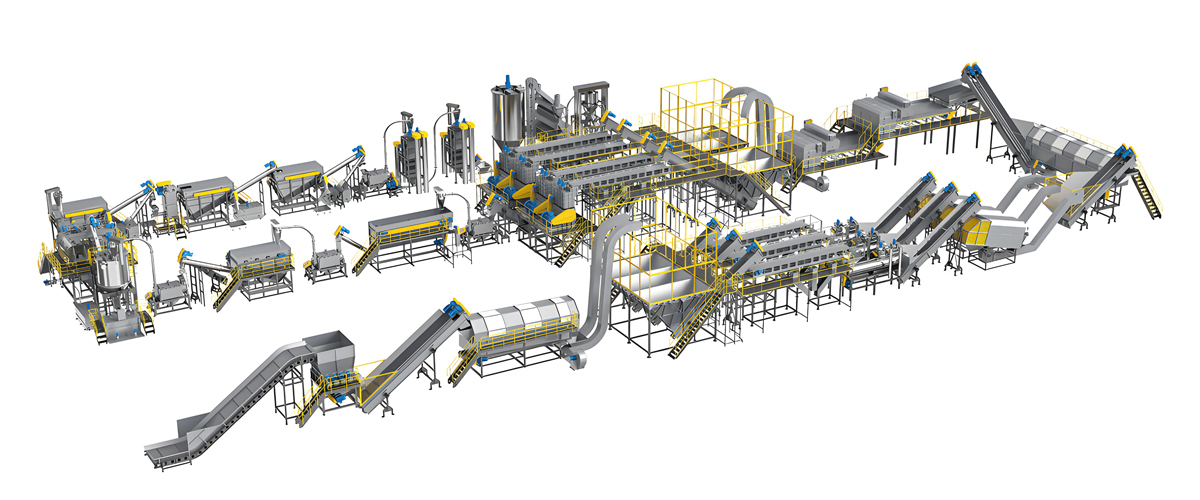
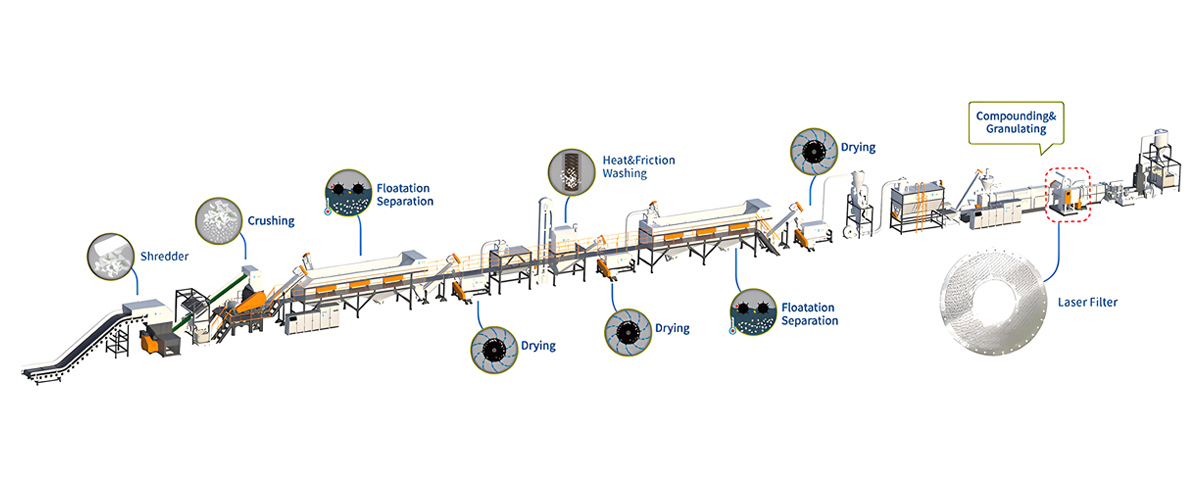
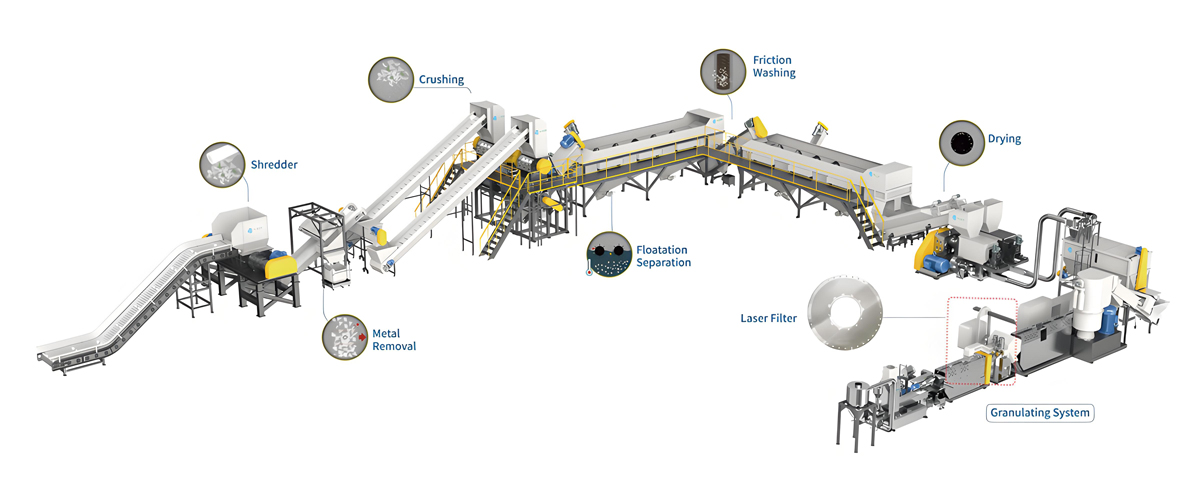
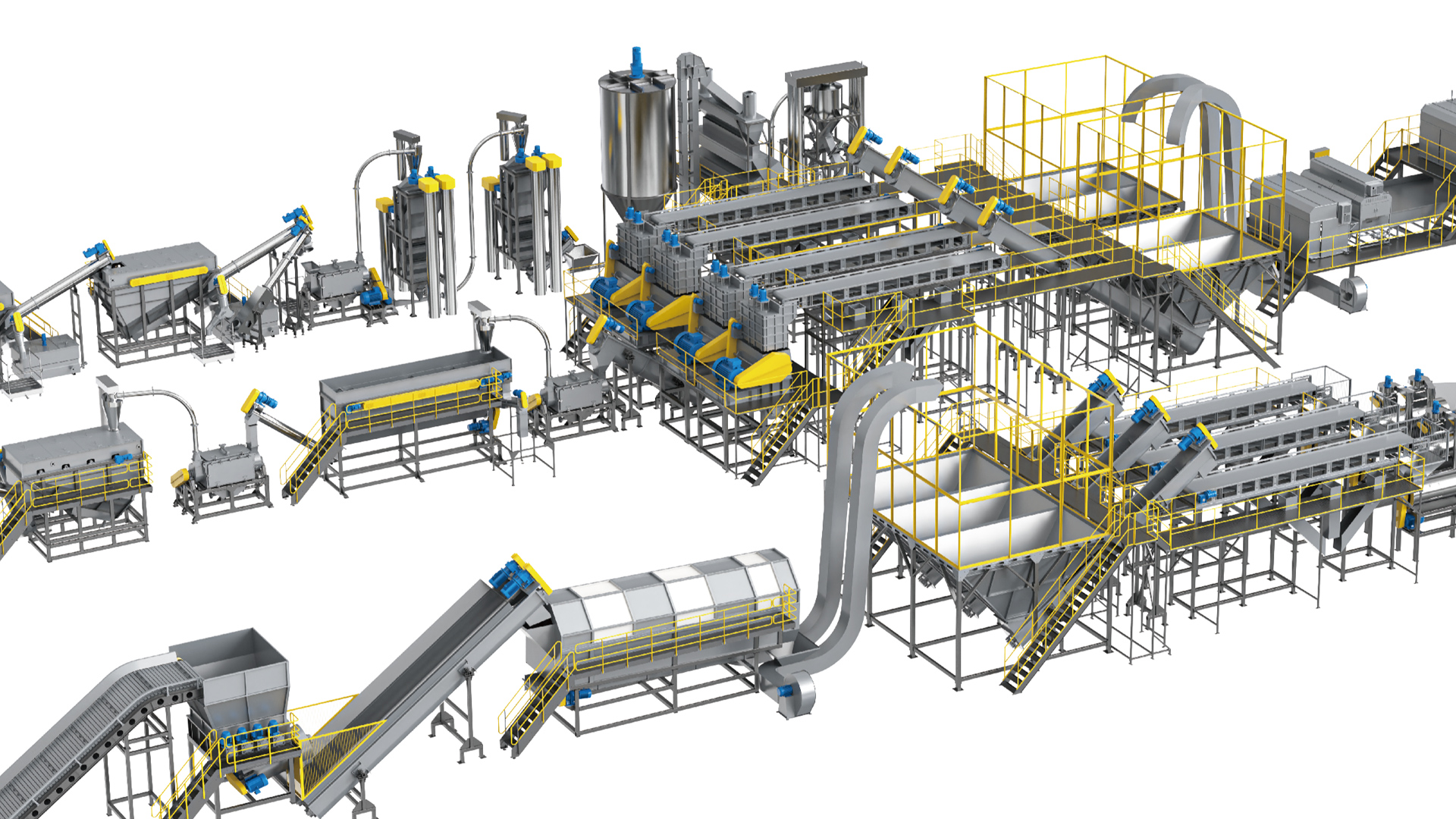
The removal of contaminants from food grade PET flakes is a sequence of physical and chemical steps, each aimed at a specific contaminant family. Skipping or under-sizing one stage lets a contaminant survive into the next, where it becomes much harder to remove. The standard Polyretec route follows the order below: pre-wash and label removal, crushing, cold rinse, hot washing with alkali and detergent, friction washing, float-sink separation, optical sorting, final washing, and drying. Each stage is described in detail so you can see what it attacks and why the order matters.
| Stage Order | Equipment | Target Contaminant | Outlet Result |
|---|---|---|---|
| 1 | Pre-wash tank, label remover | Paper, loose dirt, floating sleeves | Labels loosened, bale opened |
| 2 | Crusher or granulator | Whole bottles, large pieces | Uniform flakes, 10 to 16 mm |
| 3 | Cold rinse | Sand, dust, soluble sugars | Bulk inert load dropped |
| 4 | Hot washer, alkali and detergent | Glue, adhesive, oil, grease | Bonded residues released |
| 5 | Friction washer | Surface film, micro-gels, fiber | Bright, scrubbed flakes |
| 6 | Float-sink tank or hydrocyclone | PVC, PE, PP (floaters) | PET sink stream separated |
| 7 | Optical sorter, NIR and color | Off-color, misidentified polymer | High-purity sorted flake |
| 8 | Final wash, centrifuge, dryer | Chemical carryover, moisture | Dry, food-grade flake |
Pre-Wash and Label Removal
The bale arrives dirty, compressed, and often still containing whole bottles. The first stage loosens surface dirt and begins separating labels before the material is cut. A pre-wash tank or a dedicated label remover tumbles the bottles in water so that paper labels soften and PVC or PO sleeves partially detach. Removing labels early protects the crusher, because whole sleeves would otherwise wrap around the rotor and create downtime. This stage also removes a large share of loose sand and dust that would otherwise abrade downstream equipment. Good pre-wash design keeps water moving and uses the right retention time so that labels float off while PET stays submerged and moves forward. The removed labels and floating debris are continuously skimmed so they do not recirculate.
Crushing Into Uniform Flakes
After pre-wash, whole bottles enter a crusher, sometimes called a granulator in this context, which cuts them into flakes of a controlled size, often in the range of 10 to 16 millimeters. Uniform flake size is critical because every later step depends on consistent surface area and settling behavior. Oversized pieces hide contamination in their core; undersized fines create sludge and complicate separation. A well-tuned crushing stage also begins to liberate cap material and label fragments from the PET body, which is why it sits before the washing chemistry rather than after. Water is typically sprayed into the crusher to suppress dust and start cooling the material, and the crushed mix then flows directly into the rinse circuit.
Cold Rinse: Removing Loose Dirt and Sand
The cold rinse is the first wet cleaning of the flakes themselves. Cold water washes away the dirt, sand, and soluble sugars that the pre-wash did not capture. Because the water is cold, it does not yet attack glue, but it does drop the bulk load of inert contamination so the hot washer can focus on chemistry rather than gross dirt. Cold rinse also cools the flakes from the mechanical heat of crushing and begins to float off any remaining light label fragments. This stage is inexpensive to run and pays for itself by extending the life of the hot-wash chemicals and reducing the load on the friction washer downstream. Efficient plants recirculate and filter this water so consumption stays Low while recovery of solids improves.
Hot Washer With Alkali and Detergent
The hot washer is the heart of contaminant removal for glue and oil. PET flakes are tumbled in heated water that carries an alkaline agent, commonly a controlled dose of caustic soda, together with a surfactant or detergent. The heat and chemistry soften and hydrolyze the label adhesive so it releases from the flake surface, while the detergent emulsifies oily and greasy residues from residual drink or handling. Temperature, caustic concentration, and retention time are the three levers that decide cleaning quality. Too little and glue survives; too much and you risk IV loss or excess chemical carryover. Polyretec lines are tuned per project so that the recipe matches the contamination profile of the local feedstock. After the hot washer, the flakes are noticeably cleaner and ready for mechanical scrubbing.
Friction Washer: Mechanical Surface Scrubbing
Chemistry loosens contamination; the friction washer removes it. A friction washer spins the flakes against a perforated screen at high speed so that water shears the loosened glue, paper fiber, and surface film off the flake. Think of it as a mechanical scrub brush built into the flow. This step is decisive for flake brightness and for eliminating the micro-gels that cause black spots in re-extrusion. A high-efficiency friction washer can dramatically reduce the load on the final rinse and improve the purity number that the laboratory will later measure. The perforated screen lets freed contamination pass through while PET flakes stay in the rotor chamber, so separation is continuous rather than batch.
Float-Sink Separation: PET Sinks, PVC and PO Float
Density is the cleanest physical separator available in PET recycling. PET has a density around 1.30 to 1.40 grams per cubic centimeter, while PVC sits near 1.35 to 1.45 but in practice the PVC films and PO labels behave lighter, and PE and PP cap material is around 0.90 to 0.97. In a water bath, PET flakes sink and most label and cap polymers float. A float-sink tank or a series of hydrocyclones splits the stream so floating contaminants are skimmed off and sunk PET is carried forward. Where density overlap is a concern, the process can use a dense-medium adjustment, but for standard bottle streams plain water separation already removes the bulk of PVC, PE, and PP. This single stage is why the contaminant table above grouped PVC and PO as “floats.” Getting float-sink right is the backbone of PVC control.
Optical Sorting for Color and Material Purity
Even after density separation, some non-PET and off-color flakes remain mixed in by size or behavior. Optical sorters use near-infrared and color cameras to identify and eject them at high speed. A near-infrared sensor distinguishes PET from the few polymers that share similar density, while a color camera removes blue, green, or tinted flakes when a clear or light-blue product is required. For food-grade rPET, optical sorting is what lifts purity from “clean enough for strapping” to “clean enough for bottles.” Modern sorters reach very high ejection accuracy and can be calibrated to the customer’s color tolerance. In a Polyretec line, optical sorting is positioned after the flakes are dry enough for stable conveying, so the camera sees the true flake and not a water film.
Final Washing and Drying
The last wash removes chemical carryover and any remaining fine contamination, then the flakes are dewatered and dried. Dewatering is usually done in a centrifuge that throws off free water, followed by a thermal or hot-air dryer that brings moisture down to a tight spec, commonly below 1 percent and in premium grades below 0.5 percent. Low moisture is non-negotiable because residual water drives hydrolysis in the next thermal step and can inflate the measured contamination if salts remain dissolved. Clean, dry flakes are then conveyed to a silo or directly to the optical sorter for a final pass, and from there to quality control. The drying stage is also where energy use is concentrated, so Polyretec designs balance air volume, temperature, and residence time to keep the operating cost in the Medium range rather than High.
Food Grade PET Washing Line: 500 to 6000 kg/h
Polyretec offers the Food Grade PET Washing Line in a range from 500 kilograms per hour to 6000 kilograms per hour, with each capacity tier engineered for a specific flake grade and contamination load. The table below shows representative tiers and the indicators a buyer should compare: flake-grade output, power index, moisture after drying, and residual contamination index. These are planning values; the final specification is confirmed after a feedstock sample is tested in the Polyretec lab so the line is sized to your real bales rather than to a generic assumption.
| Capacity Tier (kg/h) | Flake-Grade Output | Power Index (kW, typical) | Moisture After Drying | Residual Contamination Index |
|---|---|---|---|---|
| 500 | Sheet grade, basic food grade | Low | Below 1 percent | PVC below 50 ppm |
| 1000 | Sheet grade, food contact | Low to Medium | Below 0.8 percent | PVC below 50 ppm |
| 2000 | Bottle-to-bottle, super-clean ready | Medium | Below 0.6 percent | Non-PET below 100 ppm |
| 3000 | Bottle-to-bottle, high purity | Medium to High | Below 0.5 percent | Non-PET below 100 ppm |
| 5000 | Bottle-to-bottle, premium | High | Below 0.5 percent | Total below 50 ppm |
| 6000 | Bottle-to-bottle, premium, large plant | High to Very High | Below 0.5 percent | Total below 50 ppm |
Flake-Grade Output Options
The same physical line can be configured to deliver different flake grades by adjusting the number of wash stages, the optical sorter pass count, and the dryer tightness. A sheet-grade output targets thermoforming sheet and strapping where the color and PVC limits are moderate. A bottle-to-bottle grade adds the extra cleaning and sorting needed for direct food re-extrusion, and a super-clean configuration prepares flakes for the additional decontamination step that bottle-to-bottle regulations require. Polyretec defines the grade during project engineering so the buyer pays only for the stages the end product actually needs. This modular thinking keeps the capital cost realistic while leaving room to upgrade purity later if the market shifts toward more bottle-to-bottle demand.
Power Index and Utility Consumption
Utility consumption is dominated by the hot washer heaters, the friction washer motors, and the dryer. The power index shown in the table is a relative planning figure rather than a fixed number, because local voltage, water temperature, and contamination load all move the result. Polyretec optimizes the circuit with heat recovery between stages and variable-frequency drives on the major motors, so a Medium capacity line does not consume the energy of a High one. Water is recirculated through filtration so fresh-water draw stays Low, which also reduces the volume that must be treated before discharge. When a buyer asks for a cost model, Polyretec presents the operating cost as Low, Medium, High, or Very High bands tied to capacity, never as a single hidden number, so the economic case is transparent before purchase.
New Generation Pelletizing Line and Downstream Integration
Washing delivers clean, dry flakes. Many customers then need those flakes converted into uniform pellets for stable re-extrusion, and that is where pelletizing enters the flow. Polyretec supplies the New Generation Pelletizing Line, a robust system built for post-consumer waste with maximum throughput and stable operation. The table below outlines its representative planning parameters. For the specific case of food-grade PET, the downstream pelletizing that follows a Polyretec washing line is handled through integrated supply: Wanplas supplies matched pelletizing systems that connect directly to Polyretec washing output, so the customer receives one coordinated process from dirty bale to rPET pellet rather than two disconnected machines.
| Parameter | New Generation Pelletizing Line | Matched PET Pelletizing (Wanplas) |
|---|---|---|
| Primary Material | PE, PP, LDPE film, regrind | Cleaned PET flakes from washing line |
| Output Range | Medium to High | Matched to washing capacity |
| Cutting Method | Die-face hot cutting, water ring option | Die-face, configured for PET IV protection |
| Melt Filtration | Continuous screen changer | Fine filtration for food contact |
| Integration | Standalone or line-linked | Direct link to Polyretec washing line |
Why Pelletizing Follows Washing
Flakes are excellent for sheet extrusion and strapping, but many converters prefer pellets because they meter more consistently, blend more easily with virgin or additive, and feed extruders with less bridging. Pelletizing melts the flake, filters the melt, and cuts it into uniform granules. The risk in this step is thermal: PET at melt temperature hydrolyzes fast if any moisture remains, and over-heating cuts IV. That is why the washing line must deliver bone-dry flakes and why the pelletizer must control residence time and vacuum degassing tightly. When the two machines are matched by one supplier group, the dryer setpoint and the pelletizer feed are tuned together, which is the practical meaning of “matched systems.” It removes the finger-pointing that happens when two separate vendors each blame the other for a failed IV result.
Wanplas Supplies Matched Pelletizing Systems
For food-grade PET specifically, the downstream pelletizing is supplied through the Wanplas group rather than named as a separate sibling factory. The wording matters for how the article is written, but the engineering point is simple: Wanplas supplies matched pelletizing systems that take the cleaned, dried Polyretec flakes and convert them into rPET pellets under one coordinated specification. The customer gets a single performance guarantee across washing and pelletizing, one commissioning team, and one spare-parts framework. This integration is a core reason buyers choose a group solution over assembling machines from unrelated sources. The advanced European-origin process route that informs the design is integrated with Chinese manufacturing, giving food-grade capability at a competitive cost without compromising the quality the regulation demands.
Quality Control and Food-Contact Standards
Cleaning is only proven by measurement. A food-grade line must verify, at the output, that the flakes meet the purity, IV, metal, and color targets discussed earlier. This section covers the four inspection pillars and the regulatory frameworks that define “food contact” for rPET. Polyretec builds quality control into the line layout so sampling and rejection are part of normal operation rather than a separate lab visit.
| Quality Parameter | Test Method | Typical Target | Where Checked |
|---|---|---|---|
| Flake purity | Density split, manual or automated sort count | Above 99.9 percent | Output sample, per batch |
| PVC residual | NIR identification, lab count | Below 50 ppm | After float-sink and sorter |
| Intrinsic viscosity | Capillary viscometer on dissolved flake | Tight retention band | Before and after line |
| Metal | Magnetic, eddy current, metal detector | Reject on detection | Clean-flake outlet |
| Color and tint | Optical sorter grading | Within customer window | Final sort pass |
| Moisture | Moisture analyzer after dryer | Below 0.5 to 1 percent | Dryer outlet |
Flake Purity Verification
Purity is measured by taking a flake sample and separating PET from everything else, usually by a combination of density check and manual or automated sorting, then reporting the non-PET fraction as parts per million. A line aimed at bottle-to-bottle should hold non-PET contamination below the tight band described in the washing spec table. Purity testing is repeated per batch and, in automated plants, can be supported by inline sensors that flag a drift before a full batch is compromised. Consistent purity is what lets a buyer promise a spec to a bottle converter, and it is the number auditors check first during a food-contact certification.
Intrinsic Viscosity Retention
IV is measured with a capillary viscometer on a dissolved flake sample, and the result is compared with the incoming bottle IV to calculate retention. A well-run line keeps the drop small and predictable. If IV falls outside the window, the cause is traced backward: too much moisture at the dryer, too high a caustic dose, or excess heat at pelletizing. Because IV links directly to the mechanical strength of the final bottle, it is treated as a first-class quality number, not a laboratory footnote. Polyretec documents the expected IV retention for each grade so the customer can build it into the product specification.
Metal Detection and Removal
Metal enters with caps, closures, and stray hardware, and even a small fragment can block a screen changer or damage a screw. The line removes ferrous metal with magnetic separators early, non-ferrous metal with eddy-current or inductive devices, and verifies the result with a metal detector at the clean-flake outlet that triggers an reject gate. The reject gate is what turns detection into removal: any flake stream containing a metal signal is diverted rather than passed. This protects both product quality and the downstream pelletizer, where a metal piece in the melt is expensive to clear. Metal control is a clear example of why removal must be engineered at multiple stages, not trusted to a single device.
Color Sorting and Optical Grading
Color sorting rounds out quality control by enforcing the tint tolerance the customer purchased. A clear-flake product rejects blue and green; a light-blue product may accept a narrow blue band. The optical sorter used in the process stage is the same technology that performs final grading, and its acceptance window is set during commissioning. Keeping color under control matters because off-spec tint cannot be corrected later without dilution with virgin material, which raises cost and lowers the recycled content claim. Stable color sorting is therefore part of both quality and commercial performance.
Compliance With FDA, EU 10/2011, and GB Standards
Food contact rPET is regulated by region. In the United States, FDA sets the framework for recycled PET used in food contact, with a focus on the elimination of contaminants that could migrate. In the European Union, EU 10/2011 sets the plastic materials and articles regulation that rPET must satisfy, including the super-cleaning challenge test for bottle-to-bottle. In China, the relevant GB standards cover food-contact plastics and define the limits and test methods domestic producers must meet. Polyretec designs its food-grade lines so the output can be evaluated against these frameworks, and the line documentation supports the customer’s submission to a certifier. The standards are named here as plain text because the article carries no external links; the engineering target, however, is entirely real and drives every stage of the washing route.
How to Select the Right Line for Your Feedstock
Choosing a line starts with the feedstock, not with a catalogue number. The contamination profile, the target purity, and the daily volume decide the configuration. The selection table below maps common input conditions to the recommended Polyretec model so you can see the logic before a sample test confirms the final spec.
| Input Contamination Profile | Target Purity | Recommended Line Model | Notes |
|---|---|---|---|
| Low label, low glue, clean bales | Sheet grade | Food Grade PET Washing Line 500 to 1000 kg/h | Single hot wash, one optical pass |
| Mixed labels, moderate glue, some PVC | Food contact, non-bottle | Food Grade PET Washing Line 1000 to 2000 kg/h | Stronger hot wash, float-sink plus sorter |
| Heavy glue, oil, high PVC share | Bottle-to-bottle ready | Food Grade PET Washing Line 2000 to 3000 kg/h | Double hot wash, double sorter, tight dryer |
| Variable, low-grade post-consumer mix | Premium bottle-to-bottle | Food Grade PET Washing Line 3000 to 6000 kg/h | Full stage set, super-clean option |
| Clean flakes needing pellets | rPET pellet, food grade | Washing Line plus Wanplas matched pelletizing | Integrated drying and degassing |
Matching Capacity to Your Feedstock Volume
Capacity should be chosen from a realistic seven-day feedstock volume, not a peak single shift. A line sized at 2000 kg/h that runs two shifts delivers far more annual output than a 6000 kg/h line that sits idle waiting for bales. Polyretec helps buyers model the annual tonnage from collection contracts and sets the tier so the plant runs near its design point, which is where energy and quality are both best. Undersizing forces overtime and wear; oversizing wastes capital and raises the idle cost. The selection table above is a starting point, and a feedstock sample test in the Polyretec lab finalizes the exact stage count.
Cost Considerations
Investment and operating cost are presented as bands rather than fixed figures. A 500 kg/h sheet-grade line carries a Low capital and operating profile. A 2000 kg/h bottle-to-bottle line is Medium, and a 6000 kg/h premium plant is High to Very High, with the super-clean option at the Premium end. Operating cost is dominated by power and water treatment, both of which Polyretec reduces through recovery and recirculation. The spare-parts policy, described next, is a separate and predictable line item that protects the lifetime cost. Presenting cost as Low, Medium, High, Very High, and Premium keeps the comparison honest across regions where currency and energy price differ, and it avoids quoting any amount that could read as a fixed offer.
Application Areas for Food-Grade rPET Flakes
Clean, dry, food-grade flakes open several end markets, and the grade you choose should match the market you serve. The highest-value use is bottle-to-bottle, but sheet, strapping, and fiber remain strong outlets that tolerate slightly different specs. This section maps the flake to its application so the line design lines up with the commercial plan.
Bottle-to-Bottle Recycling
Bottle-to-bottle is the most demanding and most rewarding route. Flakes cleaned to the bottle-to-bottle grade, then given the required super-cleaning or decontamination step, become rPET pellets that re-enter bottle preform production. This closes the loop and supports the recycled-content targets that brands now publish. The washing line must hold the tightest PVC and non-PET limits, and the downstream Wanplas matched pelletizing must protect IV through melt filtration and degassing. For a Polyretec customer, this is the flagship application and the reason the food-grade line exists in the first place.
Food Contact Sheets and Trays
Sheet and thermoformed trays for food packaging accept food-grade flakes at a slightly more forgiving limit than direct bottle reuse, which makes them an accessible premium market. The flakes are extruded into roll stock used for clamshells, trays, and blister packs. Because the sheet touches food, the flakes still must meet food-contact standards, but the super-clean challenge test required for bottle-to-bottle may not apply. This application is a strong fit for the 1000 to 3000 kg/h tiers and lets a plant serve both sheet and strapping customers from one line.
Strapping, Fibers, and Non-Food Uses
When the feedstock is dirtier or the color tolerance is wide, flakes still serve strapping band, polyester fiber, and non-food molded parts. These uses tolerate higher contamination and lower IV, so a sheet-grade output or even a relaxed food-grade output is sufficient. Including this outlet in the business plan gives flexibility: during periods when bottle-grade demand is soft, the same line can shift volume to strapping without a rebuild. Polyretec designs the line so the grade can be adjusted by enabling or bypassing stages, protecting the plant’s revenue across market cycles.
Service, Support, and After-Sales
A recycling line is a long-term production asset, and its lifetime output depends as much on support as on the steel. Polyretec, a Wanplas factory, wraps every line in comprehensive after-sales service so the customer can run, maintain, and upgrade the plant with confidence. The points below are part of the standard offer rather than optional extras.
Comprehensive After-Sales Support
Comprehensive after-sales begins before shipment with factory testing and continues through installation, commissioning, and operator training. Polyretec engineers assist on site during start-up, then stay reachable through remote monitoring and technical support so a process drift is corrected quickly. Spare parts are stocked against the line configuration, and layout or recipe changes are supported as the feedstock mix evolves. The 24 or more engineers in the group mean a customer is rarely waiting long for expert response, and the 100 or more completed projects give the team a deep reference base of real operating data to draw on.
USD 500 Free Parts Per Year
As part of the Wanplas group commitment, Polyretec lines include a USD 500 free parts per year allowance for routine wear items, so scheduled maintenance does not become a surprise cost. This policy is written in letters without a currency symbol and applies to the consumable parts that wear in normal operation, such as screens, seals, and minor mechanical items. Combined with the warranty replacement for defective components, it gives the buyer a predictable service budget and reduces unplanned downtime. The allowance is a tangible expression of the group’s “free parts” promise and is one of the reasons customers choose a branded factory over an unnamed reseller.
Open Factory and Training
Polyretec operates an open-factory policy: customers are welcome to visit, inspect the build, and run a sample on the test line before committing. Training covers operation, cleaning chemistry dosing, optical sorter calibration, and routine maintenance so the customer’s team owns the process rather than depending on the supplier for every adjustment. An open factory also supports due diligence for food-contact certification, because auditors and buyers can see the quality system in person. This transparency is consistent with the Wanplas mission to warm global customers with China plastic machinery, backed by real engineering rather than marketing claims.
Frequently Asked Questions
What contaminants must be removed from food grade PET bottle flakes?
The main contaminants are PVC shrink labels, glue and adhesive residue, paper, metals, residual oil and grease, off-spec color, and moisture. Each one lowers flake purity, reduces intrinsic viscosity, or creates a food-safety risk that must be eliminated before the flakes can enter bottle-to-bottle reuse. A complete washing route targets every one of these families in a defined sequence rather than relying on a single device.
Why does PVC need to be separated from PET flakes?
PVC has a lower density than PET, so it floats while PET sinks in a water bath. PVC also releases hydrochloric acid when heated during later extrusion or pelletizing, which degrades PET and corrodes equipment. Float-sink separation plus optical sorting removes PVC down to a very low residual level, protecting both product quality and the downstream machine. Keeping PVC below the spec is one of the clearest signs of a properly tuned food-grade line.
How does a hot washer remove glue and oil from PET flakes?
A hot washer uses heated alkaline water with detergent to soften and hydrolyze label glue and dissolve oily residues. Combined with mechanical tumbling, the flakes are scrubbed clean. Temperature, caustic concentration, and retention time are tuned to the contamination level of the feedstock. The stage is balanced so glue is removed without overheating the PET and causing intrinsic viscosity loss.
What purity level is required for food contact rPET?
Food contact applications typically require flake purity above 99.9 percent with PVC residual well below 50 parts per million and total non-PET contamination below 100 parts per million. The exact threshold depends on the intended use and the applicable regulation such as FDA or EU 10/2011. The washing line is specified so it can hold these bands consistently across production shifts.
Can the washed flakes be used directly for bottle-to-bottle recycling?
Washed flakes can be used for sheet and strapping directly. For bottle-to-bottle reuse, most regulations require an additional super-cleaning or decontamination step, after which Wanplas supplies matched pelletizing systems that convert the cleaned flakes into rPET pellets suitable for re-extrusion into new bottles. The washing line prepares the flake; the integrated pelletizing completes the loop under one specification.
How is intrinsic viscosity protected during washing?
Intrinsic viscosity is protected by avoiding excessive temperature and shear, using clean process water, and minimizing residence time in hot alkali. A well-tuned line keeps IV loss within a tight band so the final flakes retain the molecular weight needed for food-grade re-extrusion. The dryer also matters, because residual moisture at the next thermal step is the main cause of hydrolytic IV drop.
What capacity range does a Polyretec food grade PET washing line cover?
The Food Grade PET Washing Line is engineered from 500 kilograms per hour up to 6000 kilograms per hour, with capacity tiers matched to flake grade, power index, residual moisture, and final contamination index for each project. The right tier is confirmed after a feedstock sample is tested so the stage count fits the real bales rather than a generic assumption.
What after-sales support comes with a Polyretec line?
Polyretec, a Wanplas factory, provides comprehensive after-sales support including installation and commissioning, operator training, remote technical assistance, an open-factory visit policy, and a USD 500 free parts per year allowance for ongoing maintenance. The group’s 24 or more engineers and 100 or more completed projects back that support with real operating experience.
Conclusion
Removing contaminants from food grade PET bottle flakes is a disciplined sequence, not a single machine. PVC labels, glue, paper, metals, oil, off-spec color, and moisture each require a dedicated stage, from pre-wash and crushing through hot washing, friction washing, float-sink separation, optical sorting, and final drying. The reward is a clean, dry flake that meets food-contact limits for purity, intrinsic viscosity, metal, and color, and that can enter bottle-to-bottle, sheet, or strapping markets. Polyretec, a Wanplas factory with roots back to 2010 and the brand established in 2017, has delivered more than 100 recycling projects across 50 or more countries, supported by 24 or more engineers who assist from layout to commissioning. The Food Grade PET Washing Line covers 500 to 6000 kg/h in grade-matched tiers, and the New Generation Pelletizing Line plus Wanplas matched pelletizing systems carry the cleaned flake into uniform rPET pellets under one coordinated specification. With comprehensive after-sales, a USD 500 free parts per year allowance, and an open-factory policy, the path from dirty bale to food-grade material is engineered, measured, and supported.
If you are planning a food-grade PET recycling project, send your feedstock description, target flake grade, and daily volume to the Polyretec team. We will run a sample test, propose a line configuration matched to your contamination profile, and invite you to the factory to witness the washing and sorting performance before you decide. Our engineers will help you size capacity, set the quality targets, and plan the integrated pelletizing route so your plant starts up with a process you have seen working, not one you have only read about.