
Table of Contents
1. Why LDPE Film Recycling Is Expanding Across the Mexican Market
2. The Vienna-Origin Process Route Behind High-Purity LDPE Flakes
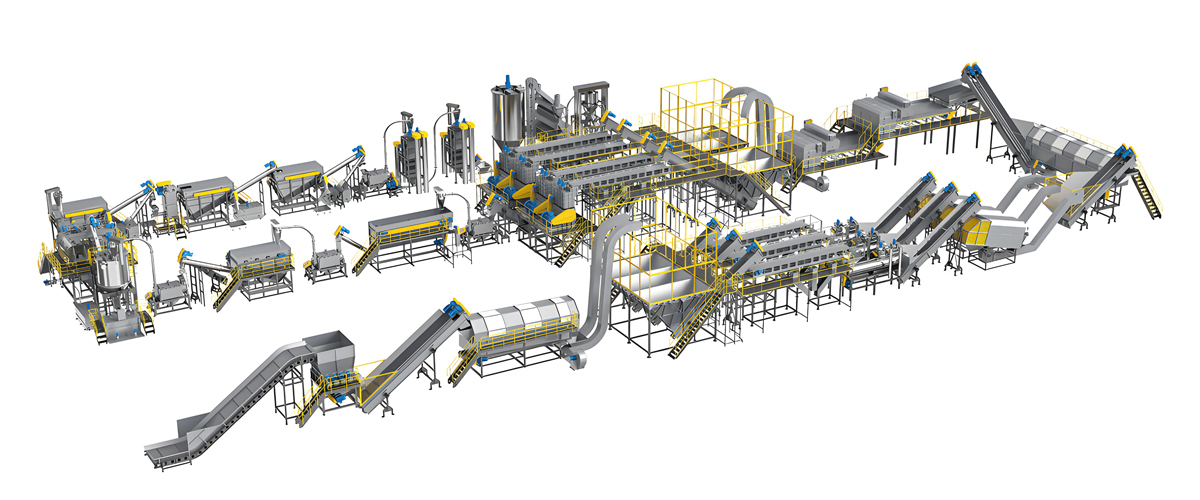
3. LDPE Film Washing Line Process Architecture
4. Polyretec PP/PE Soft Plastic Crushing and Washing Line
5. Flake Purity Targets for Mexican Converters
6. Polyretec New Generation Pelletizing Line
7. Mexican Market Access and Compliance Considerations
8. Real-World Deployment: LDPE Film With Stickers in Mexico
9. Selection Guidance: Match Capacity to Feedstock
10. Conventional vs Vienna-Origin Process Route
11. Utility Planning and Operating Cost
12. Installation, Commissioning and Service Support
13. Maintenance and Long-Term Reliability
14. Frequently Asked Questions
15. Conclusion and Next Step
16. Feedstock Contamination Profiles and Site Planning
Why LDPE Film Recycling Is Expanding Across the Mexican Market
Low-density polyethylene film is one of the most common flexible packaging materials in North America, and Mexico is no exception. Stretch wrap, retail bags, agricultural film, industrial liners and post-consumer packaging all generate a continuous stream of LDPE scrap that is light, bulky and difficult to landfill efficiently. For Mexican converters, recyclers and industrial groups, recovering this material is no longer only an environmental choice but a commercial one. Reclaimed LDPE flakes and pellets re-enter film extrusion, pipe and profile production, and a wide range of compounded goods, displacing virgin resin and protecting margins against volatile polymer pricing.
The challenge is that LDPE film is unlike rigid plastic. It floats, it tangles, it carries high levels of surface dirt, printing ink, adhesive labels and organic residue, and it compacts into a low-bulk-density mass that resists water penetration. A generic crusher-and-rinse setup is not enough. The Mexican market increasingly expects a purpose-built washing line that can deliver clean, low-moisture flakes at a predictable throughput, supported by verifiable quality documentation for downstream buyers.
Polyretec, a Wanplas factory, has supplied plastic recycling washing lines and pelletizing systems since its origin in 2010, with the brand established in 2017. The factory brings more than 100 project references, services across 50-plus countries and deploys 24-plus engineering specialists, making it a practical partner for Mexican operators who need a line that performs under local feedstock and utility conditions. This article explains the process route, the equipment, the quality targets and the selection logic behind an LDPE film washing line designed for Mexican market standards.
The discussion focuses on the engineering that turns contaminated LDPE film into saleable flake and pellet, and on how a Vienna-origin process route is adapted into a line that is both technically credible and commercially accessible. Throughout, the goal is to give procurement, plant and quality teams a clear framework for specifying, budgeting and operating such a system.
The Vienna-Origin Process Route Behind High-Purity LDPE Flakes
Modern mechanical recycling of flexible polyolefins draws heavily on long-developed European process know-how, often described in the industry as a Vienna-origin process route. That route is not about a single machine but about a disciplined sequence: minimize flake size loss, maximize contaminant liberation, recover and recirculate process water, and protect downstream extrusion from metals, fines and residual organics. The value of this process logic is consistency. A line built on these principles produces flakes whose quality varies little shift to shift, which is exactly what Mexican converters and export buyers require.
Polyretec integrates this advanced European-origin process know-how with Chinese manufacturing scale. The result is a washing line that follows the proven stage order of pre-treatment, size reduction, friction liberation, density-based rinsing, mechanical dewatering and thermal drying, while keeping capital and operating costs at a level that suits emerging and mid-size recycling markets. The engineering emphasis is on gentle handling of film, strong removal of labels and ink, and closed-loop water management.
It is worth separating process know-how from brand names. The reliability of a recycling line comes from how each stage is tuned to the feedstock, not from any specific supplier identity. Polyretec designs around the physical behavior of LDPE film: its tendency to bridge, its low density, its sensitivity to over-grinding, and its need for high-surface-area exposure during washing. By aligning stage design with material behavior, the line achieves high recovery and brightness without excessive power or water draw.
For Mexican buyers, this matters because feedstock is rarely uniform. Agricultural film arrives with sand and crop residue, retail return film arrives with tape and labels, and industrial wrap arrives with printing and adhesives. A process route that was hardened in demanding European feedstock conditions transfers well to the Mexican mix, provided the line is configured for local contamination profiles. That configuration work is where an experienced factory adds the most value.
LDPE Film Washing Line Process Architecture
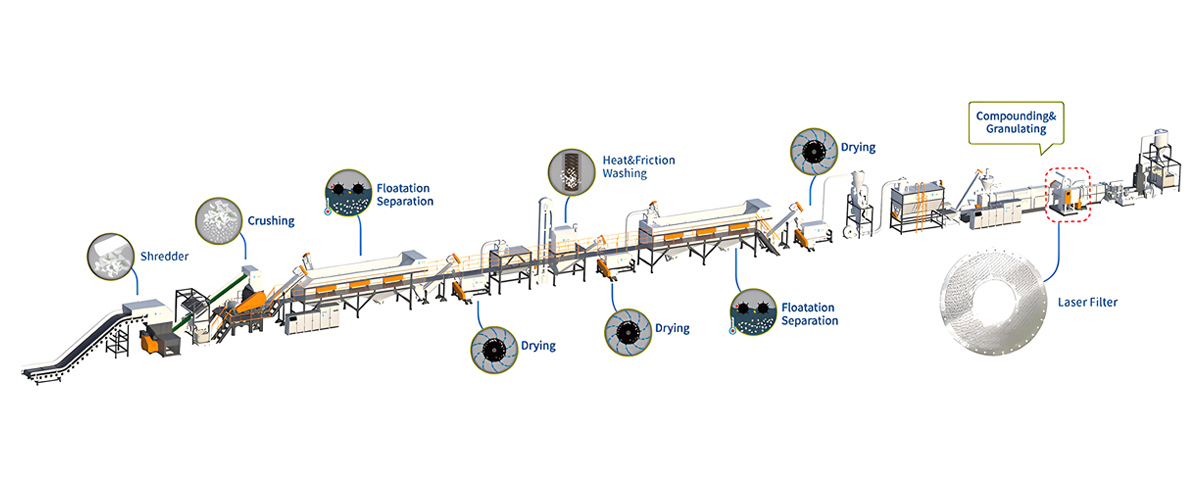
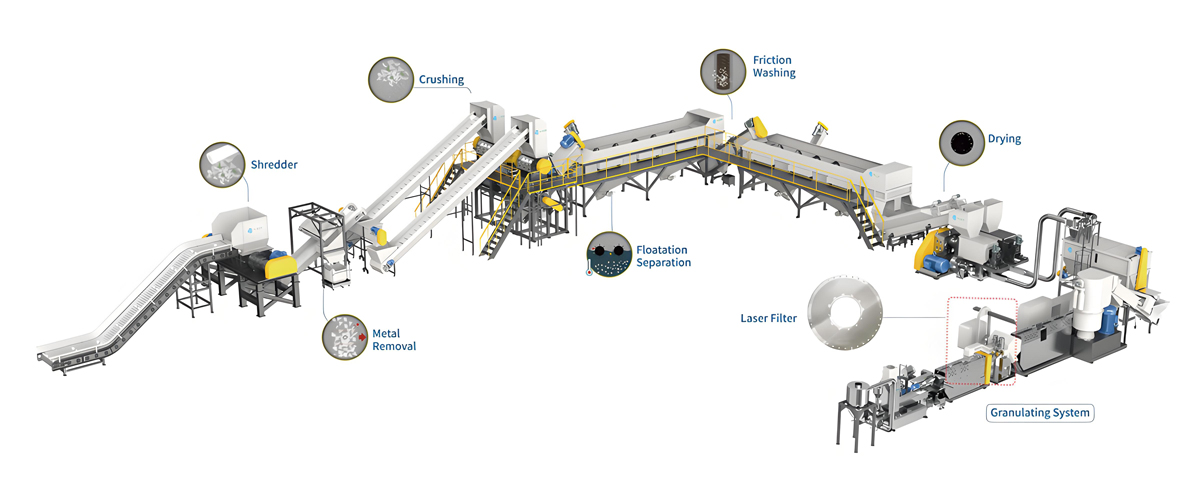
A purpose-built LDPE film washing line follows a staged path from loose, contaminated film to clean, dry flake. Each stage has a defined purpose, and the sequence is tuned so that later stages receive material that is already partially cleaned and correctly sized. The table below outlines the canonical stage order and the function of each unit.
| Stage | Key Equipment | Primary Function | Quality Lever |
|---|---|---|---|
| Pre-wash and pre-treatment | Belt conveyor, pre-wash tank, heavy-duty shredder, beater unit | Remove coarse dirt, loosen stickers and surface ink, reduce bulk | Protects later stages, improves brightness |
| Size reduction | Wet crusher or granulator | Cut film into 10 to 14 mm flake under water | Controlled flake size, low heat |
| Friction washing | High-speed friction washer | Mechanically scrub surfaces to release ink, glue and fines | Core contaminant liberation |
| Float rinsing | Rinse tank with agitation | Separate LDPE from sinkable contaminants, wash away loosened soil | Purity, density separation |
| Dewatering | Centrifugal dewatering machine | Remove free surface water from flake | Lower drying load, energy saving |
| Thermal drying | Hot-air dryer or pipeline dryer | Drive residual moisture to target level | Moisture compliance for extrusion |
| Storage and packaging | Silo, cyclone, bagging or big-bag station | Collect, cool and package finished flake | Consistent lot identity |
The pre-wash and pre-treatment stage is especially important for Mexican feedstock that includes agricultural film and stickered industrial packaging. A heavy-duty shredder breaks bulky rolls and tangled wrap into manageable pieces, while a beater unit beats the material against perforated screens to dislodge stickers and surface soil before the film ever reaches the wet crusher. This upstream work reduces wear on the crusher and raises the brightness of the final flake.
Size reduction is performed wet to suppress dust, control temperature and begin washing simultaneously. Over-grinding must be avoided because excessively fine LDPE flake floats poorly and loses value; the target is a uniform 10 to 14 mm flake that rinses and dewaters efficiently. Friction washing then provides the mechanical action that lifts ink and adhesive from the polymer surface, and float rinsing carries the loosened contamination away while LDPE stays in the light fraction.
Dewatering and drying close the loop. A centrifugal dewatering machine removes most free water, and the thermal dryer brings moisture down to the level required by extrusion or pelletizing. Because water is recirculated through a settling and filtration circuit, total consumption stays low even at commercial throughput. The whole sequence is controlled by a central PLC with HMI, so operators can monitor load, motor current and water clarity from one screen.
Polyretec PP/PE Soft Plastic Crushing and Washing Line
For LDPE film, the Polyretec PP/PE Soft Plastic Crushing and Washing Line is the core solution. It is engineered for flexible polyolefins including LDPE film, printed bags, woven bags and agricultural film, and it is available in capacity tiers from 500 kg/h to 1500 kg/h. An optional one-step pelletizing path can be integrated when the operator wants to ship pellets rather than flakes.
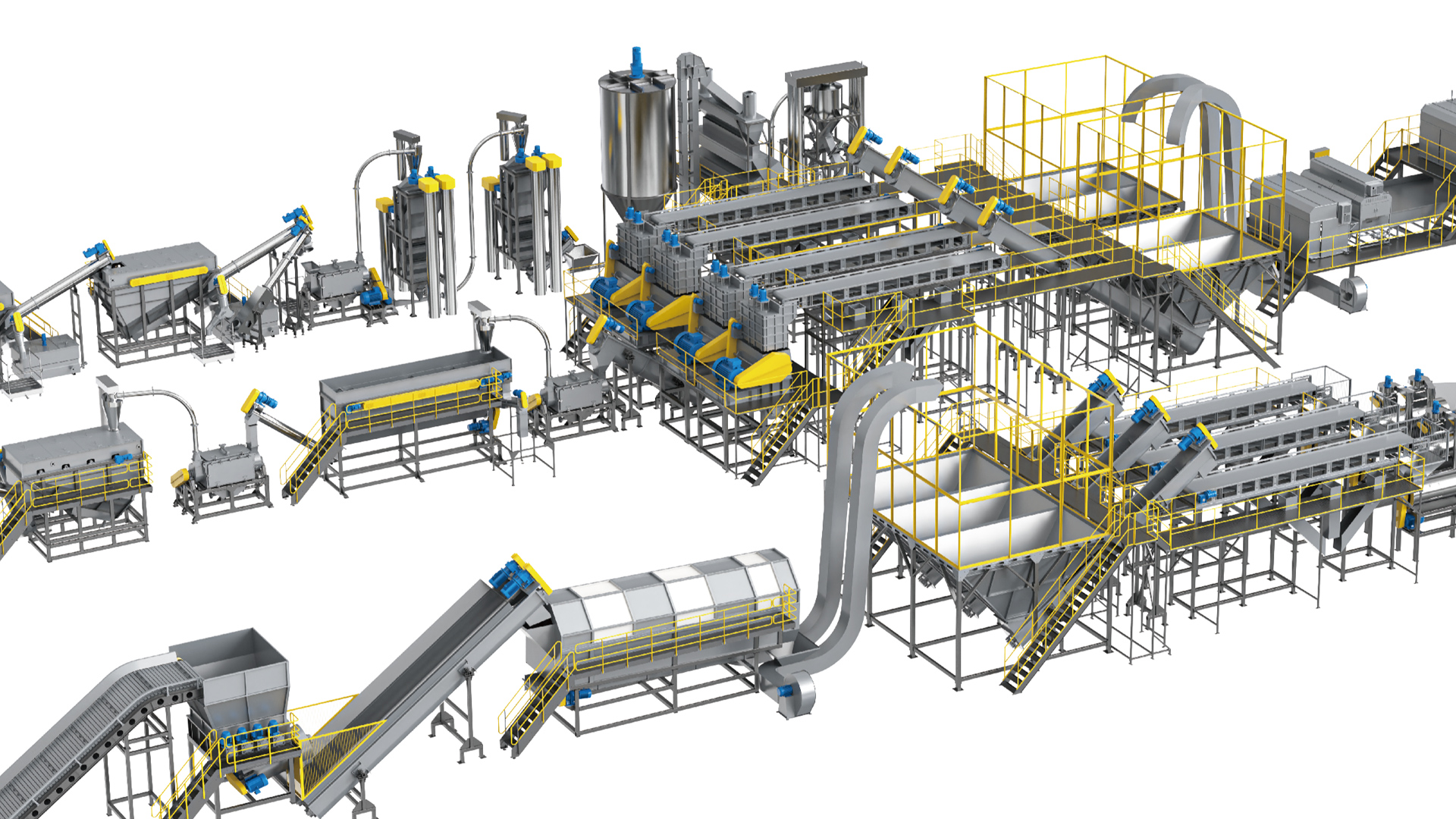
The line is built around the stage sequence described above, with stainless-contact wet sections, hardened cutter assemblies and a modular layout that fits standard industrial halls. Polyretec configures each line to the buyer’s feedstock mix, contamination level and available utilities, then verifies performance through pre-shipment testing before the equipment leaves the factory.
The representative specification table below uses the capacity tiers documented for the Polyretec PP/PE soft plastic line. Water and power figures are typical reference values for a film-dominant feedstock and should be confirmed against the final configuration; they illustrate the scaling relationship between throughput, utility draw and footprint.
| Model Tier | Throughput (t/h) | Typical Make-up Water (m³/h) | Installed Power (kW) | Flake Size (mm) | Footprint (m²) |
|---|---|---|---|---|---|
| PP/PE Soft Line 500 | 0.5 | 1.5 to 2.0 | 110 to 140 | 10 to 14 | 160 to 200 |
| PP/PE Soft Line 800 | 0.8 | 2.0 to 2.5 | 150 to 185 | 10 to 14 | 200 to 240 |
| PP/PE Soft Line 1000 | 1.0 | 2.5 to 3.0 | 190 to 220 | 10 to 14 | 240 to 300 |
| PP/PE Soft Line 1500 | 1.5 | 3.0 to 4.0 | 230 to 260 | 10 to 14 | 300 to 360 |
Each tier shares the same process logic, so moving from 500 kg/h to 1500 kg/h is primarily a question of wider conveyors, larger crusher and washer rotors, bigger dewatering and drying capacity, and a correspondingly larger water treatment loop. This modular approach means a Mexican operator can start at a lower tier and later expand throughput by upgrading key units rather than replacing the whole line.
The PTW1000 automated washing configuration referenced in Polyretec project experience demonstrates the fully automated direction of this product family, where material handling, washing and drying are linked into a continuous, sensor-monitored flow. For Mexican sites with limited manual labor or strict lot-traceability needs, this automation level reduces operator exposure and improves consistency.
Flake Purity Targets for Mexican Converters
Clean flakes are only useful if their quality can be measured and documented. Mexican converters and export buyers typically evaluate LDPE flake on moisture, contamination, bulk density and visual brightness. The table below lists practical target bands that a properly configured washing line should meet for film-grade reuse.
| Quality Parameter | Typical Target | Why It Matters | Control Stage |
|---|---|---|---|
| Residual moisture | At or below 1.5 percent | Prevents foaming and hydrolysis in extrusion | Dewatering and drying |
| Metal content | At or below 20 ppm | Protects screw and barrel, melt filter | Magnetic and metal separation |
| PVC contamination | 50 to 100 ppm or lower | PVC degrades and discolors LDPE | Float-sink and sorting |
| Residual glue or label | Below 0.5 percent | Affects film clarity and odor | Pre-treatment and friction wash |
| Flake size | 10 to 14 mm | Stable feeding and rinsing | Wet crusher screen |
| Bulk density (loose) | 200 to 350 kg/m³ | Influences storage and feeding | Flake geometry |
Moisture control deserves special attention. LDPE is hydrophobic, but surface water trapped in flake crevices can exceed the tolerance of downstream extruders and cause foaming or reduced output. The dewatering machine removes the bulk of free water, and the thermal dryer finishes the job. A reliable line holds moisture at or below the target even when ambient humidity is high, which is relevant for coastal and humid regions of Mexico.
Metal and PVC control protect both product and machine. Even small metal particles accelerate wear on the pelletizing screw and barrel, while trace PVC can thermally degrade during re-extrusion and yellow the final product. The float-rinse and separation stages, tuned to the density gap between LDPE and heavier contaminants, keep these impurities within tight limits. For buyers who require documented lots, Polyretec can supply a quality record per shipment that captures these parameters.
Polyretec New Generation Pelletizing Line
Many Mexican operators do not stop at flakes. Selling reprocessed pellets broadens the customer base to film, pipe, profile and compound producers. The Polyretec New Generation Pelletizing Line is designed for thin-walled LDPE films and thick-walled PE or PP regrind, with robust construction aimed at post-consumer waste. It connects directly to washed flake output through a controlled feeding and melt-filtration path.
The pelletizing line compacts and feeds the flake, melts it in a well-controlled extruder, filters the melt to remove residual fines and gels, and cuts uniform pellets. For film-grade LDPE, the emphasis is on stable feeding of a low-bulk-density material and on melt filtration fine enough to protect thin film dies downstream.
| Specification | Reference Range | Notes |
|---|---|---|
| Suitable feed | LDPE film flake, PE/PP regrind | Post-consumer and post-industrial |
| Output range | 200 to 600 kg/h | Matched to washing tier |
| Screw diameter | 120 to 180 mm | Selected by capacity |
| L/D ratio | 28 to 33 | Stable melt temperature |
| Installed power | 90 to 185 kW | Excludes ancillary cooling |
| Melt filtration | Continuous screen changer | Protects downstream dies |
| Pellet cut | Strand or die-face | By application |
When a washing line and a pelletizing line are specified together, the two systems should be balanced so that flake production matches pelletizing capacity. Wanplas supplies matched pelletizing systems that integrate with Polyretec washing lines, giving Mexican buyers a single-source path from dirty film to bagged pellet. This integration reduces interface risk, simplifies spare-parts planning and shortens commissioning.
For applications that need compounded or additive-adjusted output, Wanplas also coordinates downstream twin-screw compounding capability, so a Mexican operator can move from recycled flake to a value-added compound within one project scope. The key is to define the final product specification early, because it determines whether a washing-only line, a washing-plus-pelletizing line, or a full washing-compounding line is the right investment.
Mexican Market Access and Compliance Considerations
Selling recycled LDPE in Mexico means meeting local expectations for documentation, safety and environmental compliance. National standards referenced as Norma Oficial Mexicana define requirements across packaging, labeling and environmental handling, and recyclers should align their quality records and operational permits with those frameworks. This article does not name specific agencies or certifiers; the practical point is that a washing line should make compliance easier, not harder.
A line that documents throughput, water use, energy use and flake quality per lot supports both internal quality control and external reporting. Mexican buyers of recycled content increasingly ask for traceability: where the feedstock came from, how it was processed, and what contamination levels the output carries. A PLC-driven line with lot records answers those questions directly.
Environmental operating permits in Mexico commonly address wastewater discharge and air emissions. Because the Polyretec washing route recirculates process water through settling and filtration, discharge volume is small and manageable. Sludge from the water loop is concentrated and removed for proper handling rather than released. These design features help a Mexican operator present a credible environmental case to authorities and to brand owners seeking recycled content.
Electrical and machine safety alignment with widely recognized international practices simplifies import and installation. Polyretec builds to standard industrial electrical frameworks and can adapt voltage and frequency to Mexican grid conditions, which removes a frequent source of commissioning delay for imported machinery.
Real-World Deployment: LDPE Film With Stickers in Mexico
One of the most demanding Mexican feedstocks is LDPE film carrying stickers and strong adhesive labels. Standard washing lines struggle with this material because the labels remain attached through crushing and re-attach during rinsing, lowering flake brightness and raising reject rates. Polyretec addressed this in a Mexico project by adding a heavy-duty shredder and a beater machine to the front of the line.
The beater unit violently agitates the pre-shredded film against perforated screens, loosening stickers and surface ink before the material enters the wet crusher. This pre-treatment step is decisive: it shifts the hardest part of the cleaning job upstream, where it can be handled mechanically, instead of overloading the friction washer downstream. The result is brighter flake, lower reject rate and longer life for the finer washing components.
This deployment illustrates a broader principle for the Mexican market. Feedstock is heterogeneous, and a line that is tuned only to clean, single-source film will underperform on real post-consumer or post-industrial mix. By configuring pre-treatment for the specific contamination profile, Polyretec turns a difficult local feedstock into a stable, saleable product. Similar logic applies to agricultural film with soil load and to printed retail film with heavy ink coverage.
For Mexican operators, the lesson is to specify the line against the worst realistic feedstock, not the best. A conservative configuration costs a little more upfront but protects output quality and uptime across the full range of material the plant will actually receive.
Selection Guidance: Match Capacity to Feedstock
Choosing the right line starts with feedstock volume, contamination type and the final product form. The table below maps common Mexican scenarios to a recommended Polyretec configuration. These recommendations assume continuous single-shift or double-shift operation and should be refined with a site-specific feedstock sample.
| Customer Requirement | Recommended Model | Output | Recommended Add-on |
|---|---|---|---|
| Start-up recycler, clean industrial wrap | PP/PE Soft Line 500 | 0.5 t/h | Standard friction wash |
| Regional collector, mixed film with labels | PP/PE Soft Line 800 | 0.8 t/h | Beater pre-treatment |
| Agricultural film with soil load | PP/PE Soft Line 1000 | 1.0 t/h | Heavy-duty shredder, sand trap |
| Large converter, sells flakes | PP/PE Soft Line 1500 | 1.5 t/h | Automated handling, lot record |
| Operator wants pellets, not flakes | Washing line plus New Generation Pelletizing Line | 200 to 600 kg/h pellets | Continuous melt filtration |
The selection logic is straightforward. Begin with the sustainable weekly feedstock volume, not the peak. A line sized to peak volume sits idle and ties up capital; a line sized to sustainable volume runs steadily and pays back faster. Then match contamination to the right pre-treatment: stickers call for a beater, soil calls for a sand trap and heavy-duty shredder, heavy ink calls for stronger friction washing.
Finally, decide the product form before ordering. A washing-only line is simpler and cheaper, but a washing-plus-pelletizing line opens more customers. Wanplas can coordinate the full scope so the washing output feeds a matched pelletizing system without custom interface engineering. This coordinated approach is usually the lowest-risk route for a Mexican operator entering recycled LDPE for the first time.
Conventional vs Vienna-Origin Process Route
Buyers often compare a basic washing setup with a line built on the Vienna-origin process route. The difference is not single features but how the stages are sequenced and tuned. The comparison below is technology versus technology, based on how each approach handles the same LDPE film feedstock.
| Dimension | Conventional Basic Setup | Vienna-Origin Process Route |
|---|---|---|
| Pre-treatment of stickers | Limited or none | Beater and heavy-duty shredder upfront |
| Flake brightness | Variable | Consistent, higher |
| Flake size loss | Higher | Lower through controlled cutting |
| Water management | Often open loop | Closed loop with treatment |
| Metal and PVC control | Basic | Layered separation |
| Automation and lot record | Manual | PLC with HMI and records |
| Typical capital position | Low | Medium |
The conventional setup can look attractive on a spreadsheet because the initial price is lower. In practice, however, it often produces variable quality, loses more material as fines, and consumes more water. The Vienna-origin process route costs more upfront but recovers that gap through higher yield, lower utility draw and a product that meets converter specifications without rework.
For the Mexican market, where buyers are increasingly quality-conscious and where water and labor carry real cost, the process-route approach usually wins on total cost of ownership. The decision should be made on lifecycle economics, not on the equipment price alone.
Utility Planning and Operating Cost
Operating cost is best expressed in relative terms because local electricity, water and labor rates vary across Mexico. The table below ranks the main cost drivers for an LDPE film washing line using the Low, Medium, High scale requested by procurement teams, so the figures remain valid regardless of local tariff.
| Cost Driver | Relative Level | Main Influence |
|---|---|---|
| Electricity | Medium to High | Crusher, friction washer, dryer motors |
| Process water | Low | Closed-loop recirculation |
| Consumables | Low to Medium | Screens, cutter blades, filter media |
| Labor | Low to Medium | Automation level chosen |
| Maintenance | Medium | Wear parts on wet sections |
Electricity is typically the largest recurring cost because the friction washer and thermal dryer are motor-intensive. Selecting the correct capacity tier avoids running oversized equipment, and variable-frequency drives on key motors trim part-load consumption. Process water is a small cost because the closed loop needs only make-up volume to replace losses, which also simplifies wastewater compliance.
Consumables are dominated by cutter blades and filtration media, both of which are planned through the spare-parts program. Labor scales inversely with automation: a semi-automated line needs more operators, while a fully automated configuration such as the PTW1000 direction reduces headcount and improves consistency. Mexican operators should model these trade-offs against local wage and reliability assumptions.
Installation, Commissioning and Service Support
A washing line is a system, not a single machine, so installation and commissioning determine whether the documented specifications become real-world performance. Polyretec supports each project with pre-shipment testing, on-site installation and commissioning, operator training and remote assistance. Engineers verify throughput, flake quality and utility draw before the line is handed over.
The Wanplas group backs every factory with a shared service promise that includes USD 500 free spare parts per year and warranty replacement of damaged parts. For a Mexican operator, this policy lowers the risk of unexpected downtime and makes annual maintenance budgeting predictable. Polyretec also follows the Wanplas open-factory policy, welcoming customers to visit, audit the build and run a sample of their own feedstock before purchase.
Commissioning typically covers utility connection, PLC configuration, trial runs on representative feedstock, and operator training on safe operation, cleaning and basic maintenance. Remote monitoring assistance lets Polyretec specialists review PLC data and advise on adjustments after the line is in production, which is valuable when local technical staff are still building experience.
Because the line is modular, future expansion is straightforward. An operator who begins at 500 kg/h can later upgrade conveyors, crusher rotors and drying capacity to reach 1000 kg/h or more without replacing the structural layout. This staged investment path suits Mexican recyclers who want to grow with confirmed demand rather than borrowing against uncertain volume.
Maintenance and Long-Term Reliability
Reliability in a washing line comes from disciplined maintenance of the wet, abrasive sections. Cutter blades, friction washer paddles, screen packs, bearings and seals are the components that wear, and a planned replacement schedule keeps the line within specification. Polyretec supplies wear-part kits sized to the selected tier and aligned with the USD 500 free spare-parts policy.
A practical maintenance routine includes daily checks of water clarity and motor current, weekly inspection of cutter gaps and screen condition, and monthly review of dewatering and drying performance against the moisture target. When moisture or brightness drifts, the cause is usually a worn screen, a clogged filter, or a mis-set friction washer speed, all of which are quick to correct if caught early.
Training is the multiplier. Operators who understand why each stage exists make better real-time decisions and report abnormalities before they become failures. Polyretec builds training into commissioning and can refresh it remotely, so the Mexican plant maintains competence even as staff change. The Vienna-origin process route is only as good as its daily execution, and execution depends on a trained team.
Long-term, the closed-loop water system needs periodic sludge removal and media replacement, while the electrical and control system benefits from firmware and recipe updates as feedstock mixes evolve. Treating the line as a managed asset, rather than a fixed installation, protects both output quality and resale value.
Feedstock Contamination Profiles and Site Planning
Before a washing line is ordered, the single most useful exercise is to characterize the real feedstock rather than to assume an ideal mix. Mexican LDPE film arrives in several recognizable contamination profiles, and each profile changes the optimal configuration. A plant that processes mostly clean industrial wrap needs a different front end than a plant that processes post-consumer retail bags with tape, labels and food residue. Building the line around the average of these profiles, instead of the best case, protects output quality across the full operating range.
The first profile is post-industrial stretch wrap and converter scrap. This material is relatively clean, low in ink and free of label adhesive, so it responds well to a standard washing sequence without heavy pre-treatment. The main risk is that wrap arrives baled and tangled, which can bridge in hoppers; a properly sized belt conveyor and pre-breaker solve this without special cost. For this profile, the 500 kg/h or 800 kg/h tier is usually sufficient.
The second profile is retail and post-consumer film, including shopping bags, bread bags and mixed packaging. This material carries printing ink, adhesive tape and paper labels, and it is often wet or soiled. Here the beater pre-treatment and stronger friction washing pay for themselves by lifting brightness and lowering reject rates. A sand trap is useful when mineral dust is present. The 800 kg/h or 1000 kg/h tier fits this profile when volumes justify it.
The third profile is agricultural and greenhouse film. This is the most demanding because it carries sand, plant residue, fertilizers and UV stabilizer residues that can yellow the flake. A heavy-duty shredder, an aggressive pre-wash and a sand-removal stage are essential, and the water loop must be sized for higher solids loading. Operators who underestimate this profile end up with cloudy flake and clogged filters, so conservative configuration is the correct commercial choice even though it raises the initial price.
Site planning interacts directly with these profiles. The line needs a level floor with load capacity for water tanks and the dewatering-drying stack, a three-phase power supply sized to the installed power of the selected tier, and a water source for make-up and initial fill. Drainage should reach a settling area where sludge can be concentrated before removal. Ventilation helps where the dryer exhaust is warm and humid. Polyretec provides a layout drawing and utility schedule during project engineering so the Mexican buyer can prepare the building before the equipment arrives.
Another planning factor is material flow. Film is bulky and light, so the receiving and bale-opening area often dominates the floor plan. Allocating enough space for temporary feedstock storage, a pre-sort area to remove non-polyolefin rejects, and a finished-flake storage zone prevents bottlenecks that would otherwise idle an expensive washing line. In many plants the bottleneck is not the machinery but the hand labor at the front end, which is why automation such as the PTW1000 direction becomes attractive as volumes grow.
Finally, consider the product destination when planning. If flakes are sold to a known converter with a fixed specification, tune the line to that specification and document it lot by lot. If flakes are sold on the open market, aim for the stricter common denominator so the product stays salable to the widest buyer base. This destination-driven tuning is where an experienced factory adds value: Polyretec reviews the buyer’s target outlets and configures stage intensity accordingly, avoiding both under-cleaning and wasteful over-processing that raises cost without improving price.
Frequently Asked Questions
What capacity range fits a Mexican LDPE film recycling startup?
Most first-line operators in Mexico begin at 500 kg/h to 800 kg/h, which balances floor space, utility demand and payback. Polyretec configures the PP/PE Soft Plastic Crushing and Washing Line in 500 kg/h, 800 kg/h, 1000 kg/h and 1500 kg/h tiers, so a startup can select a tier that matches sustainable weekly volume rather than optimistic peak volume.
How pure must LDPE flakes be for Mexican converters?
Typical targets are residual moisture at or below 1.5 percent, metal content at or below 20 ppm, PVC contamination at or below 50 to 100 ppm, and residual glue or label below 0.5 percent. These levels support stable downstream pelletizing and film re-extrusion, and they are achievable with the staged washing route described above.
Why is a Vienna-origin process route relevant to washing lines?
Long-developed European recycling process know-how emphasizes low mechanical flake size loss, high liberation of contaminants and closed-loop water use. Polyretec integrates that process logic with Chinese manufacturing scale to deliver cost-effective lines, giving Mexican buyers consistent quality without premium European pricing.
Can the washing line handle printed and stickered LDPE film?
Yes. The Mexico-deployed configuration adds a heavy-duty shredder and a beater-type pre-treatment stage to release stickers and surface ink before friction washing, which protects later stages and improves flake brightness. This is the same approach used on stickered industrial film in local projects.
What after-sales support does Polyretec provide?
Support includes pre-shipment testing, on-site installation and commissioning, operator training, remote monitoring assistance and the Wanplas group policy of USD 500 free spare parts per year plus warranty replacement. The open-factory policy also lets buyers audit the build and trial their own feedstock.
Should I buy a washing line only or a washing plus pelletizing line?
If you sell clean flakes, a washing line is enough. If you supply reprocessed pellets to film or pipe converters, integrate the New Generation Pelletizing Line. Wanplas also supplies matched pelletizing systems that connect directly to Polyretec washing output, simplifying the interface and spare-parts planning.
How much water does an LDPE film washing line consume?
Because the process is closed-loop with settling and filtration, continuous make-up demand is low, typically a few cubic meters per hour at commercial throughput, with the exact figure set by capacity tier and contamination load. The dominant recurring cost is electricity for the motors, not water.
Is the line adaptable to Mexican grid and permit conditions?
Polyretec adapts voltage and frequency to local grid standards and builds to standard industrial electrical safety practices. The low-discharge water design and concentrated sludge handling support environmental permit applications, which helps Mexican operators present a credible compliance case to authorities and brand owners.
Conclusion and Next Step
An LDPE film washing line for the Mexican market is a system engineered around the physical behavior of flexible polyolefins: low density, high surface area, and a contamination mix that ranges from soil to ink to adhesive. By following a Vienna-origin process route, pre-treating difficult feedstock, controlling flake size, and closing the water loop, a well-configured line delivers bright, low-moisture flakes that meet converter specifications and support recycled-content documentation.
Polyretec, a Wanplas factory with project experience across more than 50 countries and a Mexico-specific reference for stickered LDPE film, offers the PP/PE Soft Plastic Crushing and Washing Line in 500 kg/h to 1500 kg/h tiers, with the New Generation Pelletizing Line available for operators who prefer to ship pellets. The shared Wanplas commitment of USD 500 free spare parts per year, warranty replacement and open-factory visits backs every installation.
If you are planning a recycled LDPE project in Mexico, the most efficient next step is to send your typical feedstock description, target monthly volume and final product form. Polyretec will propose a tuned configuration, confirm utility and footprint estimates, and invite you to run a sample of your own film on the line before you commit. That evidence-based path removes guesswork and aligns the equipment with the real material your plant will process.
Taking a measured, sample-driven approach also de-risks financing, because the line is justified by demonstrated output rather than by a vendor claim. It lets your team validate brightness, moisture and throughput on site, train operators early, and enter the recycled LDPE market with confidence backed by verified performance data.