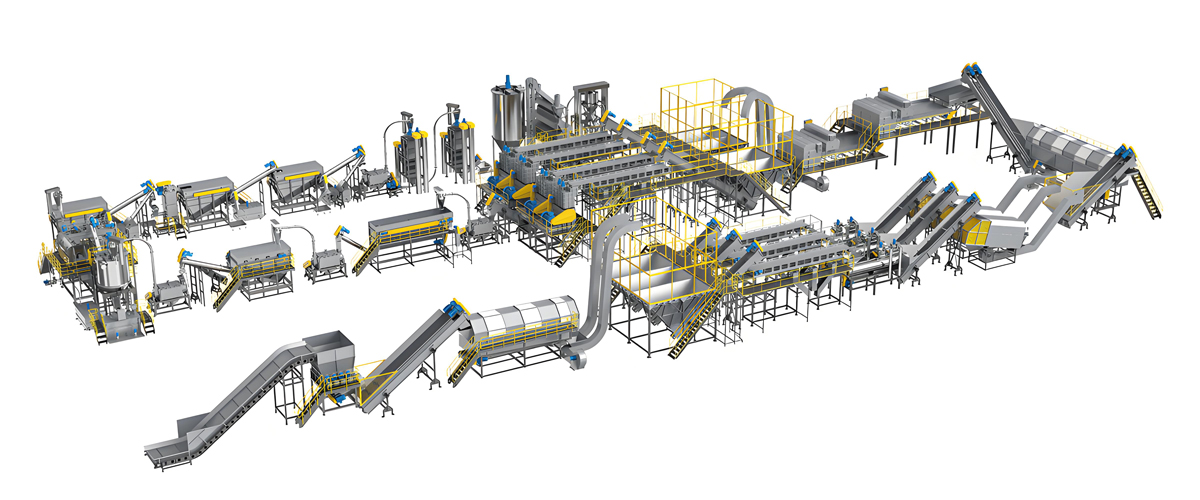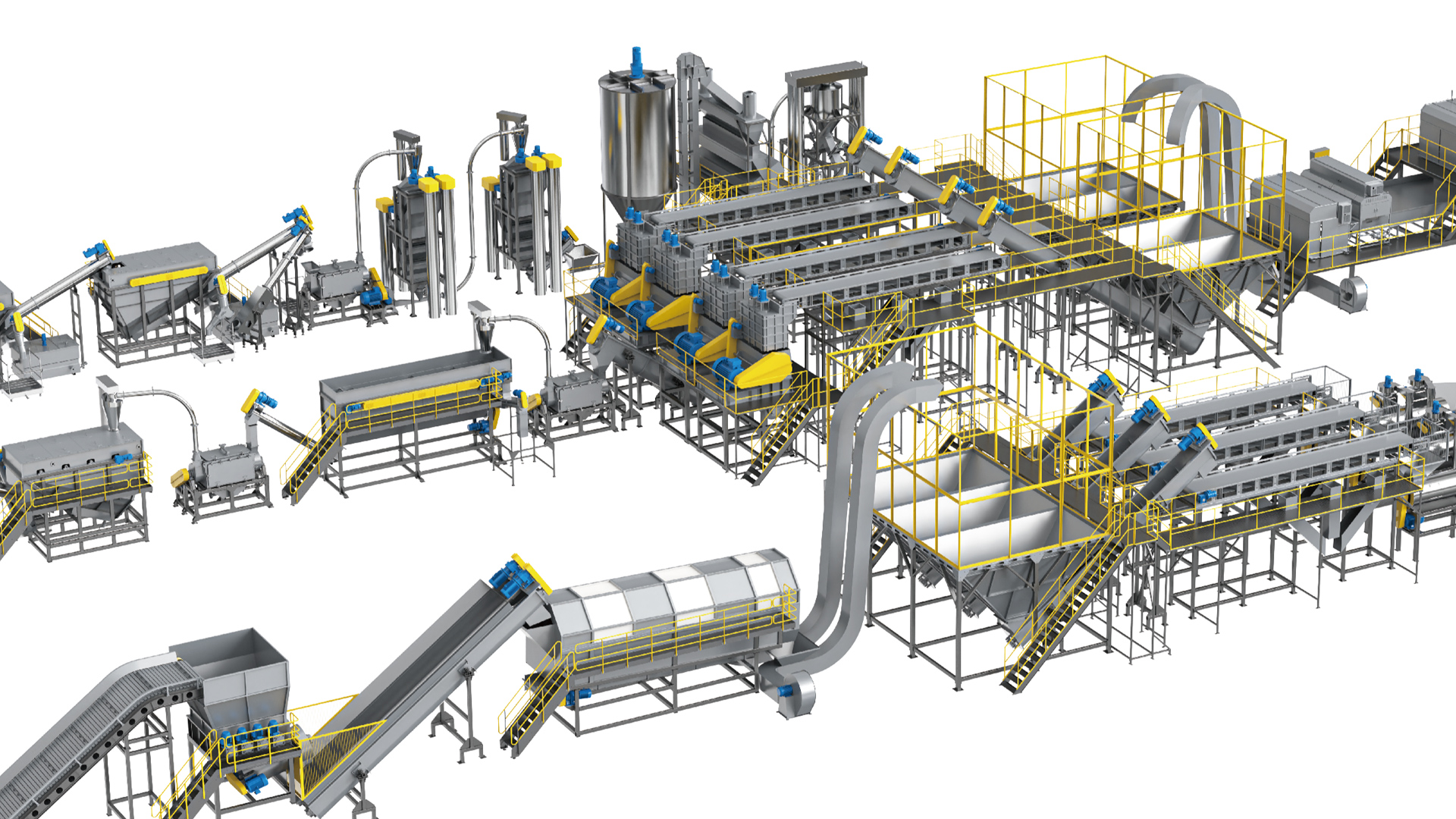

Polyretec, a Wanplas factory, is a well-known manufacturer of plastic recycling equipment whose history in the recycling field dates back to 2010 and whose brand was established in 2017. By combining advanced Austrian process technology with Chinese manufacturing expertise, Polyretec has built a strong reputation for cost-effective washing and pelletizing systems that do not compromise on quality. This article explains what defines the best food grade PET washing line with automated drying system, walks through the complete process from pre-wash to thermal drying, and shows how Polyretec equipment produces recycled PET flakes clean and dry enough for food contact applications under FDA and EU 10/2011 requirements. Whether you run a regional collection and washing operation or a bottle-to-bottle plant, the guidance below will help you understand the engineering, the quality targets, and the configuration that fits your output and flake grade goals.
What Makes a PET Linha de lavagem Food Grade
A food grade PET washing line is not simply a standard bottle washing line with a better filter. It is a system engineered from the infeed to the dried flake outlet to remove, separate, and verify every contaminant class that could prevent recycled PET from being approved for contact with food. The defining difference is consistency: a food grade line must deliver the same low levels of PVC, glue, labels, metal, color, and moisture on every batch, because food contact regulations such as FDA requirements in the United States and EU 10/2011 in Europe set strict thresholds that cannot be met by occasional good runs.
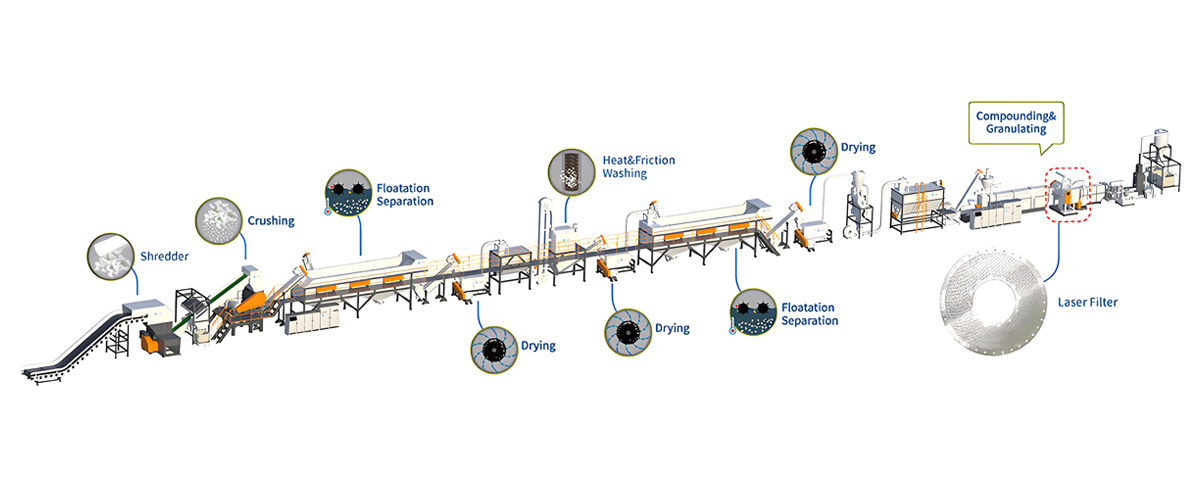
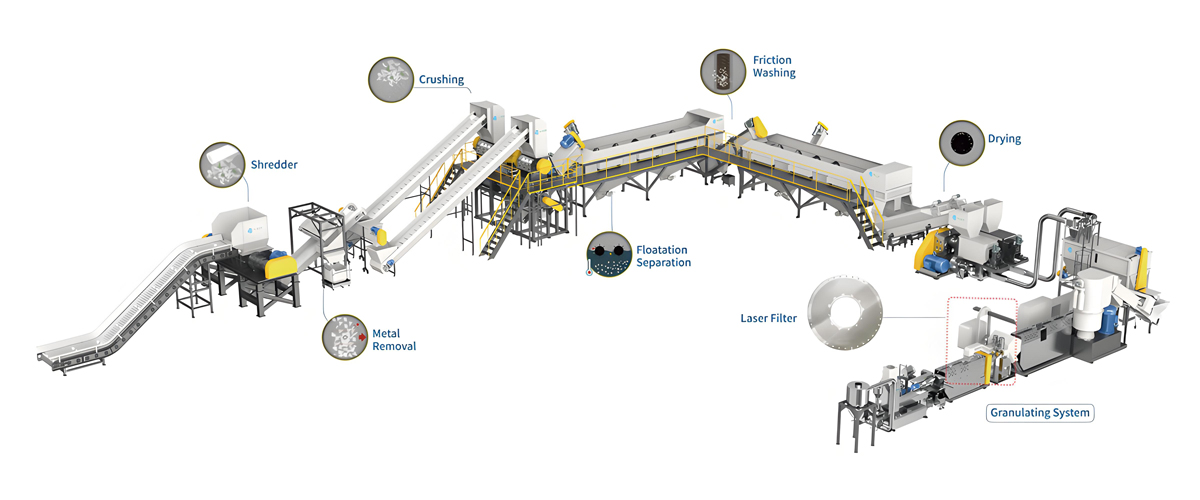
The washing line preprocesses post-consumer PET bottles through crushing, cleaning, sorting, and drying, and the food grade designation is earned at each stage. Pre-wash removes loose dirt and floating labels. Cold and hot washing strips glue, oil, and organic residues. Friction washing scrubs the flake surface. Float-sink separation pulls out caps and floatables, while density-based and optical sorting remove dense contaminants such as PVC. Rinsing clears residual caustic. Dewatering and thermal drying then drive moisture to the low level that food grade pelletizing and bottle-to-bottle processes demand.
Polyretec designs its Linha de lavagem de garrafas PET de qualidade alimentar in configurations from 500 kilograms per hour up to 6000 kilograms per hour, and each tier is built around a different flake grade target. The 500 to 1000 kilogram per hour lines suit regional recyclers and sheet producers, while the 3000 to 6000 kilogram per hour lines are engineered for bottle-to-bottle producers that require uniform food contact quality at scale. Across the range, the same disciplined process logic applies: separate contaminants early, clean aggressively in the middle, and finish with an automated drying system that guarantees the final moisture specification.
Two engineering philosophies separate a food grade line from a basic one. First, redundancy in sorting and washing so that no single equipment failure lets a contaminant through. Second, automation and inline monitoring so that moisture, dosing, and throughput are controlled rather than left to manual judgment. The automated drying system is the clearest example of the second philosophy, and it is the feature that most directly determines whether flakes meet food grade moisture limits batch after batch.
Complete PET Bottle Washing Process Flow
The washing of post-consumer PET into food grade flakes follows a sequence in which each stage removes a specific contaminant class before the next stage can work effectively. Understanding this sequence is the foundation for selecting equipment and for troubleshooting quality problems. A Polyretec food grade PET washing line organizes the sequence into eight practical stages, and the table below summarizes the operating conditions and the contaminant targeted at each stage.
Stage-by-Stage Process Parameters
| Process Stage | Key Equipment | Operating Condition | Primary Contaminant Removed |
|---|---|---|---|
| Pre-wash and label removal | Belt conveyor, trommel, label remover | Cold water spray, mechanical friction | Loose dirt, dust, paper, loose labels, caps |
| Cold wash | Cold wash tank with agitation | Ambient water, mild agitation | Remaining surface dirt, soluble residues |
| Hot caustic wash | Hot wash reactor with heater | Hot water with caustic, typically 85 to 95 degrees C | Glue, oil, organic residues, label adhesives |
| Friction wash | Friction washer with high-speed rotor | High-speed scrubbing, counter-current water | Stubborn surface contamination, residual glue |
| Float-sink separation | Float wash tank, rinsing tank | Density-based, PET sinks, caps float | PP, PE caps and floatable films |
| Rinsing | Fresh water rinse tank | Clean counter-current water | Residual caustic, detergent, fines |
| Dewatering | Dewatering machine, centrifuge | High-speed spin, mechanical | Free surface water, moisture down to 2 to 5 percent |
| Thermal drying | Thermal dryer, hot air system | Controlled hot air, automated | Bound moisture down to below 0.5 percent |
The pre-wash stage is often underestimated, yet it protects the entire line. By removing loose labels, dirt, and caps before the material is ground, the pre-wash keeps the crusher and downstream tanks from being overloaded with contaminants that are cheap to discard early. Polyretec configures the pre-wash with a belt conveyor for metal detection and a trommel or label remover so that the flakes that enter the wet section are already largely freed of loose debris.
The hot caustic wash is the chemical heart of the process. At 85 to 95 degrees C, a controlled concentration of caustic breaks down the hot-melt glues and pressure-sensitive adhesives that hold labels to bottles. Without an effective hot wash, glue survives into the flake stream and shows up later as spots, gels, or filtration problems in food grade pelletizing. Polyretec sizes the hot wash reactor and heater to give enough residence time at temperature for the targeted throughput, because undersized hot washing is the most common cause of failed food grade quality.
Float-sink separation relies on density. PET has a density around 1.38 grams per cubic centimeter, so it sinks in water, while polypropylene and polyethylene caps and films float and are skimmed off. The challenge for food grade quality is that PVC also sinks near PET, so float-sink alone cannot fully separate PVC. That is why Polyretec pairs float-sink with optical sorting downstream to reject PVC and off-color flakes, a point covered in detail in the quality section.
The effectiveness of float-sink depends heavily on tank design and water movement. Adequate agitation keeps flakes suspended long enough for density to act, while a counter-current flow carries floating caps and films toward the overflow and lets clean PET settle toward the discharge screw. Polyretec sizes the float wash tank and rinsing tank to the line throughput so that residence time is sufficient even at peak feed rates, because a tank that is too small lets contaminated material shortcut through and reach the flake outlet. Good tank geometry is therefore as important to food grade purity as the washer chemistry that precedes it.
Rinsing closes the wet section by removing caustic and detergent that, if carried into drying, would leave alkaline residues on flakes and raise the risk of hydrolysis during later melting. The counter-current fresh water rinse ensures the last contact the flakes have with liquid is clean, which also reduces the load on the dewatering and thermal drying stages.
The Automated Drying System Explained
The automated drying system is the feature that most distinguishes the best food grade PET washing line from a basic one, because moisture is the parameter most likely to vary run to run and the one most damaging to downstream food grade pelletizing. A washing line can produce perfectly clean flakes yet still fail food contact approval if those flakes carry too much water into the crystallizer or extruder, where moisture hydrolyzes the PET and drops its intrinsic viscosity.
Polyretec automated drying works in two coordinated stages. The first stage is mechanical dewatering using a high-speed dewatering machine, effectively a centrifuge, that flings free surface water off the flakes. This stage costs little energy because it uses centrifugal force rather than heat, and it removes the bulk of the water, typically taking flakes from about 30 percent surface moisture down to roughly 2 to 5 percent. The second stage is thermal drying, where controlled hot air evaporates the remaining bound moisture and brings the flakes below 0.5 percent residual moisture, the level required before crystallizing and extruding for food grade use.
Automation is what makes the system reliable rather than merely capable. A manual or batch dryer depends on an operator judging when flakes are dry, which leads to variation and occasional overdrying or underdrying. The Polyretec automated drying system is tied into the line PLC so that throughput, inlet moisture, air temperature, residence time, and outlet moisture are monitored and adjusted continuously. The dewatering machine and thermal dryer share a single control loop, and exhaust heat is recovered to lower the specific energy per ton of dry flakes.
Monitoring also supports traceability, which food grade buyers increasingly require. Because the drying parameters are recorded by the control system, a plant can demonstrate that each production batch was dried within the approved moisture window, supporting the documentation needed for food contact compliance. The same data lets Polyretec remote specialists spot a drifting sensor or a worn dewatering screen before it causes an out-of-spec batch, turning maintenance from reactive to preventive. This closed loop of measurement, control, and records is what separates an automated food grade drying system from a heated box with a timer.
The difference between dewatering and thermal drying matters for both cost and quality. Dewatering is cheap and fast and should remove as much water as possible so that the thermal dryer only has to handle the difficult bound moisture. Over-relying on thermal drying to remove free water wastes energy and risks thermal damage to flakes. Polyretec balances the two stages so that dewatering does the heavy lifting and thermal drying finishes to specification, which is the most efficient path to food grade moisture.
For bottle-to-bottle and sheet producers, the automated drying system also protects intrinsic viscosity. PET that enters the crystallizer too wet hydrolyzes and loses molecular weight, which weakens the final product and can push it outside food grade mechanical limits. By guaranteeing a stable outlet moisture below 0.5 percent, the drying system directly supports the flake quality targets discussed later in this article.
Automated Drying System Especificações
| Equipment | Function | Typical Throughput | Residual Moisture After Stage | Control |
|---|---|---|---|---|
| Dewatering machine | Centrifugal removal of free surface water | Matches line 500 to 6000 kg/h | Approximately 2 to 5 percent | PLC speed and load controlled |
| Thermal dryer | Hot air evaporation of bound moisture | Matches line 500 to 6000 kg/h | Below 0.5 percent | Temperature and residence controlled |
| Combined crystallizing dryer option | Drying plus crystallization for pelletizing feed | Configured per line tier | Below 0.5 percent, crystallized | Integrated with line PLC |
Polyretec Food Grade PET Linha de lavagem Modules
Polyretec offers the Linha de lavagem de garrafas PET de qualidade alimentar as a family of configurations sized to different throughput and flake grade targets. Each configuration shares the same process architecture described above but is scaled in crushing, washing, separation, and drying capacity. The table below presents the typical specification set for each tier so that buyers can match a configuration to their planned output and quality goal. Capacities from 500 to 6000 kilograms per hour are the figures published by Polyretec; other parameters are representative of typical configured lines and are tuned during project engineering.
Food Grade PET Linha de lavagem Configuration Especificações
| Configuration | Rated Capacity kg/h | Installed Power kW (typical) | Water Use m3/h (typical) | Final Flake Moisture | Flake Grade |
|---|---|---|---|---|---|
| 500 kg/h line | 500 | Approximately 150 to 220 | Approximately 2 to 4 | Below 0.5 percent | Food grade, sheet and strap |
| 1000 kg/h line | 1000 | Approximately 250 to 350 | Approximately 3 to 5 | Below 0.5 percent | Food grade, sheet and strap |
| 2000 kg/h line | 2000 | Approximately 400 to 550 | Approximately 5 to 8 | Below 0.5 percent | Food grade, bottle-to-bottle ready |
| 3000 kg/h line | 3000 | Approximately 600 to 800 | Approximately 7 to 11 | Below 0.5 percent | Food grade, bottle-to-bottle |
| 6000 kg/h line | 6000 | Approximately 1000 to 1300 | Approximately 12 to 18 | Below 0.5 percent | Food grade, high-volume bottle-to-bottle |
Beyond the washing line itself, Polyretec supplies a Linha de pelotização de nova geração that integrates directly downstream for customers who want to convert their dried food grade flakes into pellets. The Linha de pelotização de nova geração is built for robust performance on post-consumer waste and is matched to the washed flake output so that the dried, clean flakes move into melting, melt filtration, and cutting without re-absorbing moisture. For plants that only wash and sell flakes, the pelletizing line is optional; for bottle-to-bottle operations, the combination of a food grade washing line and a matched pelletizing line forms a complete, quality-controlled recycle stream.
The modular design philosophy means that a buyer can start with a 500 or 1000 kilogram per hour washing line and later expand toward the higher tiers by adding crushing, washing, and drying capacity at the bottleneck stages. Polyretec engineers analyze the planned feedstock and target grade to recommend which modules to scale first, which keeps the initial investment aligned with realistic output rather than oversizing the whole line.
Flake Quality to FDA and EU 10/2011 Standards
Producing food grade rPET is fundamentally about meeting contamination and moisture limits defined by regulators and by the recycling process that will reuse the flakes. In the United States, recycled PET intended for food contact is evaluated under FDA pathways, and in Europe the relevant framework is EU 10/2011, which governs plastic materials and articles intended to come into contact with food. A washing line does not itself grant approval, but it must deliver flakes clean and dry enough that the downstream super-cleaning or validated process can satisfy those frameworks.
The contaminants that matter most for food grade PET are PVC, glue and label residue, metal, non-PET plastics, color, and moisture. PVC is the hardest because it sinks with PET in water, so it escapes simple float-sink separation. Polyretec controls PVC through disciplined pre-sorting, thorough hot washing that removes the glue binding labels (which often carry PVC), and optical color sorting that rejects PVC and off-spec flakes. Metal is removed by magnetic separators and metal detectors before and after crushing. Moisture is controlled by the automated drying system described earlier.
Intrinsic viscosity retention is another food grade consideration. PET loses molecular weight through hydrolysis when it is melted while wet, so the sub-0.5 percent moisture target from automated drying directly protects the intrinsic viscosity that food grade applications require. In addition, the flakes must have consistent bulk density and low fines so that the downstream crystallizer and extruder feed evenly.
Food Grade Flake Quality Targets
| Parâmetro | Typical Post-Consumer Incoming | Food Grade Target | How Polyretec Controls It |
|---|---|---|---|
| PVC content | Highly variable, can be significant | Very low, strict regulatory threshold | Pre-sort, hot wash, optical sorting |
| Glue and label residue | Present on most labels | Negligible | Hot caustic wash, friction wash |
| Metal content | Occasional from closures, cans | Effectively zero | Magnetic separator, metal detector |
| Residual moisture | High before drying | Below 0.5 percent | Dewatering plus automated thermal drying |
| Color and non-PET | Mixed colors, some other plastics | Sorted to grade | Optical color sorting, density separation |
| Intrinsic viscosity retention | Depends on later melting | Protected by dry feed | Automated drying protects against hydrolysis |
Polyretec validates each food grade line on site before shipment, running the equipment on representative feedstock and measuring flake purity, PVC level, metal content, and residual moisture. This validation is the practical proof that the line can deliver the consistency that FDA and EU 10/2011 processes require, and it gives the buyer confidence that the commissioned plant will reproduce the same quality in production.
Application Industries for Food Grade rPET
Food grade washed PET flakes serve a range of industries that depend on recycled content meeting contact-safe quality. The core application is bottle-to-bottle recycling, where cleaned and dried flakes are repelletized and re-formed into new beverage bottles, closing the loop on PET packaging. This is the most demanding use because the recycled material re-enters direct food contact, and it is exactly the application Polyretec food grade lines are engineered to support at the 2000 to 6000 kilogram per hour tiers.
A second major application is thermoformed food packaging, where rPET sheet is formed into trays, clamshells, and cups for produce, bakery, and ready-meals. These applications require clean, low-moisture flakes with controlled color, and they can be served by the 500 to 2000 kilogram per hour lines when the sheet is not in direct food contact or when regional standards apply. Strapping and industrial strapping is another outlet that benefits from the strength and consistency of well-washed flakes.
Polyretec frames its recycling equipment around two broad application areas drawn from its own profile: plastic product production, where waste plastics are converted into reusable pellets and flakes for new products, and renewable resource utilization, where dependence on primary plastic resources is reduced. Food grade PET washing lines advance both goals by turning post-consumer bottles into a feedstock that can replace virgin PET in demanding applications, supporting brand owners and converters that have committed to recycled content targets.
For producers serving multiple outlets, the modular washing line lets a plant sort its output by grade: the cleanest, driest, best-sorted flakes go to bottle-to-bottle and food sheet, while slightly lower grades go to strapping or fiber. This grade ladder maximizes the value recovered from a mixed bottle stream and is a key reason to invest in a line with the separation and drying depth that food grade quality requires.
Selection Recommendation by Output and Grade
Choosing the right food grade PET washing line starts with three questions: what is your target hourly output, what is the contamination level of your feedstock, and what flake grade do your customers require. The table below maps common buyer profiles to the Polyretec configuration that fits, with notes on why that tier is appropriate. Capacity figures are the published Polyretec range; the recommendations reflect typical project experience across more than 100 recycling projects.
Selection Recommendation Table
| Customer Need | Recommended Configuration | Notes |
|---|---|---|
| Regional recycler, 500 kg/h, sheet and strap grade | 500 kg/h Food Grade PET Linha de lavagem | Lowest entry investment, compact footprint, manual-assisted sorting acceptable |
| Growing recycler, 1000 kg/h, food sheet grade | 1000 kg/h Food Grade PET Linha de lavagem | Balanced capacity and automation, good for regional food packaging converters |
| Bottle-to-bottle pilot, 2000 kg/h, contact-grade flakes | 2000 kg/h Food Grade PET Linha de lavagem | Adds deeper optical sorting and full automated drying for contact-grade consistency |
| Established rPET producer, 3000 kg/h, bottle-to-bottle | 3000 kg/h Food Grade PET Linha de lavagem | Higher throughput with redundant separation and matched pelletizing integration |
| Large-scale recycler, 6000 kg/h, high-volume food contact | 6000 kg/h Food Grade PET Linha de lavagem | Turnkey plant scale, largest water recycling circuit, full automation and remote monitoring |
Feedstock contamination level is the second axis of selection. Bottles that arrive pre-sorted and baled with low PVC and low labels need less aggressive hot washing and sorting, so a buyer can lean toward the lower tier. Mixed, dirty, or sticker-heavy bales need the deeper hot wash, friction wash, and optical sorting of the higher tiers to reach food grade. Polyretec engineers review a sample of the planned feedstock during project engineering so the recommended configuration matches reality rather than an idealized input.
The third axis is downstream integration. If the plant will pelletize in house using the Polyretec Linha de pelotização de nova geração, the washing line is sized so its dried flake output feeds the pelletizer without buffering bottlenecks. If the plant only sells flakes, the drying system is still specified to food grade moisture because that is what commands the premium price.
Installation, Commissioning and Maintenance
A food grade PET washing line is a multi-equipment system, so installation and commissioning determine whether the designed quality is actually achieved in production. Typical installation and commissioning runs from a few weeks for a 500 to 1000 kilogram per hour line to several weeks for a 3000 to 6000 kilogram per hour turnkey plant, depending on civil works, utility connections, and the training scope agreed with the customer. Polyretec provides on-site installation, commissioning, and operator training, and the line is run on real feedstock before handover to confirm flake quality.
Before shipment, Polyretec performs testing on the line to verify that each module operates within specification and that the integrated system reaches the target capacity and flake moisture. This pre-shipment testing reduces the risk of surprises at the customer site and shortens the on-site commissioning window. For the customer, the main preparation is a level foundation, adequate water supply and treatment, stable electrical power, and compressed air for the pneumatic and sorting elements.
Maintenance on a washing line centers on the wear parts that contact abrasive, wet, and chemically active material. Crusher blades, friction washer rotors, screen packs, centrifuge screens, and conveyor belts are the components that need planned replacement. Polyretec supplies a spare-parts list sized to the line and supports the USD 500 free parts per year policy that the Wanplas group applies across its factories. Routine maintenance is straightforward: inspect screens and blades weekly, verify caustic concentration and water pH daily, and monitor dewaterer and dryer performance through the PLC trend data.
Training is part of commissioning, not an extra. Polyretec trains operators on feedstock handling, chemical dosing, automated drying control, and basic troubleshooting so that the plant can run reliably after the engineers leave. Remote monitoring allows Polyretec specialists to review PLC data and support the customer from the factory, which is valuable for diagnosing drying or washing inconsistencies before they affect flake quality.
Cost Considerations for a Food Grade Line
The cost of a food grade PET washing line should be analyzed as a system rather than a single equipment price, because the separation depth and automated drying that earn the food grade premium are exactly the parts that raise the capital and operating cost. Using the relative cost tiers required for planning, a 500 kilogram per hour line sits in the Medium investment tier, a 1000 to 2000 kilogram per hour line in the Medium to High tier, and a 3000 to 6000 kilogram per hour turnkey plant in the High to Very High tier. These are relative planning tiers, not quoted prices, and the final figure depends on automation level, water recycling scope, and sorting depth.
Operating cost has three main drivers: energy, water and chemicals, and labor. The automated drying system is the largest single energy user, but its efficiency compared with conventional batch drying lowers the specific energy per ton of dry flakes, which protects margins at higher throughput. Water and chemical cost is controlled by the closed-loop water recycling and by automated dosing that applies only the caustic needed for the actual contamination load. Labor cost falls as automation rises, which is why the higher tiers, though more expensive in capital, can be lower in operating cost per ton.
The value side of the equation is the flake price premium for verified food grade material. Clean, dry, sorted flakes suitable for bottle-to-bottle and food sheet command a higher price than ordinary flakes, and that premium is what justifies the deeper washing and automated drying. Polyretec positions its lines to capture that premium by delivering consistent quality rather than occasional quality, because inconsistent food grade flakes are effectively ordinary flakes that failed verification.
Buyers should also weigh lifecycle cost. A line that is cheap to buy but undersized in hot washing or drying will fail food grade targets and force costly retrofits. Investing in the correct tier with proper automation and water recycling typically pays back through higher flake value, lower operating cost per ton, and fewer quality disputes with customers.
Service and Support from Polyretec
Polyretec, as part of the Wanplas group, applies the group’s shared service commitments to every food grade PET washing line it delivers. The most concrete of these is the USD 500 free parts per year policy, under which the customer receives a yearly allocation of free spare parts to keep planned maintenance affordable. Combined with warranty replacement for damaged parts within the warranty period, this policy reduces the risk of extended downtime from a missing wear part.
Pre-shipment testing, on-site installation, and commissioning are standard, and Polyretec backs them with training for the customer’s operators and remote operation and maintenance support through PLC data review. With more than 100 project experiences, service in over 50 countries, and a team of 24 or more engineers available for assistance, Polyretec brings practical recycling know-how to each commissioning rather than only equipment. The Wanplas group also maintains an open-factory policy, welcoming customers to visit and audit the manufacturing process before placing an order.
For customers planning a complete recycle stream, the Wanplas group can supply matched downstream pelletizing through Polyretec’s own Linha de pelotização de nova geração and related extrusion expertise, so the washing and pelletizing steps are engineered as one quality-controlled system. This integration avoids the common problem of a washing line and a pelletizer that were specified independently and do not match in throughput or moisture tolerance.
Support does not end at handover. Polyretec tracks line performance, assists with wear-part planning, and helps customers optimize chemical dosing and drying parameters as feedstock mixes change. For a food grade operation, where consistency is the product, this ongoing support is as important as the original equipment.
Frequently Asked Questions
What final moisture level must PET flakes reach for food grade applications?
For food grade and bottle-to-bottle rPET, washed flakes must be dried to a residual moisture of 0.5 percent or lower before they enter a crystallizer or extruder. The automated drying system on a Polyretec line achieves this through a two-stage path: centrifugal dewatering brings flakes from about 30 percent surface moisture down to roughly 2 to 5 percent, and the thermal dryer then removes the bound moisture to below 0.5 percent. This stable, low moisture protects intrinsic viscosity and satisfies the drying requirement of downstream food contact processes.
How does the automated drying system reduce energy consumption compared with conventional drying?
A conventional batch or loop dryer reheats the full air volume repeatedly and relies on long residence time, which wastes heat. Polyretec automated drying integrates dewatering and thermal drying inline under a single PLC, recovers exhaust heat, and exposes only the true moisture load to the hot zone. The result is a lower specific energy per ton of dry flakes and a steadier outlet moisture, which protects downstream pelletizing and reduces operating cost at higher throughput.
Can a food grade PET washing line remove PVC contamination?
The washing process separates most contaminants, but PVC and PET share a similar sinking density, so float-sink tanks alone cannot fully remove PVC. Polyretec lines control PVC through a combination of pre-sorting, efficient label and glue removal in the hot wash, and downstream optical color sorting that rejects PVC and off-spec flakes. Final PVC content for food grade is typically driven below the strict thresholds required by FDA and EU 10/2011 processes.
What capacity range does Polyretec offer for food grade PET washing lines?
Polyretec designs its Linha de lavagem de garrafas PET de qualidade alimentar in configurations from 500 kilograms per hour up to 6000 kilograms per hour, with each tier engineered for a different flake grade and throughput target. Smaller 500 to 1000 kilogram per hour lines suit regional recyclers, while 3000 to 6000 kilogram per hour lines serve bottle-to-bottle producers that require consistent food contact quality at scale.
Does the Polyretec washing line meet FDA and EU 10/2011 requirements?
The equipment is engineered to produce flakes that satisfy the contamination and moisture limits demanded by FDA food contact pathways and the European Union regulation EU 10/2011 for plastics in contact with food. Polyretec combines Austrian process technology with Chinese manufacturing discipline, and every line is validated on site for flake purity, PVC level, metal content, and residual moisture before shipment.
How much process water does an automated PET washing line consume?
Water use depends on capacity and the level of water recycling built into the line. Polyretec lines are designed with closed-loop water treatment and recirculation, so the fresh water draw is a fraction of the total wash volume. Larger 3000 to 6000 kilogram per hour lines include bigger settling and filtration circuits, and the automated controls optimize dosing of wash chemistry to reduce both water and chemical consumption.
What is the difference between dewatering and thermal drying?
Dewatering is a mechanical step performed by a high-speed centrifuge that flings free surface water off the flakes, reducing moisture to roughly 2 to 5 percent without heat. Thermal drying is a heated step that uses controlled hot air to evaporate the remaining bound moisture down to below 0.5 percent. Both are required: dewatering removes most of the water cheaply, and thermal drying finishes the job to food grade moisture specifications.
How long does installation and commissioning take for a food grade PET washing line?
Typical installation and commissioning for a Polyretec washing line runs from a few weeks for a 500 to 1000 kilogram per hour line to several weeks for a 3000 to 6000 kilogram per hour turnkey plant, depending on civil works, utility connections, and training scope. Polyretec engineers provide on-site installation, commissioning, and operator training, and the line is run on real feedstock before handover to confirm flake quality.
Conclusion
The best food grade PET washing line with automated drying system is defined less by a single feature and more by how consistently it removes every contaminant class and finishes flakes to a stable, low moisture. Polyretec, a Wanplas factory, brings Austrian process technology and Chinese manufacturing discipline to a washing line family spanning 500 to 6000 kilograms per hour, with the pre-wash, cold and hot wash, friction wash, float-sink, rinsing, dewatering, and automated thermal drying stages engineered to deliver food contact quality under FDA and EU 10/2011 expectations. The automated drying system is the linchpin: by combining centrifugal dewatering with PLC-controlled thermal drying, it guarantees the sub-0.5 percent moisture that protects intrinsic viscosity and commands the food grade flake premium.
For buyers, the right move is to match the configuration to output, feedstock contamination, and required flake grade, then lean on Polyretec’s pre-shipment testing, on-site commissioning, training, remote support, and the Wanplas group’s USD 500 free parts per year policy for a low-risk investment. If you are planning a food grade PET recycling project, send your target output, feedstock profile, and flake grade requirements to Polyretec for a tailored configuration, arrange a factory audit, and request a trial run on your own material before you commit. Consistent food grade quality is built into the line from the first pre-wash to the final dried flake, and that is what turns post-consumer bottles into a valuable, contact-safe resource.