
Disposable gloves and face masks have become one of the fastest-growing post-consumer and post-industrial plastic streams in the world. Yet unlike rigid bottles or injection molding scrap, this material is a soft, multi-layer, contamination-laden mixture of thermoplastic elastomers, polyolefins, plasticized PVC, cured rubber, metal, and elastic fiber. Building the best soft plastic washing line for TPE glove and mask waste is therefore a distinct engineering problem, not a scaled-down version of a rigid PET or HDPE recycling line. This guide explains how to characterize the feedstock, how to sanitize and pre-treat it, how to lay out the full process, how to size the equipment, and how to keep the operation compliant with environmental rules. Polyretec, a Wanplas factory, builds washing lines and pelletizing interfaces for exactly this kind of difficult soft plastic stream, and the recommendations below reflect field-proven practice rather than textbook theory.
Soft plastic PPE waste behaves differently from the moment it enters the plant. It wraps around shafts, floats and re-agglomerates in tanks, holds water like a sponge, and carries odors, talc, and biological residue that rigid streams rarely present. A washing line that ignores these behaviors will jam, smell, and produce black-speckled pellets. The objective of this article is to give processors, project engineers, and procurement teams a complete technical blueprint so they can specify, buy, or upgrade a line with confidence and avoid the most expensive mistakes.
1. Understanding the Feedstock: TPE, TPU, PVC, NBR and Latex Gloves plus Mask Waste
The first law of recycling is that you cannot clean what you have not identified. TPE glove and mask waste is not a single polymer; it is a blend of chemistries with radically different densities, melting behavior, and recyclability. Treating it as one material is the root cause of most failed projects. The table below maps the dominant material types to their density, the separation logic they imply, and how difficult each is to process.
Material Type, Density, Separation Method and Processing Difficulty
| Material type | Typical density (g/cm3) | Preferred separation method | Processing difficulty |
|---|---|---|---|
| TPE glove (SEBS / SBS based) | 0.89 to 1.20 | Sink-float with tuned medium; compatible with PP fraction | Medium |
| PP mask layers (spunbond + melt-blown) | 0.90 to 0.91 | Floats in water; air classification for fiber removal | Medium |
| TPU (thermoplastic polyurethane) glove | 1.10 to 1.25 | Sinks in water; needs compatibilizer with PP | High |
| PVC glove (plasticized vinyl) | 1.30 to 1.45 | Sinks in water; must be kept away from polyolefin melt | High |
| NBR glove (nitrile rubber, cured) | 0.95 to 1.00 | Thermoset; downcycled, not remelted to prime quality | Very High |
| Latex glove (natural rubber, cured) | 0.92 to 0.98 | Thermoset; allergen risk; energy recovery preferred | Very High |
| Aluminum nose strip and metal | about 2.70 | Magnetic + eddy current separation | Low (if captured early) |
| Spandex / nylon ear loops | 1.10 to 1.30 | Residual in PP; causes gel at melt stage | High |
Thermoplastic elastomers such as TPE and TPU are reprocessable: they soften on heating and can be remelted and pelletized. TPE based on SEBS or SBS is broadly compatible with polypropylene, which matters because a large share of mask body material is PP. TPU, by contrast, is polar and sticks poorly to non-polar PP; blending the two without a compatibilizer produces weak, hazy pellets. Polyvinyl chloride is the material that demands the most respect. At processing temperatures it can release hydrogen chloride, and even small PVC contamination in a polyolefin melt accelerates degradation and yellowing. For that reason a dense-media sink-float step is not optional when the feed contains vinyl gloves.
Cured rubbers are a different category entirely. Nitrile (NBR) and latex gloves are crosslinked thermosets; they do not melt and cannot be turned back into injection-grade pellets. In a TPE-dominant stream they behave as inert filler or, worse, as gel and char sources. The realistic goal with NBR and latex is either mechanical downcycling into a rubber-modified compound or, where contamination and allergen risk are high, energy recovery rather than material recycling. A competent washing line separates as much cured rubber as practical and tolerates a small residual fraction through robust melt filtration.
The single-use mask is a layered composite. The outer and inner sheets are PP spunbond, the filter core is PP melt-blown, the nose strip is aluminum, and the ear loops are elastane (spandex) or nylon over a thin elastomeric core. Density-wise the PP layers cluster at 0.90 to 0.91 g/cm3 and float, the aluminum sinks hard, and the ear-loop elastane sinks modestly. This is convenient: a sink-float tank naturally lifts the valuable PP and drops the metal and elastic, while the cured-rubber glove fraction sits in the ambiguous middle and is managed by tuning the bath medium and by downstream pelletizing filtration.
Contamination is the other half of the feedstock story. Gloves arrive dusted with talcum powder or cornstarch, soaked with sweat, skin oils, or industrial lubricants, and sometimes stained with biological fluid. Masks carry the same plus the fine fiber dust from melt-blown layers. These contaminants are not cosmetic; they raise chemical oxygen demand in the wash water, clog friction washers, and bake into black spots during pelletizing. The line design must assume a high and variable contamination load from the first conveyor to the last filter.
Compatibility chemistry decides what can be blended and what must be split. SEBS-based TPE shares the non-polar character of polypropylene, so a TPE-rich and PP-rich mixture can be co-pelletized into a single soft compound without additives. TPU and PVC are polar or chlorine-bearing and fight the polyolefin matrix; if they are not removed by density, a small amount of maleic-anhydride grafted compatibilizer can bridge the interface, but this is a corrective measure, not a license to mix indiscriminately. In practice the cleanest business model is to run two floats: a light cut that is almost pure PP plus TPE for the shoe-sole and mat market, and a heavy cut that is routed to a rubber-modified or energy-recovery outlet. Knowing the compatibilizer cost and the market price gap between a clean soft TPE pellet and a dark rubber blend is what separates a profitable line from a warehouse of off-spec regrind.
Density tuning deserves a deeper word because it is where TPE streams are won or lost. Water at 1.00 g/cm3 floats PP and most low-density TPE but sinks PVC, aluminum, and elastane. When a TPE grade sits at 1.05 to 1.15 g/cm3, it overlaps the sink line and mixes with the heavy cut. A heavy-medium bath using a safe, recoverable salt such as magnesium sulfate or calcium chloride at controlled concentration shifts the cut point upward, letting the operator float even mid-density TPE and sink only the truly heavy fractions. The medium is then washed off and reclaimed, so the operating cost is the make-up salt, not a continuous purchase. Staging two baths at different densities is the professional answer to a heterogeneous glove mix and is far cheaper than trying to sort the same material optically after it has been washed and pelletized.
2. Hygiene, Sanitation and Regulatory Pre-Treatment
Before any machine touches the material, the operator must answer a legal and safety question: is this waste allowed to be recycled at all? The boundary between recyclable PPE waste and regulated medical waste is strict and non-negotiable. Industrial and commercial gloves and masks from manufacturing rejects, overstock, cleanroom assembly offcuts, and non-infectious workplace use are legitimate feedstock. Used healthcare gloves and masks that may carry infectious body fluid are classified as medical waste in most jurisdictions and must go to autoclaving or incineration, not a washing line. A responsible recycler documents the source and signs a declaration of non-infectious origin before intake; this is the single most important compliance step and it happens at the gate, not in the machine.
Even legitimate industrial PPE waste carries odors, dust, and skin or machine oils, so sanitation is engineered in rather than bolted on. Three disinfection pre-treatments are common. Ozone treatment in a sealed chamber oxidizes odor molecules and surface microbes. Sodium hypochlorite (household bleach chemistry) dosing in the first wash stage provides broad antimicrobial action at low cost. Hot-water sterilization at 60 to 80 degrees Celsius, held long enough in the hot washer, denatures proteins and loosens organic films. Most lines combine at least two of these, with the hot washer doing double duty as both sanitizer and soil remover.
Physical handling must protect the workforce. Enclosed metering hoppers and negative-pressure dust extraction at the shredder and granulator keep talc and fiber dust out of the breathing zone. The extracted air passes through a cartridge filter and, where odor is acute, through an activated-carbon or UV stage before release. Operators wear gloves, eye protection, and respirators rated for nuisance dust, and they are trained to never reach into an energized feed throat. The Wanplas group, as the parent brand of Polyretec, applies the same enclosed-feed and negative-pressure standards across its recycling equipment range so that a line delivered to one region meets the expectation of another.
Segregation at intake is cheaper than separation in the machine. A pre-sort belt with trained operators removes obvious non-plastic objects, heavy rubber boots, and clearly mislabeled medical bags. Metal detectors guard the infeed so that forgotten steel tools or clips trip the line before they destroy a rotor. Where the supply is already sorted by a collecting partner, this manual step shrinks to spot-checking, but it should never be eliminated because a single intact scalpel or battery can wreck a shredder and start a fire.
3. Full-Line Process Design for Soft PPE Waste
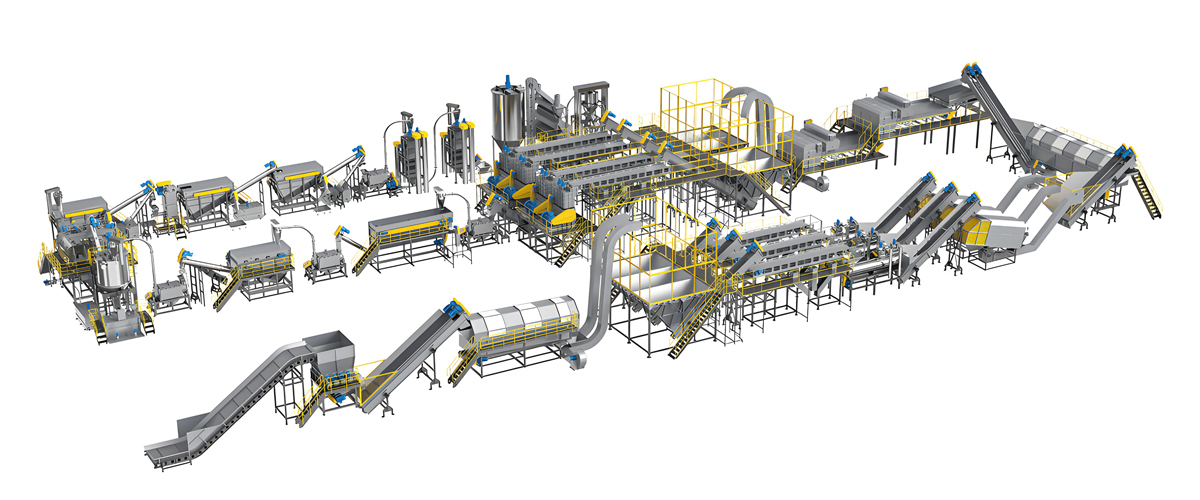
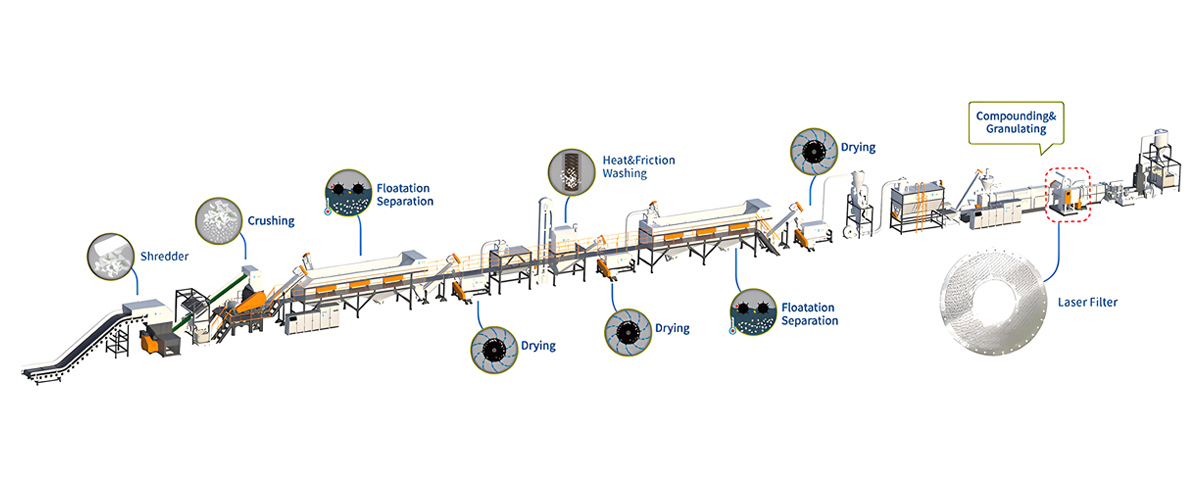
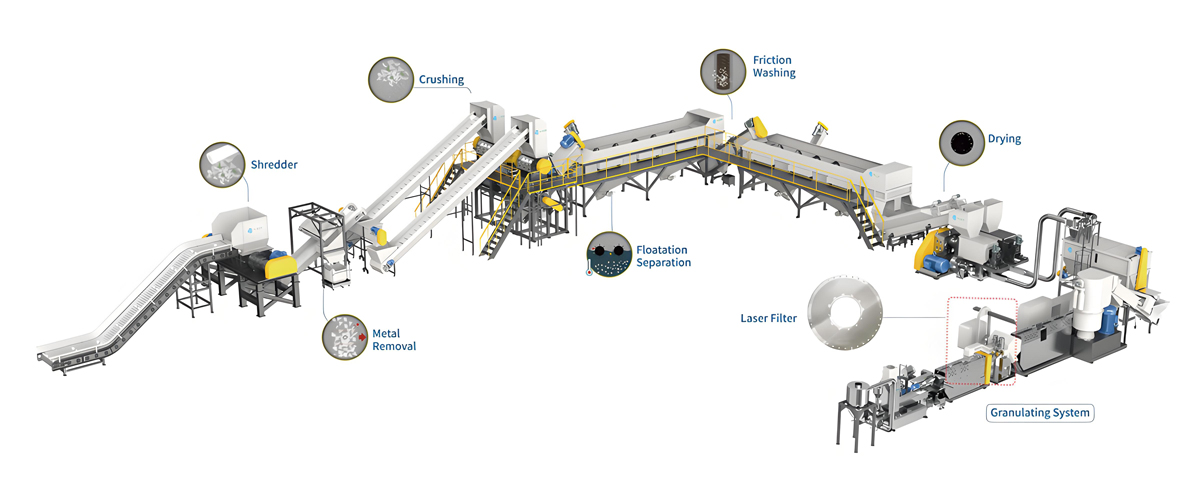
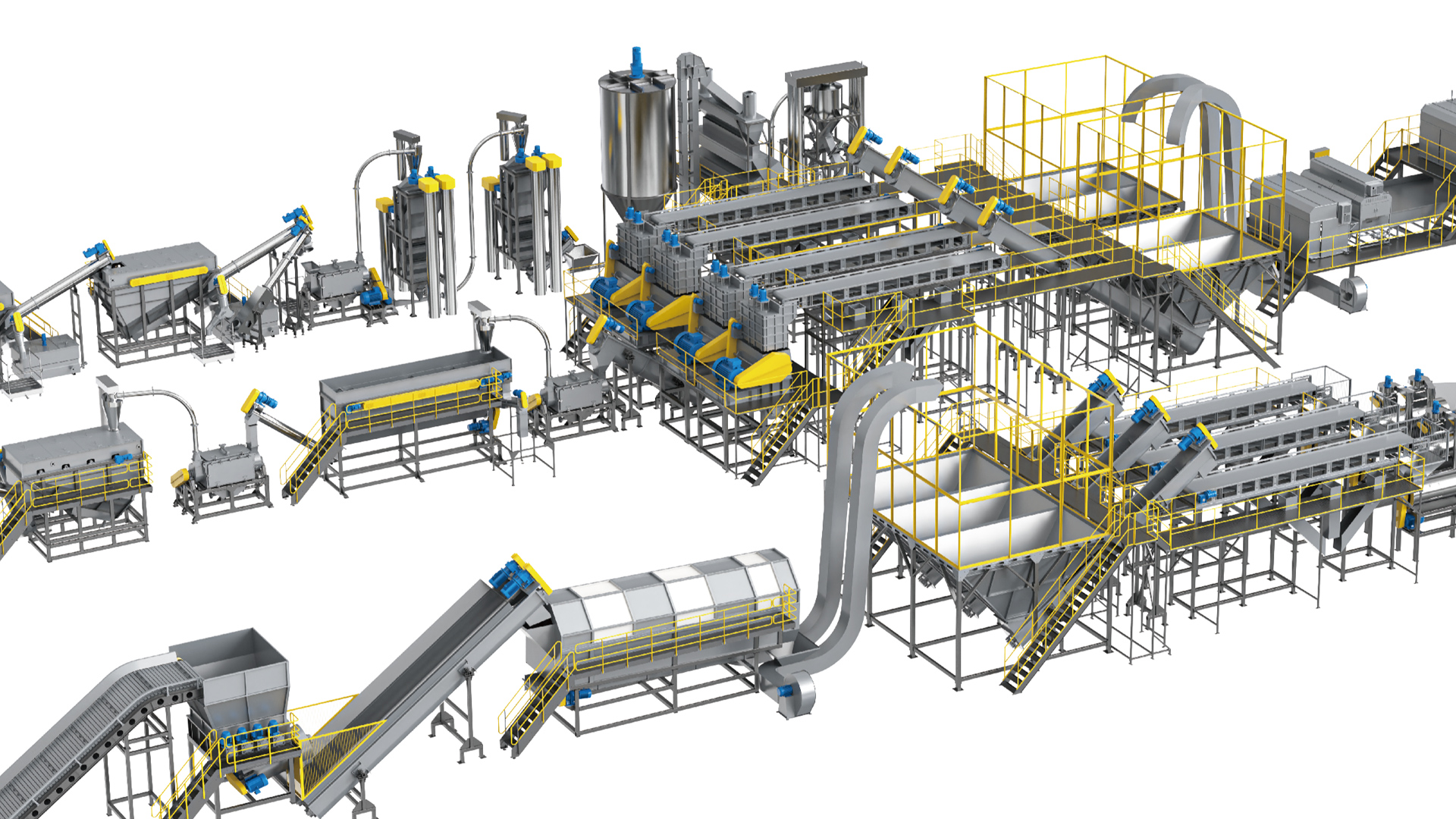
A soft plastic washing line for gloves and masks is organized around one principle: open the material gently, wash it aggressively while wet, separate by density and metal, then squeeze rather than merely spin-dry. The sequence below is the proven layout. It differs from a rigid bottle line in three ways: it shreds at low speed with high torque, it leans on a squeezer instead of relying on a centrifugal dryer alone, and it carries extra agitation and scraping in the float tanks to defeat wrapping.
Stage 1: Sorting, Metal Detection and Aluminum Recovery
Material first meets a manual or mechanical pre-sort belt, then passes a metal detector and a magnetic separator for ferrous objects, and finally an eddy current separator that throws the non-ferrous aluminum nose strip out of the stream. Capturing aluminum early protects every downstream rotor and prevents bright metal streaks in the final flake. This stage is cheap insurance and should be treated as mandatory, not optional, for mask-rich feed.
Stage 2: Shredding and Wet Granulation
A single-shaft shredder with a rotor speed of 60 to 120 rpm and a screen of 40 to 80 mm opens bulky gloves and masks into manageable pieces without generating the heat and fines that a high-speed cutter would. Soft material needs a different blade geometry than rigid plastic: hooked or angled knives with a large bite and a low-speed, high-torque hydraulic drive. The output drops into a wet granulator running a 12 to 20 mm screen, which further reduces size under a water curtain that immediately suppresses dust and begins pre-washing. Running the granulator wet is the key trick that keeps the plant clean and the operators breathing.
Stage 3: Friction Washing and Hot Alkali Wash
A friction washer spinning at 700 to 1,000 rpm scours the flake surface, knocking off talc, oil, and loose fiber. The material then enters a hot washer tank held at 75 to 90 degrees Celsius with a 1 to 3 percent sodium hydroxide solution plus a non-ionic detergent or surfactant. The heat and alkalinity dissolve skin oils, denature proteins, and lift organic soil; the surfactants stop the loosened grease from re-depositing. Dwell time, bath concentration, and rinse quality here decide whether the final pellet is clean or speckled.
Stage 4: Multi-Stage Sink-Float Separation
A sink-float tank exploits the density table from section 1. Light PP mask material and low-density TPE rise and are skimmed; PVC, aluminum, and elastane sink and are dragged out. Because soft flake wraps and mats, these tanks use stronger agitation, paddle augers, and continuous scraper chains rather than the gentle current used for rigid flake. A second, cleaner stage can use a tuned heavy-medium bath to split TPE grades that straddle the neutral line, improving the purity of the floating fraction.
The agitation design is the detail that most off-the-shelf tanks get wrong for soft waste. Rigid PET flake settles and can be lifted by a lazy auger; soft PPE flake forms a buoyant mat that rides the surface and never separates unless the tank is actively broken. Professional soft-plastic tanks therefore use a bottom-mounted paddle agitator that keeps the bed in motion, side-wall scrapers that stop material plastering the walls, and an overflow weir with a rotating skimmer that peels the floating layer off continuously instead of letting it re-wet. The sink product is dragged by a slow chain conveyor through a rinse zone before discharge so that carried-over surfactant does not contaminate the heavy cut. Getting this right typically lifts the float purity from a marginal result to a sellable, single-grade PP-TPE flake.
Stage 5: Dewatering and Squeezing
Soft, fibrous flake holds 20 to 30 percent moisture after a centrifugal dryer because water is trapped inside the entangled mat. A squeezer, sometimes built as a squeezer-compactor, mechanically presses the cake and squeezes interstitial water out, bringing moisture down to 5 to 8 percent. This step is the difference between a stable pelletizing run and a vent-plugged, surging extruder. Lines that skip the squeezer almost always regret it.
Stage 6: Hot-Air Drying and Cyclone (Brief)
The squeezed flake receives a pass through a hot-air drying duct with cyclone separation to strip the final surface moisture and any remaining light fiber before storage or direct feed. This stage is a finishing touch on top of the squeezer and is kept simple; the heavy lifting of dewatering is done in stage 5.
Stage 7: Pelletizing Interface
Because mask and film-rich flake has a bulk density of only 0.03 to 0.12 g/cm3, it bridges and starves a normal gravity hopper. The answer is a forced feeder or a compactor integrated with the single-screw extruder that pre-compacts and cram-feeds the fluffy material. A two-stage vented pelletizing setup strips volatiles through two vacuum vents, and a melt filter at 100 to 200 microns, either laser or screen-belt type, catches gel and black spots before the die-face cutter. For the pelletizing extruder itself, Wanplas’s Kerke factory supplies single-screw and twin-screw compounding extruders that integrate cleanly with a Polyretec washing and squeezing front end.
Full-Line Equipment, Parameters, Function and Required Status
| Process step | Equipment | Key parameters | Function | Status |
|---|---|---|---|---|
| Pre-sort and metal capture | Sort belt, metal detector, magnetic separator, eddy current separator | Metal detector sensitivity 1 to 3 mm ferrous; eddy current 0.5 to 2 kW | Remove objects and recover aluminum nose strip | Required |
| Coarse opening | Single-shaft shredder | Rotor 60 to 120 rpm, screen 40 to 80 mm, low-speed high-torque | Open gloves and masks without heat or fines | Required |
| Fine size reduction | Wet granulator | Screen 12 to 20 mm, water-curtain fed | Reduce size, suppress dust, pre-wash | Required |
| Surface scrub | Friction washer | 700 to 1,000 rpm | Knock off talc, oil, loose fiber | Required |
| Sanitize and degrease | Hot washer tank | 75 to 90 degrees Celsius, NaOH 1 to 3 percent, surfactant | Denature proteins, lift organic soil | Required |
| Density split | Sink-float tank, multi-stage | Paddle augers, scraper chains, tuned medium | Float PP and TPE, sink PVC, metal, elastane | Required |
| Dewater | Centrifugal dryer plus squeezer | Moisture 20 to 30 percent down to 5 to 8 percent | Remove trapped water before pelletizing | Required (squeezer critical) |
| Finish dry | Hot-air duct and cyclone | Air 80 to 120 degrees Celsius | Strip surface moisture and light fiber | Optional |
| Pelletize | Force feeder or compactor with single-screw extruder | Two-stage vented, melt filter 100 to 200 microns | Make clean, stable pellets from low bulk density flake | Required for pellet output |
Competitors such as Herbold Meckesheim, Vecoplan, Sorema, and ACERETECH each sell pieces of this puzzle, and a buyer will encounter all of them in tenders. The advantage of specifying a complete line from one recycling specialist such as Polyretec is that the squeezer, the float tank agitation, and the compactor-coupled extruder are tuned as one system rather than integrated after the fact, which is exactly where soft-plastic projects tend to fail.
The compactor deserves one more note because it is the bridge between washing and pelletizing and the point where bulk density is defeated. A compactor receives the squeezed, still-fluffy flake and uses a rotating blade disk under a fixed knife to pre-heat and densify the material against the chamber wall, forming a continuous plug that is screw-fed into the extruder at a controlled rate. This removes the bridging entirely and pre-heats the feed, cutting the extruder’s specific energy. Where a standalone force feeder only pushes, a compactor transforms: it turns a 0.05 g/cm3 fluffy waste into a 0.4 to 0.6 g/cm3 dense feed cake in one step. For mask and film-rich streams this single machine is the reason the pelletizer runs at nameplate instead of stalling at half capacity, and it is why the stage 7 equipment in the table is marked required rather than optional for anyone targeting pellet output.
4. Equipment Selection Criteria and Capacity Tiers
Capacity is the headline number buyers ask for, but it is the least informative on its own. A 300 kg/h nameplate means little if the feed is intermittent, the water is not reclaimed, or the floor space is wrong. The three practical tiers for TPE glove and mask waste are 300 kg/h, 500 kg/h, and 1,000 kg/h, and each implies a different equipment footprint, power envelope, and water loop.
Capacity Tier, Installed Power, Water Use and Footprint
| Capacity tier | Installed power (kW) | Fresh water use (m3 per hour) | Footprint (m2) | Best fit |
|---|---|---|---|---|
| 300 kg/h | 105 to 180 | 1.5 to 2.5 (after reuse) | 180 to 260 | Collectors, pilots, regional startups |
| 500 kg/h | 175 to 300 | 2.5 to 4.0 (after reuse) | 280 to 400 | Steady regional PPE supply |
| 1,000 kg/h | 350 to 600 | 4.5 to 7.0 (after reuse) | 480 to 700 | Consolidated industrial PPE streams |
The installed-power ratio of 0.35 to 0.60 kW per kg/h is a useful sanity check. A quote far below that band usually means an undersized squeezer or a missing float stage; a quote far above it signals an oversized drive train that will sit idle. Water is the hidden operating cost. A closed loop with dissolved air flotation, sedimentation, and multi-stage filtration typically reclaims 80 to 90 percent of the wash water, so the fresh-water draw is a fraction of the recirculated volume. Skipping the water treatment skid to save budget is a false economy: the line either discharges non-compliant effluent or it runs dirty water and produces grey pellets.
Footprint scales faster than capacity because the float tanks, the squeezer, and the water plant are space-hungry. A 1,000 kg/h line is not twice the size of a 500 kg/h line; it is closer to 1.7 times the floor area once you include the equalization and treatment tanks. Buyers should also budget headroom for a maintenance aisle around the shredder and granulator, because those are the machines that need the most frequent blade changes on abrasive, dusty feed.
The water loop is the part first-time buyers underestimate. Fresh intake enters the friction washer and hot washer, then flows to an equalization tank that buffers the variable load, then to dissolved air flotation where micro-bubbles lift suspended solids and free oil to a surface scum that is skimmed to sludge. The clarified water passes sedimentation for heavier fines and a sand or bag filter for polish before returning to the line at 80 to 90 percent reuse. The remaining 10 to 20 percent bleed, concentrated with contaminants, is the stream that must meet the local chemical oxygen demand and suspended-solids limit on discharge; many plants send this bleed to a municipal treatment works rather than building their own biological stage. Skipping the flotation and filter skid to save budget is the classic false economy: the line either breaks the permit or runs dirty water and produces grey, low-value pellets.
Control and automation are where the three tiers diverge most in practice. A 300 kg/h line can run on local panels with manual bath-strength checks, while a 500 kg/h line benefits from a central PLC that logs throughput, motor load, and water conductivity, and a 1,000 kg/h line should carry a full HMI with recipe management so that an operator switches between a glove-rich and a mask-rich feed by loading a recipe rather than re-tuning by hand. Motor load on the shredder is the single best early-warning signal for wrapping and blade wear, and trending it prevents the unplanned stoppages that cost more than the automation itself. Remote monitoring, where the site allows it, lets the equipment supplier support commissioning and catch drift before it becomes scrap.
The relative investment level by tier, stated without currency, runs from Medium at 300 kg/h to High at 500 kg/h and Very High at 1,000 kg/h, with a Premium band for lines that add full two-stage pelletizing, laser filtration, and automated flake sorting. Operating cost tracks the same order because power and water treatment scale with throughput. The right tier is the one that matches confirmed, segregated feed supply rather than hoped-for volume; an underfed 1,000 kg/h line is the most expensive way to lose money in this business.
5. Critical Difficulties and Countermeasures
Soft PPE waste creates a short list of recurring failures. Knowing them in advance lets the design defeat them rather than discover them on the night shift. The table below pairs each difficulty with its root cause and the countermeasure that actually works.
Common Difficulty, Root Cause and Countermeasure
| Difficulty | Root cause | Countermeasure |
|---|---|---|
| Wrapping around shafts and rotors | Long, flexible film and fiber entangle on turning parts | Single-shaft low-speed high-torque shredder, anti-wrap rotor, accessible Chamber, frequent blade service |
| Unstable feeding from low bulk density | Flake at 0.03 to 0.12 g/cm3 bridges and starves hopper | Compactor or force feeder integrated with extruder; tamping agitator in hopper |
| High residual moisture | Water trapped in entangled mat after centrifugal dryer | Squeezer bringing moisture from 20 to 30 percent down to 5 to 8 percent |
| Odor and fumes | Organic soil, skin oil, protein decomposition | Hot alkali wash at 75 to 90 degrees Celsius, ozone or hypochlorite, negative-pressure carbon or UV exhaust |
| Static cling and dust | Dry flake friction, low humidity | Static eliminator on conveyor, humidity control, wet handling through granulation |
| Black spots in pellets | Charred oil, cured rubber, insufficient hot wash | Stronger hot wash, two-stage vented pelletizing, melt filter 100 to 200 microns |
| Gel and specks from ear loops | Crosslinked spandex and nylon do not melt | Density split of elastane, fine melt filtration, accept small residual via filter |
| PVC contamination yellowing | HCl release degrades polyolefin melt | Effective sink-float, dense-media tuning, strict source control |
Two of these deserve emphasis because they sink more projects than any other. Wrapping is defeated by design, not by operator vigilance: a shredder built for rigid plastic will strangle on gloves, and only a purpose-shaped rotor with easy access for cut-and-clear will survive. Feeding instability is defeated by the compactor, not by a bigger hopper; fluffy flake will bridge in any bin, so cram-feeding is the engineered answer. Both are reflected in the equipment list of section 3 and should appear as line items in every quotation you evaluate.
6. Output Pellets and End Markets
A well-run line yields two main product streams. The floating PP-rich fraction becomes a recycled PP pellet suited to non-food injection molding such as turnover boxes, crates, and non-food-contact components. The TPE-rich fraction becomes a softer recycled TPE pellet used for shoe soles, floor mats, sealing strips, and automotive floor mats. Neither is food-grade, and both should be sold with that clear boundary stated, but both command steady industrial demand.
Output Grade, Typical Application and Property Retention
| Output grade | Typical application | Property retention and notes |
|---|---|---|
| Recycled TPE pellet | Shoe soles, floor mats, sealing strips, car mats | Tensile strength retained 70 to 90 percent; Shore A hardness 50 to 90; MFR shifts with thermal history |
| Recycled PP pellet | Turnover boxes, crates, non-food parts | Good stiffness; some fiber residue; not for food contact |
| Rubber-modified blend | Construction mats, bitumen modifier, profiles | Absorbs residual NBR or latex as filler; lower tensile, higher toughness |
Property retention is the honest part of the story. Mechanical recycling of soft PPE waste typically preserves 70 to 90 percent of original tensile strength, and the Shore A hardness of the TPE fraction lands in the 50 to 90 range depending on the SEBS-to-oil balance and how much PP is blended in. Melt flow rate moves with each thermal pass, so the line should log MFR per batch and blend to a target window rather than assume a fixed grade. Buyers in shoe soles and mats care about toughness and color consistency more than absolute strength, which is why these outlets absorb recycled TPE so well.
For demanding applications, a small dose of compatibilizer between the PP and any TPU fraction, plus a virgin top-up, raises impact and homogenizes the melt. This is where the Wanplas group’s compounding know-how, through its Kerke factory, adds value: a washing line that hands off to a tuned compounding extruder produces a sellable, spec-controlled pellet instead of a variable regrind. The pelletizing interface described in stage 7 is the bridge that turns washed flake into a product rather than a byproduct.
7. Environmental Compliance and Wastewater / Exhaust Treatment
A soft plastic washing line is a water and air permit holder, not just a machine. Wastewater leaving the wash stages carries suspended solids, surfactants, and organic load measured as chemical oxygen demand and suspended solids. A compliant plant treats this on site: dissolved air flotation removes suspended solids and free oil, sedimentation settles fines, and sand or cartridge filtration polishes the stream before 80 to 90 percent is returned to the line. The small bleed stream that is discharged must meet local limits for chemical oxygen demand and suspended solids, and that limit is a permit condition, not a suggestion.
Exhaust air from the hot washer and dryer carries odor and volatiles. Activated carbon adsorbs the odor compounds, ultraviolet oxidation breaks down many organics, and for larger lines a regenerative thermal oxidizer handles the load with heat recovery. Noise is the quiet compliance item that surprises operators: the shredder, friction washer, and squeezer are the loud machines, and enclosures plus isolation mounts keep the plant inside occupational noise limits. Standards such as ISO 14001 for environmental management and EuCertPlast for recycled-content traceability are increasingly required by European buyers, and a line built with documented source control and batch records is far easier to certify than one assembled from mixed second-hand units.
Compliance is also about what you refuse to process. The same intake declaration mentioned in section 2 is the foundation of any credible certification: if infectious medical waste never enters the gate, the recycled pellet can honestly carry a non-medical, industrial-origin claim. Pair that with weighed intake, batch labels, and a water balance sheet, and the operation satisfies both the regulator and the brand owner who buys the pellets.
Sludge and solid residue are the overlooked output of any washing line. The float scum, the sedimentation underflow, and the filter backwash concentrate the talc, fiber, oil, and metal fines removed from the plastic, and they must be handled as a separate waste stream rather than landfilled with the pellets. Most plants dewater this sludge into a cake and send it to a licensed handler or, where the local rules permit, to co-processing in cement kilns where the calorific content of the trapped plastic offsets fuel. Treating sludge as a managed byproduct, not a nuisance, keeps the water loop clean and the permit intact, and it is a line item buyers should price before signing, not after the first tank clean-out.
Certification readiness turns a compliant plant into a marketable one. EuCertPlast, for example, requires documented traceability from intake through output, so the batch records, source declarations, and water balance mentioned above are not bureaucracy but the actual evidence a auditor inspects. ISO 14001 forces a written environmental management system with objectives and monitoring, which a well-instrumented line already produces as a byproduct of normal operation. A line cobbled from mixed second-hand units rarely carries this paper trail, and the price gap between certifiable and non-certifiable pellets is often larger than the saving from buying used. For any recycler selling into European or brand-driven supply chains, certification readiness should weigh as heavily in the purchase decision as the stainless grade of the tanks.
Frequently Asked Questions
Can used medical gloves and masks be recycled into a washing line?
Only non-infectious industrial and commercial PPE waste, factory rejects, and overstock qualify for recycling through a washing line. Used healthcare gloves and masks that may carry infectious body fluids are classified as medical waste and must be disposed of through regulated incineration or autoclaving channels, not mechanical recycling.
Why does soft plastic waste need a squeezer instead of only a centrifugal dryer?
Film and fiber-rich soft waste holds water inside entangled flakes, so a centrifugal dryer alone leaves moisture around 20 to 30 percent. A squeezer or squeezer-compactor presses the cake and pushes surface and interstitial water out, dropping moisture to 5 to 8 percent, which is mandatory before stable pelletizing of low bulk density material.
What separates polypropylene mask material from PVC gloves on the line?
Polypropylene has a density of about 0.90 to 0.91 g/cm3 and floats in water, while plasticized PVC gloves sit at 1.30 to 1.45 g/cm3 and sink. A multi-stage sink-float tank therefore lifts PP mask layers and sinks PVC, with denser media used when TPE grades overlap the neutral range.
How is the aluminum nose strip removed from disposable masks?
After the mask is opened by the shredder and wet granulator, the embedded aluminum nose strip is pulled out by magnetic separation for ferrous capture and by an eddy current separator for non-ferrous aluminum recovery, preventing metal from reaching the friction washer, pelletizer, and melt filter.
What causes black spots and gel in the final recycled pellets?
Black spots come from charred contaminants, oil residue, and insufficient hot-wash alkalinity, while gel originates from crosslinked spandex ear loops and cured rubber fractions that will not melt. Countermeasures include stronger hot washing, two-stage vented pelletizing, and laser or screen-belt melt filtration at 100 to 200 microns.
Is a 300 kg/h line enough for a regional PPE recycler?
A 300 kg/h line fits collectors and pilots with limited and intermittent feedstock, while 500 kg/h suits steady regional supply and 1,000 kg/h serves consolidated industrial PPE streams. The installed power ratio of 0.35 to 0.60 kW per kg/h and the 80 to 90 percent water reuse rate should guide the decision more than nominal capacity alone.
Conclusion
The best soft plastic washing line for TPE glove and mask waste is purpose-built, not adapted. It starts with honest feedstock identification: thermoplastic TPE and PP are the recyclable core, TPU needs compatibilization, and cured NBR or latex is managed as filler or routed to energy recovery. It sanitizes at the gate with source declarations and in the tank with heat, alkali, and ozone. It opens material gently in a low-speed single-shaft shredder, scrubs it in a high-rpm friction washer, splits it by density in agitated sink-float tanks, and dewaters it with a squeezer that a rigid line would never need. It feeds a compactor-coupled, two-stage vented pelletizer with fine melt filtration, and it closes the loop with water treatment and odor control that satisfy the permit.
For buyers, the selection checklist is simple to state and easy to forget: confirm segregated, non-medical feed; specify the squeezer and the float-tank agitation explicitly; verify the installed-power ratio of 0.35 to 0.60 kW per kg/h; demand an 80 to 90 percent water reuse loop; and size the tier to real supply rather than ambition. Polyretec, a Wanplas factory, delivers these lines as integrated systems and connects them to the Wanplas group’s compounding extruder capability through the Kerke factory, so washed flake becomes a spec-controlled pellet instead of a variable regrind. Treat the difficulties in section 5 as design requirements, not surprises, and the line will pay back in clean, sellable material rather than in downtime and grey product.