
- 1. Why Noise Control Matters in Recycling Plants
- 2. Mapping the Noise Sources in a Shredder and Waschlinie
- 3. Typical Decibel Ranges by Equipment
- 4. Acoustic Enclosures for Shredders and Mills
- 5. Vibration Damping and Isolation
- 6. Silencers for Fans, Pumps and Pneumatic Lines
- 7. Workshop Layout and Operational Practices
- 8. Occupational Health Compliance and the 85 dB(A) Threshold
- 9. Noise Reduction Measure Effectiveness Comparison
- 10. Frequently Asked Questions
- 11. Key Takeaways and Conclusion
Why Noise Control Matters in Recycling Plants
Noise control in plastic recycling is not a comfort upgrade; it is a productivity, compliance, and equipment-reliability requirement. A plastic shredder and washing line operation generates some of the highest continuous sound levels in a plastics plant because it combines rotating cutting tools, high-volume air movement, and pressurized water in one continuous process. Left untreated, these lines push operators past safe exposure limits and drive unplanned maintenance from vibration fatigue.
The business case for reducing noise is concrete. Lower sound levels extend the time an operator can work beside the line without hearing protection rotation, reduce turnover in noisy plants, and avoid regulatory penalties tied to occupational exposure. Quieter lines also tend to be better-maintained lines, because a well-damped, enclosed machine is easier to inspect and suffers less structural fatigue. For overseas B2B buyers building a new recycling hall, designing noise control in from the start costs far less than retrofitting it later.
Polyretec, a Wanplas factory, builds washing and pelletizing lines that follow Austrian technology process discipline, and noise control is part of that discipline. European recycling equipment suppliers such as Lindner, Erema, and Starlinger treat acoustic enclosure and vibration isolation as standard engineering, not optional accessories. A Polyretec line applies the same logic while delivering at Chinese manufacturing economics under the Wanplas group umbrella.
Quotable conclusion: “A plastic shredder and washing line is loud by physics, not by accident; the question is whether the noise is engineered out at the source or merely endured by the operator.”
This guide walks through source identification, decibel ranges, and the three engineering levers that actually work, acoustic enclosures, vibration damping, and silencers, before covering workshop layout and the 85 dB(A) occupational threshold that defines compliance in most markets.
Source mapping should be recorded as a simple table during the supplier’s test run, listing each machine, its distance from the nearest operator position, and its untreated level. This table becomes the design specification for the acoustic package: the loudest machine closest to people gets the enclosure, the next gets the silencer, and so on down the list. Skipping this ranking is how buyers end up with an expensive enclosure on a minor source while the shredder next to the control desk runs untreated.
Mapping the Noise Sources in a Shredder and Waschlinie
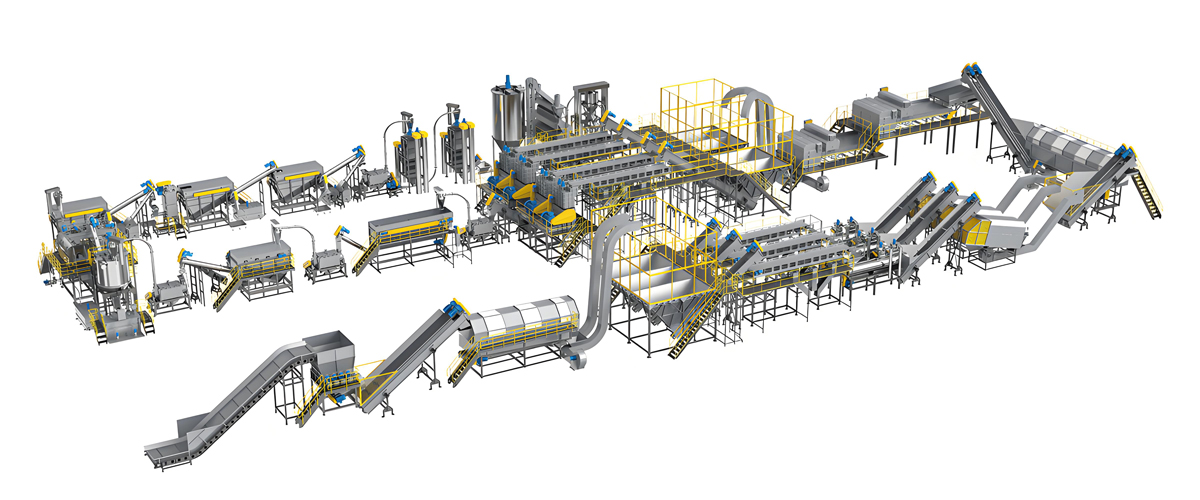
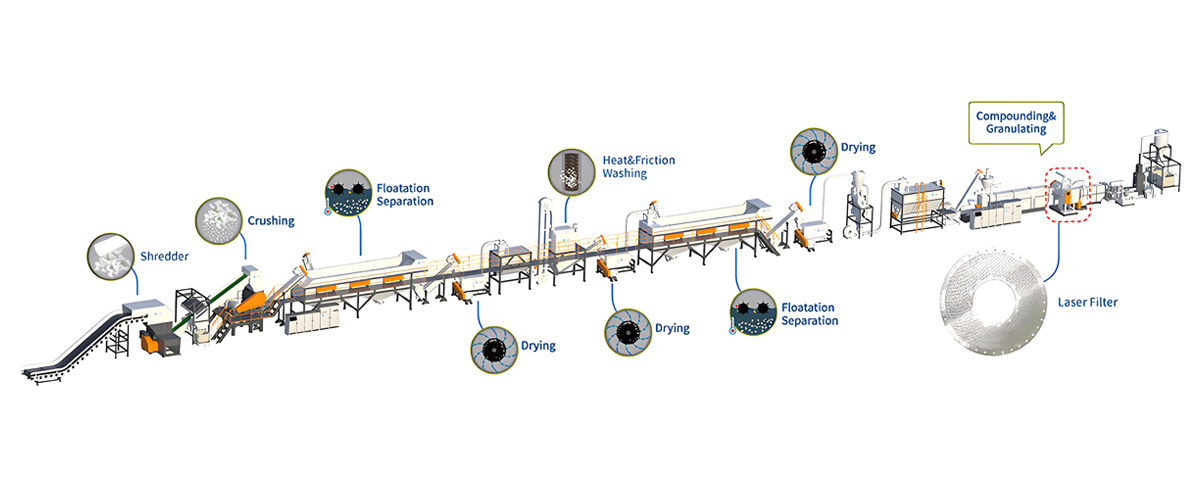
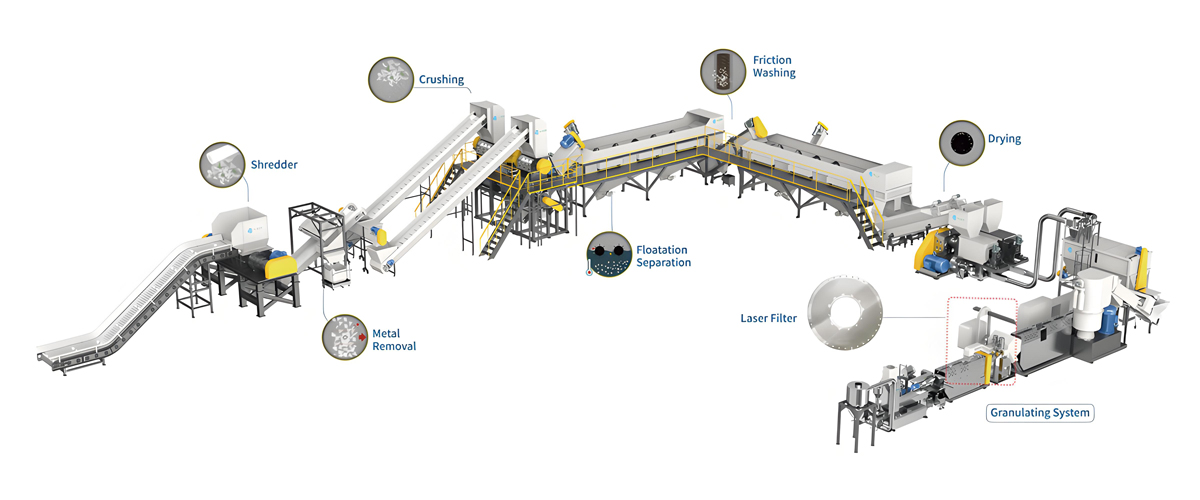
Effective noise reduction starts with a source map, because you cannot treat sound you have not located. In a typical plastic shredder and washing line operation, four families of machines dominate the sound field: the shredder blade shaft, the friction washers and high-speed rotors, the centrifugal fans and blowers, and the water pumps and electric motors. Each has a different physical mechanism and therefore a different cure.
The shredder blade shaft is the loudest single point. As hardened rotor knives strike incoming bottles, film, or rigid scrap, they create impulsive impact noise and a broadband screech from knife-on-material friction. Rotational speed, knife sharpness, and material hardness all shift the level. Friction washers and beater mills add a continuous high-frequency hiss from paddles thrashing material against a perforated cage.
Centrifugal fans for pneumatic conveying and drying produce a tonal whistle at blade-pass frequency plus broadband whoosh; this is the second major contributor and the easiest to miss because the fan often sits away from the operator. Water pumps contribute a low-frequency hum and pipe-borne structure-borne noise that travels through the floor. Electric motors add a electrical whine and cooling-fan noise, usually moderate but persistent across the whole hall.
| Noise Source | Physical Mechanism | Frequency Character | Primary Treatment |
|---|---|---|---|
| Shredder blade shaft | Impacts of knives on material | Broadband + impulsive | Enclosure + damping |
| Friction washer rotor | Paddle-on-material scrubbing | High-frequency hiss | Enclosure + lagging |
| Centrifugal fan / blower | Blade-pass + airflow turbulence | Tonal + broadband | Inlet/outlet silencer |
| Water pump | Cavitation + structure-borne | Low frequency | Isolation + silencer on discharge |
| Electric motor | Electrical whine + fan | Mid frequency | Encapsulated motor + isolation |
Once the map is drawn, the rule is to treat the loudest, closest, and longest-running sources first. For most lines that means the shredder enclosure and the fan silencers, because those two alone often account for the majority of the operator’s exposure.
Reading these ranges correctly prevents over- or under-specification. A buyer who sees a figure on a datasheet should ask at what distance and whether treated, because a number measured at one metre untreated describes the worst case an operator might face during a jam clear, not the compliant running level. The engineering target is to bring the operator’s eight-hour position below the action level, which usually means cutting the loudest sources by fifteen to twenty decibels through the combined measures in later sections.
Typical Decibel Ranges by Equipment
Decibel levels on a recycling line are best discussed in A-weighted decibels, written dB(A), because that scale approximates human hearing sensitivity. The ranges below are representative of commissioned single-shaft shredders, double-shaft shredders, friction washers, and associated utilities, measured at one metre from the machine without treatment. Treated values are included to show what engineering can achieve.
A single-shaft shredder cutting rigid HDPE or PET can exceed one hundred dB(A) at one metre, placing it among the loudest machines in the plant. Double-shaft shredders for bulky objects are slightly lower but still severe. Friction washers sit in the nineties. Fans and pumps cluster in the eighties to low nineties. The danger is cumulative: an operator walking the line is exposed to several of these sources in sequence, and the quietest part of the route still exceeds the safe eight-hour limit.
| Equipment (1 m, untreated) | Typical dB(A) Range | Typical dB(A) With Treatment |
|---|---|---|
| Single-shaft shredder (rigid) | 100 to 108 | 82 to 90 |
| Double-shaft shredder (bulky) | 92 to 100 | 80 to 88 |
| Friction washer / beater | 88 to 96 | 78 to 86 |
| Centrifugal fan (conveying) | 85 to 95 | 75 to 83 |
| High-pressure water pump | 82 to 90 | 74 to 82 |
| Electric motor (standard) | 78 to 86 | 72 to 80 |
These numbers explain why simply handing an operator ear defenders is insufficient. Even with protection, a source above one hundred dB(A) at one metre is hazardous to anyone working nearby during clearing, knife changes, or jam recovery. Engineering control at the source is the only durable answer, with personal protection as the backup layer.
Quotable conclusion: “A shredder at one hundred and five dB(A) is not made safe by earplugs alone; engineering noise control at the source is the primary control, and hearing protection is the last line of defense.”
A common failure mode is the leaky enclosure: a panel built to a high rating but defeated by an un-gasketed cable pass or a propped-open access door during operation. The attenuation of an enclosure is only as good as its worst seal, so Polyretec’s Austrian-technology approach delivers the enclosure as a factory-fitted, gasket-compressed module with documented panel fit, and trains operators to keep doors closed while running. An enclosure that is opened for a casual look can lose most of its benefit in seconds.
Acoustic Enclosures for Shredders and Mills
An acoustic enclosure is a sealed housing around the noisy machine built from mass-loaded panels, internal absorption, and a controlled opening for feed and discharge. For a plastic shredder and washing line operation, the shredder and friction washer are the priority enclosure targets because they are the loudest fixed points and the most practical to box in.
A well-designed enclosure combines three elements. First, mass: dense panels (steel with loaded vinyl or composite sandwich) block sound transmission; doubling panel mass raises isolation by a predictable amount at mid frequencies. Second, absorption: open-cell acoustic foam or mineral wool on the inside converts reverberant energy into heat instead of letting it bounce. Third, sealing: every gap, maintenance door, and cable pass is gasketed, because a small leak can waste most of the enclosure’s performance.
Feed and discharge openings are the hard part. A shredder must accept bales and eject screened material, so the enclosure uses labyrinth openings, overhanging baffles, or flexible curtains that block the direct sound path without stopping material flow. For the friction washer, a partial enclosure with lagging wraps around the rotating cage while leaving the access door sealed during运行. Removable acoustic panels are specified so knife changes remain feasible.
The Austrian-technology discipline Polyretec applies favors enclosures delivered as factory-fitted modules rather than site-built boxes, because panel fit and gasket compression are consistent. Wanplas group lines are shipped with the enclosure integrated, reducing on-site acoustic risk. Buyers should confirm the quotation includes the enclosure as standard, not as a paid extra, for the shredder and the friction washer.
| Enclosure Element | Function | Typical Attenuation |
|---|---|---|
| Mass-loaded panel | Blocks transmission | Medium |
| Internal absorber | Kills reverberation | Medium |
| Gasketed seals | Stops leakage | High impact |
| Labyrinth opening | Feed while blocking path | Medium |
| Flexible curtain | Discharge isolation | Low to Medium |
A subtle but important point is that damping and isolation also protect the machine, not only the operator. Uncontrolled vibration accelerates bearing wear, loosens fasteners, and fatigues welded frames, shortening the interval between overhauls. A shredder that is well isolated and damped not only runs quieter but also spends more time between failures, so the noise budget and the maintenance budget are the same budget viewed from two sides.
Vibration Damping and Isolation
Much of the noise a recycling line radiates is not airborne at the source but structure-borne: the shredder and pumps shake the steel frame and the concrete floor, which then re-radiate sound into the hall. Vibration damping and isolation attack this path and are essential wherever enclosures alone leave a low-frequency rumble.
Damping means adding constrained-layer material to vibrating panels so their motion is converted to heat. Spray-on or adhered viscoelastic sheets on the shredder hopper, ductwork, and washer casing cut the panel-ring that dominates mid-frequency harshness. Isolation means decoupling the machine from the structure with resilient mounts, springs, or inertia blocks so the vibration energy is not transferred. A shredder on rigid bolts transmits everything; the same machine on tuned elastomer mounts or a spring isolation frame transmits far less.
Pumps are a classic isolation win. A high-pressure wash pump bolted to a steel skid sends low-frequency energy through the floor to every machine nearby. Mounting the pump and motor on a inertia block with elastomer pads, and fitting flexible connectors on the suction and discharge pipes, removes most of that path. Pipe hangers should also be fitted with acoustic clamps so the pipe does notbecome a loudspeaker.
For the shredder blade shaft specifically, balancing the rotor and keeping knives sharp reduces the impact energy that starts the whole chain. Dull knives increase impact force and therefore both noise and vibration, so a knife-maintenance schedule is itself a noise-control measure. Polyretec’s Austrian-technology lines ship with balanced rotors and documented maintenance intervals that double as noise-control discipline.
Quotable conclusion: “An enclosure stops sound leaving the box; vibration isolation stops the box itself from becoming the loudspeaker. You need both to quiet a shredder and washing line.”
Silencers for Fans, Pumps and Pneumatic Lines
Fans, blowers, and pneumatic conveying lines produce tonal noise at blade-pass frequency that an enclosure cannot easily contain, because air must flow in and out. The cure is a silencer, an inline acoustic device that interrupts the sound path in the duct while letting air pass. For a plastic shredder and washing line operation, fan inlet and outlet silencers deliver some of the best cost-per-decibel results available.
A reactive silencer uses chambers and tubes to cancel specific tones; an absorptive silencer lines the duct with acoustic material to soak broadband whoosh. Most recycling-line fans need a hybrid: reactive tuning for the blade-pass tone plus absorptive fill for the broadband component. Sizing matters; an undersized silencer chokes airflow and forces the fan to work harder, trading noise for energy. Polyretec specifies silencers matched to the fan curve so pressure loss stays within design.
Water pumps get silencers too, though of a different kind. A discharge silencer or anti-cavitation orifice smooths pressure pulses that otherwise ring through the pipework. Pneumatic lines on sorting and actuation points benefit from mufflers on exhaust ports, which are cheap and effective. Even the vent on a vented pelletizing extruder can be fitted with a tuned silencer to cut the high-frequency whistle that otherwise escapes the line.
| Component | Silencing Method | Frequency Target | Relative Cost |
|---|---|---|---|
| Fan inlet / outlet | Hybrid silencer | Tonal + broadband | Medium |
| Pump discharge | Pulse silencer / orifice | Low frequency | Low |
| Pneumatic exhaust | Muffler | Broadband | Low |
| Extruder vent | Tuned silencer | High frequency | Low |
| Duct elbows | Lined elbow | Broadband | Low |
The pattern across all three levers is the same: treat the source with the method matched to its physics. Enclose the impact, damp the panel, isolate the structure, and silence the airflow. Mixing the wrong lever, such as enclosing a fan without a silencer, leaves the dominant tone untouched.
Silencer selection also interacts with energy. A poorly sized silencer raises system pressure drop, forcing the fan or pump to draw more power to maintain flow, which can erase part of the energy savings elsewhere on the line. The correct specification matches the silencer’s insertion loss to the dominant tone while keeping pressure loss within a few percent of the open-duct curve. Polyretec sizes silencers against the actual fan and pump curves so acoustic gain never becomes an energy penalty.
Workshop Layout and Operational Practices
Even a well-treated line benefits from intelligent workshop layout, because distance and barriers reduce sound reaching the operator and the neighboring workstations. The goal is to keep people away from the one hundred dB(A) zone except when a task requires it, and to break line-of-sight between the loudest machines and the control area.
Practical layout rules from European recycling hall design: place the shredder and friction washer against a wall away from the control room, separate the operator station behind a partial acoustic screen, route pneumatic and duct runs away from walkways, and group quiet utilities (control cabinets, labs) in a low-noise zone. A control room with a glazed acoustic window lets staff monitor the line without standing next to it. Where the line must be serviced, design removable panels and safe access so clearing jams is quick and exposure is short.
Operational practices compound the engineering. Scheduling the loudest work (shredding, conveying) into shifts with fewer personnel nearby, keeping knives sharp to reduce impact noise, closing enclosure doors during运行, and training operators to report rising noise as a maintenance signal all sustain the gains. Wanplas group’s after-sales program, delivered through Polyretec, includes commissioning support that documents the as-built noise levels so buyers have a baseline to maintain.
For buyers planning a new hall, the cheapest decibels are bought on the layout drawing, not on the machine. Designing the enclosure, isolation, and silencer scope into the purchase order, and positioning the line for distance, prevents the far higher cost of acoustic retrofits after concrete is poured.
Documentation is the often-forgotten half of layout design. A noise map drawn at commissioning, with measured levels at each workstation, gives the buyer a legal baseline and a maintenance target: if a later measurement shows a rise, it points directly to the degraded component, a worn knife, a failed mount, or a bypassed silencer. Wanplas group commissioning through Polyretec records these baselines so the hall can be re-verified annually rather than assumed compliant.
Occupational Health Compliance and the 85 dB(A) Threshold
The 85 dB(A) threshold is the reference action level in many occupational noise regulations worldwide: an eight-hour time-weighted average at or above this level typically triggers a mandatory hearing-conservation program, including noise monitoring, hearing protection, and audiometric testing. Many frameworks set a higher exposure limit, often around air dB(A) for an upper bound, above which unprotected exposure is prohibited.
What this means for a plastic shredder and washing line operation is that untreated shredders and fans will push operators past the 85 dB(A) action level within minutes of starting work. The compliance strategy is therefore source engineering first: bring the operator position below the action level, then manage remaining exposure with rotation and protection. Relying solely on ear defenders is the weakest approach and is usually rejected by inspectors when engineering control is feasible.
Buyers should request the supplier’s documented sound-power or sound-pressure data and, where local law demands, commission an independent noise map after installation. Standards such as ISO acoustic measurement series and CE machinery safety requirements inform how the data is generated and how guards and enclosures are built, but these names remain plain references in this guide, not clickable links. Polyretec lines are built to align with CE machinery safety expectations as part of the Wanplas group quality system.
| Exposure Level (8-hr TWA) | Typical Regulatory Response |
|---|---|
| Below 80 dB(A) | Generally no action required |
| Around 85 dB(A) | Action level: monitoring + protection program |
| Above action level | Mandatory hearing conservation |
| Upper exposure limit | Unprotected exposure prohibited |
Quotable conclusion: “The 85 dB(A) threshold is not a suggestion for comfort; it is the line where occupational law requires a hearing-conservation program, and source engineering is the only control inspectors accept as primary.”
Local regulation varies, so buyers should confirm the exact action and limit values with the local safety regulator before relying on the thresholds above. What is consistent across jurisdictions is the hierarchy of control: eliminate or reduce at source first, then isolate the path, then protect the person. A line that meets the letter of a limit only through mandatory ear defenders is generally viewed as non-compliant where feasible engineering exists, which is why source treatment is the defensible design.
Noise Reduction Measure Effectiveness Comparison
The table below ranks the main measures by how much operator exposure they cut relative to cost, based on typical recycling-line retrofits. It helps buyers spend the noise-control budget where it returns the most decibels. The pattern is consistent: enclose the shredder, silence the fans, isolate the pumps, then damp the panels.
| Measure | Typical Operator Exposure Reduction | Cost Tier | Priority |
|---|---|---|---|
| Shredder acoustic enclosure | Very High | Medium | 1 |
| Fan inlet / outlet silencer | High | Low | 1 |
| Pump isolation + silencer | Medium | Low | 2 |
| Vibration damping on panels | Medium | Low | 2 |
| Friction washer lagging | Medium | Medium | 2 |
| Control room acoustic screen | Medium | Low | 3 |
| Hearing protection (alone) | Medium (backup only) | Low | Last resort |
The clear lesson is that the two highest-impact measures, shredder enclosure and fan silencers, are also mid to low cost, which is why every properly specified line includes them as standard. Personal protection belongs at the end of the hierarchy, not the start.
The practical implementation order follows the table directly: first specify the shredder enclosure and the fan silencers in the base quotation, then add pump isolation and panel damping, then position the control room behind an acoustic screen. Treating items in this sequence maximizes decibels saved per dollar and avoids the classic mistake of buying premium protection for a minor source while the dominant shredder runs open. Buyers who follow the ranking consistently reach the 85 dB(A) target without over-spending.
Frequently Asked Questions
What is the loudest part of a plastic shredder and washing line?
The shredder blade shaft is usually the loudest, often above one hundred dB(A) at one metre when cutting rigid plastic. Friction washers and centrifugal fans are the next largest contributors, followed by pumps and motors.
Can earplugs alone solve the noise problem?
No. Hearing protection is the last line of defense in the control hierarchy. Above the 85 dB(A) action level, law expects engineering control at the source; relying only on ear defenders fails inspection where feasible engineering exists.
How much can an acoustic enclosure reduce shredder noise?
A properly sealed, mass-loaded, internally absorbed enclosure typically brings a one-hundred-plus dB(A) shredder down to the eighties at one metre, a very high reduction that is the single biggest win available.
Why do fans need silencers rather than enclosures?
Fans must move air, so an enclosure with sealed openings cannot contain the tonal blade-pass noise traveling through the duct. Inline silencers interrupt that airborne path while letting airflow continue, which an enclosure cannot do.
Does vibration isolation really matter if I already have an enclosure?
Yes. The enclosure stops sound leaving the box, but the machine still shakes the frame and floor, which re-radiates low-frequency noise. Isolation decouples that path, so both are needed for a quiet line.
What is the 85 dB(A) threshold?
It is the common eight-hour time-weighted-average action level above which occupational rules require a hearing-conservation program. Many recycling lines exceed it untreated, making source engineering necessary for compliance.
Should noise control be specified at purchase or retrofitted later?
At purchase. Designing enclosures, isolation, and silencers into the order, plus a noise-aware layout, costs far less than cutting concrete and rebuilding ductwork after commissioning.
Key Takeaways and Conclusion
Reducing noise in a plastic shredder and washing line operation is an engineering discipline with a clear hierarchy: control at the source first, then the path, then the receiver. The shredder blade shaft, fans, pumps, and motors each have a distinct physical mechanism, and each demands the matched lever, enclosure for impact, silencer for airflow, isolation for structure-borne energy, and damping for panels.
Key points to remember:
- The shredder blade shaft is typically the loudest source, often above one hundred dB(A) at one metre.
- Acoustic enclosures, fan silencers, and pump isolation deliver the highest decibel reduction per cost.
- Vibration damping and isolation stop the structure from re-radiating low-frequency noise an enclosure cannot catch.
- The 85 dB(A) action level makes source engineering a compliance requirement, not an optional upgrade.
- Polyretec, a Wanplas factory, applies Austrian-technology noise discipline with enclosures and isolation built in, backed by the Wanplas group’s global service.
For buyers commissioning a new recycling hall, the recommendation is to specify shredder and friction-washer enclosures, matched fan and pump silencers, elastomer or spring isolation, and a noise-aware layout in the original order, then verify with a post-installation noise map. That approach keeps operators below the 85 dB(A) threshold, protects equipment from vibration fatigue, and satisfies occupational health compliance in one coordinated design.