
- Why Agriculture Film and Mulch Waste Need a Specialized Waschlinie
- Polyretec PP/PE Weiche Kunststoffzerkleinerung and Waschlinie
- Food-Grade-PET-Flaschen-Waschanlage as a Contrast
- The Austrian-Technology Process Route for Soft Plastics
- Step-by-Step: How the Line Cleans Agriculture Film and Mulch
- The One-Step Pelletizing Option
- Application Industries and End Products
- Selection Guide: Feedstock and Capacity to the Right Line
- Service, Support, and Factory Commitment
- Line Layout, Utilities, and Operational Optimization
- Frequently Asked Questions
- Conclusion
Why Agriculture Film and Mulch Waste Need a Specialized Waschlinie
Polyretec, a Wanplas factory, has built plastic recycling equipment since 2010 and has delivered more than 100 recycling projects across more than 50 countries. The brand was formally established in 2017 and combines a European-style technology route developed from Austrian process know-how with Chinese manufacturing scale, giving customers cost-effective systems without compromising cleaning quality. One of the most demanding feedstocks the company handles is agriculture film and mulch waste, and that material is exactly why a generic crusher-plus-washer setup fails.
Agriculture film is not like a rigid bottle. It is thin, flexible, and low in bulk density. A single kilogram of greenhouse film or mulch occupies a large volume and tends to tangle into balls that jam standard crushers. It also arrives contaminated with soil, sand, crop residue, adhesive labels, fertilizer film, and sometimes pesticide carryover. A washing line designed for hard plastic will mis-handle this feedstock because the unit operations are different: films float, they wrap around rotating shafts, and they hold moisture differently than flakes.
The material science reinforces the design choice. Agriculture film is typically made from LDPE or LLDPE, sometimes blended with a small amount of PP in co-extruded mulch. These polyolefins have low density, around 0.91 to 0.93 grams per cubic centimeter, which means they float in water while sand, soil, and most mineral contamination sink. That density gap is the foundation of sink-float separation, but only after the film has been cut small enough to release trapped air and entrained dirt. Large sheets trap air and behave unpredictably in water, so size reduction must happen early and in a wet environment.
Contamination also varies by source. Greenhouse film collected at end of season may carry adhesive tape, clip labels, and pesticide residue. Mulch film laid on open fields absorbs the most soil and often arrives with stones and roots. Post-consumer LDPE from packaging is cleaner but mixed with prints and laminates. A one-size washer cannot treat all of these well, which is why Polyretec offers configurable stages and tunes each line to the customer’s dominant feedstock during the sample analysis phase.
The best soft plastic washing line for agriculture film and mulch waste is therefore purpose-built around the behavior of flexible polyolefin film. It starts with a preprocessing stage that opens and pre-cleans the material, uses wet grinding instead of dry crushing, applies friction and sink-float separation tuned for films, and finishes with film-appropriate dewatering and drying. When the customer wants pellets rather than flakes, the line links to a downstream pelletizing stage supplied by Wanplas.
This guide explains the Polyretec approach in detail. You will learn the difference between soft and hard washing lines, the specifications of the PP/PE Weiche Kunststoffzerkleinerung and Waschlinie, how it compares with the Food-Grade-PET-Flaschen-Waschanlage, the process route derived from Austrian technology, the step-by-step cleaning sequence for mulch waste, the one-step pelletizing option, the application industries, a practical selection table, and the service commitment that comes with every Polyretec system.
Every claim here is anchored to standard recycling engineering practice and to the real product families Polyretec manufactures. We do not name specific third-party European brands; instead we describe the technology generically so you can judge the route on its merits.
Polyretec PP/PE Weiche Kunststoffzerkleinerung and Waschlinie
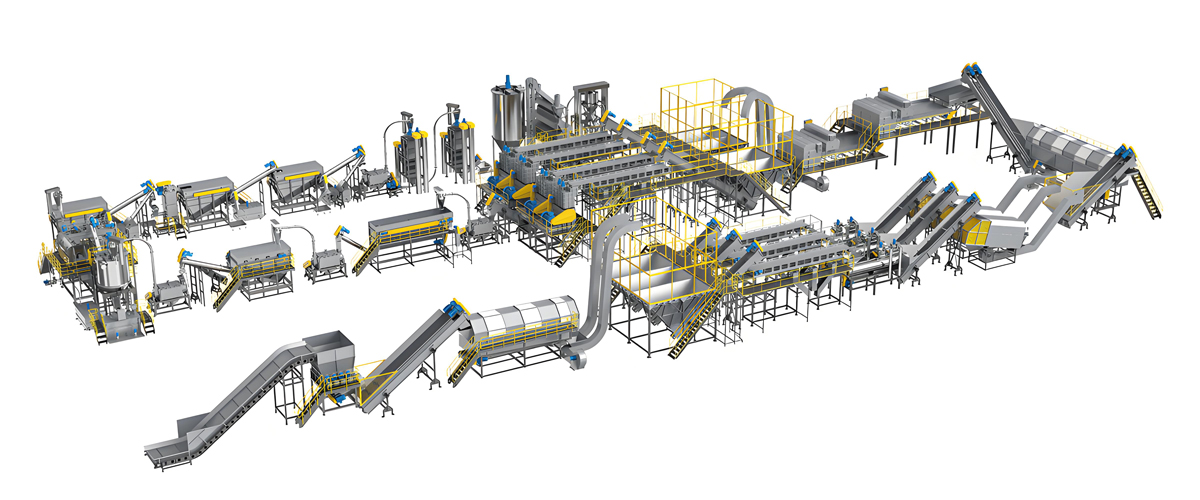
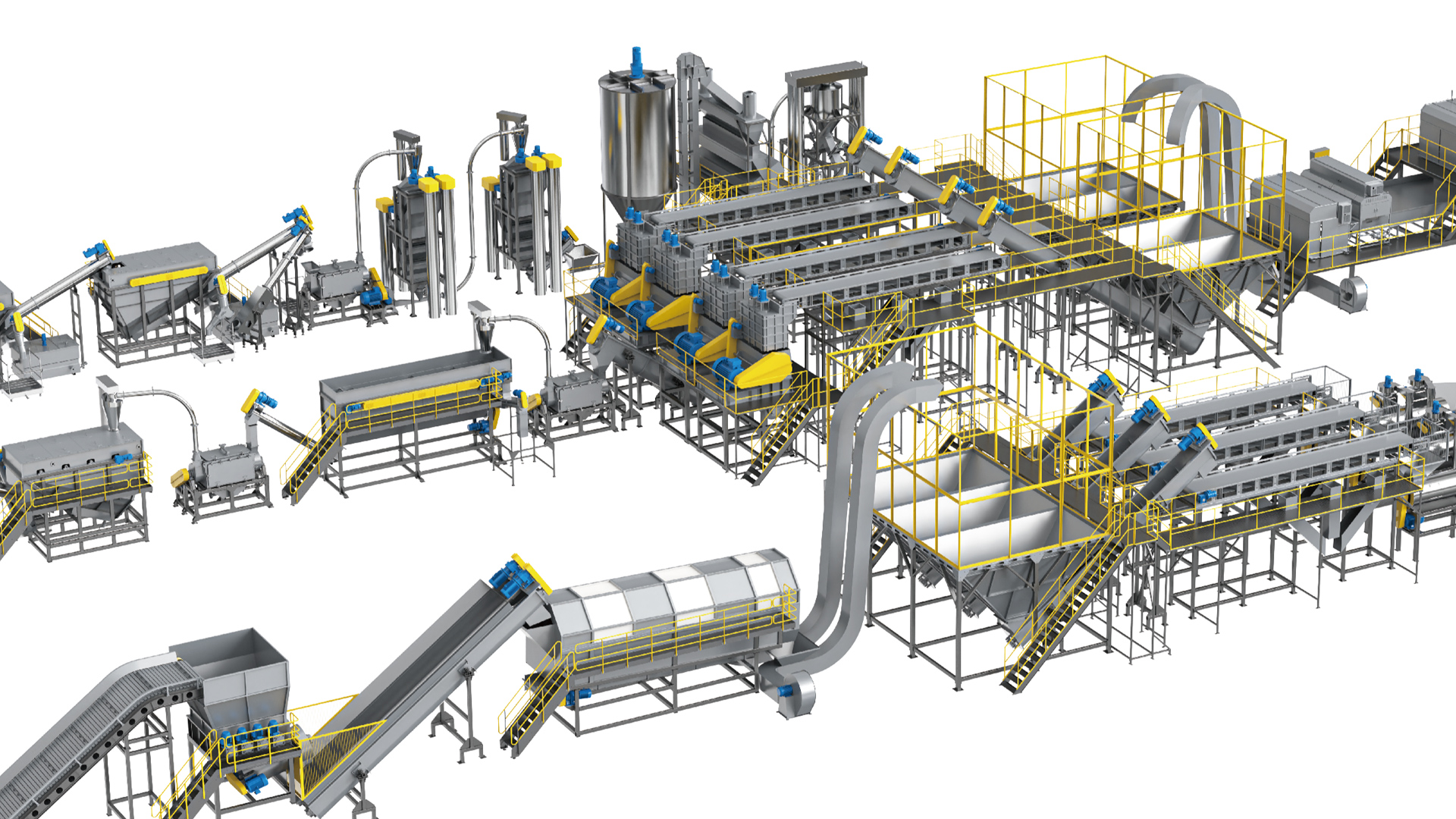
The PP/PE Weiche Kunststoffzerkleinerung and Waschlinie is Polyretec’s core solution for flexible polyolefin waste. It is configured for low-density film, woven bags, agriculture film, mulch, greenhouse film, and post-consumer LDPE and LLDPE packaging. The line is offered across a capacity range from 500 kg/h up to 1500 kg/h and can be paired with an optional one-step pelletizing module.
Because agriculture film and mulch are among the dirtiest feedstocks, this line emphasizes aggressive pre-wash and friction cleaning rather than relying on a single wash tank. The design goal is to deliver clean PP/PE flakes or a wet cake suitable for direct pelletizing, with low residual contamination and controlled moisture.
| Configuration | Throughput | Installed Power | Makeup Water | Typical Output | Footprint |
|---|---|---|---|---|---|
| PP/PE Waschlinie 500 | 500 kg/h | about 95 kW | about 0.6 m³/h | Clean PP/PE flakes or wet cake | approx. 25 m x 8 m |
| PP/PE Waschlinie 800 | 800 kg/h | about 140 kW | about 0.9 m³/h | Clean PP/PE flakes or wet cake | approx. 30 m x 9 m |
| PP/PE Waschlinie 1000 | 1000 kg/h | about 175 kW | about 1.1 m³/h | Clean PP/PE flakes or wet cake | approx. 34 m x 9 m |
| PP/PE Waschlinie 1500 | 1500 kg/h | about 240 kW | about 1.5 m³/h | Clean PP/PE flakes or wet cake | approx. 40 m x 10 m |
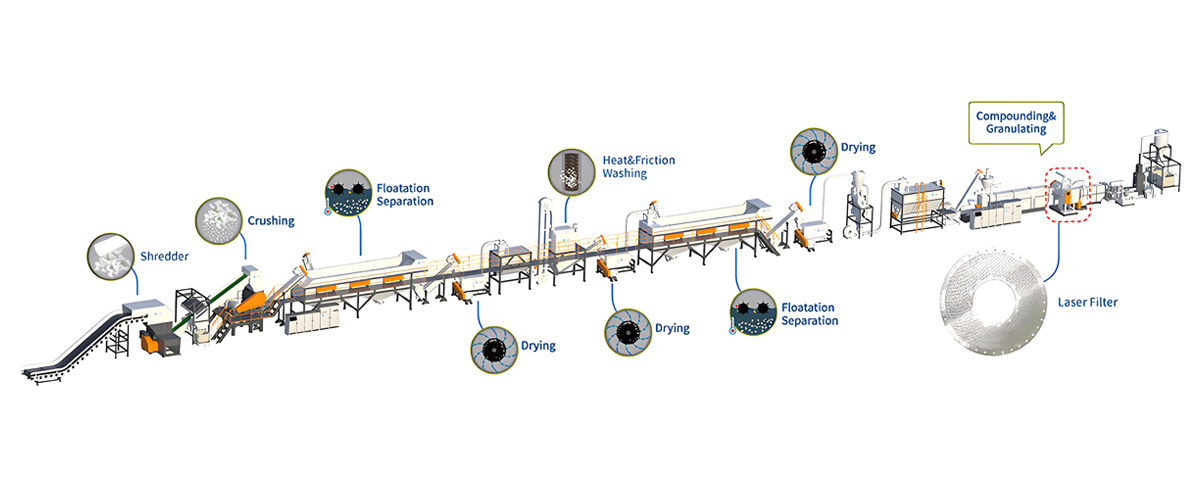
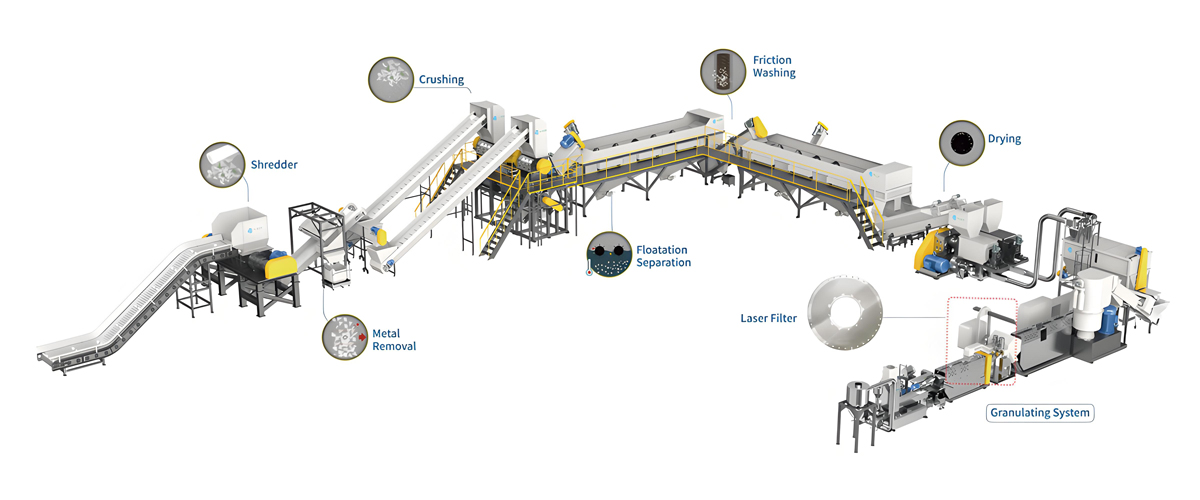
The parameters above represent the standard Polyretec series tiers. Each line is engineered as a complete module set: bale opener or hopper feeder, shredder or wet grinder, pre-wash tank, friction washer, sink-float separation tank, optional hot wash unit, rinsing tank, dewatering screw or centrifuge, and a thermal or mechanical dryer. Power and footprint scale with the selected throughput, and the layout can be adapted to the customer’s building.
For agriculture film collectors and regional recycling hubs, the 500 kg/h and 800 kg/h configurations are the most common entry points. The 1000 kg/h and 1500 kg/h configurations suit large agriculture film recovery operations that need continuous running and, frequently, the one-step pelletizing option described later in this article.
Material handling is built into the configuration rather than added later. The infeed can be a bale opener for compressed film or a belt hopper for loose collection, and a metal detector at the infeed protects the shredder from hidden ferrous objects that field-collected mulch often contains. The wet grinder operates with water injection so the cut film is immediately wetted, suppressing dust and beginning the wash while size reduction happens. This integration of cutting and pre-wetting is a small but important detail that keeps the line clean and safe. The line also handles the full family of flexible polyolefins: LDPE and LLDPE agriculture film, PP woven bags, greenhouse film, silage wrap, and post-consumer stretch film all run through the same core, with recipe changes for contamination level. Highly printed or laminated film is accepted but may need an extra rinse, and PVC-contaminated streams should be sorted out upstream because PVC adversely affects polyolefin recycling quality. Polyretec advises customers on acceptable contamination thresholds during the sample review.
The PP/PE Weiche Kunststoffzerkleinerung and Waschlinie converts contaminated agriculture film and mulch into clean polyolefin flakes or pellet-ready wet cake, with capacities from 500 kg/h to 1500 kg/h and a closed-loop water system that keeps makeup water low.
Food-Grade-PET-Flaschen-Waschanlage as a Contrast
To understand what makes a soft plastic washing line special, it helps to compare it with the Food-Grade-PET-Flaschen-Waschanlage that Polyretec also manufactures. The PET line is included here as a contrast, not as a competitor to the film line, because the two serve fundamentally different feedstocks and the engineering choices diverge sharply.
The Food-Grade-PET-Flaschen-Waschanlage processes rigid PET bottles into clean, food-contact-grade flakes. It handles capacities from 500 kg/h up to 6000 kg/h, far higher than the film line, because rigid bottles are dense, easy to convey, and break into uniform flakes. The PET route emphasizes label removal, caustic hot washing, precise sink-float density separation, and fine filtration to reach low levels of label, PVC, and glue.
| Configuration | Throughput | Installed Power | Makeup Water | Output Quality Target |
|---|---|---|---|---|
| PET Waschlinie 500 | 500 kg/h | about 130 kW | about 0.8 m³/h | Clean PET flakes |
| PET Waschlinie 1000 | 1000 kg/h | about 210 kW | about 1.3 m³/h | Clean PET flakes |
| PET Waschlinie 2000 | 2000 kg/h | about 360 kW | about 2.2 m³/h | Food-grade PET flakes |
| PET Waschlinie 3000 | 3000 kg/h | about 520 kW | about 3.0 m³/h | Food-grade PET flakes |
| PET Waschlinie 6000 | 6000 kg/h | about 900 kW | about 5.0 m³/h | Food-grade PET flakes |
The comparison below shows why you should not try to process agriculture film on a PET line, or bottles on a film line. The unit operations overlap in name only; the physical behavior of the material drives the design.
| Dimension | PP/PE Soft Film Waschlinie | Food-Grade-PET-Flaschen-Waschanlage |
|---|---|---|
| Feedstock type | Flexible film, mulch, woven bags, greenhouse film | Rigid PET bottles and trays |
| Bulk density | Very low, tangles easily | High, flows freely |
| Primary size reduction | Shredder plus wet grinder | Bottle pre-wash then crusher |
| Cleaning emphasis | Friction wash, soil and sticker removal | Label, glue, and caustic hot wash |
| Separation method | Sink-float and film-specific screening | Sink-float and density separation |
| Dewatering | Film squeezer or centrifuge | Centrifuge and hot air dryer |
| Capacity range | 500 to 1500 kg/h | 500 to 6000 kg/h |
| Downstream form | Flakes or one-step pellets | Flakes for rPET |
The takeaway is simple: choose the line that matches your material, not the one with the highest headline capacity. Polyretec manufactures both families, so the right answer for agriculture film and mulch waste is the soft plastic washing line, optionally integrated with Wanplas pelletizing.
One more contrast is worth noting: the PET line targets a food-grade output with strict limits on label, PVC, and glue content, which drives its heavier use of caustic hot washing and fine filtration. The film line targets clean industrial-grade flakes or pellet feed, so its cleaning is aggressive against soil and stickers but does not need the same chemical intensity. Understanding this difference prevents a buyer from over-specifying a film line with PET-grade caustic systems it does not need, or under-specifying a PET line that cannot reach food grade. Polyretec scopes each line to its actual output target rather than to a generic maximum.
The Austrian-Technology Process Route for Soft Plastics
Polyretec’s recycling equipment is built on a European-style technology route that originated from Austrian process know-how. We describe this route generically, focusing on the engineering principles rather than naming any supplier. The route is characterized by counter-current washing, multi-stage friction cleaning, closed-loop water treatment, and energy-conscious drying, all coordinated by a centralized control system.
The Austrian-technology route treats washing as a sequence of increasingly fine cleaning zones rather than a single tank. Dirty water from the later, cleaner stages is reused in the earlier, dirtier stages in a counter-current arrangement, which reduces both fresh water demand and effluent. A dedicated water treatment loop clarifies and filters the process water so it can recirculate. This is the same principle used in advanced European plants, adapted by Polyretec for cost-effective Chinese manufacturing.
The water treatment loop deserves specific attention because it is where the Austrian route separates from older-generation lines. Instead of discharging wash water after a single pass, the loop clarifies it through settling and filtration, then returns it to the pre-wash and friction stages. Fresh water is reserved for the final rinse so the cleanest water touches the nearly finished product. This arrangement cuts total water draw and reduces the load on any downstream effluent treatment the customer must provide.
Energy optimization follows the same philosophy. Motors use variable-frequency drives so each stage runs at the speed the current feedstock demands rather than a fixed maximum. The dryer and any hot-wash heater are sized to the line and insulated to recover heat. Over a full agriculture-film season, these measures lower the energy cost per ton of clean output, which matters for a low-margin recycling business.
| Route Attribute | Conventional Batch Washing | Austrian-Technology Route (Polyretec) |
|---|---|---|
| Water use | High, mostly single-pass | Low makeup, closed-loop recirculation |
| Cleaning stages | One or two tanks | Pre-wash, friction, sink-float, hot wash, rinse |
| Automation | Manual transfer | Centralized PLC and HMI control |
| Contamination removal | Moderate | High, tuned for soil and stickers |
| Energy profile | Higher per ton | Optimized motors and heat recovery |
| Output consistency | Variable | Stable, recipe-based settings |
Another hallmark of this route is the use of high-speed friction washers that scour the film surface mechanically rather than relying on chemicals alone. Combined with sink-float separation tuned for polyolefin density, the route reliably separates film from heavier contaminants such as sand, stones, and metal. The control system stores processing recipes so operators can switch between agriculture film, mulch, and woven bags without re-engineering the line.
This technology is what allows a Polyretec line to deliver clean flakes from feedstock that would defeat a simpler washer. It is the reason the company positions its equipment as combining European process quality with Chinese manufacturing value.
The centralized control system is the brain of the route. A PLC with an HMI lets a single operator start, stop, and tune the whole line, view alarms, and store recipes. Remote monitoring, supplied as part of the Wanplas support package, lets the technical team review control data and advise on adjustments without traveling. For agriculture recyclers in remote regions, this remote capability shortens downtime when a setting drifts or a fault occurs.
Step-by-Step: How the Line Cleans Agriculture Film and Mulch
Agriculture film and mulch waste present four persistent challenges: dirt and soil, embedded mulch and crop residue, adhesive stickers and labels, and high moisture. The Polyretec washing line addresses each through a staged sequence. The following walkthrough maps the preprocessing and cleaning steps to the specific problems they solve.
| Stage | Equipment | Problem Solved | What Happens |
|---|---|---|---|
| 1. Feeding and opening | Bale opener or hopper with metal detection | Baled, tangled film | Film is loosened and fed at a controlled rate; ferrous metal is removed |
| 2. Pre-wash | Pre-wash tank with agitation | Loose soil and sand | Heavy dirt drops out before grinding, protecting later equipment |
| 3. Size reduction | Heavy-duty shredder or wet grinder | Large sheets and tangles | Film is cut into manageable pieces in a wet environment to suppress dust |
| 4. Friction wash | High-speed friction washer | Stickers, glue, surface dirt | Mechanical scrubbing dislodges adhered contamination |
| 5. Sink-float separation | Separation tank | Density separation | PP/PE film and contaminants separate by density; heavy fractions sink |
| 6. Hot wash (optional) | Hot wash tank with caustic option | Stubborn labels and oil | Heated wash loosens residual adhesives and organic residue |
| 7. Rinsing | Clean water rinse tank | Chemical and fine residue | Final rinse removes wash liquor and suspended solids |
| 8. Dewatering | Squeezer or centrifuge | Excess moisture | Water is pressed or spun out, lowering moisture below about 5 percent |
| 9. Drying | Mechanical or thermal dryer | Surface moisture | Film is dried to a specification suitable for storage or pelletizing |
Each stage is selected based on the contamination profile. Mulch film collected after harvest often carries the most soil, so it benefits from an extended pre-wash and a stronger friction washer. Greenhouse film with adhesive tape and labels benefits from the hot wash stage. Woven bags, which are cleaner but bulkier, can often skip the hot wash and move quickly through friction and rinse.
Taken together, these nine stages form a complete cleaning chain in which each step removes a specific contaminant class before the next stage could re-deposit it. Starting with dry or pre-wash soil removal protects the grinder blades from abrasive wear; performing friction washing before sink-float prevents heavy dirt from being carried into the flake stream; reserving hot wash for adhesive-heavy feedstocks avoids unnecessary energy use. The result is a line that can be tuned stage by stage to match the contamination profile rather than over-building every stage for the worst case, which keeps both capital cost and operating cost under control.
The output of this sequence is clean PP/PE flakes or a semi-dry cake. From here the customer has two paths: store and sell the flakes, or send the material directly into the one-step pelletizing option. The modular design means a customer can start with washing only and add pelletizing later without replacing the core line.
The One-Step Pelletizing Option
Many agriculture film recyclers prefer to sell pellets rather than flakes because pellets are easier to transport, dose, and compound. For these customers, Polyretec offers the one-step pelletizing option, in which the washed film flows continuously into a pelletizing stage without an intermediate storage and re-feeding step.
The downstream pelletizing systems are supplied by Wanplas, the parent brand, which provides matched twin-screw pelletizing technology that integrates directly with Polyretec washing lines. This generic attribution keeps the focus on the capability rather than on a sibling factory name, and it reflects the real group structure: Polyretec builds the washing line, and Wanplas supplies the pelletizing stage as part of the same integrated solution.
In a one-step configuration, the dewatered and dried film enters a compactor or agglomerator that densifies the low-bulk-density material, then feeds a single-screw or twin-screw extruder where plasticizing occurs. The melt passes through a screen changer for melt filtration, is cut at the die face, and cooled into uniform pellets. Because the film is already clean, the melt filtration load is lower and the pellet quality is higher.
| Pelletizing Parameter | Typical Value for Film Feed | Notes |
|---|---|---|
| Feeding style | Compactor-fed, continuous | Densifies film before the barrel |
| Extruder type | Single-screw or twin-screw | Supplied by Wanplas, matched to line |
| Melt filtration | Continuous screen changer | Protects die and improves pellet quality |
| Pellet form | Uniform recycled PP/PE pellets | Suitable for bag, pipe, and film production |
| Integration | Direct from washing line | No separate flake storage required |
The one-step option reduces labor and floor-space fragmentation because there is no separate flake handling, bagging, and re-conveying step. It is most valuable at 1000 kg/h and above, where manual handling of flakes becomes a bottleneck. For smaller lines, washing-only with flake sale remains a perfectly valid choice.
The decision to pelletize also affects pellet quality planning. Because the film enters the extruder already cleaned and densified, the melt filtration screen lasts longer and the die pressure stays stable, which yields more uniform pellets with fewer off-spec batches. Recyclers targeting compounders or film reproducers benefit most, since those buyers specify tight melt-flow and contamination limits. Polyretec and Wanplas coordinate the washing and pelletizing settings so the integrated line is commissioned as a single system rather than two separate machines, and so the handover point between washing and plasticizing is validated during the running test.
Application Industries and End Products
The clean flakes and pellets produced by the Polyretec soft plastic washing line re-enter the plastics value chain across several industries. Because the feedstock is polyolefin film, the outputs are well suited to applications that do not require food contact and that benefit from the toughness and flexibility of recycled PP and PE.
| Application Industry | End Product from Recycled Film | Why Recycled PP/PE Fits |
|---|---|---|
| Agriculture | New mulch film, irrigation pipe, seedling trays | Closes the loop on farm plastic |
| Packaging | Garbage bags, carrier bags, stretch wrap | Flexible and tough, cost-effective |
| Construction | Formwork film, damp-proof membranes | Weather-resistant polyolefin |
| Compound base | Masterbatch carrier, filler compounds | Clean flake mixes well with additives |
| Consumer goods | Buckets, crates, molded articles | Recycled PE and PP mold reliably |
The agriculture sector is the most natural destination. Farms that collect their own mulch and greenhouse film can, in principle, recover material that returns as new mulch or irrigation products, reducing dependence on primary plastic resources. Packaging manufacturers value recycled LDPE and LLDPE for film products where optical clarity is not critical. Compounders use the clean flakes as a base for masterbatch and filler compounds, where the recycled content lowers cost and supports sustainability targets.
The marketing point here is direct: Polyretec, a Wanplas factory, does not just clean plastic, it delivers a material stream that manufacturers can actually use. The washing line is the front end of that value chain, and the optional Wanplas pelletizing stage completes it.
Sustainability is the throughline. Every ton of agriculture film recovered and reused displaces primary polyolefin production and keeps plastic out of fields and waterways. For farms and municipalities running collection programs, an on-site or regional washing line turns a disposal cost into a material asset. The recycled pellets can even return to the same agricultural supply chain as new mulch or irrigation products, creating a localized circular loop that reduces both waste and procurement cost while supporting the broader shift toward accountable plastic use.
Selection Guide: Feedstock and Capacity to the Right Line
Choosing the best soft plastic washing line for agriculture film and mulch waste comes down to three variables: the type of feedstock, the daily volume, and whether you want flakes or pellets. The table below maps common scenarios to the recommended Polyretec configuration.
| Feedstock | Daily Volume | Target Output | Recommended Polyretec Line |
|---|---|---|---|
| Light agriculture film, low dirt | Under 8 tons per day | Flakes | PP/PE Waschlinie 500 |
| Mixed film and woven bags | 10 to 15 tons per day | Flakes | PP/PE Waschlinie 800 |
| Mulch film, heavy soil, stickers | 15 to 20 tons per day | Flakes or pellets | PP/PE Waschlinie 1000 with optional pelletizing |
| Greenhouse film with labels and tape | 20 to 25 tons per day | Pellets preferred | PP/PE Waschlinie 1500 with one-step pelletizing |
| Regional collection, mixed PP/PE film | Variable, growing | Flakes then pellets later | PP/PE Waschlinie 800, add Wanplas pelletizing later |
| Rigid PET bottles (contrast only) | Up to 50 tons per day | Food-grade flakes | Food-Grade-PET-Flaschen-Waschanlage 6000 |
When contamination is high, favor the larger configuration because the preprocessing stage needs more residence time. When you plan to pelletize, choose 1000 kg/h or above so the pelletizing stage runs at a sensible utilization. If your volume is uncertain, start with an 800 kg/h washing line and add the Wanplas pelletizing module as demand grows.
Polyretec engineers can analyze your specific feedstock sample and recommend a configuration before you commit. This sample-driven approach avoids oversizing and ensures the line matches the real contamination profile rather than a generic assumption.
Beyond the table, two practical rules guide the decision. First, size the line for your sustainable daily volume, not your peak, because running a washer below its design window wastes energy and water while running it above design degrades cleaning. Second, if you expect to pelletize within a year, choose the larger configuration and reserve space and utilities for the Wanplas pelletizing module, since retrofitting power and footprint later is more disruptive than planning for it upfront. Polyretec provides a layout drawing with each quotation so customers can confirm utilities and space before ordering, which prevents costly surprises during installation.
Service, Support, and Factory Commitment
Polyretec, a Wanplas factory, backs every washing line with the group’s shared service commitments. These are not optional extras; they are part of the Wanplas brand promise that applies across the factory network.
Before shipment, each line undergoes a running test with material so that performance is verified, not assumed. After delivery, Polyretec provides installation and commissioning by engineers, on-site operator training, and remote monitoring support that lets the technical team check control data and respond to anomalies. The shared Wanplas spare-parts policy includes USD 500 free parts every year, and damaged parts within warranty are replaced free of charge.
The open factory policy welcomes customers to visit the manufacturing site, audit the build quality, and run a sample trial on the actual line. For agriculture film recyclers evaluating a major capital purchase, this transparency matters: you can see the washing line operate on your own material before finalizing the configuration.
| Commitment | What Polyretec and Wanplas Provide |
|---|---|
| Pre-shipment verification | Running test with representative material |
| Installation and commissioning | Engineer on-site setup and tuning |
| Training | Operator and maintenance instruction |
| Remote support | Control data monitoring and troubleshooting |
| Spare parts | USD 500 free parts every year, warranty replacement |
| Open factory | Visits and sample trial runs welcomed |
These commitments reflect more than 100 project experiences and service across more than 50 countries. They are the practical reason many agriculture film recyclers choose Polyretec over a low-cost line with weak after-sales coverage.
Line Layout, Utilities, and Operational Optimization
Designing the physical layout of a soft plastic washing line is as important as choosing the modules. Because agriculture film arrives in bulky bales, the line needs enough upstream buffer space for bale storage, a bale opener, and a metering conveyor that feeds the shredder at a steady rate. Surges in feed rate are the most common cause of uneven washing quality, so Polyretec configures the infeed to smooth the flow before the first washing stage.
Utilities are straightforward but must be planned early. The line runs on three-phase industrial power, with installed power scaling from about 95 kW at 500 kg/h to about 240 kW at 1500 kg/h. Komprimierte Luft is needed for pneumatic conveyors and some actuators. Process water is supplied to the closed-loop system, where makeup water is a small fraction of total circulation. The water treatment loop includes clarification, filtration, and sometimes flotation to remove fine organic solids before the water returns to the wash tanks.
Operational optimization focuses on three levers: throughput stability, water chemistry, and energy. Throughput stability comes from consistent metering and from keeping the friction washers loaded within their design window. Water chemistry matters because the pre-wash and hot-wash stages accumulate suspended solids; monitoring turbidity and adjusting the blowdown rate keeps cleaning performance high. Energy is optimized through variable-frequency drives on major motors, which let the line match motor speed to actual load rather than running at fixed speed.
The control system stores recipes for different feedstocks. Switching from clean woven bags to dirty mulch film is a recipe change rather than a mechanical rebuild. Operators set the line to the matching recipe, and the PLC adjusts speeds, wash temperatures, and water flow accordingly. This recipe-based approach is part of the Austrian-technology route and is a major reason Polyretec lines hold output quality steady across variable agriculture waste.
| Optimization Lever | Action | Result |
|---|---|---|
| Feed metering | Buffer bales, use metering conveyor | Stable quality, fewer jams |
| Water chemistry | Monitor turbidity, control blowdown | Consistent cleaning, lower water use |
| Energy | Variable-frequency drives on motors | Lower power per ton |
| Recipe control | Store settings per feedstock | Fast changeover, steady output |
| Preventive maintenance | Scheduled screen and blade checks | Higher uptime, longer life |
Preventive maintenance is the final lever. Friction washer blades, screen packs, and conveyor belts wear with abrasive soil, so a scheduled inspection plan keeps the line running. Polyretec supplies the spare-parts list and, under the Wanplas policy, USD 500 free parts every year to cover routine consumables. With these practices, a Polyretec washing line sustains high availability through long agriculture-film collection seasons and protects the customer’s return on investment.
Frequently Asked Questions
What is the difference between a soft plastic washing line and a hard plastic washing line?
A soft plastic washing line is engineered for flexible, low-bulk-density films such as agriculture film, mulch, and woven bags that float and tangle. A hard plastic washing line targets rigid bottles, pipes, and crates that sink and break cleanly. Soft lines use shredders, wet grinders, friction washers, and film-specific dewatering rather than heavy crushers and flake sinks.
How much water does the PP/PE washing line consume per hour?
Polyretec lines use a closed-loop water system. Makeup water is roughly 0.6 cubic meters per hour at 500 kg/h and up to about 1.5 cubic meters per hour at 1500 kg/h, while the majority of process water is recirculated and filtered through the treatment loop. This keeps operating cost and effluent low compared with single-pass washing.
Can agriculture mulch film with heavy dirt and stickers be processed?
Yes. Mulch film is one of the more contaminated feedstocks, so it runs through a reinforced preprocessing stage: pre-wash, heavy-duty shredder, friction washer, label and sticker removal, sink-float separation, optional hot wash, and final rinsing. The line is tuned for high-contamination agriculture waste rather than clean post-industrial scrap.
What is one-step pelletizing and when should I choose it?
One-step pelletizing connects the washing line directly to a pelletizing stage so cleaned film is converted to uniform pellets in a continuous flow without an intermediate storage step. Choose it when you want to sell pellets instead of flakes, reduce labor, and integrate downstream twin-screw pelletizing supplied by Wanplas.
What power supply and floor space does the line require?
Installed power scales with capacity, from about 95 kW at 500 kg/h to about 240 kW at 1500 kg/h, typically supplied as three-phase industrial power. Floor space ranges from roughly 25 meters by 8 meters for the compact configuration to about 40 meters by 10 meters for the high-capacity line with pelletizing.
How clean are the output flakes or pellets and what can they be used for?
Outputs are clean PP/PE flakes or recycled pellets with low residual contamination and moisture below about 5 percent after dewatering. They are reused for garbage bags, irrigation pipe, mulch film, packaging film, and compound base material, helping close the agriculture plastic loop.
What after-sales support does Polyretec provide?
As a Wanplas factory, Polyretec provides installation and commissioning, operator training, remote monitoring support, and the group policy of USD 500 free parts every year, plus an open factory policy that welcomes customer visits and sample trial runs.
How do I choose between the 500 kg/h and 1500 kg/h configuration?
Match the configuration to your daily feedstock volume, contamination level, and pellet versus flake target. A 500 kg/h line suits pilot and regional collection; 800 to 1000 kg/h fits steady commercial recycling; 1500 kg/h is for large agriculture film recovery hubs that need maximum throughput with one-step pelletizing.
Conclusion
The best soft plastic washing line for agriculture film and mulch waste is one built around the physics of flexible polyolefin film: low bulk density, tangling, high soil load, and stubborn stickers. Polyretec, a Wanplas factory with recycling experience since 2010, more than 100 projects, and service across more than 50 countries, answers this challenge with the PP/PE Weiche Kunststoffzerkleinerung and Waschlinie, a European-style Austrian-technology process route, and an optional one-step pelletizing stage supplied by Wanplas.
The line spans 500 kg/h to 1500 kg/h, uses a closed-loop water system, and cleans agriculture film, mulch, greenhouse film, and woven bags through staged pre-wash, friction washing, sink-float separation, optional hot wash, rinsing, dewatering, and drying. The outputs are clean PP/PE flakes or pellet-ready material that re-enters agriculture, packaging, construction, and compounding industries.
If you are evaluating a washing line for agriculture film or mulch waste, send your feedstock description, daily volume, and target output form to Polyretec. The engineering team will analyze a sample, recommend the right configuration from the PP/PE series, and can arrange a factory visit with a sample trial run. With the shared Wanplas commitment of USD 500 free parts every year and an open factory policy, you can validate the system on your own material before you invest.