
- What “Austrian Tech” Actually Means in a Washing Line
- The Complete Washing Process, Stage by Stage
- Material-Specific Washing Routes and Realistic Yields
- Water Treatment, Emissions and the Environmental Case
- Polyretec Washing Line Configurations and Specifications
- Selection Guide: Matching Input Material to Line Configuration
- Troubleshooting and Preventive Maintenance
- Downstream Integration: From Clean Flakes to Pellets
- Service, Testing and Support
- Frequently Asked Questions
- Conclusion
A plastic washing line is judged by three numbers that never appear in a glossy specification sheet: how many cubic meters of fresh water it swallows per ton of input, how many kilowatt-hours it burns per kilogram of clean output, and how much of the incoming material actually survives to become a saleable flake. Everything else — the number of tanks, the length of the conveyors, the size of the control cabinet — is downstream of those three numbers. A line that produces beautiful flakes while consuming eight cubic meters of water per ton is not an environmentally friendly recycling line. It is a water treatment problem wearing a recycling badge.
The phrase “Austrian tech plastic washing line” is used widely in the recycling equipment market, and it is usually understood as a shorthand for a specific engineering route that emerged from Central European plant building during the 1990s and 2000s, when tightening discharge limits and high industrial energy tariffs forced designers to treat water and power as design constraints rather than as consumables. That route is defined by measurable characteristics, not by a nameplate: closed-loop water recirculation, low specific energy, mechanical cleaning intensity in place of chemical intensity, modular process groups that can be expanded in phases, and full instrumentation so that every wash tank has a measured state rather than an assumed one.
Polyretec, a Wanplas factory, builds washing and recycling lines to exactly that engineering route. With a manufacturing history dating back to 2010 and the brand established in 2017, Polyretec has delivered more than 100 recycling projects across 50-plus countries, supported by a team of 24-plus commissioning and process engineers. The factory’s stated approach — Austrian process engineering combined with Chinese manufacturing capability — is not a marketing slogan but a description of how the lines are dimensioned: European water and energy balance targets, executed with a manufacturing cost structure that makes those targets affordable for plants in emerging recycling markets. This guide explains the engineering behind that route in full detail, walks through every process stage with parameters and control points, covers the water treatment and emissions side that gives the line its environmental credentials, and closes with real line configurations, selection tables and maintenance guidance.
What “Austrian Tech” Actually Means in a Washing Line
Austrian-standard washing architecture is best defined by six engineering characteristics that can each be measured on a commissioned line. If a line meets all six, it belongs to that engineering tradition regardless of where it was built; if it meets two of six, no amount of nationality in the sales brochure changes what it is. The six characteristics below are the specification framework Polyretec uses when dimensioning a line, and they are the framework a buyer should use when comparing offers.
1. Closed-Loop Water Recirculation at 85 to 95 Percent
In a conventional washing line, water flows in one direction: clean water enters the wash tanks, dirty water leaves to a settling pond or to discharge. In the closed-loop architecture, water flows in a circuit. Each tank draws from a treated water buffer, discharges to a collection sump, and the sump feeds a treatment train that returns clarified water to the buffer. Only three losses break the circuit: water carried out with the wet flakes, water carried out with dewatered sludge, and evaporation from hot tanks. Together those losses define the fresh water make-up, and a properly designed circuit holds recirculation between 85 and 95 percent.
Achieving that number requires design decisions upstream of the treatment plant. Counter-current rinsing is mandatory: the cleanest water enters the final rinse tank and cascades backwards toward the dirtiest pre-wash stage, so that each liter does useful work three or four times before it enters treatment. Grit and sludge must be removed continuously rather than in weekly clean-out campaigns, because a tank full of settled sand raises turbidity every time the agitator restarts. And the hot wash circuit must be hydraulically separated from the cold rinse circuit, so that caustic-loaded hot water is not diluted into the whole plant inventory.
2. Specific Energy of 0.12 to 0.25 kWh per Kilogram
Specific energy is total electrical consumption divided by clean output mass, measured over a full production shift including start-up. For a rigid flake line handling baled bottles, the achievable band is 0.12 to 0.18 kWh per kilogram. For a film line with high soil content, multi-stage friction washing and thermal drying, the band rises to 0.18 to 0.25 kWh per kilogram. Older-generation lines with oversized fixed-speed drives, no heat recovery on the hot wash and a squirrel-cage fan drying section routinely run 40 to 70 percent higher.
The savings come from unglamorous engineering: variable frequency drives on every motor above 7.5 kW so that friction washers and pumps run at the speed the material demands rather than at nameplate speed; correctly sized centrifugal pumps operating near their best efficiency point instead of throttled against a partly closed valve; insulated hot wash tanks with lids to cut radiant and evaporative losses; and heat exchange between the hot caustic overflow and the incoming make-up water, which recovers a meaningful share of the thermal load before it reaches the drain.
3. Fresh Water Demand of 0.8 to 3.0 Cubic Meters per Ton
Fresh water demand is the direct consequence of recirculation rate and material type. Clean baled PET bottles processed on a closed-loop line consume 0.8 to 1.5 cubic meters per ton. Rigid PP and HDPE packaging, which carries more product residue, sits at 1.2 to 2.0. Post-consumer packaging film runs 1.8 to 2.5. Agricultural film with heavy soil load reaches 2.5 to 3.0 because every ton of separated sand and mud leaves the circuit carrying water with it. A conventional open-circuit line handling the same agricultural film can consume six to ten cubic meters per ton, which is the single largest environmental gap between the two architectures.
4. Modular Process Groups With Phased Expansion
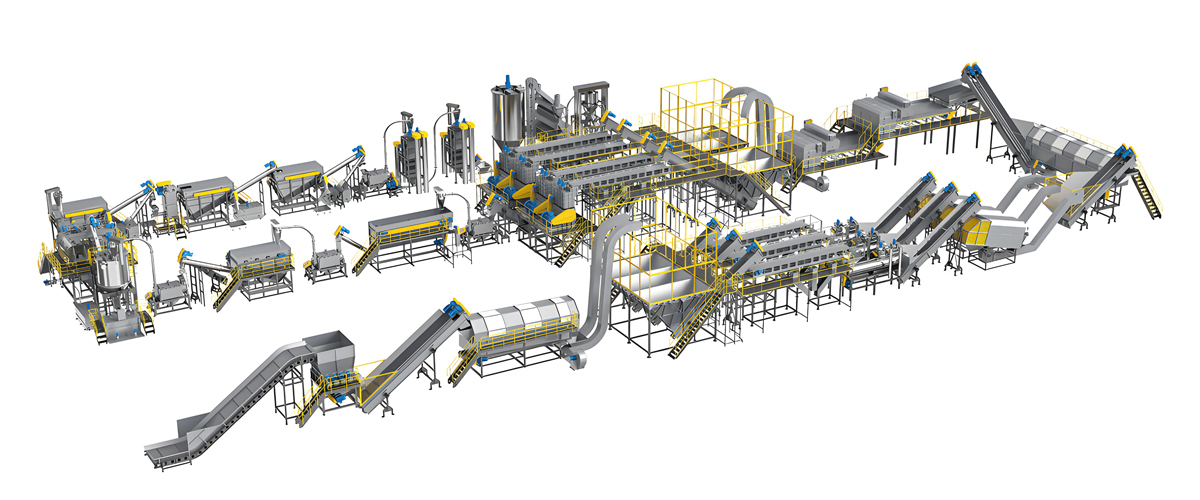
Austrian-route lines are built as process groups rather than as one monolithic machine: an intake and size reduction group, a pre-wash and grit removal group, a friction and rinsing group, a hot washing group, a separation group, and a dewatering and drying group. Each group has its own frame, its own local control node on the fieldbus, and its own defined hydraulic and electrical interface to the groups on either side.
The practical value is phased investment. A plant can commission a 1,000 kg/h cold washing line, run it for a season to establish feedstock supply and offtake, then insert a hot washing group between the friction group and the separation group without rebuilding the water circuit or replacing the control system — provided the original design reserved pump head, tank volume and control capacity for that insertion. Reserving that capacity costs very little at the design stage and is nearly impossible to retrofit, which is why the modular question should be settled before the first purchase order, not after.
5. Mechanical Cleaning Intensity Instead of Chemical Intensity
The defining process choice of the Central European route is to obtain cleanliness through mechanical work — high-shear friction washing, controlled residence time, aggressive counter-current rinsing — rather than through heavy chemical dosing. Caustic soda and detergent are used where chemistry is genuinely required, principally for removing hot-melt adhesive and label residue from PET, and they are dosed to a controlled concentration measured by inline conductivity rather than poured in by the drum.
This choice has three consequences. Chemical consumption per ton falls sharply, which reduces both operating cost and the salt load in the wastewater. Biological treatment downstream becomes viable, because a lower and more stable chemical load keeps the activated sludge population healthy. And the flake surface suffers less chemical attack, which matters for food grade PET where excessive caustic exposure causes intrinsic viscosity loss and surface hazing.
6. Full Instrumentation, Data Traceability and CE Safety Design
Every wash tank on an Austrian-route line has a measured state: temperature by RTD, level by ultrasonic or hydrostatic probe, and for the hot caustic tank, concentration by conductivity transmitter. The water circuit carries turbidity and pH transmitters at treatment inlet and outlet. Motor currents on the crusher, friction washers and dewatering centrifuge are logged continuously, because a rising current trend on a friction washer is the earliest available warning of a developing blockage.
All of that data lands in the PLC and is retained, which converts maintenance from reactive to condition-based and gives the plant an auditable production record — a requirement when the output is sold as food contact grade material and the buyer’s auditor asks for wash temperature and caustic concentration records for a specific production lot. Safety design follows EN ISO 12100 risk assessment methodology with CE Machinery Directive conformity: guarded rotating equipment, interlocked access doors on crusher and friction washer, emergency stop categories mapped across the whole line rather than per machine, and lockout provisions on every hot and pressurized circuit.
| Parameter | Conventional open-circuit line | Austrian-engineered closed-loop line |
|---|---|---|
| Fresh water demand (rigid flake) | 4.0-8.0 m³/ton | 0.8-1.5 m³/ton |
| Fresh water demand (soiled film) | 6.0-12.0 m³/ton | 2.5-3.0 m³/ton |
| Water recirculation rate | 0-40% | 85-95% |
| Specific energy | 0.25-0.45 kWh/kg | 0.12-0.25 kWh/kg |
| Caustic / detergent dosing | High, manual, uncontrolled | Low, conductivity-controlled |
| Labor per shift (1,000 kg/h line) | 6-9 operators | 3-5 operators |
| Output cleanliness (residual contamination) | 200-1,000 ppm typical | Below 50 ppm achievable; below 10 ppm on food grade PET route |
| Process data traceability | Manual logbook or none | Continuous PLC logging, lot-level records |
| Expansion capability | Rebuild required | Insert process group, circuit pre-sized |
| Wastewater treatment burden | Very High | Low to Medium |
| Relative capital investment level | Low | High to Premium |
| Relative operating cost level | High to Very High | Low |
The Complete Washing Process, Stage by Stage
A washing line is a sequence of separations, each one exploiting a different physical property difference between the target polymer and the contamination it carries. Size reduction exposes surfaces; friction removes what is loosely bound; temperature and chemistry remove what is chemically bound; density separates polymers from each other; and mechanical plus thermal drying prepares the flake for storage or extrusion. Understanding what each stage can and cannot do is the difference between specifying a line that meets the target flake grade and buying a line that produces material nobody wants.
Intake, Manual Pre-Sorting and Near-Infrared Sorting
Everything a washing line cannot remove must be removed before the material gets wet. Bales are opened by a bale breaker or fed directly to an inclined belt conveyor running at 0.2 to 0.4 m/s, deliberately slow enough for a picking platform to work the stream. Manual sorting removes the coarse foreign material that damages equipment or contaminates the product: metal parts, wood, stone, textile, oversized rigid items in a film stream, and colored or non-target polymers where the contract requires a single-polymer, single-color output.
Near-infrared sorting handles what human eyes cannot do reliably at throughput. NIR units identify polymer type from reflectance spectra in the 1,000 to 1,700 nanometer range and eject off-spec fractions with compressed air valves. On a PET bottle line, NIR removes PVC bottles — the single most damaging contaminant in PET recycling, because PVC degrades at PET processing temperatures and releases hydrogen chloride that discolors the melt and attacks equipment. NIR also separates PP from PE in mixed rigid streams and pulls out multilayer packaging that would otherwise report to the wrong density fraction. A practical layout places an NIR unit on the pre-sorting belt and, for food grade output, a second NIR unit on the dry flake stream after drying, where the smaller and better-presented particles allow much higher detection accuracy.
Ferrous Removal and Eddy Current Non-Ferrous Separation
Overband magnets are installed above the intake conveyor and again immediately before the crusher, because a single steel bolt reaching the rotor destroys knives and can crack a rotor disc. Magnetic field strength at the belt surface should reach 800 to 1,200 gauss for reliable capture through a 200 to 300 millimeter material bed; if the bed is deeper, the magnet is undersized or the belt is overloaded.
Eddy current separators handle non-ferrous metals — aluminum caps and neck rings, foil fragments from laminated packaging, small castings in post-industrial scrap. A high-frequency rotor inside the conveyor head pulley induces circulating currents in conductive particles, generating a repulsive force that throws them over a splitter plate while the plastic follows a normal trajectory. Eddy current works best on particles above roughly 5 millimeters and on a thin, evenly spread bed, so it belongs after primary size reduction on rigid lines and on a vibrating spreader feeder rather than a lumpy belt discharge. A final metal detector at the end of the line acts as the safety net for anything that escaped both stages.
Wet Crushing
The crusher converts bottles, containers and film into a particle size the wet process can handle. Wet crushing — spraying 0.5 to 1.5 cubic meters of recirculated water per hour into the crusher chamber — is the Austrian-route standard for three reasons: it suppresses dust and the fire risk that comes with dry crushing of dry film, it starts the washing process by rinsing loose soil off freshly created surfaces, and it cools the knives so that heat-sensitive materials such as PET do not develop a smeared surface layer that later traps contamination.
Knife gap is the parameter that most affects both flake quality and wear cost. A gap of 0.3 to 0.8 millimeters is the working band: below 0.3 millimeters the knives contact under thermal expansion and chip; above 0.8 millimeters the material is torn rather than cut, generating tails, fines and elevated motor current. Screen aperture governs particle size distribution and therefore everything downstream — a 30 to 40 millimeter screen produces the fine flake preferred for food grade PET, 50 to 60 millimeters suits rigid PP and HDPE, and 60 to 80 millimeters is normal for film, where oversized apertures reduce fines generation and keep the friction washers from blinding. Rotor speed typically runs 350 to 550 rpm with a V-rotor or double-scissor cutting geometry for rigid material and a straight-blade geometry for film.
Control points at this stage: motor current trend, knife gap verified at every knife change, screen inspection each shift, and crusher chamber water flow interlocked so that the rotor cannot run dry. A crusher running without spray water on film will generate enough frictional heat to soften and weld material into the screen within minutes.
Pre-Wash and Grit Removal
Pre-washing removes the bulk contamination that would otherwise overload every stage that follows. A trommel screen — a rotating perforated drum 3 to 6 meters long with 8 to 15 millimeter perforations, inclined 3 to 5 degrees and turning at 12 to 20 rpm with internal spray bars — tumbles the crushed material while sand, soil, glass fragments and label fines fall through the perforations. For agricultural film, the trommel is the single most valuable machine in the line, routinely removing 60 to 80 percent of the incoming mineral load before it can reach a pump impeller.
Downstream of the trommel, a grit settling channel or a hydrocyclone captures the fine sand that stays suspended. Settling channels are simple: a long, low-velocity trough where flow velocity drops below roughly 0.3 m/s so that particles denser than 2 g/cm³ drop out and are removed by a screw conveyor running along the trough floor. Hydrocyclones are more compact and reach a finer cut point, typically separating particles down to 60 to 100 micrometers. Skipping this stage is the most common design economy in cheap lines, and it is paid for later in pump impeller wear, tank clean-out downtime and abrasive damage to friction washer screens.
Friction Washing
The friction washer is the mechanical heart of the line. A vertical or horizontal shaft carries paddles that accelerate the flake and water slurry against a perforated screen, so that flakes scrub against each other and against the screen surface at high relative velocity. Contamination is sheared off the flake surface and passes through the screen perforations with the water, while cleaned flake advances axially to the discharge.
Working parameters: shaft speed 700 to 1,200 rpm depending on material and machine diameter, residence time 8 to 20 seconds per pass, screen perforation 1.5 to 4 millimeters, and water addition of 1.5 to 4 cubic meters per hour per machine depending on throughput. Rigid PET flake tolerates the high end of the speed range and cleans efficiently in a single pass at 900 to 1,200 rpm. Film requires a different approach: lower speed, 700 to 900 rpm, longer cumulative residence, and two or three machines in series rather than one machine run harder, because film wraps around the shaft when the paddle tip speed is too high relative to the water flow. Specific energy in the friction stage typically runs 0.02 to 0.05 kWh per kilogram, making it the second largest electrical consumer on a cold line after size reduction.
Control points: motor current, which climbs before a blockage becomes visible; discharge water turbidity, which shows whether the machine is still doing useful work; and paddle wear, which is checked at planned intervals because worn paddles quietly cut cleaning efficiency long before they fail.
Hot Caustic Washing
Hot caustic washing is the chemical stage, and on the food grade PET route it is mandatory. Its job is to dissolve or soften the hot-melt and pressure-sensitive adhesives that bond labels and sleeves to bottles, saponify fats and oils, remove residual product and surface oligomers, and reduce microbial load. Operating parameters for PET are 0.5 to 2.0 percent sodium hydroxide by weight, 75 to 90 degrees Celsius, and 8 to 15 minutes of residence in a heated, agitated tank fitted with a spiral or paddle conveyor. A small surfactant addition improves wetting and adhesive release, and an antifoam addition keeps the tank surface manageable.
The parameter window is tighter than it looks. Below 75 degrees Celsius, adhesive release becomes unreliable and label fragments survive to the finished flake. Above 90 degrees Celsius with concentrations toward 2 percent and extended residence, PET begins to suffer measurable hydrolytic attack: intrinsic viscosity drops, the flake surface hazes, and the material loses value for bottle-to-bottle applications. The correct approach is to hold temperature and concentration at the minimum that achieves label release for the specific feedstock and to verify that setting during a sample trial run rather than assuming a textbook value.
For rigid PP and HDPE packaging, the equivalent stage is a hot detergent wash at 60 to 80 degrees Celsius with alkaline detergent rather than concentrated caustic, since the objective is fat and product residue removal rather than adhesive attack, and polyolefins do not tolerate strong caustic as well as their reputation suggests when filled or pigmented grades are involved. Control points: tank temperature by RTD with heating interlock, caustic concentration by conductivity transmitter with automatic dosing, level control, and steam or hot water heat exchange with insulated tank walls and covered tops.
Rinsing and Sink-Float Density Separation
After hot washing, the flake carries dissolved and suspended contamination plus caustic that must be removed before drying. Counter-current rinsing in two or three stages handles this: fresh or treated water enters the last tank and cascades backwards, so the flake meets progressively cleaner water while the water meets progressively dirtier flake. Rinse tank pH is monitored, and the final rinse should return the flake to a near-neutral surface condition.
The rinse tanks also perform density separation. In plain water at approximately 1.0 g/cm³, PET at 1.33 to 1.40 g/cm³ sinks while PP at 0.90 to 0.91 and PE at 0.91 to 0.96 float. A float-sink tank with a surface skimming paddle and a bottom screw discharge separates the two fractions continuously. On a PET line, the floating fraction is the polyolefin cap and label material, which is recovered as a secondary product rather than discarded. On a polyolefin line, the sinking fraction is the contamination — sand, glass, metal fragments, PET residue, and heavily filled or laminated items.
Two limits must be understood. First, PP and PE cannot be separated from each other in water because both float; separating them requires a modified-density medium (a salt or alcohol solution adjusted to roughly 0.93 to 0.94 g/cm³), or NIR sorting on the dry flake. Second, PVC at 1.35 to 1.45 g/cm³ overlaps PET and therefore sinks with it; PVC removal must be handled upstream by NIR bottle sorting or downstream by flake-level NIR or electrostatic separation. This is why PVC contamination control is a sorting problem rather than a washing problem, and why the food grade PET route always specifies flake-level detection.
Centrifugal Dewatering
The centrifugal dryer, a vertical rotor spinning inside a perforated screen basket, removes free water mechanically before any thermal energy is spent. Mechanical dewatering is roughly an order of magnitude cheaper per kilogram of water removed than thermal drying, so the design objective is to leave as little water as possible for the hot air stage. A correctly configured centrifuge delivers 2 to 5 percent residual moisture on rigid flake and 5 to 12 percent on film, at rotor speeds of 800 to 1,400 rpm with screen apertures of 1.5 to 3 millimeters.
Common problems are mechanical rather than process-related: vibration from uneven paddle wear or from an accumulation of material on one side of the rotor, bearing damage from water ingress past worn seals, and screen blinding from fines. Vibration monitoring on the rotor bearing housing, with a trip threshold set during commissioning, protects the machine and provides the earliest warning of imbalance.
Thermal Drying and PET Crystallizing Drying
Thermal drying finishes what the centrifuge started. For polyolefin flake and film, a hot air pipe dryer or fluidized bed dryer at 90 to 130 degrees Celsius, combined with a cyclone separator and a zigzag air classifier, brings residual moisture below 1 percent — adequate for direct feeding to a pelletizing extruder equipped with vacuum degassing.
PET destined for food contact applications requires more. The flake must be crystallized and dried to below 0.5 percent moisture, and for bottle-to-bottle grade the target is tighter still, typically below 0.02 percent immediately before extrusion. Crystallization is performed in an agitated crystallizer at 160 to 175 degrees Celsius with residence of 20 to 40 minutes, which raises crystallinity enough to prevent the flake from becoming tacky and agglomerating in the subsequent dryer hopper. Amorphous PET flake fed directly into a hot dryer without crystallization will bridge and block the hopper — a failure mode that is entirely predictable and entirely avoidable. Where the finished material must meet food contact decontamination requirements, solid state polycondensation may follow, running under vacuum or inert gas at 200 to 215 degrees Celsius, which simultaneously raises intrinsic viscosity back toward virgin levels and drives off residual volatile contaminants.
Air Classification, Final Metal Detection and Packing
A zigzag air classifier is the last cleaning stage. Dry flake falls through an upward air stream in a zigzag duct, and each direction change forces particles to re-enter the airflow, so that light contamination — label fragments, film slivers, dust, fibers — is carried upward to a cyclone while heavy clean flake falls to the discharge. Air velocity is adjustable and must be tuned to the specific flake size distribution: too low and label fragments stay in the product, too high and good flake is lost to the reject cyclone. On a PET line, air classification is the stage that takes residual label content from a few hundred parts per million down to single-digit levels.
A final metal detector with automatic rejection gate guards the downstream extruder screw and melt filter. Clean flake is then conveyed to storage silos, big bag filling stations or a baling press. Where washing and pelletizing sit in the same plant, the dried flake usually bypasses packing entirely and feeds a silo that discharges directly to the extruder — the arrangement that saves the most energy, because the flake never cools to ambient and never re-absorbs atmospheric moisture.
Material-Specific Washing Routes and Realistic Yields
No single line configuration serves every feedstock. The stage sequence stays broadly the same, but the parameters, the number of machines per stage and the water treatment load change substantially with the input material. The table below summarizes the six routes Polyretec configures most often, with realistic contamination, consumption and yield figures for each.
| Feedstock | Input contamination | Wash temperature | Chemical dosing | Fresh water | Yield | Output cleanliness target |
|---|---|---|---|---|---|---|
| PET bottle flake, food grade route | 4-12% (labels, caps, glue, product residue) | Hot caustic 75-90 °C plus hot rinse 60-70 °C | NaOH 0.5-2.0%, surfactant, antifoam | 0.8-1.5 m³/ton | 85-93% | PVC below 5 ppm, PO below 10 ppm, metals below 5 ppm, moisture below 0.5% |
| PET bottle flake, fiber grade route | 5-15% | Hot wash 70-80 °C | NaOH 0.3-1.0%, detergent | 0.8-1.6 m³/ton | 86-93% | PVC below 50 ppm, moisture below 1% |
| HDPE bottle flake (milk, detergent, personal care) | 6-15% (labels, glue, product residue) | Hot detergent 70-80 °C | Alkaline detergent, low caustic | 1.2-2.0 m³/ton | 82-90% | Odor-reduced, contamination below 100 ppm, moisture below 1% |
| Rigid PP (crates, caps, automotive parts) | 5-20% (dust, oil, paper, metal inserts) | Warm wash 50-70 °C | Detergent only | 1.2-1.8 m³/ton | 80-90% | Metal below 5 ppm, contamination below 150 ppm |
| LDPE agricultural film | 30-50% (soil, sand, moisture, crop residue) | Warm wash 50-65 °C | Detergent, low dose | 2.5-3.0 m³/ton | 60-75% | Ash content below 1.5%, moisture below 1% before pelletizing |
| PE packaging film, post-consumer | 10-25% (print, paper labels, product residue) | Warm to hot 60-80 °C | Detergent, deinking agent optional | 1.8-2.5 m³/ton | 65-80% | Ash below 1%, paper fiber below 200 ppm |
| Mixed rigid plastics | 10-30% | Warm wash 50-70 °C plus density separation | Detergent | 1.5-2.5 m³/ton | 70-85% per target fraction | Fraction purity above 95% by polymer |
Why Agricultural Film Is the Hardest Case
LDPE agricultural film deserves separate attention because it defines the upper bound of what a washing line must handle. Film recovered from the field carries 30 to 50 percent of its gross weight as soil, sand, moisture and crop residue. That mineral load is abrasive, it settles fast in every tank, and it consumes water treatment capacity out of proportion to the plastic it accompanies. A line built for clean industrial film and then fed agricultural film will fail in a predictable sequence: pump impellers wear, tanks silt up, the friction washer screens abrade, the water circuit turbidity rises, and flake cleanliness collapses.
The correct configuration uses multi-stage mineral separation: a heavy-duty shredder ahead of the crusher, a long trommel with generous spray capacity, a dedicated grit settling channel with continuous screw removal, sink-float separation before the friction group, and a beater machine or similar high-shear pre-cleaning unit in the dry section for the heaviest soil loads. Sludge handling capacity must be sized for the mineral load rather than for the plastic throughput, because on a 1,000 kg/h agricultural film line the sludge stream can approach half the mass of the product stream. Yields of 60 to 75 percent are normal and honest; any supplier quoting 90 percent yield on 40-percent-soil agricultural film is quoting on dry plastic content, not on delivered bale weight, and the distinction matters enormously to the plant’s economics.
Why Food Grade PET Is the Most Demanding Case
Food grade PET is not the dirtiest feedstock, but it carries the strictest output specification. Contamination limits are measured in parts per million rather than percent, the wash chemistry has a narrow window that protects intrinsic viscosity, and the entire process must be documented well enough to support a food contact safety evaluation of the recycling process. That evaluation follows a defined path: the recycler characterizes the input stream and its collection system, demonstrates through challenge testing that the process removes surrogate contaminants to a defined decontamination efficiency, and submits the process description and data for assessment under the applicable regional framework — the EFSA route in the European Union, the FDA no-objection letter route in the United States. The washing line supports that path by delivering consistent, recorded process conditions and a flake specification that the decontamination step can rely on.
Water Treatment, Emissions and the Environmental Case
A plastic washing line is an environmental technology only if its own environmental footprint is engineered with the same rigor as its production output. That means the water treatment plant is not an afterthought bolted on to satisfy a permit; it is a process unit dimensioned in parallel with the washing line itself, sharing the same control system and the same instrumentation philosophy. This section covers the wastewater characteristics a washing line actually produces, the treatment chain that closes the loop, and the air, noise and carbon dimensions that complete the environmental picture.
What Washing Line Wastewater Actually Contains
The effluent from a plastic washing line is unlike municipal sewage and unlike most industrial wastewater. It is a variable-load stream whose composition changes with feedstock, and treating it well requires knowing what is in it. Chemical oxygen demand typically ranges from 800 to 5,000 mg/L, driven by product residue — beverage sugars, detergent, food fats, agricultural residues — and by the detergents added in the process. Suspended solids run from 500 to 8,000 mg/L, dominated by soil and sand on film lines and by label fiber and fines on rigid lines. Oil and grease appear at 50 to 500 mg/L on post-consumer packaging streams. Alkalinity is elevated wherever a caustic wash discharges into the circuit, and pH at the hot wash overflow can exceed 11. Microplastic fines, generated by friction washing and crushing, are present as a fine suspension that will pass straight through coarse screening and must be captured by flotation and filtration.
Two properties make this stream demanding. It is highly variable — a batch of especially soiled bales can double the solids load within an hour — so the treatment plant needs an equalization buffer sized for at least four to eight hours of flow. And it contains both readily biodegradable organics and inert mineral solids, which means neither a purely physical nor a purely biological plant is sufficient on its own.
The Treatment Chain
The standard chain for a closed-loop washing plant runs as follows, and each stage exists to protect the stage after it.
Coarse and fine screening. Bar screens at 5 to 10 millimeters followed by rotary drum or wedge-wire screens at 0.5 to 1.0 millimeters remove label fragments, film slivers and fiber before they can wrap pump impellers or blind downstream media. Screenings are dewatered and handled as solid waste.
Equalization. A buffer tank of four to eight hours of flow smooths hydraulic and load peaks, mixes the caustic-rich hot wash overflow with the near-neutral rinse water, and gives the pH correction step a stable target. Gentle mixing prevents solids from settling in the buffer.
Dissolved air flotation. Water supersaturated with air at 4 to 6 bar is released into the flotation cell, where microbubbles of 30 to 100 micrometers attach to oil droplets, low-density solids and microplastic fines and carry them to the surface for skimming. Dissolved air flotation is the workhorse of washing line treatment: it removes 60 to 85 percent of suspended solids, most of the free oil, and the great majority of microplastic fines in one compact unit. A coagulant such as an inorganic aluminum or iron salt plus a small polymer flocculant dose improves capture substantially.
Coagulation and sedimentation. For streams with heavy mineral load, a coagulation and flocculation train followed by a lamella clarifier or a conventional settling tank removes the dense fraction that flotation leaves behind. Underflow sludge is pumped to thickening.
Biological treatment. An anoxic-oxic (A/O) activated sludge process or a membrane bioreactor reduces chemical oxygen demand by 80 to 95 percent. A membrane bioreactor is the better choice when the treated water is returned to a hot wash or final rinse duty, because it delivers an effluent essentially free of suspended solids and does not depend on sludge settleability. Biological treatment is where the low-chemical Austrian route earns its keep: a stable, moderate organic load with limited salt and surfactant shock keeps the biomass healthy, whereas a heavily dosed conventional line frequently poisons its own biology and then blames the treatment plant.
Polishing. Multi-media sand filtration removes residual turbidity, and activated carbon adsorbs color bodies and residual dissolved organics — important for the final rinse, because reused water carrying color will stain light-colored flake. Where the plant returns water to a food grade PET line, an additional cartridge or ultrafiltration barrier is normal.
Return and make-up. Polished water returns to the process buffer. Fresh make-up enters at a rate set by the losses discussed earlier, and a conductivity transmitter on the buffer prevents dissolved salts from accumulating beyond the level at which they affect flake surface quality — the practical reason no circuit runs at 100 percent recirculation.
Sludge handling. Flotation float, clarifier underflow and excess biological sludge are thickened and dewatered by screw press, belt press or chamber filter press to 25 to 40 percent dry solids. Sludge from film lines is largely mineral and is typically disposed of as inert waste; sludge from food packaging streams carries more organics and is handled accordingly. Dewatering performance directly affects fresh water demand, because every point of moisture left in the cake is water leaving the circuit.
| Water stream | PET bottle flake line | PP/PE film line | Notes |
|---|---|---|---|
| Total circulating flow | 28-38 m³/h | 32-45 m³/h | Sum of all tank feed flows |
| Water carried out with wet flake | 0.35-0.55 m³/h | 0.60-0.95 m³/h | Before centrifugal dewatering recovery |
| Water lost with dewatered sludge | 0.20-0.40 m³/h | 0.80-1.50 m³/h | Mineral load dominates on film lines |
| Evaporation from hot tanks | 0.25-0.45 m³/h | 0.10-0.25 m³/h | Reduced 50-70% by insulated covers |
| Fresh water make-up | 0.9-1.4 m³/h | 1.6-2.6 m³/h | Equals total losses at steady state |
| Recirculation rate | 94-97% | 88-93% | Of total circulating flow |
| Fresh water per ton of input | 0.9-1.4 m³/ton | 1.6-2.6 m³/ton | At nominal throughput |
| Sludge cake production | 25-60 kg/h | 150-450 kg/h | At 30% dry solids; agricultural film at upper bound |
Air Emissions, Odor and Ventilation
Three air streams require attention on a washing line. The hot washing section generates water vapor loaded with detergent aerosol and, where caustic is used, a mild alkaline mist. Enclosed tanks with local extraction ducted to a wet scrubber handle this cleanly: the scrubber condenses vapor, neutralizes alkaline carryover and returns the condensate to the water circuit rather than to the atmosphere, which recovers both water and heat.
The drying section releases volatile organic compounds from residual product, printing inks and adhesive residues, particularly on post-consumer film and on HDPE containers that held fragranced household products. Where local limits require abatement, activated carbon adsorption is the usual solution for moderate loads, with regenerative thermal oxidation reserved for high-concentration streams. Dryer exhaust also carries dust and light fines, which are captured by a cyclone plus bag filter before the abatement stage.
Odor is primarily a plant design issue rather than an abatement issue. Bale storage, sludge storage and the equalization tank are the three main odor sources, and all three are managed by enclosure, by not storing wet material longer than necessary, and by maintaining aerobic conditions in the buffer. A biofilter or a chemical scrubber on the combined extraction from those areas handles the residual.
Noise and Dust
Shredders, crushers, centrifugal dryers and blowers are the noise sources that determine whether a plant can hold below 85 dB(A) at the operator position. The practical measures are well established: acoustic enclosures on the crusher with 20 to 30 dB insertion loss, anti-vibration mounts and flexible connections on the centrifuge, silencers on blower intakes and dryer exhausts, and lagging on high-velocity ducts. Positioning matters as much as hardware — placing the blower room and dryer plant away from the operator walkways and the control room costs nothing at the layout stage.
Dust is controlled at source. Wet crushing eliminates the largest dry dust source. The remaining dry sections — flake conveying, air classification, silo filling — are handled by enclosed pneumatic conveying with cyclone plus filter separation, and by dust extraction at transfer points. Dry film handling deserves particular care because fine polyolefin dust is combustible; extraction ducting should be designed with adequate transport velocity and appropriate explosion protection where dust concentrations warrant it.
The Carbon Footprint Perspective
The environmental argument for mechanical recycling rests on a straightforward comparison: producing a kilogram of recycled polymer from washed post-consumer material requires a fraction of the primary energy and generates a fraction of the greenhouse gas emissions of producing the same kilogram from crude oil feedstock. For PET, published life-cycle assessments consistently place recycled resin at roughly one third to one half of the cumulative energy demand of virgin resin, with greenhouse gas reductions commonly reported in the range of 50 to 70 percent per kilogram, depending on system boundaries, electricity grid mix and transport distances. Polyolefins show comparable directional benefits, with reported reductions frequently in the 40 to 70 percent band.
Within that overall benefit, the washing line’s own contribution is significant but not dominant — it typically accounts for a modest share of the recycled resin’s total footprint, with collection, transport and pelletizing making up the rest. This is precisely why the difference between 0.15 and 0.35 kWh per kilogram of specific energy matters: it is a controllable share of a footprint that is already advantaged, and it is the share the equipment supplier is directly responsible for. A line that halves its own energy and water intensity does not just save operating cost; it measurably improves the carbon profile of every ton of recycled resin the plant sells, which is increasingly a contractual requirement rather than a marketing point when the offtaker is a brand owner with public recycled-content commitments.
The Compliance Framework
Recycling plants operate inside a compliance framework that has tightened substantially over the past decade, and equipment specification should anticipate it rather than react to it.
ISO 14001 provides the environmental management system structure most plants adopt: documented aspects and impacts, measurable objectives for water, energy and waste, operational control procedures, and internal audit. A washing line with continuous PLC logging of water, energy and process parameters supplies the measurement layer that an ISO 14001 system requires, which turns an otherwise burdensome documentation exercise into a byproduct of normal operation.
The EU Single-Use Plastics Directive and the associated packaging rules set binding recycled content requirements for beverage bottles, together with separate collection targets. The practical consequence for a recycler is demand-side: food grade rPET is the fraction with contractual pull, and a washing line configured only for fiber-grade output is exposed to a weaker market. Anyone building today should at minimum reserve the layout and utility capacity for a food grade upgrade, even if the first phase is fiber grade.
Food contact assessment for recycled material follows a process-based route. In the European Union, the recycling process itself is evaluated for its decontamination efficiency and the input stream must be predominantly from a closed and controlled collection loop; EFSA carries out the scientific assessment and processes are authorized individually. In the United States, the FDA reviews process submissions and issues no-objection letters based on challenge test data and estimated dietary exposure. In both systems the washing line contributes by providing the documented, reproducible upstream conditions on which the decontamination step depends — wash temperature, caustic concentration, residence time, and flake specification for each production lot.
GRS, the Global Recycled Standard, is the certification most commonly requested when recycled flake or pellet enters textile and consumer goods supply chains. Its requirements fall into four groups: verified recycled content with full chain-of-custody documentation from input to output, social criteria covering labor conditions, environmental criteria covering wastewater discharge and chemical management at the processing site, and chemical restrictions on substances used in processing. For a washing plant, the environmental and chemical criteria are the ones the equipment influences directly — a documented closed-loop water system with a compliant treatment plant and a low, controlled chemical inventory makes the audit straightforward, while an open-circuit line with drum-dosed chemistry makes it painful.
Polyretec Washing Line Configurations and Specifications
Polyretec builds washing lines in two principal families plus a matched pelletizing family, all engineered to the closed-loop architecture described above. The configurations below are the real product lines, with the specification bands that apply across the capacity range. Every line is dimensioned around the customer’s actual feedstock rather than around a catalog number, and the tables show the parameter envelope within which that dimensioning happens.
Food Grade PET Bottle Washing Line — 500 to 6,000 kg/h
This is the flagship configuration, designed for baled post-consumer PET bottles and built in capacity steps from 500 kg/h up to 6,000 kg/h. The line is offered in different flake grade designs, which is the important distinction: the same nominal throughput can be configured for fiber-grade flake, for sheet and strapping grade, or for the full food grade route with hot caustic washing, extended hot rinsing, flake-level NIR sorting, air classification and crystallizing drying. Choosing the grade design at the specification stage determines tank count, heating capacity, water treatment sizing and instrumentation level, and it is far cheaper to specify the higher grade initially than to upgrade a line that was laid out for the lower one.
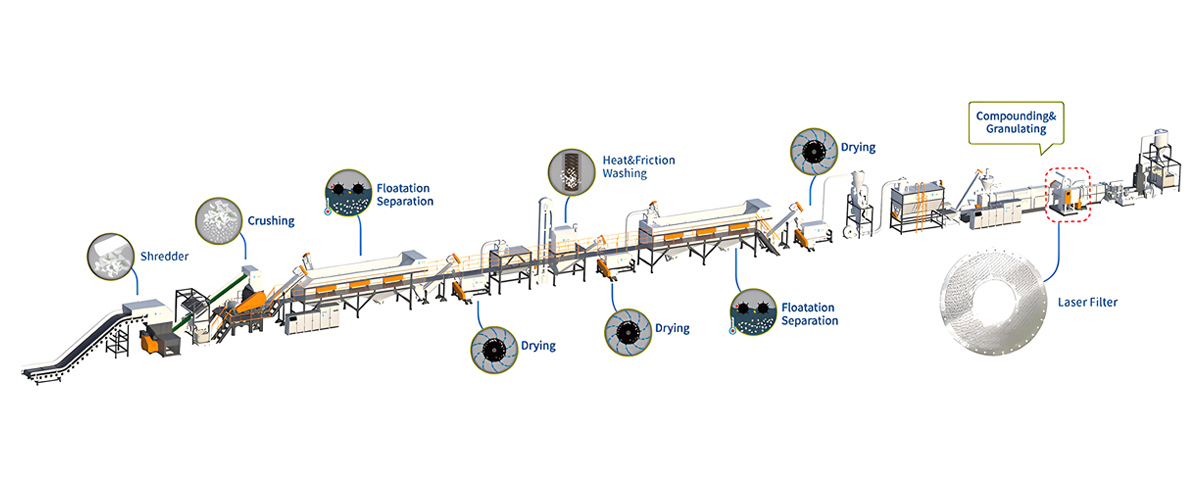
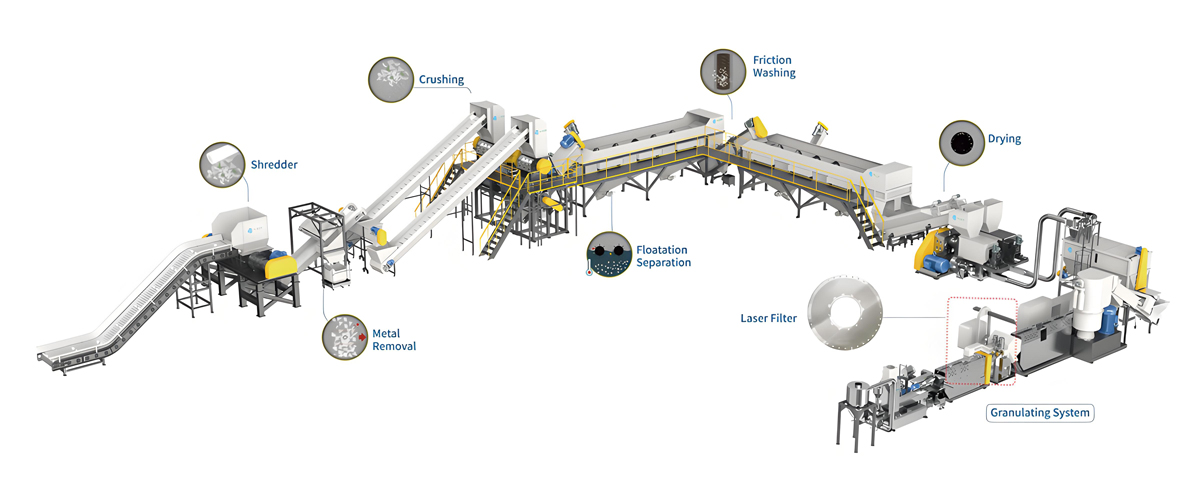
The process sequence is: bale opening, manual and NIR pre-sorting, overband magnet, wet crushing, pre-wash trommel with grit removal, first friction washing group, hot caustic washing, second friction washing group, counter-current hot rinsing, sink-float separation, final rinsing, centrifugal dewatering, thermal drying, crystallizing drying for food grade, zigzag air classification, flake NIR and metal detection, and silo storage or big bag packing.
| Parameter | PET 500 | PET 1000 | PET 2000 | PET 3000 | PET 6000 |
|---|---|---|---|---|---|
| Nominal capacity (clean flake) | 500 kg/h | 1,000 kg/h | 2,000 kg/h | 3,000 kg/h | 6,000 kg/h |
| Installed power (washing section) | 110-140 kW | 180-240 kW | 320-420 kW | 450-580 kW | 850-1,100 kW |
| Installed power (drying and crystallizing) | 60-90 kW | 110-150 kW | 190-260 kW | 270-360 kW | 500-680 kW |
| Specific energy, food grade route | 0.15-0.22 kWh/kg including drying and crystallizing | ||||
| Circulating water flow | 16-22 m³/h | 28-38 m³/h | 50-68 m³/h | 72-98 m³/h | 140-190 m³/h |
| Fresh water make-up | 0.5-0.8 m³/h | 0.9-1.4 m³/h | 1.7-2.7 m³/h | 2.5-4.0 m³/h | 5.0-8.0 m³/h |
| Steam or thermal oil demand (hot wash) | 0.4-0.7 t/h | 0.7-1.2 t/h | 1.3-2.2 t/h | 1.9-3.1 t/h | 3.6-6.0 t/h |
| Process stages | 14-18 depending on flake grade design | ||||
| Indicative footprint (washing plus drying) | 28 × 9 m | 36 × 11 m | 45 × 13 m | 55 × 15 m | 75 × 18 m |
| Residual moisture after centrifuge | 2-5% | ||||
| Residual moisture after drying | Below 0.5%; below 0.02% after solid state polycondensation option | ||||
| Operators per shift | 3-4 | 4-5 | 5-6 | 6-7 | 8-10 |
| Suitable materials | Post-consumer PET bottles, PET trays and thermoformed sheet with adapted sorting, PET strapping scrap | ||||
PP/PE Soft Plastic Crushing and Washing Line — 500 to 1,500 kg/h
The soft plastic line handles the film side of the business: LDPE agricultural film, PE packaging film, woven bags and raffia, and the general post-consumer flexible fraction. It is a different machine from the PET line in every respect that matters — lower friction washer speeds, more separation stages ahead of the wash group, far larger sludge handling capacity, and a squeezing and thermal drying section dimensioned for film’s stubbornly high water retention.
The reference configuration in this family is the PTW1000, a fully automated PP/PE film washing line at nominal 1,000 kg/h that has been supplied for post-consumer and post-industrial film projects internationally. The line integrates a heavy-duty shredder for baled and bulky input, wet crushing, a long trommel with high spray capacity, sink-float pre-separation, a multi-stage friction and rinsing group, hot washing where print and product residue require it, mechanical squeezing, and thermal drying. One-step pelletizing is available as an integrated option, in which the dried film flake feeds directly to an extrusion and pelletizing unit without intermediate storage, saving both the re-handling energy and the plant space that a separate flake buffer would occupy.
| Parameter | PTW500 | PTW1000 | PTW1500 |
|---|---|---|---|
| Nominal capacity (clean film flake) | 500 kg/h | 1,000 kg/h | 1,500 kg/h |
| Installed power (washing section) | 130-170 kW | 220-290 kW | 320-410 kW |
| Installed power (drying section) | 70-100 kW | 130-180 kW | 190-260 kW |
| Specific energy | 0.18-0.25 kWh/kg depending on soil load and drying target | ||
| Circulating water flow | 18-26 m³/h | 32-45 m³/h | 48-66 m³/h |
| Fresh water make-up | 0.9-1.4 m³/h | 1.6-2.6 m³/h | 2.4-3.8 m³/h |
| Sludge cake output (agricultural film) | 80-230 kg/h | 150-450 kg/h | 230-680 kg/h |
| Process stages | 11-14 | 12-16 | 13-17 |
| Indicative footprint | 30 × 10 m | 40 × 12 m | 50 × 14 m |
| Residual moisture after squeezer | 8-14% | ||
| Residual moisture after thermal drying | Below 1%; below 0.5% with extended dryer for direct pelletizing | ||
| Friction washer speed | 700-900 rpm, 2-3 machines in series | ||
| Main equipment list | Bale opener, heavy-duty shredder, overband magnet, wet crusher, trommel screen, grit settling channel, sink-float tank, beater machine (heavy soil option), friction washers, hot wash tank, counter-current rinse tanks, mechanical squeezer, thermal pipe dryer, cyclone and zigzag classifier, metal detector, silo or bagging station | ||
| Suitable materials | LDPE agricultural film, PE packaging film, PP woven bags and raffia, post-industrial film scrap, PP non-woven fabric with adapted sorting | ||
New Generation Pelletizing Line
The third family completes the plant. The New Generation Pelletizing Line is engineered for thin-walled LDPE film and for thick-walled PE and PP regrind, with a robust construction aimed specifically at post-consumer waste rather than at clean industrial scrap. The distinction is meaningful: post-consumer material arrives with variable bulk density, residual moisture and residual contamination, and a pelletizing line designed for clean regrind will surge, degas poorly and blind its melt filter within hours. The New Generation line addresses this with a force-feeding and compaction arrangement matched to low bulk density film, generous degassing capacity for residual moisture and volatiles, and a continuous or backflush melt filtration system so that filter changes do not stop production.
| Input material | Bulk density | Typical throughput band | Degassing requirement | Melt filtration | Pelletizing method |
|---|---|---|---|---|---|
| Washed LDPE agricultural film flake | 0.03-0.06 g/cm³ | 300-800 kg/h | Double vacuum degassing | Continuous backflush, 100-150 µm | Water ring die-face hot cutting |
| Washed PE packaging film flake | 0.04-0.08 g/cm³ | 400-1,000 kg/h | Single to double vacuum | Continuous backflush, 80-120 µm | Water ring or strand pelletizing |
| Washed rigid PE/PP regrind | 0.25-0.40 g/cm³ | 600-1,500 kg/h | Single vacuum | Piston screen changer, 60-100 µm | Strand pelletizing or underwater |
| Washed PP woven and raffia | 0.05-0.12 g/cm³ | 350-900 kg/h | Double vacuum | Continuous backflush, 100-150 µm | Water ring die-face hot cutting |
| Washed PET flake to sheet or strapping grade | 0.30-0.45 g/cm³ | 500-1,500 kg/h | High vacuum, pre-dried feed | Continuous, 40-80 µm | Underwater or strand with crystallizer |
Application Areas
Polyretec lines serve two commercial functions that the factory defines explicitly. The first is plastic product production: converting waste plastics into reusable flake, pellet or block form that feeds directly back into manufacturing — extruded film and sheet, injection molded crates and housewares, pipe and profile compounds, strapping, fiber and non-woven products, and bottle-to-bottle applications where the food grade route is used. The second is renewable resource utilization: reducing a manufacturer’s dependence on primary polymer feedstock, which is both an environmental objective and a supply security objective for converters exposed to resin price volatility and to recycled content mandates.
In practice this maps to a small number of recurring plant types. Bottle-to-bottle rPET plants supplying beverage brand owners, where food grade output and documented process control are non-negotiable. Fiber plants supplying textile and non-woven producers from PET flake. Agricultural film recyclers, usually regional operations with seasonal feedstock peaks and very high soil loads. Post-consumer packaging film recyclers producing pellet for refuse sacks, construction film and industrial packaging. Rigid packaging recyclers handling HDPE and PP containers for household and industrial products. And in-house recycling installations at large converters, where the washing line processes the plant’s own production scrap and returns it to the same process. Polyretec has delivered more than 100 projects across these categories in 50-plus countries, including LDPE film pelletizing systems for printed bags and film, PP non-woven and elastomer glove recycling, and fully automated PP/PE film washing installations.
Selection Guide: Matching Input Material to Line Configuration
Line selection is driven by four inputs: what the feedstock is, how dirty it is, how much of it must be processed per hour, and what grade the output must reach. Get those four right and the configuration follows almost deterministically. The table below maps common combinations to a recommended Polyretec configuration.
| Input material | Contamination level | Target output grade | Throughput requirement | Recommended configuration |
|---|---|---|---|---|
| Baled post-consumer PET bottles | 4-12% | Food grade, bottle-to-bottle | 1,000-3,000 kg/h | Food Grade PET Bottle Washing Line, PET 1000 to PET 3000, food grade flake design with hot caustic wash, flake NIR, crystallizing dryer, solid state polycondensation option |
| Baled post-consumer PET bottles | 5-15% | Fiber and strapping grade | 500-2,000 kg/h | Food Grade PET Bottle Washing Line in fiber-grade design, PET 500 to PET 2000, reduced hot wash stages, standard thermal drying |
| Baled post-consumer PET bottles | 4-10% | Food grade, large scale | 4,000-6,000 kg/h | PET 6000 with two parallel intake and sorting lanes, single high-capacity water treatment plant, full instrumentation package |
| LDPE agricultural film | 30-50% soil | Pellet for film and sacks | 500-1,000 kg/h | PTW500 or PTW1000 with heavy-duty shredder, extended trommel, grit channel, beater machine, oversized sludge handling, plus New Generation Pelletizing Line with double vacuum degassing |
| PE packaging film, post-consumer | 10-25% | Pellet for construction and industrial film | 800-1,500 kg/h | PTW1000 or PTW1500 with hot washing group, multi-stage friction, thermal drying, integrated one-step pelletizing option |
| PP woven bags and raffia | 8-20% | Pellet for injection molding and re-extrusion | 500-1,000 kg/h | PTW500 or PTW1000 with adapted shredder and friction group, sink-float separation, New Generation Pelletizing Line with water ring hot cutting |
| HDPE bottles (milk, detergent, personal care) | 6-15% | Flake for extrusion blow molding and pipe | 1,000-2,000 kg/h | Rigid washing configuration with hot detergent wash, dual friction group, sink-float, thermal drying and odor-reduction dryer package |
| Rigid PP crates and automotive parts | 5-20% | Regrind or pellet for molding | 1,000-2,000 kg/h | Rigid washing configuration with heavy shredder, warm detergent wash, metal separation package, direct feed to pelletizing |
| Mixed rigid post-consumer plastics | 10-30% | Separated PP and PE fractions above 95% purity | 1,000-2,000 kg/h | Rigid washing configuration plus extended separation group: NIR pre-sorting, sink-float, density-adjusted separation stage, flake NIR after drying |
| Post-industrial clean film scrap | Below 5% | Pellet for the same process | 300-800 kg/h | Reduced-stage PTW500 with friction washing and rinsing only, no hot wash group, plus New Generation Pelletizing Line; lowest water and energy configuration |
Three Questions That Change the Answer
Is the feedstock supply stable in composition? A plant with a single contracted feedstock can be optimized tightly around it. A plant buying on the open market must be configured for the worst case it will accept, with adjustable friction washer speeds, adjustable hot wash setpoints and sludge capacity for the dirtiest bales it will ever see. Under-specifying flexibility is the most common source of disappointment in the first operating year.
Will the output grade requirement rise? If there is any prospect of moving from fiber grade to food grade PET within a few years, the layout, water treatment capacity and utility connections should be sized for that step now. The incremental cost at design stage is Low; the cost of retrofitting a hot caustic group and its associated treatment capacity into a completed plant is High.
Where does the water come from and where can it go? A site with limited fresh water availability or a strict discharge permit needs a higher-specification treatment plant and a tighter closed loop, and that decision cascades into tank sizing, instrumentation and heat recovery. A site with abundant water and a municipal connection can run a simpler circuit — but should still evaluate the full closed loop, because the operating cost difference generally favors recirculation regardless of water availability once heating energy is counted.
Troubleshooting and Preventive Maintenance
A washing line runs continuously in a wet, abrasive environment, and its reliability depends far more on disciplined preventive maintenance than on component quality. The failures below account for the large majority of unplanned downtime, and almost all of them announce themselves in the process data before they stop the line.
| Symptom | Probable root causes | Diagnostic checks | Corrective and preventive action |
|---|---|---|---|
| Friction washer blockage, rising motor current | Overfeeding; insufficient water addition; screen perforations blinded by fines; worn paddles reducing axial transport; oversized or tailed flake from the crusher | Compare current trend against baseline; check inlet water flow; inspect screen from the clean side; measure paddle tip clearance; check crusher screen condition | Reduce feed rate to nominal; restore water flow; clean or replace screen; replace paddles at defined wear limit; correct crusher knife gap and screen. Set a current alarm at 15% above baseline so the operator intervenes before the machine packs solid |
| Centrifugal dryer vibration above limit | Uneven paddle or blade wear; material build-up on one side of the rotor; bearing wear; loose foundation bolts; screen partially blinded causing uneven discharge | Measure vibration at bearing housing in three axes; inspect rotor for deposits; check bearing temperature and noise; verify foundation torque | Stop and clean the rotor; replace worn blades as a matched set, never singly; replace bearings and seals on schedule; re-torque foundation. Install a vibration trip and log the trend rather than relying on operator perception |
| Hot wash tank scaling and reduced heat transfer | Hard make-up water precipitating carbonate at high temperature; caustic reacting with calcium and magnesium; insufficient blowdown | Inspect heat exchange surfaces; monitor time to reach setpoint temperature; measure make-up water hardness; track conductivity trend in the tank | Soften or partially demineralize make-up water; schedule acid descaling of exchange surfaces; maintain a defined blowdown; keep tank covered to limit concentration by evaporation |
| Flake cleanliness deteriorating with stable process settings | Water circuit quality degrading; treatment plant underperforming; rinse water turbidity climbing; dissolved salts accumulating; screening upstream of treatment blinded | Measure turbidity and conductivity at rinse tank inlet; check flotation skimming and sludge removal rates; verify coagulant and flocculant dosing; inspect fine screens | Restore treatment performance before touching wash parameters; increase blowdown to reset conductivity; clean or replace screens. Treat water quality as the first suspect whenever cleanliness drifts without a process change |
| Crusher knife chipping and edge damage | Metal or stone reaching the rotor; knife gap too small allowing contact under thermal expansion; incorrect knife material or hardness for abrasive feed; loose knife bolts | Inspect magnet and eddy current capture rates; verify gap with feeler gauge cold and after warm-up; review feedstock sorting quality; check bolt torque records | Reinforce pre-sorting and magnetic separation; reset gap to the 0.3-0.8 mm band; select knife grade appropriate to abrasive load; torque bolts to specification at every change |
| Pump cavitation, noise and loss of head | Suction line partially blocked by fines or sludge; suction lift too high; excessive fluid temperature reducing available net positive suction head; impeller worn by abrasive grit | Listen for characteristic gravel noise; measure suction pressure; compare delivered head with the pump curve; inspect impeller and wear ring | Clear suction strainers; lower suction lift or raise tank level; improve upstream grit removal; fit abrasion-resistant impellers on grit-laden duties; verify the operating point sits near best efficiency rather than throttled |
| Trommel or friction washer screen blinding | Fines and fiber accumulation; inadequate spray coverage; wrong aperture for the material; sticky organic residue on film lines | Inspect from both sides; check spray nozzle condition and pressure; assess flake size distribution against aperture | Restore spray coverage and pressure; fit anti-blinding brushes or high-pressure cleaning bars; re-select aperture for the actual size distribution; clean on a scheduled cycle rather than on failure |
| Sludge bulking in the biological treatment stage | Filamentous growth from nutrient imbalance; surfactant or caustic shock load; low dissolved oxygen; sudden organic load swing | Microscopic sludge examination; measure sludge volume index; check dissolved oxygen, pH and nutrient ratio; review chemical dosing records | Balance nitrogen and phosphorus addition; raise aeration; use the equalization buffer properly to damp shock loads; control caustic and surfactant dosing at source rather than compensating downstream. This failure is almost always caused upstream in the wash section, not in the treatment plant |
The Preventive Schedule That Prevents Most of the Above
Daily: record motor currents on crusher, friction washers and centrifuge; check tank temperatures and levels against setpoints; verify caustic concentration; inspect spray nozzles; check sludge removal is running; empty screenings.
Weekly: inspect crusher knives and screens; check friction washer paddle wear; verify magnet and eddy current capture; sample rinse water turbidity and conductivity; inspect centrifuge screen; check pump suction strainers.
Monthly: measure vibration on all rotating equipment and compare against the commissioning baseline; inspect heat exchange surfaces for scale; verify instrument calibration on pH, conductivity and temperature transmitters; review energy and water consumption per ton against the design targets — a drift in specific consumption is the single best summary indicator of a line’s overall health.
Quarterly and annually: full bearing and seal inspection on centrifuge and pumps; gearbox oil analysis and change; complete tank drain and clean-out; descaling of hot wash heat surfaces; safety system functional test including emergency stops, interlocks and light curtains; and a documented review of the water balance against the original design.
Downstream Integration: From Clean Flakes to Pellets
Washed flake is a saleable product, but most plants add more value by converting it to pellet on site. The transition from washing to pelletizing is where two engineering disciplines meet, and it is where poor coordination between suppliers causes the most trouble — a dryer sized for 1 percent moisture feeding an extruder that needs 0.05 percent, or a low bulk density film flake fed to a gravity hopper that was designed for regrind.
For downstream pelletizing, Wanplas supplies matched twin-screw pelletizing systems that integrate directly with Polyretec washing lines, along with single-screw recycling extruders for the film and regrind duties where a single-screw configuration is the better technical fit. Because the washing line and the pelletizing system are specified together within the Wanplas group, the interface parameters are agreed at design stage rather than discovered at commissioning. Four of those parameters matter most.
Residual moisture and the degassing strategy. Film flake leaving a washing line at 0.8 percent moisture carries a lot of water into the extruder. Either the dryer is extended to reach 0.3 percent or below, or the extruder is specified with sufficient vacuum degassing capacity to remove the balance from the melt. Both approaches work; specifying neither produces porous pellet with voids and inconsistent melt flow rate.
Bulk density and feeding. Washed LDPE film flake at 0.03 to 0.06 g/cm³ will not feed a standard gravity hopper reliably. Force feeding, a compactor or a crammer feeder is mandatory, and the feeding arrangement must be matched to the actual bulk density of the washed flake rather than to a catalog assumption.
Melt filtration. Residual contamination determines filter fineness and change frequency. Well-washed film flake supports 100 to 150 micrometer continuous backflush filtration with acceptable filter life; poorly washed flake at the same fineness will blind the screen within an hour. Filtration specification is therefore a direct function of washing line performance, which is why the two should be dimensioned as one system.
Thermal history. Every pass through an extruder costs polymer properties: PE loses melt flow rate stability, PP loses molecular weight through chain scission, PET loses intrinsic viscosity through hydrolysis. Feeding warm, dry flake directly from the washing line’s dryer to the extruder eliminates one cooling and reheating cycle, saves the energy of re-drying, and prevents the flake from re-absorbing atmospheric moisture during storage. Where plant layout allows, direct silo-to-extruder transfer is the best available answer to all three problems at once.
Service, Testing and Support
A washing line is a fifteen-to-twenty-year asset operating in one of the harshest environments in plastics processing. The service framework behind it determines whether year eight looks like year one. Polyretec, backed by the Wanplas brand’s shared service commitments, provides the following.
Sample trial washing before order. This is the single most valuable service a recycling equipment buyer can use, and it is routinely skipped. The customer sends a representative sample of the actual feedstock — not a clean sample, the real material with its real soil load — and the factory runs it through a test configuration to measure achievable cleanliness, realistic yield, water and energy consumption, and the parameter window for friction washing and hot washing. The results define the line specification with evidence instead of assumption, and they frequently change the configuration: a feedstock that turns out to carry 40 percent mineral load rather than the assumed 20 percent needs a different sludge handling capacity, and finding that out during a trial is far better than finding it out during commissioning.
Factory testing before shipment. Machines are assembled and run at the factory before dispatch. Rotating equipment is checked for vibration and bearing temperature, the control system is functionally tested including interlocks and emergency stops, and the group interfaces are verified so that field assembly is bolting and connecting rather than problem solving.
Installation and commissioning. Polyretec’s team of 24-plus engineers supports installation and commissioning on site, covering mechanical alignment, water circuit filling and balancing, control system configuration, process parameter setting against the customer’s actual feedstock, and performance verification against the contracted capacity and consumption figures.
Spare parts policy. The Wanplas group provides USD 500 in free spare parts every year, plus free replacement of parts that fail within the warranty period. On a washing line the practical priority is a wear parts inventory held on site: crusher knives and screens, friction washer paddles and screens, pump seals and impellers, centrifuge blades, spray nozzles and belt sections. These are the items whose absence stops a line, and none of them has a long lead time when planned rather than expedited.
Training. Operator training covers start-up and shutdown sequences, parameter adjustment for feedstock variation, the daily and weekly inspection routine, and the interpretation of process data — specifically what a rising motor current or climbing turbidity reading means and what to do about it. Maintenance training covers wear part replacement, alignment procedures and the preventive schedule.
Remote support. The PLC-based control system supports remote diagnostics, so factory engineers can review trends, parameter settings and alarm history without a site visit. Most process problems — declining cleanliness, rising consumption, intermittent alarms — are resolvable this way, and remote review also makes on-site visits far more productive when one is genuinely required.
Open factory policy. Wanplas maintains an open factory policy across all of its factories. Prospective customers are welcome to visit, inspect machines under construction, watch a trial run on their own material, and speak directly with the engineers who will commission their line. For a capital purchase of this scale, a factory visit is worth more than any specification document.
Frequently Asked Questions
What does “Austrian technology” actually mean in a plastic washing line?
It describes an engineering route rather than an origin label, and it is defined by six measurable characteristics: closed-loop water recirculation at 85 to 95 percent, specific energy of 0.12 to 0.25 kWh per kilogram, fresh water demand of 0.8 to 3.0 cubic meters per ton, modular process groups that permit phased expansion, mechanical friction cleaning intensity in place of heavy chemical dosing, and full instrumentation with data traceability under CE Machinery Directive and EN ISO 12100 safety design. A line either meets those numbers or it does not, and the numbers are verifiable during commissioning. Polyretec builds to this route and combines it with Chinese manufacturing capability to keep the configuration affordable.
How much fresh water does a closed-loop washing line consume per ton?
Between 0.8 and 3.0 cubic meters per ton of input, depending on material. Clean baled PET bottles sit at 0.8 to 1.5, rigid polyolefin packaging at 1.2 to 2.0, post-consumer packaging film at 1.8 to 2.5, and heavily soiled agricultural film at 2.5 to 3.0. The variation comes almost entirely from sludge: every ton of separated soil and sand leaves the water circuit carrying moisture with it, so a high mineral load raises make-up demand regardless of how well the circuit is designed. An open-circuit line handling the same material typically consumes three to five times more.
Is hot caustic washing always necessary?
No. It is necessary for food grade PET, where hot-melt adhesive, label residue and surface oligomers must be removed and where the decontamination requirement is strictest — 0.5 to 2.0 percent sodium hydroxide at 75 to 90 degrees Celsius for 8 to 15 minutes. Rigid PP and HDPE packaging generally needs only a hot detergent wash at 60 to 80 degrees Celsius, because the objective is fat and product residue removal. Clean post-industrial film can be processed with friction washing and counter-current rinsing alone, which is the lowest water and energy configuration available. Using caustic where it is not required raises operating cost, complicates wastewater treatment and adds nothing to flake quality.
What yield should I expect, and why do quoted yields differ so much?
Yield is set by input contamination, not by machine quality. Realistic figures are 85 to 93 percent for baled PET bottles, 82 to 90 percent for HDPE bottles, 80 to 90 percent for rigid PP, 65 to 80 percent for post-consumer packaging film, and 60 to 75 percent for agricultural film with 30 to 50 percent soil load. Quoted yields differ mainly because of the reference basis: a yield quoted on dry plastic content will always look better than the same line’s yield on delivered bale weight. Always establish which basis a quotation uses, and where possible verify it with a sample trial run on your own material.
How is the wastewater treated, and can the water really be reused?
The treatment chain is screening, equalization, dissolved air flotation, coagulation and sedimentation, biological treatment by A/O or membrane bioreactor, sand and activated carbon polishing, then return to the process buffer. Sludge is thickened and dewatered to 25 to 40 percent dry solids. Yes, the water is genuinely reused — 85 to 95 percent of the circulating flow is recirculated continuously. The limit on reuse is dissolved salt accumulation rather than organics or solids, which is why a conductivity transmitter on the buffer controls blowdown and why 100 percent recirculation is neither achievable nor desirable.
Can PVC be separated from PET in a washing line?
Not by density separation, because PVC at 1.35 to 1.45 g/cm³ overlaps PET at 1.33 to 1.40 g/cm³ and both sink in water. PVC control is a sorting problem: near-infrared sorting at the bottle stage removes whole PVC containers, and a second NIR unit on the dry flake stream catches fragments that survived. Electrostatic separation is an alternative on the flake stream. This matters more than any other contamination question on a PET line, because PVC degrades at PET processing temperatures and releases hydrogen chloride that discolors the melt, accelerates intrinsic viscosity loss and attacks equipment. Food grade specifications typically require PVC below 5 ppm.
Can a washing line be expanded after it is built?
Yes, if it was designed as modular process groups and if capacity was reserved at the outset. Adding a hot washing group, a second friction and rinsing group, or a drying upgrade is straightforward when the water circuit has spare hydraulic capacity, the treatment plant has spare load capacity, the control architecture has spare fieldbus nodes, and the building has floor space between the existing groups. Reserving that capacity at design stage adds a Low incremental cost; retrofitting it into a plant that was laid out without it is a High cost and usually requires extended downtime. Decide the expansion path before the first order, not after the first successful season.
What is the difference between fiber grade and food grade PET flake, and does it change the line?
It changes the line substantially. Fiber grade tolerates PVC up to around 50 ppm, permits higher residual polyolefin and moisture, and can be produced with a shorter hot wash and standard thermal drying. Food grade requires PVC below about 5 ppm, polyolefin below 10 ppm, metals below 5 ppm, moisture below 0.5 percent, extended hot caustic washing with tight temperature and concentration control, flake-level NIR sorting, zigzag air classification, crystallizing drying at 160 to 175 degrees Celsius, and documented process records for every production lot to support the food contact assessment. That is typically four to six additional process stages plus a higher instrumentation level, which is why the grade target must be settled before the line is laid out.
Conclusion
An environmentally friendly plastic washing line is not a line with a green paint scheme and a sustainability page. It is a line whose water circuit recirculates 85 to 95 percent of its flow, whose specific energy sits between 0.12 and 0.25 kWh per kilogram, whose fresh water demand stays between 0.8 and 3.0 cubic meters per ton, whose cleanliness comes from mechanical work rather than from chemical volume, whose wastewater treatment plant is dimensioned as a process unit rather than as a permit exercise, and whose every tank reports a measured state to a control system that keeps the record. That is what the Austrian engineering route means in practical terms, and every one of those characteristics can be checked with a flow meter, an energy meter and a laboratory sample during commissioning.
Those characteristics also happen to be the ones that determine whether the plant makes economic sense. Water and energy are the two largest recurring inputs after feedstock; yield determines how much saleable product each ton of purchased bales produces; and output grade determines which market the product can reach. A line engineered to the targets in this guide performs better on all four measures simultaneously, which is why the environmental case and the commercial case point in the same direction rather than in opposite directions.
Polyretec, a Wanplas factory with manufacturing roots reaching back to 2010, more than 100 delivered recycling projects, service coverage across 50-plus countries and a team of 24-plus engineers, builds washing and pelletizing lines to that specification: Food Grade PET Bottle Washing Lines from 500 to 6,000 kg/h in fiber-grade through food-grade designs, PP/PE Soft Plastic Crushing and Washing Lines from 500 to 1,500 kg/h including the fully automated PTW1000, and the New Generation Pelletizing Line for thin-walled LDPE film and thick-walled PE and PP regrind. Downstream, Wanplas supplies matched twin-screw pelletizing systems that integrate directly with Polyretec washing lines, so that the flake-to-pellet interface is engineered once rather than negotiated between two unrelated suppliers.
If you are planning a new washing plant, upgrading an open-circuit line to a closed loop, or moving from fiber grade to food grade output, the most productive next step is a sample trial. Send a representative sample of your actual feedstock — the real material, with its real soil load, from the source you will actually buy from — together with your target throughput, your target output grade and any local discharge limits you must meet. Polyretec’s engineers will run the trial, report the achievable cleanliness, yield, water and energy figures, and return a line configuration built on measured data rather than on catalog assumptions. Customers are equally welcome to visit the factory under the Wanplas open factory policy, inspect equipment under construction and watch their own material being washed before a single decision is made.