
Removing moisture from recycled plastic pellets after production is not one job but two: stripping the free water that clings to the pellet surface, and pulling out the bound water that has diffused into the polymer chain. Mechanical dewatering and hot air handle the first. Only a dehumidifying dryer working at a low dew point handles the second. Confusing the two is the single most common reason a recycling plant ships pellets that look dry, feel dry, weigh dry on a quick scale check, and then produce silver streaking, bubbles and viscosity collapse in the customer’s molding shop three weeks later.
This guide walks through the complete post-production moisture problem for recycled resin: where the water comes from, why polymer chemistry decides which drying route works, what excess moisture costs in mechanical properties and intrinsic viscosity, how six competing drying technologies compare on achievable residual moisture and specific energy, what temperature and residence time each polymer family needs, how to size a drying hopper and its air volume, how recycled PET behaves differently from every other resin, how to actually measure moisture instead of guessing, and how to package pellets so the moisture you paid to remove does not come straight back during shipping.
Polyretec, a Wanplas factory, has built plastic recycling equipment since 2010 and established the Polyretec brand in 2017, combining Austrian process know-how with Chinese manufacturing scale. With more than 100 delivered recycling projects, service coverage across 50-plus countries, a team of 24-plus commissioning and process engineers, and washing and pelletizing lines running from 500 kg/h to 6,000 kg/h, Polyretec has spent more than a decade solving exactly this problem for post-consumer and post-industrial material streams. The equipment recommendations in this article come from that installed base, not from a catalog.
Where Moisture in Recycled Pellets Actually Comes From
Recycled pellets pick up water at four distinct points, and each point demands a different countermeasure. If you only treat one of them, the residual moisture number at the customer’s hopper will never be stable. Diagnosing which source dominates in your plant is the first engineering step, and it usually takes nothing more than three moisture tests taken at three positions along the line.
1. Process water carried out of the pelletizer
Every wet pelletizing method leaves water on the pellet. In water ring die-face cutting, the pellets are thrown into a water film and travel with it to the centrifugal dewatering machine, arriving with roughly 8 to 15 percent free water by weight. Underwater pelletizing runs the cutter chamber fully flooded, and the pellet slurry leaves at 20 to 30 percent water before the dewatering stage. Strand pelletizing with a water bath is gentler, typically 3 to 8 percent, because the strand is air-knifed before the cutter. Air-cooled die-face cutting is the only route that produces genuinely dry pellets at the cutter, and it is limited to a narrow band of materials and pellet sizes.
This water is almost entirely surface water. It sits in the capillary gaps between pellets and in the micro-roughness of the cut face. A centrifugal dewatering machine at 1,200 to 1,600 rpm removes the bulk of it mechanically in a few seconds, taking the pellet stream down to roughly 0.3 to 1.0 percent. What remains after mechanical spin is a thin adsorbed film plus whatever the polymer itself has begun to absorb during the seconds it spent hot and wet.
2. Bulk absorption by the polymer itself
Hygroscopic polymers do not merely get wet, they dissolve water into their amorphous regions. Polyester, polyamide and polycarbonate chains all carry polar groups, ester linkages, amide linkages and carbonate linkages, that hydrogen-bond with water molecules. A freshly cut rPET pellet at 60 degrees Celsius sitting in a water ring absorbs water far faster than the same pellet would at room temperature, because diffusion coefficients rise steeply with temperature. This is the water that mechanical dewatering cannot touch, no matter how fast the rotor spins.
3. Regain during packaging, transport and storage
A hygroscopic pellet dried to 50 ppm is thermodynamically hungry. Left in open air at 23 degrees Celsius and 60 percent relative humidity, recycled PET typically climbs back above 1,000 ppm within a few hours and approaches its equilibrium value of several thousand ppm within days. Recycled PA6 is even more aggressive and can gain over one percent by weight in a week of open storage. Woven bags without a barrier liner offer effectively zero protection against this. Warehouse humidity, monsoon-season sea freight and unheated container transport all add moisture back into product that left the plant perfectly dry.
4. Condensation and dew point events
The most underestimated source is condensation. Pellets that come out of a chilled storage silo or an air-conditioned warehouse at 15 degrees Celsius and are opened in a 32 degrees Celsius, 85 percent relative humidity workshop sit below the ambient dew point of about 29 degrees Celsius. Liquid water condenses directly onto the pellet surface, and a batch that tested at 200 ppm at dispatch can measure 1,500 ppm at the customer’s hopper without anyone doing anything wrong except opening the bag too early. Cooling pellets to below 40 degrees Celsius before packing, and letting sealed bags equalize to workshop temperature before opening, eliminates most of this.
Upstream washing contributes as well, since flakes entering the pelletizing extruder carry residual water from the washing line, but that water is normally removed through the vent port of the degassing barrel section rather than at the pellet stage, so it is not the focus of this guide.
Surface Water vs Bound Moisture: The Dividing Line That Decides Everything
Surface water is a mechanical problem; bound moisture is a thermodynamic problem. Surface water is held by surface tension and capillary force, so centrifugal force, airflow and modest heat remove it. Bound moisture is held inside the polymer by hydrogen bonds with an energy of roughly 20 to 25 kJ/mol, so removing it requires two things simultaneously: enough thermal energy to break the bond and let the water molecule diffuse to the pellet surface, and a surrounding atmosphere dry enough that the water actually wants to leave.
That second condition is what people miss. Drying is driven by the vapor pressure difference between the water inside the pellet and the water in the air around it. Ambient air in a typical processing region has a dew point between plus 10 and plus 25 degrees Celsius, which corresponds to roughly 12 to 23 grams of water per cubic meter. Heating that air to 160 degrees Celsius lowers its relative humidity dramatically, but it does not remove a single gram of water. The absolute water content, and therefore the partial vapor pressure, is unchanged. Once the pellet’s internal moisture reaches equilibrium with that vapor pressure, drying stops, no matter how long you run the dryer.
A desiccant dryer changes the picture because it strips water out of the air before heating it. At a minus 40 degrees Celsius dew point, the process air carries about 0.12 grams of water per cubic meter, roughly one hundred times drier than ambient. That is what creates the gradient capable of pulling recycled PET from 3,000 ppm down below 50 ppm. Pushing to a minus 50 degrees Celsius dew point gives a further margin but adds regeneration energy for diminishing returns on most recycled grades.
Hygroscopicity classification of common recycled polymers
The table below classifies the resins a recycling plant is most likely to pelletize. Equilibrium moisture is the value the polymer reaches after prolonged exposure at 23 degrees Celsius and 50 percent relative humidity. Values are typical ranges and shift with grade, filler loading, crystallinity and contamination level of the recycled stream.
| Polymer | Class | Equilibrium moisture, 23 C / 50 percent RH | Dominant moisture type | Target before processing | Minimum viable drying route |
|---|---|---|---|---|---|
| rHDPE / rLDPE / rLLDPE | Non-hygroscopic | Below 0.01 percent | Surface only | Below 500 ppm | Centrifugal dewatering plus hot air |
| rPP (homo and copolymer) | Non-hygroscopic | Below 0.01 percent | Surface only | Below 500 ppm | Centrifugal dewatering plus hot air |
| rPS / rHIPS | Slightly hygroscopic | 0.05 to 0.12 percent | Mostly surface, minor bound | Below 1,000 ppm | Hot air, desiccant for optical grades |
| rABS | Hygroscopic | 0.20 to 0.40 percent | Bound | Below 1,000 ppm | Desiccant, minus 20 to minus 40 C dew point |
| rPET (bottle and tray origin) | Hygroscopic, hydrolysis sensitive | 0.20 to 0.60 percent | Bound | Below 50 ppm, below 20 ppm for fiber and preform | Crystallizer plus desiccant at minus 40 C |
| rPA6 | Strongly hygroscopic | 2.5 to 3.5 percent | Bound | 800 to 1,500 ppm (window, not a ceiling) | Desiccant at minus 40 C, controlled |
| rPA66 | Strongly hygroscopic | 2.0 to 2.8 percent | Bound | 800 to 1,200 ppm | Desiccant at minus 40 C |
| rPC | Hygroscopic, hydrolysis sensitive | 0.15 to 0.35 percent | Bound | Below 200 ppm | Desiccant at minus 30 to minus 40 C |
| rPBT | Hygroscopic, hydrolysis sensitive | 0.08 to 0.20 percent | Bound | 200 to 400 ppm | Desiccant at minus 40 C |
| rTPU (polyester type) | Hygroscopic, hydrolysis sensitive | 0.30 to 0.80 percent | Bound | Below 300 ppm, below 200 ppm for film | Desiccant at minus 40 C, low temperature |
| rPLA | Hygroscopic, hydrolysis sensitive | 0.30 to 0.50 percent | Bound | Below 250 ppm | Crystallize below Tg, then desiccant |
| rPOM | Slightly hygroscopic | 0.20 to 0.30 percent | Bound | Below 200 ppm | Desiccant, temperature capped |
| rPMMA | Hygroscopic | 0.30 to 0.80 percent | Bound | Below 400 ppm | Desiccant at minus 30 C |
Read the table as a routing decision, not a data dump. Everything in the non-hygroscopic and slightly hygroscopic rows can be handled with mechanical dewatering plus a well-designed hot air stage, and spending capital on a desiccant unit for rPP film pellets is money burned. Everything in the hygroscopic rows will fail acceptance testing sooner or later if you try to dry it with ambient air, no matter how hot that air is or how long you run it.
Why over-drying is also a defect
Two polymers punish excessive drying. Recycled PA6 that is dried below roughly 500 ppm loses the plasticizing effect of its residual water, melt viscosity rises, the melt becomes harder to fill thin sections with, and molded parts show reduced impact strength until they recondition in service. Recycled PC held at 130 degrees Celsius for more than eight hours begins to yellow measurably, which destroys the value of clear or light-colored recycled grades. The engineering target for these materials is a window with a floor and a ceiling, not simply “as dry as possible.” That is why a dryer with reliable temperature control and residence-time control is worth more than one with brute heating power.
What Excess Moisture Does to Pellets and Finished Parts
Moisture damage in recycled pellets falls into two categories: cosmetic and structural. Cosmetic defects like silver streaking and surface bubbles are annoying but visible, so they get caught. Structural damage from hydrolytic chain scission is invisible in the molded part and only shows up as a failed tensile test, a warranty return, or a customer who quietly stops reordering. The second category is what destroys a recycler’s reputation.
The hydrolysis mechanism in plain terms
Condensation polymers, polyester, polyamide and polycarbonate families, are built by splitting out water. Add water back at melt temperature and the reaction runs in reverse. Each water molecule that reaches an ester or amide linkage in a 280 degrees Celsius melt can cleave the chain, converting one long molecule into two shorter ones. Molecular weight drops, intrinsic viscosity drops, melt flow rate climbs, and every mechanical property that depends on chain entanglement, tensile strength, elongation at break, notched impact, fatigue life, degrades with it. The reaction is fast: for polyester at typical processing temperatures, meaningful chain scission occurs within the first minute of melt residence.
The practical rule for recycled PET is stark. Processing at 280 degrees Celsius with 100 ppm residual water can cost roughly 0.02 to 0.03 dl/g of intrinsic viscosity in a single pass. At 500 ppm the same pass can cost 0.06 to 0.10 dl/g. A bottle-grade rPET entering at 0.72 dl/g and leaving at 0.62 dl/g is no longer usable for preform or strapping, and can only be sold into low-value fiber or sheet. The economics of the whole recycling operation swing on a number that costs a few kWh per ton to control.
| Downstream process | Defect caused by excess moisture | Physical mechanism | Moisture level where risk begins | Typical property or yield impact |
|---|---|---|---|---|
| Injection molding, general | Silver streaking and splay along flow direction | Water flashes to steam at the gate and is dragged along the mold wall | Above 800 to 1,000 ppm for styrenics | Cosmetic reject rate rises from below 1 percent to 5 to 15 percent |
| Injection molding, thick section | Internal voids and bubbles | Steam nucleates in the still-molten core during cooling | Above 500 ppm in engineering resins | Burst pressure and impact strength fall by 20 to 40 percent |
| Sheet and film extrusion | Pinholes, gels, bubble lines, web breaks | Steam bubbles in the melt curtain destabilize the die exit | Above 300 to 500 ppm for thin gauge | Line speed cut 10 to 30 percent to keep the web intact |
| Fiber spinning | Filament breaks, denier variation, fluff | Chain scission lowers melt strength below the spinning window | Above 30 to 50 ppm for rPET | Break frequency multiplies, spinning yield collapses |
| Any melt process, rPET | Hydrolytic degradation, IV loss | Water cleaves ester linkages at melt temperature | Above 50 ppm, severe above 200 ppm | IV falls 0.02 to 0.10 dl/g per pass; tensile strength down 10 to 25 percent |
| Any melt process, rPC | Molecular weight loss and embrittlement | Carbonate hydrolysis, chain scission and color shift | Above 200 ppm | Notched impact can fall by half; ductile-to-brittle transition shifts upward |
| Any melt process, rPA6 | Viscosity number drop and flash | Amide hydrolysis reduces chain length, melt becomes watery | Above 2,000 ppm | Flash at the parting line, tensile strength down 15 to 30 percent |
| Compounding, all resins | Melt flow rate drift batch to batch | Variable chain scission produces variable molecular weight | Any uncontrolled moisture variation | MFR spread widens beyond the customer specification band |
| Pelletizing itself | Vent flooding, strand foaming, surging | Steam overwhelms the degassing zone of the barrel | Wet feed above 3 to 5 percent | Throughput cut, strand breaks, pellet size variation |
| Storage and handling | Caking, bridging, mold growth on organic residue | Free surface water plus warm storage | Above 0.5 percent free water at packing | Bag rejection, odor complaints, blocked feeding at the customer |
The economics in one line: the difference between selling recycled PET at 0.72 dl/g and 0.62 dl/g is the difference between a preform-grade product and a low-grade fiber feed. The energy cost of proper crystallization and desiccant drying is measured in tens of kWh per ton. The value gap is an order of magnitude larger.
Drying Technology Routes Compared
There is no universal dryer. There is a sequence of stages, and the right plant uses only the stages its material actually needs. A rPP film pelletizing line that ends with a centrifugal dewatering machine and a short hot air silo is correctly engineered. A food-grade rPET line that ends the same way is a warranty claim waiting to happen. The comparison below covers the six main technologies plus two niche routes, judged on what they can actually achieve rather than on marketing claims.
1. Centrifugal dewatering machine
A vertical rotor spins the wet pellet stream against a perforated screen. Water passes through the screen apertures, pellets are lifted by paddles and discharged at the top. It is fast, mechanically simple and extremely energy efficient because it moves water as liquid rather than evaporating it. Evaporating one kilogram of water needs about 0.63 kWh of latent heat alone; flinging it off costs a fraction of that. Every wet pelletizing line should start here. Typical outlet moisture is 0.3 to 1.0 percent on rigid pellets and 1 to 3 percent on soft film pellets with rough surfaces.
2. Vibrating fluidized bed dryer
Pellets travel along a vibrating perforated deck while heated air is blown up through the bed. The fluidized state gives excellent air-to-pellet contact and very uniform residence time, so it is the best route for knocking the last of the surface moisture off non-hygroscopic pellets at high throughput. It handles 1,000 to 5,000 kg/h comfortably and doubles as a cooling stage if the air is run cold. It cannot remove bound moisture because it uses ambient air and residence time is measured in minutes.
3. Hot air dryer with thermal silo
A blower draws ambient air, a resistance heater raises it to 70 to 130 degrees Celsius, and it passes upward through a pellet bed in an insulated silo. It is the workhorse for polyolefins and styrenics. The limitation is absolute: the process air dew point equals the ambient dew point, so the equilibrium floor is typically 400 to 1,000 ppm depending on the season and the polymer. In a humid coastal plant during the wet season, a hot air dryer may not even reach 1,000 ppm on rABS.
4. Desiccant dehumidifying dryer
Process air is passed through a molecular sieve bed or honeycomb rotor that adsorbs water vapor, producing a minus 30 to minus 50 degrees Celsius dew point, then heated and delivered to the drying hopper. The return air is dehumidified and recirculated in a closed loop. This is the only technology that reliably takes hygroscopic recycled resins to the low ppm range. Capital and operating cost are higher, and the unit needs a regeneration circuit, but for rPET, rPA, rPC, rPBT and rTPU there is no substitute.
5. Vacuum drying
Lowering absolute pressure lowers the boiling point of water and steepens the vapor pressure gradient without needing hot air. Segmented rotating vacuum dryers move pellets through fill, heat, vacuum and discharge stations, cutting drying time for rPET from four to six hours down to roughly 20 to 40 minutes. Specific energy is attractive because there is no large air stream to heat continuously. The trade-off is mechanical complexity, vacuum seal maintenance and a higher entry capital level, which makes it best suited to continuous single-material operations.
6. Infrared rotary drying
Medium-wave infrared emitters heat the pellet directly rather than heating air, inside a slowly rotating drum that continuously turns the bed. Because the energy goes into the polymer instead of into a large air mass, warm-up is fast and specific energy is low. Infrared is very effective as a pre-drying and crystallizing stage for rPET, typically taking flake or pellet from 3,000 ppm to 300 to 600 ppm in 10 to 20 minutes, after which a compact desiccant stage finishes the job. Color-dependent absorption means dark and light pellets heat at different rates, which needs allowance in the control strategy.
7 and 8. Microwave and compressed-air membrane drying
Microwave drying couples directly with the water dipole, so energy goes almost entirely into the moisture rather than the polymer, and it is intriguing for hydrolysis-sensitive resins. It remains a specialty route with limited industrial-scale references and demanding uniformity control. Compressed-air membrane dryers reach a very low dew point in a very small package and are excellent for laboratory and small-throughput applications up to roughly 30 kg/h, but the compressed air consumption makes specific energy unattractive at production scale.
| Technology | Working principle | Achievable residual moisture | Typical specific energy | Suitable materials | Practical throughput band | Relative capital cost | Relative operating cost |
|---|---|---|---|---|---|---|---|
| Centrifugal dewatering machine | Mechanical separation of free water by centrifugal force against a perforated screen | 3,000 to 10,000 ppm (0.3 to 1.0 percent) | 8 to 20 kWh/t | All polymers, mandatory first stage after wet cutting | 300 to 6,000 kg/h | Low | Low |
| Vibrating fluidized bed dryer | Vibrating deck fluidizes the pellet bed in a heated upward air stream | 500 to 1,500 ppm | 30 to 60 kWh/t | rPP, rPE, rPS, surface water only | 500 to 5,000 kg/h | Medium | Low to Medium |
| Hot air dryer and thermal silo | Ambient air heated and blown through an insulated pellet bed | 400 to 1,000 ppm, limited by ambient dew point | 60 to 120 kWh/t | rPP, rPE, rPS, rHIPS, pre-drying for others | 100 to 3,000 kg/h | Low | Medium |
| Desiccant dehumidifying dryer | Molecular sieve rotor or twin-tower adsorption produces minus 40 C dew point closed-loop air | 20 to 200 ppm | 90 to 160 kWh/t, 70 to 110 with heat recovery | rPET, rPA, rPC, rPBT, rABS, rTPU, rPLA | 30 to 2,000 kg/h per unit | High | High |
| Vacuum drying | Reduced absolute pressure lowers the water boiling point and steepens the gradient | 20 to 100 ppm | 40 to 70 kWh/t | rPET, rPA, rPC, single-material continuous runs | 200 to 1,500 kg/h | Very High | Low to Medium |
| Infrared rotary dryer | Medium-wave infrared heats the polymer directly inside a rotating drum | 300 to 600 ppm alone, below 50 ppm with a desiccant finish | 25 to 45 kWh/t | rPET pre-drying and crystallization, rPLA, rPA | 100 to 1,200 kg/h | Medium to High | Low |
| Microwave drying | Dielectric heating couples directly with the water dipole inside the pellet | 100 to 400 ppm, application dependent | 40 to 80 kWh/t | Specialty and hydrolysis-sensitive grades | 50 to 500 kg/h | Very High | Medium |
| Compressed-air membrane dryer | Membrane separation of water vapor from compressed air, then heating | 30 to 150 ppm | 180 to 300 kWh/t | Laboratory, sample preparation, micro-batches | Up to about 30 kg/h | Low | Very High |
The correct reading of this table is that the routes are complementary, not competing. A high-performing rPET pellet finishing train runs centrifugal dewatering, then infrared or hot air pre-drying with crystallization, then a compact desiccant hopper. Each stage removes the water it is cheapest at removing, and the expensive minus 40 degrees Celsius air only has to deal with the last few hundred ppm. Plants that skip the cheap stages and oversize the desiccant unit pay for it every hour they run.
Drying Parameters Material by Material
Drying temperature, residence time and dew point are one linked set of three, not three independent knobs. Raise the temperature and time falls; raise the dew point and no amount of time will reach the target. The parameters below are the working windows Polyretec engineers use as a starting point when commissioning a pellet finishing stage, and they assume the material has already been mechanically dewatered to below one percent free water.
| Recycled material | Drying temperature | Residence time | Dew point requirement | Target moisture | Dryer type | Over-drying and process risk |
|---|---|---|---|---|---|---|
| rPP and rPE (film origin) | 80 to 90 C | 0.5 to 1.0 h | Ambient acceptable | Below 500 ppm | Dewatering plus hot air silo | Above 100 C for long periods promotes oxidation and yellowing of low-stabilizer recyclate |
| rPP and rPE (rigid regrind origin) | 85 to 95 C | 0.5 to 1.5 h | Ambient acceptable | Below 400 ppm | Dewatering plus fluidized bed plus silo | Fines and dust carry more surface water than the pellets, screen them out first |
| rPS and rHIPS | 70 to 80 C | 1 to 2 h | Ambient to minus 20 C | Below 1,000 ppm | Hot air, desiccant for clear grades | Above 85 C softens the pellet surface and causes bridging in the hopper |
| rABS | 80 to 90 C | 2 to 4 h | Minus 20 to minus 40 C | Below 1,000 ppm | Desiccant hopper | Extended time above 90 C degrades the butadiene phase and dulls surface gloss |
| rPET, crystallization stage | 160 to 170 C, agitated | 20 to 40 min | Ambient acceptable in this stage | Crystallinity above 35 percent | Agitated crystallizer or infrared rotary unit | Without agitation the bed sinters into a solid mass at the Tg of 78 C |
| rPET, drying stage | 160 to 170 C | 4 to 6 h | Minus 40 C mandatory | Below 50 ppm, below 20 ppm for fiber | Desiccant hopper, insulated | Above 180 C accelerates thermal yellowing and acetaldehyde formation |
| rPA6 | 80 C | 4 to 6 h | Minus 40 C | 800 to 1,500 ppm | Desiccant hopper with tight control | Below 500 ppm the melt becomes stiff and parts turn brittle; above 100 C the polymer oxidizes and yellows |
| rPA66 | 80 to 90 C | 4 to 6 h | Minus 40 C | 800 to 1,200 ppm | Desiccant hopper | Same over-drying window as rPA6; glass-filled grades tolerate the low end better |
| rPC | 115 to 125 C | 3 to 4 h | Minus 30 to minus 40 C | Below 200 ppm | Desiccant hopper | Above 130 C or beyond 8 h produces visible yellowing in clear grades |
| rPBT | 120 to 130 C | 3 to 4 h | Minus 40 C | 200 to 400 ppm | Desiccant hopper | Hydrolysis sensitivity close to rPET; never re-use uncontrolled returns without re-drying |
| rTPU (polyester type) | 95 to 105 C | 2 to 3 h | Minus 40 C | Below 300 ppm, below 200 ppm for film | Desiccant hopper, shallow bed | Soft grades below 85 Shore A block and cake; keep bed depth low and use a conical discharge |
| rPLA | 45 to 55 C pre-stage, then 80 to 95 C | 2 h plus 3 to 4 h | Minus 40 C | Below 250 ppm | Two-stage desiccant | Amorphous rPLA sticks above its Tg near 58 C; crystallize gently before raising temperature |
| rPOM | 80 to 100 C | 2 to 3 h | Minus 20 to minus 40 C | Below 200 ppm | Desiccant hopper, capped temperature | Never exceed 110 C; thermal decomposition releases formaldehyde and requires extraction |
| rPMMA | 80 to 90 C | 3 to 4 h | Minus 30 C | Below 400 ppm | Desiccant hopper | Optical grades show haze from even brief moisture excursions; sample every batch |
How to adapt these windows to recycled material
Recycled feedstock is never as uniform as virgin resin, and three adjustments are almost always needed. First, widen the residence time by 20 to 30 percent for post-consumer streams because pellet size distribution is broader and the biggest pellets set the drying time. Second, lower the temperature ceiling by 5 to 10 degrees Celsius when the stream carries residual stabilizer depletion from previous heat histories, since recyclate has less thermal reserve than virgin material. Third, verify the target with a real moisture test on the actual production stream rather than trusting the parameter table, because contamination, filler content and pellet geometry all shift the equilibrium.
Pellet geometry deserves a sentence of its own. Water diffusion out of a pellet scales roughly with the square of the shortest diffusion path. A 4 mm underwater-cut spherical pellet has roughly twice the drying time of a 2.5 mm strand-cut lens pellet under identical conditions. If drying time is the bottleneck in a plant, changing the pellet size at the cutter is sometimes cheaper than buying a larger drying hopper.
Desiccant Dryer Principles, Sizing and Hopper Calculation
A desiccant drying system has four functional blocks: the adsorption unit that makes dry air, the process heater, the drying hopper where the actual mass transfer happens, and the return circuit with filtration and after-cooling. Most drying failures in recycling plants are hopper failures or air volume failures, not adsorption failures. The dehumidifier is usually working fine while the hopper is channeling air past the material or the blower is 40 percent undersized.
Adsorption: twin tower versus honeycomb rotor
Twin-tower systems fill two vessels with molecular sieve beads, typically a 13X or 4A type. One tower adsorbs the return air moisture while the other is regenerated with hot air at 200 to 280 degrees Celsius and then cooled. A changeover valve alternates them on a timed or dew-point-triggered cycle. Twin-tower units are robust, tolerant of dust, and give a stable minus 40 degrees Celsius dew point, but the changeover event produces a short dew point spike that must be small enough not to matter.
Honeycomb rotor systems use a continuously turning desiccant-impregnated wheel divided into adsorption, regeneration and cooling sectors. Because rotation is continuous, dew point output is essentially spike-free and typically holds between minus 40 and minus 50 degrees Celsius. Rotor systems are compact and give better dew point stability, which matters for food-grade rPET and for fiber-grade material where a single dew point excursion can ruin a spinning batch. Regeneration temperature is usually 180 to 220 degrees Celsius, lower than a twin tower, which helps the energy balance.
Sizing the drying hopper
The hopper volume follows directly from throughput and required residence time. The working formula is:
Hopper volume in liters equals throughput in kg/h multiplied by drying time in hours, divided by bulk density in kg per liter, multiplied by a safety factor of 1.2 to 1.3.
The safety factor covers the cone volume that does not participate in the drying bed, the freeboard above the material level, and the fact that a hopper running completely full has poor air distribution at the top. For recycled material with variable bulk density, use 1.3. A worked example: rPET pellets at 500 kg/h, 5 hours of drying time, bulk density 0.82 kg per liter. That gives 500 multiplied by 5, divided by 0.82, multiplied by 1.3, which is approximately 3,960 liters, so a 4,000 liter hopper is selected.
Sizing the process air volume
Air volume must carry both the heat needed to bring the material to drying temperature and the water vapor being released. The industry rule of thumb is 1.8 to 2.5 cubic meters per hour of process air per kg/h of throughput, with the higher end used for high-temperature rPET drying and for materials with high initial moisture. Below about 1.5 cubic meters per hour per kg/h, the bed cools from top to bottom and the lower layers never reach drying temperature, which is the classic cause of a dryer that has run all night and still delivers 300 ppm rPET.
| Material and throughput | Drying time | Bulk density | Calculated volume | Selected hopper | Process air volume | Indicative installed heater |
|---|---|---|---|---|---|---|
| rPET pellets, 150 kg/h | 5 h | 0.82 kg/L | 1,190 L | 1,200 L | 330 to 375 m3/h | 15 to 20 kW |
| rPET pellets, 300 kg/h | 5 h | 0.82 kg/L | 2,378 L | 2,500 L | 660 to 750 m3/h | 30 to 38 kW |
| rPET pellets, 500 kg/h | 5 h | 0.82 kg/L | 3,963 L | 4,000 L | 1,100 to 1,250 m3/h | 50 to 62 kW |
| rPET flakes, 500 kg/h | 5 h | 0.38 kg/L | 8,553 L | 9,000 L | 1,100 to 1,250 m3/h | 55 to 68 kW |
| rPA6 pellets, 200 kg/h | 5 h | 0.68 kg/L | 1,912 L | 2,000 L | 400 to 460 m3/h | 12 to 16 kW |
| rPC pellets, 250 kg/h | 4 h | 0.66 kg/L | 1,970 L | 2,000 L | 500 to 575 m3/h | 20 to 26 kW |
| rABS pellets, 400 kg/h | 3 h | 0.60 kg/L | 2,600 L | 2,600 L | 760 to 880 m3/h | 24 to 32 kW |
| rTPU pellets, 150 kg/h | 2.5 h | 0.62 kg/L | 786 L | 800 L | 300 to 340 m3/h | 10 to 14 kW |
Hopper mechanical design details that decide performance
- Cone angle. A 60-degree included cone angle is the practical minimum for free-flowing pellets. Sticky recyclate, soft rTPU and pellets with high fines content need 65 to 70 degrees or a mass-flow insert to avoid a stagnant zone along the wall where material sits far longer than the design residence time.
- Air spreader cone. Process air enters at the cone and must be distributed across the full cross-section. A properly proportioned spreader cone prevents the air from taking a short path up the center, which leaves the outer annulus of the bed effectively undried.
- Insulation. Fifty millimeters of mineral wool with a stainless outer skin is standard for 160 degrees Celsius rPET service. Skipping insulation on a 4,000 liter hopper wastes several kilowatts continuously and creates a cold wall layer where material never reaches temperature.
- Return air filtration. Recycled pellets shed fines. A cartridge filter with a differential pressure gauge protects the desiccant bed from dust blinding, which is the single most common cause of a slow, silent dew point deterioration over months.
- After-cooler on return air. Return air must be cooled before it reaches the desiccant, because adsorption capacity falls sharply with temperature. A return air temperature above 60 degrees Celsius will visibly degrade the achievable dew point.
- Dew point sensor placement. Measure at the dryer outlet, before the heater, and log it. A dew point trend line is the earliest warning of desiccant fatigue, filter blinding or a leaking changeover valve.
Energy optimization measures worth implementing
Three measures pay back reliably in a recycling plant running continuously. Closed-loop return air recovery reuses the sensible heat already in the return stream and typically cuts total drying energy by 15 to 25 percent. Throughput-following control modulates air volume and heater output to the actual extrusion demand instead of running at design maximum, which matters because most lines run below nameplate for much of the shift. Heat recovery from the desiccant regeneration exhaust into the incoming process air recovers energy that is otherwise vented to the roof. Together these can move a rPET drying stage from the 140 kWh per ton range toward the 90 kWh per ton range without changing the process window at all.
Recycled PET Deep Dive: Crystallization, SSP and IV Recovery
Recycled PET is the only common recycled resin where drying is not just a preparation step but part of the value creation. Correctly sequenced, the crystallization and drying train protects intrinsic viscosity, and an optional solid state polycondensation stage can actively rebuild it. Incorrectly sequenced, the same material blocks the hopper into a solid plug or leaves the dryer with a molecular weight too low to sell.
Why crystallization must come first
Amorphous rPET pellets, especially those cut underwater and quenched fast, have a glass transition temperature near 78 degrees Celsius. Heat them directly to a 160 degrees Celsius drying temperature and the surface passes through the rubbery state, becomes tacky, and adjacent pellets fuse. The bed sinters into a mass that has to be broken out of the hopper mechanically. Agitated crystallization at 160 to 170 degrees Celsius for 20 to 40 minutes, with continuous mechanical stirring or a fluidized state that keeps pellets in motion, raises crystallinity above roughly 35 to 40 percent. Crystalline regions do not soften at drying temperature, so the bed stays free-flowing.
An important nuance for recyclers: bottle-origin rPET flake is already partially crystallized in the body wall but amorphous in the neck and base regions, so a flake stream has mixed crystallinity and is more forgiving than freshly cut amorphous pellet. Pellets made from washed flake through a pelletizing extruder come out fully amorphous unless the line includes a crystallizing stage, which is why an underwater-cut rPET pelletizing line must always be followed by a crystallizer.
Solid state polycondensation and IV recovery
Solid state polycondensation, universally shortened to SSP, is the controlled continuation of the polyester condensation reaction in the solid phase. Crystallized, dried pellets are held at 200 to 215 degrees Celsius, below the melting point, in a nitrogen atmosphere or under vacuum for 8 to 16 hours. The inert or evacuated environment continuously removes the ethylene glycol and water released by the reaction, driving chain extension forward. Intrinsic viscosity typically rises from 0.70 to 0.74 dl/g at the SSP inlet to 0.80 to 0.86 dl/g at the outlet, restoring the material to bottle and strapping grade.
SSP has a second benefit that food-grade producers care about more than IV: it strips volatile contaminants. Acetaldehyde, the main flavor-scalping volatile in PET, falls from 5 to 15 ppm in melt-processed recyclate to below 1 ppm after SSP. Residual solvents, limonene from citrus packaging and other migrants from the post-consumer stream are also reduced, which is central to the decontamination performance evidence required for food-contact approval.
| Stage | Temperature | Residence time | Atmosphere | Target outcome | Failure mode if skipped or mis-set |
|---|---|---|---|---|---|
| Mechanical dewatering | Ambient | Seconds | Air | Free water below 1 percent | Downstream heaters waste energy boiling off liquid water |
| Pre-drying | 130 to 150 C | 10 to 30 min | Hot air or infrared | Moisture to 500 to 1,000 ppm | Desiccant unit is oversized and over-loaded for no reason |
| Crystallization | 160 to 170 C, agitated | 20 to 40 min | Hot air with agitation | Crystallinity above 35 percent | Bed sinters into a solid block in the drying hopper |
| Desiccant drying | 160 to 170 C | 4 to 6 h | Minus 40 C dew point air, closed loop | Moisture below 50 ppm | Hydrolytic IV loss of 0.02 to 0.10 dl/g in the next melt pass |
| Solid state polycondensation | 200 to 215 C | 8 to 16 h | Nitrogen or vacuum | IV up to 0.80 to 0.86 dl/g, acetaldehyde below 1 ppm | Material remains fiber or sheet grade rather than bottle grade |
| Controlled cooling | Down to below 40 C | 20 to 60 min | Dry air | Pack temperature below 40 C | Condensation inside the bag as the load cools in transit |
| Barrier packing | Ambient | Immediate | Sealed foil liner, desiccant sachet | Moisture held below 100 ppm to the customer | Every kWh spent on drying is given back during shipping |
Food-grade rPET moisture requirements
Food-contact recycled PET carries the tightest specification in the recycling industry. Producers typically hold moisture below 50 ppm at dispatch and specify below 20 ppm at the preform machine hopper inlet, with acetaldehyde below 1 ppm and intrinsic viscosity within a narrow band agreed with the converter. Certification frameworks such as EU 10/2011 for plastic food contact materials, EFSA opinions on recycling processes, and FDA letters of no objection all rest on documented, repeatable process control, which means the drying and SSP stages must be instrumented and logged, not merely operated. A dew point recorder and a batch moisture log are as much a part of the food-grade package as the decontamination step itself.
Moisture Measurement, Sampling and Acceptance Criteria
A recycling plant that cannot measure moisture to the ppm level cannot sell into engineering or food-grade markets, regardless of how good its dryers are. Measurement is not an afterthought or a laboratory luxury; it is the only mechanism that converts a drying process into a documented specification. Four methods matter in practice, and they answer different questions.
Karl Fischer titration: the reference method
Coulometric Karl Fischer titration with an oven sample changer is the reference technique for plastics, described in ISO 15512 method A and ASTM D6869. A weighed pellet sample is heated in a sealed oven, typically 20 to 30 degrees Celsius below the polymer melting point, and the liberated water is carried by dry nitrogen into a titration cell where an iodine-based reaction consumes it stoichiometrically. Resolution reaches single-digit ppm and the result is specific to water rather than to any volatile. It is the only method a food-grade rPET customer will accept as the arbitration reference. The trade-off is cost, reagent handling and a test time of 15 to 40 minutes per sample.
Loss on drying: the production floor workhorse
Loss on drying, described in ISO 15512 method B and ASTM D6980, measures the weight a sample loses when heated under defined conditions, usually on a halogen or infrared moisture analyzer. It is fast, typically 5 to 15 minutes, cheap and easy to operate on a shift basis. Its weakness is specificity: it reports all volatiles, so residual detergent, processing aid, monomer or absorbed solvent from a post-consumer stream is counted as water. For recycled material this bias is real and can inflate readings by 100 to 300 ppm. The correct approach is to correlate the loss-on-drying reading against Karl Fischer once for each material stream, then use the offset for daily production control.
Dew point monitoring: the process indicator
A dew point meter measures the process air, not the pellets, but it is the most valuable continuous signal in the plant. Chilled-mirror instruments are the most accurate and are used as calibration references; capacitive polymer sensors are what get installed permanently on dryer outlets because they are robust and inexpensive. Two placements are worth instrumenting: the dry air supply to the hopper, which should read minus 40 degrees Celsius or better, and the return air, whose moisture content tells you how much water the bed is still giving up. When the return air dew point converges toward the supply dew point, the material is dry.
Inline near-infrared and other rapid methods
Near-infrared spectroscopy can be mounted on a pellet conveying line to give a continuous moisture reading without sampling. Calibration is material-specific and needs a reference dataset built with Karl Fischer, and dark or heavily pigmented recyclate is harder to calibrate. Where it earns its place is in high-volume single-stream operations where it turns moisture from a batch test into a control variable that can trim dryer output in real time.
| Method | Principle | Useful range | Typical test time | Reference standard | Best use | Main limitation |
|---|---|---|---|---|---|---|
| Coulometric Karl Fischer with oven | Water-specific iodine titration of oven-liberated moisture | 5 ppm to 5,000 ppm | 15 to 40 min | ISO 15512 method A, ASTM D6869 | Certificates of analysis, food grade, arbitration | Reagent cost, trained operator, slow for shift control |
| Loss on drying, halogen analyzer | Gravimetric weight loss under controlled heating | 100 ppm to 5 percent | 5 to 15 min | ISO 15512 method B, ASTM D6980 | Shift-by-shift production control | Counts all volatiles as water, biased high on recyclate |
| Chilled-mirror dew point meter | Optical detection of condensation on a cooled mirror | Minus 60 to plus 30 C dew point | Minutes, continuous capable | Instrument calibration protocols | Reference calibration of installed sensors | Cost and sensitivity to contaminated air |
| Capacitive dew point sensor | Polymer film capacitance changes with water vapor | Minus 60 to plus 20 C dew point | Continuous | Instrument calibration protocols | Permanent dryer instrumentation and alarms | Drifts over time, needs annual recalibration |
| Inline near-infrared | Absorption at water-specific infrared bands | 200 ppm upward, calibration dependent | Continuous | Method-specific validation | Continuous control of a single-material stream | Needs per-material calibration; harder on dark pellets |
| Melt-pressure or bubble check | Visual inspection of an extruded strand or purge for bubbles | Qualitative, roughly above 500 ppm | 2 to 5 min | In-house practice | Fast go or no-go check at line start-up | Not quantitative, misses low-level hydrolysis damage |
Sampling protocol that makes the number trustworthy
Bad sampling ruins good instruments. The protocol that survives a customer audit looks like this. Take the sample at the discharge of the drying hopper or at the packing head, never from an open bag that has been standing. Use a sealed metal or glass container, or a foil bag purged and sealed immediately, and test within 10 minutes of sampling. Take three increments across the batch, at the beginning, middle and end of the fill, and report the highest of the three rather than the average, because the customer will find the worst bag. Record the ambient temperature and relative humidity at sampling time. For each production campaign, run one Karl Fischer test against the routine loss-on-drying result to confirm the offset is still valid. Finally, log the dryer supply dew point continuously and attach the trend to the certificate of analysis for hygroscopic grades.
Acceptance criteria should be written as a ceiling plus a method, never as a bare number. “Moisture below 50 ppm” is meaningless without “determined by coulometric Karl Fischer per ISO 15512 method A, sampled at the packing head.” Recyclers who specify this way rarely have disputes; those who do not, argue about test methods every time a batch is questioned.
Packaging and Storage: Stopping Moisture Regain
Moisture removal is only half the job; moisture exclusion is the other half, and it is far cheaper. A ton of hygroscopic recyclate dried to 50 ppm and packed in an unlined woven bag will be back above 1,500 ppm before it reaches a port. The packaging decision therefore has to be made with the same engineering seriousness as the dryer decision.
Cool before packing
Pellets leaving a 160 degrees Celsius drying hopper must be cooled with dry air to below 40 degrees Celsius before the bag is sealed. Two reasons. First, warm pellets in a sealed bag drive residual moisture into the headspace, which then condenses on the cooler bag wall and drips back onto the material. Second, hot pellets accelerate their own oxidation inside the sealed package. A dry-air cooling stage after drying is inexpensive and eliminates both problems.
Barrier packaging options
| Packaging format | Barrier performance | Indicative moisture after 30 days at 30 C and 80 percent RH | Suitable for | Relative cost |
|---|---|---|---|---|
| Unlined woven PP bag, 25 kg | Essentially none, permeable weave | Approaches full equilibrium value | rPP, rPE, rPS only | Low |
| Woven bag with PE inner liner, 25 kg | Moderate, limited by seal quality | Typically 30 to 60 percent of equilibrium | rABS, rPS, short-storage rPC | Low to Medium |
| Bulk bag with PE liner, 1,000 to 1,250 kg | Moderate, favorable surface-to-mass ratio | Core stays much drier than the outer layer | Bulk rPP, rPE, rABS | Medium |
| Bulk bag with aluminum foil laminated liner | High, near-zero vapor transmission when sealed | Typically holds within 50 to 150 ppm of packing value | rPET, rPA, rPBT, rTPU, food grade | High |
| Vacuum-sealed foil bag with desiccant sachet | Very high, active moisture scavenging | Effectively stable at packing value | Fiber-grade rPET, medical and optical grades, samples | Premium |
| Octabin with sealed liner | Moderate to high depending on liner grade | Comparable to lined bulk bags | Automated feeding at large converters | Medium to High |
| Dry-air blanketed storage silo | High while the blanket is maintained | Stable indefinitely with continuous dry air | Captive on-site consumption | High capital, Low running |
Warehouse and shop-floor rules
- Hold warehouse relative humidity below 60 percent where hygroscopic grades are stored, and keep pallets off the floor and away from external walls where condensation forms.
- Never store sealed bags in direct sun or against a hot wall. Temperature cycling pumps air, and therefore moisture, through any imperfect seal.
- Let sealed bags equalize to workshop temperature for several hours before opening. Opening a cold bag in a warm humid shop condenses water directly onto the pellets.
- Define an open-bag use window in the technical data sheet: typically 8 hours for rABS and rPC, 4 hours for rPET and rPBT, and 2 hours for fiber-grade rPET and rTPU. Beyond that, the material goes back through the dryer.
- Write a re-drying instruction on the bag for hygroscopic grades so the customer’s operator has the parameters without needing to call anyone.
- For sea freight through humid regions, add desiccant sachets inside the liner and use container desiccant bags. The cost is trivial next to the value of a rejected container.
Polyretec Dewatering and Drying Equipment
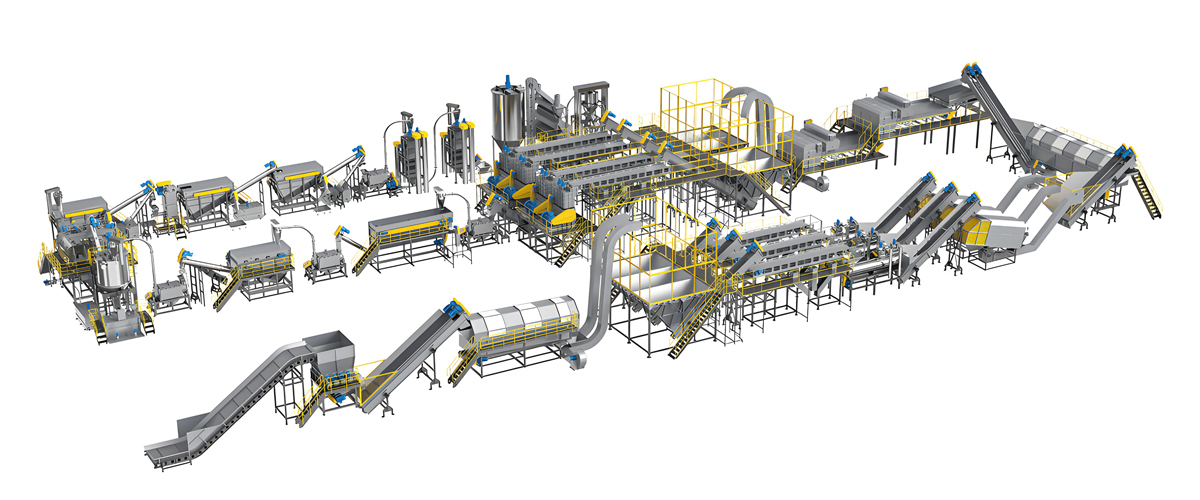
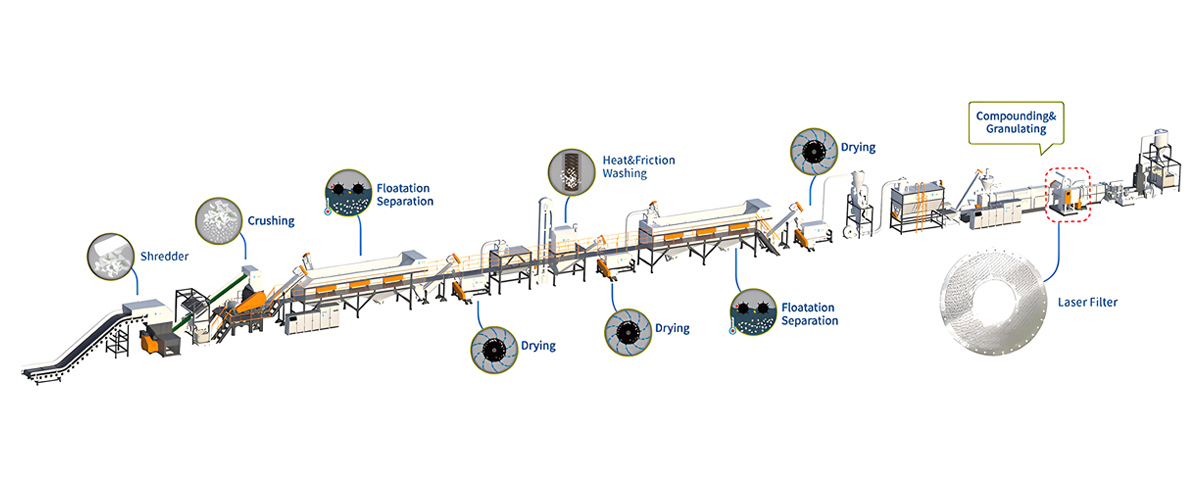
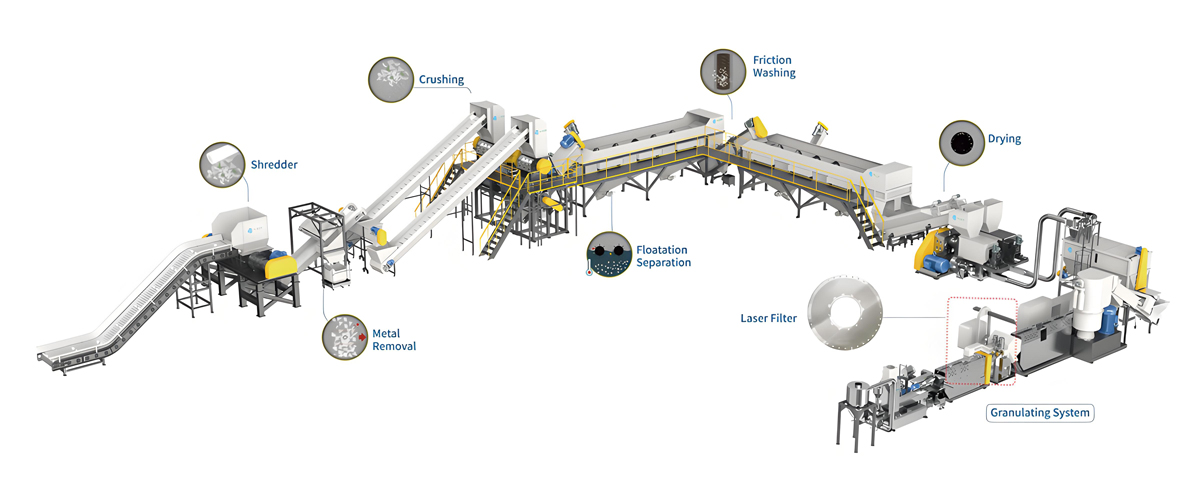
Polyretec builds the dewatering and drying stages as an integrated part of its washing and pelletizing lines rather than as bolt-on accessories. That matters because the residual moisture leaving the dewatering machine sets the load on every stage downstream, and a mismatch between pelletizer output and drying capacity is the most common bottleneck found during commissioning. Polyretec washing lines run from 500 kg/h to 6,000 kg/h for food-grade PET streams and 500 kg/h to 1,500 kg/h for soft PP and PE streams, and the pellet finishing equipment below is configured to match those throughput classes directly.
Product module one: Polyretec centrifugal dewatering machine
The dewatering machine is the first and cheapest moisture-removal stage, and it is built into every Polyretec wet pelletizing configuration. A vertical rotor with hardened paddles accelerates the pellet-water mixture against a wedge-wire or perforated screen; water passes through while pellets are lifted and discharged. Screen aperture is selected against the pellet size so that fines are separated with the water rather than carried into the finished product. Bearings are sealed and grease-lubricated with the drive mounted above the wet zone, which is the arrangement that survives continuous three-shift recycling duty.
| Specification | 500 kg/h class | 1,000 kg/h class | 2,000 kg/h class | 3,000 kg/h class |
|---|---|---|---|---|
| Nominal pellet throughput | 300 to 600 kg/h | 700 to 1,200 kg/h | 1,500 to 2,200 kg/h | 2,500 to 3,200 kg/h |
| Main motor power | 7.5 kW | 11 to 15 kW | 18.5 to 22 kW | 30 to 37 kW |
| Rotor speed | 1,200 to 1,450 rpm | 1,200 to 1,450 rpm | 1,000 to 1,400 rpm | 1,000 to 1,400 rpm |
| Screen aperture options | 0.8 to 2.0 mm | 0.8 to 2.0 mm | 1.0 to 2.5 mm | 1.0 to 2.5 mm |
| Outlet moisture, rigid pellets | 0.3 to 0.6 percent | 0.3 to 0.6 percent | 0.4 to 0.8 percent | 0.4 to 0.8 percent |
| Outlet moisture, soft film pellets | 1.0 to 2.0 percent | 1.0 to 2.0 percent | 1.5 to 3.0 percent | 1.5 to 3.0 percent |
| Contact material | Stainless steel 304, 316 optional | Stainless steel 304, 316 optional | Stainless steel 304, 316 optional | Stainless steel 304, 316 optional |
| Water recirculation connection | Yes, to line water loop | Yes, to line water loop | Yes, to line water loop | Yes, to line water loop |
| Typical specific energy | 12 to 20 kWh/t | 10 to 16 kWh/t | 9 to 14 kWh/t | 8 to 13 kWh/t |
Product module two: Polyretec hot air drying and thermal silo system
For rPP, rPE, rPS and rHIPS pellets, a dewatering machine followed by a Polyretec hot air drying and thermal silo system is the complete answer. Pellets are conveyed into an insulated silo where heated air passes upward through the bed; a level-controlled discharge maintains a constant residence time. The system doubles as the buffer between pelletizing and packing, which is why Polyretec sizes silo volume for at least 45 minutes of production at nameplate throughput. Temperature is closed-loop controlled with a high-limit cutout, and a cyclone with a fines filter recovers dust from the exhaust rather than discharging it into the workshop.
| Specification | 300 kg/h configuration | 600 kg/h configuration | 1,000 kg/h configuration | 1,500 kg/h configuration |
|---|---|---|---|---|
| Silo working volume | 600 L | 1,200 L | 2,000 L | 3,000 L |
| Heating power | 18 kW | 30 kW | 48 kW | 72 kW |
| Blower air volume | 600 m3/h | 1,200 m3/h | 2,000 m3/h | 3,000 m3/h |
| Blower motor power | 2.2 kW | 4.0 kW | 5.5 kW | 7.5 kW |
| Operating temperature range | 60 to 130 C | 60 to 130 C | 60 to 130 C | 60 to 130 C |
| Residence time at nameplate | 45 to 90 min | 45 to 90 min | 45 to 90 min | 45 to 90 min |
| Typical outlet moisture, rPP and rPE | Below 400 ppm | Below 400 ppm | Below 500 ppm | Below 500 ppm |
| Insulation | 50 mm mineral wool, stainless skin | 50 mm mineral wool, stainless skin | 50 mm mineral wool, stainless skin | 50 mm mineral wool, stainless skin |
| Control | PLC with touch screen, recipe storage | PLC with touch screen, recipe storage | PLC with touch screen, recipe storage | PLC with touch screen, recipe storage |
Product module three: Polyretec crystallizing and desiccant drying system
Where the pellet is hygroscopic, Polyretec supplies a combined crystallizing and desiccant drying system as part of the auxiliary equipment package. An agitated crystallizer conditions amorphous rPET to a free-flowing crystalline state, then an insulated drying hopper fed by a honeycomb rotor dehumidifier holds the material at temperature under a minus 40 degrees Celsius dew point. Supply and return dew point are both instrumented, return air is filtered and after-cooled before it reaches the rotor, and the whole train is interlocked so that a dew point excursion raises an alarm rather than quietly producing off-specification material.
| Specification | 150 kg/h configuration | 300 kg/h configuration | 500 kg/h configuration | 1,000 kg/h configuration |
|---|---|---|---|---|
| Crystallizer working volume | 200 L | 400 L | 600 L | 1,200 L |
| Crystallizer temperature | 160 to 170 C, agitated | 160 to 170 C, agitated | 160 to 170 C, agitated | 160 to 170 C, agitated |
| Drying hopper volume | 1,200 L | 2,500 L | 4,000 L | 8,000 L |
| Process air volume | 350 m3/h | 700 m3/h | 1,200 m3/h | 2,300 m3/h |
| Process heater power | 18 kW | 36 kW | 60 kW | 110 kW |
| Regeneration heater power | 9 kW | 15 kW | 24 kW | 45 kW |
| Guaranteed supply dew point | Minus 40 C or better | Minus 40 C or better | Minus 40 C or better | Minus 40 C or better |
| Drying temperature range | 60 to 180 C | 60 to 180 C | 60 to 180 C | 60 to 180 C |
| Achievable outlet moisture, rPET | Below 50 ppm | Below 50 ppm | Below 50 ppm | Below 50 ppm |
| Instrumentation | Supply and return dew point, bed thermocouples, data logging | Supply and return dew point, bed thermocouples, data logging | Supply and return dew point, bed thermocouples, data logging | Supply and return dew point, bed thermocouples, data logging |
These three modules are designed to be combined. A soft PP and PE film recycling plant typically buys module one plus module two. A food-grade PET plant buys module one plus module three, with module two acting as an economical pre-drying stage ahead of the desiccant unit. For plants building a complete recycling operation, Polyretec integrates the modules with its washing line and New Generation Pelletizing Line so the moisture balance across the whole plant is engineered once, as a system, rather than negotiated between separate suppliers after installation. Where a customer needs downstream compounding capability alongside the recycling line, Wanplas supplies matched twin-screw pelletizing systems that integrate directly with Polyretec equipment.
Application Industries for Properly Dried Recycled Pellets
Every downstream market for recycled resin has its own moisture ceiling, and moving up the value chain almost always means moving down the ppm scale. A recycler who can only hit 1,000 ppm is confined to thick-wall injection and low-grade extrusion. A recycler who can prove 50 ppm with a Karl Fischer certificate can sell into fiber, food-contact sheet and engineering compounds, where the same input material earns far more.
| End-use segment | Typical recycled resin | Moisture specification | Concrete end products | What happens if the spec is missed |
|---|---|---|---|---|
| General injection molding | rPP, rHDPE, rABS | Below 500 to 1,000 ppm | Crates, pallets, buckets, housewares, automotive underbody clips | Splay and surface streaks force a cosmetic downgrade |
| Film and packaging | rLDPE, rLLDPE, rPP | Below 300 to 500 ppm | Refuse sacks, construction film, secondary packaging film, carrier bags | Pinholes and web breaks cut line speed and yield |
| Pipe and conduit extrusion | rHDPE, rPP | Below 400 ppm | Non-pressure drainage pipe, cable protection conduit, corrugated pipe core layers | Voids in the wall reduce ring stiffness and fail hydrostatic testing |
| Sheet and thermoforming | rPET, rHIPS, rPP | Below 50 ppm for rPET | Food trays, blister packaging, protective sheet, display panels | Bubbles in the sheet and IV loss that ruins thermoforming behavior |
| Fiber and nonwoven | rPET | Below 20 to 30 ppm | Staple fiber, filling fiber, geotextile, strapping tape | Filament breaks, denier variation and unusable spinning yield |
| Engineering compounds | rPA6, rPA66, rPC, rPBT | 200 to 1,500 ppm by resin | Glass-filled brackets, electrical housings, connector bodies, appliance parts | Molecular weight loss that shows up only in the customer’s tensile test |
| Food-contact recycled resin | Food-grade rPET | Below 50 ppm with documented method | Beverage preform, food tray, bottle-to-bottle applications | Loss of certification standing, not just a quality complaint |
| Building and construction | rPP, rHDPE, wood-plastic composite feed | Below 800 ppm | Decking profiles, formwork panels, drainage boards, geocells | Surface foaming and dimensional instability in thick profiles |
Polyretec’s two headline application areas map directly onto this table. The first is plastic product production, converting waste plastics into reusable pellets that feed the molding, extrusion and compounding operations listed above. The second is renewable resource utilization, reducing dependence on primary resin. Both depend on the pellet meeting a written moisture specification, because that is what turns a commodity regrind into a qualified raw material with a repeat customer behind it.
Selection Guide: Matching Material and Output to a Drying Configuration
The right drying configuration is decided by three inputs: what polymer, how much per hour, and what target moisture the customer has written into the purchase specification. The table below turns those three inputs into a recommended Polyretec equipment combination. Use it as a first-pass configuration, then confirm with a moisture test on your actual material, because contamination level and pellet geometry can shift residence time by a third in either direction.
| Material stream | Output | Target moisture | Recommended Polyretec configuration | Key sizing points |
|---|---|---|---|---|
| rLDPE and rLLDPE film pellets | 300 to 600 kg/h | Below 500 ppm | Dewatering machine 500 kg/h class plus hot air silo 600 kg/h configuration | Soft pellets hold more surface water; allow the full 90 min residence |
| rPP and rHDPE rigid regrind pellets | 1,000 to 1,500 kg/h | Below 400 ppm | Dewatering machine 2,000 kg/h class plus fluidized bed plus hot air silo 1,500 kg/h configuration | Screen out fines before the silo, they carry disproportionate moisture |
| rPS and rHIPS pellets | 200 to 500 kg/h | Below 1,000 ppm | Dewatering machine 500 kg/h class plus hot air silo, capped at 80 C | Keep temperature below the softening range to avoid bridging |
| rABS pellets, appliance origin | 300 to 500 kg/h | Below 1,000 ppm | Dewatering machine plus desiccant system 500 kg/h configuration at 85 C | Three hours residence, minus 20 C dew point is sufficient |
| rPET pellets, sheet grade | 300 to 500 kg/h | Below 50 ppm | Dewatering machine plus crystallizing and desiccant system 500 kg/h configuration | 4,000 L hopper, 1,200 m3/h air, minus 40 C dew point |
| rPET pellets, food-contact grade | 500 to 1,000 kg/h | Below 50 ppm plus decontamination | Crystallizing and desiccant system 1,000 kg/h configuration with solid state polycondensation stage and dry-air cooling | Dew point logging is mandatory for the certification file |
| rPET pellets, fiber grade | 500 to 800 kg/h | Below 20 to 30 ppm | Crystallizing and desiccant system with extended residence plus vacuum-sealed foil packing | Extend residence to 6 h and hold minus 45 C dew point |
| rPA6 and rPA66 pellets | 100 to 300 kg/h | 800 to 1,500 ppm window | Desiccant system 300 kg/h configuration at 80 C with tight time control | Do not over-dry; set an alarm on the low side as well as the high side |
| rPC and rPC-ABS pellets | 150 to 300 kg/h | Below 200 ppm | Desiccant system 300 kg/h configuration at 120 C | Cap total residence at 8 h to protect color |
| rTPU pellets | 100 to 250 kg/h | Below 300 ppm | Desiccant system 150 kg/h configuration, shallow bed, 100 C | Steep cone angle and low bed depth to prevent blocking |
| Mixed post-consumer polyolefin | 3,000 kg/h and above | Below 600 ppm | Dewatering machine 3,000 kg/h class plus fluidized bed plus two parallel hot air silos | Parallel silos allow one to be cleaned during a color changeover |
Service, Testing and Support
A drying specification is only as good as the commissioning behind it, which is why Polyretec treats moisture performance as a deliverable rather than a datasheet claim. The support package below is what a Polyretec customer receives as standard, backed by the Wanplas brand promises shared across all Wanplas factories.
Incoming material testing and pilot trials
Send a representative pellet or flake sample and Polyretec engineers will measure its moisture, bulk density, pellet size distribution and fines content, then run a drying trial against your target specification. The trial output is a report with the achieved moisture curve over time, the recommended temperature, residence time and dew point, and the resulting equipment sizing. This step routinely prevents the two most expensive mistakes in a recycling project: an undersized drying hopper and a desiccant unit bought for material that never needed one.
Factory testing before shipment
Every dewatering machine, drying silo and desiccant system is run and tested at the factory before it is packed. Dew point performance is verified against the guaranteed value with a calibrated instrument, heater output and blower air volume are measured, temperature control loops are tuned, and safety interlocks are function-tested. Customers are welcome to attend the test in person under the Wanplas open-factory policy, or to receive a recorded test with the measurement data attached.
Installation, commissioning and training
Polyretec’s team of 24-plus engineers covers installation and commissioning across the 50-plus countries the factory serves, drawing on more than 100 completed recycling projects. Commissioning includes verifying the moisture result on the customer’s own material, not just confirming that the machine runs. Operator training covers daily start-up and shutdown, screen and filter cleaning intervals, desiccant condition assessment, dew point trend interpretation, moisture sampling technique and the response procedure when a dew point alarm triggers.
Spare parts and long-term support
- USD 500 free parts every year, the shared Wanplas policy across all factories, covering the wear items that matter in drying service: screens, seals, filter cartridges and gaskets.
- Free replacement for damaged parts within warranty, with the transportation guarantee that also forms part of the Wanplas brand promises.
- Production capacity guarantee, so the throughput and moisture figures agreed at order are the figures verified at commissioning.
- Quality standards guarantee, including refund plus 10 percent compensation if the delivered equipment fails to meet the agreed quality standard.
- Remote technical support, with engineers able to review controller data and guide an operator through a diagnostic sequence without waiting for a visa.
- Open factory policy, so customers can visit, watch machines being built and see equipment running on real recycled material before committing.
A practical maintenance calendar for drying equipment
| Interval | Task | Why it matters |
|---|---|---|
| Every shift | Record supply dew point, hopper temperature and one moisture reading | Creates the trend data that catches degradation before it becomes a reject batch |
| Daily | Check return air filter differential pressure and empty the fines collector | Blinded filters starve the bed of air and quietly ruin the dew point |
| Weekly | Inspect the dewatering screen for blinding, wear and damaged wedge wire | A worn screen lets fines into the product and lets water through to the dryer |
| Monthly | Verify the hopper discharge is in mass flow, check insulation and door seals | Funnel flow creates stagnant zones with residence times far above design |
| Quarterly | Cross-check the loss-on-drying analyzer against a Karl Fischer reference | Keeps the production control number honest as the material stream changes |
| Annually | Recalibrate dew point sensors, assess desiccant capacity, service the regeneration heater | Desiccant fatigue is gradual and invisible without a calibrated measurement |
Frequently Asked Questions
What moisture content is acceptable for recycled plastic pellets?
It depends entirely on the polymer and the downstream process. Non-hygroscopic rPP and rPE are normally accepted below 500 ppm, styrenics below 1,000 ppm, rABS below 1,000 ppm, rPC below 200 ppm, rPBT between 200 and 400 ppm, and rPET below 50 ppm for sheet and injection work and below 20 to 30 ppm for fiber. Recycled PA6 is the exception where the specification is a window rather than a ceiling, typically 800 to 1,500 ppm, because over-dried polyamide loses toughness and becomes difficult to process. Always write the acceptance criterion with the test method attached, because a number without a method invites disputes.
Can a hot air dryer dry recycled PET pellets?
No, not to specification. A hot air dryer heats ambient air whose dew point is typically between plus 10 and plus 25 degrees Celsius, and heating changes relative humidity but not absolute water content. The equilibrium floor that air can reach in polyester is in the hundreds of ppm, far above the 50 ppm target. Hot air is genuinely useful as a pre-drying and pre-heating stage that takes rPET from several thousand ppm down to 500 to 1,000 ppm cheaply, but a desiccant dryer holding a minus 40 degrees Celsius dew point is required to finish the job.
Why must recycled PET pellets be crystallized before drying?
Amorphous rPET has a glass transition temperature near 78 degrees Celsius. Heating it directly to the 160 degrees Celsius drying temperature takes the pellet surface through a tacky rubbery state, and adjacent pellets fuse until the whole bed sinters into a solid block that has to be broken out of the hopper. Agitated crystallization at 160 to 170 degrees Celsius for 20 to 40 minutes raises crystallinity above roughly 35 percent, and crystalline regions do not soften at drying temperature, so the bed remains free-flowing.
How do I know if my drying problem is the dryer or the hopper?
Measure the supply dew point at the dryer outlet and the temperature at three depths in the bed. If the dew point is at or below minus 40 degrees Celsius but the lower bed temperature is 15 degrees or more below setpoint, the problem is air volume or air distribution, not the dehumidifier. If the dew point has drifted upward toward minus 20 degrees Celsius, look at the return air filter, the return air temperature and the desiccant condition. Roughly speaking, a dew point fault is a dryer problem, while a temperature gradient fault is a hopper or blower problem.
Is it possible to over-dry recycled plastic pellets?
Yes, for two specific families. Recycled polyamide dried below about 500 ppm loses the plasticizing effect of its residual water, which raises melt viscosity, hampers filling of thin sections and reduces impact strength in the finished part. Recycled polycarbonate held above 130 degrees Celsius for extended periods yellows, which destroys the value of clear and light-colored grades. For polyolefins, styrenics and polyester the practical risk is thermal and oxidative damage from excessive temperature rather than from dryness itself, so cap the temperature and cap the residence time.
How quickly do dried pellets pick moisture back up?
Very quickly for hygroscopic resins. Recycled PET dried to 50 ppm and left in open air at 23 degrees Celsius and 60 percent relative humidity typically passes 1,000 ppm within a few hours and continues climbing toward its equilibrium value of several thousand ppm. Recycled PA6 can gain over one percent by weight in a week of open storage. Non-hygroscopic rPP and rPE barely change because they only hold surface water. This is why barrier packaging, cooling below 40 degrees Celsius before sealing, and a written open-bag use window are as important as the dryer itself.
What is the difference between drying and solid state polycondensation?
Drying removes water and preserves the molecular weight the material already has. Solid state polycondensation actively rebuilds molecular weight by continuing the condensation reaction in the solid phase at 200 to 215 degrees Celsius under nitrogen or vacuum for 8 to 16 hours, raising intrinsic viscosity from around 0.72 dl/g to 0.80 to 0.86 dl/g while stripping acetaldehyde below 1 ppm. Drying is mandatory for any hygroscopic recyclate; solid state polycondensation is an added value step that turns sheet-grade rPET into bottle and strapping grade.
How much energy does drying recycled pellets actually consume?
Mechanical dewatering is the cheapest stage at roughly 8 to 20 kWh per ton because it moves liquid water rather than evaporating it. Hot air drying typically runs 60 to 120 kWh per ton, and desiccant drying 90 to 160 kWh per ton, falling toward 70 to 110 with closed-loop heat recovery. Infrared pre-drying is attractive at 25 to 45 kWh per ton because energy goes into the polymer rather than a large air stream. The engineering objective is to let each cheap stage remove as much water as it can so the expensive minus 40 degrees Celsius air only handles the last few hundred ppm.
Do I need a separate dryer if my pelletizing extruder has a vacuum vent?
Yes. A vented barrel section removes moisture from the melt during pelletizing, which protects the extrusion process itself, but the pellet then goes through a water bath or water ring at the cutter and picks up surface water again, and hygroscopic pellets start absorbing bound moisture the moment they cool. Vacuum venting and pellet drying solve different problems at different points in the line, and a plant selling into engineering or food-grade markets needs both.
Conclusion
Removing moisture from recycled plastic pellets after production comes down to one diagnosis and one discipline. The diagnosis is whether your polymer holds surface water or bound water. Surface water yields to a centrifugal dewatering machine and a hot air silo, at 8 to 120 kWh per ton, with straightforward equipment. Bound water in polyester, polyamide, polycarbonate and polyester-based polyurethane yields only to a low dew point, and every hour spent trying to solve it with hotter ambient air is an hour of hydrolytic damage accumulating in the melt.
The discipline is measurement. A recycler who logs supply dew point continuously, runs a loss-on-drying check every shift, cross-checks against Karl Fischer every quarter, and packs into a barrier liner after cooling below 40 degrees Celsius will hold a specification that opens up fiber, sheet, engineering compound and food-contact markets. A recycler who relies on the dryer’s setpoint display and an unlined woven bag will keep selling into the lowest tier of the market, no matter how good the washing line upstream is. The equipment gap between those two positions is smaller than most plant owners expect; the revenue gap is not.
Polyretec, a Wanplas factory, has built plastic recycling equipment since 2010, with the brand established in 2017, more than 100 delivered projects, service coverage across 50-plus countries, 24-plus engineers and washing and pelletizing lines from 500 kg/h to 6,000 kg/h. Its dewatering machines, hot air drying silos and crystallizing and desiccant drying systems are designed as an integrated moisture balance across the whole plant, not as accessories bolted on after the pelletizer.
If you are specifying a new pellet finishing stage or troubleshooting a moisture result you cannot explain, send a representative sample of your pellets or flakes. Polyretec engineers will measure the incoming moisture, bulk density and pellet size distribution, run a drying trial against your target specification, and return a report with the achieved moisture curve, the recommended process window and a sized equipment configuration. Customers are also welcome to visit the factory under the open-factory policy, watch equipment being built and tested, and see a drying trial run on their own material before any commitment is made. Tell us the polymer, the throughput and the moisture target, and the configuration recommendation follows from there.