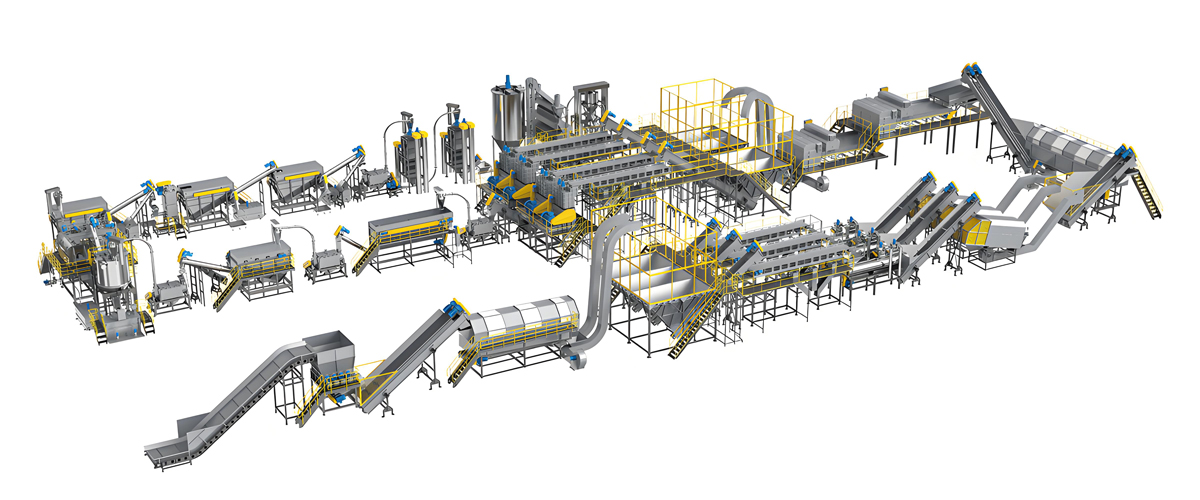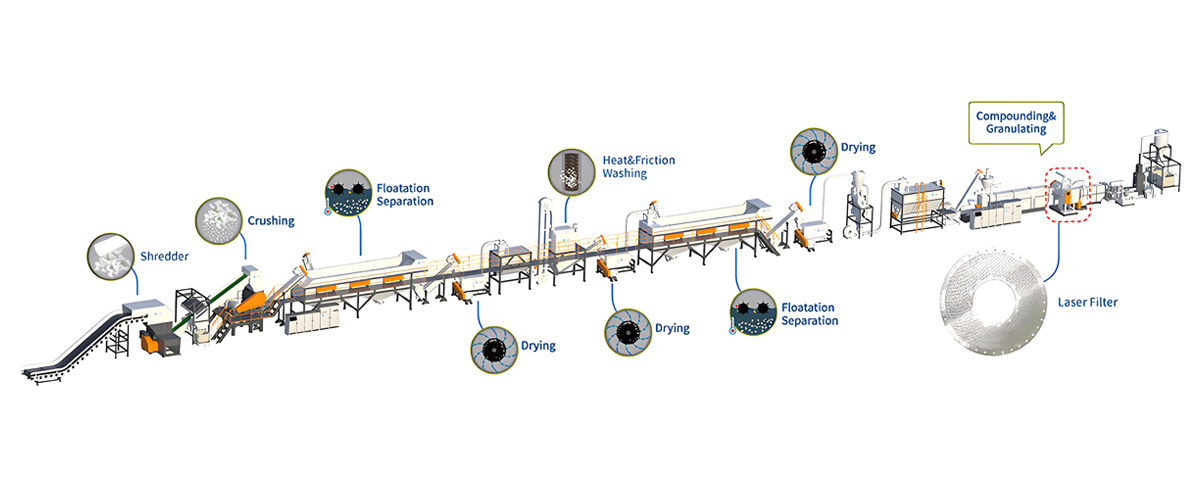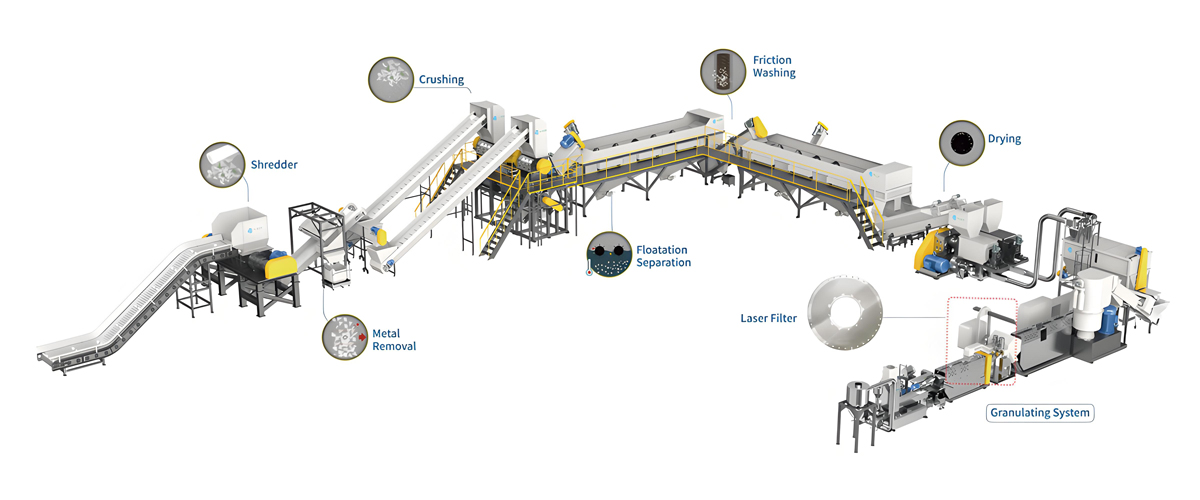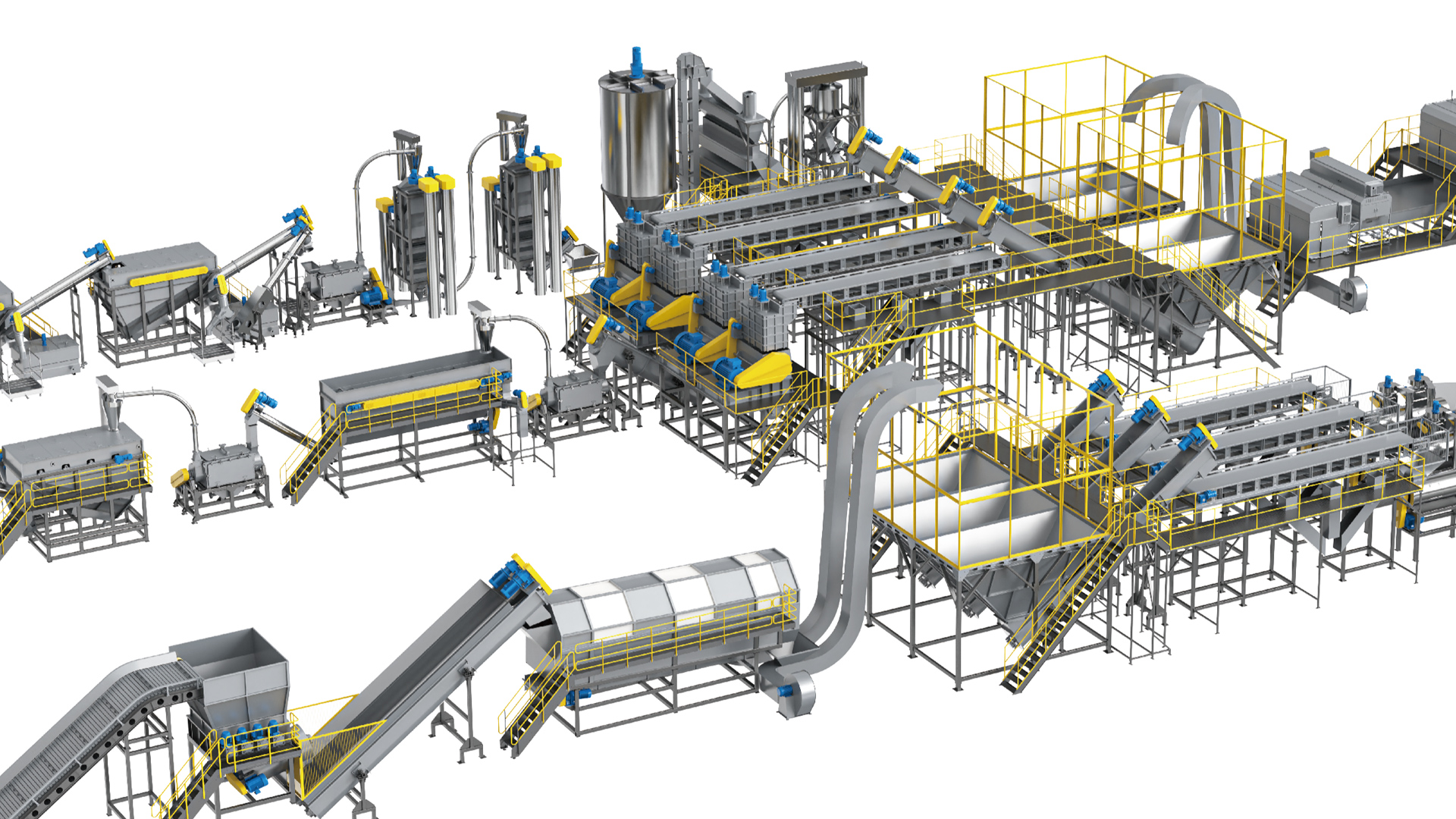

Corrosion is the silent tax on every plastic washing line. Unlike a broken bearing or a jammed screw that stops production immediately, corrosion works quietly until a tank wall weeps, a dewatering screen housing fatigues, or a weld at a crevice opens and floods the pit. For operators running PP/PE film, PET bottle, or mixed rigid-flake washing lines, understanding how to prevent corrosion in plastic washing line equipment is the difference between a line that runs for a decade and one that needs major structural rebuilds inside a few seasons. This technical guide explains the chemical and mechanical environments that attack washing-line equipment, the six dominant corrosion mechanisms, and the material-selection and engineering measures, from 304 and 316L stainless through duplex 2205 and wear-resistant overlays to epoxy or polyurea coatings and cathodic protection, that keep a line productive and safe.
Why Corrosion Dominates Lifecycle Cost
Corrosion is the largest controllable lifecycle cost on an aqueous recycling line because it touches every wetted component at once. The motor, gearbox, and control system degrade slowly and predictably; the steel and stainless parts immersed in wash water, alkali, and abrasive slurry degrade in ways that are local, hidden, and accelerating. A single chloride pit can perforate a tank wall in months, and once structural steel is compromised the repair is not a spare part but a shutdown and a weld.
The economics are straightforward. Capital equipment is a one-time Medium-to-High outlay, but corrosion-driven downtime, early component replacement, and lost production repeat every year. A washing line that loses nameplate throughput because its dewatering housing has thinned from abrasion-corrosion costs far more in lost output than the incremental price of specifying 316L or a duplex grade at the design stage. Prevention is therefore not a quality nicety; it is the highest-return engineering decision in the whole project.
Polyretec, a Wanplas factory with recycling-equipment heritage going back more than a decade, treats corrosion resistance as a design input rather than a afterthought, because its lines run in exactly the harsh conditions, printed film, soiled agricultural scrap, and mixed post-consumer bales, that generate the worst environments. The Wanplas brand’s broader manufacturing discipline, shared across its specialized factories, reinforces the value of specifying the right material for the right zone.
The Corrosive Environments Inside a Linha de lavagem
To prevent corrosion you must first map where it happens. A washing line is not one environment but a sequence of chemically distinct zones, each demanding a different defense.
Fresh-water and pre-wash zones
The infeed, wet crusher, and first rinse use water that is near neutral and low in dissolved species. This is the mildest zone and the one where carbon steel with a protective coating can survive. The risk here is mostly mechanical abrasion from grit and the beginning of crevice formation at bolted joints.
Hot-wash alkaline zone
The hot-wash tank is the chemical heart of the line. A dilute alkaline bath, often based on sodium hydroxide with surfactant, runs hot and attacks passive films while also promoting stress corrosion cracking in susceptible alloys. This is where material selection matters most.
Chloride and contamination zones
Post-consumer film and bottles carry PVC labels, food residue, salt, and soil. PVC in particular is a chloride source; when it degrades or when label glue contains chloride, the water becomes a pitting agent for stainless steel. Sink-float tanks and rinse stages that concentrate this contamination are the danger zones for localized attack.
Abrasive slurry zones
Friction washers, dewatering machines, and augers move a slurry loaded with sand, filler, and polymer fines. Here corrosion is married to erosion, and the passive film on stainless is continually scraped away. Selection must address both wear and corrosion together. Temperature is the multiplier that makes every mechanism worse. Chemical reaction rates roughly double for each modest rise in temperature, so a hot-wash tank running at the top of its band attacks passive films and accelerates SCC far faster than the same chemistry at a lower temperature. Warm recirculated rinse water feels like an energy saving, and it is, but it also keeps the whole loop in the corrosive warm regime where pitting and crevice attack thrive. The design answer is to keep temperatures at the lowest value that still cleans, and to insulate or vent where heat would otherwise raise the temperature of a component never meant for it.
Chloride Pitting Corrosion
Chloride pitting is the most common failure mode in washing lines that process PVC-containing or salt-contaminated feed. Pitting begins at a microscopic weak point, a sulphide inclusion, a scratch, a weld discoloration, where the passive chromium-oxide film breaks down in the presence of chloride ions. Once a small pit nucleates, the chemistry inside it becomes acidic and chloride-rich, so the pit grows downward into the metal even while the surrounding surface looks perfect.
The insidious part is that pitting is local and hidden. A tank can appear sound from outside while a pit penetrates from the wetted side. By the time a weep appears, the wall is already perforated. Pitting is accelerated by higher temperature, higher chloride concentration, and lower pH, which is exactly the combination found in a hot rinse that has concentrated contamination.
Defense against pitting is twofold: raise the alloy’s resistance by increasing molybdenum content, which is why 316L (with roughly 2 to 3 percent molybdenum) outperforms 304, and why duplex 2205 (with roughly 3 percent molybdenum plus high chromium) is better still; and reduce the chloride load by good pre-sorting, by limiting PVC in the stream, and by managing water chemistry. Where chloride cannot be excluded, the wetted surface should be a high-molybdenum grade or a properly applied non-metallic lining. Detection matters as much as prevention. Because pits are local and hidden, a line with known chloride exposure should include periodic ultrasonic or visual inspection of the hot-wash and rinse zones, with particular attention to welds and crevices where pits nucleate first. A small pit found early is a weld repair; a pit found after perforation is a tank outage. Operators who track chloride concentration in the loop and correlate it with inspection findings build the feedback that lets them tighten pre-sorting before metal is lost.
Alkali Stress Corrosion Cracking
Stress corrosion cracking (SCC) is a brittle fracture of a ductile metal under the combined action of a tensile stress and a specific corrosive environment. In washing lines the relevant variant is alkali stress corrosion cracking of austenitic stainless steel in the hot-wash zone. Although stainless steel is chemically resistant to alkali, it is not immune to SCC when three conditions coincide: a sufficiently high hydroxide concentration, an elevated temperature, and a sustained tensile stress from welding, fit-up, or load.
The fracture surface of SCC is characteristically branched and intergranular, and it can propagate with little visible warning. Welds are the usual origin because they carry residual stress and often have a sensitized microstructure if not properly post-treated. The practical lesson is that the hot-wash tank and its internals should use low residual-stress fabrication, full penetration welds with smooth profiles, and alloys less prone to SCC, while the operating recipe keeps alkali concentration and temperature inside conservative bands.
Austenitic grades such as 304 and 316L are more SCC-sensitive than duplex stainless, which has a two-phase structure that resists crack propagation. For hot-wash vessels under high stress and high temperature, duplex 2205 is frequently the correct specification even when its upfront cost is in the High tier, because the alternative is a cracked tank. Mitigation starts at fabrication. Low-heat-input welding, controlled interpass temperature, and a smooth weld profile reduce residual stress, while a post-weld passivation or heat treatment restores the chromium-rich film at the heat-affected zone. Where the geometry cannot avoid stress, the alloy choice carries the burden: duplex 2205 and ferritic-austenitic grades resist crack propagation because the ferrite phase blunts the advancing crack. Operators should also avoid clamping or bolting that imposes external tensile load on a hot vessel, since the combined stress is what tips a susceptible microstructure into cracking.
Acid-Alkali Alternation Damage
Many lines alternate chemistries: an alkaline hot wash, then an acidic neutralization or a citric-acid rinse to strip residual alkali or metal, then a return to neutral water. This acid-alkali alternation is more damaging than either environment alone because it prevents the formation of a stable passive film. Each swing in pH strips or reforms the protective layer, and at the transition the surface is briefly active and vulnerable.
The damage shows up as generalized thinning, as accelerated attack at welds where the microstructure differs from the base metal, and as fatigue-like cracking at cyclically stressed points. Lines that run a fixed alkaline recipe with neutral rinses are easier to protect than lines that deliberately swing acid-to-alkali, so the process design should minimize unnecessary chemistry changes and, where they are required, specify alloys and coatings rated for the full pH swing. A practical control is to monitor pH at the transition and to flush the loop fully between chemistries rather than allowing a gradient zone to persist. A slowly shifting pH front is more destructive than a clean switch because it dwells in the vulnerable mid-range where passive films are unstable. Recording pH and conductivity over time also builds the data that shows whether a coating is failing or a dosing pump is drifting, turning an invisible chemical risk into a plotted trend the maintenance team can act on.
Abrasion-Corrosion Synergy
Abrasion-corrosion, sometimes called erosion-corrosion, is the combined attack that defines the friction washer, the dewatering machine, and every auger handling slurry. The mechanism is a loop: the flowing abrasive slurry removes the passive film; the freshly exposed metal corrodes; the corrosion product is itself soft and is abraded away; and the cycle repeats, now on bare metal. The result is a loss rate far higher than the sum of pure wear and pure corrosion measured separately.
This synergy explains why a stainless screw in a friction washer can thin faster than expected even in “mild” water: the grit does the opening, the water does the eating. The defenses are to use a surface that reforms its protection quickly, to add a hard wear-resistant overlay on the wetted and struck faces, and to control slurry velocity so the abrasive energy stays below the threshold where the film cannot recover. Tungsten-carbide or chrome-rich hard-facing on paddle edges and auger flights is the standard mitigation, and it is far cheaper than replacing the component. Slurry velocity is the dial that controls the synergy. Below a threshold the passive film keeps up with the abrasion and loss stays low; above it the film cannot reform and loss climbs sharply. The line should therefore run slurry density and pump speed in the band where the film recovers, which often means a larger pipe and a slower pump rather than a small, fast one. Wear plates at predictable impact points let the operator replace a cheap liner instead of a structural wall, and routine thickness checks on those plates catch the trend before perforation.
Crevice and Galvanic Corrosion
Crevice corrosion starts in confined spaces, under bolt heads, behind gaskets, in lap joints, and inside the stagnant volumes of a poorly drained trough. Oxygen is depleted inside the crevice while the outside surface stays aerated, setting up a concentration cell that drives aggressive localized attack. Stainless steel, counter-intuitively, is prone to crevice corrosion because its protection depends on a uniform oxygen-rich film; deny it oxygen in a tight gap and it corrodes there preferentially.
Galvanic corrosion occurs when two dissimilar metals touch in an electrolyte. A stainless part bolted to carbon steel, or a 316L screen seated against a 304 frame, forms a galvanic couple where the more active metal corrodes to protect the nobler one. The fix is either to keep metals close in the galvanic series, to insulate them with non-conductive spacers and washers, or to make the sacrificed part the cheap, replaceable one.
Both mechanisms are dominated by design hygiene. Open drainage, continuous welds instead of lap joints where possible, non-absorbent gaskets, and deliberate isolation between dissimilar metals remove most of the risk before material grade is even considered. Practical isolation is straightforward but often skipped. When a 316L screen must sit in a 304 frame, insert a non-conductive washer and sleeve at every fastener so the two alloys do not form a galvanic couple through the bolt. Where a carbon-steel support meets stainless, paint the carbon-steel face and break the electrical path with a spacer. These small details cost little at build time and remove the most common crevice and galvanic failures seen in service.
Material Selection Fundamentals
Material selection for a washing line is a zone-by-zone decision, not a single blanket choice. The guiding principle is to match the alloy or coating to the local environment: mild water gets coated carbon steel, hot alkali gets 316L or duplex, chloride-risk zones get high-molybdenum grades or linings, and abrasive zones get hard-faced surfaces. Over-specifying everywhere wastes capital; under-specifying anywhere buys a failure.
304 stainless steel
304 is the workhorse austenitic grade with roughly 18 percent chromium and 8 percent nickel. It resists fresh water and mild alkali well and is the default for structural frames, guards, and lightly wetted parts. Its weakness is chloride pitting and SCC susceptibility, so it should be kept out of PVC-rich and high-temperature alkaline zones unless validated.
316L stainless steel
316L adds molybdenum, which lifts pitting resistance substantially, and the “L” low-carbon version reduces sensitization during welding, lowering SCC and intergranular corrosion risk. It is the correct general choice for hot-wash tanks, rinse stages, and most wetted surfaces where chloride is possible. Its cost tier is Medium-High relative to 304.
Duplex 2205
Duplex 2205 combines roughly equal austenite and ferrite phases with high chromium, molybdenum, and nitrogen. It resists pitting and crevice corrosion better than 316L and is markedly more resistant to stress corrosion cracking. It is the specification for the most aggressive zones, hot-wash vessels, high-chloride rinse tanks, and highly stressed welds, at a High capital tier that is justified by avoided rebuilds.
Wear-resistant overlay welding
Where abrasion-corrosion dominates, the base alloy is only the substrate; the working surface is a hard-facing deposit, tungsten carbide, chrome carbide, or a cobalt-free alloy, applied by overlay welding to paddles, auger flights, and screen frames. This converts a corrosion-wear loop into a manageable wear schedule with predictable regrind intervals. For budget-constrained structures that never see the harshest chemistry, carbon steel protected by a qualified lining remains a legitimate choice, provided the lining is specified, applied, and inspected to a standard rather than treated as paint. At the other extreme, high-nickel alloys would resist nearly every mechanism here but sit in the Premium tier and are rarely justified when duplex 2205 already covers the duty; spending there buys margin that the process does not need. The disciplined approach is to place the expensive alloy only where the environment demands it and to protect the rest by design and coating.
Stainless Grade Comparison
The table below compares the three grades against the mechanisms that matter in a washing line. Values are typical and should be confirmed against the actual alloy certificate and the process chemistry.
| Property | 304 | 316L | Duplex 2205 |
|---|---|---|---|
| Chromium (typical) | ~18% | ~17% | ~22% |
| Molybdenum | None | ~2-3% | ~3% |
| Pitting resistance | Moderate | Good | Very good |
| SCC resistance | Moderate | Good | Excellent |
| Strength | Standard | Standard | High (yield ~2x) |
| Relative cost tier | Low-Medium | Medium-High | High |
Coatings, Linings and Cathodic Protection
Not every wetted surface must be solid stainless. Coatings and linings let a lower-cost substrate, usually carbon steel, serve in corrosive duty if the barrier is intact and maintained. The two common polymer systems are epoxy and polyurea. Epoxy gives good chemical resistance to alkali and many process streams and is the standard tank lining; polyurea offers fast cure and high flexibility, useful where thermal movement or impact could crack a rigid lining.
The catch is that a coating is only as good as its preparation and its freedom from holidays, the term for pinholes and missed spots. A single holiday becomes a concentration cell: the small bare steel area corrodes rapidly while the surrounding coated steel is protected, so the defect grows into a blister and then a penetration. Coatings are therefore a complement to, not a substitute for, material selection, and they demand disciplined surface preparation, holiday testing at application, and a re-inspection cycle in service.
Cathodic protection suppresses corrosion on submerged carbon-steel structures by making the whole surface the cathode of an electrochemical cell. A sacrificial anode, typically zinc or magnesium, or an impressed current with an inert anode, supplies the protective current so the steel does not dissolve. It is most useful for tank shells, buried augers, and large submerged structures where full stainless would be uneconomic. It cannot fix a fundamentally wrong alloy choice in a high-temperature crevice, but it is a powerful tool for the bulk-water zones.
| Protection method | Best application | Key limitation | Relative cost tier |
|---|---|---|---|
| Epoxy lining | Alkali tanks, neutral water | Holidays cause local attack | Low-Medium |
| Polyurea lining | Flexible, impact zones | Needs expert application | Medium |
| Wear overlay | Friction, auger, screen | Base alloy still matters | Medium |
| Cathodic protection | Submerged steel structures | Not for crevices/heat | Medium |
Design, Process and Maintenance Measures
Material choice is necessary but not sufficient. The remaining defenses are design discipline, process control, and inspection.
Design measures
Good corrosion-resistant design drains completely, avoids dead legs and lap joints, specifies full-penetration smooth welds with passivation, keeps dissimilar metals isolated, and provides access for inspection and coating repair. Tanks should have sloped floors and bottom outlets so no process water stagnates. Bolts in wetted zones should be the same grade as the structure or be sealed, and gaskets should be non-absorbent and chloride-free.
Process control measures
The operating recipe is a corrosion control lever. Keep alkali concentration, temperature, and residence time in the conservative band that cleans without driving SCC. Limit chloride entry through pre-sorting and by controlling PVC label content. Manage water chemistry with monitored dosing rather than batch dumping, and keep pH swings to the minimum the process requires. Where a neutralization acid is used, schedule it so the swing is brief and the rinse is thorough.
Maintenance and inspection
A written inspection plan turns corrosion from a surprise into a managed risk. Monthly visual checks of wetted parts, dye-penetrant or ultrasonic testing of high-stress welds and the hot-wash tank on a periodic basis, thickness gauging of abrasive zones, and holiday testing of linings at each opening give early warning. Prompt repair of coating damage, re-passivation of welded stainless, and renewal of sacrificial anodes keep the system ahead of failure. The Wanplas brand’s yearly free spare-parts allowance supports this routine by keeping wear items in stock. A thickness-monitoring program is the difference between planned replacement and emergency repair. Ultrasonic thickness gauging at marked grid points on tanks, augers, and dewatering housings, recorded against a baseline taken at commissioning, shows the annual loss rate and predicts the remaining life of each component. When the trend approaches the retirement thickness, the part is scheduled into a planned shutdown. This same record is the evidence for warranty and capacity claims, and it lets the operator prove the line still meets nameplate rather than guessing from appearance alone.
| Component | Recommended material | Primary mechanism addressed |
|---|---|---|
| Hot-wash tank shell | 316L or duplex 2205 | SCC, pitting |
| Friction washer paddles | 316L + wear overlay | Abrasion-corrosion |
| Sink-float tank | 316L or lined steel | Pitting, crevice |
| Dewatering screen | 316L + hard-faced frame | Abrasion-corrosion |
| Structural frame | 304 or coated carbon steel | General, crevice |
Frequently Asked Questions
Is 304 stainless steel good enough for a plastic washing line?
304 is adequate for fresh-water and mildly alkaline zones, but it is vulnerable to chloride pitting if the feed carries PVC or chloride-containing contamination. In the hot-wash and rinse areas, 316L or duplex 2205 is the safer choice where chloride risk exists.
Why does abrasion make corrosion worse in a washing line?
The slurry contains sand, filler, and grit that continuously abrade the passive film on stainless steel. Once the protective layer is removed, the bare metal corrodes faster, and the abrasion then re-exposes the fresh surface, creating a self-accelerating abrasion-corrosion loop.
Can coatings replace stainless steel in the hot-wash tank?
Coatings such as epoxy or polyurea protect carbon steel economically, but only if applied to a perfectly prepared surface and maintained. Any holiday or crack in the coating becomes a local corrosion cell, so coatings are a complement to, not a full substitute for, correct material selection.
How often should a washing line be inspected for corrosion?
A written inspection plan with monthly visual checks of wetted parts, plus periodic non-destructive testing of high-stress welds and the hot-wash tank, is appropriate. Frequency should rise in lines processing chloride-rich or highly abrasive feedstock.
Does cathodic protection help in an aqueous washing line?
Impressed-current or sacrificial cathodic protection can suppress galvanic and crevice corrosion on submerged carbon-steel structures such as tank shells and augers, but it must be engineered with the process chemistry in mind and cannot compensate for fundamentally wrong material choice.
What causes stress corrosion cracking in the hot-wash tank?
SCC needs three things together: a susceptible alloy such as austenitic stainless under tensile stress, a hot alkaline environment, and often a weld with residual stress. Removing any one of the three, by using duplex 2205, lowering alkali and temperature, or eliminating residual weld stress, prevents the cracking.
How do I reduce chloride pitting without upgrading every part to duplex?
Reduce the chloride load through better pre-sorting and limiting PVC in the stream, keep water chemistry monitored, and upgrade only the highest-risk wetted surfaces, hot-wash shell, chloride-rich rinse tanks, to 316L or duplex while leaving low-risk frames in 304 or coated steel.
Should I use solid stainless or a lined carbon-steel tank to save cost?
For a hot-wash vessel handling alkali and possible chloride, solid 316L or duplex is the lower-risk choice and avoids the holiday problem of linings, but a properly specified and inspected epoxy-lined carbon-steel tank can be acceptable in lower-risk neutral-water zones where the relative cost tier drops to Low-Medium. The decision should follow the zone’s chemistry and the operator’s ability to maintain the lining, not just the initial price.
What records prove a washing line is still corrosion-fit?
A commissioning baseline of ultrasonic thickness readings at mapped points, repeated at each inspection and trended over time, plus a log of coating holidays, anode consumption, and any weld repairs, demonstrates that the equipment retains wall thickness and protection. This record supports both planned maintenance and any capacity or warranty claim under the supplier’s commitment.
Conclusion
Preventing corrosion in plastic washing line equipment is a system, not a single material. It starts with mapping the chemical and abrasive zones of the line, then selecting the right defense for each: 304 for mild structural duty, 316L for the general wetted surface, duplex 2205 for the hot, stressed, chloride-risk heart of the process, wear-resistant overlay for abrasive slurry paths, and epoxy or polyurea linings with cathodic protection where coated carbon steel is the economical choice. Layer on crevice-free design, conservative wash recipes, and a written inspection plan, and corrosion becomes a managed, predictable cost instead of a sudden failure. Polyretec, a Wanplas factory, applies this zone-by-zone thinking across its washing lines so operators can protect both uptime and the value of their investment over the full life of the equipment. A line specified this way also commands a stronger resale position, because a documented corrosion history is what a second owner pays a premium for. The cost of the right alloy at the design stage is a fraction of the cost of a failed tank during production, which is the single argument that settles most material debates.