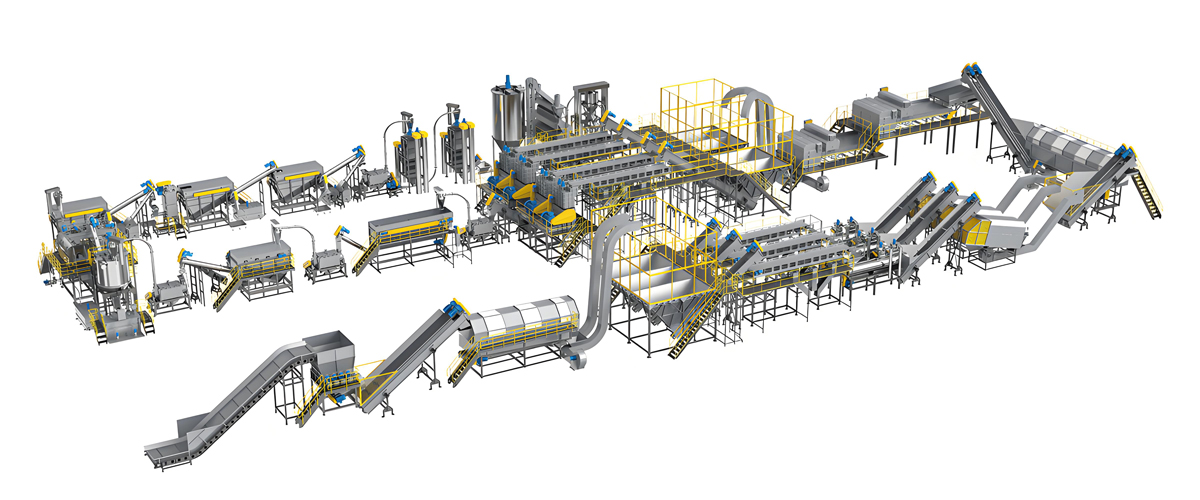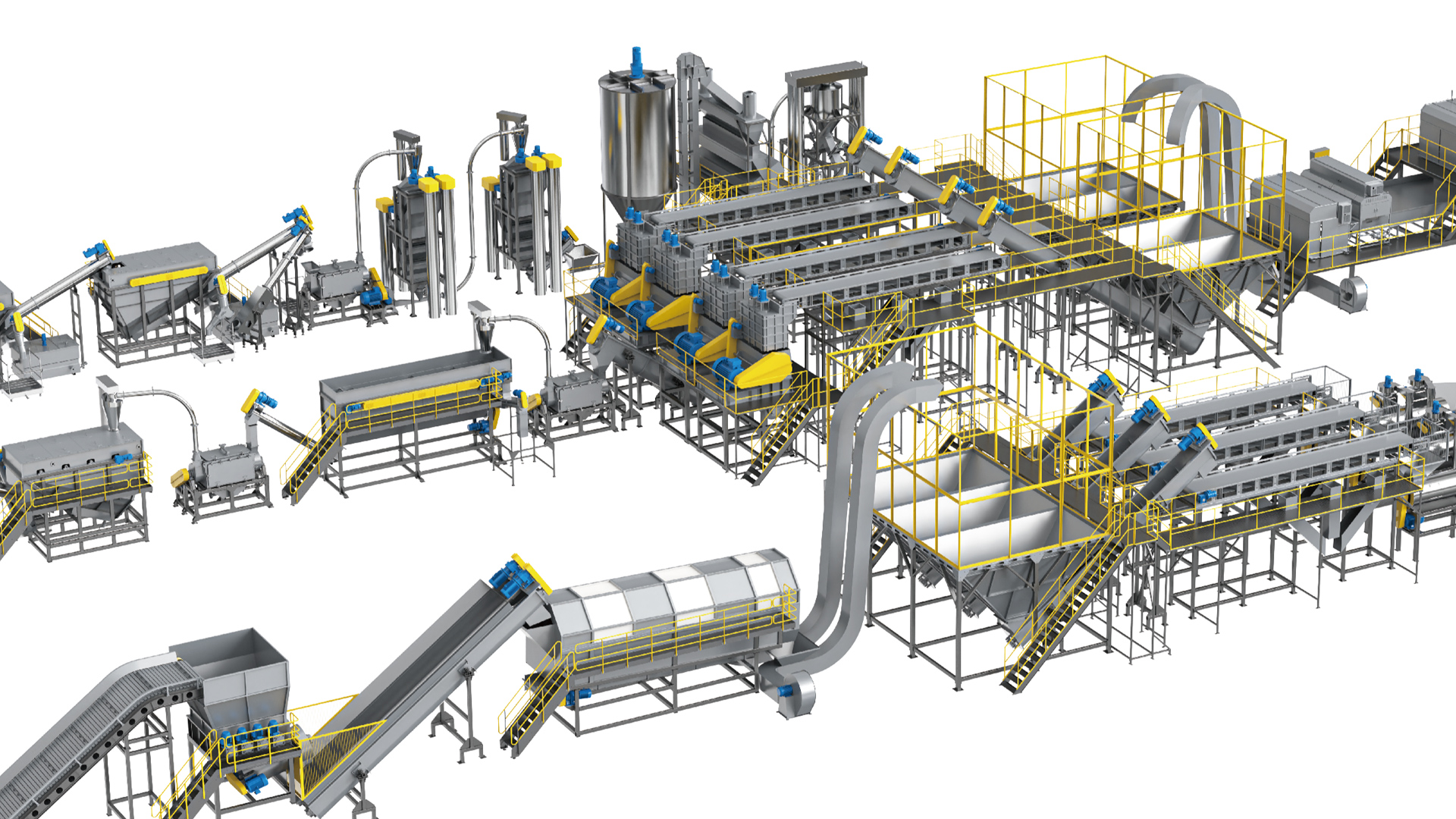

A soft plastic washing line is the front-end system that converts dirty post-consumer and post-industrial film, flexible packaging, woven bags, and agricultural sheeting into clean, dry flakes or directly into pellets ready for re-extrusion. For a recycler targeting a 1500kg/h output requirement, the design decisions made at the specification stage determine not only the achievable throughput but also the final flake purity, the moisture content, the energy draw, and the long-term maintenance burden. Choosing the best soft plastic washing line for 1500kg/h output is therefore less about buying a catalogue machine and more about engineering a balanced process chain where every stage is sized to the same hourly target. This guide explains the process chain, the equipment structure, the quality indicators that matter for rLDPE and rPP, the food-grade compliance pathways, and the trade-offs between configuration, water recycling, and operating cost.
What a Soft Plastic Linha de lavagem Actually Does
A soft plastic washing line is a continuous mechanical and aqueous system that removes foreign matter from flexible polymer scrap and reduces it to a clean, low-moisture, size-controlled flake or regrind. The defining challenge with soft plastics is not hardness but conformability: film tangles, bridges, floats, and wraps around rotating shafts, so the line must be engineered to keep material moving while it is being opened, cleaned, separated, and dried. The core outcome is a flake whose residual contamination, ash, and moisture are low enough for downstream extrusion or direct re-processing.
The phrase “soft plastic” covers a surprisingly wide family. Low-density polyethylene (LDPE) from shrink film and bags, linear low-density polyethylene (LLDPE) from stretch wrap, polypropylene (PP) from woven sacks and raffia, biaxially oriented PP (BOPP) from snack wrappers, and mixed polyethylene-polyester laminates all behave differently in water. Density is the master variable: LDPE and LLDPE float in water (density around 0.91 to 0.93 g/cm3), while PET, PVC, and most paper and mineral contaminants sink (density above 1.0 g/cm3). A well-designed line uses this density split as a primary separation mechanism rather than fighting it.
Polyretec, a Wanplas factory, positions soft plastic washing within its broader recycling mandate of “turning waste into treasure,” combining Austrian process know-how with Chinese manufacturing scale. For the 1500kg/h segment the line is typically offered as a PP/PE soft plastic crushing and washing line rated from 500kg/h up to 1500kg/h, with one-step pelletizing available for operators who want to skip a separate extrusion step. The Wanplas brand as the parent organization aggregates this capability alongside its Kerke factory’s twin-screw extruders, which can be integrated downstream for compounding or pelletizing.
Why 1500kg/h Is a Strategic Capacity Tier
The 1500kg/h nameplate sits at the upper edge of the standard modular soft-film washing range and represents a tipping point in engineering economics. Below roughly 1000kg/h, operators can tolerate more manual feeding and simpler conveyance; at 1500kg/h, automation of infeed, metal detection, and continuous dewatering becomes necessary to protect the nameplate. The 1500kg/h tier is strategic because it is the smallest capacity that justifies a dedicated hot-wash tank, a high-speed horizontal dewatering machine, and a closed-loop water recycling circuit on their own merits.
Throughput must always be defined against feed condition. A nameplate of 1500kg/h of clean dry feedstock is not the same as 1500kg/h of heavily printed, wet, soiled agricultural film at the infeed. Real-world achievable output is the dry-feed rate multiplied by availability and by the contamination-removal factor. For a typical mixed post-consumer film bale with high moisture and dirt, the effective flake output at the dryer outlet is commonly in the medium-to-high band relative to the nameplate, which is why a specification should state the feed basis explicitly.
The comparison below frames how the 1500kg/h tier sits against neighboring capacities. It is intended as a planning reference rather than a price list, because procurement cost at this scale is tier-rated rather than fixed.
| Capacity tier | Typical feed basis | Automation level | Relative capex tier |
|---|---|---|---|
| 500 kg/h | Clean industrial offcut | Semi-manual infeed | Low |
| 1000 kg/h | Mixed post-industrial film | Guided automatic | Medium |
| 1500 kg/h | Post-consumer + agricultural | Fully continuous | Medium-High |
| 2000+ kg/h | Pre-sorted mono-stream | High with inline NIR | High |
The Full Process Chain for Film and Flexible Scrap
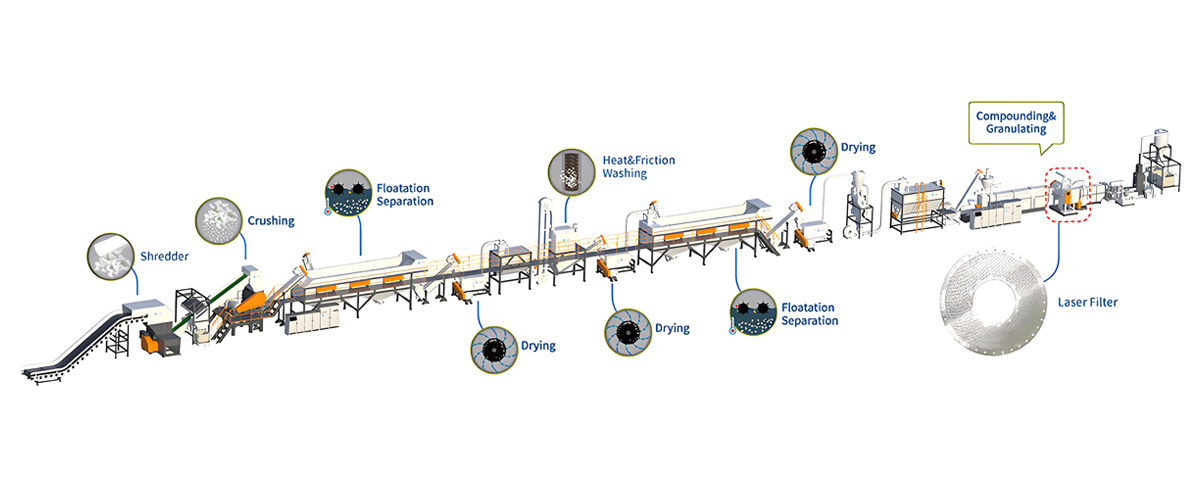
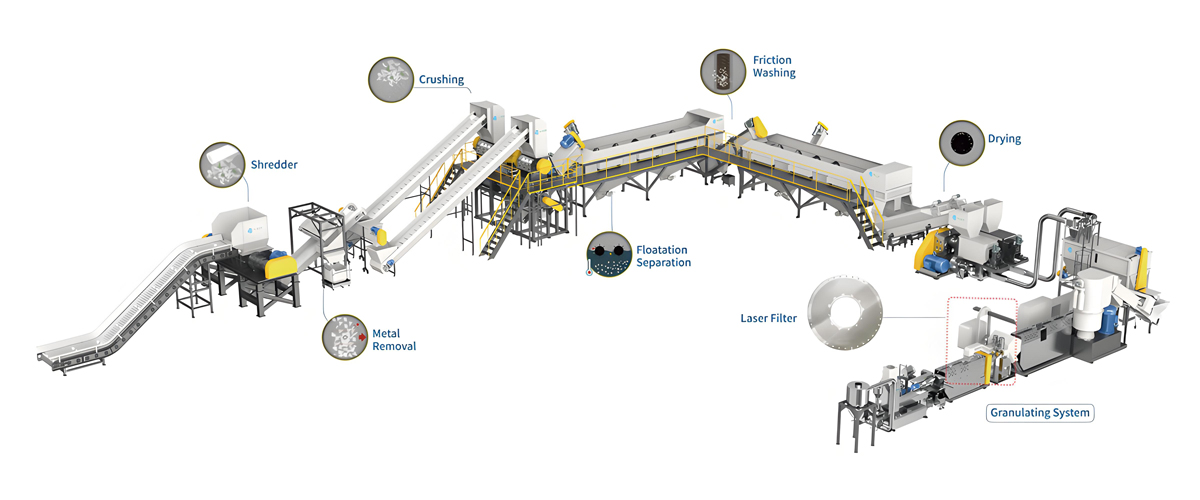
The best soft plastic washing line for 1500kg/h output is defined by how well its stages are balanced, not by the headline of any single machine. The chain runs pre-sorting, wet crushing, friction washing, hot washing, rinsing, density separation, centrifugal dewatering, thermal drying, and finally pelletizing. Each stage has a target outlet condition, and a bottleneck in any one stage caps the whole line.
Pre-sorting and metal protection
Before water touches the film, bulky contaminants must be removed. Trommel screens, disc screens, and manual picking stations take out stones, large paper, and non-plastic objects. A suspended magnet and a metal detector with reject gate protect the crusher rotor from ferrous and non-ferrous fragments, because a single forged bolt can destroy a knife and cause unplanned downtime. At 1500kg/h the infeed belt should be metered, not dumped, so the crusher sees a steady mass flow.
Wet crushing and friction washing
The film is cut underwater or with a water film in a rotor-cutter, which both sizes the material and begins to knock loose surface dirt. The resulting slurry then passes through a friction washer, a horizontal trough with a rotating screw and paddles that rub flake against flake and against the trough wall. Friction washing is the workhorse for removing printing ink, glue, and adhered soil. The mechanical energy here is what separates a good line from a poor one: too little friction leaves ink on the flake; too much generates fines and heat that accelerate polymer degradation.
Hot washing with alkali
For printed and glued film, a hot-wash tank is essential. The bath typically uses a dilute alkaline solution, often sodium hydroxide, with a surfactant and occasionally a chelating agent. The combination softens and saponifies adhesives and emulsifies ink binders. Effective ranges in practice are an alkali concentration in the low single-digit percentage, a bath temperature in the medium-hot band, and a residence time long enough for chemistry to act without over-cooking the polymer. Overly aggressive hot wash drives IV (intrinsic viscosity) loss and yellowing, so the recipe must be tuned to the actual contamination profile rather than maxed out by default. Surfactant selection is as important as alkali strength. Anionic surfactants lower surface tension so ink and grease detach, while a chelating agent such as a phosphonate binds hardness and metal ions that would otherwise deposit on the flake. The bath should be held at a stable temperature by closed-loop control rather than by manual steam valving, because temperature drift shifts both cleaning rate and polymer damage in the same direction. A well-instrumented hot-wash tank logs concentration, temperature, and residence time so the recipe can be reproduced batch to batch, which is essential when the line must deliver a consistent food-grade or film-to-film output.
Rinsing and density separation
After hot wash the flake is rinsed to remove alkali and released contaminants, then sent to a sink-float tank. Floating LDPE and LLDPE are skimmed from the surface while sinking PET, PVC, and heavy minerals drop to the bottom and are purged. A second, cleaner rinse stage reduces carry-over of surfactant and fine solids, which matters for both odor and downstream extrusion stability.
Centrifugal dewatering and thermal drying
A horizontal dewatering machine spins the flake at high rotational speed against a screen, flinging free water outward while the flake is conveyed forward. Good design leaves the flake in the low single-digit moisture band. A subsequent hot-air dryer drives residual surface moisture down further so the material can enter the extruder without steam voids or hydrolytic degradation. At 1500kg/h both machines must be sized with margin so that a brief surge does not flood the dryer.
Pelletizing integration
Operators targeting rLDPE or rPP pellets rather than flakes can add a one-step pelletizing module. This is where the Wanplas brand’s cross-factory strength shows: Polyretec washing lines can hand off to Wanplas’s Kerke factory twin-screw extruders for compounding or to a die-face pelletizer. The integration point is critical for IV retention, because every extra re-melt cycle lowers molecular weight.
Equipment Structure Built for 1500kg/h Throughput
Specifying the best soft plastic washing line for 1500kg/h requires reading the equipment at the component level. The crusher knife material and angle, the friction-washer screw geometry, the hot-wash tank agitator, the horizontal dewatering machine speed, and the sink-float tank design each carry part of the throughput budget.
Crusher rotor and knife geometry
For soft film the rotor is usually a staggered, skew-angled design rather than a straight clapper. A skewed angle in the range of roughly 8 to 12 degrees gives a scissoring cut that slices film cleanly instead of pushing it, reducing wrapping and long-string generation. Knife material matters for service life: standard tool steel is adequate for clean industrial offcut, but printed agricultural film carrying sand and TiO2 pigment is abrasive, so tungsten-carbide-tipped knives or knives with a wear-resistant overlaid cutting edge are the safer choice. Hard-facing the edge extends the interval between regrinds and keeps the flake size distribution tight.
Friction washer screw and paddles
The friction washer screw must convey against buoyancy and slurry drag while delivering rubbing action. A heavy-wall trough with wear plates, a shaft sized for torsional load at 1500kg/h, and paddles angled to both convey and tumble the flake are the marks of a line built for the tier. The screen at the washer bottom must be coarse enough to pass freed dirt but fine enough to retain flake; a mismatch here is a common cause of flake loss.
Hot-wash tank agitation
In the hot-wash tank, slow, positive agitation keeps flake suspended and prevents matting without generating excessive shear heat. Direct or indirect steam heating with temperature control, plus a dosing skid for alkali and surfactant, turns the tank from a passive bath into a controlled reactor. The tank and all wetted parts should be specified with corrosion in mind, because this is the most chemically aggressive station in the line.
Horizontal dewatering machine
The horizontal dewatering machine is the throughput gatekeeper before drying. Its rotor spins in the high-rpm band, and the screen aperture must match flake size so water escapes while flake is retained. At 1500kg/h the rotor diameter and motor power should be selected with headroom; running a dewatering machine at its limit invites screen blinding and moisture spikes that overload the thermal dryer downstream.
Sink-float tank
A properly designed sink-float tank has a long, shallow separation zone with adjustable weir and a gentle current so floating polymer has time to rise and sinking contaminants have time to settle. Baffles prevent short-circuiting, and a bottom auger removes heavy fraction continuously. For mixed film streams carrying PVC labels, this tank is the last line of defense against chloride contamination that would otherwise attack downstream equipment and poison the recycled resin. Beyond the tank itself, the rotating elements in the line, friction screws, dewatering rotors, augers, rely on sealed bearings and wear sleeves rated for a wet, mildly alkaline, abrasive environment. Specifying the wrong seal material shortens the service interval and lets slurry into the bearing, so seal compatibility should be confirmed against the process chemistry. At the 1500kg/h tier, variable-frequency drives on the main conveyors and washers allow the operator to tune mass flow to the feed, protecting every downstream stage from surge and keeping the whole chain balanced around the nameplate.
Key Especificações Buyers Must Verify
A specification sheet for a 1500kg/h soft plastic washing line should be read against the numbers below. Vague claims of “high output” are meaningless without the feed basis, the moisture target, and the power and water figures attached.
| Especificação | What to verify | Why it matters |
|---|---|---|
| Nameplate basis | Dry feed, stated contamination | Defines real achievable output |
| Final moisture | Single-digit percent after dryer | Protects extruder from steam voids |
| Power draw | Total connected load, per-stage | Drives operating cost tier |
| Water use | Net fresh draw with recycling | Permit and utility cost driver |
| Flake size | Controlled by screen set | Affects downstream melting |
| Residual contamination | Labeled as ppm or percent | Determines end-use grade |
Two specifications deserve extra attention. First, the final moisture target should be reconciled with the pelletizing method: die-face hot cutting tolerates slightly higher moisture than strand pelletizing because the melt is exposed briefly, but neither tolerates a saturated flake. Second, the connected electrical load should be broken down per stage so the buyer can see whether the dewatering and drying motors dominate the bill, which they usually do.
Water Balance and Wastewater Treatment
Water is the medium of a washing line, and at 1500kg/h the volume moving through the system is large. The best soft plastic washing line design is therefore judged as much by its water balance as by its cleaning power. A line with no recycling draws a high fresh-water rate and produces a correspondingly high dirty effluent stream; a line with a clarifier, Dissolved Air Flotation (DAF) or similar solids removal, and a closed loop drops the net fresh draw to a low-to-medium level while concentrating the contaminant load into a manageable sludge.
The wastewater treatment train typically includes a balancing tank, a coagulation-flocculation stage, a separation unit, and a sludge dewatering press. The goal is to return clarified water to the friction and rinse stages while sending only a small, thickened sludge to disposal. This is not optional in most permitting regimes: discharging wash water directly is rarely allowed because it carries surfactants, ink fragments, and suspended solids. From a cost standpoint, water recycling converts a high variable utility and discharge expense into a medium fixed cost for chemicals and sludge handling. Sludge handling is the part operators underestimate. The clarifier concentrates solids into a stream that still holds bound water, so a screw press or filter reduces volume before disposal, lowering haulage cost and the environmental load. Chemical dosing, coagulant and flocculant, must be tuned to the actual contaminant mix; overdosing wastes reagent and can leave residue on flake, while underdosing lets turbidity return to the clean loop. A balanced water system therefore pairs mechanical separation with a dosed chemistry set and a sludge path, all of which should be included in the original specification rather than added after commissioning.
Process water temperature also matters. Returning warm rinse water to the front of the line can pre-heat the slurry and reduce steam demand at the hot-wash tank, a small but real energy saving. However, the operator must watch biological fouling and odor in warm recirculated water, which argues for a sanitizing dose and periodic tank cleaning.
Output Quality: rLDPE and rPP Quality Indicators
The commercial value of the output is set by a handful of measurable indicators. For rLDPE and rPP these are intrinsic viscosity (IV), melt flow index (MFI), ash content, moisture, and odor. A buyer of the best soft plastic washing line for 1500kg/h should insist that the supplier commit to target bands for each, measured on the actual feedstock, not on ideal scrap.
Intrinsic viscosity and melt flow index
IV is a proxy for molecular weight; higher IV means longer chains and better mechanical properties. LDPE and LLDPE have an inherent IV range, and aggressive hot wash or over-heating in drying lowers it. MFI is the inverse practical measure: a higher MFI means easier flow but weaker part. The washing line influences these mainly through thermal and mechanical abuse, so gentle, well-controlled stages protect IV while still cleaning effectively. Verification requires agreed test methods. IV is commonly measured by dilute-solution viscosity, MFI on a standard extrusion plastometer at the grade-specific temperature and load, ash by controlled furnace ashing, and moisture by oven or infrared methods. Odor is assessed by trained panel or by headspace analysis when a quantitative target is needed. A supply agreement should name the method and the acceptance band for each indicator on the buyer’s actual feedstock, because a number measured on clean industrial offcut says little about post-consumer film. Documented outlet quality is also the evidence base for any downstream food-grade dossier.
Ash, moisture, and odor
Ash content reflects inorganic residue such as paper ash, filler, and mineral soil; a low ash figure signals effective density separation and rinsing. Moisture at the dryer outlet should be in the low single digits to avoid hydrolytic chain scission in the extruder. Odor is the hardest to specify but the most visible to end customers: residual surfactant, trapped volatiles, and degraded polymer all register as smell. A well-rinsed, properly dried flake reads as neutral, which is the threshold for demanding film-to-film or food-contact applications.
| Indicator | Good rLDPE/rPP target | Controlled by |
|---|---|---|
| IV (relative) | Near virgin-grade band | Gentle hot wash, low dryer temp |
| MFI | Within grade specification | Avoid over-shear and over-heat |
| Ash content | Low | Density separation, rinsing |
| Umidade | Low single-digit percent | Dewatering + thermal dryer |
| Odor | Neutral | Rinse quality, drying, no degradation |
Food-Grade Compliance Pathways
For film recyclers aiming at food-contact applications, the washing line is only the first half of a recognized recycling process. Bodies such as the US FDA, the European Food Safety Authority (EFSA), and the EU framework EU 10/2011 evaluate the whole process, including decontamination, not the washer alone. A washing line that delivers low contamination and neutral odor still needs an integrated decontamination and pelletizing step, followed by third-party challenge testing, to be cited as a food-grade recycling process.
The practical implication for a 1500kg/h buyer is to plan for the decontamination module at the design stage rather than bolting it on later. A super-clean wash plus a high-temperature extruder or a dedicated decontamination reactor gives the dossier that regulators want. Operators should also keep feedstock segregation tight, because a food-grade claim collapses if post-industrial and post-consumer streams are mixed without traceability. Reputable suppliers document the process and support the submission with process data.
A washing line does not grant food-grade status by itself; it is the cleaning half of a recognized, validated recycling process evaluated under FDA, EFSA, or EU 10/2011.
Configuration Comparison at 1500kg/h
Not every 1500kg/h line needs every stage. The table below compares three representative configurations so a buyer can match scope to feedstock and target market.
| Configuration | Stages included | Best for | Relative cost tier |
|---|---|---|---|
| Cold wash only | Crush, friction, rinse, dewater, dry | Clean industrial offcut | Medium |
| Hot wash + density | Adds hot-wash tank, sink-float | Printed post-consumer film | Medium-High |
| Full + pelletizing | Adds decontamination, one-step pelletizing | Food-contact or film-to-film | High |
The cold-wash configuration is the leanest and fits clean industrial scrap where ink and glue loads are minimal. The hot-wash plus density configuration is the mainstream choice for post-consumer film because it removes ink and separates PVC. The full plus pelletizing configuration is the right answer for operators selling into demanding markets, where the integrated decontamination step is the differentiator. The relative cost tier rises with scope, but so does the addressable market and the achievable resin price.
Manufacturer Landscape and Selection Notes
The global soft plastic recycling equipment field includes established European specialists and a growing set of Asian manufacturers. European names such as Erema, Sorema, Starlinger, and Herbold are referenced widely for mature process packages and are useful benchmarks for build quality and process know-how. Polyretec, a Wanplas factory, competes in this space by pairing Austrian-influenced process design with Chinese manufacturing cost structure, which positions its 1500kg/h line in the medium-to-high value tier rather than the premium European tier.
When comparing suppliers, weigh more than the headline machine price. Ask for a reference line running the same feedstock, request measured outlet quality on that feedstock, and confirm the supplier’s ability to support commissioning and spares. The Wanplas brand backs its factories with a yearly free spare-parts allowance and a capacity guarantee, which reduces the risk of a line that cannot hold nameplate after the warranty period. For buyers integrating pelletizing, the ability to source the washer and the extruder from within one group simplifies single-point responsibility.
Footprint, Installation and Operating Cost Tiers
A 1500kg/h soft plastic washing line is a building-scale system. Floor space, civil works for water tanks and pits, and crane access for maintenance all enter the total cost of ownership. The operating cost is dominated by electricity for the dewatering and drying motors, steam or electricity for the hot wash, chemicals for the wash and water treatment, and sludge disposal. Relative to the machine investment, these recurring costs are in the medium-to-high band and deserve modeling before purchase.
Capital cost tiers for a 1500kg/h line run from Medium for a cold-wash domestic-market build to High for a full European-equivalent package with decontamination and closed-loop water. A Premium tier would apply only to a fully instrumented line with inline sorting and full supervisory control. Buyers should size the tier to the margin in their target resin: paying for capability they cannot use is as wasteful as under-buying and losing grade.
Frequently Asked Questions
Can a 1500kg/h soft plastic washing line produce food-grade rLDPE?
Yes, provided the process reaches low residual contaminants, controlled odor, and the output is validated through an approved recycling process recognized under FDA, EFSA, or EU 10/2011 frameworks. The washing line alone does not grant certification; an integrated decontamination and pelletizing step plus third-party testing is required.
How much water does a 1500kg/h film washing line consume per hour?
A line without recycling typically uses a high water volume, but with a clarifier and closed-loop recycling the net fresh-water draw drops to a low-to-medium level. The exact figure depends on contamination and the number of rinse stages, so a water-balance calculation must be part of the specification.
What is the best crusher knife material for printed agricultural film?
For abrasive printed and soiled film, a tungsten-carbide-tipped or wear-overlay-welded rotor with a skewed angle of roughly 8 to 12 degrees gives the best balance of cut quality and service life. Hard-facing the knife edges extends the interval between regrinds.
Is 304 stainless steel enough for the hot-wash section?
304 resists the alkaline hot wash well, but if the feed carries PVC or chloride-containing contamination, 316L or duplex 2205 is safer against pitting. Material choice should follow a corrosion-risk review of the actual feedstock.
How should I size the horizontal dewatering machine for 1500kg/h?
At 1500kg/h the rotor should spin in the high-rpm band with a screen aperture matched to flake size, so residual moisture after dewatering stays in the low single-digit percentage before the thermal dryer. Oversizing the rotor reduces load and extends screen life.
Should I choose cold wash or hot wash for post-consumer film?
Post-consumer film with printing and glue normally requires hot wash plus density separation; cold wash alone leaves ink and adhesive on the flake and fails to remove sinking contaminants. Cold wash is appropriate only for clean industrial offcut with negligible print.
How does the washing line affect the final IV of rLDPE?
IV is preserved by avoiding over-aggressive hot wash, excessive mechanical shear, and overheating in the dryer. Gentle, well-controlled stages clean effectively while keeping molecular weight close to the virgin-grade band, which protects downstream mechanical properties.
Conclusion
The best soft plastic washing line for 1500kg/h output is an engineered balance of pre-sorting, wet crushing, friction washing, hot washing, density separation, dewatering, and drying, with water recycling and outlet quality built into the specification rather than added later. Buyers should demand a nameplate stated on a dry-feed basis, verify final moisture and ash targets on their own feedstock, plan the water-treatment train as part of the line, and decide early whether a food-grade pathway requires integrated decontamination. Polyretec, a Wanplas factory, offers the 1500kg/h soft plastic crushing and washing line in this medium-to-high value tier, with the option to integrate pelletizing through the Wanplas group’s extrusion capability. Match the configuration scope to your feedstock and target resin grade, and the 1500kg/h tier becomes a sound, scalable foundation for a film recycling business.