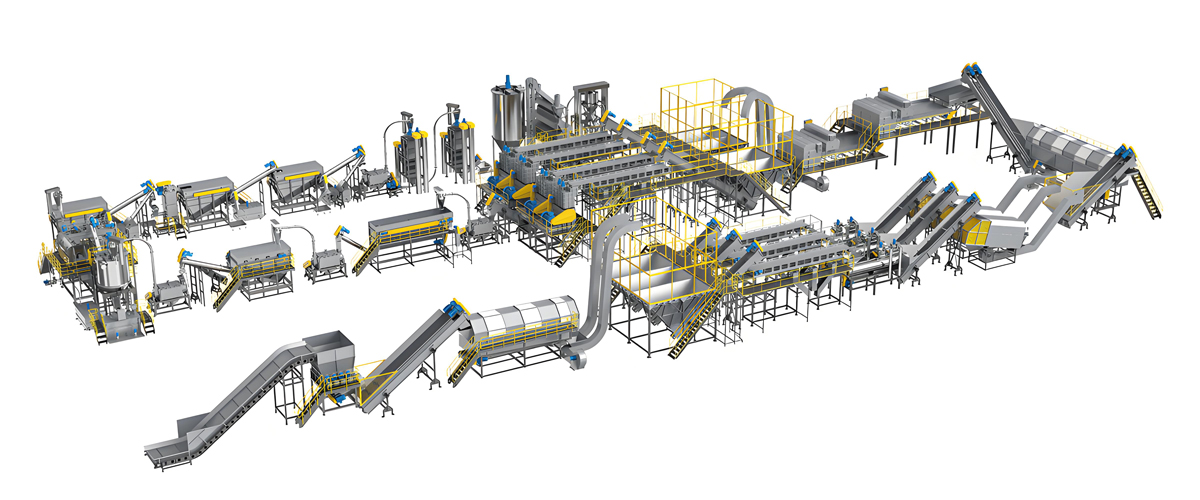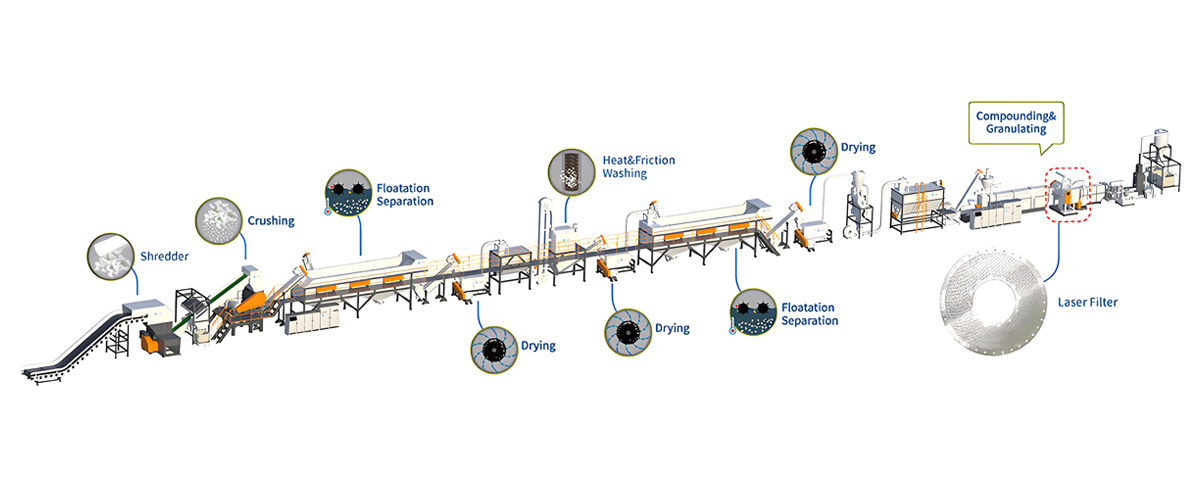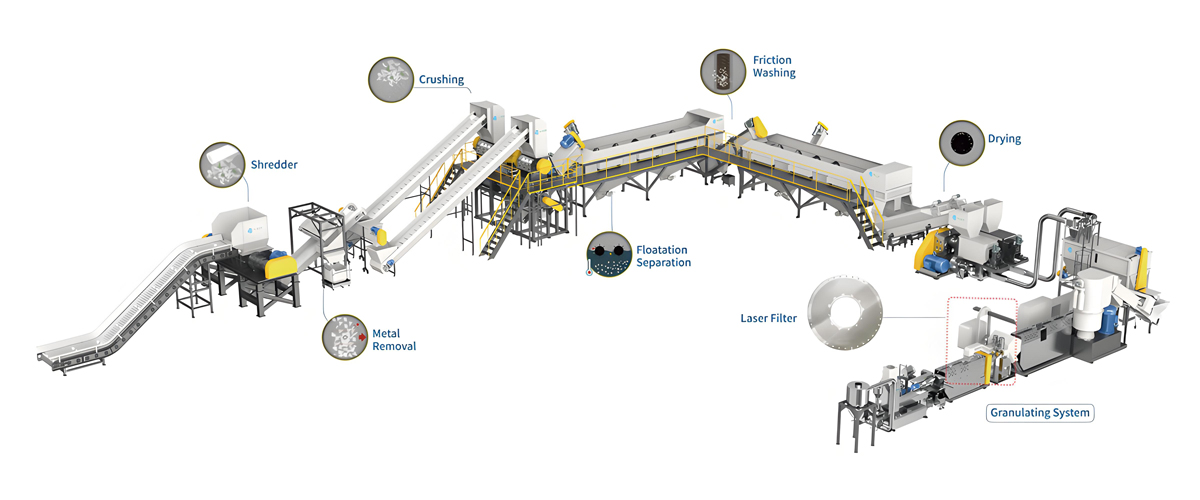

Polypropylene non-woven fabric has become one of the most widely used flexible materials in the modern economy, yet its very success creates a mounting recycling challenge. From spunbond and meltblown medical masks to SMS composite surgical gowns, needle-punched geotextiles, wet wipes, packaging bags, and disposable tableware sleeves, PP non-woven waste is generated in enormous volumes across medical, hygiene, agricultural, construction, and consumer goods sectors. The best PP non-woven fabric recycling line with Austrian technology answers this challenge by converting loose, low-density fabric waste into uniform, reusable recycled PP pellets through an integrated cutter-compactor and single-screw extrusion route. This article explains the material science, the equipment architecture, the operating parameters, the quality outcomes, and the certification landscape that together define a successful PP non-woven recycling line. Polyretec, a Wanplas factory, has built its recycling equipment on this Austrian-derived platform, combining proven European process logic with Chinese manufacturing capability to deliver lines that are both robust and cost-effective.
The defining feature of PP non-woven recycling is not the polymer itself, which is a well-understood commodity polypropylene, but the physical form of the feed. Non-woven fabric is light, fluffy, electrostatically charged, and often contaminated with hot-melt adhesive, metal nose strips, elastic bands, printing ink, and moisture. Conventional recycling approaches that work for rigid PP regrind or film flakes fail here because the material cannot be fed steadily into an extruder. The Austrian technology route solves this with a cutter-compactor that pre-conditions the fabric by friction heating and mechanical compaction, raising bulk density by an order of magnitude before the material ever reaches the extruder barrel. The result is a stable, continuous, and energy-efficient process that produces recycled PP suitable for demanding injection molding, extrusion, and re-spinning applications.
Understanding PP Non-Woven Fabric Waste: Sources and Material Characteristics
PP non-woven fabric is not a single material but a family of structures produced by several different web-formation and bonding methods. Each method yields a distinct set of physical characteristics that directly affect how the material should be recycled. The first task of any recycling engineer is to profile the feedstock, because the optimum cutter-compactor setting, screw design, and filtration strategy all depend on what is actually arriving at the plant. A line that handles clean spunbond edge trim will be tuned very differently from one that processes post-consumer masks and wipes.
Spunbond, Meltblown, and Composite Structures
Spunbond non-woven is made by extruding continuous PP filaments onto a moving belt, then thermally or mechanically bonding them. It is the workhorse of the industry: shopping bags, agricultural covers, furniture wraps, and diaper backsheets. Its gram weight typically ranges from 15 to 150 grams per square meter, and it is relatively clean when collected as industrial edge trim. Meltblown non-woven uses much finer fibers formed by high-velocity hot air; it provides filtration and barrier function in masks and respirators but is fragile, dusty, and prone to static cling. SMS is a composite of spunbond-meltblown-spunbond layers that combines strength with barrier performance for surgical gowns and drapes. Needle-punched geotextile is a heavier, mechanically entangled PP web used in civil engineering for separation, drainage, and reinforcement; it is bulky and often soiled with mineral fines.
Post-Consumer and Hygiene Streams
The fastest-growing and most difficult feedstock is hygiene and personal protective waste: discarded masks, protective gowns, wipes, and disposable tableware sleeves. These streams carry body oils, lotions, inks, adhesives, and odors that demand aggressive devolatilization. Packaging bags and woven-style non-woven totes are cleaner but often printed, while one-time-use tableware sleeves and cup holders are usually uncontaminated and easy to process. Understanding this spectrum is essential because the recycling line must be specified for the worst realistic case, not the average one.
Key Physical Parameters of the Feed
Five parameters dominate line design. Gram weight (15 to 150 grams per square meter) sets the volumetric throughput. Bulk density, only 20 to 50 kilograms per cubic meter for loose fabric, is the single biggest obstacle. Moisture content of 2 to 8 percent must be removed before melting to avoid steam voids and hydrolytic degradation. Electrostatic charge causes bridging and uneven feeding. Contamination in the form of hot-melt adhesive, metal nose strips, elastic bands, and printing ink dictates the filtration and separation strategy. The table below summarizes typical values for common feed types.
| Feed Source | Gram Weight (g/m²) | Bulk Density (kg/m³) | Moisture (%) | Typical Contaminants |
|---|---|---|---|---|
| Spunbond edge trim | 20 to 80 | 25 to 45 | 1 to 3 | Minor printing ink, anti-static agent |
| Meltblown filter media | 15 to 40 | 20 to 35 | 2 to 5 | Fine fibers, dust, odor |
| SMS composite PPE | 40 to 90 | 25 to 50 | 3 to 7 | Hot-melt adhesive, elastic, ink, odor |
| Needle-punched geotextile | 100 to 150 | 30 to 50 | 3 to 8 | Mineral fines, soil, UV stabilizer |
| Wipes and hygiene waste | 30 to 70 | 20 to 40 | 4 to 8 | Lotions, oils, odor, printing |
| Packaging and totes | 50 to 120 | 30 to 50 | 2 to 4 | Heavy printing ink, lamination |
Why Low Bulk Density Is the Core Processing Challenge
Bulk density is the mass of material per unit volume, and for loose PP non-woven fabric it sits at only 20 to 50 kilograms per cubic meter. To put that in perspective, a cubic meter of the loose fabric weighs less than a single adult person. This extreme lightness is the root cause of nearly every feeding problem in conventional recycling. When light, fluffy material is dropped into an extruder hopper, it packs poorly, traps air, and forms stable arches or bridges that block the throat. Even when it does enter the screw, the low fill density means the metering zone cannot build stable melt pressure, so the extruder surges and starves.
The Austrian technology answer is to eliminate the density gap before extrusion. The cutter-compactor takes the loose fabric, cuts it into smaller flakes, and uses the heat of friction to simultaneously dry and compact it into a dense, hot, free-flowing agglomerate with a bulk density of 300 to 450 kilograms per cubic meter. That is a tenfold improvement, enough for stable gravity or forced feeding into the screw throat. Without this pre-conditioning step, operators are forced to use crammer feeders, dribble feeding, or a separate agglomerator, all of which reduce throughput, raise energy use, and increase operator labor.
Moisture compounds the problem. At 2 to 8 percent, water in the feed flashes to steam inside the barrel, creating voids, splashing, and degraded pellets. The cutter-compactor drives moisture down from roughly 5 percent to below 0.3 percent during pre-conditioning, so the extruder only deals with dry, dense material. This single integration point is what separates a true PP non-woven recycling line from a repurposed film pelletizing line.
Österreichische Technologie Routes: One-Step Cutter-Compactor vs Two-Stage Extrusion
The phrase “Austrian technology” in PP recycling refers to process architectures pioneered by European equipment makers such as Erema and NGR, where the cutter-compactor is directly coupled to the extruder. The defining idea is that pre-conditioning and melting happen in a continuous, thermally linked sequence rather than in disconnected machines. Two principal implementations exist: the one-step integrated line and the two-stage line. Both differ fundamentally from the older approach of running a standalone agglomerator and then feeding a separate extruder.
One-Step Integrated Cutter-Compactor Route
In the one-step design, the cutter-compactor sits directly above or beside the single-screw extruder. Cut and friction-heated flakes drop through a short transition into the screw feed throat, so there is essentially no residence time gap and minimal heat loss. The extruder thus receives hot, dry, densified material at a controlled rate. This route is compact, energy efficient, and well suited to clean-to-moderately contaminated non-woven waste such as edge trim, converted offcuts, and sorted hygiene material.
Two-Stage Extrusion Route
The two-stage design uses a first extruder to melt, filter, and homogenize the material, then transfers the melt through a melt pump or adapter to a second extruder dedicated to deep devolatilization and final pressurization before pelletizing. This separation is valuable when the feed is heavily printed, odorous, or contains high volatiles, because the second stage can run a longer and deeper vacuum zone without sacrificing melt stability. The trade-off is higher capital cost, larger footprint, and greater energy consumption.
Traditional Agglomerator Plus Extruder
The legacy method runs a batch or continuous agglomerator to densify the fabric, then manually or pneumatically transfers the agglomerates to a separate extruder. This disconnect creates heat loss, dust, inconsistent feed temperature, and labor-intensive operation. Modern Austrian-derived lines replace this with direct coupling to remove the weak link. The table below contrasts the three approaches.
| Aspect | One-Step Cutter-Compactor | Two-Stage Extrusion | Agglomerator + Extruder |
|---|---|---|---|
| Process linkage | Direct coupling | Two extruders in series | Disconnected machines |
| Footprint | Compact | Large | Large with transfer |
| Devolatilization depth | Moderate | Deep, dedicated stage | Limited |
| Energy per kg | Low to Medium | Medium to High | Medium to High |
| Best feed | Clean to moderate non-woven | Heavy print, odor, volatiles | Low-value, tolerant runs |
| Capital cost | Medium | High | Low to Medium |
Polyretec, a Wanplas factory, positions its Neue Generation Pelletierlinie on this Austrian-derived philosophy, and its project history includes a Vietnam PP non-woven fabric and TPE gloves recycling system for a listed group that had previously operated an Erema machine. That reference underlines how the cutter-compactor integrated architecture transfers across brands and regions while keeping the same process logic.
Core Unit 1: The Cutter-Compactor
The cutter-compactor is the heart of any PP non-woven recycling line, and its correct sizing and tuning determine whether the line runs at all. It is a vertical, high-speed rotor chamber lined with fixed and rotating knives. Fabric enters through a tangential feed opening, is cut into smaller pieces, and is thrown against the chamber wall where friction with the material bed and the housing generates heat. This heat dries the flakes and softens the PP just enough to cause surface tackiness, which makes the particles cohere into dense agglomerates as they are forced down toward the discharge.
Volume Classes and Throughput
Commercial cutter-compactors for this application are offered in effective chamber volumes of 300, 600, 900, and 1200 liters. The choice tracks the target line throughput, because the compactor must be able to pre-condition the full mass flow of fabric without overloading. A 300 liter unit suits pilot and small commercial lines, while a 1200 liter unit is paired with the largest single-screw extruders for high-volume post-consumer processing.
| Compactor Volume (L) | Typical Rotor Speed (rpm) | Knife Tip Speed (m/s) | Matched Screw (mm) | Approx. Throughput (kg/h) |
|---|---|---|---|---|
| 300 | 900 to 1100 | 30 to 38 | 90 to 105 | 150 to 300 |
| 600 | 800 to 1000 | 34 to 42 | 105 to 120 | 300 to 500 |
| 900 | 700 to 900 | 38 to 44 | 120 to 135 | 500 to 800 |
| 1200 | 600 to 800 | 40 to 45 | 135 to 150 | 800 to 1200 |
Knife Material, Wear, and Gap Setting
The rotating and stationary knives are typically made from hardened tool steel or tungsten carbide-tipped alloy to resist abrasion from mineral-laden geotextile and printed coatings. As knives wear, the cutting gap widens and the cutting efficiency drops, which lowers friction heating and can push the material out of the optimal temperature window. Regular gap inspection and timely knife rotation or resharpening are essential maintenance items. The tangential feed port is angled so that material is thrown across the chamber rather than straight down, maximizing the residence and friction time needed for densification.
Temperature Control Window
The target discharge temperature from the compactor is 80 to 110 degrees Celsius. This is deliberately held below the 160 to 165 degrees Celsius melting point of polypropylene. At the correct window the PP is softened and surface-tacky but not molten, which lets particles agglomerate without fusing into a solid mass. If the temperature climbs too high, the material melts, sticks to the rotor, and forms the dreaded balls that clog discharge. Operators control the window through rotor speed, feed rate, chamber cooling, and the recirculation of process air. Moisture is reduced from about 5 percent to below 0.3 percent during this stage, and bulk density rises from 20 to 50 kilograms per cubic meter to 300 to 450 kilograms per cubic meter.
Core Unit 2: The Single-Screw Extruder
Downstream of the cutter-compactor sits the single-screw extruder, the machine that melts, mixes, devolatilizes, and pressurizes the densified PP. For PP non-woven recycling the single-screw configuration is preferred over twin-screw because the feed is already pre-conditioned and the goal is gentle, continuous melting rather than intensive compounding. The screw and barrel do the heavy lifting, so their geometry and temperature control define pellet quality.
Screw Diameter and Length-to-Diameter Ratio
Standard diameters are 90, 105, 120, 135, and 150 millimeters. A longer screw, expressed as a length-to-diameter (L/D) ratio of 30 to 36, gives more residence time for melting, mixing, and venting. The higher L/D also supports a dedicated devolatilization zone, which is critical for odor-prone hygiene feed. Screw design uses a barrier section to separate solids from melt and a mixing head near the discharge to homogenize temperature and color before filtration.
| Screw Diameter (mm) | L/D Ratio | Barrel Zone Temp (°C) | Melt Temp (°C) | Vacuum (MPa) |
|---|---|---|---|---|
| 90 | 30 to 33 | 180 to 220 | 200 to 220 | -0.06 to -0.08 |
| 105 | 30 to 34 | 185 to 225 | 200 to 222 | -0.06 to -0.09 |
| 120 | 32 to 35 | 185 to 228 | 205 to 224 | -0.07 to -0.09 |
| 135 | 32 to 36 | 190 to 230 | 205 to 225 | -0.07 to -0.09 |
| 150 | 33 to 36 | 190 to 230 | 208 to 225 | -0.08 to -0.09 |
Barrier Screw and Mixing Head
A barrier-type screw carries a secondary flight that separates unmelted solids from the melt film, improving melting efficiency and reducing the risk of unmolten gel particles in the pellet. The metering section builds stable pressure before the mixing head, which is a distributive and dispersive element that evens out temperature and incorporates any added masterbatch or stabilizer. Because PP non-woven feed is already homogeneous polymer, the mixing head need not be aggressive; over-shearing would only accelerate thermal and oxidative degradation.
Devolution and Venting
The venting zone is where trapped air, residual moisture vapor, and degradation volatiles are pulled out under vacuum of minus 0.06 to minus 0.09 megapascal. For hygiene and PPE feed this zone is the primary odor-control stage. A properly sized and sealed vent prevents the classic fault of “vent bleed,” where material instead of gas escapes the vent port. Barrel temperatures are zoned from 180 to 230 degrees Celsius, while the actual melt temperature is held at 200 to 225 degrees Celsius to limit thermal degradation of the PP chain.
Core Unit 3: Melt Filtration and the Bildwechsel
Even after cutter-compaction and extrusion, the melt carries contaminants: char, crosslinked gel, printing ink residues, fragments of hot-melt adhesive, paper label fibers, and fine mineral dust. Melt filtration removes these before pelletizing to protect the die and deliver clean pellets. The Austrian technology route relies on continuous filtration so that screen replacement never stops production.
Continuous Belt Filter and Bildwechsel
A continuous belt filter passes the melt through an endless laser-perforated belt that is slowly advanced so the fouled section is carried out of the melt stream and cleaned or discarded while fresh screen enters. This maintains near-constant pressure. A double-column four-station screen changer provides two filter packs in series with multiple positions, allowing one pack to be exchanged while the other stays online; this is the workhorse for non-stop operation. Both designs avoid the pressure spikes and brief stops of manual slide-plate changers.
Laser Filter Micron Ratings
Laser-perforated screens are available at 56, 80, 100, and 150 micrometers. The choice is a balance: finer screens remove more contamination but raise back pressure and shorten screen life, while coarser screens protect throughput but let more gel and specks through. For lightly contaminated spunbond trim, 100 to 150 micrometer screens are common; for printed, adhesive-laden, or dusty hygiene feed, 56 to 80 micrometer screens are selected despite the higher pressure cost.
| Screen Type | Micron (µm) | Best Feed | Back Pressure | Screen Life |
|---|---|---|---|---|
| Laser filter, coarse | 150 | Clean spunbond trim | Low | Long |
| Laser filter, medium | 100 | SMS, light print | Medium | Medium |
| Laser filter, fine | 80 | Printed, adhesive | High | Medium-short |
| Laser filter, superfine | 56 | Dusty, geotextile | Very High | Short |
Backflush Self-Cleaning Filtration
Back-pressure self-cleaning filters periodically reverse a small portion of clean melt through the screen to dislodge captured contaminants, extending screen life and stabilizing pressure. Filtration area must be matched to throughput: too small an area forces frequent exchange and pressure fluctuation, while too large an area adds cost and melt residence. The contamination level of the feed, not the polymer type, dictates the required filtration area and the frequency of screen advance.
Core Unit 4: Pelletizing Methods
After filtration the clean melt passes through a die and is cut into pellets. Three methods are relevant: water-ring pelletizing, underwater pelletizing, and strand pelletizing. The choice affects pellet shape, cooling efficiency, dust generation, and operator workload.
| Method | Cooling | MFR Range Fit | Dust Level | Typical Use |
|---|---|---|---|---|
| Water-ring pelletizing | Water ring, air dry | Broad (medium-high) | Low | Preferred for PP non-woven |
| Underwater pelletizing | Submerged water | Low to medium | Very low | High throughput, low MFR |
| Strand pelletizing | Water bath, air dry | Medium, heat-sensitive | Medium | Low volume, lab, specialty |
Water-ring pelletizing is the default for PP non-woven recycling. The melt exits the die face downward or horizontally into a rotating water ring that immediately quenches and conveys the cut pellets, after which they are dewatered and dried. This method accommodates the wide melt flow rate range typical of recycled PP, produces uniform round pellets with few tails, and supports continuous operation with minimal operator attention. Underwater pelletizing is chosen for very high throughput and lower-viscosity melts, while strand pelletizing is reserved for low-volume or heat-sensitive specialty runs where a slow, controllable process is preferred.
Core Unit 5: Auxiliary Systems
The five core units are supported by auxiliary equipment that protects the process and defines final pellet quality. These systems are often underestimated but are decisive for stable commercial operation.
Metal Separation
PP non-woven waste, especially masks and gowns, contains metal nose strips, staples, and wire. A magnetic separator removes ferrous parts before the compactor, while a metal detector or eddy-current unit intercepts non-ferrous fragments. Metal entering the cutter-compactor or screw causes severe knife and barrel damage, so separation is placed early and is non-negotiable.
Pneumatic Conveying, Dewatering, and Screening
After pelletizing, a pneumatic conveying system moves pellets to a dewatering centrifuge that removes surface water, then to a vibrating screen that grades pellet size and removes fines and tails. Consistent pellet size improves downstream feeding and appearance. A homogenizing silo evens out batch-to-batch variation by blending successive runs, which is important when feedstock composition fluctuates.
Process Water and Drying Loop
Water-ring and underwater systems circulate process water through a filter and chiller to keep pellet temperature and shape consistent. A clean water loop prevents pellet contamination and reduces biological growth. The drying step before silo storage ensures moisture in the final pellet stays below the threshold that would cause processing defects in injection molding.
Throughput and Energy Consumption
Line capacity scales with screw diameter, and the relationship is not linear because larger screws run deeper but also handle more massive melt flows. The figures below are representative for PP non-woven feed on a cutter-compactor integrated single-screw line and assume moderate contamination and proper pre-conditioning.
| Screw Diameter (mm) | Throughput (kg/h) | Specific Energy (kWh/kg) | Relative Capital Cost |
|---|---|---|---|
| 105 | 150 to 300 | 0.30 to 0.40 | Medium |
| 120 | 300 to 500 | 0.29 to 0.38 | Medium-High |
| 135 | 400 to 700 | 0.28 to 0.36 | High |
| 150 | 800 to 1200 | 0.28 to 0.35 | Very High |
Specific energy consumption typically falls between 0.28 and 0.40 kilowatt-hours per kilogram of recycled PP pellets. Larger lines tend toward the lower end because fixed overhead is spread over more output, and because the integrated cutter-compactor avoids the double heating of a separate agglomerator. Lower bulk density, higher moisture, and tighter filtration all push consumption upward. Operators should track specific energy as a routine key performance indicator, because a creeping rise often signals knife wear, screen fouling, or venting problems before they cause scrap.
Recycled PP Quality Indicators
The value of recycled PP is defined by a handful of measurable indicators. Buyers of recycled PP pellets specify these parameters in contracts, so the recycling line must be tuned to hit them consistently.
Melt Flow Rate Shift
Virgin spunbond-grade PP shows a melt flow rate of 25 to 35 grams per 10 minutes. After recycling, thermo-oxidative chain scission during heating breaks polymer chains and typically raises the value to 30 to 45 grams per 10 minutes. This increase means the recycled material flows more easily and is generally easier to mold but slightly weaker in impact. A large, uncontrolled MFR jump signals excessive thermal history and should be corrected by lowering melt temperature, shortening residence time, and adding stabilizer.
Color, Ash, Odor, and Mechanical Retention
The yellowness index (YI) rises with thermal and oxidative exposure and with residual ink; it is managed through lower processing temperature and, where needed, a small addition of optical brightener or a light color masterbatch. Ash content reflects inorganic contamination such as filler, minerals, and paper; it should be minimized by good feeding and filtration. Odor is graded by the VDA 270 sensory method on a scale where lower is better, and is the key acceptance criterion for automotive and hygiene-related applications. Tensile strength retention of 80 to 95 percent of virgin is achievable for clean feed, while black-dot count per unit area is controlled by filtration and screw cleanliness.
| Indicator | Virgin PP Reference | Recycled PP Typical | Control Lever |
|---|---|---|---|
| Melt flow rate (g/10min) | 25 to 35 | 30 to 45 | Temp, residence, stabilizer |
| Yellowness index | Low | Low to Moderate | Temp, color masterbatch |
| Ash content (%) | Below 0.1 | 0.1 to 1.5 | Separation, filtration |
| Odor grade (VDA 270) | Grade 1 to 2 | Grade 2 to 4 | Venting, deodorant |
| Tensile retention (%) | 100 | 80 to 95 | Antioxidant, chain extender |
| Black dots (count/kg) | Minimal | Low | Filtration, screw care |
Quality Enhancement Through Additives and Modification
Recycled PP often needs targeted modification to meet downstream specs. The recycling line is the ideal point to dose these additives, because the mixing head and homogenizing silo distribute them uniformly.
Stabilization and Chain Extension
A combined antioxidant package of antioxidant 1010 and antioxidant 168, dosed at 0.2 to 0.4 percent, rebuilds the thermal-oxidative protection lost during the first life and recycling. A multi-functional epoxy chain extender at 0.3 to 0.8 percent reacts with chain ends to partially restore molecular weight, counteracting the MFR rise and improving melt strength and impact. These two measures are the foundation of a sellable recycled PP.
Toughening, Filling, and Odor Control
Polyolefin elastomer (POE) at 5 to 10 percent improves low-temperature impact and flexibility, useful for automotive and durable goods. Calcium carbonate filler masterbatch reduces cost and improves stiffness for non-critical parts, while a color masterbatch standardizes appearance across variable feed. A deodorant masterbatch plus the strengthened vacuum devolatilization addresses odor from hygiene and PPE streams. The table summarizes the modification toolkit.
| Additive | Dosage | Function | Effect on Properties |
|---|---|---|---|
| Antioxidant 1010/168 | 0.2 to 0.4% | Thermal-oxidative stabilization | Limits MFR rise, retains strength |
| Epoxy chain extender | 0.3 to 0.8% | Molecular weight restoration | Higher melt strength, less brittle |
| POE toughener | 5 to 10% | Impact modification | Improved low-temperature impact |
| CaCO3 filler masterbatch | As required | Cost and stiffness | Higher stiffness, lower cost |
| Color masterbatch | As required | Appearance standardization | Consistent color across batches |
| Deodorant masterbatch | As required | Odor masking and absorption | Lower VDA 270 grade |
Downstream Anwendungen of Recycled PP
Recycled PP from non-woven feed is a versatile commodity resin. Its exact application depends on the final MFR, color, odor grade, and ash content achieved by the line.
| Anwendung | Process | Quality Requirement | Typical Feed Suitability |
|---|---|---|---|
| Injection molded crates and bins | Injection molding | Good rigidity, low odor | Clean to moderate |
| Automotive interior non-visible parts | Injection molding | Low odor, stable MFR | Ventilated, stabilized |
| Geotextile re-spinning | Spinning | High MFR, low gel | Clean spunbond |
| Strapping and banding | Extrusion | High tensile, low ash | Filtered, clean |
| Woven sacks and bags | Tape extrusion | Good drawability | Moderate, stabilized |
| Furniture components | Injection molding | Toughness, appearance | Toughened, colored |
The broadest outlet is injection molding of non-critical durable goods, where the modest MFR shift and slight property loss are irrelevant. Re-spinning into new geotextile or non-woven is possible for the cleanest feed and represents the most circular route. As sustainability mandates expand in 2026 and beyond, demand for certified recycled PP in these applications continues to rise, strengthening the business case for a dedicated PP non-woven recycling line.
Zertifizierungs and Regulations
Selling recycled PP into regulated or brand-driven supply chains requires documentation. The relevant standards are issued as plain-text reference names and should not be hyperlinked in technical literature.
Recycled Content and Traceability Standards
GRS, the Global Recycled Standard, certifies recycled content and responsible processing across the supply chain and is widely requested by brands. EuCertPlast certifies European post-consumer recycled plastic output against established criteria. RecyClass assesses recyclability and recycled content for plastic packaging. ISO 14021 governs self-declared environmental claims such as “recycled content” statements, and EN 15343 defines the traceability and calculation methodology for recycled plastic content. Together these standards let a recycler prove both the quantity and the provenance of recycled material.
Food Contact and Single-Use Legislation
For food-contact recycled PP, EU 2022/1616 is the central regulation, requiring that recycled plastic be produced by an authorized process and demonstrated safe through an EFSA challenge test that proves contaminant removal. Achieving food-grade rPP from non-woven feed is difficult because hygiene and PPE waste carry diverse contaminants and because the super-clean process validation is demanding; most lines instead target industrial-grade output. On the demand side, the EU Single-Use Plastics (SUP) directive pushes recycled content into designated products, indirectly raising the value of reliably sourced recycled PP.
| Standard / Regulation | Scope | Relevance to PP Non-Woven |
|---|---|---|
| GRS (Global Recycled Standard) | Recycled content, responsible processing | Brand supply chain requirement |
| EuCertPlast | European recycled plastic certification | EU market access |
| RecyClass | Recyclability and recycled content | Packaging claims |
| ISO 14021 | Self-declared environmental claims | Recycled content labeling |
| EN 15343 | Traceability and content calculation | Chain-of-custody proof |
| EU 2022/1616 | Food-contact recycled plastic | Food-grade rPP pathway |
| EFSA challenge test | Safety validation of recycling process | Food-grade approval |
| EU SUP directive | Single-use plastics content rules | Recycled demand driver |
Common Faults and Troubleshooting
Even a well-specified line develops faults. The most common issues in PP non-woven recycling stem from the same low-bulk-density, high-contamination nature of the feed. Early recognition prevents scrap and downtime.
| Fault | Likely Cause | Corrective Action |
|---|---|---|
| Compactor balling or clogging | Over-temperature, tight knife gap, excess adhesive | Lower rotor speed, widen gap, reduce feed, cool cycle |
| Screw slip, poor feeding | Low bulk density, bridging, cold feed | Verify compactor densification, add crammer, check feed |
| Vent bleed (material from vent) | Over-filled vent zone, weak vacuum, low melt temp | Reduce feed, increase vacuum, raise barrel temp |
| Frequent screen change | High contamination, too-fine screen, small area | Coarsen screen, enlarge filter area, improve pre-sort |
| Pellets with tails | Dull cutter, wrong speed, uneven melt temp | Sharpen blades, adjust cut speed, improve mixing |
| Odor above specification | Inadequate venting, high volatile feed | Deepen vacuum, add deodorant, two-stage option |
Most faults trace back to feed consistency. A disciplined incoming inspection that grades non-woven waste by source, removes metal, and separates heavily printed or adhesive-laden material protects the entire line. Polyretec, a Wanplas factory, supports its lines with engineering assistance and an annual free spare parts allowance so that wear items such as knives, screens, and barrel liners can be replaced on schedule rather than after failure.
Frequently Asked Questions
What is the best PP non-woven fabric recycling line configuration?
For most post-industrial and post-consumer PP non-woven waste, the most robust configuration is a one-step line that directly couples a cutter-compactor to a single-screw extruder, followed by a continuous screen changer, melt filtration, and water-ring pelletizing. This Austrian-derived route handles the very low bulk density of non-woven offcuts without a separate agglomerator.
Why is bulk density the biggest challenge in PP non-woven recycling?
Loose PP non-woven fabric has a bulk density of only 20 to 50 kilograms per cubic meter. That volumetric lightness makes screw feeding unstable, causes bridging, and starves the extruder. A cutter-compactor pre-conditions the material by friction heating and compaction, lifting bulk density to 300 to 450 kilograms per cubic meter before the material enters the barrel.
What is the difference between one-step cutter-compactor and two-stage extrusion?
A one-step line integrates the cutter-compactor directly to a single-screw extruder so pre-heated, densified flakes feed the screw throat continuously. A two-stage line uses a first extruder for melting and melt filtration, then transfers melt to a second extruder for devolatilization and final pelletizing. Two-stage systems suit heavily printed, heavily contaminated, or highly odorous feed.
How hot does the cutter-compactor get and does it melt the PP?
The cutter-compactor friction-heats the material to roughly 80 to 110 degrees Celsius. That is well below the 160 to 165 degrees Celsius melting point of polypropylene, so the PP is softened, dried, and agglomerated rather than fully melted. Maintaining this window avoids melt pooling, which would cause balling and clogging.
What screw diameter should I choose for my PP non-woven output?
A 105 millimeter single screw typically delivers 150 to 300 kilograms per hour, a 135 millimeter screw delivers 400 to 700 kilograms per hour, and a 150 millimeter screw delivers 800 to 1200 kilograms per hour. Choose the diameter from your projected feed volume, contamination level, and required pellet quality.
Which melt filter micron rating is right for recycled PP non-woven?
Laser filter screens of 100 to 150 micrometers are typical for lightly contaminated spunbond and SMS edge trim, while 56 to 80 micrometer screens are used when the feed contains fine fibers, dust, paper labels, or residual hot-melt adhesive. Tighter filtration raises back pressure and shortens screen life, so the rating must match the actual contamination level.
Water-ring, underwater, or strand pelletizing — which is best?
Water-ring pelletizing is the preferred method for PP non-woven recycling because it handles the broad melt flow rate range of recycled PP, minimizes pellet deformation, and supports continuous operation. Underwater pelletizing suits very high throughput and low-viscosity melts, while strand pelletizing is reserved for low-volume or heat-sensitive formulations.
What melt flow rate can I expect from recycled PP non-woven?
Virgin spunbond-grade PP typically shows a melt flow rate of 25 to 35 grams per 10 minutes. After recycling, thermo-oxidative chain scission usually shifts the value to 30 to 45 grams per 10 minutes. That increase is expected and can be compensated with a chain extender or by blending with virgin material.
How do I reduce odor in recycled PP from masks and wipes?
Odor from masks, wipes, and personal protective equipment comes from body oils, lotions, inks, and degradation volatiles. Reduce it with a deep vacuum devolatilization zone at minus 0.06 to minus 0.09 megapascal, the addition of a deodorant masterbatch, and a longer residence time in the vented barrel section. Final odor is verified with the VDA 270 sensory grade.
Can recycled PP non-woven meet food-contact requirements?
Food-contact recycled PP is difficult because it requires compliance with EU 2022/1616 and an EFSA challenge test demonstrating that the recycling process removes contaminants to safe levels. Most non-woven recycling lines produce industrial-grade recycled PP; food-grade rPP is achievable only with a validated super-clean process and documented traceability.
What certifications are needed to sell recycled PP as GRS or EuCertPlast certified?
GRS, the Global Recycled Standard, covers recycled content and responsible processing. EuCertPlast verifies European post-consumer recycled plastic output. RecyClass assesses recyclability and recycled content, while EN 15343 governs traceability and the calculation of recycled content. ISO 14021 covers self-declared environmental claims.
How much energy does a PP non-woven recycling line consume per kilogram?
Specific energy consumption for a cutter-compactor integrated single-screw line typically ranges from 0.28 to 0.40 kilowatt-hours per kilogram of recycled PP pellets. Consumption rises with lower feed bulk density, higher moisture, and tighter filtration. The one-step route is generally lower in energy than a separate agglomerator plus extruder setup.
What causes the cutter-compactor to ball up or clog?
Balling and clogging happen when the compactor temperature exceeds the PP softening window, when knife clearance is too tight, when feed is overloaded, or when the material contains excessive hot-melt adhesive or elastomeric components. Corrective actions include lowering rotor speed, widening knife gap, reducing feed rate, and adding a cooling cycle before densification.
Conclusion
A successful PP non-woven fabric recycling line with Austrian technology is defined less by any single machine than by the continuous, thermally linked sequence from cutter-compactor to single-screw extruder, melt filtration, and pelletizing. The cutter-compactor solves the fundamental problem of 20 to 50 kilograms per cubic meter bulk density by friction-heating and densifying the fabric to 300 to 450 kilograms per cubic meter while driving moisture below 0.3 percent. The single-screw extruder then melts, mixes, and devolatilizes the PP at controlled temperatures of 200 to 225 degrees Celsius melt, the screen changer and laser filter remove contaminants down to 56 micrometers, and water-ring pelletizing delivers uniform pellets at specific energy of 0.28 to 0.40 kilowatt-hours per kilogram.
Quality is managed through measured indicators such as melt flow rate, yellowness index, ash, VDA 270 odor grade, and tensile retention, then enhanced with antioxidant 1010/168, epoxy chain extender, POE toughener, filler, color, and deodorant masterbatches. The resulting recycled PP serves injection molding, geotextile re-spinning, strapping, woven sacks, and furniture parts, and can be certified under GRS, EuCertPlast, RecyClass, ISO 14021, and EN 15343. Polyretec, a Wanplas factory, brings this Austrian-derived process logic together with Chinese manufacturing capability and the Wanplas brand commitment to “Warm Global Customers With China Plastic Machinery,” making it a strong partner for processors building or upgrading a PP non-woven recycling line in 2026 and beyond.