
Polypropylene woven bags, sometimes called PP woven sacks or raffia sacks, are among the most widely used flexible packaging products in the world. They protect grain, fertilizer, cement, sugar, flour, animal feed, and countless industrial goods during storage and transport. Every year, however, hundreds of thousands of tonnes of these bags reach the end of their service life as post-consumer or post-industrial waste. Discarding them is wasteful because the polymer itself remains a valuable, reprocessable resource. The best response is to recover the material through a dedicated PP woven bag recycling line with crushing and washing, converting dirty, printed, and contaminated sacks into clean flakes or pellets that re-enter manufacturing. Polyretec, a Wanplas factory, has specialized in exactly this kind of recovery equipment since its operational origin in 2010, with the brand formally established in 2017. Drawing on an advanced European-origin process route integrated with Chinese manufacturing, Polyretec has delivered more than 100 recycling projects across more than 50 countries, supported by a team of 24 or more engineers and a credible commitment of 10 or more years to recycling technology. This article explains why woven bag waste must be washed, walks through the complete process flow, details the equipment modules and specifications, compares approaches, and shows how the right line configuration turns raffia waste into reusable pellets.
The primary keyword for this guide is the PP woven bag recycling line with crushing and washing, and it reflects a real, high-demand category of polyolefin recovery. PP woven material behaves differently from rigid bottles or thick-walled regrind. It is thin, flexible, often heavily printed, and frequently contaminated with sand, soil, agriculture residue, and moisture. A line that simply crushes and pelletizes without washing will produce a dark, odorous, low-value product with poor mechanical properties. The washing stage is what upgrades the material from trash to tradable feedstock. Throughout this article we use the term barrel rather than cylinder and follow standard American spelling for all technical terms such as color, optimize, analyze, and plasticizing, consistent with international technical documentation.
Why PP Woven Bags and Raffia Need Crushing and Washing
A PP woven bag recycling line exists to solve one core problem: the recovered polymer is only as good as the cleanliness of the feedstock. Woven sacks leave the field, warehouse, or factory carrying a mixture of contaminants that no extruder can tolerate. Understanding each contaminant explains why every stage of the line matters.
Printing ink and surface decoration. Most woven bags are printed with brand names, weights, barcodes, and handling instructions. The inks contain pigments, binders, and sometimes solvents. If the flakes retain ink, the recycled pellets will be grey, brown, or mottled, limiting their use to dark or low-grade products. Wet crushing and friction washing loosen and detach a large share of surface ink before it can smear across the whole batch.
Sand, soil, and dust. Bags used for cement, fertilizer, sand, sugar, and flour inevitably trap fine particulate matter in the weave and folds. Mineral dust is abrasive to screws and barrels, accelerates wear, and raises the ash content of the final pellet. A good washing line removes the bulk of loose solids in the early friction and rinse stages.
Agriculture residue and chemical film. In farming, PP woven sacks and raffia often sit next to or are reused as agriculture film. Fertilizer salts, pesticide traces, plant matter, and silage residue cling to the surface. These organic and chemical contaminants cause odor, foaming during extrusion, and degradation of melt stability. Hot alkaline washing is the most effective defense against this class of soiling.
Moisture. Wet or weathered bags can carry surprisingly high water content. Feeding wet material into a pelletizing extruder generates steam, causes puffing, and can fracture the screw or damage the barrel. Dewatering and drying stages are therefore not optional; they protect downstream equipment and stabilize quality.
Labels, glue, and mixed plastics. Some sacks include sewn labels, PP tape, or laminated layers. While washing does not remove all of these, pre-sorting and the washing action help separate loosely bonded layers so the line can reject or divert them. The objective is a consistent polyolefin stream with predictable behavior in the pelletizer.
Crushing without washing produces low-grade material; washing without proper dewatering damages the pelletizer. The best PP woven bag recycling line treats crushing, washing, dewatering, and drying as one integrated system rather than separate machines.
From a business perspective, washing converts a disposal cost into a saleable commodity. Clean PP flakes and pellets command a higher and more stable price than unwashed regrind, and they open doors to demanding applications such as injection-molded components, rope, tape, and new woven products. For recyclers, the washing line is the difference between a marginal operation and a profitable one.
The Complete Process Flow of a PP Woven Bag Recycling Line
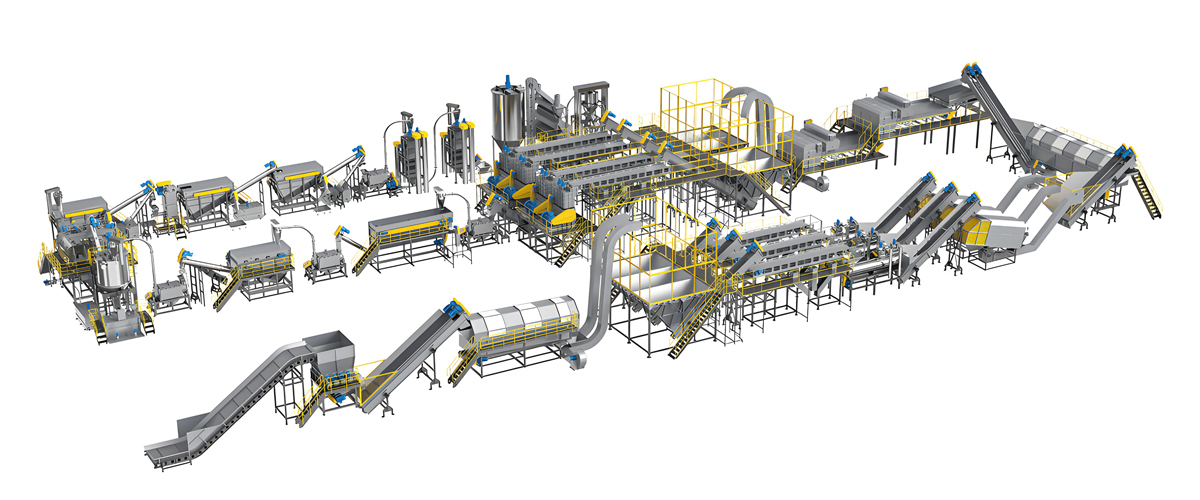
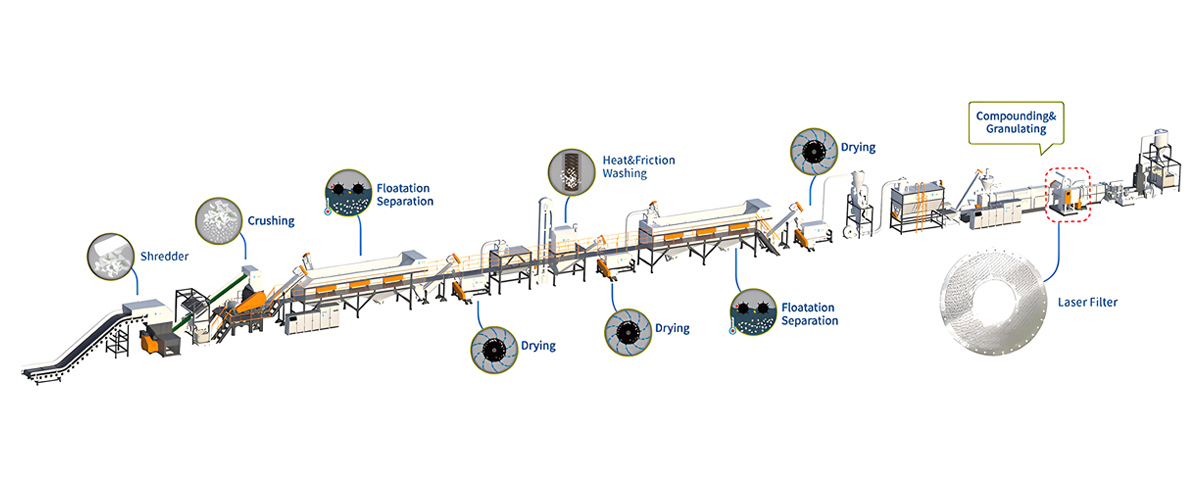
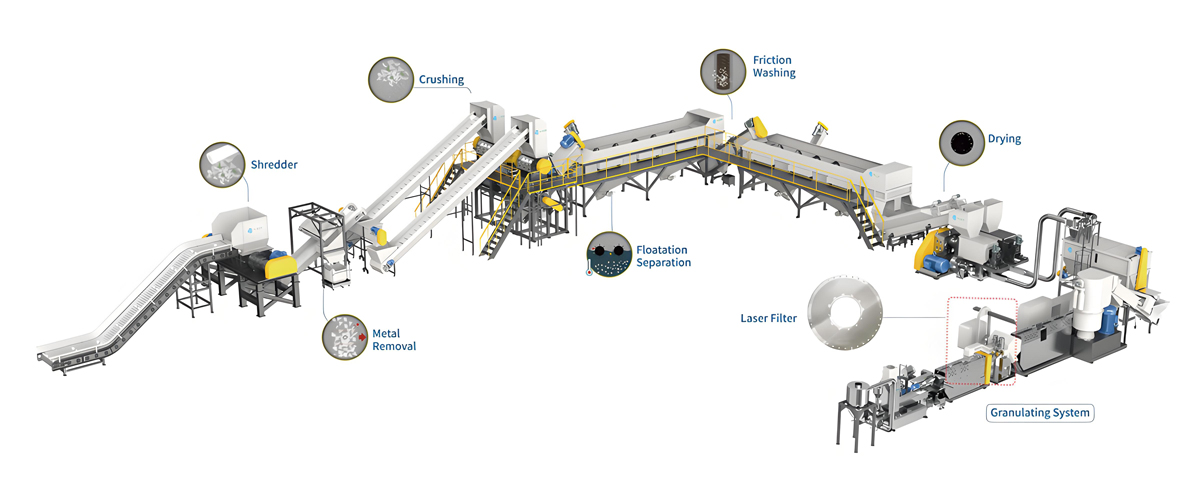
The ideal process flow for recovering PP woven bags and raffia follows a logical sequence in which each machine prepares the material for the next. The standard route is: belt conveyor to crusher for wet crushing, then friction washer, hot washer with detergent or alkali, cold rinse, dewatering via squeezer or centrifuge, thermal drying, and finally optional pelletizing. Each step earns its place in the line.
Belt Conveyor and Metal Detection
The line begins with a belt conveyor that carries loose or baled bags into the crusher at a controlled, steady rate. Controlled feeding prevents surges that could jam the crusher or overload the motor. Many configurations add a metal detector or magnetic separator on the belt to protect the cutting blades from bolts, wires, and staples that sometimes hide in used sacks.
Wet Crusher
The crusher operates in a water bath, performing wet crushing rather than dry shredding. Material is cut into flakes roughly 10 to 16 millimeters while submerged or sprayed with water. Wet crushing confines ink dust, reduces heat that would smear ink, and begins the cleaning action immediately. The water also pre-soaks stubborn soils so later washers work more efficiently.
Friction Washer
After crushing, the flakes pass through a friction washer, a high-speed rotating device that rubs flake against flake and against a perforated screen. This mechanical scrubbing dislodges surface ink, dust, and loose soil. The dirty water is separated and sent to the water treatment loop while the partially cleaned flakes move forward.
Hot Washer with Detergent or Alkali
The hot washer is where the most stubborn contamination is attacked. Flakes are agitated in heated water, typically around 60 to 85 degrees Celsius, with a detergent or an alkaline agent such as caustic soda depending on the soiling profile. Heat softens and releases inks, oils, and agriculture residue; the chemical agent emulsifies fats and breaks down organic films. Dwell time, temperature, and chemical concentration are tuned to the feedstock.
Cold Rinse
A cold rinse tank or spray system removes the detergent, alkali, and suspended soils released in the hot stage. Thorough cold rinsing is essential because any residual alkali will later accelerate polymer degradation during extrusion. Clean, neutral flakes leave this stage ready for dewatering.
Dewatering: Squeezer or Centrifuge
Dewatering removes the bulk of free water. A centrifuge spins the flakes at high speed to throw off surface moisture, while a squeezer compresses the material to press out water and, in many PP film and woven applications, compacts it into a semi-dry lump or noodle that feeds the dryer more evenly. The choice between squeezer and centrifuge depends on material thickness and the targeted moisture level.
Thermal Drying
After dewatering, a thermal dryer or hot-air system reduces residual moisture to a low percentage. For PP woven and film material, the target is typically below five percent so that downstream pelletizing proceeds without steam-related defects. Dried flakes can be stored, sold, or fed directly to pelletizing.
Optional Pelletizing
When the line is configured for full recovery, the clean dried flakes move to pelletizing. For integration with Polyretec washing lines, Wanplas supplies matched twin-screw or strand pelletizing systems that accept the flake stream, melt it, filter it, and cut it into uniform recycled PP pellets. This closes the loop from waste sack to reusable raw material.
PP/PE Soft Plastic Crushing and Washing Line: Product Module
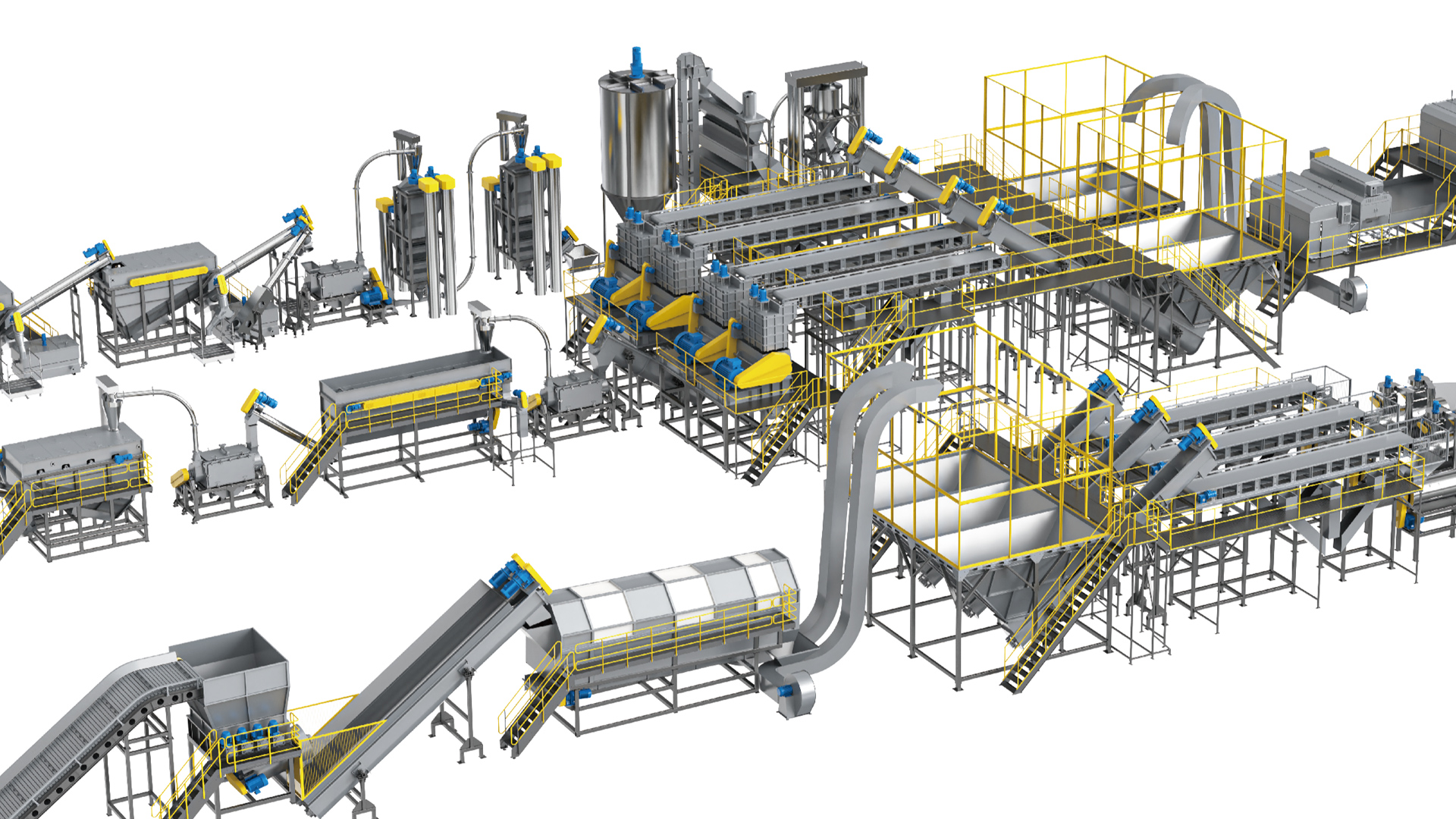
Polyretec offers the PP/PE Soft Plastic Crushing and Washing Line in the throughput range of 500 to 1500 kilograms per hour, designed for film, woven bags, agriculture film, and raffia. The line combines the full process flow described above into a compact, automated train. The specification table below reflects representative configuration tiers within that range. Values are indicative and finalized during project engineering based on feedstock condition and local utilities.
| Model Designation | Throughput (kg/h) | Total Installed Power (kW) | Water Consumption Index (m³/h makeup) | Moisture After Drying (%) | Footprint (approx. m²) |
|---|---|---|---|---|---|
| PTW-500 | 500 | 115 to 135 | 2.0 to 3.0 | Below 5 | 120 |
| PTW-800 | 800 | 150 to 175 | 2.8 to 4.0 | Below 5 | 160 |
| PTW-1000 | 1000 | 180 to 210 | 3.5 to 5.0 | Below 5 | 200 |
| PTW-1200 | 1200 | 205 to 240 | 4.0 to 6.0 | Below 5 | 230 |
| PTW-1500 | 1500 | 230 to 280 | 5.0 to 7.0 | Below 5 | 270 |
The water consumption index above reflects fresh makeup water after the line’s closed-loop water recycling and settling system returns the majority of process water to the washers. A well-designed line reuses most water, so the makeup volume stays modest even at higher throughput. The moisture after drying figure is the key quality gate: keeping it below five percent protects the pelletizer and stabilizes the melt.
Beyond the headline numbers, the line is built around reliability. Electrical components use internationally recognized brands, the control system is PLC based with a touch-screen human-machine interface, and the cutting chamber is engineered for easy blade access and fast maintenance. These details reduce unplanned downtime, which for a continuous recycling operation is often the single largest factor in profitability.
Core Equipment Modules Explained
A PP woven bag recycling line is a train of specialized modules. Knowing what each module does helps buyers evaluate a quotation and plan maintenance. The table below summarizes the core modules and their function.
| Module | Primary Function | Key Adjustment | Maintenance Focus |
|---|---|---|---|
| Belt Conveyor | Metered feeding of bags into the crusher | Feed speed and load | Belt tension, motor, detector |
| Wet Crusher | Cut bags into flakes inside a water bath | Screen size, rotor speed | Blade sharpening, screen |
| Friction Washer | Scrub surface ink and dust from flakes | Speed, residence time | Blade wear, screen cleaning |
| Hot Washer | Release inks, oils, agriculture residue with heat and alkali | Temperature, chemical dose | Heating element, seals |
| Cold Rinse | Neutralize and remove detergent and soils | Rinse cycles, water flow | Water loop, filters |
| Centrifuge or Squeezer | Remove bulk free water | Speed, compression | Bearings, screen basket |
| Thermal Dryer | Reduce moisture below five percent | Air temperature, dwell | Heater, fan, ducts |
| Silo and Storage | Buffer and store clean dried flakes | Level control | Level sensor, discharge |
Crusher
The crusher is the heart of size reduction. For PP woven bags, a wet crusher with adjustable screen openings gives operators control over flake size. Smaller flakes wash more thoroughly but demand more power; larger flakes save energy but may trap ink in folds. A typical compromise is 10 to 16 millimeter flakes for woven material. Blade material and geometry are chosen for toughness against occasional hard inclusions.
Friction Washer
The friction washer uses a rotating paddle or disc to generate intense mechanical action. It is particularly effective against dry surface dust and loosely adhered ink. Because it works mechanically, it reduces reliance on chemicals and helps keep operating cost in the Medium range rather than High.
Hot Washer
The hot washer is a heated, agitated tank or drum. Detergent or alkali concentration, temperature, and residence time are the three levers. Heavily printed or agriculture-exposed feedstock needs longer and hotter treatment. Operators must balance cleaning intensity against polymer degradation, since prolonged high-temperature exposure can embrittle PP.
Centrifuge and Squeezer
The centrifuge throws off surface water by spin, while the squeezer compresses the material to squeeze out water and, for film and woven streams, form a compacted feed. Many lines use both: a centrifuge for quick dewatering followed by a squeezer for the tight moisture target. The combined result is the low final moisture that protects the pelletizer barrel and screw.
Silo
A storage silo buffers clean flakes between washing and pelletizing or between production shifts. Proper level control and discharge design prevent bridging, a common nuisance with low-bulk-density flake.
Water Treatment and Closed-Loop Water Recycling
A washing line consumes water continuously, so the water management system is as important as the crusher or washers. A well-engineered PP woven bag recycling line operates as a closed loop in which the majority of process water is recovered, cleaned, and returned to the friction washer and rinse stages. Only a small makeup volume compensates for evaporation, drag-out with the flakes, and sludge removal. This design keeps the operating cost category in the Medium range rather than High and reduces the environmental footprint of the plant.
Settling and flotation. After the friction washer and hot washer, the dirty water carries ink particles, soil, and organic matter. It first enters a settling tank or a series of tanks where heavy solids drop out by gravity. Lighter contaminants such as ink agglomerates may be encouraged to float and are skimmed off. The clarified upper water is pumped forward for reuse.
Filtration. Before reuse, the water passes through filters that capture fine suspended solids. The level of filtration is tuned so that recirculated water does not redeposit soil onto cleaned flakes. Some configurations add a centrifuge or hydrocyclone stage to concentrate sludge efficiently.
Chemical balance. Because the hot washer uses detergent or alkali, the recirculated water carries residual chemicals. Operators monitor pH and chemical concentration, topping up as needed and bleeding a controlled sidestream to the drain or to a treatment unit so the loop does not become overloaded. Maintaining neutral conditions before the final cold rinse is critical to avoid alkaline damage during later extrusion.
Sludge handling. The solids removed from the water loop form a wet sludge containing ink, soil, and organic matter. Depending on local regulation, this sludge is dewatered and disposed of through an approved channel. A responsible sludge plan is part of a compliant recycling operation and is discussed during plant design.
Environmental and cost benefits. Closed-loop recycling reduces freshwater draw, lowers the volume of process wastewater, and stabilizes operating cost against local water pricing. For recyclers in water-sensitive regions, the ability to run with a low makeup rate is a decisive advantage when selecting a line supplier. Polyretec designs the water system as an integrated part of the train rather than an afterthought, reflecting the European-origin process discipline combined with practical Chinese manufacturing for cost-effective delivery.
Food Grade PET Washing Line: Sister Capability
While this article focuses on the best PP woven bag recycling line with crushing and washing, Polyretec also manufactures a Food Grade PET Washing Line in the throughput range of 500 to 6000 kilograms per hour. It is presented here as a sister capability so buyers understand the full polyolefin and polyester recovery portfolio. The PET line is engineered for bottle flakes and applies a more intensive label, glue, and contaminant removal sequence suited to bottle-grade requirements. The specification table below shows representative capacity tiers.
| Model Designation | Throughput (kg/h) | Total Installed Power (kW) | Water Consumption Index (m³/h makeup) | Target Flake Purity |
|---|---|---|---|---|
| PTW-PET-500 | 500 | 160 to 190 | 3.0 to 4.5 | High |
| PTW-PET-1500 | 1500 | 260 to 310 | 5.0 to 7.5 | High |
| PTW-PET-3000 | 3000 | 380 to 450 | 8.0 to 11.0 | Very High |
| PTW-PET-6000 | 6000 | 620 to 720 | 13.0 to 17.0 | Very High |
The PET washing line is a distinct product with its own process intensity and is addressed in detail in a separate article on removing contaminants from food grade PET bottle flakes. Here it is mentioned only to show that Polyretec, as a Wanplas factory, covers both flexible polyolefin and rigid polyester recovery, allowing customers with mixed waste streams to source compatible equipment from one supplier network.
New Generation Pelletizing Line and Downstream Integration
Washing produces clean flakes; many customers want pellets. Polyretec offers a New Generation Pelletizing Line designed for thin-walled LDPE films or thick-walled PE and PP regrind, built with robust construction for maximum performance on post-consumer waste. For integrated operation, Wanplas supplies matched twin-screw or strand pelletizing systems that integrate with Polyretec washing lines, creating a continuous path from dirty sack to uniform pellet.
The integration works as follows. Clean, dried PP flakes are conveyed from the washing line silo into a controlled metering hopper. The pelletizer plasticizes the flake in its barrel, pushes the melt through a screen changer that captures residual fines and gel, and cuts the strand or die-face output into consistent pellets. A matched system matters because the feed rate, melt temperature, and degassing must be synchronized with the flake moisture and bulk density delivered by the washer. Mismatched equipment causes surging, filtration overload, and inconsistent pellet quality.
Attributing the pelletizing step to Wanplas rather than naming a specific sister factory respects brand isolation while still giving the customer a complete, supported solution. The shared Wanplas engineering standards ensure that the washing and pelletizing trains speak the same control language and can be commissioned together.
Recommended Line Configuration by Feed Type and Capacity
Choosing the right configuration starts with the feedstock and the target daily volume. The selection table below maps common input types to a recommended line model and notes the typical cost category. Cost labels are relative: Low, Medium, High, Very High, and Premium, reflecting equipment scope and automation rather than a specific price.
| Feed Type | Typical Daily Volume | Recommended Line Model | Key Option | Relative Cost |
|---|---|---|---|---|
| Clean post-industrial PP woven offcuts | 3 to 6 tonnes | PTW-500 | Light wash, centrifuge only | Low |
| Mixed printed PP woven sacks | 6 to 12 tonnes | PTW-800 or PTW-1000 | Hot washer plus squeezer | Medium |
| Agriculture-exposed PP raffia and film | 12 to 20 tonnes | PTW-1000 or PTW-1200 | Extended hot wash, double rinse | Medium to High |
| Heavily soiled cement or fertilizer bags | 20 to 30 tonnes | PTW-1500 | Pre-wash drum, intensive hot wash | High |
| Washed flakes plus integrated pelletizing | Any of above | PTW-X plus Wanplas pelletizer | Metered feed, filtration, cutter | High to Premium |
The table is a starting point. In practice, Polyretec engineers analyze a sample of the customer’s actual waste, measure contamination levels, and confirm available utilities such as power supply, water source, and drainage before finalizing a configuration. A line sized on guesswork risks either chronic overload or expensive idle capacity.
Application Areas: Turning Woven Bags and Raffia into Reusable Pellets
The recovered output of a PP woven bag recycling line serves two broad goals: renewable resource utilization and the conversion of waste plastics into reusable pellets. Clean PP flakes and pellets re-enter the manufacturing chain in numerous ways.
Renewable resource utilization. Every tonne of PP recovered from woven waste displaces a tonne of virgin polymer that would otherwise be produced from fossil feedstock. For companies with sustainability commitments or regulatory recycling targets, operating a washing line is a direct, measurable contribution to circular economy goals.
Reprocessed PP pellets for molding. Washed and pelletized PP is suitable for injection molding of crates, pallets, caps, and components where color can be managed. The cleaner the feedstock, the lighter the natural pellet color and the wider the range of acceptable end products.
Raffia, tape, and rope. PP raffia recovered from sacks can be reprocessed into tape and woven products again, though careful stabilization is needed to offset the molecular-weight loss from prior processing. Many recyclers sell flakes directly back to tape producers.
Agriculture film and mesh. Because the same soft washing line handles agriculture film, a recycler can process both woven sacks and field film in one train, improving asset utilization and spreading fixed costs across more material.
Non-woven and related goods. PP non-woven fabric, often appearing in the same waste streams as sacks, can also be washed and reprocessed, expanding the addressable feedstock for the line.
Converting waste plastics into reusable pellets is not only an environmental choice but an economic one. A washing line transforms a disposal liability into a tradable raw material with stable, repeatable specifications.
Output Quality Control and Flake Specifications
The value of a PP woven bag recycling line is realized only when the output meets consistent, saleable specifications. Buyers of recycled flakes and pellets specify more than just color; they require documented, repeatable properties. A disciplined quality-control routine protects both price and customer trust.
Moisture content. The most frequently checked parameter is final moisture, targeted below five percent. A handheld moisture meter or oven method confirms the dryer performance and guards the pelletizer against steam-related defects.
Bulk density and flake size. Uniform flake size from consistent crusher screen settings gives stable bulk density, which in turn supports even feeding into the pelletizer. Variation in size causes surging and inconsistent melt pressure.
Ash and contamination. Ash content, measured by burning off the polymer and weighing the residue, indicates how much inorganic soil remains. Lower ash means cleaner washing. Similarly, a simple visual or wash-water clarity check reveals whether ink and dust removal is complete.
Melt flow index. PP loses some molecular weight with each thermal history. Measuring the melt flow index of the washed flake or final pellet tells the operator whether the material still meets the mechanical window required by the end application. Stable melt flow index across batches is a strong selling point.
Metal and foreign matter. Metal detection on the belt and, where needed, downstream confirms that blades and bearings are protected and that the product is free of ferrous or non-ferrous inclusions that would damage a customer’s equipment.
Color and odor. Clean PP flakes should be light in natural color and free of persistent odor. Residual smell usually signals incomplete hot-wash or organic contamination, prompting an adjustment of temperature, dwell time, or chemical dose. Maintaining these checks turns the washing line from a vague cleanup process into a controlled manufacturing step with traceable output quality.
Wet Crushing Versus Dry Crushing: A Comparison
Buyers sometimes ask whether they can save cost by dry crushing and skipping the water bath. The comparison below shows why wet crushing is the standard for printed and contaminated woven bags.
| Factor | Wet Crushing | Dry Crushing |
|---|---|---|
| Ink dust control | Contained in water bath | Released as airborne colored dust |
| Heat at cutting zone | Suppressed by water | Higher, risks ink smear |
| Early cleaning | Begins immediately | Delayed to washing stage |
| Flake quality | Cleaner, lighter | Darker, re-contaminated |
| Operating complexity | Medium | Low |
| Best fit | Printed, soiled woven bags | Clean post-industrial offcuts |
The analysis is clear: for genuinely dirty post-consumer sacks, wet crushing protects flake quality and ultimately pellet value. Dry crushing remains acceptable only for clean, unprinted industrial offcuts where contamination is minimal. Technology should be matched to the material, not the other way around.
Service and Support
Polyretec, a Wanplas factory, provides comprehensive after-sales support that begins long before shipment and continues through the life of the line. The service framework reflects the Wanplas group’s commitments and shared policies.
Pre-shipment testing. Each line is run and verified against the agreed throughput and quality targets before it leaves the factory. This reduces commissioning risk at the customer site.
Installation and commissioning. Engineers assist with on-site installation, alignment, and start-up, transferring operational know-how to the customer’s team during the commissioning window.
Training. Operators and maintenance staff receive training on normal operation, blade changes, water-loop management, and routine inspection so the customer can run the line independently.
Remote technical assistance. With PLC-based controls and data capture, the support team can analyze faults remotely in many cases, shortening response time and reducing travel cost.
Spare parts policy. Through the Wanplas shared policy, customers receive USD 500 free parts per year, helping keep wear items such as blades, screens, seals, and bearings in stock without an immediate out-of-pocket burden. Additional warranty replacement covers damaged parts within the agreed warranty period.
Open factory. Polyretec maintains an open-factory policy and welcomes customers to visit, inspect running lines, and discuss customization. Seeing a line in operation is often the fastest way to build confidence in a major capital purchase.
Quality standards. Equipment is built to recognized standards including CE and ISO requirements appropriate to the machinery category, giving international buyers a common frame of reference for safety and construction quality.
Plant Layout, Utilities, and Commissioning Checklist
Selecting the right line is only half the project. The site must be prepared so the equipment can be installed, permitted, and run efficiently. This section outlines the practical groundwork a buyer should plan before delivery.
Floor space and foundation. A 500 to 1500 kilogram per hour PP woven bag line needs a covered hall ranging from roughly 120 to 270 square meters depending on model and whether pelletizing is included. Most modules sit on flat, level concrete with anchored bases for the crusher, washers, and dryer. Vibration isolation at the crusher and centrifuge reduces structural transmission.
Power supply. The line draws from a three-phase supply sized to the installed power, which ranges from about 115 kilowatts at the small end to around 280 kilowatts at the 1500 kilogram per hour tier, before adding pelletizing. Stable voltage and adequate incoming capacity prevent nuisance trips during start-up of the largest motors.
Water and drainage. A freshwater source feeds the makeup demand, while a drainage route handles sludge bleed and any regulated discharge. Where discharge is restricted, the closed-loop design and an optional treatment step minimize outflow. Planning these connections early avoids costly civil rework.
Manpower. A typical line runs with two to four operators per shift covering feeding, monitoring, packing, and basic inspection. Training by the Polyretec team brings new staff to competence quickly, and the PLC human-machine interface simplifies daily control.
Commissioning checklist. Before full production, the team verifies belt alignment, blade gaps, water-loop balance, heater performance, dryer exit moisture, and safety interlocks. A sample of the customer’s actual waste is run to confirm throughput and flake quality against the agreed specification. Only after this acceptance run does the line move into routine operation, supported by the Wanplas shared policy of USD 500 free parts per year and comprehensive after-sales assistance.
Frequently Asked Questions
What contaminants does a PP woven bag washing line remove?
A PP woven bag washing line removes printing ink, surface dust, sand and soil, agriculture residue such as fertilizer and pesticide film, labels and glue, moisture, and organic matter. The combination of wet crushing, friction washing, hot alkaline washing, and cold rinsing reduces contamination to a level suitable for reprocessing into clean flakes or pellets.
Can the same line process both PP woven bags and agriculture film?
Yes. The PP/PE soft plastic crushing and washing line is designed for flexible and semi-rigid polyolefin waste including PP woven sacks, raffia, PP non-woven fabric, LDPE agriculture film, and greenhouse film. Feed type mainly changes screen size, washer dwell time, and throughput, not the core machine layout.
Why is wet crushing preferred over dry crushing for printed bags?
Wet crushing confines ink dust and fine fibers inside the water bath, prevents airborne contamination, reduces heat buildup that can smear ink into the flake, and begins the cleaning action immediately. Dry crushing releases fine colored dust that re-adheres to flakes and complicates downstream washing.
What moisture level can be achieved after drying, and why does it matter?
A properly configured line using a squeezer plus centrifuge plus thermal dryer typically delivers flakes or squeezed material at moisture below five percent. Low moisture protects the pelletizing extruder from steam puffing, stabilizes the melt, reduces energy use, and improves pellet quality.
How does downstream pelletizing work with a Polyretec washing line?
For integrated pelletizing, Wanplas supplies matched twin-screw or strand pelletizing systems that integrate with Polyretec washing lines. The clean, dried flakes are fed to the pelletizer through a controlled metering system, melted, filtered, and cut into uniform recycled PP pellets in one continuous flow.
What after-sales support and spare parts policy does Wanplas provide?
Polyretec, a Wanplas factory, provides comprehensive after-sales support including pre-shipment testing, on-site installation and commissioning, operator training, remote technical assistance, and an open-factory policy. Through the Wanplas shared policy, customers receive USD 500 free parts per year to keep lines running.
How do I choose the right line capacity for my material volume?
Estimate your stable daily feed in kilograms and target utilization around 70 to 80 percent of nameplate capacity to allow for variation. A 500 kilogram per hour line suits pilot or regional collectors, while 1000 to 1500 kilogram per hour lines suit integrated recyclers with steady supply of woven bags and raffia.
Is the washing line suitable for food-grade applications?
The PP woven bag line produces clean industrial-grade recycled PP flakes and pellets for non-food uses such as injection molding, rope, and woven products. Food-grade status depends on feedstock history and regulatory certification; the separately offered Food Grade PET Washing Line addresses bottle-grade requirements.
Conclusion
A PP woven bag recycling line with crushing and washing is the most effective way to convert dirty, printed, and contaminated sacks and raffia into a valuable, reusable resource. The washing stages are not optional extras; they are what separate a low-grade regrind from a clean flake or pellet that commands a stable market price. The complete flow, from belt conveyor and wet crusher through friction washing, hot alkaline washing, cold rinse, dewatering, and drying, is a single integrated system in which each module prepares the material for the next.
Polyretec, a Wanplas factory with an origin in 2010 and brand establishment in 2017, brings more than 100 project references across 50 or more countries, a team of 24 or more engineers, and a 10 or more year commitment to recycling technology. The PP/PE Soft Plastic Crushing and Washing Line covers 500 to 1500 kilograms per hour for woven bags, raffia, and agriculture film, while the sister Food Grade PET Washing Line covers 500 to 6000 kilograms per hour for bottle flakes, and downstream pelletizing is delivered through matched Wanplas twin-screw or strand systems. Supported by comprehensive after-sales service, USD 500 free parts per year under the Wanplas shared policy, and an open-factory welcome, the solution is designed for long-term, profitable operation.
If you are evaluating a recovery project for PP woven bags, raffia, or agriculture film, we invite you to share your typical feedstock, daily volume, and target output with our engineering team. We will analyze your material, recommend a line configuration, and welcome you to visit our factory to see a running line and discuss a tailored solution that fits your operation.