
Optimizing washing line chemical usage for flake cleaning is one of the fastest ways to lower the operating cost of a plastic recycling plant without sacrificing flake quality. Every kilogram of sodium hydroxide, every litre of rinse water, and every kilowatt-hour spent heating a bath directly affects the margin on recycled PET and PP/PE flakes. A washing line that is tuned to the contamination level of its feedstock uses far less chemical than a line running a fixed, over-safe recipe, yet it still meets the strict cleanliness specs that bottle-to-bottle and fiber producers demand. This guide explains the full chemical path from caustic bath to final rinse, quantifies how concentration, temperature, and residence time interact, defines the cleanliness metrics buyers actually check, and shows how the right equipment design cuts both chemical and water consumption. Polyretec, a Wanplas factory, has built plastic recycling equipment since 2010 and runs more than 100 recycling projects across 50-plus countries, integrating process know-how of Austrian origin with Chinese manufacturing scale to deliver washing lines that clean aggressively while dosing chemicals precisely.
The core idea is simple: chemical usage should be matched to contamination, not set once and forgotten. Post-consumer PET bottles carry paper labels, hot-melt glues, residual soda, and food oils that only an alkaline bath can break down. PP and PE films carry printing ink and agriculture dirt that respond better to surfactants and friction than to heavy caustic. By separating these paths, measuring flake quality at each stage, and recirculating both chemical and water, a modern washing line can hold caustic consumption near 2.5 to 4.5 kg per tonne of PET feedstock and recover more than 90 percent of its process water. The sections below walk through each stage with concrete numbers you can use to audit your own line or to specify a new one.
1. Understanding the Chemical Path in a Plastic Washing Line
A plastic washing line is a sequence of physical and chemical steps that turn dirty post-consumer or post-industrial scrap into clean, dry flakes ready for pelletizing or direct reuse. The chemical path is the part of that sequence where water-borne reagents remove glue, oil, ink, and soluble contamination. Getting the path right is what separates a line that merely moves material from a line that produces saleable flakes at low cost.
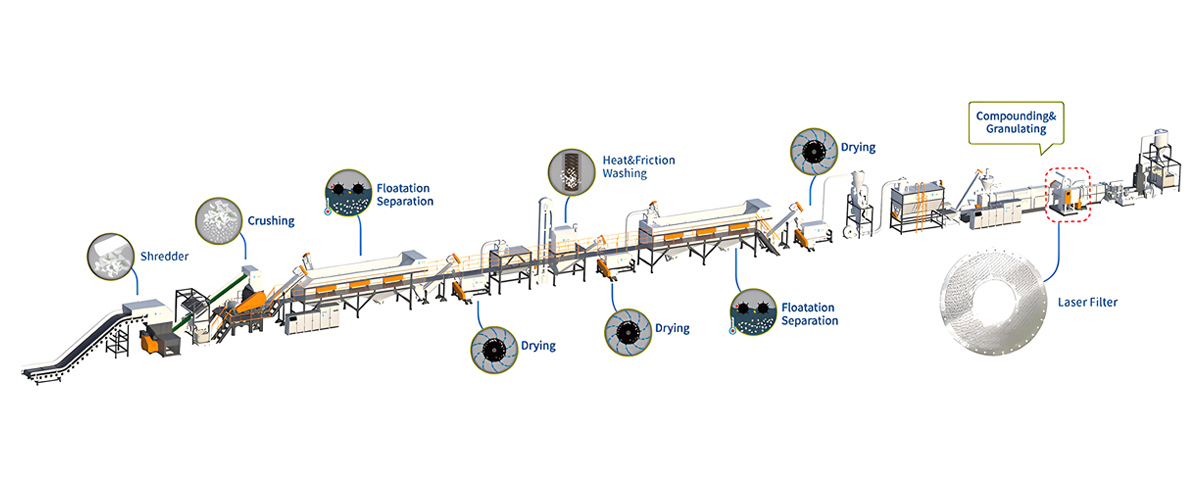
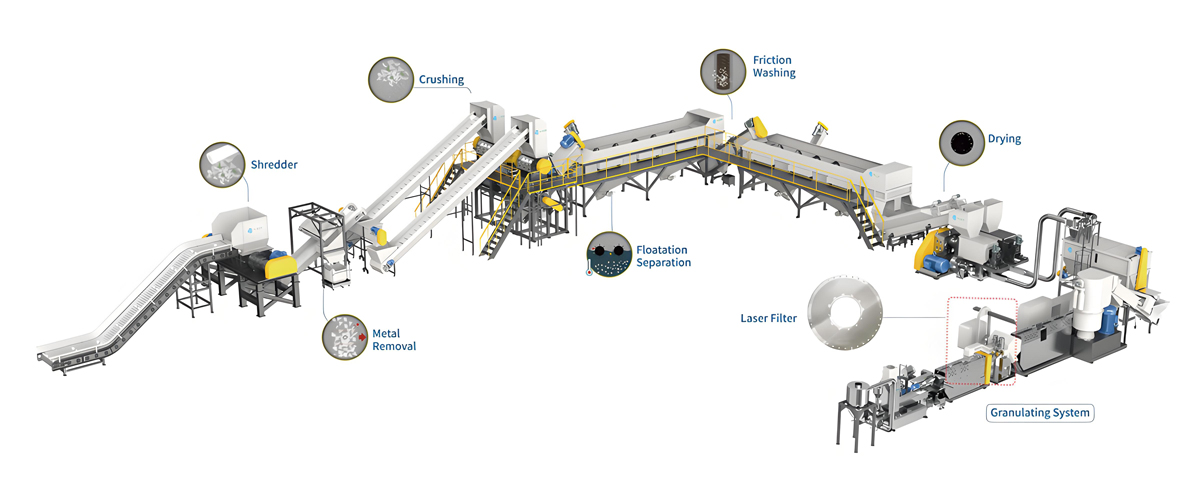
The standard chemical path for rigid PET bottles runs pre-wash, hot caustic wash, friction wash, optional acid wash, neutralization, multi-stage rinse, dewatering, and thermal drying. Soft film follows a shorter path because film has little glue to saponify. Each stage has one job, and over-dosing chemical at an early stage does not compensate for poor mechanical action later; it only wastes reagent and loads the rinse train. The table below maps each stage to its purpose and the reagent it consumes.
The Standard Stage-by-Stage Chemical Path
| Stage | Primary purpose | Main reagent | Typical condition |
|---|---|---|---|
| Pre-wash | Remove loose dirt, sand, and soluble sugar | Cold water, light surfactant | Ambient, 2 to 4 min |
| Hot caustic wash | Saponify glues, dissolve labels and oils | Sodium hydroxide solution | 80 to 92 deg C, 15 to 25 min |
| Friction wash | Scrub off softened contamination | Mechanical only, caustic carry-over | High-speed rotor, 1 to 3 min |
| Acid wash | Neutralize alkali, strip metal ions | Dilute acid (citric or mineral) | 0.2 to 0.5 percent, 40 to 60 deg C |
| Rinse train | Remove dissolved solids and residual reagent | Counter-current fresh water | pH 6.5 to 7.5, NTU under 10 |
| Dewater and dry | Lower moisture before storage or pelletizing | None (mechanical and thermal) | Moisture under 1 percent |
The most common mistake is treating the caustic bath as the only cleaning tool. In reality, the friction washer and the label separation step do most of the visible work once the glue is softened. If you raise caustic concentration to compensate for a weak friction stage, you pay for chemical you do not need and you overload the rinse train with alkaline load. A balanced line lets the chemistry do the molecular work and the mechanics do the bulk removal, which is the principle behind every Polyretec washing line design.
2. Caustic Washing: Concentration, Dosage, and Temperature
Caustic washing is the chemical heart of PET flake cleaning. Sodium hydroxide hydrolyzes the ester and polyurethane glues that bind labels to bottles, lifts food oils and fats by saponification, and helps detach paper fibers. The dosage you need depends on three coupled variables: bath concentration, bath temperature, and residence time. Change one and you can usually trade off another, which is where optimization lives.
For post-consumer PET bottle flakes, a tuned caustic bath consumes about 2.5 to 4.5 kg of sodium hydroxide per tonne of feedstock. The bath concentration normally sits between 1.5 percent and 3 percent by weight. Temperature ranges from 80 to 92 degrees Celsius; below 75 degrees the reaction slows sharply and you must raise concentration or time, which costs more overall. Residence time in the hot washer is typically 15 to 25 minutes. Heavily labeled, heavily glued, or post-industrial tray feedstock pushes dosage toward the top of the range, while clean post-industrial bottle scrap can fall below 2 kg per tonne.
How Concentration, Temperature, and Time Interact
The relationship is a classic engineering trade-off. Higher temperature accelerates saponification, so a bath at 88 degrees Celsius can hit the same cleanliness at 2 percent concentration and 18 minutes that a 65 degrees Celsius bath reaches only at 3 percent concentration and 30 minutes. Because heating energy is cheaper than wasted caustic in most regions, the optimized point is usually a hot, moderately concentrated, shorter bath. The table below shows representative outcomes for PET bottle flakes at equal cleanliness.
| Bath temperature | Caustic concentration | Residence time | Approx. NaOH per tonne | Cleaning result |
|---|---|---|---|---|
| 62 deg C | 3.0 percent | 30 min | 4.8 kg | Adequate, high chemical cost |
| 80 deg C | 2.2 percent | 22 min | 3.6 kg | Good balance |
| 88 deg C | 1.8 percent | 18 min | 2.9 kg | Optimized, lowest reagent |
| 92 deg C | 1.5 percent | 15 min | 2.5 kg | Best for clean feedstock |
Two operational rules protect this optimization. First, never let the caustic concentration drift above 3.5 percent, because excess alkali darkens PET, accelerates equipment corrosion, and raises the rinse load without improving glue removal. Second, control the feed rate so residence time stays inside the design window; a line fed above nameplate throughput simply under-cleans rather than using more chemical, because the bath is already at set concentration. Automated dosing that measures bath alkalinity and tops up only what reaction consumed is the single biggest lever for steady, low usage.
Automatic dosing deserves a closer look because it is where most plants lose their savings. A manual line is dosed by shift operators who, fearing customer complaints, add a safety margin of alkali on every fill. That margin compounds across a day and can lift usage by a full kilogram per tonne with no quality benefit. A conductive or titration-based alkalinity sensor linked to a metering pump removes the guess: it holds the bath at the target concentration within 0.1 percent and logs every litre of make-up. Over a year this disciplined control typically repays the sensor and pump within months through reduced sodium hydroxide purchase alone. Operator training matters too; the best dosing system still fails if staff override it after a single off-spec batch instead of diagnosing which stage drifted.
Another hidden cost is caustic carry-over into the friction and rinse stages. Flakes leaving the hot bath are saturated with alkaline liquor, and if the transfer does not include a drain or pre-rinse, that alkali enters the fresh-water loop and must be neutralized there, wasting both acid and water. A short drain or cage press between the caustic washer and the friction stage returns much of that liquor to the bath, which is why Polyretec lines place a dewatering step at that transfer point. Keeping the caustic in the caustic tank is the cheapest alkali you will ever buy.
Caustic Demand by Polymer Type
Not every polymer needs caustic at the PET level. The table below compares typical alkali demand and why it differs. Using PET-grade caustic on film is waste; using no alkali on glued bottles leaves label residue. Match the reagent to the polymer.
| Feedstock | Why caustic is used | NaOH per tonne | Concentration |
|---|---|---|---|
| PET bottles (post-consumer) | Glue, label, oil saponification | 2.5 to 4.5 kg | 1.5 to 3.0 percent |
| PET trays (post-industrial) | Heavy glue and ink | 4.0 to 6.0 kg | 2.5 to 3.5 percent |
| PP/PE film (printed) | Mild ink and organic lift | 0.4 to 1.0 kg | 0.5 to 1.0 percent |
| PP/PE film (clean agriculture) | Dirt only, friction dominant | under 0.5 kg | surfactant, low alkali |
3. Acid Washing and Neutralization Steps
Acid washing is the step many operators skip, yet it earns its place on lines that must hit bright, low-odor, low-alkali flakes. After the caustic bath, flakes carry residual sodium hydroxide and dissolved metal salts. A short, dilute acid pass neutralizes that alkalinity, strips metal ions that would otherwise catalyze yellowing during later extrusion, and improves flake brightness. The trade-off is an extra reagent, an extra rinse, and tighter pH control.
The acid stage normally uses a 0.2 to 0.5 percent solution, either a food-safe organic acid such as citric acid or a dilute mineral acid, held at 40 to 60 degrees Celsius for 5 to 10 minutes. The goal is not deep etching; it is neutralization and surface cleaning. Over-acidifying below pH 4 risks hazing PET and attacking metal parts, so the line should target a final flake pH of 6.5 to 7.5 after the following rinse. If your rinse train already reaches that window and brightness is acceptable, the acid stage can be bypassed to save reagent and water.
Neutralization Control
Neutralization is best run as a closed loop with online pH measurement. The acid is dosed against measured pH of the process water, not against a fixed timer, so a batch of lightly contaminated flakes receives only a short pass while heavily alkaline batches receive more. This keeps acid usage near 0.3 to 0.6 kg per tonne of PET and prevents the rinse train from fighting a pH overshoot. After neutralization, a final fresh-water rinse removes soluble salts so they do not concentrate in the recirculated loop.
One caution: acid and caustic must never mix in the same tank. They belong in separate, sequenced stages with a friction or rinse step between them. A wash line that cross-contaminates the two baths wastes both reagents through neutralization inside the tank and produces salt load that the rinse cannot easily remove. Properly isolated stages, as designed on Polyretec lines, keep each reagent doing its own job.
4. Rinse Stages and Flake Cleanliness Metrics
Rinsing is where chemical savings are won or lost. A caustic bath that does its job still leaves flakes coated in alkaline solution and suspended organic solids; the rinse train must remove these to a level the buyer can accept. The cleaner your rinse, the lower your final alkali and turbidity, and the less acid you need upstream. Counter-current rinsing, where the cleanest water enters the last stage and flows backward toward the caustic stage, is the standard design that minimizes fresh water while maximizing removal.
Flake cleanliness is judged by a set of measurable metrics rather than by eye. Buyers of washed PET specify residual alkali, rinse water turbidity, PVC contamination, residual glue and label, color, and odor. Each metric maps to a stage in the chemical path, so you can diagnose which stage to adjust when a batch fails. The table below lists the common acceptance criteria for food-grade and fiber-grade PET flakes.
Flake Cleanliness Acceptance Criteria
| Metric | Typical target | Linked stage | If out of spec |
|---|---|---|---|
| Residual alkali | below 0.05 percent | Rinse train | Add rinse stage or flow |
| Rinse water turbidity | under 10 NTU | Rinse and filtration | Improve filtration, counter-current |
| PVC content in PET | 50 to 100 ppm | Sorting, not washing | Tighten air or electrostatic sort |
| Residual glue and label | below 0.1 percent | Caustic plus friction | Raise temp or friction time |
| Final pH | 6.5 to 7.5 | Acid and rinse | Adjust acid dose |
| Moisture after drying | under 1 percent | Dewater and dryer | Check centrifugal and heat |
Note that PVC content is controlled by sorting, not by washing. Washing lines remove glue and organics, but they cannot separate PVC from PET once both are flaked; that is the job of air classification and, for tight specs, electrostatic or optical sorting upstream. If your PVC number is high, the fix is in the dry sorting section, not the chemical path. Treating PVC failure with more caustic only wastes reagent and risks hydrolyzing the PET surface.
Turbidity deserves special attention because it is the cheapest metric to monitor online. A turbidity sensor in the final rinse tells you immediately whether filtration or flow has drifted, often before flake samples come back from the lab. Plants that track rinse turbidity continuously typically hold fresh water use 10 to 20 percent lower than plants that only sample flakes, because they catch dilution problems in minutes rather than batches.
Residual alkali is the second metric worth monitoring online, and it is usually measured by sampling the last rinse and testing for pH or total alkali. A creeping pH above 7.5 signals that the counter-current flow has been set too low or that the caustic carry-over has risen, and the fix is to open the final rinse flow or recheck the inter-stage dewatering rather than to add acid. Chasing pH with acid while the rinse is under-flowing simply moves the cost from water to reagent. Good lines log both turbidity and pH so the two variables are balanced together, which is the disciplined way to keep chemical usage at the floor.
PVC content, although set by sorting, still appears on the wash quality report because a high PVC number is sometimes wrongly blamed on the wash. The correct response is to confirm the dry sorting cut before touching the chemical path. Air classification removes the bulk of PVC flakes by density, since PVC is denser than PET, and a further electrostatic or optical pass tightens the cut toward the 50 ppm food-grade limit. Washing cannot lower PVC; attempting it with more caustic only hydrolyzes the PET surface and reduces the intrinsic viscosity that bottle-to-bottle buyers measure. Keeping this boundary clear prevents wasted reagent and protects flake value.
5. Polyretec Equipment Built for Low-Chemical Operation
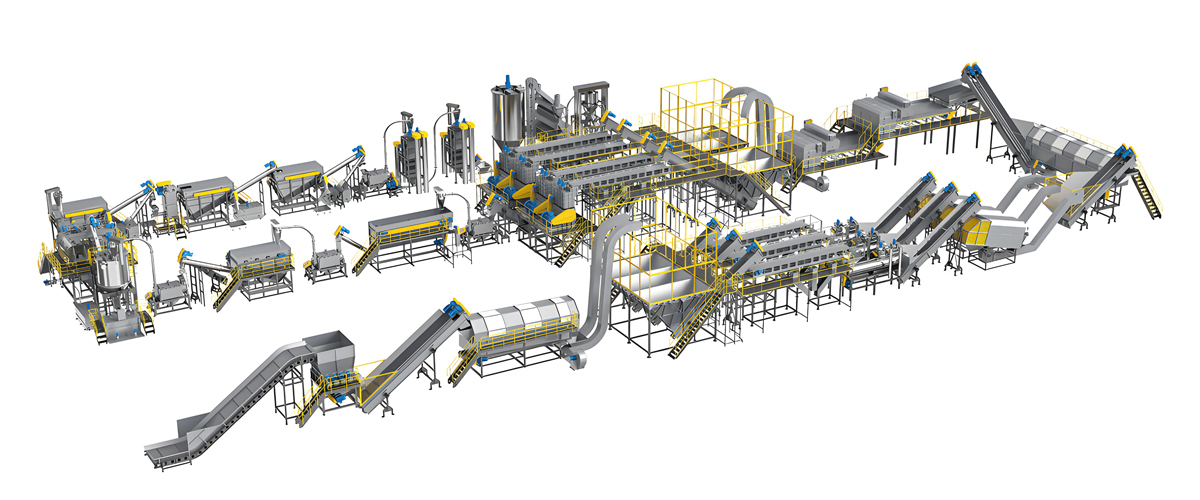
Polyretec, a Wanplas factory, designs washing lines so that chemical dosing is a controlled, measured function of the line rather than an operator guess. The equipment pairing that matters for flake cleaning is a hot caustic washer with automated alkalinity dosing, a high-intensity friction washer, an isolated acid-neutralization stage, and a counter-current rinse loop with recovered heat. Below are two representative product blocks with specification tables drawn from the Polyretec range, so you can see how capacity, tank volume, and water use scale together.
Product Block A: Food Grade PET Bottle Washing Line
The Food Grade PET Bottle Washing Line is built for rigid PET bottle, label, and tray feedstock from 500 to 6000 kg per hour. Its hot caustic tank is sized so residence time stays in the 15 to 25 minute window at nameplate throughput, and an automated dosing skid keeps concentration inside 1.5 to 3.0 percent by maintaining measured alkalinity. Recovered heat from the rinse loop pre-heats the caustic make-up water, which is why the larger capacities show lower specific water use. Typical representative specifications by capacity class are listed below.
| Capacity class | Throughput | Caustic tank volume | Fresh water use | Installed power |
|---|---|---|---|---|
| 1000 kg/h class | 1000 kg/h | 3.0 m3 | 1.6 m3 per tonne | 165 kW |
| 2000 kg/h class | 2000 kg/h | 5.0 m3 | 1.5 m3 per tonne | 265 kW |
| 3000 kg/h class | 3000 kg/h | 8.0 m3 | 1.4 m3 per tonne | 380 kW |
| 6000 kg/h class | 6000 kg/h | 15.0 m3 | 1.3 m3 per tonne | 620 kW |
The falling fresh water figure per tonne as capacity rises is not a trick of the table; it reflects the better recovery ratio of larger counter-current loops and the shared heat exchanger. A 6000 kg/h line recovers process heat and water more completely than a 1000 kg/h line, so its specific consumption is lower even though its absolute tank is bigger. For a plant planning to scale, this is why specifying the right nameplate from the start beats adding a second small line later.
Product Block B: PP/PE Soft Plastic Crushing and Washing Line (PTW1000)
The PP/PE Soft Plastic Crushing and Washing Line handles film, woven bags, and agriculture film at 500 to 1500 kg per hour, with the PTW1000 configuration a proven, fully automated unit for PP and PE film. Because soft film carries little glue, this line runs a mild alkaline or surfactant wash rather than a heavy caustic bath, and leans on intensive friction to strip printing ink and field dirt. The result is far lower chemical load than the PET line while still delivering clean, dry film flakes. Representative specifications for the PTW1000 class are below.
| Specification | PTW1000 (film) | 1500 kg/h class (film) |
|---|---|---|
| Throughput | 1000 kg/h | 1500 kg/h |
| Wash reagent | Mild alkali or surfactant | Mild alkali or surfactant |
| Alkali demand | under 1.0 kg per tonne | under 1.0 kg per tonne |
| Fresh water use | 2.0 m3 per tonne | 1.8 m3 per tonne |
| Wash tank volume | 4.0 m3 | 6.0 m3 |
| Installed power | 220 kW | 310 kW |
Film needs more water per tonne than bottles because the high surface area of film holds more liquor and ink emulsion, but it needs a fraction of the alkali. The optimization target on a film line is therefore water recovery and friction intensity, not caustic concentration. For operations that want flake straight to pellet, Polyretec, a Wanplas factory, can pair either washing line with a New Generation Pelletizing Line that accepts washed flakes and converts them to recycled pellets in one flow.
Downstream Pelletizing Note
The New Generation Pelletizing Line is built for thin-walled LDPE films or thick-walled PE/PP regrind, with a robust construction suited to post-consumer waste. In a combined configuration, washed and dewatered flakes pass to the pelletizing line without intermediate storage, cutting handling loss and keeping the chemical story consistent: clean flakes in, stable pellets out. When specified together, the washing and pelletizing sets share one control system so dosing, throughput, and moisture are balanced automatically.
6. Application Industries: Bottle Flake and Film Flake Cleaning
The same chemical principles apply across industries, but the cleanliness bar and therefore the optimized recipe change with the end use. Understanding the application is what lets you set the right caustic concentration and rinse depth instead of over-cleaning everything. Polyretec washing lines serve two dominant application streams: bottle flake cleaning and film flake cleaning, each feeding distinct recycled product markets.
Bottle Flake Applications
Washed PET bottle flakes feed food-grade sheet and bottle-to-bottle reuse, polyester staple fiber for textiles and wadding, strapping, and engineered sheet. Food-grade and fiber-grade buyers set the tightest specs: residual alkali below 0.05 percent, PVC under 50 to 100 ppm, low odor, and bright natural color. For these, the optimized line runs a full hot caustic plus friction plus rinse path, with acid neutralization when brightness is required. PET bottle flake cleaning is where chemical dosage discipline pays the largest dividend because volumes are high and specs are strict.
Film Flake Applications
Washed PP and PE film flakes feed reprocessed film for bags and agriculture use, injection and blow molding regrind, pipe and profile compounds, and mixed recycled resin. Film carries printing ink and field contamination rather than glue, so the optimized recipe is a mild alkaline or surfactant wash with strong friction and a lighter rinse load. Because the alkali demand is under 1 kg per tonne, the cost lever here is water recovery and power for friction, not caustic purchasing. PP/PE film cleaning also tolerates a wider residual range, which lets operators run shorter baths and recover more water.
Across both streams, the business case for optimization is the same: every percent of caustic or cubic metre of water saved per tonne compounds across the annual throughput. A 3000 kg/h PET line running 7000 hours a year processes about 21000 tonnes of feedstock; cutting caustic from 4.5 to 3.0 kg per tonne saves roughly 31500 kg of sodium hydroxide a year, and lifting water recovery from 80 to 92 percent saves thousands of cubic metres of fresh water. Those numbers are why the chemical path deserves engineering attention, not a fixed dial.
A useful way to set the recipe for a new application is to start from the contamination type rather than the polymer name. Glue- and oil-bearing scrap, whatever the resin, needs caustic; ink- and dirt-bearing scrap needs friction and surfactant; and odor-bearing scrap needs both a clean rinse and a verification of drying temperature. Mapping your scrap to these three contamination classes tells you which stages to emphasize and where chemical can be cut. This classification also makes it easier to accept mixed post-consumer bales, because you size the line to the worst contamination class in the mix and tune down for cleaner batches, rather than over-cleaning everything to a single conservative setting.
7. Water and Chemical Recovery: Saving Energy and Resources
Recovery is where low chemical usage becomes low total cost. A washing line that dumps its caustic and rinse water after one pass pays for reagent twice: once to buy it and once to remove it in the rinse. A line that recirculates closes that loop. Three recovery mechanisms matter most: caustic bath recirculation with filtration, counter-current rinse water, and heat recovery.
Caustic bath recirculation keeps the hot alkali in service through a settling and filtration loop that removes suspended label fibers and organics. Only the alkali consumed by reaction is replaced by automatic dosing, so the bath stays at strength for days instead of being refreshed each shift. Counter-current rinsing sends the cleanest water into the final stage and lets it flow backward toward the caustic stage, so the same litre of water does several cleaning jobs before discharge. Heat recovery uses a plate heat exchanger to move thermal energy from the hot discharge to the cold caustic make-up, cutting the energy needed to hold 85 to 92 degrees Celsius.
Representative Recovery Rates
| Recovery mechanism | Basic line | Optimized Polyretec line | Effect |
|---|---|---|---|
| Caustic reuse | 60 percent | 85 percent | Less alkali purchase |
| Fresh water recovery | 80 percent | 92 percent | Lower water cost and discharge |
| Process heat recovery | none | up to 70 percent | Lower steam or electric heat |
| Total chemical per tonne PET | 4.5 to 6.0 kg | 2.5 to 4.5 kg | 20 to 30 percent saving |
Energy and chemical savings reinforce each other. Holding the caustic bath hot with recovered heat lets you run a lower concentration and shorter time, which lowers alkali demand, which lowers the rinse load, which lowers water demand. The optimized line is a system, not a list of separate tweaks, and that is why equipment design drives the result more than operator habit. Polyretec, a Wanplas factory, builds these recovery loops as standard on its washing lines rather than as add-on options.
Sludge and suspended solids handling is the part of recovery that operators forget. The caustic loop concentrates label fibers, paper, and organics into a sludge that, if not removed, circulates back onto the flakes and raises turbidity. A settling cone or dissolved-air floatation unit paired with a belt filter keeps the bath clean and lets the alkali stay in service for days instead of hours. The separated sludge, still alkaline, should be neutralized in a dedicated small tank before disposal so it does not load the main rinse. Plants that skip this step find their caustic reuse stuck near 60 percent no matter how good the dosing, because the bath fouls faster than the reaction consumes reagent.
Discharge limits are the final reason recovery pays. Many regions cap the alkalinity and suspended solids in wash water leaving the site, and a line that dumps its bath meets that cap only by diluting with fresh water, which defeats the savings. A recovered line discharges a small, concentrated, easily treated stream while recycling the rest, so compliance cost stays low and the environmental footprint of each tonne of flake shrinks. For a recycling business, that alignment of cost and compliance is the strongest argument for designing recovery in from the start rather than retrofitting it later.
8. Selection Guide: Match Feedstock to the Right Line
Choosing the right line is the first optimization decision, because running bottles on a film line or film on a bottle line forces chemical and water waste. The guide below maps common feedstock and output goals to the matching Polyretec product, with the capacity range taken from the Polyretec range. Use it as a starting point, then confirm with a sample wash trial on your actual scrap.
Requirement to Model Recommendation
| Your feedstock and goal | Recommended Polyretec line | Capacity range | Chemical focus |
|---|---|---|---|
| Post-consumer PET bottles to food-grade flake | Food Grade PET Bottle Washing Line | 500 to 6000 kg/h | Hot caustic plus friction, acid optional |
| PET trays and mixed rigid with heavy glue | Food Grade PET Bottle Washing Line (higher class) | 2000 to 6000 kg/h | Higher caustic, longer residence |
| PP/PE film, woven bags, agriculture film | PP/PE Soft Plastic Crushing and Washing Line (PTW1000) | 500 to 1500 kg/h | Mild alkali, high friction, water recovery |
| Washed flakes straight to pellets | Washing line plus New Generation Pelletizing Line | Matched to washer | Consistent moisture and dosing control |
| Printed film needing ink removal | PP/PE Soft Plastic Crushing and Washing Line | 500 to 1500 kg/h | Surfactant plus intensive friction |
When in doubt, size the line to your steady feedstock, not your peak. A line run at 80 to 90 percent of nameplate holds residence time and rinse quality in the design window, which is where chemical usage is lowest. Oversizing wastes capital; undersizing forces over-concentration to keep pace. Polyretec, a Wanplas factory, sizes each line from a sample of your scrap so the caustic tank volume, friction time, and rinse flow are set to your real contamination rather than to a generic assumption.
9. Operation, Maintenance, and Service Support
Low chemical usage is locked in by good operation and maintenance, not just by good design. The daily habits that protect your optimization are measuring bath alkalinity, tracking rinse turbidity, cleaning filters on schedule, and calibrating dosing pumps. Skip these and even a well-designed line drifts back to over-dosing within weeks. The operational checklist below keeps a washing line in its efficient window.
Daily and Weekly Maintenance Checklist
- Check caustic bath alkalinity and adjust automatic dosing before each shift start.
- Record final rinse turbidity; investigate any rise above 10 NTU immediately.
- Inspect friction washer screens and rotors for wear that reduces mechanical action.
- Clean caustic settling and filtration loop weekly to keep reuse near 85 percent.
- Verify heat exchanger performance so bath temperature holds 85 to 92 degrees Celsius.
- Sample flakes for residual alkali and PVC content on a fixed schedule, not only when complaints arrive.
Polyretec, a Wanplas factory, backs every washing line with the shared Wanplas group service commitments. Each line is run and tested before shipment, and the group policy provides USD 500 free parts every year plus free replacement of damaged parts within the warranty period. Engineers assist with installation and commissioning on site, and the open-factory policy welcomes customers to visit the plant and inspect build quality before delivery. With 24-plus engineer assistance resources and more than 100 project references across 50-plus countries, the support covers commissioning, operator training, and remote troubleshooting so the chemical settings stay optimized after startup.
For plants planning capacity growth, the same team offers layout and utility design, helping you size the caustic make-up, water recovery, and steam or electric heat so the operating cost per tonne stays low as you scale. Because chemical and water recovery are designed into the line, most optimizations described in this guide are automatic once the line is commissioned; the maintenance checklist simply protects that baseline.
Frequently Asked Questions
What is the typical caustic dosage for washing PET bottle flakes?
For post-consumer PET bottle flakes, a well-tuned caustic bath typically consumes 2.5 to 4.5 kg of sodium hydroxide per tonne of feedstock at a concentration of 1.5 percent to 3 percent by weight, a bath temperature of 80 to 92 degrees Celsius, and a residence time of 15 to 25 minutes. Heavily labeled or glued feedstock sits at the upper end, while clean post-industrial scrap can drop below 2 kg per tonne.
Do PP and PE film flakes need caustic washing?
Soft PP and PE films generally do not require strong caustic treatment because they carry little glue or paper. Printed and agriculture films are cleaned mainly with a mild alkaline or surfactant wash combined with intensive friction to remove ink and organics, so caustic demand is far lower than for PET, often under 1 kg of alkali per tonne of film.
How can a washing line recover and reuse chemicals to cut cost?
Recirculate the caustic bath through a settling and filtration loop, top up only the consumed alkali by automated dosing, use counter-current rinsing so clean water enters the last stage and flows backward, and recover process heat with a plate heat exchanger. These measures lift chemical reuse toward 85 percent and fresh water recovery above 90 percent.
What cleanliness metrics define saleable washed flakes?
Key metrics are residual alkali below 0.05 percent, final rinse water turbidity under 10 NTU, PVC contamination in PET below 50 to 100 ppm, residual glue and label below 0.1 percent, and a bright natural flake color. Buyers of food-grade PET also require low odor and a stable pH between 6.5 and 7.5.
Is acid washing always necessary after caustic washing?
Acid washing is optional but valuable. A short dilute acid pass neutralizes residual alkali, strips metal ions, and improves flake brightness. If the rinse train already reaches pH 6.5 to 7.5 and brightness targets are met, an acid stage can be skipped, which lowers chemical and water load.
Which Polyretec line should I choose for bottle versus film feedstock?
Choose the Food Grade PET Bottle Washing Line for rigid bottles, labels, and trays at 500 to 6000 kg per hour, and the PP/PE Soft Plastic Crushing and Washing Line, such as the PTW1000, for film, woven bags, and agriculture film at 500 to 1500 kg per hour. Polyretec, a Wanplas factory, can also pair either line with a New Generation Pelletizing Line for one-step flake to pellet output.
How does water temperature affect chemical consumption on a washing line?
Higher bath temperature speeds saponification of glues and fats, allowing lower caustic concentration and shorter residence time. Holding the caustic bath near 85 to 92 degrees Celsius can reduce alkali dosage by 15 to 25 percent compared with a 60 degree Celsius bath, provided the heat is recovered with a heat exchanger to keep energy use low.
Conclusion
Optimizing washing line chemical usage for flake cleaning is a system problem, not a single dial. The caustic bath, friction washer, acid neutralization, and counter-current rinse must work together, with dosage matched to the measured contamination of your feedstock and recovery loops returning most of the reagent and water to service. Across a PET line, disciplined control typically holds sodium hydroxide near 2.5 to 4.5 kg per tonne and lifts water recovery above 90 percent, while film lines run on a fraction of that alkali and lean on friction and water recovery instead. The cleanliness metrics buyers check, residual alkali, rinse turbidity, PVC content, glue, and pH, tell you exactly which stage to tune when a batch drifts, so chemical is never wasted guessing.
Polyretec, a Wanplas factory, builds these recovery and dosing loops into its Food Grade PET Bottle Washing Line, its PP/PE Soft Plastic Crushing and Washing Line including the PTW1000, and its New Generation Pelletizing Line, so optimization is designed in rather than added later. If you are planning a new line or auditing an existing one, send Polyretec your feedstock sample and target flake specs; the team will size the caustic tank volume, friction time, and rinse flow to your real contamination, run a wash trial at the factory, and support commissioning, training, and maintenance under the shared Wanplas group policy that includes USD 500 free parts every year. Clean flakes at lower chemical cost start with the right line and the right recipe, and both begin with a conversation about your scrap.