
Flake dryness is the single most underrated variable in a plastic recycling line, and it is the variable that most often decides whether a pelletizing run produces a premium, food-grade, high-intrinsic-viscosity pellet or a brittle, streaky, off-spec product that buyers reject. For any operator running a washing and pelletizing line, residual water in the flake is not a cosmetic nuisance; it is a chemical and mechanical hazard that begins degrading the polymer the moment the melt forms and continues to punish throughput, screen-changer life, and final mechanical properties until the line is stopped and re-tuned. This guide explains, from the physics of water in polymer up to the practical layout of a drying chain, exactly how to improve flake dryness for high quality pellet production. Polyretec, a Wanplas factory, builds washing lines, squeezer-compactor units, and pelletizing systems for PET, PP, PE, ABS, and PA feedstocks, and the engineering principles below are the same ones applied in those machines. By the end of this article you will understand why PET and PA are far less forgiving than PE and PP, which combination of centrifugal, squeezer, hot-air, desiccant, infrared, and vacuum drying matches each resin, how to measure moisture correctly, and how to compensate at the extruder when the flake is not yet dry enough.
Why Flake Dryness Determines Pellet Quality
Flake dryness determines pellet quality because water is not inert in a recycling extruder; it is a reactant that hydrolyzes polymer chains, a blowing agent that creates voids, and a contaminant that fouls screens and agglomerates dust. The closer a flake gets to its resin-specific moisture target, the cleaner the melt, the steadier the pressure, and the higher the retained mechanical strength of the finished pellet. A plant that treats drying as a finishing step rather than a core process control point will consistently lose yield at the pelletizer.
The damage water causes is both chemical and physical. Chemically, water drives hydrolytic degradation, which is severe in polyesters such as PET and in polyamides such as PA6 and PA66, moderate in PC and PBT, and minor in polyolefins. Physically, water turns into steam in the melt, creating bubbles and silver streaks, forcing pressure fluctuations, and accelerating dust agglomeration. These are not separate failure modes; they compound, so a small moisture excess early in the line cascades into multiple downstream defects.
Intrinsic viscosity, or IV, is the metric that most clearly exposes hydrolytic damage in PET. Each percentage point of excess residual moisture can translate into an IV loss of roughly 0.02 to 0.08 dL/g during melt processing, depending on residence time and temperature. For bottle-to-bottle rPET, where the starting IV is already modest after mechanical recycling, that loss can push the product below the specification required for re-stretch-blow molding. PA shows the same sensitivity, with melt strength and impact resistance falling as amide bonds are cleaved.
Mechanical strength is the property the end customer feels. Wet flake produces pellets with lower tensile and impact values because chain scission shortens the molecular weight distribution and because retained micro-voids act as crack-initiation sites. Color is also affected: hydrolytic and thermal history together drive yellowing, especially in PET and in flame-retarded grades, and that yellowing cannot be reversed at the pellet stage.
Finally, drying protects the line itself. Moisture-laden flake carries fines and paper dust that clump under surface tension, and those clumps block screens, raise the frequency of screen-changer actuation, and cause erratic melt-pressure readings. A dryer that is correctly specified and maintained is therefore not a luxury add-on but a throughput and maintenance device.
| Resin | Target moisture (ppm / %) | Hygroscopic? | Primary hazard from excess water |
|---|---|---|---|
| PET (food grade) | < 50 ppm (bottle-to-bottle < 30 ppm) | Strongly | Hydrolytic IV loss 0.02 to 0.08 dL/g, bubbles, yellowing |
| PA6 / PA66 | < 200 ppm | Very strongly | Amide chain scission, brittle parts, silver streaks |
| PC | < 200 to 500 ppm | Strongly | Hydrolysis, splay, reduced impact |
| PBT | < 200 ppm | Strongly | IV drop, surface defects |
| ABS | < 0.1 % (1000 ppm) | Moderately | Silver streaks, splay, poor surface |
| PVC (rigid) | < 300 ppm | Low to moderate | Hydrolysis-assisted thermal dehydrochlorination |
| HDPE / LDPE / PP | < 0.1 to 0.2 % (1000 to 2000 ppm) | Only surface water | Dust agglomeration, poor feeding, minor bubbling |
| PS / HIPS | < 0.1 % (1000 ppm) | Low | Foaming, surface streaks |
How Moisture Attacks the Polymer During Pelletizing
Moisture attacks the polymer during pelletizing through three mechanisms that act in sequence: it hydrolyzes the chain in the melt, it flashes into steam that creates voids, and it destabilizes the process by causing pressure and filtration swings. Understanding the order of these mechanisms tells the operator where to spend effort, because stopping the steam is easy compared with reversing chain scission after it has happened.
Hydrolysis is the irreversible part. In PET, water molecules cleave ester bonds; in PA, they cleave amide bonds. The reaction rate rises sharply with both temperature and moisture content, so the hottest, wettest part of the extruder screw is exactly where the most damage occurs. The visible consequence is an IV loss of 0.02 to 0.08 dL/g for PET, but the invisible consequence is a permanently shortened molecular-weight distribution that no downstream step can restore. Solid-state polycondensation can rebuild IV for PET, but only at added energy and time cost, and it cannot undo every defect.
Vaporization is the visible part. Water that survives into the plasticizing zone becomes superheated steam. If the venting or vacuum zone cannot capture it, the steam is carried into the melt pool at the die. There it nucleates bubbles that are frozen into the pellet as internal voids, or it escapes along the flow front to leave silver streaks and splay on any subsequently molded surface. For transparent or thin-wall applications, even a fraction of a percent of retained vapor is enough to cause customer rejection.
Process destabilization is the expensive part. Bubbles and varying vapor content change the effective compressibility of the melt, so melt pressure fluctuates cycle to cycle. Those fluctuations are read by the line as instability, forcing more frequent screen-changer strokes and producing off-dimension or off-color pellets in batches. Because the screen changer is reacting to moisture that should never have reached the melt, the operator ends up consuming screens and labor to mask a drying problem.
Dust agglomeration is the quiet part. Wet flake carries fines and residual paper or label fragments that clump under surface tension into gritty balls. Those balls survive the melt poorly, appear as black or grey specks, and accelerate screen clogging. Dry, dedusted flake feeds uniformly and lets the extruder run at steady screw load.
Yellowing ties the story together. Hydrolysis and thermal exposure together oxidize chain ends and additives, shifting the pellet toward yellow. In PET this is measured directly as b* color value drift, and once shifted it cannot be corrected at the pelletizer, only prevented by lower moisture and tighter temperature control.
The Dehydration Chain: From Wash Tank to Dry Flake
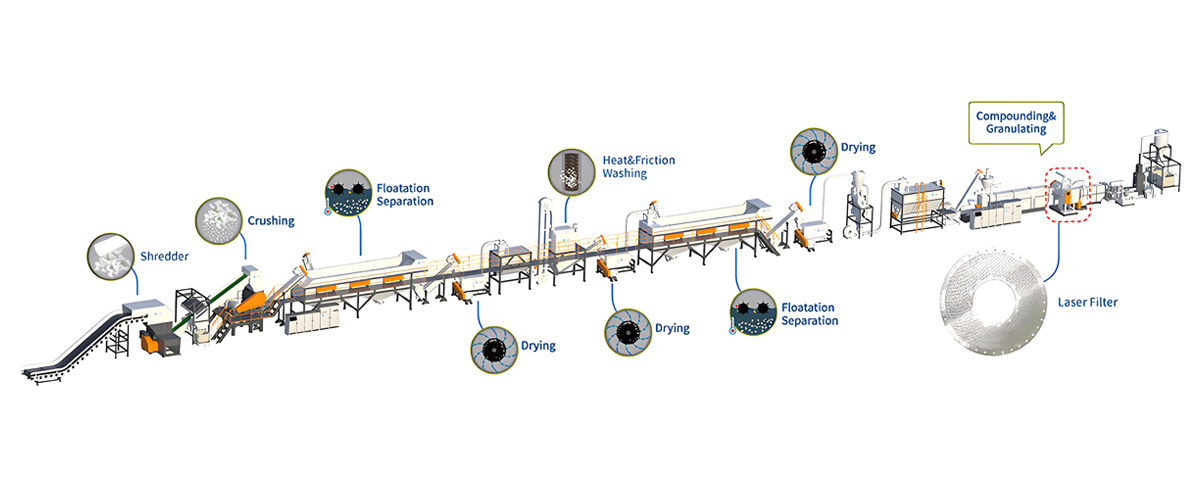
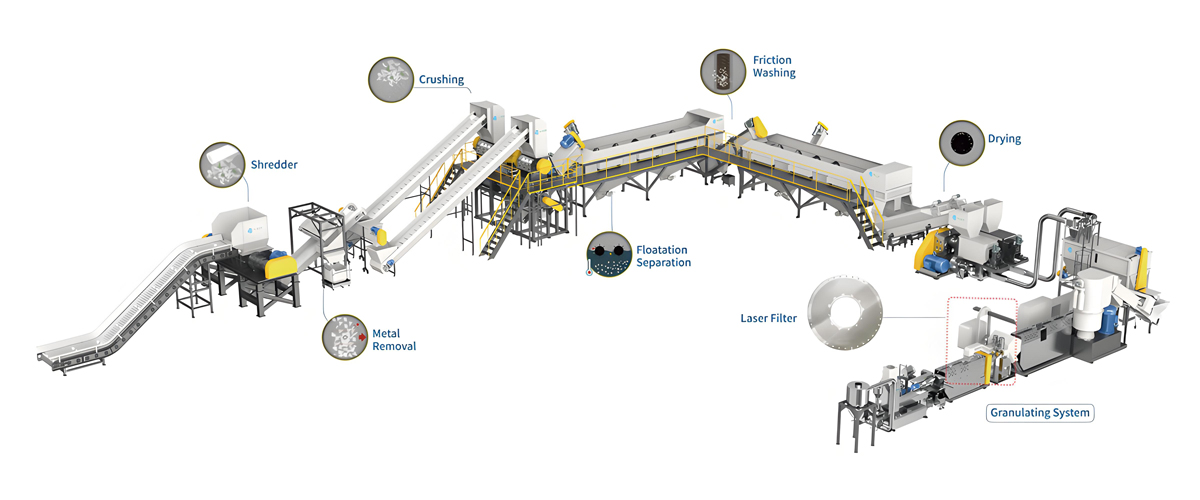
The dehydration chain is the sequence of unit operations that removes water from flake between the wash tank and the extruder throat, and a well-designed chain removes the bulk of the water cheaply by mechanical means before spending energy on thermal drying. The rule that governs the whole chain is simple: squeeze and spin out as much water as possible first, then apply heat only to the fraction that mechanical force cannot remove.
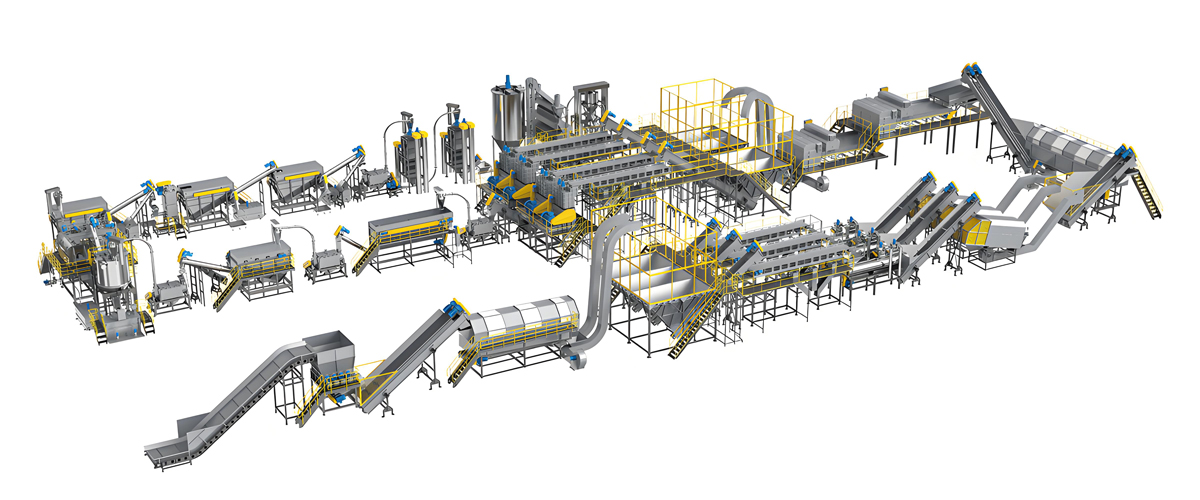
A complete chain for a typical PET bottle line runs: wash tank and friction washer, a dewatering screen or pre-drain, a centrifugal dryer, an optional hot-air tunnel, and finally a desiccant or infrared dryer immediately before the feed throat. For PE and PP film the chain replaces the centrifugal step with a squeezer or plasticompactor, because fluffy film cannot be spun dry the way rigid flake can. Each stage has its own inlet and outlet moisture and its own energy cost, and the art is to push as much work as possible to the cheaper upstream stages.
Mechanical dewatering is the lowest-cost step. A centrifugal dryer typically takes flake at 8 to 15 percent inlet moisture and delivers it at 1 to 3 percent outlet moisture, consuming only a few kilowatt-hours per ton. That single step removes the majority of the water mass without heating anything, which is why it should always come before any thermal dryer.
Thermal drying is the precision step. Hot-air and desiccant dryers remove the last bound-water fraction that mechanical force leaves behind, and for hygroscopic resins this is the step that actually protects IV and mechanical strength. Infrared and vacuum drying are higher-intensity variants that shorten residence time or lower energy per ton but cost more to install.
The chain should be tuned per resin. PE and PP need only mechanical dewatering plus a short hot-air polish. PET, PA, PC, and ABS need the full mechanical-plus-thermal sequence, and the thermal stage for PET in particular must reach desiccant-level performance to hit sub-50 ppm. Treating every resin with the same dryer setting is the most common cause of inconsistent pellet quality.
Mechanical Dewatering With Centrifugal Dryers
A centrifugal dryer removes free surface water by spinning flake against a perforated screen so that centrifugal force throws the water outward through the holes while the heavier flake stays inside the basket. It is the workhorse of mechanical dewatering because it is fast, cheap to run, and gentle on the material, and it is the stage where most of the total water mass should be removed.
Vertical and horizontal centrifugal dryers dominate recycling lines, and the choice between them follows the feed. Vertical centrifugal dryers handle rigid flake well and give a compact footprint, while horizontal units are favored where the line layout favors horizontal material flow and where the flake must be conveyed straight into the next stage. Both rely on the same physics: a rotor turning at 600 to 1000 rpm generates the g-force that separates water from the flake surface.
Rotor speed sets the centrifugal acceleration. Too low, and water remains pinned to the flake; too high, and the flake is thrown so hard against the screen that it fines or tags. The 600 to 1000 rpm band is the practical operating window for most PET, PE, and PP flake, with the upper end reserved for heavier, thicker flake that resists tagging.
Screen aperture controls both drainage and product loss. Apertures of 0.8 to 2 mm let water and fines pass while retaining flake, but a screen that is too open loses product and a screen that is too tight blinds with fines and stops draining. The correct aperture tracks flake size: small PET flake from bottle washing uses the tighter end, while coarse PP regrind uses the open end.
Residence time and feed rate are the tuning handles. Flake must stay in the basket long enough for the water film to be stripped, but not so long that the machine becomes a bottleneck. A steady, metered feed at the design rate gives the most consistent outlet moisture; surging the feeder is the fastest way to push wet flake downstream.
Typical performance is an inlet moisture of 8 to 15 percent dropping to an outlet of 1 to 3 percent. That is enough for polyolefins but only a starting point for hygroscopic resins, which still need thermal drying afterward. A clogged screen, worn rotor blade, or falling rpm will quietly move the outlet upward, so outlet moisture should be checked at shift start and after any screen change.
Squeezer and Compactor Dewatering for Films
A squeezer, sometimes called a plasticompactor, is the correct mechanical dewatering device for PE and PP film, which a centrifugal dryer cannot handle because the fluffy, low-density mat rides up on the rotor instead of draining. The squeezer forces the film through a screw and a restrictive screen so that mechanical pressure squeezes free water out of the mat before the material is cut or densified.
The principle is compaction plus expression. Film enters wet and bulky; the screw compresses it, the trapped water is expressed through the screen, and the densified, partially dry lump exits ready for the next stage. Because the water is pushed out by pressure rather than by spinning, the squeezer handles the very high surface area of film far more efficiently than a basket centrifuge.
Typical outlet moisture for film after a squeezer is 3 to 8 percent, a dramatic improvement from the dripping state it entered in. That residual is then finished by a hot-air or infrared dryer, which is far cheaper than trying to evaporate all the film’s water with heat alone. Skipping the squeezer and sending wet film straight to a thermal dryer is the classic mistake that doubles energy cost and still leaves the flake uneven.
The squeezer also densifies the feed, which helps the pelletizer. Densified film feeds more uniformly into the extruder throat, reduces bridging in the hopper, and lets a crammer feeder move material at a steady rate. For post-consumer LDPE and LLDPE film, agriculture film, and woven sacks, the squeezer-compactor is therefore both a dewatering and a feeding device.
Thermal Drying Technologies: Hot Air, Dehumidifying, IR and Vacuum
Thermal drying technologies remove the bound and residual surface water that mechanical dewatering leaves behind, and they differ mainly in how they supply dry heat and how aggressively they strip moisture from the polymer interior. Choosing among hot-air, dehumidifying, infrared, and vacuum drying is the decision that most affects both pellet quality and operating cost for hygroscopic resins.
Hot-air drying is the simplest thermal method. Heated air at 80 to 100 degrees Celsius passes over the flake in a hopper or tunnel, with circulation air volume specified in cubic meters per hour per kilogram of material. With a residence time of 20 to 40 minutes it typically brings flake below 0.5 percent, which is adequate for PE, PP, and PS but not for PET or PA. Its weakness is that the drying air itself carries humidity, so it cannot reach the very low ppm levels that polyesters and polyamides require.
Dehumidifying drying, also called desiccant drying, solves the humidity problem by passing the heated air through a molecular-sieve desiccant bed that pulls the dew point down to about minus 40 degrees Celsius. For PET the standard condition is 160 to 175 degrees Celsius for four to six hours, which drives total water below 50 ppm. This is the only practical route to food-grade rPET dryness and to the low ppm levels PA and PC demand, and it is the step that protects intrinsic viscosity against hydrolysis.
Infrared drying, often as an IR rotary dryer, uses radiant heat to warm the flake directly rather than waiting for hot air to conduct through the bed. The flake heats quickly, residence time drops, and reported energy savings of 20 to 40 percent versus conventional hot-air drying make it attractive where power cost is a concern. The IR rotary design also gives good mixing, so moisture leaves the bed more uniformly.
Vacuum drying removes water by lowering the partial pressure of water vapor above the flake, which lets moisture leave at a lower temperature and with less thermal history. It is used for heat-sensitive or high-specification resins where both low moisture and minimal thermal degradation are required, and it pairs well with vacuum devolatilization at the extruder for a continuous low-moisture path from dryer to die.
The right combination is resin-specific. Polyolefins are finished by hot air. PET and PA demand dehumidifying or vacuum. Film benefits from squeezer plus IR. The table below summarizes the operating windows and the moisture each technology can reach.
| Technology | Typical temperature | Residence time | Achievable outlet moisture | Best for |
|---|---|---|---|---|
| Centrifugal dewatering | Ambient | Seconds | 1 to 3 % surface | All rigid flake, bulk removal |
| Squeezer / compactor | Ambient to warm | Minutes | 3 to 8 % (film) | PE / PP film and fluffy scrap |
| Hot-air drying | 80 to 100 degrees C | 20 to 40 minutes | < 0.5 % | PE, PP, PS |
| Dehumidifying drying | 160 to 175 degrees C (PET) | 4 to 6 hours (PET) | < 50 ppm | PET, PA, PC, PBT |
| Infrared (IR) rotary drying | Radiant, fast ramp | Short | Low %, energy minus 20 to 40 % | Film, energy-sensitive lines |
| Vacuum drying | Low, below boiling | Minutes to hours | Very low ppm | Heat-sensitive, high-spec resins |
Process Factors That Sabotage Dryness
Even a correctly specified dryer will underperform if the upstream process sabotages dryness, because drying is the last line of defense and every upstream variable shows up at the dryer outlet. The factors below are the ones plant engineers most often overlook when moisture creeps up despite a healthy dryer.
Flake shape and particle-size distribution matter because surface-area-to-volume ratio sets how much water a flake carries and how fast it drains. Thin, feathery flake holds a thicker water film and dries slower than chunky, uniform regrind. A wide size distribution is worse still, because fines stay wet and clump while oversize pieces remain damp inside, so the average moisture reading hides a bimodal problem.
Flake thickness is the physical limit on drying speed. Water must diffuse out from the interior, and thick flake needs longer residence time at temperature to reach the core. PET flake from bottle washing is thin and dries quickly; thick-wall preform or lump regrind does not, and the dryer residence time must be extended accordingly or the core stays wet.
Static adsorption is a subtle killer. Dry plastic flake builds static charge that makes fines cling to the surface and holds a thin moisture film by electrostatic attraction, defeating the centrifugal dryer. Ionized-air bars at the dryer outlet and controlled humidity in the feed area reduce this effect and improve the real dryness of the delivered flake.
Label and paper residue act like a sponge. Paper and adhesive carry far more water than polymer and release it slowly, so a line that under-removes labels will always fight a moisture battle at the dryer. Good label separation in the wash stage is therefore a drying prerequisite, not a separate concern.
Wash-water temperature and surfactant residue change everything downstream. Hot wash water holds more dissolved surfactant, and if that surfactant is not rinsed off, it forms a hydrophilic film on the flake that re-wets the material and resists centrifugal removal. A clean cold final rinse and controlled surfactant dosing protect the dryer’s work.
Climate humidity and storage re-absorption are the variables outside the machine. Hygroscopic resins such as ABS, PA, and PET re-absorb water from humid plant air after drying, while PE and PP show almost no re-absorption and only carry surface water. Dried PET or PA must move straight from the desiccant dryer into the extruder throat through a closed, dry transfer, because even a short exposure to humid air erases the low-ppm result.
Measuring Flake Moisture Accurately
Measuring flake moisture accurately is impossible without the right method and a representative sample, and most “dryness problems” that reach the pelletizer are actually measurement problems in the quality lab. The choice of method should match the target: a quick percent reading for polyolefins, a ppm-grade titration for PET and PA.
A halogen moisture analyzer is the everyday workhorse. It weighs a small flake sample, heats it with a halogen lamp, and records the weight loss as moisture. It is fast, cheap to own, and reads down to roughly 0.01 to 0.1 percent, which is fine for PE, PP, PS, and ABS control. Its limitation is that it measures total weight loss, so it can over-read if volatiles other than water leave the sample.
Karl Fischer titration is the reference for ppm-level accuracy. It chemically reacts with water in the sample and reports total water, including the bound water inside hygroscopic polymers, down to a few ppm. For PET, PA, PC, and PBT it is the only method that confirms the sub-200 ppm or sub-50 ppm targets that protect IV and mechanical strength, and it is the method a buyer’s certificate will accept.
Oven weight-loss methods remain the standard reference for many specifications. A sample is weighed, held in a circulating oven at a defined temperature for a fixed time, and re-weighed, with the loss taken as moisture. It is slow, often two to four hours, but it is the basis of several published standards and is easy to cross-check between labs. It suits incoming and outgoing lot verification rather than in-line control.
Online near-infrared moisture meters give continuous, real-time control. Mounted over a conveyor or in a drop chute, an NIR sensor estimates moisture from the water absorption band and feeds the dryer controller instantly. The capital cost is high and the reading needs periodic calibration against Karl Fischer, but for a high-volume line the ability to catch a wet batch before it reaches the extruder pays for itself in avoided scrap.
Sampling discipline decides whether any method is trustworthy. Moisture varies across a batch, so a scoop from the top of a gaylord is not representative. The sample should be taken across the stream at several points, sealed immediately to prevent re-absorption, and tested promptly. A well-run line pairs a grab sample for the lab with an online meter for the controller, and treats any disagreement as a signal to re-sample rather than to ignore.
| Method | Resolution | Result speed | Capital cost | Best use |
|---|---|---|---|---|
| Halogen moisture analyzer | 0.01 to 0.1 % | 5 to 15 minutes | Low | PE, PP, PS, ABS shop control |
| Karl Fischer titration | ppm grade | 5 to 20 minutes | High | PET, PA, PC, PBT certification |
| Oven loss on drying | 0.01 to 0.1 % | 2 to 4 hours | Low | Reference / lot acceptance |
| Online near-infrared | 0.05 to 0.2 % | Real time | Very High | Continuous in-line control |
Compensating at the Pelletizer: Extrusion Devolatilization
Compensating at the pelletizer means using extrusion devolatilization to strip residual vapor that drying left behind, and while it is a powerful safety net, it is never a substitute for proper pre-drying because it cannot stop hydrolysis that already occurred in the melt. The extruder is the last place water can be removed before the pellet is cut, so its venting design is part of the drying strategy.
Single-screw extruders with double venting use two atmospheric or shallow vents along the barrel to let vapor escape as the melt pressure drops between zones. This is adequate for polyolefins and for mildly wet flake, but the vents are weak compared with a true vacuum, so they leave more residual moisture than a twin-screw line would.
Twin-screw extruders with vacuum devolatilization are the stronger option for hygroscopic and contaminated feed. A vacuum vent pulled to a few tens of millibar draws vapor out of the melt far more completely, which is why Wanplas’s Kerke factory supplies co-rotating twin-screw extruders that integrate with Polyretec washing and drying systems for demanding rPET and engineering-resin recycling. The deeper the vacuum and the larger the free melt surface at the vent, the more moisture and volatiles are removed.
Vent design and backflow control decide whether devolatilization actually works. A poorly designed vent lets melt climb the barrel and block the opening, or lets vapor flow backward into the feed. Proper vent geometry, an adequately decompressed zone ahead of the vent, and sometimes a vent stuffing device keep the path clear so vapor leaves instead of returning to the melt.
Melt filtration and screen changing protect the line from the grit that wet flake produces. A robust screen changer with adequate filtering fineness catches the agglomerated dust and paper fragments, but if the flake was wet the screen will clog faster and the changer will stroke more often. Filtration is therefore a downstream symptom of upstream dryness, not an independent fix.
Intrinsic-viscosity recovery for PET is possible through solid-state polycondensation, or SSP, after pelletizing. SSP rebuilds molecular weight by holding the pellet under heat and dry gas, partially offsetting hydrolytic IV loss. It adds a process step and energy, so it is best treated as insurance for marginal feed rather than as a reason to skip drying.
Cutting method sets the final moisture the customer sees. Water-ring pelletizing and underwater pelletizing both quench the strand in water, so the finished pellet leaves the cutter wet and must pass through a particle centrifugal dewatering and, for hygroscopic grades, a final drying step. Underwater cutting gives more uniform, spherical pellets but demands tighter control of the quench water and the subsequent dewatering to avoid raising the pellet’s surface moisture above a few tenths of a percent.
| Process stage | Inlet moisture | Outlet moisture | Typical energy (kWh/ton) |
|---|---|---|---|
| Wash exit / pre-drain | 20 to 40 % | 8 to 15 % | Negligible (gravity) |
| Centrifugal dryer | 8 to 15 % | 1 to 3 % | 3 to 8 |
| Squeezer (film) | High surface | 3 to 8 % | 15 to 35 |
| Hot-air dryer | 1 to 3 % | < 0.5 % | 20 to 45 |
| Dehumidifying dryer (PET) | 1 to 3 % | < 50 ppm | 80 to 140 |
| IR rotary dryer | 1 to 8 % | Low % | 50 to 90 |
| Pellet centrifugal dewater | Wet pellet | < 0.2 % surface | 2 to 6 |
Energy and Cost Trade-offs Across the Drying Chain
Energy and cost trade-offs across the drying chain all follow one principle: spend the cheapest energy first and reserve the expensive thermal stages for the small fraction of water that mechanical force cannot remove. A line that leans on a desiccant dryer to do the job a centrifuge should have done will show it directly in the power bill.
Centrifugal dewatering is the lowest-energy stage at roughly 3 to 8 kWh per ton, and every percent of water it removes ahead of the thermal dryer is energy saved many times over, because heating and evaporating water in a dryer costs far more per ton than spinning it out. The squeezer for film sits at 15 to 35 kWh per ton but still beats the alternative of hot-air evaporating all that film moisture.
Hot-air drying costs about 20 to 45 kWh per ton and is the right tool for polyolefins. Dehumidifying drying for PET is the most energy-intensive at 80 to 140 kWh per ton, because reaching a minus 40 degrees Celsius dew point and holding 160 to 175 degrees Celsius for four to six hours demands both desiccant regeneration and sustained heat. Infrared drying cuts that by 20 to 40 percent through faster, more direct heating, which is why it is attractive where power cost is a deciding factor.
Cost tiers track the energy and capital. Centrifugal and squeezer dewatering are Low capital and Low to Medium operating. Hot-air drying is Medium on both. Dehumidifying and vacuum drying are High to Very High capital and High operating. Infrared rotary drying is High capital but Medium operating thanks to its energy saving. A Premium total cost of ownership appears only when a line combines several high-tier stages for the most demanding food-grade rPET.
Closed-loop water reuse changes the economics in a way operators often miss. Recycling wash water lowers fresh-water and discharge cost, but it also raises wash-water temperature and lets surfactant concentration build up, which leaves a hydrophilic film on the flake and forces the dryer to work harder. A balanced loop with controlled temperature and surfactant levels captures the water saving without quietly raising drying energy.
The practical target is a dryness-energy-cost balance: drive mechanical dewatering to its limit, size the thermal dryer to the resin’s true target rather than a blanket setting, and treat any upgrade to a higher cost tier as justified only by a real specification such as food-grade rPET or PA.
Quality Acceptance Criteria and Inspection Frequency
Quality acceptance criteria translate the resin moisture targets into a checklist the lab and the line operator can enforce, and the inspection frequency must match the risk: hygroscopic, high-value resins are tested every lot, while robust polyolefins are checked per shift. A written criterion removes the guesswork that lets wet batches reach the extruder.
The criteria below combine the ppm and percent targets from the resin table with the measurement method and a standard reference. They are written so a quality technician can act on them without interpretation, and so a customer audit finds a documented, repeatable rule rather than an ad-hoc judgment.
Standards give the criteria external credibility. ISO 15512 defines the determination of water content in plastics and is the backbone method reference for many of these measurements. ISO 62 covers water absorption of plastics, useful for qualification of hygroscopic grades. ASTM D6980 describes moisture in plastic materials by loss on drying, a common North-American reference. EN 15347 characterizes plastics recycling and sets characterization requirements for PET flakes, including moisture. GB/T 40006 is the Chinese standard for recycled plastics that many domestic lines certify against. These are cited as plain references; the line’s own documented limits remain the operating rule.
Frequency should rise with consequence. PET and PA, where a few ppm decide acceptance, are tested on every incoming and outgoing lot with Karl Fischer. PE, PP, and ABS, where the tolerance is a few tenths of a percent, are verified per shift with a halogen or oven method and monitored continuously with an online meter where fitted. A falling or drifting reading triggers an immediate re-sample and a dryer check before the run continues.
| Resin / product | Acceptance moisture | Test method | Standard reference | Inspection frequency |
|---|---|---|---|---|
| rPET flake (food grade) | < 50 ppm | Karl Fischer | ISO 15512 / EN 15347 | Every lot |
| PA6 / PA66 | < 200 ppm | Karl Fischer | ISO 15512 | Every lot |
| PC | < 0.05 % (500 ppm) | Karl Fischer | ISO 62 | Every lot |
| ABS | < 0.1 % | Halogen / oven | ASTM D6980 | Per shift |
| PE / PP | < 0.2 % | Halogen | EN 15347 | Per shift |
| Recycled pellet (general) | < 0.2 % surface | Halogen / NIR | GB/T 40006 | Per shift / online |
Troubleshooting Matrix for Moisture Defects
A troubleshooting matrix turns symptoms at the pelletizer back into the drying cause, which is the fastest way to stop a recurrence instead of patching the result. Most moisture defects are misdiagnosed as extruder problems when the real fault sits in the wash, the centrifuge, or the dryer.
The matrix below maps each visible defect to its likely moisture root cause and the corrective action. Operators should work top-down: confirm the flake moisture reading first, then walk the chain backward from the extruder to the wash tank, because the earliest stage that failed is the cheapest one to fix.
| Defect | Likely moisture cause | Usually seen in | Corrective action |
|---|---|---|---|
| Bubbles or voids in pellets | Insufficient desiccant drying, IV loss | PET, PA | Raise dryer temp and time, verify dew point |
| Silver streaks / splay | Bound water in matrix | ABS, PC, PA | Extend drying, lower dew point, dry transfer |
| Yellowing | Hydrolysis plus thermal history | PET, FR grades | Dry more, lower melt temp, reduce residence |
| Frequent screen changer strokes | Dust agglomeration from moisture | All resins | Improve dewatering, add dedusting and ionization |
| Melt pressure fluctuation | Trapped vapor not vented | PET, PA, PC | Strengthen venting, lower feed moisture |
| Low mechanical strength | Hydrolytic chain scission | PET, PA | Reduce moisture to target, consider SSP |
| Agglomerated, lumpy pellets | Surface water plus static | PE, PP, film | Centrifuge tune, ionized air, squeezer check |
How Polyretec Engineering Controls Flake Dryness
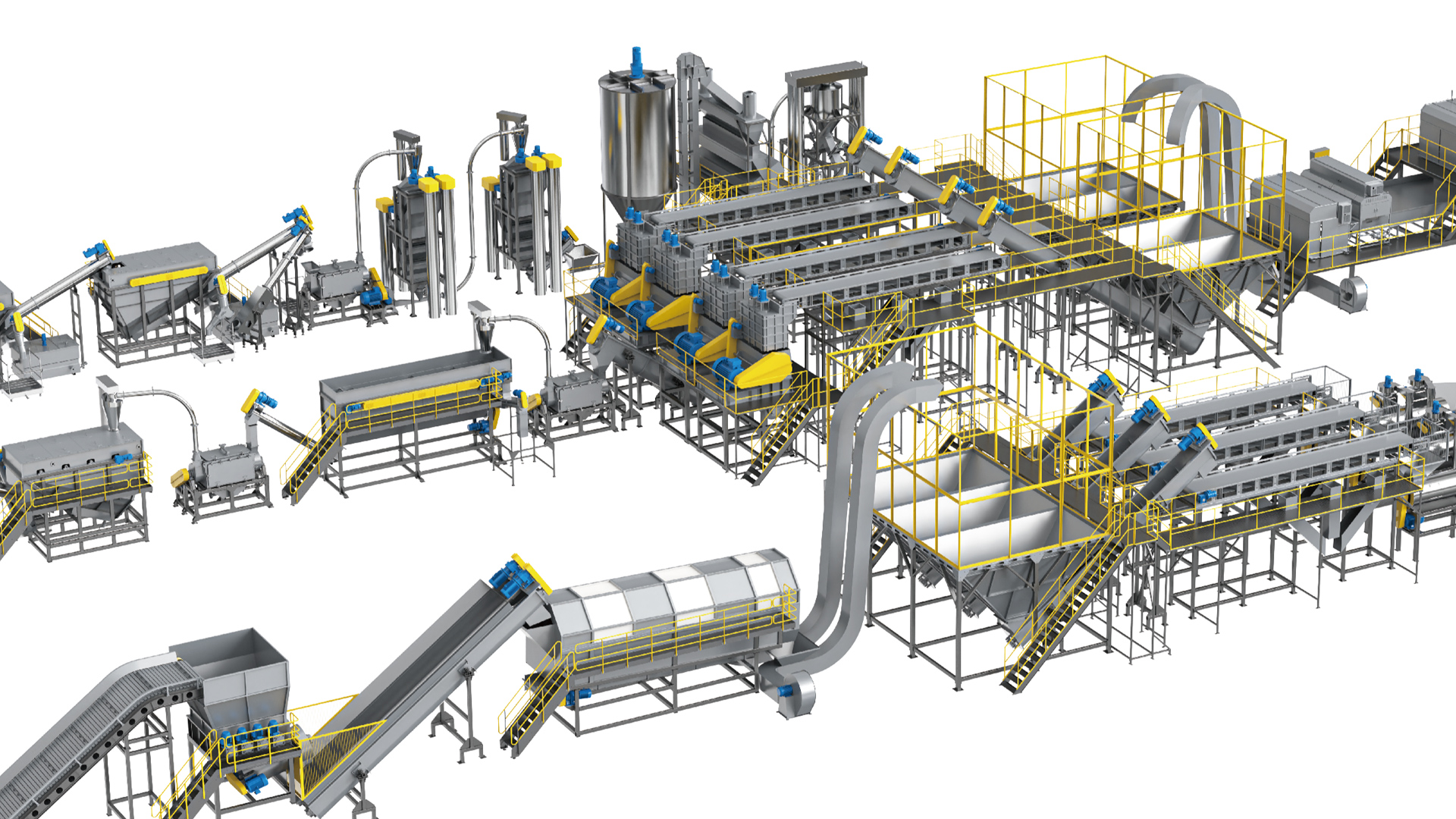
Polyretec, a Wanplas factory, controls flake dryness by treating the washer, dewatering, and drying stages as one integrated system rather than as separate machines bought separately. The brand’s equipment combines advanced Austrian washing and dewatering technology with Chinese manufacturing scale, and dryness is engineered into the line from the friction washer forward rather than bolted on at the end.
The washing lines are built around the resin. The food-grade PET bottle washing line, rated from 500 to 6000 kg per hour, integrates friction washing, label removal, and a centrifugal dewatering stage sized so the flake leaves the washer already in the 1 to 3 percent range. The PP and PE soft-plastic crushing and washing line, rated from 500 to 1500 kg per hour, pairs the wash with a squeezer or compactor so film reaches the thermal dryer at 3 to 8 percent instead of dripping wet.
The Linha de pelotização de nova geração is designed to receive dry, uniform flake and to finish the job with proper devolatilization. Where the application demands it, Wanplas’s Kerke factory supplies co-rotating twin-screw extruders with vacuum venting that integrate downstream of the Polyretec drying system, giving a continuous low-moisture path from wash tank to pellet. For the most demanding food-grade rPET, the line philosophy is to dry to below 50 ppm before the extruder and to verify it with Karl Fischer rather than to rely on extruder devolatilization alone.
Global project experience reinforces the engineering. Installations such as LDPE film recycling in Turkey, PP non-woven recycling in Vietnam, LDPE film with stickers in Mexico, and automated PP PE film washing in Taiwan each had a different moisture challenge, from printed-film ink to sticky labels, and each was solved by matching the dewatering and drying chain to the specific contaminant and resin rather than applying a generic setting.
As part of the Wanplas brand, Polyretec applies the group’s shared service commitments, including an annual complimentary spare-parts provision and a ten-point service promise, so the drying chain is supported for the long run rather than left to drift after commissioning. Because dryness is a process-control discipline, not a single machine, that continuity of support is what keeps moisture at target month after month.
Frequently Asked Questions
What moisture level should recycled PET flake reach before pelletizing?
For food-grade rPET the accepted target is below 50 ppm total water, and below 30 ppm for bottle-to-bottle applications where hydrolytic chain scission must be minimized. A dehumidifying dryer operating at 160 to 175 degrees Celsius for four to six hours with a dew point near minus 40 degrees Celsius is the typical route to reach that level.
Why does moisture cause silver streaks and bubbles in recycled pellets?
Trapped water flashes to steam inside the extruder and the venting system cannot remove all of it before the melt is cut. The vapor forms voids that appear as bubbles in the pellet and as silver streaks or splay on molded surfaces. Hygroscopic resins such as ABS, PC, and PA are the most prone because they absorb bound water into the polymer matrix.
Is a centrifugal dryer enough to dry flakes for pelletizing?
A centrifugal dryer is enough only for non-hygroscopic polyolefins such as PE and PP, where the goal is to drop surface water from roughly 8 to 15 percent down to 1 to 3 percent. For PET, PA, PC, and ABS the flake still carries bound water after centrifuging, so a desiccant or infrared dryer must follow before extrusion.
How does a squeezer or compactor help with film scrap?
A squeezer or plasticompactor forces PE and PP film through a screw and screen so mechanical pressure squeezes free water out of the fluffy mat. It typically brings film from a very high surface moisture down to 3 to 8 percent, which a subsequent thermal dryer can finish far more cheaply than trying to evaporate all the water with hot air alone.
Which moisture measurement method is most accurate for low ppm levels?
Karl Fischer titration is the reference method for ppm-level accuracy and is the right choice for PET and PA where the target is below a few hundred ppm. A halogen moisture analyzer or oven loss method is adequate for polyolefins where the tolerance is a few tenths of a percent, while online near-infrared meters give continuous in-line control but at a higher capital cost.
Can the pelletizer itself compensate for wet flake?
Partially. A twin-screw extruder with vacuum devolatilization at a few tens of millibar can strip a large fraction of residual vapor, and double venting on a single-screw line helps, but drying before melt is always more efficient and protects intrinsic viscosity. Water-ring or underwater cutting then adds a final particle centrifugal dewatering step that should leave finished pellets below a few tenths of a percent surface moisture.
Why do PE and PP tolerate more moisture than PET?
Polyolefins are non-hygroscopic and carry only surface water, so they do not hydrolyze and they tolerate a few tenths of a percent moisture with only mild bubbling or feeding issues. PET and PA absorb water into the chain and hydrolyze, so the same moisture level causes irreversible IV loss and strength drop. The tolerance difference is chemical, not just physical.
Does recycling wash water hurt flake dryness?
Closed-loop reuse lowers fresh-water and discharge cost, but it also lets wash-water temperature and surfactant concentration rise, leaving a hydrophilic film on the flake that re-wets it and forces the dryer to work harder. A balanced loop with controlled temperature and surfactant levels captures the saving without quietly raising drying energy.
Conclusion
Improving flake dryness for high quality pellet production is fundamentally a chain-design problem: remove the bulk of the water cheaply by mechanical means, reserve expensive thermal drying for the bound-water fraction that actually threatens the polymer, and measure the result with a method matched to the resin’s target. PET and PA demand desiccant or vacuum drying to sub-50 or sub-200 ppm to protect intrinsic viscosity and mechanical strength, while PE and PP are satisfied by centrifugal dewatering plus a hot-air polish. The squeezer is indispensable for film, infrared drying offers a 20 to 40 percent energy saving where power cost matters, and the extruder’s vacuum devolatilization is a safety net rather than a substitute for pre-drying. Polyretec, a Wanplas factory, builds these principles into integrated washing, dewatering, and pelletizing lines so that dryness is controlled from the friction washer to the die. For any recycler, the highest-return action is to push mechanical dewatering to its limit, set the thermal dryer to the true resin target, and verify with Karl Fischer for hygroscopic grades and a halogen or online meter for polyolefins, checking every lot for PET and PA and every shift for PE and PP. Treat moisture as a process-control variable, not a finishing step, and pellet quality, throughput, and screen-changer life will all improve together.