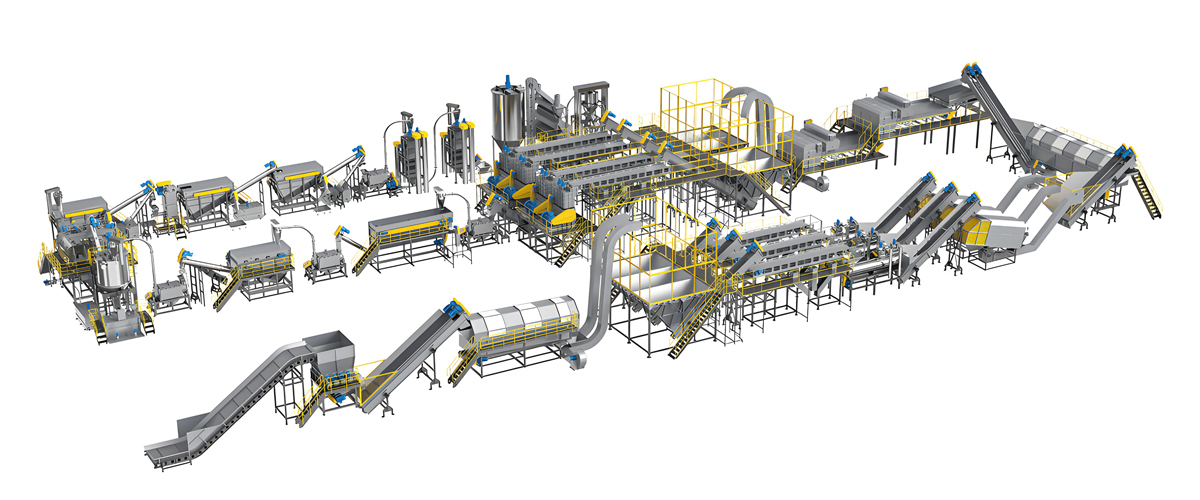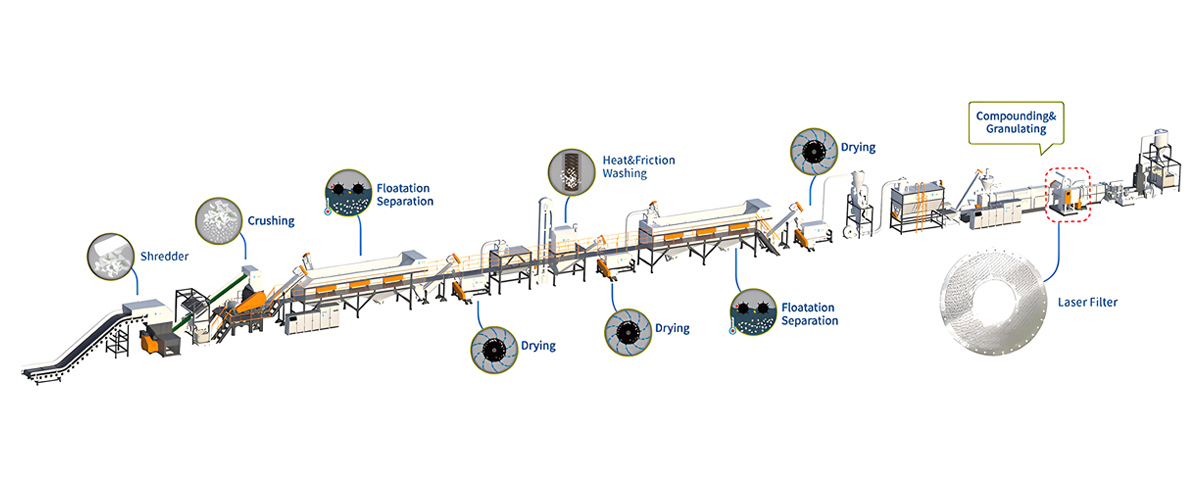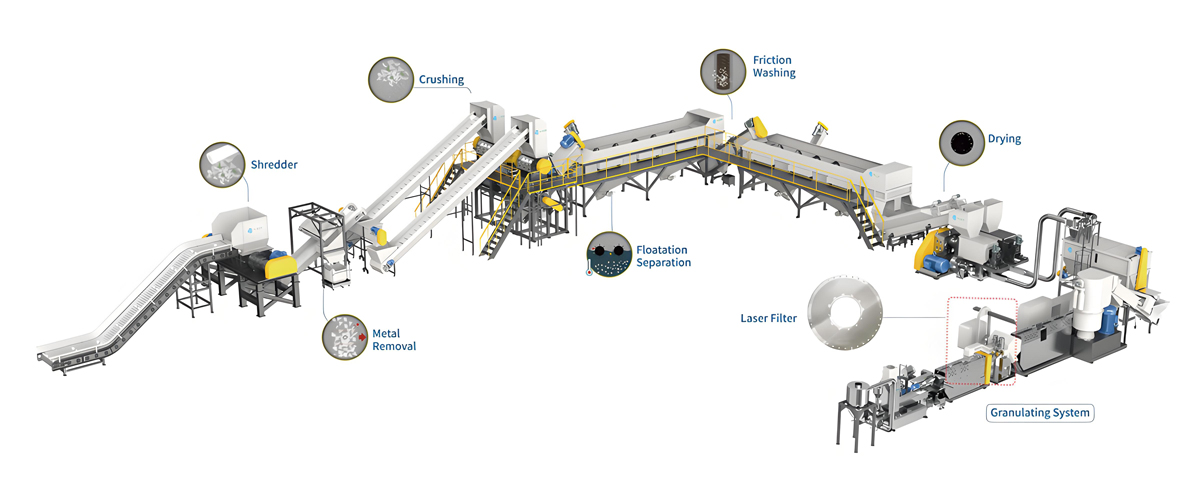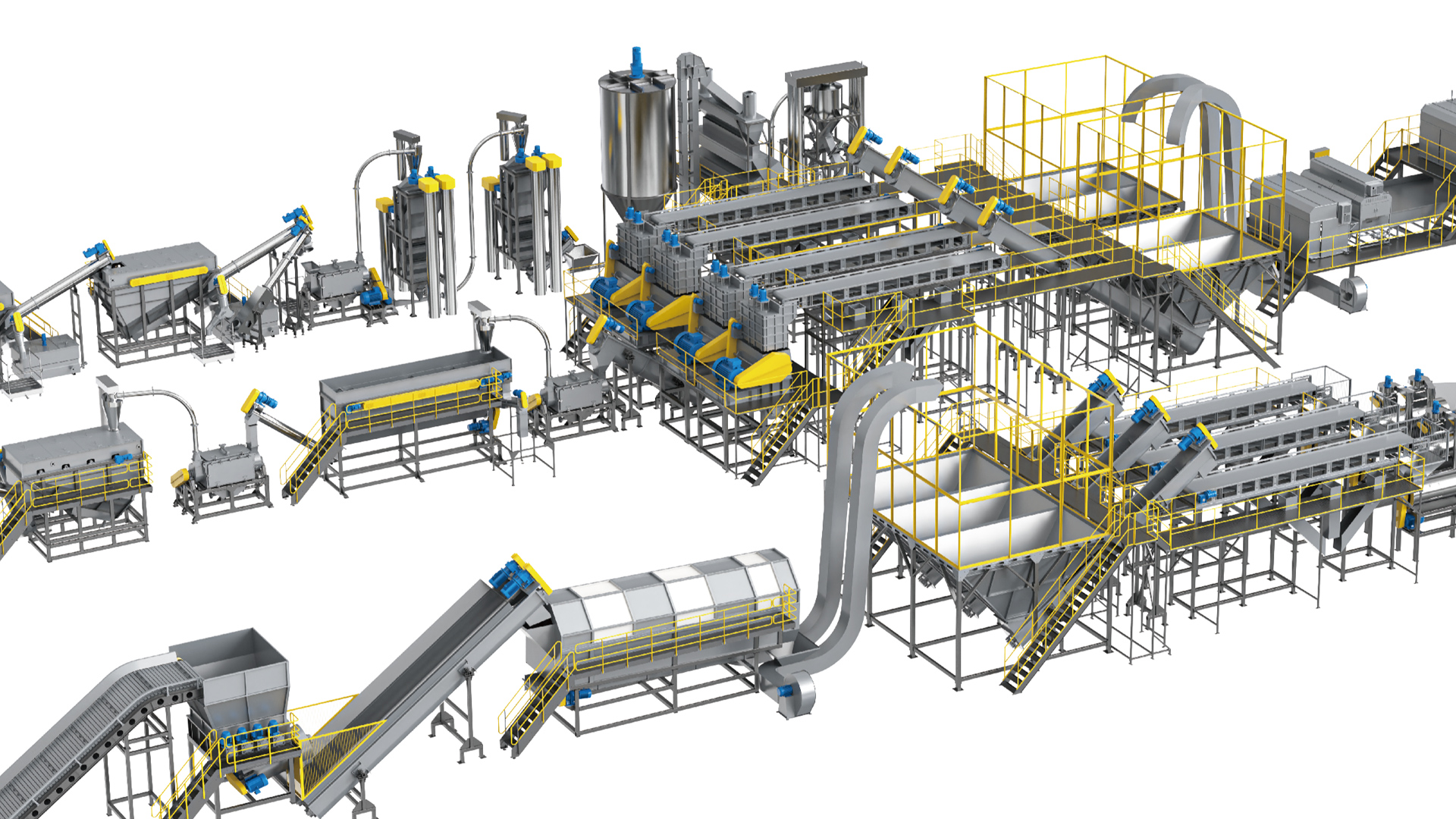

A plastic washing line is the engineering core of any serious plastics recycling operation, and at a rated 6000 kg/h it enters the territory of industrial-scale material recovery plants rather than small workshops. Polyretec, a Wanplas factory, builds high-capacity washing lines that fuse Austrian process engineering with Chinese manufacturing depth, targeting the demanding throughput, water stewardship and flake-purity expectations of modern PET, PE and PP recyclers. This article is a technical deep-dive into what a 6000 kg/h Austrian-technology plastic washing line actually comprises, how each process stage is specified, and how the line is tuned for low water consumption, low energy intensity and food-grade-ready flake quality. The focus here is the complete washing line process and the engineering of very large capacity; downstream pelletizing is referenced only where it connects to the washing line, not as the central subject.
For recyclers evaluating a major capital investment, the single most misunderstood number is the nameplate capacity. A 6000 kg/h washing line is not simply six tonnes of dirty bales moving through a machine per hour on paper. It is a tightly integrated chain of conveyors, crushers, friction washers, float-sink tanks, hot washing vessels, optical sorters and a closed-loop water plant, every element sized so that the slowest stage never throttles the fastest. Throughout this article we translate that nameplate into daily tonnage, annual scale, bulk density handling, water-to-material ratios and the specific Austrian and German-speaking engineering features that make such a line reliable at full load.
What 6000 kg/h Really Means: Capacity, Throughput and Plant Scale
The headline figure of 6000 kg/h is the dry, decontaminated flake output rate the line is engineered to sustain under a defined feed specification. Understanding what that figure implies for plant scale is the first step in justifying a project of this size.
Daily and annual throughput
Running a 6000 kg/h washing line across three shifts with twenty effective operating hours per day yields roughly 120 tonnes of clean flake per day. This assumes realistic availability factors: bale feeding interruptions, screen changes, brief cleaning stops and a modest maintenance buffer. At a conservative 300 operating days per year, the annual output approaches 36,000 tonnes of washed flake. Even with a more conservative availability assumption of 280 days, the line still delivers well over 33,000 tonnes per year, placing it firmly in the mid-to-large tier of regional recycling plants. This scale matters for logistics: feedstock intake, bale storage, intermediate silo capacity and finished-flake dispatch all must be planned around a continuous hundred-tonne-per-day rhythm rather than batch handling.
Feedstock bulk density and its impact on line sizing
Capacity is quoted in mass per hour, but the equipment that moves material is sized by volume and by how that mass is distributed through the line. PET bottle bales, often called bottle bricks, arrive at a bulk density of roughly 250 to 400 kg per cubic meter. Agricultural film and post-consumer PE film, by contrast, are extremely bulky, with bulk densities of only 30 to 80 kg per cubic meter. The same 6000 kg/h mass flow therefore represents a vastly larger volumetric flow for film than for bottle bales. A washing line designed around bottle bricks can be physically compact; the same nameplate applied to film requires far wider conveyors, larger buffer hoppers and bigger float-sink tanks because the material occupies so much more space per tonne. This is why a single nominal capacity always hides a feedstock-specific engineering story.
Water and energy intensity benchmarks
Water consumption is best expressed as cubic meters per tonne of feed. Advanced Austrian-influenced closed-loop designs achieve a fresh-water makeup of only 2 to 3 cubic meters per tonne, whereas traditional open washing lines can consume 5 to 8 cubic meters per tonne. At 6000 kg/h, that difference is enormous: a closed-loop line uses roughly 120 to 180 cubic meters of makeup water per day, while a traditional line can demand 300 to 480 cubic meters daily, with corresponding wastewater treatment loads. Electrical energy intensity for a modern high-capacity washing line typically falls in the range of 0.12 to 0.25 kWh per kilogram of feed, which at full load translates to a connected and well-managed demand that we discuss in detail under utility sizing. These benchmarks are the reference points against which any 6000 kg/h proposal should be judged.
Rule of thumb: a 6000 kg/h washing line sustained for 20 effective hours per day produces about 120 tonnes of clean flake daily and roughly 33,000 to 36,000 tonnes annually, but the equipment volume and water plant size depend far more on feedstock bulk density than on the mass figure alone.
Austrian and German-Speaking Engineering DNA in a High-Capacity Washing Line
Austrian and broader German-speaking recycling engineering has long set the global benchmark for reliability, low water consumption and consistent flake quality. When Polyretec describes an Austrian-technology washing line, it refers to a specific set of design principles and component philosophies rather than a single imported part.
Modular, expandable architecture
The line is built as a sequence of independent, skid-mounted modules: pre-sorting, label removal, wet granulation, pre-wash, float-sink, hot washing, friction washing, rinsing and dewatering, optical sorting and water treatment. Each module is dimensioned to a common design capacity, so the plant can be commissioned stage by stage, expanded by adding parallel modules, or reconfigured when feedstock mix changes. Modularity also simplifies spare-part strategy and reduces mean time to repair, because a faulty module can be bypassed or swapped without stopping the entire line.
Low-water closed-loop philosophy
The defining Austrian characteristic is water stewardship. Every wash stage drains to a central water treatment plant where solids are removed by multi-stage sedimentation, dissolved and suspended organics are stripped by dissolved-air flotation, and fine particles are filtered before the clarified water is returned to the process. Makeup water stays below 10 percent of circulating volume. This closed loop is what allows the 2 to 3 cubic meters per tonne figure quoted earlier and is central to obtaining environmental permits in water-sensitive regions.
High-intensity friction washing and precise hot washing
German-speaking designs favor aggressive mechanical cleaning. Friction washers run at high peripheral speeds to scour labels, glue and surface dirt from flake, and they are staged in series rather than relying on a single stage. Hot washing is governed by tight temperature control: the caustic bath is held within plus or minus 2 degrees Celsius of setpoint by jacketed vessels and automated dosing, because glue hydrolysis rate is strongly temperature dependent and overshooting wastes energy while undershooting leaves residual adhesive. This temperature precision is a hallmark of Austrian process control.
Online density and optical sorting, SCADA and hygienic construction
High-capacity lines embed near-infrared and color sorting directly in the process flow rather than treating sorting as a final afterthought. A supervisory control and data acquisition system monitors motor loads, flow rates, temperatures, water turbidity and energy per tonne in real time, enabling operators to catch contamination drift before it reaches the silo. Construction follows hygienic-welding practice with stainless steel, typically grade 304 for structural and water-contact frames and grade 316L for the most corrosive zones such as hot caustic sections, because 316L resists chloride and alkaline attack far better than ordinary steel and protects both product hygiene and equipment life.
Stage-by-Stage Breakdown of the 6000 kg/h Washing Line
This is the core of the washing line. Each stage below is specified for the 6000 kg/h design point, with concrete parameters that an engineer would use to size, operate and troubleshoot the equipment.
Stage 1: Feeding and pre-sorting
Baled feed is delivered by forklift into a bale breaker, commonly called a debaler, which mechanically opens the brick and discharges loose bottles or rigid containers onto a chain-plate conveyor. The chain-plate conveyor is chosen over a belt here because it withstands heavy, sharp objects and metal strapping without damage. From the conveyor the material passes a manual or AI-assisted visual sorting station where operators or cameras reject non-target items, colored PET for a clear-flake line, and gross contaminants such as stones, ceramics and multilayer pouches. Belt speed at the sorting station is deliberately slow, typically 0.2 to 0.5 meters per second, to give the human or vision system enough dwell time for reliable rejection.
Metals are removed in two layers. A permanent-magnetic drum extracts ferrous scrap at a field strength of 8000 to 12,000 Gauss, mounted so that the magnetic field lifts steel caps and tins away from the product stream. Non-ferrous metals, chiefly aluminum from caps and rings, are then separated by an eddy-current separator, which induces a repulsive field that throws light non-ferrous pieces sideways off the belt. Together these protect the downstream crusher and granulator, where hidden metal is the most common cause of catastrophic knife damage.
Stage 2: Label removal
Before size reduction, a dry label remover strips shrink sleeves and glued paper labels from whole bottles. The rotating cage and beak configuration abrades labels off while the bottles remain largely intact, and a zig-zag air classifier then lifts the lighter label fragments away from the heavier bottle stream. A well-tuned label remover achieves a label-removal rate of 92 to 98 percent, which is critical because labels are a major source of paper fiber contamination and of the glue that later complicates float-sink and hot washing. Removing labels dry, before granulation, also keeps the first wash water far cleaner and reduces the load on the water-treatment plant.
Stage 3: Wet granulation or crushing
The pre-cleaned whole bottles enter a wet granulator, essentially a crusher operating under a water curtain. Wet granulation suppresses dust, pre-wets the flake and begins flushing soluble dirt before the material is ever exposed to the main wash circuit. The rotor diameter on a 6000 kg/h unit ranges from 400 to 800 millimeters, paired with a screen aperture of 12 to 16 millimeters that defines the target flake size. Installed power spans 90 to 250 kW depending on rotor speed, feed character and whether the unit is built for rigid bottle or heavier rigid scrap. Knives are manufactured from wear-resistant tool steel such as SKD-11 or D2, and the clearance between the rotating and stationary knives is held at 0.2 to 0.5 millimeters to guarantee clean cutting rather than tearing, which in turn minimizes fines generation and protects intrinsic viscosity.
Stage 4: Pre-washing and sand removal
Coarse flake from the granulator enters a screw washer and then a sand-removal trough, sometimes called a grit chamber. Soil, sand, glass fines and small stones, which are denser than water and sink immediately, are collected at the bottom and purged continuously. This stage protects the friction washers and float-sink tanks from abrasive wear and prevents sand from being carried into finished flake, where even small amounts raise the ash and dust content that buyers penalize. Pre-washing also removes the bulk of loose surface mud before the more energy-intensive cleaning stages.
Stage 5: Float-sink separation
The heart of polymer separation is the float-sink tank, a long, agitated water bath. At a water density of 1.0, PET, with a density of about 1.38, sinks, while polyolefins such as PE and PP, with densities of 0.90 to 0.96, float. A paddle or drum agitator keeps the bed moving so that entangled flakes separate properly. The sunk PET is continuously withdrawn from the bottom; the floating PE and PP are skimmed from the surface. The float-sink tank is the reason a mixed post-consumer bale can be split into saleable PET flake and a polyolefin stream without manual sorting.
The difficult separations appear at the margins. PVC and PS sit close to or above the PET density band, and silicone elastomer and certain multilayer fragments can masquerade as sink or float depending on trapped air. These contaminants are addressed by multi-stage float-sink with controlled density adjustment, by extended agitation to release trapped air bubbles, and ultimately by optical sorting downstream. A single float-sink pass is never sufficient for food-grade targets, which is why the design employs multiple tanks and a final wash before optical sorting.
Stage 6: Hot washing
Sunk PET flake is pumped into a hot washing vessel where a hot caustic solution removes the residues that cold washing cannot: glue from labels, residual oils, food stains and the water-soluble PVA adhesives used on many modern labels. The bath is maintained with sodium hydroxide at a concentration of 1 to 3 percent, at a temperature of 80 to 95 degrees Celsius, with a residence time of 10 to 20 minutes. Surfactants lower surface tension to lift greasy soils, and a small deodorizing additive controls odor carryover. The temperature control tolerance of plus or minus 2 degrees Celsius is mandatory: below the window, glue hydrolysis is incomplete; above it, energy is wasted and flake yellowing risk rises. After hot washing the flake is rinsed to remove caustic before entering the friction stage.
Stage 7: High-speed friction washing
The friction washer is a high-shear rotating device that mechanically scours each flake against its neighbors and against a perforated screen under a strong water flow. At 6000 kg/h the friction washers run at a peripheral or rotor speed of 800 to 1200 rpm and are arranged as three to five stages in series. Each successive stage removes a finer layer of contamination: the first strips bulk soil loosened by hot washing, later stages polish the flake surface and dislodge microscopic glue films. Multiple stages are preferred over a single oversized unit because staged washing keeps energy per tonne lower and lets each stage be tuned to a different contaminant class. This is where Austrian engineering earns its reputation, because friction washing intensity directly governs final flake brightness and the PVC and glue residues that buyers measure.
Stage 8: Rinsing and dewatering
Clean flake is rinsed in fresh or near-fresh water to drop residual caustic and suspended solids below specification, then dewatered. A centrifugal dryer, essentially a high-speed rotating basket, removes free water to a moisture content below 1 percent at the discharge. A final hot-air drying tunnel drives surface moisture below 0.3 percent, which is essential before optical sorting, storage or any subsequent pelletizing, because residual moisture destabilizes near-infrared sorting and causes bridging in silos. The dewatering and drying train is sized so that it never becomes the bottleneck: at 6000 kg/h the centrifuge throughput and hot-air volume are matched to the upstream wash rate.
Stage 9: Optical sorting
Dry, clean flake passes under near-infrared sensors that identify polymer type by its absorption spectrum, ejecting any non-PET fragment with compressed-air valves. A color sorter then classifies flake by color, removing off-spec tints, blue or green fragments from a clear-flake stream, and any remaining colored contamination. High-resolution cameras and fast ejectors achieve very low false-reject rates, while the mis-ejection rate, the fraction of good flake wrongly thrown away, is kept within tight limits by calibrated lighting and trained models. For a bottle-to-bottle line, this stage is what lifts the flake from industrial grade to food-contact-ready grade.
Stage 10: Water treatment and recovery
All process effluent converges on the water plant. Multi-stage sedimentation drops heavy solids, dissolved-air flotation removes floatable grease and fine organics, and filtration polishes the stream before it is pumped back to the wash stages. Makeup water is held below 10 percent of circulation, and the closed loop is what delivers the 2 to 3 cubic meters per tonne fresh-water figure. A well-designed water plant is not an accessory; at 6000 kg/h it is a process unit as important as any crusher, because without it the line cannot meet discharge limits or hit its water-cost target.
Finished Flake Quality Specification
The entire washing line exists to deliver flake that meets a buyer’s specification. For PET, the critical parameters are intrinsic viscosity retention, PVC content, metal content, color, moisture, dust and bulk density. The way these parameters are defined and sampled follows internationally recognized recycling frameworks: ISO 15270 provides guidance on the recovery and recycling of plastics waste, and EN 15347 specifies the characterization of plastics wastes so that feedstock and output can be described on a common basis between supplier and buyer. Polyretec also operates its manufacturing under ISO 9001 quality management and ISO 14001 environmental management systems, which is why the 6000 kg/h line is delivered with documented quality control and a managed environmental footprint rather than ad hoc commissioning.
Intrinsic viscosity, commonly abbreviated as IV, is the single most watched property because it indicates how much molecular chain length survived recycling. A good 6000 kg/h washing line limits mechanical and thermal degradation so that the drop in IV, written as delta IV, stays below 0.03 relative to the incoming bottle stock. PVC is the feared contaminant in PET recycling because it degrades into hydrogen chloride during later reprocessing and yellows the melt; food-grade specifications demand PVC residue below 50 parts per million. Metal content is held below 10 parts per million through magnetic and eddy-current separation plus metal-detection at the flake stage. Color is quantified by delta E, the standard color-difference metric, with tight limits for a clear, low-yellow flake. Moisture at the silo is below 1 percent, dust and fines are minimized by clean cutting and good dewatering, and bulk density is stabilized so that downstream pelletizing feeders run consistently. These numbers are not marketing claims but the operating envelope the line is engineered to hold at full capacity.
Food-Grade Bottle-to-Bottle Upgrade Path
A standard washing line produces industrial-grade flake. Reaching food-contact status requires extending the process with super-clean steps. The upgrade path begins with the same high-intensity washing described above, then adds a super-washing and intensive polishing stage that drives residual contaminants to trace levels, followed by crystallizing and drying the flake to remove moisture and prevent agglomeration, and finally solid-state polycondensation, abbreviated SSP, which rebuilds intrinsic viscosity lost in prior use and further reduces acetaldehyde and oligomers.
Regulatory clearance for food contact follows recognized routes. In the United States, compliance is pursued under FDA 21 CFR 177.1630 for recycled PET intended for food contact, supported by a suitable no-objection letter from the FDA. In the European Union, the EFSA evaluates the recycling process and issues a scientific opinion, and the material must satisfy the requirements of EU 10/2011 for plastic materials and articles intended to come into contact with food. Certification schemes such as EuCertPlast and GRS, the Global Recycled Standard, document chain-of-custody and recycled content for brand owners. A 6000 kg/h line built on Austrian process discipline is the natural platform for this upgrade because the upstream purity it achieves determines whether the super-clean and SSP stages can ever reach specification economically.
Energy and Water Optimization
At 6000 kg/h, small efficiency gains compound into large annual savings, so optimization is designed in rather than bolted on.
Heat recovery
The hot washing stage is the dominant energy consumer. A plate heat exchanger recovers 60 to 75 percent of the heat from the hot discharged liquor and transfers it to the incoming cold caustic make-up, dramatically cutting steam or electric heating demand. Because the hot wash operates at 80 to 95 degrees Celsius, the recoverable enthalpy is substantial and the payback on the exchanger is short even at this scale.
Water loop closure and dosing control
Closing the water loop keeps fresh-water draw below 10 percent of circulation and shrinks the wastewater load proportionally. Chemical dosing is automated against measured turbidity and pH, so caustic and surfactant are added only as needed rather than in fixed excess, reducing both cost and the burden on the water plant.
Variable-frequency drives and load matching
Conveyors, pumps, friction washers and centrifuges run on variable-frequency drives, abbreviated VFDs, so each motor consumes only the power its instantaneous load requires. During start-up, grade change or partial feed, the drives ramp down instead of running flat-out, and the SCADA system correlates energy per tonne so that drifting efficiency is visible immediately. These measures are what hold the line in the 0.12 to 0.25 kWh per kilogram band rather than drifting upward as the plant ages.
Layout, Footprint and Utility Sizing
A 6000 kg/h washing line is a building-scale installation, and its civil and electrical demands must be planned early.
Footprint and building
The process train alone, from debaler through optical sorting, spans roughly 60 to 90 meters in length when laid out as a straight line, and more if arranged in an L or U to fit an existing hall. Clear internal height of at least 6 to 8 meters is needed for the elevated conveyors, hoppers and maintenance cranes over the crusher and granulator. A floor pit is required beneath the wet granulator, float-sink tanks and screw washers for drainage, access and maintenance, and the entire wet area needs graded, acid-resistant flooring with floor drains feeding the water plant. Logistics flow should move dirty bales in at one end and clean flake silos out at the other, with intermediate buffer silos sized to decouple feeding from sorting shift patterns.
Electrical capacity
Total installed power for a 6000 kg/h line, including the water-treatment plant, hot-wash heating, friction washers, centrifuges, optical sorters and conveyors, falls in the range of 1200 to 2200 kW. The actual demand depends on feedstock hardness, the number of friction-wash stages and whether heat recovery is fitted. A site must provide a dedicated supply with appropriate transformer capacity, soft starters or VFDs to limit inrush, and a standby arrangement for the water plant so that an electrical trip does not flood the wet section. Planning the配电, the power distribution, alongside the mechanical layout prevents the common failure of a perfectly good line that cannot be energized on the available supply.
Process Route Differences by Feedstock
A 6000 kg/h washing line is rarely fed a single material forever. The table below shows how the route adapts when the dominant feedstock changes, which is essential when specifying the line for a given market.
| Feedstock | Typical bulk density (kg/m3) | Label removal needed | Hot wash intensity | Float-sink role | Dominant output |
|---|---|---|---|---|---|
| PET bottles (bales) | 250 to 400 | Yes, dry label remover | High, glue and PVA removal | PET sinks, PE/PP float | Clear or colored rPET flake |
| HDPE drums and rigid | 120 to 250 | Low, mostly printed | Medium, ink and oil removal | Separates HDPE from PP/PET | Natural or colored HDPE flake |
| PP woven bags | 80 to 180 | Yes, heavy printing | Medium-high, ink removal | PP floats, dense dirt sinks | PP tape and raffia flake |
| Agricultural film | 30 to 60 | No, but soil heavy | Low-medium, soil removal | Washes out sand and stones | LDPE/LLDPE film regrind |
| Post-consumer PE film | 40 to 80 | No, adhesive labels | Medium, glue and sticker removal | Removes dense contaminants | PE film flakes or regrind |
The takeaway is that feedstock determines whether the float-sink tank is doing polymer separation, grit removal, or both, and whether hot washing must run at the aggressive top of its window. Polyretec configures the 6000 kg/h platform so that these stages can be weighted toward the dominant local feedstock while retaining the flexibility to handle mixed input, which is the reality for most large recyclers.
Equipment, Sorting, Quality and Utility Reference Tables
The following four tables consolidate the engineering data from the preceding sections into quick-reference form for project specification and supplier comparison.
Table A: Process stage, equipment, key parameter and power range
| Process stage | Primary equipment | Key parameter | Installed power range |
|---|---|---|---|
| Feeding and pre-sorting | Debaler, chain-plate conveyor, magnetic drum, eddy-current separator | Belt speed 0.2 to 0.5 m/s; magnet 8000 to 12000 Gs | 15 to 45 kW |
| Label removal | Dry label remover, zig-zag air classifier | Label removal 92 to 98 percent | 20 to 55 kW |
| Wet granulation | Wet granulator / crusher | Rotor 400 to 800 mm; screen 12 to 16 mm; SKD-11/D2 knives; clearance 0.2 to 0.5 mm | 90 to 250 kW |
| Pre-wash and sand removal | Screw washer, grit chamber | Continuous grit purge | 20 to 60 kW |
| Float-sink separation | Float-sink tank (multiple stages) | Water density 1.0; PET 1.38 sinks, PE/PP 0.90 to 0.96 float | 30 to 90 kW |
| Hot washing | Jacketed hot wash vessel | NaOH 1 to 3 percent; 80 to 95 C; 10 to 20 min; control +/-2 C | 80 to 250 kW (incl. heating) |
| Friction washing | Friction washer (3 to 5 stages) | 800 to 1200 rpm peripheral speed | 120 to 400 kW |
| Rinsing and dewatering | Centrifugal dryer, hot-air dryer | Moisture below 1 percent; below 0.3 percent after hot air | 90 to 260 kW |
| Optical sorting | NIR sorter, color sorter | Polymer and color identification, low false-reject | 20 to 80 kW |
| Water treatment | Sedimentation, DAF, filtration, heat exchanger | Makeup below 10 percent; heat recovery 60 to 75 percent | 60 to 180 kW |
Table B: Float-sink and optical sorting, density and identification method
| Material | Density (g/cm3) | Float-sink behavior at density 1.0 | Identification / separation method |
|---|---|---|---|
| PET | 1.38 | Sinks | NIR polymer sorting; sink fraction |
| PVC | 1.38 to 1.45 | Sinks (overlaps PET) | NIR specific PVC channel; strict reject |
| PS | 1.05 | Near neutral, tends sink | NIR; density tuning of tank |
| PE | 0.91 to 0.96 | Floats | Float fraction; NIR confirmation |
| PP | 0.90 to 0.91 | Floats | Float fraction; NIR confirmation |
| Aluminum (caps) | 2.70 | Sinks | Eddy-current before granulation; metal detector after |
| Silicone / rubber | variable, often sinks | Sinks, traps air | Multi-stage float-sink; NIR reject |
Table C: Finished flake quality metrics and test methods
| Quality metric | Typical target for 6000 kg/h line | Test / measurement method |
|---|---|---|
| Intrinsic viscosity change (delta IV) | Below 0.03 | Dilute-solution viscometry (Ubbelohde) |
| PVC residue | Below 50 ppm | NIR laboratory scan or X-ray fluorescence |
| Metal content | Below 10 ppm | Magnet + metal detector; lab acid digest |
| Color difference (delta E) | Tight limit per grade | Spectrophotometer, CIE Lab scale |
| Moisture content | Below 1 percent, below 0.3 percent hot-air dried | Loss-on-drying oven method |
| Dust and fines | Minimized, grade-dependent | Sieving / air classification |
| Bulk density | Stable per grade | ASTM D1505 gradient column or mass-volume |
Table D: Water and energy comparison and optimization measures
| Scenario | Water use (m3 per tonne) | Energy (kWh per kg) | Key optimization | Relative cost level |
|---|---|---|---|---|
| Traditional open line | 5 to 8 | 0.20 to 0.35 | None / minimal recovery | High (water + effluent) |
| Closed-loop, no heat recovery | 2 to 3 | 0.15 to 0.25 | Water loop closure, DAF filtration | Medium |
| Closed-loop with heat recovery | 2 to 3 | 0.12 to 0.20 | Plate heat exchanger 60 to 75 percent | Low to Medium |
| Full Austrian-spec line, VFD + SCADA | 2 to 3 | 0.12 to 0.18 | VFD load matching, auto dosing, heat recovery | Low (operating), Premium (capital) |
The relative cost level column distinguishes operating cost from capital cost: an Austrian-specification line carries a Premium capital tag but delivers the Lowest operating cost through efficiency, whereas a traditional open line is cheaper to buy but carries a High ongoing water and effluent burden. This distinction is the basis of most lifecycle-cost arguments for the 6000 kg/h class.
Frequently Asked Questions
What does a 6000 kg/h plastic washing line actually produce per day?
At a realistic 20 effective operating hours per day across three shifts, a 6000 kg/h line produces about 120 tonnes of clean, dried flake daily, which scales to roughly 33,000 to 36,000 tonnes per year at 280 to 300 operating days. The figure assumes the feed matches the design specification and that availability losses from feeding, screen changes and maintenance are already accounted for in the effective hours.
Why is Austrian technology important for a high-capacity washing line?
Austrian and German-speaking engineering emphasizes modular design, very low water consumption through closed loops, high-intensity multi-stage friction washing, tight hot-wash temperature control within plus or minus 2 degrees Celsius, inline optical sorting and SCADA-based energy monitoring. These principles are what let a 6000 kg/h line hold flake quality and utility efficiency at full load rather than only at partial test runs.
How does the float-sink tank separate PET from PE and PP?
In a water bath at density 1.0, PET at about 1.38 sinks while PE and PP at 0.90 to 0.96 float, so the sunk fraction is collected from the bottom and the floating polyolefins are skimmed from the surface. Multiple tanks and controlled agitation are used because PVC, PS and trapped-air silicone can mimic either behavior and must be resolved by density tuning plus downstream near-infrared sorting.
What is the role of hot washing in the line?
Hot washing uses a sodium hydroxide solution at 1 to 3 percent concentration, 80 to 95 degrees Celsius, with 10 to 20 minutes residence to hydrolyze label glues, remove oils, food soils and PVA adhesives that cold washing cannot dissolve. Precise temperature control protects intrinsic viscosity and prevents flake yellowing, making hot washing indispensable for clear, food-grade PET flake.
How much water and power does a 6000 kg/h line consume?
An advanced closed-loop Austrian-design line uses about 2 to 3 cubic meters of fresh water per tonne and 0.12 to 0.25 kWh per kilogram of feed, depending on hot-wash heating and friction-wash staging. Traditional open lines consume 5 to 8 cubic meters per tonne and more energy, so the closed loop is the dominant factor in both water permits and operating cost.
Can the same line handle bottles, film and woven bags?
Yes, with configuration. The 6000 kg/h platform is modular so that float-sink, hot wash and friction washing can be weighted toward the dominant feedstock, whether PET bottle bales at 250 to 400 kg per cubic meter or bulky film at 30 to 80 kg per cubic meter. Film needs larger buffers and tanks because of its low bulk density, while bottles need stronger label removal and glue hydrolysis.
What quality can the finished PET flake reach?
A well-run line holds delta IV below 0.03, PVC residue below 50 parts per million, metal below 10 parts per million, moisture below 1 percent at the centrifuge and below 0.3 percent after hot-air drying, with color controlled by delta E and stable bulk density. These are the parameters buyers test against when specifying rPET for sheet, strap or bottle-to-bottle use.
What does it take to reach food-grade bottle-to-bottle status?
Beyond intensive washing, the flake needs super-clean polishing, crystallizing and drying, then solid-state polycondensation to rebuild intrinsic viscosity and reduce acetaldehyde and oligomers. Regulatory clearance follows FDA 21 CFR 177.1630 with an FDA no-objection letter in the United States and an EFSA opinion plus EU 10/2011 compliance in Europe, often documented through EuCertPlast or GRS certification.
How big is the plant and what power supply is required?
The process train spans about 60 to 90 meters in length with a clear height of 6 to 8 meters and a maintenance pit under the wet section. Total installed power, including water treatment and hot-wash heating, is 1200 to 2200 kW, so the site needs a dedicated supply with adequate transformer capacity, soft starters or variable-frequency drives, and standby for the water plant to avoid flooding on an electrical trip.
How does the washing line connect to pelletizing?
The washing line delivers dry, sorted, specification flake that can be stored or fed directly to a pelletizing line. For integrated recycling, Wanplas’s Kerke factory supplies twin-screw extruders whose barrel and screw geometry are matched to the washed flake and convert it into recycled pellets, while Polyretec remains focused on the washing and sorting discipline that determines final pellet quality. The cleaned flake is then suitable for downstream molding applications such as injection molding and blow molding of non-food articles.
Conclusion
A 6000 kg/h Austrian-technology plastic washing line is far more than a large crusher and a few tanks; it is a fully integrated, modular material-recovery system where every stage, from the debaler and magnetic drum through wet granulation, multi-stage float-sink, precisely controlled hot washing, three-to-five-stage friction washing, centrifugal and hot-air dewatering, near-infrared and color sorting, to the closed-loop water plant, is sized so that none becomes the bottleneck. The engineering payoff is concrete: roughly 120 tonnes of clean flake per day, fresh-water use of 2 to 3 cubic meters per tonne, energy of 0.12 to 0.25 kWh per kilogram, flake with delta IV below 0.03 and PVC below 50 parts per million, and a clear upgrade path to food-grade bottle-to-bottle status under FDA 21 CFR 177.1630, EFSA and EU 10/2011.
For recyclers planning at this scale, the decision is less about buying a machine and more about choosing a process philosophy. Polyretec, a Wanplas factory, builds this class of washing line by combining Austrian process discipline with Chinese manufacturing capability, delivering Premium-capital, Low-operating-cost plants backed by Wanplas group engineering and service. Whether the dominant feed is PET bottle bales, HDPE drums, PP woven bags or agricultural film, the 6000 kg/h platform can be configured to the local material mix while retaining the flexibility that mixed post-consumer input demands. When evaluating suppliers, weigh the full lifecycle: water loop closure, heat recovery, variable-frequency drives and documented flake quality will decide both your permit trajectory and your margin long after the line is installed.