
Best Rigid Plastic Pelletierlinie für PP PE PC ABS Flocken
Polyretec, a Wanplas factory with recycling equipment experience dating back to 2010 and projects delivered across more than 50 countries, designs complete pelletizing systems for post-industrial and post-consumer rigid plastic flakes. The best rigid plastic pelletizing line for PP PE PC ABS flakes is one that matches the melt behavior of each resin to the right screw geometry, filtration, and cutting method, because rigid flakes are not a single uniform feedstock and treating them as one invites poor pellet uniformity, frequent screen clogging, and unnecessary energy use. This article explains how a purpose-built rigid flake pelletizing line works, why PP, PE, PC, and ABS each demand different handling, and how Polyretec configures lines that turn dirty, mixed, rigid scrap into clean reusable pellets that downstream converters can run with confidence. By the end you will understand the process route, the core equipment, the selection logic, and the practical service package that makes a line productive from day one.
Why Rigid Flakes Need a Dedicated Pelletierlinie
Rigid plastic flakes differ sharply from film scrap, and that difference drives the entire machine design. Film and woven bags are low bulk density, springy, and prone to bridging, so they need crammer feeders and aggressive pre-compaction before the screw. Rigid flakes from bottles, containers, lumps, purgings, sheets, and rejected molded parts have much higher bulk density, sharper edges, and often carry surface print, labels, oil, or filler that must be handled before melting. A line built for film will starve or over-shear rigid flakes, while a line built for rigid flakes will simply choke on loose film, so the two feeds need different feeding, venting, and filtration strategies. The best rigid plastic pelletizing line for PP PE PC ABS flakes therefore starts with feed preparation sized to rigid scrap: controlled shredding to a consistent flake size, metal separation, and a metering feed that delivers steady mass flow to the extruder rather than letting the hopper surge.
Beyond feeding, the four resins in the title behave very differently at the screw. PP and PE are polyolefins with low polarity, good thermal stability, and a narrow melt window that rewards gentle plasticizing and strong melt filtration. ABS and PC are engineering plastics with higher processing temperatures, stronger moisture sensitivity, and a real risk of thermal degradation or hydrolysis if dried incorrectly. PC in particular must be dried to a low moisture content before melting or it loses molecular weight and turns brittle, while ABS tolerates modest moisture but discolors if overheated. A single generic line cannot serve all four well, which is why the best rigid plastic pelletizing line for PP PE PC ABS flakes uses modular drying, venting, and temperature zoning that the operator can tune per resin. The table below summarizes the processing windows that the line must respect.
| Material | Melt Temp | Dry Need | Pelletizing Note |
|---|---|---|---|
| PP | 200-260 C | Low | Gentle shear, strong filtration |
| PE | 180-240 C | Low | Wide window, watch gel |
| PC | 260-300 C | High | Dry below 0.02 percent moisture |
| ABS | 210-250 C | Medium | Avoid overheat, control color |
The economic case for a dedicated line is also clear. Recycled rigid flakes are abundant from packaging, appliance housings, automotive shredder residue, and electronic enclosures, and converting them on site closes the loop instead of paying for disposal or buying only virgin resin. A correctly specified line lifts pellet quality to a point where regrind can replace a meaningful share of virgin material in non-critical and even semi-critical parts, lowering the cost index of finished goods without sacrificing process stability. Wanplas, as the parent brand, supports Polyretec with matched downstream and upstream capabilities so a recycling project can be planned as one integrated turnkey system rather than a stack of incompatible machines bought separately.
Process Route of a Rigid Flake Pelletierlinie
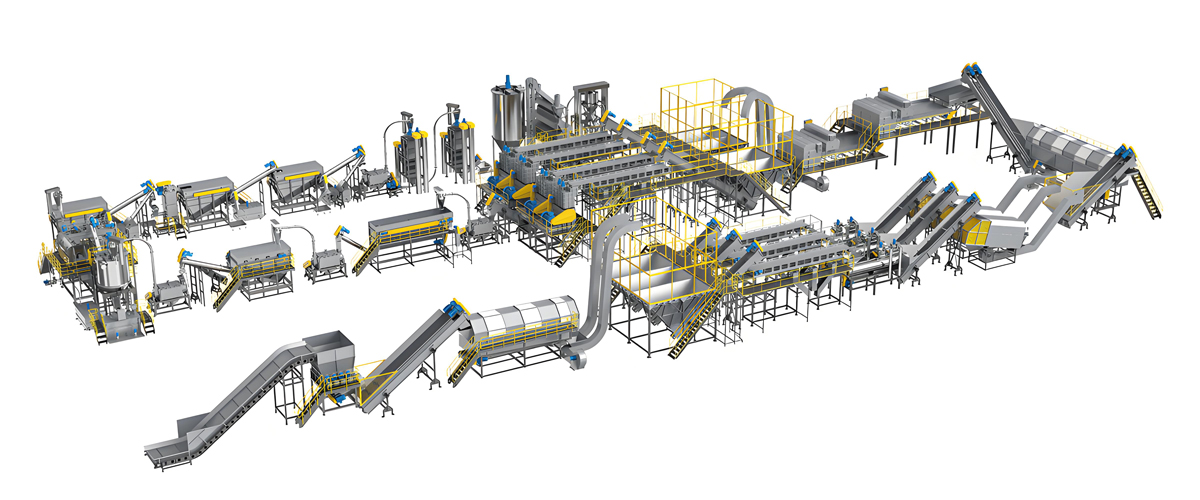
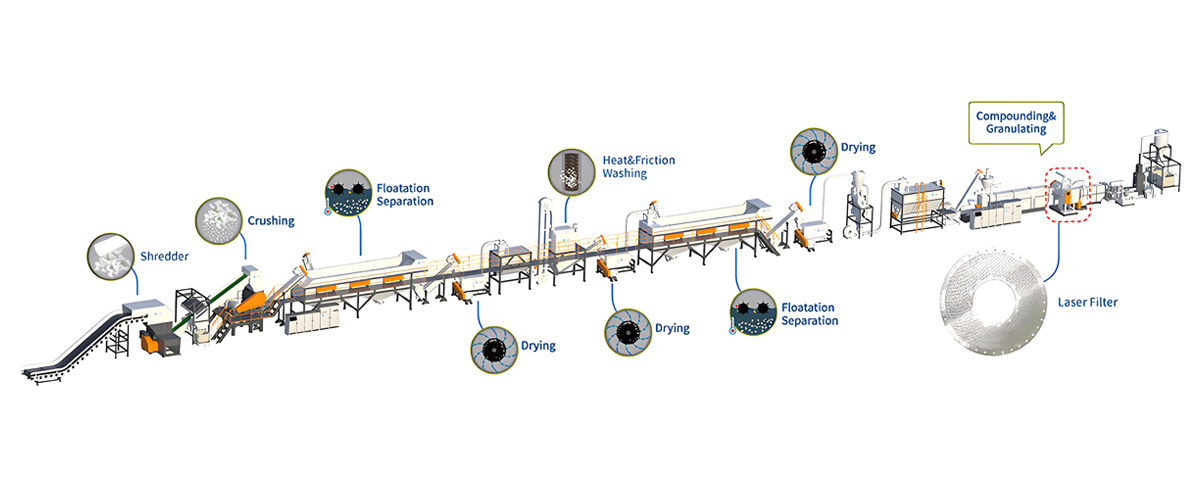
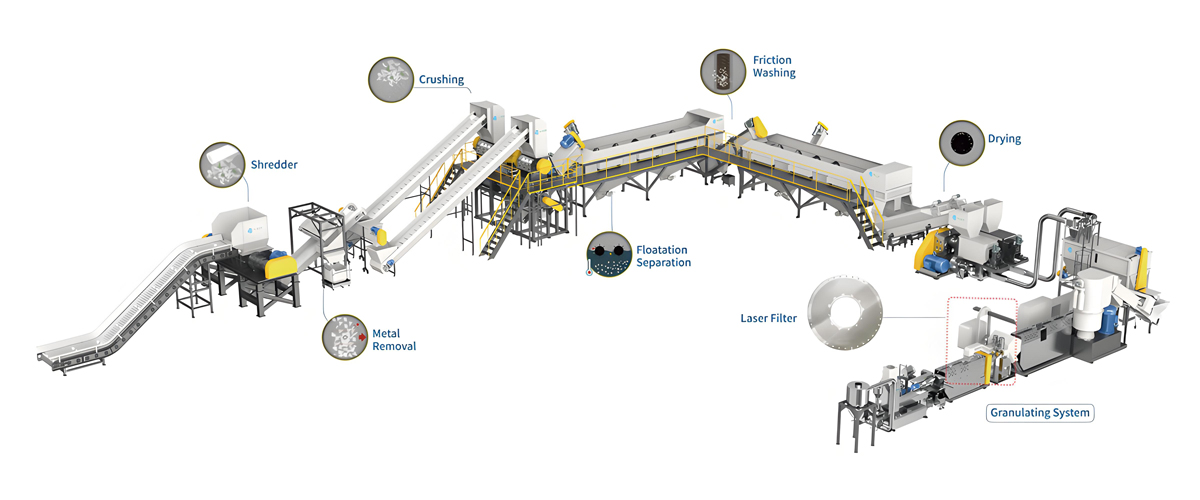
A complete rigid flake pelletizing line follows a predictable sequence from dirty flake to uniform pellet, and each stage exists to remove a specific defect before it reaches the screw. The accepted European-origin process route for rigid recycling centers on pre-shredding, optional washing and drying, loss-in-weight metering, single or twin-screw plasticizing, continuous melt filtration, degassing, die-face or strand cutting, cooling, and screening. Skipping or under-sizing any stage shows up later as black specks, high filler load, inconsistent pellet size, or premature screw and screen wear. The configuration below is the backbone of the best rigid plastic pelletizing line for PP PE PC ABS flakes.
| Stage | Equipment | Function |
|---|---|---|
| Pre-size | Shredder, crusher | Flake to even size |
| Clean | Wash, friction, rinse | Remove label, oil, dirt |
| Feed | Loss-in-weight feeder | Steady mass flow |
| Melt | Extruder, screen changer | Plasticize, filter |
| Cut | Die-face or strand | Form pellet |
| Finish | Cool, screen, silo | Stable uniform pellet |
The pre-size stage uses a double-shaft shredder for bulky rigid items such as crates, drums, and thick purgings, followed by a crusher that reduces the material to a target flake size, typically in the range of eight to sixteen millimeters depending on screw diameter. Even flake size matters because it controls how uniformly the feed melts and how steadily the extruder draws material, so this is not a step to rush. When flakes come from a washing line, a dewatering step and a crystallizing or dehumidifying dryer prepare them for the extruder; for PC and ABS especially, the drying spec is strict and the line must hold it. Metal separation, typically a magnetic bar over the feed and sometimes an eddy-current unit, protects the screw and screen from tramp metal that would otherwise gouge the barrel.
Feeding is where many lines fail quietly. A simple gravity hopper lets rigid flake surge and starve the screw, creating melt temperature swings and inconsistent output. A loss-in-weight feeder weighs the actual mass delivered per unit time and trims the screw speed or feeder rate to hold a set throughput, which stabilizes the whole line and makes the pellet specifications repeatable batch to batch. From the feeder the flake enters the extruder barrel, where it is plasticized, homogenized, and pushed through the screen changer that strips contamination. Continuous screen changers keep pressure steady during changeover, which is essential for rigid flakes that carry abrasive filler and paper residue. After filtration the melt passes a venting zone where trapped air, residual moisture, and light volatiles are drawn off, then it reaches the die and cutter.
Core Equipment Explained
The extruder is the heart of the best rigid plastic pelletizing line for PP PE PC ABS flakes, and the choice between a single-screw and a co-rotating twin-screw design depends on contamination level and mixing duty. A single-screw extruder with a specialized feed throat and a robust screen changer is cost-effective and easy to maintain for moderately clean rigid flakes of one resin, and it handles the high bulk density of rigid scrap without over-shearing. A co-rotating twin-screw extruder adds intensive mixing, devolatilization, and the ability to add compatibilizer or filler on the fly, which suits mixed or heavily printed flakes and engineering resins such as PC and ABS that benefit from stabilizer addition. Both routes use a barrel built in easily replaced segments and a screw assembled from modular elements so wear parts can be changed without scrapping the whole shaft, a practical point that lowers lifetime cost.
Melt filtration deserves special attention because rigid flakes are dirtier than most people expect. A continuous screen changer with a robust hydraulic actuator holds process pressure while the screen belt advances, so the line never stops to clean. For very dirty feeds a two-stage filter with coarser then finer mesh catches bulk contamination first and protects the fine screen, raising the effective recovery rate and cutting screen consumption. The screen mesh count is a tuning parameter: coarse mesh passes more material but leaves specks, fine mesh cleans better but loads faster and raises power draw, so the best rigid plastic pelletizing line for PP PE PC ABS flakes lets the operator set the mesh per feed grade. Waste film and label fragments that survive washing tend to ball up at the screen, which is why pre-cleaning and a good friction washer upstream pay for themselves many times over.
Cutting method is the last major decision and it sets pellet shape and cooling load. Die-face hot cutting pushes the melt against a rotating blade at the die, chops it into pellets, and drops them into a water ring or air stream that quenches them instantly; this suits high output and keeps the line compact, and it is the default for the best rigid plastic pelletizing line for PP PE PC ABS flakes where throughput and uniformity matter most. Strand pelletizing extrudes multiple ropes, cools them in a water bath, and cuts them on apuller and rotary knife; it is gentle and easy to service, favored for engineering resins and small runs. Underwater pelletizing cuts inside a pressurized water chamber and is chosen for demanding, sticky, or heat-sensitive melts at large scale. Each method has a place, and the selection table later in this article maps feed type to the right cutter so the line is not over-built.
Degassing and drying are twin safeguards against weak or cloudy pellets. Rigid flakes often carry trapped air from shredding, residual moisture from washing, and volatiles from print or adhesive, and if these are not removed the pellet develops voids, surface pits, and poor mechanical properties. A properly sized venting zone on the barrel, often a double-vent layout for wet or printed feeds, pulls these out before the die. For PC and ABS the dehumidifying dryer ahead of the extruder is non-negotiable, and the line control system should log inlet moisture so the operator can prove the resin entered the screw within spec. These are the unglamorous details that separate a line that merely runs from the best rigid plastic pelletizing line for PP PE PC ABS flakes that runs cleanly for years.
Product Module One: Neue Generation Pelletierlinie
When the feed is moderately clean rigid PP, PE, PC, or ABS flake from a single stream, Polyretec configures the Neue Generation Pelletierlinie around a heavy-duty single-screw extruder with forced feeding and continuous melt filtration. This line targets recyclers and molders who already separate their scrap by type and want maximum uptime with low operating complexity, and it is the workhorse version of the best rigid plastic pelletizing line for PP PE PC ABS flakes for plants that value simplicity and easy service. The line pairs with a Polyretec washing line when the feed is post-consumer, and Wanplas supplies matched upstream and downstream equipment so the whole train is commissioned as one system rather than pieced together from separate vendors.
| Spec | Value | Note |
|---|---|---|
| Output | 300-900 kg/h | By resin, L/D |
| Screw Ø | 130-160 mm | Single-screw |
| L/D | 32-36 | With vent |
| Power | 90-185 kW | Main motor |
The Neue Generation Pelletierlinie uses a segmented barrel with a side vent and a continuous screen changer sized for abrasive flake, plus a die-face cutter with a water ring cooling system that delivers round, uniform pellets at a stable rate. The control system runs on a PLC with a touch screen HMI that stores recipes per material, so an operator switching from PP to ABS mostly loads a saved setpoint rather than re-tuning by hand. Polyretec builds the line on a compact frame with quick-access panels so the screen pack, cutter, and die are serviced without tearing down the machine, which keeps planned downtime short. For plants that already own a Wanplas twin-screw compounding line, this single-screw pelletizer can also take clean regrind from compounding as a dedicated densification step.
Product Module Two: Rigid Flakes Recycling- und Pelletierlinie
For dirtier, mixed, or engineering-resin-dominant feeds, Polyretec offers the Rigid Flakes Recycling- und Pelletierlinie, which adds a double-shaft shredder pre-stage, stronger filtration, and a co-rotating twin-screw plasticizing option for PC and ABS with additive dosing. This version of the best rigid plastic pelletizing line for PP PE PC ABS flakes is aimed at recyclers processing post-consumer bottles, appliance shells, and electronic enclosures where contamination and material variety are higher and where on-line compatibilizer or stabilizer addition protects melt quality. It is the line chosen when the feed is not pre-sorted to a single clean resin and the plant needs margin for variation.
| Spec | Value | Note |
|---|---|---|
| Output | 500-1500 kg/h | Mixed rigid |
| Screw Ø | 160-180 mm | Twin option |
| L/D | 34-40 | Double vent |
| Power | 160-280 kW | With feeder |
The Rigid Flakes Recycling- und Pelletierlinie integrates the shredder, metal separation, loss-in-weight feeder, and twin-screw extruder behind one control system so the operator manages throughput, melt pressure, and screen advance from a single screen. The twin-screw configuration gives strong dispersive mixing that breaks up agglomerated filler and print residue, and side feeding allows liquid stabilizer for PC and ABS to enter after the main vent, protecting it from premature degradation. Polyretec sizes the screen changer and pellet cooler for the higher contamination load, and the line can be paired with a Wanplas washing and sorting front end to form a complete dirty-flake-to-pellet train. Plants running this line typically report steadier pellet color and fewer black specks than with a basic single-screw setup, which is exactly the quality that lets regrind re-enter demanding applications.
Pelletizing Method Comparison
Choosing the cutter is a trade between throughput, pellet shape, and service ease, and the best rigid plastic pelletizing line for PP PE PC ABS flakes usually lands on die-face cutting for volume runs and strand cutting for flexibility. The comparison below helps a buyer avoid paying for capacity they do not need or settling for a cutter that fights their material. Each method is sound; the question is fit, not superiority, and that fit depends on output target, resin sensitivity, and how much floor space the plant can give to cooling and screening.
| Method | Best For | Note |
|---|---|---|
| Die-face | High volume | Compact, round pellet |
| Strand | Small, engineering | Gentle, easy service |
| Underwater | Sticky, large | Premium cost |
Die-face hot cutting dominates high-output rigid flake lines because it removes the open water bath and puller, shortening the footprint and cutting the number of moving parts the operator must tend. Strand cutting stays popular for engineering resins and labs because a blocked strand is obvious and easy to clear, and the pellet is cleaned by a long water path that suits heat-sensitive PC. Underwater cutting is the premium choice for large, sticky, or low-viscosity melts where die-face caking would otherwise occur, and its higher cost is justified only at scale. For most PP, PE, PC, and ABS rigid flake recyclers, die-face with a well-tuned water ring is the sweet spot, and Polyretec sets the blade gap and water flow per resin to keep pellets from agglomerating.
How to Select the Right Line
Selection starts from three facts about the feed: what resin or mix it is, how clean it is, and what output the plant needs per hour. A single clean resin at moderate volume points to the New Generation single-screw line; a mixed or dirty engineering-resin feed at higher volume points to the Rigid Flakes twin-screw line; and any feed that needs washing points to adding a Polyretec washing front end, with Wanplas supplying matched integration. The table below gives a fast mapping, and a Polyretec engineer refines it after reviewing a sample of the actual flake, because real contamination always beats a spreadsheet guess.
| Feed | Recommended Line | Output |
|---|---|---|
| Clean PP PE | New Generation | 300-900 kg/h |
| Clean PC ABS | New Generation twin | 300-800 kg/h |
| Mixed rigid | Rigid Flakes | 500-1500 kg/h |
| Dirty post-use | Wash plus Rigid | 500-1200 kg/h |
Beyond the feed, selection should weigh power budget, floor space, and the target pellet use. A plant making pellets only for its own low-stress parts can accept a simpler line and a coarser screen, lowering the cost index to Medium. A plant selling pellets into extrusion or molding of visible parts needs finer filtration, stricter drying, and recipe control, pushing the cost index to High or Premium but protecting the sale price. Wanplas and Polyretec jointly advise on this trade so the buyer pays for the quality the market requires and no more, and the shared engineering team can model energy per kilogram so the line is justified on operating cost, not just sticker price. The right answer is rarely the biggest line, but the one whose capability matches the dirtiest feed the plant will actually run.
Application Industries
Pellets from the best rigid plastic pelletizing line for PP PE PC ABS flakes re-enter a wide set of industries because rigid scrap is itself wide. PP and PE rigid flakes from crates, caps, containers, and pipe offcuts become non-food packaging, pallets, and profile; PC flakes from water tanks, compact discs, and electronic shells become extruded sheet and automotive interior trim; ABS flakes from appliance housings and keyboard frames become new housings and low-stress structural parts. By closing the loop on site, a molder or recycler lowers the cost index of finished goods and reduces dependence on primary resin, which the market analyst view frames as a supply-security gain as much as a green one.
Construction and infrastructure absorb large volumes of recycled rigid PP and PE as pipe, profile, and board where color and minor speck are acceptable, making them the steadiest outlet for mixed rigid flake. The automotive and electronics sectors take cleaned PC and ABS pellet for non-appearance components where traceability and low volatiles matter, which is why the double-vent, fine-filter version of the line earns its cost there. Consumer goods and appliances reuse their own regrind internally through closed-loop programs that pair a Polyretec pelletizer with a Wanplas molding or extrusion line, so offcut never becomes waste. In every case the pellet quality set by the line decides how much virgin material it can replace, and that ratio is the true measure of whether the investment paid off.
Service and Support
Buying the best rigid plastic pelletizing line for PP PE PC ABS flakes is only half the task; running it well for a decade is the other half, and Polyretec as a Wanplas factory backs each line with a practical support package. Every line is run on a test bed with the customer’s sample flake before shipment, so commissioning starts from proven setpoints rather than guesswork, and the factory documents throughput, melt pressure, and pellet appearance at acceptance. Wanplas shares the group policy of USD 500 free spare parts per year and warranty replacement of damaged parts, which keeps a stray worn screen or blade from becoming a long stoppage, and the open-factory policy welcomes buyers to inspect assembly and training at the plant.
After delivery, Polyretec engineers assist with on-site installation and commissioning, train the operator team on recipe management and routine maintenance, and stay reachable for remote monitoring of the control system so a drifting setpoint is caught before it ruins a batch. The shared Wanplas service promise covers transport guarantee, production capacity guarantee, and a quality standard that refunds and compensates if the line fails to meet the agreed specification, which shifts risk from the buyer to the builder. Spare screws, barrel segments, screen packs, and cutter blades are stocked against the line’s bill of materials, and the modular design means a worn section is swapped, not the whole machine rebuilt, holding lifetime cost at Medium even on a Premium-grade line.
Frequently Asked Questions
What is the difference between a rigid flake line and a film line?
A rigid flake line feeds high bulk density flake through a loss-in-weight feeder and uses stronger filtration because rigid scrap carries filler, label, and metal, while a film line needs a crammer feeder and pre-compaction for low bulk density springy film. The screw, cutter, and screen are sized to those different loads, so the two lines are not interchangeable without rework.
Can one line handle PP, PE, PC, and ABS together?
Yes for mixed rigid flake if the line has a twin-screw with double vent and additive dosing, but PC and ABS need strict drying and stabilizer while PP and PE do not, so running all four in one batch lowers pellet grade. Most plants sort by family and switch recipes, which the PLC stores as saved setpoints for fast changeover.
Which cutting method works best for rigid flakes?
Die-face hot cutting is the default for volume runs because it is compact and gives uniform round pellets, while strand cutting suits small or heat-sensitive engineering-resin batches where easy service matters more than throughput. Underwater cutting is reserved for sticky large-scale melts at Premium cost.
How important is melt filtration for rigid flakes?
Filtration is critical because rigid flakes carry abrasive filler, paper, and metal that would otherwise gouge the barrel and speck the pellet, and a continuous screen changer holds pressure during changeover to keep output steady. A two-stage coarse then fine screen raises recovery and cuts screen use on dirty feed.
What output can a rigid flake pelletizing line deliver?
A single-screw clean-flake line runs about 300 to 900 kg/h, while a twin-screw mixed or dirty-flake line reaches 500 to 1500 kg/h depending on screw diameter, L/D, and motor power. Real output is set by feed cleanliness and resin, not by nameplate alone.
Does the line need washing before pelletizing?
Clean in-plant regrind can skip washing and feed straight from a loss-in-weight feeder, but post-consumer rigid flake needs a Polyretec washing and sorting front end to remove label, oil, and dirt first. Pairing wash and pelletize as one Wanplas-integrated train gives the best pellet quality.
How does Polyretec support installation and spare parts?
Polyretec runs each line on the customer’s sample flake before shipment, sends engineers for on-site commissioning and training, and applies the Wanplas policy of USD 500 free spare parts per year with warranty replacement. Remote monitoring and stocked wear parts keep planned downtime short over the line’s life.
Get a Line Matched to Your Flake
If you are planning a rigid flake recycling project for PP, PE, PC, or ABS, the fastest path is to send Polyretec a sample of your actual flake and your target hourly output, and the engineering team will propose the right line version, screen spec, dryer duty, and cutter, then run it on the test bed so you see real pellets before you commit. As a Wanplas factory, Polyretec can also plan the washing, pelletizing, and downstream molding or extrusion as one integrated system, and you are welcome to visit the plant to watch assembly, run a trial, and train your operators on site. Tell us your feed, your volume, and your pellet quality goal, and we will return a configuration built to run cleanly for years rather than the largest machine on the floor.