
- Overview
- Central-European Process Engineering Behind the Recycling Line
- The Complete Plastic Recycling Process Flow
- Polyretec Food Grade PET Bottle Washing Line
- Polyretec PP/PE Soft Plastic Crushing and Washing Line
- Polyretec New Generation Pelletizing Line
- Central-European Process Route vs Conventional Recycling Lines
- Key Performance Parameters and Benchmarks
- Application Industries and End Products
- Line Footprint, Utilities, and Commissioning Plan
- Global After-Sales Support and Service Commitments
- How to Select the Right Recycling Line
- Frequently Asked Questions
- Conclusion and Next Steps
Austrian Technology Plastic Recycling Line for Global After-Sales Support
Plastic waste has become one of the defining material challenges of the current decade, and the economics of converting post-consumer and post-industrial plastic scrap back into reusable raw material have improved dramatically as collection systems mature across every region. A modern recycling line is no longer a simple crusher followed by a wash tank; it is an integrated, sensor-controlled production system that must deliver consistent flake purity, controlled moisture, and stable pellet properties if the recycled output is to re-enter demanding applications such as food-grade PET or technical compound. Polyretec, a Wanplas factory, is a manufacturer that specializes in exactly this kind of integrated plastic recycling equipment, combining washing lines and pelletizing lines with a service model built for customers who operate far from the original factory.
This article explains how a recycling line built on Central-European process engineering delivers reliable cleaning and pelletizing of PET, PP, and PE, and how the same supplier structures global after-sales support so that a plant in one continent can be diagnosed, maintained, and upgraded from another. We cover the full process flow from pre-wash to pelletizing, present real product lines from the Polyretec catalog, benchmark the process route against conventional lines, list the parameters that matter most for return on investment, map the application industries, and close with a practical selection guide plus a service commitment that includes USD 500 of free spare parts every year.
Polyretec traces its engineering history back to 2010 and was established as a dedicated brand in 2017. As a member of the Wanplas group, it draws on a parent network that spans more than 300 employees, exports to more than 100 regions, and a shared set of brand promises covering free parts, transport guarantees, production capacity, and quality standards. With more than 100 delivered project references and service presence in more than 50 countries, the factory positions itself as a partner for recyclers who need both the machine and the long-term support that keeps it running.
Central-European Process Engineering Behind the Recycling Line
The phrase “Central-European process engineering” is used here to describe a family of washing and densification techniques that originated in the mature recycling industries of German-speaking Europe and have since been adopted and refined across the global equipment supply base. Rather than pointing to any single supplier, this route is defined by a sequence of unit operations: hot washing to remove glues and fats, high-speed friction washing to strip surface contamination, optical sorting to separate colors and polymers, mechanical dewatering to cut drying energy, and agglomeration or compounding pelletizing to convert flakes into uniform, free-flowing pellets. The value of the route is not a brand name; it is the engineering logic that each stage is tuned so the output of one stage is the correct input for the next.
In a Central-European style washing line, the design priority is flake quality at the lowest sustainable utility cost. Hot wash modules operate with closed-loop water heating so that the thermal energy is reused rather than discharged. Friction washers use counter-rotating rotors and fixed paddles to generate shear at the flake surface without over-grinding the plastic. Optical sorters apply near-infrared and color cameras to reject off-spec material in real time. Dewatering centrifuges remove the bulk of free water before the thermal dryer, which lowers the energy index of the whole line. The pelletizing stage then uses an agglomerator or a compounding extruder to homogenize the material and produce pellets with predictable melt behavior.
This engineering logic is what allows a recycling line to serve both rigid container scrap such as PET bottles and flexible scrap such as PP and PE film. The same building blocks are rearranged and resized for the feedstock. For rigid PET the line emphasizes label removal, hot caustic wash, and high-purity optical sorting. For flexible PP and PE film the line emphasizes pre-shredding, low-temperature friction, and agglomeration before pelletizing because film compacts and bridges if handled like rigid flake. Understanding this route is the foundation for the rest of the article, because every specification table that follows is an expression of the same process philosophy.
The Wanplas group frames its recycling equipment around this process discipline and wraps it in a China manufacturing base, which is what makes the cost structure competitive without abandoning the cleaning rigor associated with the Central-European method. The remainder of this article shows how that discipline appears in concrete product lines and in the support program that follows the machine after it leaves the factory.
A second defining trait of this engineering route is the control architecture. Rather than treating each module as an independent machine, the line is supervised by a single programmable logic controller with a shared human-machine interface, so the crusher speed, wash temperature, centrifuge load, and sorter reject rate are logged as one dataset. This unified data layer is what makes remote diagnosis practical, because an engineer reviewing the logs sees the whole train rather than isolated alarms. It also makes the line modular: a customer can start with a washing line and later bolt on a pelletizing line without rebuilding the control system, which protects the original investment as the business grows. The same architecture lets recipe changes propagate across stages, so a hotter wash or a tighter sorter threshold is applied consistently instead of being set by hand at every module.
The Complete Plastic Recycling Process Flow
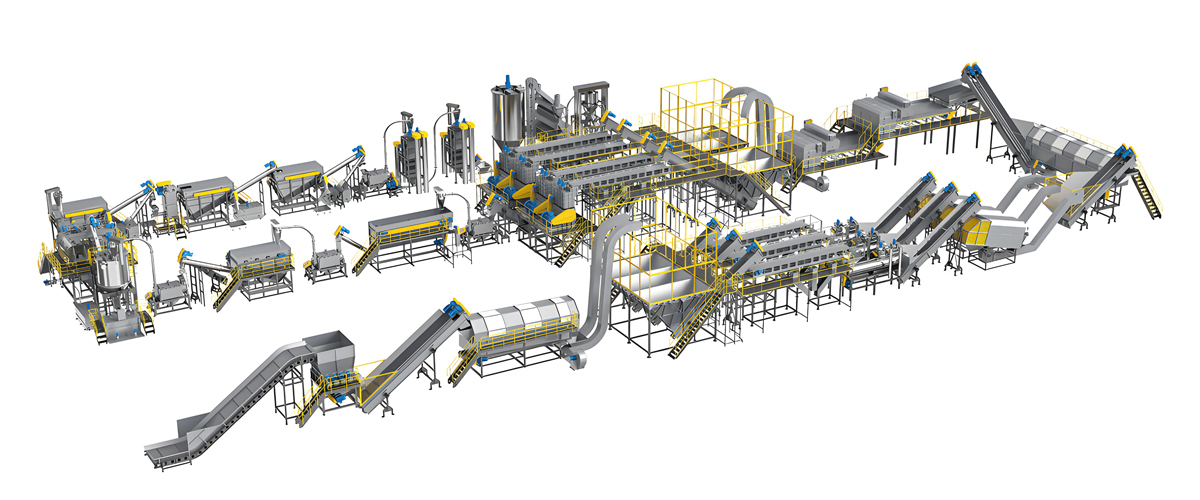
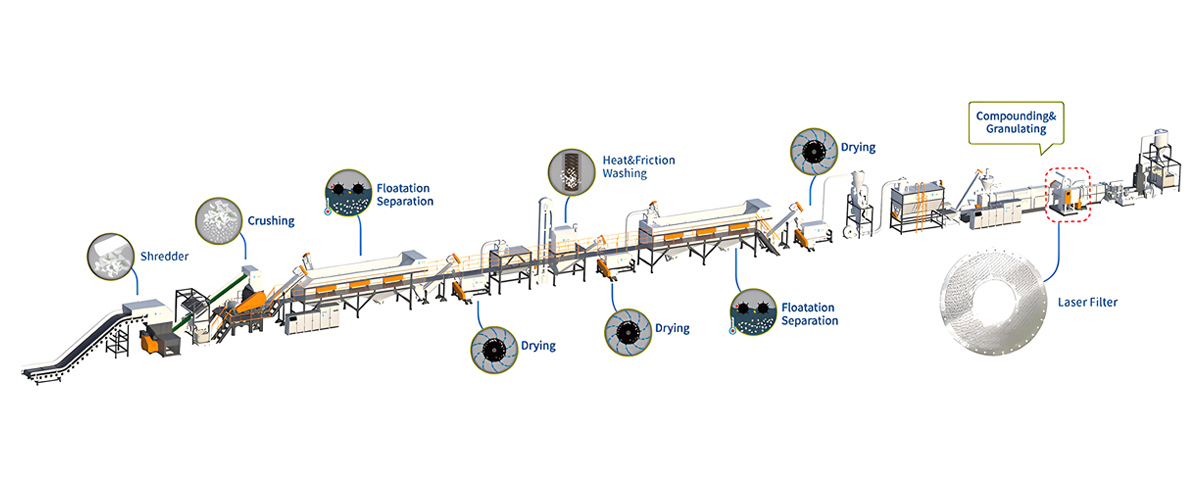
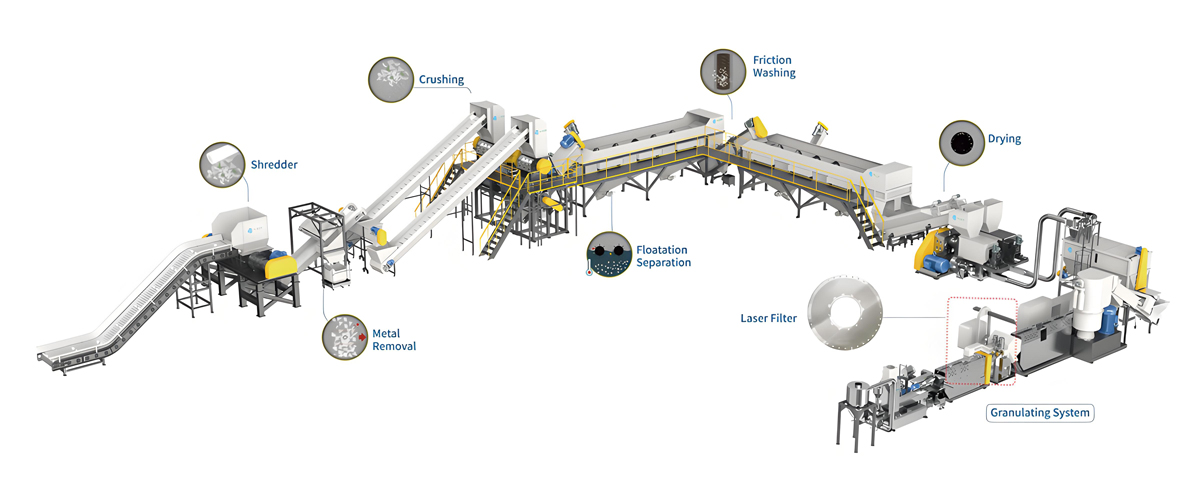
A complete plastic recycling line moves material through nine logical stages. Each stage has a defined purpose, a piece of equipment that performs it, and a specification window that tells the operator whether the stage is performing. The table below maps the recycling stage to the equipment and to the typical specification the operator should expect from a properly tuned line.
| Stage | Equipment | Function | Typical Specification / Target |
|---|---|---|---|
| 1. Pre-wash | Wet granulator / belt pre-washer | Remove loose dirt, sand, and bulk contamination before fine cleaning | Reduces bulk contamination by 60 to 80 percent before main wash |
| 2. Label removal | Cold friction washer / label separator | Detach PVC and paper labels from PET bodies | Label residue below 1 percent on sorted PET bodies |
| 3. Friction wash | High-speed friction washer | Shear surface contamination from flake under sprayed water | Surface organic load reduced to trace levels |
| 4. Hot wash | Hot wash tank with caustic loop | Dissolve glues, oils, and residual fats | Water temperature 85 to 95 C, alkali dosed by recipe |
| 5. Rinse | Float rinse tank / freshwater rinser | Neutralize and remove alkali, float off PP/PE caps | Rinse water pH returned toward neutral |
| 6. Dewater | Centrifugal dewatering machine | Remove free surface water before thermal drying | Moisture after dewater below 12 percent |
| 7. Optical sort | NIR and color optical sorter | Separate polymers and colors, reject off-spec flake | Flake purity above 99 percent achievable |
| 8. Agglomerate | Agglomerator / compactor | Densify film and fluff into a feed-stable state | Bulk density raised for stable extruder feed |
| 9. Pelletize | Twin-screw or single-screw pelletizing line | Melt, filter, and cut uniform recycled pellets | Pellet MFR within the grade target window |
The reason this stage list matters for buyers is that it defines where capital and operating cost live. Roughly half of the utility cost of a washing line sits in the hot wash and the thermal dryer, which is why a good dewatering stage and a closed-loop hot water system are the highest-leverage design choices. A buyer who compares two lines only on nameplate throughput will miss the fact that one line may need 30 percent more steam and 25 percent more freshwater than the other for the same output.
Polyretec applies this stage logic across its three core product families. The PET bottle washing line is built around stages one through eight with food-grade cleanliness as the target. The PP/PE soft washing line emphasizes stages one, three, eight, and nine because film does not need the same hot caustic label chemistry as PET. The pelletizing line picks up at stage eight or nine and converts the clean flake or agglomerate into pellets. In practice many customers buy the washing line and the pelletizing line as one continuous train so that material never sits exposed between stages.
Polyretec Food Grade PET Bottle Washing Line
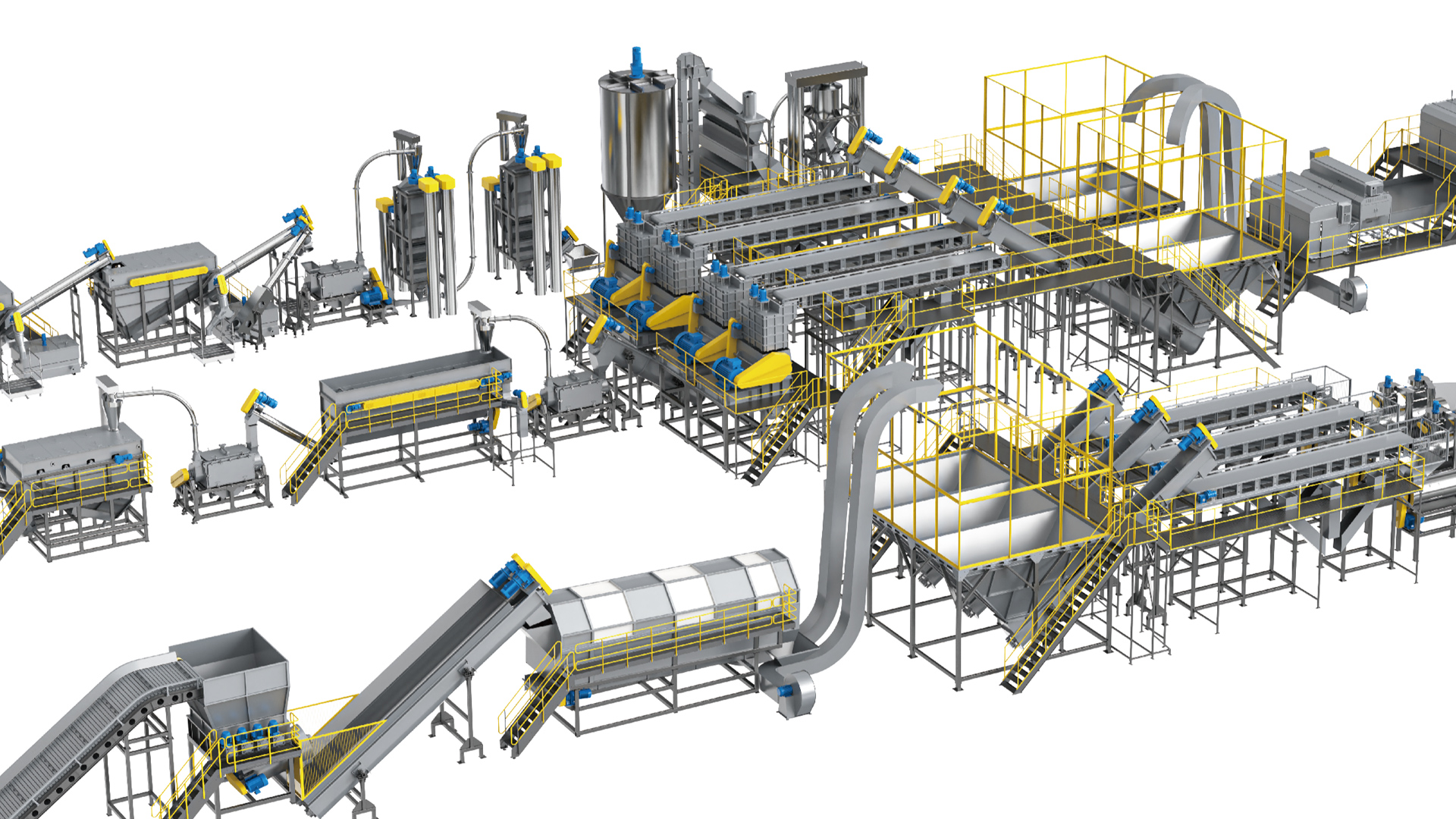
The Polyretec food grade PET bottle washing line is the flagship rigid-container system in the catalog, rated from 500 kg/h up to 6000 kg/h depending on configuration. It is engineered for post-consumer PET bottles, post-industrial PET scrap, and mixed rigid PET waste where the operator needs flake clean enough for bottle-to-bottle or sheet applications after a suitable super-clean step. The line follows the nine-stage flow above and is tuned so that the bottleneck is the hot wash residence time rather than the crusher, which protects flake size distribution.
The design uses a wet granulator at the front end so bottles are cut under water, suppressing dust and pre-wetting the label glue. A cold friction stage removes the bulk of PVC and paper labels before the material enters the hot wash, which lowers alkali consumption. After hot wash the line passes flake through a freshwater rinser, a centrifuge, and a thermal dryer, then to an optical sorter for color and polymer separation. The result is clean PET flake with low residual glue, low PVC content, and stable moisture.
| Parameter | PET Washing Line (Polyretec) | Notes |
|---|---|---|
| Capacity range | 500 to 6000 kg/h | Configured by module count and hot wash volume |
| Final flake purity | Up to 99 percent plus | After optical sorting, depends on feed |
| Moisture after drying | Below 2 percent | Critical for stable pelletizing |
| Label residue | Below 1 percent | Cold friction plus hot wash |
| PVC content in PET | Below 50 ppm target | Optical sorting rejects PVC bodies |
| Water reuse | Closed-loop with filtration | Lowers freshwater index |
| Typical power | Scales with throughput | See parameter benchmark section |
For food-contact reuse, the washed flake must meet the regulatory expectations of the destination market. In the European Union this is expressed through EU 10/2011, and in the United States through FDA expectations for recycled PET. Polyretec positions the washing line as producing flake suitable for further super-clean treatment; the washing line itself is the front end of a food-grade loop rather than a substitute for the final decontamination step, and buyers should validate the full loop against their own market’s compliance file.
From a service perspective this line benefits most from the remote diagnostic program described later, because the hot wash chemistry and the optical sorter settings are the two areas where a small recipe error shows up days later as off-spec flake. A customer running this line typically keeps a small stock of friction washer paddles, screen packs, and sorter lamps as the first-line spares, all covered under the annual free parts allowance.
Polyretec PP/PE Soft Plastic Crushing and Washing Line
The Polyretec PP/PE soft plastic crushing and washing line targets flexible scrap: agricultural film, woven bags, post-consumer LDPE packaging, and mixed soft PP and PE. It is rated from 500 kg/h to 1500 kg/h and is designed around the fact that film behaves differently from rigid bottle flake. Film compacts, floats, and tangles, so the line uses a pre-shredder and a low-temperature friction approach, then offers one-step pelletizing as an option so the customer receives pellets rather than wet flake.
Because soft film carries a high surface-area-to-mass ratio, it traps dirt and prints more aggressively than rigid containers. The line answers this with extended friction washing and a wash water filtration loop, then moves to an agglomerator that densifies the material into a free-flowing state before the pelletizer. For customers who only need clean flake, the washing section can be delivered without the pelletizer; for customers who want a finished pellet, the agglomerator and pelletizing line are integrated so the whole process is continuous.
| Parameter | PP/PE Soft Washing Line (Polyretec) | Notes |
|---|---|---|
| Capacity range | 500 to 1500 kg/h | Set by shredder and agglomerator size |
| Typical feedstock | LDPE film, PP woven, agriculture film | Post-consumer and post-industrial |
| One-step pelletizing | Available | Agglomerator feeds pelletizer directly |
| Wash water | Filtered closed loop | Reduces freshwater draw |
| Output form | Wet flake or pellets | Selected by scope |
| Bulk density of output | Raised by agglomeration | Stable extruder feed |
The soft washing line is often the entry point for a recycler who starts with film and later adds rigid PET, because the agglomerator and pelletizing philosophy carry over. The Wanplas group supports this expansion path by keeping the control architecture common across its recycling lines, so an operator trained on one line reads the next one without re-learning the human-machine interface.
Polyretec New Generation Pelletizing Line
The Polyretec new generation pelletizing line converts clean flake or agglomerate into uniform recycled pellets. It is built for both thin-walled LDPE film regrind and thick-walled PE/PP regrind, with a robust construction intended for post-consumer waste that arrives dirty and variable. The line performs melt, filtration, devolatilization, and cutting in a controlled sequence so the pellet has predictable melt flow rate, low gel content, and consistent color.
The pelletizing line can be fed either by the washing line directly or by a standalone agglomerator for customers who buy flake on the open market. Melt filtration uses a screen changer to strip residual fines and contaminants that survived washing; the choice between a continuous screen changer and a manual one depends on how dirty the feed is and how continuous the campaign must be. Cutting is carried out by a die-face or strand system selected to match the melt strength of the polymer, because LDPE needs a different cutting geometry than rigid PP.
| Parameter | New Generation Pelletizing Line (Polyretec) | Notes |
|---|---|---|
| Feed forms | LDPE film, PE/PP regrind, agglomerate | Post-consumer and post-industrial |
| Melt filtration | Screen changer, continuous option | Protects pellet quality |
| Cutting system | Die-face or strand, by polymer | Matched to melt strength |
| Devolatilization | Vent zone on barrel | Lowers odor and volatiles |
| Pellet consistency | Controlled MFR window | Graded to application |
| Integration | Direct from washing line | Continuous train option |
In the broader Wanplas program, downstream densification and compounding capability is supplied by the group so that a recycling customer who wants to add masterbatch or engineering compound downstream can extend the same train. For the recycling line itself, however, the pelletizing line is the finishing stage, and its reliability is what determines whether the plant ships sellable pellets or re-works material.
Central-European Process Route vs Conventional Recycling Lines
Buyers often ask how a line built on Central-European process engineering differs from a conventional, lower-cost washing line. The honest answer is that the difference is not one dramatic machine; it is the discipline across stages. A conventional line may crush, wash once, and dry with heat alone. The Central-European route adds friction, hot chemistry, optical sorting, and aggressive dewatering so that the thermal dryer does less work and the flake leaves the line cleaner.
| Dimension | Central-European Process Route | Conventional Entry-Level Line |
|---|---|---|
| Pre-treatment | Wet granulation plus cold label removal | Dry crush, minimal label removal |
| Washing | Friction wash plus hot caustic loop | Single cold wash tank |
| Sorting | NIR and color optical sorting | Manual or sink-float only |
| Dewatering | Centrifuge before thermal dryer | Direct to thermal dryer |
| Flake purity | Above 99 percent achievable | Often below 95 percent |
| Water index | Closed loop, lower freshwater draw | Open loop, higher draw |
| Energy index | Lower due to dewatering | Higher due to hot drying load |
| Output grade | Food-grade loop ready | Non-food or back-to-basic use |
The comparison is deliberately framed as a technology route versus a technology route, not as a brand versus a brand. The right choice depends on the customer’s feedstock and the end market. A recycler supplying non-food strapping or pipe compound may be perfectly served by a simpler line, while a recycler targeting sheet or bottle-to-bottle applications needs the full route. The point is to match the route to the commercial goal rather than to buy the most or least expensive machine.
Total cost of ownership tells the same story in numbers. A conventional line may carry a lower purchase price, but the higher water and energy indices compound every operating year, and the lower flake purity caps the resale value of the output. Over a multi-year horizon the Central-European route frequently closes the purchase gap through utility savings and a better pellet price, especially where freshwater is metered and energy is priced at industrial rates. The correct comparison is therefore lifetime cost per ton of saleable pellet, not the headline machine price, and that is the number a buyer should ask the supplier to model before committing capital. A line that looks expensive on the quotation can be the cheaper machine once the water, energy, and grade premiums are added to the operating ledger.
Key Performance Parameters and Benchmarks
Four parameters decide whether a recycling line earns its place on the factory floor: throughput in kg/h, the water consumption index, the energy consumption index, and the flake purity percentage. Throughout this article the indices are expressed on a baseline of 100 index points for a representative conventional line, so a lower number means lower consumption. This keeps the comparison honest without quoting a specific utility tariff, which varies by site.
| Metric | Central-European Route (index) | Conventional Route (index) | Why it matters |
|---|---|---|---|
| Throughput (kg/h) | 100 baseline | 100 baseline | Nameplate output of the line |
| Water consumption index | 62 | 100 | Closed-loop wash saves freshwater |
| Energy consumption index | 71 | 100 | Dewatering cuts dryer load |
| Flake purity percent | 99 plus | 92 to 95 | Drives resale grade |
| Moisture after dry | Below 2 percent | 3 to 5 percent | Stabilizes pelletizing |
Flake quality is the second table that belongs in this section, because purity and moisture together determine whether the pelletizer can run continuous campaigns. The values below are typical windows the operator should hold; exact numbers depend on feedstock and recipe.
| Flake Quality Item | Target Window | Impact if Out of Range |
|---|---|---|
| Flake purity | Above 99 percent | Off-spec pellet, lower price |
| Moisture content | Below 2 percent | Steam, gel, screw slip |
| PVC in PET | Below 50 ppm | Yellowing, property loss |
| Label residue | Below 1 percent | Odor, contamination |
| Bulk density | Stable per grade | Feeder bridging |
| Melt flow rate | Within grade window | Downstream process failure |
Operators should log these parameters daily. The remote diagnostic service described in the support section works best when the customer sends these logs, because a drifting energy index is often the first sign of a worn friction paddle or a scaled hot wash heater, both of which are cheap to fix early and expensive to ignore.
Modeling operating cost on the index baseline makes the trade-offs visible. If the conventional route is set at 100 water and 100 energy index points, moving to the Central-European route at 62 and 71 points reduces the utility burden by roughly a third across the two largest consumers. Expressed per ton of output, that reduction is what funds the difference in capital cost over the depreciation period. Buyers should request the supplier’s estimated index for their specific feedstock, because a very dirty post-consumer mix will always sit above the baseline while a clean post-industrial regrind will sit below it; the route is stable, but the absolute numbers move with feed quality. The daily log then becomes the instrument that confirms whether the installed line is tracking its quoted index or quietly drifting away from it, which is the earliest possible warning of a maintenance need.
Application Industries and End Products
A recycling line is only as valuable as the market for its output. The Polyretec lines feed several industrial chains, and the choice of line should track the end product the customer can actually sell.
- Food and beverage packaging — Washed PET flake enters sheet and bottle-to-bottle loops after super-clean treatment. This is the highest-grade outlet and needs the full washing route with optical sorting.
- Fibers and strapping — PET flake and pellets go into polyester staple fiber and PET strapping. These tolerate slightly lower purity than food grade but still reward good washing.
- Film and bag production — PP and PE pellets from the soft washing line return to blown film, cast film, and woven bag production. This is the natural home for post-consumer LDPE recovery.
- Pipe and profile — PE and PP recycled pellets enter pipe and profile extrusion where mechanical properties matter more than clarity.
- Non-woven and molded goods — PP non-woven and thin-wall molded articles consume large volumes of recycled PP, a steady outlet for the agglomeration route.
- Renewable resource utilization — Beyond specific industries, every line reduces dependence on primary resin, which supports corporate sustainability targets and regulatory recycling mandates.
The Wanplas group encourages customers to start from the end market and work backward to the line, because the grade requirement at the outlet sets the required purity, which sets the required process route. A customer who can only sell non-food strapping does not need the most expensive optical sorter; a customer targeting sheet does.
Concrete end products help illustrate the chain. Washed PET flake graded for sheet becomes thermoformed trays, blister packs, and carrier sheets; the same flake graded for fiber becomes polyester staple used in geotextile, padding, and non-woven wipes. PP and PE pellets from the soft washing line return to blown film for consumer bags, to cast film for lamination, and to woven tape for bulk sacks and construction mesh. PE recycled pellet also enters pipe and conduit where impact and stiffness matter more than appearance. Each of these outlets pays a different price for a different purity level, which is why the selection table earlier in this article maps the outlet to the line rather than mapping the budget to the line. Selling the right grade to the right outlet is the difference between a recycling line that prints cash and one that stockpiles off-spec flake. A recycler who understands the outlet can also negotiate feedstock price, because knowing the achievable purity turns a mixed bale from a liability into a calculated input.
Line Footprint, Utilities, and Commissioning Plan
Before a recycling line is ordered, the buyer must plan the site around it, because the utility draw and the floor footprint are set by the process route, not by the building. A Central-European route with closed-loop wash and aggressive dewatering needs a steady supply of power, a source of process water, a drain for the filtration reject, and enough floor length for the modules to sit in series. Getting these wrong is the most common cause of a delayed startup, and it is cheaper to design for them on paper than to retrofit a foundation after the machine has arrived.
| Utility / Site Item | What to Plan | Why It Matters |
|---|---|---|
| Power supply | Three-phase, sized to line rating | Crusher and centrifuge draw starting current |
| Process water | Inlet plus closed-loop tank | Wash loop needs buffer volume |
| Drainage | Reject and cleaning discharge | Filtration backwash must be handled |
| Floor footprint | Series layout, access aisles | Modules cannot be stacked tightly |
| Steam or heat | Hot wash heater source | Hot wash runs at 85 to 95 C |
| Ceiling height | Clear for conveyor and sorter | Optical sorter needs service headroom |
| Spare parts store | Locked cabinet on site | Fast swap of wear items |
The commissioning plan is the second half of site readiness. After the line is installed, the supplier runs a material trial on the customer’s own feedstock where practical, then documents the achieved purity, moisture, and throughput as the acceptance baseline. That baseline is the reference the daily log is later compared against, so a small drift is visible as a percentage of a known-good start rather than as a guess. The Wanplas installation and commissioning step is built to produce this baseline, and the training program is built to teach operators how to reproduce it on every shift. A customer who skips the material trial and accepts on clean samples alone often discovers the gap only after a month of real scrap, which is why the trial on actual waste is treated as a non-negotiable part of handover.
Footprint also drives the choice between a washing-only delivery and a combined washing-plus-pelletizing train. A combined train saves floor space at the interface because material moves through an enclosed transfer rather than being bagged and re-fed, and it protects purity because the flake is never exposed between stages. A washing-only delivery is smaller and lets the customer sell flake directly, but it costs floor and handling at the pelletizing stage if that is added later. The selection table earlier maps this to the customer situation, and the site plan should be drawn for the train the customer will actually run in year two, not only in year one, because moving a washing line once it is piped and wired is far more disruptive than planning the extra aisle up front.
Finally, the open-factory policy is most useful at this planning stage. A customer who visits with a floor drawing and a sample of waste can watch the line run, confirm the footprint against the real machine, and leave with a commissioning plan that already accounts for their building. That visit turns the specification sheet from a document into a confirmed plan, which is the surest way to avoid a startup surprise and the most direct way to confirm that the quoted capacity will fit the available space.
Global After-Sales Support and Service Commitments
The second half of the article title is global after-sales support, and it is where a line built on sound process engineering either pays off or fails. A recycling line running in one country but supplied from another lives or dies by the quality of remote diagnosis, spare parts logistics, training, and the willingness of the supplier to open its factory for audit. Polyretec, as a Wanplas factory, delivers support through five concrete commitments.
Remote diagnosis. Each line ships with a PLC and human-machine interface that can export process logs. With the customer’s permission, Polyretec engineers review throughput, energy index, moisture, and alarm history to spot drifting parameters before they become failures. The 24-plus engineer assistance team covers multiple time zones so a night-shift alarm in one region can be reviewed during the supplier’s working day.
Spare parts and the free parts allowance. The Wanplas group promise includes USD 500 of free spare parts every year for the life of the standard support period. Common wear items such as friction washer paddles, screen packs, centrifuge screens, and sorter lamps are the first to be drawn against this allowance. Beyond the allowance, the parts catalog is structured so that a critical spare can be identified and shipped without a long engineering discussion.
Installation, commissioning, and testing. Lines are run and tested at the factory before shipment, then installed and commissioned by engineers on site. The commissioning step includes a material trial on the customer’s own feedstock where practical, so the line is accepted against real scrap rather than ideal samples.
Training. Operators and maintenance staff receive hands-on training covering the process route, the control system, safe lockout of the crusher and centrifuge, screen change procedure, and the daily log that feeds remote diagnosis. Training is repeated for new shifts so knowledge does not leave with one person.
Open factory. The Wanplas open-factory policy welcomes customers to visit, audit the build quality, and watch a line run before purchase. For a recycling line this is especially useful because the buyer can bring a sample of their own waste and watch it processed on the actual equipment.
A practical note on support economics: the annual free parts allowance covers routine wear, not major components, so customers should still budget for consumables and for the occasional large spare. The value of the allowance is that it removes the friction of small urgent orders and keeps the line from stopping for a missing paddle or screen.
Support also covers the lifecycle of the line rather than only the break-in period. As feedstock mixes change, the wash recipe and sorter settings need re-tuning, and the engineering team treats this as a recurring service rather than a one-time commissioning task. When a customer’s volume grows, the modular design lets the factory add a parallel module or upgrade a rotor instead of replacing the train, which is the practical meaning of the Wanplas capacity guarantee. Training is refreshed for new shifts so the daily log that feeds remote diagnosis stays accurate even as personnel change. In this sense the after-sales program is less a warranty and more a continuing operating partnership, which is exactly what a recycler running the line on another continent needs to keep output grade stable year after year. The USD 500 annual parts allowance is the visible edge of that partnership, but the deeper value is the engineering continuity that keeps the line producing saleable pellet long after the warranty card has been filed away.
How to Select the Right Recycling Line
Selection starts from three facts: what is the feedstock, what purity does the outlet require, and what throughput pays back. The table below maps common customer situations to a recommended Polyretec line so the reader can self-screen before sending a detailed inquiry.
| Customer Situation | Feedstock | Target Purity | Recommended Line |
|---|---|---|---|
| PET bottle recycler, sheet grade | Post-consumer PET bottles | Above 99 percent | Polyretec PET bottle washing line 500 to 6000 kg/h |
| Film recycler, bag production | LDPE / PP film, woven bags | Clean flake or pellet | Polyretec PP/PE soft washing line 500 to 1500 kg/h |
| Flake buyer, pellet outlet | Clean flake or agglomerate | Pellet MFR window | Polyretec new generation pelletizing line |
| Integrated recycler | Mixed rigid and soft | Above 99 percent | Washing line plus pelletizing line as one train |
| Entry-level non-food | PP/PE post-industrial | Below food grade | Soft washing line, minimal sorting scope |
The selection logic is deliberately conservative. A customer who believes they need food grade should buy the full PET route even if their current outlet is non-food, because the cost gap to upgrade later is larger than the cost gap to buy the higher route upfront. Conversely, a customer whose outlet is strapping should not over-pay for an optical sorter they will never use. The Wanplas sales process exists to confirm this mapping against the customer’s real scrap sample.
Frequently Asked Questions
What does “Central-European process engineering” mean for a recycling line?
It describes a process route defined by hot washing, high-speed friction washing, optical sorting, mechanical dewatering, and agglomerator or compounding pelletizing, rather than any single supplier name. The route is valued for delivering high flake purity at a lower water and energy index than a conventional single-tank wash.
Can the PET washing line produce food-grade flake on its own?
The washing line produces clean flake that is the front end of a food-grade loop. Final food-contact compliance depends on the full system, including any super-clean decontamination step, validated against EU 10/2011 in Europe or FDA expectations in the United States. Buyers should complete their own compliance file for the destination market.
How much spare parts support is included?
The Wanplas group promise includes USD 500 of free spare parts every year for the standard support period, covering routine wear items such as friction paddles, screens, and sorter lamps. Major components are ordered separately through the parts catalog.
What throughput can the lines handle?
The PET bottle washing line is rated from 500 to 6000 kg/h, the PP/PE soft washing line from 500 to 1500 kg/h, and the pelletizing line is sized to match. Actual output depends on feedstock cleanliness and the configured module count.
Do I need both a washing line and a pelletizing line?
If you sell flakes, the washing line alone may be enough. If you sell pellets or want a continuous train without intermediate handling, add the pelletizing line. Many customers buy both as one integrated system to avoid re-contaminating material between stages.
How is remote diagnosis delivered?
With the customer’s permission, Polyretec engineers review PLC and human-machine interface process logs covering throughput, energy index, moisture, and alarms. The 24-plus engineer team covers multiple time zones so issues are reviewed promptly and the daily log becomes an early warning system.
Can I visit the factory before buying?
Yes. Under the Wanplas open-factory policy, customers are welcome to visit, audit build quality, and watch a line run, ideally bringing a sample of their own waste so it can be processed on the actual equipment during the visit.
Conclusion and Next Steps
A plastic recycling line built on Central-European process engineering is best understood as a sequence of tuned unit operations rather than a single machine, and its commercial success depends as much on the support behind it as on the steel in front of it. Polyretec, a Wanplas factory, brings this route to PET, PP, and PE through a food grade PET bottle washing line rated up to 6000 kg/h, a PP/PE soft washing line rated up to 1500 kg/h, and a new generation pelletizing line that finishes the material into uniform recycled pellets. The combination of friction wash, hot caustic loop, optical sorting, and aggressive dewatering delivers flake purity above 99 percent at a lower water and energy index than a conventional line.
Just as important for a global operator is the after-sales program: remote diagnosis across time zones, an annual USD 500 free parts allowance, on-site installation and commissioning, hands-on training, and an open-factory policy that lets you audit the build before you buy. With more than 100 delivered projects and service presence in more than 50 countries, the factory is structured for customers who run the line far from where it was made.
If you are evaluating a recycling line, the most useful next step is to send a sample of your actual waste together with your target output grade and daily throughput. Polyretec will map it to the right configuration, run it on the equipment during a factory visit, and return a configuration and support plan sized to your feedstock and your market. Reach out with your material specification and production target, and the team will prepare a tailored proposal for your plant.