
Disposable plastic products have become one of the most challenging yet most abundant waste streams on the planet, and the first machine that determines whether that waste becomes a valuable secondary raw material or a contaminated liability is the shredder. An Austrian tech plastic shredder for disposable plastic product waste is purpose-built to take lightweight, low-bulk-density, often contaminated single-use items such as PP and PS cutlery, PET drinking cups, thin-wall injection-molded trays, and food-service packaging, and reduce them into a uniform, free-flowing flake that downstream washing and pelletizing systems can process without interruption. Polyretec, a Wanplas factory, has combined advanced Austrian cutting-chamber technology with Chinese manufacturing scale to deliver single-shaft and double-shaft shredders that balance throughput, energy efficiency, and tool life for exactly this difficult feedstock. In this guide we explain the engineering behind these machines, the material science of the disposable waste they handle, the key specifications plant engineers should specify, and how the shredder integrates into a complete recycling line. By the end you will understand why rotor geometry, blade steel, screen aperture, reducer torque, and overload protection matter more for disposable waste than for almost any other plastic waste category.
Understanding Disposable Plastic Product Waste as a Recycling Feedstock
Disposable plastic product waste is defined here as short-life, single-use articles made from commodity thermoplastics that are discarded soon after a single functional use. The dominant polymers in this stream are polypropylene (PP), polystyrene (PS), polyethylene terephthalate (PET), and to a lesser extent low-density polyethylene (LDPE) and high-impact polystyrene (HIPS). Each of these behaves very differently inside a shredder, and a successful machine design begins with a realistic model of the feed material rather than a generic assumption that all plastic cuts the same way.
The first defining characteristic is low bulk density. A bale or gaylord of PP cutlery, PS cups, or thin-wall trays can contain a large volumetric void fraction, often 70 percent air by volume, which means the shredder chamber must be fed steadily rather than dumped, or it will bridge and stall. Unlike rigid purgings or thick-wall pipes, disposable items arrive as a fluffy, springy mass that resists compaction and tends to ride up on the rotor instead of being cut.
The second characteristic is contamination. Food-service disposables carry residual oils, sauces, starches, dairy films, and beverage sugars. PET cups may retain cold-drink residues and paper labels. PS foam trays often carry meat juices and absorbent pads. These contaminants raise the ash content of the final flake and accelerate screen clogging, so the shredder must be designed for easy wash-down and the downstream line must assume a pre-rinse stage.
The third characteristic is entanglement and wrapping. Thin-wall parts with flanges, handles, and snap-fit tabs interlock during conveying and can wrap around a rotating shaft if the rotor and screen are not engineered to release material quickly. This is precisely why Austrian chamber designs emphasize a close rotor-to-screen clearance and aggressive hook angles that pull material into the cutting zone rather than letting it rotate passively.
The fourth characteristic is heterogeneous melt behavior. A mixed stream of PP, PS, and PET cannot be re-melted together; they are incompatible and will phase-separate into a weak, speckled pellet. Therefore the shredder’s job is not to homogenize but to produce a clean, size-uniform regrind that a washing and sorting stage can then separate by density and type before pelletizing. Particle uniformity from the shredder directly improves the efficiency of sink-float tanks and optical sorters later in the line.
| Material / Item | Typical Bulk Density (kg/m³) | Residual Contaminants | Shredding Difficulty |
|---|---|---|---|
| PP cutlery and thin-wall trays | 80 to 160 | Food oils, starches, sauces | Medium — springy, tends to bridge |
| PS cups and HIPS trays | 40 to 120 | Paper labels, inks, beverage sugars | Low to Medium — brittle, dusty |
| PET drinking cups and lids | 60 to 140 | Cold-drink residue, adhesives | Medium — abrasive label glue |
| LDPE wrapped food wraps | 30 to 90 | Grease, printing ink | High — wraps and ropes on shaft |
Engineers sizing a line should always request a representative sample bale from the source stream and run a bulk-density and contamination test before finalizing screen size and motor power. A shredder specified only on nameplate capacity will underperform by a wide margin on a fluffy, contaminated disposable stream, whereas one specified on measured bulk density and contamination load will deliver stable output hour after hour.
The Austrian Engineering Philosophy Behind Polyretec Shredders
The phrase “Austrian technology” in plastic recycling refers to a school of machine design that emerged from Central Europe, where companies such as Erema, Lindner, and Starlinger established the global benchmark for robust, low-maintenance size-reduction equipment. Polyretec, a Wanplas factory, has adopted and localized this philosophy: heavy-wall welded cutting chambers, oversized bearings, generously dimensioned reducers, and a calibration culture that treats tool steel hardness, clearance, and balance as first-class specifications rather than afterthoughts. The result is a machine that favors uptime and predictable wear over the lowest possible purchase price.
A core principle of the Austrian approach is “cut, do not tear.” Many low-cost shredders rely on blunt shear and high hydraulic force to rip material apart, which produces elongated, fibrous particles, excessive fines, and rapid blade dulling. The Austrian tech plastic shredder instead uses a precisely angled rotor that presents each rotating blade to the stationary blade like a planing knife, slicing cleanly through the wall of a cup or tray. This clean cut reduces dust generation and gives a flake with sharp, defined edges that flows well into the next stage.
Another principle is modularity. Austrian-style designs separate the rotor, screen cradle, bearing blocks, reducer, and hydraulic group into serviceable modules so that a worn component can be removed and refurbished without stripping the entire machine. Polyretec applies this to its single-shaft and double-shaft platforms, which share a common hydraulic pusher, common PLC logic, and common wear-part geometry across a range of chamber sizes.
A third principle is energy discipline. Rather than fitting the largest possible motor and hoping for throughput, the Austrian method matches motor power, reducer ratio, and rotor inertia to the specific cutting resistance of the target waste. For disposable products, which are thin-wall and low-resistance but voluminous, this means a moderate motor with a high-torque reducer and a ram-fed chamber, delivering a specific energy in the range of roughly 40 to 90 kWh per tonne depending on screen size and contamination, versus far higher figures for thick-wall or baled rigid waste.
A fourth principle is safety and diagnostics. Austrian machines integrate torque monitoring, bearing-temperature probes, and chamber-level interlocks as standard rather than options. Polyretec mirrors this with CE-compliant control architecture, emergency pull-cords, and a PLC that logs motor current, hydraulic pressure, and reversal events so that maintenance is condition-based rather than calendar-based.
Polyretec combines Austrian cutting-chamber technology with Chinese manufacturing scale, delivering single-shaft and double-shaft shredders purpose-built for low-bulk-density, contaminated disposable plastic waste while keeping spare-part logistics and service response fast through the Wanplas network.
The practical outcome for the buyer is a machine that may cost more upfront than a commodity shredder but delivers a lower total cost per tonne of clean flake over a five-year horizon, because blade life is longer, unplanned stops are rarer, and the regrind quality is high enough to command a premium in the recycled-PP or recycled-PS market. For disposable waste, where margins are tight and contamination is high, that differential is decisive.
Single-Shaft Versus Double-Shaft Shredder Architecture
Choosing between a single-shaft and a double-shaft shredder is the first architectural decision for any disposable-waste line, and the two designs serve different points on the contamination and particle-uniformity spectrum. A single-shaft shredder uses one rotating rotor with mounted blades that cut against a stationary counter-blade, with a screen beneath the rotor controlling the discharge particle size. A double-shaft shredder uses two intermeshing rotors that rotate slowly in opposite directions, pulling material between them and shearing it without a screen, producing a coarser, variable flake.
For disposable plastic product waste, the single-shaft design is usually the correct primary choice when the goal is a uniform, screen-controlled flake that feeds directly into a washing line. The screen enforces a maximum particle dimension, typically 20 mm to 80 mm, which prevents oversized cups or trays from reaching and choking the friction washer or the densifier downstream. The hydraulic pusher plate forces the fluffy mass onto the rotor so that low-bulk-density waste does not simply rotate on top of the cutting circle.
The double-shaft design excels as a pre-shredder for extremely bulky, tangled, or mixed bales where a single-shaft machine would bridge. Two counter-rotating shafts with hooked teeth rip the mass apart into rough chunks, which are then passed to a single-shaft granulator for final sizing. In a Polyretec line, a double-shaft pre-shredder is often placed ahead of the washing line when the incoming material is loose, baled, or heavily interlocked, while a single-shaft shredder handles the controlled final cut.
Operationally, single-shaft machines turn faster, produce finer and more uniform output, and consume less specific energy per tonne of sized product, but they are more sensitive to contamination and require a clean screen path. Double-shaft machines are gentler on tools and tolerant of foreign objects such as trapped metal or stones, because the two shafts simply reverse and eject the obstruction, but their output is coarser and must be re-processed.
| Attribute | Single-Shaft Shredder | Double-Shaft Shredder |
|---|---|---|
| Rotor configuration | One rotor, stationary counter-blade | Two counter-rotating intermeshing shafts |
| Screen | Yes, 20 to 80 mm aperture | No screen, open discharge |
| Output particle size | Uniform, screen-controlled | Coarse, variable chunks |
| Best role for disposables | Final sizing before washing | Pre-shredding bulky bales |
| Foreign-object tolerance | Moderate, reverse to clear | High, self-ejecting |
| Specific energy (kWh/t) | Lower, 40 to 90 | Higher, 60 to 130 |
Polyretec frequently configures a tandem arrangement for demanding disposable streams: a low-speed double-shaft pre-shredder to open the bale and break interlocks, followed by a single-shaft shredder with a 30 mm to 50 mm screen for the final cut. This pairing protects the fine-cutting tools from shock loads and delivers the uniform flake that washing lines require, at a specific energy that remains competitive.
Rotor Design: The Heart of the Cutting Chamber
In an Austrian tech plastic shredder, the rotor is not a generic shaft with welded paddles; it is a precision-machined component whose diameter, blade pocket geometry, hook angle, and balance tolerance define the machine’s character. For disposable waste, the rotor must combine a large flywheel inertia to carry the cut through momentary overloads with a high number of cutting events per revolution to keep throughput steady on low-density feed.
Polyretec rotor bodies are typically fabricated from a solid forged or heavy-wall seamless tube core, machined to accept square or hexagonal blade seats. The blades are clamped into pockets rather than simply bolted to the surface, which centers each cutting edge precisely and distributes impact loads into the rotor body instead of the fasteners. This pocket design is a hallmark of Austrian engineering and is what allows the machine to survive the repeated shock of a thick PET cup base or a folded PP tray entering the chamber.
The hook angle, also called the rake or attack angle, determines whether the blade slices or wedges. For thin-wall disposables, an aggressive positive hook angle of roughly 25 to 35 degrees pulls the material down into the cutting circle and prevents it from riding up, while a near-zero angle would let the fluffy mass skate on the rotor. The counter-blade is fixed in an adjustable cradle so that the running clearance between rotating and stationary edges can be restored to 0.1 mm to 0.3 mm after each resharpening, preserving cut quality throughout the blade life.
Rotor diameter and speed are linked to particle control. A larger diameter rotor running at lower speed delivers higher tip torque and a cleaner cut on rigid items, while a smaller, faster rotor suits friable PS foam that shatters easily. For a mixed disposable stream, Polyretec typically specifies a medium-diameter rotor, around 300 mm to 500 mm, at 70 to 110 rpm, a compromise that cuts cleanly without generating excessive fines or heat that could soften low-melting PP and PS.
Dynamic balancing is non-negotiable. An unbalanced rotor at 100 rpm imposes alternating loads on the bearings and reducers that shorten their life and raise vibration to a level that triggers CE-mandated guards and isolation mounts. Polyretec balances each rotor to G6.3 or finer and documents the result, because a balanced rotor is the single biggest contributor to low noise and long bearing life in the field.
| Rotor Parameter | Typical Range (Polyretec disposables) | Engineering Rationale |
|---|---|---|
| Rotor diameter | 300 to 500 mm | Torque vs tip speed balance |
| Rotor speed | 70 to 110 rpm | Clean cut, low fines and heat |
| Blade pockets | 18 to 40 per rotor | Cutting events per revolution |
| Hook angle | 25 to 35 degrees | Pulls fluffy feed into cut |
| Running clearance | 0.1 to 0.3 mm | Restored after resharpening |
| Balance grade | G6.3 or finer | Low vibration, long bearings |
Operators should understand that rotor condition is the leading indicator of product quality. A chipped blade pocket, a loose clamp, or a worn counter-blade cradle degrades the cut long before total failure, producing elongated particles and rising current draw. A simple weekly inspection of blade seating and clearance, recorded in the maintenance log, prevents most downstream quality escapes.
Cutting Tools: D2 and SKD11 Blade Material and Hardness
The blade is where metallurgy meets economics. For disposable plastic waste, the ideal blade holds a keen edge through thousands of tonnes of mildly abrasive, contaminated material, resists chipping when it meets an unexpected hard object, and can be resharpened many times without losing its geometry. Polyretec specifies D2 and SKD11 tool steels for the rotating and stationary blades on its Austrian-tech shredders, and the choice is deliberate.
D2 is a high-carbon, high-chromium cold-work tool steel, internationally designated as 1.2379, known for high wear resistance due to a large volume fraction of chromium carbides. After heat treatment it typically reaches a hardness of 58 to 62 HRC, the range Polyretec targets for shredder blades. Its carbides make it excellent against the abrasive paper labels, mineral fillers, and silica dust found on disposable waste, and its dimensional stability during heat treatment keeps blade pockets accurate.
SKD11 is the Japanese industrial standard equivalent of D2 (JIS G4404), with a near-identical chemical philosophy and comparable hardness of 58 to 62 HRC after quenching and tempering. Many Asian supply chains default to SKD11 because it is locally available, machinable, and proven on recycling lines. Polyretec uses both designations interchangeably depending on the production batch and the customer’s spare-part preference, because their in-service performance is effectively equivalent when heat-treated to the same HRC band.
Why 58 to 62 HRC and not harder? Pushing above 62 HRC increases wear resistance but makes the blade brittle, so a folded PET cup base or a hidden metal fragment can chip the edge, creating a stress riser that propagates into a crack. Staying at 58 to 62 HRC preserves a toughness margin that survives impact while still delivering thousands of operating hours between resharpenings on thin-wall disposables, which are far less abusive than baled rigid purgings.
Blade geometry matters as much as steel. Polyretec uses square, double-edged blades that can be rotated through four usable corners before full removal, and a counter-blade that is adjustable in two axes. This four-corner rotation roughly doubles the effective service interval compared with single-edge designs and reduces the spare-part inventory the operator must hold. The blade thickness, typically 20 mm to 40 mm for this class of machine, is chosen so that several resharpening passes remain possible before the blade falls below the minimum pocket engagement length.
| Property | D2 (1.2379) | SKD11 (JIS) | Soft Tool Steel (reference) |
|---|---|---|---|
| Hardness (HRC) | 58 to 62 | 58 to 62 | 48 to 54 |
| Wear resistance | High | High | Low to Medium |
| Impact toughness | Medium | Medium | High |
| Resharpenability | Excellent | Excellent | Good |
| Best use on disposables | Recommended | Recommended | Not recommended |
The maintenance takeaway is that blade hardness is a system property, not a number to maximize. Polyretec sets the 58 to 62 HRC band, uses square double-edge blades, and supplies a resharpening jig so operators can restore the edge on-site. Combined with the Wanplas brand’s annual complimentary spare-parts allowance and shared service network, this keeps blade cost per tonne of flake predictable and low.
Screen Aperture Selection From 20 mm to 80 mm
The screen is the component that converts a shredder from a rough ripper into a precision size-reduction machine. In a single-shaft Austrian tech plastic shredder for disposable waste, the screen is a curved perforated plate cradling the lower portion of the rotor; only material small enough to pass the aperture falls through to the discharge, while oversized pieces remain in the cutting circle until they are cut again. Selecting the right aperture between 20 mm and 80 mm is therefore the primary lever for controlling downstream processability.
A 20 mm to 30 mm screen produces a fine, uniform regrind ideal for thin-wall PP and PS that will enter a friction washer and then a centrifuge or squeezer. Small particles expose more surface area to wash water, improving the removal of food oils and inks, and they densify more readily in a agglomerator. The trade-off is higher specific energy and faster blade wear, because the material is cut more times before it clears the screen.
A 40 mm to 50 mm screen is the common middle choice for mixed disposable streams, balancing throughput and flake size. It handles cups, trays, and cutlery without excessive re-cutting, and the flake is still small enough for efficient sink-float separation and optical sorting. Most Polyretec lines for food-service waste default to this band unless the downstream pelletizer demands finer feed.
A 60 mm to 80 mm screen is used when the shredder is a pre-cutter feeding a granulator or when the material is bulky but friable, such as PS foam trays that would generate too much dust if over-cut. Larger apertures raise throughput and lower energy, but the coarse flake may need a second cutting stage before washing, so the plant must weigh single-machine simplicity against two-stage capital cost.
| Screen Aperture | Typical Output Flake | Relative Throughput | Relative Specific Energy | Downstream Fit |
|---|---|---|---|---|
| 20 to 30 mm | Fine, uniform | Low | High | Friction washer, squeezer |
| 40 to 50 mm | Medium, uniform | Medium | Medium | Sink-float, optical sort |
| 60 to 80 mm | Coarse | High | Low | Granulator feed, pre-cut |
Screen material is usually hardened manganese steel or perforated D2-equivalent plate, and the open-area ratio must be high enough to avoid restricting discharge; a screen with too little open area causes material to recirculate, raising current and heat. Polyretec designs screens with a segmented, quick-release cradle so operators can swap aperture in under thirty minutes when switching between a PP-cutlery campaign and a PS-cup campaign, keeping the line flexible across disposable-waste subtypes.
Operators should also monitor screen wear at the leading edge where flakes scrape during discharge. A worn screen enlarges the effective aperture unevenly, producing a broader particle distribution that harms washing efficiency. Routine measurement of discharged flake with a sieve stack, recorded weekly, is the cheapest insurance against a slow, invisible quality drift.
Hydraulic Pusher Plate and Intelligent Feeding
Low-bulk-density disposable waste cannot simply be dropped into a shredder and expected to cut; it will float on the rotor, bridge across the hopper throat, and stall the drive. The hydraulic pusher plate is the device that solves this, and in an Austrian tech plastic shredder it is far more than a brute ram. Polyretec’s pusher is a guided horizontal plate that sweeps the chamber floor, forcing the fluffy mass against the rotating rotor at a controlled, adjustable pressure so that every cutting event bites real material rather than air.
The pusher is driven by a hydraulic cylinder sized for both force and speed, with a pressure-compensated pump that modulates flow according to chamber load. When the rotor current rises, indicating a full cutting zone, the PLC reduces pusher advance; when current falls, indicating the chamber is hungry, the pusher advances faster. This load-following logic is what allows a single operator to run the machine unattended for long periods without manual poking, and it is a direct Austrian inheritance of closed-loop process control.
Intelligent feeding extends beyond the pusher. Polyretec pairs the shredder with a metered infeed conveyor whose speed is slaved to rotor current, so the hopper is never overfilled. A level sensor in the hopper commands the conveyor to pause when the chamber is saturated and resume when it clears. The result is a steady state where throughput is limited by the machine’s cutting capacity rather than by erratic dumping, which both protects the tools and maximizes usable capacity.
The pusher also provides a safety function. In a jam or overload, the control can retract the plate fully, clearing the chamber before a controlled reverse rotation frees the obstruction. Because the pusher is hydraulic rather than mechanical, it naturally absorbs shock and cannot transmit a destructive reaction force back into the reducer the way a rigid mechanical feeder can, which is why Austrian designs favor hydraulics for this duty.
From a maintenance standpoint, the pusher seals and guide rails are wear items. Abrasive dust from PS and paper labels penetrates the chamber floor, so Polyretec specifies hardened wear plates on the pusher face and scrapers that keep the guide rails clear. A monthly inspection of seal condition and rail alignment prevents the slow loss of hydraulic pressure that would otherwise manifest as irregular feeding and fluctuating output.
The hydraulic pusher plate transforms a shredder from a batch machine that needs constant manual attention into a load-following, continuously fed size-reduction stage that stabilizes both throughput and specific energy on fluffy disposable waste.
Plants that skip the pusher and instead rely on gravity feed or a screw feeder almost always regret it on disposable streams, because the material’s springiness defeats gravity and a screw can stall on interlocked trays. The hydraulic pusher is, for this feedstock, not an option but a prerequisite for reliable operation, and it is one of the clearest differentiators between an Austrian-engineered shredder and a commodity unit.
Planetary Reducer, Torque, and Motor Power in Kilowatts
The drive train of an Austrian tech plastic shredder is built around a heavy-duty planetary reducer rather than a standard helical gearbox, and the reasoning is rooted in the physics of size reduction. Shredding is a high-torque, low-speed duty: the rotor turns slowly, but each cut can demand a large instantaneous torque, especially when a folded tray or a thick cup base enters the chamber. A planetary reducer delivers that torque in a compact, coaxial package with high efficiency and excellent shock-load capacity.
Motor power for disposable-waste shredders typically ranges from around 22 kW on a compact single-shaft unit up to 90 kW or more on a wide-chamber machine processing several tonnes per hour. The exact figure depends on chamber width, rotor diameter, and target capacity, but the key insight is that motor kilowatts alone are a poor specification; what matters is the torque at the rotor, which equals motor power divided by angular speed. A 55 kW motor at 90 rpm produces a very different rotor torque than the same motor at 200 rpm, and disposable waste needs the low-speed, high-torque end of that curve.
Polyretec sizes the planetary reducer with a generous service factor, often 2.0 or higher, because the torque demand is not steady but spiky. A service factor below 1.5 on this duty leads to premature bearing and gear-tooth fatigue, the classic failure that ends a cheap shredder’s useful life within a year. The Austrian approach spends mass and cost in the reducer precisely so the rest of the line is never waiting on the shredder.
The reducer also determines reversibility. Because the machine must reverse to clear jams, the planetary stage must tolerate frequent direction changes without backlash growth, and Polyretec selects hardened, honed gears with minimal lost motion for this reason. The hydraulic pusher retracts, the rotor reverses a partial turn, and the obstruction either drops free or is re-cut in the correct orientation, all without manual entry into the chamber.
| Chamber Class | Motor Power (kW) | Rotor Speed (rpm) | Reducer Service Factor | Indicative Throughput (kg/h) |
|---|---|---|---|---|
| Compact single-shaft | 22 to 37 | 90 to 110 | 2.0 plus | 300 to 700 |
| Medium single-shaft | 45 to 75 | 75 to 95 | 2.0 plus | 800 to 1500 |
| Wide single-shaft | 90 to 132 | 70 to 85 | 2.2 plus | 1600 to 3000 |
When specifying, buyers should ask the supplier for the rotor torque curve, not just the motor kilowatt rating, and should confirm the reducer brand and service factor. Polyretec documents both and, as part of the Wanplas brand commitment, supports commissioning with on-site engineering assistance so the drive is tuned to the actual feed rather than a generic setting. The payoff is a shredder that sustains nameplate throughput on disposable waste instead of tripping on the first bale of interlocked trays.
Soft Start, Overload Protection, and Reverse Rotation
An Austrian tech plastic shredder for disposable waste lives or dies by its control intelligence, and three features define that intelligence: soft start, overload protection, and automatic reverse rotation. Together they protect the drive train, keep the chamber clear, and minimize unplanned downtime, which on a recycling line is the difference between profit and loss.
Soft start addresses the inrush current problem. A shredder rotor has significant inertia, and a direct-on-line start would draw several times the rated motor current for seconds, stressing the supply and the windings. Polyretec uses a soft starter or variable-frequency drive that ramps the rotor smoothly to operating speed, reducing mechanical shock on the reducer and limiting peak electrical demand. For plants on weak or capacity-limited grids, this alone can be the reason a large shredder is feasible at all.
Overload protection monitors rotor current as a proxy for cutting torque. When disposable waste momentarily piles into the chamber, current rises; if it exceeds a preset threshold for longer than a short允许 window, the controller interprets this as a developing jam and intervenes. The response is graduated: first it slows or pauses the hydraulic pusher, then if current persists it stops the rotor, retracts the pusher, and triggers a reverse cycle. This staged logic avoids unnecessary reversals that would otherwise waste energy and time.
Reverse rotation is the self-clearing mechanism. On a detected overload, the rotor turns backward a partial revolution, typically a fraction of a turn, repositioning the obstructing piece so that the next forward cut meets it at a fresh angle. Because the hydraulic pusher has retracted, nothing is forced; the material simply resettles and is re-cut cleanly. Modern Polyretec controllers log every reversal event with a timestamp and current value, giving maintenance a diagnostic trail: a sudden spike in daily reversals signals a contamination change or a dulling blade long before a breakdown.
These functions are interlocking with safety. Reverse can only occur after the pusher is confirmed retracted and the chamber guard is closed, satisfying CE machinery directives on hazardous motion. The PLC will not restart forward rotation until all interlocks are verified, so an operator can never be caught by an unexpected rotor movement during a jam clear, which is the single most common cause of shredder injuries on poorly designed machines.
| Control Feature | Trigger | Action | Benefit |
|---|---|---|---|
| Soft start | Power-up | Ramp to speed | Lower inrush, less shock |
| Overload protection | Current threshold | Pause pusher, stop rotor | Protects reducer and motor |
| Reverse rotation | Sustained overload | Back-turn, re-cut | Self-clears jams, no entry |
The business case for this intelligence is straightforward. A machine without it stops on every interlocked tray and demands an operator with a pry bar, whereas a Polyretec Austrian-tech shredder runs through the same contamination with a few automatic reversals and keeps the washing line fed. Over a year, the recovered operating hours dwarf the incremental control cost, and the Wanplas service network ensures the logic stays calibrated through firmware and on-site support.
Capacity, Specific Energy Consumption, and Particle Size Distribution
Three numbers decide whether a shredder earns its place on a disposable-waste line: capacity in kg/h, specific energy in kWh/t, and the particle size distribution of the discharge. Buyers should insist on all three quoted against a defined feed sample, because a capacity number without a screen size and contamination level is meaningless marketing.
Capacity for disposable waste is strongly depressed by low bulk density. A machine that shreds densely baled rigid purgings at 2000 kg/h may only manage 600 kg/h on loose PP cutlery, not because the machine is weak but because the hopper and pusher are metering air and voids as much as plastic. Polyretec therefore quotes capacity as a band tied to bulk density: for a medium single-shaft unit with a 40 mm screen, expect roughly 800 to 1500 kg/h on a typical mixed disposable stream at 80 to 160 kg/m³ bulk density, rising when the feed is pre-compacted.
Specific energy, the kilowatt-hours consumed per tonne of shredded output, is the true efficiency metric. On thin-wall disposables with a 40 mm screen, well-tuned Austrian-tech shredders land in the 40 to 90 kWh/t range; finer screens (20 mm) push toward the top of that band, coarser screens (60 to 80 mm) drop toward the bottom. This is markedly better than double-shaft pre-shredding alone (60 to 130 kWh/t) because the single-shaft cut is more efficient per unit of size reduction, and it is the reason the single-shaft stage is preferred for the final cut.
Particle size distribution is reported as a sieve analysis: the mass percentage passing each screen size in a stacked series. A tight distribution, with 80 to 90 percent of mass between 20 mm and 50 mm for a 40 mm-screened product, is the goal, because uniform flakes wash, sink-float, and pelletize predictably. A broad distribution with a long tail of fines (below 5 mm) indicates over-cutting or blade wear, raising dust and lowering yield, while a tail of oversize indicates screen blockage or a dull counter-blade.
| Screen (mm) | Specific Energy (kWh/t) | Fines below 5 mm | Oversize above screen | Typical Use |
|---|---|---|---|---|
| 20 to 30 | 70 to 90 | 8 to 14 percent | Under 2 percent | Fine wash feed |
| 40 to 50 | 50 to 70 | 4 to 8 percent | Under 3 percent | General disposables |
| 60 to 80 | 40 to 55 | 2 to 5 percent | Up to 6 percent | Pre-cut, granulator feed |
Plant engineers should benchmark their line monthly: record throughput, energy meter reading, and a sieve analysis of the discharge. A rising specific energy at constant capacity is the earliest sign of blade dulling or screen wear; a widening distribution signals a chamber problem. Catching these trends early, rather than after a customer complaint about flake quality, is the discipline that separates a mature recycling operation from a reactive one, and Polyretec’s PLC logging makes the data trivially available.
Noise, Dust, and Emission Control in the Workplace
Disposable plastic waste, especially polystyrene foam and paper-labeled cups, is a dusty, statically charged feed that challenges workplace environment compliance. An Austrian tech plastic shredder addresses noise and dust by design rather than by bolting on extraction after the fact, because retrofits rarely meet the thresholds that modern CE and local occupational standards expect.
Noise originates from blade impacts, screen rattling, and aerodynamic whine from the rotor. Polyretec controls it through a heavy-wall welded chamber that dampens resonance, a balanced rotor that eliminates imbalance noise, and an acoustic enclosure option that wraps the cutting zone in mineral-wool-lined panels. Typical operating noise at the operator station sits in the 78 to 88 dB(A) range depending on chamber size and screen, and the enclosure can bring the perimeter below 80 dB(A), the common threshold for mandatory hearing protection zones in many jurisdictions.
Dust is the more insidious issue. Cutting PS cups and HIPS trays releases fine polymer dust that, combined with paper and food residues, forms a combustible, respiratory-hazardous cloud. Polyretec designs the shredder discharge to interface directly with a closed pneumatic or screw transfer to the washing line, minimizing open dust paths, and provides connection flanges for a central dust extraction system at the hopper and discharge. A capture velocity at the hood above the recommended minimum prevents the fine fraction from escaping into the hall.
Static control matters because shredded PP and PS flakes carry charge and cling to surfaces, causing uneven feed and dust accumulation on guards. Grounded chamber construction and ionized air bars at the discharge neutralize the flake, improving material flow into the next stage and reducing the fire risk associated with charged, suspended fines near electrical equipment.
Water and leachate management at the shredder is often overlooked. Food residues washed from disposable waste during pre-rinse create a high-BOD wastewater that must not simply floor-drain into the environment. Polyretec integrates the shredder area drains into the line’s water-treatment loop, where the Wanplas group’s washing-line philosophy recirculates and filters process water, keeping fresh-water consumption and discharge low and compliant with local limits.
A well-designed Austrian-tech shredder treats noise, dust, static, and leachate as engineering parameters from the first sketch, not as afterthoughts, which is why it integrates cleanly into a CE-compliant, operator-safe recycling hall.
For buyers, the practical checklist is: request the declared noise level at one meter, confirm dust-connection flanges and grounding, and verify that chamber drains route to the treatment system. These details are where a commodity shredder quietly fails an audit while a Polyretec machine passes, and they protect both the workforce and the operating license of the plant.
Blade Wear, Resharpening Intervals, and Tool Management
Blades are a recurring consumable, and on disposable waste the wear pattern is distinctive. The abrasive load comes less from the plastic itself, which is soft, and more from the contaminants: paper label fibers, mineral fillers in some trays, silica anti-slip coatings, and trapped sand from outdoor collection. These slowly erode the keen edge and, over time, increase the cutting force needed for each pass, which the operator sees as rising motor current and a coarsening particle distribution.
Resharpening interval depends on contamination and screen size. On a relatively clean PP-cutlery stream with a 40 mm screen, a D2 or SKD11 blade set at 58 to 62 HRC may run 800 to 1500 tonnes between edge restorations; on a heavily labeled, sandy PS-cup stream the interval can fall to 300 to 600 tonnes. The square, double-edge geometry lets each blade present four fresh corners, roughly doubling the calendar interval before the blade must leave the machine for grinding.
Resharpening itself is a controlled process. Polyretec supplies a grinding jig that maintains the original hook angle and edge geometry, because freehand grinding that changes the angle destroys the cut quality and the running clearance. Each pass removes only enough material to restore the edge, typically 0.2 mm to 0.5 mm per face, and the blade can survive perhaps eight to twelve such passes before it drops below the minimum pocket engagement length and is retired. Tracking cumulative removed thickness on a per-blade logbook predicts retirement and avoids sudden failures.
Tool management is where total cost is won or lost. Best practice is to keep a rotating inventory: a set in the machine, a set at the grinder, and a sharp set on the shelf, so a changeover takes minutes rather than waiting for off-site grinding. Polyretec supports this through the Wanplas brand’s annual complimentary spare-parts allowance and a regional stock of D2/SKD11 blades, shortening the lead time that would otherwise idle the line.
| Feed Condition | Tonnes Between Resharpen | Usable Corners | Grind Per Pass | Retire After |
|---|---|---|---|---|
| Clean PP cutlery, 40 mm | 800 to 1500 | 4 | 0.2 to 0.5 mm | 8 to 12 passes |
| Labeled PS cups, sandy | 300 to 600 | 4 | 0.3 to 0.5 mm | 6 to 10 passes |
| Mixed, 20 mm fine | 400 to 800 | 4 | 0.2 to 0.4 mm | 8 to 11 passes |
The operator-facing rule is simple: never run a blade until it chips. A dull blade raises specific energy, increases fines, and overloads the reducer; a chipped blade can fracture and damage the rotor. Scheduling resharpening on accumulated tonnage, logged automatically by the Polyretec PLC, keeps the machine in its efficient window and makes blade cost per tonne of flake a predictable, budgetable line item rather than a surprise.
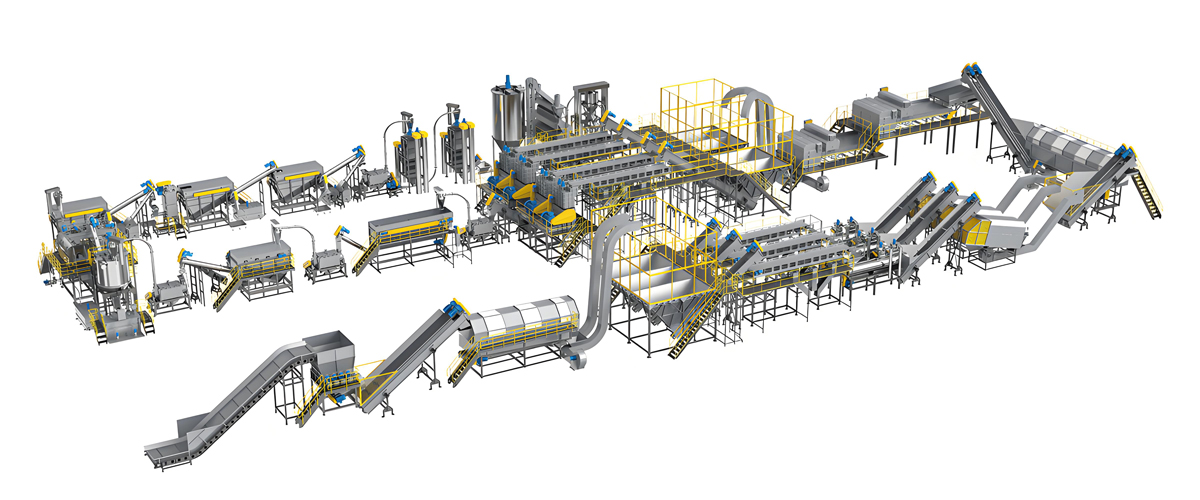
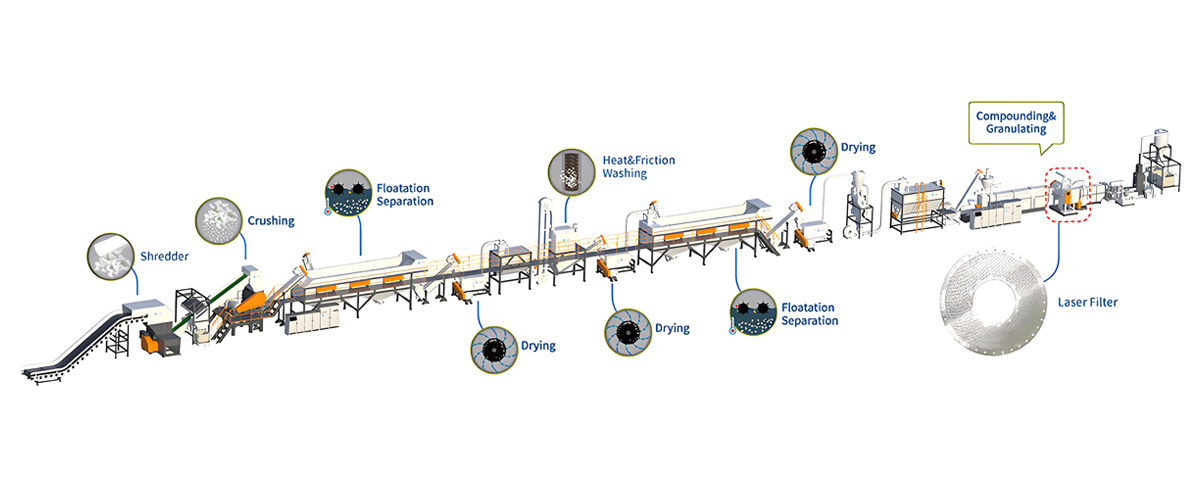
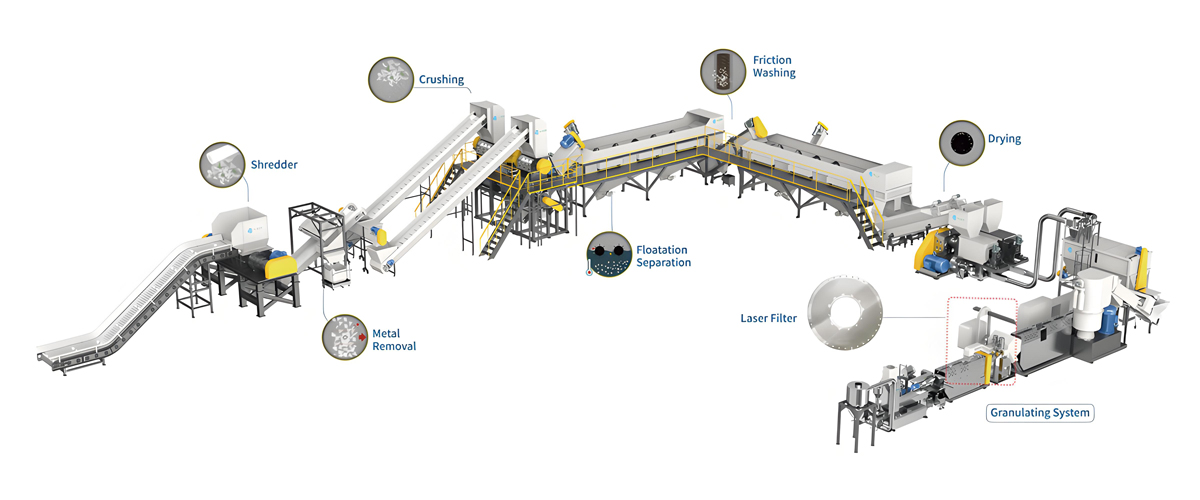
Integration With Washing Lines and Pelletizing Systems
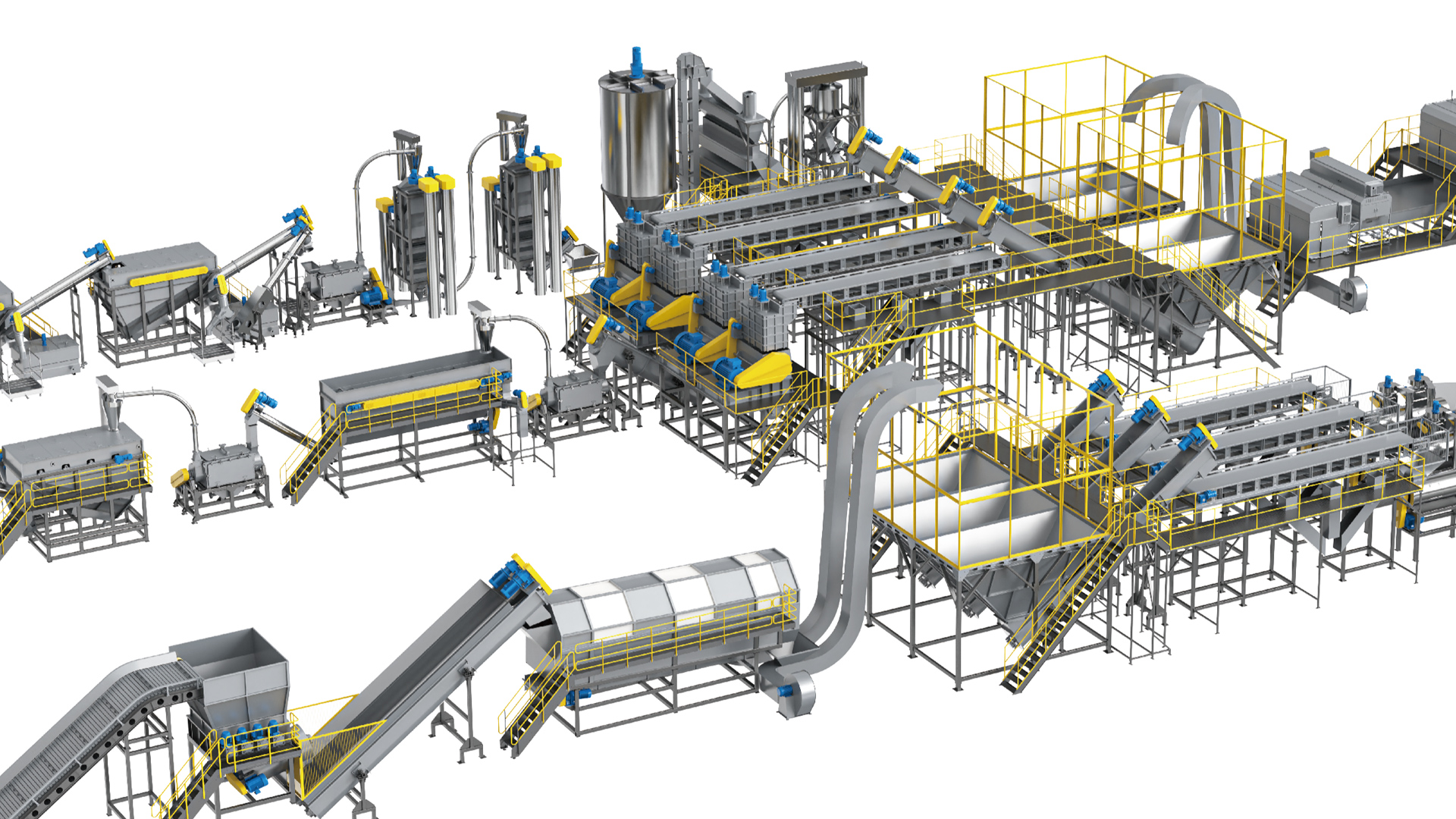
A shredder is rarely the end of the story for disposable plastic waste; it is the front end of a washing and pelletizing line, and its output quality dictates the performance of everything downstream. Polyretec, a Wanplas factory, designs its shredders as the first module of an integrated recycling system rather than as standalone islands, which is why the discharge geometry, flake size, and contamination profile are engineered for the next stage.
After the shredder, the flake typically enters a pre-wash or friction washer. Uniform 20 mm to 50 mm flakes from a single-shaft cut expose more surface to mechanical friction and hot-water washing, stripping oils, inks, and sugars far more effectively than coarse double-shaft chunks would. The screen-controlled maximum size also prevents oversized pieces from wrapping on the beater shaft of the friction washer, a common failure mode when a shredder is mismatched to the washer.
For sink-float separation, flake uniformity improves the sharpness of the density cut. A tight particle distribution means all PP and PS pieces behave similarly in the tank, so the float fraction (PP, PS) separates cleanly from the sink fraction (PET, denser contaminants) without a long tail of ambiguous mid-size pieces that confuse the overflow weirs. Polyretec sizes the shredder screen in consultation with the separation stage to optimize this behavior for the specific disposable mix.
When the stream is mono-material, such as a PP-cutlery-only campaign, the shredded flake can move directly toward pelletizing. Here Polyretec’s integration with the Wanplas group matters: Wanplas’s Kerke factory supplies twin-screw compounding extruders that accept the cleaned flake and produce recycled pellets, while Polyretec’s own new-generation pelletizing line handles thin-wall LDPE films or thick-wall PE/PP regrind. The shredder thus feeds a pelletizing line whose screw design is matched to the flake’s melt behavior, avoiding the incompatibility problems of mixed PP/PS/PET re-melt.
Control integration ties it together. The shredder’s PLC communicates throughput and jam status to the line controller, so the washing line slows when the shredder reverses and speeds when it clears, preventing buffer overflow and starvation. This line-level coordination, standard in Austrian-engineered plants, is what lets a single supervisor run the entire disposable-waste recycling line, and it is a core part of the Wanplas brand promise of efficient, integrated solutions.
| Downstream Stage | What It Needs From the Shredder | Optimal Shredder Setting |
|---|---|---|
| Friction washer | Uniform small flake, no wraps | 20 to 40 mm screen |
| Sink-float separation | Tight size distribution | 40 to 50 mm, balanced rotors |
| Pelletizing (Kerke twin-screw) | Clean, mono-material flake | Pre-sorted, 30 to 50 mm |
The strategic message for buyers is to specify the shredder together with the washing and pelletizing stages, not separately. Polyretec’s project experience across more than 100 installations, from Turkey to Mexico to Vietnam, shows that line-level design yields higher yield and lower specific energy than bolting independently purchased machines together, and the Wanplas network ensures every module speaks the same control language.
CE Safety Standards and Operator Protection
Safety is not a feature added at the end; for an Austrian tech plastic shredder it is woven into the machine from the structural calculation onward, and CE conformity is the documented proof. Polyretec builds its shredders to the applicable European machinery directives, and although many units ship outside Europe, the CE discipline produces a safer, more insurable, and more audit-ready machine wherever it operates.
The central safety principle is that no person can reach a moving cutting tool under any normal or foreseeable fault condition. This is enforced by interlocking guards on the hopper and screen-access doors, a trapped-key or coded-magnet system that prevents opening a guard while the rotor turns, and an emergency stop circuit wired to category-3 or better per the relevant functional-safety standard. The hydraulic pusher and rotor are interlocked so reverse rotation only occurs with the pusher retracted and guards closed, eliminating the classic entrapment scenario.
Electrical safety follows the low-voltage and electromagnetic-compatibility directives, with correctly rated isolation, motor protection, and screened cabling that prevents spurious trips from the variable-frequency drive. Mechanical safety covers guarding of the reducer coupling, the hydraulic power unit relief valves, and the lifting points for rotor removal, all documented in the risk assessment that accompanies the machine.
Noise and dust compliance, discussed earlier, forms part of the CE dossier through the machinery noise-emission declaration and the supplied measurement data. Polyretec provides the declared emission values and, where the enclosure option is specified, the attenuation achieved, so the plant can demonstrate conformity with workplace exposure limits during an inspection.
Operator training is the final, non-negotiable layer. Even the safest machine fails if an untrained worker defeats an interlock to clear a jam. Polyretec’s commissioning includes documented operator and maintenance training, lockout-tagout procedure instruction, and a written risk assessment the customer can fold into their own safety management system. As part of the Wanplas brand commitment, this training and the accompanying technical documentation are part of the standard handover, not a billable extra.
CE conformity on a Polyretec Austrian-tech shredder is the documented outcome of interlocking guards, functional-safety-rated controls, declared noise and dust emissions, and certified operator training, protecting both people and the plant’s operating license.
For procurement teams, the due-diligence step is to request the Declaration of Conformity, the machinery risk assessment, and the noise-emission declaration before accepting delivery. A supplier that cannot produce these documents is selling a machine that may be cheap but is also a latent liability, whereas Polyretec’s Austrian-engineered safety architecture makes compliance a default condition of the purchase rather than a negotiation.
Frequently Asked Questions
What is an Austrian tech plastic shredder for disposable plastic product waste?
It is a single-shaft or double-shaft size-reduction machine built on Central-European cutting-chamber principles, combining a precision rotor, D2 or SKD11 blades at 58 to 62 HRC, a hydraulic pusher, a planetary reducer, and CE-rated controls, tuned to cut low-bulk-density single-use plastics such as PP cutlery, PS cups, and PET lids into a uniform, wash-ready flake.
Why use a single-shaft shredder rather than a granulator for disposables?
A single-shaft shredder with a 20 to 80 mm screen produces a controlled, uniform flake and handles bulky, low-density feed via its hydraulic pusher, whereas a granulator alone struggles with fluffy waste that bridges and rides on the rotor. Most lines use a shredder for the first cut and a granulator only when finer particles are required.
How hard should shredder blades be, and why 58 to 62 HRC?
Polyretec specifies D2 or SKD11 tool steel at 58 to 62 HRC. This band delivers high wear resistance against labels, fillers, and dust while retaining enough toughness to survive the occasional hidden hard object, avoiding the chipping that harder, more brittle blades would suffer on disposable waste.
What screen size is best for mixed disposable plastic waste?
A 40 to 50 mm aperture is the common default, balancing throughput and flake uniformity for washing and sink-float separation. Use 20 to 30 mm when the flake feeds a friction washer or squeezer directly, and 60 to 80 mm only as a pre-cut before a second granulation stage.
How much energy does shredding disposable waste consume?
Specific energy for a tuned single-shaft Austrian-tech shredder on thin-wall disposables typically falls between 40 and 90 kWh per tonne, depending on screen size and contamination. Finer screens and dirtier feed sit at the high end; coarser screens and cleaner feed at the low end. This is lower than double-shaft pre-shredding alone.
How often do the blades need resharpening?
On a relatively clean PP-cutlery stream with a 40 mm screen, expect 800 to 1500 tonnes between edge restorations; on heavily labeled, sandy PS cups the interval can drop to 300 to 600 tonnes. Square double-edge blades present four usable corners, and Polyretec supplies a jig to maintain the original geometry during grinding.
Can the shredder integrate with a washing and pelletizing line?
Yes. Polyretec designs the shredder as the first module of an integrated recycling system, with flake size and discharge engineered for the friction washer, sink-float tank, and pelletizer. The Wanplas group’s Kerke factory supplies twin-screw extruders for pelletizing, and the shredder’s PLC coordinates throughput with the rest of the line.
What safety standards apply to these shredders?
Polyretec builds to the applicable European machinery directives with CE conformity, including interlocking guards, functional-safety-rated emergency stop, declared noise and dust emissions, and certified operator training. The company provides the Declaration of Conformity and risk assessment as standard documentation at handover.
Conclusion
An Austrian tech plastic shredder for disposable plastic product waste is a precision size-reduction system, not a simple chopper, and its value shows up in the metrics that matter to a recycling business: stable kg/h capacity on fluffy feed, specific energy in the 40 to 90 kWh/t band, a tight particle distribution that washing and sorting stages can handle, and blade life measured in hundreds of tonnes between resharpenings. Polyretec, a Wanplas factory, delivers this through Austrian cutting-chamber engineering localized with Chinese manufacturing scale, specifying D2 and SKD11 blades at 58 to 62 HRC, a hydraulic pusher for low-bulk-density waste, a heavy planetary reducer with a high service factor, soft start with overload reversal, and CE-rated safety throughout. For plants processing PP cutlery, PS cups, PET lids, and thin-wall trays, the correct specification is a single-shaft shredder with a 40 to 50 mm screen as the final cut, optionally preceded by a double-shaft pre-shredder for baled or interlocked feed, all integrated into a washing and pelletizing line under one control architecture. We recommend engaging Polyretec early in the project so the shredder, washer, and pelletizer are sized together against a real sample of your disposable waste stream, ensuring the highest yield and lowest cost per tonne of clean recycled flake.