
Shredder overheating is one of the most common and most expensive failures encountered in heavy duty crushing of plastic waste, yet it is also one of the most preventable. When a shredder runs hot, the symptom is rarely the real problem. Heat is the visible signature of an underlying mismatch between the feed material, the machine setup, and the operating envelope. Operators who learn to read that signature protect their blades, their bearings, and their production schedule. This guide explains how overheating develops in heavy duty crushing, how to diagnose each root cause with measurable evidence, and how to design a crushing process that stays cool and productive.
Polyretec, a Wanplas factory, has specialized in plastic recycling equipment since its origin in 2010 and was established as a brand in 2017. With 100+ project references, service in 50+ countries, and a team of 24+ engineers, Polyretec builds washing lines and pelletizing lines that turn difficult post-consumer and post-industrial plastic waste into reusable material. The company slogan, “Turn Waste Into Treasure,” sums up the engineering goal: recover maximum value from material that other lines reject. Solving shredder overheating is central to that mission, because a cool, stable crusher protects every downstream step from washing to pelletizing.
In the sections below we analyze the physics of heat generation inside a shredder, define the bearing temperature thresholds that separate normal operation from danger, specify blade materials and sharpening discipline, balance rotor speed and screen size against throughput, compare cooling methods, and present two real Polyretec equipment modules that embody these principles. We close with a selection guide, a preventive maintenance program, and the service framework that keeps a heavy duty crushing line running inside its safe operating envelope.
Understanding Shredder Overheating in Heavy Duty Crushing
Every shredder converts electrical energy into mechanical work, and no machine is perfectly efficient. In a heavy duty shredder, the majority of input energy becomes useful cutting work, but a meaningful fraction becomes heat. That heat originates from three coupled sources: the shear deformation of plastic as blades slice through it, friction between the cut material and the chamber surfaces, and losses inside the gearbox, bearings, and motor. Under a correct operating envelope, this heat is removed as fast as it is generated, and temperatures stabilize. Overheating begins when heat generation outpaces heat removal.
The crushing chamber of a single-shaft or double-shaft shredder is a relatively enclosed volume. Material sits against a screen, is drawn onto the rotating rotor by hooked blades, and is cut into pieces small enough to pass the screen aperture. In heavy duty service, the feed is not clean uniform scrap. It is agricultural film crusted with dirt, rigid containers with stones, labeled PET bottles, or thick-walled industrial lumps. Each of these raises the force per cut, slows throughput, and increases the residence time of hot material inside the chamber. The chamber temperature climbs, the bearing temperature follows, and the motor current rises.
A useful mental model is the energy balance: heat stored equals heat generated minus heat removed. Generated heat scales with motor load and cutting resistance. Removed heat scales with cooling capacity, chamber ventilation, and the rate at which finished material leaves the machine. When operators push throughput beyond the cooling capacity, or when blade condition degrades, the balance tips and temperature accelerates upward. The practical objective of this guide is to keep the balance tipped the other way, with margin.
A practical way to visualize the safe operating envelope is to plot motor load against bearing temperature on the same trend chart. When the two lines move together and stay flat, the machine is healthy. When bearing temperature rises while motor load is steady, the fault is thermal or mechanical inside the drivetrain rather than in the feed. When motor load rises while temperature lags, the cause is almost always blade condition or screen restriction. This simple two-signal view turns an overheating complaint into a precise diagnosis before any part is opened, and it is the discipline Polyretec builds into every commissioned line so operators trust the data instead of guessing.
Heavy duty crushing differs from light-duty granulation in its tolerance for abuse. A granulator running thin sprues never sees the torque spikes that a heavy duty shredder absorbs when a steel-reinforced object jams the rotor. That robustness is exactly why overheating is dangerous: the machine keeps running while internal damage accumulates. By the time smoke or seizure appears, the bearing, gearbox, or blade seats may already be ruined. Early detection through temperature and current monitoring is therefore not optional, it is the core of reliable operation.
Root Cause Analysis: The Six Primary Triggers
Field data across recycling plants shows that shredder overheating traces back to a short list of causes. We group them into six primary triggers. Treating the symptom without identifying the trigger wastes time, because the same temperature reading can come from very different failures. The disciplined approach is to measure, then classify.
1. Overload from Excessive Throughput
The most frequent cause is simply asking the machine to do more than its cooling and torque envelope allow. Operators raise the feed rate to hit a daily target, the rotor slows under load, the motor draws higher current, and chamber temperature rises. Overload is self-reinforcing: as material heats and softens, it clogs the screen, which raises load further. The fix is feed control, not a bigger motor. A heavy duty shredder should be fed to a target motor load, typically 70 to 85 percent of rated current, not to the limit of the hopper.
2. Dull Blades and Loss of Cutting Edge
A sharp blade parts plastic with a clean, low-resistance cut. A dull blade crushes and tears, demanding far more force for the same result. The extra force becomes extra heat at the cut zone and extra load on the drive. Dull blades are easy to miss because throughput falls gradually. The signature is rising motor current with unchanged feed rate, and a change in particle shape from clean granules to fuzzy, elongated shreds. Scheduled sharpening eliminates this trigger entirely.
3. Mis-Fed Material and Contamination
Mis-feeding means introducing material the machine was not set up for: oversized lumps, tangled film bridged over the rotor, or foreign objects such as metal and stones. Tangled film wraps around the rotor and stalls it, generating intense localized heat. Hard contamination forces the blades to deflect and the gearbox to absorb shock that becomes heat. A properly designed feed system with metal detection and controlled metering prevents mis-feeding before it reaches the cutting zone.
4. Insufficient Cooling or Lubrication
Bearings and gears generate heat by friction, and they depend on lubrication film and cooling to reject it. When the oil level drops, the grease hardens, or the bearing cooling circuit is disabled, temperature climbs steadily even at normal load. This trigger is insidious because it develops slowly and is often overlooked during routine checks. A lubrication schedule tied to operating hours, plus a working bearing cooling loop, removes it.
5. Bearing Failure in Its Early Stage
A bearing that has lost preload, suffered spalling, or ingested contamination runs hot before it fails. The temperature rise is localized to one bearing housing and is often accompanied by a change in noise and vibration. Ignoring an early-stage bearing fault leads to thermal runaway: the hotter it gets, the faster it degrades, the more heat it makes. Continuous bearing temperature monitoring catches this trigger while the bearing is still replaceable during a planned stop.
6. Motor Overload and Electrical Imbalance
The motor itself can be the heat source. Voltage imbalance, a failing contactor, or a mis-set overload relay lets the motor run hot independent of the mechanical load. In such cases the chamber may be cool while the motor terminal box is hot. Electrical measurement, not mechanical inspection, reveals this trigger. Balanced supply, correct protection settings, and periodic thermography of connections keep the motor inside its envelope.
Bearing Temperature Thresholds and What They Tell You
Bearings are the components most sensitive to overheating, and they are the ones that fail catastrophically if ignored. A rolling-element bearing in a heavy duty shredder typically runs warm because it carries high radial and axial loads at low speed with high torque. The absolute number matters less than the trend, but every plant needs fixed thresholds so that alarms mean the same thing to every operator. The table below is a practical framework used on Polyretec washing lines.
Bearing Temperature Reference Framework
| Operating Condition | Bearing Housing Temperature | Required Action |
|---|---|---|
| Normal continuous operation | Below 65 degrees Celsius | Continue running; log data for trend analysis |
| Elevated but stable | 65 to 75 degrees Celsius | Inspect load, verify lubrication, reduce feed if rising |
| Warning stage | 75 to 85 degrees Celsius | Cut throughput, investigate contamination and blade condition |
| Alarm stage | Above 85 degrees Celsius | Auto-stop, allow cool-down, diagnose before restart |
| Imminent failure | Above 90 degrees Celsius | Immediate shutdown, isolate bearing, plan replacement |
Two rules make this framework useful. First, the alarm must be based on the rate of rise as well as the absolute value. A bearing that climbs from 60 to 82 degrees Celsius in ten minutes signals a developing fault even if 82 is still below the hard stop. Trend-based alarms catch bearing failure days before a threshold crossing would. Second, ambient temperature must be part of the interpretation. A housing at 70 degrees Celsius on a cold morning is more suspicious than the same reading on a hot afternoon, because the delta above ambient is what reflects internal friction.
Bearing temperature should be measured at the outer race, ideally with a sensor embedded in the housing near the load zone. Surface infrared guns give a rough check but miss the true race temperature by a wide margin. For heavy duty crushing, Polyretec lines integrate bearing temperature probes into the control system so that the same screen that shows motor load also shows each bearing. That integration turns overheating from a surprise into a managed parameter.
Blade Material, Geometry, and Sharpening Intervals
Blades are where cutting energy is spent, so blade selection and care directly control heat. The wrong material or a neglected edge forces the motor to work harder, raises chamber temperature, and shortens bearing life. The right blade cuts cleanly, stays sharp longer, and keeps the whole line cool.
Blade Materials and Their Behavior
Heavy duty shredder blades are made from hardened tool steels selected for wear resistance and toughness. D2 and SKD-11 are the workhorses: high-carbon, high-chromium steels that hold an edge through thousands of cuts. H13 hot-work steel offers more toughness for sticky, contaminated feed that would chip a brittle edge. For highly abrasive stock such as labeled PET, tungsten carbide tipped edges extend service life dramatically, though at higher cost. The choice is a trade between edge retention and impact resistance, and it should follow the material being crushed.
Sharpening Intervals by Material
| Material Processed | Recommended Blade Material | Sharpening Interval (operating hours) | Notes |
|---|---|---|---|
| Soft LDPE and LLDPE film | D2 hardened tool steel | 400 to 600 | Long interval; low abrasion |
| PP and PE rigid containers, crates | SKD-11 tool steel | 250 to 400 | Moderate wear from filler |
| PET bottles with paper labels | Tungsten carbide tipped | 150 to 300 | Abrasive contamination drives wear |
| Sticky, contaminated post-consumer mix | H13 hot-work steel | 200 to 350 | Toughness prevents chipping |
| Mixed recycled regrind | D2 or SKD-11 | 200 to 300 | Variable hardness demands monitoring |
Geometry matters as much as material. A blade with the correct hook angle and clearance cuts with minimum resistance. Too steep an angle increases the force per cut and the heat; too shallow an angle chips under impact. Polyretec configures blade geometry per application during line commissioning, then documents the confirmed settings so that resharpening restores the original profile rather than a guessed one. Counter blades, the stationary cutters the rotor blades pass against, must be aligned to a tight clearance; a widened gap lets material fold instead of cut, raising load and temperature.
Resharpening should remove only enough material to restore the edge, typically a fraction of a millimeter per pass, because over-grinding changes the blade weight balance and the rotor dynamics. Balanced rotors run smoother, vibrate less, and stay cooler. A blade management program that tracks each blade by serial number, records operating hours, and schedules sharpening before the edge degrades keeps the chamber temperature low and the power draw predictable.
Rotor Speed, Screen Size, and Throughput Balance
Three mechanical settings decide how much heat a shredder makes: rotor speed, screen aperture, and the throughput the operator demands. They interact, so changing one without the others shifts the thermal balance. Understanding the interaction lets an operator cool a hot machine without buying new hardware.
Why Low Rotor Speed Produces Less Heat
Heavy duty shredders are deliberately low-speed, high-torque machines. A single-shaft unit typically rotates at 60 to 90 rpm, and a double-shaft unit at 15 to 45 rpm. Low speed means each blade meets the material with controlled force rather than high-velocity impact, which limits friction heating and protects the blades from shock. High-speed rotation would raise the chamber temperature through air movement and impact energy, so it is avoided in heavy duty crushing. The table below summarizes the relationship.
| Parameter | Single-Shaft Heavy Duty | Double-Shaft Heavy Duty | Effect on Heat |
|---|---|---|---|
| Rotor speed | 60 to 90 rpm | 15 to 45 rpm | Higher speed increases friction heat |
| Screen aperture | 40 to 100 mm | Not applicable | Smaller aperture raises recirculation heat |
| Target motor load | 70 to 85 percent | 70 to 85 percent | Overload steepens temperature rise |
| Torque characteristic | High, via gearbox | Very high, via gearbox | High torque enables cool cutting |
Screen Size and Recirculation
The screen determines the maximum particle size leaving the chamber. A smaller aperture forces material to be cut more times before it escapes, which means more energy per kilogram and more heat. Oversizing the screen to the largest aperture that still satisfies the downstream process is one of the simplest ways to cool a hot shredder. When the washing line only needs flakes below a certain size before granulation, specifying the screen one step larger often drops chamber temperature by a measurable margin while raising throughput.
Throughput Balance
Throughput should be set to the motor load target, not to the hopper capacity. A programmable logic controller can modulate the feed conveyor so that motor current stays inside the envelope even as blade condition changes. This automatic load control is the single most effective defense against overload overheating, because it responds faster than any operator and never chases a daily number at the expense of the machine. Wanplas designs its recycling lines with integrated load-based feed control so that the crushing stage self-regulates.
Cooling Methods and Lubrication Strategy
Cooling is the other side of the energy balance. Generated heat must be rejected, and the method depends on where the heat is and how much there is. A robust heavy duty shredder uses several cooling layers rather than a single one.
| Cooling Method | Primary Application | Advantage | Limitation |
|---|---|---|---|
| Forced air ventilation | Rotor chamber and motor | Simple, low cost, no fluid | Limited capacity in tropical climates |
| Bearing oil cooling circuit | Bearing housings and gearbox | Targets the hottest components | Requires pump, filter, and maintenance |
| Water jacket on chamber | Heavy duty continuous crushing | High heat removal capacity | Corrosion and leak management needed |
| Spray or mist cooling | Specific hot zones | Targeted, responsive | Can introduce moisture to material |
Lubrication is inseparable from cooling because the lubricant both reduces friction heat and carries heat away from the contact zone. Bearing grease must be the grade specified for the load and speed, applied on a schedule measured in operating hours, not calendar time. Oil in the gearbox should be sampled periodically to check for water, metal particles, and viscosity loss; contaminated oil loses its ability to separate surfaces and heat spikes follow. For tropical or high-ambient sites, specifying a higher-viscosity-capable oil and an active oil cooler keeps the gearbox inside its envelope during summer peaks.
A common mistake is to disable the bearing cooling circuit to save energy or because a valve leaks. The circuit typically uses only a fraction of the line’s total power, and its absence can cost a bearing worth many times the saving. Polyretec commissions the cooling circuit as a protected system: it must be running before the rotor starts, and its failure triggers a controlled stop. That interlock is what allows a heavy duty shredder to run through long shifts without thermal drift.
Product Spotlight: Polyretec Heavy Duty Shredder
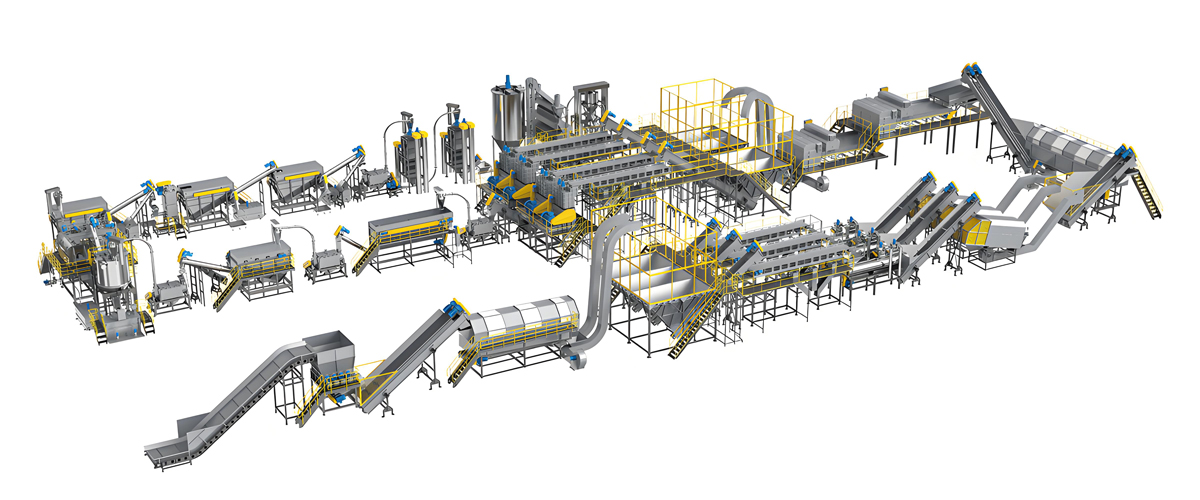
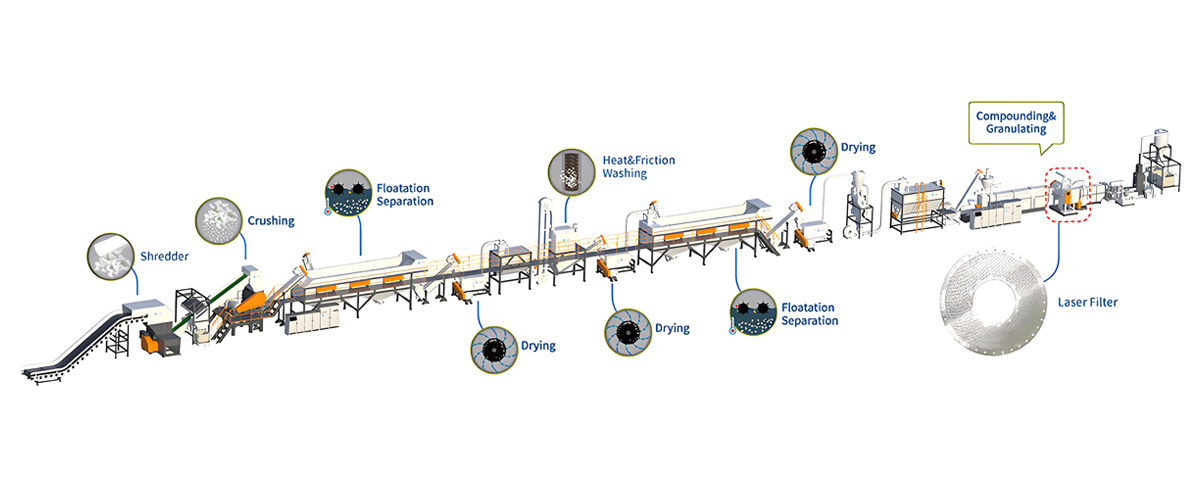
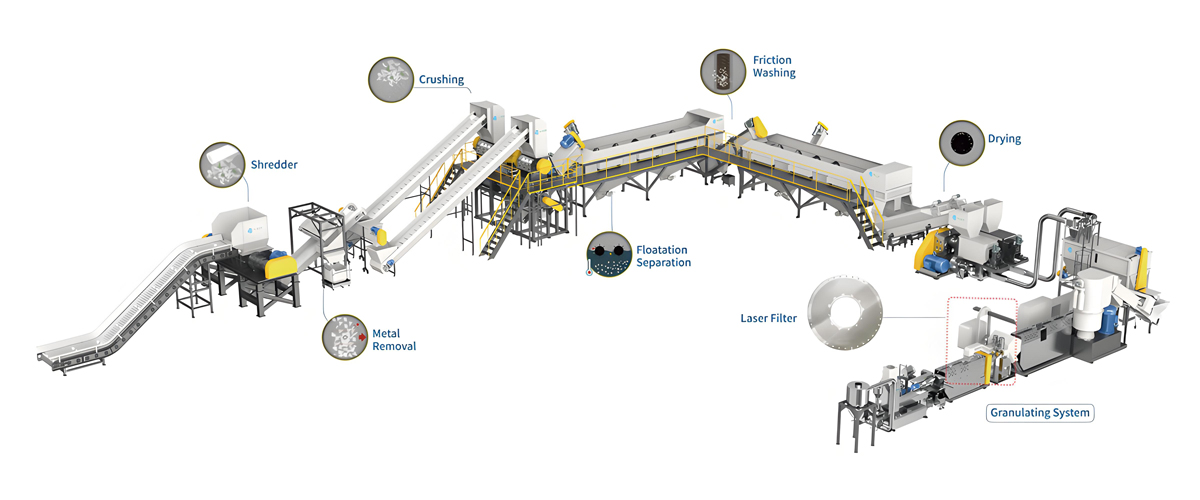
The Polyretec Heavy Duty Shredder is integrated into the company’s washing lines, where it performs the first size-reduction step on contaminated, bulky, or tangled plastic waste before cleaning and sorting. It is engineered around the principles in this guide: low rotor speed, high torque, load-based feed control, and protected bearing cooling. A representative configuration for a washing line is summarized below.
| Specification | Heavy Duty Shredder (Washing Line Integration) |
|---|---|
| Equipment type | Single-shaft heavy duty shredder integrated in Polyretec washing line |
| Rotor diameter | 400 to 800 mm, configurable per project |
| Rotor speed | 60 to 90 rpm, low-speed high-torque |
| Drive power | 55 to 160 kW, project dependent |
| Throughput | Matched to washing line, 500 to 6000 kg/h |
| Blade material | D2 or SKD-11 hardened tool steel, H13 option |
| Screen aperture | 40 to 100 mm, adjustable |
| Cooling | Bearing oil cooling plus forced air ventilation |
| Control | Load-based feed control, bearing temperature alarms |
| Typical feed | LDPE film with stickers, PP and PE rigid, PET bottles pre-shred |
This module is the same class of equipment Polyretec supplied for a washing line processing LDPE film carrying stickers, where the heavy duty shredder and beater machine handled material that jams lesser crushers. Its cooling interlock and load control are what let the line sustain rated output without the temperature excursions that shut down uncontrolled machines. Because it is part of a complete washing line, the crushed material flows directly into friction washing and separation, so the thermal design of the shredder protects the entire recovery process.
Product Spotlight: New Generation Pelletizing Line
After washing and size reduction, many post-consumer streams are converted into reusable pellets. The Polyretec New Generation Pelletizing Line is built for exactly this duty: thin-walled LDPE films or thick-walled PE and PP regrind, with robust construction that delivers maximum performance on post-consumer waste. Its extrusion and filtration stages are the downstream partner to the heavy duty shredder, and its own thermal management is critical because melt temperature, not just mechanical heat, governs quality.
| Specification | New Generation Pelletizing Line |
|---|---|
| Line type | New Generation Pelletizing Line for post-consumer waste |
| Suitable material | Thin-walled LDPE film, thick-walled PE and PP regrind |
| Screw diameter | 100 to 180 mm, configuration dependent |
| L/D ratio | 28 to 36 |
| Output | 200 to 1000 kg/h, material dependent |
| Cutting method | Die-face hot cutting or strand pelletizing |
| Filtration | Continuous screen changer for contamination |
| Cooling | Water ring or air-cooled pellet cooling |
| Integration | Directly after washing line and shredder output |
For downstream pelletizing, Wanplas supplies matched twin-screw pelletizing systems that integrate directly with Polyretec washing lines, so the regrind moves from crusher to pellet without re-handling. The New Generation Pelletizing Line manages melt temperature with staged barrel heating and melt filtration, which protects the polymer from thermal degradation while maintaining output. Stable melt temperature is the extrusion equivalent of stable bearing temperature in the shredder: both are controlled parameters, not hopes.
Application Industries: Plastic Recycling and Renewable Resource
Polyretec equipment serves two overlapping application areas that define the recycling economy. The first is plastic product production: converting waste plastics into reusable pellets and blocks that replace primary resin in new manufacturing. The second is renewable resource utilization: reducing dependence on virgin plastic resources by recovering material that would otherwise be landfilled or burned. Both depend on a crushing stage that runs cool and clean.
In plastic recycling plants, the heavy duty shredder is the gateway. If it overheats and stops, the washing line starves, the pelletizing line idles, and the whole recovery rate drops. In renewable resource operations, where the goal is maximum material recovery from mixed post-consumer streams, the shredder must accept variable, unpredictable feed without thermal failure. The engineering discipline described in this guide is what makes variable feed acceptable. Polyretec’s project experience across more than 50 countries covers film, rigid packaging, and industrial scrap, each with its own overheating risk profile that the line is configured to manage.
Selection Guide: Matching Material and Hardness to Equipment
Choosing the right crushing and recovery path starts with the material form and hardness. The table below maps common waste types to the Polyretec equipment that handles them without overheating, based on the principles of load control, blade selection, and cooling.
| Material and Form | Hardness or Toughness | Recommended Equipment | Cooling and Blade Note |
|---|---|---|---|
| LDPE and LLDPE agricultural film | Soft, flexible | Heavy duty shredder in washing line, then pelletizing | D2 blades, forced air, one-step pelletizing available |
| PP and PE rigid containers, crates | Medium-hard | Heavy duty shredder in washing line | SKD-11 blades, screen 60 to 80 mm |
| PET bottles with labels | Hard, abrasive | PET bottle washing line with crushing stage | Tungsten carbide tips, frequent sharpening |
| PP woven bags, non-woven fabric | Medium, tangling | Heavy duty shredder plus washing | Anti-wrap rotor, controlled metering feed |
| Thick-walled PE and PP lumps | Very hard | Heavy duty shredder, low speed high torque | Bearing oil cooling mandatory |
| Mixed post-consumer regrind | Variable | New Generation Pelletizing Line after crushing | Continuous filtration, melt temperature control |
The pattern is consistent: softer, cleaner material needs less cooling and longer blade life, while harder or contaminated material demands better blades, tighter load control, and active cooling. Matching the equipment to the material before purchase prevents the overheating problems that appear when a line is forced to process stock it was not configured for. Polyretec engineers analyze the customer’s actual waste stream during project design so the delivered line sits inside its safe operating envelope from the first day.
Preventive Maintenance and Monitoring Program
Overheating is cheapest to solve before it happens. A preventive program converts the triggers in this guide into scheduled actions and continuous measurements. The program has three layers: inspection, lubrication, and monitoring.
Inspection Layer
Operators should perform a daily visual and auditory check: listen for changed bearing noise, look for smoke or odor, and confirm the cooling circuit is running. A weekly check measures blade clearance and counter-blade gap, inspects for chipping, and verifies screen condition. A monthly check records bearing temperature trends, samples gearbox oil, and confirms the load-control setpoints. Each check is logged so that a slow drift becomes visible long before a failure.
Lubrication Layer
Lubrication is scheduled by operating hours. Bearings are greased on a cycle matched to speed and load; gearbox oil is changed on a calendar-plus-condition basis with periodic sampling. The grease grade and quantity are documented per bearing position so that refilling restores the designed film rather than over- or under-greasing. Over-greasing can be as harmful as under-greasing because churned grease generates heat, so the program specifies measured amounts.
Monitoring Layer
Continuous monitoring is the modern standard. Bearing temperature probes feed the control system with alarms at the thresholds defined earlier, and motor current is trended against throughput so that dull blades or overload show up as a rising current-to-output ratio. Vibration sensors detect early bearing faults and rotor imbalance. Some plants add infrared thermography of electrical connections during planned stops to catch motor-side heating. Together these measurements turn overheating from an event into a managed parameter with lead time for action.
A safe operating envelope is the result of all these layers working together. It is defined by the maximum sustained motor load, the ambient temperature ceiling, the duty cycle, and the cooling capacity. When any input changes, the envelope is recalculated. Polyretec commissions each line with its envelope documented, trains the customer team to respect it, and supports changes when the material stream evolves. That discipline is why a line rated for 6000 kg/h of film can run for years without a thermal shutdown.
Service and Support from a Wanplas Factory
Polyretec operates as a Wanplas factory, which means customers receive the group’s shared service commitments on top of Polyretec’s recycling specialization. The support framework is built to keep heavy duty crushing lines inside their thermal envelope for the full life of the equipment.
The Wanplas group policy provides USD 500 in free spare parts every year, which covers the consumable items most tied to overheating: blades, bearings, seals, and screen sections. Preventive replacement of these parts on schedule is exactly what prevents heat-related breakdowns, so the free-parts allowance directly supports thermal reliability. Beyond that, Polyretec offers comprehensive after-sales support delivered by its team of 24 plus engineers, who assist with commissioning, troubleshooting, and process optimization across the more than 50 countries the brand serves.
An open factory policy welcomes customers to visit the manufacturing site, audit the build quality, and train on the equipment before shipment. Seeing the cooling interlocks, load-control logic, and blade change procedure in person builds the operational discipline that keeps a shredder cool. For customers with evolving material streams, Polyretec re-evaluates the operating envelope and recommends configuration changes rather than leaving the line to drift into overload. This combination of free parts, engineering support, and open access is what lets a 100 plus project track record continue to grow.
Frequently Asked Questions
What bearing temperature is too hot for a heavy duty shredder?
A shredder bearing running below 65 degrees Celsius is normal. Between 65 and 75 degrees Celsius the operator should inspect load and lubrication. Above 85 degrees Celsius the drive should auto-stop and cool down before any diagnosis begins. A rapid rise toward 90 degrees Celsius signals imminent bearing failure and requires immediate shutdown.
How do dull blades cause shredder overheating?
Dull blades increase the shear force needed to cut each particle, so the motor works harder and the rotor chamber temperature climbs. Sharpening on schedule restores the clean cutting edge and lowers both motor load and heat generation. The earliest sign is usually rising motor current at unchanged throughput rather than visible smoke.
Can a shredder run continuously without a cooling system?
Low-speed, high-torque single-shaft shredders tolerate batch duty with forced air, but heavy duty crushing of thick-walled or contaminated material requires bearing oil cooling and sometimes a chamber water jacket to stay inside the safe operating envelope. Disabling the cooling circuit to save energy typically costs far more in bearing failures.
How often should shredder blades be sharpened?
Soft LDPE film allows 400 to 600 operating hours between sharpening, while abrasive PET bottle stock with labels may need service every 150 to 300 hours. Blade material and contamination level set the interval. A serial-numbered blade program that schedules sharpening before the edge degrades keeps chamber temperature low.
Does screen size affect shredder temperature?
Yes. A smaller screen aperture forces material to recirculate and be cut repeatedly, raising chamber temperature. Selecting the largest aperture that still meets the downstream requirement reduces heat and energy use. The screen should be specified for the washing or pelletizing step that follows, not made arbitrarily fine.
Which rotor speed prevents overheating in heavy duty crushing?
Heavy duty shredders use low rotor speed, typically 60 to 90 rpm for single-shaft and 15 to 45 rpm for double-shaft designs. Low speed with high torque cuts cleanly and limits friction heat far better than high-speed rotation. Raising speed to chase throughput is a common cause of thermal runaway.
What blade material should a heavy duty shredder use?
D2 and SKD-11 hardened tool steel suit most films and rigid stock. Tungsten carbide tipped edges resist abrasion from labeled PET, while H13 handles sticky contaminated feed. Material choice drives sharpening interval and heat stability, so the blade grade should follow the waste stream, not a generic default.
How does the Wanplas group support Polyretec shredder maintenance?
Polyretec, a Wanplas factory, provides USD 500 in free spare parts each year, comprehensive after-sales support with 24 plus engineers, and an open factory policy so customers can audit the line and train on site. These commitments directly fund the preventive replacement of blades and bearings that prevents overheating.
Conclusion
Shredder overheating in heavy duty crushing is never mysterious once you measure the right parameters. It is the product of an energy balance that has tipped toward heat generation: overload, dull blades, mis-fed material, weak cooling or lubrication, early bearing failure, or motor-side electrical problems. Each trigger has a measurable signature in motor current, bearing temperature, blade condition, and feed consistency, and each has a concrete remedy rooted in low rotor speed, correct blade material, sensible screen size, active cooling, and load-based feed control.
Polyretec, a Wanplas factory with origins in 2010 and a brand established in 2017, builds this discipline into every line it delivers. The Heavy Duty Shredder integrated in its washing lines and the New Generation Pelletizing Line for post-consumer waste both embody the thermal principles covered here, from protected bearing cooling to melt temperature control. With more than 100 project references, service in over 50 countries, and 24 plus engineers, Polyretec turns difficult waste into reusable material under the slogan “Turn Waste Into Treasure.”
If your crushing stage runs hot, stops unexpectedly, or shortens blade life, the most valuable next step is a direct conversation with the Polyretec engineering team. Share your material stream, target throughput, and current pain points, and the team will analyze the root cause, recommend the right configuration of heavy duty shredder and pelletizing line, and invite you to visit the factory to witness the line running inside its safe operating envelope. You are welcome to request a tailored proposal, arrange a factory audit, or schedule a sample trial run on your own waste so you can verify cool, stable, high-recovery operation before you commit.