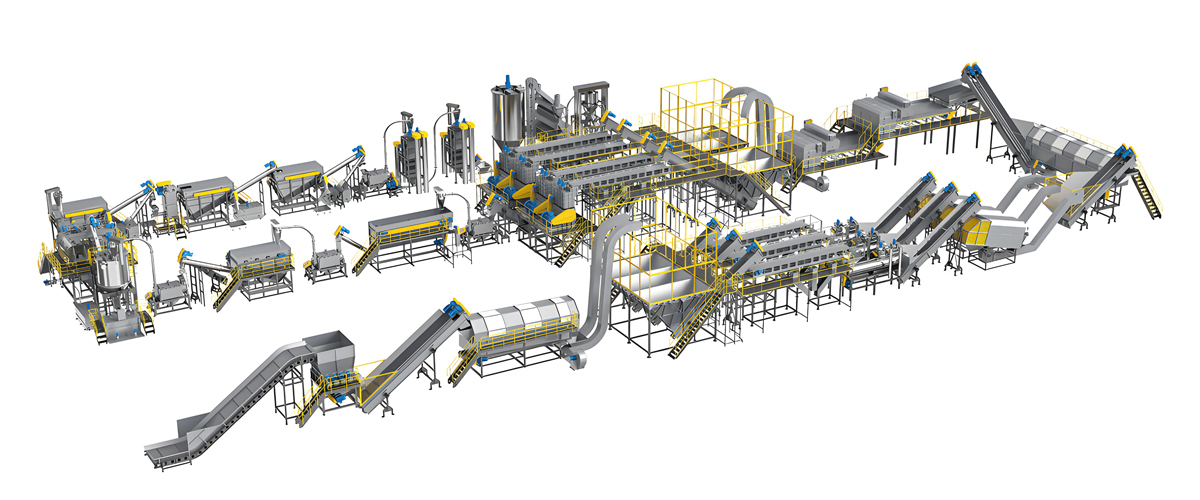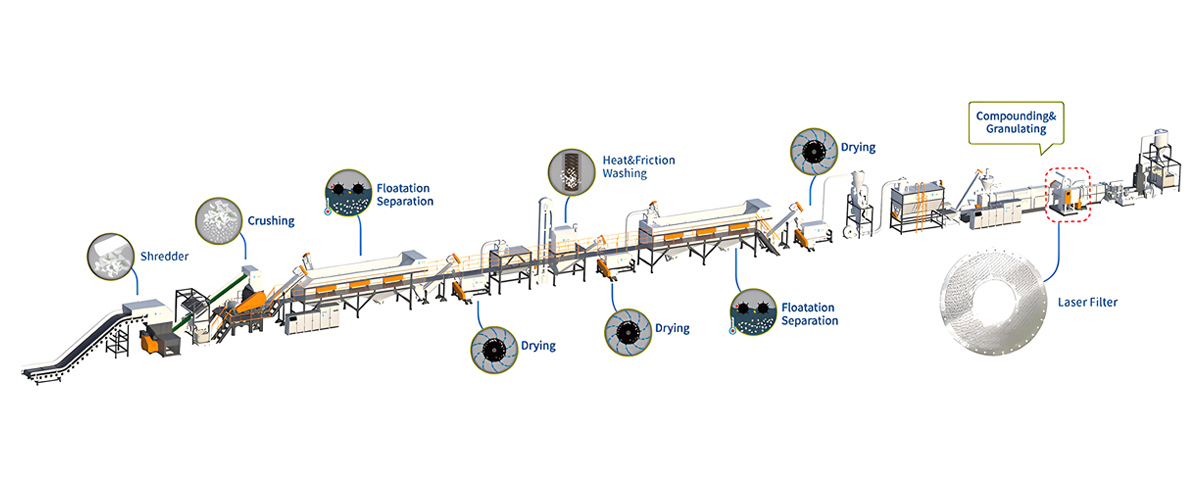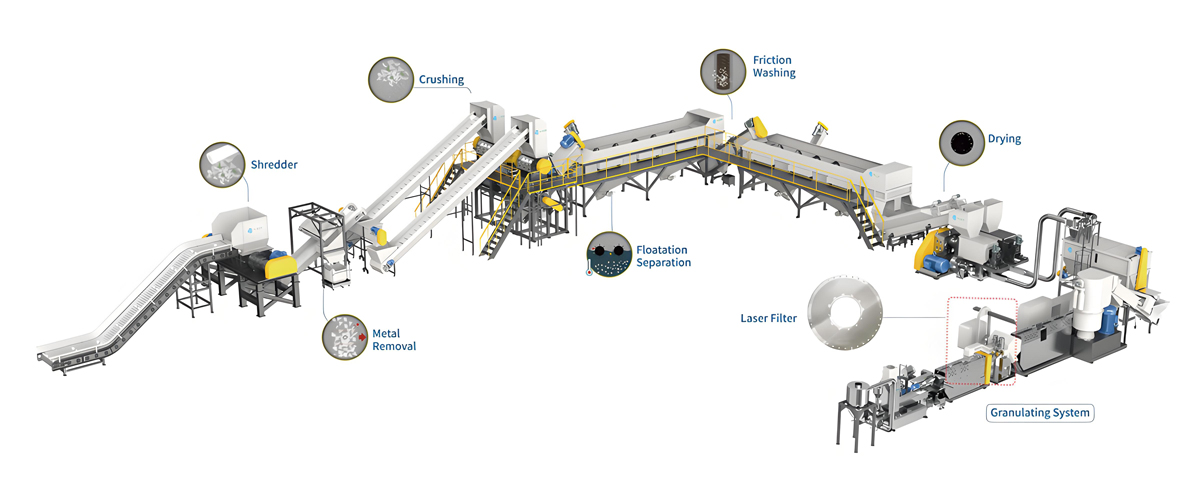

Choosing the correct pelletizing extruder for recycled plastic flakes is the single decision that sets the ceiling on pellet quality, throughput, and operating cost for any recycling plant. Unlike virgin resin compounding, where the feed is uniform and dry, recycled flakes arrive with wide swings in moisture, bulk density, contamination, and melt flow rate that directly change which machine route will succeed. A pelletizing extruder that is perfect for rigid PET bottle flakes can fail badly on soft LDPE agricultural film, and a twin-screw line built for heavy degassing may be over-engineered and unprofitable for clean, single-grade HDPE regrind.
This guide explains how to select a pelletizing extruder for recycled plastic flakes by working from the material upward. We start with the measurable input variables of the flake stream, then compare the five principal machine routes — single-screw with force feeder, single-screw with cutter-compactor, co-rotating parallel twin-screw, conical and counter-rotating twin-screw, and two-stage tandem systems. We then detail the subsystems that decide pellet quality: degassing, the melt filter and screen changer, the melt pump, and the pelletizing method. Finally we cover process windows, defect troubleshooting, and energy accounting so you can size the line with confidence.
Polyretec, a Wanplas factory, has supplied plastic recycling equipment since 2010 and combines Austrian process know-how with Chinese manufacturing scale across more than 100 recycling projects in over 50 countries. The guidance below reflects field experience on post-consumer and post-industrial flake streams rather than textbook ideal cases. Where specific numbers are given, treat them as typical engineering ranges that must be confirmed by a trial run on your own flake. For twin-screw compounding-integration needs, Wanplas’s Kerke factory supplies co-rotating twin-screw extruders that bolt onto recycling pelletizing lines.
Input Variables of Recycled Flakes That Drive Extruder Selection
The pelletizing extruder is only as good as the feed it receives. Before any machine route is chosen, the flake stream must be characterized on six independent variables, because each one pushes the design in a different direction. Ignoring any one of them is the most common reason a newly installed line fails to reach nameplate capacity.
Material family and its thermal sensitivity
The polymer identity sets the temperature ceiling, the shear tolerance, and the degassing demand. PET flakes are hygroscopic and shear-sensitive; above about 285 degrees C and in the presence of moisture they hydrolyze and lose intrinsic viscosity. HDPE and PP are forgiving but oxidize if residence time is long. LDPE agricultural film carries ink, soil, and silicone and degrades if shear is too high. PS and ABS are stiff and brittle and need careful temperature control to avoid yellowing. PVC — often a contaminant in mixed streams but also a legitimate feed — is heat- and shear-intolerant and demands a dedicated conical or counter-rotating twin-screw route rather than a single-screw line.
Moisture content after washing
Washed flakes usually hold 0.3 to 1.0 percent residual moisture depending on the dewatering and drying stage. For PET this moisture must be driven below roughly 0.3 percent before the barrel or hydrolysis destroys the IV; for PE and PP a little surface moisture is vented through degassing but high carryover wastes energy and destabilizes the melt. Moisture level decides whether you need a crystallizing dryer upstream or whether a dry-free twin-screw degassing route is acceptable.
Bulk density and the bridging problem
Bulk density determines how the hopper and feeder must be built. PET flakes sit at 300 to 400 kg/m3 and feed almost like a free-flowing solid. LDPE film flake, by contrast, floats at 30 to 80 kg/m3 and traps enormous air volume, bridging in any conventional hopper and starving the screw. PP woven bag flake and fiber fall between. The lower the bulk density, the stronger the case for a cutter-compactor or crammer feeder that mechanically densifies the feed before the barrel.
Flake size distribution
Most washing lines size flakes to 8 to 16 mm. Smaller flake melts faster but entrains more air and dust; larger flake feeds more steadily but can overload a force feeder. The flake size distribution also interacts with the melt filter, because oversized, undetected metal or unmelted regrind raises back pressure and accelerates screen consumption.
Impurity level: metal, paper, PVC, and gel
Post-consumer flake carries metal, paper, labels, PVC, and silicone at ppm levels that still matter. PVC is the most dangerous co-contaminant in a PET stream because it dehydrochlorinates and yellows the whole melt. Paper and wood fiber char and become black specks. Metal damages screws and barrels. These impurities set the required filtration fineness of the melt filter and the necessity of upstream metal separation and color sorting. EN 15347 classifies contamination in recycled plastics and is the practical language for specifying acceptable flake quality to a washer supplier.
Melt flow rate fluctuation and volatiles
Recycled flake rarely has a single melt flow rate. Mixed bottle grades, added caps, and labels push the MFR band wide, and the volatiles from residual inks, oils, and food residues create odor and bubbles. Both variables raise the need for degassing and for homogenization in the barrel. Melt flow rate should be measured per ASTM D1238 or ISO 1133 on every incoming lot to bracket the expected processing window.
The table below maps the principal flake types to a recommended machine route and the typical length-to-diameter ratio, throughput band, and specific energy you can expect. These are starting points; a trial run confirms the final numbers.
Table 1 — Raw material type, recommended machine route, L/D ratio, throughput, and specific energy
| Recycled flake type | Recommended machine route | Typical L/D ratio | Throughput range (kg/h) | Specific energy (kWh/kg) |
|---|---|---|---|---|
| PET bottle flakes (rigid, washed) | Single-screw + force feeder, or two-stage vacuum for food grade | 30:1 to 36:1 (single); 40:1 to 48:1 (two-stage) | 300 to 2000 | 0.13 to 0.22 |
| HDPE bottles and rigid regrind | Single-screw + force feeder | 30:1 to 34:1 | 300 to 1500 | 0.13 to 0.20 |
| LDPE agricultural film (soft, low bulk density) | Single-screw + cutter-compactor | 28:1 to 33:1 | 300 to 1500 | 0.15 to 0.25 |
| PP woven bags and raffia | Single-screw + cutter-compactor | 28:1 to 32:1 | 300 to 1200 | 0.15 to 0.24 |
| PS / ABS rigid flakes | Single-screw or twin-screw with degassing | 32:1 to 40:1 | 300 to 1200 | 0.16 to 0.26 |
| Mixed, high-volatile, filler-added flakes | Co-rotating parallel twin-screw | 40:1 to 48:1 | 300 to 1500 | 0.20 to 0.35 |
| PVC rigid flakes and profiles | Conical / counter-rotating twin-screw | 18:1 to 25:1 (conical) | 200 to 800 | 0.18 to 0.30 |
Single-Screw Extruder with Force Feeder for Rigid Flakes
The single-screw extruder with a force feeder is the workhorse for rigid, free-flowing flakes such as PET bottle flakes and HDPE regrind. Its strength is simplicity, low capital cost, easy maintenance, and a specific energy as low as 0.13 kWh/kg. The force feeder — often a crammer or a side-stuffing auger — pushes flake into the barrel throat at a controlled rate so the screw never starves, which matters because rigid flakes can interlock and surge in a gravity hopper.
Geometry and throughput
Typical geometries use a barrel with an L/D ratio of 30:1 to 36:1 and screw diameters from about Φ90 to Φ200. A Φ120 single-screw line commonly delivers 400 to 700 kg/h on PET, while a Φ200 unit reaches 1500 to 2000 kg/h. Throughput scales roughly with screw diameter squared and with screw speed, but the limiting factor for flakes is usually melt homogeneity and filtration back pressure rather than mere conveying capacity.
Compression ratio and shear control
Flakes need a moderate compression ratio, often around 3:1 to 4:1, so the solid bed collapses and melts without over-shearing. Because PET is shear-sensitive, the metering section must be designed for low specific energy and short residence time. The barrel is zoned for feeding, compression, melting, mixing, and metering, with one or two vacuum vents placed after the melting zone where the melt is thin enough for gas to escape.
Where it falls short
A single-screw line has weak dispersive mixing. It cannot break down agglomerated contamination or homogenize widely varying MFR as well as a twin-screw. For film, fiber, or very low bulk-density material it bridges unless a cutter-compactor is added. And for food-grade rPET it usually needs a downstream crystallizer, dryer, and a second vacuum stage to protect intrinsic viscosity. Compared with competitors such as EREMA or Starlinger single-screw routes, the Chinese-manufactured single-screw line from a Wanplas factory like Polyretec trades some automation for a substantially lower capital tier while keeping the same core process physics.
Cost tier
Capital and operating cost for a single-screw rigid-flake line is Low to Medium. It is the right choice when the feed is clean, single-grade, rigid, and already dried, and when the target is commodity re-pellet rather than food-grade rPET.
Single-Screw Extruder with Cutter-Compactor for Film and Soft Materials
The single-screw extruder paired with a cutter-compactor is the standard answer for soft, fluffy, low-bulk-density flakes: LDPE agricultural film, post-consumer film, PP woven bags, raffia, and non-woven fiber. On its own, a single-screw cannot swallow this material because the flake floats at 30 to 80 kg/m3, traps air, and bridges. The cutter-compactor solves this upstream of the barrel.
How the cutter-compactor works
The compactor is a rotating knife chamber that chops and friction-heats the flake while a hot face discharges directly into the extruder feed throat. Friction preheats the material to roughly 70 to 95 degrees C, which drives off surface moisture and, more importantly, collapses the fluff so bulk density rises by 3 to 8 times. The densified, pre-warmed mass feeds the single-screw barrel continuously and without bridging. This preheating also reduces the thermal load on the barrel, lowering specific energy versus feeding cold film.
Throughput and material fit
Cutter-compactor lines handle 300 to 1500 kg/h depending on screw diameter and film thickness. Thin LDPE agriculture film with high ink load needs the compactor at the higher end of the preheat range and strong degassing to remove volatiles from print and silicone release agents. PP woven bags, being stiffer, feed well but can carry sand and filler that accelerate screw and barrel wear, so abrasion-resistant liners are advised.
Limitations
The cutter-compactor adds cost and complexity versus a plain hopper, and the aggressive chopping can over-heat heat-sensitive material if not controlled. It is not ideal for rigid PET flakes, which are better fed by a force feeder, and it does not provide the intensive mixing or multi-stage degassing of a twin-screw. For printed film, residual odor after pelletizing signals that degassing capacity is insufficient and a twin-screw or two-stage route should be considered.
Cost tier
Capital cost is Medium. Operating cost stays favorable because preheating cuts barrel energy, but knife wear and compactor maintenance are recurring items.
Co-Rotating Parallel Twin-Screw Extruder for Heavy Degassing and Compounding
The co-rotating parallel twin-screw extruder is selected when the flake demands strong dispersive mixing, deep degassing, or simultaneous compounding with filler, compatibilizer, or color. Two intermeshing, co-rotating screws in a closed barrel give high shear, excellent self-cleaning, and the ability to place several vacuum vents along the length.
Geometry and degassing capacity
These lines run longer at an L/D ratio of 40:1 to 48:1, which leaves room for feed, melting, multiple mixing and venting zones, and a metering zone. Vacuum is pulled at two or more stages, commonly reaching minus 0.08 to minus 0.095 MPa, which strips moisture, air, and volatiles far more completely than a single vent on a single-screw. For high-moisture or high-ink flake, this multi-stage degassing is what removes odor and prevents bubbles and hollow pellets.
Modular screw design
The screw is built from interchangeable elements — conveying, kneading, and reverse elements — so the shear and residence profile is tuned to the flake. Side feeders can inject filler, glass fiber, or liquid additive mid-barrel, so the same pelletizing extruder also compounds. This is why Wanplas’s Kerke factory builds co-rotating twin-screw lines: the modular barrel supports both recycling pelletizing and masterbatch or engineering-compound production on one machine.
When to choose it
Choose a twin-screw route when the flake is mixed or contaminated, when volatiles are high, when you must add filler or compatibilizer, or when the product spec demands tight MFR and color uniformity. It is also the route for a dry-free PET process where deep vacuum degassing replaces pre-drying, provided delta IV is held below 0.03. The trade-off is higher capital, more complex control, and faster wear of screw elements in abrasive flake.
Cost tier
Capital and maintenance cost is High to Very High. The payback comes from product value: compounded, deodorized, uniform pellets command a better price than straight re-pellet.
Conical Twin-Screw, Counter-Rotating Routes, and Two-Stage Tandem Systems
Two further routes deserve dedicated attention because they cover materials and quality levels the single-screw and co-rotating twin-screw lines do not serve well: the conical or counter-rotating parallel twin-screw for PVC and rigid heat-sensitive stock, and the two-stage tandem system for demanding PET and high-quality re-pellet.
Conical and counter-rotating twin-screw for PVC
PVC flakes and profiles must never run on a high-shear single-screw because PVC degrades and releases HCl above about 200 degrees C. The conical twin-screw and the counter-rotating parallel twin-screw use a calandra-like nip that gently conveys and melts PVC at low shear and short residence time. Their L/D is short, typically 18:1 to 25:1 for conical designs, and they tolerate the heat-sensitive, easily decomposed nature of PVC. Throughput is moderate, around 200 to 800 kg/h, and cost is Medium to High. Detection of even small PVC fractions in a PET stream is therefore critical, because a PVC-contaminated PET feed will yellow and corrode a single-screw barrel.
Two-stage tandem (mother-baby) systems
The two-stage tandem pairs a first stage that plasticizes and a second stage that finishes at low shear with intense degassing. The first extruder (often a single-screw or the first twin-screw) does the melting and rough mixing; the melt is transferred to a second extruder operating at lower shear and longer vacuum residence. This split isolates the high-shear melting from the gentle, fully degassed finishing, which is ideal for PET where shear and oxygen together destroy IV, and for any flake where odor and volatiles must be driven to very low levels.
PET-dedicated routes
For food-grade rPET, two proven routes exist. The first is crystallization and drying followed by a two-stage vacuum extruder: the flake is crystallized to stop clinging and dried below roughly 0.3 percent moisture, then extruded through a first plasticizing stage and a second deep-vacuum stage that protects intrinsic viscosity. The second is a dry-free co-rotating twin-screw with aggressive vacuum degassing that accepts higher surface moisture and still holds delta IV below 0.03. When the final IV is still short of bottle-to-bottle spec, solid-state polycondensation (SSP) downstream raises IV to target. The choice between routes depends on flake purity, energy cost, and the required final IV.
Cost tier
Two-stage and PET-dedicated lines are High to Premium. They are justified when the pellet must meet food-contact rules such as FDA 21 CFR 177.1630 or EFSA opinion, or when GRS certification and consistent IV are contract requirements.
Key Subsystems: Degassing, Melt Filter, Melt Pump, and Pelletizing Methods
Whatever the machine route, four subsystems decide whether the pellets are saleable: degassing, melt filtration, melt pressure stabilization, and the pelletizing method. Getting these wrong wastes the investment in the extruder itself.
Degassing
Degassing removes moisture, trapped air, and volatiles. A single vacuum vent suits clean, dry, low-odor flake. Double or multi-stage venting is needed for film, printed material, and food-contact PET. The vacuum source matters: a water-ring pump is cheaper and tolerates vapor and dust but reaches only moderate vacuum; a Roots blower (often backed by a water-ring pump) pulls deeper, to minus 0.08 to minus 0.095 MPa, which is required for low residual VOC and for protecting PET IV. Residual VOC after pelletizing should be verified by odor panel or analytical test, not assumed.
Melt filter and screen changer
The melt filter, also called a screen changer, strips solid contamination — metal, paper char, gel, unmelted specks — from the melt before the die. Plate-type screen changers use stacked wire mesh and come as manual, hydraulic, or double-column four-screen versions that shift a clean screen into position. Continuous belt filters and slide-plate automatic screen changers swap screen without stopping the line, holding pressure steady. Laser-drilled and slotted wedge-wire screens give precise, uniform pores at 80 to 300 micrometres, corresponding to about 60 to 180 mesh, and resist blinding better than woven mesh. Back pressure across the filter rises with fineness and contamination and typically runs 8 to 20 MPa; the filter area and the change frequency must be sized to the contamination load so the line is not stopped every few hours. Higher fineness protects pellet appearance but raises energy and screen cost.
Table 3 — Melt filtration options by precision, automation, contamination level, and relative cost
| Filtration solution | Typical precision | Automation level | Suitable contamination level | Relative cost tier |
|---|---|---|---|---|
| Manual plate screen changer | 150 to 300 micrometres (60 to 100 mesh) | Manual, line stops | Low | Low |
| Hydraulic double-column, four-screen | 100 to 250 micrometres (70 to 150 mesh) | Hydraulic, fast shift | Low to medium | Medium |
| Continuous belt / slide-plate automatic | 80 to 250 micrometres (60 to 170 mesh) | Fully automatic, no stop | Medium to high | High |
| Laser-drilled / wedge-wire screen | 80 to 300 micrometres (60 to 180 mesh) | Automatic with continuous changer | High, gel-prone | High to Very High |
Melt pump for pressure stabilization
A melt pump (gear pump) mounted between the extruder and the die isolates the die from screw pulsation. It holds die pressure steady within about plus or minus 0.2 MPa, which tightens pellet size and shape and lifts throughput 5 to 15 percent because the extruder can run at higher screw speed without pressure fluctuation. For film and fiber re-pellet where strand or die-face uniformity matters, the melt pump pays for itself in yield and grade. It adds cost and a heated, sealed component that must be maintained, so it is usually specified on Medium to High tier lines.
Pelletizing methods compared
The pelletizing method decides pellet shape, cooling load, and labor. Strand pelletizing pulls extruded strands through a water bath, air-dries them, and cuts them on a puller; it is simple and cheap but needs floor space and hands-on tending, and is poor for hydroscopic PET strands that absorb water. Water-ring pelletizing cuts the melt against a rotating blade at the die face into a water ring; it suits film and soft materials, runs at medium to high throughput, and uses moderate water. Underwater pelletizing cuts inside a water-filled chamber, giving spherical, uniform, dust-free pellets at the highest throughput; it is the choice for PET and high melt-strength materials and for food-grade where pellet cleanliness matters, at Premium equipment cost. Die-face hot cutting (air-cooled) is used for some PE/PP where water contact is undesirable.
Table 4 — Pelletizing method comparison
| Pelletizing method | Pellet shape | Throughput | Water use | Energy note | Best-suited material |
|---|---|---|---|---|---|
| Strand pelletizing | Cylindrical, variable length | Low to medium | Medium (bath + dry) | Lowest | PE, PP, rigid flakes |
| Water-ring pelletizing | Near-spherical, small | Medium to high | Medium | Medium | LDPE film, PP, soft flakes |
| Underwater pelletizing | Spherical, uniform | High | High (closed loop) | High | PET, high melt-strength materials |
| Die-face hot cutting (air-cooled) | Irregular, small | Medium | None | Medium | PE, PP avoiding water |
Downstream of cutting, the pellets pass a vibrating screen for size grading, a de-dusting step, pneumatic conveying to a silo, and blending or homogenization in the silo before packaging. Homogenization in the silo is what smooths out MFR and color batch-to-batch variation.
Process Parameter Windows by Material
Each polymer has a temperature window in which the melt is stable and the pellet is clean. Running below the window gives poor melting and unmelted specks; running above it degrades the polymer, yellows the pellet, and, for PET, drops intrinsic viscosity. The figures below are barrel-set ranges at the die; local melt temperature can differ by several degrees.
Table — Process windows by material
| Material | Barrel / melt temperature window (degrees C) | Screw speed guide | Melt / die pressure note |
|---|---|---|---|
| PET flakes | 265 to 285 | Medium, avoid over-shear | Protect IV; deep vacuum |
| HDPE | 190 to 230 | Medium to high | 8 to 18 MPa at filter |
| LDPE film | 170 to 210 | Medium | Lower pressure, avoid degradation |
| PP (woven, rigid) | 200 to 240 | Medium to high | 10 to 18 MPa at filter |
| PS / ABS | 200 to 230 | Medium | Avoid yellowing, vent well |
Screw speed sets shear and residence time; for shear-sensitive PET it is kept moderate, while for PE and PP it can rise to raise output. Melt pressure at the filter and die should be monitored continuously because a rising trend means the screen is loading or the die is narrowing. Die pressure stability, especially with a melt pump, is the single best proxy for steady pellet quality.
Common Defects and Countermeasures
Even a well-selected pelletizing extruder produces defects when the upstream flake or the process window drifts. The table below is the field troubleshooting map used by Polyretec service engineers. Each defect points to a root cause and a concrete countermeasure.
Table 5 — Defect, root cause, and countermeasure
| Defect | Likely cause | Countermeasure |
|---|---|---|
| Black specks / carbonization | Dead spots, long residence, overdue cleaning | Shorten residence, set cleaning cycle, reduce barrel tail temperature, purge regularly |
| Bubbles / hollow pellets | Moisture or insufficient degassing | Improve drying, add vacuum stage, deepen vacuum to minus 0.09 MPa, check pump seal |
| Uneven pellet size | Knife gap, blade wear, speed mismatch | Adjust knife-to-die gap, sharpen or replace blades, match cutter speed to throughput, add melt pump |
| Color streak / dark line | Poor mixing, un-homogenized feed, contamination | Use twin-screw or add mixing element, homogenize in silo, tighten upstream color sort |
| MFR drift between batches | Inconsistent feed grade, surge feeding | Gravimetric loss-in-weight feeder, narrow flake MFR band, verify per ASTM D1238 / ISO 1133 |
| Screw and barrel wear | High ash, sand, filler, metal in flake | Upstream metal separation, abrasive-resistant liner, reduce filler, maintain clearance |
| Odor in pellets | Residual volatiles, ink, oil | Add degassing stage, raise vacuum, use twin-screw, improve washing |
| PET IV drop / brittle pellet | Moisture + shear + oxygen | Dry below 0.3 percent, two-stage vacuum, inert blanket, hold delta IV below 0.03 |
Energy Consumption and Throughput Accounting
Sizing the line is finally an energy and yield calculation. The installed motor power is not the same as the energy consumed; the actual load depends on screw speed, melt viscosity, and degassing duty, and the plant power factor (often 0.8 to 0.9 for an extrusion line with mixed drives) sets the apparent power the supply must deliver. Specific energy — kWh per kg of good pellet — is the figure that should appear in any comparison between routes.
Specific energy by route
Single-screw rigid-flake lines are the most efficient at 0.13 to 0.22 kWh/kg. Cutter-compactor film lines sit at 0.15 to 0.25 kWh/kg because preheating offsets some barrel load. Twin-screw and two-stage systems with deep degassing and compounding run 0.20 to 0.35 kWh/kg. Adding a melt pump usually lowers the per-kg energy at a given output by allowing higher screw speed with stable pressure, and lifts yield by cutting off-grade pellet.
Throughput and shift accounting
Nameplate throughput assumes continuous feed and clean flake. Real shift output equals nameplate times equipment utilization (commonly 0.85 to 0.92) times good-rate (commonly 0.95 to 0.99). A 1000 kg/h line at 0.88 utilization and 0.97 good-rate delivers about 839 kg/h of saleable pellet, or roughly 20 tonnes per 24-hour day. The good-rate is where the melt filter fineness and degassing quality earn their cost: a coarser screen saves energy but raises rejection at the color sorter downstream.
Quality verification and standards
Every lot should be tested for melt flow rate (ASTM D1238 or ISO 1133), density (ASTM D1505 by density-gradient column), contamination class (EN 15347), and, for food-contact, the relevant migration and purity rules (FDA 21 CFR 177.1630, EFSA). The recycling process and material loop are framed by ISO 15270, and the plant should run an ISO 9001 quality system. Recycled-content claims are evidenced through GRS certification. These references are the language buyers and brands use, and they should appear on the pellet specification sheet.
Frequently Asked Questions
What is the difference between a single-screw and a twin-screw pelletizing extruder for recycled flakes?
A single-screw extruder is simpler, lower cost, and well suited to rigid, low-bulk-density-stable flakes such as PET and HDPE where shear and mixing demands are modest. A co-rotating parallel twin-screw extruder provides far stronger dispersive mixing, self-cleaning, and the multi-stage vacuum degassing needed for high-volatile, high-moisture, or filler-modified streams, at a higher capital and maintenance level.
Do I need a cutter-compactor for LDPE agricultural film flakes?
Yes, in most cases. LDPE agricultural film and similar soft, low-bulk-density flake (30 to 80 kg/m3) bridge and entrain air in a plain hopper. A cutter-compactor densifies and preheats the material to roughly 70 to 95 degrees C, raising bulk density by 3 to 8 times and feeding the barrel steadily without bridging.
How do I choose between strand, water-ring, and underwater pelletizing?
Strand pelletizing is simple and cheap, fits low to medium throughput, and needs a water bath and air dryer. Water-ring pelletizing suits film and soft materials at medium to high throughput with moderate water use. Underwater pelletizing gives spherical, uniform pellets at the highest throughput and is preferred for PET and high melt-strength materials, at Premium equipment cost.
What melt filter micron rating should I use for post-consumer PET flakes?
For washed post-consumer PET flakes, continuous screen changers or laser/slotted wedge-wire filters at 80 to 300 micrometres (about 60 to 180 mesh) are typical. Tighter filtration near 80 to 120 micrometres is chosen when gel, paper, and silicone contamination are high, accepting higher back pressure of 8 to 20 MPa.
How important is degassing for recycled plastic flakes?
Degassing is decisive. Residual moisture, trapped air, and volatiles from inks, oils, and food residues cause bubbles, hollow pellets, odor, and hydrolysis. Single or double vacuum vents at minus 0.08 to minus 0.095 MPa remove these; PET especially needs strong degassing or the intrinsic viscosity drops and pellets turn brittle.
What is the typical specific energy consumption of a pelletizing extruder for flakes?
A single-screw line for rigid PET or HDPE flakes typically runs 0.13 to 0.22 kWh per kg of pellet. Twin-screw and two-stage systems with intensive degassing sit higher, often 0.20 to 0.35 kWh/kg depending on moisture, filler loading, and vacuum duty. Adding a melt pump can lift throughput 5 to 15 percent at similar energy.
Can I pelletize PET flakes without pre-drying?
It depends on the route. A conventional single-screw line needs crystallized and dried feed below about 0.3 percent moisture to avoid hydrolysis and IV loss. A dry-free co-rotating twin-screw route with deep vacuum degassing can accept higher surface moisture, but for food-grade rPET a crystallization and drying stage before a two-stage vacuum extruder remains the safer route to hold delta IV below 0.03.
How do I keep the melt flow rate of recycled pellets stable?
Stability comes from consistent feed composition and steady throughput. Use a gravimetric loss-in-weight feeder, keep flake moisture and bulk density within a narrow band, maintain barrel temperature and screw speed, and verify MFR on every lot with a melt flow rate tester per ASTM D1238 or ISO 1133 to catch drift from mixed grades or degradation.
Which standards apply to recycled pellet quality and testing?
Key references include ISO 1133 and ASTM D1238 for melt flow rate, ASTM D1505 for density by density-gradient column, ISO 15270 and EN 15347 for recycling process and flake contamination classification, ISO 9001 for quality management, FDA 21 CFR 177.1630 and EFSA for food-contact approvals, and GRS for recycled-content certification.
Conclusion
Selecting the right pelletizing extruder for recycled plastic flakes starts with the flake, not the machine. Characterize moisture, bulk density, flake size, impurity level, and melt flow rate first; those numbers decide the route. Rigid, clean PET and HDPE flakes are best served by a single-screw extruder with a force feeder at 0.13 to 0.22 kWh/kg. Soft, low-bulk-density film and fiber demand a cutter-compactor. High-volatile, mixed, or filler-added streams need a co-rotating parallel twin-screw with multi-stage degassing, while PVC calls for a conical or counter-rotating twin-screw and demanding PET for a two-stage tandem or dry-free twin-screw holding delta IV below 0.03.
Within any route, the subsystems make or break the pellet: size degassing to the volatiles, choose the melt filter fineness and automation to the contamination load, add a melt pump where pressure stability and yield matter, and pick the pelletizing method — strand, water-ring, or underwater — to the material and grade. Verify every lot against ISO 1133, ASTM D1238, ASTM D1505, EN 15347, and the food-contact rules where applicable. Polyretec, a Wanplas factory, designs and supplies these pelletizing lines with Austrian-derived process know-how and supports integration with Wanplas’s Kerke twin-screw compounding systems, so the same flake can move from washing through pelletizing to high-value compounded product under one quality system. For a specific flake analysis and a sized line proposal, share a representative sample and the target throughput with the Polyretec engineering team.