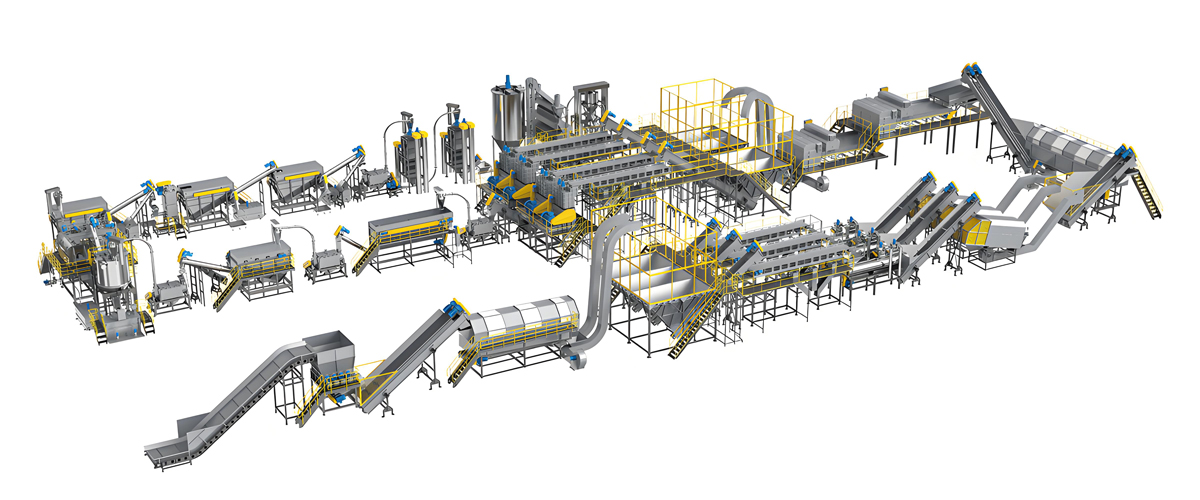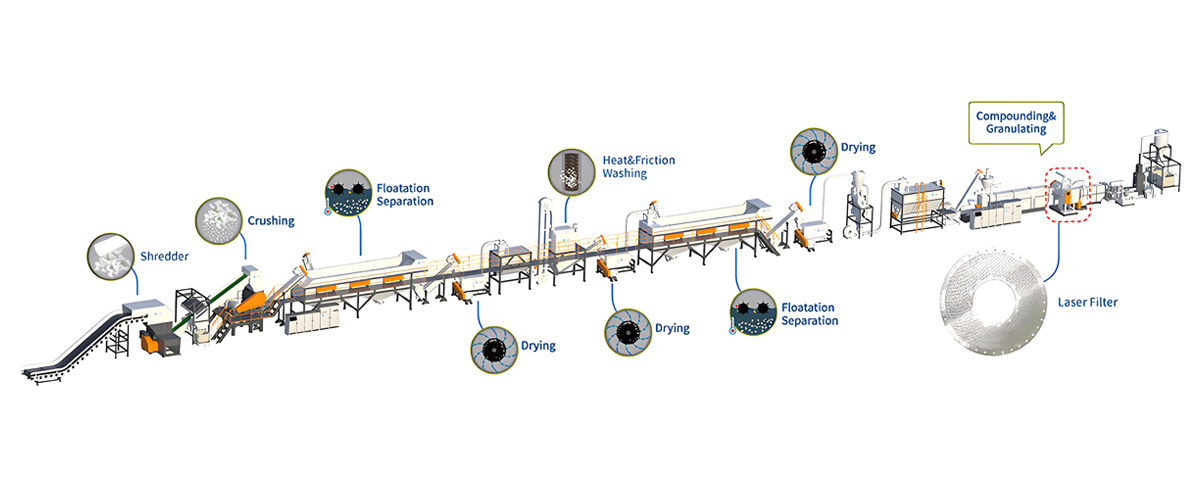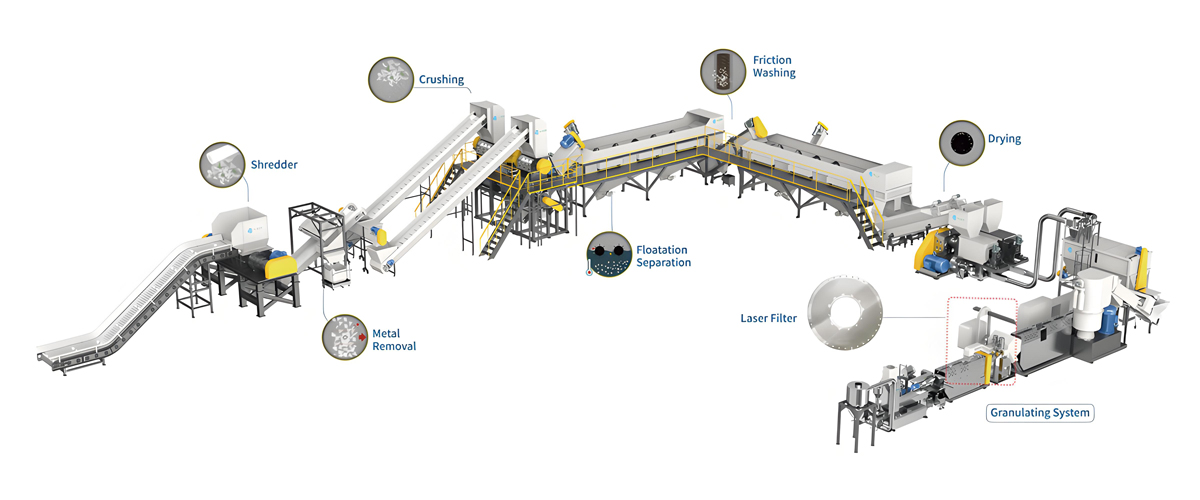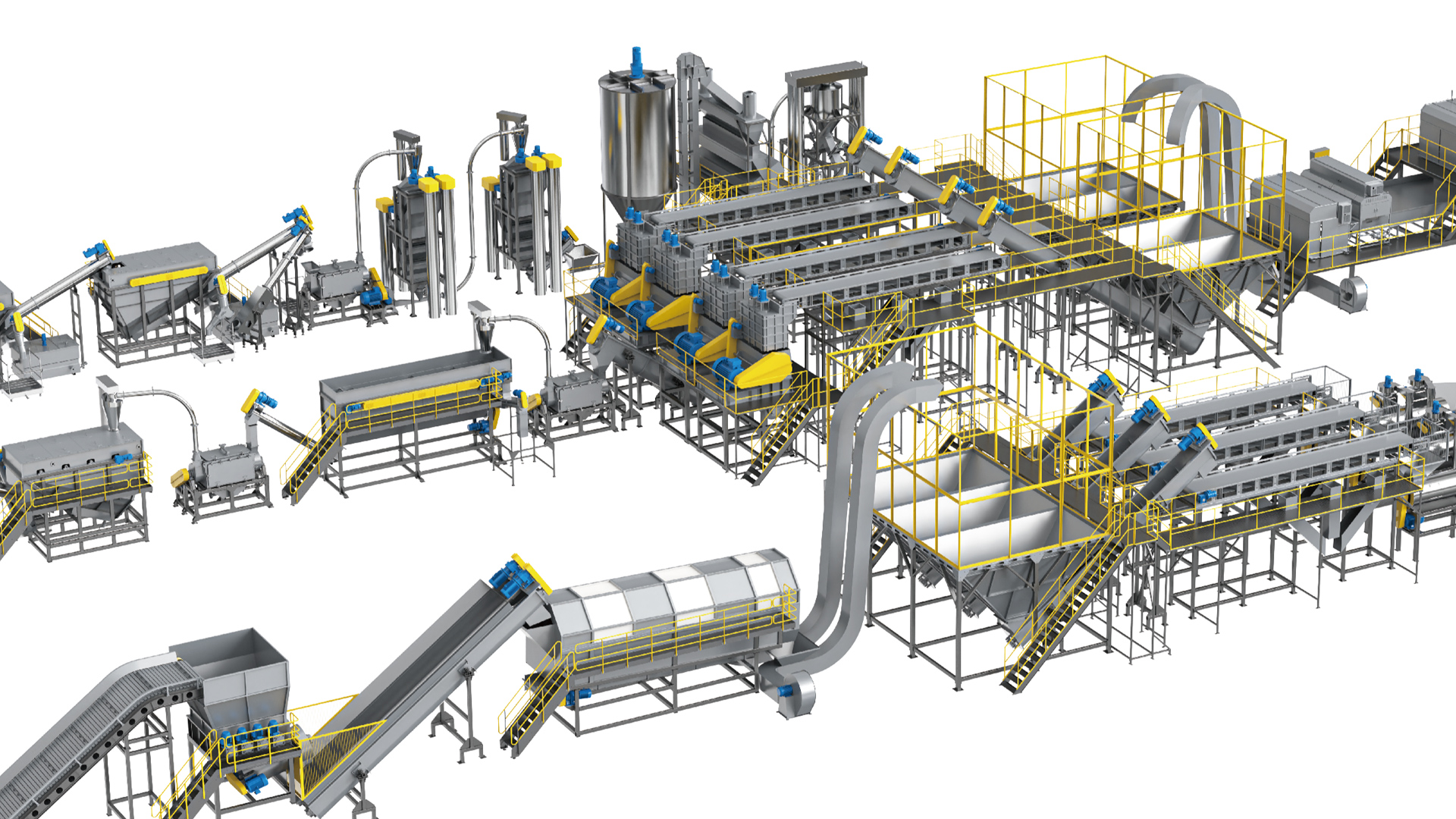

A plastic pelletizing line is the final and most value-adding stage of any plastic recycling plant, converting cleaned flakes or regrind into uniform, free-flowing, high density recycled pellets that can be sold at a premium or reused in-house. For operators focused on high density polyethylene, often abbreviated as HDPE, the difference between a marginal line and a profitable one comes down to how well the extruder, melt filter, degassing zone, and cutter work together. Polyretec, a Wanplas factory, builds its pelletizing lines on Austrian technology process engineering, the same heritage associated with Erema and Starlinger, while manufacturing in China to keep the total cost of ownership at a Medium to High tier rather than the Premium tier demanded by European machinery. This article explains how an Austrian technology plastic pelletizing line for high density recycled pellets is designed, sized, and operated, with concrete motor power figures, throughput tables, and a specification checklist you can take to any supplier.
Global plastic production now exceeds four hundred million tons per year, yet the post-consumer recycling rate remains in the single digits globally. That gap is precisely where recycled HDPE pellets earn their margin: blow-molding grade and pipe-grade HDPE command a strong resale value when pellet quality is consistent. Throughout this guide the primary term plastic pelletizing line will be used alongside Austrian technology and high density recycled pellets so that plant managers, procurement engineers, and sustainability officers can benchmark their options with confidence.
What Is a Plastic Linha de pelletização for High Density Recycled Pellets?
A plastic pelletizing line is a continuous extrusion system that takes solid plastic feed, typically flakes or densified regrind, melts it under controlled shear and temperature, removes contaminants and volatiles, and cuts the extruded strand or melt stream into regular pellets. When the feedstock is HDPE, the output is described as high density recycled pellets because the material’s crystallinity and density, normally in the range of nine hundred forty to nine hundred seventy kilograms per cubic meter, give the finished pellet its stiffness, chemical resistance, and suitability for rigids, pipes, and bottles.
The line is not a single machine but a sequence. A controlled feeder meters the flake into the extruder throat, the single-screw extruder plasticizes the material, a melt filter strips paper, aluminum, and polymer gel, a vacuum degassing zone pulls out moisture and residual hydrocarbons, and a die-face cutter or strand pelletizer forms the pellet. Cooling and a vibratory classifier separate good pellet from fines and longs. The entire train runs under one PLC, and the main extruder motor is the dominant power consumer.
High density recycled pellets differ from low density or film-grade pellet in melt behavior. HDPE has a higher melting point and a sharper viscosity curve, which means the screw design must avoid over-shearing while still delivering enough specific mechanical energy to homogenize contaminated feed. Austrian technology pelletizing lines solve this with a deep-flighted, low-shear metering screw and a long degassing zone, a combination that preserves the molecular weight of the HDPE and keeps the pellet’s melt flow index stable.
Core Process Steps in Sequence
- Metered feeding — a loss-in-weight or crammer feeder delivers a steady mass flow, preventing surge loads on the motor.
- Plasticizing — barrel zones heat the HDPE to roughly one hundred eighty to two hundred sixty degrees Celsius while the screw conveys and melts it.
- Filtration — a screen-changer or laser filter removes solids at a defined micron rating.
- Degassing — one or two vacuum vents strip moisture, trapped air, and volatiles.
- Cutting — die-face hot cutting or strand pelletizing forms uniform pellets.
- Cooling and classification — water or air cooling followed by screening removes fines and off-spec longs.
Why Tecnologia austríaca Defines Modern Pelletizing
Austrian technology has long set the benchmark for plastic recycling extrusion because Austrian engineering prioritized continuous operation, gentle melt handling, and automatic melt filtration decades before these features became standard elsewhere. Companies such as Erema and Starlinger, both Austrian, pioneered the single-screw reclaim extruder with an integrated melt filter and the direct recycling of film and rigid scrap into pellet. The phrase Austrian technology, when applied to a plastic pelletizing line, therefore signals a design philosophy rather than a country of assembly: robust single-screw plasticization, generous L/D ratio, automatic self-cleaning filtration, and deep vacuum degassing.
Polyretec, a Wanplas factory, adopts this Austrian technology process logic and combines it with Chinese manufacturing scale. The practical result is a line whose engineering behavior resembles a Premium European machine but whose procurement and spare-parts cost sits at a Medium to High tier. For a recycler weighing capital expenditure, this is the central appeal: the output pellet quality approaches European standards while the investment stays accessible to mid-size plants in Asia, the Middle East, Africa, and Latin America.
The Wanplas brand, as the parent of Polyretec, applies a shared quality承诺 across its network of specialized factories. Every Wanplas factory, including Polyretec, honors a spare-parts policy that provides a USD 500 spare-parts allowance each year and a warranty replacement commitment, which matters for a pelletizing line whose cutter blades, screen packs, and barrel liners are wear items. This brand-level backing reduces the risk of long downtime when a filter component eventually needs replacement.
Key Components of a High-Density Linha de pelletização
Understanding each module helps a buyer judge whether a quoted plastic pelletizing line will actually deliver high density recycled pellets at nameplate throughput. The following components appear on every competent Austrian-technology design.
Controlled Feeder
The feeder protects the extruder motor. A crammer feeder or loss-in-weight screw pushes low-bulk-density flake into the throat at a steady rate, avoiding the torque spikes that occur when an operator hand-feeds. For HDPE regrind, which has good bulk density, a simple belt or screw feeder is often sufficient, but for film-derived densified bail the crammer is mandatory.
Single-Screw Extruder
The extruder is the heart of the line. Austrian technology lines favor a single-screw design with an L/D ratio of thirty-two to forty-four, a gently decreasing compression ratio, and a bimetallic barrel. Screw diameter for HDPE pelletizing commonly runs from one hundred twenty millimeters to two hundred millimeters. The main motor is typically AC or DC with a gearbox designed for high torque at low screw speed, because HDPE needs mechanical energy, not just heat, to plasticize uniformly.
Melt Filter
A continuous screen-changer or laser filter sits between the extruder and the die. For post-consumer HDPE, a hydraulic screen-changer with a twenty to sixty micron pack is standard; laser filters reach finer ratings and self-clean but sit at a Higher cost tier. The filter pressure differential is a key control signal, automatically advancing the screen before the motor load climbs too high.
Degassing Zone
HDPE regrind carries moisture trapped in flake and residual washing chemistry. A vented barrel section with a vacuum pump pulls these volatiles out. Austrian technology designs often use two vents, a shallow vent for surface moisture and a deep vent for dissolved volatiles, which protects pellet appearance and prevents porosity.
Die-Face Cutter and Cooling
For HDPE, a water-ring die-face cutter is the dominant choice. The rotating blades slice the melt as it exits the die holes, and a ring of process water quenches the pellets immediately. An alternative is strand pelletizing, where multiple extruded strands pass through a water bath and a rotary cutter. Underwater cutting is reserved for heat-sensitive or low-viscosity materials and is less common for rigid HDPE.
Classifier and Conveying
A vibratory screen removes fines and longs, and a centrifugal dryer or air conveyer moves the pellet to the silo. The apparent bulk density of the finished high density recycled pellets is measured here and fed back to process control.
Single-Screw vs Twin-Screw Extrusion for HDPE Regrind
Most HDPE pelletizing uses a single-screw extruder because the material is a simple homopolymer that needs plasticization and filtration more than intensive mixing. A twin-screw co-rotating extruder, such as those built by Wanplas’s Kerke factory, is chosen when the recycler must compound additives, fillers, or color masterbatch into the recycled pellet, or when the feed is highly contaminated and needs dispersive mixing. The trade-off is capital cost and power: twin-screw lines sit at a Higher to Premium cost tier and consume more specific energy per kilogram.
| Criterion | Single-Screw (Austrian technology line) | Twin-Screw (compounding grade) |
|---|---|---|
| Typical use | Recycle HDPE flake to pellet | Compound additives or fillers into pellet |
| Mixing intensity | Low to moderate | High, dispersive and distributive |
| Specific energy | Low | Medium to High |
| Capital cost tier | Medium to High | High to Premium |
| Throughput range | 300 to 1500 kg per hour | 200 to 2000 kg per hour |
| Maintenance complexity | Low | Medium |
For a recycler whose goal is high density recycled pellets from clean flake, the single-screw Austrian technology line is the efficient choice. When the business case includes selling masterbatch or engineering compounds made from recycled resin, a twin-screw extruder from Wanplas’s Kerke factory integrated downstream of a Polyretec washing line becomes attractive.
Pelletizing Methods: Strand, Water Ring, and Underwater
The cutting method determines pellet shape, fines generation, and how much operator attention the line needs. Each method suits different melt properties and throughput targets.
Strand Pelletizing
Multiple extruded strands are pulled through a water bath and a rotary cutter. Strand lines are simple and cheap, suit throughput below roughly five hundred kilograms per hour, and are forgiving on melt strength. Their weakness is labor: strand breakage forces frequent restarts, and the method scales poorly for HDPE rigids.
Water-Ring Die-Face Cutting
The die-face cutter slices melt at the die exit while a water ring quenches the pellets. This is the workhorse for HDPE high density recycled pellets because it handles high melt strength, produces round uniform pellets, and runs continuously at high throughput. It sits at a Medium cost tier for the cutting head and is the default on Austrian technology lines.
Underwater Cutting
The die and cutter are submerged; pellets are conveyed by process water to a centrifuge. Underwater cutting suits low-viscosity or heat-sensitive polymers and very high throughput, but the capital and water-treatment cost is Higher. For standard HDPE regrind it is usually unnecessary.
| Method | Best for HDPE? | Throughput | Cost tier |
|---|---|---|---|
| Strand | Small plants only | Up to 500 kg per hour | Low |
| Water ring | Yes, recommended | 300 to 1500 kg per hour | Medium |
| Underwater | Only heat-sensitive grades | 800 to 3000 kg per hour | High |
Motor Power and Throughput Sizing
Motor power is the single largest driver of both capital cost and operating cost for a plastic pelletizing line. The main extruder drive dominates, but feeders, cutters, conveyors, and vacuum pumps add meaningful load. The tables below give practical starting points for HDPE; always confirm against your actual flake bulk density and contamination.
Main Extruder Motor Power by Screw Diameter
| Diâmetro do parafuso (mm) | Main motor (kW) | Typical HDPE throughput (kg per hour) | L/D ratio |
|---|---|---|---|
| 120 | 90 to 110 | 300 to 450 | 32 to 36 |
| 150 | 132 to 160 | 500 to 750 | 34 to 40 |
| 180 | 185 to 220 | 800 to 1100 | 36 to 42 |
| 200 | 220 to 280 | 1100 to 1500 | 38 to 44 |
Auxiliary Drive Load
| Auxiliary | Power (kW) | Note |
|---|---|---|
| Crammer or loss-in-weight feeder | 3 to 7 | Scales with throughput |
| Die-face cutter | 5 to 15 | Higher for large die |
| Water pump and ring | 4 to 11 | Process water circulation |
| Vacuum pump | 2 to 5 | Degassing |
| Centrifugal dryer and conveyor | 3 to 9 | Pellet handling |
As a rule of thumb, budget the total connected load at roughly one hundred twenty percent of the main motor to cover auxiliaries and inverters. A one hundred fifty millimeter line at one hundred thirty-two kW main drive therefore needs a supply capacity near one hundred sixty kW. Austrian technology lines compensate for voltage dips with vector-duty inverters, which protect the screw during filter advances.
Melt Filtration and Degassing for High-Density Output
Contamination and volatiles are the two enemies of a clean, high density recycled pellet. Filtration removes solids; degassing removes gases. Both must be specified before purchase, not after.
Selecting the Filter
For post-consumer HDPE, a hydraulic screen-changer with a pack of twenty to sixty microns is the baseline. If the feed includes printed or highly contaminated rigids, drop to a ten to twenty micron laser filter, which self-cleans and reports pressure rise to the PLC. The filter’s pressure differential is the early-warning signal that prevents the main motor from overloading when a contaminant slug hits the screen.
Degassing Design
Austrian technology lines use a vented barrel with one shallow and one deep vacuum vent. The shallow vent removes surface moisture carried by the flake; the deep vent strips dissolved hydrocarbons from residual label adhesive and washing agents. Without adequate degassing, the pellet shows porosity and a foul odor, and its market grade drops. Two-stage vacuum is therefore strongly recommended for post-consumer HDPE, even though it adds a Higher equipment tier.
A pelletizing line is only as good as its worst contaminant control. A USD 500 saving on a coarser filter often costs far more in rejected pellet lots and customer returns.
Quality of Recycled HDPE Pellets: Density, MFI, Contamination
Buyers of high density recycled pellets judge quality on a short list of measurable properties. Specifying and monitoring these lets a plant defend its price.
| Property | Typical target for HDPE | Why it matters |
|---|---|---|
| Apparent density | 940 to 970 kg per cubic meter | Confirms high density grade |
| Melt flow index | 0.2 to 1.0 g per 10 min | Processability in blow molding |
| Umidade | Below 0.2 percent | Prevents splay and porosity |
| Fines below 2 mm | Below 1 percent | Reduces dust in handling |
| Foreign matter | Below 50 ppm | Meets buyer specifications |
Consistency matters more than any single number. A line that holds melt temperature within plus or minus three degrees Celsius and cutter speed locked to extruder output will produce a pellet lot that passes audit every time. Austrian technology process control, with closed-loop temperature and pressure, is what lets a Medium to High cost line approach Premium-grade consistency.
How Polyretec Integrates Tecnologia austríaca with Manufacturing
Polyretec, a Wanplas factory, has built plastic recycling equipment since 2010 and was established as a brand in 2017, combining Austrian technology process engineering with Chinese manufacturing capability. The company’s pelletizing lines are designed around the single-screw, deep degassing, continuous filtration principle described above, then manufactured to a cost tier that emerging-market recyclers can finance. With more than one hundred project references and engineering assistance available in over fifty countries, the brand positions itself as the practical alternative to a Premium European line when the application is standard HDPE or PP recycling.
For plants that need compounding-grade output, the Wanplas network matters. Wanplas’s Kerke factory supplies co-rotating twin-screw extruders that integrate with Polyretec washing and pelletizing systems, letting a recycler upgrade from simple repelletizing to filled or masterbatch-grade recycled compound on the same site. This cross-factory capability is part of why the Wanplas brand, with its network of specialized factories, is referenced as the umbrella under which Polyretec operates.
Polyretec’s documented projects include LDPE film pelletizing in Turkey, PP non-woven recycling in Vietnam, and LDPE film washing in Mexico, showing that the Austrian-technology pelletizing philosophy transfers across materials. For HDPE specifically, the same engineering team tunes screw geometry and filter rating to the customer’s flake profile before shipment, a step that protects the motor power budget discussed earlier.
Checklist: Specifying a Linha de pelletização for Your Plant
Use this checklist when requesting a quote for a plastic pelletizing line producing high density recycled pellets:
- Confirm feedstock form: flakes, regrind, or densified bail, and state bulk density.
- State target throughput in kilograms per hour and whether it is nameplate or realistic.
- Request the main motor kW and total connected load, not just throughput.
- Specify filter type and micron rating for your contamination level.
- Require at least one deep vacuum vent; two if post-consumer HDPE.
- Choose cutting method: water ring for most HDPE, strand only for low throughput.
- Ask for the L/D ratio and whether the screw is bimetallic.
- Confirm CE and ISO compliance for the control and electrical system.
- Request the spare-parts list and the annual spare-parts allowance.
- Verify commissioning, operator training, and remote PLC support are included.
Commissioning, Maintenance, and Spare Parts Strategy
A plastic pelletizing line for high density recycled pellets earns its return only when it runs continuously, so commissioning and maintenance deserve as much attention as the motor power calculation. Austrian technology lines are commissioned with a staged start: the extruder is run on virgin or clean regrind to verify temperatures and pressures before any contaminated feed enters the barrel. This protects the screw and the first screen pack from a cold-start surge that could otherwise embed a contaminant slug into the melt filter.
Commissioning Sequence
- Dry run — confirm every motor, conveyor, and pump rotates in the correct direction with no load.
- Thermal profile — ramp barrel zones to setpoint and verify the control loop holds within plus or minus three degrees Celsius.
- Clean feed trial — process clean HDPE regrind to set baseline motor current and filter pressure.
- Contaminated feed — introduce the real post-consumer flake and tune feeder rate to the filter pressure limit.
- Pellet audit — measure apparent density, moisture, and fines, then lock the setpoints into the recipe.
Preventive Maintenance
The wear items on a pelletizing line are predictable: cutter blades, screen packs, barrel and screw lining, and dryer bearings. Blade changing interval depends on throughput and contamination but typically falls every one to four weeks; screen packs are advanced automatically by pressure differential. The Wanplas brand, as parent of Polyretec, applies a shared after-sales policy that provides a USD 500 spare-parts allowance each year and warranty replacement, which directly supports this maintenance rhythm and prevents unplanned stoppages when a component eventually reaches end of life.
Operator Training
Most pellet quality deviations trace to operator decisions, not machine faults. Training should cover feeder rate control, filter pressure alarm response, degassing vacuum checks, and cutter speed matching. Polyretec, a Wanplas factory, includes commissioning and operator training in its standard scope, and remote PLC access lets its engineers read process data from China to support troubleshooting abroad.
Total Cost of Ownership and Market Outlook
The purchase price of a pelletizing line is only the visible part of the investment. Over a five-year horizon the dominant costs are energy, consumables, and downtime. The table below maps the cost tier of a typical HDPE pelletizing line by capacity, using a twenty-hour daily operation as the basis for the energy line item.
| Capacity (kg per hour) | Equipment cost tier | Connected load (kW) | Energy cost tier |
|---|---|---|---|
| 300 to 500 | Medium | 100 to 130 | Medium |
| 800 to 1100 | High | 200 to 260 | High |
| 1200 to 1500 | High to Very High | 260 to 330 | Very High |
Market outlook supports the investment case. Circular economy regulation in Europe and extended producer responsibility schemes across Asia are raising demand for recycled HDPE, and the global post-consumer recycling rate near nine percent leaves enormous headroom for new capacity. An Austrian technology line at a Medium to High equipment tier captures most of the quality benefit of a Premium European line while preserving margin. For recyclers planning ahead, the combination of a Polyretec washing and pelletizing line, with optional integration to Wanplas’s Kerke twin-screw factory for compounded grades, is a defensible platform for the next decade of recycled resin demand.
Frequently Asked Questions
What does Austrian technology mean for a plastic pelletizing line?
Austrian technology refers to the process engineering heritage of companies such as Erema and Starlinger, emphasizing robust single-screw extrusion, continuous melt filtration, and deep degassing. Polyretec integrates these design principles with Chinese manufacturing to deliver high density recycled pellets at a competitive cost tier.
Can an Austrian-technology pelletizing line process post-consumer HDPE bottles?
Yes. After a washing line delivers clean HDPE flakes, the pelletizing line melts and filters the material, producing high density recycled pellets suitable for blow molding, pipe, and rigids. A laser or screen-pack filter rated for the contamination level is required.
What motor power is typical for an HDPE pelletizing line?
A single-screw pelletizing extruder for HDPE typically uses a main drive of 90 kW to 250 kW depending on screw diameter and target throughput, with auxiliary drives for the cutter, feeder, and conveyor adding 10 to 30 kW.
Which pelletizing method is best for high density recycled pellets?
Water-ring die-face cutting is the most common for HDPE because it produces uniform round pellets with low fines and handles high melt strength well. Strand pelletizing suits lower throughput, while underwater cutting suits heat-sensitive or low-viscosity materials.
How is pellet density controlled in recycled HDPE?
Pellet apparent density is governed by cooling rate, cutter speed, and melt temperature. Proper degassing and consistent melt temperature keep density within the 940 to 970 kg per cubic meter range expected for high density recycled pellets.
Does Polyretec offer pelletizing lines integrated with washing?
Yes. Polyretec, a Wanplas factory, supplies both washing lines and pelletizing lines, and can deliver a turnkey line where washed flakes feed directly into the extruder. For compounding-grade output, Wanplas’s Kerke factory supplies twin-screw extruders that integrate with Polyretec washing systems.
Conclusion
A plastic pelletizing line built on Austrian technology is the most reliable route to consistent high density recycled pellets from HDPE flake. The design priorities are clear: a low-shear single-screw extruder with a long L/D ratio, continuous melt filtration matched to contamination, deep two-stage degassing, and water-ring die-face cutting for uniform pellet shape. Motor power should be sized from screw diameter and target throughput, with total connected load budgeted at roughly one hundred twenty percent of the main drive. Polyretec, a Wanplas factory, delivers this engineering at a Medium to High cost tier rather than the Premium European price, and the broader Wanplas network, including the Kerke twin-screw factory, lets a recycler grow from simple repelletizing into compounded recycled grades on one site. For any plant specifying a new line, the checklist in this article provides a procurement-ready shortlist to take to suppliers.