
1. Overview of Flake Clumping Issues in Plastic Waschlinie Drying Systems
1.1 Basic Definition of Plastic Flake Clumping
Plastic flake clumping refers to the abnormal adhesion and agglomeration of fragmented PP, PE, PET, and HDPE plastic flakes during the mechanical drying process of a plastic washing line. After high-speed friction washing, rinsing, and dewatering, wet plastic flakes often stick together to form dense clusters, large blocks, or layered aggregates instead of maintaining loose single-particle separation. This common technical defect widely occurs in conventional waste plastic recycling washing and drying production lines, seriously affecting continuous production efficiency and finished flake quality.
In standard plastic recycling workflows, washed plastic flakes must pass through centrifugal drying and hot air drying systems to remove surface and interstitial moisture before entering pelletizing, storage, or secondary processing. When clumping occurs, clustered flakes retain internal moisture, trap residual impurities, and cause uneven drying results. Without targeted resolution and system optimization, long-term clumping problems will lead to batch product unqualified rates, frequent equipment failures, and increased production costs for recycling enterprises.
1.2 Negative Impacts of Clumping on Waschlinie Production
Flake clumping brings multiple operational and quality risks to the entire plastic washing line production process. First, it reduces drying efficiency significantly. Clustered plastic flakes form dense structures that block hot air circulation and centrifugal dewatering, resulting in inconsistent internal and external moisture content. Surface flakes may reach standard dryness while inner clumps remain wet, causing overall unqualified drying effects.
Second, clumping causes equipment overload and frequent blockage. Agglomerated plastic blocks increase the operating load of drying rotors, conveying pipelines, and subsequent feeding systems, leading to motor overload, belt wear, and pipeline jams. Frequent shutdowns for manual cleaning and blockage removal greatly reduce continuous production capacity and increase labor intervention costs.
Third, clumping deteriorates finished product quality and market value. Wet clumped flakes are prone to mildew, oxidation, and yellowing during storage, and residual moisture will cause bubble defects, brittle cracking, and uneven plasticization in subsequent pelletizing processing. Recycled pellets produced from clumped flakes have unstable physical properties and low surface gloss, reducing market sales premiums and product competitiveness.
1.3 Industry Status of Clumping Problems in Conventional Waschlinies
Most traditional plastic washing lines on the market adopt single centrifugal drying or simple hot air drying structures, lacking targeted anti-clumping design and dynamic dispersion functions. Conventional drying systems only focus on surface moisture removal without considering the physical adhesion characteristics of wet plastic flakes. For waste plastic materials with high viscosity, residual oil stains, fine powder impurities, and high moisture content, clumping problems are extremely prominent, with a clumping rate of up to 15%-25% in actual production.
Most small and medium-sized recycling factories rely on manual spreading, secondary scattering, and repeated drying to alleviate clumping, which consumes massive labor and time costs and cannot fundamentally solve the problem. As a professional plastic recycling equipment manufacturer, POLYRETEC optimizes the drying system structure and production process for clumping pain points, forming a complete set of systematic solutions to completely eliminate flake clumping in washing line drying processes.
2. Root Causes of Plastic Flake Clumping in Drying Systems
2.1 Material Characteristic Factors Leading to Clumping
Waste plastic flakes have inherent physical and chemical characteristics that cause easy adhesion and clumping during drying. Recycled PP and PE flexible flakes have thin wall thickness, large specific surface area, and strong surface tension after water washing. The water film on the flake surface forms adhesive tension between adjacent flakes, causing mutual adhesion and aggregation under mechanical extrusion and high-speed rotation of the drying system.
In addition, most waste plastics carry residual oil stains, adhesive residues, printing ink fine powder, and organic impurities after use and recycling. These viscous impurities remain on the flake surface after washing, forming sticky bonding layers. During the high-temperature drying process, residual colloids soften and solidify alternately, further bonding scattered flakes into dense clumps. Plastic flakes with high fine powder content are more prone to agglomeration, as fine powder fills the gaps between flakes and strengthens adhesion stability.
2.2 Unreasonable Drying System Structural Design
Structural defects of traditional drying systems are the core mechanical causes of clumping. Conventional centrifugal dryers adopt single-layer rotor rotation design with simple internal blade structures, which only realize centrifugal dewatering function without effective material scattering mechanism. Wet flakes are continuously stacked and extruded in the rotating drum, and the centrifugal force further compacts adhered flakes to form stable clumps that are difficult to disperse.
The hot air drying system of traditional washing lines has uneven air duct layout and unreasonable wind speed distribution. Local hot air dead zones exist inside the drying chamber, leading to inconsistent drying speed of flakes. Partially dried semi-wet flakes have stronger surface viscosity and are more likely to bond with surrounding dry flakes, forming mixed wet and dry clumps. Moreover, the single linear conveying mode of traditional drying lines causes continuous accumulation of flakes without layered dispersion space, aggravating clumping problems.
2.3 Unscientific Production Process Parameter Settings
Unmatched process parameters in actual production will exacerbate flake clumping problems. Excessive feeding volume leads to material overstocking in the drying system, causing mutual extrusion and stacking of flakes without sufficient dispersion space. Too high rotating speed of centrifugal dryers increases material compaction force, while too low speed cannot realize effective material turning and dispersion, both resulting in aggravated clumping.
Unreasonable temperature setting is also a key factor. Excessively high drying temperature causes rapid surface dehydration of flakes while internal moisture cannot be discharged in time, forming a hardened surface layer that locks internal wet flakes into clumps. Too low temperature leads to slow moisture volatilization, long-term retention of surface water film, and continuous adhesion of flakes. In addition, mismatched drying time and air supply volume will cause incomplete drying or excessive baking, further deteriorating clumping conditions.
2.4 Post-Washing Residual Moisture and Impurity Problems
Incomplete pre-drainage and unclean washing in the previous washing link will directly induce drying clumping. If the rinsing and dewatering links before drying fail to remove floating sludge and residual water completely, the moisture content of incoming flakes exceeds the standard range, leading to enhanced surface adhesion. Residual fine sediment and organic impurities in the washing water will attach to the flake surface, forming adhesive media between flakes and promoting clumping during drying.
3. Systematic Solutions to Solve Flake Clumping in Drying Systems
3.1 Pre-Drying Material Pretreatment Optimization
Fundamentally reducing clumping starts with standardized pre-drying material pretreatment to eliminate adhesive conditions of flakes. First, optimize the final rinsing and primary dewatering process of the washing line to reduce incoming material moisture and impurity content. Upgrade the high-precision circulating water filtering device to remove fine powder and colloidal impurities in washing water, ensuring clean flake surface without residual viscous attachments.
Set up a pre-scattering and layered feeding device before the drying system to break up initially adhered flake clusters through mechanical vibration and uniform spreading. Control the feeding moisture content strictly below 55% to avoid excessive surface water film tension. For waste plastics with serious oil stains and adhesive residues, add targeted high-efficiency cleaning agents in the friction washing link to completely remove surface viscous substances and eliminate the bonding medium for flake clumping.
3.2 POLYRETEC Drying System Structural Upgrade and Optimization
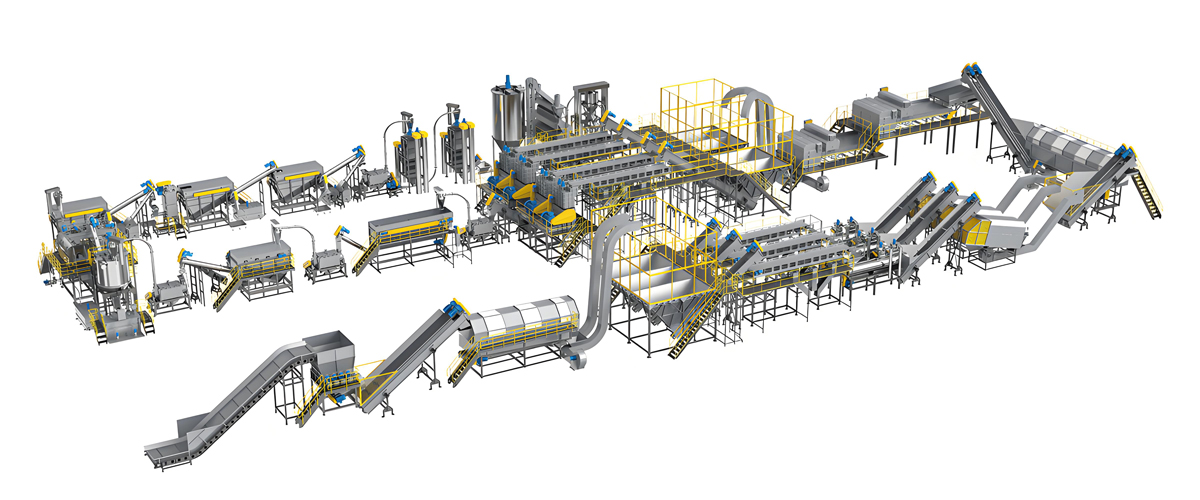
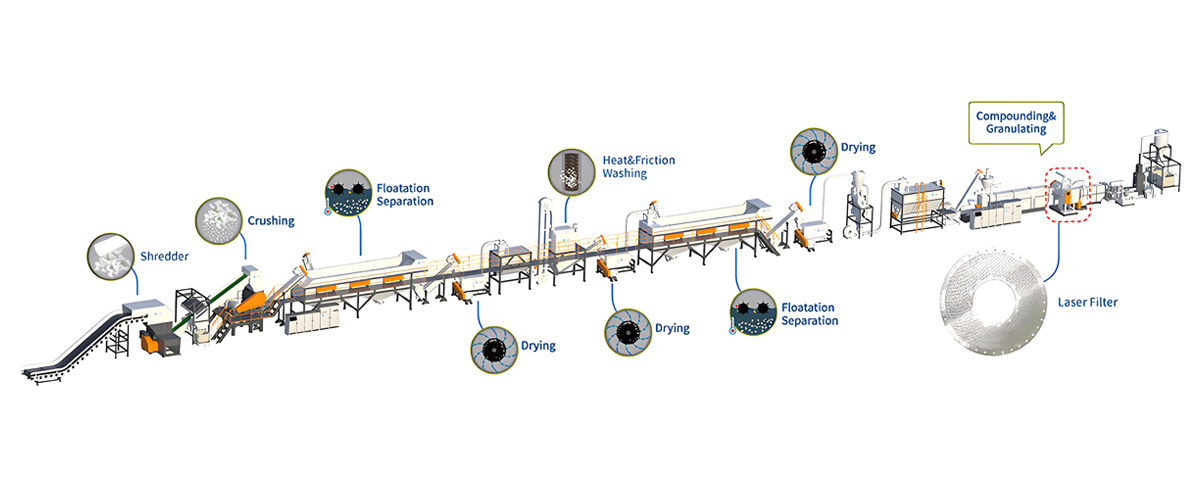
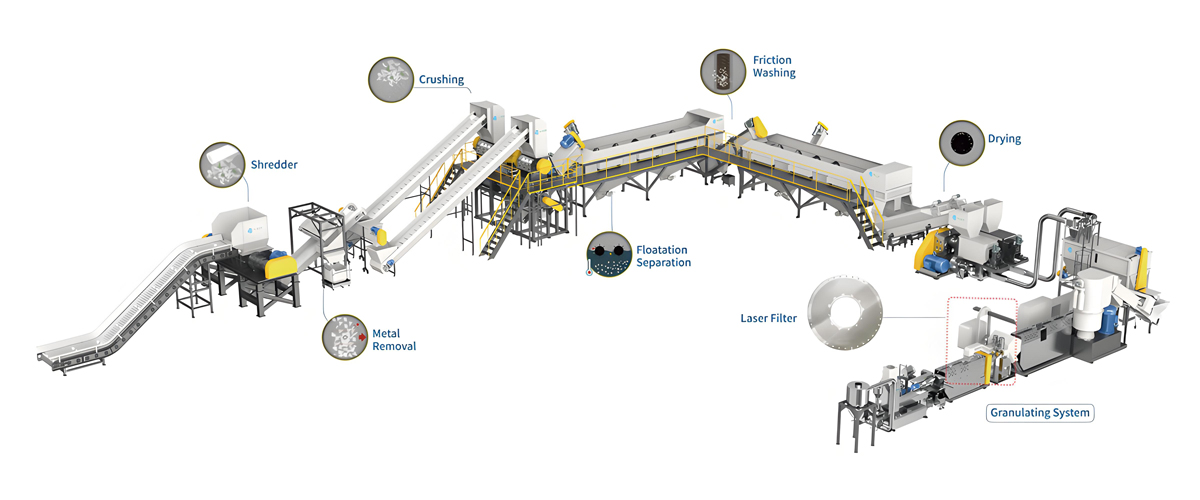
POLYRETEC’s upgraded professional drying system for plastic washing lines is equipped with a multi-stage anti-clumping structural design, fundamentally solving the clumping defect of traditional equipment. The optimized centrifugal drying rotor adopts a special staggered blade and raised dispersion structure, which can continuously turn, scatter, and separate stacked flakes during high-speed rotation. The three-dimensional turbulence motion of materials inside the drum avoids layered extrusion and compaction, realizing real-time dispersion of adhered flakes.
The hot air drying system adopts a full-around uniform air supply design with multi-angle air duct layout, eliminating hot air dead zones inside the drying chamber. The adjustable high-speed hot air flow forms a fluidized drying state for flakes, making each flake fully contact with hot air and realize independent suspension drying. This fluidized drying mode completely avoids mutual contact and adhesion between flakes during the drying process.
In addition, POLYRETEC adds an automatic vibrating dispersion device at the drying discharge port. The high-frequency vibration screen can screen and disperse a small number of residual clumps, ensuring that all discharged flakes are loose and single particles with zero agglomeration. The integrated anti-clumping structure does not increase floor space but greatly improves drying uniformity and finished product qualification rate.
3.3 Scientific Drying Process Parameter Calibration and Adjustment
Aiming at different plastic materials and flake specifications, formulate standardized drying process parameters to avoid clumping caused by parameter mismatch. For conventional PP and PE plastic flakes, control the centrifugal dryer rotating speed at 1800-2200r/min, which balances dewatering efficiency and material dispersion effect to prevent excessive compaction or insufficient turning. For thin and easy-to-adhere flexible flakes, appropriately reduce the rotating speed by 10% and increase the blade turning frequency to enhance dispersion performance.
Optimize the segmented temperature control strategy of hot air drying. Set the initial low-temperature pre-drying stage at 65-75℃ to slowly evaporate surface water film and avoid rapid hardening of the flake surface. The intermediate constant-temperature drying stage is set at 80-90℃ to fully remove internal interstitial moisture. The final cooling and shaping stage adopts natural air cooling to stabilize flake dryness. Segmented temperature adjustment ensures synchronous internal and external drying of flakes, eliminating hard-shell clumping caused by inconsistent drying speed.
Control the feeding volume and drying cycle reasonably according to equipment model parameters to avoid material overstocking. Maintain a sparse material distribution state inside the drying system to ensure sufficient dispersion space for each flake, completely solving stacking and extrusion clumping problems.
3.4 Post-Discharge Screening and Secondary Anti-Clumping Treatment
Build a complete post-discharge quality control system to thoroughly eliminate residual clumped products. Install a high-efficiency vibrating screening device at the drying system discharge end to automatically separate a small number of unqualified clumped flakes. The screened clumps will be automatically returned to the drying system for secondary dispersion and drying through the circulating feeding device, avoiding unqualified products entering the next process.
Equip a real-time moisture detection module to monitor flake dryness dynamically. Once local wet clumping is detected, the system will automatically adjust drying temperature, air volume, and rotating speed parameters to realize intelligent dynamic correction, ensuring long-term stable operation of the drying system and zero clumping in batch production.
4. 2026 Equipment Upgrade and Transformation Cost Analysis
4.1 POLYRETEC Anti-Clumping Drying System Upgrade Price
In 2026, the complete set of POLYRETEC anti-clumping drying system supporting plastic washing lines has clear and standardized pricing. The full-upgrade anti-clumping drying module suitable for 500kg/h small-scale washing lines is priced at $8,500-$9,800 FOB, including optimized dispersion rotor, full-around hot air system, vibrating dispersion device, and intelligent parameter control module. The matching upgrade module for 800-1000kg/h medium-sized washing lines is $11,200-$12,800 FOB, with higher air volume and stronger dispersion power.
The large-scale anti-clumping drying system for 1500kg/h high-efficiency washing lines is priced at $14,500-$16,000 FOB, equipped with dual-stage centrifugal dispersion and fluidized drying structure, suitable for high-output and high-impurity waste plastic continuous production. All upgraded modules are plug-and-play compatible with traditional washing lines, without overall line replacement, greatly reducing transformation investment.
4.2 Comprehensive Transformation and Auxiliary Investment Cost
The renovation and upgrade of the existing washing line drying system does not require large-scale infrastructure transformation. The auxiliary transformation cost includes pipeline adjustment, electrical parameter matching, and installation and commissioning, with a total investment of only $800-$1,500. Compared with the cost of replacing the entire production line, the local upgrade solution saves more than 70% of fixed asset investment.
For enterprises with limited budget, POLYRETEC provides split phased upgrade solutions. Enterprises can first replace the dispersion rotor and vibrating anti-clumping device with an investment of $3,000-$4,500 to solve basic clumping problems, and then complete the full system upgrade in the later stage, reducing the pressure of one-time capital investment.
4.3 Operating Cost Change and Cost Saving Benefit Analysis
The upgraded POLYRETEC anti-clumping drying system has no additional increase in daily operating energy consumption. The optimized air duct and rotor structure reduces invalid power consumption, and the overall energy consumption is reduced by 8%-12% compared with traditional drying systems. The intelligent parameter adjustment system avoids energy waste caused by repeated drying, further reducing electricity costs.
In terms of labor costs, the automatic anti-clumping system eliminates manual scattering and secondary sorting work, reducing 1-2 post operators for a single production line, saving annual labor costs of $9,000-$12,000. The clumping defect rate is reduced from the original 15%-25% to below 0.8%, greatly reducing material waste and reprocessing costs. The annual comprehensive cost saving of a single washing line can reach $18,000-$25,000, and the equipment upgrade investment can be fully recovered within 5-7 months.
5. Production Quality and Efficiency Improvement After Solving Clumping Problems
5.1 Drying Uniformity and Finished Product Quality Upgrade
After adopting POLYRETEC anti-clumping drying system solutions, plastic flakes achieve full loose drying without agglomeration. The moisture content of all finished flakes is stably controlled below 3%, meeting the national and international recycled plastic secondary processing standards. The problem of inconsistent internal and external moisture of clumped flakes is completely solved, and the dried flakes have uniform dryness, clean surface, and no residual impurities.
The quality of downstream recycled pellets is significantly improved. Pellets produced from non-clumped dry flakes have smooth surface, uniform texture, no internal bubble defects, and stable tensile and impact resistance. The product qualification rate is increased from 85% to more than 99.2%, and the market sales premium of finished products is increased by 6%-10%, bringing higher profit margins for recycling enterprises.
5.2 Production Line Continuous Operation Efficiency Improvement
Flake clumping is the main cause of frequent shutdowns and blockage failures of traditional washing lines. After solving the clumping problem, the average trouble-free continuous operation time of the washing line is increased by more than 40%, and the daily effective production time is greatly extended. The hourly output of the production line is increased by 10%-15% due to the elimination of repeated drying and manual sorting links.
The stable and continuous production state reduces equipment wear and failure loss, extends the service life of drying rotors, air ducts, and conveying equipment, and reduces the frequency of replacement of vulnerable parts. The annual equipment maintenance cost is reduced by 15%-20%, and the overall operational efficiency of the production line is comprehensively improved.
5.3 Reduction of Post-Processing Defect Rate
Wet clumped flakes will cause a variety of defect problems in pelletizing production, including bubble holes, material breaking, yellowing, and uneven particle size. After thorough drying and anti-clumping treatment, the flake raw materials have stable performance and no hidden moisture and impurity hazards. The defective rate of downstream pelletizing products is reduced from 7% to below 1%, which greatly reduces product reprocessing and waste loss and improves enterprise production efficiency and market reputation.
6. Daily Operation and Maintenance Guidelines to Prevent Recurrence of Clumping
6.1 Daily Pre-Production Parameter Inspection and Debugging
Before daily startup of the plastic washing line, operators need to inspect and calibrate the core parameters of the drying system. Check whether the rotating speed, hot air temperature, air supply volume, and feeding speed are within the standard range, and fine-tune parameters according to the daily waste plastic material type, impurity content, and moisture state. Pre-test 3-5 minutes of idle operation and small-batch feeding to confirm no clumping risk before formal mass production.
6.2 Regular Equipment Cleaning and Maintenance Work
Clean the drying system rotor, air duct, and vibrating dispersion device every day to remove residual plastic fine powder, colloidal attachments, and accumulated impurities. Long-term residual attachments will form new adhesive layers, inducing secondary clumping. Check the blade wear and vibration device operating status every week, replace aging vulnerable parts in time, and ensure the stability of material dispersion and drying functions.
Clean the circulating water filtering system of the washing line regularly to ensure the cleanliness of washing water, reduce residual impurities on the flake surface from the source, and maintain the long-term anti-clumping effect of the drying system.
6.3 Batch Production Process Dynamic Monitoring
Arrange special personnel to monitor the drying operation status in real time during batch production, observe the flake dispersion and drying effect at the discharge port, and dynamically adjust process parameters according to subtle changes in material status. Establish production parameter records and material quality files to form targeted parameter schemes for different types of waste plastics, realizing standardized and refined production management.
7. Common Misoperations and Avoidance Measures in Drying Production
7.1 Excessive Feeding and Overload Operation
Blindly increasing feeding volume to pursue output is the most common misoperation causing clumping. Overload feeding leads to dense material accumulation in the drying system, insufficient dispersion space, and serious extrusion clumping. Enterprises need to formulate standardized feeding standards according to equipment model parameters, prohibit overload operation, and maintain reasonable material sparsity to ensure full dispersion and drying of flakes.
7.2 Unreasonable Temperature and Speed Parameter Adjustment
Randomly increasing drying temperature to improve efficiency or reducing rotating speed to save energy will both induce clumping. Excessively high temperature causes surface hardening and internal wet clumping, while excessively low rotating speed cannot realize effective material turning. Operators must follow the standardized parameter calibration standards, and any parameter adjustment needs to be based on material characteristics and actual operating conditions.
7.3 Neglect of Pre-Washing Impurity Removal Link
Ignoring the cleaning and filtering effect of the early washing link leads to excessive residual viscous impurities on the flake surface, which cannot be completely eliminated by the drying system alone, resulting in recurring clumping problems. It is necessary to ensure the normal operation of the washing line impurity removal and filtering device, strictly control the surface cleanliness of incoming dried materials, and solve the clumping hazard from the source.
8. Industry Application Value and Market Prospect of Anti-Clumping Drying Technology
8.1 Practical Application Value for Recycling Enterprises
The anti-clumping drying system solution solves the long-standing technical pain point of flake agglomeration in plastic washing line production, helping recycling enterprises achieve standardized, high-efficiency, and low-consumption production. By eliminating clumping defects, enterprises reduce material waste, labor investment, and equipment maintenance costs, significantly improve product qualification rate and market competitiveness, and obtain stable profit growth in the increasingly competitive recycled plastic market.
8.2 Industry Technical Development Trend
With the continuous improvement of recycled plastic product quality standards and the continuous upgrading of environmental protection production requirements, traditional high-defect and low-efficiency drying processes will be gradually eliminated. Intelligent, uniform, and anti-clumping high-precision drying technology has become the inevitable development trend of plastic washing line manufacturing and production. POLYRETEC’s independent optimized anti-clumping drying system technology leads the industry upgrading direction, providing mature and reliable technical solutions for the high-quality development of the plastic recycling industry.
9. Conclusion
Flake clumping in the plastic washing line drying system is a comprehensive problem caused by the combination of material characteristics, equipment structural defects, and unreasonable process parameters, which brings multiple adverse effects on production efficiency, product quality, and enterprise operating costs. Through systematic pretreatment optimization, professional equipment structural upgrade, scientific parameter calibration, and standardized daily maintenance, the clumping problem can be completely solved fundamentally.
As a professional plastic recycling equipment brand, POLYRETEC’s customized anti-clumping drying system upgrade solution effectively makes up for the structural defects of traditional washing line drying equipment, realizes loose and uniform drying of plastic flakes, comprehensively improves production efficiency and finished product quality, and reduces comprehensive operating costs. With low transformation investment, quick return on cost, and stable long-term use effect, this solution is the most practical and efficient technical choice for plastic recycling enterprises to upgrade washing line production technology and optimize production benefits.