
1. Introduction to Austrian Tech One-Step PP PE Recycling and Pelletizing
1.1 Industry Background of PP PE Plastic Recycling
Polypropylene and polyethylene plastics represent the largest proportion of flexible plastic waste generated globally, covering agricultural films, packaging films, PP woven bags, industrial packaging scraps, and post-consumer daily plastic products. These soft plastic materials feature light weight, large volume, and low bulk density, bringing great challenges to traditional recycling processes. Conventional plastic recycling relies on multi-step segmented processing, including independent shredding, washing, dewatering, drying, and pelletizing procedures, which requires multiple equipment deployment, large workshop space, long production cycles, and high labor and energy consumption costs.
With the global promotion of plastic circular economy and carbon reduction policies, the plastic recycling industry is rapidly upgrading from fragmented multi-step processing to integrated one-step intelligent production. Austrian advanced plastic recycling technology has always occupied a leading position in global flexible plastic processing, focusing on simplifying recycling procedures, improving material utilization, and reducing comprehensive operating costs. The innovative one-step PP PE pelletizing process completely subverts the traditional multi-process recycling mode, realizing full-process integrated processing from waste plastic feeding to finished pellet output.
As a professional manufacturer inheriting and iterating Austrian core recycling technology, POLYRETEC launches a full set of Austrian tech PP PE pelletizing lines specially designed for one-step recycling process. This equipment perfectly solves the pain points of low efficiency, high energy consumption, large floor space, and complex operation of traditional recycling lines, providing small and medium-sized recycling enterprises with low-investment, high-efficiency, and high-return flexible plastic recycling solutions.
1.2 Core Definition of One-Step PP PE Pelletizing Process
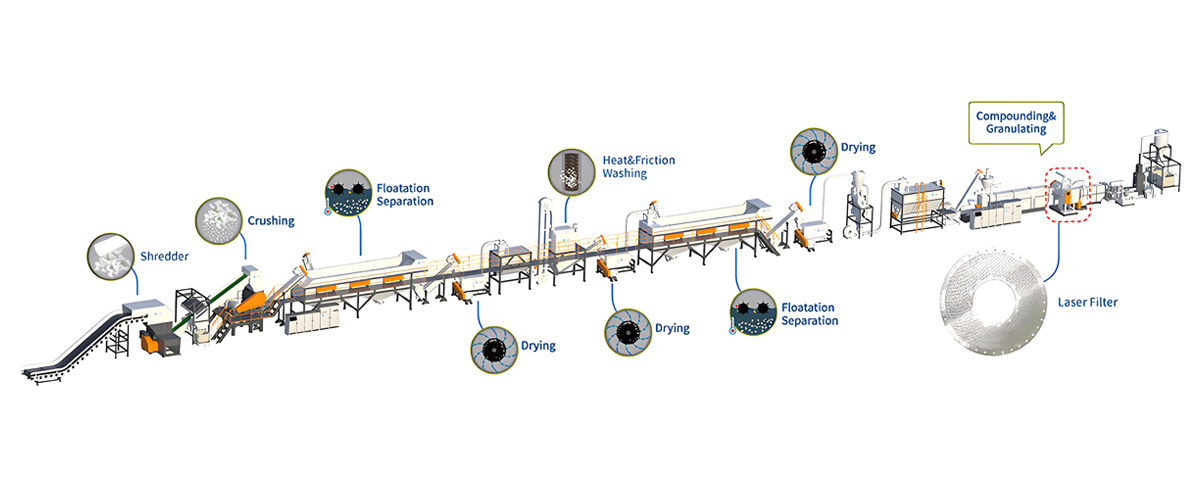
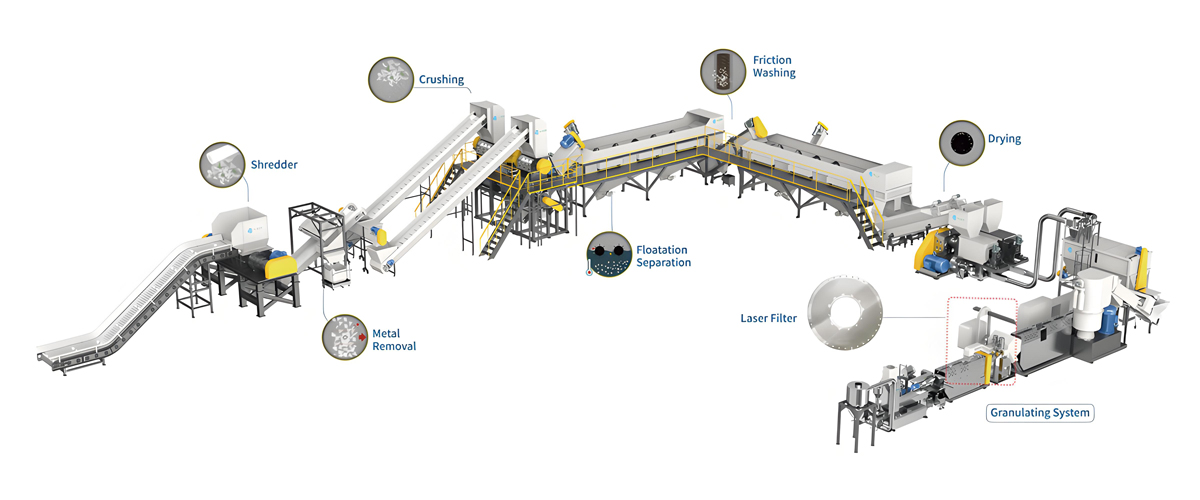
The one-step PP PE pelletizing process refers to an integrated continuous recycling technology that completes automatic feeding, shredding, impurity removal, high-temperature washing, dewatering, melting extrusion, filtering, cooling, and pelletizing in a single production line without intermediate material transfer, stacking, and secondary handling. Different from traditional multi-step lines that require separate configuration of shredders, washing tanks, dewaterers, dryers, and pelletizers, the Austrian tech one-step system integrates all functional modules into one compact and continuous production flow.
For waste PP and PE flexible plastics with high moisture, high impurity, and easy winding characteristics, the one-step process realizes real-time processing from raw waste materials to standard plastic pellets in one go. The whole production process is closed and automated, which not only avoids secondary pollution and material loss caused by manual transfer but also greatly shortens the production cycle, improves production continuity, and ensures the consistency and stability of recycled pellet quality.
1.3 Advantages of Österreichische Technologie in Plastic Recycling Field
Austrian plastic recycling technology is famous for its precision mechanical design, energy-saving optimization, and integrated process innovation in the global industry. Compared with ordinary domestic and conventional European recycling equipment, Austrian tech pelletizing lines have obvious advantages in structural rationality, process matching degree, energy consumption control, and material adaptability. It adopts optimized screw extrusion design, high-efficiency dynamic impurity removal technology, and intelligent temperature control system, which can adapt to high-impurity, wet, and unprocessed original waste PP PE materials.
In terms of operational performance, Austrian one-step technology effectively reduces material preprocessing requirements, omits complex manual sorting and pre-shredding procedures, and realizes direct feeding of raw waste plastics. The equipment has low failure rate, strong continuous operation capability, and high finished pellet purity, which can produce high-quality recycled PP PE pellets that meet secondary processing standards such as injection molding and film blowing. POLYRETEC’s upgraded Austrian tech pelletizing line further optimizes the compact structure and intelligent control system, making professional industrial-grade recycling technology accessible to small and medium-sized recycling factories.
2. Differences Between One-Step Process and Traditional Multi-Step Recycling Process
2.1 Process Flow and Equipment Composition Differences
The traditional PP PE plastic recycling multi-step process adopts a segmented independent working mode, requiring separate deployment of multiple single-function equipment. The complete flow includes manual sorting, large machine shredding, floating washing, friction washing, secondary rinsing, mechanical dewatering, hot air drying, material storage and feeding, and final pelletizing extrusion. Each link is relatively independent, requiring manual material transfer and equipment coordination, with cumbersome overall procedures and many equipment types.
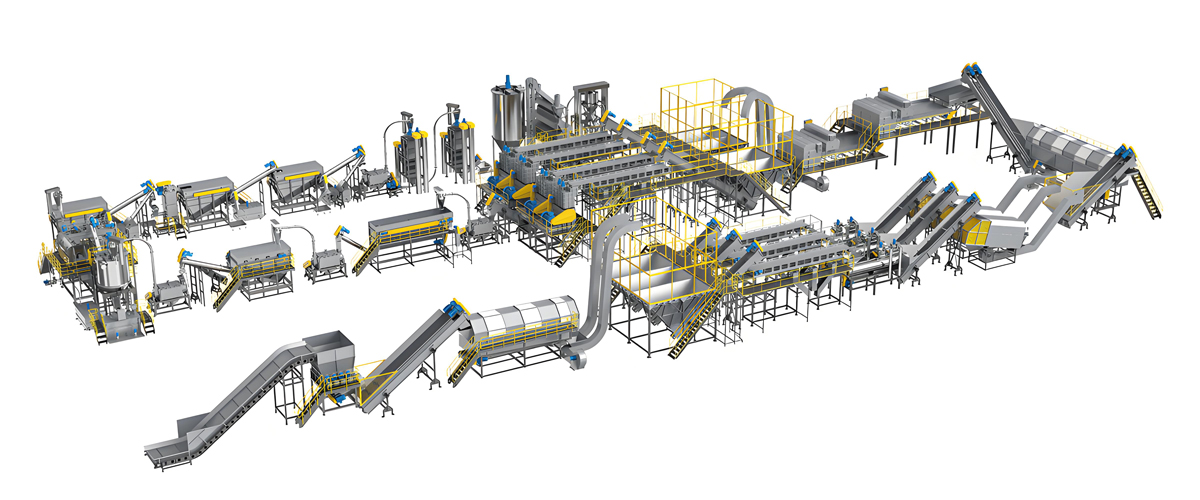
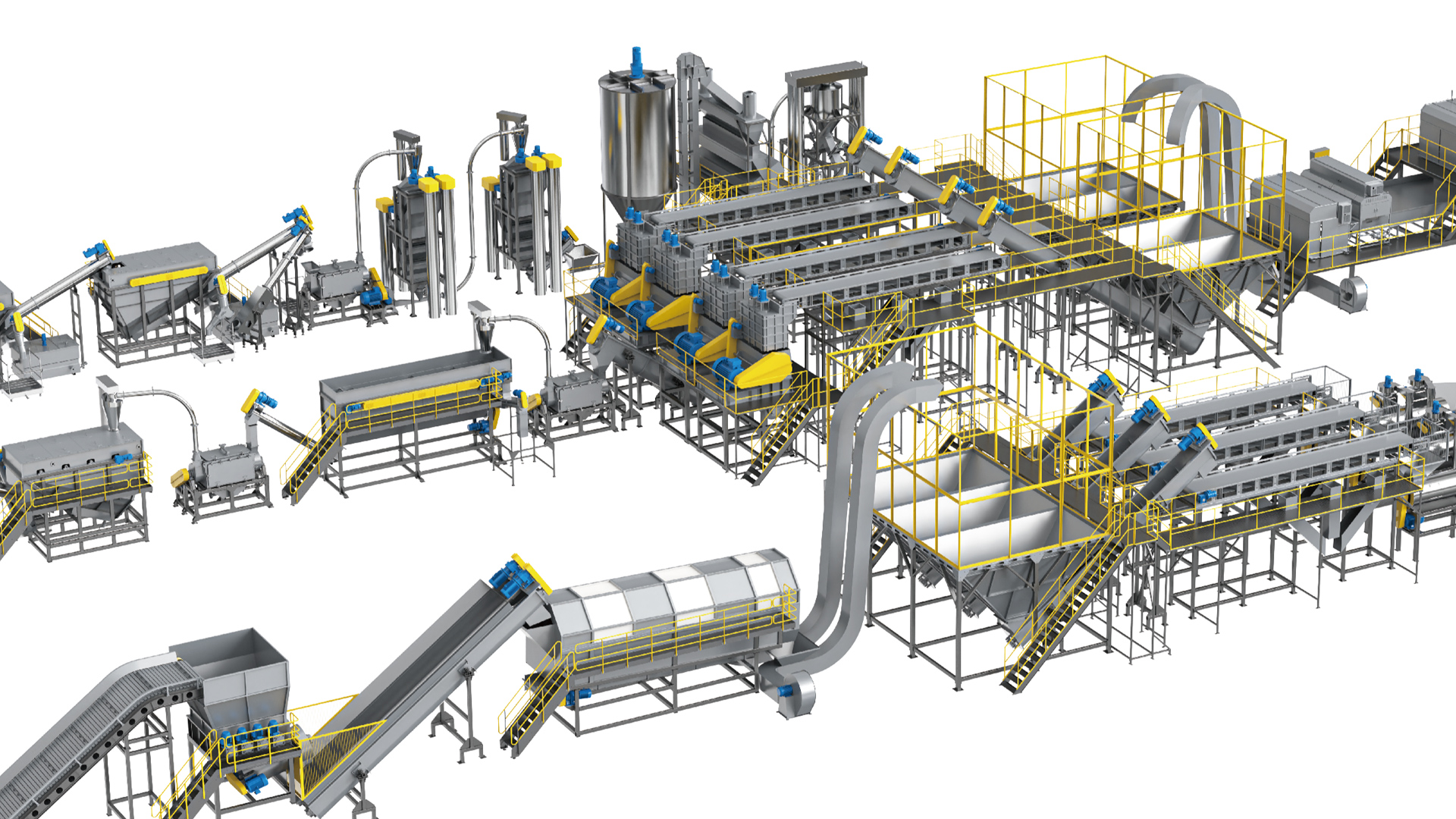
The POLYRETEC Austrian tech one-step pelletizing line integrates all segmented functions into a single continuous production system. The equipment is composed of automatic feeding system, integrated shredding and washing module, high-efficiency dewatering and densifying module, precision extrusion filtering system, circulating cooling system, and automatic pelletizing and collecting module. There is no need for intermediate material stacking and transfer, and the whole line runs synchronously with one-key start, realizing seamless connection of all recycling links.
2.2 Production Efficiency and Material Utilization Rate Gap
Affected by intermediate transfer and equipment start-stop interval, the material utilization rate of traditional multi-step recycling lines is only 82%-88%. A large amount of fine plastic fragments and light materials are lost in multiple washing and transfer links, resulting in serious waste of recycled resources. At the same time, discontinuous production leads to low overall efficiency, with an hourly output of conventional multi-step lines stabilized at 300-500kg/h.
The one-step continuous processing mode of POLYRETEC Austrian tech pelletizing line avoids material loss in intermediate links, and the material utilization rate is increased to more than 95%. The synchronous operation of all modules eliminates production intervals, and the hourly stable output can reach 500-1500kg/h according to different configuration models. The continuous and efficient production mode greatly improves the daily processing capacity of the factory and increases the effective output of finished recycled pellets.
2.3 Operating Cost and Labor Demand Differences
Traditional multi-step recycling lines require 4-6 skilled operators to be responsible for equipment operation, material transfer, and process monitoring of each link, with high labor costs. Multiple equipment operation also leads to high overall energy consumption, and the segmented equipment has many vulnerable parts, resulting in high daily maintenance costs. In addition, multi-equipment deployment requires large workshop space, increasing factory rental and infrastructure transformation costs.
The highly automated design of POLYRETEC one-step pelletizing line only requires 1-2 operators to complete full-line monitoring and feeding work, which reduces labor input by more than 60%. The integrated optimized structure reduces redundant power consumption and mechanical wear, with lower unit energy consumption and maintenance costs. The compact integrated design saves workshop space, effectively reducing the comprehensive operating cost of the recycling factory.
3. Core Structure and Arbeitsprinzip of POLYRETEC Austrian Tech Pelletierlinie
3.1 Automatic Feeding and Preprocessing Module
The front-end automatic feeding module of the pelletizing line is specially optimized for the characteristics of fluffy and easy-to-wind PP PE waste films and woven bags. It is equipped with a quantitative uniform feeding device and anti-winding structure, which can stably and continuously feed raw waste materials containing soil, impurities, and moisture without manual pre-sorting and bundling. The built-in preliminary crushing and scattering structure can break up clustered waste plastics to ensure uniform material feeding and avoid equipment blockage caused by material accumulation.
This module completely solves the problem of difficult feeding and easy blockage of traditional equipment for fluffy soft plastics, laying a foundation for stable continuous operation of the subsequent one-step process. The intelligent feeding system can automatically adjust the feeding speed according to the operating load of the host, realizing dynamic matching of material supply and processing capacity and avoiding idle operation or overload operation of the equipment.
3.2 Integrated Shredding, Washing and Impurity Removal Module
Different from the separate setting of shredding and washing in traditional processes, the Austrian integrated process integrates high-speed shredding, friction washing, and dynamic impurity removal into one module. The high-strength alloy cutter head realizes uniform shredding of waste PP PE materials into standard fragments, and the high-speed water flow friction structure removes surface sediment, oil stains, and residual impurities synchronously during the shredding process.
The built-in multi-stage filtering and sediment removal system can automatically screen and discharge heavy impurities such as sand, stones, and metal fragments mixed in waste plastics, avoiding impurity involvement in subsequent pelletizing links. The whole washing process adopts circulating water purification technology, which ensures high cleaning efficiency while reducing water resource consumption, meeting environmental protection production standards.
3.3 High-Efficiency Dewatering and Densifying Module
Waste PP PE materials after washing have high moisture content, which will affect the melting extrusion quality if directly entering pelletizing. POLYRETEC’s exclusive densifying and dewatering module adopts high-speed centrifugal dewatering and hot air drying integrated technology, which can reduce the material moisture content from more than 60% after washing to below 3% in one step, fully meeting the extrusion molding standard.
While dewatering, the high-speed rotating structure realizes preliminary densification of fluffy plastic fragments, increasing the bulk density of materials, avoiding material floating and empty extrusion in the extrusion barrel, and improving extrusion efficiency and pellet uniformity. This module replaces the traditional independent dewaterer and dryer, simplifying the process flow and reducing equipment failure points.
3.4 Precision Extrusion and Double-Stage Filtering System
The core extrusion system adopts Austrian optimized screw design, with high plasticizing uniformity and low shear thermal degradation performance. It can perform low-temperature uniform melting on cleaned PP PE materials, effectively avoiding molecular chain degradation and yellowing of recycled materials, and ensuring the toughness and gloss of finished pellets. The screw structure is optimized for soft plastic characteristics, with strong material adaptability and no dead-angle accumulation.
The double-stage high-precision filtering system is equipped with automatic mesh changing device, which can intercept tiny impurities, carbonized materials, and residual flocs in the melt in real time. It solves the problem of poor pellet purity and many black spots in traditional single-filter pelletizing, ensuring that the produced PP PE recycled pellets have uniform texture and high purity, reaching industrial reusable grade.
3.5 Circulating Cooling and Automatic Pelletizing Module
The rear-end circulating water cooling system adopts constant-temperature circulating water design, which realizes uniform and rapid cooling of extruded plastic strips, avoiding uneven cooling and strip deformation. The high-speed rotary cutter adopts adjustable spacing and speed design, which can precisely cut plastic strips into uniform cylindrical pellets with consistent particle size and smooth surface. The automatic pellet collecting and screening device automatically screens unqualified broken materials and oversized pellets, ensuring batch product consistency.
4. 2026 Complete Price and Investment Cost Analysis
4.1 Standard Model Equipment Price Quotation
In 2026, POLYRETEC provides three mainstream specifications of Austrian tech one-step PP PE pelletizing lines to meet the production needs of small, medium and large recycling factories. The 500kg/h small-scale standard model is priced at $29,000-$32,000 FOB, which is suitable for startup factories with limited capital and small order volume. The 800kg/h medium-scale upgraded model costs $36,000-$39,000 FOB, with improved extrusion efficiency and intelligent control system, suitable for stable batch production.
The 1200-1500kg/h large-scale high-efficiency model is priced at $42,000-$46,000 FOB, equipped with dual-screw high-efficiency extrusion and automatic mesh changing system, meeting the high-output production needs of large-scale recycling enterprises. All models are complete one-step integrated lines without the need to purchase additional supporting equipment, effectively avoiding secondary investment costs.
4.2 Auxiliary Configuration and Infrastructure Investment
The one-step pelletizing line has a highly integrated structure, with no need for complex auxiliary equipment. The supporting auxiliary facilities only include circulating water tank, simple dust removal device, and power distribution cabinet, with a total one-time investment of $2,000-$4,000. The equipment has a compact floor space, and the small-scale model only requires a workshop area of 80-120 square meters, greatly reducing factory rental and infrastructure transformation costs.
Compared with traditional multi-step lines that require more than 300 square meters of workshop space and more than $10,000 auxiliary equipment investment, POLYRETEC one-step lines save a lot of early fixed investment, with lower entry threshold and higher investment cost performance.
4.3 Daily Operating and Maintenance Cost Analysis
In terms of labor costs, the full-automatic one-step line only needs 1-2 operators, with a monthly total labor cost of $700-$900, which is 60% lower than that of traditional multi-step lines. In terms of energy consumption, the integrated energy-saving design reduces unit power consumption by 15%-20%, and the monthly electricity cost of the 500kg/h model is controlled at $1,800-$2,200.
The equipment has a simple structural design and few vulnerable parts. The monthly maintenance cost including replacement of filter screens, sealing rings and other vulnerable parts is only $50-$80. The circulating water system realizes repeated water use, with extremely low water consumption cost. The comprehensive daily operating cost is stable and controllable, with no hidden high expenditure.
5. Production Capacity, Yield and Profit Benefit Analysis
5.1 Actual Production Capacity and Product Quality Parameters
The POLYRETEC Austrian tech one-step pelletizing line operates stably for 24 hours, with a daily effective production time of 22 hours after deducting daily maintenance and debugging time. The 500kg/h model has a daily processing capacity of 11 tons of waste PP PE plastics and a daily finished pellet output of 10.45 tons based on a 95% material utilization rate. The produced recycled pellets have uniform particle size, low impurity content, low moisture content, and good ductility, which can be directly used for producing woven bags, plastic films, injection-molded plastic parts and other products.
Compared with pellets produced by traditional multi-step processes, POLYRETEC one-step recycled pellets have higher surface gloss and more stable physical properties, with a 5%-8% higher market sales premium and stronger market competitiveness.
5.2 Unit Production Cost of Recycled Pellets
Calculated based on the 500kg/h standard model, the comprehensive unit production cost of finished PP PE recycled pellets includes raw material waste plastic cost, energy consumption cost, labor cost, equipment depreciation and maintenance cost. The purchase cost of waste PP PE film and woven bag raw materials is $0.28-$0.32 per kilogram. After processing, the comprehensive unit cost of finished pellets is $0.38-$0.42 per kilogram.
The market wholesale price of qualified industrial-grade PP PE recycled pellets in 2026 is $0.55-$0.62 per kilogram, with a stable unit gross profit of $0.13-$0.24 per kilogram, forming a stable profit space.
5.3 Monthly and Annual Net Profit Estimation
Based on the daily finished pellet output of 10.45 tons and 300 days of annual production, the annual total output of the small-scale production line reaches 3135 tons. Calculated according to the average unit net profit of $0.18 per kilogram, the annual gross profit is $564,300. After deducting annual labor, energy consumption, maintenance and other comprehensive operating costs of $32,000-$38,000, the annual net profit of the production line is stably maintained at $526,000-$532,000.
The total investment return cycle of the small-scale one-step pelletizing line is 2.5-3 months, and the return cycle of the medium and large-scale models is shorter, with extremely high investment return efficiency and low operational risk.
6. Core Technical Advantages of POLYRETEC Austrian One-Step Pelletierlinie
6.1 Simplified Process and High Material Utilization Rate
Relying on Austrian integrated recycling technology, POLYRETEC one-step pelletizing line cancels all redundant intermediate processing links, realizes seamless connection of the whole process, and avoids material loss and pollution caused by multiple transfers. The professional impurity removal and screening system ensures that effective plastic materials are fully recycled, and the material utilization rate is increased from the industry average of 85% to more than 95%, maximizing the recycling value of waste PP PE plastics.
6.2 Energy-Saving Design and Low Operating Consumption
The equipment adopts Austrian frequency conversion energy-saving technology and optimized fluid dynamics structural design, which intelligently adjusts power output according to production load and material status. Compared with traditional multi-step production lines, the overall energy consumption is reduced by 18%-22%, and the long-term energy-saving benefit is extremely significant. The circulating water recycling system reduces water resource consumption by more than 70%, meeting green environmental protection production standards and reducing enterprise energy consumption costs.
6.3 Strong Material Adaptability and Wide Application Range
This one-step pelletizing line is suitable for all types of PP PE flexible waste plastics, including agricultural PE films, packaging films, PP woven bags, ton bag scraps, industrial flexible packaging waste, printed and non-printed soft plastic materials. It can process raw materials with high impurity and high moisture without strict preprocessing, with strong fault tolerance and wide application range. One equipment can meet the recycling and pelletizing production needs of multiple materials, realizing diversified production and expanding enterprise business scope.
6.4 Intelligent Operation and Low Failure Rate
The whole line is equipped with PLC intelligent control system, realizing one-key start, automatic operation, overload protection and fault self-detection. The operation interface is simple and intuitive, without requiring professional technical operators. The integrated structural design reduces mechanical connection points and vulnerable parts, greatly reducing equipment failure rate. The average trouble-free continuous operation time exceeds 7000 hours, ensuring long-term stable production of the factory.
7. Common Production Problems and One-Step Process Optimization Solutions
7.1 Material Blockage and Discontinuous Feeding
Fluffy PP PE waste films and woven bags are easy to wind and agglomerate, causing equipment blockage and discontinuous feeding in traditional processing. POLYRETEC one-step line adopts anti-winding feeding structure and quantitative feeding adjustment technology, which can automatically break up clustered materials and control uniform feeding speed. It completely solves the blockage problem of flexible plastics and ensures continuous and stable production.
7.2 Unclean Impurity Removal and Low Pellet Purity
Traditional processes have incomplete impurity removal, resulting in many impurities and black spots in recycled pellets, which affects product sales and reuse. The Austrian one-step process adopts multi-stage dynamic impurity removal and double-stage melt filtering technology, which removes macroscopic impurities in the washing stage and intercepts microscopic impurities in the extrusion stage. The produced pellets have high purity and stable quality, fully meeting the reuse standards of downstream plastic products.
7.3 High Moisture Content and Poor Pellet Toughness
Insufficient dewatering and drying in traditional processes leads to high moisture content in pellets, resulting in bubble holes and poor toughness in secondary processing. The integrated high-speed dewatering and hot air drying module of the one-step line ensures thorough material dewatering, effectively improving the compactness and toughness of recycled pellets and optimizing product quality.
8. Industry Application Scenarios and Market Prospect Analysis
8.1 Main Application Scenarios of One-Step PP PE Pelletierlinie
POLYRETEC Austrian tech one-step pelletizing line is widely applicable to waste plastic recycling factories, plastic product manufacturing enterprises’ self-produced scrap recycling, agricultural waste plastic processing, and packaging material recycling and reuse industries. It can centrally process various waste PP PE flexible plastics into high-quality recycled pellets, which are widely used in producing woven bags, plastic films, plastic pipes, daily plastic products, and industrial plastic accessories, with a very broad downstream market demand.
8.2 Future Development Trend of PP PE Plastic Recycling
With the continuous improvement of global plastic environmental protection policies and the increasing shortage of plastic raw materials, the market demand for high-quality recycled plastic pellets continues to rise. The plastic recycling industry is gradually eliminating backward multi-step high-consumption and low-efficiency production lines, and intelligent, integrated, energy-saving one-step recycling technology has become the inevitable development trend of the industry.
As a mature and advanced recycling solution, POLYRETEC Austrian one-step PP PE pelletizing technology can help recycling enterprises reduce costs, improve efficiency, stabilize product quality, and occupy a dominant position in the increasingly competitive recycling market, with long-term industry development advantages and investment value.
9. Conclusion
The Austrian tech one-step PP PE pelletizing process has completely changed the traditional fragmented and high-consumption plastic recycling mode, realizing integrated, automated, and efficient full-process production from waste plastic feeding to finished pellet output. The POLYRETEC one-step pelletizing line inherits and optimizes advanced Austrian recycling technology, with outstanding advantages in process simplification, production efficiency, energy-saving consumption reduction, material utilization rate, and operating cost control.
With reasonable equipment investment, low daily operating cost, fast investment return cycle, and stable product quality, the equipment is very suitable for small and medium-sized waste plastic recycling enterprises to upgrade and expand production. In the context of the booming global plastic circular economy, POLYRETEC Austrian one-step PP PE pelletizing line provides a high-efficiency, low-cost, and high-value technical solution for the resource recycling of PP PE flexible plastics, helping enterprises realize stable profit growth and sustainable industrial development.