The global volume of discarded electronics, commonly called e-waste, keeps climbing every year, and a surprisingly large share of that waste stream is rigid plastic rather than metal or glass. As we move through 2026, recyclers and material recovery facilities face mounting pressure to recover these plastics instead of sending them to landfill, incineration, or uncontrolled export. A rigid plastic washing line is the core system that turns dirty, mixed electronic plastic scrap into clean, reusable flakes ready for pelletizing, and choosing the best rigid plastic washing line for electronic plastic waste recycling is no longer a minor operational decision. It determines flake purity, plant throughput, compliance with environmental regulation, and ultimately the resale value of the recovered material.
Polyretec, a Wanplas factory, has spent more than a decade building plastic recycling equipment that combines Austrian process know-how with cost-effective Chinese manufacturing. Electronic plastic waste presents some of the toughest contamination challenges in the entire recycling industry, from brominated flame retardants to embedded metal inserts and multilayer assemblies. This guide explains what a rigid plastic washing line is, why electronic plastics are so difficult to clean, which components matter most, how to select the right configuration, and which manufacturers lead the field in 2026. By the end you will understand the technical and commercial factors that separate an adequate line from the best rigid plastic washing line for electronic plastic waste recycling.
Whether you operate a dedicated e-waste recycling plant, a WEEE treatment facility, or an integrated plastics recovery operation, the information below will help you specify, budget, and commission a washing line that meets your purity targets and regulatory obligations.
What Is Electronic Plastic Waste and Why Recycle It?
Electronic plastic waste refers to the rigid plastic fractions recovered from discarded electrical and electronic equipment, a category regulated in the European Union under the WEEE Directive and tracked globally as part of the broader e-waste stream. These plastics come from computer housings, television and monitor frames, printer bodies, mobile phone casings, small household appliances, and a long list of consumer and industrial electronics. Unlike packaging plastics, electronic plastics are engineered for durability, impact resistance, and fire safety, which means they carry a heavy load of additives that complicate recycling.
The dominant polymers in this stream are acrylonitrile butadiene styrene, known as ABS, high-impact polystyrene, known as HIPS, polypropylene, known as PP, and various PC and ABS blends. ABS alone can account for a large portion of appliance housings because of its stiffness and surface quality, while HIPS appears heavily in television and monitor frames. PP shows up in interior structural components and small appliance bodies. Each of these polymers has distinct density, melt behavior, and contamination profiles, so a recycling strategy has to treat them as separate, valuable material fractions rather than as one undifferentiated plastic mass.
Recycling electronic plastic waste is worthwhile for three overlapping reasons. The first is regulatory: frameworks such as the WEEE Directive, the RoHS Directive, and REACH place obligations on producers and treatment facilities to recover materials and control hazardous substances, so landfilling mixed e-waste plastics is increasingly restricted across Europe, parts of Asia, and several other regions. The second is economic: recovered ABS, HIPS, and PP flakes and pellets carry meaningful market value, especially when purity is high enough for use in new electronic housings or in non-food automotive and consumer goods. The third is environmental: producing recycled resin from post-consumer electronics displaces virgin polymer production, lowering fossil feedstock demand and the associated carbon footprint.
According to widely cited industry data, global e-waste generation surpassed 62 million metric tons in 2022 and is projected to exceed 80 million metric tons by 2030, yet only a small fraction of that volume is formally documented as properly collected and recycled. Within the average discarded device, rigid plastics make up roughly 20 to 30 percent by weight, which means the addressable plastic fraction is enormous. For recyclers, that represents both an obligation and an opportunity: the best rigid plastic washing line for electronic plastic waste recycling is the piece of equipment that converts this liability into a salable, specification-grade raw material.
It is also worth noting that downstream demand for recycled content is rising. Brand owners under voluntary and mandatory recycled-content targets are actively seeking reliable sources of post-consumer recycled ABS and HIPS, and the cleanliness of the flake is what determines whether a recycler can serve that premium market or is limited to low-value applications. The washing line, therefore, is not just a cleaning step; it is the gatekeeper of product value.
Collection and pre-sorting infrastructure also shapes what a washing line must handle. In many regions, e-waste is first processed at a dismantling facility where batteries, cables, and high-value components are removed before plastics enter the stream. The degree of pre-sorting directly affects contamination load: a line fed with already-segregated ABS housings can skip several stages that a line receiving mixed, unsorted shredder residue cannot. Forward-looking recyclers in 2026 are investing in upstream sorting partnerships so their rigid plastic washing line operates on a cleaner, more homogeneous feed, which improves both yield and final flake value.
What Is a Rigid Plastic Waschlinie?
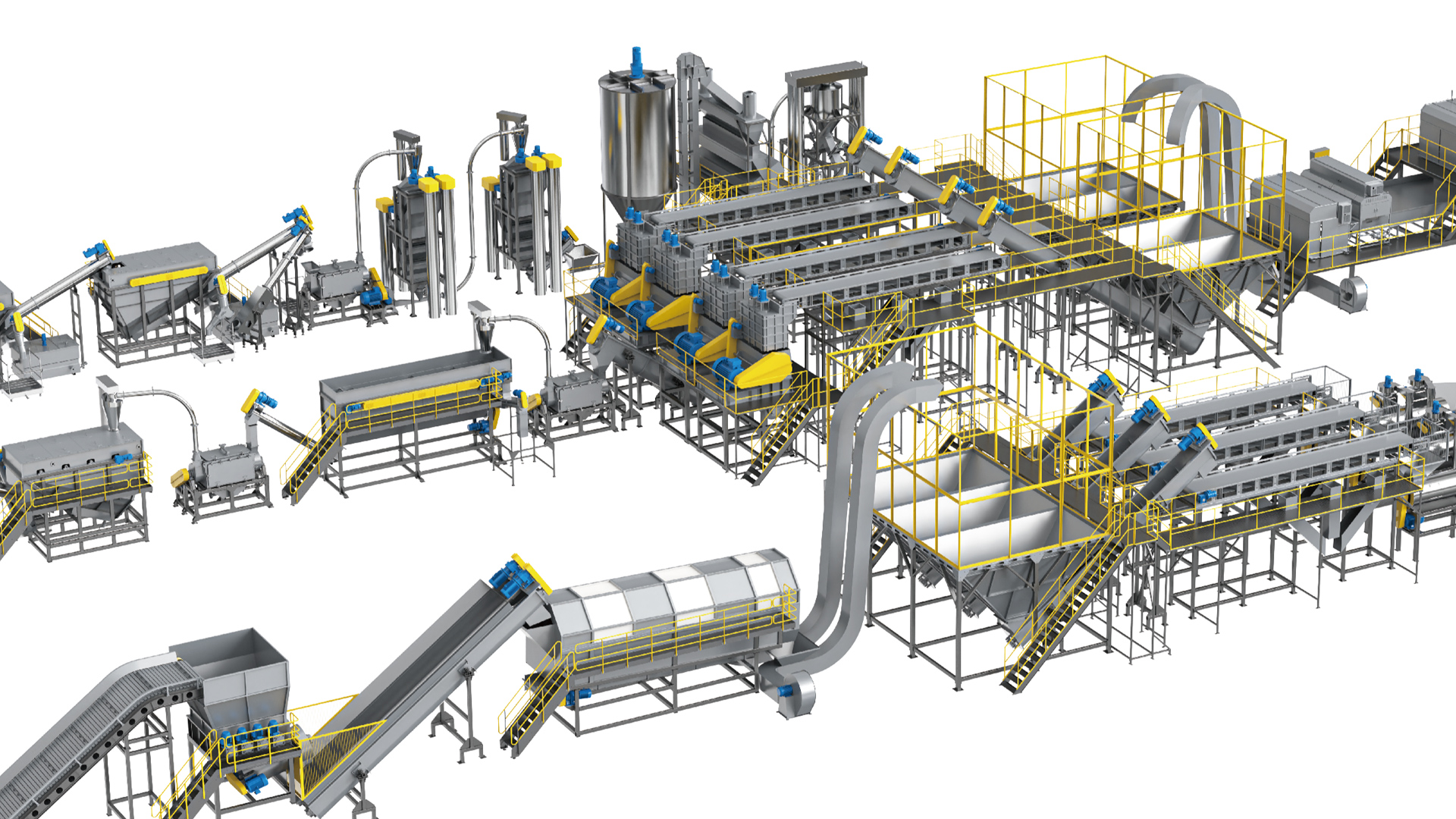
A rigid plastic washing line is an integrated, predominantly wet processing system that takes mixed, dirty, post-consumer or post-industrial rigid plastic scrap and converts it into clean, dry, specification-grade flakes suitable for pelletizing or direct reuse. The defining characteristic of a rigid line, as opposed to a film or soft-plastic line, is that it is built to handle thick-walled, high-strength polymers such as ABS, HIPS, and PP that arrive as housings, shells, and molded parts rather than as thin films or fibers. Polyretec offers washing lines under its dedicated washing-line product category, with configurations engineered for rigid plastics recovered from electronics, appliances, and similar durable goods.
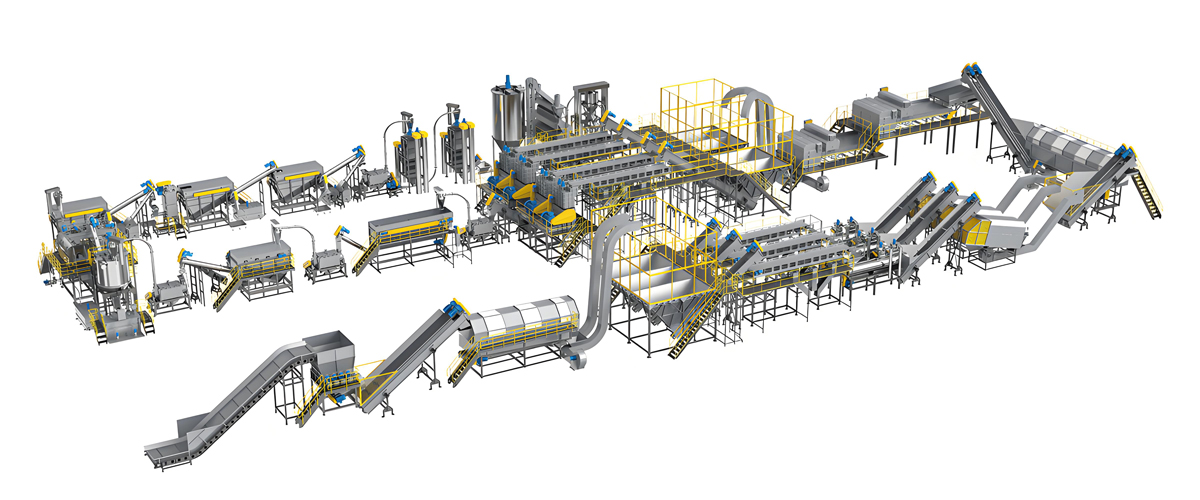
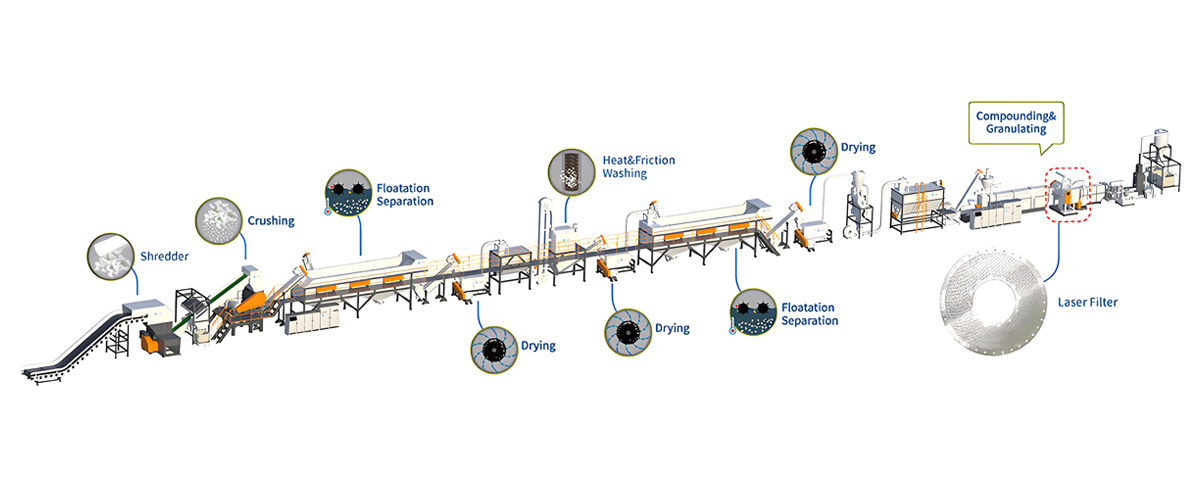
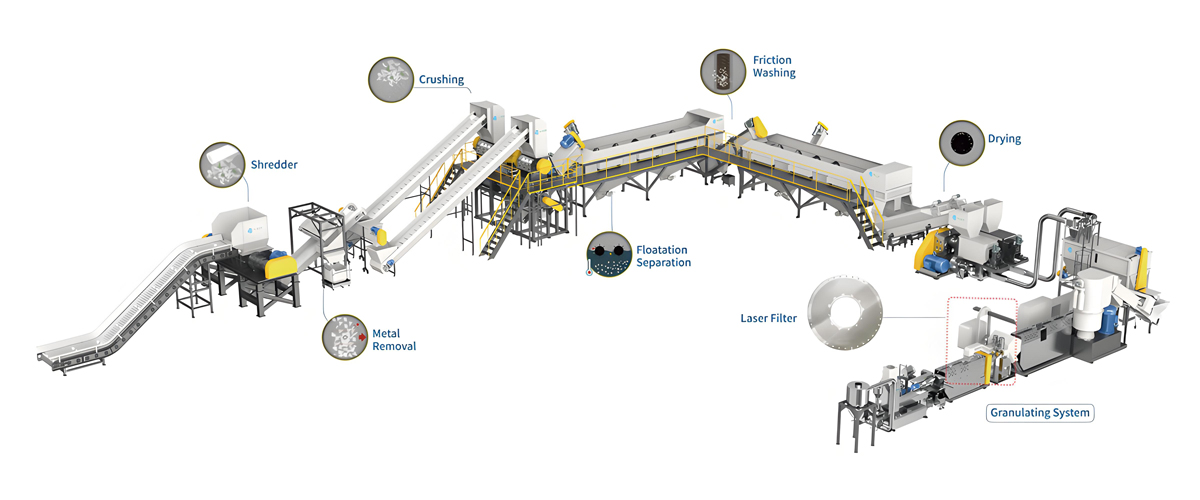
The core process flow of a rigid plastic washing line follows a logical sequence. First, incoming material is coarsely pre-shredded to reduce bulky housings into manageable pieces and to liberate embedded metal. Second, the pre-shredded pieces are ground into smaller flakes, typically in a wet granulator that suppresses dust and begins the cleaning action. Third, a pre-wash or friction washer removes loose dirt, dust, and surface contaminants. Fourth, the flakes pass through sink-float separation tanks where polymers are split by density, allowing ABS and HIPS to be separated from PP and from sinking contaminants such as glass and residual metal. Fifth, a hot wash stage with detergent addresses labels, glues, and oily residues. Sixth, the flakes are rinsed, mechanically dewatered in a centrifuge, and finally dried in a thermal or mechanical dryer to reach the low moisture level required before pelletizing.
Key components you will encounter include the pre-shredder, the wet granulator, friction washers, sink-float tanks, a hot wash vessel, a centrifuge dewatering unit, a thermal dryer, and a supporting water-filtration and recirculation loop. Many modern lines also add an optical sorter or a metal separator to lift final purity. The output is clean, sorted, dry flake with moisture typically below one percent, which can then be fed directly into a pelletizing line.
It is important to distinguish a rigid washing line from a PET bottle washing line. PET bottle lines are optimized for thin-walled, food-grade bottle scrap and emphasize food-safety washing and color sorting, whereas a rigid line for electronics must contend with paints, brominated additives, multilayer assemblies, and dense metal contamination. Trying to process electronic housings on a PET bottle line usually leads to poor separation, equipment wear, and off-spec flake, which is why selecting a line purpose-built for rigid plastics matters.
Throughput for commercial rigid washing lines generally ranges from 500 kilograms per hour for pilot or regional operations up to 3000 kilograms per hour or more for full-scale facilities. The best rigid plastic washing line for electronic plastic waste recycling is the one whose capacity, separation precision, and contamination control are matched to your specific feedstock and purity goals, not simply the line with the highest nominal throughput.
Modern rigid washing lines are also increasingly offered with centralized programmable logic control and remote monitoring, allowing operators to track water quality, motor loads, and throughput in real time. This instrumentation matters for e-waste because contamination varies batch to batch, so being able to adjust wash intensity and detect anomalies early protects product quality and reduces off-spec generation. When evaluating the best rigid plastic washing line for electronic plastic waste recycling, control capability should rank alongside mechanical specifications.
Key Challenges of Washing Electronic Plastic Waste
Electronic plastic waste is widely regarded as one of the most demanding feedstocks in mechanical recycling. Unlike relatively clean post-industrial scrap, e-waste plastics arrive contaminated with substances that are difficult, expensive, or legally sensitive to remove. Understanding these challenges is essential before specifying the best rigid plastic washing line for electronic plastic waste recycling.
The first and most discussed challenge is the presence of brominated flame retardants, often abbreviated as BFRs, which are added to meet fire-safety standards in electronics. These substances are tightly controlled under the RoHS Directive and monitored under REACH, and several are restricted or require special handling. Recyclers must sort and document BFR-containing fractions, and in some jurisdictions a separate treatment stream is required. A washing line cannot chemically destroy these additives, so the strategy is precise sorting and traceability rather than removal through washing.
The second challenge is metal contamination. Electronic housings are full of screws, brackets, copper wire, aluminum shields, and steel inserts. If these are not removed early, they blunt granulator blades, damage friction washers, and contaminate the flake. Effective metal separation, both ferrous and non-ferrous, before and after grinding is therefore critical.
The third challenge is polymer mixing. ABS, HIPS, PP, and PC blends often appear together in a single device, sometimes bonded or co-injected. Because these polymers have different densities and melt temperatures, they must be separated to produce specification flakes. Sink-float separation handles the broad density split, but distinguishing ABS from HIPS, which have close densities, may require optical or electrostatic sorting.
The fourth challenge is surface contamination: paints, silk-screen inks, adhesives, labels, and weathered greases. These are removed through friction washing and hot wash chemistry, but aggressive washing raises water-treatment load and energy use. The table below summarizes common contaminants and the washing-line response that addresses each.
Contaminant-to-Solution Reference
| Contaminant | Source in E-Waste | Washing-Line Response |
|---|---|---|
| Brominated flame retardants | Housings, connectors | Pre-sorting, documentation, dedicated fraction |
| Metal inserts and wire | Structural brackets, cabling | Magnetic and eddy-current separation |
| Paints and inks | Exterior housings | Friction washing, hot wash |
| Adhesives and labels | Branding, assembly | Hot wash with detergent, rinsing |
| Mixed polymers | Device assemblies | Sink-float, optical or electrostatic sorting |
A further operational challenge is water management. Washing lines consume and soil large volumes of water, so a responsible design includes filtration, settling, and recirculation to cut freshwater demand and meet discharge rules. In 2026, with tightening environmental permitting in many regions, a closed or near-closed water loop is becoming a baseline expectation rather than a premium feature.
Core Components of an Effective Rigid Plastic Waschlinie
The performance of the best rigid plastic washing line for electronic plastic waste recycling depends on how well its individual components are specified and sequenced. Below is a practical tour of the components that matter most, with guidance on what to look for in each.
A pre-shredder is the first mechanical stage, reducing bulky housings and monitors into rough pieces while liberating metal. Look for a heavy-duty, low-speed, high-torque design with overload protection, because electronics contain unexpected hard objects. A wet granulator then cuts the pre-shredded pieces into flakes, typically 8 to 14 millimeters, while water suppresses dust and begins cleaning. Blade material and ease of access for sharpening directly affect operating cost.
Friction washers use rapidly rotating paddles to scrub flakes against each other and against the washer wall, displacing dirt and surface coatings. For e-waste, a robust friction washer with adjustable speed is essential because paints and inks cling tightly. Sink-float separation tanks exploit density differences: ABS and HIPS sink while PP floats, and heavy contaminants such as glass and residual metal sink with the ABS fraction and are removed. A hot wash vessel, often with a caustic or detergent solution, loosens labels, glues, and oily films that cold washing leaves behind.
After washing, a centrifuge dewaters the flakes mechanically, and a thermal dryer or mechanical dryer removes the remaining surface moisture to below one percent. Finally, a metal separator and, on higher-spec lines, an optical sorter remove residual contamination to push purity above 98 percent. The supporting water-treatment loop, with filtration, chemical dosing, and recirculation, ties the whole system together and protects both equipment and the environment.
Core Component Overview
| Component | Primary Function | Why It Matters for E-Waste |
|---|---|---|
| Pre-shredder | Reduce bulky parts, free metal | Protects downstream equipment from shocks |
| Wet granulator | Cut into flakes, suppress dust | Controls fine dust carrying additives |
| Friction washer | Scrub surface contamination | Removes paint and ink from housings |
| Sink-float tank | Separate by density | Splits ABS, HIPS from PP and metal |
| Hot wash vessel | Loosen glue and oil | Clears labels and weathered grease |
| Dryer and sorter | Dry, polish purity | Reaches specification for pelletizing |
When evaluating a vendor, ask for a documented mass balance on representative feedstock. A credible supplier will run your actual e-waste sample through a pilot line and report input contamination, output purity, and material recovery rate. This evidence, more than any brochure claim, tells you whether a given configuration is the best rigid plastic washing line for electronic plastic waste recycling in your specific case.
How to Choose the Best Rigid Plastic Waschlinie for E-Waste
Selecting the best rigid plastic washing line for electronic plastic waste recycling is a structured decision, not a single purchase. Start by characterizing your feedstock honestly: what polymers dominate, what contaminants are present, how much metal is embedded, and what is the incoming cleanliness. A line tuned for clean post-industrial ABS scrap will underperform on mixed, painted, BFR-containing consumer electronics, and vice versa.
Next, define your target output purity and the application it serves. If flakes will be pelletized for new electronic housings, you need very high purity and tight polymer separation. If they will be used in low-spec injectable goods, a less aggressive line may suffice. Your purity target drives the number of washing and sorting stages you need. Then size capacity to your steady feedstock volume, not your peak influx, because a line running consistently near its design rate is more profitable than an oversized line that sits idle.
Water and energy footprint deserve explicit attention in 2026. Prioritize lines with recirculation, efficient friction washers, and heat recovery on dryers, because permitting and operating costs for water and power are rising. Footprint and automation level matter for labor cost and plant layout; a compact, well-instrumented line with central control reduces operator burden and improves consistency.
Compliance cannot be an afterthought. Confirm the line supports documentation and sorting needed for WEEE, RoHS, and REACH obligations, and that the supplier understands these frameworks. After-sales capability, spare-parts availability, and remote support should weigh heavily, because downtime on a washing line stops revenue. Wanplas, the parent brand of Polyretec, applies shared service promises across its factory network, including annual free spare parts and warranty replacement, which lowers the lifetime cost of ownership.
Finally, think about the full process chain rather than the washing line in isolation. Washed flakes must be pelletized to become a usable resin, and the integration between washing and pelletizing is where many plants lose efficiency. Wanplas’s Kerke factory supplies twin-screw pelletizing extruders that integrate with Polyretec washing lines, allowing clean dried flakes to move directly into compounding and pelletizing without re-handling or re-contamination. This kind of factory-to-factory integration, available across the Wanplas group, is a strong reason to consider a coordinated supply rather than mixing unrelated vendors.
A practical selection checklist includes: feedstock analysis, target purity, required capacity, water-recovery design, energy efficiency, footprint, automation, compliance support, after-sales coverage, and pelletizing integration. Score each candidate line against this list using your own weights, and the best rigid plastic washing line for electronic plastic waste recycling will emerge from the comparison rather than from a headline specification.
Before finalizing a purchase, run a pilot trial on your own material. A reputable supplier will process a representative sample and share a mass balance showing input contamination, output purity, and recovery rate, and this evidence is far more valuable than nominal marketing claims. Plan commissioning and operator training from day one, because even the best rigid plastic washing line for electronic plastic waste recycling only delivers its rated performance when run by trained staff using the correct wash chemistry and maintenance cadence.
Top Rigid Plastic Waschlinie Manufacturers
The market for rigid plastic washing lines spans European technology leaders and Asian volume manufacturers, and in 2026 the most capable offerings often blend European process engineering with competitive Asian production. Below are several manufacturers worth evaluating, including Polyretec and its Wanplas group partners.
Polyretec, a Wanplas factory, is a specialist in plastic recycling equipment with origins going back to 2010 and a brand established in 2017. Its washing lines combine Austrian-inspired process technology with Chinese manufacturing, targeting cost-effective, high-purity recovery of rigid plastics from electronics and appliances. Polyretec emphasizes turnkey washing plus pelletizing integration and has delivered 100 plus projects across 50 plus countries, supported by more than 24 engineers.
EREMA, based in Austria, is a long-established technology leader in plastics recycling systems, including washing and pelletizing for post-consumer waste. Its lines are known for robust engineering and high output quality, and it is frequently referenced as a benchmark for performance, though typically at a premium investment tier.
Starlinger, also Austrian, is well known for recycling and direct extrusion systems, including washing lines for rigid and film plastics. Its reputation for engineering precision makes it a common choice for demanding, specification-led recycling operations.
Within the Wanplas group, Wanplas’s Kerke factory focuses on twin-screw compounding and pelletizing extruders rather than washing, but it is directly relevant because its extruders are the natural downstream partner for a Polyretec washing line. Considering these two Wanplas factories together gives a buyer a coordinated washing-to-pelletizing solution from a single group.
Manufacturer Comparison
| Manufacturer | Origin | Focus | Investment Tier |
|---|---|---|---|
| Polyretec | China (a Wanplas factory) | Washing and pelletizing lines | Medium |
| EREMA | Austria | Integrated recycling systems | Premium |
| Starlinger | Austria | Washing and direct extrusion | High |
| Wanplas’s Kerke factory | China (a Wanplas factory) | Twin-screw pelletizing extruders | Medium |
When shortlisting, request references from operators processing similar feedstock, validate claimed purity with your own sample trial, and compare lifetime cost including water, energy, and spares rather than只看 sticker price. For many mid-volume recyclers, a Polyretec washing line paired with Wanplas’s Kerke factory pelletizing extruders delivers European-class process logic at a more accessible investment level, which is why it frequently ranks as the best rigid plastic washing line for electronic plastic waste recycling for pragmatic buyers in 2026.
Frequently Asked Questions
What is the best rigid plastic washing line for electronic plastic waste recycling?
The best rigid plastic washing line for electronic plastic waste recycling is a closed-loop system combining pre-shredding, wet grinding, friction washing, sink-float separation, hot wash, and thermal drying, with metal removal and optical sorting. The optimal configuration depends on feedstock purity targets and throughput, not on a single brand.
Can a standard PET bottle washing line clean electronic plastic waste?
A standard PET bottle washing line is not ideal for electronic plastic waste because e-waste plastics are rigid ABS, HIPS, and PP blends with flame retardants, paints, and metal inserts. A line designed for rigid plastics with stronger friction washing and metal separation performs far better.
How pure can washed electronic plastic flakes become?
With proper friction washing, sink-float separation, and optional optical sorting, washed electronic plastic flakes can reach purity above 98 percent, which is adequate for downstream pelletizing into reusable recycled resin.
Are brominated flame retardants a problem for e-waste plastic recycling?
Yes. Brominated flame retardants and other additives are restricted under the RoHS Directive and tracked under REACH. Recyclers must sort and document these fractions, and some jurisdictions require separate treatment streams for compliance.
What capacity should a rigid plastic washing line have for e-waste?
Typical commercial lines run from 500 kilograms per hour for pilot operations up to 3000 kilograms per hour or more for full-scale material recovery facilities. Match capacity to your steady feedstock volume rather than peak influx.
How is a washing line connected to pelletizing?
Clean dried flakes from the washing line are conveyed to a pelletizing line. Wanplas’s Kerke factory supplies twin-screw pelletizing extruders that integrate with Polyretec washing lines so washed flakes become uniform recycled pellets in one continuous process.
Conclusion
Electronic plastic waste is a large and growing resource stream, and the best rigid plastic washing line for electronic plastic waste recycling is the system that converts mixed, contaminated housings into clean, sorted, dry flakes ready for pelletizing. Success depends on matching the line to your feedstock, prioritizing friction washing, sink-float separation, and metal removal, and planning for water and energy efficiency under 2026 regulatory expectations. Polyretec, a Wanplas factory, offers purpose-built washing lines that pair naturally with Wanplas’s Kerke factory twin-screw pelletizing extruders, giving recyclers a coordinated, cost-effective route from e-waste to reusable resin. By comparing manufacturers against a clear purity, capacity, and compliance checklist, you can commission a line that turns regulatory obligation into reliable, specification-grade recycled material.